Article Contents:
- What is a serial furniture component
- Why a single article number is not enough
- When a new supplier SKU should not retain the old Part ID
- How to unify furniture handles across models
- When handle unification is dangerous
- Legs and supports as a serial system
- Why a height change requires a new revision
- Leg and fastener — one assembly, but different line items
- The decorative overlay must also be a serialized component
- Coordinates matter more than the wording “centered”
- Linear stock: supplier SKU and cut parts exist simultaneously
- Why total footage is not enough
- Why a catalog photo is not an approved sample
- A furniture golden sample complements component samples
- Engineering change and procurement substitution are not the same thing
- Approved alternative: the backup SKU must be verified in advance
- Why an approved alternative is especially important for a Common SKU
- Prototype
- Pilot batch
- When a prototype can be considered unsuccessful
- A new LOT is not mixed before incoming inspection
- Incoming inspection of a production component
- Quality hardware for production means specification repeatability
- Production stock
- Safety stock
- Service stock
- Safety stock should not be the same for all SKUs
- How to calculate series demand
- Common SKU should be counted across all models together
- Forecast and PO are different documents
- Transition lot must be explicitly allowed
- When the old revision must be closed completely
- Regular supply is built from the configuration, not from memory
- What is rechecked before a repeat order
- Handles
- Legs and Supports
- Assembly hardware
- Decorative appliqués
- Trim
- Materials for furniture manufacturing and serial components — different levels
- Wooden components for furniture and finish
- Solid wood furniture components in one collection
- Which STAVROS categories make sense to use in a serial program
- Value engineering for serial hardware
- How serial SKU management differs from contract manufacturing
- When to move to the article about serial handles
- When a product category overview is needed
- When a serial part is better not standardized as COMMON
- Error: supplier SKU is stored without configuration
- Error: Part ID and supplier SKU are treated as the same code
- Error: the buyer independently selects an alternative
- Error: photo reference is used instead of approved sample
- Error: prototype is considered proof of serial production
- Error: LOT is mixed before incoming inspection
- Error: service stock reduces the new purchase
- Error: the old REV is simply overwritten
- When it is still too early to purchase components
- The master card must separate the design family from the purchase SKU
- The CANDIDATE status must not be confused with APPROVED
- As-built BOM: what is actually installed in the finished furniture
- As-built BOM is especially important with an approved alternative
- Packaging and labeling are part of batch stability
- What should be on the label
- Scenario 3: identical geometry, but two finishes
- Scenario 4: the supplier offers an "equivalent" during a shortage
- Scenario 5: one model is discontinued
- Scenario 6: A new model is added to an existing furniture program
- What should not be stored only in correspondence
- Commercial request to a supplier: what an RFQ should contain
- It is better to obtain a commercial proposal after the technical freeze
- How to assess the maturity of a serial SKU
- Supplier scorecard for a critical serial SKU
- Price should be compared with cost of disruption
- Lifecycle of a serial component by stages
- What to do if a component stops the production line
- Which SKUs should be considered line-stop critical
- Supplier change: when the internal Part ID can be retained
- Dual sourcing requires two supplier SKUs
- What to do if the supplier changed a component under the same SKU
- Why the last accepted LOT needs to be stored
- When a physical sample is not required
- Minimum package for handover between shifts and departments
- Which components are needed for serial furniture production?
- What is a serial furniture component?
- How to fix SKU in BOM?
- What is an approved sample?
- How does a golden sample differ from an approved sample?
- How does a prototype differ from a pilot batch?
- Why mark a LOT?
- Can the handle be changed in serial furniture?
- How to approve an equivalent component?
- What hardware reserve does a furniture factory need?
- Can safety stock be used in regular production?
- How to organize a reorder?
- What should be done with the remaining stock from the old revision?
- Can one furniture model be released in two revisions at the same time?
- How to determine that a SKU should be COMMON?
- When is a LOCAL SKU justified?
- What should be done if a supplier SKU is discontinued?
- Is it necessary to keep samples of all components?
- What should be included in a commercial request for a production batch?
- Where to buy components for serial furniture?
- What does “order samples of furniture hardware” mean for a factory?
- Which document should be the main one: the BOM or the supplier catalog?
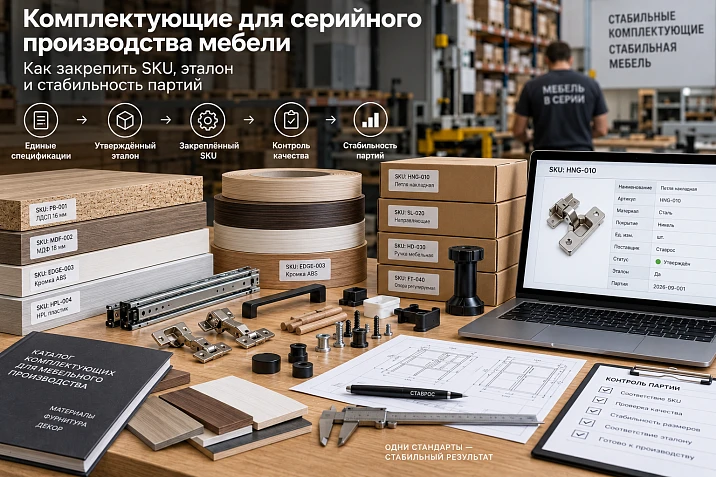
For one-off furniture, it is acceptable to replace one beautiful handle with another and resolve the issue during assembly. In serial production, such a replacement can affect facade drilling, the process card, fasteners, packaging, warehouse, and service. If the same model is produced for months, the component becomes part of the product just like the body size or facade material.
Components for serial furniture production must be described not only by name and article number, but by a managed configuration: Part ID → supplier SKU → size → material → finish → approved sample → BOM REV → prototype → pilot batch → LOT → incoming QC → usable stock → safety stock → service stock → repeat order.
The main result of such a system is that the first, fifth, and twentieth batches of furniture receive the same approved handle, leg, support, overlay, or profile. If a component changes, the change does not happen "quietly" in the purchasing table: it receives a new revision, affected models, and an introduction date.
In this article, STAVROS is considered as a supplier of furniture components and a manufacturer of those product groups that are actually represented in the catalog: wooden furniture handles, legs and supports, mounting hardware for legs and handles, decorative overlays, moldings, and other products made of wood and MDF. Hinges, slides, and other internal mechanisms are also part of the furniture BOM, but they should not be attributed to STAVROS's assortment without a confirmed product category.

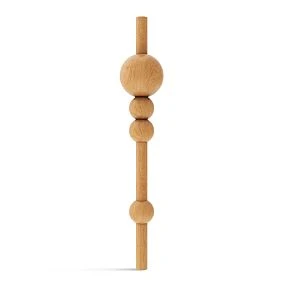
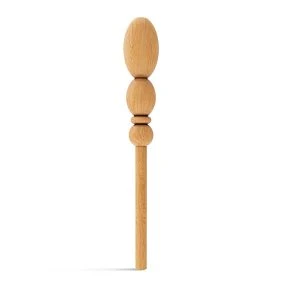
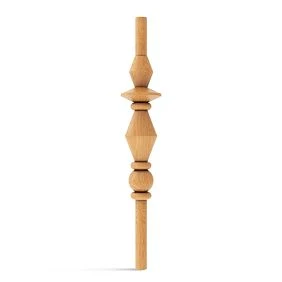
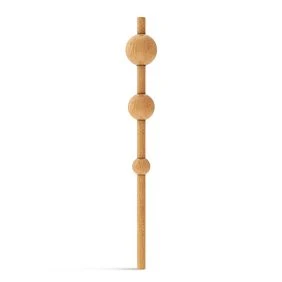
What is a serial furniture component
A serial component is not just a product purchased many times. Components for serial furniture must maintain the same managed configuration between releases. It has technical identity and a place in product documentation.
Minimum set of attributes:
- permanent internal Part ID;
- supplier SKU;
- specific geometry;
- dimensional configuration;
- the material;
- finish;
- installation rules;
- approved sample;
- incoming inspection rules;
- BOM revision history;
- accepted LOT history.
If at least half of this data exists only in correspondence with the manager, the repeatability of the series depends on the employees' memory. For the first batch, this may not manifest itself. Upon re-release after six to twelve months, the risk increases sharply.




Why a single SKU is not enough
A supplier SKU may combine several physical variants. One handle model may have several lengths, wood species, and finishes. A leg — several heights. Trim — different materials and lengths.
Weak entry:
HL-XXXStronger:
HL-XXX / SIZE-400 / OAK / FINISH-02For the support:
MN-XXX / H150 / BEECH / RAW / MOUNT-AFor molding:
MLD-XXX / MDF / RAW / STOCK-LENGTH-2400The more serialized the production, the less acceptable it is to "understand from context."
Our factory also produces:
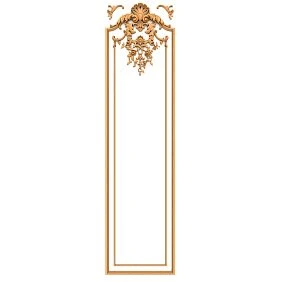
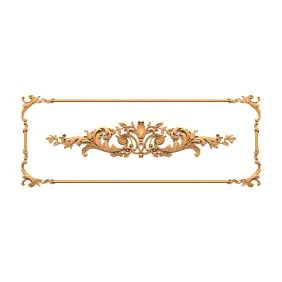
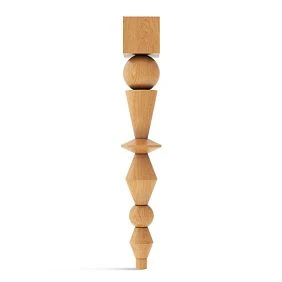
Part ID, supplier SKU, and full configuration
The internal Part ID belongs to the furniture factory. The supplier SKU belongs to the supplier. They should not be mixed.
| Field | Who it belongs to | Why it's needed |
|---|---|---|
| Part ID | Factory | Stable internal product code |
| Supplier SKU | Supplier | Repeat commercial order |
| Configuration | Jointly | Size, material, finish, mount |
| Approved sample | Factory | Physical acceptance reference |
| LOT | Delivery batches | Traceability |
For example:
COMP-HANDLE-001
SUPPLIER SKU: HL-029
SIZE: ...
MATERIAL: OAK
FINISH: DARK-02
If the factory later changes supplier, the internal Part ID can remain the same only after engineering confirmation of full compatibility. The Supplier SKU will change. Thanks to the two identifiers, ERP, BOM, and service do not have to be rebuilt around a specific supplier's names.
Get Consultation
When a new supplier SKU should not retain the old Part ID
If the mounting geometry, size, material, finish, or a functionally significant characteristic changes, the new item is no longer automatically the same internal part. Sometimes it is more correct to create a new Part ID than to mask a new product under an old code.
The decision is made by the engineering team, not just the buyer.
Common and Local SKU: handle, support, and decor families
A Common SKU is used across multiple models. A Local SKU applies to only one model, one collection, or one scale.
It is beneficial for the factory to increase the share of COMMON where this does not degrade the product. A shared handle for a wardrobe and a chest of drawers simplifies purchasing. A shared mounting plate for several supports reduces inventory. A single moulding profile can work across several facade systems.
But the goal is not the minimum number of SKUs at any cost. LOCAL is justified when:
- product scale differs;
- unique height required;
- special fastening available;
- component creates brand identity;
- functional compatibility prevents using COMMON;
- the series is specifically positioned as separate.
How to unify furniture handles across models
It is more convenient to standardize not a single size, but a design family. In the STAVROS wooden furniture handles catalog various shapes and size options are available for fronts, drawers, cabinets, and kitchens.
Working logic:
HANDLE FAMILY H-01
H-S → base cabinet / small drawer
H-M → chest of drawers / medium front
H-L → wardrobe / tall front
The visual language remains unified, and ergonomics are not sacrificed to unification.
When handle unification is dangerous
You should not force a single SKU to work on a small drawer, a tall wardrobe, and a wide front if the grip and visual proportion change. In that case, COMMON remains the design family, while the physical purchase SKUs are split by size.
If you need furniture handles for serial production or furniture handles wholesale, it is useful to first check Handles with a ready-made coating и handles without coating for your own finish. These are two different purchasing scenarios even with identical geometry.
Legs and supports as a serial system
The same rule applies to supports: serial production begins not with the model name, but with the complete configuration. Furniture legs for serial production and furniture supports wholesale are purchased only after the height, material, and mounting unit are fixed. In the catalog of STAVROS furniture legs and supports one style can exist in different heights, materials, and finishes. For the factory, these are separate SKU configurations.
The BOM for a support specifies:
- supplier SKU;
- height;
- cross-section;
- the material;
- finish;
- the seating part;
- associated fasteners;
- quantity per product;
- installation coordinates.
Why a height change requires a new revision
If a leg becomes 20 mm taller, it is not only the component itself that changes. The final furniture dimensions, floor clearance, visual proportion, and sometimes ergonomics change as well. For a nightstand, this can alter its relationship with the bed; for a TV unit, the height of the screen zone; for a chair, the seating position.
Therefore, "almost the same leg, but slightly taller" is not an automatic replacement. The change undergoes engineering review and goes into a new BOM REV.
The leg and fasteners are one assembly, but separate line items
В section of hardware for legs and handles mounting elements are presented that may be part of the support assembly. It is useful for the manufacturer to keep the bundle:
LEG SKU
STUD SKU
PLATE SKU
FOOT SKU
If the buyer changes the LEG but does not check the PLATE and STUD, it may turn out during assembly that the new support cannot physically be installed on the existing body.
The decorative overlay must also be a serial component
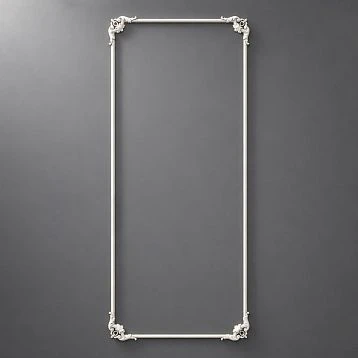
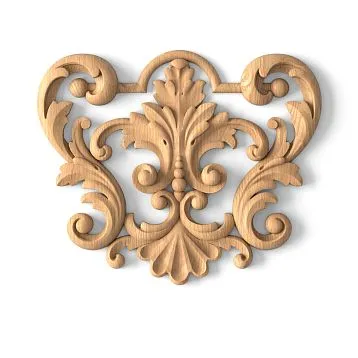
Decorative elements for serial furniture are often perceived as "optional decor," but in a repeatable series they have the same product identity as a handle. For wooden decorative overlays in master-data, the following are recorded:
- supplier SKU;
- size;
- the material;
- finish;
- orientation;
- installation coordinates;
- furniture model;
- approved sample.
If the overlay is asymmetrical, it is better to store LEFT and RIGHT separately. The entry "2 overlays per front" is too weak: it does not tell assembly where the left one is and where the right one is.
Coordinates are more important than the wording "centered"
For serial furniture, the position of a decorative part must be specified by a dimension from the base edge or axis. The craftsman should not have to center the overlay by eye each time. Otherwise, the batch will show visual variation, even if the components themselves are perfect.
Linear trim: supplier SKU and cut parts exist simultaneously
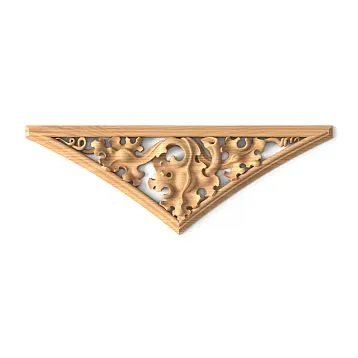
STAVROS furniture molding differs from a piece handle: the supplier sells the profile in commercial length, and the furniture factory turns it into a set of parts.
In the BOM, it is useful to store two levels:
SUPPLIER PROFILE: MLD-01 / STOCK LENGTH
CUT PART: MLD-01-A / 420 mm / QTY 2
CUT PART: MLD-01-B / 280 mm / QTY 2
This allows purchasing the actual product and calculating production requirements at the same time.
Why total linear meters are not enough
If a frame needs 1.4 m of profile, that does not mean that for 100 frames it is enough to buy exactly 140 m. The actual requirement depends on commercial length, cutting, and usable remnants. Therefore, for linear trim, the master BOM must reference the cutting map.
Approved sample and golden sample
A drawing describes geometry. A BOM describes configuration. But color, sanding, texture, and actual visual scale are often better captured by a physical reference. For critical elements, it is useful to keep an approved sample.
On the reference card:
- Part ID;
- supplier SKU;
- material;
- finish;
- BOM REV;
- approval date;
- used in models;
- reference photo.
To select physical fragments, you can use STAVROS product samples. The section includes samples of moldings, baguettes, and slatted panels. For a specific handle or leg, the possibility of a test position is best coordinated separately.
Why a catalog photo is not an approved sample
A photograph does not confirm the actual color under project lighting, tactility, depth of relief, quality of sanding, and actual dimensions. It is useful for selection, but it should not be the only reference for accepting a production batch.
A furniture golden sample complements component samples
Besides individual references, one fully approved piece of furniture is useful:
COMOD-A / GOLDEN SAMPLE / BOM REV05
It is used to check the position of handles, the height of legs, the composition of decor, gaps, and the overall finish. This is especially useful when several individually correct components may conflict during assembly.
BOM revision, change request, and approved alternative
Every change to a critical component must leave a trace. There is no need to edit the old specification "on top" and lose the history.
Example:
BOM REV03 — current handle H01
BOM REV04 — new handle H02
The change request records:
- current Part ID;
- old supplier SKU;
- new supplier SKU;
- reason for change;
- affected models;
- impact on the drawing;
- impact on inventory;
- effective batch;
- first LOT of the new version;
- those responsible for approval.
Engineering change and procurement substitution are not the same thing
A buyer may find a cheaper or more available handle, but they must not decide on their own that it is interchangeable. If the geometry, projection, finish, or fit changes, the decision must be confirmed by the design engineer, process engineer, and product owner.
This protects against a typical mistake: an alternative is in stock, but installing it requires different drilling or changes the appearance of a collection that is already on sale.
Approved alternative: the backup SKU must be verified in advance
For critical components, it is useful to have not a random "substitute in case of shortage," but a pre-approved alternative.
PRIMARY PART ID: COMP-HANDLE-001
PRIMARY SKU: HL-029
ALT-01: HL-0XX
STATUS: APPROVED
CONDITIONS: same drilling / approved finish / same model list
The alternative undergoes the same checks as the main component:
- size;
- fit;
- installation;
- prototype;
- visual approval;
- finish;
- impact on affected models.
Only after that can it be used as a managed backup. If a new handle has a different center-to-center distance, and a new leg has a different height, they are not quick replacements. This is a new engineering configuration.
Why an approved alternative is especially important for a Common SKU
The more models depend on a single item, the higher the risk of a stoppage during a shortage. One COMMON SKU of a handle can be used in a wardrobe, chest of drawers, nightstand, and kitchen modules. If it has no alternative and the lead time is long, a single shortage will affect several programs at once.
Therefore, criticality can be assessed through:
| Factor | Low risk | High risk |
|---|---|---|
| Number of models | 1 | Many |
| Lead time | Short | Long |
| Approved alternative | Present | No |
| Current stock | Sufficient | Minimal |
| Impact on the drawing | No | New drilling required |
Prototype and pilot batch: from compatibility to repeatability
The prototype verifies the design. The pilot batch verifies process repeatability. One perfectly assembled cabinet does not yet prove that 100 handles and 400 legs in a real batch will be equally compatible.
Prototype
The prototype is used to check:
- the geometry of the component;
- drilling;
- the landing;
- the mounting assembly;
- visual scale;
- finish;
- interaction with adjacent parts.
Pilot batch
The pilot batch is used to check:
- repeatability of several dozen or another justified number of components;
- marking;
- packaging;
- acceptance;
- sorting speed;
- operation on the assembly line;
- finish stability;
- actual amount of rework and damage.
There is no universal number for a pilot run. Before a 5,000-piece series, it makes sense to first test a small batch, but its size depends on the complexity and history of the SKU. For a long-familiar catalog handle, the pilot can be smaller than for a new support with a non-standard mounting.
When a prototype can be considered unsuccessful
If a part only fit after manual adjustment, additional reaming, adding shims, or changing its position on site, the prototype does not confirm series compatibility. Such corrections must either be incorporated into the design or removed before the pilot batch.
LOT and incoming inspection of a production batch
For each production batch, a useful combination is:
SKU / LOT / QTY / DATE / SUPPLIER
LOT is needed not for bureaucracy, but to answer a practical question: which furniture models received a specific batch of the component?
If a finish difference is found on handles, the chain should make it possible to determine:
HANDLE LOT H-07
→ PRODUCTION BATCH COMOD-2026-10
→ CUSTOMER ORDERS / FINISHED GOODS
A new LOT is not mixed before incoming inspection
A new delivery receives HOLD status. After inspection — ACCEPTED. Only then does it become usable stock.
Scheme:
RECEIVED → HOLD → IQC → ACCEPTED → USABLE STOCK
                       ↘ CLAIM / SORT / REWORK
If a new and an old batch are mixed immediately, it is impossible to quickly localize the source when a defect is found.
Incoming inspection of serial components
Incoming QC should not check everything indiscriminately, but rather those characteristics that can alter the product or halt assembly.
| Category | Critical checks |
|---|---|
| Handle | SKU, size, center-to-center, offset, material, finish |
| Leg | Height, mounting area, material, finish |
| Mounting plate | Size, holes, compatibility with support |
| Overlay | Dimensions, L/R, relief, material, finish |
| Molding | Profile, length, cross-section, material |
The number of units measured and the sampling plan are determined by the internal quality system and the criticality of the component. But identity — whether it is the correct SKU, size, and finish — must always be confirmed.
Quality hardware for a series means specification repeatability
Quality hardware in a B2B series is not necessarily the most decorative or expensive. It consistently matches the agreed configuration.
For a factory, quality furniture hardware means:
- identical geometry;
- compatible installation;
- consistent material;
- repeatable finish;
- clear labeling;
- no undeclared substitution;
- ability to reproduce the next batch.
Supplier of serial hardware: data, quality, and repeatability
For a serial program, assortment alone is not enough. A furniture hardware manufacturer must make it possible to lock in and reproduce the product.
Minimum data set:
- article number;
- size;
- the material;
- finish;
- technical drawing or clear dimensional diagram;
- lead time for the required volume;
- packaging unit;
- sample availability;
- repeat supply;
- B2B communication.
For STAVROS, the factory can use catalogs, DWG and 3D by product groups and section for furniture manufacturers as a commercial channel after fixing the technical configuration.
Warehouse stock and demand calculation
The same physical handle can be in stock in three different roles. If all balances are summed into one number, the buyer gets a false picture of availability.
Production stock
Stock for the current production plan. It is already "promised" to specific orders or furniture batches.
Safety stock
Safety stock for delivery delays, additional demand, damage, or unforeseen deviation.
Service stock
Reserve for repair and replacement of components on already sold furniture.
Separate statuses are useful in accounting:
FREE
PRODUCTION RESERVED
SAFETY STOCK
SERVICE STOCK
QUARANTINE
CLAIM
If the service reserve is counted as free stock, the next production run will gradually consume it. In two years, the factory will not be able to replace a handle or leg on a previously sold model.
Safety stock should not be the same for all SKUs
More safety stock is needed if:
- long lead time;
- SKU is used in many models;
- no approved alternative;
- consumption is unstable;
- component is critical for assembly;
- supplier's minimum order quantity is high;
- supply history shows delays.
A smaller buffer is possible for a cheap, quickly replenishable SKU with a short lead time and an available alternative. Therefore, universal "+10% on everything" creates either excess stock or a shortage.
How to calculate series demand
First, gross requirement is calculated:
component quantity per product × production plan.
Example: the factory plans 500 dressers. Each dresser requires four handles and four legs.
| Component | Per product | Furniture plan | Gross |
|---|---|---|---|
| Handles | 4 | 500 | 2000 |
| Legs | 4 | 500 | 2000 |
But purchase requirement is calculated differently:
PURCHASE REQUIREMENT =
GROSS REQUIREMENT
- FREE ACCEPTED STOCK
+ PRODUCTION / SAFETY RESERVE
If handles gross is 2000, there are 300 in stock, but 100 belong to service stock, the free balance is 200. If the production reserve is 100, the purchase requirement is:
2000 − 200 + 100 = 1900 handles.
Common SKUs must be calculated across all models together
If one handle is used in wardrobes, dressers, nightstands, and kitchens, the gross requirement is aggregated:
| Program | Requirement |
|---|---|
| Cabinets | 400 |
| Dressers | 600 |
| Base cabinets | 300 |
| Kitchens | 700 |
| TOTAL | 2000 |
This way, components for serial furniture are purchased as one program, not four separate small orders.
Forecast and PO are different documents
It is useful to share the forecast with the supplier:
October — 2000
November — 2800
December — 2400
Forecast helps plan raw materials and production capacity, but it is not equal to a purchase order. A PO records a real commercial order. If the forecast changes, this should not automatically be treated as cancellation of an already placed PO.
Transition between revisions and repeat supply
When BOM REV03 changes to REV04, old components do not disappear from the warehouse. You need to decide what to do with the remaining stock.
Options:
- use until a certain production batch;
- isolate;
- rework;
- keep for service;
- return to supplier if agreed;
- write off;
- use in another model after separate approval.
Transition lot must be explicitly allowed
Sometimes part of a batch is assembled on REV03, and part already on REV04. This is acceptable only if the production order clearly specifies the version.
BATCH 2026-10-A → BOM REV03
BATCH 2026-10-B → BOM REV04
You must not allow a situation where an assembler takes "whatever handle they find" during a transition period. Otherwise, the as-built configuration of the batch becomes unknown.
When an old revision needs to be closed completely
If the new version is incompatible with the old one — for example, the facade drilling or leg height has changed — mixing revisions must be prohibited. Old components receive SERVICE / ARCHIVE / HOLD status and are physically separated from the new production stock.
Regular supply is built from the configuration, not from memory
A repeat order three months later should look like a reproduction of the master card:
PART ID
SUPPLIER SKU
SIZE
MATERIAL
FINISH
CURRENT BOM REV
PREVIOUS ACCEPTED LOT
QTY
NEED DATE
The phrase "2000 of the same handles" is not suitable. It does not protect against changes in length, finish, or material.
What is rechecked before a repeat order
- Is the SKU active.
- Has a new BOM revision been released.
- Has an approved alternative appeared.
- Are there any open complaints.
- What free stock is available.
- Is service stock physically and in accounting separated.
- Are the price and lead time up to date.
- Has the production forecast changed.
This way, regular supply of furniture components becomes a repeatable process rather than a new procurement task every month.
How to include STAVROS SKU in the furniture program
Working chain for a standard item:
catalog → technical data → sample → prototype → Part ID → approved configuration → BOM → pilot order → serial PO → repeat order.
Used for initial search the STAVROS catalog. Broader wood and MDF products section combines key furniture groups.
Handles
Wooden furniture handles can be included as a COMMON or LOCAL SKU after size and fit verification.
Legs and supports
Furniture Legs and Supports are linked to the overall product height and mounting assembly.
Mounting hardware
Furniture for legs and handles is entered as separate BOM lines if physically purchased separately.
Decorative inlays
Wooden overlays for furniture fronts receive coordinates, orientation, and approved sample.
Linear trim
Wood and MDF furniture mouldings is linked to the cutting map and the internal Part IDs of the parts after cutting.
After the technical selection, the request can be passed via STAVROS B2B section for furniture manufacturers. This is a logical final commercial step, not a replacement for the internal BOM.
Materials for furniture manufacturing and serial components are different levels
The query "materials for furniture manufacturing" refers to a broader layer of the production base. Solid wood parts for furniture production and wooden components for furniture already belong to the level of specific purchased components: chipboard, MDF, solid wood, HDF and other bases. In this article, the material matters only as part of the configuration of a specific component.
For example:
PART ID: COMP-LEG-004
SUPPLIER SKU: MN-XXX
MATERIAL: OAK
FINISH: NATURAL-01
If the material changes from oak to beech, even with the same geometry, the appearance, possible finish, price and approved sample change. For a serial product, this is a controlled change.
Wooden components for furniture and finish
Wooden components for furniture can be supplied unfinished or with a ready-made finish. These options must not be mixed.
If the factory purchases RAW:
- it is responsible for the color and finish itself;
- an internal paint/finish process must be maintained;
- the approved sample of the finished furniture already relates to its own production.
If the supplier provides a finished component:
- the finish is part of the procurement configuration;
- the delivery is compared with the approved sample;
- different finishes are stored as separate physical items.
Solid wood furniture components in one collection
If solid wood handles, legs, and overlays must look like one system, the same word "oak" or "beech" does not guarantee a matching shade. It is useful to assemble a material/finish board and check the parts together under lighting close to the project lighting.
Which STAVROS categories make sense to use in a serial program
For serial production, it is correct to rely only on real product groups.
Main STAVROS catalog helps to start the search. The factory can then use:
- Wood and MDF Products as a general furniture section;
- Wooden furniture handles;
- furniture legs and supports;
- mounting hardware for legs and handles;
- Decorative wooden overlays;
- wooden and MDF trim;
- Product samples.
After selection and prototype, the furniture component supplier receives not an abstract request, but a production specification. This allows ordering a serial batch without re-selecting the component. This reduces the risk that the commercial calculation refers to a different size or finish.
When and how to change a serial component
Stability of a series does not mean a ban on any changes. A component can be changed if there is a clear reason and a controlled process.
Typical reasons:
- SKU discontinued;
- lead time became unacceptable;
- the price changed so much that value engineering is required;
- the collection design changed;
- a structurally more suitable version became available;
- the old batch produced a recurring defect;
- unification with other models is needed.
But even a cost-effective replacement must pass engineering review. A lower price for the handle does not compensate for reworking already drilled fronts.
Value engineering for serial hardware
Compare not only the price per piece, but the total impact:
| Factor | What to consider |
|---|---|
| SKU price | Difference per unit |
| Drilling | Are new templates needed |
| Housing | Does the fastening assembly change |
| Warehouse | What to do with the old remaining stock |
| Service | Do two versions need to be kept |
| Documentation | New REVs and instructions |
| Prototype | Is a new check needed |
Only after this does it become clear whether the new component is cheaper at the series level.
How serial SKU management differs from contract manufacturing
STAVROS already has a separate article about the standardization of components in contract furniture manufacturingThe central issue there is the interaction between the product owner, the external workshop, and suppliers.
The current article addresses a different question. Production can be in-house or contracted; that is not essential. What is managed here is the component lifecycle:
Part ID → supplier SKU → configuration → approved sample → BOM REV → LOT → stock → repeat order.
In other words, the focus is not on who physically manufactures the furniture, but on how to preserve the identity of the component across production runs.
When to move on to the article about serial handles
If the issue relates to only one group of handles — dimensions, finish, drilling, batches, and stock — it is more useful to use a separate article about furniture handles for serial production.
When an overview of product categories is needed
If the factory has not yet determined which wooden components are needed — handles, legs, overlays, or moulding — it is more logical to first use a guide to wholesale wooden furniture hardware. The current article begins after the category has been chosen, when serial production needs to be established.
When a serial part is better not standardized as COMMON
COMMON is useful, but sometimes a Local SKU gives the product real value. A component should not be unified if:
- only one model has the required scale;
- a different height affects ergonomics;
- the flagship product must stand out;
- a special mounting interface is required;
- the serial handle is inconvenient on a specific front;
- a unique overlay creates recognizability;
- a profile of a different cross-section is needed for joining.
The right question is not “can everything be made common?”, but “does locality create measurable value?”.
Errors and situations when a serial PO should not be released yet
Error: supplier SKU is stored without configuration
Why it happens: one model has multiple sizes or finishes. Consequence: a repeat order receives a different physical item. How to prevent: store size/material/finish together with the SKU.
Error: Part ID and supplier SKU are treated as one code
Why it happens: the supplier has not changed for a long time. Consequence: changing the supplier breaks the internal BOM. How to prevent: keep two identifiers.
Error: the buyer independently selects an alternative
Why it happens: there is a need to quickly close a shortage. Consequence: incompatible drilling, height, or finish. How to prevent: an approved alternative or a formal change request.
Error: a photo reference is used instead of an approved sample
Why it happens: a photo is easier to store. Consequence: it is impossible to reliably compare color, texture, and real scale. How to prevent: a physical sample for critical components.
Error: a prototype is considered proof of serial production readiness
Why it happens: the first part fit. Consequence: the variance only shows up in the main batch. How to prevent: pilot batch.
Error: the LOT is mixed before incoming inspection
Why it happens: identical SKU labeling. Consequence: if there is a defect, the delivery cannot be localized. How to prevent: HOLD → IQC → ACCEPTED.
Error: service stock reduces the new purchase
Why it happens: the entire warehouse is counted as a single balance. Consequence: stock for repairing sold furniture is consumed by production. How to prevent: a separate status and storage location.
Error: the old REV is simply overwritten
Why it happens: you don't want to create more files. Consequence: you can't tell which version was used in old furniture. How to prevent: revision history and as-built BOM.
When it is still too early to purchase components
Even a favorable offer should not be turned into a serial PO if the product has not yet stabilized.
An order should be placed early if:
- the fronts are still changing;
- handle not approved on a real prototype;
- leg not verified for height and fastening;
- finish exists only on the render;
- no approved sample;
- no current BOM revision;
- supplier offers CANDIDATE instead of APPROVED;
- production/safety/service stocks not defined;
- unclear how LOT is marked;
- claims from the previous batch not closed.
Early purchasing does not shorten the cycle. It turns engineering uncertainty into inventory risk.
Master-card, as-built BOM, packaging and claims
After the pilot batch, the item must no longer exist as a "reference from correspondence." A master-card is created for it, linking engineering, commercial and warehouse data.
| Field | Content |
|---|---|
| Part ID | Internal factory code |
| Supplier SKU | Supplier SKU |
| Category | Handle / leg / overlay / profile |
| Size | Full dimensional configuration |
| Material | Oak / beech / MDF / other finish |
| Finish | RAW / specific finish |
| Mount | Mounting geometry / associated fasteners |
| Approved sample | Physical reference ID |
| Used in models | List of furniture models |
| Primary supplier | Primary source |
| Alternative | Approved fallback option |
| Last accepted LOT | Last accepted batch |
| Status | ACTIVE / HOLD / SERVICE / ARCHIVE |
The master-card must separate the design family from the purchase SKU
One handle series can exist in three sizes. At the design level, this is one family. At the procurement level, it is three different physical items. If these levels are mixed, the warehouse sees "one handle," while production sees three incompatible lengths.
DESIGN FAMILY: H-01
PURCHASE SKU S: HL-XXX / 128 / OAK / DARK
PURCHASE SKU M: HL-XXX / 256 / OAK / DARK
PURCHASE SKU L: HL-XXX / 512 / OAK / DARK
The CANDIDATE status must not be confused with APPROVED
A new item that a designer or buyer is only considering receives the CANDIDATE status. It must not enter a serial PO until it has passed review. After prototype/pilot and approval, it becomes APPROVED/ACTIVE.
This simple rule prevents a typical mistake: someone sees a link in a working spreadsheet and assumes the item is already approved for serial production.
As-built BOM: what is actually installed in the finished furniture
The design BOM states what was planned to be installed. The as-built BOM records what actually went into a specific production batch. It is especially needed during change requests and transitional revisions.
Example:
MODEL: COMOD-A
PRODUCTION BATCH: 2026-10-B
BOM REV: 04
HANDLE: COMP-HANDLE-001 / HL-029 / LOT-H08
LEG: COMP-LEG-004 / MN-___ / LOT-L03
DECOR: COMP-DECOR-006 / N-___ / LOT-D02
If part of a run is assembled according to REV03 and part according to REV04, service can determine the actual configuration by production batch.
As-built BOM is especially important with an approved alternative
Suppose the main supplier delayed handles, and for one month the factory used ALT-01. This is acceptable if the alternative was approved in advance. But the as-built BOM must reflect exactly that. Otherwise, a year later, service will be looking for the main SKU, which is not actually on the furniture.
Packaging and labeling are part of batch stability
A serial component may fully match the drawing and still arrive unfit for assembly due to packaging damage. Painted handles, turned legs, carved overlays, and long mouldings are especially sensitive.
On a pilot batch, it's useful to check:
- number of units per box;
- dividers;
- protection of the finished finish;
- protection of protruding elements;
- SKU marking;
- LOT marking;
- separation of sizes and materials;
- convenience of recounting in the warehouse.
If packaging constantly requires additional sorting, this is not necessarily a product defect, but it is an operational cost worth considering when choosing a supplier.
What should be on the label
Minimum:
SUPPLIER SKU
SIZE
MATERIAL
Scenario 3: same geometry, but two finishes
The same wooden handle is used in the light and dark collection. The geometry is identical, but the physical stock is separated:
H01 / OAK / LIGHT
H01 / OAK / DARK
At the design level, this is a COMMON family. At the purchasing and incoming QC level, they are two different items. You cannot calculate a shared stock balance without accounting for finish.
Scenario 4: supplier offers an "analog" during a shortage
If the alternative is not approved in advance, its status is CANDIDATE. Even with a similar appearance, you need to check:
- size;
- the landing;
- the material;
- finish;
- prototype;
- affected models;
- service compatibility.
Only after this does the candidate become ALT-01. A purchasing shortage must not override the engineering procedure.
Scenario 5: one model is discontinued
If the Local SKU is no longer needed by production, it cannot be deleted from the database immediately. First you need to:
- calculate the quantity of furniture sold;
- determine service stock;
- check whether the component is used in other models;
- separate the free stock;
- save the approved sample and last accepted LOT;
- move the master card to SERVICE/ARCHIVE.
This way, the service retains the ability to repair even after the product line is closed.
Scenario 6: a new model is added to an existing furniture program
A new product must not automatically create new handles, legs, and decor. First, it checks the existing library of APPROVED components.
Algorithm:
- Determine the functional requirements of the new model.
- Check COMMON families.
- Check existing dimensions.
- Check approved finishes.
- Assemble a prototype using already approved components.
- If the system fits — expand used in models.
- If it doesn't fit — create a new CANDIDATE.
This way the nomenclature grows in a controlled manner. A new Local SKU appears only after proven necessity.
Master data, RFQ, and supplier lifecycle
A serial SKU sits at the intersection of several functions. If each team maintains its own "correct" table, divergence is inevitable.
Role
What it is responsible for
Construction set
Geometry, fit, drawing reference
Technologist
Installation, process, prototype/pilot
Design / product
Visual configuration, finish, family
Procurement
Supplier SKU, price, lead time, supplier
Quality
Approved sample, incoming QC, accepted LOT
Warehouse
Stock status, LOT, location
The master card must be the single point of truth for all details for serial furniture production. Even if the system is implemented in a regular ERP/PDM or spreadsheet, the fields and responsible parties must be unambiguous.
What must not be stored only in correspondence
- finish change;
- permission to use an alternative;
- new center-to-center distance;
- new leg height;
- decision to use up the old REV;
- approved sample;
- first production batch of the new version.
An email can be the basis for a decision, but the result must be recorded in master data.
Commercial request to a supplier: what should be in an RFQ
If a factory wants to buy furniture components or order furniture components wholesale for a production run, the request must be precise enough for the manager to calculate exactly the required configuration.
Field
Example
Part ID
COMP-HANDLE-001
Supplier SKU
HL-029
Size
Specific size
Material
OAK
Finish
DARK-02
Gross qty
2000
Free stock
200
Reserve
100
Purchase qty
1900
Need date
Required date
Forecast
Next batch
The phrase "furniture components wholesale" describes commercial intent, but a real RFQ must be specific.
It is better to obtain a commercial proposal after the technical freeze
A preliminary price can be requested earlier. But a serial PO is better issued after the following are fixed:
- Part ID;
- supplier SKU;
- size;
- material;
- finish;
- approved sample;
- BOM REV;
- quantity.
Otherwise, the price refers to one configuration, while production has already switched to another.
How to assess the maturity of a serial SKU
A component can be considered mature if the next release does not require a new discussion of its basic parameters. This is how furniture elements for serial production move from one-off purchases into a managed reference catalog.
Level
Condition
CANDIDATE
Selected but not verified
PROTOTYPE
Design verified
PILOT
Small-batch repeatability verified
APPROVED
Configuration approved for serial production
ACTIVE
In production use
SERVICE
Not used in new products, kept for repairs
ARCHIVE
Historical item
This status model helps avoid confusing “we found a nice handle” with “the handle is approved for serial production.”
Supplier scorecard for a critical serial SKU
If one component affects several furniture programs at once, it is useful to evaluate the supplier not only by the price of the latest RFQ. A simple supplier scorecard helps separate commercial attractiveness from production reliability.
Criterion
What to measure
Why this is important
On-time delivery
Share of deliveries on the agreed date
Direct risk of production stoppage
Incoming acceptance
Share of accepted quantity without sort/rework
Shows batch stability
Configuration accuracy
SKU/size/material/finish errors
Protects against hidden configuration changes
Repeatability
Discrepancies between LOTs
Critical for serial appearance
Response time
Response speed for RFQ and claim
Affects the change cycle
Alternative support
Availability of technically verifiable replacements
Reduces supply risk
Such a scorecard does not require a complex analytical system. Even six metrics on recent deliveries already help to understand why one supplier with a higher price may be more advantageous for a COMMON SKU with a high risk of line stoppage.
Price should be compared with cost of disruption
If a part is 5% cheaper but is regularly delayed, the actual cost may be higher due to line stoppage, expedited logistics, production plan reallocation, and manual sorting. For critical items, the buyer should see not only the unit price but also supply performance.
Lifecycle of a serial component by stages
It is useful to describe not only the SKU status but also the expected actions at each stage. This turns component management into a repeatable process.
Stage
Main action
Result
Discovery
Find a candidate
CANDIDATE SKU
Engineering
Check geometry and mount
Compatibility confirmed
Prototype
Install on real furniture
Design confirmed
Pilot
Check small batch
Repeatability confirmed
Approval
Lock sample and BOM REV
APPROVED
Serial
Regular PO and incoming QC
ACTIVE
Change
Change request / ALT
New REV or new Part ID
End of life
Separate service reserve
SERVICE / ARCHIVE
This lifecycle is especially useful for a product manager: they see that "choosing a handle" is only the first stage. Most of the work begins after the design choice.
What to do if a component stops the production line
If a critical SKU has not arrived by the need date, the solution depends on the maturity of the system. A well-prepared program already knows the approved alternative, safety stock, and affected models. A weak program starts looking for "something similar" on the day of the stoppage.
Correct sequence:
- Check free and safety stock.
- Check the approved alternative.
- Identify affected production orders.
- Check whether the model queue can be temporarily reordered.
- Obtain a confirmed supplier ETA.
- Only if ALT is unavailable — launch an urgent engineering review of a new candidate.
Urgency does not cancel engineering verification. If a handle is replaced without checking the drilling, the factory can turn one supply problem into a batch of incompatible fronts.
Which SKUs should be considered line-stop critical
A component is critical if the product cannot be completed, packaged, or shipped without it. This could be an expensive leg or an inexpensive mounting plate. Price does not determine criticality.
For each item, a useful field is:
CRITICALITY = A / B / C
A = line stop
B = limits some models
C = easily replenished / non-critical
Safety stock and supplier management are then built not only on cost but also on real production risk.
Supplier change: when the internal Part ID can be retained
The factory may want a second source or to completely change the supplier. The internal Part ID is retained only if the new component is confirmed as equivalent to the internal specification.
Need to check:
- key dimensions;
- the landing;
- material;
- finish;
- approved sample;
- packaging;
- marking;
- pilot batch;
- repeatability.
If the new component requires a change to the front or the body, this is already a new Part ID or a new engineering version. A supplier change must not mask a product change.
Dual sourcing requires two supplier SKUs
If one Part ID is purchased from two suppliers, the master card stores both supplier SKUs and the status of each source. Incoming QC may differ by supplier, but the as-built BOM must retain the LOT so that service knows the actual origin of the part.
What to do if a supplier changes a component under the same SKU
The most unpleasant scenario for serial production is formally the same item code, but in fact a changed part. It could be a different coating shade, new mounting geometry, a different material, or an imperceptible size change. If the factory accepts goods only by item code, the problem is discovered already at assembly.
If a change is suspected:
- Move the new LOT to HOLD.
- Compare it with the last accepted LOT and the approved sample.
- Check the key dimensions and finish.
- Request confirmation of the changes from the supplier.
- Identify affected models.
- Decide whether the delivery can be accepted as the current configuration or a change request is required.
If the change affects compatibility, the new goods cannot be accepted under the old internal configuration just because the supplier SKU has not changed. The factory's internal specification takes priority over the supplier card name.
Why the last accepted LOT should be kept
The last successfully accepted batch provides a practical point of comparison. If the approved sample is lost or the finish is difficult to describe in words, the last accepted LOT helps quickly determine whether the new delivery is actually different.
When a physical sample is not required
A physical reference is not useful for every item. If a factory wants to order furniture hardware samples, it should first determine which characteristics cannot be reliably covered by a drawing alone. It should be kept where some requirements are difficult to fully describe with numbers or a drawing.
A sample is especially needed for:
- natural wood with visible grain;
- a finished painted finish;
- complex relief;
- a visible handle or leg that defines the style of the collection;
- a decorative overlay;
- moulding with a pronounced profile.
For a simple metal dowel, plate, or other technical element, a drawing, dimension, material, and incoming inspection are usually sufficient if appearance is not a product characteristic.
This way, the system does not turn into a warehouse of samples for the sake of samples. A physical sample is used where it genuinely reduces ambiguity.
If this is impossible, seriality formally exists only in the finished furniture, but not in the data. Such a gap is especially dangerous when a key employee leaves, a supplier changes, or a repeat batch is launched after a long pause.
To ensure the system does not depend on a specific purchaser or process engineer, it is sufficient to maintain a short transfer package for each critical SKU: master-card, released drawing, approved sample reference, current BOM REV, last accepted LOT, stock status, and active supplier contact. A new employee should be able to understand the current configuration without reading old correspondence.
Minimum package for handover between shifts and departments
FAQ: component management in serial furniture production
What components are needed for serial furniture production?
The list depends on the product, but at the level of seriality management, all separately purchased items that can halt assembly or change the appearance are important: handles, legs and supports, mounting hardware, overlays, moldings, panels, as well as internal mechanisms from other suppliers. Each item must have a Part ID, supplier SKU, configuration, and place in the BOM.
What is a serial furniture component?
This is a component that has a stable identity and can be reproduced in the next batch according to documentation. It has a fixed size, material, finish, mounting, approved sample, incoming inspection rules, and revision history.
How to lock a SKU in the BOM?
Do not store only the article number. Link the factory's internal Part ID with the supplier SKU and the full configuration:
PART ID / SUPPLIER SKU / SIZE / MATERIAL / FINISH / MOUNT / QTY
If one supplier SKU has multiple sizes or finishes, the BOM must unambiguously specify the required variant.
What is an approved sample?
A physical reference of a specific configuration. It is needed where a drawing alone is insufficient to assess surface, shade, texture, or visual scale. An approved sample is marked with Part ID, SKU, material, finish, and approval date.
How does a golden sample differ from an approved sample?
An approved sample refers to a separate component. A golden sample refers to an entire piece of furniture. It shows how the handle, leg, decor, facade, and finish work together.
How does a prototype differ from a pilot batch?
A prototype answers the question "does this design work at all?". A pilot batch answers "can production consistently reproduce it in several dozen or another justified number of units?". One good part does not confirm the stability of a series.
Why mark the LOT?
To link a specific delivery to the production batch of finished furniture. In case of a claim, the problematic batch can be localized instead of checking the entire sales volume.
Can the handle be changed in serial furniture?
Yes, but via a change request. It is necessary to check the drilling, overhang, size, finish, remaining stock of the old version, affected models, and the transition date. If the center-to-center distance changes, a new facade revision is usually required.
How is an analogue of a component approved?
The analogue receives CANDIDATE status, undergoes a technical comparison, prototype, and, if necessary, a pilot batch. After approval, it becomes an approved alternative. Until then, the buyer must not use it as an automatic replacement.
What hardware reserve does a furniture factory need?
There is no universal percentage. The reserve depends on lead time, the number of models, SKU criticality, availability of an alternative, consumption stability, and supply history. Production stock, safety stock, and service stock are calculated separately.
Can safety stock be used in regular production?
Only according to internal rules and with subsequent replenishment of the level. Otherwise, the safety stock gradually turns into regular free stock and stops protecting production.
How to organize a reorder?
Use the master card: Part ID, supplier SKU, size, material, finish, current REV, previous accepted LOT, quantity, and need date. Commercial terms are checked again, while the technical configuration is preserved.
What should be done with the remaining stock of the old revision?
Determine the status: use until a specific production batch, keep for service, rework, isolate, or write off. Old and new revisions must not be mixed without control if they are incompatible.
Can one furniture model be released in two revisions at the same time?
During the transition period, this is possible if the production order explicitly states which batch is being assembled according to which REV, and the as-built BOM preserves the actual configuration. Without such traceability, mixing versions is dangerous.
How to determine that a SKU should be COMMON?
If a component fits several models without compromise in function, size, mounting, and design. COMMON is beneficial when it reduces the number of items but does not force one handle or leg to work where it is inconvenient.
When is a LOCAL SKU justified?
When a unique component is needed because of scale, a special function, mounting, or branded design. LOCAL becomes a problem only when it appears by accident and does not create value.
What to do if a supplier SKU is discontinued?
First check the approved alternative. If there is none, the new candidate goes through the technical procedure. The old Part ID must not be automatically assigned to another part without confirmation of compatibility.
Should samples of all components be stored?
Not necessarily. A physical sample is especially useful for visible and critical items: finish, natural wood, texture, large profile. Simple standard fastening elements can be controlled by technical parameters and drawings.
What should a commercial request for a serial batch include?
Supplier SKU, full configuration, total quantity, breakdown by batches, need date, delivery location, sample requirement and forecast. If the factory wants furniture components wholesale, it is useful for the supplier to see not only the first PO but also the expected program.
Where to buy components for serial furniture?
STAVROS offers wooden handles, legs and supports, mounting hardware, overlays, mouldings and other products made of wood and MDF. After selecting specific SKUs, the manufacturer can use B2B terms of STAVROS for furniture manufacturers and provide an exact specification for calculation.
What does “ordering samples of furniture hardware” mean for a factory?
Not just to receive a demonstration piece, but to check the actual size, material, finish and compatibility before a large batch. For mouldings, baguettes and panels there is product sample catalogue; for a specific handle or leg, the test unit is better agreed separately.
Which document should be the master: the BOM or the supplier catalog?
For production, use your released BOM. The catalog helps select and verify the supplier SKU, but the finished furniture must be assembled according to the approved internal specification.
Final check before the serial PO
Check
Status
The component has a Part ID
OK / HOLD
Supplier SKU and size are locked
OK / HOLD
Material and finish are defined
OK / HOLD
Assembly compatibility is confirmed
OK / HOLD
Used in models is up to date
OK / HOLD
COMMON / LOCAL is defined
OK / HOLD
Approved sample is present where needed
OK / HOLD
Prototype passed
OK / HOLD
Pilot batch accepted for the new configuration
OK / HOLD
BOM REV released
OK / HOLD
Approved alternative identified for critical SKUs
OK / HOLD
Gross requirement calculated
OK / HOLD
Free stock verified
OK / HOLD
Safety stock calculated
OK / HOLD
Service stock separated
OK / HOLD
RFQ and PO belong to the same configuration
OK / HOLD
LOT marking approved
OK / HOLD
Incoming QC defined
OK / HOLD
Old REV transition rule defined
OK / HOLD
Repeat-order package saved
OK / HOLD
If a critical line remains on HOLD, it is better not to release a large order. First, the engineering or product uncertainty needs to be resolved.
Final lifecycle scheme for a serial SKU
- Select the component category.
- Find the specific supplier SKU.
- Create an internal Part ID.
- Record size, material, finish, and mount.
- Determine COMMON or LOCAL.
- Obtain a sample if the characteristic is visually critical.
- Assemble furniture prototype.
- Approve approved sample and golden sample.
- Release BOM REV.
- Conduct pilot batch for the new component.
- Create incoming QC.
- Accept LOT into ACCEPTED status.
- Calculate gross requirement.
- Separate free, safety, and service stock.
- Send forecast to supplier.
- Release serial PO.
- Link LOT to production batch.
- Save as-built BOM.
- If changed, file a change request.
- Manage the remaining stock of the old REV.
- Repeat the purchase using the master card.
This way, components for serial furniture production and hardware for serial furniture production stop being a set of goods that are "selected anew" each time. A handle, leg, support, or decorative element becomes a managed part of the product — with its own identity, reference sample, revision, supply history, and replacement rules.
For a furniture factory, this delivers a practical result: stable geometry, predictable purchasing, lower risk of production stoppage, controlled service, and the ability to produce the next batch without re-approving basic components.
After the configuration is approved, you can send STAVROS the exact SKUs, quantities, need date, and forecast to receive a commercial proposal and establish regular supply of furniture components for a pilot or regular serial supply.
For a sustainable series, this is sufficient as a control framework: if a new batch can be ordered, accepted, installed, and later reproduced without restoring context from old correspondence, the SKU is truly managed as a serial component. But if every repeat production run starts with the question "which handle exactly did we use?", the lifecycle is not yet standardized.