Article Contents:
- What contract furniture manufacturing means from the customer's perspective
- What you should never hand off to a contractor with the wording "find something similar"
- Example: one chest of drawers model and four external components
- A single SKU is not enough — a full configuration is required
- Why material is part of the contract specification
- One handle for several furniture models: when unification pays off
- Leg height cannot be changed without revising the model
- How to set the position of an overlay on a facade
- Moldings and linear trim in furniture production
- Linear trim cannot be ordered in linear meters alone
- Ready-made frame vs. your own: how to make the decision
- Wooden baguette as a serial decorative component
- Approved sample for each visually significant component
- Change request: how to change a component after approval
- Primary SKU and approved alternative
- How to calculate the number of components per series
- Pilot batch
- Validation
- Serial batch
- Why a new batch must not be mixed with the old one before inspection
- LOT must be linked to the finished furniture
- How to label components for contract manufacturing
- Service reserve and production reserve should be kept separate
- How to increase the visual value of a series without a complete body change
- Creating a family of models on a single platform
- When component unification is truly beneficial
- How a furniture manufacturer can work with STAVROS
- Hardware for legs and handles — a separate procurement circuit
- Not all components should be given to a single supplier
- When not to start a serial order of components
- CAD and a 3D model do not replace a product card
- Tolerances: what the product owner must define
- The coating must be standardized separately from the shape
- A product for enamel and a product with a finished coating are different procurement scenarios
- The quality of sanding and finishing must be fixed on a reference sample
- Packaging is part of production compatibility
- RFQ, purchase order, and actual delivery — three different levels
- How to compare furniture component suppliers
- Mistake: storing only an image
- Mistake: changing the material without a new revision
- Mistake: letting the contractor choose the handle
- Mistake: buying molding by the meter only
- Mistake: mixing lots
- Mistake: starting with the maximum run right away
- What counts as components for STAVROS furniture production
- How not to repeat a generic article about wholesale furniture hardware
- When contract manufacturing Responsibility matrix between the brand, the workshop, and the supplier
- Responsibility matrix between the brand, the workshop, and the supplier
- How to accept a pilot batch
- Acceptance criteria for serial production
- How to manage a claim for an external component
- How to store the history of actually installed components
- Contract furniture manufacturing in Moscow and the contractor's geography
- Payment and logistics relate to a specific order, not to a category
- How to purchase furniture legs wholesale
- Decorative elements for furniture: when they become a production standard
- What to do with leftovers after a series ends
- How to close a furniture series in documentation
- The cost of change increases as the product progresses
- How not to give the contractor too much freedom
- How to scale production from 20 to 500 units
- When to place a single wholesale order and when to split it into deliveries
- How to use data from previous production runs for the next RFQ
- What the product owner should retain after changing contractors
- Risk register for external components
- Checkpoint before each repeat production run
- Why the contract model is especially demanding on data
- The price of a component and its real cost for a furniture series
- How to estimate the cost of changing a component
- The pilot batch size is determined by risk, not by a universal number
- What is contract furniture manufacturing?
- Which components are best standardized before handing the project over to a contractor?
- Where to buy wooden components for furniture manufacturing?
- How to choose furniture handles for serial furniture?
- How to choose legs and supports for a furniture series?
- Do you need to make a reference sample?
- How to control component repeatability?
- What is included in a furniture BOM?
- How to organize a repeat order of the same part?
- Can ready-made furniture frames and bases be used?
- How to calculate components for a furniture series?
- What is a pilot batch?
- Do you need to have a backup supplier?
- How to work with components in contract manufacturing of furniture from laminated chipboard?
- What to check during incoming inspection?
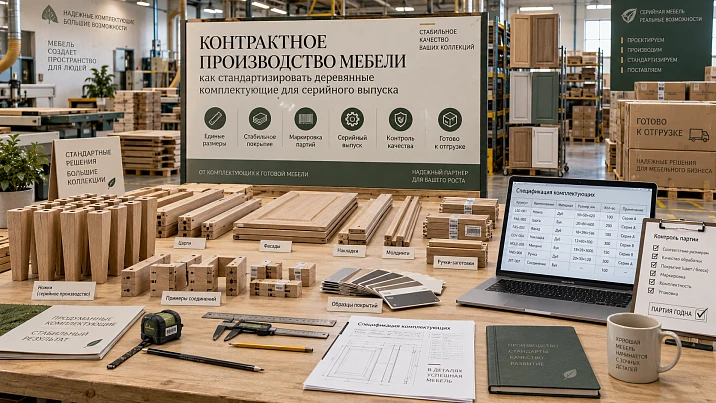
Handing a beautiful render to a furniture contractor is not enough. For a single prototype, the workshop can still manually select a "similar" handle, leg, or molding and approve the result on site. By the second and third production run, this scheme begins to break down: the size changes, a different wood species is used, a different coating shade appears, a similar but not identical overlay is selected, and the facade has already been drilled for the old handle.
The contract model becomes manageable only when an external component stops being "decor based on a picture" and turns into an exact BOM line: SKU, material, size, mounting geometry, finish, quantity, reference sample, and revision. Then the first and the tenth production run can be assembled using a single data system.
In this article, STAVROS is considered as a manufacturer and supplier of serial components: furniture handles, legs and supports, decorative overlays, moldings, frames, table bases, baguette, and other products. This is not an offer of a full contract cycle for furniture manufacturing. The furniture brand or customer manages the product, the contract workshop produces the furniture, and external suppliers provide standardized components.
The working chain looks like this: furniture model → BOM → external component → SKU → material → approved sample → pilot batch → incoming inspection → serial batch → lot → repeat order.

What contract furniture manufacturing is from the customer's perspective
It is more useful to consider not an encyclopedic definition, but the distribution of responsibility. A typical scheme involves at least three parties.
| Side | What it is responsible for | What it should not decide on its own |
|---|---|---|
| Product owner / furniture brand | Design, model range, BOM, reference samples, commercial requirements | Does not transfer undefined critical components to the contractor |
| Contract manufacturer | Technology, production, assembly, process control | Does not replace an approved SKU with a "similar" one without a change request |
| Component supplier | Specific SKUs, material, dimensions, batches, delivery times | Does not define the furniture model architecture on behalf of the brand |
This model allows some operations to be outsourced without losing control over the product. The main tool is not the technologist's personal memory, but documentation that can be reproduced.




What cannot be handed off to a contractor with the instruction "find something similar"
The more noticeably a component affects the appearance or geometry, the riskier it is to leave it to the workshop's discretion.
Critical external items include:
- furniture handles;
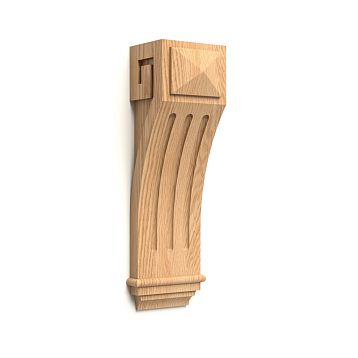
- legs and supports;
- decorative overlays;
- moldings and trim;
- wooden baguette;
- frames and bases;
- finishing decorative facade elements;
- fasteners, if they determine the fit of the visible part.
If the contract workshop selects such a part on its own, it effectively changes the product. In the first run, the substitution may look acceptable, but on a repeat order it turns out that no one remembers the exact variant anymore.
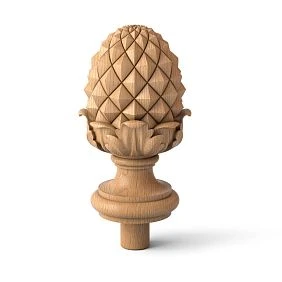
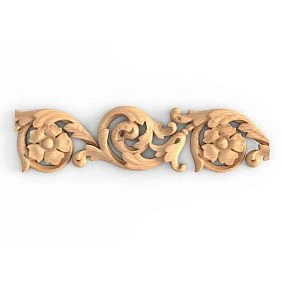
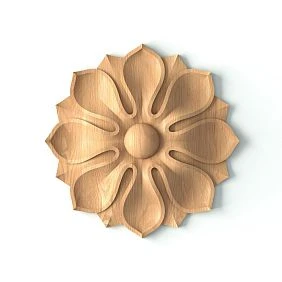
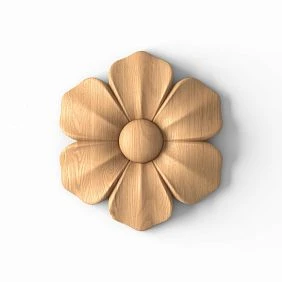
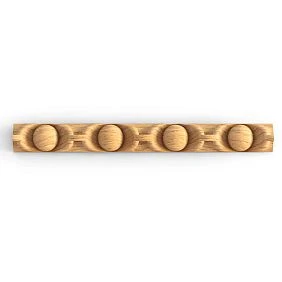
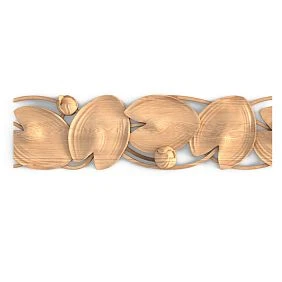
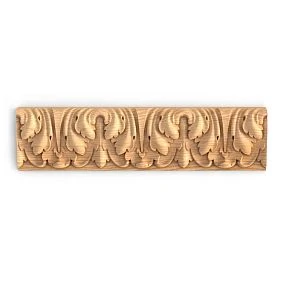
Our factory also produces:
BOM — the master document of serial furniture
The Bill of Materials must answer the question: which physical components are required for one unit of furniture and in what exact configuration.
| Code | Component | SKU | Material | Size / configuration | Quantity |
|---|---|---|---|---|---|
| H-01 | Handle | HL-___ | Oak | Specific size / finish | 4 pcs. |
| L-01 | Leg | MN-___ | Beech | Height / cross-section / fastening | 4 pcs. |
| D-01 | Overlay | N-___ | Beech | Dimensions / orientation | 2 pcs. |
| M-01 | Molding | MLD-___ | Oak | Profile / commercial length | By cutting |
For serial furniture, the line "wooden handle — 4 pcs." is useless. It describes a type, not a product. The BOM must lead to a specific configuration.
Get Consultation
Example: one chest of drawers model and four external components
Suppose a brand launches a chest of drawers with a run of 120 units. One unit requires four handles, four legs, two decorative overlays, and 3.4 m of profile trim. In the BOM, these are four independent lines, not one "decor" line.
Before RFQ, the handle must have approved installation geometry, the leg must have its height and mounting interface, the overlay must have its coordinates on the front, and the trim must have a parts map. Only after that can the total requirement be calculated. For handles and legs, the base gross requirement will be 480 pcs each; for overlays, 240 pcs. The trim is first converted from 408 linear meters of net requirement into actual commercial lengths, taking cutting into account.
This example shows the main principle: the same furniture run does not mean the same purchasing formula for all components. Piece hardware is counted by the piece, decorative profiles are calculated via the cutting map, and each item retains its own SKU, material/finish, and approved sample.
One item code is not enough — a full configuration is required
Even a stable SKU may have several sizes, materials, or finish options. Therefore, the line HL-XXX is often insufficient.
Working form:
SKU / size / material / finish / mounting / revision
The same rule applies to legs, overlays, moldings, and frames. If the same design is produced in oak and beech, these are two procurement configurations. If a handle comes in different lengths, each length gets its own line.
Why material is part of the contract specification
If a component is available in oak, beech, and MDF, a contract manufacturer cannot leave the field as "wood." For production, these are different items: visual texture, possible finish, price, and sometimes available sizes and lead time all differ.
Strong entry:
MLD-014 / OAK / size ___ / FINISH-01
MLD-014 / BEECH / size ___ / FINISH-01
MLD-014 / MDF / size ___ / PAINTED
If the material changes after approval, this is a change request, not a "safe procurement substitution."
Furniture handles must be standardized before launching fronts
A handle simultaneously affects the design and the mechanics of the front. Before serial drilling, you need to define the SKU, size, installation geometry, orientation, material, and finish.
Current category STAVROS furniture handles contains several design types and individual variants with and without coating. For production, this is not a decorative reference, but source data for the BOM.
The query "furniture handles wholesale" should reasonably be translated into a production line: which handle exactly, how many units per piece of furniture, what material, what configuration, and what forecast for repeat batches.
One handle for several furniture models: when standardization pays off
If one handle profile fits a nightstand, wardrobe, chest of drawers, and kitchen module, its standardization can reduce the complexity of the entire system.
Advantages:
- fewer active SKUs;
- simpler RFQ;
- simpler warehouse;
- fewer drilling templates;
- simpler service reserve;
- lower risk of substitution during assembly;
- easier repeat ordering.
But a single SKU cannot be imposed on all fronts. If a model is inconvenient or disproportionate on one type of furniture, it is better to have two standards than one bad one.
Legs and supports: appearance plus structural function
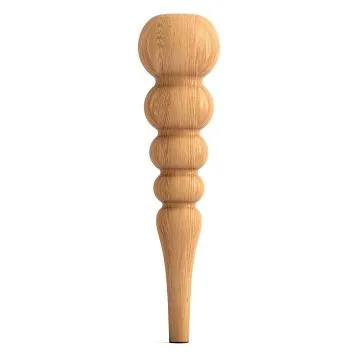
The query "furniture supports wholesale" is more connected to engineering than it seems. A leg affects the overall height of the product, visual scale, clearance from the floor, stability, and the person's seating position.
The specification records:
- exact SKU;
- height;
- cross-section;
- the material;
- type or variant of attachment;
- quantity per unit of furniture;
- approved sample;
- an acceptable alternative, if it has been verified in advance.
Main category: Furniture Legs and Supports.
The leg height cannot be changed without revising the model
Replacing a leg with a "similar one, but 30 mm taller" changes more than just the appearance. The overall height of the furniture changes, as does the position of the tabletop or seat, the gaps, and sometimes the ergonomics and alignment with adjacent items.
Therefore, a leg is not a purchasing trifle. It is part of the product's geometry. Any change in height or mounting must undergo an engineering review and a new BOM revision.
Decorative overlays: standardizing the facade without hand carving
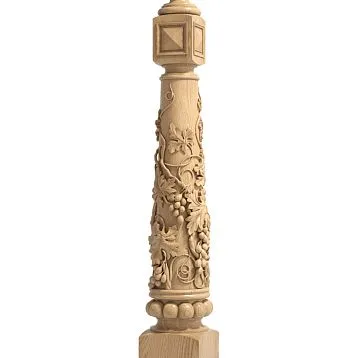
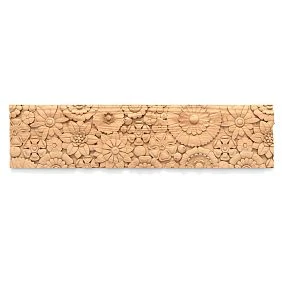
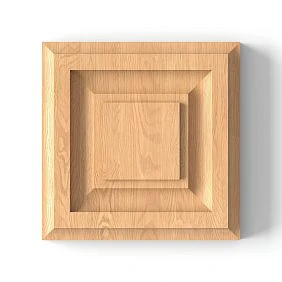
A ready-made decorative overlay allows the same ornament to be repeated on cabinets, chests of drawers, kitchen facades, headboards, and other products without individual handcrafting on each facade.
STAVROS has a separate category decorative inserts. For contract manufacturing, it is important to translate the selected model into an exact placement scheme.
How to set the position of the overlay on the facade
The phrase "in the center" is not enough for a production run. Coordinates and orientation must be specified.
Minimum:
- X axis;
- Y axis;
- offsets from the edges;
- orientation;
- mirroring;
- left / right variant if the composition is asymmetrical;
- connection with the handle and molding.
This way, the contract workshop does not reinterpret the decorative composition in each batch.
Moldings and linear trim in furniture production
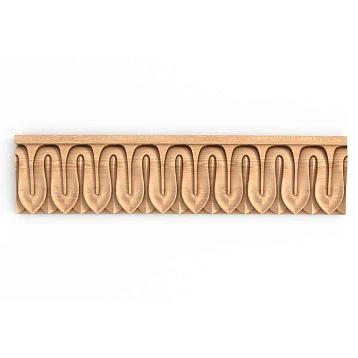
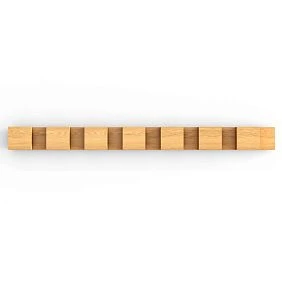
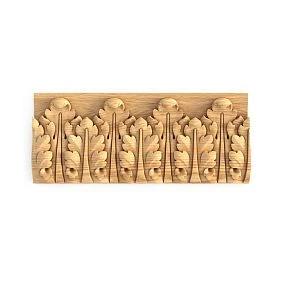
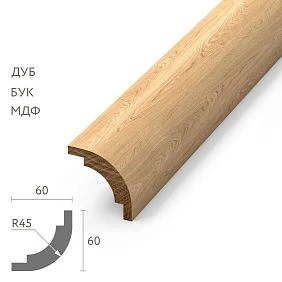
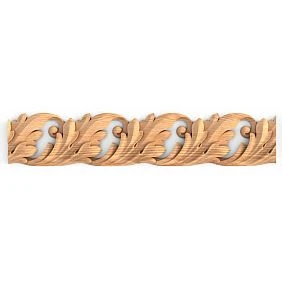
Furniture linear trim is used for facade frames, top cornices, decorative bands, plinth elements, and surrounds. In the category of STAVROS millwork products profiles made of solid wood and MDF are presented.
For furniture, it is especially important to record not only the profile but also the actual length of the part after cutting. The workshop assembles specific frames and bands, not abstract linear meters.
Moulding cannot be ordered in linear metres only
Linear metreage is a reference number, while the purchasing unit is the actual product length or physical part.
Need to consider:
- commercial length;
- cutting map;
- dimensions of parts of a single furniture model;
- repeatability of modules;
- usable offcut;
- production reserve.
If the contractor is given only “3.4 m of moulding for a chest of drawers,” they still have to decide again how many strips to buy and how to cut them. It is better to determine this centrally.
Frames and bases as ready-made assemblies in the contract model
Sometimes it is more cost-effective not to purchase dozens of individual parts for the furniture base, but to incorporate a ready-made standardised assembly into the product. STAVROS has a separate category frames and bases, which features table bases, table frames, chair and armchair frames, console frames, bench frames, cabinets, chests of drawers, and other items.
For a contract model, this is especially interesting: a brand can design the external look of furniture around a proven base unit, while a contract workshop handles the carcass, upholstery, tabletop, fronts, and assembly.
But a ready-made unit should not automatically be considered more cost-effective. Its value only appears if the geometry genuinely suits the product, repeat supply is available, and using the unit reduces your own operations.
Ready-made frame vs. your own: how to decide
| Scenario | Ready-made unit | Your own frame |
|---|---|---|
| Geometry already suits the model | Reduces the scope of your own development | May be excessive in labor costs |
| Non-standard sizes are needed | Requires verification of the capabilities of a specific item | Gives full control over geometry |
| Repeatability matters | Convenient with a stable SKU | Requires its own production discipline |
| Need to launch a pilot batch quickly | Can reduce the number of operations | Will require tooling and a prototype |
If the frame becomes part of a serial product, it must go through the same path as a handle or a leg: a specific SKU, configuration, reference sample, batch, and reorder control.
Wooden baguette as a serial decorative component
Wooden baguette can be used not only for frames, but also in furniture: facade frames, decorative inserts, mirrors, panels and trims. For a serial product, this is another ready-made profile that can be standardized.
Category STAVROS wooden baguette contains ready-made models, and individual cards directly show the application on facades and furniture.
If the baguette is included in the furniture BOM, the following must be defined for it:
- SKU;
- the material;
- cross-section;
- product length;
- cutting map;
- finishing;
- corners and joints;
- reserve volume.
Reference furniture before launching a production run
Before the series, it is useful to produce a golden sample — a reference furniture unit. This is not a demonstration prototype of "approximately this appearance," but a specific physical version that corresponds to the approved BOM and drawings.
The following are approved on the golden sample:
- body geometry;
- handles;
- legs and supports;
- Plates;
- moldings and baguette;
- frame or base;
- color and finish;
- mounting holes;
- visible gaps;
- packaging logic, if critical.
After approval, any change requires a new revision. Otherwise, the contract manufacturer receives a contradictory signal: the physical sample says one thing, the new file says another.
Approved sample for each visually significant component
The golden sample represents the entire product, while the approved sample represents a specific external component. For critical parts, it is useful to keep physical samples of:
- the approved handle;
- the leg or support;
- decorative overlay;
- molding fragment;
- baguette sample;
- color sample;
- if necessary — a fastening assembly.
The sample or its immediate surroundings must show the SKU, material, finish, and revision number. The wording “that same oak sample” is not suitable for a system in which several furniture series exist simultaneously.
Specification versions: R0, R1, R2
The contract manufacturer must see one current version of the document. For this purpose, the BOM and related drawings receive revisions.
For example:
BOM CABINET-04 / REV 03 / 21.09.2026
DRAWING CABINET-04-FRONT / REV 05
HANDLE STANDARD / REV 02
Changed the handle — new revision. Changed the leg height — new revision. Replaced the overlay material — new revision. Old documents do not disappear but are archived as SUPERSEDED.
This makes it possible to reconstruct why the January furniture batch and the June batch differ, and not to accuse the workshop of an “unauthorized substitution” if it had been approved earlier.
Change request: how to change a component after approval
After the golden sample, changes cannot be made by simply editing Excel. A change request is required.
Minimum entry:
| Field | What to fix |
|---|---|
| Old SKU | What was used |
| New SKU | What is proposed |
| Reason | Lead time, price, unavailability, design, error |
| Geometric impact | Dimensions, drilling, joints |
| Commercial impact | Price and timeline |
| Introduction date | Effective from batch |
| Who approved | Product owner |
If the change affects the facade or frame, new engineering documentation is issued. If it affects only the finish, the configuration and approved sample are still updated.
Primary SKU and approved alternative
For critical components, it is useful to have a backup option in advance. But the "alternative" must be verified before a shortage occurs.
Structure:
PRIMARY SKU → APPROVED ALTERNATIVE → conditions of use
For example, a backup handle may be considered acceptable only if the mounting geometry is preserved. An alternative leg — only if the overall height of the furniture does not change. An overlay — only after re-checking the facade composition.
If the conditions do not match, it is not an approved alternative, but a new design candidate.
How to prepare an RFQ for a supplier of wooden components
The request "count the handles and legs for 100 dressers" leaves too much uncertainty. The supplier needs to receive an already structured requirement.
The RFQ includes:
- SKU;
- the material;
- size;
- execution;
- quantity per one unit of furniture;
- total run;
- justified production reserve;
- date of the first delivery;
- forecast of repeat batches;
- need for an approved sample;
- city or delivery address.
If a furniture series includes handles, legs, overlays, and moulding, each category remains a separate line. This way, a supplier of furniture components can provide a commercial offer without guesswork.
How to calculate the quantity of components per series
Basic formula:
component quantity per furniture unit × production plan = gross requirement.
After that, the free verified warehouse stock and production reserve are taken into account.
Example. A dresser has 4 handles, 4 legs, and 2 overlays. The production plan is 120 dressers.
- handles: 4 × 120 = 480 pcs.;
- legs: 4 × 120 = 480 pcs.;
- overlays: 2 × 120 = 240 pcs.
If the warehouse has 40 free verified handles of the same configuration, the gross requirement is not equal to the purchase. The purchasing requirement is 440 plus a justified reserve. If 20 of these 40 are reserved for service, the free stock is already 20.
The first batch should not be maximum right away
Even with ready documentation, it is reasonable to split the first launch into three stages:
PILOT BATCH → VALIDATION → SERIAL BATCH.
Pilot batch
A small quantity of furniture and components. The goal is to check how the documentation works in real production.
Validation
Assembly, drilling, appearance, packaging, incoming inspection, and actual repeatability of parts are checked.
Serial batch
Full-scale production begins after the pilot defects are resolved.
Thus, an error in the overlay, handle, or cutting map does not immediately scale to hundreds of units.
Incoming inspection of components before transfer to the workshop
Components should not be delivered and immediately dissolved into the general warehouse. First, the new batch is checked against documents and reference samples.
Minimum incoming inspection:
- SKU;
- the material;
- dimensions and geometry;
- quantity;
- coating or surface quality;
- fastener kit completeness;
- visible damage;
- compliance with the approved sample;
- batch marking.
For critical parameters, selective inspection is used according to the company's internal quality plan. There is no need to devise a universal sampling plan for all production facilities: it depends on the volume, the supplier's statistics, and how dangerous an error is for assembly.
Why a new batch must not be mixed with the old one before inspection
Parts from a previous order may remain in the warehouse. If a new delivery is immediately poured into the same bins, the link between the physical part and the batch is lost.
Until acceptance is complete, the new batch is stored separately. After ACCEPTED, production decides whether the remaining stock can be merged. For painted and tinted elements, it is especially useful to maintain lot traceability: the shade and surface are compared with the reference and the previously accepted lot.
LOT must be linked to the finished furniture
For serial production, it is useful to know not only "when the handles arrived" but also which batch of furniture they were installed in.
Link:
COMPONENT LOT → PRODUCTION BATCH → FINISHED GOODS
If a complaint about the handle coating arises a few months later, the system makes it possible to determine which products received components from the problematic lot. Without such a link, the entire sales volume has to be checked.
How to mark components for contract manufacturing
Minimum packaging marking:
MODEL / SKU / LOT / QTY
For a more complex chain:
CUSTOMER / FURNITURE MODEL / SKU / MATERIAL / FINISH / LOT / QTY
Marking must match the BOM and packing list. An internal code is acceptable, but the supplier's real SKU must remain alongside it — otherwise, reordering turns into deciphering internal names.
Reorder after 6–12 months
The phrase "make the same legs as last time" is not suitable for a serial product. A repeat RFQ must be based on the archive of a specific configuration.
The following are provided:
- previous SKU;
- size and material;
- coating;
- approved sample or its ID;
- previous shipment number;
- current quantity;
- required date;
- current BOM revision number.
The historical price and old lead time are kept for reference, but are rechecked before a new order. This is where the advantage of standardization shows: the supplier receives not a photo of old furniture, but an exact purchasing line.
Service reserve and production reserve must be separated
The production reserve is consumed during production: damage, loss, defects, an extra unit. The service reserve is kept after shipment of the finished furniture to replace parts for the client.
If both reserves are stored in the same bin, the service stock quickly disappears. Therefore, separate statuses are useful in accounting:
- FREE STOCK;
- PRODUCTION RESERVED;
- SERVICE RESERVE;
- QUARANTINE;
- CLAIM.
This is especially important for decorative components, which after a few years are difficult to replace with “similar” ones without a visible difference.
Contract manufacturing of furniture from chipboard: where wooden components appear
A contract scheme with chipboard carcasses does not mean that the entire product must consist of a single material. The carcass and part of the fronts can be made of chipboard or MDF, while the visual value of the series is created by wooden handles, legs, overlays, moldings, or baguette.
Practical scenario:
neutral chipboard/MDF carcass + standardized wooden components = several visual lines on one structural platform.
But external parts must be planned in advance: the handle affects drilling, the leg affects height, the overlay affects the front, and the moulding affects cutting and edge banding.
How to increase the visual value of a series without completely changing the carcass
A furniture brand can keep one base carcass and change the external elements:
- handles;
- legs;
- Plates;
- Moldings;
- wooden baguette;
- finish option.
This makes it possible to build several product lines on a common engineering platform. It is important that each line has its own BOM revision, rather than existing as a verbal “for premium we use richer decor.”
Creating a family of models on one platform
A manufacturer’s conditional methodology might look like this:
| Line | Base construction | Components | Purpose |
|---|---|---|---|
| BASE | Single body | Simple handle + plain legs | Minimal decorative detailing |
| CLASSIC | Same body | Carved handle + profiled legs + overlays | More pronounced look |
| PREMIUM | Same platform with permissible changes | Oak, complex decor, baguette, extended finish | High decorative richness |
This is an example of a methodology, not ready-made STAVROS collections. The manufacturer determines the model range and commercial positioning independently.
When component unification is truly beneficial
Unification is useful if a component performs the same function without compromising ergonomics and design. One handle for several chests of drawers and nightstands reduces the number of SKUs. One leg for several models simplifies inventory and service. One molding can form a recognizable decorative language for a collection.
But unification is harmful if it forces the use of an unsuitable scale. A handle that is comfortable on a chest of drawers may be too small for a tall wardrobe. A leg of the right height for a nightstand is wrong for an armchair. The decision is made based on engineering compatibility, not on the desire to reduce the catalog at any cost.
When a supplier becomes part of the production system
For a one-time purchase, it is enough to receive the desired product. For serial furniture, the requirements are higher.
A supplier becomes part of the production system when they have:
- stable SKUs;
- actual dimensions;
- technical data;
- clear materials and finishes;
- samples;
- transparent way to request a batch;
- ability to reorder;
- predictable commercial communication.
STAVROS has a separate page for furniture manufacturers. It advertises special prices, a personal manager, shipping from a single unit across Russia, and support for production clients. This confirms the role of a component supplier, but does not mean performing the full contract cycle of furniture.
How a furniture manufacturer should work with STAVROS
The correct sequence looks like this:
choose a product category → determine the SKU → check the technical data → receive / order a sample → assemble a prototype → approve → form the quantity → request a commercial quote → receive the batch → carry out incoming inspection.
For an initial search, you can use STAVROS Main Catalog, and for working files — Catalogs and drawings. In the downloads section, there are materials on furniture handles, legs and frames, mouldings, carved overlays, and other groups.
Hardware for legs and handles — a separate procurement contour
Even when a wooden part is standardized, the fasteners can remain a separate item. STAVROS has a separate section hardware for furniture legs and handles.
In the BOM, it is useful to clearly separate:
- a wooden handle;
- handle fasteners;
- leg;
- mounting plate or stud;
- other connecting elements.
This prevents a situation where the main part arrived on time, but assembly stalled due to a missing small mounting component.
Not all components should be given to a single supplier
A single supplier is convenient, but it should not be an end in itself. If a specific external part is critical to the product and another manufacturer offers a better technical option, it can be kept in a separate loop.
The main thing is a single BOM and consistent data discipline. The contract workshop must receive accurate items regardless of the number of suppliers.
When you should not start a serial order of components
An order should be placed early if:
- the golden sample has not yet been approved;
- the BOM revision has not been determined;
- the handle has not been tested on the facade;
- the leg has not been confirmed for height and mounting;
- the overlay has no coordinates;
- the linear trim is not broken down by parts;
- the finish is described in words only;
- the production release plan is unclear;
- the supplier received an old version of the RFQ.
Early purchasing saves time only when the input data is already stable.
The drawing and the BOM must reference each other
The BOM says what to install. The drawing shows where and how. If these documents exist independently, there is a risk that the designer updated the facade but the component remained in an old version.
For critical components, two-way linking is useful:
BOM H-01 → DRAWING FRONT-02 / DETAIL H-01
and on the drawing:
HANDLE H-01 → see BOM REV 04
When a handle is changed, the new revision affects both the BOM and the drilling pattern. When a overlay is changed — the BOM and the positioning map. When a leg is changed — the BOM and the overall height of the product.
CAD and 3D models do not replace the product card
3D is convenient for visualization and assembly verification, but the model can be scaled, become outdated, or lose its connection to the product. Therefore, the external part must retain its primary identifier — the supplier's SKU.
Within PLM, PDM, or an ordinary folder, a structure is useful:
SKU
↳ supplier card
↳ DWG / CAD
↳ 3D
↳ approved sample
↳ BOM usage
↳ last accepted lot
This way, the contract manufacturer does not have to guess whether the file corresponds to the actual product.
Tolerances: what the product owner must define
It is impossible to demand a "perfect match" without a measurable criterion. For each component, it is important to understand which parameters are truly critical.
Examples:
- for the handle — the mounting geometry and overall dimensions;
- for the leg — the height and mounting interface;
- for the overlay — the external dimensions and the geometry of its fit on the front;
- for moulding — profile cross-section, part length and joint quality;
- for a painted part — visual match to the approved sample.
Specific numerical tolerances are established by the furniture company's own design and process documentation. If a supplier publishes technical parameters, they are used as input data but do not replace the product's internal requirements.
The finish must be standardized separately from the shape
The same wooden element can look like a different product after a change in stain, enamel or gloss level. That is why the finish gets its own code.
For example:
HL-XXX / OAK / SIZE-01 / FINISH-03
MN-XXX / BEECH / SIZE-02 / FINISH-03
If a handle and a leg must match in visual finish, a reference to the color name alone is not enough. A physical approved sample or a confirmed finish sample is required.
A product for enameling and a product with a finished coating are different purchasing scenarios
If a component is supplied for the furniture factory's own finishing, responsibility for the final color and coating quality lies with the internal process. If a finished painted component arrives, the external supplier is responsible for the supplied configuration.
In the BOM it is better to separate this:
- RAW / FOR FINISH — a part without the final coating;
- FINISHED — supplier's ready-made finish.
It is not possible to compare the commercial price of these options as a fully identical cost of a finished component without taking into account the in-house painting operation.
The quality of sanding and finishing must be fixed on the reference sample
For wooden parts, tactility and surface are no less noticeable than geometry. But general words like “well sanded” are not suitable for a dispute about a batch.
The reference sample must show what exactly has been accepted: surface, edges, visible areas, level of finish. If the supplier offers different options for processing quality, the required configuration is fixed in the order.
During incoming inspection, a new batch is compared with the approved sample, not with an employee's memory.
Packaging is part of production compatibility
Small handles, carved overlays, and long moldings are damaged in different ways. If a component arrives with scratches or chips, technical identity no longer helps.
For a B2B order, it is useful to agree on:
- number of units per package;
- separation by SKU;
- protective pads;
- LOT marking;
- protection of carved elements;
- method of packaging long-length items;
- the ability to immediately distribute batches by model series.
Packaging should not force the workshop to fully re-sort the delivery before production.
Delivery must be synchronized with the production plan
Buying all components a year in advance is not always reasonable. For a stable SKU, it is more advantageous to tie deliveries to serial furniture batches.
The production calendar can be built as follows:
PILOT → SERIAL LOT 01 → SERIAL LOT 02 → SERVICE RESERVE → REPEAT RFQ
For each purchase, ORDER BY, READY DATE, and NEED ON SITE / NEED IN PRODUCTION are recorded. The specific supplier lead time is checked before ordering, rather than stored as a permanent characteristic of the category.
RFQ, purchase order, and actual delivery are three different levels
An RFQ asks for price and lead time. A purchase order records a commitment. Receiving confirms what was physically delivered.
| Document | The main question |
|---|---|
| RFQ | How much does it cost and when can we get it? |
| PO | What exactly did we order? |
| Receiving / IQC | What actually arrived and was accepted? |
If the RFQ was for oak but the PO was accidentally issued for beech, incoming inspection will discover the management error far too late. That is why documents must be linked by a single configuration.
How to compare suppliers of furniture components
Unit price matters, but for a serial product you compare the supplier's full profile.
| Criterion | What to check |
|---|---|
| SKU | Stable identification |
| Technical data | Dimensions, drawings, finish options |
| Materials | Specific materials / MDF, not "wood" |
| Samples | Can a component be approved before the series |
| Repeatability | Can the configuration be repeated |
| Lead time | Is it confirmed for the required volume |
| Batches | Is there clear labeling and documentation |
| Claims | How discrepancies are resolved |
| Communication | Can you quickly get an RFQ and status |
For B2B furniture, what matters is not one successful purchase, but the repeatability of the entire chain.
Common mistakes when working with external components
Mistake: storing only an image
Cause: the design was approved based on a render. Consequence: on a repeat run, no one knows the exact SKU. Prevention: a master card for the component and a link from the BOM.
Mistake: changing the material without a new revision
Cause: beech and oak seem interchangeable. Consequence: the appearance, price, and sometimes the finishing technology change. Prevention: change request.
Mistake: leaving the choice of handle to the contractor
Cause: the component seems minor. Consequence: a different fit and rework of the fronts. Prevention: APPROVED before drilling.
Mistake: purchasing molding only by the meter
Cause: it is easier to calculate by the meter. Consequence: the contractor decides the cutting layout themselves and gets unexpected waste. Prevention: a parts map and commercial lengths.
Mistake: mixing lots
Cause: the warehouse combines identical SKUs. Consequence: the batch problem cannot be localized. Prevention: traceability until inspection and production are completed.
Mistake: launching the maximum run right away
Reason: the desire to save on scale. Consequence: a single defect multiplies across the entire production run. Prevention: pilot batch and validation.
What counts as components for STAVROS furniture production
In this article, components for furniture production refer to specific STAVROS product groups: furniture handles, legs and supports, decorative overlays, mouldings, frames and table bases, wooden baguette, carved decor, and mounting hardware.
General section carved decor elements useful when a standard overlay is not enough and the series uses other carved elements. But each such element must still pass BOM standardization.
How not to repeat the general article about wholesale furniture hardware
STAVROS already has a separate material about furniture hardware wholesale. Its purpose is to help choose a set of categories and coordinate handles, legs, overlays, and mouldings.
This article answers a different question: how to integrate external components into contract furniture production, link them to the BOM, approved sample, pilot batch, lot, and repeat order. That is why there is less assortment overview here and more production system.
When contract production
Responsibility matrix between the brand, the workshop, and the supplier
| Solution | Product owner | Contract workshop | Component supplier |
|---|---|---|---|
| Which SKU is used | Approves | Applies | Confirms the available configuration |
| How to install the component | Provides the design / criteria | Develops or applies the technology | Provides product data |
| Material and finish | Approves | Controls at assembly | Supplies the approved option |
| SKU replacement | Approves change request | Does not change without authorization | May propose an alternative |
| Incoming inspection | Sets critical criteria | Performs or participates | Provides documents / batch |
Such a matrix is especially useful when contract furniture manufacturers perform different operations at different sites.
How to accept a pilot batch
A pilot batch is needed not only to check whether the furniture "assembles." Its goal is to prove that the entire process is reproducible.
Checked:
- whether all external SKUs matched the BOM;
- whether handle drilling works;
- whether the product height changes because of the legs;
- whether the overlays are positioned correctly;
- whether the linear trim map adds up;
- whether the finish matches the reference;
- whether component marking is clear;
- Can the product be assembled without the project author's verbal instructions?
If the assembler keeps asking the designer "what about this?", the documentation is not yet ready for series production.
Acceptance criteria for series production
Before moving from pilot to main batch, it is useful to lock down the "ready to launch" criteria.
For example:
- BOM has RELEASED status.
- Golden sample approved.
- Critical components have an approved sample.
- RFQ and PO match in configurations.
- All assembly templates are linked to current SKUs.
- Packaging tested.
- No open critical change requests.
- Component deliveries are included in the production calendar.
If one criterion is not met, the decision to launch becomes a conscious exception rather than an accident.
How to manage a claim for an external component
If a defect in a handle, overlay, or leg is found in a batch, the component problem must be separated from the assembly problem.
The claim records:
- furniture model;
- Component SKU;
- LOT;
- number of defective units;
- type of problem;
- photographs;
- supplier order number;
- production batch of finished furniture;
- resolution: replacement, sorting, rework, credit, other agreed action.
This way, a defect in one batch does not turn into the vague statement “this handle has inconsistent quality.”
How to store the history of actually installed components
After release, it is desirable to have an as-built BOM — that is, not only the design configuration, but also the actual configuration of the furniture batch.
If an approved alternative was approved during the process, it is the one that should appear in the actual history. A year later, service will see which handle or leg is actually installed in the product, not which one was in the first version of the design.
Contract furniture manufacturing in Moscow and the contractor’s geography
The query “contract furniture manufacturing Moscow” reflects a real need for geographic proximity, but the city should not be the main selection criterion. For a serial model, documentation, technological competence, workload, quality control, and the ability to work with external components are more important.
If the contractor is located closer, this may reduce logistics and simplify pilot control. But a weak data system does not become stronger just because of geography.
How to assess a contract manufacturer’s readiness to work with external SKUs
Before placing an order, it is useful to ask the contractor practical questions:
- can they work with the customer's BOM;
- how they manage revisions;
- how they store incoming components;
- can they split LOTs;
- who performs incoming inspection;
- how substitutions are documented;
- how components are linked to the production batch;
- how unused remnants are returned;
- how as-built configuration is documented.
If the answers boil down to "we'll figure it out on site," the risk of re-releasing is high.
How to prepare a STAVROS commercial inquiry for a furniture series
Instead of a general letter saying "we need wooden components for furniture," it is better to send a table.
| SKU | Category | Material | Configuration | Qty per item | Quantity | Total |
|---|---|---|---|---|---|---|
| HL-___ | Handle | Oak | Size / finish | 4 | 120 | 480 + reserve |
| MN-___ | Leg | Beech | Height / mounting | 4 | 120 | 480 + reserve |
| N-___ | Overlay | Beech | Size | 2 | 120 | 240 + reserve |
Additionally, the date of the first delivery, the forecast for the second batch, and the need for samples are specified. This helps to obtain a commercial proposal for the actual production requirement.
Payment and logistics relate to a specific order, not to the category
Commercial terms change. Before placing a batch, you need to check the current data for the specific order and delivery. For STAVROS, the section is used payment and delivery.
The production schedule must account not only for the manufacturing of components, but also for the time required for shipment, transportation, acceptance, and incoming inspection before assembly begins.
How to purchase furniture handles wholesale for a contract series
If a handle is used in several models at once, its procurement should follow the production plan, not be done "by project." First, the BOM calculates the gross requirement across all active models, then free stock is subtracted and the reserve is added.
The request "buy furniture handles wholesale" for B2B manufacturing means that the inquiry already specifies:
- exact SKU;
- size;
- the material;
- coating or absence of coating;
- quantity per product;
- total run;
- first need date;
- the next forecast batch.
If the series has not yet passed the pilot batch, it is too early to purchase the maximum annual volume.
How to purchase furniture legs wholesale
Furniture legs wholesale are calculated per unit of furniture, but the BOM separately records the number of supports per item. If a chest of drawers has four legs and the batch contains 80 chests of drawers, the base requirement is 320 pieces before accounting for free stock and reserve.
But quantity is only the last step. Before that, height, cross-section, fastening, material, and impact on the overall geometry of the product are checked.
Decorative elements for furniture: when they become a production standard
Decorative elements for furniture cease to be "decor" in the everyday sense when their position and configuration enter production documentation. The overlay on each facade must be positioned at the same point. The molding must have an identical cut. The baguette must follow a single pattern of angles and joints.
For the brand, this creates recognizability; for the workshop, a repeatable operation; for procurement, a stable SKU.
How to create a list of external components separately from the main BOM
A large specification may contain hundreds of internal parts. To manage external procurement, it is useful to have a separate supplier BOM or external components register.
It contains only what comes from outside:
- supplier SKU;
- internal code;
- category;
- the material;
- size;
- quantity per product;
- planned batch volume;
- approved sample;
- lead time;
- supplier;
- alternative;
- last accepted lot.
This way, the buyer does not search for external items among hundreds of panels, fasteners, and internal cabinet parts.
What to do with leftovers after the series ends
After the last production run, handles, legs, overlays, or trim may remain. They cannot automatically be considered free stock for other models.
It needs to be divided into:
- service reserve;
- a remainder that can be used in another active model;
- an archived component for a discontinued series;
- a surplus that is subject to a separate commercial decision.
If an SKU was used in sold furniture, a minimum service stock may have greater value than immediate write-off.
How to close a furniture series in documentation
Closing a series is not deleting files. The actual product configuration must be preserved.
The archive includes:
- final BOM;
- as-built BOM;
- golden sample status;
- drawings;
- approved samples;
- the last accepted lots of components;
- service stock;
- list of open and closed claims;
- supplier contacts;
- replacement history.
If the brand decides to bring the model back in two years, this archive shortens the path to a new pilot.
Release gate before the main production run
Before SERIAL BATCH, it is useful to hold a separate release gate — a formal point after which a change to an external component is already considered a change to the serial product.
At the gate, the following are checked:
- final BOM;
- golden sample;
- approved samples;
- up-to-date drawings and CAD;
- verified pilot batch;
- RFQ and purchase order;
- first serial delivery plan;
- volume of production and service reserve;
- incoming inspection rules;
- lot marking.
After release, a random replacement with a "more affordable handle" is no longer acceptable. It goes through a change request with an impact assessment.
The cost of change increases as the product progresses
The same mistake costs differently to fix at different stages. At the 3D stage, changing the handle costs almost nothing. After the golden sample is approved, documents will need to be updated. After drilling the fronts, parts must be redone. After the finished furniture is packaged, items must be opened and components replaced. After sale, service must be arranged.
Therefore, external components need to be stabilized earlier than it seems. The more a component affects geometry, the more expensive a later change becomes.
| Stage | What happens during replacement | Risk |
|---|---|---|
| Concept | Model / render changes | Low |
| Prototype | New sample and verification | Medium |
| After release | New revision of BOM and drawings | Higher |
| After facade manufacturing | Rework of drilling / parts | High |
| After furniture release | Reassembly / claim / service | Maximum |
How not to give the contractor excessive freedom
A contract workshop needs the freedom to choose the technology where the result remains the same, but not the freedom to change the product itself. A good data package separates two types of decisions.
Product-controlled: SKU, material, appearance, dimensions, position of decorative elements, approved samples.
Process-controlled: order of internal operations, layout of the work area, part of the tooling, assembly sequence — if this does not change the result.
If the boundary is not defined, any production question turns into a potential design change.
How to scale output from 20 to 500 items
A small batch forgives manual management: components can be placed into boxes by hand, and the process engineer knows every position. As the run size grows, a different discipline is needed.
For scaling, the following are useful:
- identical BOM codes;
- batch picking of components;
- labeling by furniture model;
- lot separation;
- kanban or min/max for frequently used SKUs;
- separate service stock;
- supplier reorder plan;
- formalized incoming QC.
That is, it's not just the quantity of furniture that scales. The data system around every external part scales.
When to place a single wholesale order and when to split it into deliveries
A large order can provide commercial advantages, but it increases warehouse space and the risk of freezing the wrong configuration. Splitting into batches is useful if:
- the series is just being launched;
- there is a risk of demand changes;
- the component is expensive;
- the coating requires periodic inspection;
- the production schedule is divided by month;
- warehouse space is limited.
A single volume is more sensible when the configuration is stabilized, demand is confirmed, the supplier's lead time is critical, and storage conditions allow accepting the batch.
How to use data from previous production runs for the next RFQ
After each series, it is worth saving not only the quantity but also the actual consumption.
For example:
ORDERED: 500 handles
USED IN PRODUCTION: 472
SCRAP / DAMAGE: 8
SERVICE RESERVE: 12
FREE STOCK: 8
The next reserve can already be calculated based on real statistics rather than the usual "let's take 10%." After several production runs, a furniture brand develops its own norm for each group of components.
What should remain with the product owner after a contractor change
A strong contract model should not be hostage to a single workshop. If the manufacturing contractor changes, the product owner should retain:
- an up-to-date BOM;
- drawings;
- CAD/3D;
- approved samples;
- a list of external suppliers;
- change request history;
- a golden sample or an exact fixation of the reference;
- latest accepted lots;
- as-built specifications.
Then switching to another contractor requires a new pilot/validation, but not restoring the product from photographs.
Standard component or in-house development: decision tree
Not every external part is worth designing from scratch. Before developing your own component, it is useful to go through four questions.
- Is there a ready-made SKU that fulfills the function? If so, it is checked first.
- Does the geometry fit the product without compromise? If not, a ready-made part no longer saves time.
- Can the configuration be re-purchased? If not, it is risky for series production.
- Does in-house development create real product value? If the difference is imperceptible to the client, a standard component may be more rational.
An in-house component is justified when the geometry is unique, the brand builds recognition on it, or a standard part creates an engineering compromise. In all other cases, a ready-made SKU can reduce development time and lower the number of in-house technological operations.
Risk register for external components
For series furniture, it is useful to keep a short risk register. It does not require complex software.
| Risk | Probability / impact | Inspection |
|---|---|---|
| Change in PRIMARY SKU availability | Assess | Approved alternative |
| Coverage discrepancy between lots | Assess | Approved sample + IQC |
| Incorrect revision at the contractor | Assess | Release package + revision control |
| Shortage of components by the assembly date | Assess | ORDER BY + safety stock |
| Mixing of batches in the warehouse | Assess | LOT marking |
| Change in facade geometry without updating the handle | Assess | Change request |
The register helps avoid trying to control all details in the same way. For one handle, the main risk will be the mounting geometry; for a painted overlay, finish repeatability; for long linear profiles, cutting and supply of the required lengths.
Checkpoint before each repeat production run
Even if the previous series was successful, a repeat release should not be launched automatically based on old commercial data.
Before REPEAT LOT, the following are checked:
- BOM relevance;
- absence of new change requests;
- remaining components;
- current availability of PRIMARY SKU;
- new price and lead time;
- status of approved samples;
- production plan;
- service reserve of previous series.
This is how past success becomes a process standard rather than a reason to stop verifying data.
Why the contract model is especially demanding on data
At an in-house factory, some knowledge can exist informally for years: the craftsman knows which leg goes on a specific dresser, the warehouse keeper remembers the box with the right handles. With external production, such knowledge becomes unavailable or distributed across companies.
That is why the external production model forces you to formalize what an in-house workshop sometimes keeps "in its head." This is a useful effect: a well-described product is easier to hand off between contractors, scale, maintain, and bring back into production after some time.
The price of a component and its real cost for a furniture series
Comparing two handles, legs, or overlays by unit price alone is not enough. For a serial product, you need to evaluate the full cost of using a component.
It may include:
- purchase price;
- in-house painting or tinting;
- additional fasteners;
- new tooling or template;
- changes to the drilling program;
- moulding waste;
- incoming inspection;
- stock inventory;
- service reserve;
- cost of late replacement.
Example. An alternative handle is 150 rubles cheaper, but requires a new drilling template and is incompatible with already manufactured fronts. For a batch of 20 prototypes, the savings may still be worth checking. For 500 finished fronts, the cost of rework will outweigh the difference in the component price.
Therefore, the commercial decision is made after the technical one. First, compatibility is confirmed, then the cost is compared.
How to estimate the cost of changing a component
Before a change request, it is useful to prepare a short impact sheet:
| Article | What will change |
|---|---|
| Procurement | New price and minimum order quantity |
| Design documentation | New dimensions / holes / positioning |
| Production | Tooling, drilling, assembly |
| Warehouse | What to do with the old remaining stock |
| Service | Which version is installed on furniture that has already been sold |
| Lead time | Is a new sample and pilot needed |
This protects against a "cheap replacement" that becomes expensive once the entire production loop is taken into account.
The size of the pilot batch is determined by risk, not by a universal number
You cannot say in advance that a pilot must always consist of 5, 10, or 20 items. Its size depends on the complexity of the model and the number of processes that need to be checked.
If only one handle changes on an already familiar platform, a small quantity may be enough to confirm drilling and assembly. If a new series simultaneously uses a different frame, legs, overlays, moulding, and a new finish, the pilot must provide enough units to verify the repeatability of operations, not just assemble one beautiful prototype.
The criterion for completing a pilot is not the number of units produced, but closing the questions: the documentation works without verbal clarifications, the components fit, inspection is clear, the packaging protects the item, and the BOM can be reproduced in the next release.
FAQ: contract furniture model and external components
What is contract furniture manufacturing?
This is a model in which the product owner or furniture brand outsources furniture production to an external manufacturing contractor. For a sustainable series, the project must be described by a BOM, drawings, reference samples, and change rules. In this article, STAVROS acts as a supplier of individual components, not a full contract furniture manufacturer.
Which components should be standardized before handing the project over to the contractor?
All visually and geometrically critical ones: handles, legs, supports, decorative overlays, moldings, baguette, frames, and pedestals. The more a part affects the appearance or drilling, the earlier it needs to be approved.
Where to buy wooden components for furniture production?
STAVROS has separate categories for furniture handles, legs, overlays, moldings, frames, baguette, and carved decor, as well as a page for furniture manufacturers. For series purchasing, specific SKUs are selected first, and only then is a commercial quote requested.
How to choose furniture handles for series furniture?
Lock in the model, size, installation geometry, material, finish, and approved sample before launching the fronts. If the handle is used on several models, test it on each type of front.
How to choose legs and supports for a furniture series?
Check the height, cross-section, mounting, material, and impact on the overall geometry. Changing the leg height requires engineering verification because it changes the entire piece of furniture.
Is it necessary to make a reference sample?
For a series product, it is reasonable. A golden sample shows the assembled furniture, while approved samples lock in the critical external components and finish. Without a reference, repeatability is assessed subjectively.
How to control component repeatability?
Store the full SKU configuration, approved sample, and lot history. Accept each new batch separately and do not mix it with the old one until incoming inspection is complete.
What is included in a furniture BOM?
All components of a single product unit: internal parts, fasteners, external components, and their quantities. For a purchased item, the exact configuration must be specified, not just the product type.
How to organize a repeat order for the same part?
Provide the supplier with the previous SKU, material, size, finish, approved sample ID, previous lot, and current quantity. Price and lead time are requested anew.
Can ready-made furniture frames and bases be used?
Yes, if the ready-made assembly fits geometrically and is available for repeat order. It can reduce the volume of your own operations. If the design is unique, a custom frame may be more rational.
How to calculate components for a furniture series?
The quantity per item is multiplied by the production plan. Then the free verified balance is subtracted and a justified production reserve is added. The service reserve is calculated separately.
What is a pilot batch?
A small first batch that tests not only the furniture itself, but also the work of documentation, drilling, external components, packaging, and incoming inspection. After validation, the main production run is released.
Is it necessary to have a backup supplier?
For critical components, it is useful to have an approved alternative or second source in advance if it is commercially justified. However, the alternative must be verified for geometry and appearance before a shortage occurs.
How to work with components in contract manufacturing of furniture made of laminated chipboard?
A carcass made of laminated chipboard or MDF can use standard wooden handles, legs, overlays, and moldings. They must be included in the BOM and design in advance: especially handles and legs, which affect drilling and height.
What to check during incoming inspection?
SKU, material, size, quantity, coating, surface, fasteners, damage, and compliance with the approved sample. Critical dimensions are controlled according to the furniture manufacturer's internal quality plan.
Final scheme: how to integrate STAVROS into the contract furniture process
A practical scheme for a furniture brand:
- Create the furniture model and release BOM.
- Identify external components for serial furniture production.
- Select specific STAVROS SKUs.
- Verify dimensions, material, mounting, and technical files.
- Obtain critical samples and assemble a prototype.
- Approve the golden sample.
- Calculate the pilot batch.
- Request a commercial quote.
- Receive components as a separate lot.
- Perform incoming inspection.
- Release the pilot batch and pass validation.
- Launch serial production.
- Maintain traceability through to the finished furniture.
- Repeat the order by SKU and configuration, not by photo.
This way, external serial production does not depend on whether the technician remembers a specific handle or shade of a leg. External parts become part of the data and quality system.
For STAVROS, this is a correct B2B role: a supplier of serial components with a separate catalog and terms for furniture manufacturers. For the brand, it is an opportunity to use standardized external units and decor without giving the supplier control over the entire furniture model.