Article Contents:
- Why kitchen finishing requires a different approach
- Steam, grease and regular cleaning
- Heating zones and places where you can't mix
- The protective layer is part of the construction
- Why these are not two different polymer families
- Is polyurethane foam the same as foam rubber?
- What "polyurethane" means in STAVROS product cards
- When to choose polystyrene
- When to choose a polyurethane set
- Free wall in the dining area
- Wall sections between the window and the door
- Kitchen-living room and the wall by the sideboard
- Fine lines: MLDPU-001
- Expressive frames: MLDPU-004
- Larger profile: MLDPU-002
- Ready-made corners and center overlays
- Option one: geometry only
- Option two: classic frames
- Option three: a molded composition in the dining room
- What is polyurethane foam and can it be used to make stucco?
- Is polyurethane foam the same as foam rubber?
- How does polyurethane foam differ from polystyrene?
- Which is better for the kitchen — polystyrene or polyurethane?
- Which moldings are suitable for the dining area?
- Can Polyurethane Molding Be Washed?
- Is stucco acceptable directly next to a gas stove?
- Which STAVROS moldings should you choose for a classic dining room?
- What can be used to complement polyurethane moldings?
- Which ready-made corners are suitable for MLDPU-004?
- How many strips are needed for two frames of 800 × 1200 mm?
- Where to buy polyurethane stucco for the kitchen?
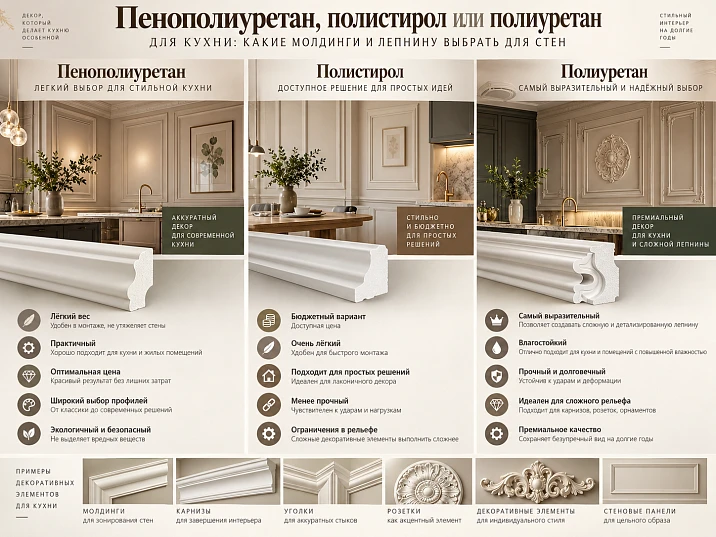
A decorative frame above the dining table can stay clean for years, while the same molding near the stove will quickly become covered with a sticky film. The material is the same, but the conditions are completely different. Therefore, when choosing kitchen stucco, you should first determine the installation location, and only then compare polystyrene, polyurethane foam, and ready-made polyurethane profiles.
For a free wall in the dining room, a simple polystyrene molding with compatible paint is suitable. If you need a classic composition with ready-made corners, relief overlays, and a repeating pattern, it is more interesting to consider a set of polyurethane products. And directly near an open flame or in an area of unacceptable heating, conventional decorative polymers are best not used at all without a documented approval.
The kitchen has one more requirement: the decor will have to be cleaned. Therefore, the depth of the relief, the quality of the seams, and the paint's resistance to washing are sometimes more important than how impressive the profile looks in the catalog. The STAVROS assortment includes Moldings, straight moldings, and decorative elements from which you can assemble finishing for a calmer dining area.
Why kitchen finishing requires a different approach




Steam, grease and regular cleaning
Around the dining table, the wall is usually wiped of occasional stains. Near the cooking surface, the soiling is different: tiny droplets of grease settle on the protrusions, mix with dust and over time form a hard-to-wash layer. Moisture from cooking and cleaning further tests the quality of the paintwork and the joints.
On a smooth strip, dirt is noticeable and easy to remove with a soft cloth. In ornamentation with deep recesses, the same droplet can remain at the base of a leaf or scroll. That is why a scattering of small appliqués on the wall by the stove often turns out to be less convenient than one calm contour in the dining area.
Our factory also produces:

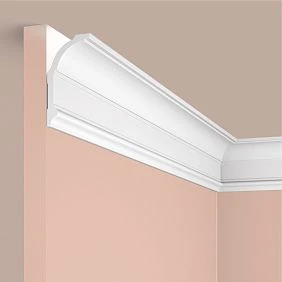


Heating zones and places where you must not interfere
When planning decorative moulding, mark the hob, oven, extractor hood, sink, air ducts and sockets on the layout. The polymer profile must not cover the ventilation grille, removable panels, access to electrical connections or the technical clearances of appliances.
Particular care should be taken with a gas hob. Decorative polyurethane moulding is not a non-combustible cladding; the distance to a heat source cannot be set according to generic advice from the internet. For a specific location you need the appliance instructions, the technical data of the decorative product and, where necessary, a design solution.
Get Consultation
The protective layer is part of the construction
A painted moulding is already a system made up of the substrate, the adhesive, the profile itself, the primer and the finish coat. Water may not damage the polymer itself, but it can penetrate through a poorly sealed joint to weak plaster. Washable paint will withstand wiping, whereas an unsuitable matt finish will start to shine or become soiled after a few cleanings. Assess the entire finished surface, not an individual property of the polymer.
Polyurethane foam and polyurethane: what lies behind the names
Why these are not two different families of polymers
Polyurethane foam is a type of polyurethane with a cellular structure: there are small cavities inside the material. The word “polyurethane” itself denotes a broad family of materials, not one strictly defined density or hardness. A comparison of “polyurethane foam versus polyurethane” without the characteristics of specific products is therefore not entirely correct.
Soft polyurethane foams used as fillers are available on the market, as are rigid ones from which three-dimensional parts can be moulded. The difference is determined by the formulation, the cell structure and the manufacturing technology. It cannot be concluded that any part with the prefix “foam” is necessarily soft and unsuitable for moulding.
Is polyurethane foam the same as foam rubber?
In everyday speech, foam rubber usually refers to soft, elastic polyurethane foam. But this is only one group of such materials. Rigid PU foam, used in other products, holds its shape differently and does not work like furniture sponge. Therefore the question “is polyurethane foam foam rubber or not?” is decided by the type of the specific material, not by the chemical name alone.
For wall mouldings, what matters is not everyday associations but the profile shape, surface, edge strength, permissible load, paintability and conditions of use. Density can be a useful indicator, but on its own, without geometry and testing, it does not determine how a thin ornament corner behaves.
What "polyurethane" means in STAVROS product cards
For MLDPU mouldings, the manufacturer specifies the material as "polyurethane" and gives product dimensions. This is enough to select a profile from the catalogue, but not enough to declare every product to be polyurethane foam of a specific density, assign it a particular fire hazard class or guarantee resistance to any temperature without a separate technical data sheet.
Rigid polyurethane foam should only be compared with such products when the characteristics of both are known. For the buyer of kitchen decor, it is more reliable to compare specific profiles and recommended operating conditions rather than promises at the level of the material name.
Polystyrene, rigid PU foam and polyurethane decor: a comparison
Polystyrene also comes in different forms. A lightweight foamed profile cannot automatically be equated with dense impact-resistant polystyrene: structure, edge treatment and mechanical properties differ. At the same time, no polymer on its own guarantees that painted mouldings will withstand frequent scrubbing of kitchen grease.
| Criterion | Polystyrene moulding | Rigid polyurethane foam | STAVROS polyurethane products |
|---|---|---|---|
| A simple line on the wall | Suitable when choosing a suitable profile | Possible in specific products | There are thin and more expressive moldings |
| Complex terrain | Depends on manufacturing and product range | Possible during molding | There are separate ornamental overlays |
| Resistance to contact | Depends on the type and shape | Depends on the formulation and surface | Specific product data required |
| Wet cleaning | Determined primarily by the finish and seams | Also depends on the coating | A suitable finishing system is required |
| Painting | With compatible paints and primers | According to the manufacturer's documentation | Taking into account surface preparation and paint |
| Ready-made corner pieces for frames | Checked by series | Checked by series | Components are available for individual mouldings |
| Installation near heat sources | Temperature tolerance check required | Temperature tolerance check required | Specific product check required |
| Complex composition | Possible if the required parts are available | Possible with a suitable product range | A system can be assembled from profile and overlays |
When to choose polystyrene
If you only need a thin border between two wall colors or a couple of simple rectangular frames, a quality polystyrene profile can solve the task without additional ornaments. It is necessary to check whether the manufacturer allows painting with the chosen composition, how the joints are made, and how well the base is prepared.
Dense polystyrene is sometimes preferable to a lightweight foamed alternative in areas subject to accidental contact. But the word "impact-resistant" must refer to the documented characteristics of a specific product, not to all polystyrene items.
When to choose a polyurethane set
For a dining room in a classic style, a straight line is sometimes not enough. You need corners, a central axis, repetition of the same ornament, and a consistent cross-section of the parts. What is useful here is not an abstract "higher-quality polyurethane" but a ready-made system. For example, Polyurethane moldings allows you to complement a straight outline with a textured accent where it does not complicate cleaning.
Where to place moldings in the kitchen
Free wall of the dining area
This is the most obvious place for a decorative frame. There is no constant heat from the burners here, and soiling is usually local. It is better to lay out the composition relative to the table, the wall light, and the visible part of the wall, rather than automatically relative to the whole room.
Suppose the table is shifted toward the window. If you place the frame at the geometric center of a large wall, it may end up noticeably to the left of the dining group. A person will perceive not the ideal symmetry of dimensions, but the inconsistency between the furniture and the decorative lines. Sometimes one large frame tied to the table works better than three identical ones.
Wall sections between the window and the door
A narrow wall section is easy to overload. Consider not only the visible width of the molding, but also space for corner pieces, sockets, switches, and casings. For several vertical lines, a thin profile without central decoration is sometimes enough. If the window is close to the corner of the room, first draw a full-size outline with painter's tape.
Kitchen-living room and the wall near the sideboard
In a combined space, the same profile can link the kitchen and living areas, but the density of the decor does not necessarily have to be the same. Near the cooking area — a simple line or no molding at all; near the sideboard, table, and armchairs — a decorative frame. This way the composition retains a common pattern but does not interfere with kitchen maintenance.
molded decoration made of polyurethane it is more appropriate to place them on such free sections, rather than directly on the most soiled wall behind the cooktop.
Which STAVROS moldings to choose for the kitchen and dining room
Specifying dimensions is more useful than describing products with the word "elegant." Even a difference of a few millimeters in projection is noticeable when the frames are next to a cabinet door or on a small wall section.
| Product | Dimensions, mm | Where to use |
|---|---|---|
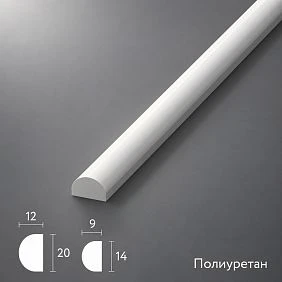
| MLDPU-001 | 10 × 6 × 2600 | Thin lines and small frames |
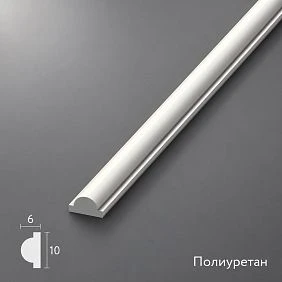
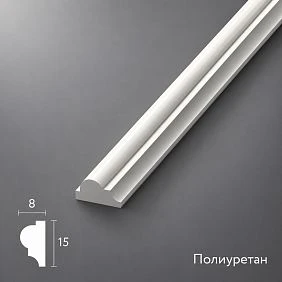
| MLDPU-004 | 15 × 8 × 2600 | Outline of a classic frame above the table |
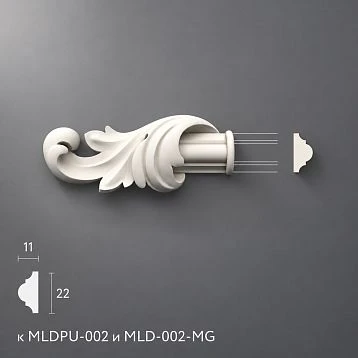
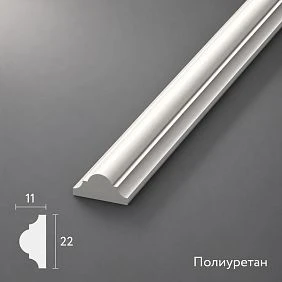
| MLDPU-002 | 22 × 11 × 2600 | A more prominent architectural line |
| MLDPU-004U | 135 × 135 × 10 | Ready-made corner for series 004 |
| MLDPU-4U-1.1 | 145 × 145 × 14 | Ornamental corner of series 004 |
| MLDPU-4-1.1 | 232 × 124 × 14 | Central overlay of series 004 |
Thin lines: MLDPU-001
polyurethane molding MLDPU-001 has a cross-section of 10 × 6 mm. It allows you to build a small frame that remains a background for furniture. For a compact kitchen, this can be more practical than a large ornament: fewer protrusions, easier to wipe along a straight contour with a cloth.
However, a slim cross-section does not turn the profile into a protective cover. If a chair regularly hits the wall with its backrest, it is wiser to change the position of the decor or provide separate protection rather than rely on the molding.
Expressive frames: MLDPU-004
Polyurethane molding MLDPU-004 15 mm wide with an 8 mm projection, it is well suited for a standalone rectangular outline. The profile can be painted to match the wall or in a contrasting color, subject to coating requirements. Its difference from a simple decorative strip is the ability to add matching corner and center elements.
For a calm kitchen, four straight sections with precise joints are enough. In a dining room with classic furniture, it is appropriate to reinforce the corners. But decorative density should not be the same across the entire wall: it is better to leave free fields near switches and the door.
Larger profile: MLDPU-002
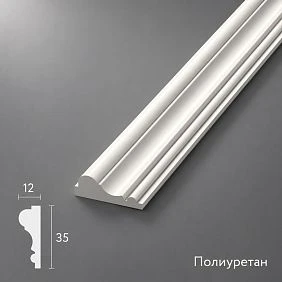
polyurethane molding MLDPU-002 has a cross-section of 22 × 11 mm. On a spacious dining room wall, it creates a more noticeable shadow and clearly defines the frame. In a small kitchen, such an outline may compete with the cabinet fronts and door casings; evaluate the size on a paper template before buying several strips.
Width alone does not mean greater resistance to impact or temperature. It is primarily a geometric and visual parameter.
Ready-made corners and center overlays
For the 004 series, the following is provided corner piece MLDPU-004U measuring 135 × 135 × 10 mm. If an ornamental composition is needed, use corner MLDPU-4U-1.1 measuring 145 × 145 × 14 mm. These are different parts, not two names for the same product.
Central decorative overlay MLDPU-4-1.1 measuring 232 × 124 × 14 mm adds a separate ornament on the selected axis. Before ordering, verify how it joins with the molding using the drawings: the external dimensions of the overlay are not equal to the length of the section it actually overlaps.
Three solutions for one dining wall
Option one: geometry only
A wall approximately three meters wide, a table in the center, two light fixtures on the sides. Two rectangular frames made of narrow polystyrene profile create rhythm but do not add volumetric overlays. This option is chosen when ease of cleaning and a limited budget remain the main conditions.
The same calm lines can be created from polyurethane MLDPU-001. The decision depends not on the fashion for a particular material, but on the quality of the chosen profile, the finish, adhesive compatibility, and the availability of the required cross-section.
Option two: classic frames
Two frames made of MLDPU-004 are installed on the same wall. The contour protrudes slightly and creates a shadow under side lighting. A free painted surface remains inside, so grease and dust do not accumulate on numerous small details.
Corners can be finished with a miter cut if the tool and geometry allow a precise joint, or compatible ready-made corner elements can be used. In the second case, a different calculation of the length of the straight strips will be required. The color can be the same as the wall for a calm result, or contrasting if the lines need to read more strongly.
Option three: a stucco composition in the dining room
For a separate dining room or a large kitchen-living room, MLDPU-004, corners MLDPU-4U-1.1 and overlays MLDPU-4-1.1 are used. The main ornament is placed on the wall of the dining area, while the area near the stove is left without protruding decor.
The system wins not through "indestructibility" but through the consistency of its parts. A person can see in advance where the profile ends, where the corner begins, and how the axis of the central overlay relates to the frame. For the project, it is useful to select decor for polyurethane moldings together with the straight strips, rather than looking for ornaments after the cutting is complete.
How will kitchen moulding be cleaned?
A smooth profile or shallow relief is easier to keep in order: a soft cloth passes over the surface with almost no obstacles. In a complex ornament, dust collects on horizontal ledges and in recesses. This does not rule out using moulding in the kitchen, but it changes where it is installed and how often it needs care.
When choosing paint, look in the technical information not just for the word "interior" but for the permitted cleaning methods, resistance to wet abrasion, and compatibility with the prepared polyurethane or polystyrene base. Matte and semi-matte finishes can be equally suitable if the specific product is designed for washing; the level of gloss alone does not prove resistance to grease.
It is best to clean the surface with a soft cloth and a neutral product approved by the coating manufacturer. Strong solvents, abrasive powders and stiff brushes should first be tested on an inconspicuous sample or avoided entirely if the instructions prohibit them. Do not pour water into the joints and do not leave moisture on damaged paint.
If a local scratch appears on the molding after cleaning, determine whether only the paint is affected or the relief itself is damaged. The former is often resolved by restoring the coating. A chip on a corner element requires a different assessment: sometimes replacing the part is neater than a thick layer of filler.
Can molding be installed next to a stove, sink and range hood?
Near a gas hob. Open flame and high-temperature surfaces are no place for ordinary polymer moulding without confirmation that such use is permitted. Painting cannot be assumed to be fire protection by default, nor can a safe distance be set without the hob instructions and the material's characteristics.
Near an electric cooktop and oven. Even without open flame, significant local heating is possible. Check temperature limits, installation clearances, hot air movement and the appliance manufacturer's requirements. Individual decorative products from other manufacturers have their own heating limits, but these figures cannot be applied to STAVROS without documentation.
Near the sink. The main risk here is not only water on the surface: the tightness of the joints and the adhesion of the adhesive to the base are important. If the area is regularly flooded or requires intensive cleaning, smooth moisture-resistant cladding is more practical than a relief composition.
Near a range hood and ventilation. Do not cover grilles, service covers, air intake openings or access to fasteners. If a decorative frame ends up on the appliance's service line, change the composition in advance: moving molding after final painting usually leaves marks on the wall.
How to paint moldings so they can be washed
Start by checking the factory preparation of the specific product. Some surfaces require additional primer, while others are already prepared for painting but may need sanding or cleaning. Do not skip primer automatically: layer compatibility matters more than saving one operation.
On a separate offcut, apply the same primer and paint that you intend to use on the wall. After complete drying, check adhesion using the method permitted for the coating and carefully wipe the sample with the product you plan to use for kitchen cleaning.
A white profile on a colored wall highlights every curve and every flaw in the joint. Painting it to match the wall color makes the composition more cohesive, but it does not hide geometric errors. When applying multiple coats, take care of the small recesses of the ornament: excessive material thickness will smooth out the pattern. Observe intercoat drying and the time to full hardness specified by the paint manufacturer before washing the finish.
How to calculate moldings and overlays for the kitchen
Let's imagine two decorative frames measuring 800 × 1200 mm along the outer contour of the molding. The corners are cut at 45°, and the length of each blank is measured along the long outer edge after cutting.
Perimeter of one frame: 2 × (800 + 1200) = 4000 mm. For two, 8000 mm of profile will be required, excluding waste. The MLDPU-004 strip is 2600 mm long. Based on the total length, it seems that four strips are enough: 4 × 2600 = 10 400 mm.
Let's check the cutting plan by individual blanks. In total, four pieces of 1200 mm and four of 800 mm are needed. From each strip, one long and one short piece can be obtained: 1200 + 800 = 2000 mm. About 600 mm remains for total losses, test cuts, and waste. This layout is feasible for the given example if the final lengths are measured correctly and the saw kerf is taken into account.
| Position | Quantity | Calculation rule |
|---|---|---|
| Straight strips MLDPU-004, 2600 mm | 4 | According to the cutting plan for two frames with a miter cut |
| Parts 1200 mm long | 4 | Two vertical sides per frame |
| Parts 800 mm long | 4 | Two horizontal sides each |
| Finished corners with the other option | 8 | Four elements per frame |
| Central overlays, if provided | 2 | One per frame |
Ready-made corners change the calculation. For MLDPU-004U or MLDPU-4U-1.1, you cannot mechanically subtract 135 or 145 mm from the side: the full size of the decorative part does not show the junction with the straight profile. First read the drawing, determine the actual abutment points, then create a new cutting map. Calculate central overlays per piece, separately from linear meters.
What makes up the cost of a finished composition
Comparing only the price per meter is incorrect. A simple polystyrene contour may not have ornamental parts; a polyurethane frame costs more due to ready-made corners, overlays, glue, painting and more complex work.
As a verifiable example, let's take the published STAVROS prices as of October 22, 2026. One MLDPU-004 strip costs 3,190 rubles. Four strips for two frames with a standard miter cut — 12,760 rubles without installation materials. Adding eight ornamental corners MLDPU-4U-1.1 at 1,790 rubles each and two overlays MLDPU-4-1.1 at 2,990 rubles each, the conditional total of the products will be 33,060 rubles.
This is not a final estimate for a complete system with corners: the actual number of straight strips is recalculated based on the drawings, and the cost may change. Wall preparation, delivery, adhesives, painting and labor are not included. If you want Buy moldings specifically as a set, it is wiser to first compile a list of item codes and check their junction points, and then approve the order.
Installation of decorative moldings on a kitchen wall
- Check the base. Remove dirt, grease marks and loose coatings. In the kitchen, it is especially important that the adhesive holds to the wall, not to an old layer of contaminated paint.
- Mark out the layout. Align the axes of the frames with the table, doors and free wall sections. Check the horizontal, vertical and diagonals of each rectangle.
- Prepare the cutting. Make a test cut and a dry fit without adhesive. A complex profile requires checking that the relief matches at the corners.
- Choose the installation compound. It must be compatible with the product material, the base and the room conditions. Do not replace the joint adhesive specified by the system with an arbitrary sealant.
- Secure the parts. Apply the adhesive at the locations specified by the manufacturer. If necessary, provide temporary support until the required strength is achieved.
- Finish the joints and painting. Apply the finish after the adhesive has cured sufficiently. Do not assign the same drying times to all compounds.
Do not attach the new relief to weak wallpaper, and do not hide damp spots or deep cracks with molding. First eliminate the cause of the substrate defect. If a kitchen cabinet is located nearby, check the actual trajectory of the door opening: even a few millimeters of protrusion can be an obstacle.
Nine mistakes that are better prevented before purchase
| Mistake | What it leads to | What to do in advance |
|---|---|---|
| Treating all PU foam as foam rubber | Possible products are assessed incorrectly | Confirm the material type and specification sheet |
| Assume any polyurethane is stronger than polystyrene | Buying without comparing specifications | Compare specific profiles |
| Place molding near a flame | Dangerous or unacceptable heating | Check equipment and finish requirements |
| Install deep relief near the stove | Grease is hard to remove from recesses | Move the ornament to the dining table |
| Choosing paint without testing washability | Stains, scuffs and shiny spots in certain areas | Make a test patch and study the data sheet |
| Applying to a greasy or crumbly wall | Peeling along with the coating | Clean, strengthen and prepare the substrate |
| Mixing parts from different series | Sections and joints do not match | Check item numbers and drawings |
| Covering the ventilation grille | Operation and maintenance are impaired | Leave free technical access |
| Buy material only along the perimeter | Not enough required continuous pieces | Create a cutting map |
Frequently asked questions
What is polyurethane foam and can it be used to make stucco molding?
Polyurethane foam is a cellular variety of polyurethane. Rigid variants can be used to manufacture molded decorative products, including moldings and relief details. But the word "polyurethane foam" by itself does not indicate surface quality, hardness, heat limit, or resistance to washing. For the kitchen, you need to choose a specific product with a stated purpose and manufacturer's recommendations.
Is polyurethane foam the same as foam rubber?
Foam rubber usually refers to soft elastic polyurethane foam, which is used in fillers. Rigid polyurethane foam belongs to the same broad family but differs in structure and properties. Therefore, calling any PU foam foam rubber is incorrect. For interior stucco molding, clarify which material was used, how stable its shape is, and which mounting method is permitted.
How does polyurethane foam differ from polystyrene?
These are different polymer families. Both have foamed varieties, but their chemical composition and manufacturing methods are not the same. The visual similarity of two white profiles does not mean the same strength, moisture resistance, or behavior when heated. Compare the density, cross-section shape, protective layer, and technical requirements of specific products. You cannot choose a winner based on the material name alone.
Which is better for the kitchen — polystyrene or polyurethane?
For a minimalist frame on a clear wall, a quality polystyrene profile with a compatible finish is suitable. For a complex system with ornamental corners and centre overlays, it is convenient to use coordinated polyurethane products. If the wall is near a heat source or is constantly covered in grease, first assess whether placing the decor there is acceptable at all. In some locations it is better to avoid protruding moulding regardless of the material.
Which mouldings are suitable for a dining area?
For a fine line, consider a profile with a small cross-section, such as MLDPU-001. For a more prominent frame, MLDPU-004 is suitable; if space allows, a larger MLDPU-002 is possible. Assess the wall dimensions, the position of the table, side lighting and cleaning access. The chosen outline should not obstruct furniture movement or access to switches.
Can polyurethane moulding be washed?
Care depends on the finish, the condition of the joints and the recommendations for the specific product. With a suitable coating, careful damp cleaning is acceptable, but solvents, abrasives or vigorous rubbing must not be used automatically. Pay particular attention to the joints: damaged paint and unsealed abutments can let moisture reach the substrate. Before regular cleaning, check the instructions for the finishing coat.
Is moulding acceptable directly next to a gas stove?
Ordinary decorative polymer should not be placed in an area of open flame or significant heat without a confirmed technical solution. There is no universal distance that is equally safe for all stoves and mouldings. The stove manufacturer's requirements, the thermal effect on the chosen wall and the permissible conditions of use for the decor must be taken into account. In a questionable area, non-combustible cladding with a confirmed purpose is preferable.
Which STAVROS mouldings should I choose for a classic dining room?
For wall frames, MLDPU-004 with a cross-section of 15 × 8 mm is suitable. In a larger room, you can consider MLDPU-002 with a cross-section of 22 × 11 mm. Separate ready-made corner and centre overlays are available for the 004 series. Before ordering, mark out the furniture layout and check that the ornament is not located where the wall is regularly knocked or intensively washed.
What can be used to complement polyurethane moldings?
If a simple contour looks unfinished, you can add compatible corner elements and a central overlay. For MLDPU-004, MLDPU-004U and the ornamental MLDPU-4U-1.1 are available; the central composition can be complemented with MLDPU-4-1.1. The choice depends on the overall scale of the frame. It is better to check a sample and a drawing than to buy based on a photo alone: too large a relief will overload a small kitchen.
Which ready-made corners are suitable for MLDPU-004?
This series includes the geometric corner MLDPU-004U measuring 135 × 135 × 10 mm and the more decorative MLDPU-4U-1.1 measuring 145 × 145 × 14 mm. They differ in pattern and dimensions. They cannot be considered interchangeable without clarifying the project: the actual junction points and lengths of the straight parts must be determined from the drawings of the selected system.
How many strips will be needed for two frames of 800 × 1200 mm?
For two rectangles with 45° mitre cuts, you will need four long sides of 1200 mm and four short sides of 800 mm. From each 2600 mm strip, one long and one short piece can be cut, so in the given scheme four strips are sufficient. However, this is a calculation for a specific external size and joining method. Ready-made corners will require a new cutting plan.
Where to buy polyurethane stucco molding for the kitchen?
In the STAVROS catalog you can select MLDPU profiles, compatible corner elements and decorative overlays. To place an order, prepare the frame dimensions, the number of corners, their joining scheme and information about the installation location. The section "buy polyurethane stucco molding" will be useful for choosing overlays, and straight moldings are easier to compare by article numbers and sections. This way the set will match the project rather than a random collection of beautiful parts.
What to choose for your kitchen
On a kitchen wall, not only the material but also the installation location matters. In the dining area, you can make simple frames from suitable polystyrene. Rigid polyurethane foam is also used for molded decorative products, but specific properties should be verified against technical data, without confusing it with soft foam rubber.
If you need an architectural composition with a pronounced line, ready-made corners and a central ornament, it makes sense to choose polyurethane moldings and overlays from a single STAVROS system. Before purchasing, measure the wall, identify heat and dirt zones, create a cutting map, and check the compatibility of parts and paint. Place the most relief elements where they will be clearly visible but will not require constant intensive cleaning. Then the decor will become part of a well-thought-out kitchen interior rather than an obstacle to its daily use.