Article Contents:
- What kind of stucco is found in Stalin-era buildings
- Why gypsum was used and how ornaments were made from it
- Ceiling cornices, rosettes and decorative bands
- Wall frames and ornaments: not every Stalin-era building was a palace
- When it is better to keep the original
- When gypsum stucco restoration is required
- When new decorative finishing is acceptable
- What to check if the house has protected status
- How polystyrene profiles differ
- Why the existing relief influences the choice of material
- Straight profile MLDPU-002 for classic frames
- Wider profile MLDPU-003
- Ready-made corners and centre elements
- Thin additional details
- A genuine rosette cannot be considered an ordinary replaceable part
- Two scales of STAVROS ceiling decor
- Scenario 1. The plaster ceiling has been preserved
- Scenario 2. The plaster ceiling stays, the walls are finished anew
- Scenario 3. There was no original decor, or it was lost long ago
- The perimeter of three frames is only the first step
- Cutting plan without transverse joints
- What changes with ready-made corners and overlays
- First check the plaster, then glue the decor
- Marking, fitting, and fastening
- Painting old and new decor
- What was molding in Stalin-era buildings made of?
- Can plaster molding be replaced with polyurethane?
- How does polyurethane stucco differ from polystyrene?
- Which preserves complex ornament better: gypsum or polyurethane?
- Can new moldings be glued next to old stucco?
- How to restore ceiling stucco in a Stalin-era apartment?
- Which moldings to choose for high walls?
- How to choose a polyurethane ceiling medallion?
- Can old gypsum stucco be combined with modern overlays?
- Where to buy STAVROS polyurethane stucco?
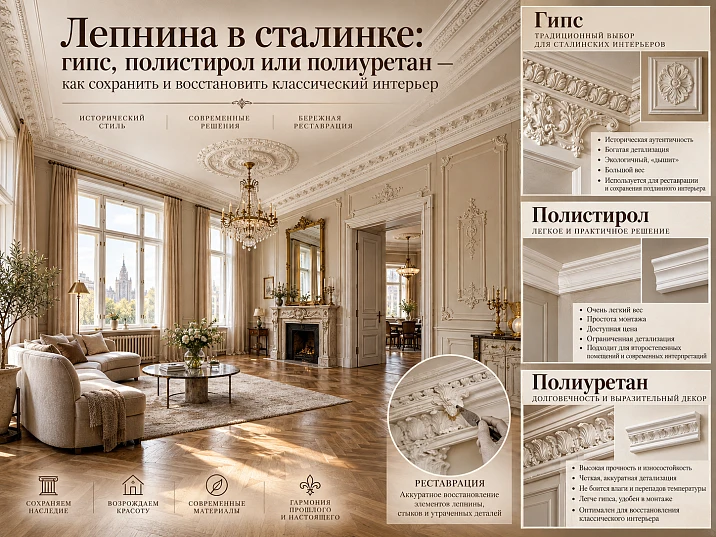
Within a few hours of renovation, a ceiling in a Stalin-era apartment can lose what it had preserved for decades. Under layers of whitewash, a gypsum medallion is revealed; near the cornice, a crack; and above the door, a trace of a vanished ornament. There is a temptation to remove everything uneven and replace it with new white pieces. But damaged stucco can sometimes be restored, and what seems like a simple decoration may turn out to be part of the historical design.
The first decision is made before dismantling: determine which elements are authentic, how securely they are attached, and whether cultural heritage protection requirements apply to the interior. If the old gypsum stucco needs to be preserved, the work begins with a survey, not with choosing an adhesive. Polyurethane and polystyrene are useful in a different case — when the project calls for a new decorative band, wall frames, or a ceiling composition on a free surface.
For such an addition, STAVROS has Moldings: coordinated moldings, overlays, decorative corners, and rosettes. It is not only the materials that need to be understood. It is far more important to decide what to preserve, what can actually be reproduced, and where modern decor will be appropriate.
What stucco is found in Stalin-era buildings




Why gypsum was used and how ornaments were made from it
Gypsum mortars make it possible to cast repeating decorative details in molds and to create extended profiles using prepared templates. In an old apartment, you can find individual cast elements and drawn cornices that form a single composition. On a painted surface, the manufacturing method is not always obvious: years of paint layers hide the joints and fine edges.
Therefore, the question "how was stucco made in Stalin-era buildings" does not have a single answer for all addresses. The technology, the richness of ornament, and the quality of execution depended on the time of construction, the architectural design, and the status of the building. A grand apartment with elaborate ceiling decoration and more modest housing from the same period may differ more than two apartments from different eras.
Our factory also produces:
Ceiling cornices, rosettes, and decorative bands
The cornice connects the top of the wall to the ceiling. Its purpose is not limited to covering the corner: the shape of the profile creates shadow and a visual boundary for the room. The rosette emphasizes the axis of the chandelier or another compositional point. There are ornamental bands, wreaths, plant motifs, and strict geometric divisions. However, the presence of a particular pattern cannot automatically be declared a mandatory feature of Stalinist Empire style.
Particular caution should be taken with the chandelier area. A historic rosette may be attached to an old base with electrical wiring running beneath it. Before any intervention, the attachment must be inspected and the power supply safely disconnected. The decorative element itself must not be regarded as a load-bearing support for the light fixture.
Get Consultation
Wall frames and ornaments: not every Stalin-era building was a palace
In some rooms, wall moldings, stucco bands, and framed doorways have survived; in others, the finish was restrained. By adding new frames to every wall, it is easy to create an interior that never existed in the apartment. If the goal is to preserve the character of the home, it is useful to study old photographs, traces of the original finish, and similar apartments in the same building, rather than transferring an arbitrary sample from an interior design collection.
Preserve the old plaster stucco or replace it: the decision comes before renovation
When it is better to keep the original
If the cornice retains a legible pattern, the rosette has not lost its basic shape, and the fastening can be inspected and, if necessary, reinforced, preservation should be the priority. The original element retains dimensions, profile, and traces of the technique that a purchased overlay does not reproduce automatically. Even individual surviving fragments can help a restorer reconstruct the lost section.
Do not assess condition by color alone. Darkened stucco under old paint sometimes turns out to be sound. Conversely, a smooth whitewashed cornice may have hidden voids and delamination. The inspection is carried out using methods that exclude accidental destruction. It is dangerous to tap heavy, suspiciously secured ceiling decor on your own.
When plaster stucco restoration is required
The reason to call a specialist is deep cracks, detachment from the base, falling fragments, traces of moisture, a noticeable change in geometry, or missing parts of the relief. The purpose of the inspection is to determine not only the size of the visible defect but also its cause. A crack caused by movement of the base will return if only decorative patching is done.
Professional stucco restoration may include documenting the pattern, carefully exposing the damaged area, reinforcement, fabrication of replacement parts, and finishing according to an agreed methodology. The specific materials and sequence depend on the condition of the original. Advice such as “just cover everything with ordinary putty” is insufficient here: it does not solve the fastening problem and sometimes destroys delicate ornament.
When new decorative finishing is acceptable
If there are no authentic elements on the free wall and the project does not affect protected finishes, a new composition can be created. For example, keep the restored plaster ceiling cornice, and on the newly prepared wall install frames made of polyurethane profiles. This is a new finish, stylistically consistent with the historic interior, but not a restoration of the original.
The same logic applies when all the old decor has long been lost. A modern rosette or overlay can help support the chosen architectural theme, but it cannot be presented as an accurate copy of a lost historic item without measurements, samples and a confirmed design.
What to check if the building has protected status
The word “stalinka” does not mean that the building is necessarily a cultural heritage site. Nor does it mean the opposite. Check whether the building is included in the register or is classified as a newly identified object, and which elements are listed in the subject of protection. The interior of an individual apartment may be subject to special requirements, but this should be established from documents, not from the age of the walls.
For works to preserve a registered or newly identified object, Article 45 of Federal Law No. 73-FZ of 25 June 2002 provides for a work assignment, a permit, approved project documentation and the corresponding supervision conditions. Requirements for contractors are established for such works. At the same time, the scope of approvals for a specific renovation depends on the status of the building, the subject of protection and the nature of the intervention. Before dismantling disputed stucco, it is advisable to request information from the regional heritage protection authority and obtain a specialist opinion.
Practical rule: if the status or condition of an element is doubtful, stop the dismantling. A polyurethane part cannot be considered an acceptable replacement for protected plaster stucco merely because it looks similar.
Plaster, polystyrene or polyurethane: comparison table
| Criterion | Gypsum | Polystyrene | Polyurethane |
|---|---|---|---|
| Preservation of authentic plaster stucco | Used with proper restoration methodology | Not an equivalent replacement for the historic original | Not an equivalent replacement for the historic original |
| New decorative composition | Possible | Available for suitable profiles | Available; there are STAVROS system products |
| Complex terrain | Supports molding and restoration from a sample | Depends on technology and product range | Ready-made three-dimensional overlays and ornaments are available |
| Mass | Depends on size, composition, and mounting | Depends on density and geometry | Depends on composition and construction |
| Impact resistance | Depends on construction and condition | Varies for foamed and dense variants | Determined by the specific product |
| Painting | After appropriate preparation | Compatible coating | Compatible coating |
| Installation | According to the product design and technology | According to the adhesive and profile instructions | According to the adhesive and profile instructions |
| Ready-made compatible corners and covers | Depends on the system and manufacturer | Depends on the manufacturer | Available in STAVROS series |
The table does not establish an overall winner. To preserve a genuine gypsum ornament, the concept of authenticity cannot be replaced by price or weight. For a new simple divider, a quality polystyrene profile may be suitable. For a finished classic frame with ornamental ends, the appeal of STAVROS polyurethane lies in the availability of specific coordinated parts.
How polystyrene profiles differ
An inexpensive foamed profile and a dense polystyrene molding are not the same in terms of dent resistance and surface quality. When comparing products for walls, study the cross-section, density or stated performance parameters, purpose, and paintability. It cannot be claimed that any polystyrene is fragile and any polyurethane is impact-resistant: such conclusions cannot be drawn without testing.
Why the finished relief influences the choice of material
The buyer chooses the result, not the chemical formula. For a single narrow line above the baseboard, straightness and quality painting matter. For a frame with pronounced corners, additional elements and matching cross-sections are already required. It is precisely in such projects that Polyurethane moldings STAVROS becomes a substantive option rather than an abstract replacement for gypsum.
How to decorate free walls in a Stalin-era building: STAVROS moldings and overlays
Straight profile MLDPU-002 for classic frames
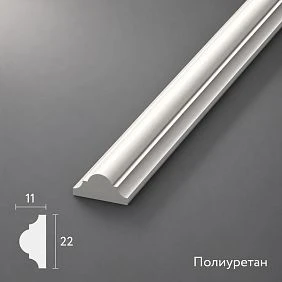
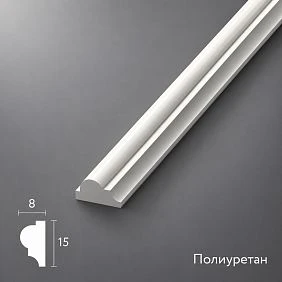
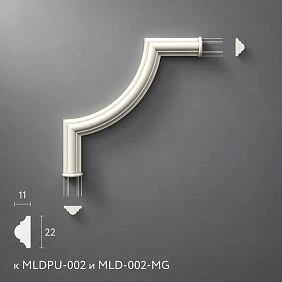
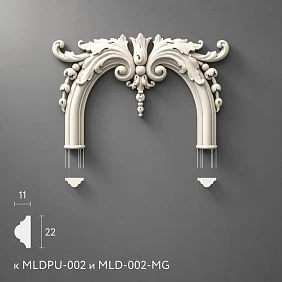
Polyurethane molding MLDPU-002 has a cross-section of 22 × 11 mm and a factory length of 2600 mm. Its multi-level profile creates a noticeable shadow on the wall, while not requiring as large a field as a massive panel. On a newly painted surface, it can mark out a frame around a free wall section, define the sofa area, or echo the vertical rhythm of doorways.
Do not try to compose a wall composition based only on the general dimension "ceiling height three meters". First, find the position of the cornice, the top of the architraves, the baseboard, the edges of the radiator, and the actually visible part of the wall. A frame positioned at the geometric center of the wall may look off-center after a cabinet is installed.
Wider profile MLDPU-003
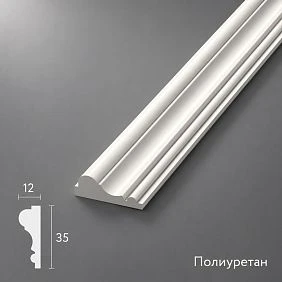
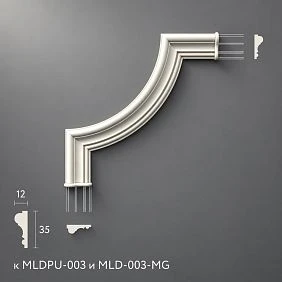
Polyurethane molding MLDPU-003 has a cross-section of 35 × 12 mm, and its length is also 2600 mm. The difference from MLDPU-002 is not only 13 mm in width. The wider front surface changes the scale of the ornamental line and the distance from which it is perceived as an independent architectural boundary.
Ready-made corners and center elements
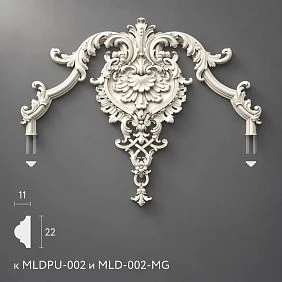
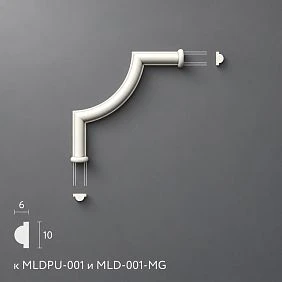
Corner molding MLDPU-2U-1.1 measuring 210 × 210 × 18 mm is designed for the MLDPU-002 system. It finishes the turn of the frame with a separate piece, so when cutting, its actual geometry and the junction points of the straight profile must be taken into account.
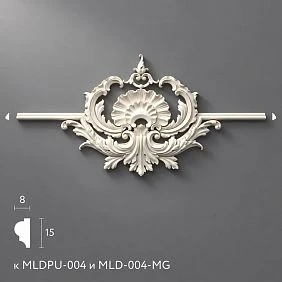
Center overlay MLDPU-2-2.1 measuring 235 × 237 × 21 mm adds an ornamental accent to the same molding. It is placed along the chosen axis of the frame, not automatically at the geometric center of the entire wall. The length of the straight sections next to the overlay is determined after dry layout: the usual perimeter formula is no longer sufficient.
Thin additional details
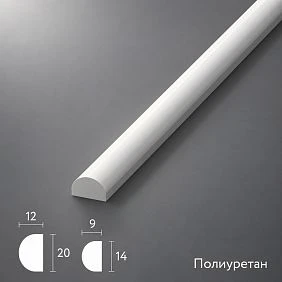
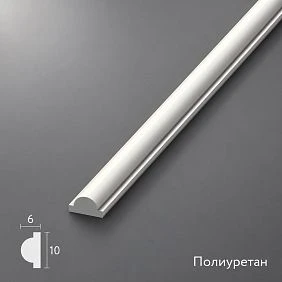
Polyurethane decor NPU-506 measures 12 × 205 × 5 mm. It can be considered for a delicate vertical accent piece in a new composition, after first comparing the ornament with the other elements. A small thickness does not mean the product should be mounted over old damaged plaster: the fastening must be on a solid, suitable substrate.
For walls where there were no historical elements, you can also look at a wider category Wall molding. But the choice begins with the room plan, not with the number of decorative elements in the catalog.
Ceiling rosette: keep the old one or install a new one
An authentic rosette cannot be considered an ordinary replaceable part
If historic stucco surrounds the chandelier, first determine what parts it consists of and how it is attached. The loss of one petal does not require automatic replacement of the entire composition. In case of cracks, displacement, or suspected loss of adhesion, an inspection is carried out by a specialist. Do not test the strength of a decorative element by pulling on the chandelier or subject the ceiling to vibration to speed up repairs.
If the new ceiling design is approved by the project and there is no historical rosette in this location, a modern product can be selected. However, a decorative overlay does not replace the anchor fastening of the light fixture to a reliable structure. The wiring, junction box, and permissible distances to heated parts of the light fixture are checked separately.
Two scales of STAVROS ceiling decor
In the category Polyurethane ceiling rosettes compositions of different dimensions are presented. For example, ceiling stucco CRPU-070 It measures 765 × 765 × 18 mm. The CRPU-068 model is considerably larger: 1325 × 1325 × 18 mm. Their dimensions are verified against the product cards; the card designations use the spelling CPU in the page address, although the product name contains CRPU.
For a ceiling 3.2 m wide, a 765 mm medallion will occupy about 24% of the width, while a 1325 mm composition will take approximately 41%. This comparison covers geometric scale only and is not a ready-made selection recommendation: the pattern, the position of the chandelier, the cornice, beams, neighbouring light fixtures and the actual area of free surface are all taken into account. A large model may prove excessive next to a surviving, richly detailed plaster frieze.
Do not call a modern medallion an exact equivalent of a historical one without comparing the patterns. Even an identical outer diameter does not confirm a match in ornament, relief height and compositional axes.
Three apartment renovation scenarios with stucco
Scenario 1. A plaster ceiling has survived
In the living room, the cornice and medallion have survived, but the medallion has some minor losses. The first step is to record the condition in photographs and carry out an inspection. A specialist decides whether the pattern can be restored from the surviving part and how to eliminate the causes of the damage. If the object is protected, the work is carried out in accordance with the procedure prescribed by law.
Here there is no need to buy a polyurethane medallion just to refresh the appearance. Buying a new element can deprive the interior of an authentic detail, and in the case of protected finishes it may be impermissible.
Scenario 2. The plaster ceiling stays, the walls are finished anew
Suppose the cornice has survived, but the walls have been reconfigured many times and no longer have their former wall frames. After verifying that changes are permissible, the designer may propose a restrained band or frames made from MLDPU-002. They are painted in an agreed shade, leaving the old stucco as an independent historical layer.
Scenario 3. There was no original decor, or it was lost long ago
The room has no surviving elements, and the renovation rules allow for a new design. In that case, you can design a unified modern classical system: wall moldings, compatible corners, and a separate ceiling medallion. A useful starting point is not pictures of grand halls but the actual proportions of the apartment — the distance from the cornice to the windows, the height of the architraves, the axis of the chandelier, and the furniture zones.
If the historical appearance is unknown, it is more accurate to call the result "an interior in a classical style" rather than "restored Stalin-era stucco."
How to choose decor based on ceiling height and architectural rhythm
A high ceiling allows for more prominent lines, but it does not justify any profile width. A molding with an 11–12 mm projection creates a shadow whose intensity depends on the direction of light. Under side lighting, even a relatively thin relief reads more strongly than under even ceiling light. That is why samples are evaluated in the morning and in the evening.
With a room height of about 3 m, it is not necessary to raise the frames almost to the ceiling. If the top of the door architraves is below the historical cornice, frame compositions are usually better tied to the lines of the openings and furniture. A separate space is left between the decorative frame and the cornice so that the two ornaments do not merge into a random stripe.
For a wall 3.8 m wide with two side door openings, the usable area may be only 2.2 m. Two identical frames in this zone sometimes produce fields that are too narrow. One well-calibrated frame or a calm vertical band may prove more convincing. A convenient way to check is with full-size strips of masking tape. The layout is marked out along the visible pier, the diagonals are checked, and only then are the products ordered.
Do not try to replicate the geometry of a crooked historical opening with a single slanted molding. First determine whether the deviation is a feature of the structure, damage, or the result of later finishing. In an old house, this diagnosis often changes the entire layout design.
How to match a new ornament to surviving plaster
Find a repeating motif in the old stucco: a leaf, a geometric meander, a wreath, a simple band. Then compare it with the modern piece across four parameters: overall size, projection height, density of the pattern, and direction of the composition. Two elements may depict the same leaf, but one will be large and deeply carved, the other small and flat. Side by side, they will begin to visually conflict.
For a check, an advertising photo alone is not enough. Download the product drawing and draw it at 1:1 scale on paper if the format allows. Place the template next to the intended installation site, but do not fix anything onto the original decor. Check whether the ornament overlaps the neighboring cornice and whether the central overlay takes up almost the entire width of the frame.
Color is the final stage of approval. White paint can hide the difference between materials from a distance, but it will not fix different scales or incompatible relief shapes. In an interior with valuable old stucco molding, it is sometimes better to avoid additional overlays and limit yourself to a straight profile.
How to calculate the number of moldings for new wall decoration
The perimeter of three frames is only the first step
Suppose three identical frames measuring 1000 × 1600 mm along the outer long points of the profile are planned for a new free wall. Without ready-made corners and center inserts, the length of one frame is:
2 × (1000 + 1600) = 5200 mm.
Three frames will require 15,600 mm of profile. The factory strip MLDPU-002 is 2600 mm. Dividing the total length by 2600 gives six strips. But six strips are not enough in real cutting: each tall side requires a solid 1600 mm segment; mathematically, exactly 1000 mm remains for it, while the saw kerf and possible trimming require additional material.
Cutting map without cross joints
You need six vertical segments of 1600 mm and six horizontal segments of 1000 mm. A reliable scheme, provided the dimensions are accurate: allocate six factory strips for the vertical sides, and from the other three obtain two horizontal segments each with a margin for cutting. That makes nine strips in total, not six. This scheme assumes that the dimension on the drawing corresponds to the selected measuring line of the molding; when sawing, the dimensions should be clarified using the long points of the corners.
| Position | Quantity | Workpiece | Source |
|---|---|---|---|
| Vertical sides | 6 | 1600 мм | 6 strips of 2600 mm |
| Horizontal sides | 6 | 1000 мм | 3 strips, 2 segments from each |
| Total | 12 pieces | 15,600 mm of clean calculated length | 9 factory strips |
What changes with ready-made corners and overlays
The MLDPU-2U-1.1 corner elements occupy parts of the perimeter, while the central overlays occupy sections of the straight sides. But you cannot automatically subtract 210 or 235 mm from each side: these are the overall dimensions of the parts, not confirmed lengths of the junction points for the selected orientation. First you need to lay out the elements according to the drawings, measure the distances between the installation boundaries, and only then draw up a new cutting map.
Corners, central accents and overlays are counted individually. For three frames, if four corners are decorated on each, twelve corner pieces are required. If one central overlay is provided per frame, there will be three. But the number of pieces does not replace checking the scale: in a small frame, such a large ornament may take up a disproportionately large amount of space.
Installing new polyurethane moulding in an old apartment
First check the plaster, then glue the decor
Old walls often contain heterogeneous layers: lime whitewash, old filler, several coats of paint and local repairs. Fastening to such a base will be only as strong as its weakest layer. If the paint is peeling off in sheets, a good mounting compound will not fix the problem: the moulding will come away together with the paint.
Do not cover active cracks or damp areas with decorative profile. The cause of the damage must be eliminated first. If voids or instability of the old plaster are suspected, an inspection by a specialist is required; applying a thick bead of adhesive instead of repairing the base is unacceptable.
Layout, dry fitting and fastening
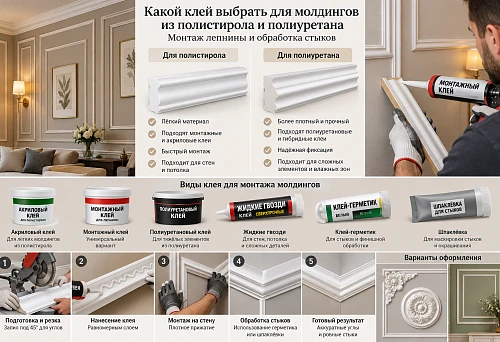
Mark out the composition with a level and a square, and check the diagonals of the frames. Dry-fit all mouldings and overlays without glue. Match the profiles and joint points; if an angle is made for a different series, external similarity is not enough. Select an adhesive compatible with polyurethane and the specific substrate, following the manufacturer's instructions. Do not assign a single drying time to all adhesives.
After fixing, remove excess in the recommended way and wait for curing before finishing. Small decorative seams are treated with compatible products, but sealant must not be turned into a substitute for a structural joint that was executed incorrectly. At the same time, old gypsum stucco is not drilled and is not used as an attachment point for a new product.
Painting old and new decor
For polyurethane parts, select a suitable primer and coating. Historic gypsum is treated differently: its multilayer coating may require special assessment, especially if the task is to reveal the surviving pattern. Aggressive chemical cleaning on your own can damage the old substrate and affect potentially hazardous old coatings. If in doubt, have a specialist carry out an assessment and do not create dust without appropriate safety measures.
Even when the material is painted overall, it is useful to keep the compositional logic distinguishable: the original ceiling ornament should not dissolve into randomly added wall overlays.
Which is cheaper: gypsum restoration or a new polyurethane composition
Comparing them as two identical products is incorrect. Restoring surviving historic decor includes assessment, sometimes a design and approvals, work with the authentic material and replacement of losses. The cost is determined after assessing the condition; there is no universal price per linear metre for such cases.
A new polyurethane composition is calculated differently: profiles, corners, overlays, substrate preparation, adhesive, painting and installation. For the conditional example of three rectangular frames above, nine MLDPU-002 strips will be required. At the price of 5460 ₽ per strip indicated in the STAVROS product card at the time of checking on 22 October 2026, the profile will cost 49 140 ₽. This is the cost of only nine straight mouldings, excluding decorative corners, overlays, delivery, adhesive, labour and a possible additional reserve.
If the project provides for ready-made corners instead of mitre cuts, the estimate is recalculated from scratch based on the new lengths of the straight sections. For reference, one MLDPU-2U-1.1 costs 4490 ₽, and the MLDPU-2-2.1 overlay costs 5350 ₽ according to the verified product cards. Twelve corners will cost 53 880 ₽, and three central overlays will cost 16 050 ₽. Adding these amounts to nine strips without recalculating their quantity would mean overstating or distorting the estimate.
Modern finishing is economically appropriate where new decor is needed and its installation is permitted. If the original stucco belongs to protected heritage, the low price of a polymer replacement does not by itself create the right to install it. When the task is only to restore a few damaged leaves of an old rosette, buying a large modern set may also be unnecessary.
To select new products, you can open the catalog by searching for Buy moldings, having first compiled a list of specific item codes and checked compatibility, rather than selecting products by a general style name.
Mistakes when renovating a Stalin-era building with stucco
1. The old ornament was removed before inspection. The reason was the desire to get a flat ceiling right away. The consequence is the loss of a sample for restoration and a possible violation of heritage protection requirements. First record the condition, determine the status of the premises and assess the fastening.
2. Replacement was called restoration. A new polyurethane cornice may look convincing, but it does not become the original gypsum element. In the estimate and work description, distinguish between preserving the historical element and modern decorative finishing.
3. The ornament was selected from a color photograph. The actual dimensions and cross-section profile are not visible in the photo. Before ordering, study the drawing, make a full-size paper mock-up, and compare the relief projection.
4. An overly large rosette was installed. Even the ceiling of a large room may already be occupied by a cornice, a beam and a group of light fixtures. Check the available geometry and suspension points; do not draw conclusions based only on ceiling height.
5. The new molding was glued onto weak paint. The bond will fail along the weak layer. Prepare a solid base and use a compatible compound.
6. An active crack was covered with a decorative strip. The crack will continue to open, deforming the finish. Determine the cause of the damage and carry out the necessary repair before installation.
7. Too many ornaments were mixed. Wreaths, leaves and geometric bands with different rhythms begin to compete with each other. Choose one leading motif and a limited number of accents.
8. The order was calculated only along the perimeter. The total profile length does not account for the possibility of obtaining the required continuous sections. Create a cutting map with the actual saw cut locations.
9. A new part was fixed through the old stucco. Such intervention can crack the original, damage the fastening and violate the requirements for a protected site. Provide an independent fastening to a verified base that is permitted by the project.
Frequently asked questions
What was stucco made from in Stalin-era buildings?
Gypsum was widely used for molded decorative details and drawn profiles. The specific technology varied between buildings and even individual interior zones. The method of manufacture of each element cannot be reliably determined from a painted surface: layers of whitewash hide seams and the pattern. If an accurate restoration methodology is needed, a survey of the existing finish will be required.
Can gypsum stucco be replaced with polyurethane?
For new decoration — often yes, if the condition of the base and the project permit it. But genuine historical stucco, especially protected stucco, cannot be arbitrarily replaced with a modern product. Such a step may conflict with conservation objectives and legal requirements. First, the status of the building, the composition of the protected item and the possibility of restoring the gypsum original are determined.
How does polyurethane stucco differ from polystyrene stucco?
These are different polymer bases. However, strength, impact resistance, profile accuracy and cost are determined by the specific product, not by a single material name. A polystyrene molding may be suitable for a simple straight line; STAVROS has polyurethane series with coordinated corners and three-dimensional overlays. For walls with historical finishes, both materials are considered only where new decor is permissible.
Which better preserves complex ornament: gypsum or polyurethane?
Gypsum allows authentic gypsum stucco to be restored using a special technique, including recreating lost parts. Polyurethane allows ready-made molded ornaments to be produced for new finishing. The question is not about a universal ability of one material to convey more detail: in restoration, preserving the original form is decisive, while in new finishing, it is the quality of the specific piece.
Can new moldings be glued next to old stucco?
Yes, if the new finish is permitted, sits on a suitable base, and does not affect historical elements. You need to check for sufficient clearance, composition compatibility, wall strength, and the installation method. Do not use the old gypsum cornice as a support for new decor. Before installation, create a layout and check that the strips do not cover the surviving pattern.
How can stucco on the ceiling of a Stalin-era building be restored?
First, the defects are recorded, then the fastening, the condition of the base, and possible causes of damage are checked. If parts are missing, a specialist assesses whether the relief can be reproduced from the surviving fragments. If the building is protected, the work is carried out in accordance with the established procedure. Removing a poorly secured rosette yourself or using random putty can increase the damage.
Which moldings should be chosen for high walls?
Do not rely on ceiling height alone. Measure the width of the visible wall sections, the position of doors, the cornice, and furniture. MLDPU-002, sized 22 × 11 mm, is suitable for relatively restrained frames, while MLDPU-003, sized 35 × 12 mm, will create a more noticeable architectural line. Check your choice with paper templates of the actual width.
How do you choose a polyurethane ceiling rosette?
First, mark the light fixture point and the free ceiling area. Then compare the rosette dimensions with the existing cornices and ornaments. For example, CRPU-070 measures 765 × 765 mm, and CRPU-068 measures 1325 × 1325 mm. A decorative item does not replace the load-bearing fastening of the chandelier; the installation plan must account for weight, the base, and electrical safety.
Can old gypsum stucco be combined with modern overlays?
It is possible on acceptable new areas if the scale and ornament of the decor are coordinated. The combination does not require imitating authenticity: the old ceiling can remain a historical accent, while the new walls can be a restrained interpretation of the classics. For protected sites, such solutions are preliminarily checked against the documents and the approved project.
Where to buy STAVROS polyurethane stucco molding?
For new classical compositions, you can Buy polyurethane molding in the STAVROS catalog, separately selecting moldings, corner elements, center overlays, and ceiling rosettes. Before ordering, check the dimensions, product compatibility, the number of solid strips according to the cutting map, and the current price. If the task concerns genuine gypsum stucco molding, first resolve the issue of its preservation rather than finding a replacement.
How to preserve the character of a Stalin-era apartment and not turn the renovation into an imitation
The most valuable thing in an old apartment is often discovered not in a photo after renovation, but during a careful inspection: a preserved curve of the cornice, a genuine rosette, a repeating ornament above the door. Such details cannot be evaluated as ordinary consumables. If they have historical value, priority belongs to preservation and professional restoration; if there is a protected status, special requirements apply.
For walls and ceilings where there is no original decor and new finishing is permissible, polystyrene or polyurethane products can quite well be used. A simple profile solves the task of linear division. The STAVROS polyurethane system makes it possible to supplement it with coordinated corners, center overlays, and rosettes. But it is worth buying the set after measurements, comparing the pattern, and calculating the cutting.
A good renovation of a Stalin-era apartment does not have to turn every surface into a formal hall. Sometimes the best result is a carefully restored gypsum ceiling and a few precisely placed new moldings that do not argue with its history.