










































































Ceiling Decor


 5-10 days
CPU-P1 molding decor set
1,556.66 $


 5-10 days
CPU-P2 Molding Decor Kit
1,936.17 $


 5-10 days
CPU-P3 molding decor set
1,043.73 $


 5-10 days
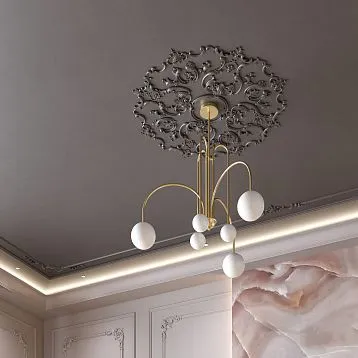
CPU-P4 Molding Decor Kit
1,364.53 $


 5-10 days
CPU-P5 Molding Decor Kit
951.96 $


 5-10 days
CPU-P6 Molding Decor Kit
1,163 $


 5-10 days
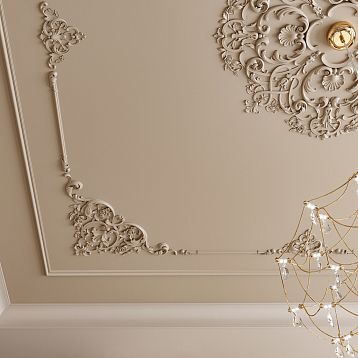
Molded decor set CPU-P7
1,877.58 $
Application Gallery
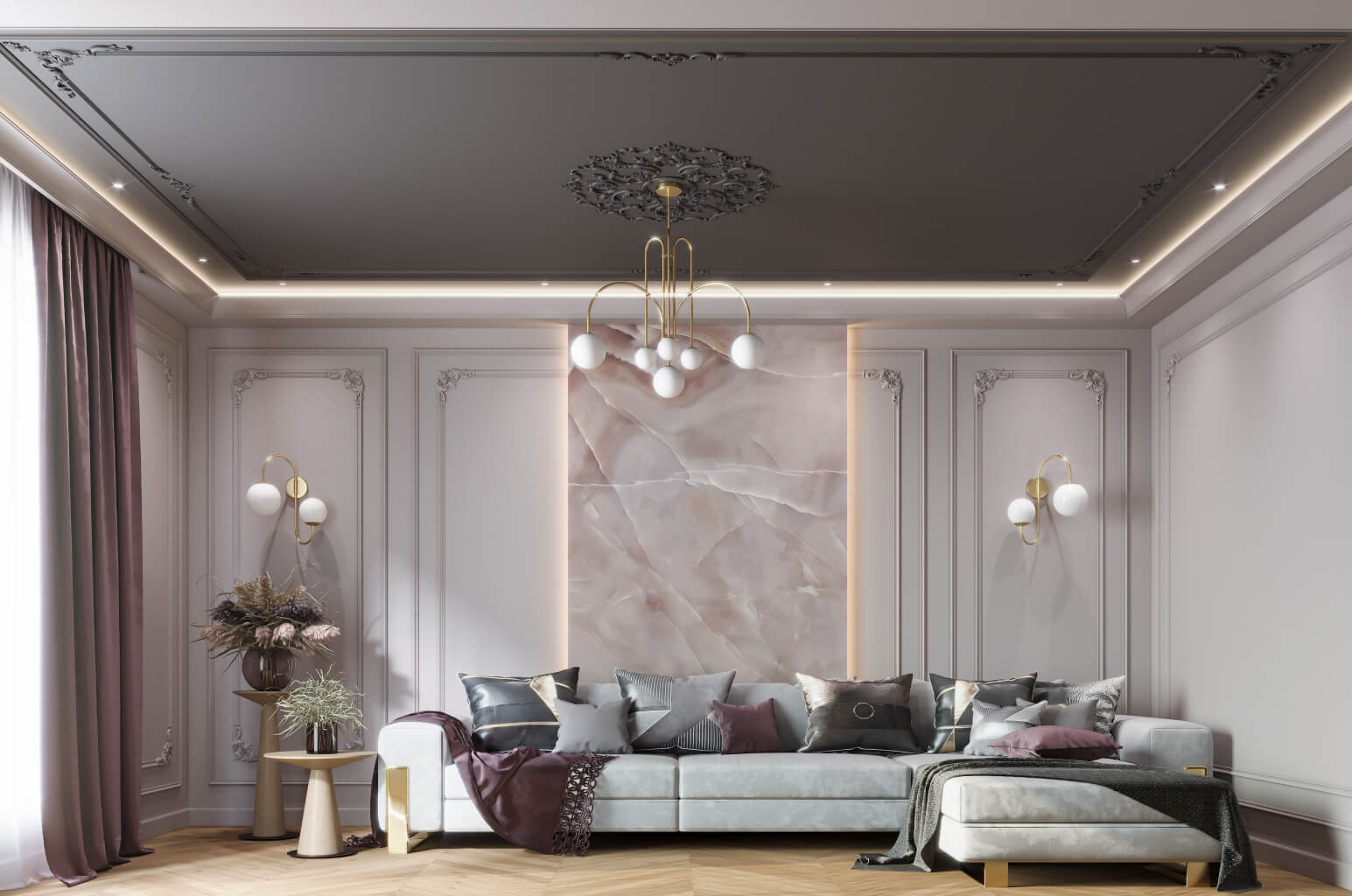
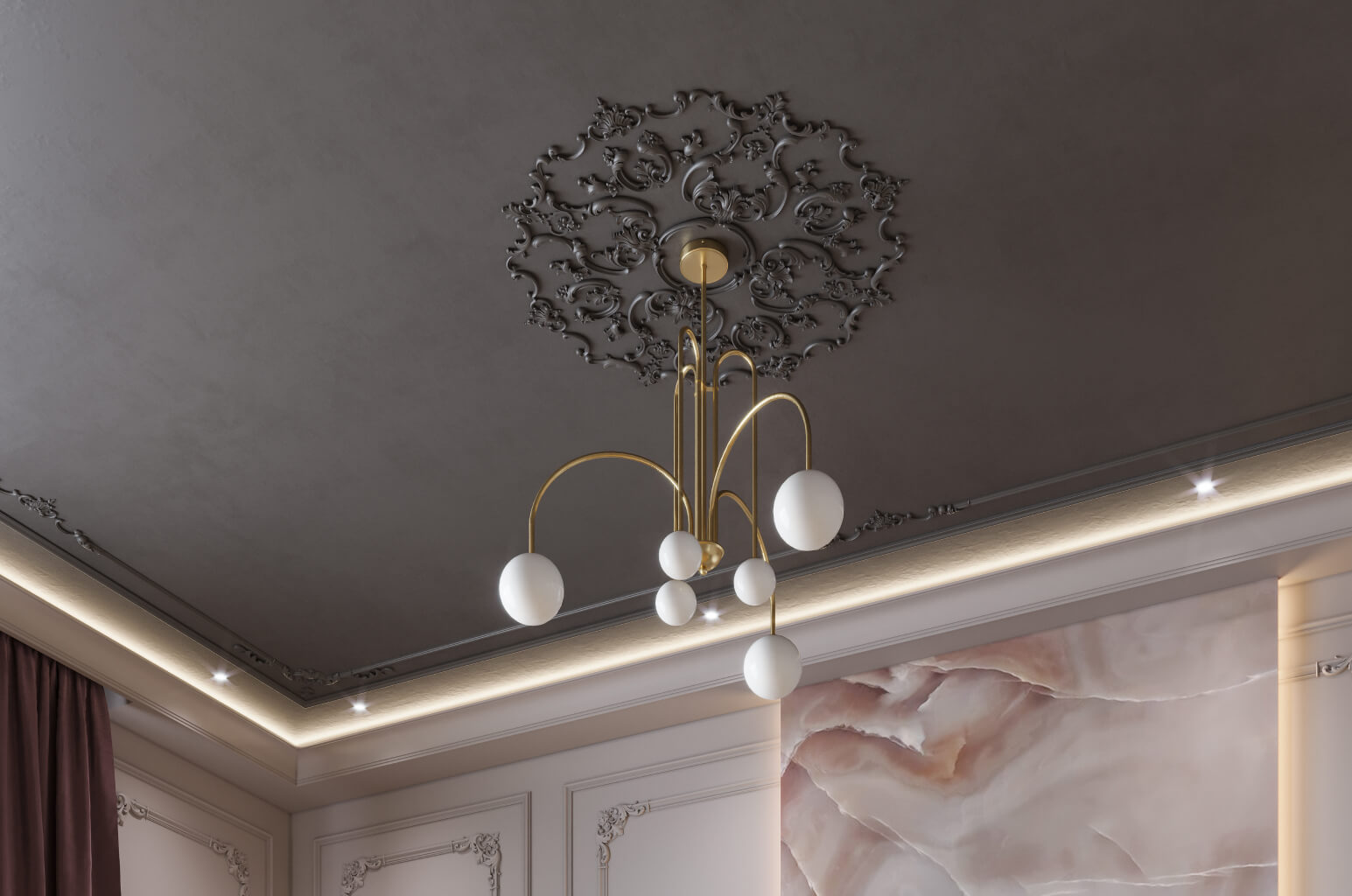
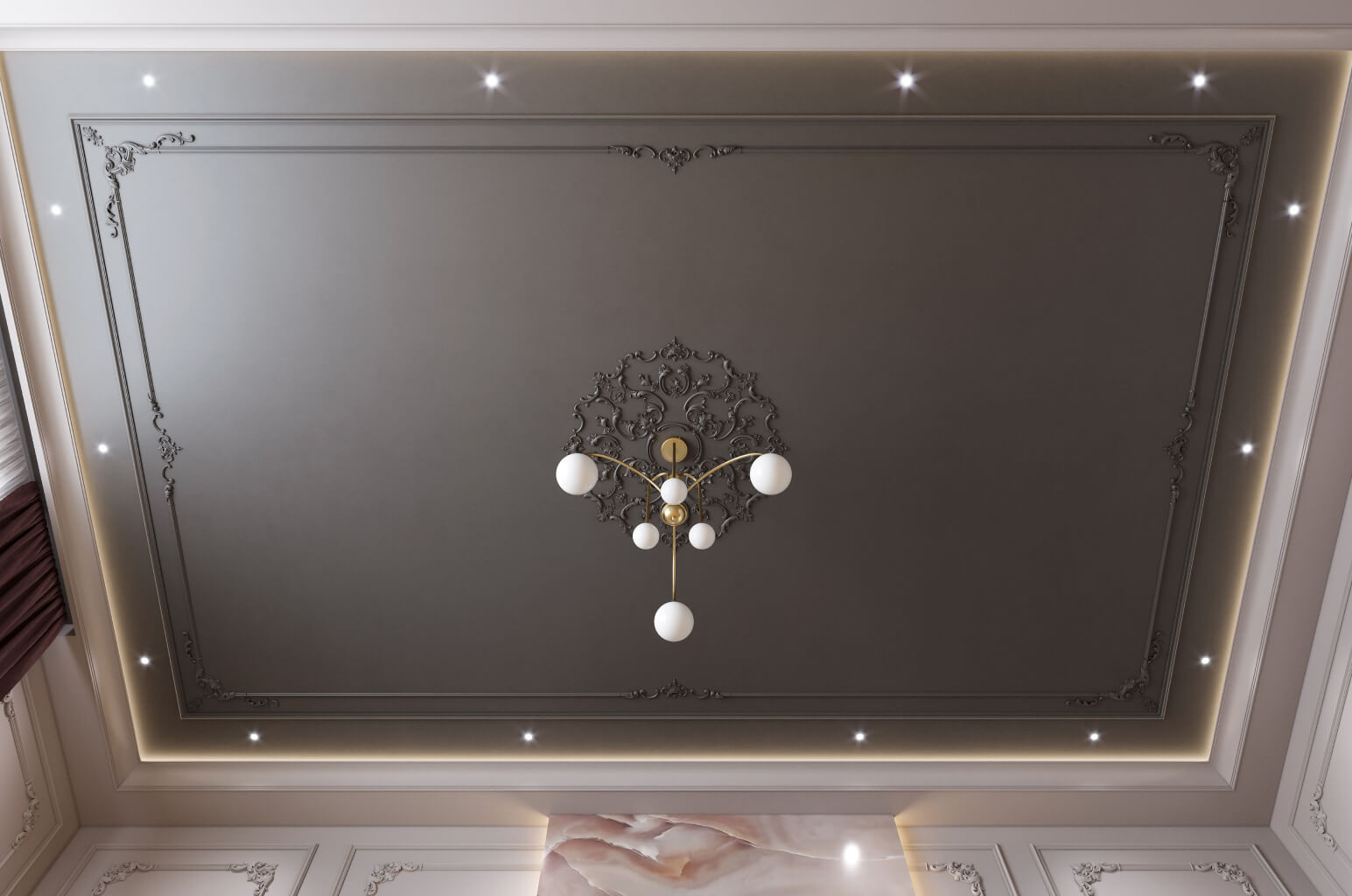
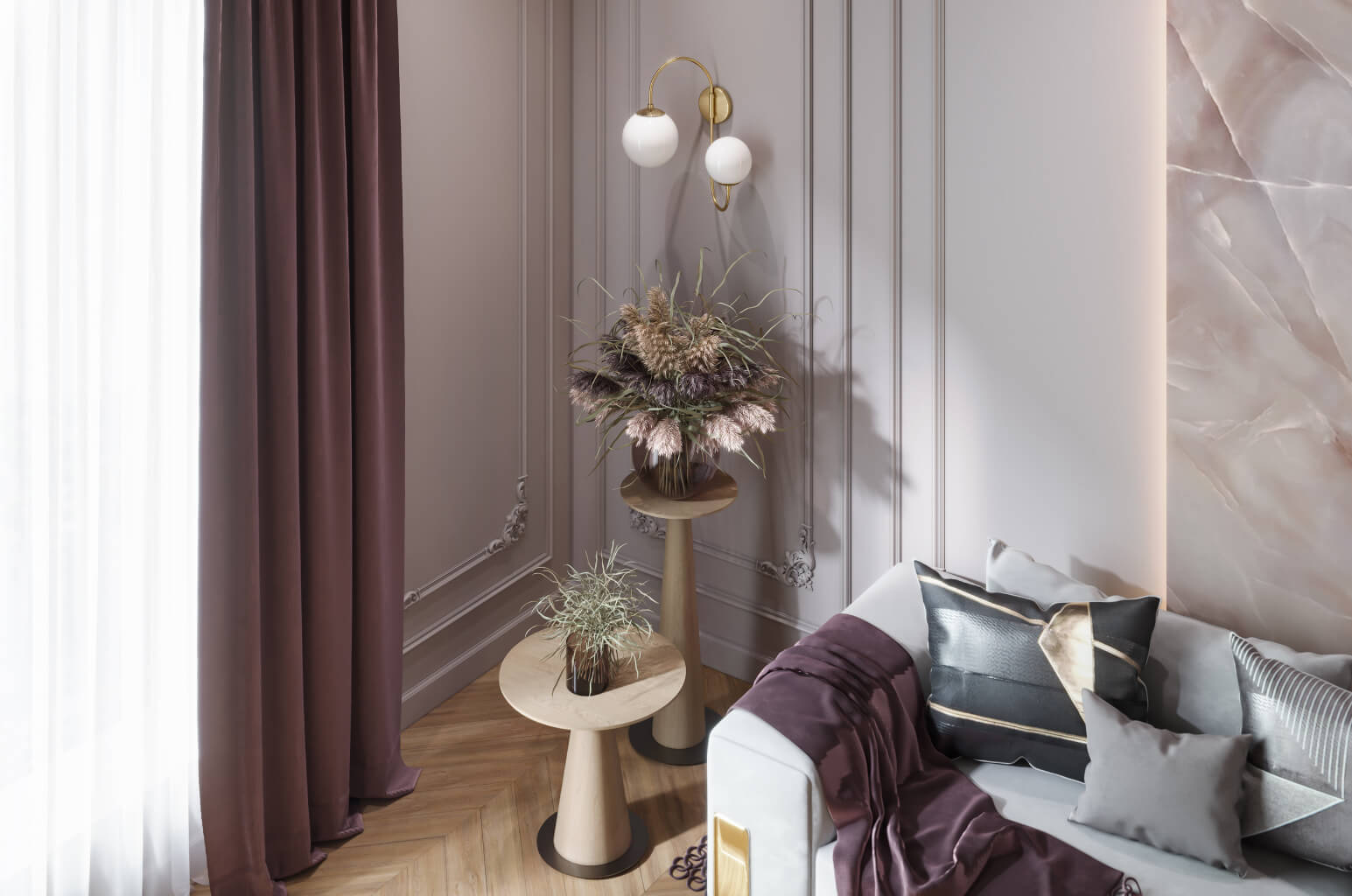
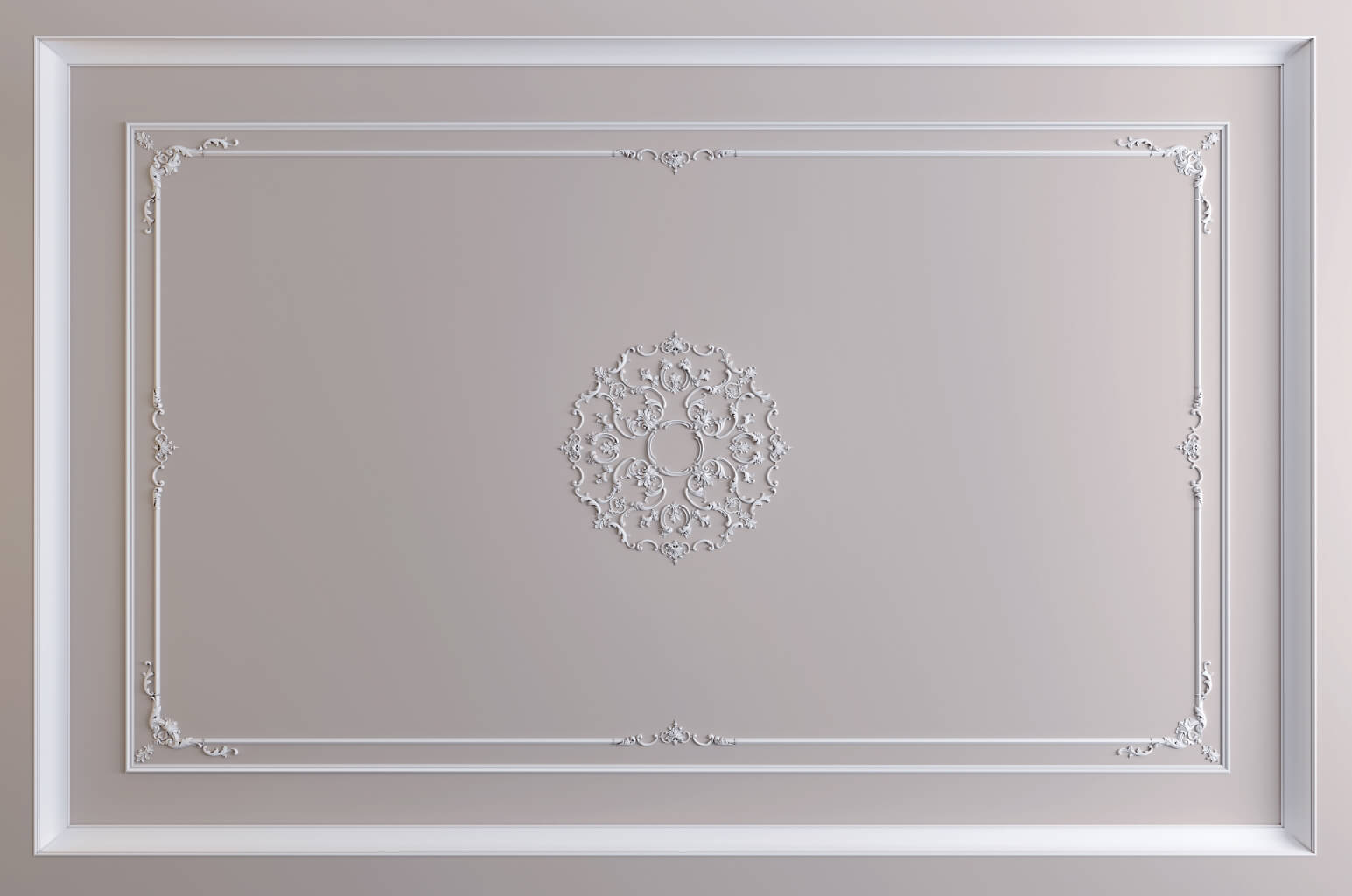
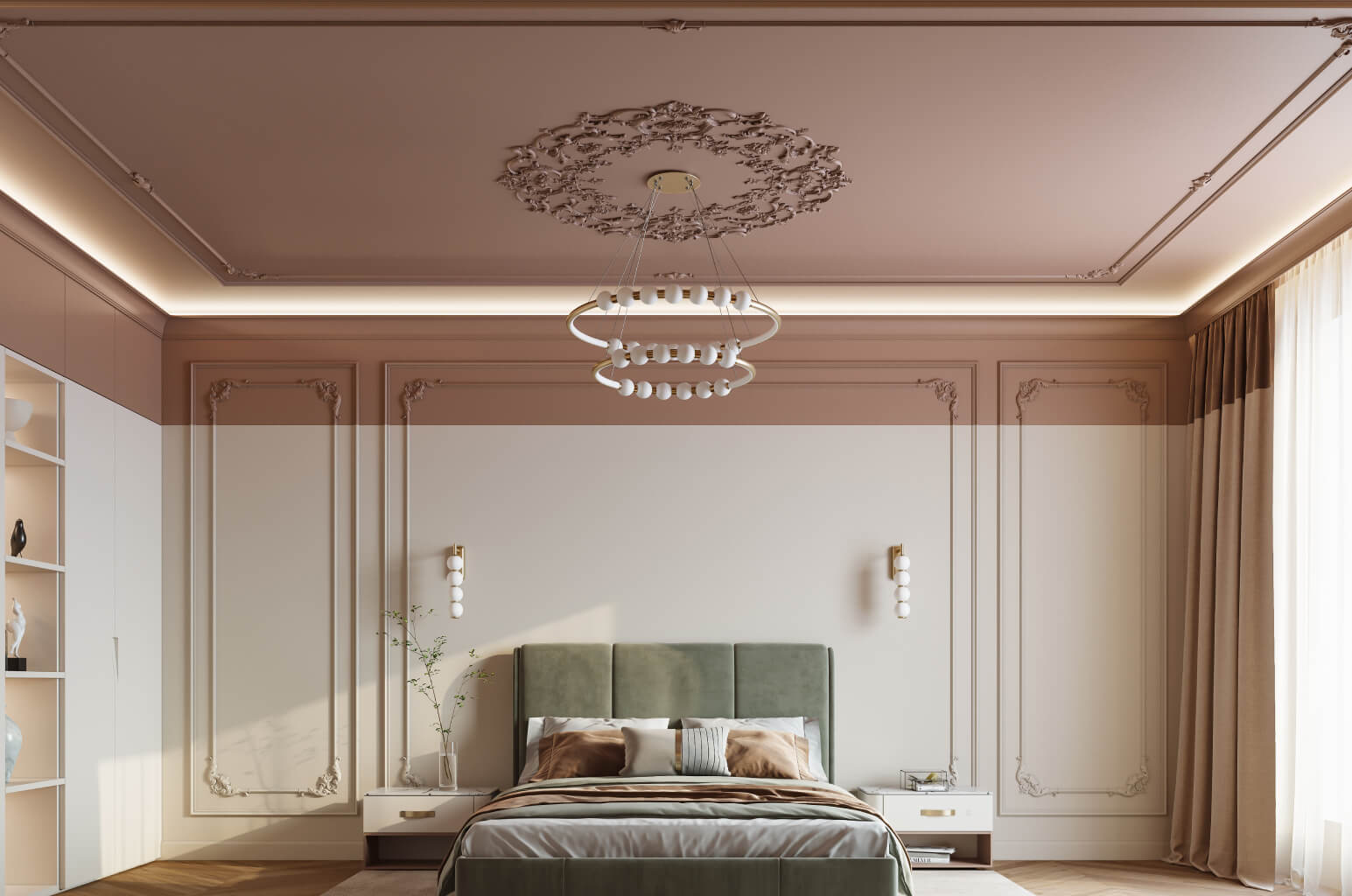
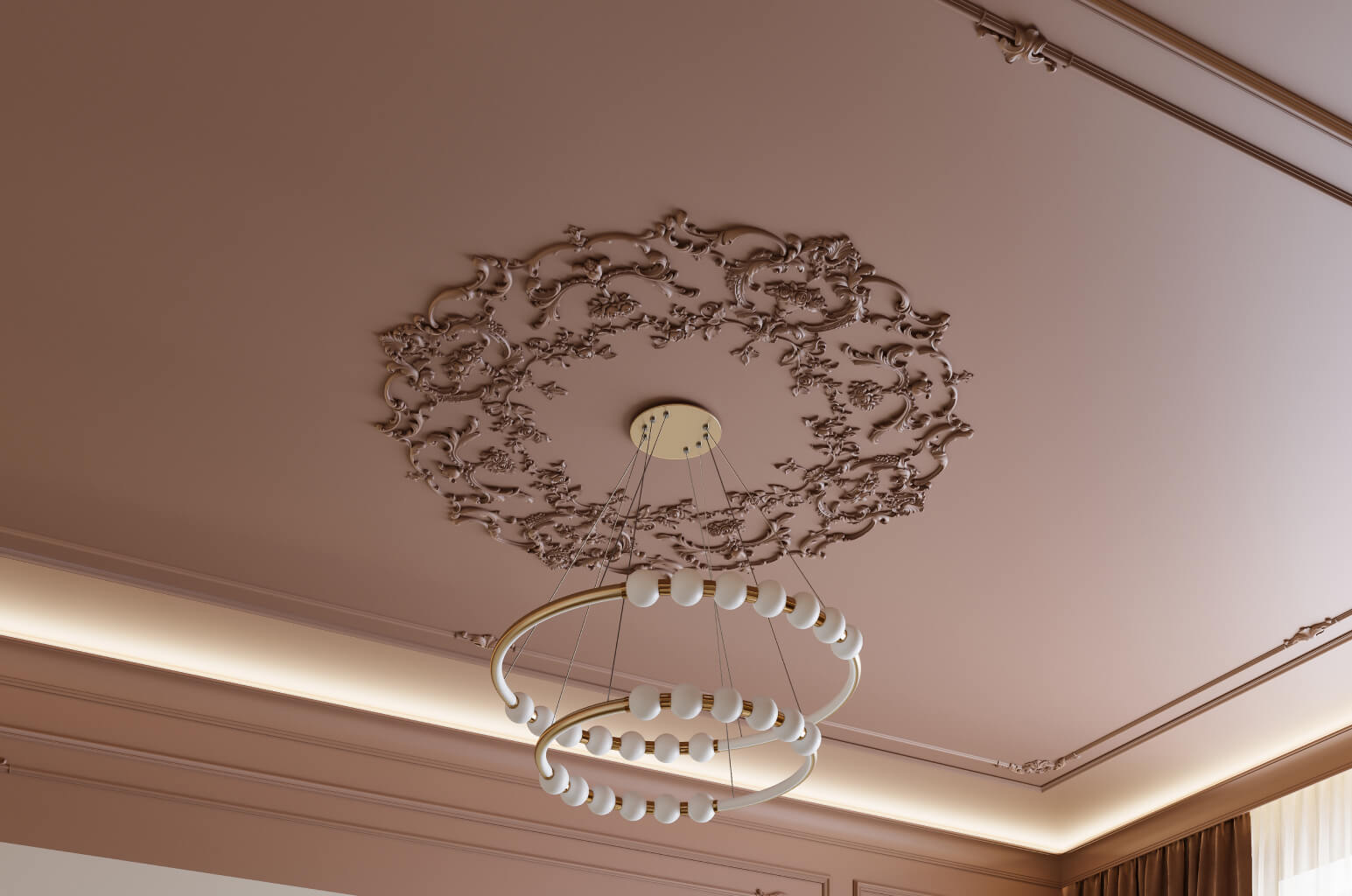
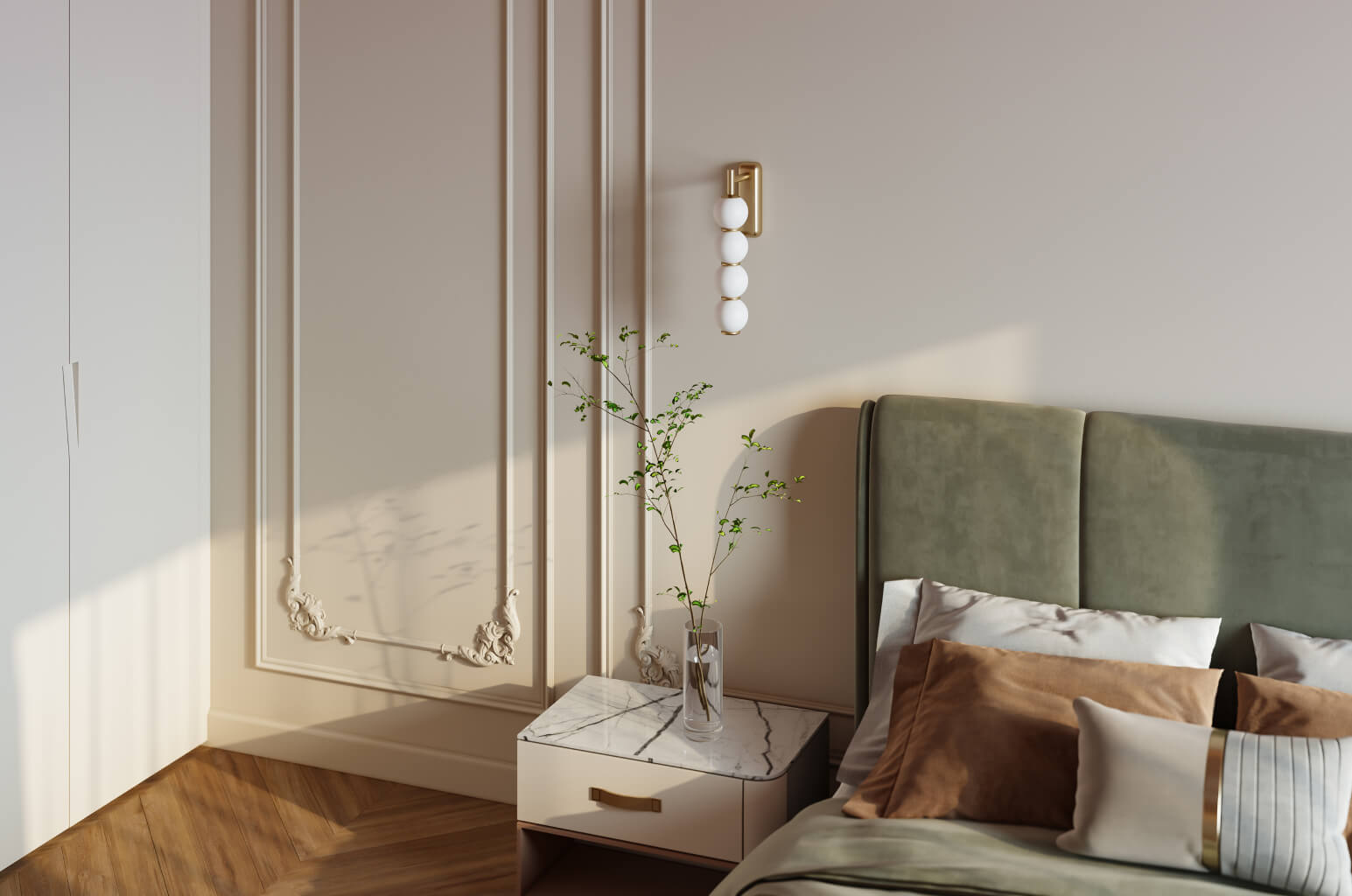
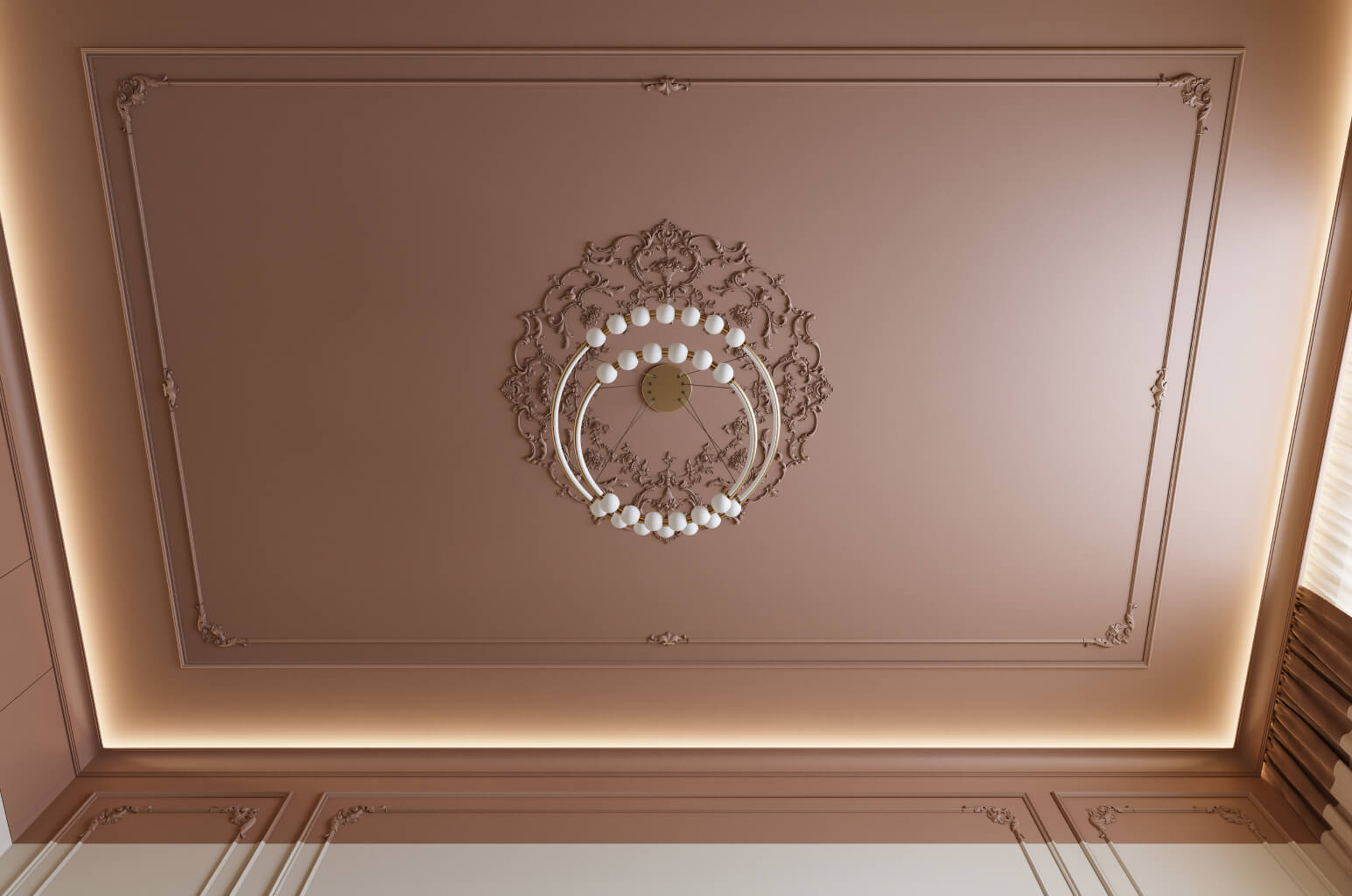
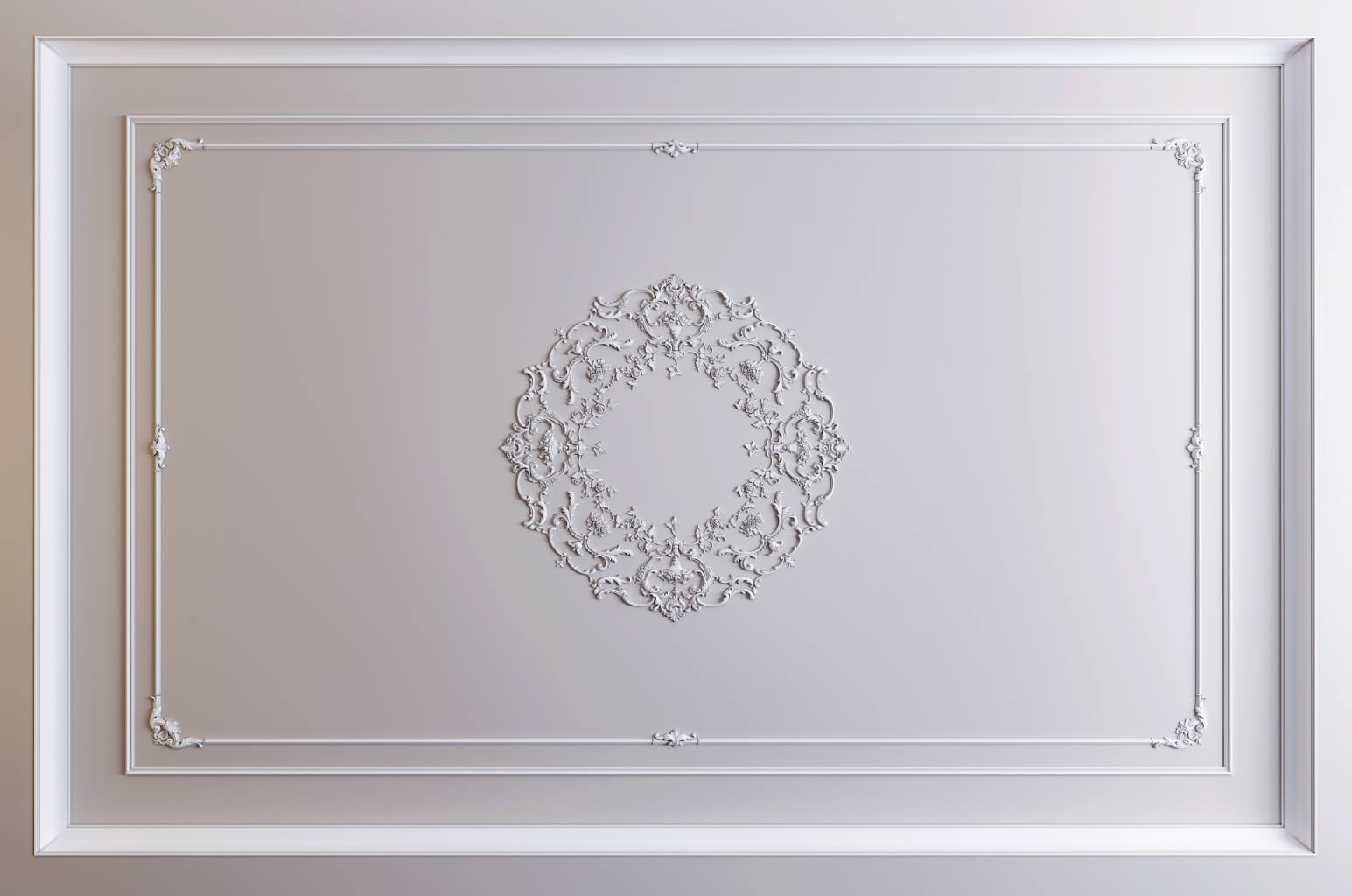
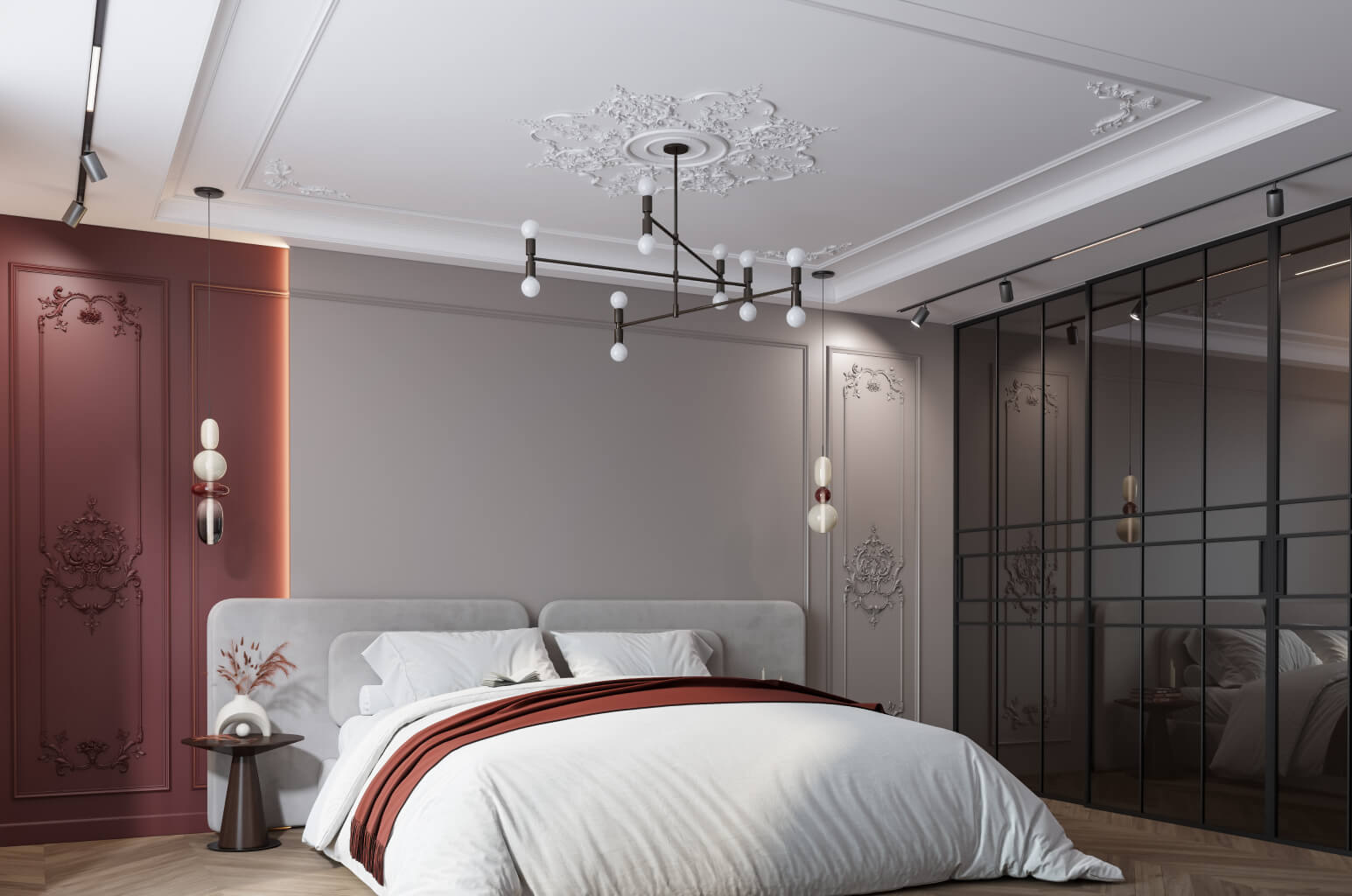
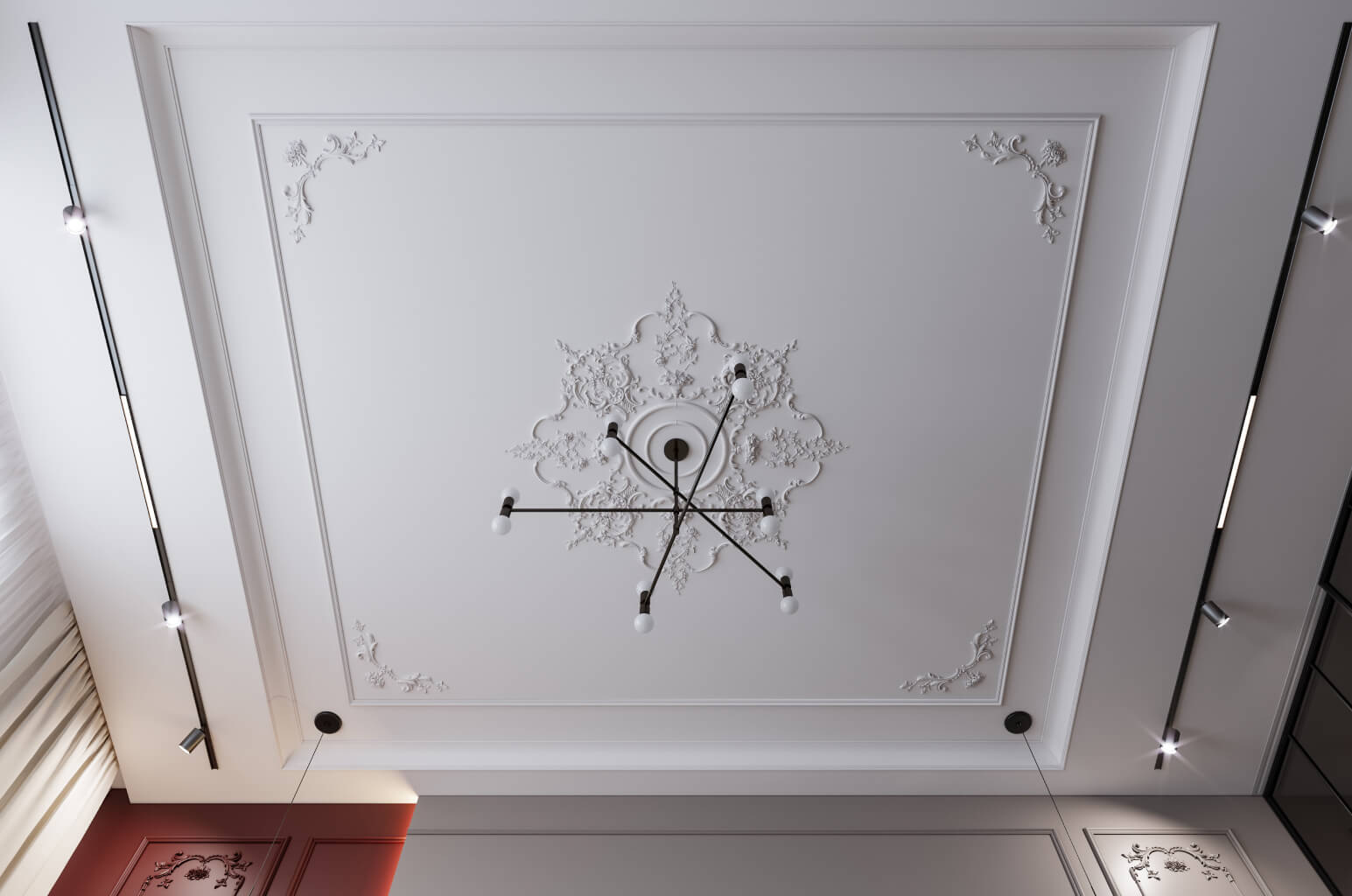
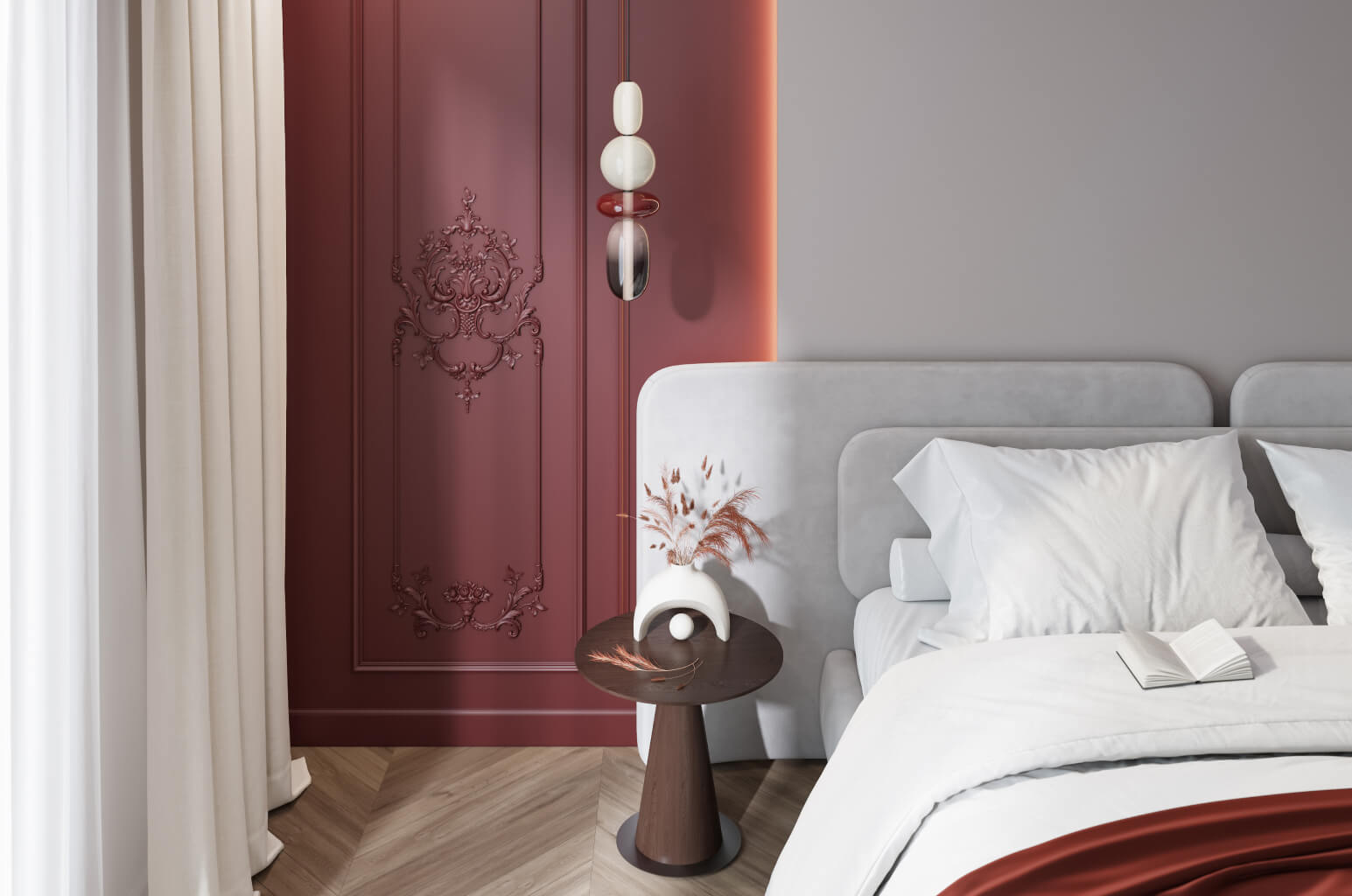
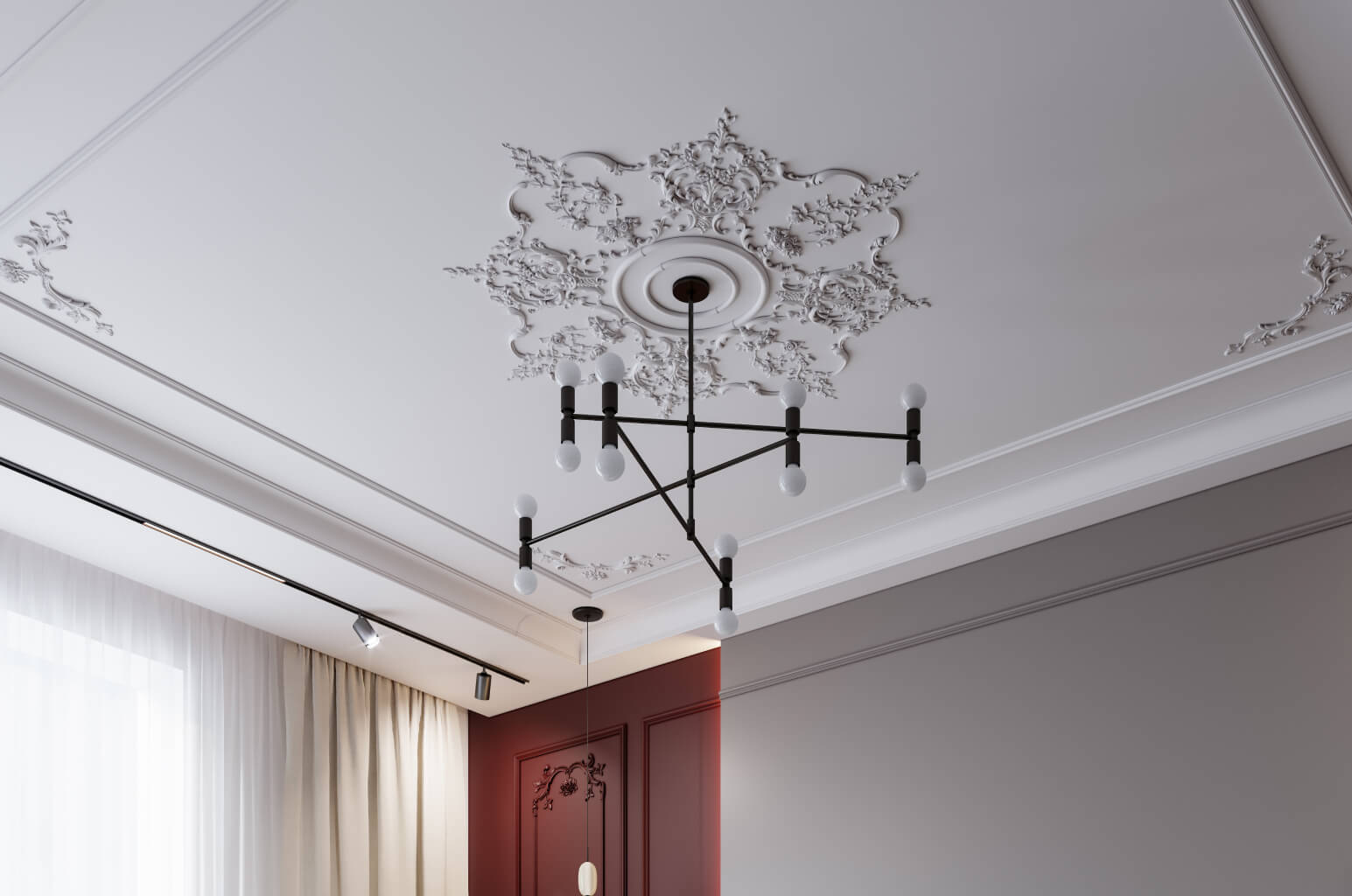
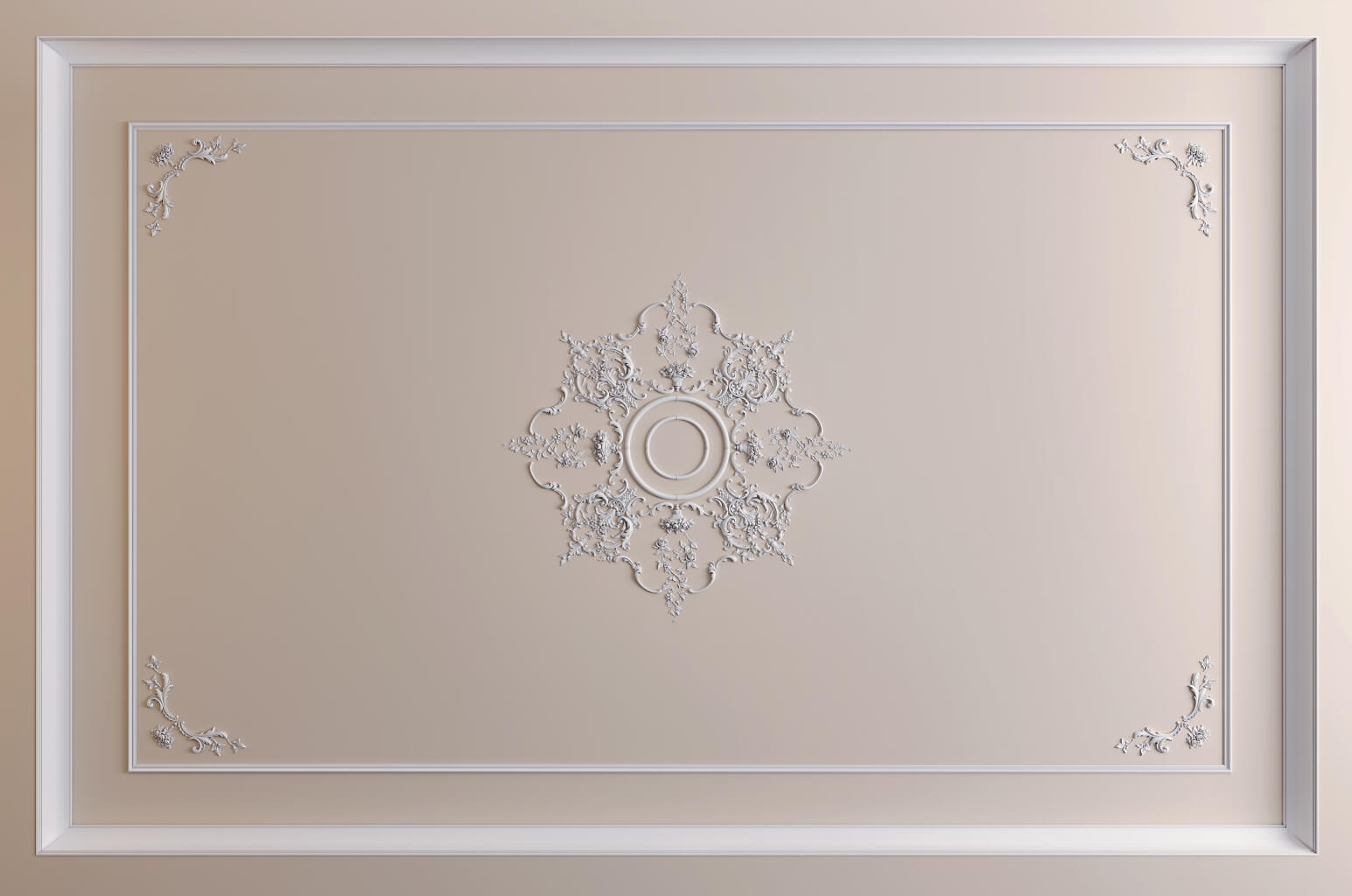
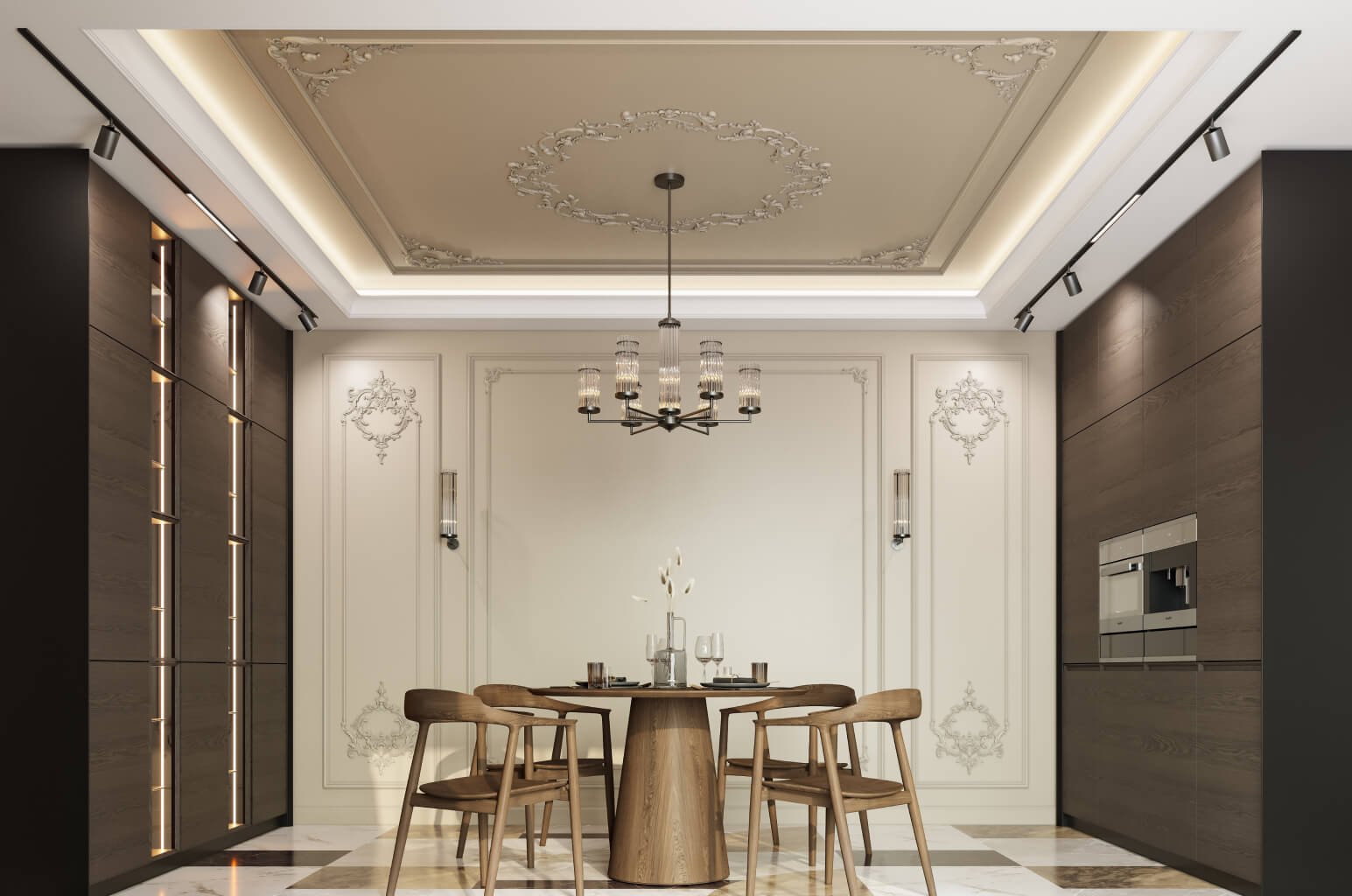
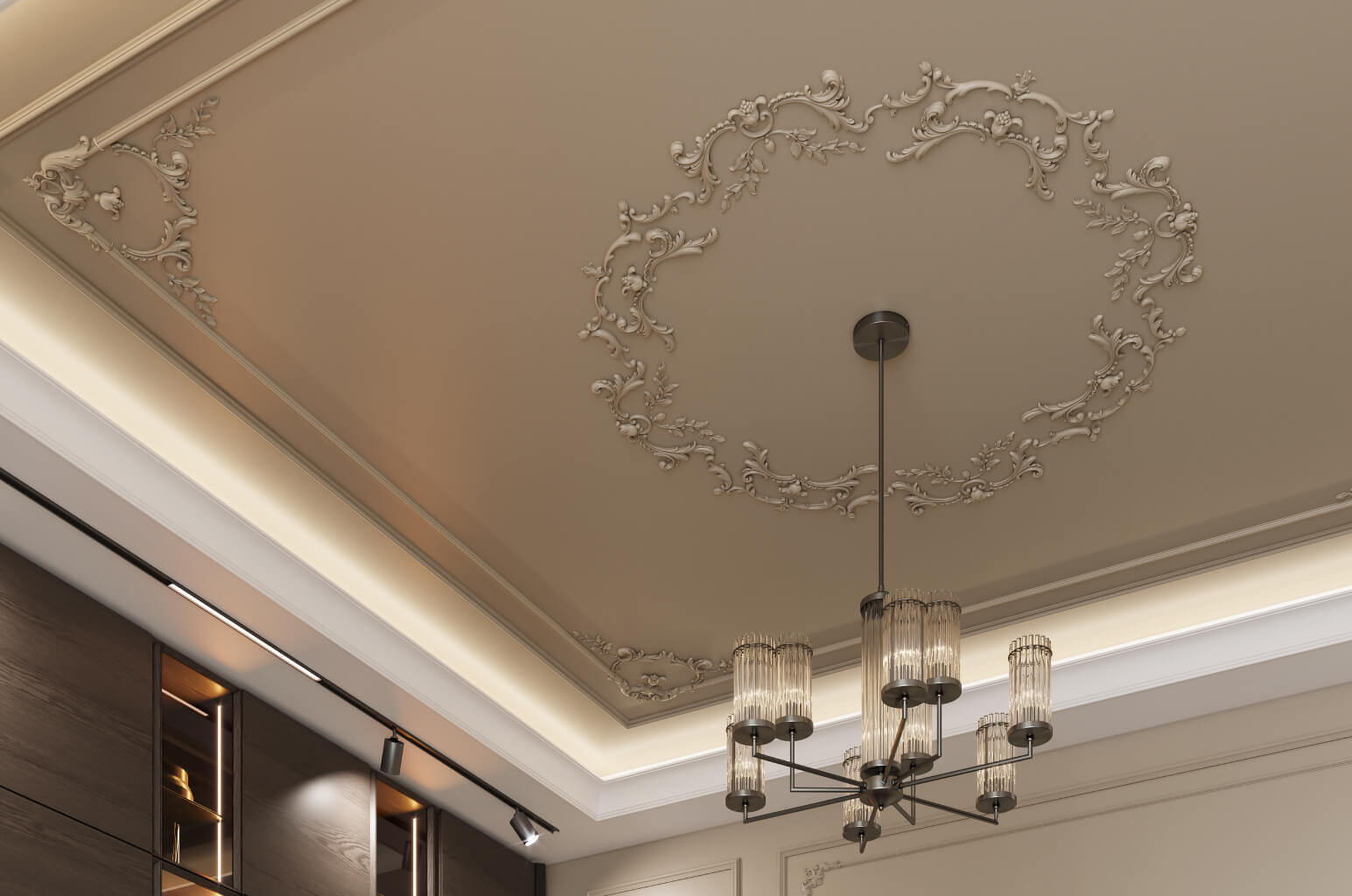
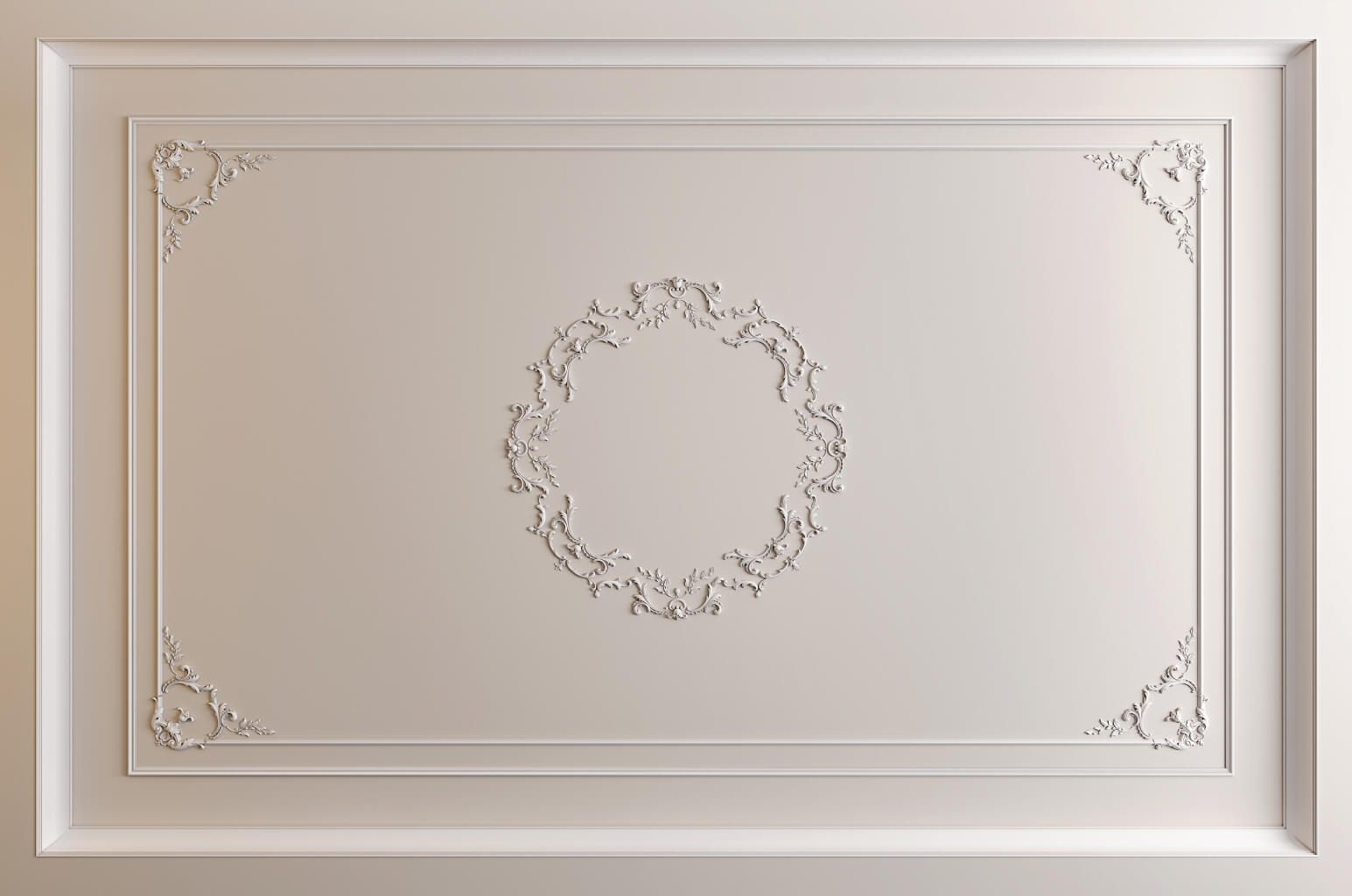
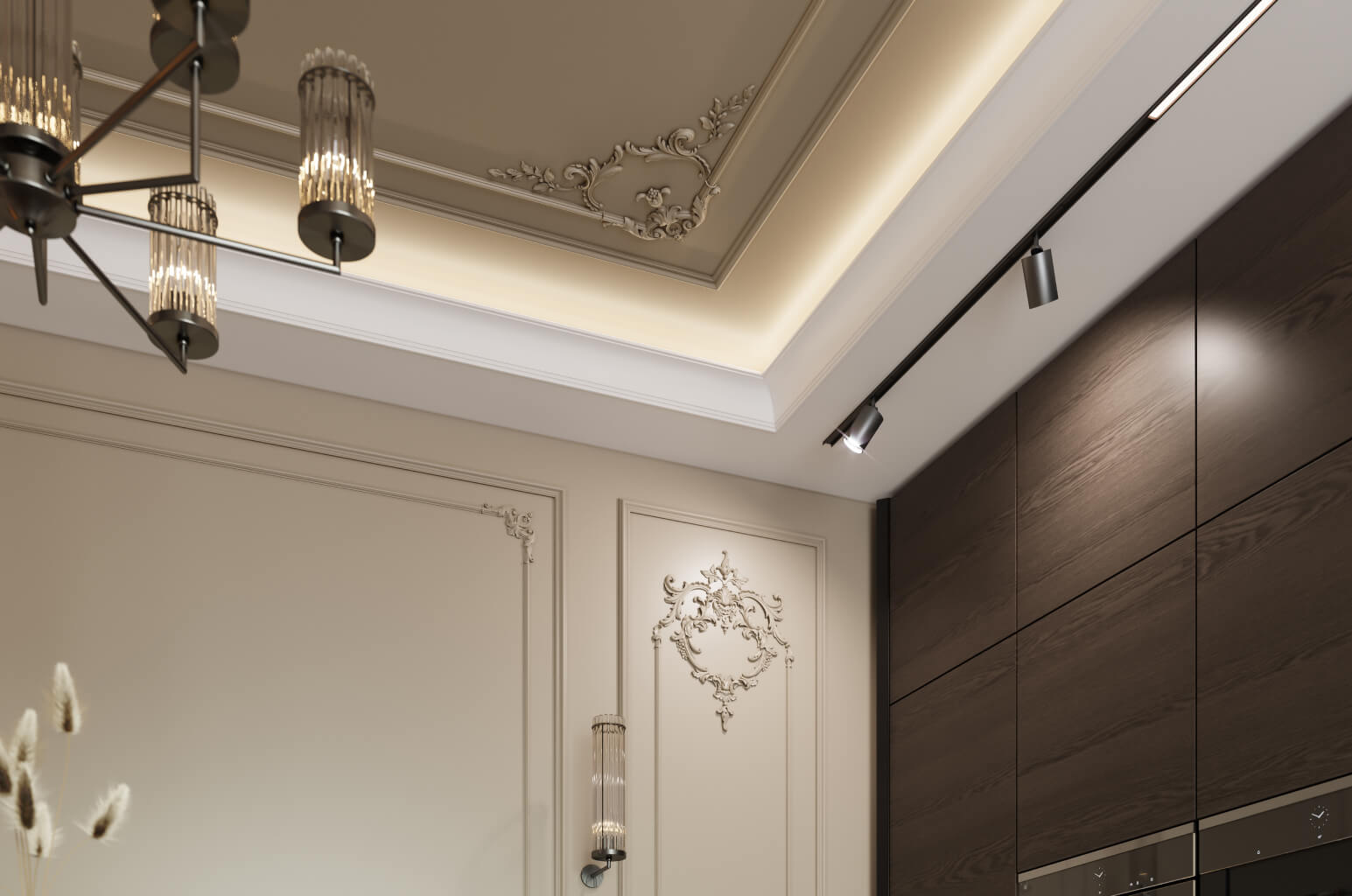
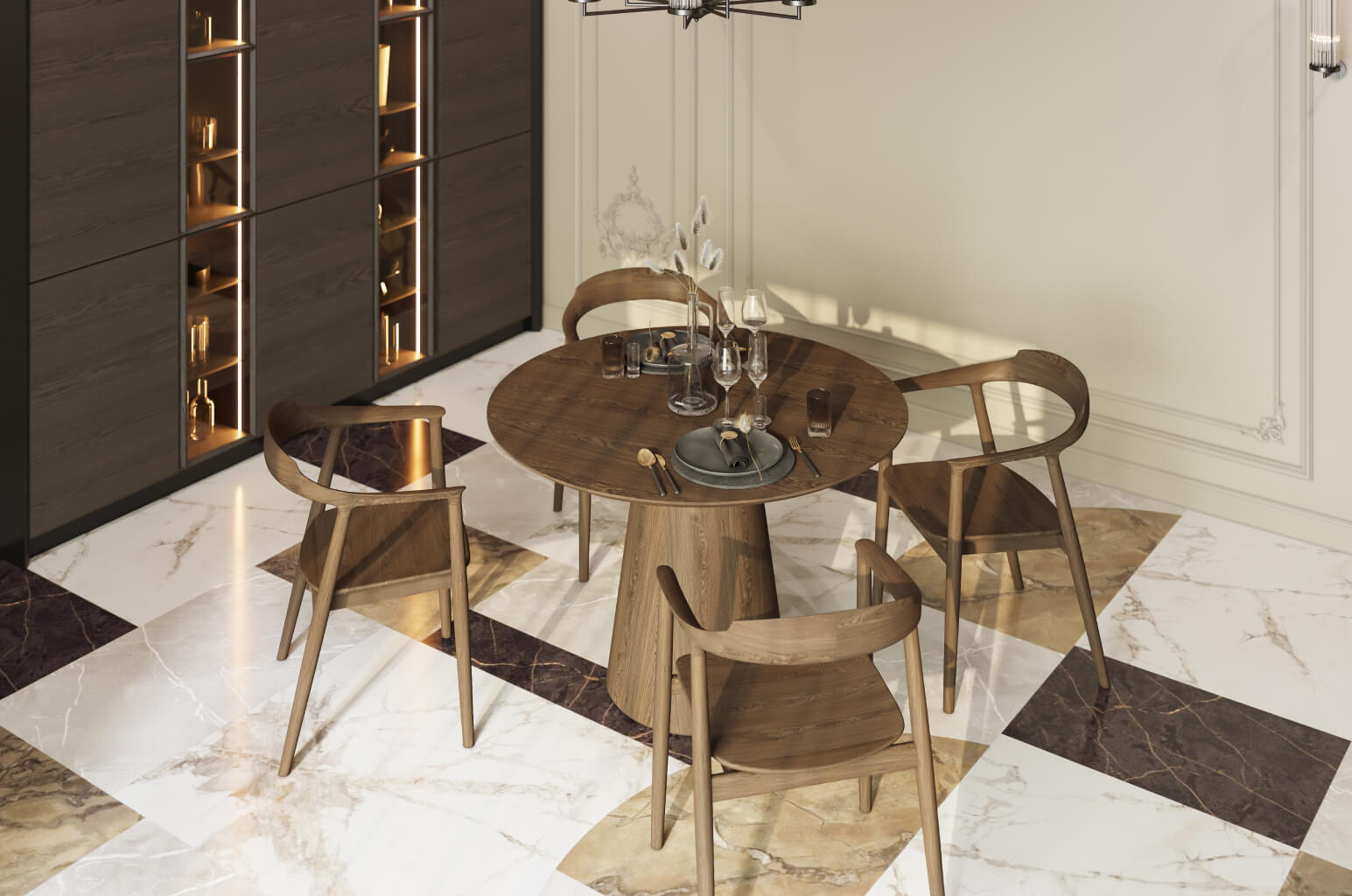
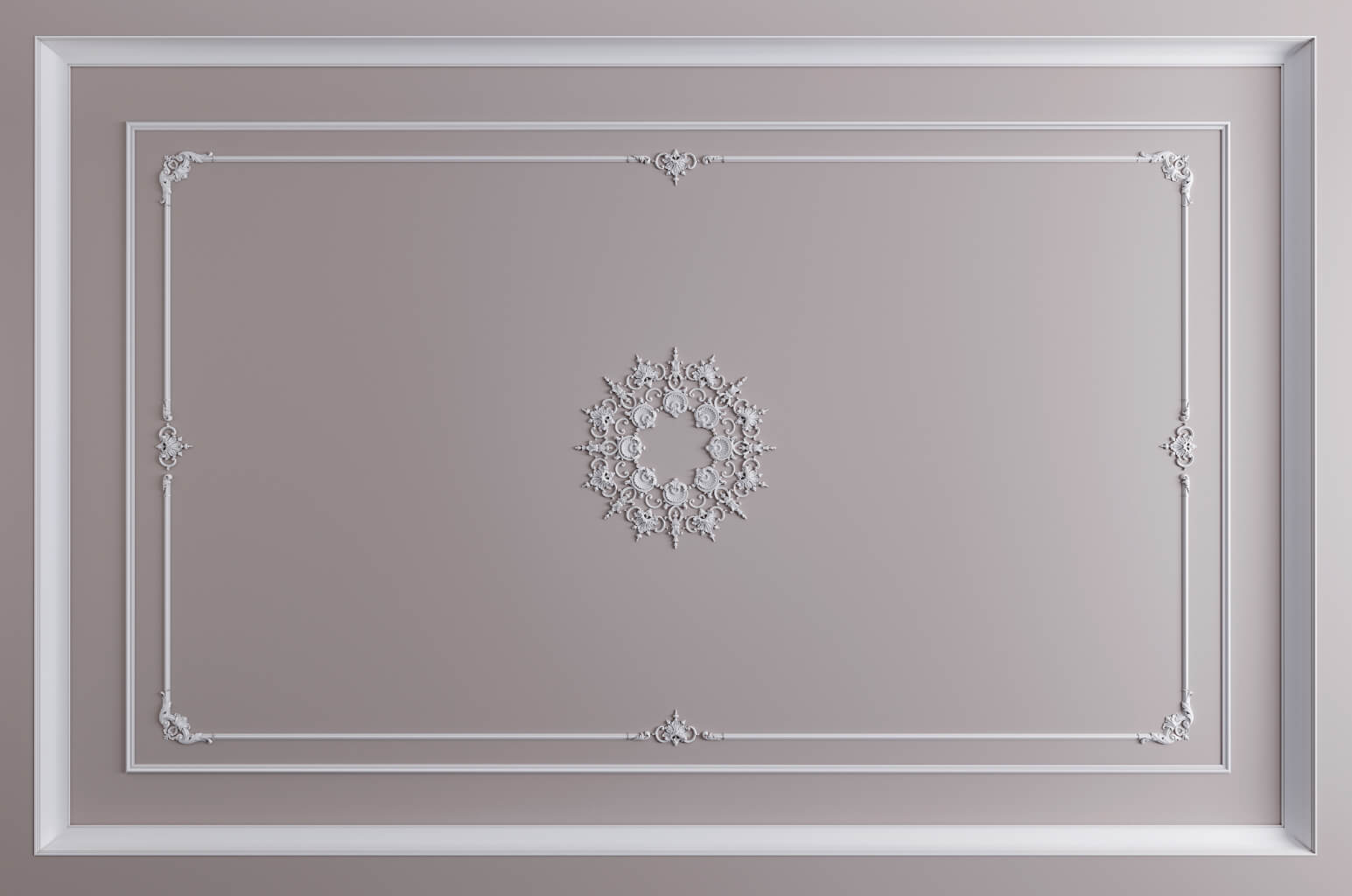
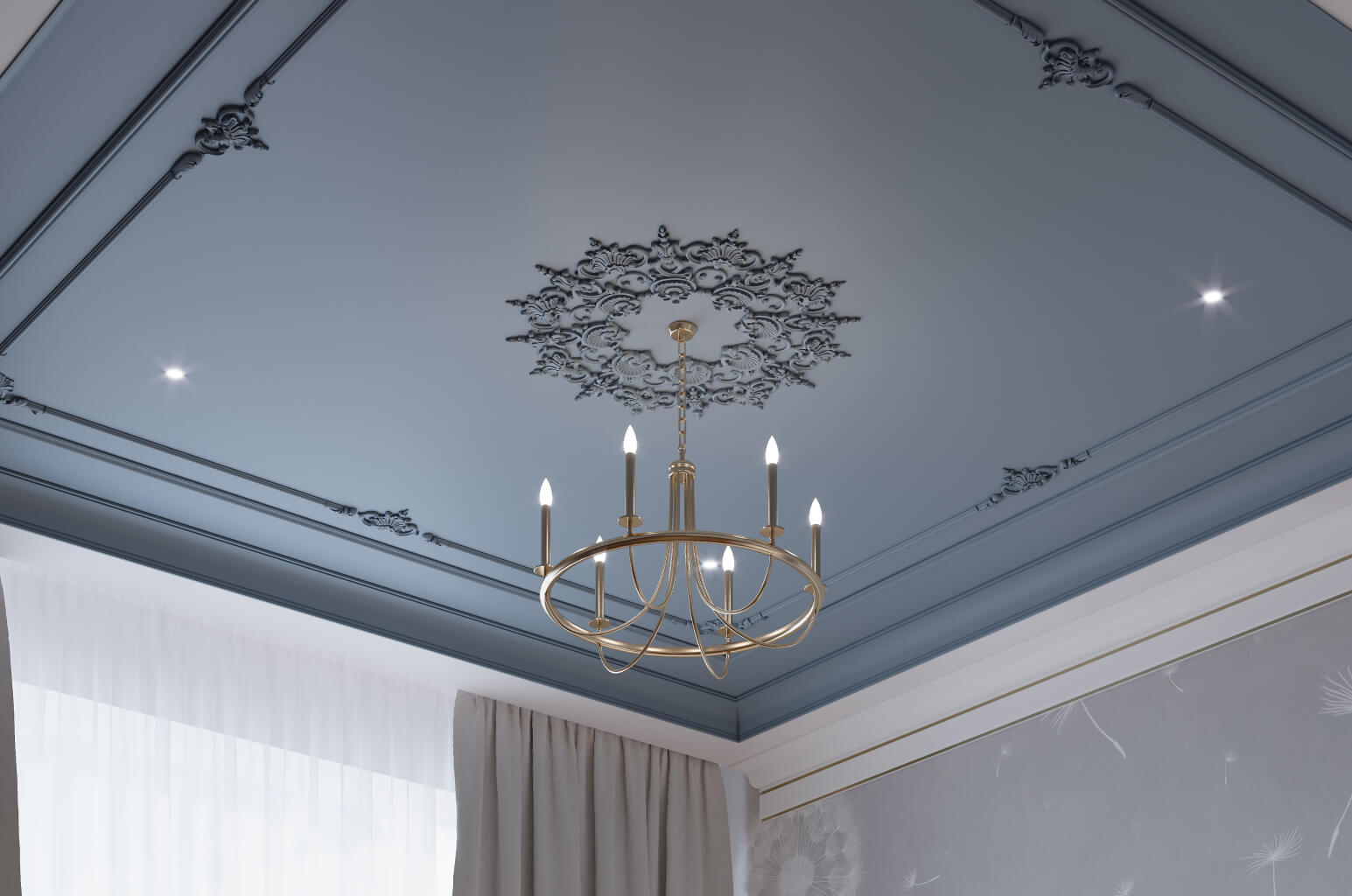

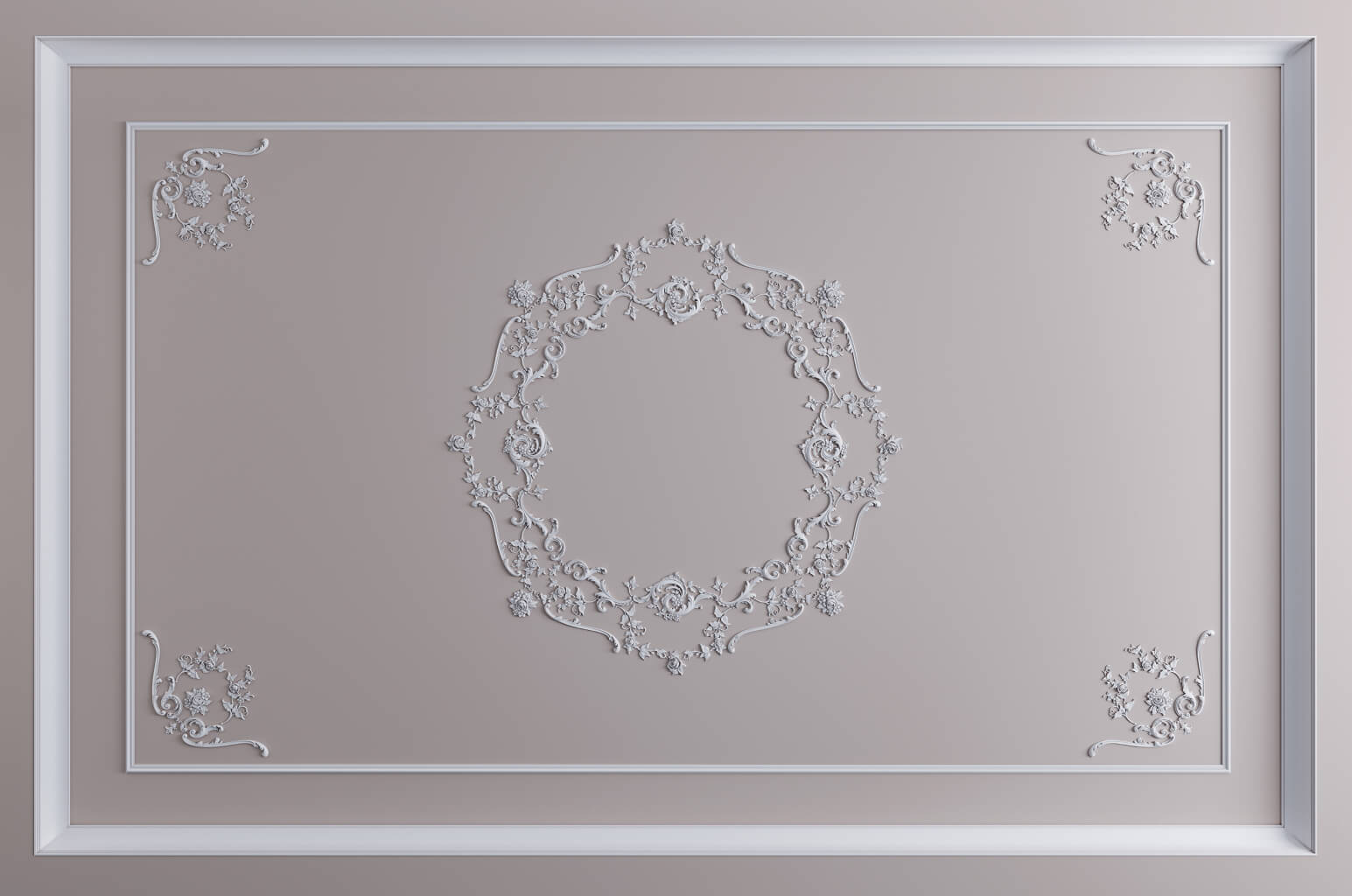
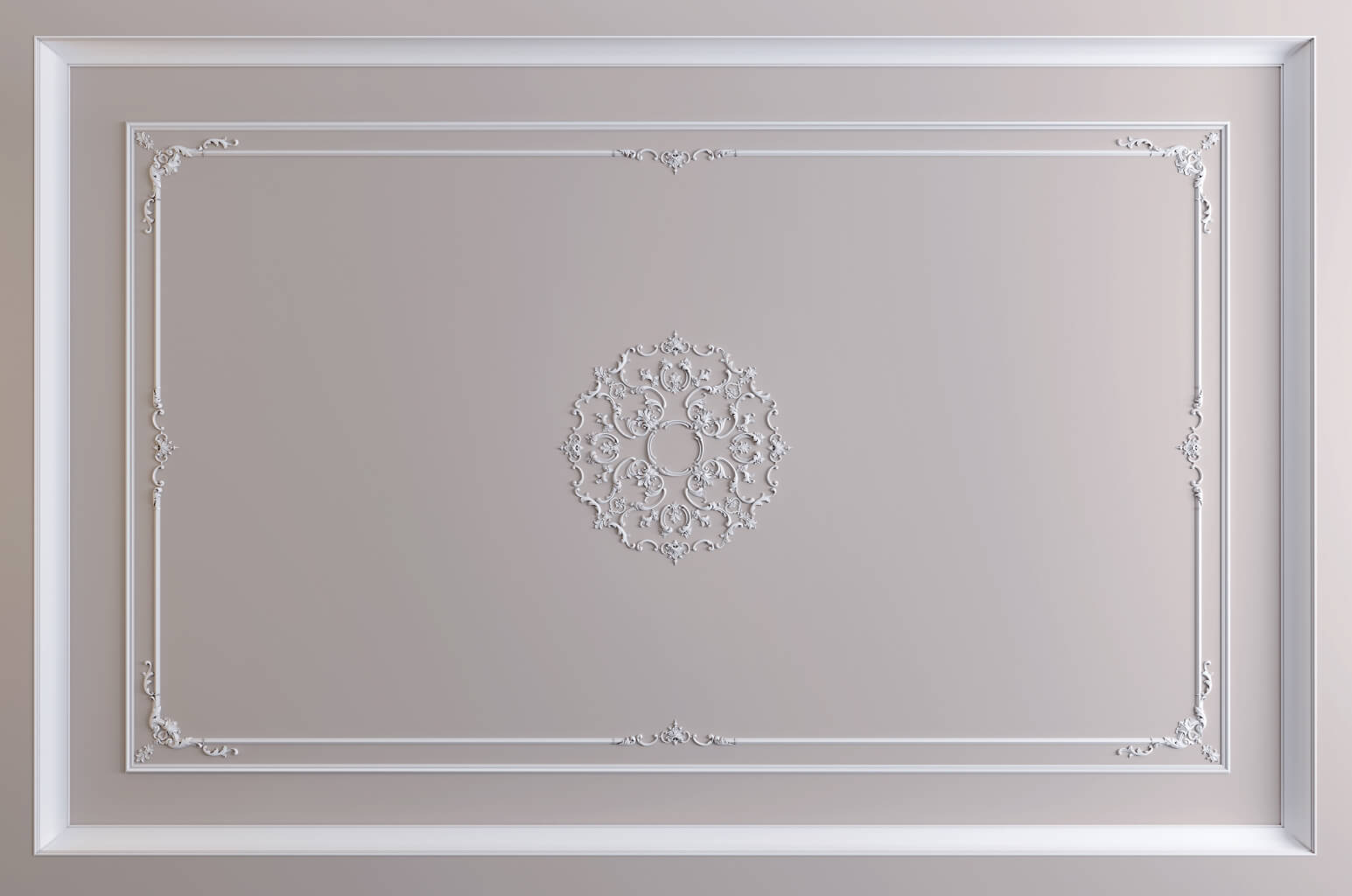
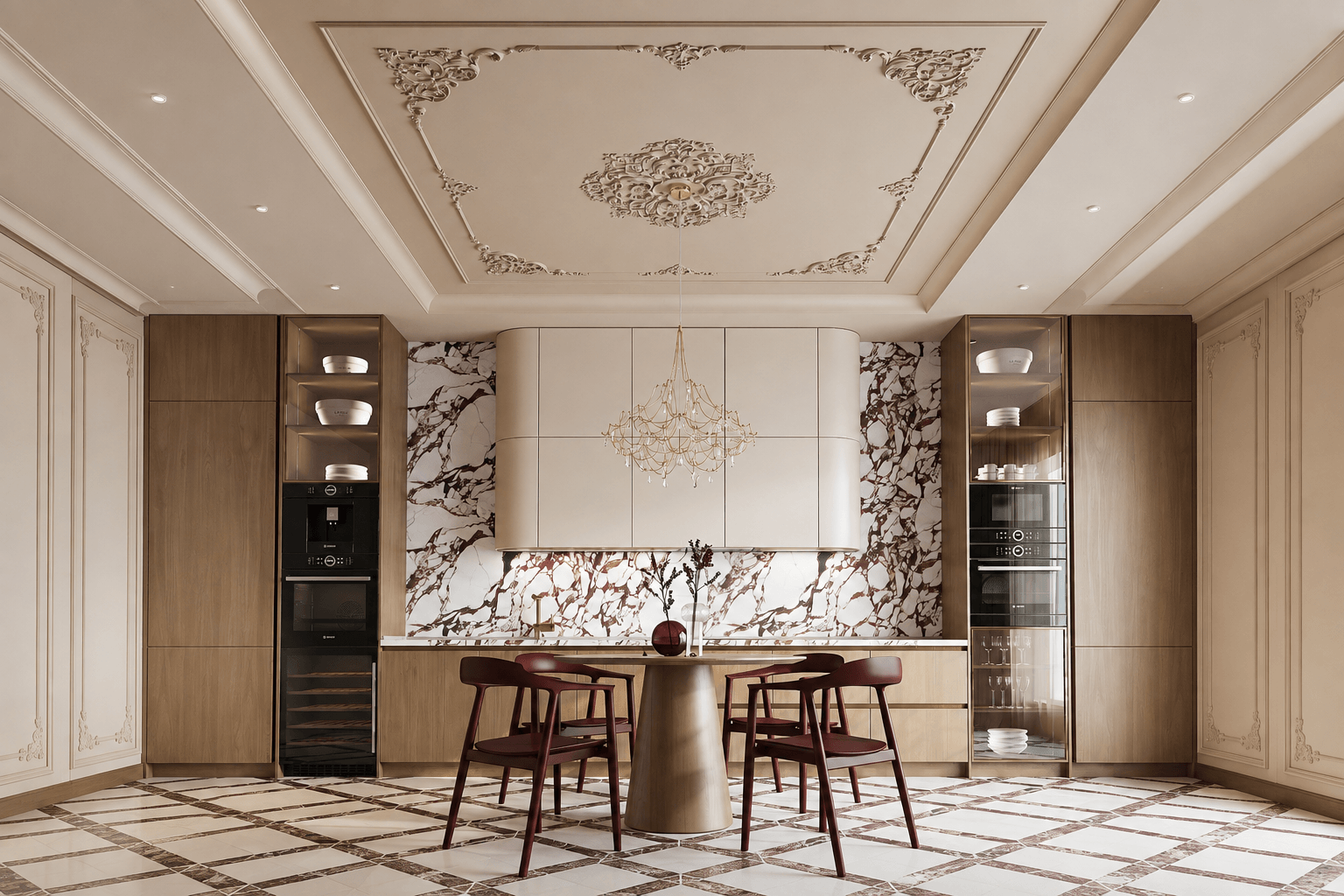
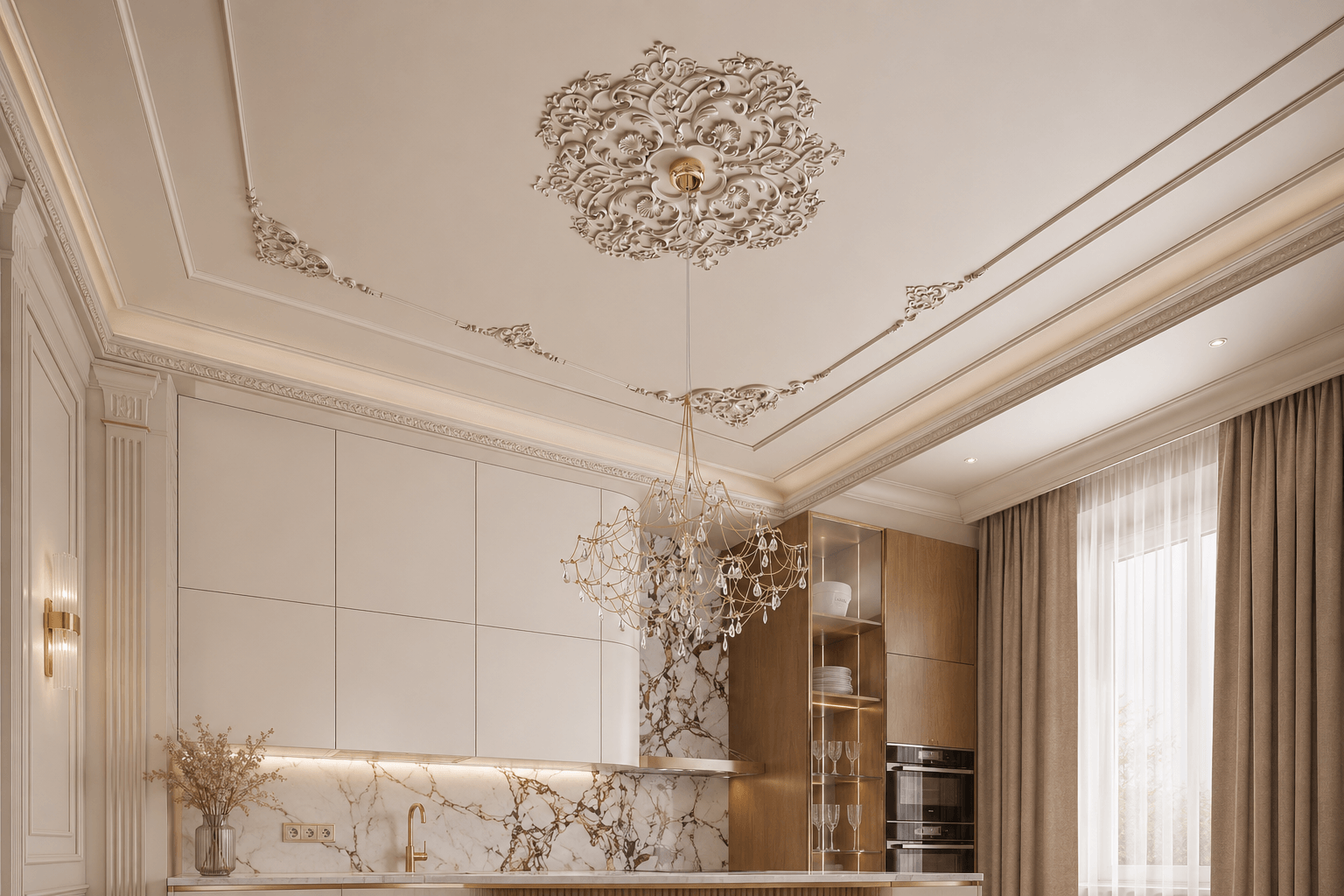
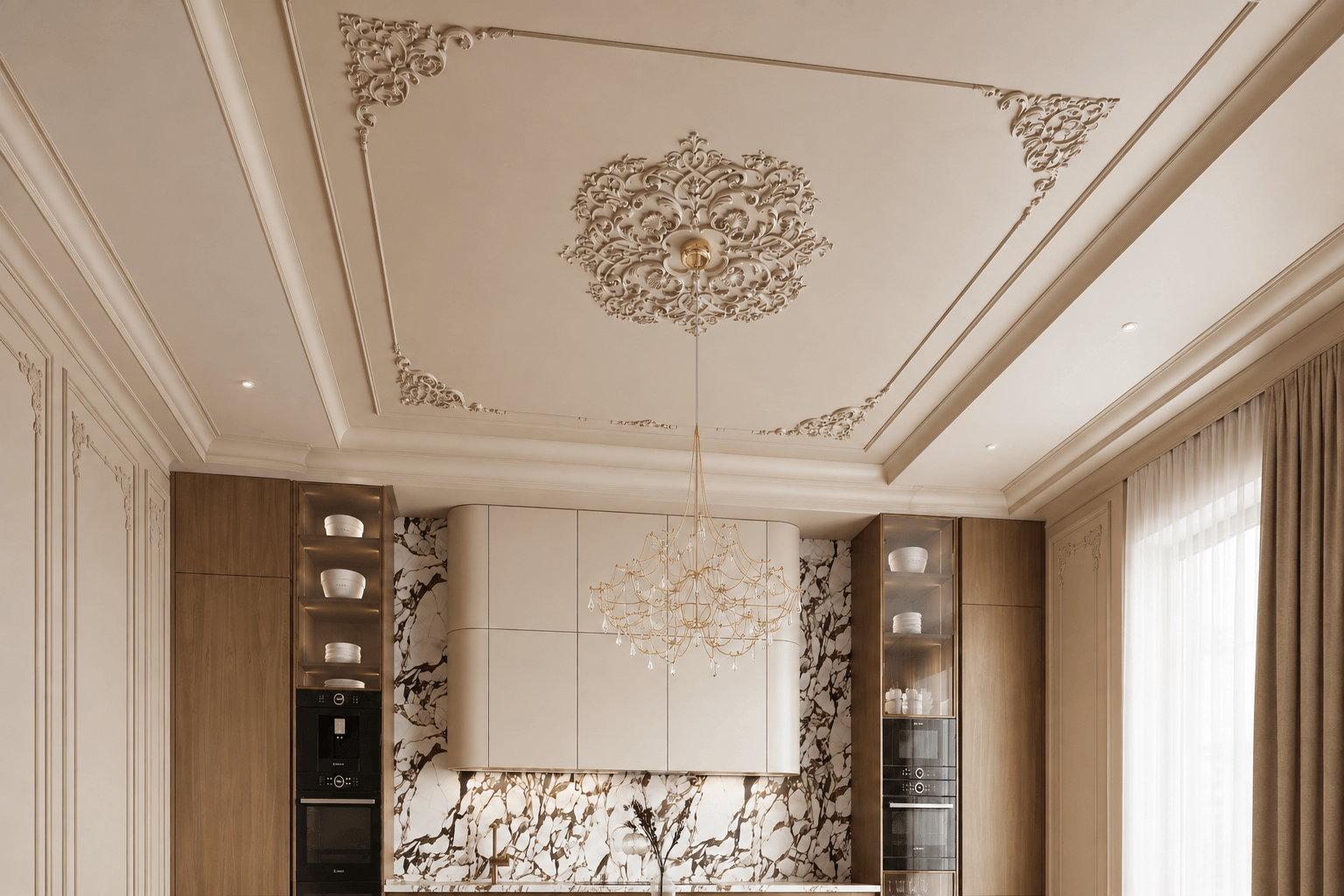
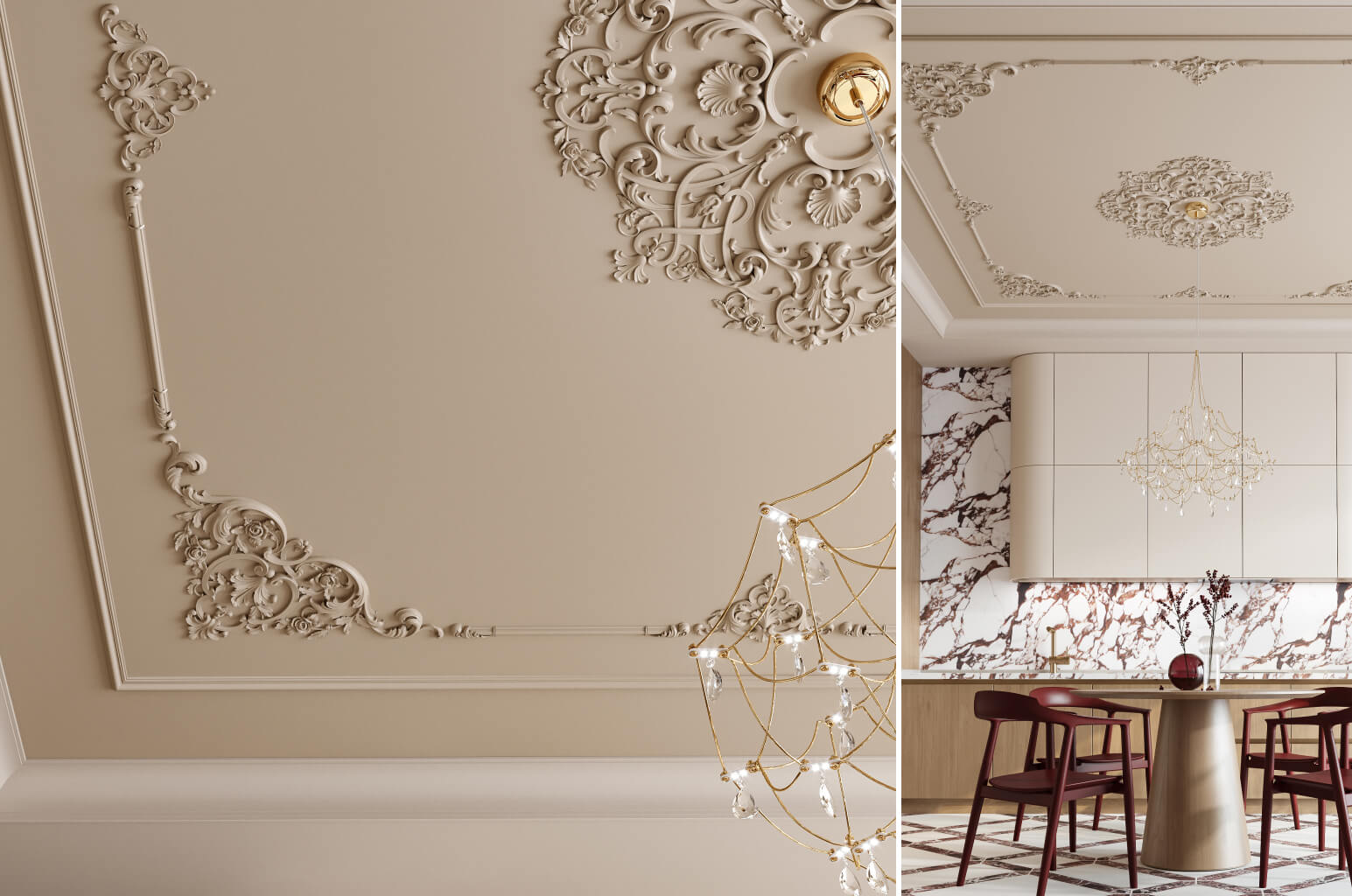
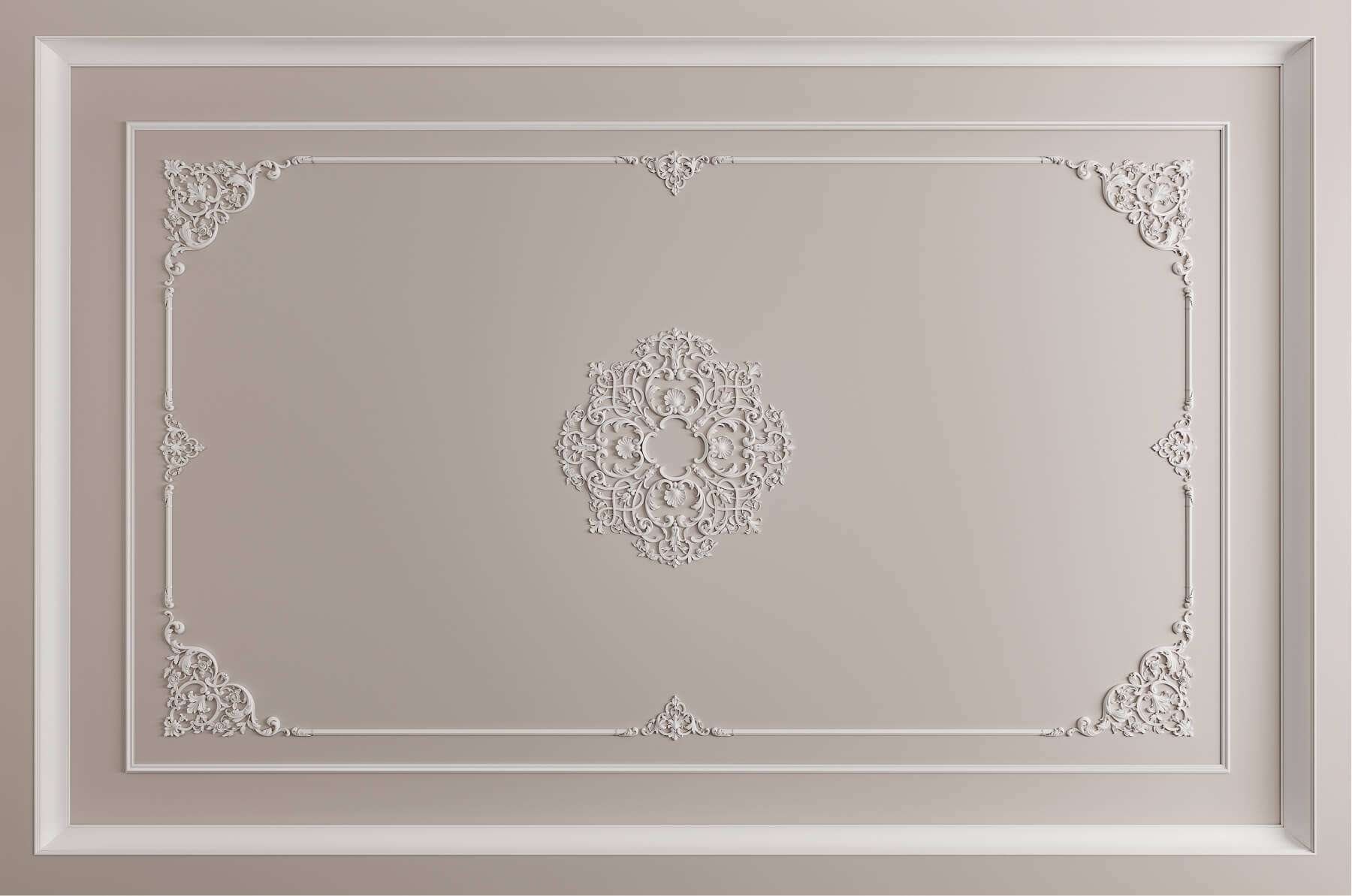
Ceiling Decor: Ready-made polyurethane stucco decor sets for classical and neoclassical interiors
The ceiling is the only surface in a home that cannot be ignored. You can turn your back on a wall. The floor is hidden by furniture. But the ceiling is always above you — in every corner of the room, under any lighting, at any time of day. It defines the feeling of space more than any other interior element. And yet, it is most often the 'blank spot' in design — both literally and figuratively.
If you are looking forceiling decor— you have already drawn the right conclusion: the ceiling deserves as much architectural attention as the walls, floor, or furniture. This section of STAVROS presents ready-made stucco decor sets from the 'Classic' collection — from laconic solutions for intimate rooms to monumental multi-level systems for formal spaces. All sets are made of polyurethane and dense HIWOOD polystyrene, designed for a 3200 × 3200 mm area, and sold as complete kits without the need to individually select separate elements.
Classical ceiling decor— in the form of a ready-made kit — is an architectural solution that works simultaneously as an aesthetic tool, a signal of finishing class, and a practical simplification of the interior design process. You don't just get a set of elements — you get a complete ceiling system where everything is coordinated: the scale of the cornice, the thickness of the moldings, the proportions of ornamental accents, the hierarchy of the central element.
Polyurethane Ceiling Decor: What is presented in the section and how to work with it
The 'Ceiling Decor' section of the STAVROS catalog features six sets from the 'Classic' collection — CPU-P1, CPU-P2, CPU-P3, CPU-P4, CPU-P5, CPU-P6. These are not six random sets with the same cornice and different small details. These are six architectural statements of varying complexity, each created for a specific type of space and a specific decorative scenario.
The principle of organizing the line is simple and logical: from laconic to rich. CPU-P1 is a basic three-contour system with a minimal set of ornamental accents. CPU-P6 is a monumental multi-level ceiling architecture with 15 types of products, an original central system MLDPU-027, and monumental field dominants measuring up to 350 × 420 mm.
What unites all six sets:
-
a unified perimeter cornice A130V1 (100 × 83 mm, HIWOOD polystyrene) — powerful, with a groove for LED strip;
-
molding inner contours — one or several, depending on the set;
-
ornamental polyurethane overlays of various scales;
-
central element for a chandelier or light fixture;
-
ready-made ceiling area 3200 × 3200 mm without the need for independent layout design.
The fundamental difference between the kits lies in the number of ornamental levels, the scale of the field elements, and the complexity of the corner groups. The choice of a specific kit is determined by several parameters, which we will discuss in detail below.
CPU-P Series Ceiling Decor Kits: Line Navigation
To simplify the choice, below is a brief navigation for each kit in the series with direct links to the product cards:
-
Stucco decor set CPU-P1— a basic, concise system with a minimal number of elements, an ideal start for small rooms and intimate spaces;
-
Molding decor set CPU-P2— a more saturated option with an expanded corner system, for medium-sized rooms;
-
Molding decor set CPU-P3— in-depth ornamental elaboration of the field, a transitional level from intimate to formal;
-
Molding decor set CPU-P4— a rich, multi-level system with 21 types of products, for formal living rooms and halls;
-
Molding decor set CPU-P5— chamber classic with expressive large accents, optimal for bedrooms and children's rooms;
-
Molding decor set CPU-P6— monumental ceiling architecture with the original MLDPU-027 system and the largest elements of the series.
Where ceiling stucco decor is used: spaces where the ceiling becomes the main feature
There is a common belief that decorative ceilings are the domain of palaces and country villas. This is outdated logic. ModernPolyurethane ceiling decorationis light enough, practical, and easy to install to be used in city apartments, medium-sized houses, children's rooms, and bedrooms—anywhere people want to create a space with character, not just a 'renovated' one.
Living room: the architectural scene of the main room
Living room—a space where ceiling decor works for two audiences simultaneously: the owner and guests. For the owner—the daily feeling of architectural completeness of the space. For guests—the first and strongest impression of the home.
The ceiling decor set for the living room is chosen based on area and height. For a living room of 25–35 m² with ceilings of 2.7–2.9 m, CPU-P2 or CPU-P3 are optimal. For a living room of 35–50 m² with ceilings from 2.9 m—CPU-P4 or CPU-P6. In both cases, the ceiling area of 3200 × 3200 mm covers the central sofa or dining group, creating a decorative 'canopy' above it—an architecturally highlighted zone within a broader space.
Bedroom: the ceiling that starts and ends every day
Ceiling decor for the bedroom—a choice that radically changes the feeling of the room. It is in the bedroom that people look up the longest: before sleep, after waking up, in the quiet of the night. An empty white ceiling during these moments is a missed opportunity. The ornamental CPU-P5 system above the bed—calm, unobtrusive classicism that creates a sense of architectural protection over the sleeping area.
For a master bedroom with high ceilings and larger area—CPU-P6: its monumental character is organic in a spacious personal space with a claim to luxury.
Children's room: classic as a culture of spatial perception
Ceiling stucco decorIn a children's room — an unconventional but very deliberate choice. A child growing up in a space with thoughtful architectural design perceives beauty as the norm. The CPU-P1 or CPU-P5 ceiling system in a children's room is delicate, concise, not overwhelming the space, but creating a sense of care and attention to detail.
For a teenager's room, a classic ceiling is a long-lasting solution: trends in teenage interior design change, but a cornice with a molding contour remains relevant with any wall color and any furniture.
Study and library: a serious space requires a serious ceiling
A home study with wooden panels, bookcases, and leather furniture — a space in whichClassical ceiling decorbecomes part of a unified architectural theme. A cornice along the perimeter of the zone, a molding contour, ornamental accents in the field — all this harmonizes with the wooden profiles of the furniture and creates a space where thinking and working happen differently than in a bland study without architectural features.
CPU-P3 or CPU-P4 — the optimal choice for a study with high ceilings and medium area.
Hall and formal rooms: maximum decorative richness
For formal halls of private houses, dining rooms with high ceilings, representative spaces — CPU-P4 or CPU-P6. It is in such spaces that four levels of corner accents and monumental field dominants work without reservations: the scale of the room accepts the scale of the decor.
Ceiling with a central chandelier: decor as a context for the main light fixture
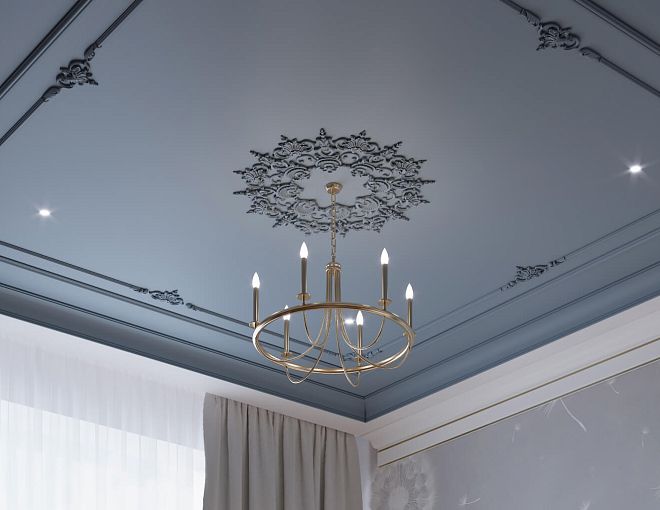
Any of the six sets in the CPU-P series contains a central element for the chandelier mounting point. This is a fundamental detail: a chandelier without decorative framing is a technical object that 'hangs' in space without architectural context. The ceiling decor kit transforms the mounting point into an architectural focal point: the central element creates a frame, corner accents form 'force lines' converging toward the center, and molding contours establish a concentric hierarchy of levels.
Additional level of central detail —ceiling rosettesfrom the STAVROS catalog, which are installed directly under the mounting point, creating a final concentric accent.
Ceiling with contour lighting: LED and molding — the union of two lighting architectures
Ceiling decor with lighting — a scenario in which the molding system operates in two fundamentally different modes. Day mode: natural or artificial direct light — the system works through relief, creating shadows. Evening mode: LED strip behind the A130V1 cornice — the system works through contour lighting, which emphasizes the relief of ornamental overlays.
The A130V1 cornice (100 × 83 mm) — a mandatory perimeter element of the entire CPU-P series — was specifically designed with a profile depth sufficient to accommodate an LED strip in the groove behind its rear edge. This is not a random technical coincidence but a deliberate structural solution. Contour lighting at 2700K (warm white) combined with relief ornamental overlays creates an evening effect that cannot be reproduced by any other lighting tools: a softly glowing perimeter contour from which the sculptural shadows of ornaments 'grow'.
What is included in the ceiling decor kit: anatomy of a ready-made system
A buyer first exploring the 'Ceiling Decor' section often asks the same question: what exactly will I get in this kit? What do I need to purchase separately? Let's break down the structure of the ready-made system by levels.
Level 1. Perimeter cornice
In all six sets of the series — cornice A130V1 (100 × 83 × 2000 mm, HIWOOD polystyrene). It forms the outer perimeter of the zone and serves as the foundation upon which the entire internal system is built. Full catalogceiling cornicesSTAVROS — in the corresponding section, where you can select lighter profiles for the perimeter of the entire room outside the CPU zone.
Level 2. Molding contours
Depending on the set — one or several internal molding contours. Molding LD32 (32 × 15 mm, HIWOOD polystyrene) — the first internal contour. In a number of sets, a primed MDF molding MLD-002-MG (22 × 11 mm) is added — the third, final contour with extremely clean geometry.
In CPU-P6, there is additionally a central molding system based on molding MLDPU-027 with two types of corner elements. Sectionceiling moldingsSTAVROS — for independent selection of additional profiles for the system.
Level 3. Ornamental field overlays
Polyurethane decorative overlays of various scales — from small punctuation inserts (NPU-309, 66 × 45 mm) to monumental dominants (NPU-464, 300 × 420 mm as part of CPU-P6). This is the 'text' of the ceiling system: it is the overlays that create the decorative character, define the style, and form the first visual impression of the ceiling.
Full rangemoldings from polyurethane— overlays, corner elements, ornamental inserts — in the catalog section. Here you can select additional elements to enrich the field if the standard composition of the set seems insufficient.
Level 4. Corner accents
Symmetrical right and left ornamental pairs in corner positions of the zone. Depending on the set — one, two, three, or four levels of corner accents. CPU-P6 — four independent levels: NPU-461L/R, NPU-430L/R, NPU-431L/R, NPU-470L/R.
Level 5. Corner molding transitions
In some sets — special corner molding elements for molding junction points (NPU-436.1L/R). Section decoration for moldings — for selecting additional corner and intermediate elements.
Level 6. Central element
The central dominant of the system — MLDPU-2U-1.1 (210 × 210 mm, in most sets) or the central system MLDPU-027 with two types of corner elements (in CPU-P6). A chandelier is mounted under the central element. Additional detailing — decorative chandelier rosette inside the central element.
What to purchase separately
CPU-P series sets contain all elements of the decorative field zone. Separately, if necessary, the following are purchased:
-
perimeter cornice for the rest of the room space (outside the CPU zone);
-
decorative rosettes for the chandelier;
-
additional molding frames for walls;
-
LED strip for contour lighting.
Why ready-made kits are more convenient than selecting elements individually
This is a question worth discussing directly, without evasive answers. Is it possible to select a similar ceiling system yourself, choosing each element individually from the catalog? Technically — yes. Practically — it is a labor-intensive and risky path, where it is easy to make several costly mistakes.
Mistake 1: inconsistent scale. A 100 mm cornice + 180 × 64 mm corner overlays + a 150 × 150 mm central element — proportions that look logical on paper, but in reality create a 'mismatch' of scales, where each element is present, but the system does not 'harmonize'.
Mistake 2: stylistic mismatch of ornaments. Overlays with acanthus leaves + corner elements with geometric weaving + a central rosette with baroque curls — three different ornamental vocabularies in one system. Visually — chaos, despite the 'classical' nature of each individual element.
Mistake 3: incorrect layout geometry. How many corner elements are needed? How to arrange the field inserts to create a symmetrical system, not a random set? What is the offset between the cornice and the first molding? Answers to these questions require either design experience or... a ready-made kit, where all these decisions have already been made by a professional designer.
Mistake 4: different production batches. When selecting individually, there is a risk of ordering items from different production batches — with slight differences in color or surface texture that become noticeable after painting.
Ready-madeset of stucco decoreliminates all four risks simultaneously. The scale is coordinated. The ornamental vocabulary is unified. The layout has been tested in completed projects. The production batch is one.
How to choose ceiling decor for your interior: a practical algorithm
Choosing a set is not an intuitive act. It is a systematic decision made according to several criteria sequentially.
Criterion 1: Room area
The CPU-P zone occupies 3200 × 3200 mm. With a room area of up to 20 m², such a zone occupies more than half of the ceiling surface — that's a lot. In small rooms, it's worth considering CPU-P1 or CPU-P2: their concise system does not 'overload' the limited ceiling.
With an area of 25–40 m², CPU-P3 or CPU-P4 create the correct decorative scale: the zone occupies the central third of the ceiling, leaving sufficient perimeter clearance.
With an area of 40 m² and above — all six sets of the series, including the monumental CPU-P6. In large spaces, a small CPU-P1 zone risks 'getting lost' — for a formal character, saturation is needed.
Criterion 2: Ceiling height
With a height of 2.5–2.7 m, CPU-P1, CPU-P2, CPU-P5 are optimal — concise systems without monumental dominants.
At a height of 2.7–2.9 m — CPU-P2, CPU-P3, CPU-P4 are suitable without restrictions.
At a height of 3.0 m and above — the full range, including CPU-P6 with its monumental elements NPU-464 (300 × 420 mm) and NPU-475 (350 × 180 mm). At this height, large elements are perceived as proportionate.
Criterion 3: Presence of a chandelier and lighting scenario
If a central chandelier is planned — all six sets contain a central element for the mounting point. The size of the central element varies: MLDPU-2U-1.1 (210 × 210 mm) in most sets, a double system MLDPU-027 in CPU-P6. When choosing a central element, it is advisable to consider the diameter of the chandelier: the central decorative element should be at least 30–50% smaller than the diameter of the chandelier, otherwise the chandelier will 'cover' the decor.
If contour LED lighting is planned — all six sets are suitable: the A130V1 cornice with a slot for the tape is a mandatory element of each of them.
Criterion 4: Style and degree of decorativeness
Classical interior with wooden panels, wall moldings, furniture with carved elements — CPU-P4 or CPU-P6.
Modern neoclassicism with clean lines, neutral colors, minimal wall moldings — CPU-P2 or CPU-P3.
Minimalist interior with one or two decorative accents — CPU-P1: basic three-contour perimeter with a single central element.
Classic children's or youth bedroom — CPU-P5: intimate, personal, finely detailed.
Criterion 5: Level of Decorative Boldness
Ask yourself: are you comfortable with 'lots of decor' or do you prefer 'less, but more precise'? Both positions are valid and both find their solution in the CPU-P line. CPU-P1 is for those who want the presence of classic style without the risk of overdoing it. CPU-P6 is for those ready for a monumental ceiling statement without compromise.
Kit materials: polyurethane and HIWOOD polystyrene — why this particular pair
Ceiling decor made of polyurethane is not a 'substitute' for plaster or wood. It is an independent, technologically justified choice of material for a specific task.
Polyurethane for ornamental overlays:
Reproduction accuracy. Polyurethane casting reproduces relief with an accuracy of fractions of a millimeter — sheet ornaments, scrolls, turned profiles come out of the mold geometrically flawless. Plaster provides comparable accuracy, but with significantly greater weight and fragility. Wood offers expressiveness, but technologically complex installation.
Lightweight. A large ornamental element NPU-464 (300 × 420 mm) weighs about 250–300 g. Installation — mounting adhesive without anchors, without a drill, without reinforcement. One person, no assistant needed.
100% moisture resistance. For bedrooms with air conditioning, children's rooms with unstable humidity, rooms adjacent to bathrooms —polyurethane decordoes not change geometry or delaminate with humidity fluctuations.
Ready for painting. The non-porous surface of polyurethane — paint applies evenly, without graininess, without uneven absorption. One coat of primer + two coats of enamel or water-based paint provide a perfect monochrome surface.
HIWOOD polystyrene for profiled moldings:
Rigidity and straightness over long spans. The A130V1 cornice, 2000 mm long, does not sag on a 12-meter perimeter — a density of 680 kg/m³ ensures geometric stability without additional support.
Temperature resistance. HIWOOD polystyrene does not deform under seasonal temperature fluctuations during unheated periods.
Complete section polyurethane products— cornices, moldings, overlays, rosettes, molding decor — in the STAVROS catalog.
How to combine ceiling decor: building a classic system on all planes
The CPU-P ceiling system is the starting point for the decorative language of the entire room. It sets the style, scale of the ornament, and decorative density, which all other surfaces follow.
Walls: molding frames and wall overlays
Moldings for the ceilingand for walls in the STAVROS catalog — the same assortment. Classic wall frame 'panels' made from the same molding profile as the inner contours of the CPU-P system create a decorative link between the ceiling and walls: a unified ornamental language on horizontal and vertical planes.
Corner and intermediatemolding decorative elementson wall frames additionally enrich vertical surfaces with ornaments, coordinated with the style of the ceiling system.
Ceiling rosettes: the finale of the central theme
ceiling rosettesFor the chandelier mounting point — an additional concentric level at the center of the zone. A decorative rosette with a diameter of 200–400 mm inside the central element of the set creates a 'matryoshka' architectural system: CPU-P zone → central element → rosette → mounting point. Each level is more detailed.
For the bedroom — a delicate 200 mm rosette. For a formal living room with a large crystal chandelier — a 350–400 mm rosette.
Perimeter cornice throughout the room
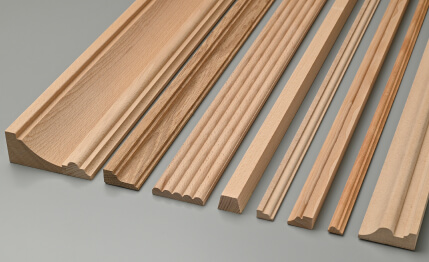
Outside the CPU-P zone, the room is also decorated with a cornice — a lighter one that does not compete with the A130V1 of the zone.Ceiling MoldingHIWOOD of different profiles (from 40 to 100 mm) allow building the correct decorative hierarchy: heavy A130V1 of the zone + light 40–50 mm along the perimeter of the room.
Moldings for walls and openings
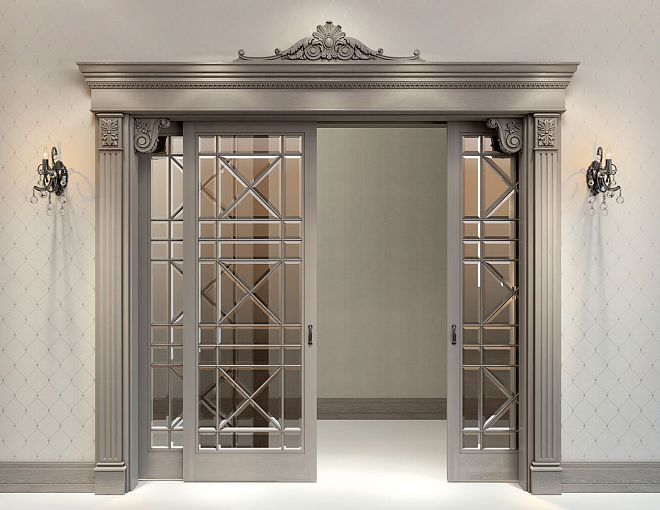
Polyurethane moldingsFor framing door and window openings, for pilasters, for decorative wall panels — in the same 'Classic' ornamental style as the CPU-P series ceiling sets. This allows building a unified decorative language in the volume of the room without stylistic inconsistency.
Frequently asked questions about STAVROS ceiling decor
What is a 'ready-made set' and why is it needed?
Ready-madeceiling decor kit— is a pre-designed set of elements with coordinated scales, unified ornamental styling, and a proven layout scheme. The buyer receives not individual items, but a ready-made ceiling system that only needs to be installed — without independent design, without the risk of making mistakes in combining elements.
How does polyurethane ceiling decor differ from gypsum stucco?
Polyurethane is lightweight (installation without anchors), moisture-resistant (not afraid of humidity fluctuations), precise in relief (reproduces shape to fractions of a millimeter), ready for painting without priming. Gypsum stucco is a traditional material with greater weight, requiring anchor fastening, vulnerable to moisture, and labor-intensive to install. For ready-made ceiling sets in residential interiors, polyurethane is the optimal choice based on the combination of characteristics.
Is ceiling decor suitable for a bedroom with 2.7 m ceilings?
Yes. For a height of 2.7 m, CPU-P1, CPU-P2, or CPU-P5 are optimal — concise systems without monumental dominants. The A130V1 cornice (83 mm in profile) is proportionate at a height of 2.7 m. The 3200 × 3200 mm zone above the bed is perceived proportionally given standard bedroom dimensions.
Is the set suitable for a living room with an area of 40 m²?
Yes. For a 40 m² living room with a ceiling from 2.9 m — CPU-P4 or CPU-P6. The 3200 × 3200 mm zone will occupy the central sofa area of the living room, leaving sufficient perimeter clearance. With a 2.7 m ceiling and a high level of interior saturation, CPU-P3 can be considered.
Can the set be used with LED lighting?
Yes. The A130V1 cornice — a mandatory element of all six sets in the series — has a groove behind the rear edge for placing an LED strip. Contour lighting at 2700K behind the cornice creates an evening light contour, which, with any relief ornament, produces sculptural shadows. Technically: 24V LED strip, density 60 diodes/m, installation direction — upward (for diffused reflection) or downward (for direct contour light).
How to select ceiling decor to match a chandelier?
Focus on the size of the central element of the set: it should be smaller than the diameter of the chandelier. MLDPU-2U-1.1 (210 × 210 mm) — for a chandelier with a diameter from 40 cm. The MLDPU-027 system in CPU-P6 (204 × 204 mm outer contour) — for a chandelier from 50 cm. Additionally —Ceiling rosettes for chandeliersfrom the STAVROS catalog for the final detailing of the center.
How to order ceiling decor with delivery across Russia?
Through the product card on the STAVROS website — the 'Add to Cart' or 'Pre-order' button. Delivery across Russia — via SDEK, DPD, transport companies. Pickup — from showrooms in Saint Petersburg and Moscow. Production time — from 5 working days. Each element is individually packed in protective packaging. When ordering a comprehensive project (ceiling system + wall moldings + rosettes) — a preliminary consultation with a manager is recommended.
Is professional installation needed or can it be done independently?
Depends on the set. CPU-P1 and CPU-P5 — are most accessible for independent installation: a small number of elements, a clear layout scheme, simple geometry. CPU-P6 — professional installation or hiring an experienced craftsman is recommended: the central molding system MLDPU-027 and four levels of corner groups require experience working with molding systems and precise laser marking.
Are there options for ceiling decor for non-standard zone sizes?
The standard zone for CPU-P series sets is 3200 × 3200 mm. If a non-standard size is needed (e.g., 4000 × 4000 mm for a large formal space), a consultation with a STAVROS manager is recommended: it is possible to increase the number of individual elements or design a non-standard layout based on standard article numbers.
Order a call
Do you have questions? Fill out the form and send it.
Your request has been sent!
Our manager will contact you within 5 minutes