





















































































Milled panels are a modern way to turn an ordinary wall into an expressive architectural surface without complex structures or an abundance of applied decor. The relief is formed directly on the face of the board: repeating recesses create a crisp pattern that changes depending on the lighting and viewing angle. This finish is suitable for calm monochrome interiors, accent zones, and projects where precision of lines, proportions, and a unified room style matter.
The STAVROS catalog features milled MDF wall panels for interior finishing. They help to style the wall behind a sofa or headboard, highlight a TV zone, or complement a hallway, office, or public space. Unlike a set of individual slats, here the pattern is already executed on a single sheet. This simplifies designing the decorative composition and allows you to assess the scale of the relief, the placement of joints, and the final color in advance.
Panels with milling are chosen not only for their decorative effect. They allow you to create a visually cohesive surface, coordinate it with furniture and lighting, and, when painted, match the shade to a specific interior palette. Below we explain how this cladding differs, how to choose the right solution, calculate the number of sheets, and prepare for installation.
Milling is a mechanical processing of the material in which a tool removes part of the surface along a set path. Grooves, channels, or other recesses of a certain width and depth are formed on the board. As a result, a flat sheet gains relief while retaining the format of a large wall panel. The pattern is not glued on top: it is part of the base itself.
This principle has an important design advantage. The lines are perceived as a unified system rather than a random combination of individual parts. Vertical milling can emphasize the height of a room, horizontal milling can enhance the sense of width, and a repeating fine pitch gives the wall a complex texture without a bold ornament. At the same time, the character of the surface depends on the specific profile, so the direction and frequency of the lines should be assessed based on the drawing and image of the product.
Milled wall panels are used primarily as decorative interior cladding. They do not replace a load-bearing structure, waterproofing, or a specially designed acoustic system. Their task is to give the interior expressiveness and create a neat rhythm on the chosen plane.
MDF is a wood-fiber board material suitable for precise processing and subsequent finishing. Its homogeneous structure allows consistent lines to be formed without the knots and pronounced wood grain transitions typical of solid wood. That is why milled MDF panels are especially convenient for interiors that require a geometric pattern and a smooth painted surface.
The practical advantage of the material is the ability to choose a color not from a limited set of ready-made decorative finishes, but according to the project concept. The wall can be white, milky, graphite, olive, terracotta, or painted to exactly match the shade of adjacent surfaces. The appropriate finishing system is selected taking into account the primer and the recommendations for the specific product.
Limitations must also be taken into account. MDF is sensitive to prolonged contact with water, and decorative milling requires careful handling of edges and protrusions. For ordinary dry rooms this is a convenient material, however, use near constant sources of moisture, in unheated areas, or on surfaces with special requirements should be agreed separately. Technical specifications are always more important than general promises of universality.
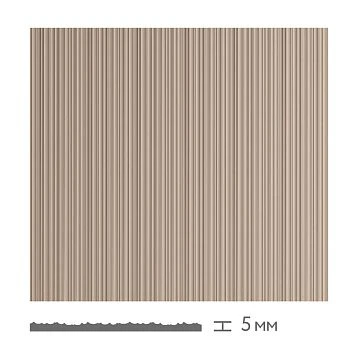
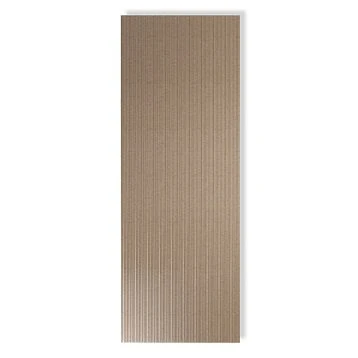
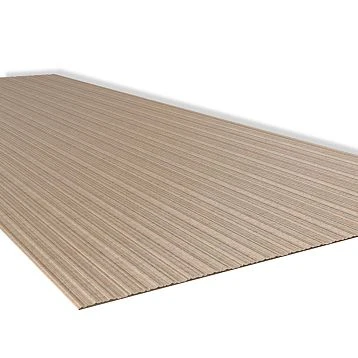
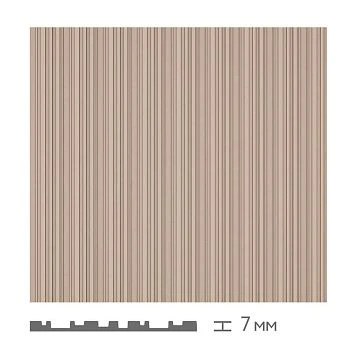
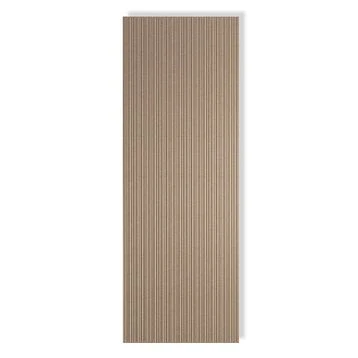
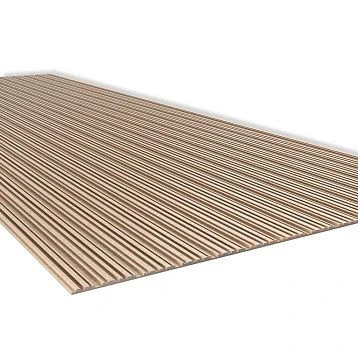
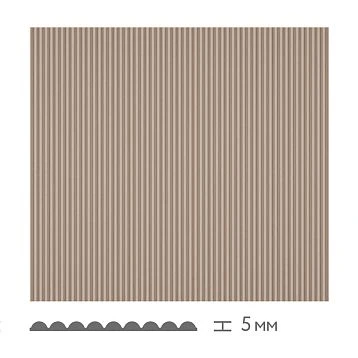
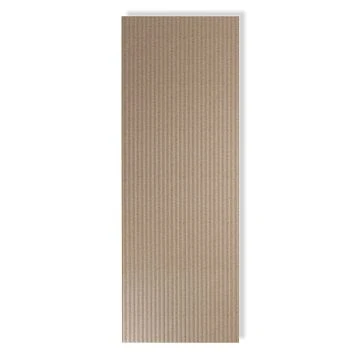
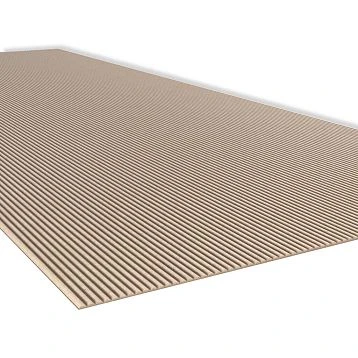
This section presents milled panel FP-001 made of MDF with a frequent longitudinal linear pattern. The milling geometry creates a rhythmic surface: under frontal lighting the lines look restrained, while side light makes the recesses more noticeable and adds volume.
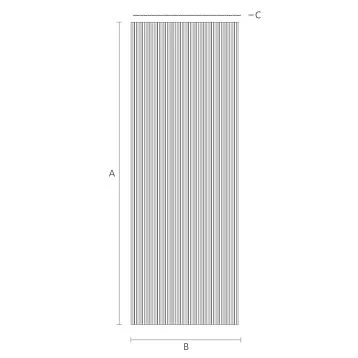
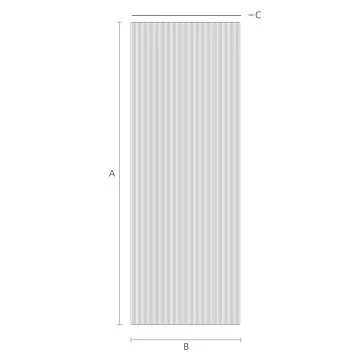
Main model parameters:
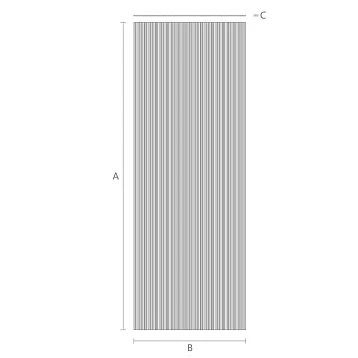
Sheet size: 2750 × 1000 mm.
Thickness: 5 mm.
Material: MDF.
Finish: "Prestige primed", intended for subsequent compatible decorative painting.
Purpose: decorative finishing of interior surfaces.
The large format is especially interesting for cladding a wall along its height with few horizontal joints, if the room height and installation scheme allow it. At the same time, a thickness of 5 mm requires a properly prepared substrate and careful handling during transport and installation: a thin decorative sheet should not be treated as a self-supporting rigid partition.
Please check availability, production times, current price and availability of finishes directly in the FP-001 product card. As the section expands, options should be compared by pattern, actual dimensions and confirmed specifications of each model.
The impression of the finish is determined not only by the shape of the grooves, but also by a combination of three factors: direction of the lines, color and light. If the milling is oriented vertically, the eye glides upward — this is useful in rooms that need added visual height. A horizontal rhythm, by contrast, can emphasize the length of a wall. On a large surface, a dense linear pattern forms a calm background, while on a narrow area it becomes a noticeable decorative detail.
Light paint softens the contrast between the raised and recessed areas. Dark and saturated shades create a more graphic surface, especially under directional light. Warm lighting can enhance the feeling of coziness, while cool lighting emphasizes strict geometry. Before making a final choice, it is worth checking the color and direction of light on a real finish sample or a test area.
A combination of a milled wall with smooth surfaces looks especially expressive. It is not necessary to cover the entire room with panels: sometimes one accent zone works more strongly than a continuous relief on every wall. This approach preserves visual balance and helps avoid an overloaded interior.
Living room and TV area. The relief cladding forms a backdrop for the sofa, TV, console or storage system. It is important to plan in advance the mounting of equipment, placement of sockets and cable outlets: the decorative sheet should not bear the weight of heavy equipment without attachment to a suitable substrate.
Bedroom. Milled wall panels are used behind the bed, next to bedside lights or on a free accent surface. With a calm color, the pattern remains unobtrusive and combines well with textiles, soft headboards and wooden details.
Hallway and corridor. A milled panel helps define the area of a mirror, built-in wardrobe or console. In narrow passages, the likelihood of accidental impacts and contact with shoes, bags and outerwear should be taken into account; for the most heavily used areas, a suitable protective finish is chosen in advance.
Study and workspace. A linear texture gives the interior a sense of order and is well suited to the wall behind a desk, a home library or a video call area. For comfortable perception, it is useful to avoid excessively contrasting lighting directly in front of the eyes.
Office, reception and showroom. Milled MDF panels can support the brand palette and highlight the representative part of the space. For public premises, the applicable requirements for materials, fire safety, wear resistance and mounting structure must be checked separately.
Decorative niches and built-in furniture. The relief can be used in a limited area provided that the dimensions of the parts, the direction of milling and the base structure allow the cladding to be installed safely. The possibility of use on a specific furniture facade should be assessed separately from standard wall mounting.
In minimalism and contemporary, the relief works instead of an active pattern: a monochrome wall gains expressiveness through light and shadow while retaining a sense of cleanliness and order. For japandi, muted natural shades and combinations with natural materials are suitable. In a modern interior, you can choose graphite, complex grey or deep green and complement the surface with hidden lighting.
In neoclassicism, a milled insert is used sparingly — for example, within a calm composition with smooth wall sections. In art deco, a frequent geometric rhythm can become a backdrop for metal, stone or expressive furniture. At the same time, one should not automatically transfer the same profile to any project: the milling pattern must be correlated with ceiling height, furniture dimensions and the character of the other finishing materials.
Proportion is also important. In a small area, it is better to leave visual pauses around the relief. In a spacious room, several sheets can be combined into a wide composition, carefully aligning the lines and determining the location of the seams in advance.
The primed FP-001 surface is intended for subsequent decorative finishing with compatible products. Painting allows the panels to be tied to the color of the walls, ceiling, doors or furniture. If you choose tone on tone, the relief will manifest primarily through shadows. A contrasting shade, on the other hand, will make the cladding an independent accent.
For a neat result, not only the paint but also the application technique matters. Excessive accumulation of material in the recesses must not be allowed: a layer that is too thick can visually smooth out fine grooves. The coating is applied in compliance with the manufacturer's instructions, intercoat drying and compatibility with the factory primer. The specific method — spraying, roller or a combined technique — is chosen taking into account the relief and surface quality requirements.
Before painting the entire wall, it is recommended to make a test patch. It will show how noticeable the lines are, how the shade looks under daylight and artificial lighting, and whether there is any unwanted glossy effect. For saturated colors, the evenness of the finish coat is especially important. Additional recommendations can be found in the section STAVROS finishing and installation tips.
Start not with color, but with the purpose of the surface. Will it be full-wall cladding, a vertical insert, a niche or a decorative backdrop behind furniture? For each task, the permissible number of joints, the required substrate stability and the layout pattern differ.
Then evaluate five parameters:
Size of the cladding area. Measure the width and height at several points, taking into account the actual deviations of the walls.
Direction of the pattern. Consider how the lines will be oriented relative to the floor, ceiling, doors and furniture.
Scale of the relief. Frequent milling looks different up close and from a distance of several meters.
Finishing. Choose the color, gloss level and a compatible painting system before starting the main work.
Junctions and seams. Decide in advance how the panel will terminate at a corner, skirting board, door casing or ceiling.
Do not confuse the pattern shape with the material characteristics. A search for "milled wall panel" may refer to various products, including door overlays and furniture components. In this STAVROS category, we are talking specifically about decorative solutions for interiors. When comparing products, focus on the purpose, drawing and manufacturer's data, not just a similar name.
For a preliminary calculation, determine the area of the surface to be clad and the usable area of one sheet. FP-001 has nominal dimensions of 2.75 × 1 m, i.e. 2.75 m² per sheet excluding trimming. However, dividing the total wall area by 2.75 is not enough: with a linear pattern, orientation, room height, the position of vertical seams and the possibility of using offcuts all matter.
Example: if the wall is 2.7 m high and 3.4 m wide, then with vertical arrangement of panels 1 m wide, four full-format sheets will be preliminarily required across the width. Actual consumption may change due to seams, openings, pattern specifics, cutting method and technological gaps. Offcuts from one section cannot always be used in another without disrupting the rhythm of the milling.
Therefore, for ordering it is better to prepare a simple diagram with wall dimensions, the position of sockets, doors, windows and intended seams. If the surface is complex, it is advisable to agree on the cutting plan before purchase. This approach helps avoid both a shortage of material and an unjustified surplus.
Milled MDF wall panels require a level, dry, strong and clean substrate. Before starting work, check the geometry of the plane, the reliability of the existing finish and the compatibility of the selected fasteners or adhesive with the wall and panel materials. A thin sheet should not be used to conceal significant unevenness: substrate irregularities may become visible after installation.
The next stage is marking. Vertical lines, sheet boundaries, seam positions and technological opening locations are marked on the wall. If the pattern consists of frequent parallel lines, even a slight rotation of an adjacent sheet can become noticeable. Therefore, during installation it is necessary to constantly monitor the milling direction and the alignment of the visual rhythm.
The fastening method is selected according to the instructions for the specific product and taking the project into account. Any universal mounting adhesive cannot automatically be considered suitable for primed MDF. If necessary, clarify the recommendations with STAVROS specialists and the mounting system manufacturer. Cutting is performed with a tool designed for careful processing of MDF, with sheet support and protection of the decorative edge.
Sockets, switches and light fixtures require pre-planned cutouts. Electrical wiring work must be carried out in compliance with electrical engineering requirements. After installation, the quality of the joints, the integrity of the relief and the condition of the coating are checked. Painting and finishing operations are carried out in the sequence appropriate for the chosen finishing system.
The first common oversight is choosing panels based only on a large photo of the texture. In a real room, the perception of the pattern depends on the distance to the wall and the lighting. The second is not taking joints into account. Even an aesthetic relief loses its integrity if the lines of adjacent sheets are misaligned or a seam falls on the most noticeable point of the composition.
The third mistake is trying to compensate for an uneven base with adhesive without assessing the permissible layer thickness. The fourth is using unsuitable paint and varnish materials or filling the grooves with paint too generously. The fifth is forgetting about sockets, door slopes and furniture fastenings before ordering the material.
A preliminary layout, a test paint application and checking the installation conditions are usually more effective than correcting cladding that has already been installed. On large accent walls, it is sensible to agree not only on the number of sheets but also on the sequence of their placement.
The STAVROS range includes several types of decorative finishing that may look similar in photographs but differ in construction. A milled panel is a solid sheet with a relief cut into its surface. It is chosen when a continuous pattern geometry on a flat base and a painted surface are required.
Flexible slatted panels form the relief with individual slats on a suitable base; some variants are also intended for finishing radius elements. They are chosen when the pronounced volume of the slats or the ability to follow curves within the characteristics of a specific product matters.
Wood and MDF tile represents a different principle: the decorative composition is assembled from repeating modules. This solution is suitable for geometric panels and areas where you want to emphasize the boundaries of individual elements.
If the task has not yet been defined, compare the options in the general catalog of STAVROS wall panelsThe choice should be based on the character of the pattern, the material, the surface type and the installation requirements, not just on visual similarity.
Everyday care of milled MDF panels depends on the chosen finishing paint. Usually, a soft cloth or brush that does not damage the painted surface is sufficient to remove dry dust. More dust can accumulate in the recesses than on a smooth wall, so it is better to clean the relief regularly and without excessive pressure.
Prolonged contact with water, abrasive sponges and aggressive solvents without confirmed compatibility with the coating should be avoided. If the surface is accidentally damaged, the method of local repair depends on the depth of the defect, the primer and the finishing paint. When choosing a finish for a high-traffic area, assess its resistance to everyday wear in advance.
The STAVROS catalog allows you to compare decorative solutions within a single interior finishing system. For FP-001, the material, dimensions, finish and ordering conditions are specified; images and product information are available. This provides a basis for a precise discussion of the project with a designer or installer, rather than buying "by eye".
The panels can be combined with other decorative products of the brand if their dimensions, profile and installation method are compatible with each other. For complex finishes, it is important to consider not only the appearance but also the completion of the composition: corners, ends, joints with the floor and ceiling, transitions to furniture. It is also worth planning separately where the relief ends and the smooth plane begins.
The company handles orders for various regions of Russia; current shipping methods and conditions are provided on the page payment and delivery. The price, availability and lead times for a specific panel should be checked when placing an order, as this data may change.
Can I buy milled MDF panels for painting? Yes. The presented FP-001 has a primed finish. The finishing paint and application technology should be selected taking into account compatibility with the primer and the desired decorative effect.
Are the panels suitable for a small room? Yes, if you choose a proportionate cladding area and a calm finish. Instead of decorating all the walls, one vertical zone, a fragment behind the bed or a small accent near the mirror is often enough.
Can the panel be installed on an uneven wall? The base must be prepared beforehand. Thin milled cladding is not designed to level out significant wall defects, and the permissible deviations and mounting method are determined taking into account the specific installation system.
Does milled MDF have soundproofing properties? The decorative relief itself is not a basis for promising an acoustic effect. If confirmed soundproofing is required in the project, a specially calculated structure with the appropriate characteristics is needed.
Can the panels be used in wet rooms? Suitability for such conditions cannot be determined by appearance alone. For ordinary MDF, humidity, contact with water, edge protection and coating properties are critical; use in non-standard conditions must be agreed separately.
How does milling differ from individual decorative slats? In the first case, the recesses are made directly in the board. In the second, the volume is created by individual slats fixed to a base or independently. This affects the geometry, relief depth and installation requirements.
To select and order milled panels for interior finishing, start with the wall dimensions and the desired direction of the pattern. Determine whether you need cladding for the entire surface or only an accent area, choose the intended color, and mark all openings and technical elements. After that, review the specifications of FP-001 and calculate the preliminary number of sheets taking cutting into account.
If precise junctions, a complex room configuration or a specific painting method are important, discuss the details before paying for the order. This makes it easier to agree on the material, installation and final appearance. STAVROS milled wall panels help create an interior in which decorativeness is achieved not by the number of details, but by the quality of geometry, the calm rhythm of lines and thoughtful work with light.
Have questions about our products or your project? Leave your contact details and our team will get back to you.
Our manager will contact you within 5 minutes