Article Contents:
- Wholesale purchasing of handles starts not with quantity, but with a standard
- One model SKU does not always equal one purchasing line item
- What data to store in a furniture handle specification
- First a control front, then a large batch
- The handle and the front size are designed together
- Small facade
- Tall cabinet
- Wide pull-out drawer
- Knob handle
- Bracket handle
- Profile handle
- Recessed handle
- The reference front hasn't been approved
- The mounting geometry hasn't been finalized
- The finish is described in words, but there's no reference sample
- No specific material has been selected
- The furniture series is still changing its fronts
- There's no confirmed production plan
- Where to buy furniture handles wholesale?
- Can I buy furniture handles directly from the manufacturer?
- Which wooden handles are suitable for the kitchen?
- What is the difference between coated and uncoated handles?
- How to choose the handle size for the front?
- When should you choose the handle — before or after drilling the front?
- How to calculate the number of handles for a furniture series?
- Should you keep a reserve of handles?
- How to control a repeat batch?
- Can the same handle model be used across different furniture series?
- How to order wooden furniture handles with a custom finish?
- Do I need to order a sample before a wholesale batch?
- What should I do if the supplier offers an alternative?
- How to store data for reordering?
- Can the same handle be used with different finishes within one series?
- How to check a handle for a cabinet with a long front?
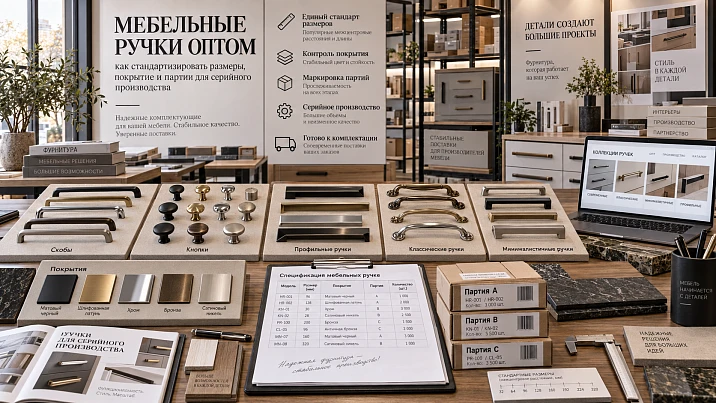
A designer may choose the first furniture handle by eye: the shape works, it looks good on the front, and the material supports the concept of the series. Once production starts, the rules change. For the second, third, and tenth batch, it is no longer enough to remember that a "wooden Wave handle" or a "long oak pull" was used. Production needs the exact SKU, size, installation parameter, material, finish, quantity, and a reference sample against which a repeat delivery can be compared.
That is exactly why wholesale furniture handles for a furniture factory are not just a large cart. The handle must become a standard component of a furniture series: its geometry goes into the design documentation, the mounting goes into the drilling program, the material and finish go into the visual standard, and the SKU and configuration go into the BOM and procurement specification.
For a factory, wooden furniture handles must be described as production components, not as abstract decor. For serial production, the working chain looks like this: furniture model → front → handle → size → mounting → material → finish → control front → reference → quantity → batch → incoming inspection → service reserve → repeat order.
This article deals specifically with furniture handles. Legs, overlays, moldings and other furniture decor appear only where they must visually coordinate with the handle. General wholesale furniture hardware is better managed as a separate assortment contour.
Wholesale purchasing of handles begins not with quantity, but with a standard
The request “we need 300 wooden handles” says almost nothing about the production task. Which article number? Which size? Which version? Is a ready finish needed? What is the mounting geometry? Which fronts will the batch go to? Can it be repeated without changes six months later?
A strong purchasing line looks different:
SKU / version / size / material / finish / quantity / furniture series / revision
After such fixation, the handle ceases to be a decorative accessory “to taste” and becomes a controlled component. The designer understands what geometry to drill the front for. Production knows which variant arrives at assembly. The buyer can compare commercial offers without mixing different versions. The service department understands a year later which part to order as a replacement.
For wholesale furniture handles from a manufacturer, this is especially important: the manufacturer may offer one model in several sizes, materials and finish options. Visually it is one family; in purchasing terms it is several different configurations.




One model article number does not always equal one purchasing position
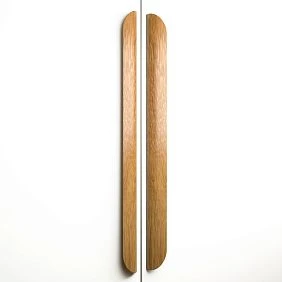
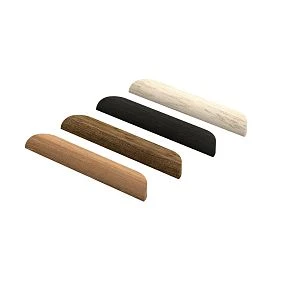
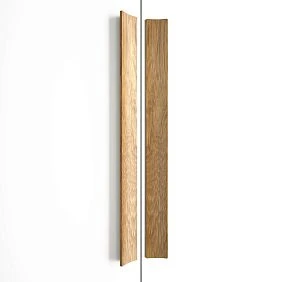
The current Wave HL‑006 product page provides a useful manufacturing example. The model is available in several lengths — from 180 to 1800 mm. Each variant has its own set of dimensions A × B × C × D; there are versions in oak and beech. The unfinished HL‑006 and the coated version HL‑006M are also different product variants.
Therefore, the entry HL-006 in the BOM is insufficient. Even if the designer and purchaser understand which shape is meant, production does not know which specific variant is required.
More correctly:
HL-006 / 400 × 35 × 23 × 320 / OAK / unfinished
HL-006 / 700 × 35 × 23 × 576 / BEECH / unfinished
HL-006M / 900 × 35 × 23 × 832 / OAK / coating per selected option
The specific figures in your own specification must always be taken from the current product page of the selected modification, not from memory or an old order. If one furniture series uses different lengths of the same model, each length gets its own line.
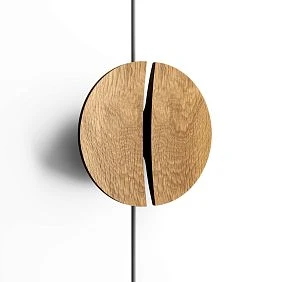
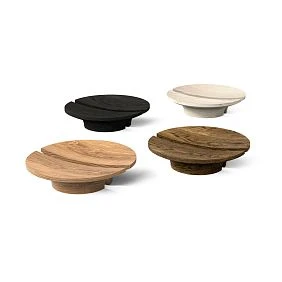
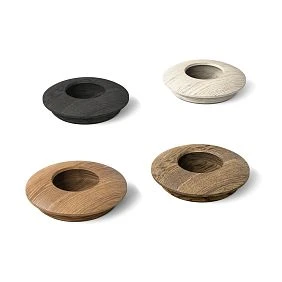
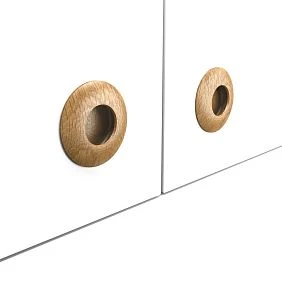
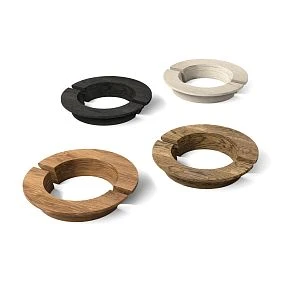
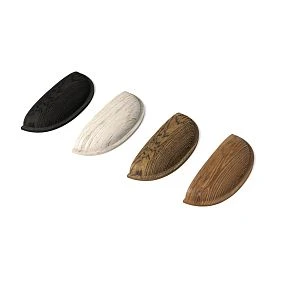
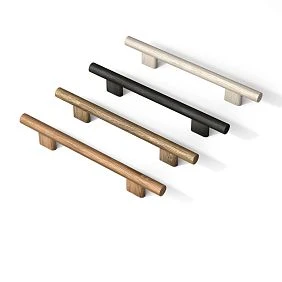
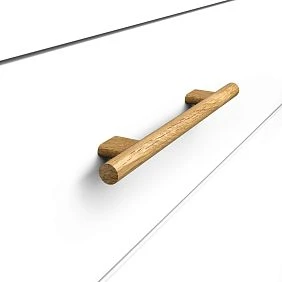
Our factory also produces:
What data to store in a furniture handle specification
| Field | What to fix | Why production needs this |
|---|---|---|
| SKU | Exact SKU / modification | Unambiguous product identification |
| Type | Bracket, knob, profile, mortise, etc. | Understanding the design and installation |
| Size | All relevant card dimensions | Facade and assembly drawing |
| Mounting | Installation parameter per card / drawing | Drilling and template |
| Material | Oak, beech, or another available finish | Visual and commercial configuration |
| Finish | Uncoated or a specific finished option | Finish repeatability |
| Furniture model | Kitchen, wardrobe, chest of drawers, series | BOM binding |
| Quantity per product | 1, 2, etc. | Batch calculation |
| Reference | Sample ID / APPROVED | Incoming inspection of the repeat batch |
| revision | BOM version | Protection against outdated data |
If a field does not affect production, it does not need to be stored. But geometry, material, and finish must not be left in a free-form comment — they must be a structured part of the line.
Get Consultation
First the control facade, then the large batch
Before ordering furniture handles in bulk, assemble one real control facade in the material and size as close as possible to the production version. A catalog photo shows the shape of the handle, but does not test it on specific furniture.
On the control facade, you need to evaluate:
- the scale of the handle relative to the front;
- grip comfort;
- position in height and relative to the edge;
- visual proportion;
- actual mounting geometry;
- front thickness and suitable fasteners;
- no conflict with adjacent doors and drawers;
- the appearance of the wood and finish;
- horizontal or vertical installation scenario, if the model allows both.
The control front solves two tasks at once. The designer gets an honest scale, and the technician gets a real installation check. After approval, the front, handle, or their marked samples become the reference for launching the series.
The handle and front size are designed together
There is no universal percentage rule like "handle length should be X% of the front width" for production furniture. The same proportion is perceived differently for a knob handle, a long profile, and a massive pull. Beyond aesthetics, there is the actual grip, the proximity of adjacent doors, the clearances, and the construction of the furniture piece.
Small facade
A large, long handle can dominate the furniture or conflict with the adjacent front. Here it is more important to check the actual projection and grip area, not just the overall length.
Tall cabinet
A handle that is too small can get visually lost. For long fronts, elongated models are useful, but the length needs to be tied to the door construction and mounting points.
Wide drawer
A handle is checked not only for symmetry but also for ease of grip. If a series includes different drawer widths, you need to decide in advance whether one model stays and its size changes, or different types are used.
For Wave HL‑006, the current product page provides a good example of one shape in a large size range. This allows building a series around a single visual language, but it does not remove the need to check each size on its own front.
The installation parameter cannot be changed after drilling has started
Once the front has been drilled, the hole positions become part of the furniture construction. In the Wave product page, for example, the overall length A and parameter D are different values: the variant A = 180 mm has D = 128 mm. For replacement or for starting production drilling, you need to rely on the installation data of the specific modification, not on the size name shown in the listing.
If, after production has started, the handle is replaced with a variant that has a different geometry, it may be necessary to:
- change the drilling program;
- remake the template;
- re-drill or scrap the finished fronts;
- update the design documentation;
- rebuild the packaging map and BOM.
Therefore, the handle must receive APPROVED status before serial drilling of the fronts. If the supplier proposes an alternative later, it is first checked for geometry, not just for visual similarity.
One mounting standard for a furniture series reduces production errors
If each cabinet and each wardrobe uses its own incompatible mounting option, the series becomes unnecessarily complex. Where the design allows, it makes sense to unify installation parameters, fasteners, and templates.
Within one series, it is desirable to minimize the number of:
- installation schemes;
- fastener types;
- drilling templates;
- separate instructions for assemblers;
- non-standard operations.
This does not mean using a single handle across all furniture. For example, a knob and a long profile handle serve different purposes. But within each group, the production logic must be deliberate.
Uncoated handles: when it benefits production to take an unfinished part
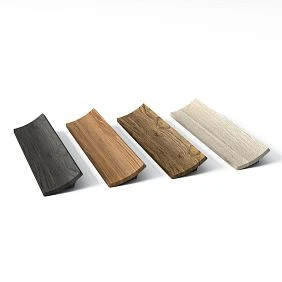
The STAVROS catalog has a separate category of uncoated handles. This scenario is interesting for production that wants to manage the finish itself: tint the handle to match the wooden facade, paint it together with other elements, or include it in its own technological cycle.
The advantage here is not that "uncoated is always cheaper," but in process control. The furniture factory receives a wooden part and is itself responsible for the final visual result.
Before ordering, it is necessary to determine:
- who prepares the surface;
- which coating system is used;
- which color and gloss level are approved;
- how the approved sample will be stored;
- how finish repeatability is controlled;
- at which stage the handle arrives at furniture assembly.
Uncoated models can be viewed in the section of handles without coating. For serial production, the selected model must receive its own technological finishing route.
Coated handles: when it is more rational to receive a finished part
A separate current STAVROS category contains handles with a ready-made coating and several structural types: mortise, surface-mounted, T-shaped, knobs, profiles, shells, brackets, and other options.
A ready-made handle is convenient when the furniture manufacturer does not want to load its own area with finishing this part or when the design must rely on a specific approved coating option from the manufacturer.
But a ready-made finish increases the requirements for the reference sample. For a repeat batch, it is not enough to write “brown” or “white.” The specification records the selected product configuration and sample ID.
You can view ready-made options in categories of handles with coating.
You cannot compare the price of an uncoated handle and a finished handle as a single item
When requesting an RFQ and comparing suppliers, bring products to a single configuration. If option A is supplied without coating and option B already has a finish, the unit price describes different scopes of work.
The comparison line should look like this:
model + size + material + finish + fastening + quantity + lead time.
For an unpainted handle, the factory's own finishing operation is accounted for separately: materials, labor, drying, inspection, and possible defects. Only after that can you compare the full cost of the component in a finished piece of furniture.
How to standardize handles for a kitchen series
A kitchen rarely consists of identical fronts. Base cabinets, upper cabinets, tall units, drawers, and tall built-in blocks create several geometric scenarios. If a designer selects a handle separately for each front, the series quickly ends up with too many SKUs.
It is more convenient to first divide the fronts into functional types:
- upper hinged doors;
- lower hinged doors;
- wide pull-out drawers;
- narrow drawers;
- tall cabinets;
- appliance fronts, if the same decorative system is provided for them.
For each type, an allowed handle or handle range is fixed. For example, one short model for small doors, one medium for most drawers, and one long for tall fronts. If a family such as Wave with several sizes is used, this allows maintaining a common language while adapting to the geometry.
But the production matrix should contain not "Wave short / Wave long", but exact configurations. Then the designer understands which parameter D to use for drilling, and purchasing knows which length and material to order.
How to standardize handles for cabinets and wardrobes
Tall doors present a separate task: the position and direction of the handle. A long furniture handle can work vertically and support the geometry of the front, but it cannot be chosen based only on the door height.
The following is checked on the reference sample:
- façade height;
- the user's working grip zone;
- handle orientation;
- indent from the edge;
- adjacent doors;
- opening to the required angle;
- conflict with adjacent furniture and the wall;
- the visual alignment of the handle with the vertical lines of the façade.
If cabinets are produced in several heights, it is useful to define a correspondence table in advance: façade height → permissible handle configuration. This removes the need to re-select for each individual order and protects production from accidental substitutions.
For a wardrobe series, it is especially important to check whether a single visual handle family can cover both standard doors and taller façades. If not, it is better to approve two compatible models in advance than to look for a second one after sales have launched.
Chests of drawers and cabinets: repeatability matters more than the number of variants
A chest of drawers with six identical drawers demonstrates the value of standardization especially clearly. Six identical handles create a rhythm, while production gets one drilling template, one packaging line, and one purchasing item.
If one chest of drawers is produced in several widths, the first thing to check is whether a single handle remains proportional across all fronts. If not, two sizes of the same model are allowed. But the transition between sizes must be described by a rule, not decided by the assembler on the spot.
Standardization simplifies:
- design documentation;
- drilling;
- packaging contents;
- warehouse accounting;
- wholesale batch calculation;
- service stock;
- repeat order.
The fewer arbitrary exceptions, the easier it is to scale the series.
How to create a handle matrix for furniture production
The matrix is the bridge between the design concept and the BOM. It does not need to store the supplier's entire catalog. It only needs the configurations that are approved for a specific furniture series.
| Furniture series | Facade type | SKU | Size / configuration | Material | Finish | Status |
|---|---|---|---|---|---|---|
| KITCHEN-A | Upper door | HL-___ | Specific size | Oak | FINISH-01 | APPROVED |
| KITCHEN-A | Wide drawer | HL-___ | Specific size | Oak | FINISH-01 | APPROVED |
| WARDROBE-B | Tall door | HL-___ | Specific size | Beech | FINISH-02 | APPROVED |
After approval, the designer does not select the handle again for each customer order. They work within the approved matrix. If a new option is needed, it goes through a separate testing cycle and only then is added to the standard.
Primary and backup model: the alternative is tested before a shortage occurs
For critical serial components, it is useful to have a PRIMARY SKU and a pre-tested ALTERNATIVE SKU. This does not mean that the alternative can be changed without approval. It is needed to reduce decision time if the primary item is temporarily unavailable.
The alternative is tested in advance for:
- overall geometry;
- installation parameters;
- material;
- finish;
- scale on the facade;
- ergonomics;
- compatibility with drilling;
- the visual language of the series.
The best-case scenario is when a spare handle can be installed without modifying the facade. But this must be proven with a drawing and a control facade, not assumed from a photograph.
How to approve a finish for serial production
A color name is a weak standard. "Dark walnut," "natural oak," or "almost black" can mean different results for different people and batches. Serial production requires a physical reference.
Working note:
SKU + material + finish + APPROVED SAMPLE ID
The reference sample must be labeled, stored separately from random samples, and be available for incoming inspection. If the finish is applied by the furniture factory itself to an unfinished handle, the reference sample already relates to the internal production technology. If the handle arrives ready-made, the reference sample is used to compare deliveries.
When approving, it is important to look at the handle next to the actual front. The same shade can be perceived differently on light veneer, colored enamel, and dark solid wood.
How to control batch repeatability
A repeat batch is the main test of standardization. The first purchase may be perfect, but if after four months production cannot unambiguously order the same thing, the standard has not been created.
During incoming inspection of a new batch, it is compared with the approved reference sample:
- SKU and configuration;
- dimensions;
- profile geometry;
- the material;
- surface;
- finish color;
- gloss level;
- completeness of the fastening, if it is included in the delivery;
- batch marking.
Inspection must occur before the handles reach the assembly line. If a discrepancy is discovered after installation on a hundred fronts, the correction already affects finished furniture.
Incoming inspection: 100% or sampling
Not every characteristic must be measured on every unit. Production can develop its own incoming inspection plan depending on the batch size, supplier stability, and the criticality of the parameter.
But documents and markings are always checked. Then dimensions, coating, surface, and geometry are assessed by sampling. If a systematic deviation is found, the sample is expanded or the batch is placed in quarantine until a decision is made.
The article does not establish a sampling standard — it depends on the internal quality system of the furniture manufacturer. The main rule: the inspection method must be determined in advance, not after a defect is discovered.
How to calculate the number of furniture handles for a series
The quantity is calculated not by the number of cabinets as such, but by the actual fronts and drawers. One cabinet may have two doors and four drawers, another — one door, and a third — three independent fronts.
Calculation logic:
furniture model → front types → quantity of each type → handles per front → number of items → production reserve.
Example. A series contains 50 dressers. Each dresser has four drawers, each with one handle. Base requirement: 50 × 4 = 200 handles. If there are additionally 20 cabinets with two doors each, that is another 40 handles. Total requirement before reserve — 240.
Next, the reserve is determined not by a universal “+10%,” but by production logic: how many items may be needed for damage, inspection, service, replacement during assembly, and launching the next batch. The approach may differ for a stable mass-produced series and for a rare expensive handle.
Production reserve and service reserve are different stocks
The production reserve is kept next to the current batch and is used during assembly: loss, damage, defects, an additional unit of furniture. The service reserve is kept after finished furniture is shipped to customers.
The service stock is especially useful if furniture is sold in series and the manufacturer promises the possibility of after-sales replacement of components. It is stored separately and labeled:
SKU / size / material / finish / LOT / SERVICE RESERVE
If the service reserve is mixed with the current warehouse stock, production will almost certainly gradually use it up.
How to determine the size of the reserve without a universal percentage
The size of the stock depends on several factors:
- volume of the main batch;
- repeat order frequency;
- ability to quickly obtain the same configuration;
- coating criticality;
- furniture series lifespan;
- damage statistics from own assembly;
- warranty service terms;
- storage cost.
For a serial handle that can be regularly repeated, a huge warehouse stock may not be needed. For a discontinued or individually finished configuration, a reasonable service reserve is more valuable. The decision should be based on the factory's real data.
How to assemble handles, legs, and decorative elements as one furniture system
The handle remains the central theme, but in furniture it rarely exists in isolation. If the series includes wooden legs and carved overlays, these elements need to be checked together for material, scale, and finish.
For example, a dark oak handle and a light beech leg can be a deliberate contrast or an accidental inconsistency. This is decided at the design standard stage.
For a coordinated selection, you can use the section of furniture legs and supports и decorative inserts. But in the BOM, each category still remains a separate line.
If you need a broader approach to hardware, a separate article on the site already covers the set of handle + legs + overlays + moldings. The current material should not become a duplicate of it.
How to create an RFQ for furniture handles wholesale
To buy furniture handles wholesale without a long chain of clarifications, the supplier needs to receive a ready technical requirement.
The RFQ includes:
- SKU;
- execution;
- size;
- the material;
- coating;
- quantity;
- the required date;
- the city or delivery address;
- need for a control sample;
- the estimated reorder frequency;
- question about availability and production lead time.
If a series uses three sizes of one model, that is three lines. If part is needed in oak, part in beech — again separate lines. The general phrase “300 Wave handles” is insufficient for production.
Furniture handles wholesale from the manufacturer: what to check besides price
The phrase “furniture handles wholesale from the manufacturer” does not mean that any direct order is automatically more profitable and safer. For a serial factory, reproducibility of the configuration and the quality of data around the product matter more.
Before including a supplier in the production standard, check:
- is there a stable SKU;
- are the actual dimensions published;
- is the mounting geometry clear;
- which materials are available;
- are the coated and uncoated options separated;
- can a sample be obtained;
- is there a technical drawing or 3D;
- is the production lead time clear when out of stock;
- can the same configuration be reordered;
- how the batch is labeled.
STAVROS publishes dimensions, materials, finish options, and technical files on handle product pages; for Wave HL‑006, mounting hardware and separate size options are also listed. For serial production, this is more useful than the general marketing phrase “furniture handles from the manufacturer,” because the data can be transferred into a BOM.
How to compare furniture handle suppliers
Comparing only the price per piece is risky. A cheaper item may use a different material, differ in an installation parameter, or require additional finishing at the factory.
| Parameter | Supplier A | Supplier B | What to Check |
|---|---|---|---|
| SKU | Whether the model is the same | ||
| Size | Whether the geometry matches | ||
| Installation parameter | Is the front compatible | ||
| Material | Oak / beech / other | ||
| Finish | Finished or unfinished | ||
| Fastening | What's included | ||
| Sample | Is there a reference sample | ||
| Availability | Is it confirmed now | ||
| Lead time | Is it confirmed for the required volume | ||
| Repeat order | Can the configuration be reproduced |
If the supplier offers an alternative, it is evaluated as a separate line item. A "similar wooden bracket" cannot be considered equivalent until the installation parameters and the reference front have been verified.
Incoming inspection of a wholesale batch
Acceptance begins not with counting boxes, but with verifying documents and configuration. A new delivery must not be mixed with the remainder of a previous batch right away. First, it receives its own LOT ID and undergoes inspection.
Check:
- SKU;
- size;
- the material;
- coating;
- quantity;
- the surface condition;
- visible damage;
- completeness of fasteners, if provided for by the specific model;
- compliance with the approved reference sample.
If the handle is to be installed on a serial front with pre-drilled holes, the installation geometry is selectively checked. A slight visual discrepancy may be non-critical, but an error in mounting will halt assembly.
Batch marking is needed not by the supplier, but by production itself
After acceptance, the batch receives a clear internal code. For example:
SERIES / SKU / FINISH / LOT
Or:
KITCHEN-A / HL-006M-400 / FINISH-02 / LOT-06
Marking helps in three situations. First — if a discrepancy is found during assembly, it is possible to quickly determine which batch the handles came from. Second — during warranty replacement, it is clear which LOT was on the furniture. Third — when reordering, the new delivery can be compared with the previous one.
If production uses the same SKU with different finishes, FINISH ID is mandatory. One model name does not protect against mixing.
Do not mix a new batch with the old remainder before inspection
There may be 25 handles left in stock from a previous order. Another 300 have arrived. If they are immediately combined into one bin, production loses the ability to compare batches.
More correctly:
- receive the new batch separately;
- check the configuration and the reference sample;
- record the LOT;
- decide whether the old and new remaining stock can be used in the same furniture series;
- only after that should the physical stock be combined or kept separate.
For natural wood, visual variation may be part of the material, so the decision to mix should be based on the approved series standard. For the painted option, it is especially important to compare the finish.
How to store an approved sample and why a master sample is needed
The approved handle must exist not only in the render and BOM, but also as a physical reference sample if the appearance of the coating is critical.
The master sample is stored separately from the regular working stock. It should indicate:
- SKU;
- size;
- the material;
- coating;
- approval date;
- furniture series;
- standard revision;
- if necessary — the number of the batch from which the reference sample was taken.
It should not be installed in furniture or used in production. Otherwise, there will be nothing to compare the next batch against.
How to keep a batch history for a single handle
For a permanent series, a simple lot register is useful:
| LOT | Date | SKU | Configuration | Quantity | Inspection result | Comment |
|---|---|---|---|---|---|---|
| LOT-01 | Delivery date | HL-___ | OAK / FINISH-01 | 300 | ACCEPTED | First series |
| LOT-02 | Delivery date | HL-___ | OAK / FINISH-01 | 500 | ACCEPTED | Repeat order |
| LOT-03 | Delivery date | HL-___ | OAK / FINISH-01 | 400 | CLAIM | Coating discrepancy |
Such a record allows the issue to be discussed concretely. Not "it was better last time," but "LOT-03 differs from the approved sample and LOT-02 in a specific attribute."
Repeat order: reproduce the configuration, not the name
Six months later, an order for "the same Wave, 300 pieces" is too weak. The production record must reproduce the exact configuration:
SKU / size / installation parameter / material / coating / sample ID / quantity / previous LOT
Before a repeat order, current status is still verified. Price, availability, and lead time may change. But the geometry and visual standard of the furniture series must remain under the factory's control.
If the manufacturer reports that the previous configuration is no longer available, this triggers a replacement workflow, not a simple purchase of the "closest equivalent."
What to do if the primary model becomes unavailable
A backup SKU is useful here. But even a pre-selected alternative must undergo re-verification before replacement if the facade or supplier has changed since its approval.
Sequence:
- confirm that PRIMARY is indeed unavailable within the required timeframe;
- open approved ALTERNATIVE;
- verify installation geometry;
- check current material and finish;
- install on the reference front;
- update BOM and drilling program if required;
- approve the new series revision.
If the alternative requires re-drilling of already manufactured fronts, the decision must account for the cost of reworking the entire unfinished furniture batch.
How to work with long furniture handles
Long handles require separate control because a size error scales across a large portion of the front. For models with multiple lengths, it is important not only to choose A, but also to check the related installation parameters.
For tall doors, check:
- the actual length of the front;
- the top and bottom offset;
- the installation direction;
- the grip zone;
- the rigidity and geometry of the mounting;
- the visual connection with adjacent doors;
- the packaging and transportation of a long part.
If the same long model is used vertically on a wardrobe and horizontally on a wide drawer, these are two different control front scenarios.
Knob handles, pulls, profiles, and recessed models cannot be standardized with a single logic
The STAVROS catalog shows several structural types of handles. Each type affects the front differently.
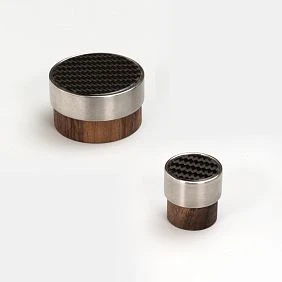
Knob handle
It usually has a compact mounting point and depends more on its position on the front than on its overall length.
Pull handle
Requires two-point mounting control and the proportion between handle length and front.
Profile handle
It can be long and architecturally connected to the edge of the front. Its actual length and the visual rhythm of the series are especially critical.
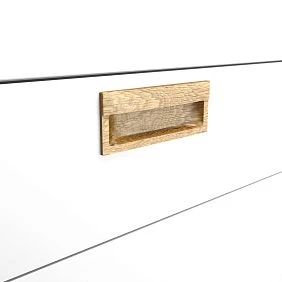
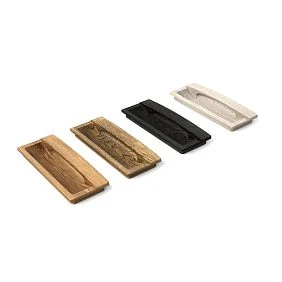
Mortise handle
It affects facade processing more than a standard overlay handle: its design must be built into the technology before series launch.
That is why in a furniture series matrix, the type is a separate field, not a marketing description.
Custom furniture handles: where the series standard ends
A custom furniture manufacturer often wants to maintain flexibility: the client can choose several handles. But even custom furniture benefits from a standard library.
Instead of endless choice, you can offer an approved set:
- BASE — standard handles with short lead times and known geometry;
- PREMIUM — more complex or expensive options;
- CUSTOM — items requiring separate calculation and possible facade modification.
This way, custom furniture handles do not break engineering discipline: each option still has an exact card.
How to include furniture handles in the BOM
The BOM must answer the question "what is installed per one unit of furniture". For example:
ITEM: KOMOD-A
DRAWER-FRONT: 4 pcs.
HANDLE: HL-___ / OAK / FINISH-01
QTY PER UNIT: 4
SERVICE RESERVE: separate
Then MRP or a regular production table multiplies the handle quantity by the production plan. If 80 dressers are produced, the gross requirement is 320 handles. Changing a handle is done through a new BOM revision, not a verbal instruction to the shop floor.
How a production plan turns into a wholesale requisition
The handle quantity must be tied to the production plan, not to a feeling of "let's take more". For each furniture series, you can store:
PLAN QTY × HANDLE QTY PER UNIT = GROSS REQUIREMENT
The available quality stock is subtracted from the gross requirement, and a justified production reserve is added. This yields the NET REQUIREMENT — that is what is sent to purchasing.
Example: the plan is 100 cabinets, with two handles per unit. Gross requirement — 200. The warehouse has 34 verified handles of the required LOT and finish. Production needs another 166 plus the calculated reserve. If 20 of the 34 in stock belong to the service reserve and cannot be used, the available stock is already 14. That is why the stock type must be visible in the records.
How not to confuse production stock, reserve, and free warehouse stock
Identical handles may physically sit in the same warehouse but belong to different purposes. If the system shows only the total stock, the buyer makes incorrect decisions.
It is useful to separate:
- FREE STOCK — free verified stock;
- PRODUCTION RESERVED — reserved for an already planned batch;
- SERVICE RESERVE — set aside for after-sales replacement;
- QUARANTINE — awaiting a decision after incoming inspection;
- CLAIM — problem items under a claim.
So having 50 units in stock does not mean all 50 can be allocated to a new customer order. Perhaps 30 already belong to the next production cycle, and 10 to the service reserve.
How to store handles in the warehouse so the configuration is not lost
For wooden handles, not only quantity but also identification matters. Packaging must preserve the SKU, material, finish, and LOT. If the items are poured into a common box labeled "oak handles," the link to a specific batch will be lost.
A warehouse bin may have a code:
HANDLE / SKU / FINISH / LOT / STATUS
The label additionally indicates the quantity and the date of receipt. For long profiles, it is useful to store the length directly in the marking so that two similar sizes do not get mixed up.
If a handle arrives without a coating and will be painted inside the factory, before finishing it is stored as one stage, and after finishing as another. An internal finish lot helps link the finished handles to a specific painting batch.
Fasteners must be standardized together with the handle
For a model, it is not enough to approve only the wooden part. If the fasteners are included with a specific handle, this must be reflected in the BOM. If the furniture production uses its own fasteners, their parameters must also be standardized.
Check:
- fastener type;
- quantity per handle;
- compatibility with facade thickness;
- the screw length;
- whether washers, bushings, or decorative elements are needed;
- whether the kit is included in the supply or purchased separately.
An error in the fasteners can halt assembly even when handles are fully in stock. Therefore, the line “handle — 300 pcs.” without understanding the mounting kit is insufficient for production.
The drilling control template must be linked to the SKU
If production uses a drilling template or a CNC program, it must reference a specific approved handle configuration. The file name ruchka_new.dxf creates the same risk,
When you shouldn't buy a large batch
Even with a good wholesale offer, it's too early to rush into a large batch if critical checks aren't complete.
The reference facade hasn't been approved
Size and ergonomics haven't yet been confirmed on actual furniture.
The mounting geometry hasn't been finalized
The facades aren't yet ready for production drilling.
The finish is described in words, but there's no reference sample
There will be nothing to compare the repeat batch against.
No specific material has been chosen
The phrase "solid wood" is too general for a purchasing line if different species are available.
The furniture series is still changing its fronts
Changing the size of a door or drawer can also change the optimal handle size.
No confirmed release plan
A large wholesale order will create excess warehouse stock if the series has not been launched yet.
Typical mistakes when wholesale purchasing furniture handles
| Mistake | Why it occurs | Consequence | How to prevent |
|---|---|---|---|
| Store only the model name | Visually it seems there is only one option | A different size or material is being ordered | Record the full configuration |
| Choose after drilling | Design leaves hardware "for later" | Reworking holes and fronts | APPROVED before drilling starts |
| Comparing price only | Finish and fasteners are not taken into account | Different products are being compared | Compare an identical configuration |
| Do not store a master sample | Coating is described in words | Dispute about a repeat batch | Physical reference |
| Mix LOT | One shared warehouse is more convenient | Cannot localize the discrepancy | Separate batch labeling |
| Use service reserve in production | Stock statuses are not separated | No parts for warranty replacement | Separate SERVICE RESERVE |
| Search for an equivalent after line stoppage | No backup model | Urgent redesign of the structure | Check ALTERNATIVE in advance |
| Reuse the old price | Price is stored without a date | Incorrect budget for the new batch | New RFQ before ordering |
Furniture decor: how not to blur the handle specification
Related queries such as "buy furniture decor", "buy furniture decor" and "decorative elements for furniture" are useful only as context. If a furniture series includes handles, legs and overlays, they can form a single visual system. But from a procurement standpoint, these are different categories.
A decorative overlay should not be added to the line "handle + decor as a set" if it is a separate SKU. Each part has its own quantity, material, finish and reserve.
For a user who needs to buy furniture decor together with handles, the right path is to first determine the composition of the series, then create separate lines. This preserves the ability to replace or reorder one category without rebuilding the entire set.
How to work with decorative furniture elements near the handle
A decorative overlay or carved element must not conflict with the grip zone. On the front, not only the style is checked, but also the actual clearances.
If nearby there are:
- handle;
- carved overlay;
- molding;
- panel;
- the edge of the facade;
you need to build a scaled drawing and check the distances. A beautiful ornament can physically obstruct the hand or force the handle to be shifted off-axis.
This is exactly where decorative furniture elements must be coordinated as a composition, but not merged into a single purchasing line item.
How to use the STAVROS catalog in production work
You can start with the main STAVROS catalog, and then go to the main section STAVROS furniture handles. The handle catalog is divided into coated and uncoated options and shows different structural types.
For production work, it is better to build the route as follows:
catalog → model → card → exact modification → drawing / 3D → control front → approved sample → BOM → RFQ.
Technical materials can additionally be found in the section catalogs, drawings and 3D, and professional information — on the page for designers and architects.
Before ordering, payment and delivery terms must be verified in the current payment and delivery section.
How not to cannibalize the general article about furniture hardware wholesale
The site already has a separate material about furniture hardware wholesale. The task there is broader: handles, legs, overlays, moldings, and other decorative categories are compared.
The current article should not repeat this assortment overview. Its subject is narrower: how to make one selected handle a stable production component — lock down geometry, material, finish, reference sample, BOM, LOT and reorder rules.
If the reader needs to choose a full set of furniture hardware, it makes more sense to go to the general material. If the task is to organize serial purchasing of handles, stay here.
How not to duplicate general material about hardware from the manufacturer
Separate article about furniture hardware from the manufacturer addresses the broader question of choosing components and a manufacturer.
Here the focus is different. We already assume that the production facility specifically needs a handle, and we consider the entire lifecycle of a single component: from the control sample front to the repeat batch.
How to order STAVROS furniture handles for a production series
The final sequence can be short:
- choose a model from the catalog;
- lock in the exact size and installation geometry;
- choose the material;
- determine the finish option or your own finishing technology;
- assemble a control facade;
- approve the master sample;
- enter the configuration into the BOM;
- calculate gross and net requirements;
- send the RFQ with quantity and deadline;
- receive and mark the LOT;
- perform incoming inspection;
- separate the production and service reserve.
After this, you can place a wholesale order for handles not as an unnamed batch of decor, but as a reproducible component of serial furniture.
The practical CTA is simple: send STAVROS the SKUs, selected finishes, and the quantity of handles for batch calculation, without replacing the specification with the general wording "wooden handles".
Handle standard revision: when a series should get a new version
A furniture handle standard cannot be considered permanent. A series can evolve: facade heights change, a new material appears, the finish is updated, or the main SKU is replaced with another. It is important not to edit the old record without a trace, but to issue a new revision.
For example:
HANDLE STANDARD REV01 — HL-___ / OAK / FINISH-01
HANDLE STANDARD REV02 — same SKU / OAK / FINISH-02
HANDLE STANDARD REV03 — ALTERNATIVE SKU / OAK / FINISH-02
A new revision is needed if at least one parameter changes that affects drilling, appearance, purchasing, or service: SKU, size, installation geometry, material, finish, fasteners, or an approved alternative option.
Old revisions are not deleted. They remain linked to furniture that has already been produced and sold. Then the service department understands why a 2025 cabinet and a 2026 cabinet of the same series may have different handles.
Production documentation must always have one RELEASED revision. A draft version gets DRAFT and must not reach the workshop. This protects against a situation where the designer is already discussing a new handle while the engineer considers it approved.
If the finish or material changes after the series launch
A color-only change may seem cosmetic, but for purchasing it is a new configuration. If an unpainted beech handle is changed to an oak one with a ready finish, at minimum the material, price, internal finishing technology, reference sample, and warehouse code are affected.
Correct change workflow:
- record the reason for the change;
- create a new configuration without rewriting the old one;
- obtain an up-to-date product card and commercial quote;
- assemble a control facade;
- approve a new sample;
- update the BOM and warehouse code;
- decide the fate of the remaining stock of the old configuration;
- update the service reserve.
Old stock cannot be automatically mixed with new stock or used in subsequent products "until it runs out" if the series must be visually uniform. It can be directed to service for older revisions, to a separate furniture model, or written off — the decision depends on the specific production.
This is precisely where the query "furniture handles from the manufacturer" takes on practical meaning: a furniture manufacturer needs not the abstract ability to buy a handle, but the ability to clearly order a specific finish and then repeat it in the next batch.
Commercial queries about furniture decor: how to use them without straying from the main topic
A buyer who enters "furniture decor buy" or "decorative elements for furniture buy" may be searching for handles, overlays, and other parts at the same time. For serial production, these categories are best separated already in the specification.
If furniture decor is purchased together with handles, a visual system is first formed, and then each part receives its own SKU, quantity, and revision. The handle remains a separate functional and decorative component with its own mounting geometry; the overlay is a separate decorative element; the leg is a separate support part.
This way, the article preserves a narrow intent while also giving a clear path to those who purchase several wooden elements for a single furniture series.
FAQ: furniture handles for serial production
Where to buy furniture handles wholesale?
For serial production, it is better to choose a supplier that has specific SKUs, real dimensions, clear finish options, and the ability to reorder. At STAVROS, a separate category of wooden furniture handles includes models with and without coating, and product cards provide dimensions and available materials. Before purchasing a large batch, it is better to first approve one specific configuration and a control facade.
Can furniture handles be bought directly from the manufacturer?
Yes, if the manufacturer works with the required batch and can confirm the specific item number, material, size, finish, and lead time. The fact of buying directly does not remove the need for a technical check. For a furniture factory, the reproducibility of the next batch is more important than the formal status of “from the manufacturer.”
Which wooden handles are suitable for the kitchen?
The suitable model depends on the geometry of the fronts, the opening method, the visual language of the series, and the production matrix. For the kitchen, it is useful to separate upper fronts, lower fronts, drawers, and tall cabinets, then test one or several approved models on real control fronts.
How do coated and uncoated handles differ?
An unpainted handle allows the furniture manufacturer to independently perform tinting, painting, or another agreed finish. A coated handle arrives as a more finished visual component. In purchasing, these are different configurations; they cannot be compared only by the price per piece without accounting for the internal finishing operation.
How to choose the handle size for a front?
Do not use a universal percentage. First select a specific model and available sizes, then check the proportion, grip, projection, adjacent fronts, and installation geometry on a control sample. For long handles, the vertical or horizontal scenario is checked separately.
When should the handle be chosen — before or after drilling the front?
Before serial drilling. Once holes appear, the installation parameter becomes part of the front's construction. Replacing it with a handle of different geometry may require a new program, template, or rework of already manufactured parts.
How to calculate the number of handles for a furniture series?
Count by fronts and drawers, not only by the number of cabinets. For each furniture model, determine the number of fronts of each type and the number of handles per front. Then the requirement is multiplied by the production plan, the available free stock is subtracted from it, and a justified reserve is added.
Should a reserve of handles be kept?
Yes, if the production model and service require it. At the same time, the production and service reserves are best kept separate. The first is used during furniture production, the second is retained for possible replacement after sale.
How to control a repeat batch?
Compare it with the master sample and the previously accepted batch. SKU, size, material, finish, installation geometry, surface, and completeness are checked. A new LOT should not be mixed with old stock until incoming inspection is complete.
Can the same handle model be used across different furniture series?
Yes, if the specific configuration fits in terms of geometry, style, and mounting. But each series must have its own BOM line and quantity. You cannot assume that a handle approved for one piece of furniture automatically fits another without checking the front.
How do you order wooden furniture handles with your own finish?
If the unfinished option is selected, production must define its finishing technology, color, gloss level, and reference sample in advance. Procurement keeps the original SKU and material, while the internal finish ID refers to the furniture factory's own operation.
Should a sample be ordered before a wholesale batch?
For a new series, it makes sense to first check wooden furniture handles physically. A sample helps evaluate the actual profile and material, and a control front shows how the handle works on the furniture. If the finish matters, the approved physical sample becomes the reference for repeat deliveries.
What should you do if the supplier offers an alternative?
Do not replace the original handle based on a photo alone. Check the dimensions, installation parameter, material, finish, mounting, and ergonomics. If the furniture has already been drilled, compatibility with the holes becomes a critical condition. After verification, the new model goes through its own approval and receives a new BOM revision.
How should data be stored for reordering?
Minimum set: SKU, exact modification, size, installation parameter, material, finish, sample ID, previous LOT, and supplier. Price and availability are kept as historical data but are re-verified before a new order.
Can one handle with different finishes be used within the same series?
Yes, if it is a deliberate part of the design and each configuration has a separate code. Production must not store them under one common name: FINISH-01 and FINISH-02 must be separate BOM lines and inventory items.
How do you test a handle for a cabinet with a long front?
You need to assemble or model the actual front, check the clearances, grip zone, vertical orientation, adjacent doors, and installation geometry. For a long handle, packaging and transportation are additionally important, since damage to one large part can halt the assembly of a specific cabinet.
Final production checklist before a wholesale order
Before issuing a purchase order, it is useful to run a short check. If one of the critical points is not confirmed, the item remains on HOLD.
| Check | Status |
|---|---|
| Exact SKU and modification are defined | OK / HOLD |
| Dimensions and installation geometry are confirmed | OK / HOLD |
| Reference front has been checked | OK / HOLD |
| Material approved | OK / HOLD |
| Coating or proprietary finishing technology approved | OK / HOLD |
| Master sample saved | OK / HOLD |
| BOM updated to the current revision | OK / HOLD |
| Gross requirement calculated based on the production plan | OK / HOLD |
| Free warehouse stock verified | OK / HOLD |
| Production and service reserves separated | OK / HOLD |
| RFQ relates to the same configuration | OK / HOLD |
| Delivery time and address confirmed | OK / HOLD |
This checklist turns a beautiful handle into a manageable production item. It is especially useful before the first large batch of a new furniture series.
Final logic: how to turn a handle into a stable serial component
The main task of a furniture factory is not simply to find a handle you like. It must ensure that a month, six months, and several production cycles later, the same furniture can be produced with the same clear, consistent configuration.
To achieve this, the handle goes through the following sequence:
catalog → specific SKU → size and mounting → material → finish → reference front → approved sample → BOM → production plan → RFQ → batch → incoming inspection → LOT marking → assembly → service reserve → repeat order.
If product identity is preserved at every stage, buying furniture handles wholesale stops being a decorative purchase made by eye. They become a standard component that a designer can specify for the front, a process engineer can include in drilling, a buyer can include in the order, the warehouse can include in inventory records, and service can include in future replacement.
This is what makes this new material different from a general article about furniture hardware. There is no goal here to compare all types of components. The entire system is built around one object — the furniture handle — and one production goal: to choose it correctly once, then reproduce it without errors in serial furniture and subsequent batches.