








































































Article Contents:
- What is the wooden finial L-087
- Key features of L-087
- Why the finial cannot be chosen separately from the entire structure
- What the four numbers in the L-087 size mean
- Three sizes of L-087: how to choose the right scale
- L-087 on stairs: the main but not the only scenario
- How to match L-087 with balusters and handrail
- Finial L-087 for a bed
- Application on cabinet, library, and furniture portal
- L-087 on chair and other small furniture
- Carved cornice and interior composition
- Restaurant, hotel, salon and showroom
- Beech or oak for L-087
- How to choose surface preparation quality
- How many finials to order
- What to buy together with L-087
- How not to confuse L-087 with a regular artichoke finial
- How to check size on site before ordering
- Installation: what to decide before purchase
- Finishing L-087
- Application of L-087 in new products and restoration
- New staircase or furniture
- Replacement of lost decor
- Adding decor to an existing structure
- Serial design
- Choosing only by frontal photo
- Purchase without full size
- Ignoring the landing area
- Mixing breeds
- Random quantity
- Overload with ornament
- Waiting for a finished painted product
- Installation without a node project
- Additional purchase of a paired part later
- Use in a constant contact zone
- Ordering the maximum size "with a margin"
- Lack of test paint
- What is a post finial?
- How is L-087 different from a regular artichoke?
- What sizes are available?
- Which size to choose for a stair post?
- Can L-087 be installed on a bed?
- Is the finial suitable for a cabinet?
- Can L-087 be used on a chair?
- Which material should I choose: beech or oak?
- Is the finial supplied already painted?
- Can L-087 be painted to match the wall or furniture color?
- How many finials are needed for a staircase?
- Can L-087 be used individually?
- Is a spare part needed?
- How to attach the finial?
- Can the finial be installed using only glue?
- What to check before buying?
- How to order matching finials?
- Will L-087 suit a modern interior?
- Can L-087 be used in a restaurant or hotel?
- Where can I see other models?
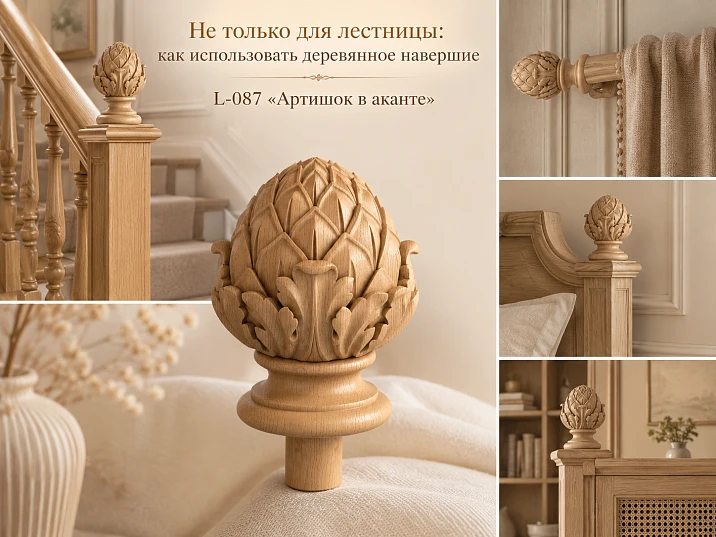
A wooden finial is often perceived as a small detail that just needs to be matched by appearance and installed on the top platform of a post. In practice, it is the top finish that sets the character of the entire vertical: it connects the post with the balusters, emphasizes the scale of the staircase, completes a furniture support, or turns an ordinary structure into an expressive interior object. Therefore, the decision to buy a wooden finial should be made not separately from the post, bed, cabinet, or cornice, but together with the entire composition.
The L-087 "Artichoke in Acanthus" model is particularly interesting because it is not limited to a single staircase task. It can be considered as a decorative top for a stair post, a finish for a furniture post, an ornament for a bed, cabinet, chair, carved cornice, portal, or thematic commercial interior. The pronounced plant relief makes the product an independent detail, but at the same time requires precise scale selection: a small version may get lost on a large structure, while the largest one may overload compact furniture.
The line includes three sizes: 106 × 50 × 67 × 85 mm, 149 × 70 × 94 × 119 mm, and 200 × 100 × 135 × 170 mm. These are not just three price points of one model. Each option is designed for a different visual scale and a different mounting location. Before ordering, you need to check not only the overall height of the finial but also the geometry of the base, the width of the post, the direction of the pattern, the wood species, the future finish, and the number of identical parts in the project.
Below, we will analyze where L-087 is truly appropriate, how to choose the size for a staircase, bed, cabinet, and commercial space, how beech differs from oak in such a task, which details to order together, and what must be checked before launching the product into finishing and installation. The main goal is to move from the abstract desire to "add a carved artichoke" to a precise specification that can be unambiguously communicated to the manufacturer, designer, furniture maker, or installer.
Short answer. For a small furniture post, chair, compact bed, or local decorative unit, the L-087 size 106 × 50 × 67 × 85 mm is often considered. For a cabinet, bed, interior post, and medium stair post, the scale 149 × 70 × 94 × 119 mm is suitable. For a large starting post, tall cabinet, portal, restaurant, or expressive architectural composition, the size 200 × 100 × 135 × 170 mm is intended. The final decision is made only after comparing the finial drawing with the mounting platform of the structure.
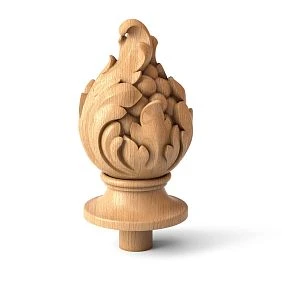
What is the wooden finial L-087?
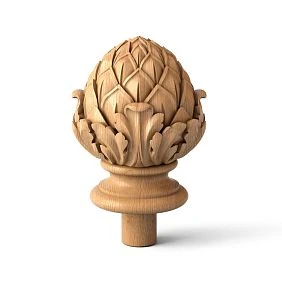
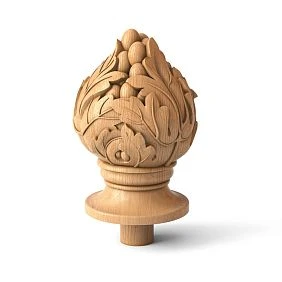
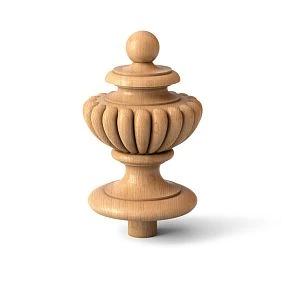
L-087 is a carved wooden finial with an artichoke motif surrounded by acanthus leaves. The artichoke forms the central volume, while the acanthus plasticity connects it with the tradition of classical architectural and furniture decor. As a result, the model appears more complex than a simple pine cone, ball, or smooth finish. It not only covers the top of the post but also creates an upward-directed finish that reads well in silhouette.
The main practical feature of L-087 is the combination of a compact landing area and a developed relief top. This geometry allows the product to be used on various objects: from a stair post to a furniture stand. However, the mere presence of a suitable overall size does not automatically guarantee compatibility. It is necessary to check the contact plane, attachment point, thickness and shape of the base, and also ensure that the carved volume does not conflict with adjacent parts.
The model is made from beech and oak. This allows either preparing the product for opaque painting or preserving the natural wood grain. For paired and series parts, it is especially important to order the same wood species and a consistent level of surface preparation. This way, the finials will accept the finish uniformly and will not show random differences in tone, texture, or degree of fiber visibility.
You can view confirmed execution options, images, and current parameters in the product card: buy wooden finial L-087 "Artichoke in Acanthus". Before adding to the order, you must select the exact size, material, processing option, and quantity.




Main characteristics of L-087
| Parameter | Confirmed data | What to check before ordering |
|---|---|---|
| Article number | L-087 | Not to be confused with other artichoke-shaped finials |
| Ornament | Artichoke framed by acanthus leaves | Compatibility of the pattern with balusters, post, furniture, and adjacent decor |
| Size 1 | 106 × 50 × 67 × 85 mm | Landing area and scale of a small structure |
| Size 2 | 149 × 70 × 94 × 119 mm | Width of the post, overall silhouette of a cabinet, bed, or stair post |
| Size 3 | 200 × 100 × 135 × 170 mm | Proportionality to a large post, portal, or commercial interior |
| Material | Beech or oak | Species of adjacent parts and type of future finish |
| Surface | Delivery for further finishing, available preparation options are specified in the card | Required quality of preparation for enamel, tinting, or transparent coating |
| Application | Stair posts, beds, cabinets, chairs, carved cornices, and themed interiors | Specific attachment point and direction of the pattern |
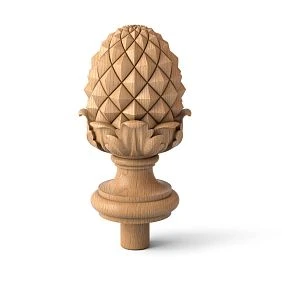
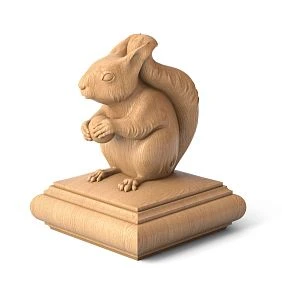
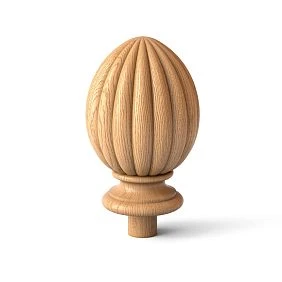
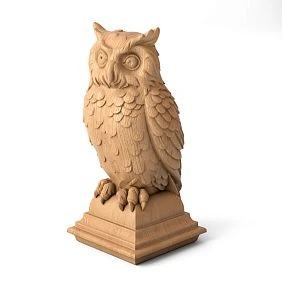
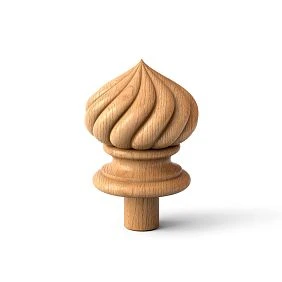
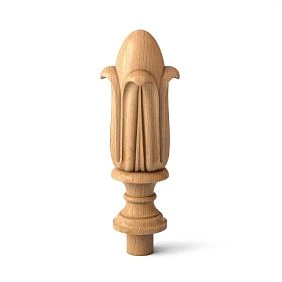
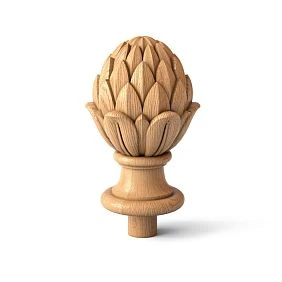
Our factory also produces:
Why the finial cannot be chosen separately from the entire structure
The finial completes the vertical line, so its scale is perceived not by itself, but relative to the height and width of the base. On a sample, a size of 200 × 100 × 135 × 170 mm may seem moderate, but on a thin furniture post it will become dominant. Conversely, a variant of 106 × 50 × 67 × 85 mm may look expressive in hand but get lost on a tall newel post or large portal.
The first parameter is the width of the post or column. The base of the finial should logically rest on the top surface, not create a random step. A small transition is possible as part of the design, but it needs to be seen on the drawing. If the base is significantly smaller than the top platform of the post, it creates a feeling of a randomly placed detail. If it extends beyond the edges, you need to understand whether the protrusion will interfere with use or look heavy.
The second parameter is the height of the entire vertical. The taller the post, furniture column, or decorative pillar, the larger the volume it can accommodate. But this does not mean that the largest finial should be chosen for any tall element. It is important to consider the thickness of the post, the richness of the carving, and the number of repeating elements. Four large artichokes on a bed can be perceived much more actively than one such element on a staircase newel post.
The third parameter is the pattern of the adjacent decor. L-087 features developed plant-like plasticity. If balusters, overlays, cornices, and furniture fronts are already rich in carving, the finial should continue the overall theme, not add another unrelated motif. When calm, smooth elements are used nearby, the artichoke can become the sole accent and will read more clearly.
The fourth parameter is the future finish. With opaque enamel, the difference in wood species visually decreases, but the precision of surface preparation becomes especially important. With tinting and a transparent coating, the wood texture comes to the forefront, so it is better to order the finial, post, balusters, or furniture columns from the same wood species and, if possible, from the same batch.
Get Consultation
What the four numbers in the size of L-087 mean
In the L-087 product card, dimensions are given by four values: 106 × 50 × 67 × 85 mm, 149 × 70 × 94 × 119 mm, and 200 × 100 × 135 × 170 mm. The buyer should not independently assign each number as height, base width, or maximum projection without checking the drawing. For a complex carved product, a single text designation is insufficient: the model may differ in overall height, mounting part, maximum cross-sectional size, and other control dimensions.
The correct order of work is as follows: first, choose the appropriate scale, then open the drawing of the specific variant and compare it with the top platform of the post or furniture column. If the finial is planned to be installed in an existing structure, take the actual dimensions of the base after manufacturing or restoration, rather than just the nominal size from an old project.
For furniture production, it is useful to provide the supplier not only with the notation "L-087, medium size" but also with the full set of numbers from the product card. This eliminates the situation where the designer intends 149 × 70 × 94 × 119 mm, but the purchaser orders a different variant. In the specification, it is also worth attaching a link to the product card and indicating the installation location for each item.
If the project is complex, it makes sense to create a simple mockup of the dimensions. For this, there is no need to reproduce the thread: it is enough to cut out a volume close to the outer contour from cardboard or foam material. Such a mockup shows how much the finial protrudes beyond the post, whether it touches the wall, curtain, door leaf, top of the cabinet, or decorative cornice.
Three sizes of L-087: how to choose the right scale
| Size | Suitable scenarios | Main risk of error |
|---|---|---|
| 106 × 50 × 67 × 85 mm | Furniture post, chair, compact bed, small decorative element | Getting lost on a tall column or large architectural structure |
| 149 × 70 × 94 × 119 mm | Cabinet, bed, interior post, medium stair newel | Being too active on a thin post or in a dense furniture composition |
| 200 × 100 × 135 × 170 mm | Starting post, tall cabinet, large portal, restaurant, hotel, decorative structure | Overload a small object and require more free space around |
The first size is convenient to consider where the finial should be noticeable when viewed up close, but should not become the main volume of the interior. On a small bed, chair, furniture stand, or local decorative node, it supports a classic character and does not take up too much space.
The medium option is more universal in scale, but that is precisely why it requires careful checking. It can suit a bed, wardrobe, library, interior stand, and a medium-thickness stair newel post. The decision depends not only on the height of the structure, but also on the width of the base, the relief of adjacent details, and the number of identical finials.
The maximum size is designed for a situation where the product has "room to breathe." This could be a starting post, a large furniture portal, a tall wardrobe, or a decorative structure in a restaurant, hotel, or salon. In a cramped room, such a volume can visually lower the ceiling or make the top of the furniture appear heavy. Therefore, it is advisable to evaluate the large option from the distance from which the object will be perceived in the finished interior.
L-087 on stairs: the main, but not the only, scenario
On stairs, the finial usually completes the starting or support post. Here it works in several directions at once: it closes the top of the vertical, marks the beginning of the railing, connects the post with balusters and handrail, and also forms a visual point that a person notices when entering the stairs. The more open the stair hall, the more pronounced the silhouette of the top decor becomes.
For the entry post, a large size is often considered, but there is no automatic rule. A tall post with a thin cross-section may pair better with a medium L-087, while a massive structure with developed carving can accommodate the 200 × 100 × 135 × 170 mm option. You need to compare not only the height, but also the width of the top platform, the depth of the relief, and the distance to the wall or handrail.
If finials are installed on two entry posts, they are ordered as a pair in the same size, same wood species, and same surface preparation. A difference in shade with a transparent finish or a slight difference in the processing of paired parts will be more noticeable than on a single element. For a stair landing with several posts, it is advisable to draw up a diagram in advance: where L-087 is used, and where the top remains more restrained.
When selecting a stair set, you can consider buying a carved stair post L-073. Its size 1170 × 100 mm shows a suitable type of base in terms of scale, but the compatibility of the fit with L-087 must be checked against the drawings of both products.
Another route — pick a wooden post L-071. It also has a size of 1170 × 100 mm, but differs in pattern. In such a set, it is important to assess whether the plastic of the post continues the shape of the artichoke and acanthus leaves, or whether there is a conflict between two independent ornaments between the parts.
How to match L-087 with balusters and handrail
The finial is above the balusters, but is perceived together with them. If the balusters have a pronounced floral pattern, L-087 can become a logical conclusion to the theme. If the row of balusters is smooth and geometric, the artichoke will be the only carved accent. Both options are possible, but the compositional principle must be chosen in advance.
As an example of developed floral decor, consider carved baluster L-002 in Renaissance style size 1000 × 70 × 25 mm. This is not a confirmation of automatic compatibility, but a direction for selecting the overall style. You need to compare the ornament, width, wood species, and future finish.
For a different scale, buy carved baluster L-027 size 1000 × 60 mm. A narrower part creates a different rhythm of the fence, so the number of balusters, the distance between them, and the richness of the carving will differ.
The handrail and the under-baluster rail must connect the row into a single structure, but they do not have to repeat the complex ornament of the finial. Often, a calm linear molding better emphasizes the carved top. Before ordering, it is important to coordinate the width of the handrail, the top of the post, the position of the balusters, and the attachment point of L-087, so that the elements do not interfere with each other technically.
Finial L-087 for bed
A bed with vertical posts is one of the most expressive non-staircase scenarios. The finial can be installed on four posts, only at the headboard, or on the two most prominent supports. The choice of quantity changes the character of the furniture: four identical artichokes make the silhouette solemn and symmetrical, a pair at the headboard creates an accent in the upper part, and a single element is more suitable for an asymmetrical custom project.
For a compact bed, the size 106 × 50 × 67 × 85 mm is more often considered. It can emphasize the post but should not overshadow the perception of the headboard. The medium option 149 × 70 × 94 × 119 mm is suitable for a higher backrest, a wide post, and developed carved decor. The maximum size is only appropriate on a large structure, where the top elements do not look disproportionate.
When restoring an old bed, you need to especially carefully check the base. Old posts may have traces of previous fastening, uneven height, or a damaged top surface. The new finial should not be used as a way to hide a serious structural defect. First, the furniture maker restores the support, then selects the size and method of installing the decorative top for it.
For a bed, safety of close contact is important. The carved element should not protrude into the passage, catch textiles, or be located where a person constantly touches it with their hand or head. Therefore, a full-size mockup is more useful than a single photo. It allows you to check the height, width, passage around the furniture, and interaction with the bedspread, canopy, curtains, or wall lamps.
In terms of finish, the post, headboard, and finial should be perceived as a single product. For enamel, it is advisable to coordinate the preparation of all parts, and for a transparent coating, use the same wood species. Paired finials are best ordered simultaneously to reduce the risk of differences in wood and processing.
Application on a cabinet, bookcase, and furniture portal
On a cabinet, L-087 can finish the side posts, corners of the superstructure, or verticals of the furniture portal. Here, the finial works as a top point that directs the gaze from the facades to the cornice. It looks especially expressive on tall furniture, where there is space between the top of the doors and the ceiling for a decorative superstructure.
For a bookcase or cabinet, the size is chosen based on the width of the side post and the overall height of the body. A small finial is suitable for a compact display case, a medium one for a full-sized cabinet or sideboard, and a large one for a tall bookcase, portal, or built-in composition. You cannot rely solely on the width of the facade: the proportion of the vertical support on which the product is actually installed is more important.
In the L-087 furniture portal, it can be located at the edges of the upper part. Then the two elements create a symmetrical finish and help connect the side posts with the carved cornice. Before ordering, you need to check whether the finial competes with the central decor, pediment, overlay, or capital. When the top is already saturated with several large details, a calmer finish may be more convincing.
On a display case or sideboard, the finial should not only be beautiful but also convenient in use. It should not interfere with opening doors, lighting, top shelves, cleaning, or moving the furniture. If the cabinet is close to the ceiling, space must be left for installation and subsequent maintenance.
When designing custom furniture, it is useful to include L-087 in the model before manufacturing the body. Then the furniture maker forms the correct top platform in advance and hides the fastening. Attempting to add a finial after the furniture is completed is not always possible: the finished post may be too thin, hollow, or inconvenient for a reliable joint.
L-087 on chairs and other small furniture
The product card allows the use of L-087 when designing chairs. For this scenario, a particularly precise scale is needed. On furniture that a person touches and moves daily, large protruding decor can interfere with use. Therefore, the first candidate is usually the 106 × 50 × 67 × 85 mm option, but even it must be checked on a real post.
The finial can complete a high backrest, side post of an armchair, decorative throne chair, or furniture for a themed interior. It is appropriate where the design itself is intended for a pronounced historical or theatrical image. On an ordinary dining chair, a complex artichoke may look excessive and create an inconvenient protrusion.
For serial furniture, it is important to consider the quantity. Four chairs with two finials each require eight identical products. In such a batch, any differences in wood species, size, or finish become noticeable. Therefore, it is better to place the order with one specification and not purchase parts one by one after finishing has started.
Before starting a series, it is worth making one prototype piece of furniture. On it, check the fit, ease of grip, resistance to accidental touches, placement relative to upholstery, and overall silhouette. Only after this is the quantity approved and the full order launched.
Carved cornice and interior composition
In the L-087 cornice, it is not used as linear molding, but as a vertical or corner finish. It can mark the edge of a carved superstructure, support a side post of a portal, or complete a composition above a door, cabinet, display case, or decorative panel.
The main mistake is to perceive the finial as a universal overlay that can be attached to any surface. The geometry of the product is designed for a specific base and direction. Before ordering, you need to decide how it will be oriented, which part contacts the structure, and whether the relief will be turned sideways relative to the viewer.
In a corner composition, it is necessary to check two angles. What looks beautiful from the front may create a heavy protrusion from the side. This is especially important near a door, passage, curtain cornice, or built-in furniture. A full-size mockup helps evaluate not only the height but also the maximum width of the carved volume.
If L-087 is used together with a linear carved cornice, the ornaments must be coordinated. Acanthus leaves support classical plant motifs well, but next to another large central pattern, overload may occur. In a complex project, it is useful to keep one leading motif and make the other elements calmer.
Restaurant, hotel, salon, and showroom
A commercial interior allows using large decor more boldly than an ordinary apartment. The visitor perceives the space from a greater distance, and counters, portals, and entrance groups often have an increased scale. Therefore, L-087 measuring 200 × 100 × 135 × 170 mm can be appropriate in a restaurant, hotel, salon, showroom, or boutique.
On an entrance group, the finial helps indicate the thematic character of the space even before the visitor sees the main hall. In a restaurant with a classical, baroque, or botanical theme, an artichoke in acanthus can finish decorative columns, portal frames, partitions, or counters. In a hotel, it can support the design of the reception, library, stair hall, or photo zone.
For a salon and showroom, the readability of the decor in photographs is important. Large relief works well with directional lighting but can get lost with uniform frontal light. Before finishing, it is worth testing a sample color and lighting on one piece, especially if a complex dark shade or metallic effect is planned.
In a public interior, operation must be considered. The finial should not protrude into the evacuation route, interfere with cleaning, be located in an area of constant visitor contact, or be used as a handrail. A decorative detail does not replace a structural element and must be installed in a node designed by the designer.
For a serial order for a restaurant or hotel, a room-by-room specification is compiled: article, size, material, quantity, installation location, side or orientation, type of finish, and person responsible for installation. Such a table reduces the risk that identical finials will be accidentally distributed across different zones or painted in different shades.
Beech or oak for L-087
| Criterion | Beech | Oak |
|---|---|---|
| Typical decorative scenario | Opaque white or colored finish | Staining and coatings that preserve wood grain |
| Perception of relief | Relief is emphasized by color and chiaroscuro | Expressed natural texture is added to the relief |
| Combination with base | It is advisable to order with a beech post or furniture parts, especially with transparent sections | Better to combine with oak racks, posts, and moldings |
| Paired products | Order simultaneously with the same surface preparation | Order in one batch for more consistent texture and shade |
Choosing a wood species cannot be reduced to the rule "beech is cheaper, oak is more expensive," especially if the current price is not checked in the product card. It is more important to understand what result is needed after finishing. With dense opaque enamel, the quality of the relief and surface preparation becomes key. With transparent coating or tinting, the wood structure is visible, so oak provides a more pronounced natural pattern.
For a staircase, bed, or cabinet with transparent finish, it is better to choose the post and finial from the same wood species. Otherwise, even a well-matched color may not hide the difference in texture. In paired parts, it is important to coordinate not only the material but also the direction of perception: two finials should look like part of one set.
If the base is already made from unknown wood, do not try to guess the species from a photo. It is better to show a sample to the finisher and make a color test in advance. The finial is supplied for further processing, so the final appearance depends on the entire system of preparation and coating, not just on the choice of beech or oak.
How to choose the quality of surface preparation
The carved relief L-087 contains recesses, transitions, and thin edges. On such a shape, surface preparation affects no less than on smooth millwork. Any roughness, tool marks, or uneven sanding can become more noticeable after applying enamel or tinting.
When ordering, you need to clarify the available processing option in the product card and match it with the future finish. Do not assume that sanding means a ready final coating. The finial remains a wooden blank for subsequent finishing, and the final result depends on the primer, intermediate preparation, paint, stain, varnish, and the contractor's technique.
For opaque enamel, the cleanliness of the relief and the absence of rough defects that would show through under an even color are important. For tinting, uneven absorption and wood differences are especially noticeable. Therefore, a test coating on a separate area or sample is more useful than choosing a color only from a catalog.
If a set of posts, balusters, finials, and millwork is ordered, the requirements for the preparation of all parts must be described identically in the specification. Otherwise, some elements may arrive in a different condition, and the finisher will have to spend extra time leveling the batch.
How many finials to order
The quantity depends on the scenario, not the length of the structure. For one starting post, one L-087 is enough. For a symmetrical staircase entrance, two may be needed. On a bed, two elements are used at the headboard or four on all posts. On a cabinet or furniture portal, a pair is often ordered, and in a restaurant or hotel, the quantity is determined by the list of vertical supports.
| Scenario | Preliminary quantity | What to Check |
|---|---|---|
| One starting staircase post | 1 | The fit, pattern direction, and combination with balusters |
| Paired staircase entrance | 2 | Same size, species, and finish |
| Bed with decor only at the headboard | 2 | Symmetry and safety near textiles |
| Bed with four posts | 4 | Proportionality of all posts and free space around |
| Cabinet, bookcase, or furniture portal | Usually 2, but depends on the project | Width of side posts and central decor |
| Restaurant, hotel, salon, showroom | According to the project specification | Each installation location, orientation, and finish |
A spare finial is not always required. For a single post, an extra part may be unjustified. But in a large batch, especially with custom tinting, one spare element helps reduce the risk of delays due to damage during finishing or installation. The decision on a spare is made based on quantity, lead time for re-production, and complexity of the final coating.
You cannot order quantities based solely on visualization. The final specification must account for all actual posts, corners, portals, and repeating sections. For a large project, it is useful to number installation locations and link each to a specific line in the specification.
What to buy together with L-087
A finial is rarely a standalone purchase. It is usually part of a staircase, furniture, or interior set. The main goal of accompanying selection is not to gather as many carved parts as possible, but to ensure consistency in size, material, ornament, and future finish.
| What to add | Why | What to pay attention to |
|---|---|---|
| Column L-073 | Assemble a large stair node | Fit compatibility is checked against two drawings |
| Column L-071 | Select a different carved base | Coordinate the column pattern with the acanthus ornament of the finial |
| Baluster L-002 | Continue the developed plant theme in the railing | Check scale, spacing, wood species, and finish |
| Baluster L-027 | Assemble a staircase row of a different scale | Calculate the quantity and do not count automatic compatibility |
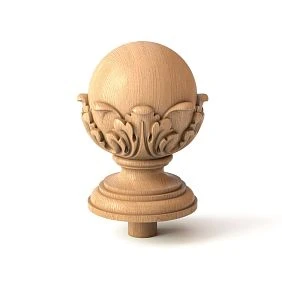
| Category of wooden finials | Find a calmer or differently shaped model | Compare sizes, mounting geometry, and ornament |
When the active plant pattern L-087 is not suitable, it is better View all wooden finials, rather than trying to fit an artichoke into a composition alien to it. In the category, you can choose a more laconic shape, a different scale, or a different stylistic direction.
How not to confuse L-087 with a regular artichoke finial
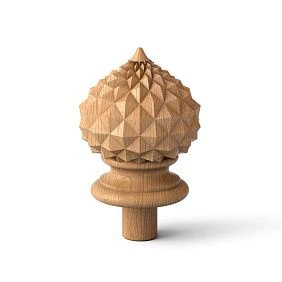
The name "artichoke" is found in different decorative models, but L-087 is distinguished by its acanthus framing. Here, not only the central fruit is important, but also the leaves, which form a more complex silhouette. Therefore, purchasing by the single word "artichoke" without an article code creates a risk of choosing a different model.
In the order, you need to specify the full article code L-087 and the name "Artichoke in Acanthus." Additionally, record the full size. The phrase "medium wooden artichoke" is insufficient: the supplier and customer may have different ideas about the medium scale.
The finial should not be confused with an overlay, rosette, or carved furniture detail. The finial is designed to complete a vertical base and has a corresponding three-dimensional geometry. A flat overlay works differently and cannot replace it without reworking the entire structure.
Another mistake is assuming all finials are interchangeable when they have the same maximum width. The mounting part, height, relief direction, and proportions may differ. Therefore, replacing one model with another requires rechecking the drawing and mockup.
How to check the size on the object before ordering
Start with the top platform of the post or pillar. Measure its width and depth, note any rounding, chamfers, existing holes, and irregularities. For an existing structure, additionally check how horizontal the plane is and whether the base needs restoration.
Then mark the maximum allowable dimension. Consider the wall, handrail, cornice, door leaf, textiles, light fixture, ceiling, and other elements. For a bed, the passage is especially important; for a cabinet, the distance to the ceiling; for a staircase, the position of the hand on the railing; for a commercial interior, the visitor traffic zone.
After that, make a dimensional mockup. Even a simple paper silhouette helps assess the height from the front. A three-dimensional mockup shows the side overhang and interaction with neighboring objects. Check from several distances: up close, from the room entrance, and from the main viewpoint.
If paired finials are used, set up two mockups. One piece may look moderate, but a pair can appear significantly more active. For four bed posts, it is useful to model all four positions because repetition enhances the decorative effect.
The final size is approved after comparing with the product drawing. The mockup checks perception but does not replace technical verification of the fit.
Installation: what to decide before purchasing
The exact mounting method depends on the structure of the post, furniture, or portal and should not be chosen based solely on the product photo. Before ordering, determine the base material, top platform thickness, access to the joint, possibility of hidden fastening, and the finishing sequence.
The finial should not be held only by the decorative coating. If the base is painted, the joint is prepared according to the installer's and finisher's technology. Glue, pin, fastener, or a combined joint is chosen by the project; there is no universal scheme for all stairs, beds, and cabinets.
For paired parts, it is important to ensure the same height and orientation. Even a small difference is noticeable on entrance posts or bed posts. Before final fixation, the elements are dry-fitted, compared from the front and side, and then the position is marked.
If the structure will be finished after assembly, it is necessary to decide whether it is more convenient to paint the finial separately or together with the base. Complex relief requires access from all sides. In some projects, separate finishing simplifies the work, but the joint after installation should still look neat.
For a public interior, the joint is additionally checked for accidental contact and maintenance. The decor should not become loose during cleaning or be used by visitors as a handle.
Finish L-087
The relief of the artichoke and acanthus leaves is revealed by chiaroscuro. Opaque enamel unifies the part with the painted post, bed, or cabinet and allows the carving to become part of a solid object. Tinting or a transparent coating preserves the wood grain and enhances the natural character of the oak.
Before the final finish, it is necessary to check the surface in the recesses. On complex carvings, one cannot limit oneself to a quick inspection of the front part: defects most often remain between the leaves and in the transitions. After priming, the relief is inspected again under side lighting.
Too thick a layer of opaque coating can soften fine transitions. Too contrasting a tint, on the other hand, can make the pattern appear fragmented. Therefore, a test application helps to evaluate not only the color but also how the coating works on the specific depth of the carving.
Paired parts are finished using the same technology. With a transparent coating, an absolutely identical natural pattern cannot be guaranteed, but a single batch and joint tinting help achieve a more consistent result.
For restoration of existing furniture, the color of the new finial is selected based on an actual sample, not on the name of the old stain. The surface of the main item may have changed over time, so an exact match requires tests and adjustments.
Application of L-087 in new products and during restoration
New staircase or furniture
In a new project, the finial is included in the design at an early stage. The designer selects the size, the engineer forms the mounting platform, the purchaser records the material and quantity, and the finisher receives uniform requirements for the entire batch. This is the most predictable scenario because the decorative part is not added at the last moment but becomes part of the product.
Early inclusion of L-087 in the project allows you to check the height of the entire vertical, the distance to the ceiling, passage, or wall, the position of the handrail and adjacent decor in advance. The furniture maker or staircase craftsman can prepare the base for the selected size, rather than trying to adapt a ready-made post to a random shape.
Replacement of lost decor
During restoration, L-087 can replace a lost or damaged finial, but only if
Adding decor to a finished structure
If a post, bed, or cabinet did not originally include a finial, first check the load-bearing part and the possibility of attachment. The decor should not be installed on a thin lid, hollow post, or unstable element without reinforcement.
It is useful to assess whether the new top will change the proportions of the finished furniture. Sometimes adding even a small L-087 visually makes the cabinet taller and requires reconsidering the cornice, central overlay, or distance to the ceiling.
Serial finishing
For a hotel, restaurant, salon, or furniture series, one reference unit is first approved. After checking the size, fit, and finish, the remaining items are launched. This reduces the risk of ordering a large batch of parts that look beautiful individually but do not fit the actual structure.
The reference is kept until the project is completed. Subsequent batches, color, pattern orientation, and installation quality are compared against it. In the specification, each finial is assigned a specific location to prevent parts from being mixed between rooms and furniture sections.
Who L-087 is for
L-087 should be considered by owners and designers of classic staircases, furniture with vertical posts, beds with high headboards, libraries, cabinets, sideboards, and portals. The model is especially appropriate when the interior already features floral ornaments, acanthus leaves, carved balusters, or classic moldings.
It suits commercial projects that need a noticeable thematic image: a restaurant, hotel, salon, boutique, showroom, photo zone, or reception desk. Three sizes allow distributing one motif across objects of different scales without using equally large decor in every area.
The model is useful for restoration and custom furniture when a ready-made carved element is needed instead of carving a complex artichoke yourself. The buyer receives a finished form and can focus on fitting, finishing, and assembling the set.
L-087 is suitable for a client who is willing to review the drawing and compile a specification, rather than choosing decor only from a photo. The more complex the object, the more important it is to agree on the material, size, quantity, and installation method in advance.
When it is better to choose a different finial
L-087 may be unnecessary in a minimalist interior, on a thin modern post, or next to already saturated central decor. The active artichoke in acanthus requires space and stylistic support. If the structure should look calm, it is better to choose a simpler finish.
A different model is needed when none of the three sizes fits the mounting platform. It is not worth altering the post just for a decorative detail if it compromises the structure or proportions. In such a case, it is useful View all wooden finials and choose a shape with a suitable base.
L-087 should also be avoided if a protruding relief falls into a narrow passage, interferes with textiles, a cabinet door, a light fixture, or cleaning. In a public interior, safety and operation are more important than decorative richness.
If the client needs an exact historical replica of a lost detail, a ready-made model may not match the original. In that case, individual restoration based on a sample is required, and L-087 can only be used as a stylistic reference.
Practical mistakes when choosing
Selection based only on a frontal photo
A photo does not show the side projection and actual scale. You need to look at the drawing and make a mockup. This is especially important for a bed, a cabinet near the ceiling, and a stair post next to a wall.
Purchase without full size
The entry "L-087 medium" is insufficient. The specification includes all four numbers of the selected option. This eliminates errors between 149 × 70 × 94 × 119 mm and the other two versions.
Ignoring the mounting platform
The overall width of the post does not guarantee proper fit. The specific top surface and base geometry of the finial must be checked. On old furniture, the condition of the wood is additionally assessed.
Mixing wood species
Oak top on a beech base may differ in texture with a transparent finish. Materials are agreed upon in advance. With opaque enamel, it is still important to prepare the surface uniformly.
Random quantity
A pair, four parts, or a series must be calculated based on actual installation locations. Visualization does not replace a schedule. On a large project, each top is tied to a specific position.
Overload of ornament
Artichoke, complex column, carved balusters, and a rich cornice may compete. One motif should remain dominant. Sometimes a calm handrail and simple molding better highlight L-087.
Waiting for a finished painted product
The top requires further finishing. The order specifies the material and surface preparation, while the finishing system is coordinated with the finisher. The species name does not determine the final color.
Installation without a node project
There is no universal fastener for stairs, beds, and cabinets. The installation method is determined by the base structure. A decorative part should not hide a weak or damaged post.
Purchasing a matching part later
With a transparent finish, an additional finial from a different batch may differ. Paired and series products are best ordered simultaneously and finished with the same system.
Use in an area of constant contact
The protruding relief should not obstruct passage, opening of furniture, or be used as a handle. On a chair, bed, or in a public interior, this issue should be checked before purchase.
Ordering the maximum size "with a margin"
A large finial does not automatically make the structure more expressive. It can overload a thin post, bring the top of the furniture closer to the ceiling, and require more space around it.
Lack of a test paint sample
Complex relief perceives light enamel, dark tinting, and transparent coating differently. A small sample helps avoid too dense a layer or excessive contrast.
How to place an order without ambiguity
A good specification starts with the article number: L-087. Next, the full name "Artichoke in Acanthus" and the full size of the selected option are indicated. After that, the material — beech or oak — and the required surface preparation option, available in the card, are recorded.
The next line is the quantity and installation location. For example: "2 pcs., bed headboard posts" or "4 pcs., staircase and landing entry posts." For a large project, room numbers and positions on the drawing are added.
In the specification, it is useful to indicate the base model: stair post, furniture post, bed, cabinet, or portal. If a specific STAVROS product is used, attach a link to its card. But even with the same nominal size, compatibility is confirmed by drawings.
The finish is described separately: opaque enamel, tinting, or transparent coating. This is not an order for a ready-made color, but information necessary for material selection and surface preparation. The exact coating system is approved by the finisher.
For a project with a tight schedule, the required delivery time and city are specified, and current conditions are checked before payment. Availability, price, and production time may change, so they cannot be transferred from an old estimate without re-checking the product card.
| Specification field | Example of filling |
|---|---|
| Article number | L-087 |
| Name | "Artichoke in Acanthus" |
| Size | 149 × 70 × 94 × 119 mm |
| Material | Beech or oak |
| Surface preparation | Selected option from the product card |
| Quantity | 2 pcs. |
| Installation location | Bed headboard posts |
| Future finishing | Opaque enamel or tinting |
| Additional materials | Base drawing, photo, layout, or column model |
How to buy L-087 on STAVROS
First open the card and check the sizes and options of the wooden finial L-087. Match each size to an actual post, pillar, bed, cabinet, or portal. Do not choose an option solely by the name "small", "medium", or "large".
Then determine the material. Beech is suitable for opaque finishes, oak when you need to preserve a pronounced texture. For transparent coatings, match the finial's wood species with the base and adjacent parts.
After that, check the set. For a staircase, you may need posts, balusters, handrail, and moldings; for furniture, paired posts, cornice, and other carved elements. All parts must be coordinated in size and style, not just selected from one category.
If the active artichoke does not fit in scale or pattern, go to the section and choose another wooden finial. A calmer model sometimes better supports a complex post or richly detailed furniture.
Before confirming the order, provide the manager with a specification: article number, full size, material, finish, quantity, purpose, and installation location. For a complex composition, attach a drawing or photo of the base with dimensions.
Useful materials for further selection
When you need to compare L-087 not only with products but also with general selection principles, it is useful to study the material "Buy wooden finials: choice for portal, stairs, bed, and interior". It helps to see the product group more broadly and understand when a finial is used outside of stairs.
For the stair assembly, a guide will be useful how to choose a wooden finial for a stair post. It reveals the role of the top decorative element in the railing composition.
Overview wooden finials for posts: shapes, sizes, and styles will help compare different types of finials if the artichoke in acanthus seems too complex.
Separate comparison carved artichoke L-057 or classic pinecone L-104 shows another purchasing fork and helps understand how active a plant motif the project needs.
How to check L-087 under different lighting
The carved artichoke is perceived differently under frontal and side light. Uniform lighting smooths the relief, while directed light emphasizes the depth of the leaves and the central volume. Therefore, evaluating only from a product photo does not show how the finial will look in a specific room.
For a stair hall, it is useful to check daylight from a window and evening artificial lighting. If the post is near a window, one side of the finial may constantly appear darker. With a paired installation, this is especially noticeable: two identical products are perceived differently if light falls on them from different directions.
On a bed or cabinet, the light source is often from the side or above. A lamp can highlight the acanthus leaves, but also reveal coating irregularities. Therefore, a test sample should be examined not only under the workshop's work light, but also near the future light source.
In a restaurant, hotel, or salon, decorative lighting becomes part of the scenario. Dark tinting makes the silhouette deeper, but in a dimly lit area, fine transitions may disappear. Light enamel shows the shape better, however, with overly bright frontal light, the relief looks calmer. The decision is made after checking one finished sample.
When choosing between three sizes, lighting does not replace scale. A large finial should not be chosen just for a more noticeable shadow. First, it must match the post and free space, and then the effect of light is checked.
Acceptance of the batch before finishing
After receiving the order, first verify the article number, full size, material, and quantity. For the three variants of L-087, you cannot limit yourself to a general name check: each box or item must correspond to the size from the specification. In a paired order, compare the two parts side by side.
Inspection is carried out before applying primer, stain, or enamel. Check the integrity of protruding leaves, relief depressions, the mounting surface, and the absence of damage after transport. If the product is immediately sent for finishing, it will be more difficult to determine the origin of a defect.
For oak parts, the overall texture character is compared. Natural wood does not have to have an absolutely identical pattern, but paired finials should be perceived as consistent. If one part is noticeably different, it is better to resolve the issue before tinting.
For a serial order, an acceptance report or internal record is drawn up. It records the quantity, condition, room or furniture position where each product is sent. This is especially useful when different sizes of L-087 are used simultaneously in a project.
After acceptance, one part is selected as a finishing standard. The color, degree of relief manifestation, and surface quality are approved based on it. The rest of the batch is compared with the standard at intermediate stages, not only after the work is fully completed.
Storage and transfer for installation
Before finishing and installation, wooden finials are stored in conditions suitable for interior wood products. Parts should not be left near heating appliances, in a damp area, or under direct sunlight. A sharp change in conditions between the warehouse, workshop, and room can affect the wood and coating.
Carved volume requires protection from impacts. Finials cannot be stacked so that the weight of one part rests on the protruding leaves of another. For paired products, it is useful to keep the marking so that after finishing they return to their agreed positions.
If the column or furniture is already on site, the finials are handed over to the installer along with a drawing and orientation diagram. A simple label L-087 does not explain which way the pattern should be oriented and on which post a specific part is placed.
Before final installation, check the fit without final fixation. The part should stand level, not wobble, and not create an accidental gap. For a pair, compare the height, rotation, and distance to adjacent elements.
After installation, the relief is protected until construction and furniture work is completed. The finial should not be used as a temporary handle, tool support, or attachment point for packaging. This procedure preserves the finish and reduces the risk of chipping before project handover.
FAQ: questions about the wooden finial L-087
What is a newel cap on a post?
This is a decorative finish for the top of a post or pillar. It creates a complete silhouette, connects the vertical element with other components, and can be used on stairs, furniture, beds, cabinets, or portals.
How is L-087 different from a regular artichoke?
L-087 combines the central artichoke shape with acanthus leaves. Therefore, the silhouette is more complex and richer than a model with a single fruit without developed framing.
What sizes are available?
106 × 50 × 67 × 85 mm, 149 × 70 × 94 × 119 mm, and 200 × 100 × 135 × 170 mm. Each dimension and fit must be verified against the drawing of the selected option.
Which size should I choose for a stair post?
The size depends on the width of the top landing, the height and cross-section of the post, the relief of the balusters, and the overall scale of the hall. For a large starting post, consider the maximum option, but make the final decision after checking the drawings.
Can L-087 be installed on a bed?
Yes, the product card allows use on beds. Finials can be placed on four posts or in pairs at the headboard. Safety, clearance, textiles, and the mounting platform must be checked.
Is the finial suitable for a cabinet?
Yes. It can finish side posts, a bookcase, display case, sideboard, or furniture portal. The size is chosen based on the furniture height and the width of the vertical base.
Can L-087 be used on a chair?
This scenario is possible for a high decorative backrest or themed furniture. Typically, a minimum size is required, and comfort must be checked to ensure the relief does not interfere with use.
Which material to choose: beech or oak?
Beech is often chosen for opaque enamel, oak for tinting and transparent coatings that preserve texture. For a solid set, the wood species should ideally be coordinated with the newel post or furniture post.
Is the finial supplied already painted?
There is no reason to consider it a ready-painted product. The finial is selected with available surface preparation and passed on for further finishing according to the project.
Can L-087 be painted to match the wall or furniture color?
Yes, with a properly chosen preparation and coating system. A test paint helps verify that the paint does not hide the fine transitions of the relief.
How many finials are needed for a staircase?
One for a single starting post, two for a paired entrance, and for multiple landings, according to the project schedule. The quantity is determined by the actual posts, not the length of the staircase.
Can L-087 be used individually?
Yes. A single finial is suitable for one gate post, custom furniture, a decorative stand, or an asymmetrical composition.
Is a spare part needed?
Not always for a single order. In a large series or with complex custom tinting, a backup finial can reduce the risk of delays due to damage during finishing or installation.
How to attach the finial?
The method depends on the material and structure of the base. There is no universal scheme. The joint must be determined by a furniture maker, staircase specialist, or designer before ordering.
Can the finial be installed only with glue?
Universal installation using only glue cannot be guaranteed. Reliability depends on the base, contact area, and operating conditions. The decision is made by a specialist for the specific joint.
What to check before purchasing?
Full size, drawing, mounting platform, clearance, material, future finish, quantity, pattern orientation, and attachment method.
How to order paired finials?
Specify one article number, same size, wood species, treatment, and quantity. It is advisable to order the pair simultaneously and finish them with the same system.
Will L-087 suit a modern interior?
It can work as a single contrasting accent, but the active acanthus pattern requires caution. For strict minimalism, a more laconic finial is usually more suitable.
Can L-087 be used in a restaurant or hotel?
Yes, for a portal, entrance group, reception desk, photo zone, decorative stands, and themed furniture. It is necessary to consider the safety of passages and the operation of the public space.
Where can I see other models?
In the category you can View all wooden finials and choose a different ornament, size, or a calmer shape.
Result: how to turn L-087 into a precise part of the project
L-087 "Artichoke in Acanthus" is not just a finial for a stair post. Three sizes allow its use on a bed, cabinet, chair, library, furniture portal, carved cornice, entrance group, reception desk, and in themed commercial interiors. But versatility does not mean interchangeability: each option is designed for its own scale.
The right choice starts with the design. First, measure the mounting platform and free space, then choose the size, material, and quantity, check the drawing, make a mockup, and agree on the finish. For paired and serial products, fix one wood species, identical preparation, and a common specification.
Beech is rationally considered for opaque finishes, oak for a project where natural texture is important. In a stair set, the finial is coordinated with the post, balusters, and handrail; in furniture, with the posts, cornice, facades, and operating conditions. The mounting assembly is developed for a specific base and is not chosen based on universal advice.
To proceed to order, open the product card and buy the wooden finial L-087 "Artichoke in Acanthus" after checking the full size, material, and fit. If the ornament or scale is not suitable, compare other models in the STAVROS category. This approach allows you to order not a random carved item, but a finish that truly matches the staircase, furniture, or interior composition.