Article Contents:
- L-057 or L-104: quick selection
- What a finial does and why it cannot be chosen separately from the post
- The finial sets the final height
- The finial finishes the end
- The finial defines the character of the decor
- The finial helps assemble the set
- For a simple turned post
- For a botanical interior accent
- For furniture and decorative posts
- When you need a choice of four sizes
- For a paired composition
- When L-057 proves too active
- 91 × 37 × 50 × 76 mm
- 123 × 52 × 70 × 106 mm
- 165 × 72 × 96 × 145 mm
- 191 × 82 × 110 × 166 mm
- For a large stair post
- For a fireplace surround
- For classic interiors
- When a tall, elongated silhouette is needed
- For furniture and mirror frames
- When L-104 is too tall
- 146 × 35 × 50 × 128 mm
- 207 × 50 × 71 × 182 mm
- 288 × 70 × 99 × 253 mm
- Measure the end face in two directions
- Do not call C or E the mounting size without a drawing
- Consider the total height of the column
- Look at the viewing distance
- Check the free space above
- Consider pairing
- Make a full-size layout
- Similar height — different shape
- Similar cross numbers do not necessarily mean the same fit
- Relief changes the perceived size
- The mounting area may be smaller than the overall base
- L-057 — botanical and expressive
- L-104 — calm and classic
- For a simple base
- For a carved base
- For modern classic
- For a formal interior
- Beech under white enamel
- Beech for colored enamel
- Oak for light tinting
- Oak for dark tinting
- Why you shouldn't mix beech and oak under a clear finish
- "Standard" or "Prestige"
- One finial
- Two finials
- Four finials
- Is a spare part needed
- L-057 and post L-112
- L-104 and post L-053
- When to start with the post category
- One wood species for the entire set
- Uniform sanding
- Dry fit before finishing
- Adhesive Joining
- Dowels or threaded rod
- Combined fixation
- Centering
- Installation on furniture and portal
- When a master is needed
- Finial and cap
- Finial and capital
- Finial and decorative knob for separate installation
- Finial and furniture leg
- Carved and turned finial
- Need to finish a simple stair post
- Need to design a large entrance column
- Need to add a botanical motif to the furniture
- Need to design a fireplace portal
- Need to finish the mirror frame
- Need to select an element for white enamel
- Need to preserve natural oak
- Need to assemble paired columns
- Need to replace the old finial
- Need to design a commercial interior
- On the stairs
- On the bed and furniture
- On the fireplace portal
- On the cornice or architectural panel
- On a Mirror Frame
- In the hallway and foyer
- In the study and library
- Acceptance before coating
- Refinement of "Standard"
- Preparation of "Prestige"
- Priming of beech
- Oak tinting
- Protection during installation
- Daily Care
- Selection from photo without drawing
- Attempt to determine fit by a single digit
- Selection only by height
- Too much carving
- Too small pommel
- Too high L-104
- Buying one part for a paired composition
- Mixing breeds
- Waiting for the finished paint
- Installing a large part with glue only
- Finishing before dry fitting
- Ignoring the overall height of the railing
- Buying a random cone instead of the exact article
- Simple balusters and L-057
- Large handrail and L-104
- Same wood species
- Check on the common layout
- Article and size
- Drawing
- Post or column
- Material and finish
- Quantity
- Installation
- Which finial fits a 100 × 100 mm post?
- How do parameters A, B, C, and E differ from each other?
- Which finial is more compact?
- Which finial is taller?
- Can L-057 be installed on a furniture post?
- Is L-104 suitable for a fireplace portal?
- Do I need to buy two identical finials?
- Which material should I choose for white enamel?
- Which material should I choose for dark tinting?
- What to choose: 'Standard' or 'Prestige'?
- Can a large finial be secured only with glue?
- Do I need to paint the finial before installation?
- How is a newel cap different from a capital?
- Can L-057 and L-104 be used outdoors?
- How to tell if L-057 will be too decorative?
- How to tell if L-104 is too tall?
- Can I order an oak finial for a beech post?
- What size L-057 should I choose for a small decorative piece?
- What size L-104 should I choose for a large post?
- Where can I see other shapes?
- What to check right before payment?
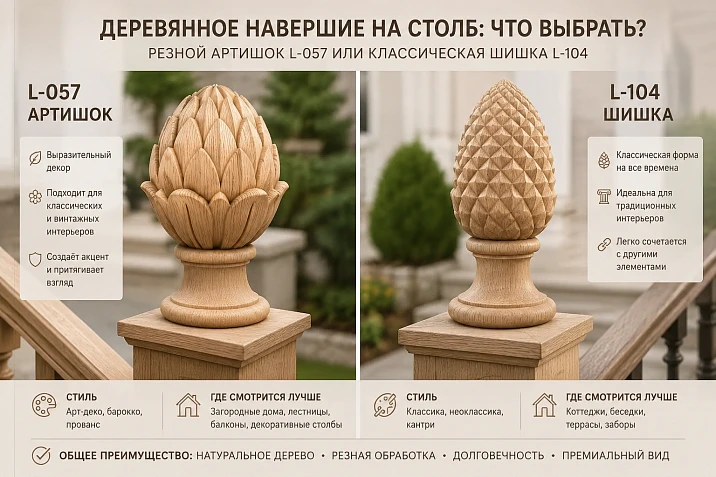
Two ready-made carved finials made of beech or oak for stairs, furniture, portals, and decorative posts
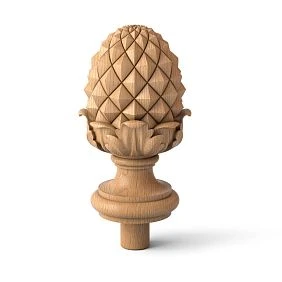
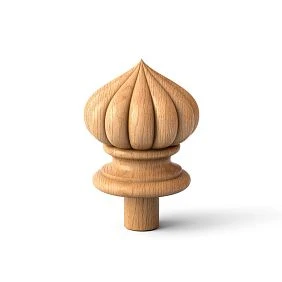
L-057 or L-104: quick selection
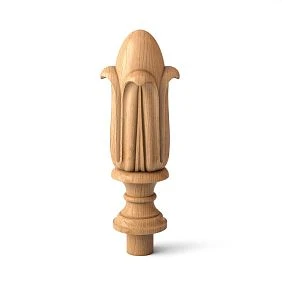
Short answer: For a simple turned post and a bright plant accent, choose L-057 in an artichoke shape — the model is available in four sizes. For a large staircase, fireplace portal, or tall furniture stand, the more elongated classic pinecone L-104 is better suited, available in three sizes.
Buy L-057 Buy L-104 View all wooden finials
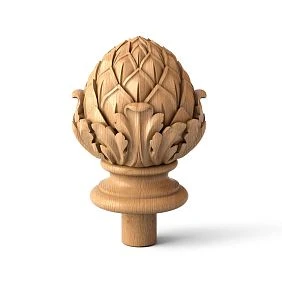
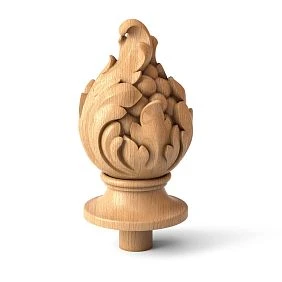
L-057 — botanical accent. Works well on a simple post or stand where the carved artichoke should be the main decorative element.
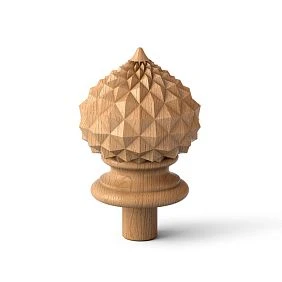
L-104 — elongated classic. Suitable for a large stair post, fireplace portal, furniture stand, and a more formal composition.
Four sizes versus three. L-057 is available from 91 × 37 × 50 × 76 to 191 × 82 × 110 × 166 mm, L-104 from 146 × 35 × 50 × 128 to 288 × 70 × 99 × 253 mm.
Beech under enamel. Suitable for opaque white, colored, or dark finishes, if specified by the project.
Oak for tinting. Preserves the wood grain and helps connect the finial to the post, furniture, and other moldings.
Dimensions must be checked against the drawing. Parameters A, B, C, and E cannot be automatically considered as the mounting diameter or end size without checking the specific scheme.
A wooden finial for a post is purchased not for a separate figurine, but for a complete structure. It must match the post in scale, not get lost on a large column, not overlap adjacent carvings, and not disrupt the overall height of the stair railing, portal, or furniture element. That is why the choice between L-057 and L-104 begins not with the question "which is more beautiful," but with the shape of the base, dimensions, material, and the role of the finial in the interior.
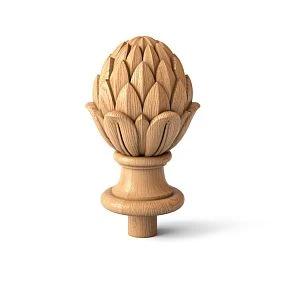
L-057 looks more compact and wider. Its carved artichoke creates a dense botanical accent and pairs especially well with simple turned balusters and posts without their own carving. This approach helps avoid overloading the structure: the main post remains calm, while the decorative top draws attention above.
L-104 is taller and more elongated. It is perceived as a classic carved pinecone and better supports a large column, fireplace portal, furniture post, cornice, or mirror frame. The maximum size for parameter A reaches 288 mm, so the model is suitable for spaces where the finial should be noticeable from a distance and not look too small.
Both models can be ordered in beech for enamel or in oak for tinting, with "Standard" or "Prestige" sanding quality. This allows you to choose not only the shape but also the subsequent finishing method. Beech is more often chosen for white or colored opaque surfaces. Oak is chosen for visible texture and matching with an oak post.
For a simple turned post and a bright plant accent, you can buy the wooden finial L-057 in the shape of an artichoke. For a large staircase, portal, or tall decorative stand, it is better to buy the wooden finial L-104. If neither model matches the post in size or character, it is wiser to open the catalog of carved finials and compare other options from the L-series.




What a finial does and why it cannot be chosen separately from the post
The finial completes the top part of a post, stand, portal, or furniture element. It covers the end, forms the final silhouette, and helps connect the vertical with the rest of the decor. But the decorative role does not negate compatibility: the base of the finial must match the end, the installation method, and the overall structure.
Our factory also produces:
The finial sets the final height
Adding L-057 or L-104 changes the overall height of the post. On a staircase, this affects the proportions of the newel post relative to the handrail and adjacent balusters. On furniture, it affects the final silhouette and distance to the ceiling. On a portal, it affects how majestic or compact the upper part looks.
Get Consultation
The finial completes the end
An open post end looks unfinished and may expose the technical part of the structure. A finished carved finial creates a neat top point. However, no size can be considered universal: parameters A, B, C, and E must be matched with the drawing and the actual end.
The finial sets the character of the decor
L-057 adds a botanical motif and makes a simple post more expressive. L-104 creates a taller classic silhouette and pairs more easily with large architectural carvings. If the post already has a lot of ornamentation, an artichoke finial may be excessive. If the post is too simple and large, a small finial may get lost.
The finial helps complete the set
The buyer can choose the post, finial, balusters, and handrail in the same wood species and finish. This reduces the risk of accidental differences in texture, color, and scale. It is especially important to order matching parts simultaneously if the staircase or portal is built symmetrically.
Confirmed specifications for L-057 and L-104
| Parameter | L-057 | L-104 | Practical Meaning |
|---|---|---|---|
| Shape | Carved artichoke finial | Carved knob with elongated botanical pattern | L-057 is brighter and more botanical, L-104 is calmer and more vertical. |
| Size options | 4 | 3 | L-057 provides more intermediate scales, L-104 provides a larger upper range. |
| Minimum size A × B × C × E | 91 × 37 × 50 × 76 mm | 146 × 35 × 50 × 128 mm | Small L-104 is taller, but in one of the transverse parameters it is close to small L-057. |
| Maximum size A × B × C × E | 191 × 82 × 110 × 166 mm | 288 × 70 × 99 × 253 mm | L-104 is significantly taller and designed for a larger vertical composition. |
| Material | Beech or oak | Beech or oak | The material should be better coordinated with the column and other parts. |
| Sanding | "Standard" or "Prestige" | "Standard" or "Prestige" | "Prestige" reduces the amount of manual finishing of complex carving. |
| Beech | For enamel | For enamel | Suitable for opaque color. |
| Oak | For tinting | For tinting | Preserves natural texture. |
The most important row in the table is not the maximum height, but the full set A × B × C × E. These parameters describe different parts of the product and must be checked against the drawing. You cannot automatically call B, C, or E a mounting dimension just because the number resembles a column cross-section.
How L-057 differs from L-104 in the finished composition
| Criterion | L-057 | L-104 |
|---|---|---|
| Silhouette | Compact, wide, botanical | Tall, elongated, classic |
| Role on a column | Main decorative accent on a simple base | Finial for a large column or portal |
| Suitable style | Botanical classics, Mediterranean motifs, eclecticism | Classics, neoclassics, ceremonial interior |
| Scale | From small posts to medium-sized large columns | From medium to large, including tall posts |
| Scenarios | Staircase, furniture, kitchen, cornice, decorative structure | Staircase post, furniture, fireplace portal, cornice, mirror frame |
| Main risk | Overload an already carved column | Choosing too tall a model for a small structure |
L-057 works better where the finial needs to add decoration that the base lacks. If the post is smooth or has simple turned geometry, the artichoke creates an expressive top point. L-104, on the other hand, more easily supports an already large architectural vertical and does not need such a contrasting botanical accent.
When comparing models, it is useful to look not only at height A. For example, the smallest L-104 is taller than the small L-057, but one of the cross-sectional parameters is the same — 50 mm. This does not mean the same fit. The drawing shows which part belongs to the base, where the thread starts, and how the mass is distributed.
When to buy a carved artichoke L-057
L-057 is suitable for a buyer who needs noticeable plant decor without a tall, elongated silhouette. The artichoke shape creates a dense relief that is clearly visible at close and medium distances. Four sizes allow you to choose a model for both a small furniture stand and a larger post.
For a simple turned post
This is the main scenario for the model. A smooth or moderately turned post provides a calm background for the carved artichoke. The finial becomes an accent, but the structure does not look overloaded. If the post is already covered with large carvings, you need to check whether the two ornaments compete.
For such a task, you can buy carved artichoke finial after checking the full drawing and the end of the post.
For a plant interior accent
The query "artichoke decor" may refer to different items, but L-057 is a specific wooden part for finishing a post, piece of furniture, or architectural structure. It suits interiors with botanical motifs, carved leaves, natural wood, and a calm classic background.
The artichoke should not be repeated on every element. If it is chosen as the main motif, adjacent balusters, cornices, and overlays should be made more restrained. Then wooden artichoke for decor it truly brings the composition together, rather than dissolving among other carved details.
For furniture and decorative posts
L-057 can be used on a furniture post, kitchen composition, decorative cornice, or other wooden structure, if the dimensions and installation are confirmed by the project. In this case, it is especially important to check the height to the ceiling, symmetry, and the number of identical parts.
On a cabinet, bed, or open post, the finial is visible from close range, so the quality of sanding and finishing becomes more important. For transparent oak tinting, it is reasonable to consider "Prestige" to reduce manual finishing of the complex relief.
When a choice of four sizes is needed
L-057 is available in four variants, so there are two intermediate sizes between the small and maximum formats. This is useful when one size looks weak, but the next larger L-104 is already too tall. The size range allows for a more precise match to the scale of the post.
For a paired composition
Two identical L-057 are suitable for paired entrance posts, portal posts, or symmetrical furniture. It is better to buy a pair at the same time, in the same material and with the same quality of sanding. For oak, it is advisable to finish both parts in the same batch so that the tone and gloss match.
When L-057 becomes too active
If the post is already decorated with large plant carvings, the artichoke may create excessive density. In such a situation, L-104 or a calmer finial of the category may be more harmonious. Also, L-057 should not be chosen solely because of its unusual name: first, you need to check whether the botanical motif supports the entire interior.
Size range of L-057: four artichoke options
91 × 37 × 50 × 76 mm
The small option is suitable for a compact post, furniture element, or small decorative structure. The height according to parameter A is 91 mm, so the finial does not create a tall silhouette. However, the base is still checked according to the drawing, not by a single parameter C or E.
123 × 52 × 70 × 106 mm
The medium format is more noticeable and suitable for a medium-scale post. It retains the compact proportion of the artichoke but is better readable from a distance. This size is convenient to compare with the small L-104: L-104 is taller, but the shape and cross-sectional dimensions are arranged differently.
165 × 72 × 96 × 145 mm
The large L-057 is suitable for an expressive stair post, large-scale furniture, or a decorative stand. The botanical relief becomes a noticeable independent element. Before ordering, you need to check whether there is enough free space on the sides and above.
191 × 82 × 110 × 166 mm
The maximum L-057 provides the widest and richest artichoke. It suits large structures but remains lower than the maximum L-104. If a strong plant accent without the 288 mm vertical is needed, this option becomes the main point of comparison.
Before choosing a specific size, you can view the L-057 finial in oak or beech and download or open the drawing of the selected configuration.
When to buy the classic pine cone L-104
L-104 is chosen for a taller and more elongated finish. The carved pine cone creates a calm classic vertical and suits large posts, portals, furniture, and frames. Three sizes cover medium and large scales, with the maximum option reaching 288 mm in parameter A.
For a large stair post
A tall post requires a finial that won't get lost. L-104 continues the vertical and makes the top of the post more majestic. However, you should not select a model based only on the overall impression: the base and mounting method must match the drawing.
For such a task, you can buy a classic post finial in one of three sizes.
For a fireplace portal
Finials on a portal are often installed in pairs. L-104 supports vertical posts and enhances the classic silhouette. The height should be matched with the portal width, cornice, and free space to the ceiling. A too large finial will make the portal heavy, a too small one will get lost.
If the project includes such a composition, it is worth choosing a finial for the fireplace portal after full-size marking.
For a classic interior
L-104 is easier to combine with columns, tall doors, massive furniture, mirror frames, and carved cornices. Unlike the botanically bright artichoke, the finial is perceived as calmer and more vertical. It does not require a simple base as strictly, but the ornaments must still be coordinated.
When a tall, elongated silhouette is required
If the finial should increase the overall height of the post and be noticeable above the handrail, furniture cornice, or portal, L-104 is better suited. The maximum version has A 288 mm and E 253 mm, so it requires sufficient space and reliable fastening.
For furniture and mirror frames
L-104 can be used as a finish for a post, cornice, or mirror frame if the project confirms the dimensions and installation. In a paired composition, it is important to maintain the same orientation, height, and finish. At close range, joints and surface quality are especially noticeable.
When L-104 turns out to be too tall
On a small cabinet, low post, or in a room with height restrictions, the finial may look disproportionate. If the main column is thin and short, it is better to compare L-057 or a more compact model from the category.
Size range of L-104: three options of an elongated finial
146 × 35 × 50 × 128 mm
The small L-104 is already noticeably taller than the minimum L-057. It suits a medium-scale post, furniture, or a classic decorative element where an elongated shape is needed without excessive height. Parameters B, C, and E should be checked against the drawing, as they describe different parts of the product.
207 × 50 × 71 × 182 mm
The medium size is suitable for a large stair post, portal, or furniture post. The height according to parameter A exceeds 200 mm, so the finial already noticeably affects the overall silhouette. Before ordering, it is necessary to check the distance to the handrail, cornice, ceiling, and adjacent parts.
288 × 70 × 99 × 253 mm
The maximum L-104 is a large architectural finish. It is designed for a massive vertical element and is noticeable from a great distance. This size requires precise dry fitting, reliable concealed fastening, and verification of the overall height of the structure.
For a large staircase or portal, you can buy a large carved wooden finial, but the final size selection is made only after comparing the drawing and the end face.
How to choose the size of a finial for a post
The size is chosen based on the structure, not a single number. First, measure the end of the post or column, then open the finial drawing and determine which parameter corresponds to the base, overall width, height, and other sections. Only then compare the scale and installation method.
Measure the end face in two directions
For a square or rectangular post, width and depth are needed. For a round one, the actual diameter. If the end face has a chamfer, step, or decorative transition, measure those sections as well. The finial must rest on the calculated surface, not on a random edge.
Do not call C or E the mounting size without a drawing
In the product cards, dimensions are listed as A × B × C × E. From a single table, you cannot reliably determine which parameter refers to the mounting. Therefore, stating "fits a 100 × 100 mm post" without verification is risky. A related product also does not replace geometry checking.
Consider the overall height of the post
The finial should be proportionate to the entire post. A small L-057 on a post over a meter tall may look too weak if surrounded by large balusters and a handrail. A maximum L-104 on a low furniture post may take up a disproportionately large part of the structure.
Look at the viewing distance
On a staircase, in a hall, or near a fireplace, the finial is visible from several meters away. A large shape reads better. On furniture or a small stand, the item is viewed up close, so overly large carving may look heavy. A mockup helps check both scenarios.
Check the free space above
For a furniture stand and portal, the height to the ceiling, shelf, cornice, or top panel is important. L-104 increases the vertical more. Leave free space so the carved knob does not touch a neighboring element and does not look cramped.
Consider pairing
If finials are installed on both sides of a staircase opening, portal, or furniture, the sizes must be identical. Order the set at the same time. For oak, this helps achieve similar texture and finish, and for enamel, the same color and gloss.
Make a full-size layout
Cut out a silhouette from cardboard using the maximum dimensions A and the widest part indicated in the drawing. Place the mockup on the post and look from different angles. This is especially useful when choosing between the large L-057 and the medium L-104.
General rules are detailed in the article about how to choose the size of the finial for the post. After it, you need to return to the card of the specific model and the drawing.
Why you can't choose only by overall height
Height A helps to imagine the scale, but does not answer the question of compatibility. Two finials can have similar height and different width, base, and relief distribution. On a column, they will look and be installed differently.
Similar height — different shape
L-057 165 mm and L-104 146 mm are close in height, but the artichoke is wider and denser, while the pinecone is more elongated. On a simple column, the first will create a botanical dome, the second — a vertical finish. You need to choose based on the overall composition.
Similar cross-sectional numbers — not necessarily the same fit
The tables show a value of 50 mm for both models, but this does not give the right to declare the products interchangeable. The parameter must be compared with the designation on the drawing. Even if one number matches, the shape of the base may differ.
Relief changes the perceived size
The artichoke visually appears wider due to the leaves. The pinecone appears taller due to the elongated pattern. Therefore, digital comparison is supplemented with a photo, drawing, and mockup. Only this way can you understand how the part looks on a real column.
The mounting area may be smaller than the overall base
Part of the lower profile may be decorative, while the actual support surface is different. Without a drawing, you cannot calculate the dowel, pin, or glue area. This is especially important for the large L-104.
Artichoke or Pinecone: Choosing by Style
L-057 — Botanical and Expressive
The artichoke suits interiors that value botanical decor, rounded leaves, and an unusual natural motif. It works well on simple posts because it creates the main decorative impact itself. In eclectic and Mediterranean styles, such an element can become a recognizable detail.
L-104 — Calm and Classic
The pinecone is perceived as more familiar for classical architecture. Its elongated form supports columns, portals, stair posts, and furniture cornices. It combines more easily with large frames and carved panels if the ornaments are coordinated.
For a Simple Base
If the post is smooth or moderately turned, L-057 adds the needed expressiveness. L-104 is also possible but will give a calmer and taller result. The choice depends on whether you want to draw attention to the finial or continue the vertical line.
For a Carved Base
On an ornate post, L-104 is safer if its pattern supports the main carving. L-057 may compete with existing leaves and flowers. But there is no universal rule: a mockup and photo of the entire post are more important than the shape name.
For modern classic
Both models can be made calmer with a solid-color enamel. Compact L-057 will provide an unusual accent, elongated L-104 a more traditional vertical. In a small room, choose a smaller size and do not repeat the motif too often.
For a formal interior
Large L-104 better supports a high portal, grand staircase, and large hall. Max L-057 is also expressive, but looks more botanical and compact. If an architectural scale is needed, rather than decorative figurativeness, the pine cone is a more precise fit.
Beech or oak: the material must match the column
The finial and column are in direct contact, so the difference in wood species is more noticeable than with distant parts. For a solid structure, it is better to choose one material and perform the finishing simultaneously. Beech is designed for enamel, oak for tinting while preserving the texture.
Beech under white enamel
White finishing emphasizes the chiaroscuro of the carving and suits a classic staircase, painted furniture, or a portal. L-057 in white looks lighter, L-104 looks slimmer. To match the column, identical primer, color, and gloss level are needed.
Beech for colored enamel
Dark, gray, green, or other opaque finishing can tie the finial to furniture and wall details. The specific color is not automatically confirmed by the card, so the system is selected separately and a test paint-out is done.
Oak for light tinting
Light oak preserves the natural grain and makes the carving calmer. It suits a staircase or furniture with a natural finish. On L-057, the texture runs through the leaves; on L-104, it emphasizes the elongated relief.
Oak for dark tinting
Dark oak enhances the depth of carving and makes the finial more noticeable. The large L-104 becomes particularly massive, thus requiring a spacious composition. L-057 retains a dense botanical character.
Why you shouldn't mix beech and oak under a clear finish
Different textures will immediately show that the finial and post are not a single set. Even a close shade does not hide the pore pattern. Under enamel, materials can be visually unified, but the preparation and surface behavior still differ.
"Standard" or "Prestige"
"Standard" is suitable for a workshop that performs its own finishing. "Prestige" reduces the amount of manual sanding and is especially useful for oak under a clear finish. The more complex the relief and the closer the viewing distance, the more noticeable the quality of preparation.
How many finials to buy
One finial
One element is needed for a single starting post, decorative furniture stand, or standalone vertical. In this case, the shape becomes particularly noticeable, so it must be coordinated with the rest of the interior.
Two finials
A pair is suitable for two stair posts, sides of a portal, mirror frame, or symmetrical furniture. Both items must have the same article number, size, material, and sanding. A paired order is best placed simultaneously.
Four finials
Four identical parts can be used on a bed, furniture, or a structure with four posts if the project confirms the dimensions. In such a composition, even a small difference in height or shade is noticeable, so the set is assembled in one batch.
Is a spare part needed
For complex finishes, commercial projects, or furniture that may be transported, a spare finial can be useful. It must match in size and material. The decision depends on the budget and the risk of damage.
How to assemble a post and finial set
A finial is not bought blindly separately from the support. First, determine the post, its top end, material, and overall height, then select the shape and size of the finial. This order protects against the main mistake: a beautiful piece turns out to be too small, too wide, or does not match the mounting part.
L-057 and post L-112
In the L-057 card, among related products, L-112 is shown in size 1200 × 100 × 100 mm. This is a useful starting point, but not a ready promise of compatibility for each of the four artichoke sizes. Before ordering, you need to compare the drawing of the specific finial with the top end of the post.
If the project is built around a simple vertical and an expressive plant-like finial, you can buy a staircase post L-112 and separately check which L-057 fits in geometry and scale.
L-104 and L-053 post
The L-104 card shows L-053 among related products. The elongated finial pairs well with the classic post, but size selection still requires a drawing. It cannot be assumed that any L-104 automatically fits any version of the post just because of a related recommendation.
For a classic staircase, you can buy an L-053 post, and then check the base of the selected finial.
When starting from the post category
If the support has not been chosen yet, first you should buy a staircase post or at least determine its model, cross-section, and style. After that, the finial is selected more precisely. This route is more reliable than looking for a post for an already purchased decorative piece.
One wood species for the entire set
An oak post is best finished with an oak finial, a beech post with a beech one. Under enamel, materials can be visually unified, but with a transparent finish, mixing species is noticeable. If the staircase includes a handrail and balusters, it is also advisable to include them in the overall specification.
Uniform sanding
The post and finial must accept primer or stain equally. If the post is prepared more thoroughly and the finial requires additional work, the difference will show in gloss and texture after finishing. For transparent oak, it is especially useful to order "Prestige" for complex carvings.
What to buy together with the finial
In addition to the finial itself, the buyer may need a post, balusters, handrail, mounting compound, hidden fasteners, and finishing materials. The specific set depends on whether a staircase, furniture post, portal, or decorative structure is being created.
For L-057, you can match a post to the L-057 finial, but compatibility is checked against drawings. For L-104, it is worth matching a staircase post to L-104. If the post model is not determined, it is better to open the category and select a post for a wooden finial.
| What to add to the purchase | Why this is needed | For which scenario | What to Check |
|---|---|---|---|
| Post finial with floral ornament | Adds a decorative artichoke to a simple post or pole | Staircase, furniture, kitchen, decorative structure | One of four sizes, drawing, material, and sanding |
| Wooden finial for a staircase | Creates a tall classical finish | Large post, portal, furniture stand, frame | One of three sizes, height, and free space above |
| Wooden stair post 100 × 100 mm | Creates a base for the set with L-057 | Stair post with floral finial | Actual end face and compliance with the finial drawing |
| Wooden post for a classic staircase | Supports the elongated finial L-104 | Classic staircase and large vertical element | End face dimensions, overall scale, and carving pattern |
| Assembly adhesive for carved decor | Complements adhesive or combined joint | Installation on a prepared wooden base | Surface compatibility and the need for mechanical fixation |
| Wooden finials made of oak and beech | Allow comparison of other shapes and scales | L-057 and L-104 do not fit the drawing or style | Shape, size, type of processing, and wood species |
How to attach a finial to a wooden post
Installation depends on size, weight, base shape, post material, and usage conditions. It cannot be guaranteed that for any L-057 or L-104, glue alone is sufficient. A small furniture finial and a large knob 288 mm high create different loads and require different fixation systems.
Dry fitting before finishing
First, the finial is installed without glue, and the base contact, central axis, and overall height are checked. If there is a gap between the parts, it should not be hidden with a thick layer of compound without understanding the cause. Perhaps the wrong size was chosen or the end requires preparation.
Glue joint
The glue distributes contact and is suitable for prepared compatible surfaces. It is specified in the L-104 related products. glue for L-104 installation. However, the specific sufficiency of the glue depends on the size and design.
Dowels or pins
A hidden central dowel or pin can additionally hold the finial and prevent lateral displacement. The diameter, depth, and location are calculated by the craftsman according to the drawing. Do not drill a carved part at random or too close to thin areas.
Combined fixation
For a large L-104, it is reasonable to consider glue together with a hidden mechanical connection, if the design allows. This approach helps hold the tall finial and leaves no visible fasteners on the front side.
Centering
The finial should continue the axis of the post. Even a slight misalignment is noticeable on an elongated L-104. Before fixation, markings are made in two directions, and the view is checked from the staircase and from the room.
Installation on furniture and portal
A furniture rack or portal is often finished before final assembly. You need to decide whether the finial will be
When a master is needed
Professional installation is especially important for the maximum L-104, paired posts, load-bearing staircase structures, expensive transparent finishes, and cases where the mounting geometry is not obvious. An error can damage both the finial and the post.
How not to confuse a finial with similar parts
Finial and cap
A cap covers the technical end and usually does not form a high decorative silhouette. A finial becomes a visible part of the composition. If the task is only to close a hole or the end of a pipe, a carved L-057 or L-104 may be excessive.
Finial and capital
A capital decorates the top of a column and often serves as a transition to the horizontal part. A finial completes the post from above with an independent shape. These parts cannot be considered interchangeable just because they are placed at the top.
Finial and decorative knob for separate installation
L-104 is designed as a finial for a post or an element of a specific decorative structure. If a standalone figurine without a stand is needed, you must separately check the scenario and a stable base.
Finial and furniture leg
A furniture leg takes load from below, a finial completes the vertical from above. The same turned or carved shape does not mean the same purpose and attachment.
Carved and turned finial
A carved piece has a more complex relief and requires careful finishing. A turned one looks calmer and combines more easily with a rich post. If L-057 or L-104 overload the structure, it is worth comparing turned models in the category.
Practical choice for specific situations
Need to complete a simple stair post
If the post is smooth or has a calm turned shape, start with L-057. The artichoke will add an expressive top and will not require additional carving on the base. Choose one of four sizes, match the drawing with the end, and check the overall height relative to the handrail.
Need to design a large starting post
For a massive vertical, L-104 is often more suitable. The elongated pinecone continues the height and looks more convincing on a large base. The medium or maximum size is chosen based on a mockup, and the attachment is calculated in advance.
Need to add a botanical motif to furniture
L-057 is suitable for a cabinet, bed, kitchen, or decorative console post if the project allows such a finish. The artichoke must be used deliberately: as a pair or a set, not randomly on one corner of the furniture.
You need to design a fireplace portal
For the portal, L-104 is often chosen. The high finial supports vertical posts and a large cornice. Finials are ordered as a pair, the height to the ceiling is checked, and the same finish is applied. For a small portal, it is better to consider a smaller size or a more compact model.
Need to finish the mirror frame
L-104 can be used in the top corners or on the vertical posts of the frame as per the design. It is important that the weight and protrusion do not pose a risk to the mirror's fastening. The pair must be symmetrical, and the pattern must be oriented identically.
Need to select an element for white enamel
Choose beech. For complex relief, consider "Prestige." First perform a dry fit, then primer and enamel. If the post is already painted, a color and gloss level sample is needed.
Need to preserve natural oak
Choose an oak finial of the same wood species as the post. Make a test paint out. L-057 shows the botanical grain more strongly, L-104 shows the vertical movement of fibers and relief.
Need to assemble paired posts
Order two identical items from the same batch. Check that the posts have the same height and ends. After dry fitting, mark each pair to avoid mixing up parts during finishing and installation.
Need to replace the old finial
Take measurements of the end, the height of the old part, and the fastening method. Do not try to select a new model based only on external similarity. Modification of the mounting seat may be required. If the end is damaged, first restore the base.
Need to design a commercial interior
In a restaurant, hotel, salon, or showroom, L-104 works best on a large architectural counter, while L-057 serves as a memorable botanical accent. Order a spare part and save the finish data for future repairs.
Where to use L-057 and L-104
On the staircase
Both models are suitable for finishing a post with confirmed geometry. L-057 pairs better with simple balusters, while L-104 works with large classic railings. The finial does not replace the staircase safety calculation and should not interfere with the handrail grip.
On beds and furniture
Carved finials can decorate bedposts, cabinets, kitchen units, or decorative furniture. Consider the room height, transportation, and the ability to remove the finial when moving. Four identical pieces are ordered as a set.
On the fireplace mantel
L-104 supports a tall classic mantel. L-057 is possible in a botanical composition if the artichoke is linked to other decor. Installation should be done away from unconfirmed heat sources and considering the mantel material.
On a cornice or architectural panel
The finial can complete vertical elements of a cornice or panel. It is important that it does not look like a randomly glued figure. The base should have a structurally clear place, and the scale should match the overall architecture.
On the mirror frame
L-104 suits a classic elongated frame. L-057 creates a more unusual botanical top. In both cases, the mounting must account for the weight of the frame and the mirror's placement on the wall.
In the hallway and foyer
In a small space, use compact L-057 or small L-104. In a spacious foyer, a large finial appears more convincing. The finial should not be in the walkway or where it can be easily bumped.
In the study and library
L-104 pairs well with tall cabinets and wood panels. L-057 suits furniture with botanical decor. Oak trim is tied to the desk, doors, and baseboard.
Preparation for finishing and care
Inspection before coating
Check the article number, size, material, sanding, and thread condition. Examine the base and compare it to the column. After applying enamel or stain, original features will be harder to assess.
Refinement of "Standard"
If "Standard" is selected, the master checks recesses, transitions, and ends. The thread cannot be roughly sanded: the shape of leaves or an elongated pattern may be altered. The tool and grit are selected based on the wood species and finish.
Preparation of "Prestige"
"Prestige" reduces the amount of manual work but does not eliminate dust removal and test coating. Before transparent tinting of oak, special attention is paid to processing marks under side lighting.
Priming of Beech
Beech under enamel requires a compatible primer. Layers should be thin to avoid filling the carved relief. After each stage, the surface is checked and, if necessary, carefully sanded.
Oak tinting
A test coating shows how the shade will appear on convexities and in recesses. Carving often appears darker due to shadows and absorption. The post and finial are best tinted with the same system and in one period.
Protection During Installation
The finished part is not held by thin carved sections and is not placed face down on a hard surface. A soft backing and clean gloves are used. Excess glue is removed according to the composition's technology before it damages the finish.
Daily Care
Dust is removed with a soft dry brush or cloth. Abrasives are not used in recesses. Wet cleaning is performed considering the coating, and water is immediately removed. On the staircase, the finial is periodically checked for loosening.
Mistakes when buying
Selection by Photo Without Drawing
The customer sees a beautiful artichoke or cone but does not check the base. After delivery, the part does not match the post. Drawing and measurements are mandatory.
Attempting to determine fit by a single digit
The parameter 50 or 70 mm is taken as the diameter, although the designation may refer to another part. This leads to a compatibility error. You need to look at the location of A, B, C, and E on the diagram.
Selection only by height
The tall L-104 seems suitable for a large post, but its base does not match. Or the compact L-057 fits the end but is lost in scale. The size is evaluated comprehensively.
Too much thread
The artichoke is installed on a post already saturated with plant motifs. As a result, the top looks heavy. For an active base, a calm model or a turned finial is better.
Too small finial
The small L-057 is placed on a large entry post, and the part looks random. A mockup shows the problem before purchase. For a large vertical, compare the large L-057 and L-104.
Too tall L-104
The maximum finial is placed on a low furniture stand and disrupts the proportion. Check the share of the top piece in the total height and the free space above.
Purchasing one part for a paired composition
Later, the second model differs in oak shade or batch. If the structure is symmetrical, the set is ordered immediately.
Mixing wood species
An oak finial on a beech column under a clear finish looks alien. For a natural finish, choose one species.
Waiting for the finished paint color
Beech under enamel and oak under stain describe the preparation, not necessarily the final color. The finish needs to be checked in the product card and estimate.
Mounting a large part with glue only
For the maximum L-104, the glue joint may be insufficient. An assessment by a craftsman and possibly hidden mechanical fastening is needed.
Finishing before dry fitting
After enameling, it turns out the base requires adjustment. Any modification damages the coating. First fitting, then finish.
Ignoring the overall height of the railing
The finial increases the post and may disrupt the planned proportions relative to the handrail. Height is calculated before ordering.
Buying a random finial instead of the exact article number
A similar shape does not guarantee the same size and carving quality. The article number, drawing, and material must be specified in the order.
Who L-057 is suitable for
- owner of a simple turned post without active carving;
- for a botanical and plant interior accent;
- for stairs, furniture, kitchen, cornice, or decorative post;
- when a choice of four sizes is needed;
- for a more compact and wide silhouette;
- for beech under enamel or oak under tinting;
- for a paired composition with identical artichokes;
- for a buyer ready to check parameters A, B, C and E according to the drawing.
Who is L-104 suitable for
- for a large stair post;
- for a fireplace portal, tall furniture stand or mirror frame;
- for a classic and solemn interior;
- when a tall elongated silhouette is required;
- when a version with A up to 288 mm is needed;
- for an oak or painted wooden system;
- for paired installation on a large structure;
- for a project with concealed calculated fastening.
When it's better to choose a different model
- no size matches the end face according to the drawing;
- the post already has too much carving;
- a simple technical end closure is needed, not a decorative finish;
- a square, spherical, or turned shape is required;
- the overall height of the structure does not allow installation of L-104;
- the artichoke is not supported by the interior style;
- there is no possibility to perform a reliable concealed fastening;
- the buyer needs a finished finish not confirmed by the card
How to match the finial with balusters and handrail
The finial completes not just one post but the entire stair railing. Therefore its shape should be compared with the balusters handrail and starting post simultaneously. If each element is chosen separately the composition may become fragmented: the finial speaks one decorative language the balusters another and the handrail looks too simple or too massive.
Simple balusters and L-057
Artichoke is best revealed next to smooth or moderately turned balusters. They create a calm repeating rhythm while the finial remains the main botanical accent. If each baluster is already decorated with leaves and flowers L-057 may add excessive decorative density.
Large handrail and L-104
The elongated pinecone pairs more easily with a massive classic handrail and large starting post. Its height continues the vertical line and balances the wide top line of the railing. On a thin modern handrail the maximum L-104 may look heavy.
Same wood species
If the post balusters and handrail are made of oak an oak finial with matching stain helps maintain integrity. For a painted staircase you can choose beech under enamel but the color and gloss should be applied with the same system. Mixing species under a transparent finish is especially noticeable on details located nearby.
Check on the overall layout
Place photos or samples of the post, baluster, handrail, and selected finial next to each other. Compare the thickness, height, and amount of carving. Such a simple collage shows which model looks like part of a set and which one appears as a randomly added piece.
Before making the final choice, it is useful to evaluate the set from a distance and under normal room lighting.
What to check before placing an order
Before payment, it is useful to compile a short specification. It should include the article number, selected size, material, sanding, quantity, post model, its end dimensions, finishing method, and intended installation. Such a record helps avoid confusing L-057 with L-104 and ordering paired parts in different configurations.
SKU and size
Write down the full version, for example L-057 165 × 72 × 96 × 145 mm or L-104 207 × 50 × 71 × 182 mm. Do not limit yourself to words like "medium artichoke" or "large cone": the order must include exact numbers.
Drawing
Open the diagram and match the designations A, B, C, and E with the actual parts of the product. If it is unclear which parameter refers to the support surface, clarify this before purchase. An assumption may lead to incompatibility with the post.
Post or column
Specify the model, cross-section, height, and material. For an existing structure, attach photos of the end with a ruler. If the finial is being selected for a new post, it is better to order or at least coordinate both parts simultaneously.
Material and finish
For beech, record the future enamel and gloss level. For oak, record the tint, oil, or varnish if they are defined by the project. A test swatch helps coordinate the finial with the post, handrail, and furniture.
Quantity
Check if you need one piece, a pair, or a set of four. Symmetrical items are best ordered in one batch. For complex finishing or commercial use, consider ordering a spare piece.
Installation
Determine whether glue, dowel, pin, or a combined joint will be used. For a large L-104, the solution must be coordinated with the master. The composition of accompanying materials depends on the base and the chosen coating.
How to buy L-057 or L-104 on STAVROS
If the post is already selected, start with the drawing. For an expressive botanical finial, open the L-057 card and compare four sizes. For a tall classic pinecone, open the L-104 card with three options. Then choose beech or oak and the required sanding quality.
If there is no post yet, first select a post and finial of the same wood species. For a broad comparison of shapes, you can view all L-series finials. The general principles of shape selection are covered in the material about how to choose a wooden finial.
Before ordering, check the current price, availability, lead times, selected material, and finish in the product card. The article helps determine the route but does not replace a drawing of a specific configuration. If the finial is being selected for an existing staircase, furniture, or portal, provide the manager with photos and dimensions.
FAQ: questions about L-057 and L-104
Which finial fits a 100 × 100 mm post?
It cannot be answered based on a single post cross-section. You need to open the drawing of the selected L-057 or L-104 and determine the actual support part. The accompanying L-112 has dimensions of 1200 × 100 × 100 mm, but the compatibility of each finial is still checked separately.
How do parameters A, B, C, and E differ from each other?
They refer to different parts of the product: overall height, width, depth, or other dimensional zones according to the drawing. Without a diagram, one cannot assign the role of the mounting diameter to any of them.
Which finial is more compact?
L-057. It has a wider and denser silhouette, but in comparable variants, it is lower than L-104. The minimum size starts at 91 mm for A.
Which finial is taller?
L-104. The maximum variant reaches 288 mm for A, while the maximum L-057 is 191 mm.
Can L-057 be installed on a furniture post?
Yes, if the dimensions, end face, and mounting method are confirmed by the project. For paired furniture, it's better to order identical parts at the same time.
Is L-104 suitable for a fireplace portal?
Yes, the model is considered for portals and large classical compositions. The scale, distance to the ceiling, portal material, and mounting need to be checked.
Do I need to buy two identical finials?
For symmetrical posts, portal, or frame — yes. The same article, size, material, and sanding help achieve a matching pair.
Which material should I choose for white enamel?
Beech. It is offered for opaque finishes. The color code, primer, and gloss level need to be agreed upon separately.
Which material should I choose for dark tinting?
Oak. It retains a pronounced texture and pairs well with an oak post and handrail.
What to choose: "Standard" or "Prestige"?
"Standard" is suitable for a workshop that is ready to perform additional finishing. "Prestige" reduces the amount of manual sanding and is especially useful for transparent oak finishes.
Can a large finial be secured only with glue?
Not always. For maximum L-104, a hidden dowel, pin, or combined system may be required. The decision is made by the craftsman based on the design.
Is it necessary to paint the finial before installation?
Often it is more convenient to finish the carving before installation, but a dry fit is done earlier. The joint and attachment point may require touch-up after assembly.
How is a finial different from a capital?
A finial completes a post with an independent decorative shape. A capital typically creates a transition from a column to a horizontal part. Their purpose and geometry differ.
Can L-057 and L-104 be used outdoors?
Outdoor use cannot be guaranteed automatically. It depends on the wood species, protective system, design, and conditions. The main safe scenario for the article remains interior use.
How to tell if L-057 will be too decorative?
If the post already has large leaves, flowers, and deep carving, an artichoke may overload the top. Make a mockup and compare with a calmer finial or turned model.
How to tell if L-104 is too tall?
Match it with the overall height of the post and the available space. If the finial takes up too much of the vertical or nearly touches the ceiling, a smaller size is needed.
Can I order an oak finial for a beech post?
Under opaque enamel, the difference can be hidden, but under a clear finish, the species will be noticeably different. For a natural finish, one species is better.
Which size of L-057 to choose for small decor?
Start with 91 × 37 × 50 × 76 or 123 × 52 × 70 × 106 mm, then check the drawing and mockup. The size depends on the post, not just the room.
Which size of L-104 to choose for a large post?
Compare 207 × 50 × 71 × 182 and 288 × 70 × 99 × 253 mm. The largest finial is only suitable with sufficient scale and calculated mounting.
Where can I see other forms?
In the category you can buy wooden finials of different sizes, shapes, and types of processing.
What should you check right before payment?
SKU, size A × B × C × E, material, sanding, quantity, drawing, post, finishing method, installation, and current card data.
Result: L-057 for a botanical accent, L-104 for a tall classic vertical
L-057 and L-104 solve different tasks. The L-057 artichoke suits a simple turned post, furniture, and a decorative stand where the finial should be the main botanical accent. Four sizes allow for a more precise scale selection from a small element to a large carved form.
L-104 better supports a massive stair post, fireplace portal, tall furniture stand, and classic frame. Its elongated silhouette and maximum height of 288 mm create a more solemn architectural completion.
In both cases, first check the drawing and the end, then choose the material. Beech is suitable for enamel, oak for tinting. For transparent finishing and complex carving, 'Prestige' sanding is useful. Paired parts are better ordered as one set.
on the Stavros website you can buy artichoke decor made of wood or buy a finial cone. A conscious choice of shape, size and fastening helps to complete the post without random fitting, mismatch in wood species and reworking of the finished finish.