








































































Article Contents:
- What is a wooden post cap and why is it needed
- Where wooden post caps are used: seven application scenarios
- For stair support posts
- For balusters and balustrades
- For porches and entryways
- For terraces and gazebos
- For interior decorative posts
- For classic-style furniture
- For fences with decorative accents
- Main shapes of wooden finials: what to choose
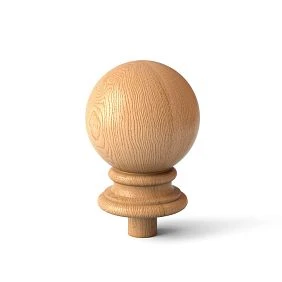
- Ball: universal classic
- Pyramid: strictness and geometry
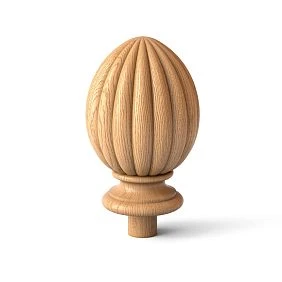
- Carved finial: ornament as completion
- Figural finial: vase, acorn, finial
- Smooth minimalist finial
- How to choose the size of the finial for the post
- Principle of cross-section matching
- Height of the finial and post proportions
- Ratio with handrail and balusters
- Ball diameter and post width: compatibility table
- Material: oak, beech, pine and selection for the task
- Oak: premium with character
- Beech: smoothness for painting
- Pine: for decor and budget solutions
- Larch: for outdoor use
- How to buy wooden finials without mistakes: step-by-step checklist
- Step 1. Measure the post cross-section
- Step 2. Determine the mounting type
- Step 3. Choose the shape to match the design style
- Step 4. Match the wood species
- Step 5. Determine the finish coating
- Step 6. Select the kit
- Step 7. Check the quality of products
- Step 8. Order with a margin
- Installation of wooden finials: what is important to know
- Mounting methods
- Features of outdoor installation
- Coating before or after installation
- Wooden finials in the STAVROS staircase kit system
- Typical mistakes when choosing wooden finials
- FAQ: answers to popular questions about wooden finials
A staircase is not just a way to go from one floor to another. It is the architectural backbone of the house, the first thing people see and by which they gauge the level of the entire space. Railings, balusters, handrails, posts — each element works in an ensemble. But there is a detail that is often left for last or even overlooked: the post finial.
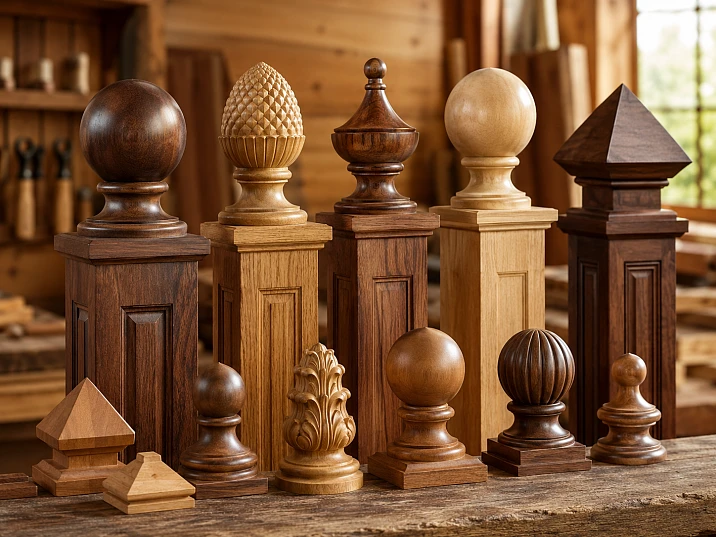
A wooden finial is the final chord of the staircase structure. Without it, the post looks "cut off": the top cut exposes the end grain, disrupts the silhouette, and deprives the structure of completeness. With a finial, the post gains shape, a visual point appears that holds the eye and closes the vertical line.
Buying wooden finials is a task that seems simple only until you start looking into the details. Shape or ball? Oak or beech? For varnish or for enamel? What base diameter? How to attach? Can it be used outdoors? This article provides a comprehensive answer to each of these questions, plus a practical selection checklist and an analysis of typical mistakes.
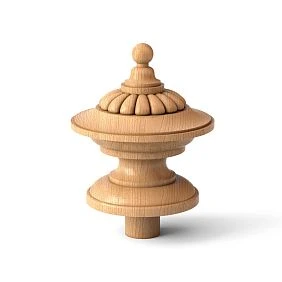
What is a wooden finial and why is it needed
A post finial is a decorative and functional element that is installed on the top end of a load-bearing or decorative wooden post. In staircase work, it completes the newel post, secures the handrail, and shapes the silhouette of the entire structure. In architecture and decor, it works as an accent detail that finishes the vertical line.
Wooden finials should always be purchased when the structure includes a wooden post whose top end remains visible. This applies to:
-
staircase newel posts (bottom and top post of the flight)
-
balusters and balustrade posts — in structures where the posts have a free top end
-
pillars of the porch and canopies above the entrance group
-
pillars of the terrace and gazebo — open structures where the pillar is visible from above
-
decorative interior posts — in the hall, living room, study
-
furniture posts — in classic sideboards, cabinets, bed posts
Buying wooden finials means solving two tasks at once: protecting the end from moisture and mechanical damage, and visually completing the structure. The open end of the wood is the most vulnerable spot: it is through this end that the wood most intensively absorbs moisture and begins to deteriorate. The finial covers this end, and a properly applied coating ensures durability.
Wooden Caps from the STAVROS catalog — solid wood products with precise machining of the seating part and a ready surface for the final coating.




Where wooden finials are used: seven application scenarios
Our factory also produces:
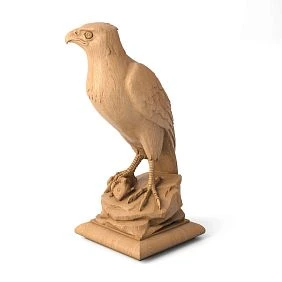
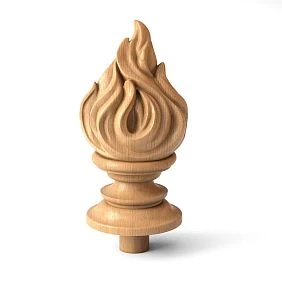
For stair newel posts
This is the most common application. A stair newel post is a powerful vertical element that bears the load from the handrail and the entire guardrail system. Without a finial, its top end looks unfinished.
Posts for staircase — typically square in cross-section: 80×80, 100×100, 120×120 mm. The finial must exactly match this cross-section in the seating part.
The lower support post (at the starting point of the stairs) is larger and more massive than the intermediate ones. The finial here is often made accentual: a larger diameter ball, a carved figured top. It is the lower post with the finial that greets the guest in the hall and sets the image of the entire staircase.
The upper post (at the finish point of the flight) is a symmetrical response to the lower one. Its finial, as a rule, is identical to the lower one — for visual consistency.
Get Consultation
For balusters and balustrade
balusters for staircases — vertical posts between the handrail and the steps. In most constructions, balusters fit into the groove of the handrail from above and below — and their end is hidden. But in a number of architectural solutions, especially in balustrades with a horizontal top railing, balusters have a free upper end — and here a finial is needed.
A balustrade on a terrace, balcony, or along a staircase with open ends of balusters — requires many finials: equal to the number of balusters. The shape is usually more laconic than that of support posts: a small ball or pyramid.
For the porch and entrance group
Porch posts are vertical supports for the canopy or awning over the entrance to the house. They bear the main decorative load in the exterior architecture of the house: it is with them that the appearance of the facade at the entrance level begins.
Finials for porch posts are often large, with an expressive shape: a ball with a diameter of 100–150 mm, a pyramid, or a carved figured top. Here, compatibility with Carved casings and the overall style of the facade decor is important.
For outdoor posts — mandatory: wood species with high moisture resistance (larch or oak), treatment with antiseptic and water-repellent coating.
For terraces and gazebos
Open wooden structures — terraces, gazebos, pergolas — support posts with ends facing upward (toward the roof) or, in the case of railings, remaining visible.
Wooden finials for terrace railings — small, with a smooth shape, resistant to external loads. A ball or dome are the most common shapes for outdoor use.
For interior decorative posts
In classical and neoclassical interiors, decorative wooden posts are found — lamp stand bases, divider posts in libraries, decorative columns in hallways. Their finial is an ornamental accent that harmonizes with wooden capitals and other room decor.
For classic-style furniture
Beds with wooden posts (four-poster bed in classic style), sideboards, cabinets, ottomans with wooden posts — all these items use finials as part of furniture decor.
to buy, which will allow you to transform your furniture using carved wooden elements. You can use the C-003-3 decor set to decorate furniture, walls, doors, or any other surface. The C-003-3 decor set is made of oak or beech, known for their strength, durability, and beauty. You can buy the C-003-3 decor set at the Stavros decor store, which specializes in producing and selling decorative elements and hardware for furniture and interiors. At the Stavros decor store, you will find a wide selection of decor sets of various shapes, sizes, and styles. You can choose includes not only applied ornamental elements but also finishing details of posts and legs — including miniature finials.
For railings with decorative accents
Fences — along the path, at the entrance to the plot, near the flower bed or along the driveway — wooden posts with regular finials acquire an architectural appearance. An even row of identical pillars with balls or pyramids on top is a classic technique of landscape architecture.
Main shapes of wooden finials: what to choose
This is where real analysis begins. The shape of the finial is not just aesthetics. It is style, scale, tectonics, compatibility with the staircase structure.
Ball: universal classic
The spherical finial is the most common shape. The ball is geometrically neutral: it fits into classic, country, and modern interpretations of traditional interiors.
Diameters of balls for wooden posts:
-
60–70 mm — for thin baluster posts and small decorative pillars
-
80–90 mm — for staircase posts with a section of 80×80 mm
-
100–110 mm — for posts 100×100 mm, standard size for most staircases
-
120–130 mm — for massive posts 120×120 mm, lower support posts
-
150 mm or more — for accent posts at the porch, in grand halls
Wooden balls for posts — the best-selling finial. And not without reason: the ball does not compete with other staircase elements, but softly completes its silhouette.
Pyramid: strictness and geometry
A pyramidal finial — a four-sided pyramid with a square base. A strict, graphic, architectural form. Suitable for staircases in neoclassical, art deco, Scandinavian classic styles.
The pyramid is visually 'sharper' than the ball: it directs the gaze upward, emphasizes the vertical. For posts with a square cross-section, the pyramid is especially organic — the square base repeats the shape of the post without an adapter.
Base-to-height ratio: the optimal proportion of the pyramid is 1:1.2–1.5. The pyramid is 'squatter' than the ball and holds scale well in low-ceilinged rooms.
Carved finial: ornament as completion
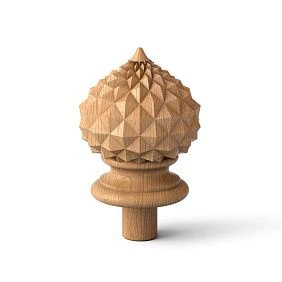
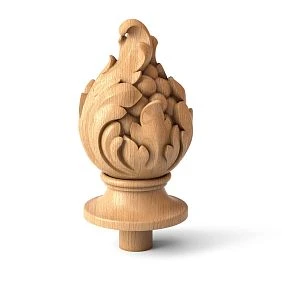
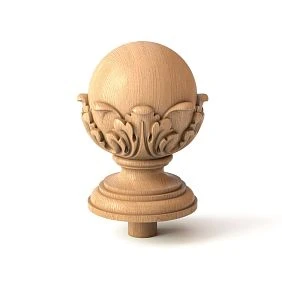
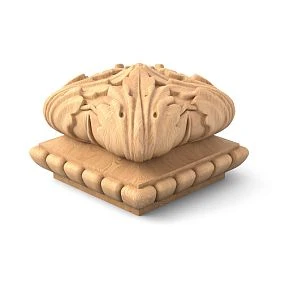
A carved finial is a ball, hemisphere, vase, or figured element with ornamental carving on the surface. It may include a petal pattern, floral motif, geometric weave, cartouche.
Carved wooden finials — a choice for grand staircases in classical, baroque, empire styles. They must be coordinated with the ornament wooden rosettes и bracketswhich may be present in the same staircase structure or in the interior as a whole.
Thread depth on the finial: from 5–8 mm (surface relief) to 15–25 mm (deep sculptural carving). For staircases with high detailing requirements — at least 10–12 mm of relief.
Figural finial: vase, acorn, finial
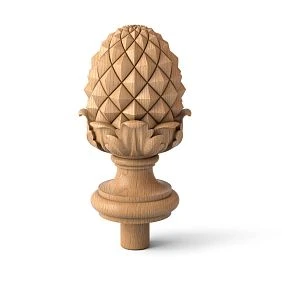
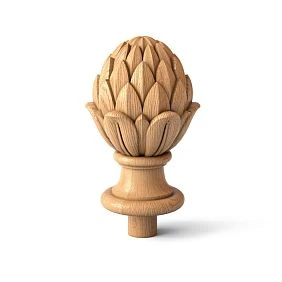
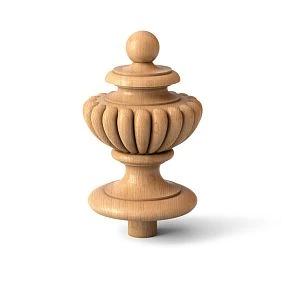
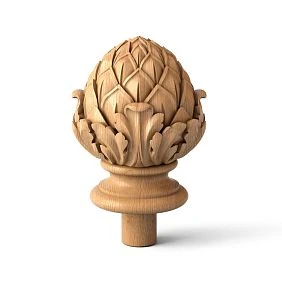
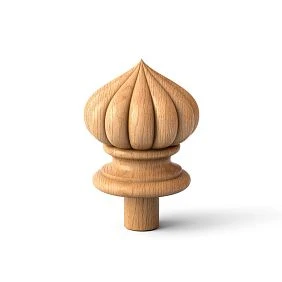
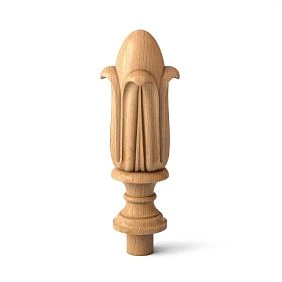
A figural finial is a more complex shape, imitating classical architectural terminations: vase, acorn, pineapple, finial (pointed tip, characteristic of Gothic and Neo-Gothic), onion.
Finial — a vertical accent element with a pointed top. Reads as an architectural ornament, characteristic of classical and neoclassical architecture. For grand staircases, library shelves, interior columns.
Acorn and vase — warm, natural forms. Characteristic of English classic, Victorian style, country interiors. They pair well with balusters for staircases in the form of turned "melons" and "vases."
Smooth, minimalist finial
Dome-shaped, truncated conical, or cylindrical smooth finial without ornament — for modern classic, minimalism, Scandinavian style. Here, pure geometry works without additional details.
Such finials are most often intended for painting: the smooth surface of beech or pine accepts enamel perfectly.
How to choose the size of the finial for a post
This is the most practical and most critical question. A finial of the wrong size is a visual mistake that immediately catches the eye.
Principle of cross-section matching
The mounting part of the finial (the base by which it attaches to the post) must exactly match the cross-section of the post. For a square post 100×100 mm — a square finial base 100×100 mm. For a round post with a diameter of 80 mm — a round mounting with a diameter of 80 mm.
The finial should not be narrower than the post — a gap along the edges of the end will be visible. The finial should not be significantly wider than the post without a special architectural intent — otherwise it 'overhangs' and looks disproportionate.
Allowable overhang of the finial beyond the post cross-section: no more than 15–20% of the post width. For a 100 mm post — maximum overhang of 15–20 mm on each side.
Finial height and post proportions
The height of the finial should be visually proportionate to the height of the post. Approximate guideline:
| Column height | Recommended finial height |
|---|---|
| up to 900 mm | 60–80 mm |
| 900–1200 mm | 80–110 mm |
| 1200–1800 mm | 100–130 mm |
| Above 1800 mm | 120–160 mm |
A ball with a diameter of 100 mm on a post 1200 mm high is proportionate. A 60 mm ball on an 1800 mm post will be lost. A 180 mm ball on a 900 mm post will overwhelm.
Relationship with handrail and balusters
The finial should not compete with the handrail in height. If the handrail runs along the side of the post (side mounting), the finial rises above the handrail level: this is a visually correct hierarchy.
If the handrail is attached to the top end of the post, the finial is not installed in this case: the post is completed by the handrail. However, in some designs with T-shaped or corner joints, the top end of the side posts remains open, and then a finial is needed.
stair railings must be matched with the finials in wood species and tinting. This is especially important for visible joints: a handrail made of oak + a finial made of pine under the same stain — matching in color, but the difference in pore structure may be noticeable.
Ball diameter and post width: compatibility table
| Post cross-section | Finial ball diameter |
|---|---|
| 60×60 mm | 70–80 mm |
| 80×80 mm | 85–95 mm |
| 100×100 mm | 100–110 mm |
| 120×120 mm | 115–130 mm |
| 150×150 mm | 140–160 mm |
For square posts, the ball diameter is selected based on the diagonal of the cross-section, not the side: the diagonal of a 100×100 mm post is 141 mm, meaning a ball with a diameter of 100–110 mm will be "inscribed" in the square of the post.
Material: oak, beech, pine, and selection based on the task
Not every wood species is equally suitable for every scenario. Let's break it down in detail.
Oak: premium with character
Oak is the most sought-after material for finials on grand staircases. Dense structure (750–950 kg/m³), large expressive grain, good moisture resistance, surface hardness — oak lasts for decades without losing its appearance.
Wooden finials made of oak — for staircases with oak posts, oak handrails and oak balustersUniform material — uniform color when tinting, uniform structure when polishing.
Oak feature: it accepts staining, tinting, and oil well. Under clear varnish — expressive texture of annual rings. Under oil — a more matte, tactilely warm finish.
For outdoor use (porch, terrace) — oak with antiseptic and water-repellent oil — a reliable option.
Beech: smoothness for painting
Beech (620–750 kg/m³) — a dense, homogeneous, fine-grained species with a neutral light tone. Almost devoid of a pronounced pattern — this is what makes it ideal for painting with enamel.
Wooden finials made of beech under white or cream enamel — for stairs in Provence, classic, Scandinavian style. The surface of beech after sanding is exceptionally smooth, without lint or pore channels. Enamel lays evenly and holds firmly.
Beech is more affordable than oak. For the same volume of product, the price difference is 30–50%.
For outdoor use, beech is less suitable than oak: it is more moisture-sensitive. If finials are needed for a porch or outdoor railing, it is better to choose oak or larch.
Pine: for decor and budget solutions
Pine (450–550 kg/m³) — light, easy to process, affordable. For wooden finials made of pine — niche: decorative structures without serious loads, temporary or seasonal railings, finials for painting in non-formal rooms.
Pine finials for painting are a popular and economical option. They are cheap, easy to sand, and accept primer and enamel. For country stairs, gazebos, and summer verandas, they are the optimal choice.
Important: pine resin. Before applying paint and varnish coating, mandatory resin removal with a special compound is required. Otherwise, resin will seep through the enamel within 6–12 months.
Larch: for outdoor use
If finials are needed for outdoor posts — porches, open terraces, gazebos, entrance fences — larch is the optimal choice among domestic wood species.
Larch has a unique property among conifers: its wood does not swell or crack under moisture like pine. Its high resin content provides natural antiseptic protection.
How to buy wooden finials without mistakes: a step-by-step checklist
Step 1. Measure the post cross-section
This is the first and most important step. For a square or rectangular post, the exact side size. For a round post, the exact diameter. Not 'approximately,' but with a tape measure.
Step 2. Determine the type of fit
The mounting part of the finial can be:
-
with a spike (a vertical pin at the bottom of the finial fits into a hole in the end of the post)
-
with a groove (the finial "fits" onto the end of the post from below)
-
flat (the finial is attached with glue or a self-tapping screw without special mounting geometry)
Specify the mounting type when ordering — or consult with a STAVROS specialist regarding the specific "post — finial" pair.
Step 3. Choose a shape to match the structure's style
-
Classic staircase with turned balusters — ball or shaped finial
-
Strict neoclassicism — pyramid or dome
-
Baroque and Empire style — carved finial with ornament
-
Modern classic — smooth ball or minimalist dome
-
Country and Provence style — acorn, "melon", ball for painting
Step 4. Match the wood species
The finial should be made of the same species as the post, or a species close in tone. Different species with the same stain are possible but require testing on a sample: oak and beech give different results with the same stain.
Step 5. Determine the finish coating
-
For clear varnish or oil — oak with a pronounced texture
-
For enamel — beech or pine with careful sanding
-
For staining — oak, beech
-
Without coating (for subsequent processing by the customer) — any species
Step 6. Select the set
Wooden finials can be purchased most effectively only as part of a set with the other staircase components: posts, balusters, handrails. This guarantees matching species, stain, and style.
Step 7. Check the quality of the products
Before acceptance or when ordering online, clarify:
-
uniformity of sanding across the entire surface
-
absence of chips, cracks, resin pockets
-
accuracy of the mounting size (±1 mm is acceptable, ±3 mm is a problem during installation)
-
symmetry of shape (for a ball — check the diameter in several planes)
Step 8. Order with a reserve
For a balustrade or railing with a large number of posts — order 5–10% more than calculated. One finial from a different batch, even with the same size, may differ in tone.
Installation of wooden finials: what is important to know
Methods of mounting
On a dowel. This is the most common and reliable option. A hole is drilled in the end of the post, and a matching hole in the finial. The dowel (wooden or metal) is glued with woodworking PVA glue or epoxy glue. The connection is detachable if necessary (by heating with a construction heat gun).
On a pin. A metal pin is screwed into the end of the post and into the corresponding hole in the finial. A more rigid connection than a dowel. Suitable for finials with a shaped groove.
With glue. MS polymer construction adhesive or woodworking PVA — for small and lightweight finials. Flat mounting surface without a tenon. For decorative applications without load.
Combined installation. Dowel + glue — the most common solution for stair finials. The dowel ensures precise positioning, the glue ensures joint strength.
Features of outdoor installation
For finials on outdoor posts (porch, terrace, gazebo) — additional requirements:
-
Antiseptic before the final coating is mandatory. Especially for end joints.
-
Hydrophobic impregnation on the surface of the finial — to reduce water absorption.
-
Final coating — facade varnish or oil for exterior use. Not interior varnish.
-
Gap in the mounting joint — 0.3–0.5 mm (to compensate for thermal expansion of the wood). A monolithic glued joint outdoors may crack with temperature changes.
Coating before or after installation
Coating before installation is more convenient: all edges and the seating part are processed evenly. The end of the mounting tenon is coated with antiseptic separately.
If coating is applied after installation, make sure the gap at the installation point (between the finial and the end of the post) is sealed with sealant or putty compatible with the finish coating.
Wooden finials in the STAVROS stair kit system
A finial is not a separate part. It is part of the system. And it is the systematic approach to selection staircase components that delivers the result — a staircase that looks solid, professional, and expensive.
The complete stair railing kit includes:
-
Posts for staircase — support and intermediate
-
balusters for staircases — turned, carved, or milled
-
stair railings — in cross-section matching the selected baluster
-
Wooden Caps — for posts by cross-section
-
Additional decor: wooden capitals on the posts from below, Wooden Brackets to support steps or decorative elements
When everything is purchased from one place, from the same wood species and under the same tinting, the staircase looks like an architectural piece, not like a set of parts from different suppliers.
Additionally: to wooden posts and finials in a classic interior, the following may be added Wooden sockets on the ceiling at the attachment point of the upper posts — for an accent at the point where the structure meets the ceiling. This is a detail that is not noticed immediately, but creates a feeling of completeness of the entire space.
Typical mistakes when choosing wooden finials
1. They buy without measuring the post. "Standard size" is a common misconception. Each staircase structure has its own dimensions. Buying a finial "approximately 100 mm" risks a mismatch of 5–15 mm, which is critical for the appearance.
2. They mix wood species without checking. Oak and beech under the same stain give different results. Always check samples before ordering a batch.
3. They take a finial that is too small. On a large post 120×120 mm, an 80 mm ball looks like a "button". The proportion must be observed: a ball of at least 115 mm for such a post.
4. They do not consider the final coating. The finial is selected for size and shape — but the wood species is incorrect for the planned coating. Pine under clear varnish looks completely different from oak.
5. Using an interior product outdoors. A pine finial without external impregnation on an outdoor post will crack and darken after one season. For outdoor use, only the appropriate wood species and coating should be used.
6. Not buying as a set. Finials from the same batch have the same tint. If purchased later, the tint may differ. For staircases with multiple posts, buy the finials at the same time.
7. Not allowing for extras. For railings with a large number of posts, a 10% reserve is good practice. One ball chipped during installation and no replacement in the catalog is a problem.
8. Ignoring wooden capitals the bottom of the post. The finial crowns the post from above, while the capital completes it from below. Together they create a fully finished post. Without a lower finish, even a beautiful finial "hangs" in the air.
FAQ: answers to popular questions about wooden finials
Which wooden finials are suitable for stair posts?
The choice is determined by the post's cross-section, its height, and the staircase style. For square posts 100×100 mm, a ball with a diameter of 100–110 mm or a pyramid with a 100×100 mm base is suitable. For classic staircases, a ball or carved figured finial is appropriate. For modern classics, a dome or a minimalist pyramid works well.
Can wooden finials be purchased separately from the posts?
Yes. However, it is important to accurately measure the cross-section of the existing post and specify it when ordering. For reliable installation, clarify the mounting type: dowel, threaded rod, or flat base.
How does a wooden ball on a post differ from a carved finial?
A ball is a universal neutral shape for any style. A carved finial is a decorative accent with ornamentation, suitable for classic, baroque, neoclassical styles. The ball is less "demanding" regarding the stylistic environment; a carved finial requires coordination with the overall decor of the staircase and interior.
Which wood species is best for finials?
Oak — for natural finishes, for outdoor use, for premium staircases. Beech — for painting with enamel, for interior applications. Pine — for decorative use without load, for budget-friendly solutions under paint. Larch — for outdoor posts in climatically demanding conditions.
Are wooden finials suitable for porches and terraces?
Yes, with the right choice of material and coating. Oak or larch + antiseptic + facade oil or varnish for exterior use is a reliable scheme. It is important not to use interior coatings for outdoor applications and not to use pine without appropriate protection.
How to attach a finial to a wooden post?
Standard method: dowel + woodworking PVA glue. A hole for the dowel is drilled in the end of the post, and a corresponding hole in the finial. For outdoor structures — epoxy glue or combined installation with a small gap to compensate for thermal expansion.
Do wooden finials need to be painted before installation?
Preferably — before installation. This allows for even treatment of all edges, including the seating area (with antiseptic). After installation, only visible surfaces are treated; the joint between the finial and the post is sealed.
Where to buy wooden finials with delivery?
Wooden Caps in the STAVROS catalog — made of solid wood, with the possibility of matching to existing posts, balusters и handrails. Contact us to confirm shipping to your destination. Compatibility consultation — upon request.