Article Contents:
- Kitchen furniture components are several different procurement circuits
- First determine the kitchen design, then the components
- What should be included in the BOM of a kitchen module
- Kitchen carcass: why the carcass material does not determine the appearance of the entire kitchen
- MDF and chipboard: the difference should be considered at the level of a specific part
- Materials for manufacturing kitchen furniture: why one list is not enough
- Kitchen front as the main point of decorative finishing
- Coated or uncoated handles for kitchen production
- “The best kitchen hardware” is not a brand, but a set of criteria
- Which kitchen hardware is better and more practical
- Why a kitchen hardware rating does not solve the production task
- Applied decor or milled front
- Furniture mouldings in a kitchen series
- Why mouldings should not be measured in metres alone
- The island must have a separate BOM
- Mounting hardware — a separate procurement stream
- Sample before the serial kitchen
- Kitchen prototype before serial launch
- What to lock in after the prototype
- What to purchase for the series and what for a specific order
- How to prepare an RFQ for STAVROS
- What matters to the procurement department
- STAVROS page for furniture manufacturers
- Why reserve should differ for different SKUs
- Incoming batch inspection: what to actually compare
- Labeling of components within the enterprise
- What to do if the required SKU is temporarily unavailable
- When decorative components are not needed
- Common mistakes when configuring a kitchen series
- Mistake 1. Choosing the handle after approving the facade
- Mistake 2. Calculating linear meters as just the sum of meters
- Mistake 3. Storing the finish in words
- Mistake 4. Not splitting the island into surfaces
- Mistake 5. Mixing decorative and functional hardware
- Mistake 6. Changing SKU without a new revision
- Applicability matrix: how not to assign a part to the wrong place
- Design freeze: when to stop changing components
- How to manage BOM revisions
- What to do with leftovers after a revision change
- How to plan a repeat order
- How to use actual consumption for the next batch
- Packing and kitting for a kitchen order
- Color and finish control across multiple materials
- Why a 100 × 100 mm sample does not replace a finished assembly
- Which STAVROS components are reasonable to include in a kitchen BOM
- Furniture production material: how not to confuse the base and external components
- What components are needed for kitchen furniture production?
- Which material is best for kitchen furniture?
- Which is better for the kitchen — MDF or chipboard?
- Which kitchen hardware is more practical?
- Which handles to choose for serial kitchen production?
- Can wooden kitchen handles be purchased wholesale?
- How to use decorative overlays on facades?
- Are slatted panels suitable for a kitchen island?
- How to order samples before a bulk purchase?
- What to check with a furniture hardware manufacturer?
- How to order components for furniture production from STAVROS?

For a single kitchen, it is not enough to choose the carcass material, the facade, and a beautiful handle. In a one-off project, some decisions can be clarified during assembly, but in a series this approach quickly becomes a source of discrepancies: the first kitchen has one handle, the fifth has a similar one but with a different projection; the decorative profile is cut according to different nesting maps; the island panel is ordered "by area" without being tied to a module; a finish change does not make it into the documentation. As a result, identical models look slightly different, procurement cannot confidently repeat the order, and production wastes time re-approving decisions that have already been made.
Therefore, components for kitchen furniture production should be viewed not as a list of goods, but as a system. Every external element must have a purpose, an SKU, a material, a size, a finish, a quantity per module, an installation location, and an approved sample. The relationship is built in the direction of kitchen design → assembly → material → external SKU → BOM → sample → prototype → batch → repeat order.
This logic is especially important for a manufacturer of serial and semi-custom kitchens. Carcass board, facade material, hinges and slides, a wooden handle, a decorative overlay, and island cladding belong to different procurement loops. They cannot be mechanically lumped into a single category of "hardware." But they must be brought together into one manageable specification, because in the finished kitchen unit they work together.
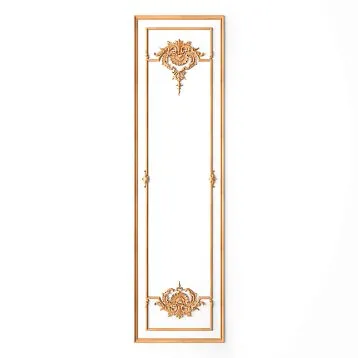
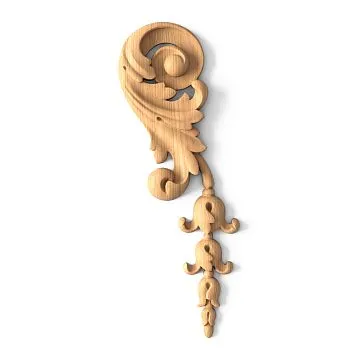
In this system, STAVROS primarily covers visible decorative components: Wooden furniture handles, Decorative carved overlays, Furniture molding, Flexible slatted panels, as well as separate hardware for furniture legs and handles. Hinges, slides, lifts, and other mechanisms are best handled as a separate group of suppliers and a separate BOM block.
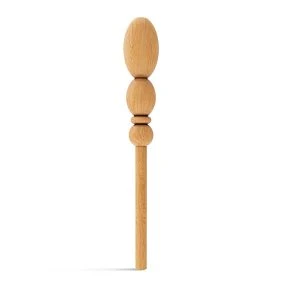
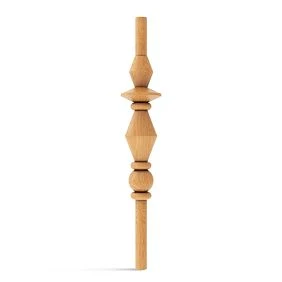
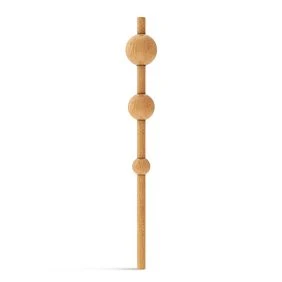
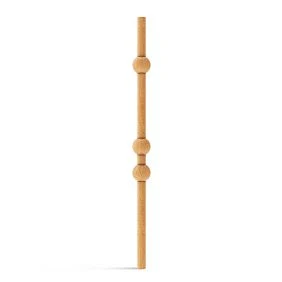
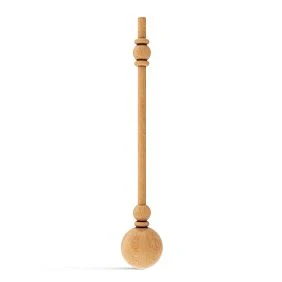
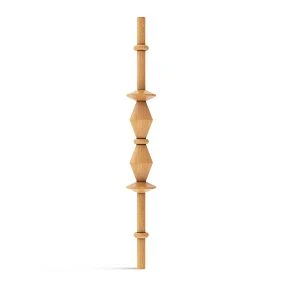
Kitchen furniture components comprise several distinct procurement contours
The first mistake in a production specification is calling everything that is not a board a component. For a process engineer, that is not enough. Different groups are selected, tested, stored and replaced differently.
Carcass materials form the geometry of base units, wall units and tall units. What matters here is thickness, format, board decor, edge banding, cutting layout and supply stability for a specific SKU.
Front materials work differently. In addition to geometry, appearance, finishing technology, milling, edge banding, colour, surface durability and compatibility with visible hardware are critical here.
Functional hardware — hinges, slides, lift systems, pull-out mechanisms. For it, installation diagrams, load capacity, operating cycles, adjustment and service become decisive. STAVROS should not be regarded as a supplier of a complete mechanical set for a kitchen: this specification block must remain standalone.
Visible decorative hardware — primarily handles. It is simultaneously involved in ergonomics and forms the external rhythm of the front.
Decorative components — overlays, moldings, rails, baguettes, panels. Their function can be purely visual, structurally decorative, or technological, for example when a ready-made slatted panel replaces the piece-by-piece assembly of dozens of rails.
Splitting into contours yields a practical result: if the hinge supplier changes, this should not automatically change the handles or facade decor. If the designer updates the outer profile, there is no need to rebuild the carcass board card. Each group has its own revision, but all groups converge in the BOM of a specific kitchen model.




First determine the kitchen construction, then the components
The correct sequence begins not with the parts catalog, but with the architecture of the kitchen unit. Until the standard modules are defined, it is impossible to correctly answer how many handles, overlays, linear meters of trim, or panels will be needed for one kitchen.
It is minimally useful to divide the model into the following units:
-
base cabinets;
-
upper cabinets;
-
pencil cases;
-
pull-out units;
-
open sections;
-
decorative end side panels;
-
kitchen island or peninsula;
-
the plinth and upper decorative lines.
Each node has its own BOM. For example, a 600 mm wide base cabinet should not exist in production documentation merely as a "carcass + front". It has a carcass panel, a front, edge banding, fasteners, hinges or slides, a handle, and in a decorative series, possibly a moulding or overlay. If a handle is used in several modules, that is not a reason to remove it from the modular BOM: on the contrary, a single SKU should be repeated in every applicable assembly unit.
This is how traceability emerges. The purchaser can calculate the total requirement for the series, the designer can verify applicability, the assembler can see the specific installation location, and the quality department can compare the part with the approved sample.
Our factory also produces:
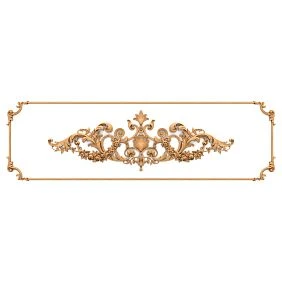
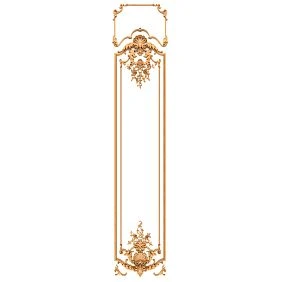


What should be included in the BOM of a kitchen module
BOM — bill of materials, a list of materials and components required to assemble a specific product or unit. In furniture production, it is useful to build it hierarchically: kitchen → module → part.
A simplified entry might look like this:
| Node | Material / SKU | Quantity | Control parameter |
|---|---|---|---|
| Housing | Particleboard, decor code | by part map | thickness, decor, edge banding |
| Facade | MDF / chipboard, code | per module | size, finish |
| Handle | HL-___ | 1 pc. | fit, overhang, coating |
| Overlay | N-___ | 1 pc. | position, orientation |
| Molding | MLD-___ | ___ m | cutting, joint, finish |
| island panel | PAN-___ | ___ pcs. | direction, boundaries |
| Mounting part | FUR-___ | By node | Compatibility |
A real system usually has more columns. You will need the internal company code, supplier code, unit of measure, consumption rate, process waste percentage, drawing version, revision date, alternative SKU, approved sample status, and finish note.
It is especially useful to separate identification parameters from purchasing ones. For example, "oak, dark oil" is not enough for a repeat order. The buyer needs the exact item code, and production also needs a document showing which sample was approved as the reference.
Get Consultation
Which material is better for a kitchen for furniture
The query "which material is better for a kitchen for furniture" seems simple, but in production it has no single answer. The right question is different: which material is better for a specific part given the technology, price, appearance, and load.
For the carcass, stable geometry, clear machining, cost, availability of decors, and edgebanding performance matter. For the front, these requirements are joined by the visual task, the possibility of milling or painting, surface quality, and compatibility with the chosen handle. For decorative trim, the material is already evaluated by profile, finishing method, and the nature of the joints. For the overlay, the relief, scale relative to the front, and surface quality are essential. For the island panel — modularity, grain direction, edges, and behavior on radii, if any.
Therefore, the formula "MDF is better than chipboard" is unsuitable for a specification. In one kitchen, chipboard can be rationally used in the carcass, painted MDF — on the fronts, solid oak — in handles and decorative profile, and a slatted panel made of MDF or solid wood — on the island. This is not a contradiction, but a normal multi-material construction.
If a separate detailed review of boards and other base materials is needed, it is better not to duplicate it within this article, but to use the STAVROS material kitchen furniture is made of. Here the task is different: to link the selected materials with external components and production documentation.
Kitchen carcass: why the carcass material does not determine the appearance of the entire kitchen
The carcass is responsible for the basis of the geometry, but the user most often perceives the kitchen by the front plane, handles, exposed ends, island, and decorative accents. This is fundamental for purchasing: saving on or unifying the carcass does not mean that the external range of components can be chosen last.
If two series use the same carcass but different fronts, handles, and trim, for the buyer these can be two visually independent kitchens. If, on the contrary, the front material changes insignificantly, while the handle and decorative rhythm are preserved, the line may be perceived as one family.
Within the enterprise, it is useful to separate the structural platform and the decorative platform. The structural platform defines the grid of modules, depths, carcasses, and mechanisms. The decorative one — the front, visible side panels, handles, overlays, trim, island panel, and finish.
This separation makes it easier to develop the model range. You can produce several visual series on a single carcass base without recreating the entire set of design documentation.
MDF and chipboard: the difference should be considered at the level of a specific part
When people search for “chipboard and MDF what's the difference kitchen” or “MDF and chipboard what's the difference and which is better for the kitchen,” they often expect a universal winner. For production, an applicability matrix is more useful.
| Node | What to check for chipboard | What to check for MDF |
|---|---|---|
| Housing | decor, edge banding, cutting, fasteners | economic feasibility and technology |
| Facade | quality of the face surface and edge | type of finish, milling, painting/cladding |
| Decorative side panel | matching decor and geometry | ability to achieve the desired texture/finish |
| base for overlay decor | surface stability and fastening | compatibility with adhesive/finish |
The point of the table is not that one material is "worse." When choosing a carcass, the rationality of serial production is usually what matters; for a facade, freedom of visual treatment is often more important. But the decision depends on the specific technology of the enterprise.
For the purchaser, the difference becomes even more practical: the material must have a stable code, a clear replacement when a decor is discontinued, and a pre-established rule for approving alternatives. You cannot replace one board with a "similar" one if doing so changes the shade of an exposed side panel, the thickness of the facade, or the fit of the handle.
Materials for manufacturing kitchen furniture: why one list is not enough
The list "chipboard, MDF, solid wood, veneer" is useful only at the level of getting acquainted with the topic. A manufacturer needs the relationships between entities:
material → assembly → technology → external SKU → quality control.
For example, the entry "MDF, facade" does not answer the questions that will arise in the workshop. What thickness? What finish? Is there milling? Where is the handle located? Is an overlay element needed? What profile forms the frame? Are there left and right versions? What does an acceptable joint look like?
That is why materials for manufacturing kitchen furniture should exist in the documentation not on their own, but in connection with a specific product. The same material on a facade and a decorative side panel may have different machining maps. The same moulding on a tall cabinet and an upper cornice means different cutting. One handle on an upper facade and a wide pull-out drawer means different drilling points.
A production specification is valuable not for the number of lines, but for the fact that each line unambiguously leads from the kitchen model to a physical part.
Kitchen facade as the main point of decorative configuration
The facade is the place where the greatest number of external solutions come together. It may have a handle, applied decor, moulding, frame, milling, insert, or slatted section. Therefore, when developing a new series, it is the facade that should be made as the first physical prototype.
A good facade prototype allows several risks to be checked at once:
-
the proportions of the handle relative to the width and height of the door;
-
the actual handle projection and conflict with the adjacent facade;
-
the position of the holes and the possibility of unifying drilling;
-
the scale of the overlay relative to the free field;
-
the joint of the profile in the corners;
-
the texture and color after finishing;
-
the visual compatibility of different materials.
In a render, a handle may look proportionate, but in reality it may turn out to be too small. In a drawing, an overlay may fit, but after a chamfer or frame appears, there will not be enough free space. Therefore, the specification must undergo not only a design check but also a physical check.
Furniture handles must be approved before drilling the fronts
In a production kitchen, a handle affects more than just the design. It determines the mounting holes, the drilling template, and sometimes the ability to use one front in different modules. If the fronts are launched first and the handle is chosen later, production becomes dependent on a random match of dimensions.
The algorithm should be reversed:
-
choose a handle family;
-
obtain the exact dimensions of the selected SKU;
-
check the projection and grip on a prototype;
-
lock in the positioning;
-
only after that approve the facade drilling map.
In the STAVROS catalog wooden furniture handles are placed in a separate category. For a series, it is important to choose not a "similar wooden handle" but a specific SKU. Even a small change in geometry can change the hand position, visual rhythm, and drilling template.
If deep standardization of center distances, finishes, and batches is required, it is better to continue this topic in a separate article "Furniture handles wholesale: how to standardize dimensions, finish, and batches". In the overall kitchen BOM, the handle is considered one of the linked components.
Coated and uncoated handles for kitchen production
For a factory, this is not a question of "what looks better" but a choice of where the finishing operation belongs in the process chain.
Handles with Finish are convenient when a ready visible component is needed. In this case, procurement receives a product that must match the approved sample in shade and finish character. This option reduces the number of operations within furniture production.
unpainted wooden handles are rational when the company wants to include the part in its own painting or tinting system. For example, the facade, trim, and handle can undergo coordinated finishing within a single color program.
But this approach has a condition: the BOM must not contain the wording "paint to match the facade color." A color code, coating system, number of layers, or another internal process is required, as well as an approved physical sample. Otherwise, two shifts can produce visually different results with a formally identical task.
“Best kitchen hardware” is not a brand, but a set of criteria
The phrase “best kitchen hardware” is useful only as a starting point for selection. For serial production, a brand rating without reference to the product solves almost nothing. A manufacturer needs to answer tougher questions.
For a visible handle, the following are checked:
-
precise geometry;
-
mounting dimensions;
-
protrusion from the facade plane;
-
grip convenience;
-
material;
-
finish;
-
batch repeatability;
-
availability of a SKU and technical data;
-
ability to reorder.
For a functional mechanism, the list will be different: load, installation diagram, adjustment, service life, compatibility with the cabinet. Therefore, it is incorrect to combine a decorative handle and, for example, a slide in one rating.
The production logic is simpler: the best hardware is not the most expensive or well-known, but the one that suits a specific module and is reproduced in series without surprises.
Which kitchen hardware is better and more practical
Practicality depends on function. When it comes to a handle, you need to evaluate real use, not a photo in a catalog.
On a narrow upper front, a long pull can visually overload the surface. On a wide drawer, a small knob can be inconvenient for constant gripping. Too large a projection increases the risk of catching clothing in a passage. Too small a projection makes the grip uncomfortable. A textured relief looks expressive, but in a kitchen you need to check how easy the surface is to clean in real-world use.
There is also a production criterion: one well-chosen handle family can cover several front types and reduce the number of SKUs. But unification should not be mechanical. If a narrow front and a wide pull-out drawer require different ergonomics, it is better to have two related article numbers in one visual series than to force one size to work everywhere.
Therefore, the answer to the query “which kitchen hardware is better and more practical” should end not with the name of a model, but with a verification protocol: fit, grip, projection, care, repeatability, availability for reorder.
Why a kitchen hardware rating does not solve the production task
A rating usually compares brands by overall impression, popularity, or set of characteristics. But for a factory, the questions are different:
-
is the specific SKU compatible with your front;
-
does its fit fall within the existing drilling map;
-
can the same article number be obtained six months later;
-
does the finish match the approved sample;
-
is technical data available;
-
is replacement possible without changing the drawing;
-
can the required volume be purchased in a single batch.
If a rating puts a product in first place, but it requires separate drilling for only one kitchen model and is inconsistently available, the production value of such a "leader" is low.
Therefore, the query "kitchen hardware rating" is better translated into a criteria matrix rather than a list of winners. For the buyer, the outcome should be a card for a verified component with clear conditions for use and replacement.
Decorative overlays for kitchen facades
An overlay is a separate part that is attached to a finished or prepared facade surface. Unlike milling, the relief is not part of the panel itself. This makes overlay decor convenient specifically as a standalone SKU.
В STAVROS decorative overlays catalog you can select elements for facade compositions, classic tall cabinets, central accents, and vertical decorative solutions.
In production, an overlay must have:
-
a specific item code;
-
a specified orientation;
-
anchor point on the facade;
-
permissible offset;
-
fixation technology;
-
finishing rule;
-
approved sample.
Do not leave the wording "overlay in the center." The geometric center and the visual center of the composition may not coincide, especially if the facade has a frame, panel, handle, or asymmetrical relief. It is better to anchor the part to the base axes of the drawing.
Overlay decor or milled facade
These are two fundamentally different production approaches.
Milling creates the relief directly in the facade material. The advantage is the integrity of the part and the absence of a separate overlay SKU. The disadvantage for a series is that any change to the pattern means changing the facade processing program, and sometimes the entire process sheet.
The overlay lives as a separate SKU. It can be replaced, removed, or transferred to another series without changing the base geometry of the facade. This is convenient for a model range where one body-and-facade platform receives several decorative variants.
But the overlay adds other requirements: you need to control positioning, the adhesive or other fastening method, the alignment of finishes, symmetry, and the quality of the joint with the main surface.
The choice should be made not on the principle of "which is better," but based on the strategy of the series. If a unique integrated pattern and stable volume are needed, milling may be rational. If modularity and the ability to change the external appearance through individual components are important, overlay decor offers more freedom.
Furniture moulding in the kitchen series
Mouldings, rails, trims, cornices, and other linear elements are often perceived as decorative trifles. In a series, this is a full-fledged production resource.
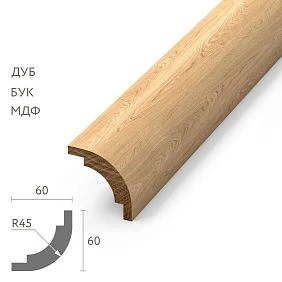
STAVROS furniture molding can be used for the upper decorative line, facade frame, side edging, trim, plinth profile, and other visible joints.
The main feature of moulding: it is purchased in lengths, but consumption occurs in pieces. Therefore, the line "moulding — 18 m" does not answer the question of whether there is enough material.
Production needs:
-
a list of finished cut lengths;
-
the length of each;
-
quantity;
-
orientation;
-
cutting allowance;
-
cutting map by commercial lengths;
-
reserve.
The same total linear meterage can yield different results. If twenty parts of 580 mm each are needed, the cutting plan can be efficient. If long continuous elements and short frames are needed at the same time, the remnants are distributed differently.
Why linear footage should be calculated not only in meters
Let's imagine a conventional kitchen series with 20 identical fronts, each requiring a frame made of four profiles. Simply adding up the perimeters gives the total linear meterage, but that is not enough for ordering.
You need to calculate:
part → finished length → allowance → quantity → cutting map → commercial length.
Suppose one front requires two vertical and two horizontal parts. If the vertical is longer than half of the commercial bar, only one vertical part can be obtained from one blank, even if mathematically the material "fits" by total linear meterage. The remaining piece will be useful for a horizontal only if the profile length and orientation are compatible.
This is where practice diverges from arithmetic. A purchaser who multiplied the perimeter by the number of fronts and added 5% may end up short on long parts while having a large volume of inconvenient remnants.
Therefore, in the BOM it is useful to store not only the norm in meters, but also a reference to the cutting map.
Slatted panels on a kitchen island
A kitchen island is a separate furniture object. Its end faces and outer front surface are often perceived as a large architectural accent. Slatted cladding allows you to set a rhythm without assembling many identical elements piece by piece.
STAVROS separately shows slatted panels for furniture facades and kitchen islands. For production, not only the pattern and material are important, but also the way the panel is integrated into the structure.
Need to check:
-
the direction of the slats;
-
cladding boundaries;
-
thickness of the finished assembly;
-
finishing of the visible edge;
-
the junction with the countertop;
-
junction with the plinth;
-
position of sockets and service elements;
-
compatibility with handles and doors;
-
cutting on a straight or radius section.
If the island has a rounded end, panel flexibility becomes a functional parameter rather than just a design feature. If the surface is flat and small, individual slats sometimes offer more freedom in spacing. Therefore, the specification should record not "slatted decor" but the exact format of the solution.
The island must have a separate BOM
The line "island decor — 1 set" is convenient only at the concept stage. For production, it is useless.
Break the island down into at least surfaces:
-
ISLAND-FRONT; -
ISLAND-SIDE-L; -
ISLAND-SIDE-R; -
if necessary
ISLAND-BACK; -
separate radius segments.
For each surface, record the size, material, SKU, grain direction, edge, joint method, and quantity.
This is especially important if the island side can differ in length due to the project configuration. From the outside, the kitchen looks like a single product, but the BOM must see specific planes. Then, when the island size changes, there is no need to manually recalculate the entire "decor set."
Installation hardware — a separate procurement loop
If the kitchen series uses decorative furniture legs, supports, or other elements, it makes sense to manage some installation components as a separate group. The STAVROS catalog includes hardware for furniture legs and handles.
This group includes not hinges or slides, but specialized fastening and support elements associated with specific products.
Separation matters for two reasons. First, the designer does not mix the functional mechanisms of the kitchen with the fastening of decorative parts. Second, the buyer sees the dependency: changing the leg may require changing the mounting plate, the stud, or the glide.
A good BOM stores such dependencies explicitly. If the main part has a compatible mounting kit, it must have a reference to it or child rows. Otherwise, the warehouse may end up with a support without the required fasteners.
Furniture hardware manufacturer: what a kitchen buyer should check
For a B2B customer, the query "furniture hardware manufacturer" means more than just the origin of the product. The buyer is interested in whether the supplier can be integrated into a repeatable production process.
Minimum checklist:
-
whether a stable SKU exists;
-
whether dimensions and a drawing are available;
-
whether the material is clearly specified;
-
whether the finish is clear;
-
whether a sample can be obtained;
-
whether a reference standard can be approved;
-
how a repeat order is placed;
-
what lead times apply for the required volume;
-
whether there is a clear contact for B2B coordination.
For STAVROS, the logical entry point is the page of terms of cooperation for furniture manufacturers. It separately lists special prices, the option of shipping from a single unit across Russia, a personal manager, and adherence to deadlines.
But even when working with a manufacturer, the buyer must link the order to their own BOM. The category name does not replace the internal code, version, and approved sample.
Sample before a serial kitchen
A sample is not needed to “see whether it looks nice.” It links digital documentation to the physical result.
For a new kitchen series, it is useful to have:
-
a profile sample;
-
a panel sample;
-
an approved handle;
-
decorative overlay;
-
a test color sample, if the part is finished in production.
STAVROS has a separate category product samples, including samples of moldings, baguettes, and slatted panels. For furniture production, this is especially useful before a large batch: the material can be compared with the facade, lighting, shade, and adjacent components.
Internally, the sample needs to be labeled. The format can be simple:
PROJECT / SERIES / SKU / FINISH / REV / DATE
Then, after a few months, the workshop and the procurement department compare a new delivery not with a photo in a messenger, but with a specific reference standard.
Kitchen prototype before serial launch
The full production run should not be the first place where the carcass, facade, handle, overlay, and panel meet at the same time.
Before launching the series, it is enough to assemble a representative set of components:
-
one lower base cabinet;
-
one upper wall cabinet;
-
one tall cabinet;
-
island fragment;
-
if necessary, one corner or radius module.
The prototype verifies more than just the design. It shows whether the fasteners can be installed with a tool, whether the handle conflicts with the adjacent front, whether the joint of the trim runs well, how the slatted panel ends, and where a gap appears after actual assembly.
All discovered changes must be returned to the documentation. A prototype that was fixed by hand but did not update the BOM and drawing does not solve the task. It only hides the problem until the next batch.
What to record after the prototype
After the prototype is approved, each external part must be "frozen" at the revision level.
Minimum set:
-
SKU;
-
name;
-
material;
-
sizes;
-
coating or internal finishing process;
-
installation point;
-
quantity;
-
approved sample;
-
drawing version;
-
BOM revision.
It is useful to add a status: APPROVED, ALTERNATIVE, OBSOLETE, TEST.
This makes changes easier. If the main SKU is temporarily unavailable, you cannot simply order a similar one. An alternative first goes through the status TEST, then is tested on a prototype or control unit, and only after approval receives ALTERNATIVE.
How to unify hardware across different kitchen models
The larger the model range, the greater the temptation to assign a separate handle to each facade, its own profile to each side panel, and its own panel to each island. From a design perspective this is possible, but for production the number of SKUs, inventory stock, and risk points grows quickly.
Unification starts with a family, not with an individual part. For example, one handle series can include several sizes and cover:
-
upper cabinets;
-
standard lower facades;
-
wide pull-out drawers;
-
tall cabinets.
Visually, the kitchen maintains a unified language, while production works with a limited set of proven items.
The same applies to trim. A single profile can be used across multiple models if its scale, material, and finish are compatible. A slatted panel can be shared across islands of different lengths if the size change is handled by layout rather than a new SKU.
But you can't cut SKUs at any cost. If a single handle is inconvenient on a wide drawer, unification creates a bad product. If a profile looks great on a 900 mm facade and gets lost on a small door, you need two solutions. The goal is the minimum sufficient number of SKUs, not the minimum overall.
What to purchase for the series and what for a specific order
Not all components require the same stock.
It makes sense to purchase in series the items that are consistently part of the model range: standard handles, recurring overlays, the main decorative profile, standard mounting elements. For these, consumption is forecast for a month, quarter, or production batch.
For a project, it is more rational to order rare parts: a non-standard overlay for a one-off kitchen, a specific profile, an unusual finish, a panel used in only one island configuration.
The boundary is determined not only by frequency. Delivery time, minimum order quantity, storage cost, risk of damage, and the likelihood of an item being discontinued matter.
You can use a simple matrix:
| Item type | Usage frequency | Stockout risk | Approach |
|---|---|---|---|
| basic handle | High | High | minimum stock level |
| main moulding | High | Medium | batch + reserve |
| rare overlay | Low | Low | Custom Order |
| island panel | Medium | depends on the series | for the production plan |
| experimental decor | Low | high surplus risk | only after order |
This way, supply does not turn the assortment into a warehouse of random leftovers.
How to prepare an RFQ for STAVROS
RFQ — request for quotation. The more precisely it is prepared, the less correspondence there is between the buyer and the supplier's manager.
Bad request:
We need handles and decor for 100 kitchens. Calculate the price.
Such a text contains neither an item code, nor the quantity per kitchen, nor the material, nor the finish version.
Working format:
| SKU | Category | Material / finish | Per 1 kitchen | Quantity | Total |
|---|---|---|---|---|---|
| HL-___ | Handle | oak / approved finish | 14 | 100 | 1400 |
| N-___ | Overlay | beech / for finishing | 2 | 100 | 200 |
| MLD-___ | Molding | ___ | 8.4 m | 100 | 840 м |
| PAN-___ | Slat panel | ___ | 2 | 100 | 200 |
It is useful to attach to the table:
-
required deadline;
-
shipping city;
-
breakdown by batches;
-
need for samples;
-
allowability of partial delivery;
-
reference to the approved specification revision;
-
marking requirement, if any.
Such an RFQ can already be matched against the BOM and subsequently used for reordering.
What matters to the procurement department
For an interior designer, the focus is on form, color, and composition. A buyer has a different responsibility: to get the right SKU in the right quantity by the right date without losing the approved configuration.
Therefore, the language of the procurement department is:
volume → series → item code → batch → lead time → price → reserve → reorder.
It is especially important to separate a supplier's offer from an internal standard. If the supplier quotes a price per piece, but the BOM counts handles per kitchen, the system must recalculate the requirement by run quantity. If linear trim is sold in commercial lengths, the standard in meters must be converted into the number of strips according to the cutting map.
The buyer must also see the status of changes. If the designer changed the overlay after the sample was approved, this is not a comment in a messenger but a new revision. If the old batch has already been ordered, the change must have an effective date: for example, REV-B applies from order No.....
STAVROS page for furniture manufacturers
For a B2B customer, the main transition is not just the general catalog but the page STAVROS for furniture manufacturers. It is aimed specifically at manufacturing companies and procurement.
At the moment of p
For linear profiles, a cutting map is built first. For panels — a layout across surfaces. For left- and right-hand overlays — a separate count by orientation.
Practical control: the order total must be traceable back to specific kitchens. If the buyer sees only “840 meters of profile” and cannot explain how many sets that is and what reserve is included, the calculation is not transparent enough.
Why the reserve should differ for different SKUs
Universal “plus 10%” is convenient, but often wrong.
For a piece handle, the stock compensates for defects, damage, service replacement, and minor program changes. For linear profiles, the reserve is also tied to the cutting map: an entire additional strip may be needed, even if the mathematical percentage reserve looks large. For a panel, the module dimensions and the usability of the remainder matter. For a decorative overlay that is difficult to replace with another without changing the appearance, a small service reserve for the entire life cycle of the series is useful.
Therefore, the reserve is set by category and failure scenario.
In the BOM or purchasing specification, it is worth keeping a separate column RESERVE_REASON: service, cutting, launch, quality, samples. Then a year later it is clear why more than the norm was purchased.
Incoming batch control: what actually needs to be compared
A serial specification doesn't end with the order. The received batch must be identified and inspected.
For visible components, inspection may include:
-
article number;
-
quantity;
-
geometry;
-
material;
-
surface condition;
-
color or finish compared to the approved sample;
-
absence of damage;
-
completeness of mounting parts.
Inspection should be proportional to risk. An inexpensive hidden element and a large batch of visible handles require different levels of control.
A particularly dangerous situation is when the item code matches but the finish visually differs from the approved sample. If the part is part of a facade composition, the user will notice such a defect immediately. That is why a physical reference or master sample has real production value.
Marking components within the enterprise
Even if the supplier uses their own item code, it is useful for the factory to have an internal code.
For example:
KIT-KITCHEN / SERIES-A / HANDLE-01 / REV-B
In the card, the internal code is linked to the supplier's SKU.
The advantage becomes apparent during replacement. If the main supplier changes the item code or an approved equivalent becomes available, the engineering documentation can retain the internal object HANDLE-01and the correspondence table will be updated to the new external SKU. But this scheme is safe only with strict revision control.
For the warehouse, labeling must make it possible to quickly understand the series, category, and status. A box labeled "wooden handles" without a project and revision is a potential source of batch mixing.
What to do if the required SKU is temporarily unavailable
Replacement must proceed as a controlled change.
The wrong path: the purchaser finds a similar handle, informs the workshop, and puts it into production.
Correct:
-
select a candidate;
-
compare dimensions and fit;
-
check the projection and ergonomics;
-
evaluate the finish;
-
assemble a control facade;
-
assign status
ALTERNATIVE; -
release a new BOM revision;
-
determine from which production batch the change applies.
If a new handle requires different holes, this is no longer a procurement substitution but a design change to the facade. It cannot be disguised as an "equivalent".
When decorative components are not needed
An expert specification must be able not only to add parts but also to exclude them.
An overlay is not needed if the facade already has a complex relief and additional decor overloads the composition. A molding is not needed just because it is in the catalog: a smooth minimalist series can benefit from a clean plane. A slatted panel on the island is not needed if it conflicts with ventilation grilles, service access, or makes cleaning a specific unit too difficult. A wooden handle should not be assigned automatically to every model if the design implies a different opening method.
The commercial goal of the article is not to increase the number of SKUs in a single kitchen. It is to help the manufacturer choose the right parts and make them repeatable.
Typical mistakes when configuring a kitchen series
Mistake 1. Choosing a handle after approving the facade
Why it happens: the handle is considered "the last decorative detail."
Consequence: the holes do not align, requiring new drilling or a compromise model.
How to prevent it: approve the handle before the drilling map.
Mistake 2. Treating linear footage as just the sum of meters
Why it happens: the purchaser sees a linear unit of measurement.
Consequence: the total length is there, but long parts are missing.
How to prevent: build a cutting map.
Mistake 3. Storing the finish in words
Why it happens: "dark oak" seems like a sufficient description.
Consequence: the next batch looks visually different.
How to prevent: finish code + approved sample + revision.
Mistake 4. Not splitting the island into surfaces
Why it happens: the island is perceived as a single object.
Consequence: when the size changes, it is unclear which panels need to be recalculated.
How to prevent: separate BOM nodes for the front and side panels.
Mistake 5. Mixing decorative and functional hardware
Why it happens: everything falls into one category.
Consequence: supplier responsibility and inspection criteria are lost.
How to prevent: separate procurement loops.
Mistake 6. Changing SKU without a new revision
Why it happens: the replacement appears equivalent.
Consequence: kitchens with different configurations appear on the market at the same time.
How to prevent it: a formal BOM change procedure.
How to link multiple kitchen models to a single SKU library
If a factory produces not just one kitchen but a whole line, individual BOMs quickly start duplicating the same parts. To avoid losing control, it is useful to create a library of approved external components.
Example structure:
| Internal code | Supplier SKU | Category | Material | Finish | Allowed series |
|---|---|---|---|---|---|
| HANDLE-01 | HL-___ | Handle | Oak | FIN-01 | A, B |
| HANDLE-02 | HL-___ | Handle | Beech | FIN-02 | C |
| DECOR-01 | N-___ | Overlay | Beech | For painting | CLASSIC-A |
| PROFILE-01 | MLD-___ | Molding | ___ | FIN-01 | A, CLASSIC-A |
| PANEL-01 | PAN-___ | Panel | ___ | FIN-03 | ISLAND-A |
Then the BOM of a specific model references not arbitrary text but an object from the library. If a part is prohibited for a series, the designer must not be able to assign it accidentally.
This architecture is especially useful when expanding a model range. A new kitchen set can be assembled from already proven elements and only genuinely new items added. As a result, the number of tests and samples decreases, and purchasing can forecast demand faster.
Applicability matrix: how not to assign a part to the wrong place
External compatibility is not just about size. A handle may physically fit on the front, but be visually or ergonomically unsuitable. An overlay may fit within the dimensions, but conflict with the frame. A panel may cover the side, but its edge will end up on the visible side.
Therefore, alongside the SKU library, an applicability matrix is useful:
-
facade type;
-
minimum width;
-
minimum height;
-
allowed orientations;
-
allowed finishes;
-
allowed series;
-
forbidden combinations.
For decorative parts, this is a kind of production filter. It does not replace the designer's work, but protects against accidentally assigning an item to a configuration where it has already been deemed unsuccessful.
Design freeze: when to stop changing components
In serial production, you need a point after which changes are no longer free. It is convenient to call it design freeze — freezing the configuration before launch.
Up to this point, you can change the handle, profile, overlay, panel, finish. After it, any change goes through as an official revision with an impact assessment.
Why is this critical? Because by the time of launch, the following may already exist:
-
ordered fronts;
-
drilled parts;
-
purchased batch of handles;
-
cut moldings;
-
packaging cards;
-
assembly instructions;
-
materials for marketing photography.
Replacing a single visible component can affect several processes at once. That's why "let's just use a different handle" after design freeze is not a cosmetic tweak, but a product change.
How to manage BOM revisions
Simplest scheme:
-
REV-A— the first approved prototype; -
REV-B— handle change; -
REV-C— island panel change.
But a single letter is not enough. The change log needs a reason:
REV-B: HANDLE-01 replaced with HANDLE-02; new drilling pattern for F-600 and F-800 fronts; applies from production order No....
This way the history remains clear.
For each revision, it's useful to record:
-
date;
-
initiator;
-
list of changed SKUs;
-
related drawings;
-
stock balances of the old version;
-
transition rule;
-
new approved samples.
Without this, the old and new configurations begin to mix.
What to do with leftovers after a revision change
This is a practical question that is rarely considered at the design stage. After replacing a handle or decor, old parts may remain in stock.
Four scenarios are possible:
-
use the remainder in already launched orders of the old revision;
-
allocate a separate batch "until depletion";
-
move the item to service reserve;
-
write off or reassign to another series after inspection.
You cannot mix the old and new version in the same kitchen if they differ visually. Therefore, the revision must be visible not only in the engineering system but also in the warehouse.
How to plan a repeat order
A repeat order should be easier than the first one. If each new batch again requires correspondence about material, color, size, and quantity, the specification is not working well.
A repeat order has five reference points:
-
internal code;
-
supplier SKU;
-
approved sample;
-
latest revision;
-
actual consumption of the previous batch.
The last point is especially valuable. After the first production run, the factory already knows how much moulding was actually wasted, how many handles were used for replacements, whether the service stock was sufficient, and how many panels remained usable. This data allows the norm to be adjusted based on facts, not gut feeling.
How to use actual consumption for the next batch
After the production order is completed, you can compare:
planned requirement → purchased → consumed → remaining → written off
If 1,400 handles were purchased, 1,365 went into products, 8 were written off for quality, and 27 remained — the company gets a real consumption profile.
For moulding, the analysis is even more useful. A large remainder does not always mean a surplus: it may be short pieces unsuitable for the next cutting plan. Therefore, the remainder should be assessed as reusable, not just in linear metres.
Packaging and kitting for a kitchen order
When external components arrive in a bulk batch, the assembly area still needs kits for specific kitchens.
One approach is kit picking: assembling a kit for an order or module. The box or container includes approved handles, overlays, mounting parts, and other piece items.
The advantage: the assembler does not go to the general warehouse for each part and is less likely to pick a similar SKU.
For long-length mouldings or panels, a different logic applies, but the marking must lead to the same production order.
Color and finish control across multiple materials
A kitchen series may combine painted MDF, wood, panel, and handle. Even if they are all called by the same color name, the actual perception differs due to texture, substrate, and gloss.
Therefore, “RAL such-and-such” is not always sufficient for a visual match. During design, real samples must be checked side by side:
-
facade;
-
handle;
-
profile;
-
overlay;
-
Panel.
The goal is not necessarily a perfect match. Sometimes a deliberate contrast is needed. But it must be approved physically, not arise accidentally from different manufacturing processes.
Why a 100 × 100 mm sample does not replace a finished assembly
A small sample shows the material and color. It does not show scale.
A handle may look good on its own, but on a 900 mm front it may turn out disproportionate. A slatted panel on a small fragment shows the pitch, but does not show how the pattern ends on the side of the island. An overlay in the hand seems large, but on a two-meter-tall tall cabinet it may become too small.
Therefore, the correct verification ladder is:
material sample → part → front prototype → module → kitchen fragment.
The more expensive a mistake in a production run, the further you need to go up this ladder before launch.
How to prepare a commercial request for kitchen furniture components
When a manufacturer is ready to move from a prototype to a production run, the request must be specific enough for the supplier to quote it without guesswork.
The email or form should include:
-
company name;
-
production type;
-
series name;
-
list of SKUs;
-
material and finish;
-
quantity per kitchen;
-
planned production run;
-
total volume;
-
desired date of the first delivery;
-
breakdown by batches;
-
need for samples;
-
comment on the repeat order.
If the task is to buy kitchen furniture components for regular production, it is useful to indicate the prospective volume right away, even if the first batch is a test one. Then the discussion is framed not as a retail purchase of a few parts, but as a production program.
Which STAVROS components make sense to include in a kitchen BOM
Depending on the design, these may be:
-
wooden furniture handles;
-
carved decorative overlays;
-
wood and MDF mouldings;
-
slat panels;
-
hardware for legs and handles.
There is no need to try to use all categories at once. For a minimalist kitchen, one expressive handle and an island panel may be enough. For a classic series, handles, overlays, and mouldings. The BOM should reflect the design of a specific product, not the supplier's assortment.
Furniture production material: how not to confuse the base and external components
The phrase "furniture production material" is too broad for a working order, because it mixes boards, solid wood, cladding, hardware, and decorative parts. In kitchen production, it needs to be broken down into functional layers: what forms the carcass, what forms the front, what is a visible component, and what relates to installation.
Therefore, the question "which kitchen furniture material is better" only makes sense after specifying the assembly. For the carcass, the criteria are one thing; for the front, another; for a handle or trim, a third. A procurement error occurs when a material characteristic is transferred from one part to another: for example, when it is assumed that the same selection criterion automatically applies to carcass board, a decorative overlay, and island cladding.
In practice, it is useful to add a field to the BOM FUNCTION, where each item receives one of the assignments: STRUCTURE, FACADE, VISIBLE-HARDWARE, DECOR, MOUNTING. Then even a large list of materials remains readable, and procurement understands which items can be replaced only after an engineering check.
The general selection of furniture hardware categories and the logic of working with the manufacturer have already been covered in the material "Furniture hardware from the manufacturer STAVROS". In this article, the focus is narrower: not all furniture hardware, but specifically the connection between kitchen assemblies, external components, and one reproducible BOM.
Checklist before launching the first production batch
Before sending components to serial order, check:
-
kitchen design is frozen;
-
all external SKUs are assigned;
-
handles are approved before drilling;
-
overlays have installation coordinates;
-
trim is calculated according to the cutting map;
-
panels are laid out by island surfaces;
-
finishes have samples;
-
alternatives are formally approved;
-
BOM has the current revision;
-
RFQ matches BOM;
-
reserve is calculated by categories;
-
the warehouse knows the labeling rules;
-
the quality department has approved samples.
If at least a few items are missing, it is better to eliminate the risk of inconsistency before the production run.
FAQ
What components are needed for kitchen furniture production?
The set depends on the design and construction. In production documentation, case and facade materials, functional hardware, visible handles, decorative overlays, trim, panels, and related installation elements are usually separated. The main task is not to assemble the longest possible list, but to assign each component an exact SKU and place in the BOM.
What material is best for kitchen furniture?
There is no universal material for the entire kitchen. The case, facade, decorative side panel, handle, and profile solve different tasks. The choice must be made at the level of a specific part, taking into account the technology, appearance, load, and repeatability.
What is better for the kitchen — MDF or chipboard?
Comparison should be made at the assembly level. Chipboard is often considered a rational material for carcasses and fronts in certain technologies, while MDF offers different processing and finishing capabilities. Both materials can be used simultaneously in a single kitchen. For a manufacturer, it is more important to lock down the exact specification, thickness, finish, and processing method.
Which kitchen hardware is more practical?
Practicality is determined by function. For a handle, you check grip comfort, projection, material, finish, fit, and care. For a mechanism, you check load, installation, adjustment, and service life. Therefore, a single overall hardware rating does not replace checking a specific SKU.
Which handles should you choose for a serial kitchen?
First determine the front types and the desired visual rhythm, then choose a handle family, check dimensions and grip on a prototype, and only after that lock down the drilling map. For a series, it is beneficial to reduce the number of SKUs if this does not worsen ergonomics.
Can you buy wooden kitchen handles wholesale?
For production procurement, it makes sense to select specific items in the STAVROS furniture handle catalog and pass the calculation by SKU and volume to the manager. The terms of B2B interaction are set out on the page for furniture manufacturers.
How should decorative overlays be used on fronts?
An overlay should be managed as a separate SKU. Its orientation, reference axes, mounting method, and finish are recorded in the drawing. Before going into series, the actual front must be checked, because the free field, frame, and handle can change the visual balance.
Are slatted panels suitable for a kitchen island?
Yes, if the specific panel model is compatible with the island's geometry and assembly technology. Before ordering, check the pattern direction, cladding boundaries, edges, the junction with the countertop and plinth, and for radiused surfaces — the ability of the chosen solution to replicate the required shape.
How do I order samples before a bulk purchase?
Can be used STAVROS product samples section. Once received, the sample should be assigned a project, SKU, finish, and revision, and the approved version should be kept as a physical reference for subsequent batches.
What should you check with a furniture hardware manufacturer?
Check SKU stability, technical data, material and finish, the ability to obtain a sample, terms for bulk and repeat orders, lead times, a contact for B2B approval, and the procedure for handling changes. For a buyer, not only the first delivery matters, but also the ability to reproduce the same result in the next batch.
How do I order components for furniture production from STAVROS?
First, compile a list of the selected SKUs and the quantity per kitchen, calculate the production run, and prepare samples and a prototype. Once the specification is approved, you can submit it via the page for manufacturers to calculate the batch and delivery terms.
From specification to a repeatable kitchen series
Components for kitchen furniture production become manageable only when they cease to exist as a set of separate purchases. The carcass and front set the foundation, the handle — ergonomics and rhythm, the overlay — a decorative accent, the trim — linear architecture, the panel — large-scale texture. But series production does not emerge from the parts themselves. It is created by the connection between them.
The working chain looks like this:
construction → assemblies → materials → SKU → BOM → samples → prototype → design freeze → batch → incoming inspection → repeat order.
If this chain is locked in, the first and the hundredth kitchen set are assembled according to the same logic. The purchaser understands what to order; the process engineer — where to apply it; the assembler — where to install it; the quality department — what to compare it against. And when the series changes, the company sees not a chaotic replacement of a part, but a specific product revision.
To select visible furniture components, you can start with STAVROS catalog, choose the required handles, trim, overlays and panels, then obtain samples and pass the approved specification for production batch calculation.