Article Contents:
- L-117 or L-118: short answer
- What L-117 and L-118 have in common
- Same height 1000 mm
- Beech and oak
- Prestige sanding
- Modern Styling
- Possibility of combining with other materials
- How L-117 reads as a single product
- What does the L-117 row look like
- How is L-118 read in a single product
- What does the L-118 row look like
- Why 2 mm doesn't decide the choice
- For Scandinavian interior
- For a light staircase
- For combination with glass
- For combination with metal
- When the handrail should be the main element
- For alternating with more complex elements
- For a small staircase
- When L-117 may look too neutral
- For minimalism with an expressive form
- For a round handrail
- For a large open space
- For an accent railing
- For rounded posts
- For oak with visible texture
- When L-118 may be too heavy
- L-117 with a round handrail
- L-118 with a round handrail
- Handrail and subrail plank
- How to evaluate the proportion
- Beech under white enamel
- Beech for colored enamel
- Black balusters for a modern staircase
- Oak for light tinting
- Oak for dark tinting
- Why you shouldn't mix beech and oak without a plan
- One finishing system for the entire railing
- Scandinavian interior
- Minimalism
- Modern classicism
- Jatoba
- Loft with wood and metal
- Country house
- Straight stair flight
- Staircase to the second floor
- Double-height space railing
- Stair landing
- Staircase next to glass
- Open staircase in the living room
- Balustrade in a large hall
- Modern staircase with round handrail
- Contrast railing
- Staircase with soft modern furniture
- All L-117 on the march
- All L-118 on the march
- L-117 as base, L-118 as accent
- Why the reverse scheme is more complex
- Alternation in different sections
- What to check before ordering
- First, determine the boundaries of the section
- Then, set the position of the outermost elements
- Clearance is more important than distance between axes
- Step width affects the layout
- Platforms are counted separately
- Add margin only after precise specification
- Why it's useful to create a scaled layout
- Post for L-117
- Post for L-118
- Same material
- Smooth baluster and regular round rod
- Round baluster and carved baluster
- Baluster and post
- Blank height and finished railing height
- For enamel and finished white baluster
- Modern and classic baluster
- Dry layout
- Cutting to the angle of the flight
- Bottom mounting
- Fastening to handrail
- Round handrail installation
- Finishing Before or After Installation
- Batch marking
- Need a light staircase in a light interior
- Need a round handrail and soft plastic
- The staircase is next to the glass
- The interior features black metal
- The flight is short and narrow
- The hall is tall and spacious
- Need to design a double-height space
- Need to replace the old balusters
- The staircase is being designed from scratch
- Need to achieve a calm background for complex posts
- Consider the 2 mm difference as the main criterion
- Look only at one baluster
- Ignore the handrail
- Buy balusters before posts
- Mix beech and oak without a plan
- Paint batches at different times
- Do not count landings and second light
- Do not check the drawing
- Ignore trimming
- Choose too frequent spacing for L-118
- Choose too sparse spacing for L-117
- Consider "under enamel" as finished coating
- Make a frontal template
- Check a section at least a meter long
- Add a handrail and a post
- Evaluate the staircase from different angles
- Compare light and dark colors
- Request a separate calculation for each model
- Article and size
- Quantity by sections
- Material
- Drawings
- Finishing
- Installation
- How is baluster L-117 different from L-118?
- Which model looks more modern?
- What to choose for a Scandinavian interior?
- Which baluster is suitable for minimalism?
- Is the height of the models different?
- Is the difference between 62 and 60 mm important?
- Which model creates a lighter railing?
- Which baluster looks more voluminous?
- Which model is better suited for a round handrail?
- Can L-117 and L-118 be combined?
- Can L-117 be installed next to glass?
- Can L-118 be combined with metal?
- What to choose for white enamel?
- How to preserve the oak texture?
- How to calculate the number of balusters?
- Which post should I choose?
- Do I need to buy a spare?
- Can balusters be used outdoors?
- Are balusters sold painted?
- Where to buy wooden balusters for stairs
- What to check right before payment?
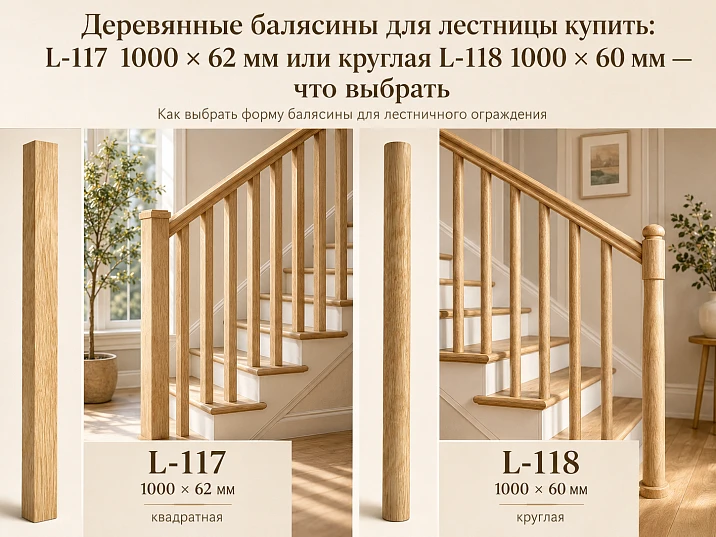
Comparison of two modern balusters of the same height for a private house, balustrade and stair railing
L-117 or L-118: short answer
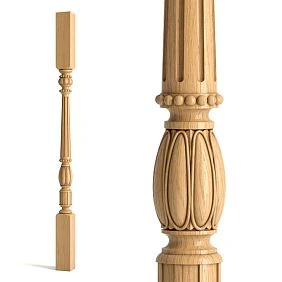
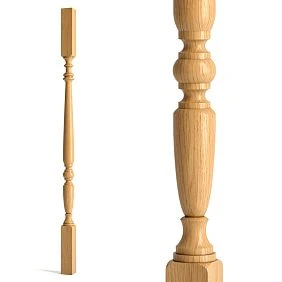
The width difference is only 2 mm, but visually the models work differently. L-117 size 1000 × 62 mm creates a more elongated, calm and vertical line. It suits Scandinavian interiors, light modern stairs and projects where the handrail, glass or metal should remain noticeable. Round L-118 size 1000 × 60 mm has a pronounced central volume and forms a denser, sculptural row. It is chosen for minimalism, round handrails and railings that should be clearly visible from a distance.
Buy L-117 Buy L-118 View all balusters Select handrail
L-117 — light vertical. The elongated turned shape creates a calm repetition and does not overload the modern railing.
L-118 — round central volume. The row looks denser and more expressive, even with almost the same maximum width.
Both models have a height of 1000 mm. The choice is made not by height, but by shape, handrail, installation pitch, and scale of the room.
Beech — for enamel. Suitable for light, white, black, or colored opaque finishes, if specified by the project.
Oak — for tinting. Preserves the natural texture and helps connect the balusters with the oak handrail and posts.
Sanding — "Prestige". Both models are designed for detailed manual surface preparation without the need to choose between two levels of processing.
A buyer who wants to purchase wooden balusters for a staircase often starts with size. In the case of L-117 and L-118, this approach hardly helps. The height of both models is the same — 1000 mm, and the maximum width differs by only 2 mm: 62 vs 60 mm. In the drawing, the difference seems insignificant, but in the finished row, it is less important than the shape of the middle part. L-117 stretches the railing upward and creates a calmer rhythm. L-118 draws attention to the round central volume and makes the row denser.
Both balusters are designed for modern projects. They can be ordered in beech for enamel or in oak for tinting, with "Prestige" sanding quality. Therefore, the buyer chooses not between a "basic" and an "expensive" option, but between two plastic characters. One better supports a light Scandinavian staircase, glass, and metal; the other supports a round handrail, rounded posts, and a minimalist composition where the vertical elements themselves should be noticeable.
You cannot judge a baluster by a single photo. The card shows an individual element, but on the staircase it repeats dozens of times. One calm shape can turn into a very dense row with a frequent step. Conversely, one expressive round detail can look appropriate if there is enough space between balusters. Therefore, the right choice starts with the overall layout of the railing, not with comparing two millimeters.
For a light modern vertical, you can buy a wooden baluster L-117. For a more rounded and sculptural row — buy a round baluster L-118. If no shape matches the handrail, posts, or house style, it is better to open the catalog of beech and oak balusters and compare other round, turned, and carved models.




What L-117 and L-118 have in common
The similarity of the models helps eliminate secondary factors from the choice. Both balusters have a height of 1000 mm, are offered in beech and oak, are available only with "Prestige" sanding quality, and belong to the modern group. This means the choice can be focused on the shape, row density, handrail, color, and installation location.
Our factory also produces:
Same height 1000 mm
Height simplifies comparison but does not mean the product is always installed without trimming. The final length depends on the angle of the flight, the handrail bracket, the mounting method, and the landing areas. Before ordering, you need to open the drawing of the specific model and coordinate it with the staircase project.
Get Consultation
Beech and oak
Both models can be ordered in two types of wood. Beech is chosen for opaque enamel. Oak is for semi-transparent finishes that preserve the texture. The material must match the handrail and posts or be consciously linked to them through a common finish.
Prestige sanding
For L-117 and L-118, there is no need to choose between Standard and Prestige. The product cards confirm detailed hand sanding. This is especially useful for modern smooth shapes: on a minimalist surface, any trace of processing is more noticeable than on rich carving.
Modern style
L-117 is associated with Scandinavian and calm modern projects. L-118 is associated with minimalism and round geometry. Both models lack rich carved ornamentation, so they work well in interiors where clean form and color are important.
Possibility of combination with other materials
Smooth wooden balusters can be included in compositions with glass and metal if the railing project is designed as a single system. Wood softens cold surfaces, and the absence of carving does not create a stylistic conflict.
Confirmed characteristics of L-117 and L-118
| Parameter | L-117 | L-118 | Practical Meaning |
|---|---|---|---|
| Size A × B | 1000 × 62 mm | 1000 × 60 mm | The 2 mm difference has almost no effect on the choice without evaluating the row shape. |
| Shape | Smooth turned, elongated | Round, with noticeable central volume | L-117 makes the row lighter, L-118 makes it denser and more sculptural. |
| Material | Beech or oak | Beech or oak | The material can be selected after the shape is approved. |
| Sanding quality | «Prestige» | «Prestige» | Both models are prepared for a neat modern finish. |
| Beech | For enamel | For enamel | Suitable for opaque white, colored, or dark finishes. |
| Oak | For tinting | For tinting | Preserves the natural texture and connects the railing to the oak handrail. |
| Main style | Scandinavian, modern | Minimalism, Modern | The difference is in the degree of lightness and volume. |
| Main effect | Vertical, calm, elongated | Rounded, dense, sculptural | The choice depends on the rhythm the entire row should have. |
The table shows why comparing only 62 and 60 mm is pointless. The maximum width is almost the same, but the shape distributes the volume differently along the height. In L-117, it is elongated and gradually transitions into thin sections. In L-118, the central part is more pronounced, so the row looks more massive even with a smaller width.
Main difference: how the shape works in a full row
| Criterion | L-117 | L-118 |
|---|---|---|
| Silhouette of one baluster | Elongated, calm, vertical | Round, voluminous, gathered around the center |
| Row on the march | Light and rhythmic | Dense and sculptural |
| Best background | Light wall, glass, metal, calm furniture | Spacious hall, round handrail, rounded columns |
| Role of the handrail | Can remain the main horizontal element | Preferably supported by a round or soft shape |
| Color | Works well in light and neutral enamel | Withstands contrasting dark coloring and noticeable tinting |
| Main risk | With a rare step, it may look too neutral | With a frequent step, the row may become heavy |
A single baluster does not show the real result. On a flight, one shape repeats many times, and each central volume combines with its neighbors. For L-117, there is more visual space between the extensions. For L-118, the rounded parts form a sequence of large accents, so the row has a stronger impact on the perception of the staircase.
How L-117 reads as a single item
A single L-117 looks simple and restrained. Its shape does not try to replace carved decor and does not compete with the handrail. On a sample, such neutrality may seem like a drawback, but in a row it becomes an advantage: many verticals create a clean system without decorative noise.
How a row of L-117 looks
The repetition of the elongated shape enhances height and helps the staircase look lighter. This is especially noticeable next to a glass insert, metal stringer, or light wall. The balusters do not completely dissolve, but they do not draw attention away from the overall architecture of the flight.
How L-118 reads as a single item
For L-118, the central spherical volume is immediately noticeable. It makes the individual element more expressive and creates a sense of a finished sculptural detail. In a minimalist interior, such plasticity replaces complex ornament: the shape remains smooth but does not look flat.
What does the L-118 row look like
When repeated, the central volumes create a strong rhythm. If the balusters are placed frequently, the railing appears dense. If the step is larger, each form gets more air and is perceived as an independent element. That is why L-118 should only be evaluated in a scaled layout.
Why 2 mm doesn't decide the choice
The width of 62 mm for L-117 and 60 mm for L-118 refers to the maximum dimension. It does not show how much volume falls on the central part, where the constrictions are located, and how light and shadow are distributed. Visual density depends on shape and step, not on a difference of two millimeters.
When to buy L-117
L-117 is suitable for a project where the balusters should create a neat vertical grid but not become the most active element. It is chosen for light modern interiors, Scandinavian homes, stairs next to glass and metal, and for railings where the handrail and posts have a more complex shape.
For a Scandinavian interior
The Scandinavian approach is built on clean geometry, a light background, and clear natural materials. L-117 supports this logic. It is noticeable due to its turned silhouette but does not turn the staircase into a classic balustrade. In white or light enamel, the row looks airy; in natural oak, it is warmer and more expressive.
For such a project you can choose L-117 for a Scandinavian staircase and check the drawing together with the handrail and posts.
For a light staircase
White, milky, or other light enamel emphasizes the shape with soft shadows. On the L-117, the shadows stretch vertically and do not form a large dark center. This effect is useful in a small hallway, where the railing should not visually close off the space.
For combination with glass
Glass sections of the railing require a calm wooden shape. The L-117 can be used on posts, turns, or individual sections next to glass, if the structure is designed as a single unit. Its conciseness helps to connect materials without stylistic conflict.
For combination with metal
On a staircase with a metal stringer or fastening details, an elongated wooden baluster softens the structure. It does not look overly classic and supports the verticals of the metal. The color can be matched to the wall, handrail, or contrastingly, if provided by the project.
When the handrail should be the main element
If a wide or expressive handrail is chosen, calm balusters will not compete with it. The L-117 creates a supporting rhythm, while the horizontal line of the handrail remains noticeable. This is especially important on a long flight, where an overly active vertical could fragment the composition.
For alternating with more complex elements
The L-117 works well as a base model. At a turn, near a post, or in the central part of a section, a more expressive element can be used if the project allows alternation. The calm shape helps the accent baluster not to get lost.
For a small staircase
In a compact opening, a light row usually looks more appropriate. L-117 does not create strong rounded volumes at each step. But the final choice depends on the number of elements: installing any model too frequently makes the railing dense.
When L-117 may look too neutral
In a large double-height space, on a wide flight, or next to massive columns, the shape may seem too calm. In such a case, it is worth comparing L-118 or another model in the category. It is better to make a decision based on a visualization of the complete railing.
When to buy L-118
L-118 is chosen when a modern staircase should have noticeable plasticity without carved ornamentation. The round cross-section and central volume make the row expressive while maintaining conciseness. This model works especially well in a spacious hall, next to a round handrail, and in interiors with repeating rounded shapes.
For minimalism with an expressive form
Minimalism does not require a complete rejection of decorativeness. In L-118, decor is created not by carving but by pure volume. The smooth surface, round center, and even repetition allow the staircase to be noticeable without traditional leaves, flutes, and complex turned plasticity.
For such a solution, you can choose L-118 for a modern railing and check in advance how dense the row will be.
For a round handrail
The rounded central volume naturally supports the soft shape of the handrail. This does not mean that any round handrail is automatically compatible in size and installation. First, choose a specific profile, handrail bracket, and mounting method, then check the proportions.
For a large open space
In a double-height hall or living room with an open staircase, balusters are visible from afar. L-118 maintains readability thanks to its central volume. A thin neutral model could get lost, while the round shape remains noticeable even in a light color.
For an accent railing
If the staircase is to become one of the main interior objects, L-118 provides a stronger rhythm. Contrasting black or dark enamel enhances the shape but requires sufficient space and precise spacing. On a small flight, such an approach may look heavy.
For rounded posts
A round baluster connects more easily with a turned post that has spherical or soft transitions. However, it is not necessary to literally repeat the same shape. The post can be larger and more complex, while L-118 supports it with its main central volume.
For oak with visible texture
Toned oak emphasizes the rotation of fibers around the rounded shape and makes the central part especially expressive. On a long row, the texture adds liveliness but requires a single finishing system and pre-staining of the entire batch.
When L-118 may be too heavy
If the staircase is narrow, balusters are placed frequently, and the handrail and posts are already large, central volumes will create too dense a grid. In such a situation, L-117 or another more elongated model will help restore airiness.
Which model is more modern
Both models are modern, but express modernity differently. L-117 is closer to Scandinavian restraint, combining wood with simple surfaces and calm colors. L-118 is closer to plastic minimalism, where one clean geometric shape repeats and becomes the main motif.
Therefore, the question "which is more modern" is better replaced with "what character does the staircase need." For a light architectural line, choose L-117. For a prominent row with a round center, choose L-118.
Which model is better suited for a round handrail
A round handrail naturally supports turned and round vertical elements. However, visual compatibility does not equal technical compatibility. You need to check the handrail profile, the subrail plate, the width of the top part of the baluster, the cutting method, and the actual height after installation. You cannot select a handrail based on a photo.
L-117 with a round handrail
The elongated L-117 creates a calmer connection. The round handrail becomes the main soft element, and the balusters support it with subtle transitions. This scheme suits a light staircase where the horizontal line should read confidently, and the verticals should not overload the space.
L-118 with a round handrail
L-118 repeats the rounded shape more strongly. The central volume and soft handrail form a single motif. The result looks more cohesive and noticeable, especially in a large hall. However, the handrail should not be too massive relative to the baluster.
Handrail and handrail bracket
The handrail cannot be considered separately from the under-rail strip and the upper seating area. The category includes different profiles, including PR-004, PR-002, PR-001, and the under-rail strip PR-003. The specific combination is selected according to the drawing and installation diagram.
Before ordering, it is worth select a round handrail for L-118 or choose a handrail for L-117 balusters, and then check the compatibility of the entire system.
How to evaluate the proportion
Create a front visualization of a section of the railing: handrail, two or three balusters, and a post. Compare the thickness of the horizontal line with the maximum width of the verticals. If the handrail looks too thin, L-118 may weigh down the bottom. If too massive, L-117 may appear weak. Balance is only visible in the set.
Detailed principles are explained in the material about how to combine balusters with a round handrail.
Beech for enamel or oak for tinting
Material changes the perception of shape no less than color. The same L-117 in white enamel looks lighter than in dark oak. L-118 in black enamel becomes graphic and dense, while in light tinting it becomes softer and more natural. Therefore, the shape and finish should be chosen simultaneously.
Beech under white enamel
White enamel emphasizes the purity of the turned surface and hides differences in lamellas. L-117 in white suits a Scandinavian staircase and a light hallway. L-118 creates a more expressive rhythm but does not look heavy due to its light color.
Beech for colored enamel
Gray, green, blue, or another opaque color allows the staircase to blend with walls, doors, and furniture. The specific shade is not confirmed by a card, so it is chosen according to the project. A test coating should be done on prepared beech before finishing the entire batch.
Black balusters for a modern staircase
Dark enamel enhances the silhouette. L-117 turns into a graphic vertical grid, L-118 into a chain of rounded accents. On a narrow flight, black L-118 may be too dense, so the spacing and background need to be checked in advance.
Oak for light tinting
Light oak preserves the natural texture and suits a modern interior without sharp contrast. L-117 looks calmer and lighter, L-118 more voluminous but not heavy. The handrail and posts should ideally be stained simultaneously.
Oak for dark tinting
Dark oak enhances shadows at transitions. On L-117, this emphasizes the elongated shape. On L-118, the central volume becomes even more noticeable. This option suits a spacious staircase but requires careful lighting and sufficient distance between elements.
Why you should not mix beech and oak without a plan
Under a transparent finish, the difference in wood species is obvious. Under enamel, it can be hidden, but the preparation and surface behavior remain different. If the handrail is oak and the balusters are beech, the composition must be specifically designed, not happen by chance due to price or availability.
One finishing system for the entire railing
Balusters, posts, handrail, and under-rail strip should ideally be primed and coated with one system. Otherwise, white color may differ in shade, and oak staining may differ in saturation. For a large batch, a test coating and marking of parts are mandatory.
How L-117 and L-118 work in different styles
Scandinavian interior
L-117 is particularly well-suited. The elongated form supports light walls, natural wood, and simple furniture. L-118 is also possible if the interior is built around rounded objects and a more noticeable accent is needed.
Minimalism
L-118 reveals minimalism through pure volume. It has no carved pattern, but the central round part creates character. L-117 suits a stricter option where the staircase should almost dissolve into the architecture.
Modern Classic
Both models can be considered modern classics if the posts and handrail are not overloaded with ornament. L-117 makes the railing calmer, L-118 adds soft plasticity. White enamel and tinted oak give different characters with the same shape.
Japandi
For an interior that combines Japanese restraint and Scandinavian warmth, L-117 usually looks more natural. Natural oak, simple geometry, and a sparse rhythm support a calm atmosphere. L-118 is suitable if rounded forms are repeated in furniture and lighting.
Loft with wood and metal
On a metal stringer, L-117 creates a vertical contrast without classical decorativeness. L-118 makes the staircase more plastic and can connect with round metal details. Color and fastenings must be coordinated in the project.
Country house
In a house with natural wood, both models are appropriate. L-117 suits a light modern interior, L-118 suits a more expressive staircase in a spacious hall. Oak finish helps tie the railing to the floor, doors, and furniture.
Where to use L-117
Straight flight of stairs
The even repetition of elongated balusters enhances the direction of ascent. On a long flight, L-117 creates a calm rhythm and does not fragment the space. It works especially well on a light background.
Staircase to the second floor
In a private house, the railing is often visible from both the living room and hallway simultaneously. L-117 allows the staircase to be noticeable but not dominant. It suits projects where the main accent is on the wall, light fixture, or furniture.
Second light railing
On a long balustrade, many L-117s create a thin vertical grid. It does not block the view and supports the open space well. However, the installation step must comply with safety requirements and the project.
Stair landing
On a horizontal section, the elongated shape maintains a consistent rhythm with the flights. If the landing is long, L-117 helps keep the railing from feeling heavy. Posts and corner transitions should be selected in advance.
Staircase next to glass
The baluster can be used in areas where glass is interrupted by posts or wooden sections. L-117 supports the lightness of the transparent material. The structural scheme is calculated by a specialist.
Where to use L-118
Open staircase in the living room
When the flight becomes part of the overall space, L-118 creates a noticeable decorative rhythm without carving. The central volumes are visible from the sofa, kitchen, and second floor. In a light finish, the row remains modern.
Balustrade in a large hall
On a spacious platform, the round shape is not lost. L-118 helps connect the railing to the rounded posts and handrail. If the balustrade is long, the spacing must be modeled especially carefully so that the row does not become too dense.
Modern staircase with a round handrail
This is one of the most natural scenarios. The rounded handrail follows the shape of the baluster. But dimensions and installation are not chosen "by eye": the handrail profile and the handrail support strip are checked against the drawings.
Contrasting railing
In black or dark enamel, L-118 becomes a strong graphic element. This option suits a light wall and a spacious room. On a small staircase, it is better to check L-117 or a light finish.
Staircase with soft modern furniture
Rounded chairs, lamps, and tables support the central volume of L-118. The repetition of the shape makes the interior cohesive. In this scenario, the baluster becomes a connecting motif rather than a separate decoration.
Can L-117 and L-118 be combined in one staircase
Combination is possible but requires a strict repeating module. Random alternation of two similarly sized shapes looks like a batch error. It is necessary to decide in advance which model is the main one, where the accent is, and how the pattern repeats on each flight and landing.
All L-117 on the flight
The calmest option. A uniform row, the handrail and posts easily become the main elements. Suitable for small and medium staircases.
All L-118 on the flight
Creates a strong circular rhythm. Suitable for a spacious interior and a round handrail. The installation frequency needs to be checked via visualization.
L-117 as the base, L-118 as the accent
L-118 can be placed after a certain number of L-117 or to mark the start of a section. The module must repeat consistently. For example, one L-118 between several L-117. The specific quantity is determined by the project, not a universal rule.
Why the reverse scheme is more complex
If L-118 becomes the base and L-117 is a rare accent, the calm form may get lost among the rounded volumes. This solution requires particularly precise visualization.
Alternation in different sections
You can use L-117 on the flight and L-118 on the landing, or vice versa, if the transition is supported by a post and handrail. Without a separating element, the change in form may appear random.
What to check before ordering
It is necessary to render the entire flight, the landing, and the balustrade, mark the article numbers, and count each model separately. An error in quantity will disrupt the repeat and require additional purchases.
How to calculate the number of balusters
The number of balusters cannot be determined by a single universal formula without a project. The result is affected by the length of the flight, the number of steps, the tread width, the presence of landings, the placement of starting and support posts, the method of fastening, and the permissible gap between vertical elements. The article helps to understand the logic, but the final calculation must correspond to the design and current safety requirements.
First, determine the boundaries of the section
Each section of the railing is calculated separately: a straight flight, a turning landing, a second-light balustrade, a short horizontal section. Posts separate one section from another. If you add up all the lengths without breaking them down, you can get the correct total number but an incorrect distribution.
Then set the position of the outermost elements
The outermost baluster should not accidentally end up too close to a post or leave a large empty gap. The distances at the edges are included in the calculation on par with the internal gaps. For a flight, the slope and the actual installation line are taken into account.
The gap is more important than the distance between axes
For L-117 and L-118, the maximum width is similar, but the shape changes with height. Therefore, the gap between the central volumes and thin sections will be different. In the drawing, the most critical zone should be assessed, not just the step between axes.
The width of the step affects the layout
On some stairs, balusters are placed one per step, on others — two per step or according to another calculated scheme. You cannot transfer a solution from someone else's photo to your own flight. The quantity is determined by the geometry of the steps and the project requirements.
Platforms are counted separately
A horizontal section often requires a different quantity than an inclined flight of the same length. Here, the axes, post placement, and visual rhythm change. An error on the platform is especially noticeable because the railing is seen frontally.
Add spare only after precise specification
Spare may be needed for trimming, possible damage, and future repairs. But first, calculate the exact quantity of L-117 and L-118 for each section. For a mixed scheme, spare for two articles is calculated separately.
Why it's useful to make a scale layout
Even a safety-correct step can visually look heavy with L-118 and too sparse with L-117. A mock-up of a one to two meter section shows the real rhythm. After approval, the step is repeated throughout the staircase.
For a general understanding of the range and prices, you can view prices for wooden balusters, but the specific quantity of L-117 and L-118 needs to be calculated for your own project.
How to select posts for L-117 and L-118
The post completes the section and is usually larger than the baluster. It does not have to literally repeat its shape, but should support the overall character. For L-117, calm turned posts with elongated transitions are suitable. For L-118, models with rounded volumes or soft plasticity are suitable. A too ornate post next to a minimalist baluster may look alien.
Post for L-117
An elongated baluster pairs well with a post where decorativeness is concentrated in one or two transitions. If the post is completely smooth, it may look too simple; if heavily carved, it may draw too much attention. Balance is checked in the overall visualization.
Post for L-118
A rounded baluster calls for a soft support shape. The post may repeat the round motif on a larger scale or remain calm, but should not have random angular geometry if other staircase elements are rounded.
Same material
Beech balusters logically pair with beech posts for enamel, oak with oak for tinting. This makes it easier to achieve the same color and texture. Mixing wood species is only allowed as a deliberate choice under opaque finishes.
Before ordering, it is worth matching a post to L-117 or choosing a support post for L-118after comparing the drawings and finish.
What to buy together with balusters
The stair railing is assembled as a system. Balusters alone are not enough: you need a handrail, a sub-rail strip, support and starting posts, as well as a mounting solution. All parts must match in material, scale, and future coating. If you buy them separately without a common specification, the difference will show up during assembly.
For a buyer who hasn't yet decided on the kit composition, it's useful to select posts, balusters, and handrails in one section. This makes it easier to compare shapes and not forget the sub-rail strip.
| What to add to the purchase | Why this is needed | Which scenario | What to Check |
|---|---|---|---|
| Beech L-117 baluster for enamel coating | Creates a light, elongated row | Scandinavian and calm modern staircase | Quantity, drawing, mounting areas, and color |
| Wooden baluster L-118 made of beech | Forms a dense circular rhythm | Minimalism and railing with a round handrail | Installation step and visual density |
| Wooden handrails for stairs | Form the top line and connect the balusters | Any staircase railing | Profile, material, handrail support strip and installation |
| Wooden posts and balusters | Complete sections and bear the main load of the railing | Start of the flight, turns and landings | Scale, shape, wood species and overall height |