Article Contents:
- Oak or beech is chosen after understanding the final part
- When oak becomes part of the appearance
- When beech is convenient for a furniture workshop
- Visible or hidden wood — the main choice before purchase
- A rough blank is not yet a furniture part
- A planed blank does not mean "ready for enamel"
- Turned part: same shape, different wood
- Carved blank made of oak or beech
- A raw blank and a finished unfinished component are not the same thing
- Rough blank
- Finished unfinished component
- Mistake 1. Choosing the species before understanding the finish
- Mistake 2. Treating beech only as a material for painting
- Mistake 3. Assuming oak is automatically the best option
- Mistake 4. Buying a rough blank and underestimating the remaining work
- Mistake 5. Confusing a planed blank with a part ready for finishing
- Mistake 6. Treating a finished component as an ordinary blank
- Mistake 7. Mixing oak and beech under a clear finish without a sample
- Mistake 8. Ordering a large batch without a trial part
- Which is better for a furniture blank — oak or beech?
- Which wood should I choose for enamel?
- What should I choose for clear varnish?
- Which wood is best for tinting?
- Is beech suitable for turned furniture parts?
- When is it best to use oak blanks?
- Can oak and beech be combined in a single piece of furniture?
- Which is more cost-effective — processing a blank or buying a finished part?
- Should I do a test finish?
- Where can I buy ready-made wooden components made of oak and beech?
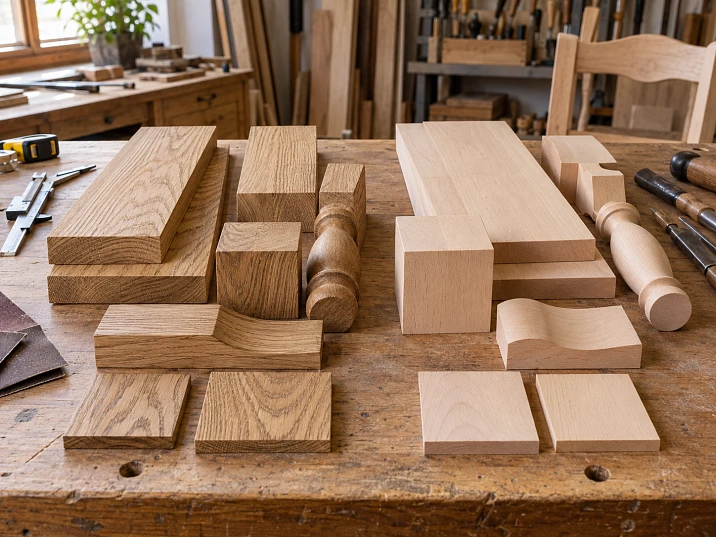
Page description: How to choose oak or beech blanks for furniture: processing, turning, milling, enamel, oil, lacquer, and tinting. Comparison of blanks and ready-made STAVROS wooden components.
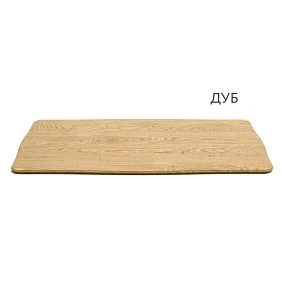
The same furniture part can be made from oak or from beech, but after processing and finishing it will look different. If the wood remains open under oil, lacquer, or tinting, the species becomes part of the design. If the part is fully coated with opaque enamel, what comes to the fore is no longer the pores and grain of the wood, but the geometry, surface quality, and neatness of preparation.
Therefore, when choosing oak or beech blanks for furniture, it is better not to go by the principle of "which wood is better." First you need to understand what exactly will be made from the blank, how complex the future shape is, what processing still lies ahead, and whether the wood will remain visible after finishing.
For one part, oak may be the most logical choice. For another, beech. And sometimes, instead of a regular blank, it is more advantageous to take an already formed wooden element and not waste time making a complex shape from scratch.
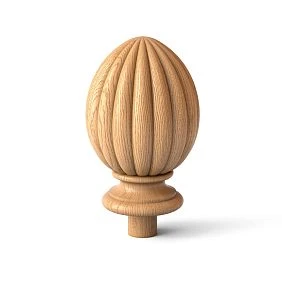
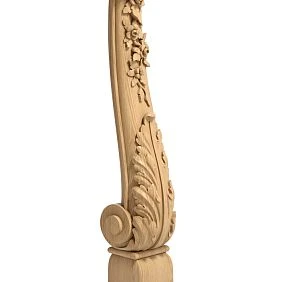
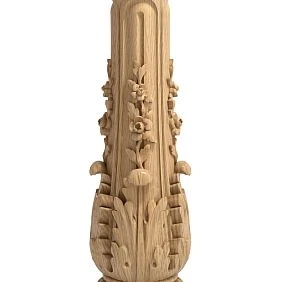
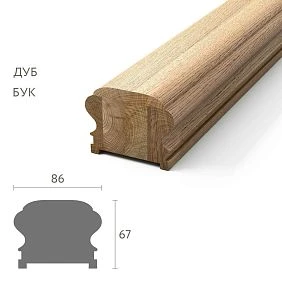

Oak or beech is chosen after understanding the final part
The first question should not be:
Which is better — oak or beech?
But like this:
What am I going to make, and what should the finished result be?
The difference seems small, but it completely changes the choice.
For a simple painted leg, there is one logic.
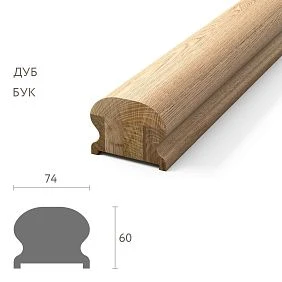
For a long molding under clear lacquer, another.
For a turned handle, a third.
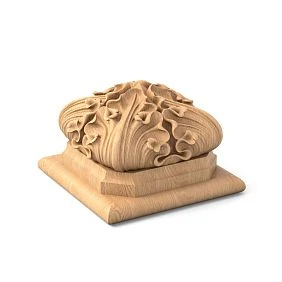
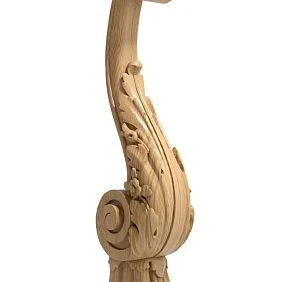
For a carved decorative element — the fourth one.
Before buying, it is useful to answer five questions:
- Which part is needed?
- What processing is still ahead?
- How complex is the geometry?
- Should natural wood be visible?
- What will the final finish be?
After that, the question of species becomes significantly simpler.




When oak becomes part of the appearance
Oak is especially interesting where the wood surface is not going to be fully covered with paint.
For example, if the part will be:
- coated with clear lacquer;
- coated with oil;
- tinted;
- treated with stain;
- left with a clearly visible natural texture.
In such furniture, the wood grain works together with the form.
On a straight molding, it runs along the piece.
On a turned leg, the direction of the fibers constantly changes relative to the surface.
On a carved element, the wood is visible simultaneously on the raised areas, recesses, and end-grain sections.
That is why oak stock is especially justified where you want to see the wood itself, and not just the form.
Imagine a console with oak legs, oak molding, and handles under a clear tinted finish. If all the parts are selected from the same species, the interior perceives them as a single material system.
If, however, one part is made of beech and the rest of oak, the difference may become noticeable after finishing.
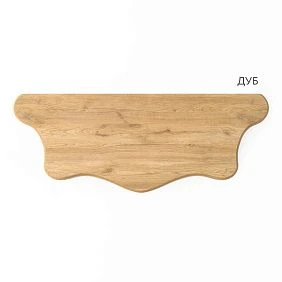
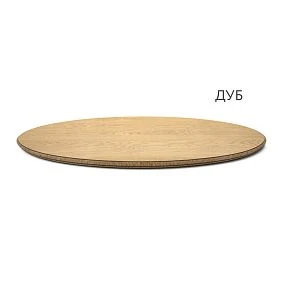
Our factory also produces:
When beech is convenient for a furniture workshop
Beech is often considered for items that will be painted with opaque enamel.
For example:
- furniture leg for white enamel;
- handle in the color of the facade;
- turned element for an opaque finish;
- geometric part where shape matters more than the natural grain;
- a composite furniture structure that, after painting, should be perceived as a single whole.
In that case, there is no need to preserve a pronounced wood texture.
The craftsman looks first at:
- accuracy of geometry;
- surface quality;
- absence of unnecessary defects;
- ease of processing;
- preparation for painting.
But beech cannot be considered a wood only for enamel.
It can be lacquered, tinted, used under oil. The result will simply be different from that of oak.
If the wood will remain open, it is better to first look at a real sample.
Get Consultation
Visible or closed wood — the main choice before purchase
For a workshop, it is convenient to link the finish and material in advance.
| Finish | What to look at first |
|---|---|
| Dense enamel | geometry, surface, preparation |
| Transparent varnish | the shape and natural grain of the wood |
| Oil | the wood texture becomes especially noticeable |
| Stain | color, grain direction, evenness of the result |
| Staining | the combination of the natural grain and the chosen shade |
| Patina | relief, recesses, and transitions of the shape |
This table does not mean that only beech is allowed under enamel and only oak under lacquer.
It shows which parameter becomes the main one.
If the surface is fully covered with paint, the species has less influence on the appearance.
If the coating is transparent, the influence of the material increases.
A rough blank is not yet a furniture part
The query "rough furniture blank" describes the earliest stage well.
This is a material that still needs to be turned into the required shape.
After purchase, the following may be needed:
- Cutting;
- calibration;
- planing;
- Milling;
- turning;
- drilling;
- Carving;
- sanding;
- preparation for coating.
That is, the choice between oak and beech is only one part of the decision.
The second part is how much work will remain after receiving the blank.
If a craftsman buys a rectangular beam and makes a complex carved leg from it, all the geometry remains in production.
If an already formed unfinished leg is purchased, most of this work has already been done.
That is why it is useful to distinguish:
raw material → processed blank → formed part → finished unfinished component.
A planed blank does not mean "ready for enamel"
A planed furniture blank already has more precise geometry and processed surfaces.
But this does not yet mean that it can be painted right away.
Need to check:
- does the actual size match the project;
- is there an allowance;
- is additional milling needed;
- are there machining marks;
- is sanding required;
- is the surface prepared specifically for the chosen finish.
This is especially important for enamel.
Dense paint does not hide poor geometry. On the contrary, a smooth painted surface often makes waves, scratches, and unevenness more noticeable.
Therefore, "planed" and "ready for painting" are different states of a part.
Turned part: same shape, different wood
A turned furniture component shows the difference between wood species especially well.
On a straight block, the grain is mostly read along a single plane.
On a turned form, the surface constantly changes direction.
Available:
- cylindrical sections;
- rounded transitions;
- beads;
- narrowings;
- end-grain sections.
After a clear finish, oak and beech on the same geometry will be perceived differently.
Therefore, when choosing a turned blank or a finished turned element, it is more useful to look not at a flat wood sample, but at the actual profile.
It is on this that you can see how the material behaves on curves and transitions.
Carved blank made of oak or beech
For a carved part, relief is added to the question of wood species.
It has:
- peaks of the pattern;
- deep hollows;
- thin edges;
- areas across the grain;
- internal corners;
- end-grain surfaces.
If all of this remains under a transparent finish, the wood pattern becomes part of the ornament.
Oak carving is often perceived as richer due to its pronounced texture.
A beech surface may look calmer, so the form itself reads more strongly.
If the carved element is painted with opaque enamel, the difference in materials becomes visually less noticeable.
Then the quality of sanding and the preservation of fine relief transitions are especially important.
A raw blank and a finished unpainted component are not the same thing
For a workshop, this is a fundamental difference.
Rough blank
The craftsman forms almost the entire future part himself.
He determines:
- final size;
- profile;
- holes;
- thread;
- cross-section;
- surface.
Ready-to-use unfinished component
The shape is already there.
The part already has:
- dimensions;
- profile;
- outer contour;
- product number;
- basic geometry.
All the craftsman has to do is include it in the project, check compatibility, apply their own finish, and install it.
This is no longer an ordinary blank in the classic sense.
This is a finished wooden part without a final decorative coating.
For one-off furniture and small batches, this option often saves more time than buying raw material.
STAVROS wooden “Construction Kit”: start not with a rectangular block
In the section wooden construction set elements pre-formed parts are assembled, from which you can build legs, posts, rods, and other furniture or interior structures.
For a workshop, this is an intermediate path.
There is no need to create a complex shape from scratch.
But the finished product is not bought whole either.
The craftsman receives a set of wooden elements and assembles their own structure from them.
This is convenient if you want to preserve the freedom of the project but reduce the amount of machining.
KN-008: a pre-formed part instead of making from scratch
Geometric figure KN-008 measures 150 × 96 × 96 mm and has a through hole of 34 mm.
It is produced from beech and oak.
This is a good example of already finished geometry.
If a craftsman wants to produce such a three-dimensional element independently, they need to:
- prepare the blank;
- set the outer dimension;
- form the profile;
- make a precise hole;
- sand the surface;
- repeat the shape if there are multiple elements.
With KN-008, the main geometric work has already been done.
All that remains is to decide whether the size is suitable, whether this particular shape is needed, which species to choose, and how the part will be finished.
Therefore, KN-008 is more accurately called not a rough blank, but a formed wooden component.
KN-011: a ready-made cube instead of preparing the block yourself
Geometric figure KN-011 — a cube measuring 105 × 105 × 105 mm with a 34 mm hole.
Available in beech and oak.
At first glance, the cube seems like a very simple part.
But if a workshop needs a neat, uniform block with a precise central hole, making it requires several operations:
- prepare the blank;
- achieve three identical dimensions;
- keep the right angles;
- make the hole;
- avoid damaging the edges;
- sand all surfaces.
With a single part, this doesn't look like a big problem.
With eight or twenty identical elements, the time starts to add up.
The ready-made KN-011 eliminates this part of production and leaves assembly and finishing to the craftsman.
KON-010: when instead of a set of individual blanks you can take a kit
Furniture leg set KON-010 — another level of readiness.
Its overall size is 730 × 120 mm, the seating size of the elements is 34 mm.
The kit is offered in beech and oak.
It consists of selected wooden construction set elements and an axle for assembling one decorative leg.
This is no longer a single blank.
The craftsman receives a system of parts from which a finished geometry can be assembled.
This example clearly illustrates three levels of work:
the first — buy raw timber and make everything yourself;
the second — buy individual pre-formed elements and assemble your own composition;
the third — take an already curated kit and focus on assembly, finishing, and installation.
The higher the level of readiness, the less mechanical processing remains in the workshop.
MLD-002: one profile in different materials
Wooden Moulding MLD-002 has a profile of 22 × 11 mm.
For solid wood, there are options in beech and oak. The line also includes an MDF version.
This example clearly shows why material cannot be chosen separately from function.
Molding is a long linear component.
Its purpose is nothing like that of a volumetric leg or a cubic element.
If the molding is to be painted together with the furniture, the material is chosen based on the entire project system.
If the natural wood remains exposed, oak and beech will give a different appearance.
That is, the question "oak or beech" should always come after the question "what does this part do in the furniture."
Proun HL-053-1: the geometry is already set, all that remains is to choose the wood and finish
Furniture handle Proun HL-053-1 measures 28 × 28 × 29 mm and is available in oak and beech.
This is already a fully formed component.
The craftsman does not make:
- size;
- shape;
- profile;
- main surfaces.
He chooses:
- beech or oak;
- finishing method;
- place on the facade;
- quantity.
This example shows how far the transition from a raw blank to a finished wooden part can go.
In one case, the craftsman buys the material.
In the other — an almost finished element that only needs to be properly integrated into the furniture.
Which is more cost-effective: a blank or a finished wooden part
Comparing only the material price is wrong.
For making it yourself, you need to calculate:
wood + waste + cutting + machine time + manual work + tools + sanding + possible defects + finishing.
For a finished component:
cost of the part + delivery + custom finishing + installation.
Let's imagine you need four identical turned legs.
If the workshop regularly produces such elements, the template already exists, the equipment is set up, and the material is purchased, making them yourself can be worthwhile.
If, for the sake of four parts, you need to set up the machining again, make a test sample, and spend several hours sanding a complex shape, a ready-made component may be the wiser choice.
Quantity matters a great deal here.
Four parts and four hundred parts are two different economies.
When an oak blank is the more rational choice
An oak blank is especially justified if:
- a unique size is needed;
- the shape is designed specifically for a particular piece of furniture;
- the wood will remain visible;
- the workshop wants to control the pattern and material selection itself;
- the series is large enough for its own processing;
- there is no ready-made component of the required shape.
For example, a workshop produces a series of tables with a custom oak leg profile for clear oil.
If production is repeated in dozens of items, it makes sense to develop your own technology.
When a beech blank is more rational
Beech is often convenient if:
- the part will be fully painted;
- the geometry is relatively simple;
- natural texture is not part of the design;
- processing is already familiar to the workshop;
- the material is used in the overall system of painted furniture.
Let's imagine a painted chest of drawers where the legs and handles should be the same color as the body.
If all wooden parts are to be finished with opaque enamel, beech can be a very clear choice.
But if the shape is complex and only a small batch is needed, the question of species becomes secondary. Perhaps it would be wiser to first find a ready-made part with suitable geometry.
When it is better to take a ready-made component instead of a blank
A ready-made part is especially useful if:
- the profile is complex;
- a small batch is needed;
- 4–20 identical parts are required;
- turning is not a regular job for the workshop;
- threading is needed;
- repeatability matters;
- a suitable ready-made item already exists.
In that case, the craftsman is not just buying wood.
He is buying geometry that has already been produced.
And this is often the main saving.
Trial finishing before starting a series
If the wood remains visible, a trial is essential in almost all important projects.
Especially when:
- clear lacquer;
- oil;
- wood stain;
- tinting;
- combination of several wooden parts.
The procedure is simple:
- choose the material;
- take a real sample of the part;
- perform the required treatment;
- make a test finish;
- compare with other furniture elements;
- only then approve the entire batch.
A flat wood sample is useful, but a three-dimensional piece is more informative.
On a turned or carved surface, color and texture are perceived differently.
Do not mix oak and beech accidentally
Let's imagine a single piece of furniture:
- leg — oak;
- handle — beech;
- molding — oak.
And everything is coated with clear oil.
Before finishing, the parts may appear quite similar.
After oiling, the difference becomes more pronounced.
It's not just the shade that changes.
These read differently:
- pores;
- grain direction;
- end-grain sections;
- light on the surface.
If the blending is intentional, that's fine.
If it happened by accident, the furniture may look disjointed.
Under thick enamel, the situation is different: the natural texture almost disappears.
But even then, it's better to record the material in the project so the next batch isn't assembled from memory.
How to record the wood species in the specification
Avoid writing:
wooden part — 4 pcs.
Better:
furniture leg, project item code, oak, 4 pcs., for clear tinting
Or:
handle Proun HL-053-1, beech, 6 pcs., for enamel
For a long project, you can add:
- size;
- installation location;
- finishing method;
- drawing number.
This way, a repeat order becomes clear even to another craftsman.
How to choose material for a small batch
Let the workshop make five identical chests of drawers.
For each:
- 4 legs;
- 6 handles;
- 2 decorative elements.
For the entire series you need:
- 20 legs;
- 30 handles;
- 10 decorative parts.
If the wood is to be left open-pored, the material must be approved before ordering the entire batch.
You cannot accidentally make half the handles from beech and the other half from oak and expect the same result after a clear finish.
If everything is going under a dense enamel, the difference may be almost imperceptible, but the production record must still be unified.
Common mistakes when choosing blanks
Mistake 1. Choosing the species before understanding the finish
First they order oak, then they decide to cover everything with a dense white enamel.
What's better: first determine the finished appearance.
Mistake 2. Considering beech only a material for painting
Beech can be left under a transparent finish.
You need to look at a real sample.
Mistake 3. Considering oak automatically the best option
If the texture is completely covered, some of its decorative qualities are not used.
Mistake 4. Buying a rough blank and underestimating the remaining work
The material price is low, but then processing hours are added.
Mistake 5. Confusing a planed blank with a part ready for finishing
After planing, sanding and other operations may still be required.
Mistake 6. Treating a finished component as an ordinary blank
A finished leg or handle already has its main geometry formed. This is a different level of readiness.
Mistake 7. Mixing oak and beech under a clear finish without a sample
The difference may become noticeable only after finishing.
Mistake 8. Ordering a large batch without a sample part
An unsuitable color or surface is repeated across the entire series.
Where to look for wooden blanks and ready-made components
General section of solid wood suitable for finding ready-made wooden components of various types.
For modular parts, you can look at wooden construction set.
If you need pre-formed supports without coating — from STAVROS open boundless possibilities for designers, furniture makers, and anyone striving to create unique high-quality furniture..
For fronts and drawers — unpainted wooden handles.
For linear parts — Wooden trim.
It is better to search not from the word “blank,” but from the future part.
If you need a leg — first look for a suitable leg.
If a handle — a handle.
If the module is of composite construction — constructor elements.
And only after that decide whether a ready-made form or custom processing from a raw blank is more advantageous.
Short selection table
| Task | What most often makes sense to consider |
|---|---|
| Part for clear lacquer | Oak |
| Part for oil | Oak |
| Tinted furniture with visible texture | Oak |
| Part for opaque enamel | Beech |
| Simple custom geometry | standard blank |
| Complex turned shape, small batch | ready-made component |
| Carved element, small series | ready-made part |
| Unique shape, large series | in-house blank production and processing |
| Need to maintain full control over the wood | in-house blank |
| Need to reduce machining operations | ready-formed part |
The table is only a starting point.
The final decision is made based on the specific part and a sample finish.
What to ultimately choose — oak or beech
If the wood is to remain visible, oak is often the more expressive choice.
If the part will be painted with opaque enamel, beech is often more convenient.
But this answer is not enough for production.
You also need to decide in what state to buy the part.
Sometimes it is better to start with a block and create all the geometry yourself.
Sometimes — to take a planed blank.
Sometimes — to buy a pre-shaped module.
And sometimes it is more cost-effective to order a ready-made unfinished leg, handle, or set right away.
Therefore, the correct sequence is as follows:
first the part → then processing → then finishing → then species → then readiness level.
So the choice between oak and beech stops being a debate about which wood is "better" and becomes a normal production decision.
Frequently Asked Questions
Which is better for a furniture blank — oak or beech?
For visible wood under a clear finish, oak is often chosen. For parts under opaque enamel, beech is often convenient. But the final decision depends on the shape of the part and the future coating.
Which wood should be chosen for enamel?
In many cases, beech will be a clear option. However, oak can also be painted. What matters more is the quality of the surface and the preparation of the part.
What should I choose for clear varnish?
If you want to see the natural texture clearly, oak is usually more interesting. Before a production run, it is useful to do a test on an actual element.
Which wood is better for tinting?
Both species can be tinted. But the result will be different, so the shade should be evaluated on a real sample of the chosen wood.
Is beech suitable for turned furniture parts?
Yes. Especially if the turned part will be painted. If the surface will remain natural, it is better to check the appearance of the finished profile in advance.
When is it better to use an oak blank?
When a custom size and custom geometry are needed, and the wood should remain visible under a clear or semi-transparent finish.
Can oak and beech be combined in one piece of furniture?
Yes. Under a dense enamel, the difference is often almost invisible. Under a clear finish, it is more noticeable, so the combination is best checked in advance.
Which is more cost-effective — machining a blank or buying a finished part?
You need to calculate the entire job. For a blank — material, waste, machine time, sanding, and possible defects. For a finished part — its cost, finishing, and installation.
Should a test finish be done?
For important projects, it is advisable. Especially with oil, stain, tinting, and clear lacquer.
Where to buy ready-made wooden components made of oak and beech?
Suitable products are collected in the STAVROS catalog: construction kit elements, unpainted legs, handles, moldings, and other solid wood products. First choose the type of future part, then the material and degree of readiness.