Article Contents:
- What the buyer gets by choosing KL-014
- Confirmed characteristics of capital KL-014
- Eight sizes of KL-014: complete dimension table
- Why you cannot choose a capital only by width B
- Height
- Depth
- Lower support part
- Distance to adjacent decor
- One central capital
- Two capitals on the sides
- Capital as part of a portal
- One central capital
- Two parts for a door portal
- Two parts for a cabinet
- Kit for a library
- Need to arrange a small furniture stand
- Need to finish two pilasters at the door
- Need to arrange a bookcase
- Need to assemble a large portal
- Need to repeat one ornament in different parts of the room
- Need to select a capital for ready-made furniture
- Need to design several identical openings
- No size fits
- Choosing only by photo
- Comparison only by width B
- Ignoring the door leaf
- Ordering one part instead of a pair
- Mixing sizes
- Buying from different materials
- Lack of space to the cornice
- Material selection after purchase
- Attempt to trim a large ornament
- Ordering a batch without a specification sheet
- Expecting the same result on different wood species
- 1. What sizes of KL-014 are available?
- 2. Can I choose a capital only by the width of the pilaster?
- 3. What size is suitable for an interior door?
- 4. Can KL-014 be used for a cabinet?
- 5. How to choose between beech and oak?
- 6. Do I need to buy capitals as a pair?
- 7. Can different sizes of KL-014 be combined in one room?
- 8. Will the 350 mm size fit a standard door?
- 9. What to do if the post width is between two sizes?
- 10. Can the capital be trimmed if it doesn't fit slightly?
- 11. What does the choice of surface preparation mean?
- 12. How to check if the capital will interfere with the door?
- 13. What to buy together with KL-014?
- 14. Where to check the price and availability of KL-014?
- 15. Can I order different sizes from the same material?
- 16. What should I tell the manager for an accurate selection?
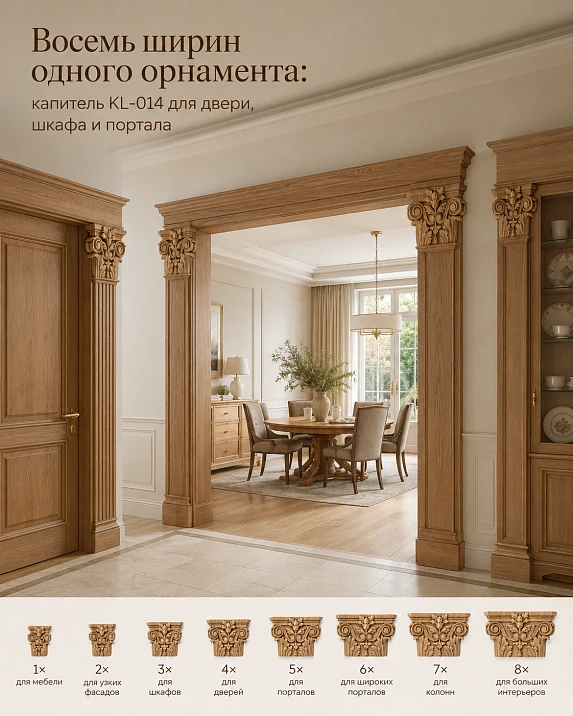
Buy the KL-014 capital made of beech or oak makes sense when you need not just to add carved decor, but to complete a door portal, furniture pilaster, bookcase, or decorative column with one expressive detail. This model is chosen for two practical advantages: the ornament can be repeated in several parts of the project, and eight width options from 90 to 350 mm allow maintaining a single pattern on structures of different scales. It is important for the buyer to understand in advance why they need the capital, where exactly it will be installed, and what size corresponds to the post, casing, or pilaster, because buying only from a photo easily leads to incorrect projection, lack of height space, or a visually heavy top part.
KL-014 is useful where a vertical element cannot be left simply cut off at the top. A pilaster, cabinet post, or side part of a portal without finishing often looks like a technical detail rather than part of a well-thought-out composition. The carved capital forms the top point, connects the vertical with the cornice, and helps distribute the decor so that it does not gather only at the bottom or center. At the same time, its task is not limited to decoration: a correctly selected width covers the transition between the post and the top element, supports symmetry, and allows repeating the same motif on several sections of furniture or openings.
The main advantage of KL-014 is not just the presence of eight sizes, but the preservation of one ornament when changing scale. For a narrow furniture post, you can consider a compact version, for a door portal — a medium one, for a large wall composition — a wide one. Thus, the buyer does not have to combine different capitals just because one model is produced in a single size. As a result, the door, cabinet, and decorative column can look like part of one collection, even if their dimensions differ noticeably.
But the wide size range does not cancel project verification. Width B is only one of the parameters. Along with it, the height, depth, lower support part, and overall projection of the carving change. Therefore, before ordering, you need to compare the full dimensions of the product with the drawing, check the distance to the ceiling or cornice, ensure that the capital does not interfere with the opening of the door leaf, and decide how many identical parts are needed for a symmetrical composition.
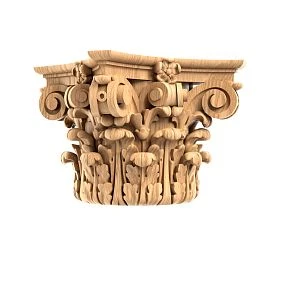
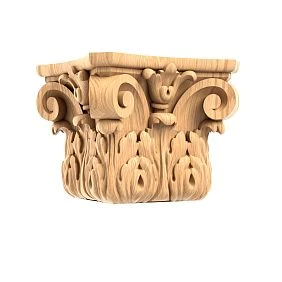
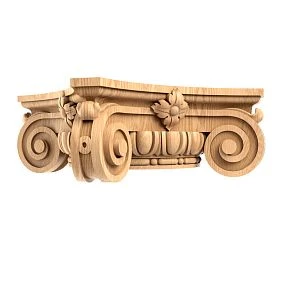
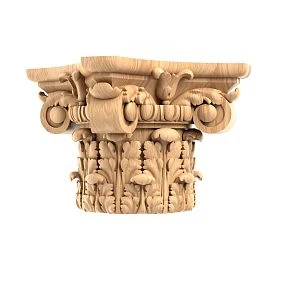
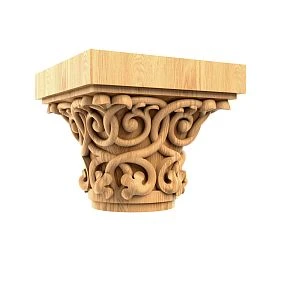
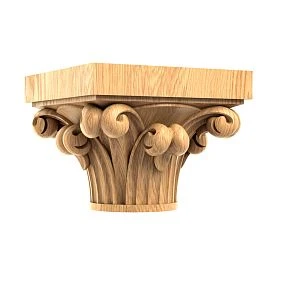
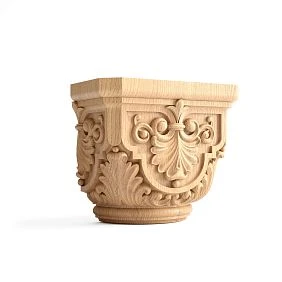
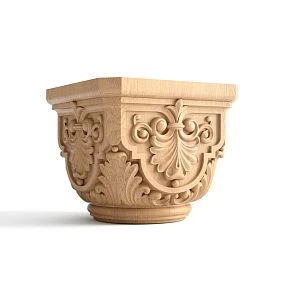
What the buyer gets by choosing KL-014
A capital is the upper decorative completion of a vertical element. In classical architectural logic, it completes a column or pilaster, but in interiors and furniture, its application is broader. A capital can be installed above a door casing, on the top of a furniture post, on the sides of a bookcase, as part of a portal, or on a decorative wall pilaster. It helps transform individual slats, posts, and applied verticals into a cohesive system.
That is why purchasing a capital begins not with the question "do I like the design," but with the question "what structure should it complete." For a single central piece above a door, alignment with the opening's axis is important. For a pair above pilasters, equal height, symmetrical projection, and matching dimensions are crucial. For a bookcase, the repeatability of sections and the location of the cornice must be considered. For a decorative column, the capital must relate not only to the width of the pilaster but also to the base, the upper band, and the overall scale of the wall.
KL-014 is convenient for such tasks because one design is available in eight widths. The buyer can use a compact capital in furniture, a medium one in door framing, and a large one in wall compositions, without changing the carving character. This is especially important in projects where several items are in the same room and are perceived simultaneously. Different ornaments may clash with each other, while repeating one design creates a clear connection.
Before a detailed selection, it is useful to look at what wooden capitals are available, and then compare the specific KL-014 with the width of your post or opening. The general article helps understand the role of the element, but the decision to purchase this model should be based on its exact dimensions and the actual construction drawing.




Confirmed characteristics of the KL-014 capital
| Parameter | What is confirmed | What this means for the buyer |
|---|---|---|
| Model | KL-014 | One ornament available in multiple scales |
| Product type | Carved wooden capital | Suitable for decorative completion of vertical elements in furniture and interiors |
| Number of sizes | Eight | You can choose a version for a narrow rack, a medium portal, or a large composition |
| Width B | 90, 110, 130, 160, 190, 210, 240, and 350 mm | The size is selected based on the rack width, allowable overhang, and overall scale |
| Materials | Beech and oak | The wood species is coordinated with the base, future finish, and adjacent wooden parts |
| Surface preparation | Different processing options are available | Before ordering, check in the card which preparation suits the selected coating |
| Main scenarios | Door, cabinet, library, portal, pilaster, decorative column | The purpose is not determined solely by size: compliance is checked against the project |
| Product card | Capital KL-014 in all available sizes | The card checks current execution options, cost, and availability |
This table shows the key feature of the model: the buyer chooses not a separate pattern for each item, but one ornament at the required scale. However, the word "scale" cannot be understood only visually. As the width increases, all related dimensions change, so a large capital takes up more vertical space and protrudes further forward. If only the front width is considered, you may get a part that matches the post in the front but hits the cornice, protrudes into the doorway, or is too deep for a furniture facade.
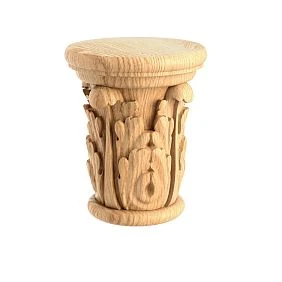
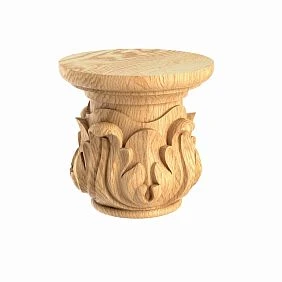
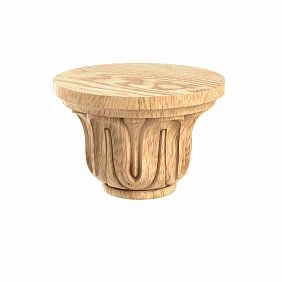
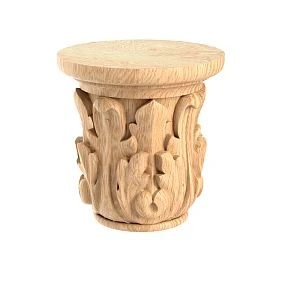
Our factory also produces:
Eight sizes of KL-014: complete dimension table
| Width B | Full dimensions | Preliminary scenario for verification |
|---|---|---|
| 90 мм | 63 × 90 × 25 × 12 × 57 mm | Small furniture post, local decorative accent, narrow pilaster |
| 110 мм | 77 × 110 × 30 × 14 × 69 mm | Compact cabinet, small door post, top of narrow casing |
| 130 мм | 91 × 130 × 36 × 17 × 82 mm | Furniture pilaster, small portal, library section |
| 160 мм | 112 × 160 × 44 × 21 × 101 mm | Cabinet, wide architrave, paired pilasters, door portal |
| 190 мм | 133 × 190 × 52 × 25 × 120 mm | Bookcase, built-in furniture, classic portal |
| 210 мм | 147 × 210 × 58 × 27 × 132 mm | Large furniture column, wide portal, wall pilaster |
| 240 мм | 168 × 240 × 66 × 31 × 151 mm | Large opening, grand wall composition, decorative column |
| 350 мм | 245 × 350 × 97 × 46 × 221 mm | Large portal, wide pilaster, large-scale interior composition |
The scenarios listed are not a rigid assignment for each version, but a guide for initial selection. The KL-014 90 mm capital may be suitable not only for furniture, and the 240 mm model not only for a portal. Everything depends on the actual width of the vertical, the desired projection, the room height, and the adjacent decor. The correct choice is made based on a drawing or at least precise measurements, not on the name of the item.
After the table, it is useful for the buyer not to immediately place an order, but to select the two closest options and compare them on a diagram. For example, with a 140 mm wide stile, you can consider KL-014 with widths of 130 and 160 mm. The first version will be more compact and may almost align with the stile, while the second will provide a noticeable side projection. Which option is better depends on whether the capital should be a restrained finish or an independent top piece.
For a preliminary check, you can make a template from paper or cardboard based on the front dimensions. It will not replace accounting for depth, but it will allow you to see the scale. Such a mockup is especially useful next to a door and on furniture: it becomes clear whether a wide carved piece looks heavier than the casing itself, whether the compact option is lost, and whether there is enough space to the cornice.
Get Consultation
Why you cannot choose a capital only by width B
Width B is convenient for initial search because it is easiest to compare with the width of a pilaster or furniture stile. But the final decision requires checking the entire dimensional chain. For each version of KL-014, the height, projection depth, lower part, and length of individual pattern elements change. The larger the model, the more space it needs not only horizontally. A size that looks good in a front sketch may turn out to be inconvenient when viewed from the side.
Height
Height determines how much space the capital will occupy between the top of the stile and the cornice, ceiling, shelf, or other decorative band. If this distance is not checked, the top part may end up cramped. The carving will lose readability, and installation will require unplanned trimming of adjacent elements. For a door portal, additionally consider the height of the opening and the position of the upper casing. For a cabinet, consider the position of the cornice, top panel, and doors.
Height is checked especially carefully in an already finished interior. The drawing may provide a free section that, after installing a stretch ceiling, cornice, or built-in lighting, will become smaller. The capital must fit considering the actual finish. If the distance is measured to the rough ceiling, the result cannot be used without adjusting for the finished level.
Depth
Depth is especially critical near the door leaf and on furniture. A large capital may project forward more than the casing or pilaster. In a portal, such a projection can approach the door opening trajectory. On a cabinet, a deep piece may conflict with the facade, handle, top shelf, or adjacent section. Therefore, a front view is insufficient: a side sketch is needed.
On a wall pilaster, depth affects the shadow. The more the capital protrudes from the plane, the more noticeably it separates from the wall. This can be an advantage in a large portal, but in a narrow area, a too deep detail looks heavy. The buyer must decide in advance whether a pronounced volume or a calmer finish is needed.
Lower support part
The capital must rest on the vertical element logically and symmetrically. If the lower part is wider or narrower than the post, this is not always a mistake, but the overhang must be intentional. A too small support area creates the feeling that the detail is held on by chance. Excessive overhang requires checking the fastening and can disrupt proportions.
Therefore, the width of the pilaster is compared not only with the maximum width of the ornament. It is important to understand which part of the capital actually adjoins the vertical. For this, a full drawing of the product or card data is used, and for a complex project, the fit is clarified with a specialist. A random match of one number does not guarantee the correct assembly.
Distance to adjacent decor
In classical design, a capital rarely exists alone. Above there may be a cornice, below a pilaster, nearby a casing, rosette, overlay, or repeating section. Air is needed between details. If the capital is flush with the cornice, the patterns merge and become unreadable. If the gap is too large, the vertical looks broken. Therefore, the size is chosen not in isolation, but within the entire composition.
Neighboring capitals must also be considered. In a library or portal, they may be close to each other. If wide details almost touch, individual verticals cease to be readable. Sometimes it is wiser to choose a smaller width and maintain distance than to use the maximum size for more noticeable carving.
Compact sizes 90–130 mm: where they work best
Capitals with widths of 90, 110, and 130 mm are suitable for projects where the decorative vertical is narrow and the top finish should be noticeable but not heavy. These can be small furniture facades, side posts of a cabinet, the top of a narrow door casing, local carved inserts, and small pilasters. The compact version allows preserving the character of the ornament without turning it into a dominant detail.
KL-014 with a width of 90 mm should reasonably be considered for narrow furniture elements and small accents. But it cannot be automatically assigned to any thin post. It is necessary to check whether there is enough area for support, whether part of the pattern is covered by the cornice, and whether the capital looks too small relative to the overall height of the furniture. On a tall cabinet, a very compact detail may get lost, even if it formally matches the post.
The 110 mm version provides more presence while maintaining a neat scale. It may suit a compact cabinet, door jamb, or small pilaster. When paired, it is important to measure both sides of the opening: construction deviations sometimes make visually identical sections actually different. Capitals must be at the same height, so it is better to set a common installation line rather than measuring separately from the floor.
The 130 mm size often serves as a transition between furniture and interior scale. It can be considered for a library section, furniture pilaster, small portal, or expressive architrave. Here it is especially important to check the depth: the capital protrudes more noticeably and interacts more strongly with the upper cornice.
Compact sizes are also useful in projects with repetition. If a cabinet consists of several sections, identical capitals help define the rhythm of the uprights. But the quantity should be counted not by the number of cabinets, but by the number of verticals that actually terminate at the top. Three sections may have four uprights—two outer and two intermediate—or six separate vertical elements; the scheme depends on the construction.
When choosing between 90, 110, and 130 mm, it is useful to evaluate the capital from the distance at which the furniture or door is usually seen. Up close, even a small ornament appears expressive. From two to three meters, a compact detail can become almost invisible. Therefore, it is better to view the template not only up close but also from the center of the room.
Medium sizes 160–210 mm: cabinets, libraries, and door portals
Widths of 160, 190, and 210 mm are suitable for more prominent verticals: wide architraves, furniture columns, bookcases, built-in libraries, paired pilasters, and classic portals. In this group, the ornament is already well readable from a distance, so the capital becomes not only the termination of the upright but also an independent part of the facade.
KL-014 with a width of 160 mm can be considered when the upright is wide enough but large decor is not yet needed. This is a convenient option for a cabinet or door portal of medium scale. On a furniture composition, the capital should relate to the height of the base and cornice. If the upper part is too massive and the lower base is almost invisible, the vertical looks inverted. Therefore, it is better to evaluate the top and bottom together.
The 190 mm size is suitable for more developed furniture and interior solutions. It can finish the side upright of a library, built-in cabinet, or classic door portal. Here, it is no longer sufficient to limit oneself to a paper template only for the facade. It is advisable to make a side contour and check how much the detail protrudes relative to doors, shelves, and cornice.
KL-014 with a width of 210 mm is a noticeable capital for a wide pilaster or large furniture column. It requires sufficient space around it. If two capitals are located nearby, the distance between them should allow the ornament to be read separately. On a too narrow section, two large details may visually merge and overload the top.
Medium sizes work especially well in symmetrical compositions. Two identical capitals on either side of a doorway set the top points of the portal. Two details on the outer uprights of a cabinet frame the facade. Repetition on several sections of a library creates rhythm. But symmetry requires not only the same article: the size, material, finish, installation height, and projection relative to the upright axis must match.
When choosing the medium version, one must not forget about the scale of the room. In a small room, a 210 mm capital may appear larger than on a spacious wall. Interior photographs often distort the sense of size, so decisions are best verified on an actual surface or a full-size mockup.
Large sizes 240–350 mm: portals and wall compositions
Capitals with widths of 240 and 350 mm are designed for large-scale tasks: wide door portals, large wall pilasters, decorative columns, framing of large openings, and formal compositions. They are noticeable from a distance and require an appropriate surrounding. On small furniture, such a size will almost always conflict with the facade, but on a high wall or wide portal, the compact version, on the contrary, may get lost.
KL-014 with a width of 240 mm is suitable for large verticals where the ornament must remain legible from a distance. Before purchasing, you need to check not only the width of the pilaster but also the distance to the ceiling, upper cornice, and adjacent elements. The capital should not accidentally touch other decor. There needs to be a gap between the patterns, otherwise the top of the portal will become too dense.
The 350 mm version is the widest option in the range. Its full dimensions are 245 × 350 × 97 × 46 × 221 mm, so the depth and height require separate control. Such a capital can be part of a formal portal or a large column composition, but it should not be chosen solely out of a desire to make the decor more noticeable. The scale must match the width of the opening, the height of the room, and the thickness of the vertical elements.
Special attention should be paid to door opening. A large capital may be located above the door leaf, but its protrusion can still conflict with the casing, door closer, upper transom, or adjacent cornice. A side drawing helps to see these intersections before ordering. If the project is complex, it is useful to provide the manufacturer or furniture workshop not only with the dimensions of the opening but also with a photograph of the installation site.
For a decorative column, the capital is considered together with the pilaster and base. A separately chosen large top part may turn out to be too heavy for a thin vertical. It is useful to study in advance what a decorative column consists of, and then coordinate the width of the top part with the other components of the system.
The large format increases the requirements for material and finish. On a large area, both the wood texture and the quality of preparation of small elements are more noticeable. If a transparent coating is planned, the oak version will be perceived differently than the beech version. If the surface is covered with enamel, the purity of the relief and the uniformity of the entire composition come to the forefront.
How to select KL-014 for pilaster width
The pilaster is the main reference for choosing a capital, because it sets the vertical axis and support width. However, a one-to-one size match is not mandatory. The capital can be wider than the post and create a side overhang. The question is not whether there is an overhang, but how proportional and symmetrical it is.
- Measure the actual width of the post. Do not use only the size from the project if the structure is already assembled. Finishing, overlays, and tolerances can change the final width.
- Determine the allowable overhang. Decide whether the capital should almost match the vertical line or noticeably extend to the sides.
- Check the axis. The center of the capital should align with the center of the pilaster, unless the project specifies a different placement.
- Match the depth. The top piece should not accidentally protrude forward so much that it interferes with doors, facades, or adjacent decor.
- Check the height position. Consider the cornice, ceiling, shelf, and other top elements.
- Make a template. A full-size paper mockup allows you to compare two close sizes.
- Only after checking, choose the execution. The material and surface preparation must match the entire composition.
Suppose a pilaster is 140 mm wide. The buyer compares KL-014 with widths of 130 and 160 mm. The 130 mm option will be slightly narrower than the post or almost match it depending on the shape of the lower part. The 160 mm version will give about 10 mm total difference on each side when positioned symmetrically, but the actual overhang must be calculated based on the part of the product that rests on the pilaster. That is why width B alone is not enough.
If the pilaster has not been chosen yet, it is first useful to understand how to choose a wooden pilaster. The capital and vertical should be considered as a pair: the pattern, width, depth, material, and future finish must support each other.
A narrow pilaster does not always require the smallest capital. If the vertical is tall and located in a large room, a small overhang can be useful: it will mark the completion and connect the post to the cornice. But this overhang must be the same on the left and right. In a paired composition, even a few millimeters of axis offset are more noticeable than on a single piece.
A wide pilaster does not necessarily require a maximum capital. A restrained design is sometimes built on nearly equal width of the post and the top detail. If there is already a developed cornice or carved overlays nearby, a too large KL-014 can create unnecessary competition. The choice should consider the entire facade, not just the free space.
Capital KL-014 for interior door
The query 'buy capital for interior doors' arises when a regular casing is not enough and the opening needs a more expressive finish. KL-014 can be used in several schemes: one central piece above the door, two capitals on the sides, as part of a portal with pilasters, or as top elements of an extended casing. Each scheme requires its own calculation of quantity and sizes.
One central capital
One piece in the center works as a top accent. In this case, its width is compared not only with the casing but also with the overall width of the opening. A too small capital will get lost above the door, a too wide one will look like a random overlay. The center of the product must exactly align with the axis of the door leaf or the entire portal composition.
Central placement is not suitable for every ornament or every portal. If the vertical posts are strongly expressed, one piece in the middle can break their logic. Then it is more reasonable to use two capitals above the pilasters. If the portal is built around a central top piece, a single KL-014 can become the semantic peak.
Two capitals on the sides
Paired placement is associated with vertical posts or pilasters. Here, the size is chosen based on the width of each vertical. Both pieces are ordered identical, from the same material and with the same surface preparation. The installation height is set along a common horizontal line. Even a small difference becomes noticeable because the door opening itself creates strict symmetry.
Before ordering a pair, you need to check if both sides are arranged identically. On one side, there may be a switch, furniture, or a wall corner nearby, on the other — free space. Even if the structure is symmetrical in the drawing, actual constraints may differ. The capital should not abut a neighboring object or look cramped.
Capital as part of a portal
In the KL-014 portal, it interacts with the casing, pilaster, base, and top cornice. Before ordering, it is useful to draw the entire facade. Sometimes a capital of the correct size for the post turns out to be too tall for the remaining space under the cornice. In another case, it fits well, but its depth interferes with the opening of the door. These problems are easier to solve on a diagram than after receiving the parts.
For a door, the material is especially important. If the portal is planned for dense enamel, beech may be a rational choice when coordinating with other parts. If a pronounced wood texture needs to be preserved, oak is considered. But the wood species cannot be chosen separately from the casing and pilaster: different materials under a transparent finish will differ.
If there is a top cornice, it is necessary to decide whether it connects directly to the capitals or whether an intermediate band remains between them. This area affects the perception of the entire door. Too tight a connection may hide part of the carving, while too large a gap will weaken the connection between the verticals and the top.
KL-014 for cabinet, library, and built-in furniture
In furniture, the capital helps to complete the post and connect it to the top cornice. It is appropriate on a bookcase, library, built-in furniture, sideboard, or facade composition with vertical pilasters. Repeatability is especially important here: the same part can be used on the outer and intermediate posts, forming a common rhythm.
The KL-014 capital for a cabinet is chosen based on the width of the furniture post, but at the same time, the depth of the facade and the position of the doors are checked. If the capital protrudes forward, it should not interfere with opening. If there is a cornice above it, a clear transition must remain between the two elements. On small furniture, an excessively large part visually weighs down the facade, while one that is too compact looks lost.
For a bookcase, it is important to decide which verticals should actually be finished with capitals. Sometimes two parts on the outer posts are enough. In another composition, a capital is placed above each section. The quantity depends not on the number of shelves or the total length of the furniture, but on the scheme of vertical division.
If the library consists of several identical modules, it is better to calculate the entire batch at once. This helps to avoid a situation where some sections are designed with one size or material, and the missing parts are selected later. For a symmetrical facade, matching the shade after finishing is especially critical, so the material and surface preparation are coordinated for the entire batch.
A wooden capital for a bookcase should support not only the pilaster but also the base. If the upper part is richly decorated and the base is completely smooth and very thin, the composition may look unbalanced. It is not necessary to repeat the carving at the bottom, but the scale of the base and cornice should match the expressiveness of the capital.
In built-in furniture, the connection to the wall and ceiling is additionally checked. Sometimes the top cornice almost touches the ceiling, and the capital physically fits only in a smaller size. In another case, the side post stands flush against the wall, so a side projection is only possible inward into the composition. Such limitations should be noted on the drawing before purchase.
For a freestanding cabinet, the side view is important. If the capital looks good from the front, but its back or side is visible when entering the room, this angle needs to be evaluated. The model must be coordinated with the depth of the body, not perceived as a flat overlay that accidentally protrudes beyond the facade.
KL-014 for a portal and decorative column
A portal is one of the most natural scenarios for KL-014. It combines a door or opening with pilasters, bases, and a top cornice. The capital in this system completes the vertical and transitions it into the horizontal part. The accuracy of the selection determines whether the transition will look integral.
For a wide portal, sizes 190, 210, 240, or 350 mm can be considered, but they cannot be assigned solely based on the name of the structure. First, measure the width of the pilaster. Then determine the allowable overhang. After that, check the height to the cornice and the depth. Sometimes a more compact capital better supports a strict portal, while a large one is only needed with a high wall and a developed upper belt.
A decorative column can be an independent wall composition or part of furniture. In both cases, the capital must correlate with the base. If the top detail is several times wider than the base, the vertical looks unstable. If the base is massive and the capital is too small, the top appears unfinished. Balance is checked on a front sketch.
For multiple columns in one room, it is desirable to use the same ornament. Sizes may differ if the verticals have different widths, but the character of the pattern will remain uniform. This is where the eight versions of KL-014 provide a practical advantage: the buyer can design a large portal and a narrower furniture pilaster without switching to another model.
On the wall, the capital is perceived together with the background color. Light enamel on a light wall makes the relief softer, contrasting tinting enhances the pattern. This does not change the geometry, but affects the perception of scale. With contrasting finishing, a large version seems even more noticeable, so the size must be checked with an idea of the future color.
Beech or oak: which material to choose
KL-014 is made from beech and oak. One species cannot be called unconditionally better: the choice depends on the base, the future coating, and whether the wood grain should remain visible. The capital is in a prominent place, so the difference in material is especially noticeable with transparent or semi-transparent finishing.
| Criterion | Beech | Oak |
|---|---|---|
| Main visual character | More uniform and calm surface perception | More noticeable natural texture |
| When to consider | For dense enamel, even tinting, for beech furniture | For transparent finish, oil or varnish, for oak projects |
| Combination with base | Better to coordinate with beech pilasters, trims, and furniture parts | Better to coordinate with oak parts, especially when preserving texture |
| What to check before ordering | Type of coating and required preparation of fine carving | Direction and visibility of texture, shade compatibility with adjacent parts |
| Main risk | Choose material without considering how it will look after coating | Mix oak with another species under transparent finish and get noticeable difference |
Beech is often considered for coating with dense enamel, because in such a project the purity of form and uniformity of surface are more important than pronounced texture. But the final decision depends on the entire structure. If the pilaster and casing are made of a different species, a beech capital may differ after tinting.
Oak is chosen when the wood grain should remain visible. A large oak capital becomes not only a carved but also a textured element. However, a transparent finish makes differences especially noticeable. If adjacent parts are not made of oak, their shade and porosity may not match.
The practical rule is simple: with an opaque finish, the material is coordinated with the coating technology and the base; with a transparent finish, primarily with the species of adjacent parts. For paired capitals and a series of furniture sections, it is better to order the same material for the entire set.
When choosing a material, scale must also be considered. On a capital 90 mm wide, the visible texture area is relatively small, although the species is still important. On the 350 mm version, the wood grain occupies a larger area and plays a greater role in perception. Therefore, a large oak capital under a transparent coating will look more expressive than the same shape under dense enamel.
You cannot choose beech just because it is planned for painting, or oak just because it is more expensive or visually more familiar. The decision is made based on the project. If all furniture is oak, a beech part under tinting may stand out. If the entire portal is covered with dense enamel, the pronounced texture of oak may not be the main advantage.
Standard or Prestige: how to choose surface preparation
For KL-014, different surface preparation options are available. The choice between them cannot be made based solely on the name. It is necessary to consider what coating is planned, how close the capital will be to the viewer, whether additional manual preparation is required, and how noticeable small carving details are.
If the capital is installed high on a large portal and covered with dense enamel, the requirements for visual perception may differ from a furniture part located at eye level. For a transparent finish, the surface and wood grain are more visible. The closer the product and the thinner the coating, the more carefully preparation must be approached.
It cannot be guaranteed that one processing option will completely eliminate all preparatory operations in any project. The coating, installation method, and requirements of the furniture workshop differ. Before ordering, you should check the execution description in the KL-014 card and coordinate it with the person who will perform the finishing.
It is useful to inform in advance whether enamel, tinting, varnish, oil, or another coating is planned. This helps to choose the material and surface option as a unified system. An error occurs when a carved part is first purchased, and then a random finishing technology is attempted to be matched to it.
For several capitals, identical execution is especially important. If one part of the set is prepared differently, the degree of smoothness or readability of small areas may differ after coating. Even when parts are at a distance, symmetry makes differences noticeable.
The back side of installation also needs to be checked: whether the capital will be painted before installation, after installation, or partially. If part of the surface becomes inaccessible, the order of work is determined in advance. This is not a characteristic of the model itself, but part of the project, yet it affects the choice of preparation.
How many capitals need to be ordered
The quantity depends on the scheme, not just on the number of doors or cabinets. Before purchasing, each vertical that ends with a capital should be marked on the drawing. Such a calculation protects against the most common mistake—ordering one part where the composition requires a pair.
One central capital
For a central accent above a door or furniture section, one part is needed. But it is necessary to check whether the composition is truly built along a single axis. If there are pilasters on the sides, one central capital may conflict with them, and a paired scheme may be more logical.
Two parts for a door portal
If capitals complete the left and right posts, a pair is required. Both parts must match in size, material, and finish. It is better to order them simultaneously. During installation, it is important to align the overall height rather than relying on individual marks from the floor.
Two parts for a cabinet
On a cabinet, capitals are often placed on the outer posts. For a symmetrical facade, a pair is needed. But if there is another furniture pilaster in the center, the quantity may increase. The actual number of completed verticals should be considered.
Set for a library
In a multi-section library, capitals may terminate each post or only groups of sections. For example, four sections do not automatically mean four capitals. There may be five, eight, or another number of verticals depending on the design. The count should be based on the facade drawing.
You cannot mechanically add spare parts to the ordered quantity if they are not needed for the project, but for a complex series, it is worth discussing with the workshop the risk of damage during finishing or installation. The decision on a spare part is made considering the project, not by a universal rule.
For multiple rooms, it is convenient to compile a separate list. It indicates the room, installation location, size, material, and quantity. This prevents confusion when the hallway uses 160 mm capitals, the study uses 110 mm, and the living room uses 240 mm. One ornament does not mean one size for all zones.
| Scenario | What to count | Possible quantity | What to Check |
|---|---|---|---|
| Central decor above the door | Central axis | One capital | Alignment with the center of the opening |
| Portal with two pilasters | Left and right vertical | Two capitals | Same size and height |
| Cabinet with end posts | Two outer verticals | Two capitals | Free opening of fronts |
| Library with repeating sections | All terminating posts | According to the drawing | Repetition and symmetry |
| Multiple rooms | Each installation point | Separate statement | Do not mix sizes and materials |
What to buy together with KL-014
A capital is rarely installed without adjacent elements. To ensure the purchase yields a complete result, you need to determine in advance what vertical element is underneath it, what completes the composition from above, and how the base is designed. Random selection of individual parts creates discrepancies in width, material, and style.
| Element or solution | Why it's needed | For which scenario | What to Check |
|---|---|---|---|
| Wooden pilaster | Creates a vertical base for the capital | Door portal, cabinet, library, wall composition | Width, depth, axis and material |
| Pilaster base | Balances the top finish from below | Portal and decorative column | Proportion of base and capital |
| Top cornice | Connects capitals into a horizontal composition | Cabinet, library, portal | Distance, depth and no pattern conflict |
| Casing | Forms the door frame | Interior door | Width, free door opening and symmetry |
| Unified finish | Unifies parts by color and texture | All scenarios | Compatibility of wood species, surface preparation, and coating |
| Complete set drawing | Prevents size mismatch | Complex furniture and portals | All heights, projections, quantities, and mounting points |
A pilaster sets the vertical line, a base completes it from below, and a cornice connects the upper elements. If these parts are selected independently, the capital may be wider than the cornice, narrower than the pilaster, or too expressive relative to the base. Therefore, it is better to assemble the set on a single facade sketch.
The casing is especially important for a door. Its width and profile determine how naturally the capital integrates into the portal. If the casing is very thin, a wide KL-014 looks detached. If the casing is massive, a compact version may not handle the top finish.
A uniform finish unifies the set but does not correct geometric errors. Painting in one color will not make a too narrow capital fit a wide pilaster. First, choose dimensions and proportions, then material and coating.
If the buyer has not yet decided on adjacent parts, it is useful to look catalog of wooden capitals and compare KL-014 with other models. But a model change is needed not for variety, but only if none of the eight sizes or the ornament character matches the project.
How not to confuse KL-014 with similar products
The capital can be confused with a decorative overlay, finial, rosette, or the top element of a casing. These products may occupy a similar area but perform different compositional tasks. KL-014 is designed to complete a vertical: its logic is tied to a pilaster, post, or column. If there is no clear vertical base under the part, it may be perceived as randomly added decor.
A decorative overlay is more often placed on a flat surface and does not necessarily rest on a vertical element. A finial may complete a central axis but is not always associated with paired posts. A rosette creates a local motif. A capital, however, should look like a continuation of the vertical, so its lower supporting part is especially important.
Within the same model, it is easy to confuse close sizes. The buyer sees the same ornament and may think that only the width differs. In fact, other dimensions change along with it. Therefore, the specification should record the full size, not just "KL-014, 160 mm" without additional verification.
Another mistake is mixing KL-014 in beech and oak in one symmetrical composition. Under dense enamel, the difference may be less noticeable, but with a transparent finish, it will show. A pair or series should be ordered in the same material, unless the project specifically calls for contrast.
KL-014 should also not be confused with a capital of a different ornament that happens to have a similar width. Matching dimensions only solves the geometric part. If the pattern differs from the other elements, the door or cabinet will lose its unified character. When the project already includes carved parts, before purchasing, you need to compare not only the sizes but also the motif.
Practical selection for different situations
Need to design a small furniture post
Start with sizes 90, 110, and 130 mm, but do not assign the smallest one automatically. Compare the width of the pilaster, the total height of the facade, and the size of the cornice. If the furniture is tall, the 90 mm version may look too weak. If the facade is compact, the 130 mm version may appear heavy. Make two paper templates and evaluate them on the actual furniture.
Need to complete two pilasters at the door
Measure both pilasters, set a common axis and height. Choose one size for the pair. Check if the depth interferes with the door opening. Consider the top cornice. In the specification, indicate two identical capitals, material, and surface preparation option.
Need to design a bookcase
First, determine the number of vertical sections and termination points. Then match the capital with the furniture pilaster and cornice. For a series, it is better to order the entire set at once. If the finish is transparent, especially carefully coordinate the wood species.
Need to assemble a large portal
Consider sizes 190–350 mm only after checking the width of the pilasters and the height to the ceiling. Make front and side sketches. A large capital should have space around it and not conflict with the upper belt. For a complete system, plan the base and cornice in advance.
Need to repeat one ornament in different parts of the room
This is one of the strongest scenarios KL-014. For a cabinet, you can choose a compact version, for a door — a medium one, for a portal — a large one. The pattern will remain the same. But the material and finish must also be coordinated, otherwise the same ornament will look different.
Need to select a capital for already finished furniture
When working with a ready-made cabinet, you cannot rely solely on the stated facade size. Measure the actual width of the post, the depth of the cornice, and the distance to the door. Check if there is a flat support surface. If the furniture is already painted, decide in advance how the color of the new part will be coordinated.
You need to design several identical openings
For a series of doors, create one diagram and check each opening. Even in the same house, dimensions may vary slightly. If the capitals should look identical, choose a single size and adjust the mounting base, rather than ordering different versions for similar doors unnecessarily.
No size fits
Do not try to install a large capital on a too narrow post or trim the carving without a design solution. It is better to choose a wooden capital of a different size or change the pilaster design. The product is selected to fit the actual geometry, not the other way around.
Installation and preparation: what to decide before purchase
The selection article should not replace the installation project, because the fastening method depends on the base, the size of the capital, the material of the wall or furniture, and the future finish. But several decisions need to be made before ordering, otherwise even a correctly chosen ornament may be inconvenient to install.
First, determine the support plane. The capital must fit against the pilaster or post without random gaps. If the base is uneven, this is taken into account during preparation. Then check whether the part will be finished before or after installation. For complex carvings, the order of work affects access to the surface.
In a paired composition, mark the common horizontal line. You cannot install the left and right parts independently based on the distance from the floor, because the floor or furniture base may have a slight deviation. The viewer perceives the top line, so it must be level.
Before finishing, it is useful to do a dry fit. It shows whether the axis aligns, whether there is enough space to the cornice, and whether the depth interferes. At this stage, it is easier to adjust adjacent elements. After applying the final coating, any modifications become more difficult.
For a transparent finish, you need to assess the direction and character of the wood in advance. For enamel, evaluate the quality of surface preparation and access to small recesses. The choice of Standard or Prestige is coordinated with the technology, not used as an abstract quality assessment.
If the capital is included in a set with a pilaster and cornice, it is better to evaluate the trial assembly as a whole. An isolated dry fit may show the correct width but fail to reveal a conflict with the upper belt. In furniture, you also need to open doors and drawers to check functional gaps.
You cannot pre-assign a universal fastening method based solely on the article number. The wall base, furniture post thickness, and weight of the specific size differ. The scheme is determined by the craftsman or designer. It is important for the buyer to provide them with full dimensions and installation location before work begins.
Mistakes when purchasing KL-014
Choosing only by photo
The photograph shows the pattern but does not convey the real scale. The same model in widths of 90 and 350 mm is perceived differently. Without dimensions, it is impossible to understand how much space the product will take and how much it will protrude beyond the post.
Comparison only by width B
Width helps to filter options but does not guarantee compatibility. You need to check all dimensions, especially height and depth. A large model may match the front but not fit under the cornice.
Ignoring the door leaf
In a portal, the capital is located near a functional structure. Its depth and position should not interfere with the door opening, casing, hardware, or upper mechanisms.
Ordering one part instead of a pair
If capitals complete two posts, buying one part will break symmetry. The quantity is counted by verticals, not by the number of openings.
Mixing sizes
In a symmetrical pair, you cannot use 160 mm on one side and 190 mm on the other just because the posts differ slightly. First, fix or align the structural logic, rather than masking the difference with decor.
Purchasing from different materials
Beech and oak differ, especially under a transparent coating. Paired and repeating elements must have a consistent material.
Lack of space to the cornice
The capital cannot be squeezed between the post and the top element. The carving needs a visual gap, and installation needs working space.
Choosing material after purchase
First determine the finish and base, then the species. The reverse order often leads to the capital differing from the casing or furniture.
Attempt to trim a large ornament
Trimming can disrupt the pattern and symmetry. If the size is not suitable, it is better to choose another version or another model rather than altering the carved form without a project.
Ordering a batch without a specification sheet
When a project includes multiple doors and cabinets, it is easy to confuse sizes. A separate table by room prevents the situation where a capital of the required width ends up in the wrong area.
Expecting the same result on different wood species
The same tint does not make beech and oak visually identical. If the texture remains visible, the material should be part of the overall solution.
Who KL-014 suits and who should choose another option
KL-014 is suitable for a buyer who wants to maintain one ornament in multiple scales. It is especially useful for door portals, cabinets, libraries, and wall compositions with vertical posts. Eight sizes allow selecting a part without switching to another pattern.
The model should be considered if the project is based on pilasters, columns, or pronounced verticals. It helps complete them and connect them with the cornice. Also, KL-014 is convenient for symmetrical pairs and repeating furniture sections.
The capital will suit those who are ready to work with measurements. The wide size range offers freedom but requires comparison. A buyer who makes a template, checks the depth, and calculates the quantity from the drawing fully utilizes the model's advantage.
It is better to choose another option if no size matches the geometry, if the ornament is too rich for a minimalist facade, or if the structure does not require a vertical support at all. In such a case, randomly adding a capital will make the decor look artificial.
You should not buy KL-014 just because it looks expressive in the photo. First, you need to answer what post it completes, what overhang is acceptable, what material is needed, and how many identical parts are required. If there are no answers to these questions, the order is premature.
What to specify in the order specification
A clear specification helps avoid confusion between eight sizes and two materials. The wording should be understandable to the manager, designer, furniture workshop, and installer.
- article KL-014;
- full selected size;
- width B;
- material — beech or oak;
- surface preparation option;
- planned coating;
- number of parts;
- purpose — door, cabinet, portal, pilaster, or column;
- support post size;
- required side projection;
- photo, sketch or drawing of the structure;
- note about paired or repeated placement.
Example of a work record: "KL-014, width 160 mm, full size 112 × 160 × 44 × 21 × 101 mm, beech, selected surface preparation option, two pieces for paired pilasters of the door portal. Width of each pilaster — 140 mm. Finish — according to the general project." Such a record is better than a short "two capitals 160 mm" because it captures the purpose and geometry.
If the project includes several sizes of the same ornament, each item is recorded separately. For example, two capitals 160 mm for the door and four capitals 110 mm for furniture. The material and finish must be coordinated between all items.
How to buy capital KL-014 on STAVROS
Before ordering, open the product card and select the size of capital KL-014 from eight available options. Check not only the width B, but also the full set of dimensions. Then determine the material, surface preparation option and quantity.
If the capital is selected for a ready-made door or furniture, compare the dimensions with actual measurements. For a new project, use the drawing. For a complex portal or library, prepare front and side sketches. This will allow you to see the projection, height and depth in advance.
The current price, availability, and ordering conditions must be checked on the product page. Do not rely on old saved data, as commercial information may change. If the selected capital must match already purchased pilasters, architraves, or cornices, it is better to check compatibility with a STAVROS manager before placing an order.
The main point of this approach is not just to order a carved part, but to get a capital that truly fits the structure. A conscious check of dimensions saves more time than trying to fix a mismatch after finishing and installation.
Frequently asked questions about the KL-014 capital
1. What sizes of KL-014 are available?
The model is available in eight width options: 90, 110, 130, 160, 190, 210, 240, and 350 mm. For each option, the other dimensions also change, so before ordering, you need to check the full set of dimensions.
2. Can I choose a capital only by the width of the pilaster?
No. Width is the first reference point, but height, depth, bottom support part, distance to the cornice, and allowable side projection are also important.
3. What size is suitable for an interior door?
There is no universal size. You need to consider the width of the architrave or pilaster, the overall width of the portal, the height to the ceiling, and the layout — one central capital or two side ones.
4. Can KL-014 be used for a cabinet?
Yes, the model is suitable for furniture posts, cabinets, and bookcases. The size is chosen based on the width of the post, the position of the cornice, and the free opening of the facades.
5. How to choose between beech and oak?
Beech is considered for a uniform surface and projects under dense enamel, oak — when you need to preserve a pronounced texture under a transparent finish. The material should match or harmonize with adjacent parts.
6. Do I need to buy capitals in pairs?
If they complete two symmetrical posts, a pair is needed. For a central accent, one piece may be sufficient. The quantity is calculated by the number of verticals, not by the number of doors or cabinets.
7. Can different sizes of KL-014 be combined in one room?
Yes. This is the advantage of the size range: one ornament can be used on furniture, a door, and a large portal. The material and finish should preferably be coordinated.
8. Is the 350 mm size suitable for a regular door?
Only after a design check. This is a large version with noticeable height and depth. For a standard opening, it may be excessive, but on a wide grand portal, it may be appropriate.
9. What to do if the post width falls between two sizes?
Compare the nearest options on a paper template. Evaluate the side projection, depth, and height. For example, for a 140 mm stand, you can check versions 130 and 160 mm.
10. Can the capital be trimmed if it doesn't fit slightly?
Trimming a carved product may disrupt the pattern and symmetry. It's better to choose a different size or modify adjacent elements at the design stage.
11. What does the choice of surface preparation mean?
It relates to the part's readiness for further finishing. The specific option is chosen considering the coating, product location, and workshop requirements. The description should be checked in the product card.
12. How to check if the capital will interfere with the door?
Make a side sketch and mark the door opening trajectory, casing thickness, capital depth, and location of upper mechanisms. Checking only the facade is insufficient.
13. What to buy together with KL-014?
Depending on the project, you will need a pilaster, base, casing, cornice, and coordinated finishing. All elements should be matched by width, depth, material, and style.
14. Where to check the price and availability of KL-014?
Current commercial data is checked in the product card. The size and material are also selected there. Previously saved prices and availability information may be outdated.
15. Can I order different sizes of the same material?
Yes. This is reasonable if one ornament is repeated in projects of different scales. For example, a medium capital is used on a door, and a compact one on a cabinet.
16. What should I tell the manager for an accurate selection?
Provide the article number, intended size, material, quantity, post width, installation location, planned finish, and attach a photo or drawing.
Conclusion: one ornament, but eight different design solutions
The KL-014 capital helps complete a door, cabinet, library, portal, or decorative column with one recognizable ornament. Eight widths from 90 to 350 mm allow you to maintain the pattern in projects of different scales without mixing random models. This is why the product is interesting not only as a separate carved element but also as a basis for a coordinated series.
The purchase will be successful if you choose the size not by photo and not only by width B. You need to check the full dimensions, projection relative to the post, space to the cornice, depth, material, finish, and quantity. For pairs or repeating sections, all parameters must match.
on the Stavros website you can order carved capital KL-014 in the appropriate size from beech or oak. Before placing an order, compare the part with the drawing and adjacent elements. This approach allows you to buy not just a beautiful decor, but a correctly calculated completion of a specific pilaster, door, cabinet, or portal.