










































































Article Contents:
- What is a narrow and wide set: a clear boundary
- Narrow stucco decor for the wall: task and scenario
- Where the narrow format is used
- Key rules for the narrow format
- Wide set of stucco decor: task and scenario
- Where the wide format is needed
- Comparison of formats: narrow vs wide
- How to choose a format based on the width of the work area
- Working area up to 700 mm
- Working area 800–1200 mm
- Working area over 1200 mm
- Choosing a format by room: specific scenarios
- Hallway and corridor
- Living room: area behind the sofa
- Bedroom
- TV Area
- Office
- Narrow set as a vertical accent: features of operation
- Wide set as the center of the interior composition
- STAVROS collections: narrow, wide, and everything in between
- Yekateringof collection
- Pavlovsk collection
- Tsarskoye Selo Collection
- Peterhof Collection
- St. Petersburg Collection
- How to Avoid Mistakes with Proportions: Typical Miscalculations
- When to Combine Narrow and Wide Formats
- Quick Recommendation: Narrow or Wide
- Choose a Narrow or Wide Set of Stucco Decor for Your Wall
- About the company
- FAQ: Frequently Asked Questions
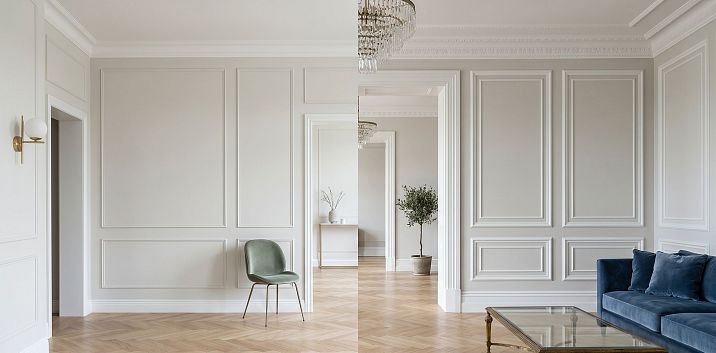
Two people look at the same wall. The first says: "We need wide decor to make it beautiful." The second objects: "The wall is narrow, wide won't fit." And both are right — each in their own way. Becausenarrow stucco decor for the wallandWide set of stucco decor— this is not about "better" or "worse". These are different tools for different tasks.
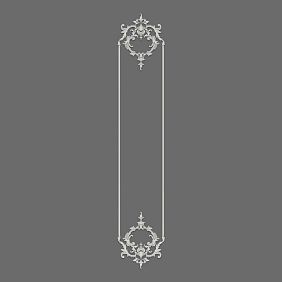
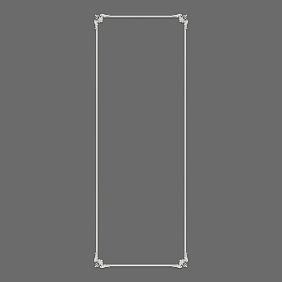
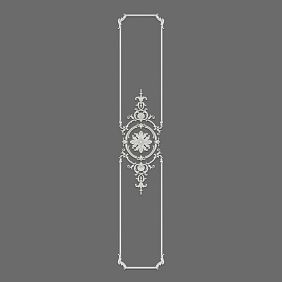
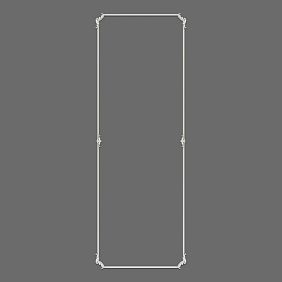
A narrow set in the 338–610 mm format is a vertical accent that works where width is limited. A wide format of 900–1000 mm is a wall composition that takes on the role of the main decorative statement in the room. Confusing them means either getting decor that gets lost on an empty wall, or cluttering a narrow space with a too-heavy scheme.
In this article, we will honestly and specifically analyze both formats: where each works, where it loses, how to choose between them, and how to competently combine them in one interior.

What is a narrow and wide set: a clear boundary
Before moving on to application scenarios, it is worth providing a clear classification. In the wall decor market, there is a conventional division based on the width of the finished set:
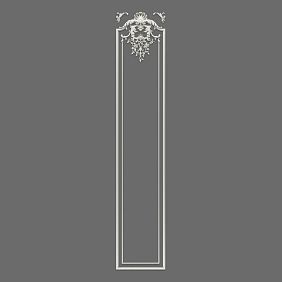
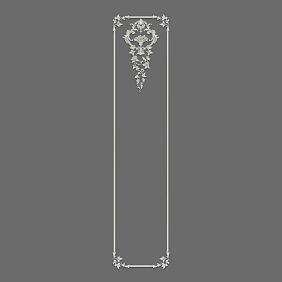
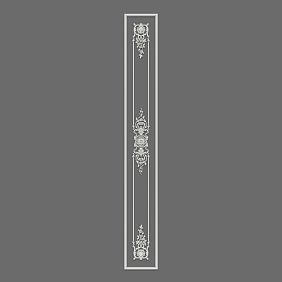
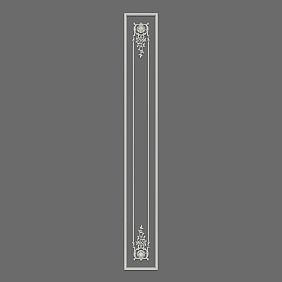
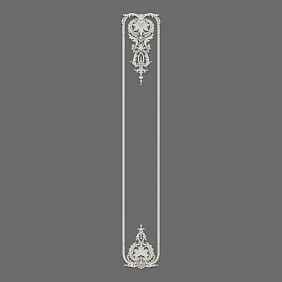
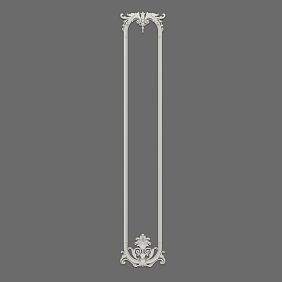
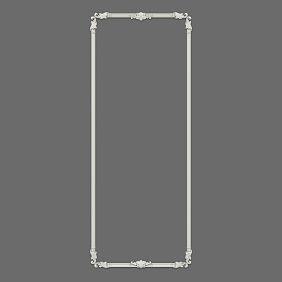
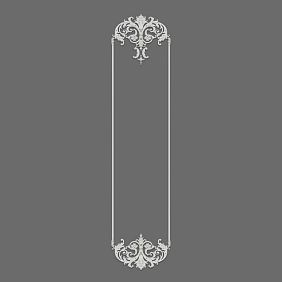
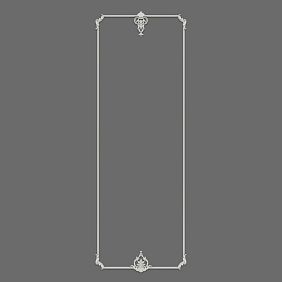
Narrow sets — 338–610 mm. These are compact solutions focused on vertical presentation. The main purpose is to decorate narrow walls, hallways, corridors, and areas with limited width. They do not claim to be the main wall decor — they create a neat vertical accent.Vertical stucco set in this format works as an architectural detail, not as a painting or panel.
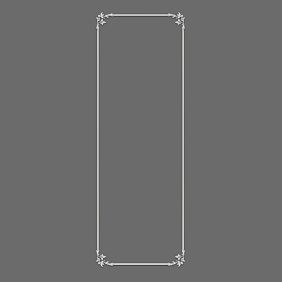
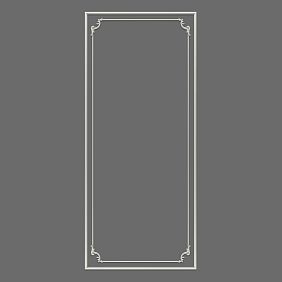
Wide sets — 900–1000 mm. These are already full-fledged decorative compositions designed for accent walls with sufficient free space. They are well readable from a distance, set symmetry, and become the visual center of the interior.Wide stucco setcreates exactly that "finished" look of the wall that buyers often seek.
This boundary is not rigid — it is conditional. But it helps you quickly orient yourself when you are standing in front of a catalog and thinking about where to start.




Narrow stucco decor for the wall: task and scenario
A narrow set is not a compromise. It is the right answer to a specific question: how to decorate a wall that lacks width. And there are many more such walls in real apartments than is commonly thought.
Go into any hallway. Count: the front door, closet, mirror, switches, door to the room — and somewhere between them remains a narrow wall section 60–80 cm wide. It is for this thatnarrow sets of stucco decor.
Our factory also produces:
Where the narrow format is used
The wall section between doors. Two doors next to each other — and between them a wall section 50–80 cm wide. That is exactly wheredecor for the wall sectionof a compact vertical format. It fills the area, does not weigh down the space, and creates architectural completeness.
The area between the window and the corner. One of the most overlooked zones in an interior. Yet it's an excellent spot fornarrow stucco decor — especially if the windowsill is low and the wall section reads as an independent vertical plane.
The wall by the mirror. A mirror in the hallway or bedroom is already decor in itself. But two symmetrical narrow sets on either side turn an ordinary mirror panel into a complete interior composition. This is a technique long used in classic interiors and still works flawlessly.
The wall behind a console or small chest. A console is usually narrow — 30–40 cm deep and 80–100 cm wide. Wide decor above it would look disproportionate. A narrow set is a perfect fit in scale.
A small wall in the bedroom. Between the wardrobe and the door, next to the desk, at the headboard in a non-standard small bedroom — anywhere there's no space for a wide layout.
Corridor. Corridors in Russian apartments often resemble tunnels: long and narrow. HereVertical stucco set — it's not just decor, but a way to visually expand and refine the space.
A repeating motif along a long wall. Several identical narrow sets placed at equal intervals along a long corridor or hall — this is no longer just decor, it's rhythm. An architectural rhythm that transforms a utilitarian space into something more.
More details on how to work with narrow and non-standard zones — in the articlestucco decor for niches, ledges, and piers.
Get Consultation
Key rules for a narrow format
-
Vertical orientation is the main principle. A horizontal wide scheme on a narrow wall grounds the space. Verticality stretches it.
-
Indents from edges — at least 5–8 cm from the nearest openings, corner, door frame or window frame. Decor without breathing room looks cramped.
-
Proportionate overlays — do not choose massive, heavy overlays with large relief for a narrow wall. Elegant, detailed elements work better here.
-
Symmetry — if you place two narrow sets symmetrically (on either side of a mirror, door or fireplace), the distance between them and from each to the edge must be equal.
Wide set of stucco decor: task and scenario
Wide set of stucco decor — this is a different story. Here it is no longer a "neat accent", but a full-fledged decorative statement. This is the center of the wall. What people look at when they enter the room. What sets the tone for the entire interior.
Where a wide format is needed
Wall behind the sofa. The most classic area of application. The sofa is typically 180 to 240 cm wide. The decor above it should be proportionate: no narrower than 70% of the sofa width. With a standard 200 cm sofa, that is at least 140 cm. One set of 900–1000 mm here is a good starting point, which can be expanded if necessarypolyurethane moldings on the sides. A detailed breakdown of this scenario is in the articlepolyurethane wall decor behind the sofa.
The wall at the head of the bed. The bed is centered on the wall — and it is on this vertical axis that the decor should be placed. A wide set with a central accent element is one of the best options here. This creates a sense of completeness in the bedroom that is so difficult to achieve with other means. More about bedroom decor in the article.Stucco molding set for the bedroom.
TV zone. Provided the wall is sufficiently free and the TV does not overwhelm the area with its diagonal size. A wide set of 900–1000 mm creates a framing context for the screen. All about the nuances of this zone in the article.Polyurethane TV zone decor.
Living room with high ceilings. This is where a wideStucco decor for an accent wallunfolds to its full potential. The higher the ceiling, the more large-scale the decor should be. A small set on a wall with three-meter ceilings is a visual failure.
Hall and large entryway. If the entryway is spacious, with high ceilings and long walls, a wide set is appropriate. It creates a representative entrance area — what is called a "first impression."
Study. The wall behind the work chair or bookshelf. A wide decorative composition here gives the space solidity and character.
Commercial interior. Offices, meeting rooms, reception areas, restaurant halls — everywhere you need to make an impression.
Comparison of formats: narrow vs. wide
| Criterion | Narrow set 338–610 mm | Wide set 900–1000 mm |
|---|---|---|
| Main task | Vertical accent, pier | Accent wall, central area |
| Where it is used | Hallway, corridor, between doors | Living room, bedroom, TV area, hall |
| Visual effect | Stretches the wall, adds detail | Makes the wall the main element of the interior |
| Risk if chosen incorrectly | Will get lost on a wide wall | Will overload a narrow pier |
| Combines with | Mirror, console, doorways | Sofa, bed, TV, large furniture |
| For small spaces | Yes | Depends on layout |
| For spacious rooms | As an additional rhythm | Yes, as the main decor |
| Check before purchase | Indents left and right | Width of the working area, ratio with furniture |
| Ceiling height | Any, especially good at low | Better at medium and high |
How to choose a format based on the width of the working area
The decor format is determined not by the total width of the wall, but by the working width of the area — the space that is actually available for decor. This is a fundamental distinction.
Working area up to 700 mm
Here, practically no options:narrow set of stucco decor. It does not overwhelm, leaves air at the edges, and visually works exactly as needed. A wide set in such an area will not fit without violating the indents — or will look cramped and heavy.
For such areas, the following are well suited:stucco decor sets 338 mmandstucco decor sets 610 mm— they are created specifically for such spatial conditions.
Working area 800–1200 mm
Transition zone where the solution is not obvious. Here it is important to consider the furniture: if there is a chest of drawers, armchair or console under the decor, the width of the decor should correspond to their width.Ready-made stucco frame on the wallin the 900 mm format often turns out to be the optimal solution for such zones — it already creates a noticeable decorative effect but does not overload the moderate space.
Guideline for this zone:stucco decor set 900 mm— one of the most sought-after sizes in standard apartments precisely because it falls into this "sweet spot".
Working area larger than 1200 mm
A narrow set can get lost here. You needWide set of stucco decor — or several elements forming a system. For very wide walls (from 200 cm), consider this option: a wide set as a central accent pluspolyurethane wall moldings on the sides. How to calculate such solutions — in the articlehow to calculate moldings and stucco decor for a wall.
Choosing a format by room: specific scenarios
Hallway and corridor
Hallway — the territory of a narrow format. There are almost always many doors, cabinets, mirrors, switches, and limited wall sections. A widestucco wall decor in this area is most often excessive — it doesn't fit between obstacles or disrupts the balance of the space.
Narrow vertical set in the hallway is a precise tool. A pair of symmetrical narrow sets on either side of a mirror works especially well: they create a "frame" for the mirror panel and turn a functional area into a well-thought-out interior. Details about decor in this area — in the articleWall decor in the entryway and hallway made of polyurethane.
Living room: area behind the sofa
Wide sets work here. But with an important caveat. If the living room is large and the sofa is against a wall longer than 3 meters, one set of 900–1000 mm may not be enough. In this case, either a wide central set plus side ones are usedMoldings made of polyurethane, or several symmetrical elements in a unified style.
On the side walls of the living room, next to doorways — a narrow format is again appropriate. Thus, in one living room, both narrow and wide sets can be present: one as the main accent, others as a supporting rhythm.
Bedroom
The wall at the headboard is a place for a wide solution. But the side walls — near the mirror, dressing table, passage — can be decorated with narrow vertical sets. This creates a unified decorative language for the bedroom without overloading.
If the bedroom is small (12–14 sq. m), a wide set at the headboard is a good accent, but it's better not to add anything to the side walls or limit yourself to very light narrow elements.
TV area
The TV is already an active element of the wall. The task of decor next to it is not to compete, but to frame.Wide set of stucco decor works here if the wall is sufficiently free. On the sides of the TV, on adjacent piers —decor for the wall section of a narrow format creates a repeating motif and unifies the area.
Office
In a study, both formats are appropriate — depending on the area and style. A small study with narrow walls between shelves is a place for vertical decor. A spacious study with a wide wall behind the workspace is for a wide accent composition that gives the space solidity.
Narrow set as a vertical accent: key features
This is a separate topic worth exploring in more detail.Vertical stucco set— is not just 'small'. It is a tool with a specific visual function.
A vertical accent does several things at once:
Stretches the wall. With low or medium ceilings, a vertical scheme creates the illusion of greater height. The eye follows the vertical axis and perceives the space as taller.
Structures the pier. A bare pier between doors seems like a random void.Narrow stucco decorturns it into an architectural element, giving the space meaning.
Creates rhythm. Several identical narrow sets placed at equal intervals along the wall establish a rhythm that works in both classic and modern interiors.
Frames an object. Two narrow sets on either side of a mirror, door, fireplace, or painting turn these objects into part of a decorative system. This is one of the most effective wall decoration techniques.
Details about vertical solutions — in the articleVertical wall decor made of polyurethane.
A wide set as the center of an interior composition
WhenWide set of stucco decorinstalled correctly — at the right scale, on the right wall, with proper indents — it works like a real wall panel. Not a picture that can be removed, but part of the architecture.
It is wide sets that create symmetry in the living room. They become the answer to the question 'what is missing in this interior?'. A wall with a proper wide set does not need any additional decor — it is already complete.
For interiors with a classic, historical, or formal aesthetic, the choice of collection is especially important — because the pattern of overlays, the profile of the molding, and the overall composition must match the spirit of the space.
STAVROS collections: narrow, wide, and everything in between
The STAVROS assortment includes several thematic collections that cover the entire range — from compact vertical accents to wide formal compositions.
Ekateringof collection
Ekateringof collection — for those seeking a St. Petersburg character in the walls. Expressive classic wall decorwith historical motifs. It works well both on accent walls and in symmetrical paired solutions — two narrow elements on either side of an opening or mirror. The collection combines the scale and detail characteristic of classical St. Petersburg architecture.
Pavlovsk Collection
Pavlovsk Collectionis a calmer and more restrained version of the classics.Pavlovsk wall decoris appropriate in interiors where aristocratic restraint is needed without overloading with details. This is a collection for those who appreciate moderation. It works in both formats: as a narrow vertical accent and as a wide accent scheme.
Tsarskoye Selo Collection
Tsarskoye Selo Collectionis for grand, ceremonial interiors.Decorative accent wall Tsarskoye Selocreates the right impression where representativeness is important: in halls, living rooms with high ceilings, and studies. This is a wide-format choice — it fully unfolds on a large free wall.
Peterhof Collection
Peterhof Collection— a ceremonial palace aesthetic in polyurethane.Wide set of Peterhof stucco decor— this is a solution for those who want a truly rich interior. Suitable for high ceilings, spacious living rooms, and formal areas. When used in small apartments, it is important to maintain scale.
Petersburg Collection
Petersburg Collection— universal, architecturally clean.Petersburg-style wall decor— it's geometry without excess, urban classics with character. Works in both formats: narrow sets from this collection are for piers and hallways, wide ones for accent walls in living rooms and studies.
In addition to Petersburg collections, the assortment. Clear lines, created using modern technologies, emphasize the strict aesthetics of the room. Each decorative element harmoniously fits into the overall concept, creating a sense of order and thoughtfulness.also includes more modern solutions — for those seeking not palace aesthetics but a contemporary interior language.
How to avoid mistakes with proportions: typical miscalculations
Errors in format selection repeat from project to project. Knowing them is the best prevention.
Choosing by photo. A beautiful photo in a studio interior gives no idea of real sizes. The buyer sees "wide" — but in reality it's 600 mm. Always look at the numbers, not just the picture.
Not measuring the work area. They take "for a 4-meter wall" but place it on a 90 cm pier between a door and a wardrobe. Result — decor without margins, squeezed on both sides.
Not accounting for furniture.stucco decor set 900 mmover a 180 cm wide chest of drawers — that's half the furniture. Looks like a lost element.
They take a wide one for a narrow wall section. A set of 900–1000 mm on an 80 cm wall section is decor that literally has nowhere to be placed with normal indents.
They take a narrow one for a wide wall. A set of 338 mm on a 4-meter living room wall is a decorative point that gets lost in the space.
They ignore the ceiling height. A vertical scheme that is too tall with low ceilings hits the cornice. Decor that is too compact with high ceilings looks toy-like.
They don't mark with painter's tape. The simplest way to check the scale is to outline the decor's contours with tape on the wall. This takes 10 minutes but saves disappointment from a wrong choice.
They mix incompatible styles. A narrow set from the St. Petersburg collection next to a wide one in Japandi style is a visual conflict that no paint can save.
They don't consider the style of adjacent elements. Baseboard, cornice, doors, furniture facades — all of this creates a stylistic foundation. The decor should fit into it, not conflict.
It's useful to study the article in advance Ready-made molding frames for the wall— it explains how the frame scheme works and how to avoid mistakes when arranging it yourself.
When it's better to combine narrow and wide formats
This is perhaps the most interesting scenario — and one of the most professional. Combining formats allows you to create a decorative system that covers several zones and works as a single whole.
A living room with several walls. A wide set — on the main accent wall behind the sofa. Narrow vertical ones — on the side walls, next to doorways, on both sides of the window. Everything from the same collection — and the space reads as a cohesive, well-thought-out interior.
The transition zone from the hallway to the living room. Narrow sets in the hallway create a rhythm that "leads" to the wide accent wall of the living room. This is a through decorative motif that unites two different spaces.
A long wall with a central window. On both sides of the window — two symmetrical narrow sets. Between the window and the opposite wall — a wide accent decor. The result is a balanced system with clear horizontal and vertical axes.
A hall or large entryway. On both sides of the front door — two narrow vertical sets. On the far wall — a wide accent. Visually greets the guest, sets the tone for the entire space.
For such combined solutions, it is important that all elements are from the same collection or have a compatible style.Polyurethane decorative appliquesandMolding corner piecesin such systems ensure visual unity.
The question of when it is better to choose a set, and when to assemble decor from individual elements, is discussed in detail in the articlea ready-made set of stucco decor or individual moldings.
Brief recommendation: narrow or wide
For those who want a quick answer without long discussions — here it is:
-
Pier, hallway, corridor, area between openings — narrowset of stucco decor 338–610 mm.
-
Wall behind sofa, bed, TV, dresser — wideset of stucco decor 900–1000 mm.
-
Wide wall with large free area — wide set plusmoldings to expand the composition.
-
Non-standard wall — first measure the work area, then choose the format.
-
Multiple zones in one interior — view the entire collection and combine both formats in a unified style.
Choose a narrow or wide set of stucco decor for your wall
In the STAVROS catalog you can selectReady-made molded decor kits for piers, hallways, bedrooms, living rooms, and wide accent walls. For a complex wall, the set can be supplemented withpolyurethane moldings, PU decorative overlaysanddecor for moldings.
Collections for different styles and formats:
-
Ekateringof collection — St. Petersburg classic character for piers and accent walls
-
Pavlovsk Collection — aristocratic restraint in any format
-
Tsarskoye Selo Collection — ceremonial composition for accent zones
-
Peterhof Collection — palace aesthetics for wide decorative solutions
-
Petersburg Collection — architectural urban classic for any space
-
All products made of polyurethane — full range for comprehensive solutions
Useful articles on the topic:
About the Company
STAVROS is a manufacturerpolyurethane wall moldingsandpolyurethane interior decorfor residential and commercial interiors. The range includes narrow and wide ready-made sets, moldings, overlays, decorative elements for frames, and corner inserts. STAVROS works with private customers, designers, builders, and suppliers of finishing materials throughout Russia.
FAQ: Frequently Asked Questions
Which set of decorative moldings should you choose for a narrow wall?
For a narrow wall, choose a compact or vertical set in the 338–610 mm format. It does not overwhelm the limited space and visually elongates the area vertically.
Where to use narrow decorative moldings of 338–610 mm?
In the hallway, corridor, wall space between doors, area between a window and a corner, near a mirror, above a console or small chest of drawers — anywhere the working area width does not exceed 60–70 cm.
When is a wide set of decorative moldings needed?
For an accent wall, area behind a sofa, headboard of a bed, TV zone, spacious living room, hall, or study — where the working area is wide and the decor should become the main visual accent.
Will a wide set of 900–1000 mm fit a small room?
It may work if there is a free wall without obstacles and normal indents are maintained. But on a narrow wall or in a tight space, it looks heavy and disproportionate.
What is better for a hallway: a narrow or wide set?
For a hallway, a narrow vertical set is often better. Hallways have many doors, mirrors, cabinets, and switches — there is simply no room for a wide set with normal indents.
Can narrow and wide sets be combined in one interior?
Yes, and this is one of the best professional techniques. A wide set serves as a central accent, while narrow ones create a supporting rhythm on side walls and partitions. The main thing is to choose from the same collection or stylistically compatible series.
How to tell if a set is too narrow for the wall?
After marking with painter's tape, the decor looks like a small random fragment on a large empty wall. There is too much unfilled space around it. The solution is a wide set or adding moldings.
How to properly combine decor from the Petersburg and Ekateringof collections?
Both collections have a classic Petersburg foundation, so they can be combined — for example, a wide element from one collection as a central accent and narrow ones from another as side verticals. The main thing is that the molding profiles and overlay style are comparable in scale and character.