































































Set Composition


Description
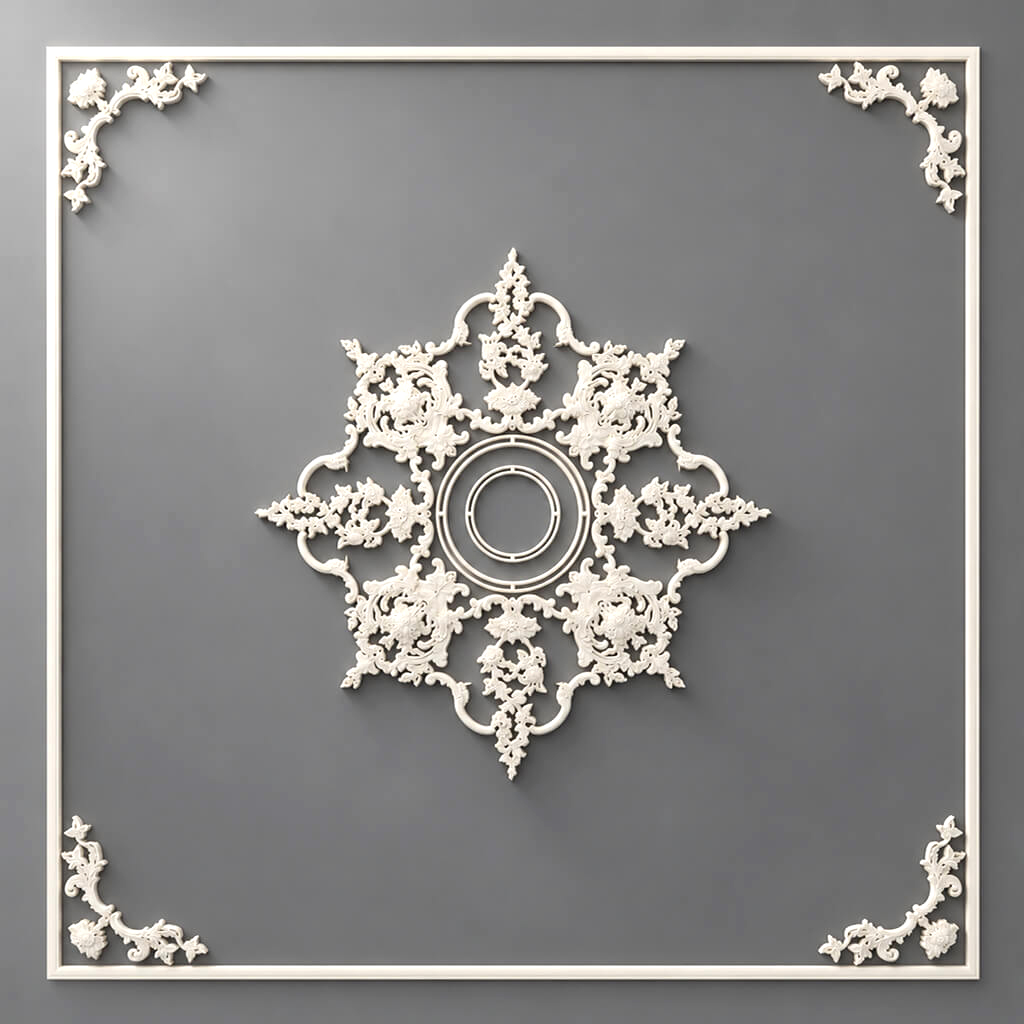
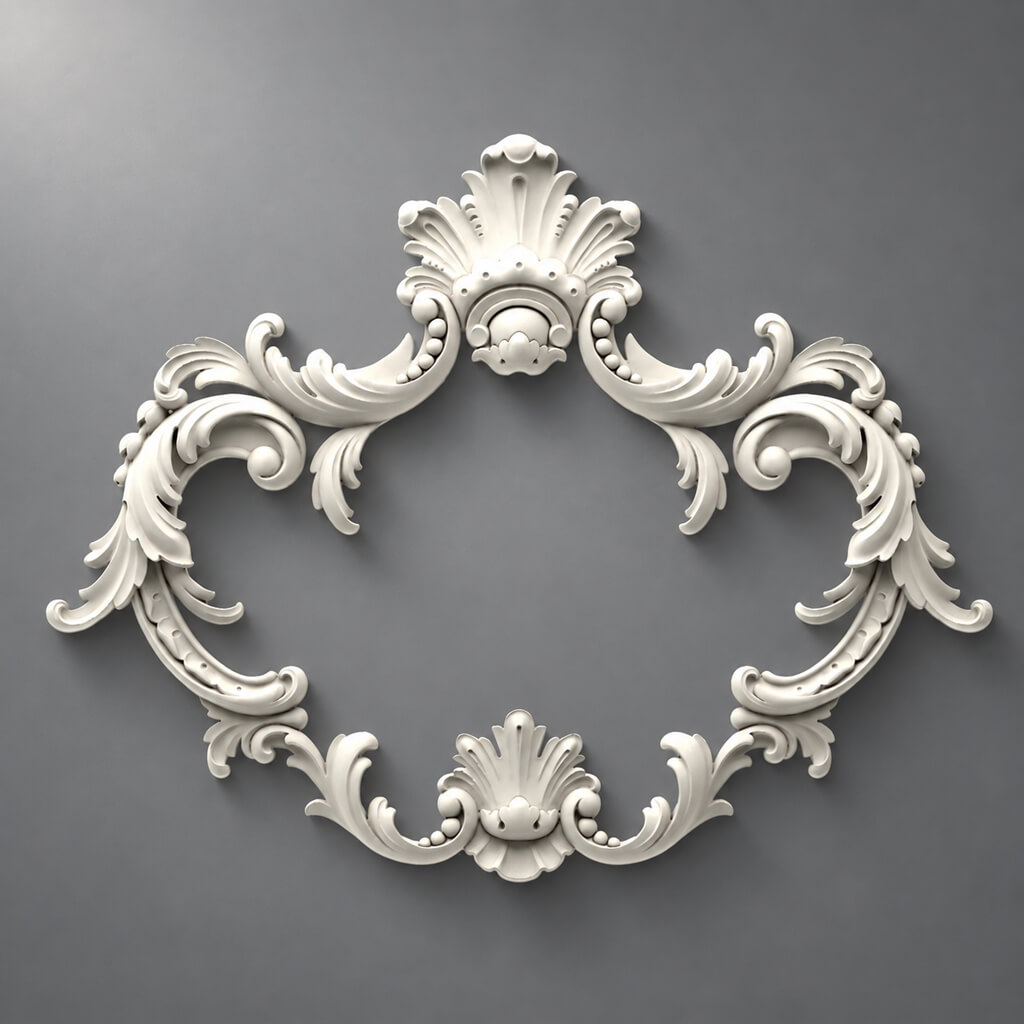
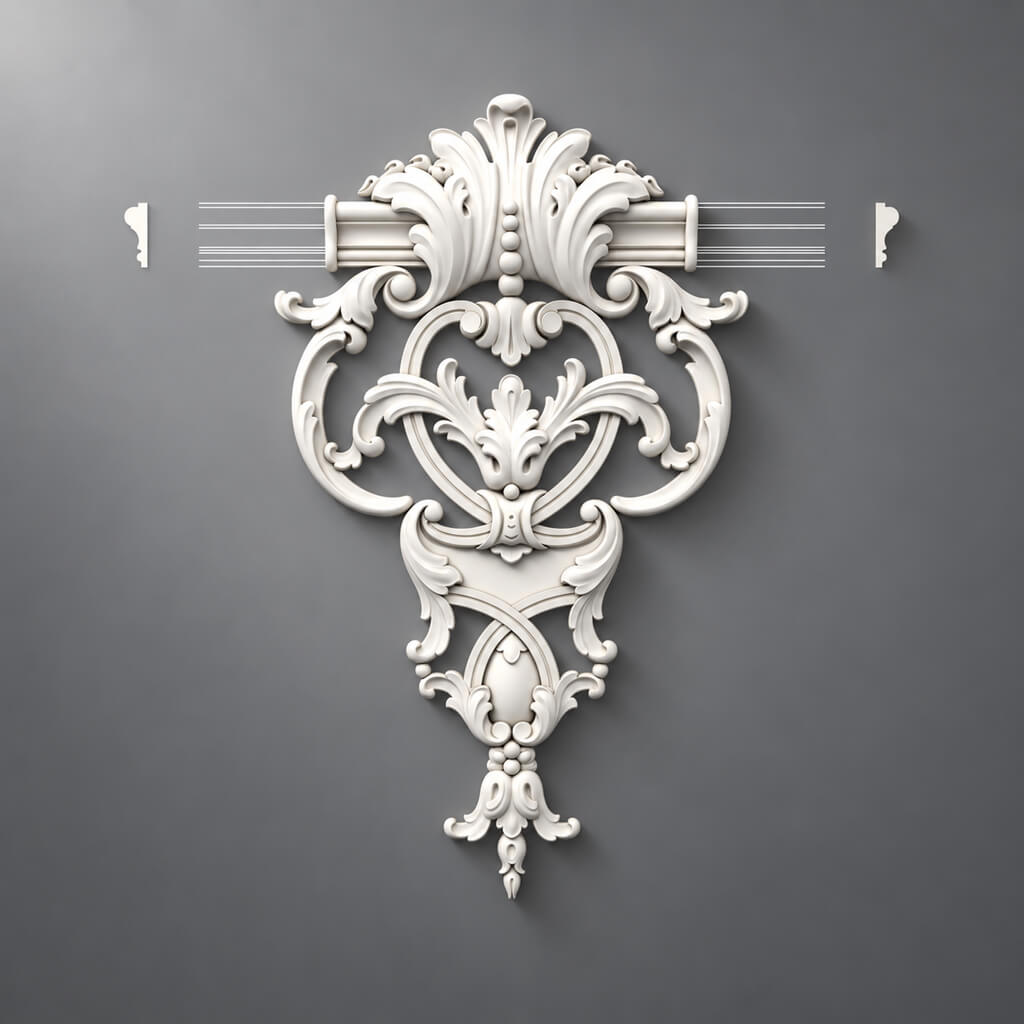
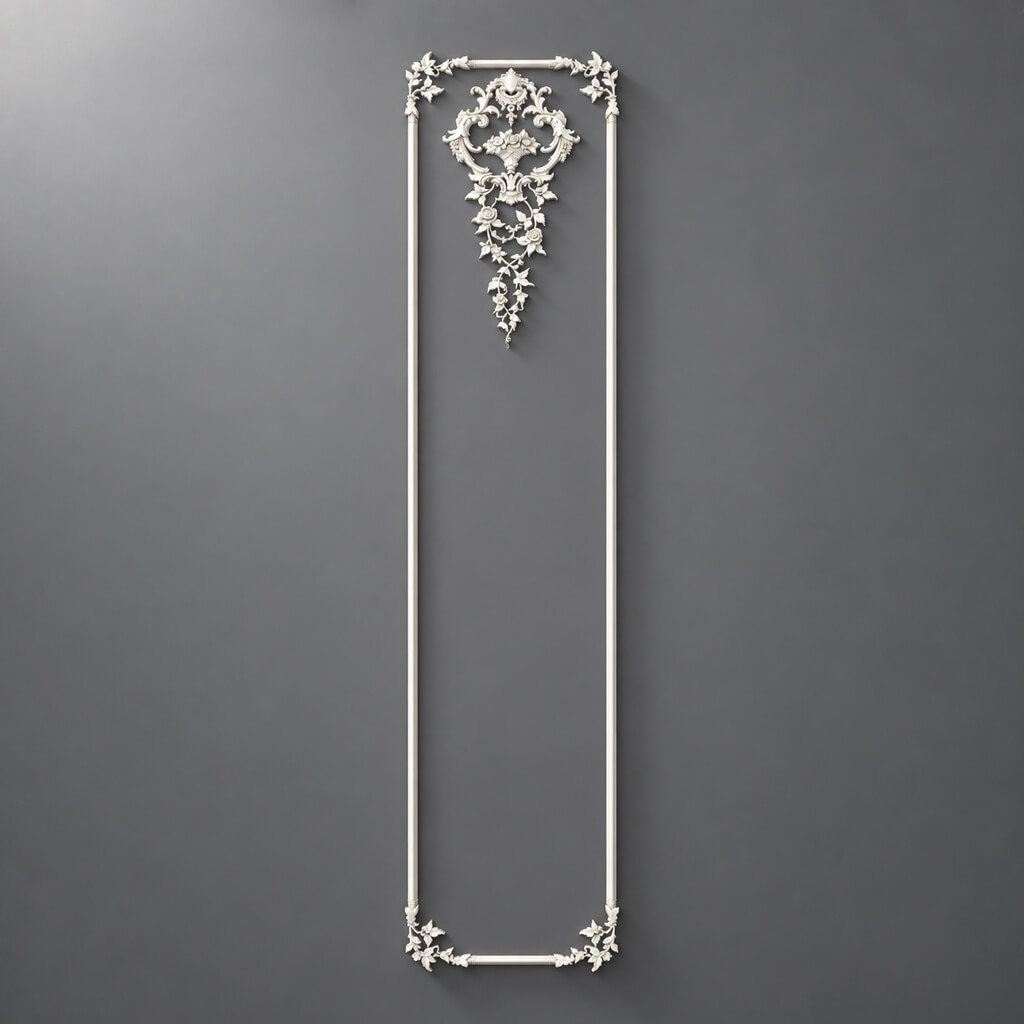
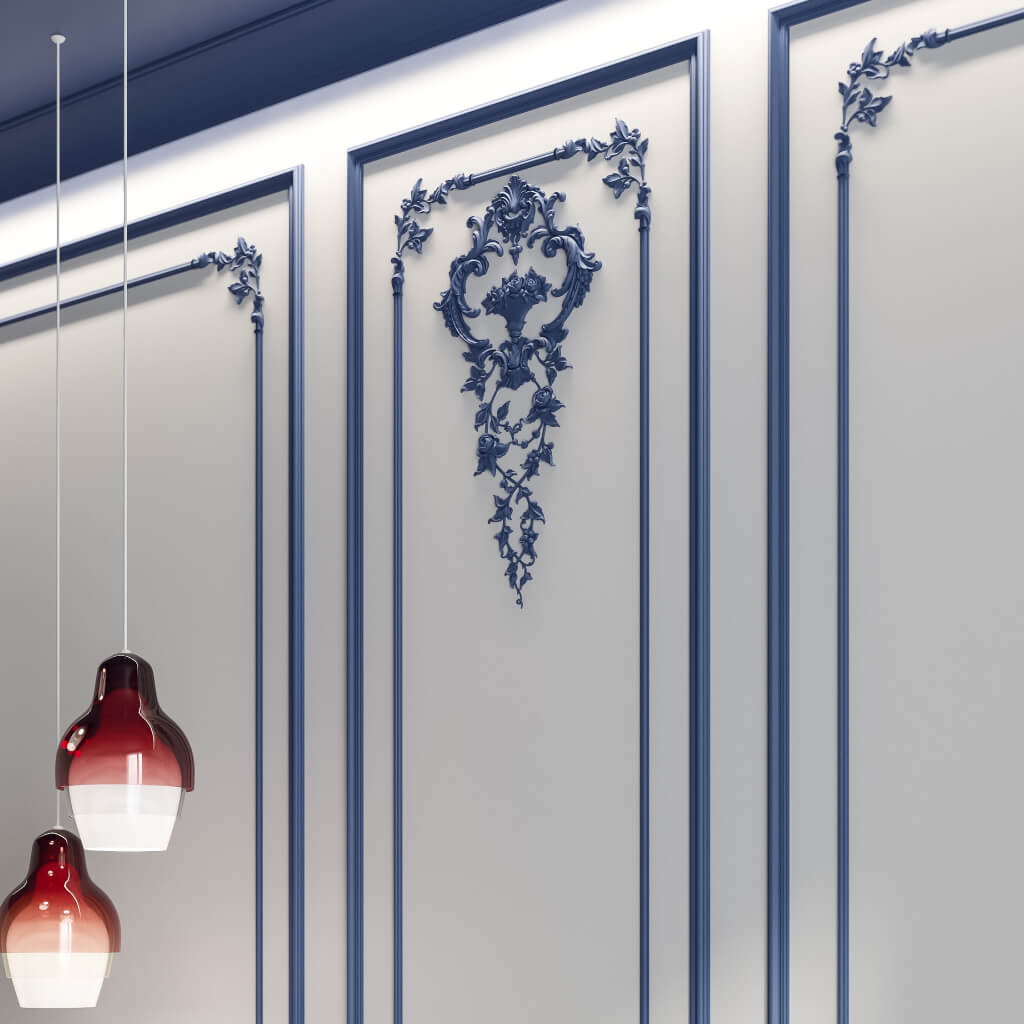
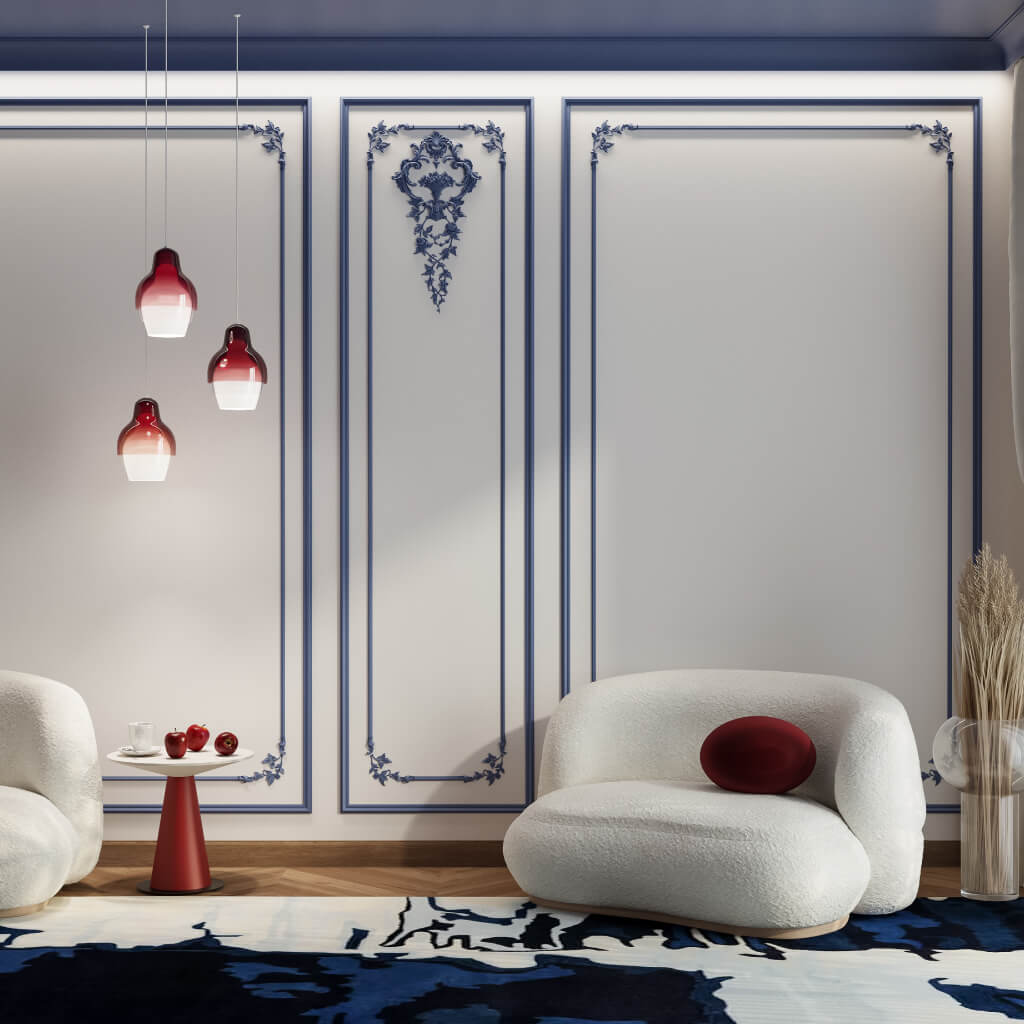
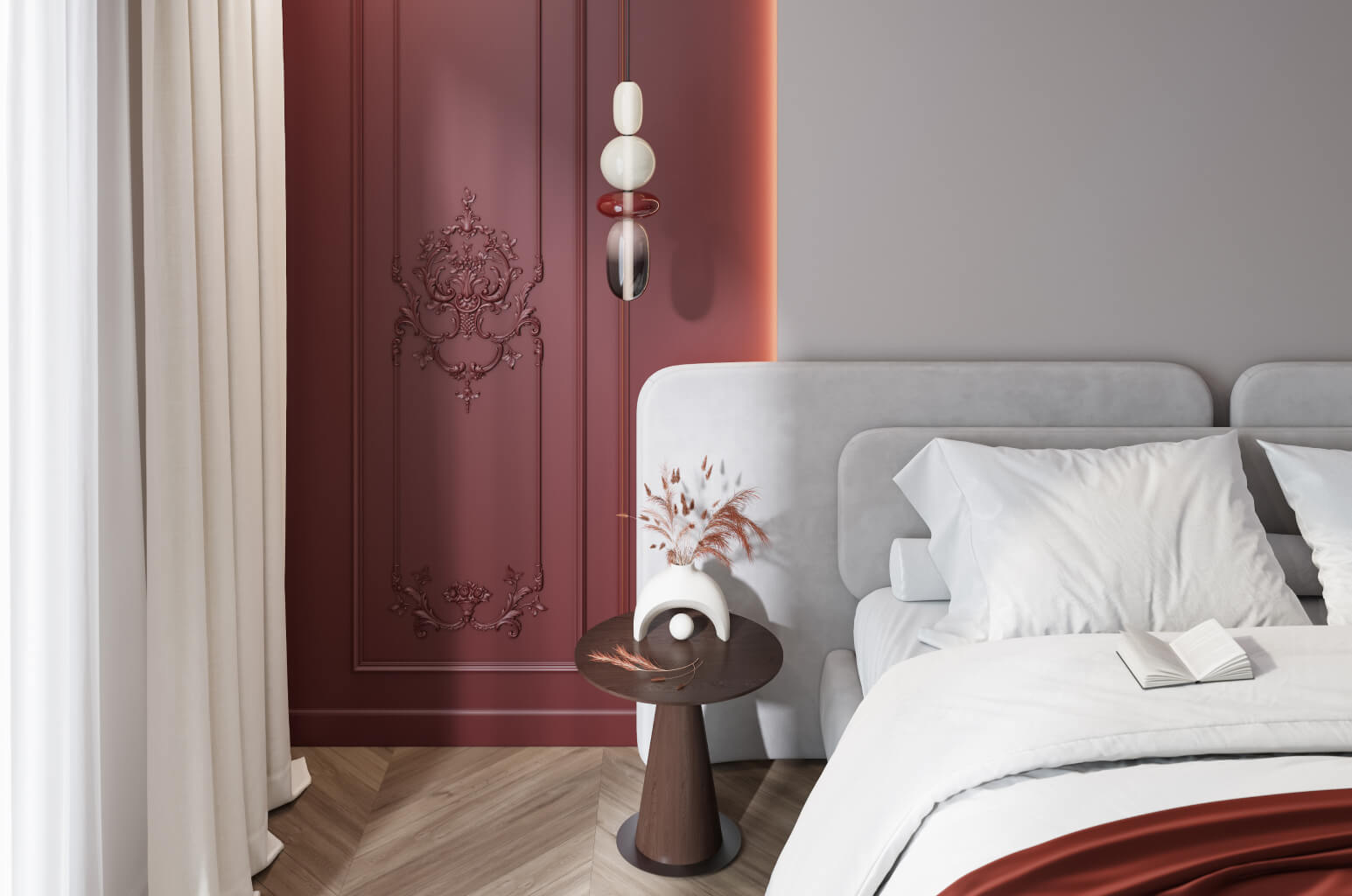
A large botanical accent in the center of a narrow vertical frame immediately draws attention and makes the wall more expressive. The strict contour of the molding emphasizes the shape, while the leaves, stems, and smooth lines of the ornament convey the natural character of the "Botanical Garden" collection.
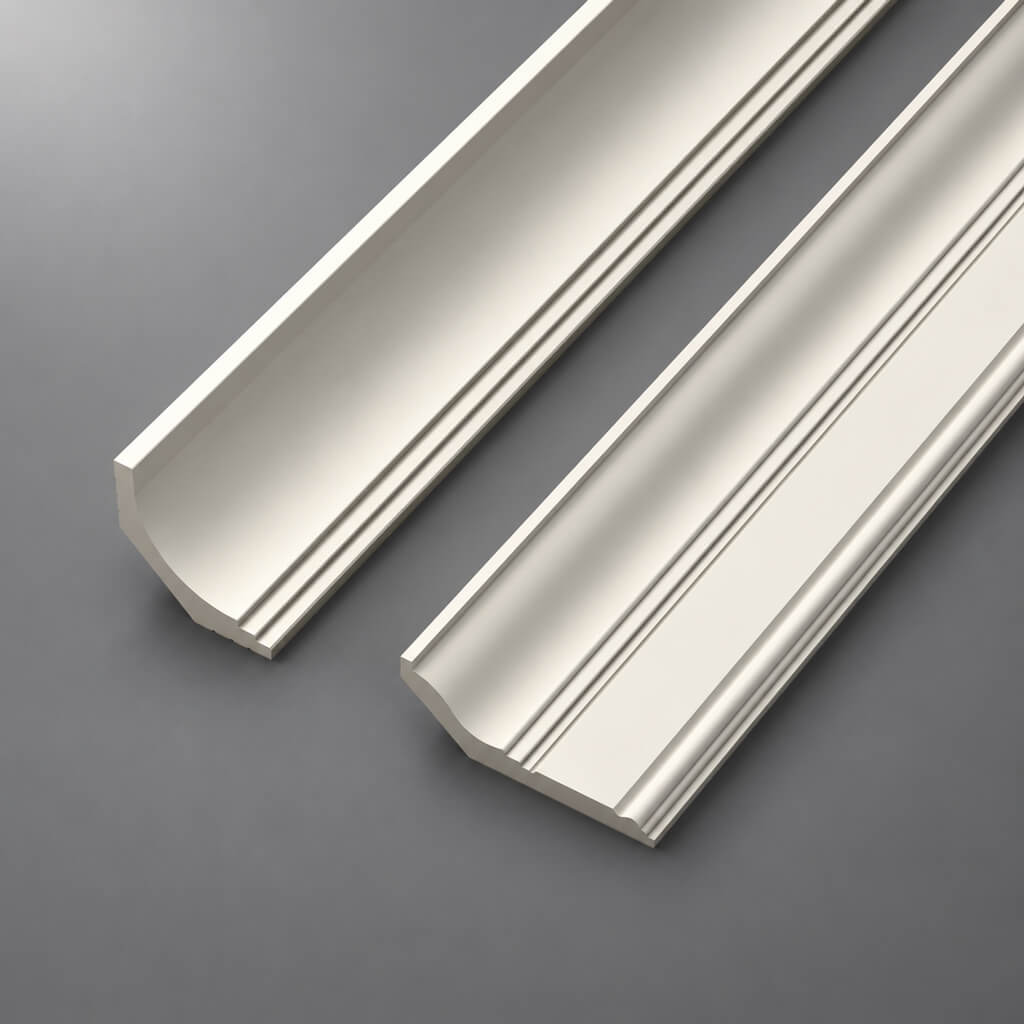
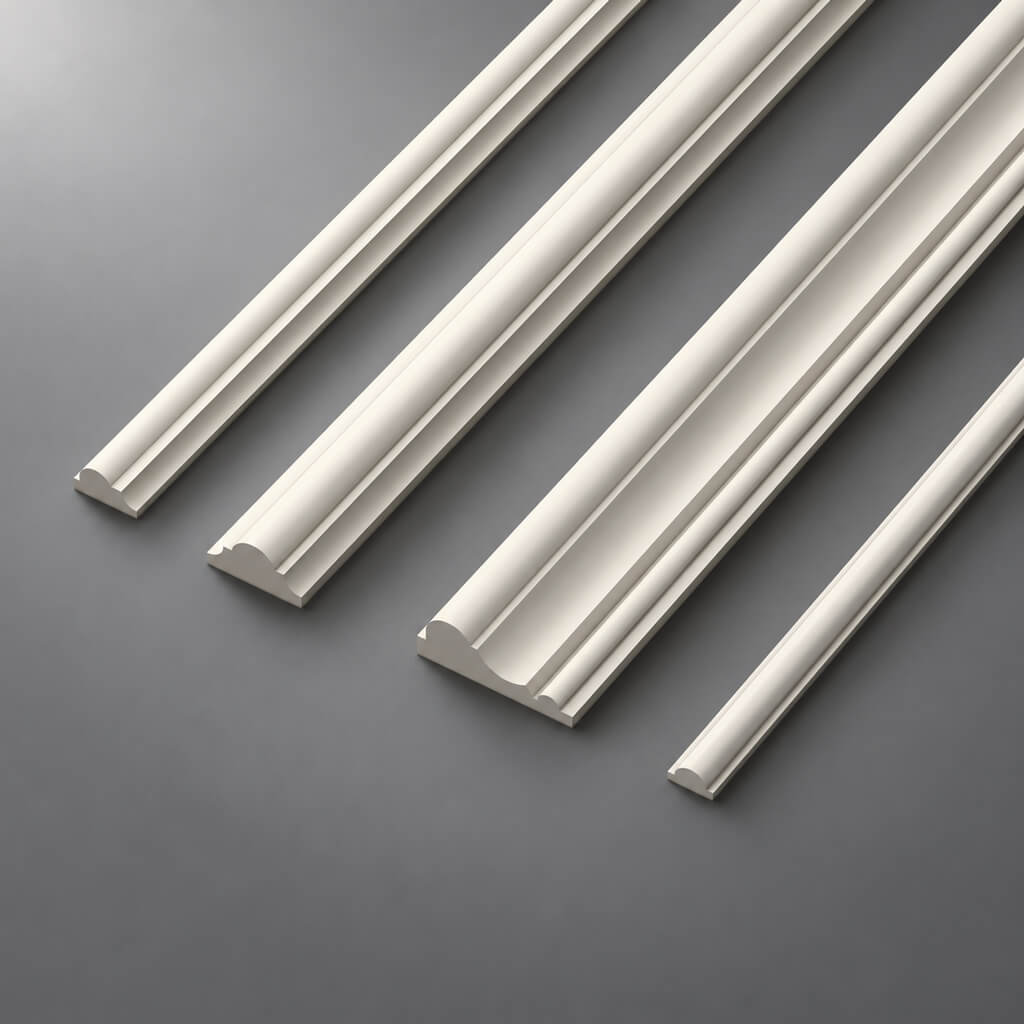
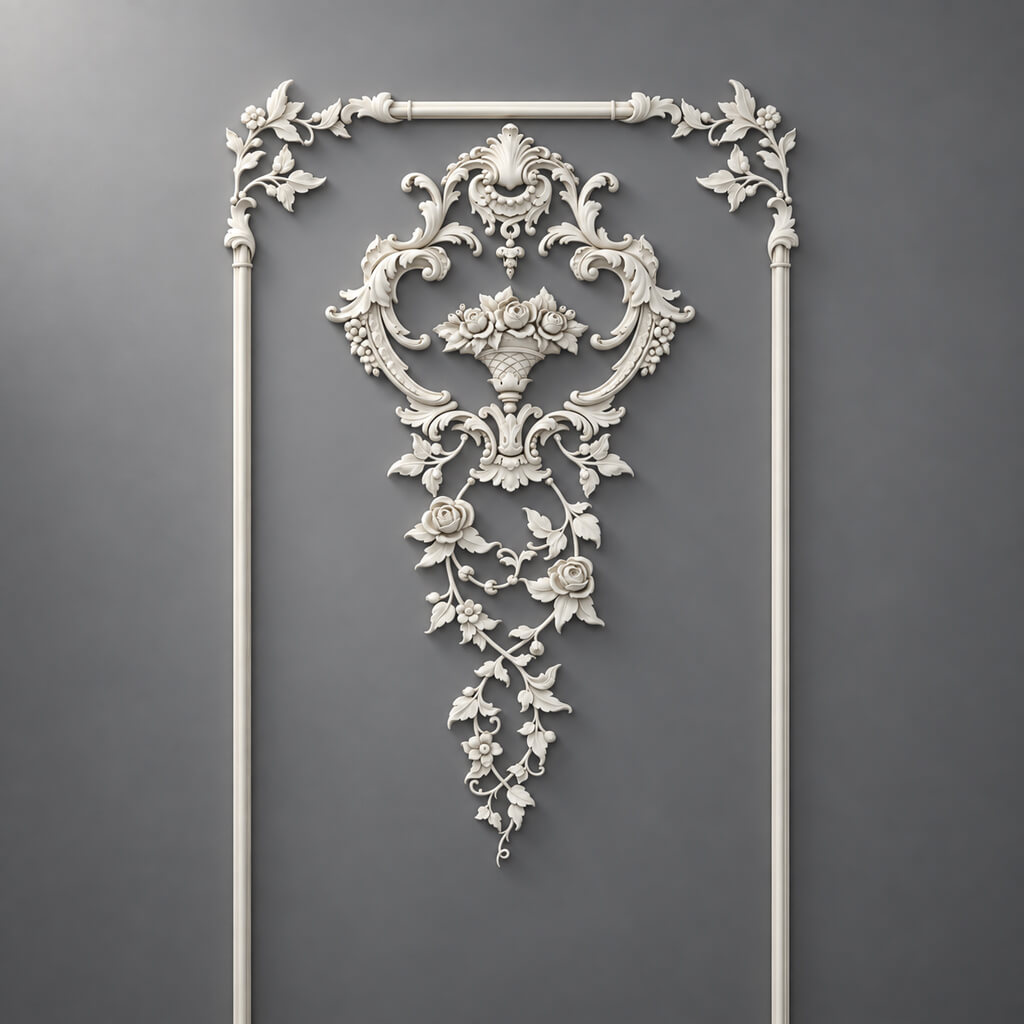
The ready-made wall decor set already combines MDF molding and polyurethane elements into a cohesive composition. It can be used on its own or complemented with other elements from the collection. For your own layout, the "Botanical Garden" decor can be selected separately and used to create your own wall design.
Have questions?
Customers also buy
 In stock
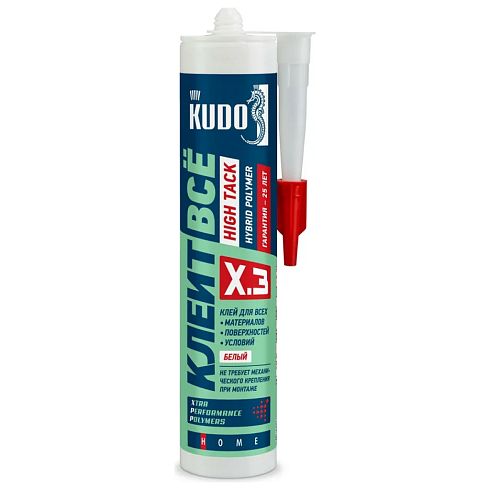
KUDO Adhesive, All-Purpose HIGH TACK, Hybrid Polymer Based, White, 280 ml
11.84 $


 New
5-10 days
New
5-10 days
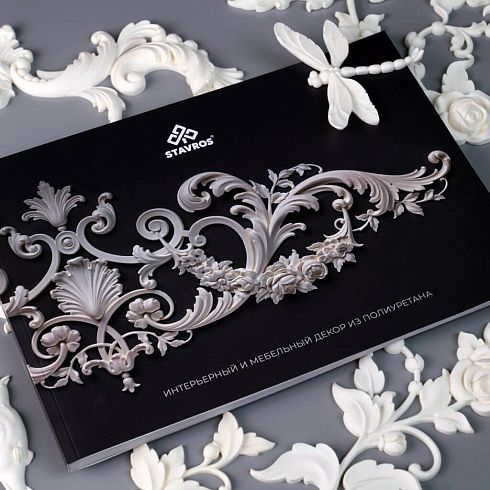
Printed catalog of polyurethane decor KATALOG-PU
6.70 $


 5-10 days
Exhibition stand SVPU-003
357.46 $


 5-10 days
CPU-P1 molding decor set
1,608.39 $


 5-10 days
Polyurethane molding NPU-408
from 29.66 $

Ekaterina Y.
October 5, 2026
An excellent team! A huge selection of products! I recommend that craftsmen, designers, decorators, and home stagers take a tour of the production facility to immerse themselves and be inspired.
Alexander U.
October 2, 2026
I have been working with Stavros since 2024, and the quality of the products is top-notch. Customers are happy!!!
Elena G.
September 29, 2026
Daria is a very competent specialist; she provided consultation and helped us select items. They were sent promptly.
Polyurethane stucco decor
We have been on the market for over 20 years and are ready to offer you the best combination of aesthetics, quality, and practicality. Our polyurethane is not just a material, but a reliable foundation for flawless details, resistance to moisture and cracks, as well as convenient and quick installation. The company's success began in 2002, when two artists – Andrey Ragozin and Evgeny Tsapko – created a small creative workshop for making carved wooden products. The work of the craftsmen was quickly noticed, and within a year they were invited to participate in the reconstruction of the Konstantinovsky Palace in Strelna.
Every product in our range is the result of years of experience, thoughtful technology, and attention to detail. We constantly update our collections, follow and shape trends in interior design ourselves. From elegant neoclassicism to bold Art Deco, you will find the perfect accent for the interior of your dreams.
Choose durable polyurethane decor STAVROS — beauty proven by time and real projects, not just words.
STAVROS Guarantees
Quality of products without complaints
We save your time, peace of mind, and budget
Large warehouse program
We solve your tasks with maximum speed
Adherence to production deadlines
Streamlined process reduces all risks
Contact us for shipping options
Quality service regardless of order volume
Your positive business reputation
Reliable partner — the foundation of your business
More products in the "Botanical Garden" collection


Frequently asked questions
Our showrooms are located in Saint Petersburg and Moscow. Production is located in Saint Petersburg.
Moscow contacts: https://www.stavros.ru/contacts_all/?tab=msk
Contacts of Saint Petersburg: https://www.stavros.ru/contacts_all/?tab=spb
- Send request by email [email protected]
- Write to us at Telegram
- Write to us at WhatsApp
- Order by phone +7 (800) 555-46-75
- Visit our showroom in Saint Petersburg and Moscow
Please contact us to confirm shipping availability, costs and delivery times for your destination.
Delivery cost depends on the size, weight of the item, and delivery address.
When placing an order, the delivery cost is calculated automatically and displayed as a separate line on our website.
Prices and availability of items on the website are always current. Data is updated daily.
Note: items in stock are stored on the warehouse in unpolished form and shipped within 3 working days.
If the item is not in stock, average production time: 5–10 working days.
This is the quality of polishing of the items.
Standard — machine polishing, at a more attractive price.
Prestige — detailed hand polishing, items do not require further work.
More details: https://www.stavros.ru/information/kachestvo/
This is the type of veneer of the items.
Under enamel: produced by gluing wooden laminates without color and texture matching. Contrast tonal and textural differences are noticeable. This blank should be chosen if the item is intended for opaque coating.
Under tinting: produced by gluing wooden laminates with color and texture matching. Tonal and textural differences may occur. This blank should be chosen if the item is intended for semi-transparent finish.
More details: https://www.stavros.ru/information/kachestvo/
Beech — dense, non-porous wood, most often used for items covered with enamel.
Oak — dense, porous wood with clearly visible natural grain. Due to its strength and decorative properties, it is often used in items with semi-transparent coating, highlighting the wood pattern.
Custom-made, if non-standard items are required, we can produce products from other types of wood, including blanks provided by the customer, manufactured according to our technical specifications.
All our furniture legs can withstand a vertical load of at least 100 kg.
Average production time for custom-made items: 5–10 working days.
Most items are stored on the warehouse in unpolished form. We need time to polish and pack orders.
Yes, we manufacture non-standard items according to individual projects, but we only accept orders with a minimum quantity.
We can manufacture items of the desired size, but we only work with bulk orders. For details, please consult the sales department manager.
Yes, some of our products can be used outdoors. For example, polyurethane items, as well as carved door casings made of pine.
Other items are produced to order using PUR glue, if minimum quantity is available. No warranty is provided for such products, as outdoor conditions are considered aggressive.
Yes, we paint items when ordering products for a total amount of 150,000 rubles or more.
- Dust removal. After sanding, the surface must be dusted.
- Priming. Apply primer in an even layer.
- Matting. After the primer has fully dried, the surface should be matted (lightly sanded for better adhesion).
- Finish coating. Apply finish coating: lacquer or enamel, in 2 layers, with interlayer drying.
More details: https://www.stavros.ru/information/sovety/
Apply adhesive to the decor. Place it on the surface and press briefly. Then, lift the decor from the surface and leave it open for 3–5 minutes. Press the decor firmly onto the surface and hold for 5–10 seconds.
More details: https://www.stavros.ru/information/sovety/
Ideally, you should prepare a design project before placing an order.
You can do this yourself by downloading drawings of our products from our website, or you can order a project from us.
If the number of decorative elements and fittings is small, our company's manager can assist you with selection.
Unfortunately, this service is not provided.
The packaging method depends on the type of items, but in each case, we ensure sufficient protection for safe transportation.
We most often use corrugated cardboard and stretch film. Fragile items are additionally secured on a rigid base to prevent damage during transport.
We ship all items starting from 1 piece.
Room measurements and item installation can be performed by our partners — carpentry companies represented in most regions of Russia.
Often searched in category Wall Decor
Stucco decor set CPU-6-1 for wall panel design
Interior dominant: why you need the CPU-6-1 set
There are walls that exist — and there are walls that speak. The first simply hold the ceiling and block neighbors. The second shape the atmosphere, set the tone for the entire space, and make a guest pause at first glance. The transition from one state to another is not a matter of expensive renovation. It is a matter of proper decor. And the stucco decor set CPU-6-1 is exactly the tool that makes this transition real.
CPU-6-1 is not a scattering of individual parts that need to be selected, matched by profile, projection, and style, and then hoped to fit together. It is a ready-made vertical interior composition: a complete system of primed MDF moldings and polyurethane decor with an expressive floral ornament, which is installed as a single unit and immediately delivers an architectural result.
Buying a stucco decor set for a wall means buying not parts, but a solution. CPU-6-1 creates a vertical decorative frame 2300 mm high and 500 mm wide with a powerful central stucco accent that visually makes the wall more significant, taller, and richer. Such stucco wall decor is suitable for decorating a living room, bedroom, hallway, study, restaurant, boutique, salon, showroom — any space that needs not just finishing, but character.
All elements from "Botanical Garden" collectionSTAVROS are already selected and matched. All you have to do is mark the wall, apply glue, and paint. No experiments with part compatibility, no reorders due to profile mismatches.
Why CPU-6-1 is a special kit
Among ready-made solutions forwall decor made of polyurethaneCPU-6-1 holds a special place. Its distinctive feature is the expressive central stucco decor, which turns an ordinary frame into a true decorative dominant.
Most molding frames work through repetition: perimeter, corners, a single ornament. CPU-6-1 adds a semantic center to the vertical composition — a large stucco element NPU-462, located along the panel axis. This changes the entire perception of the wall: the gaze does not just move along the contour, it fixes on the ornamental core, and then diverges to the edges, like in classical painting, where the main motif is surrounded by supporting details.
That is why CPU-6-1 is chosen when the task is not just to decorate a wall with moldings, but to create a decorative focal point there. This is a solution for those who want the wall to work as an architectural argument, not a background.
Visual idea: how CPU-6-1 looks in an interior
Close your eyes and imagine: a narrow but tall panel, stretching almost from floor to ceiling. A thin molding traces its perimeter — clearly, confidently, without extra thickness. Inside this contour lives an ornament: plant curls, soft leaves, natural curves — decor that is both ancient and modern, because nature never goes out of style.
In the center of the vertical axis is a large stucco element NPU-462.1 with dimensions of 330 × 330 mm. This is not just a decoration — it is a point that organizes the entire panel around itself. Above and below it are symmetrically placed corner decors NPU-470 and NPU-471, which pick up the rhythm of the ornament and lead the gaze up and down, creating a sense of architectural narrative sequence. At the bottom is a stucco element NPU-475 (350 × 180 mm), a horizontal accent that "grounds" the entire vertical and gives the panel completeness.
The result is not just a decorated wall. It is a wall panel with hierarchy, rhythm, and semantic structure.Wall-mounted stucco decorCPU-6-1 looks like an architectural detail embedded in the wall from the start, not glued on top of the renovation.
When painted in the wall color, all this wealth of details turns into a subtle play of light and shadow — barely perceptible in daylight and distinct in side evening lighting from a sconce or floor lamp. With a contrasting color — blue, graphite, bronze, deep green — the panel becomes a statement, a quote from a palace interior translated into a modern apartment scale.
Dimensions of CPU-6-1: narrow format with maximum expressiveness
A width of 500 mm is a fundamental choice. Not 800, not 1000 — exactly 500. This format opens up a whole range of application scenarios unavailable for wider frames.
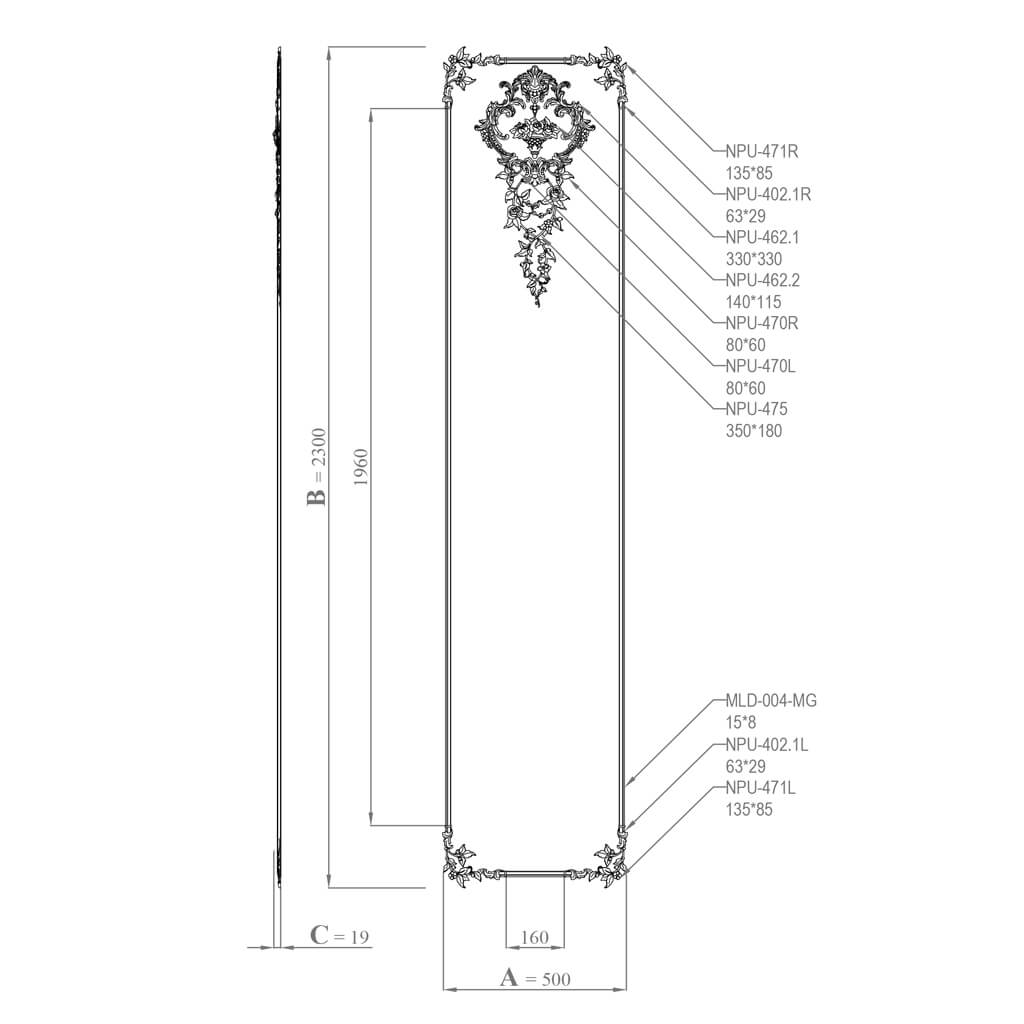
Full parameters according to the installation diagram:
-
Total width (A): 500 mm
-
Total height (B): 2300 mm
-
Projection / thickness according to diagram (C): 19 mm
-
Inner vertical part of the frame: 1960 mm
-
Lower horizontal section: 160 mm
Five hundred millimeters of width is the size of a standard wall section between doorways, the width of a niche, the area next to a window, the space on either side of a fireplace, a fragment of the wall at the head of a bed in a compact bedroom. CPU-6-1 is designed for places where a wide frame simply won't fit or will look overloaded.
At a height of 2300 mm, the vertical decorative wall frame occupies almost the entire span from floor to ceiling — with small gaps at the bottom and top that breathe and do not block the space. This is a proportion that designers call "full height": the decor is proportionate to a person and at the same time makes the room feel taller.
The 19 mm protrusion creates a well-defined relief — sufficient for expressive shadows under any lighting, but not so deep as to become a mechanical obstacle. This is especially important in a narrow corridor or hallway.
CPU-6-1 kit composition: each element in its place
Ten positions — and not a single extra one. The CPU-6-1 contains exactly what is needed to create a finished decorative panel, and nothing that would cause confusion or leftovers.
| Element | Dimensions | Quantity |
|---|---|---|
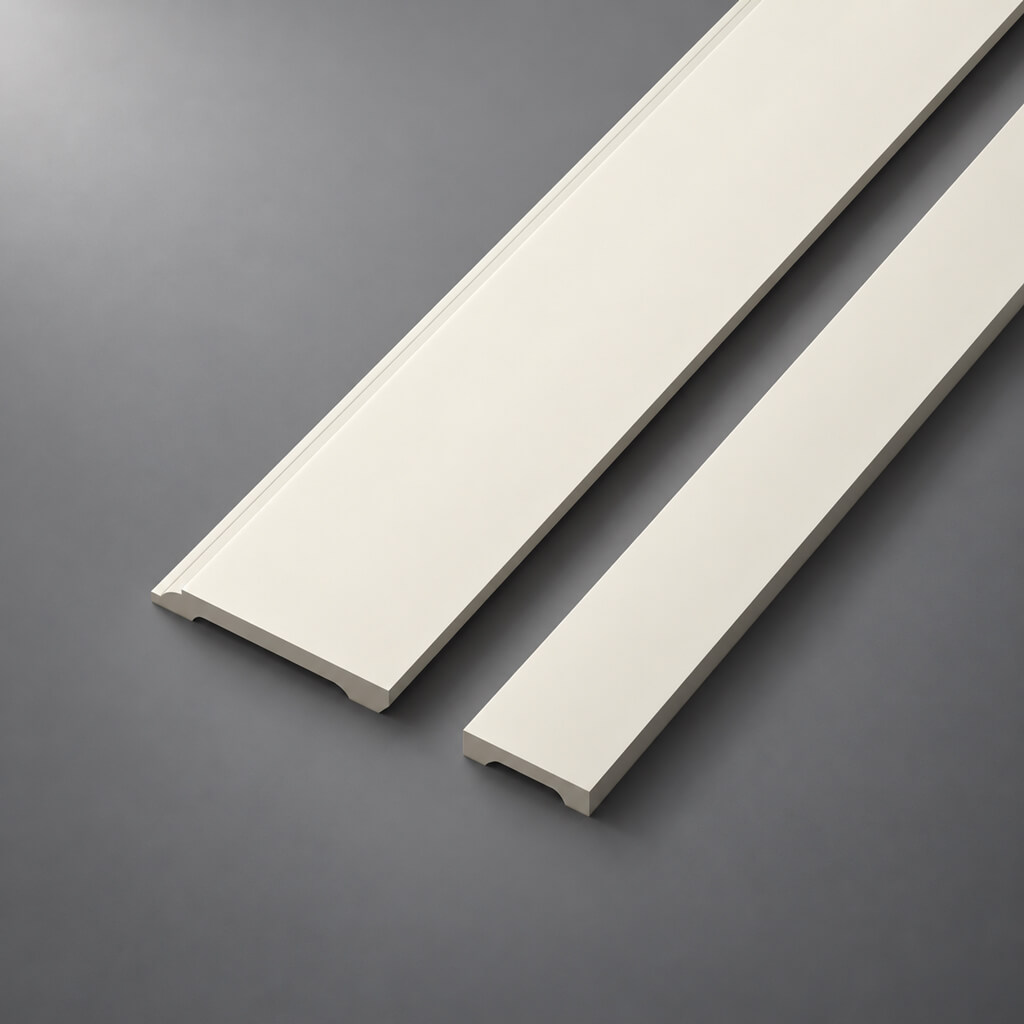
| Primed MDF molding MLD-004-MG | A=15 mm, C=8 mm, L=2600 mm | 2 pcs. |
| Polyurethane stucco NPU-402.1L | A=63 mm, B=29 mm, C=13 mm | 4 pcs. |
| Polyurethane stucco NPU-402.1R | A=63 mm, B=29 mm, C=13 mm | 4 pcs. |
| Stucco decor NPU-462.1 | A=330 mm, B=330 mm, C=14 mm | 1 pc. |
| Stucco decor NPU-462.2 | A=115 mm, B=140 mm, C=19 mm | 1 pc. |
| Stucco decor NPU-470L | A=80 mm, B=60 mm, C=8 mm | 3 pcs. |
| Stucco decor NPU-470R | A=80 mm, B=60 mm, C=8 mm | 3 pcs. |
| Stucco decor NPU-471L | A=135 mm, B=85 mm, C=8 mm | 2 pcs. |
| Stucco decor NPU-471R | A=135 mm, B=85 mm, C=8 mm | 2 pcs. |
| Stucco decor NPU-475 | A=350 mm, B=180 mm, C=16 mm | 1 pc. |
MLD-004-MG: architectural foundation
Primed molding MLD-004-MG with a profile of 15 × 8 mm and a length of 2600 mm is the load-bearing skeleton of the entire composition. Two such moldings form the vertical posts of the frame, which hold all the decor in strict architectural order. The length of 2600 mm provides a margin for trimming — the molding is cut precisely to the required vertical size without joints. A clean, even line from the base to the top end.
MDF is a material that delivers geometry without compromise. The molding does not warp, deform, or react to humidity fluctuations within the normal range of a residential space. Factory priming saves you one step of work and guarantees an even coating for the final paint job.
NPU-402.1L and NPU-402.1R: horizontal ornament elements
Paired mirror elements with a profile of 63 × 29 × 13 mm — four pieces on each side. They are positioned along the inner edge of the frame, creating an ornamental border around the perimeter. Their function is to fill the space between the molding and the central decor, linking the perimeter geometry with the volume of the ornament.
The thirteen-millimeter projection on these elements is exactly the distance at which the shadow from side lighting will read as a deep relief, rather than a flat pattern.
NPU-462.1 and NPU-462.2: central accent
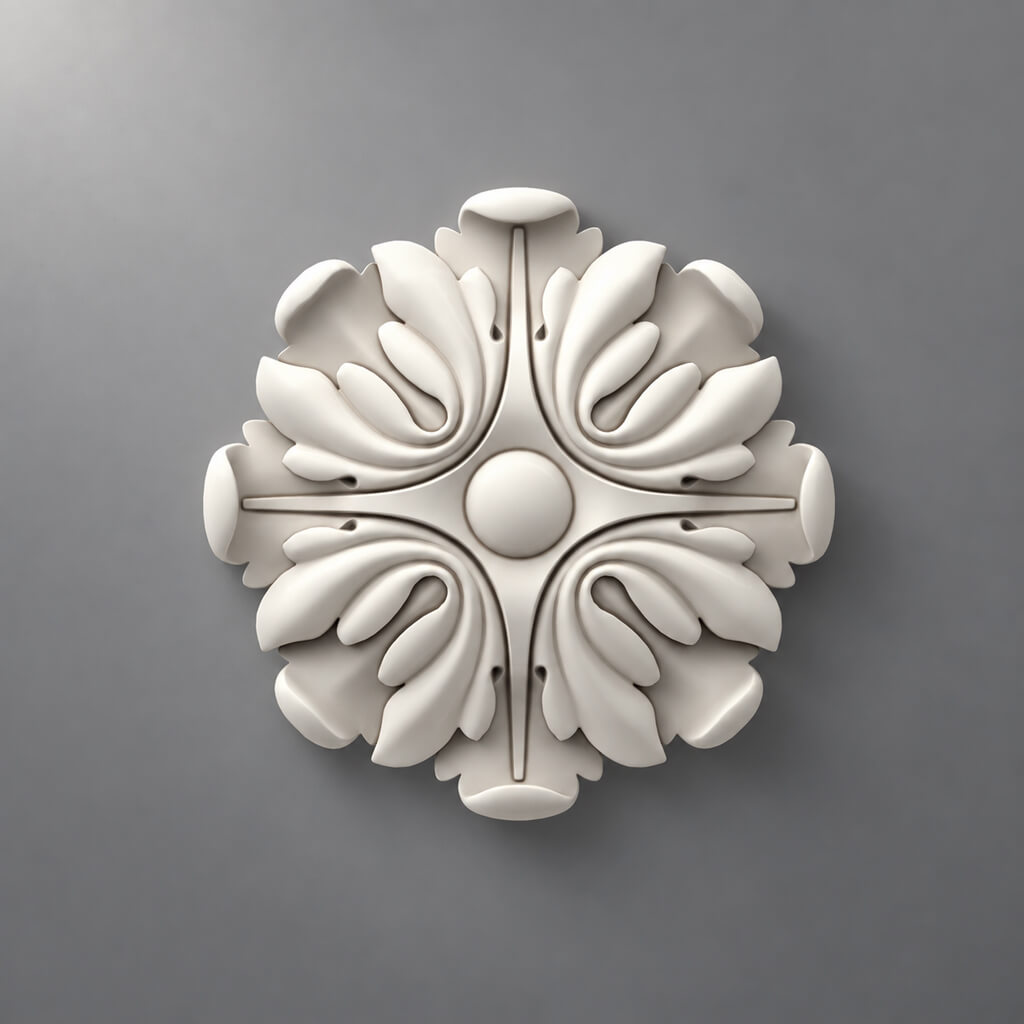
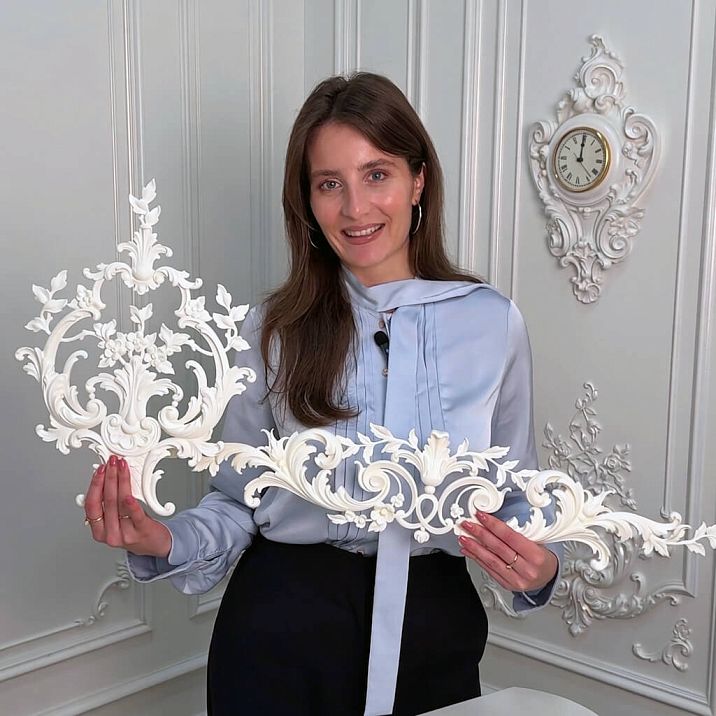
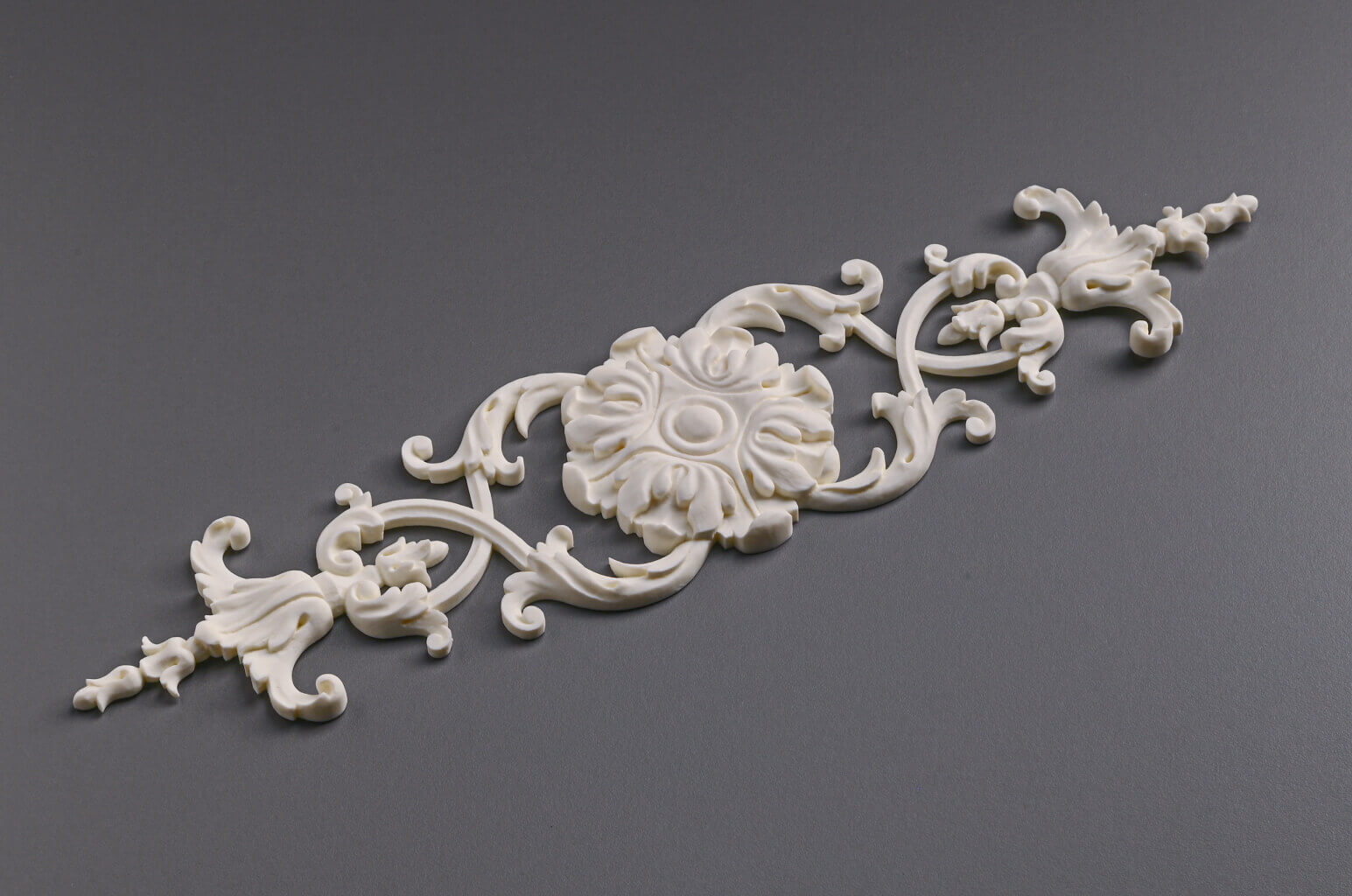
This is where the main expressive power of the set is concentrated. NPU-462.1 is a square decorative element 330 × 330 × 14 mm. One-third of a meter. With a relief depth of 14 mm, this is a substantial volumetric detail that is visible from several meters away and works even in low light. The floral ornament inscribed in a square cartouche is both classic and naturally free: geometry holds the ornament, and the ornament enlivens the geometry.
NPU-462.2 (115 × 140 × 19 mm) is a smaller-scale complementary element that, together with NPU-462.1, creates a two-level central accent. This solution gives the panel that 'precious' effect: the main decor is framed by a smaller accent, and the entire structure works like a medallion in an interior cartouche.
NPU-470 and NPU-471: supporting accents
Corner and intermediate decorative elements in two sizes — 80 × 60 mm and 135 × 85 mm. They are arranged symmetrically along the vertical of the panel, creating an ornamental rhythm that supports and accompanies the central motif. Three pairs of NPU-470 and two pairs of NPU-471 — that's eight points of decorative activity along the height of the frame.
Two sizes work together, creating a sense of increase and decrease: small accent, large accent, central medallion, large accent, small accent. This is an ornamental cadence that makes the panel readable from bottom to top and top to bottom.
NPU-475: bottom finish
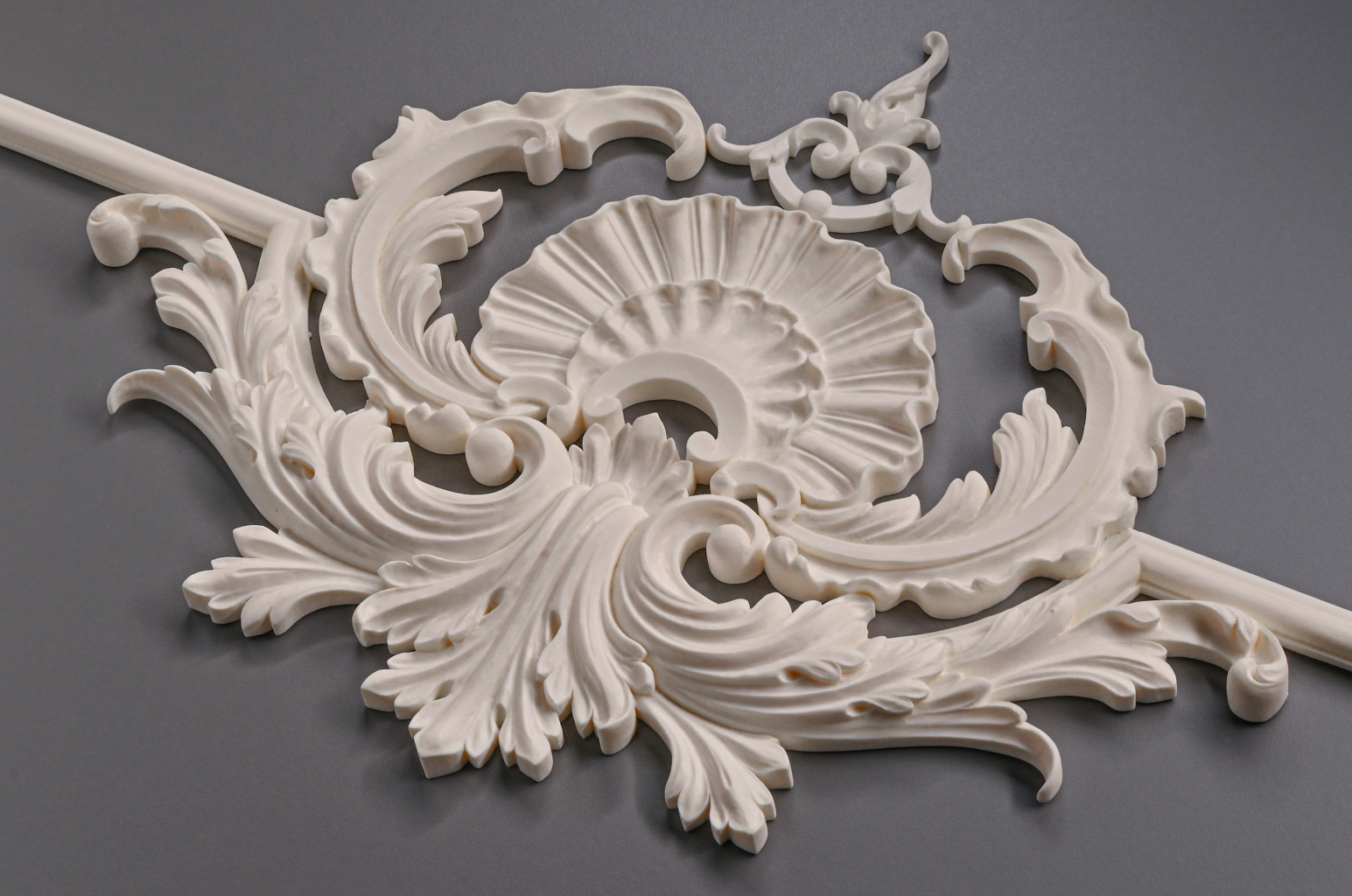
The horizontal decor NPU-475 (350 × 180 × 16 mm) is located at the bottom of the panel and serves as its visual base. Wide, horizontal, with a deeper relief — it holds the entire vertical structure, giving it a "pedestal." Without this element, the frame would simply be stretched upward. With it, it is rooted, complete, full.
Materials CPU-6-1: MDF plus polyurethane
Why polyurethane for decor
Polyurethane is not a compromise. It is a deliberate choice that in the field of wall stucco molding has long become the gold standard. The material is foamed, lightweight, elastic, with closed pores — it does not absorb moisture, does not crack under normal temperature conditions, does not crumble or shed.
The relief of polyurethane elements reproduces the original shape of the injection mold without loss: every leaf, every curl of the ornament is drawn with the same clarity with which it was cut in the model. This means that two different CPU-6-1 kits purchased at different times will be identical — which is critical when repeating several panels on one wall.
Polyurethane decorative elements are ready for painting without special preparation: they are easily sanded with fine sandpaper, accept primer and paint, and do not require the application of special adhesion compounds. Compatible with any interior paints on water and alkyd bases.
Why MDF for the molding
MDF in the molding profile is a choice in favor of geometric perfection. A straight molding must be perfectly straight — that is an axiom. Polyurethane trim over a long span may show slight deflection; MDF does not. For vertical frame posts 2300 mm high, this is fundamental: the slightest deviation from a straight line at such a height becomes visible.
The primed MDF surface accepts paint without forming the "grain" characteristic of untreated wood, and without the absorption that bare MDF exhibits. One or two coats of interior finish paint — and the molding looks like a cast interior detail.
The combination of MDF molding and polyurethane decor is a fundamental formulaof polyurethane moldings STAVROS: each material is used where it delivers the best result. Straight long parts — MDF. Complex relief ornaments — polyurethane. Together, they achieve what neither material can achieve alone.
Where to apply CPU-6-1: specific scenarios
Narrow wall sections and problem areas
Five hundred millimeters is exactly the width at whichDecorative frame made of moldings on the wall it fits where wider solutions do not. The wall section between a door frame and a room corner, a narrow wall fragment between a window and a built-in wardrobe, the space on either side of a fireplace or TV — all these are ideal places for CPU-6-1.
Instead of leaving such wall fragments "empty" and decoratively unfinished, they can be turned into rhythmic accents that create a sense of thoughtfulness in the entire interior down to the last detail.
Accent Wall in Living Room
In the living room, CPU-6-1 works in two modes. The first is as part of a system: several panels with equal spacing create a rhythmic wall composition that reads like palace paneling. With a frame width of 500 mm and standard gaps between panels of 150–250 mm, four to five sets of CPU-6-1 cover a wall width of 3 to 4 m.
The second mode is a single accent: one panel on the main wall of the living room, opposite the entrance. Here, CPU-6-1 works as a focal point that is seen from the threshold — and sets the tone for the entire space.
Bedroom: headboard and side walls
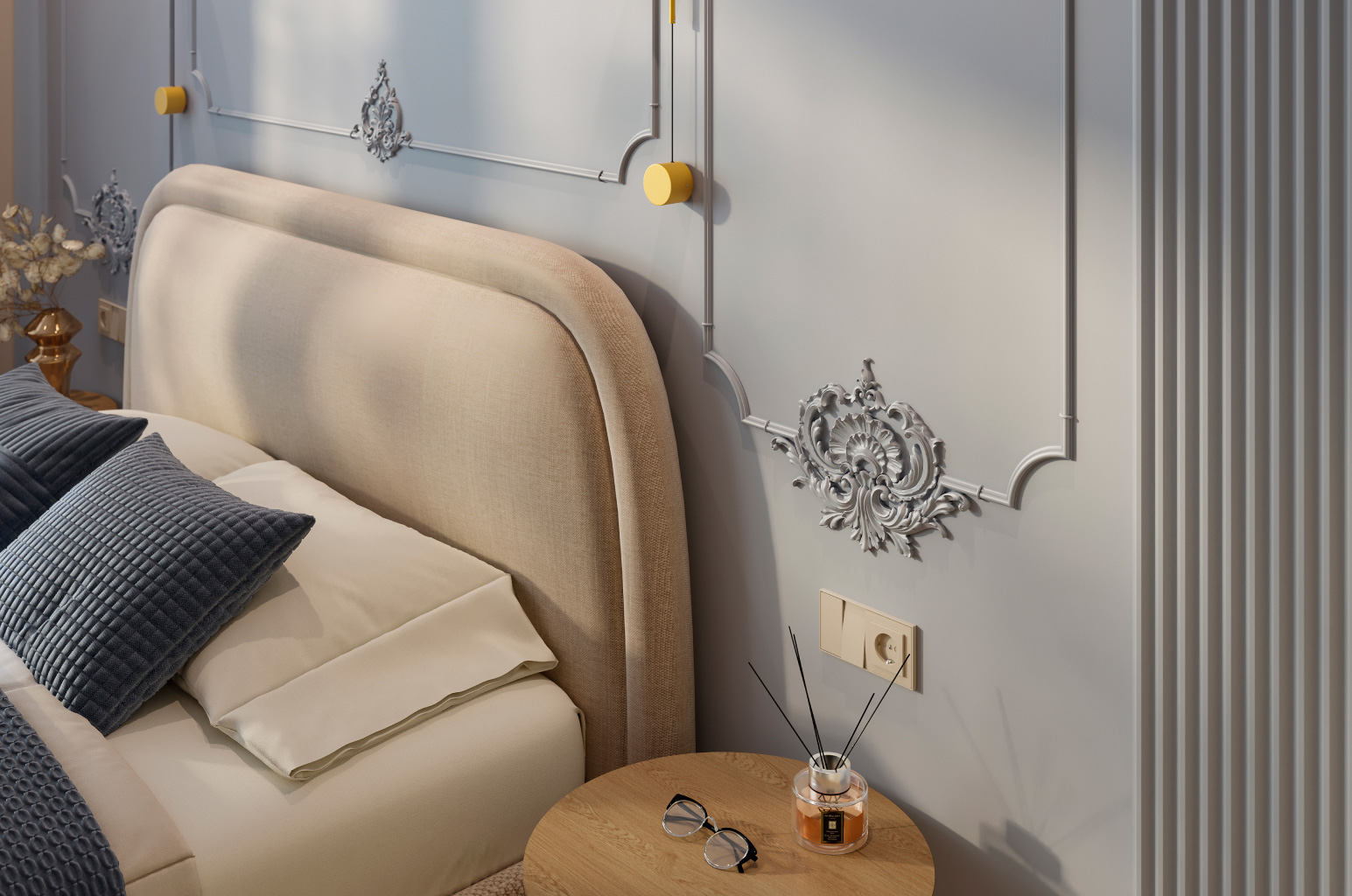
In the bedroom, aWall molding decorationspecial role. The frame at the head of the bed is an alternative to a soft panel, patterned wallpaper, or expensive wood cladding. CPU-6-1 with a width of 500 mm fits well into the space above the bed even in small bedrooms, where a wider frame would overload the wall.
Paint the panel the color of the wall — you get an architectural relief, barely noticeable in daylight and creating a deep shadow in evening light from a sconce. Highlight it with a contrasting color — you get an independent decorative object that defines the entire color concept of the bedroom.
On the sides of the bed — the space between the nightstands and the wall — is another place for CPU-6-1. The symmetry of two narrow panels on either side of the headboard creates a ceremonial framing of the sleeping area, worthy of luxury hotel design.
Hallway and entryway: verticality conquers crampedness
The hallway is a space that is always either narrow, dark, or both.Molding for the hallwayin the CPU-6-1 format solves both problems simultaneously. The 2300 mm vertical stretches the ceiling upward — this is an optical effect that works even in small spaces. The relief panel adds texture and depth to the wall — it no longer seems flat and oppressive.
Place CPU-6-1 opposite the front door, so that the panel is the first thing a person sees upon entering. This is an impeccable technique: the guest hasn't yet figured out whether the apartment is large or small, modern or classic — but they already feel that people with taste live here.
TV zone and study
In the TV zone, CPU-6-1 works symmetrically: one panel on each side of the screen. The television ceases to be a "hole in the wall" and integrates into the architectural context, framed by vertical molding accents.
The office has its own story.Decorative Wall Moldingsin the format of vertical frames create the atmosphere of an office with history: where serious decisions are made, the walls must match the weight of those decisions. CPU-6-1 adds dignity to the office without pomposity.
Commercial interiors
Restaurant, boutique, salon, showroom — all these spaces share one requirement: maximum visual effect with controlled costs. CPU-6-1 solves this task elegantly. Several identical panels along the wall of a restaurant hall create the atmosphere of a good European establishment. One or two panels in a boutique are a style showcase that works even when the shelves are empty.
Which interior styles does CPU-6-1 suit?
It's easier to flip this question: which styles does CPU-6-1 not suit? Harsh industrial loft with concrete walls, Scandinavian minimalism with conscious asceticism, Japanese wabi-sabi with a cult of imperfection — here floral ornament and molding frames would be out of place. In all other cases, CPU-6-1 is organic.
Neoclassicism is the native environment forstucco decor with floral ornament. Vertical frames with a central medallion are the grammar of the neoclassical language written on the walls. CPU-6-1 speaks it fluently.
Modern classic is a style in which classical forms are translated into a modern scale and restrained palette. CPU-6-1 works here as an architectural accent, not overloading the interior but giving it the necessary weight.
Art Deco is a style of contrasts: geometry and ornament, strictness and luxury. The molding perimeter and rich central decor of CPU-6-1 are a precise fit for Art Deco aesthetics, especially when painted in gold, bronze, or anthracite.
Parisian style and eclecticism — here CPU-6-1 acts as one of many decorative layers, each contributing its voice to the overall polyphony. The frame does not dominate but holds the space.
An interior with decorative wall panels — that's what CPU-6-1 is literally created for. It is a system-forming element of such an interior, its structural unit.
Installation of CPU-6-1: from concept to result
Stage one: surface preparation
Good installation of decorative moldings starts with a good wall. The surface must be level, dry, free of dust and grease. If the finishing putty has not yet been applied, apply it before installation: trimming and puttying around an installed molding is much more difficult than on a clean wall.
Check the verticality of the wall with a straightedge: if there is a deviation of more than 5 mm per meter of length, it will have to be compensated during molding installation. Ignoring this step causes the vertical molding to "drift" to the side — and at a height of 2300 mm, this is visible to the naked eye.
Stage two: marking
Marking is the main intellectual stage of installation. This is where you make decisions that you will later execute with your hands.
Start by determining the central vertical axis of the panel: mark it with a plumb line or laser level. From the axis to the right and left — 250 mm each to the outer edge of the molding. These are your vertical posts. Horizontal marks — the top and bottom cuts of the frame.
Then mark the position of the central element NPU-462.1: its geometric center must lie exactly on the central axis of the panel. Calculate the vertical height of this position considering the entire symmetry system of the composition. Intermediate decors NPU-470 and NPU-471 are marked in place after installing the moldings — their positions are adjusted "on the fly."
Stage three: cutting the moldings
MDF molding MLD-004-MG is cut with a miter saw or a fine-tooth hacksaw. The vertical posts of the frame are cut at a right angle (90°). The top and bottom horizontals of the frame are joined to the verticals either butt-to-butt or at 45° — the second option gives a neater corner without a noticeable joint.
The cuts are sanded with fine-grit sandpaper (grit 150–180) and primed with a thin layer before installation.
Step four: installing the moldings
Construction adhesive is applied in a zigzag pattern on the back surface of the molding — with a spacing of approximately 150 mm. The molding is pressed against the wall according to the markings and held for 30–60 seconds. Excess adhesive that seeps out at the edges is immediately removed with a spatula or cloth.
For moldings with a height of 2300 mm, additional fixation with two or three finishing nails along the length of the piece is recommended — this prevents slipping until the adhesive fully sets. The nail heads are filled with putty.
Step five: installing decorative elements
Polyurethane decor pieces are glued with construction adhesive — applied in dots, in small portions. The central element NPU-462.1 is held pressed for at least 2–3 minutes: its area is large, and the adhesive must set evenly.
The symmetry of the corner elements is checked with a tape measure from the central axis and a spirit level. All elements are installed strictly according to the markings — even a slight shift will disrupt the symmetry, which will be clearly visible at such a height.
Step six: puttying and sanding
After the adhesive has dried (at least 4 hours, ideally overnight), all joints between the molding and the wall, joints between moldings, and areas where polyurethane elements meet are filled with acrylic sealant or a thin layer of finishing putty. Sanding after drying — fine sandpaper, with light strokes.
Stage seven: painting
Two to three coats of water-based interior paint — and the CPU-6-1 decorative molding set takes on a finished look. The first coat is applied with a brush over all ornament details, the second and third with a brush and a small foam roller over the moldings. Drying time between coats — according to the paint manufacturer's instructions.
Ornament from the "Botanical Garden" collection: nature as an architectural language
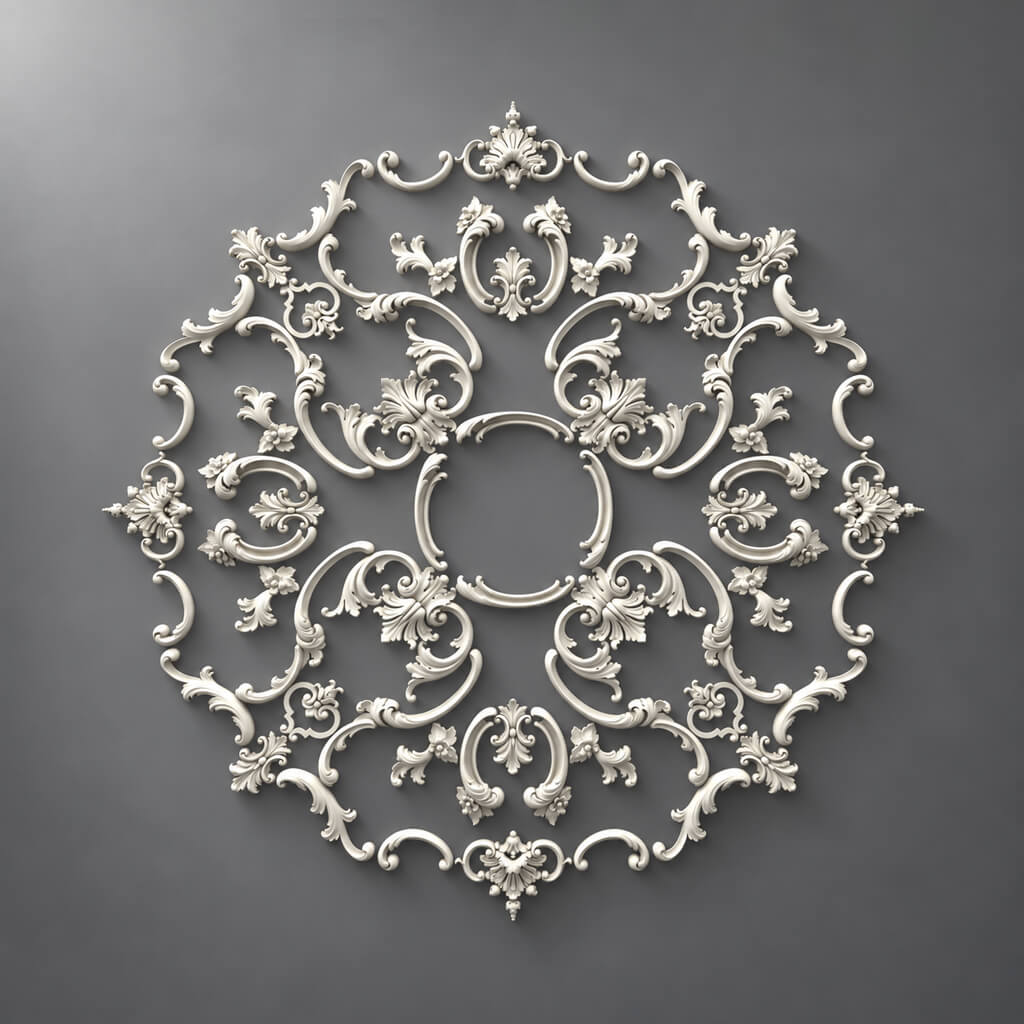
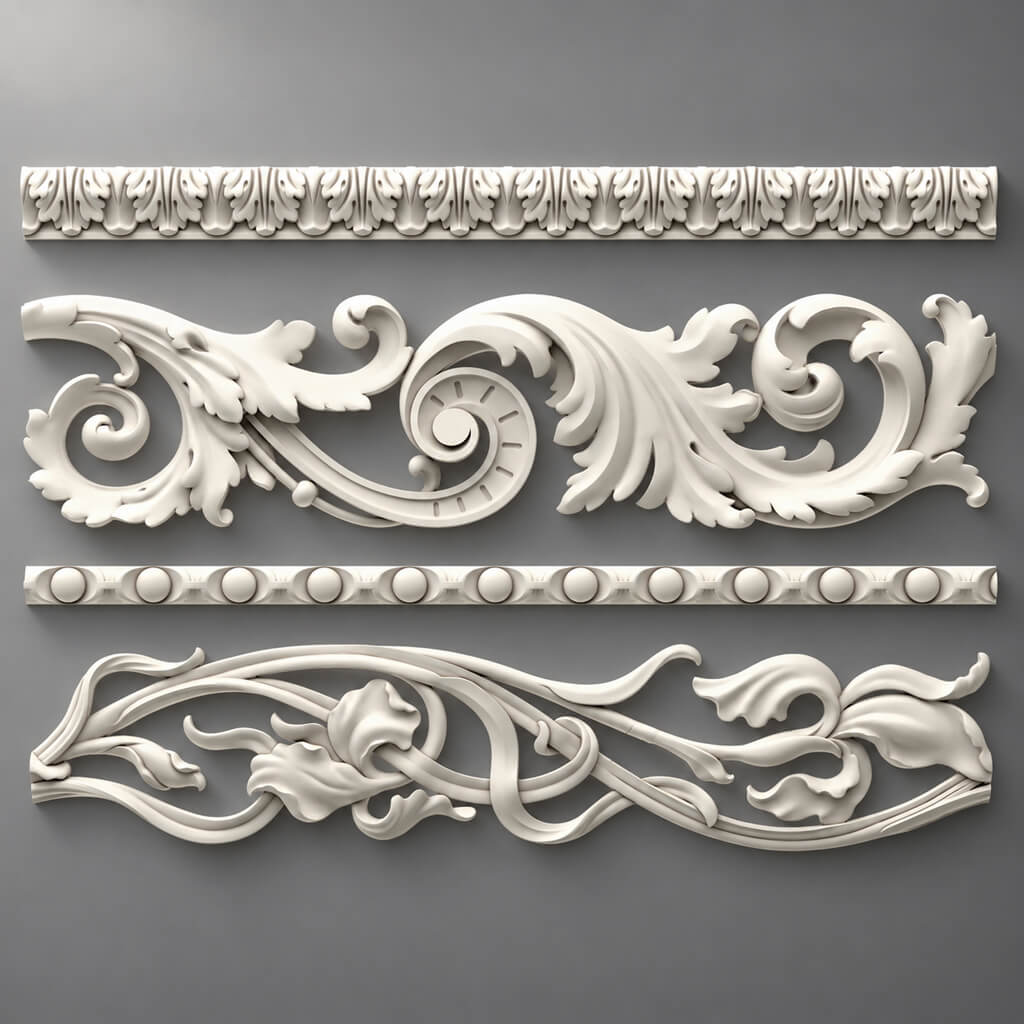
All polyurethane elements of CPU-6-1 are developed within the "Botanical Garden" collection STAVROS. This is a line where natural motifs — leaves, stems, inflorescences, organic curls — are interpreted on the scale of architectural decor: not as a naturalistic drawing, but as an abstraction of natural form translated into three-dimensional relief.
Plant ornament in architecture is a theme with a millennia-long history. From the acanthus leaves of Greek capitals to Baroque garlands, from Rococo rocailles to the floral motifs of Art Nouveau — natural form has always been the language through which architecture spoke of life, growth, and beauty. The STAVROS "Botanical Garden" collection continues this tradition in modern material and modern scale.
An important advantage of the collection is the possibility of combination. Elements NPU-462, NPU-470, NPU-471, and NPU-475 from the CPU-6-1 set are compatible with other products from the same series. This allows expanding and complicating the composition, adding elements to an already installed frame, or creating fundamentally new configurations.
CPU-6-1 and CPU-6-2: what's the difference
Comparing these two sets is a natural question if you are choosing between them.
CPU-6-2 is a wider format (800 × 2300 mm), without a large central accent. Four corner ornaments along the perimeter create a uniform ornamental rhythm, the frame is perceived as a strict architectural detail without an obvious dominant. This is the choice for those who need a neutral, calm, reproducible panel.
CPU-6-1 — a narrower format (500 × 2300 mm), but with a powerful central accent — a double medallion NPU-462 and a lower horizontal decor NPU-475. This is a choice for those who need a decorative focal point, an expressive single accent, a panel with character and hierarchy.
If space allows, both sets can be used in one interior, alternating them along the wall: wide frame — narrow with accent — wide. This creates a complex rhythmic pattern that reads as a professional design technique.
Advantages of CPU-6-1: what to know before buying
-
Ready-made vertical composition — all details are selected and coordinated, nothing extra, nothing missing
-
Expressive central decor — double medallion NPU-462 creates an architectural dominant within the frame
-
Narrow format 500 mm — ideal for piers, niches, side zones, compact spaces
-
Lower finish NPU-475 — horizontal accent "grounds" the vertical and gives the panel completeness
-
Compatible STAVROS elements from the same collection — unified ornament, unified quality, unified projection
-
Primed MDF molding — ready for final painting, no additional preparation needed
-
polyurethaneWall Decor — lightweight, moisture-resistant, with a clear relief
-
Flexibility of coloring — matching the wall tone or contrasting color, for any interior design concept
-
Suitable for residential and commercial spaces — apartment, house, restaurant, boutique, office
-
Scalable — a single panel or a series of several identical frames
How to calculate the number of CPU-6-1 kits for your wall
The calculation is simple. The width of one panel is 500 mm. Add the gap between panels — typically 150–300 mm depending on the desired rhythm density and wall width.
-
Wall 1.5–2.0 m: 1–2 panels (single accent or symmetrical pair)
-
Wall 2.5–3.0 m: 3 panels with gaps of about 200–250 mm
-
Wall 3.5–4.0 m: 4 panels with gaps of about 200 mm
-
Wall 4.5–5.0 m: 5 panels with gaps of about 200–250 mm
With symmetrical placement, the gap from the wall corner to the first panel equals the gap between panels — this creates optical harmony.
For an accurate calculation, it's better to first mark all panel axes on the wall with a pencil and view the result from a distance of 3–4 meters before proceeding with installation.
FAQ: answers to customer questions about CPU-6-1
How is CPU-6-1 different from a set of individual parts?
In the CPU-6-1 kit, all elements are matched as a system: the molding, corner decorations, central medallion, and bottom finish are coordinated in style, projection, and ornament. When selecting individually, you risk buying incompatible parts or getting a result without visual coherence. The kit eliminates this risk.
Can the frame height be changed?
Yes. The MLD-004-MG molding, 2600 mm long, is cut to the required size. If you need a frame height of, for example, 2000 mm, the molding is cut to that size. The positions of decorative elements are recalculated proportionally.
Is a specialist needed for installation?
Not necessarily. An experienced home DIYer can handle it independently with a miter saw, a spirit level, construction adhesive, and basic putty skills. For commercial projects with a large number of panels, it makes sense to hire an installer.
Is CPU-6-1 suitable for bathroom finishing?
Polyurethane elements are moisture-resistant. MDF molding can deform under constant high humidity. For a bathroom, it is recommended to consider kits based on fully polyurethane linear elements from the rangeof polyurethane moldings STAVROS.
What color is best to paint CPU-6-1?
There is no universally "best" color — it's a matter of design intent. White and cream are classics, always appropriate. Gray and graphite are modern classics, elegant and restrained. Bronze and gold are Art Deco luxury. Rich blue or green is a bold interior statement for those unafraid of color.
Can the panel be repainted after installation?
Yes, at any time. Sanding the old paint layer with fine sandpaper — and the surface is ready for a new color. MDF and polyurethane are equally easy to repaint.
How to care for the surface after installation?
Wipe with a dry or slightly damp soft cloth. No abrasive agents, no stiff brushes. Relief parts of the ornament are conveniently cleaned with a soft brush from dust.
Is CPU-6-1 compatible with other elements from the STAVROS range?
Yes. All elements from "Botanical Garden" collection are designed as a compatible system. NPU-462, NPU-470, NPU-471, and NPU-475 can be used as part of extended or custom compositions together with other products from the same collection.
How long does it take to install one panel?
For one craftsman: marking — 20–30 minutes, cutting — 15 minutes, molding installation — 30–40 minutes, decor installation — 20–30 minutes, joint putty — 15–20 minutes, painting after drying — 30–45 minutes. Total: half a working day including drying breaks.
Can CPU-6-1 be used not only on walls but also on other surfaces?
Yes. The set is suitable for decorating door panels, wooden panels, slopes, furniture facades — anywhere a decorative vertical frame with an ornament is needed.
Your request has been sent!
Our manager will contact you within 5 minutes