








































































Article Contents:
- What is artistic stucco: beyond profile and cornice
- Stucco as a decorative statement
- How it differs from just a "profile"
- Polyurethane as a material for artistic decor
- Where artistic stucco is used: ten spaces with character
- Living Room
- Bedroom
- Office and Library
- Corridor and Hall
- Dining area and dining room
- Doors and doorways
- Fireplace and fireplace area
- Furniture facades and cabinets
- TV zone with a niche
- Commercial Spaces: Restaurant, Hotel, Showroom
- How artistic stucco differs from ordinary moldings: a fundamental distinction
- Molding: line, profile, border
- Artistic stucco: accent, volume, ornament
- Table: key differences
- Artistic stucco for walls: six decorative techniques
- Technique one: symmetrical frame composition
- Technique two: vertical panel system
- Technique three: horizontal "horizon"
- Technique four: accent central element
- Technique five: framing architectural elements
- Technique six: decorative panel across the entire facade
- Artistic ceiling stucco: from rosette to ceiling symphony
- Ceiling rosette: focal point
- Ceiling cornice: room horizon
- Ceiling frame around the rosette
- Coffered ceiling using stucco
- Wall-to-ceiling transition with ornamental frieze
- Stucco for furniture and doors: a detail that changes everything
- Decorative overlays on furniture facades
- Door leaf: stucco as architectural design
- Fireplace portal with artistic stucco
- How to choose the style of artistic stucco: seven architectural codes
- Classic: full ornamental code
- Neoclassical: restrained richness
- Modern classic: minimum with character
- Art Deco: geometry and speed
- Country house and rustic style
- Restaurant and hotel: theatricality and scale
- Study, library: rigor and dignity
- Why polyurethane is convenient for artistic stucco: seven compelling arguments
- Argument 1. Precision of ornament reproduction
- Argument 2. Light weight, no special fastening required
- Argument 3. Possibility of any coloring
- Argument 4. Resistance to humidity
- Argument 5. Easy installation without special tools
- Argument 6. Durability without maintenance
- Argument 7. Wide selection of shapes and sizes
- How to create a decorative composition from artistic stucco: principles of construction
- Principle of axis of symmetry
- Principle of Element Hierarchy
- Principle of series unity
- The Principle of Proportionality
- The principle of "air" between elements
- Mistakes when choosing artistic stucco molding: eight blunders
- Mistake 1. Buying elements without an overall concept
- Mistake 2. Mixing different ornaments
- Mistake 3. Overloading a small room
- Mistake 4. Choosing too small decor for a large wall
- Mistake 5. Not considering the furniture style
- Mistake 6. Forgetting about the finish coating
- Mistake 7. Not counting the number of elements in advance
- Mistake 8. Confusing wall, furniture, and facade decor
- Painting decorative stucco: how to achieve a perfect result
- White painting 'matching the wall color'
- Contrasting white stucco on a colored wall
- Imitation of gold and aged metal
- Toning to imitate marble or stone
- FAQ: answers to the main questions about decorative stucco
- STAVROS: decorative stucco that creates an interior with soul
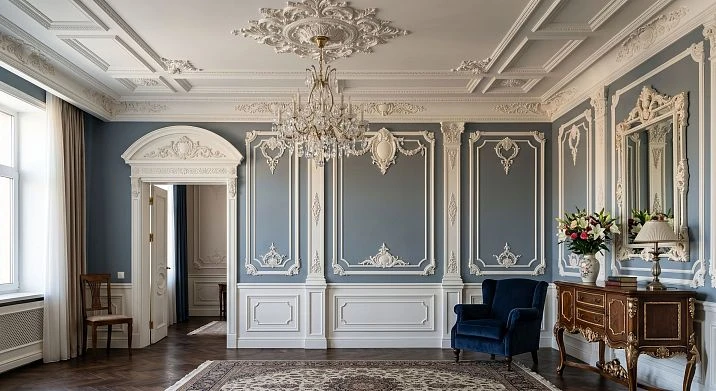
There are interiors that simply exist. Walls, ceiling, furniture — everything is functional, everything is in place, everything is neat. But entering them is like entering an empty room. There is space, but no character.
And there are interiors that speak. Where the rhythm of ornamental frames can be read on the wall. Where the ceiling rosette holds the gaze no worse than a chandelier. Where the molding above the door frame turns the opening into a portal. Where every detail is not accidental, but meaningful.
The difference between the first and the second — artistic stucco. Not as a profile. Not as "something to glue to the wall." But as a conscious decorative tool with its own aesthetic purpose, ornamental logic, and architectural meaning.
This article is for those who want not just to "add stucco," but to choose it correctly: according to style, scale, and specific place in the interior. For the living room and bedroom, for the ceiling and furniture, for classic and neoclassical styles. Detailed, honest, and to the point.

What is artistic stucco: beyond the profile and cornice
In everyday usage, the word "stucco" most often evokes one image: a white cornice at the junction of wall and ceiling. This is not a mistake — it is just one of its applications. But artistic stucco is a much broader concept.




Stucco as a decorative statement
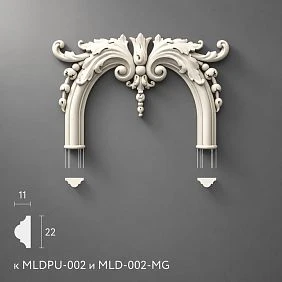
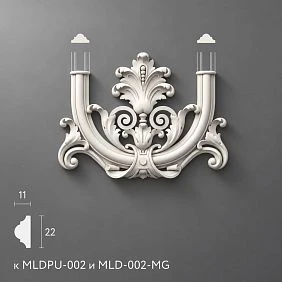
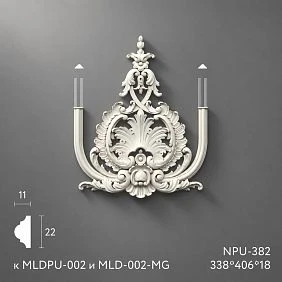
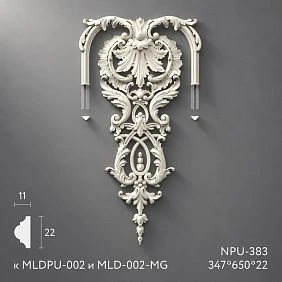
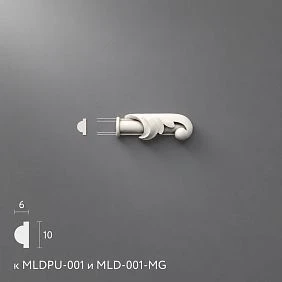
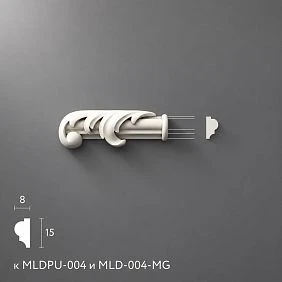
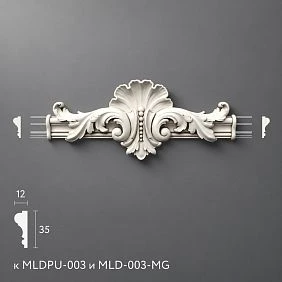
Artistic stucco made of polyurethane — these are all three-dimensional decorative elements made of polyurethane, primarily serving an aesthetic function. Their task is not just to hide a joint or create a transition, but to create an image: express a style, set accents, and give the space depth and character.
Artistic stucco includes:
-
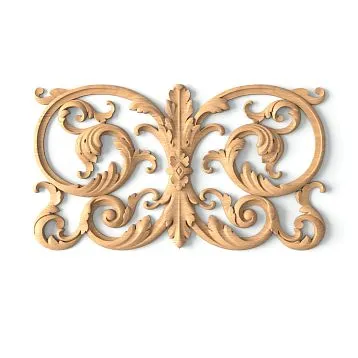
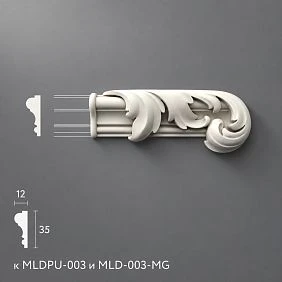
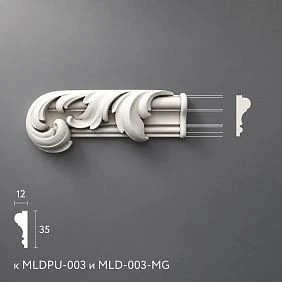
Decorative overlays with relief ornamentation (leaves, scrolls, cartouches, medallions)
-
Ceiling rosettes with openwork or rich relief
-
Corner blocks with ornamental filling
-
Central decorative elements for accent walls
-
Frame moldings with shaped profile
-
Elements for designing portals, niches, fireplaces, door panels
-
Decorative pilasters and capitals
-
Ornamental inserts for furniture facades
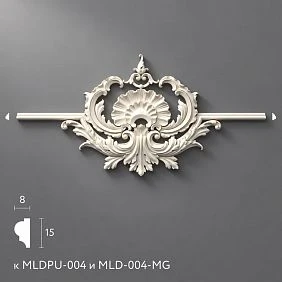
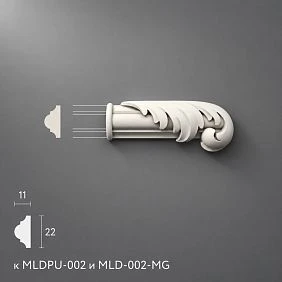
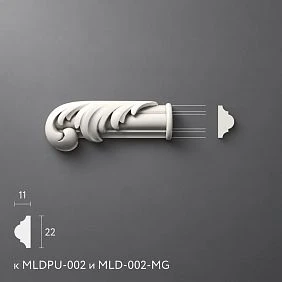
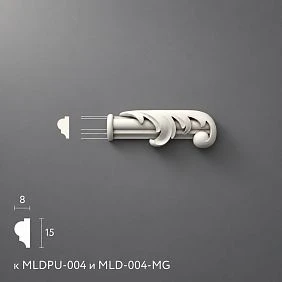
Our factory also produces:

How is this different from just a "profile"
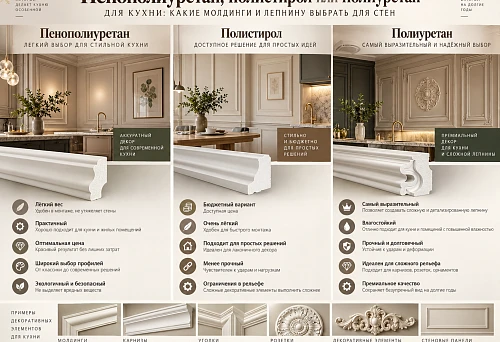
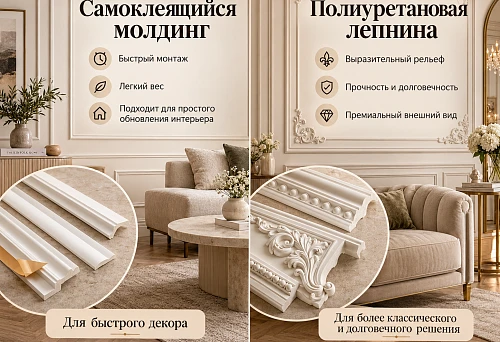
Technical profile — linear molding, baseboard, simple cornice — solves an architectural task: hide a joint, create a horizon, complete a transition. Artistic stucco solves an aesthetic task: make the space expressive, rich, memorable.
This is not a contradiction. In a good classical interior, both types of elements work — but their roles are different. Polyurethane trim — is the structure. Artistic molded decoration made of polyurethane — is the content.
Get Consultation
Polyurethane as a material for artistic decor
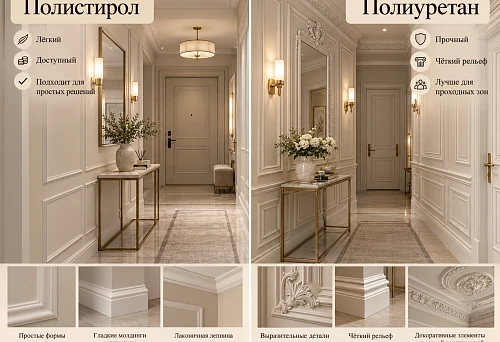
Why polyurethane? Because this material allows reproducing complex ornamental relief with millimeter precision — sharp edges of acanthus leaves, thin stems of scrolls, deep recesses of caisson decor — while weighing 6–10 times less than its plaster counterpart.
A polyurethane element is not afraid of moisture, does not crack from temperature changes, and accepts any coating — from white enamel to gilding, from ivory tinting to imitation of aged stone. And that is why artistic polyurethane stucco is not a material of compromise, but of choice.
Where artistic stucco is used: ten spaces with character
Living Room
The main room of the house — here artistic stucco works to its fullest. An accent wall behind the sofa with a symmetrical frame composition of molding and a central medallion. A ceiling cornice with brackets above the fireplace area. A rosette with lush ornament in the center of the ceiling under the chandelier.
Bedroom
In the bedroom, artistic stucco creates both intimacy and grandeur simultaneously. A classic technique — a frame panel above the headboard with a central decorative element. A horizontal band dividing the wall into a lower "fabric" zone and an upper "clean" surface.
Office and library
Here, stucco works through strictness: vertical moldings dividing walls into sections, a horizontal band at the level of bookshelves, a simple cornice with a small projection. No overload — decor through line, not through ornament.
Corridor and Hall
A corridor turns into a real enfilade if the walls are decorated with frame moldings with ornamental corner blocks. Even in a narrow space, artistic decor creates visual expansion through rhythmic structure.
Dining area and dining room
The ceiling above the dining table is an ideal place for a ceiling rosette with a rich relief. A cornice with brackets above the niche with a sideboard is a classic architectural technique.
Doors and doorways
Stucco above the door leaf: a horizontal lintel with a decorative overlay turns an ordinary door into a portal. Moldings around the perimeter of the doorway are a frame that gives the opening architectural weight.
Fireplace and fireplace area
A fireplace portal is a traditional place for artistic stucco decor. decorative polyurethane elements on the shelf, on the side pilasters, in the architrave part — they create the image of a real classic fireplace even in an apartment.
Furniture Facades and Cabinets
Decorative overlays on the facades of cabinets, sideboards, chests of drawers are a separate genre of artistic stucco. A small rosette in the center of the door, corner ornamental blocks, a horizontal molding divide the furniture facade into fields and give the piece of furniture an architectural character.
TV area with a niche
A niche for the TV, framed with moldings around the perimeter and a decorative element above the niche — a full-fledged architectural frame for the main screen of the living room.
Commercial spaces: restaurant, hotel, showroom
In commercial interiors artistic stucco it works for the brand image: creates an atmosphere of premium quality, classic taste, and solidity. Restaurants with classic interiors, hotel lobbies, beauty salons in a neutral classic style — everywhere artistic stucco decoration serves a commercial function: it forms the first impression.
How artistic stucco differs from ordinary moldings: a fundamental distinction
This question often causes confusion — and it is precisely this that needs to be clarified before choosing products.
Molding: line, profile, border
Polyurethane molding — is primarily a linear element. It creates horizontal or vertical lines, divides surfaces into fields, forms frames. Its decorativeness lies in the profile: ogee, roll, fillet, shelf. Molding works through repetition and rhythm.
Artistic stucco: accent, volume, ornament
Artistic Relief Decoration — is primarily a separate decorative object. It can stand on its own: a medallion in the center of a wall, a rosette on the ceiling, a cartouche above the fireplace. Its decorativeness lies in the ornament and relief. Artistic stucco works through accent and completeness.
Table: key differences
| Parameter | Molding | Artistic stucco |
|---|---|---|
| Shape | Linear, linear molding | Volumetric individual element |
| Function | Line, border, frame | Accent, ornament, center |
| Application | Joints, frames, transitions | Walls, ceiling, furniture, doors |
| Expressiveness | Through repetition and rhythm | Through relief and ornament |
| Examples | Cornice, baseboard, band | Rosette, medallion, cartouche, overlay |
In practice, both types work in a good interior. Molding creates structure. Artistic stucco decor provides the content within that structure.
Artistic stucco for walls: six decorative techniques
The wall is the largest plane in a room and the broadest canvas for stucco decor. Let's explore specific techniques.
Technique one: symmetrical frame composition
On an accent wall (typically the main one opposite the entrance), a symmetrical system of molding frames with ornamental corner blocks is arranged. In the center of each frame or in the space between frames, a decorative element is placed — a medallion, overlay, or cartouche.
This is a classic technique that works in living rooms, halls, and bedrooms. Symmetry creates a sense of order and grandeur.
Technique two: vertical panel system
The wall is divided into sections by vertical moldings. Each section is a separate 'field' with a decorative element inside. This technique is especially suitable for long walls in a hallway, dining room, or a living room with a large pier.
Polyurethane wall decor In the form of pilasters or vertical frames, it creates a rhythmic division — the wall ceases to be a monotonous plane.
Technique three: horizontal "horizon"
One horizontal belt at a certain height (900, 1,200, 1,600 mm) divides the wall into two zones. The lower one is the "panel" zone, more active. The upper one is the "clean", background zone. The belt can be a simple profile or a rich ornamental molding.
Technique four: accent central element
On a wall without frames and belts — in the center — one large decorative element is installed: a medallion with a diameter of 200–400 mm, a vertical cartouche, a decorative rosette. This is a minimalist approach to artistic stucco — one accent instead of a system.
Especially appropriate in modern classic and neoclassical styles, where overloading with decor is unacceptable.
Technique five: framing architectural elements
Moldings and ornamental overlays around a window, door, mirror, or niche. A standard opening turns into an architectural accent with a frame, corner blocks, and a central keystone.
Technique six: decorative panel across the entire facade
Large decorative polyurethane elements in the form of ornamental panels covering a significant part of the wall. Used in restaurants, hotels, beauty salons — where the image of the space is as important as its function.
Artistic stucco for the ceiling: from a rosette to a ceiling symphony
The ceiling in a classic interior is not just the upper plane of the room. It is the fifth facade, defining the sense of height, volume, and grandeur of the space.
Ceiling rosette: a point of attraction
artistic stucco in the form of a ceiling rosette — one of the most expressive decorative elements. The rosette is installed in the center of the ceiling under a chandelier or as an independent accent.
By type of ornament:
-
Simple geometric — rays, concentric rings, minimal profile. For modern classic and neoclassical
-
Leaf and floral — petals, acanthus leaves, rosettes. For classic
-
Composite — several ornamental bands of different diameters around the center. For formal interiors
-
With relief ornament — deep relief, sculptural molding. For premium classic interior
By size: diameter 200–1,000 mm and more. Proportion rule: the diameter of the rosette should not exceed 1/5 of the smallest ceiling dimension.
Ceiling cornice: the horizon of the room
Polyurethane trim for the ceiling cornice — the structural base. Artistic stucco turns the cornice into a rich architectural element: a frieze with ornament, a decorative belt, and overlay elements in the corners are added to the basic profile.
Ceiling frame around the rosette
Moldings forming a concentric rectangle or square around a central rosette — a classic ceiling composition. Between the frame and the cornice is an open ceiling field. The frame accents the center and creates the feeling of a "coffer" without a real coffered ceiling.
Coffered ceiling through stucco
A regular grid of moldings on the ceiling, dividing it into rectangular "cassettes" — an imitation of a coffered ceiling. This is one of the most complex and impressive ceiling techniques using artistic stucco. In the center of each coffer is a small rosette or decorative overlay.
Used in studies, libraries, formal dining rooms. Requires a ceiling height of at least 2.8 m.
Wall-to-ceiling transition with an ornamental frieze
Between the cornice and the clean ceiling — an ornamental frieze strip with a repeating element. A classic technique creating a "border" of the ceiling zone. Frieze height: 60–150 mm depending on the room height.
Stucco for furniture and doors: a detail that changes everything
Artistic stucco on furniture is a separate topic rarely covered in articles about stucco. And it's a shame: it is the furniture decorative element that turns an ordinary cabinet into a sideboard with history, an ordinary door into an object of interior art.
Decorative overlays on furniture facades
molded decoration made of polyurethane for furniture are small three-dimensional overlays installed on the facade of a cabinet, the door of a chest of drawers, the body of a sideboard, or the surface of a display case.
How it works:
-
Corner overlays are installed in the corners of the door facade, forming an ornamental frame
-
A central rosette in the middle of the facade is an accent element that focuses the gaze
-
A horizontal molding divides a tall facade into upper and lower zones
-
A cartouche above the sideboard door is a classic decorative technique that gives a piece of furniture a "face"
Dimensions of furniture overlays: as a rule, small — 50–150 mm along the largest dimension. Relief: 10–30 mm.
Door leaf: stucco as architectural design
Decorative overlays on the door leaf turn a flat door into a relief architectural element. Design scheme:
-
Two horizontal moldings divide the panel into three parts
-
In the upper part — an ornamental rosette or cartouche
-
In the lower part — a horizontal molding frame
-
Along the perimeter of the panel — a thin molding trim
This technique was used in classic interiors of the 18th–19th centuries — and today is reproduced using polyurethane decorative stucco decor without complex joinery work.
Fireplace portal with artistic stucco
A fireplace portal is an architectural frame around the fireplace. Structure of a classic portal: lower support blocks → side pilasters → horizontal shelf → upper part with decorative composition.
Artistic stucco made of polyurethane for the fireplace portal: corner capitals on pilasters, central cartouche or medallion on the upper part, ornamental strips along the horizontal shelf. Polyurethane withstands temperatures up to +80°C — this is sufficient for the decorative part of the portal (not for the firebox).
How to choose the style of artistic stucco: seven architectural codes
Artistic stucco does not exist outside of style. It embodies it. A wrongly chosen ornament in the wrong style is worse than no decoration at all.
Classic: full ornamental code
Acanthus leaves, volutes, rosettes, laurel wreaths, cartouches with ornament. Deep relief (30–60 mm), rich detailing, symmetrical compositions. Ceiling rosette with multi-tiered ornament. Composite cornice. Frieze with repeating leaf ornament.
Relief Decoration in the classic style, it is a decor library: each element has a historical origin and ornamental logic. Mixing classic ornaments with non-thematic details is not allowed.
Neoclassicism: restrained richness
Ornament is present, but reduced and simplified. Relief: 15–30 mm. Leaves are geometric, without fine detailing. Rosettes have a clear, readable pattern. Cornice of medium complexity (2–3 profiles). Overlays at accent points, not everywhere.
Neoclassicism is the golden mean: decor exists, space is not overloaded.
Modern classic: minimum with character
Lines instead of ornament. Simple cornice with a small projection. Mouldings of rectangular profile without ornament. Rosettes are simple concentric. Overlays are single, truly accent. Color: white or wall color (monochrome).
Art Deco: Geometry and Speed
Straight lines, stepped profiles, geometric patterns: zigzags, diamonds, 'sun rays'. No leaves or curls — only geometry. Moldings made of polyurethane with a stepped profile create a characteristic Art Deco look without complex manual work.
Country House and Rustic Style
'Stone-like' decor: rusticated moldings imitating rough texture, brackets with simple silhouettes, horizontal bands instead of complex cornices. Polyurethane brackets with a rusticated profile — a recognizable element of a country interior.
Restaurant and Hotel: Theatricality and Scale
For commercial spaces artistic stucco works on a different scale. Cornices 200–400 mm high. Rosettes 600–900 mm in diameter. Large decorative overlays and medallions. Walls with rich frame systems. This scale is justified by the room height (3.5–5 m) and the goal of creating a 'theatrical' image.
Study, Library: Rigor and Dignity
Horizontal moldings as "bookshelves". Simple vertical pilasters divide walls into sections. No leaves or rosettes — decor through line and proportion. Color: white or dark wood color (imitation through painting).
Why polyurethane is convenient for artistic stucco: seven compelling arguments
Argument 1. Precision of ornament reproduction
Polyurethane casting allows reproducing the finest details of the ornament: veins on leaves, stem weaves, micro-relief of stone texture. Precision unattainable with manual plaster molding.
Argument 2. Light weight requiring no special fastening
Artistic stucco made of polyurethane Weighs 5–10 times less than a plaster counterpart. A rosette with a diameter of 500 mm — 400–600 g. A large overlay — 200–350 g. Fastening: glue + 1–2 dowels. No additional anchors, metal inserts, or ceiling reinforcement.
Argument 3. Possibility of any painting
White polyurethane is a universal base. After applying primer, it can be painted in any color with facade or interior paint. White, cream, golden, aged gold, marble — a complete free field for design solutions.
Argument 4. Resistance to humidity
Polyurethane does not absorb water, does not swell with humidity changes. For kitchens, bathrooms with good ventilation, hallways — a safe choice unlike plaster.
Argument 5. Easy installation without special tools
Polyurethane overlays and rosettes are cut with a regular utility knife or fine saw. Corner cuts are made in a miter box. Installation uses water-based or polyurethane-based adhesive + fixation while drying.
Argument 6. Long-lasting without maintenance
Properly painted polyurethane decor retains its shape and color for 7–15 years without renewal. If needed, repainting is possible without dismantling.
Argument 7. Wide selection of shapes and sizes
the STAVROS catalog covers the full range of artistic and decorative elements: from small furniture overlays to large rosettes and composite cornices. The designer gets a complete toolkit within a single source.
How to create a decorative composition from artistic stucco: design principles
Buying individual beautiful elements is not yet a decorative system. The system is built on principles that we will break down below.
Principle of axis of symmetry
Any stucco composition on a wall or ceiling is built around an axis of symmetry—vertical or horizontal. The central element (rosette, medallion) is on the axis. Side elements are mirrored. A shift from the axis by even 10 mm destroys visual order.
Principle of element hierarchy
In a good decorative system, there is a main element (a ceiling rosette, a wall medallion) and secondary ones (moldings, corner blocks, bands). The main element is the largest and most ornamentally rich. The secondary ones create context without competing with the main one.
Principle of series unity
All elements are from the same ornamental series: one ornament style, one relief character, one line thickness. decorative polyurethane elements from different series create ornamental chaos even with the same color.
The principle of proportionality
The size of each element is proportional to the size of the room and surface. A small room 3 × 4 m — overlays 80–120 mm, rosette 250–350 mm. A hall 6 × 8 m — overlays 150–250 mm, rosette 500–700 mm.
Principle of 'air' between elements
Stucco should breathe. Between frames — fields of clean surface. Between overlays — empty space. Decor that fills the entire wall is no longer artistic stucco, but ornamental noise.
Mistakes when choosing artistic stucco: eight blunders
Mistake 1. Buying elements without an overall concept
'This rosette is beautiful, this overlay is interesting' — and as a result, there are three elements from three different styles on the wall, connected by nothing but white color. First — the concept and layout plan. Then — the selection of specific products.
Error 2. Mixing different ornaments
Classic acanthus ornament + Art Deco geometrics + country floral ornament on one wall is an ornamental cacophony. One style, one series.
Error 3. Overloading a small room
A small bedroom of 12 m² with a lush compound cornice, large rosette, and rich frame systems on all walls creates a feeling of a cage in stucco, not a cozy room. The scale of decor should match the scale of the space.
Error 4. Choosing too small decor for a large wall
Overlays with a diameter of 60 mm in a hall of 40 m² will get lost. Small decor in a large space looks like uncertainty, not restraint.
Error 5. Not considering the furniture style
artistic stucco The walls must be coordinated with the furniture style. Classic ornament on the walls + Scandinavian minimalist furniture is a conflict that cannot be resolved by painting the decor.
Error 6. Forgetting the finish coating
White polyurethane without painting is an 'unfinished' look. After installation, coating is mandatory: primer + paint in 2 layers. Only then does the stucco look like part of the architecture, not like a glued-on object.
Error 7. Not counting the number of elements in advance
"I'll buy a few and see" — and as a result, they end up buying from a different batch with a different shade of white. Always create a layout plan with the exact quantity of each item before purchasing.
Error 8. Confusing wall, furniture, and facade decor
A large facade overlay intended for the exterior facade of a house is not for a furniture facade. Scale, wall thickness, and mounting type are all different. Check the product's purpose in the catalog.
Painting decorative stucco: how to achieve a perfect result
Artistic stucco made of polyurethane supplied in a white base color. Final coating is a mandatory step.
White painting "to match the wall"
The most common approach: the decor is painted the same color as the wall — creating a monochrome three-dimensional surface. The decor is perceived through shadow and relief, not through color. This is the most versatile solution.
Technology: acrylic primer (1–2 coats) → interior acrylic paint (2 coats). Light sanding between coats.
Contrasting white stucco on a colored wall
White decor on a wall of dark green, terracotta, and dusty blue is an expressive classic technique. The decor "emerges" from the plane of the wall, becoming an independent object.
Imitation of gold and aged metal
Special paints (gold, bronze, silver) or decorative "aging" technique (dark base color + gold paint applied with a brush to the protruding edges of the relief) — for theatrical, formal, and restaurant interiors.
Toning to imitate marble or stone
Marbling technique (imitation of marble) or decorative painting to imitate stone — for fireplace portals, large overlays, elements of formal interiors. Requires skills in decorative painting, but the result is a convincing image of natural stone.
FAQ: answers to main questions about artistic stucco
What is artistic stucco?
artistic stucco — decorative three-dimensional elements with relief ornament: overlays, rosettes, medallions, cartouches, corner blocks. Their task is to create a decorative accent and express the style of the interior, not just perform a technical function.
How is artistic stucco different from regular stucco?
Molding is a linear element (border, frame, transition). Artistic stucco is an independent decorative object with ornament and relief. Full selection — in the catalog of polyurethane molding.
Where is decorative stucco used in interiors?
On walls (frames, accents, panels), ceiling (rosettes, cornices, coffers), furniture (facade overlays), doors (ornamental overlays), portals (fireplace decor), niches and TV zones.
Is polyurethane stucco suitable for walls?
Yes. Polyurethane wall decor — lightweight, moisture-resistant, mounted with glue without base reinforcement.
Can decorative stucco be used on furniture?
Yes. Small sculpted appliqués are installed on cabinet facades, sideboards, dressers, door panels — creating an architectural decor effect on furniture.
How to choose stucco decor in one style?
Select all elements from one ornamental series with the same relief character. Focus on the interior style: classic → acanthus ornament; neoclassical → simplified floral; art deco → geometric.
Is artistic stucco suitable for painting?
Yes. Polyurethane decor can be painted with any interior paint after priming. White, colored, imitation gold, marble — any coating.
Which elements should you choose for the ceiling?
A rosette — under the chandelier or as a standalone accent. A cornice — around the perimeter. For a formal ceiling, a frame system made of molding and a central rosette.
How to avoid overloading the interior with molding?
One main element + context from moldings. "Air" between elements. Decor size proportional to room size. One style and one series.
Where to buy artistic polyurethane stucco?
In the STAVROS catalog: molded decoration made of polyurethane, Moldings, Trim, Brackets, full catalog of polyurethane products. Contact us to confirm shipping to your destination.
STAVROS: artistic stucco that creates an interior with soul
A good interior is not just a set of right decisions. It is a space where intention is felt: every detail is chosen deliberately, every ornament works for the overall image.
Artistic stucco made of polyurethane — is a tool of that intention. A rosette above the chandelier, a cartouche above the fireplace, an overlay on the door leaf, a frame system on the accent wall — all together create a space that speaks.
STAVROS offers a full range of artistic stucco decor: overlays and decorative elements, Moldings and cornices, Trim, Brackets — all made of polyurethane, all with precise dimensions and article numbers. Full the STAVROS catalog with Contact us to confirm shipping to your destination.
STAVROS — because an interior with character starts with details that have thought invested in them.