






























































Article Contents:
- Why the shape of a baluster changes the entire look of the staircase
- Flat balusters: when they are appropriate
- When flat balusters work best
- Technical specifications of flat balusters
- Should you choose flat balusters for a grand staircase
- Square balusters: a strict and modern option
- When a square baluster is the best choice
- Parameters of square balusters
- Square baluster with decorative elements
- Turned balusters: the classic of wooden staircases
- Types of turned profiles
- In which interiors a turned baluster is mandatory
- Advantages of a turned baluster over other types
- Carved balusters: a decorative accent
- When carved balusters are justified
- Types of carved ornament
- Care for carved balusters
- How to choose the shape of a baluster to match the house style
- Classic and neoclassic
- Modern minimalism
- Scandinavian Style
- Rustic, country, and village style
- Baroque and Empire
- Loft and Industrial Style
- How to combine balusters with a handrail and post
- The principle of hierarchy
- Profile compatibility
- Combining shapes in one staircase
- What to choose for a staircase to the second floor
- Comparative table of baluster types
- Mistakes when choosing a baluster shape
- Where to buy balusters of the required type
- About the Company STAVROS
- FAQ: Answers to Popular Questions
- Which balusters are better — flat or turned?
- Are flat balusters for a wooden staircase reliable?
- How to choose a baluster shape for a modern interior?
- Can I buy carved balusters for a classic staircase in a small house?
- Square wooden balusters for stairs — what are their advantages?
- Where to buy beautiful balusters for stairs in a house?
- How to choose the shape of a baluster for a handrail?
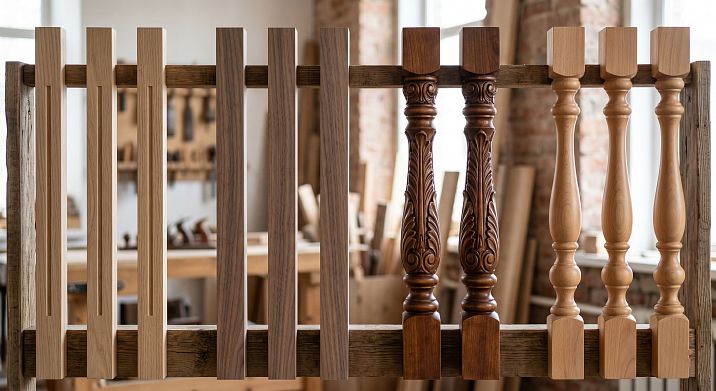
A staircase without a railing is just a structure. A staircase with balusters is architecture. And it is the shape of the baluster that determines whether this architecture will speak the language of strict geometry, classical elegance, folk ornament, or modern minimalism. Shape is not a detail, it is a concept.
When a person first encounters the choice of balusters, they often get lost: catalogs offer dozens of profiles, and they all look different, but it is unclear how they fundamentally differ. Flat wooden balusters, square, turned, carved — what is the real difference and how to choose what suits your staircase, your home, your interior?
Answering this question requires not just listing types, but understanding the logic behind each shape. That is exactly what we will do — consistently, without haste, with examples and specific recommendations.

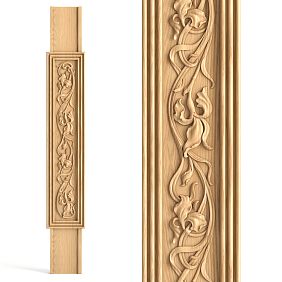

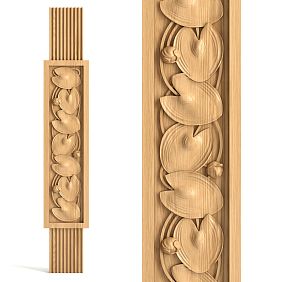

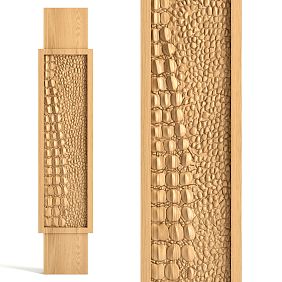

Why the shape of a baluster changes the entire look of the staircase
Imagine two identical flights of stairs — identical steps, identical wood, identical height. On the first, there are thin square balusters with a clean profile. On the second, there are ornate turned posts with vases and discs. These will be two completely different staircases — in mood, in weight, in the character of the space.
The shape of a baluster works on several levels simultaneously. First, it sets the visual rhythm: each post is a vertical accent, repeating at equal intervals. The more complex the profile, the richer this rhythm. Second, it determines the "weight" of the railing: flat and square balusters give a light, transparent structure; turned ones with large vases — a heavier and more solemn one. Third, the shape creates a stylistic context — hints at an era, tradition, mood.
That is why choosing balusters only by color or wood species is wrong. Shape is primary. It sets everything else. And before buy balusters for the staircaseYou need to clearly answer yourself: what style, what character, what feeling do I want to achieve in the end?




Flat balusters: when they are appropriate
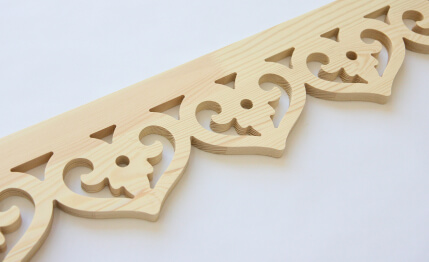
A flat baluster is not a simplification, but a conscious design choice. It is cut from a board or wide blank on a milling or laser machine, has a shaped contour on both sides and flat faces. Unlike a turned or carved baluster, it has no three-dimensional form — it exists in two dimensions.
But that is precisely what makes it special. A flat baluster creates a more "closed" railing — less space is visible behind it. This is not a drawback: in the right context, it is an advantage.
Our factory also produces:


When flat balusters work best
A wooden house in rustic or country style. The flat carved shape with a silhouette of a jug, flower, or geometric pattern is a folk motif that feels organic in a log house, a timber house, or a country cottage with exposed beams. Here, a flat baluster does not look like a simplification — it looks appropriate and homey.
Terrace and porch. Outdoors, flat balusters are often preferable to turned ones: they are less demanding in terms of installation precision and better withstand atmospheric effects due to fewer relief surfaces where moisture accumulates. Flat balusters for a terrace — a popular solution in dacha and country architecture.
Families with small children. A flat baluster with small gaps provides a denser railing. A child cannot easily stick their hand between flat elements as they could between round posts. This is not just a visual effect but a real safety advantage.
Modern rustic style and Scandinavian minimalism. A flat baluster with a simple geometric profile silhouette — arches, trapezoids, rectangles with rounded corners — works well in light, bright interiors with an emphasis on naturalness and authenticity.
Get Consultation
Technical specifications of flat balusters
The thickness of a flat baluster is typically 25–45 mm. The width ranges from 80 to 150 mm depending on the model. The height is standard, like other types: 900–1000 mm full length.
You can buy a flat wooden baluster in several silhouette options. Classic — a symmetrical contour with smooth transitions. Modern — geometrically clear, with straight lines and minimal rounding. Decorative — with a carved or figured top.
A flat baluster is mounted via a tenon from below (into the step or stringer) and fixed to the handrail using metal fasteners or glue. An important detail: during installation, a single direction must be maintained — all flat balusters should face the same way, otherwise the railing looks chaotic.
Is it worth choosing flat balusters for a grand staircase
Honest answer: generally, no. A flat baluster is an element of a democratic, warm, informal interior. In a grand staircase of a country house, in a mansion with high ceilings and stucco, in a neoclassical interior, it will look out of place. For formal spaces — turned or carved shapes.
Square balusters: a strict and modern option
A square baluster is the primacy of geometry over decor. A rectilinear profile, clear cross-section, no vases or discs. That is why it fits perfectly into modern interiors, where geometric purity and rejection of historical ornaments reign.
square balusters for stairs are produced in several versions: strictly square (same cross-section along the entire length), with a slight taper towards the top end, with decorative chamfers on the edges, or with milled grooves — without breaking the straightness of the overall profile.
When a square baluster is the best choice
Modern minimalism and high-tech. In a space where metal coexists with wood, where furniture lacks carved decor, where clean lines are valued — a square baluster looks organic and convincing. It doesn't aspire to historical elegance, but fits perfectly into a modern context.
Loft and industrial style. Here, a square wooden baluster with dark oil or black oak stain creates the right feel of a "raw" material with clear geometry. Combined with metal staircase details — steel stringer, stainless steel handrail — a wooden square baluster provides that perfect balance of warmth and rigidity.
Scandinavian style. A light square baluster made of birch or pine with a clear oil finish — this is an image that works flawlessly in a Scandinavian interior. The simplicity of the form emphasizes the naturalness of the material.
Staircase to the second floor in an apartment. In city apartments with two-level layouts, there is often not enough space for monumental classics. A square baluster is concise, does not overload the space, and looks complete.
Parameters of square balusters
Standard cross-sections: 40×40 mm, 50×50 mm, 60×60 mm. For light modern interiors — 40×40. For more massive structures — 50×50 or 60×60. A 60×60 cross-section already creates a sense of solidity and works well with large posts of 120×120 mm.
An important installation nuance: a square baluster does not require alignment along the axis of rotation (unlike a turned one, which has no "front" and "back" but risks decorative misalignment). This simplifies marking and speeds up installation, especially with a large number of balusters.
Square baluster with decorative elements
A separate category is square balusters with milled grooves (flutes), chamfers, or decorative inlays. They retain the straightness of the profile but gain additional expressiveness. This is an intermediate option between strict geometry and classic decor — a good solution for transitional styles: modern classic, neoclassical in a concise execution, art deco.
Turned balusters: the classic of wooden staircases
A turned baluster is the heart of traditional joinery. It is the first thing that comes to mind when you think of a wooden staircase. It is its silhouette — with smooth vases, necks, cones — that has become the archetype of the baluster as such. Why? Because the turned form is both functionality and beauty, simplicity and richness.
A turned baluster is created on a lathe: the workpiece rotates, the cutter removes material according to a given profile. The result is a symmetrical vertical shape with repeating elements. Depending on the complexity of the profile, a baluster can have from two to three simple elements to seven to eight parts with various transitions.
Types of turned profiles
Simple turned profile. One or two necks, a conical transition, a smooth shaft with a slight taper. Minimalistic, clean, suitable for most classic and transitional interiors. Made from pine, oak, beech. The most affordable price category among turned products.
Vase profile. One or two vases in the center or offset towards the ends of the baluster. A vase is an expanding element that gives the baluster pomp and baroque character. Typical for classic, Provence, neoclassical styles.
Multi-element profile. A sequence of discs, vases, necks, cones. A rich, saturated form, well readable in a row. Used in grand staircases, in interiors with high ceilings and stucco.
Spindle-shaped profile. Symmetrical tapering towards both ends, a smooth expanding center. A light, airy form — slightly stricter than the vase shape, but warmer than the square one.
In which interiors is a turned baluster mandatory
There are spaces where replacing a turned baluster with a square or flat one would be a stylistic mistake. These are houses in the styles of classicism, neoclassicism, baroque, Provence, Empire, Russian noble estate. In such a context, a turned baluster is not an option, but a mandatory element of the stylistic code.
It looks equally organic in interiors with oak parquet, wooden ceiling beams, and a natural stone fireplace. The turned shape creates a sense of rootedness in tradition, craftsmanship, and time.
That is why, when choosing wooden balusters for staircases in a classic home, 90% of designers opt for a turned profile — it is versatile in this context and rarely misses.
Advantages of turned balusters over other types
-
The widest range of profiles — from minimalist to intricate
-
Compatible with most standard handrails
-
Pairs well with turned posts from the same manufacturer
-
Available in all wood species: pine, oak, beech, ash, birch
-
Classic shape never goes out of style
Carved balusters: a decorative accent
If a turned baluster is a classic, then a carved baluster is the highest level of skill. It is carving that turns a functional element into an artistic object. This is no longer just a railing post — it is a sculpture that repeats in a row and creates an ornamental pattern.
Carved wooden balusters They are created on 3D milling machines, which apply a relief ornament to the surface of a turned or square workpiece. These can be flutes (vertical grooves), acanthus leaves, diamond-shaped ornaments, floral motifs, braiding, meander — virtually any flat or three-dimensional ornament that can be milled.
There is also an intermediate type — turned-carved balusters: first, the workpiece is processed on a lathe, giving it a turned profile, then carved decor is applied. This is the richest form of all — it combines the volume of a turned profile and the decorative quality of carving.
When carved balusters are justified
A carved baluster is an investment in the interior. It is 1.5–3 times more expensive than a turned one, requires more careful maintenance and attention during installation. But where it is appropriate — it is irreplaceable.
A grand staircase in a large house. If the staircase is the main architectural accent of the hall or living room, if it is literally looked at as a work of art — Buy carved wooden balusters — this is the right decision.
Baroque, Empire, Classicism, Renaissance. In these styles, decorative richness is the norm and a virtue. A carved baluster is as organic here as a stucco cornice on the ceiling or gilding on a mirror frame.
A house in the style of a Russian estate. Here, a carved baluster is part of a tradition stemming from wooden architecture. Carved window frames, wooden lace on cornices, patterned railings — all of this is a single architectural language in which the carved baluster occupies its rightful place.
Representative spaces. Hotels, restaurants, clubs with wooden interiors — here, a carved baluster creates a feeling of status and attention to detail that the guest intuitively perceives.
Types of carved ornament
| Type of ornament | Character | Suitable style |
|---|---|---|
| Flutes (grooves) | Strict, vertical rhythm | Classicism, Empire, Neoclassicism |
| Acanthus leaf | Natural, Baroque | Baroque, Renaissance |
| Diamond-shaped ornament | Geometric, concise | Art Deco, modern classic |
| Braid | Decorative, folk | Russian estate, rustic |
| Floral motif | Soft, romantic | Provence, country |
Care for carved balusters
A surface with relief requires more careful maintenance than a smooth one. Carving collects dust in recesses — it needs to be removed with a soft brush or vacuum cleaner with a soft nozzle. With a lacquer coating, a carved baluster is quite practical. With a wax or oil coating, it requires renewal of the coating every 3–5 years.
How to choose the shape of a baluster to match the style of the house
This is the central question to which the entire choice boils down. Let's break it down systematically — by interior styles.
Classicism and neoclassicism
Choice: turned or turned-carved baluster with a vase profile. Wood species — oak, beech. Finish — clear lacquer or tinting with lacquer. Standard diameter — 55–70 mm.
A classic interior is built on symmetry, repetition of motifs, and reference to historical forms. A turned baluster here is not just a practical choice, but a stylistically mandatory element. Square or flat shapes in classic look like a random mistake.
Modern minimalism
Choice: square baluster, cross-section 40×40 or 50×50 mm. Wood species — any, painting in white, gray, or dark oak. Chamfers on edges are acceptable.
Minimalism is the rejection of decoration for the sake of purity of form. Here, a square baluster is the only organic choice. A turned one with vases would look like a quote from another era — appropriate elsewhere, but not here.
Scandinavian style
Choice: a flat baluster with a simple profile or a square one. Light woods — pine, birch. Finish — natural oil or white paint.
Scandinavian style values naturalness, lightness, and functionality. A flat baluster with a clean silhouette or a thin square post creates exactly that feeling — without pomp, without decoration, with an emphasis on the material.
Rustic, country, and village style
Choice: a flat baluster with a figured contour or a turned one with a simple profile. Pine or larch. Finish — matte oil, wax, tint for aged wood.
Country style is an interior with a memory of a village house, with warm light, with wooden details that look 'lived-in'. A flat baluster with a jug or flower silhouette is an archetypal element of this style.
Baroque and Empire
Choice: a turned-carved baluster with fluting or acanthus motif. Oak or beech. Toning + glossy varnish or gilding of individual elements.
Baroque does not tolerate stinginess. Here, the richer, the more correct. A carved baluster with a voluminous profile and decorative milling is exactly what is needed. Flat or square balusters are not just unsuitable here — they ruin the style.
Loft and industrial style
Choice: a square baluster in dark oak or with black paint. Or a turned one with a minimal profile. In combination with metal staircase elements.
In a loft, wood appears as a 'warm' counterpoint to metal and concrete. A square baluster with a dark finish creates this contrast most convincingly.
How to combine balusters with handrail and post
The shape of the baluster is only one third of the equation. The complete look of a stair railing consists of three elements: baluster + handrail + post. All three must work in a unified stylistic and structural key.
Principle of hierarchy
The post is the main element. It is more massive, expressive, and monumental. The baluster is subordinate. The handrail is the connecting horizontal element. Violating this hierarchy — when the baluster is more decorative than the post — creates visual imbalance.
The rule is simple: the style and degree of decorativeness of the post should be equal to or exceed that of the baluster. Never the other way around.
Profile compatibility
The handrail has a bottom groove or recess into which the top tenon of the baluster fits. For standard turned and square balusters with a diameter of 45–55 mm, there are standard handrails with corresponding grooves. But if you choose a non-standard profile — especially a flat baluster of non-standard width — you need to check compatibility in advance.
Purchasing balusters, handrails, and posts from a single manufacturer is the only way to guarantee compatibility without surprises. This approach is offered by staircase components STAVROS — all elements within a series are coordinated in terms of profiles, sizes, and style.
Combining shapes in one staircase
Sometimes the design involves a combination of different shapes: for example, square balusters on the flights and a turned post at the turn. This is acceptable if the decision is deliberate and the contrast creates the desired effect. But it is important that such a combination is planned in advance, rather than arising from an incorrect calculation.
What to choose for a staircase to the second floor
A staircase to the second floor is a special case. It is usually located in the center of the house: hall, living room, open plan. It is visible from everywhere, constantly looked at. There is no room for random decisions here.
If the house is built in a classic style — turned balusters made of oak or beech, turned posts, a handrail with a rounded profile. No square sections — they will disrupt the style.
If the house is modern, with an open plan — square balusters made of light pine or oak, a solid wood handrail with a soft profile, minimal posts. A combination with metal inserts is possible.
If the house is in a rustic style — flat balusters with a figured silhouette, a handrail with a soft profile, wooden posts with simple decoration.
An important nuance for staircases to the second floor: the horizontal railing of a balcony or mezzanine should continue the logic of the flight railing. Changing the type of baluster on a horizontal section is a common mistake. Everything should be systematic: from the first step to the last baluster of the balcony.
Comparison table of baluster types
| Parameter | Flat | Square | Turned | Carved |
|---|---|---|---|---|
| Style | Rustic, country, Scandinavian | Minimalism, loft, modern | Classic, neoclassical, Provence | Baroque, Empire, formal classicism |
| Installation difficulty | Medium | Simple | Medium | High |
| Care | Simple | Simple | Simple | Requires brushing |
| Price range | Medium | Affordable | Medium–high | High |
| Child safety | High (small gap) | Medium | Medium | Medium |
| Visual weight | Medium | Lightweight | Medium–heavy | Heavy |
Errors when choosing a baluster shape
Errors in shape selection are not a disaster, but correcting them without complete dismantling is impossible. It's better to know about them in advance.
Mixing styles on one staircase without a plan. A carved baluster with Baroque ornament and a square post in the loft style is not design boldness, it's a visual conflict. If you want to combine, do it consciously, with an understanding of what exactly you want to achieve.
Choosing a baluster based on a photo without considering the wood species. The same shape in pine and oak are two different balusters in feel. Pine is softer, lighter, with a coarser structure. Oak is denser, darker, with a pronounced grain.
Not considering ceiling height. For low ceilings (2.4–2.6 m), a lush turned baluster with large vases creates a feeling of overload. Here, a light turned or square profile works better. For high ceilings (3 m and above), on the contrary, a large form with rich decor is appropriate and imposing.
Not checking compatibility with the handrail. Flat baluster of non-standard width may not fit a standard handrail — you'll have to mill a groove on site or change the handrail. Check compatibility before purchase.
Ignoring the horizontal railing. If the second-floor balcony is visible from the living room, the type of baluster there should match the stair railing. Switching to a different form "upstairs" disrupts the integrity.
Choosing too complex a profile for a small staircase. A bulky carved baluster with voluminous ornament in a small apartment staircase will turn the space into a clutter of details. The scale of the form should match the scale of the space.
Where to buy the right type of balusters
Shape chosen — now the practical question: where to get what you need without surprises in quality and deadlines.
Buying from the manufacturer is the only way to get guaranteed quality, systematic matching of elements, and the ability to order custom products. The STAVROS catalog features all four types:
-
flat wooden balusters to buy — several models with different silhouettes
-
square balusters for stairs — clean geometry in oak and pine
-
Turned — over 30 profiles from simple to multi-element
-
Carved wooden balusters — classic and turned-carved series
All balusters are made from kiln-dried wood, supplied unlacquered — ready for final finishing. Compatible handrails, posts, and fasteners are in a single catalog staircase components.
About the company STAVROS
STAVROS is a Russian manufacturer of wooden products for stairs and interiors. The company has been operating since 2002, specializing in turned, carved, square, and flat balusters, support posts, handrails, risers, and finishing elements made from solid oak, beech, and pine.
The production is equipped with CNC lathes and 3D milling centers — this ensures geometric accuracy of each product and repeatability of the profile from batch to batch. Sanding is manual, in two to three passes, ready for final coating.
STAVROS offers a full range of beautiful wooden stair balusters in organized series: classic, modern, baroque, folk. Within each series — matching posts, handrails, and fasteners. Contact us to confirm shipping to your destination. and CIS countries. Self-pickup from Moscow and St. Petersburg warehouses. Free kit calculation and consultation.
FAQ: Answers to popular questions
Which balusters are better — flat or turned?
It depends on the style. For classic, neoclassical, Provence — turned. For country, rustic, Scandinavian style — flat. If in doubt, look at the style of doors and furniture: they will suggest the right direction.
Are flat balusters for a wooden staircase reliable?
Yes. A flat solid wood baluster with proper installation provides the same reliability as a turned one. Thickness of 25–40 mm and tenon mounting withstand standard loads.
How to choose the shape of a baluster for a modern interior?
For a modern interior — a square baluster with a cross-section of 40×40 or 50×50 mm. A combination with metal details is possible. Wood species — oak with tinting or light pine with oil coating.
Can I buy carved balusters for a classic staircase in a small house?
Yes. The key condition is scale: choose a carved pattern that matches the size of the room. For a small staircase, a turned-carved baluster with fluting or a diamond pattern is suitable — without overloaded acanthus decoration.
Square wooden balusters for stairs — what are their advantages?
Ease of installation, concise form, compatibility with modern interiors. They do not require alignment along the axis, which speeds up installation.
Where to buy beautiful balusters for a staircase in a house?
In the wooden balusters for staircases STAVROS — all types, all wood species, compatible handrails and posts, free kit calculation.
How to choose the shape of a baluster for a handrail?
The handrail should have a groove or recess compatible with the top tenon of the baluster. Buy balusters and handrails from the same manufacturer — this guarantees compatibility without adjustment.