
























Article Contents:
- What is a large-format ceiling rosette
- When you need a large rosette instead of a regular one
- How to choose the size for the room and chandelier
- Large STAVROS models for chandeliers and large spaces
- CPU-071 — large square rosette for a massive chandelier
- CPU-068 — modular oval composition
- CPU-067 — large-scale composition for formal interiors
- CPU-069 — option for standard rooms with an expressive center
- Square, round, or modular — which to choose
- What to pair a large ceiling rosette with
- How to calculate the purchase of a large-format rosette
- Mistakes when choosing large ceiling decor
- Installation of a large-format rosette: key steps
- About the Company STAVROS
- Answers to popular questions
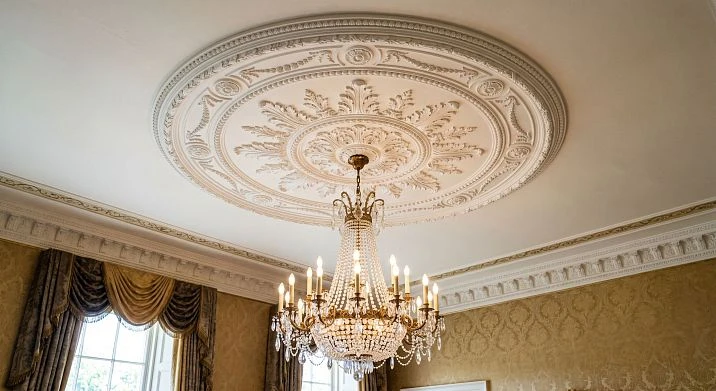
Large-format polyurethane ceiling rosette — it's not just a decorative detail around a chandelier. It is the architectural dominant of the ceiling, the central axis of the entire interior composition, the point that draws the eye from any corner of the room. In a large living room, hall, foyer, restaurant, hotel, or formal interior, a small, modest rosette simply gets lost — it doesn't hold the space, doesn't set the scale, doesn't create a sense of architectural completeness. That is why choosing a large-format stucco decor for a chandelier is a decision that requires an understanding of proportions, shapes, relief, style, and technical characteristics of the material.
In this article — everything you need to know before buying a large polyurethane ceiling rosette: from principles of size selection to specific models, from selection tables to mistakes most often made when designing ceiling decor.
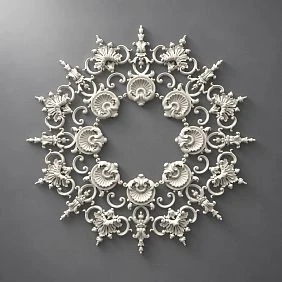
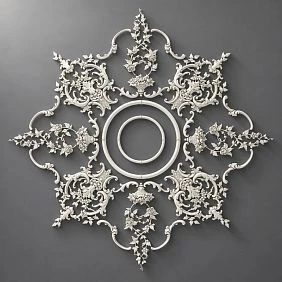
What is a large-format ceiling rosette
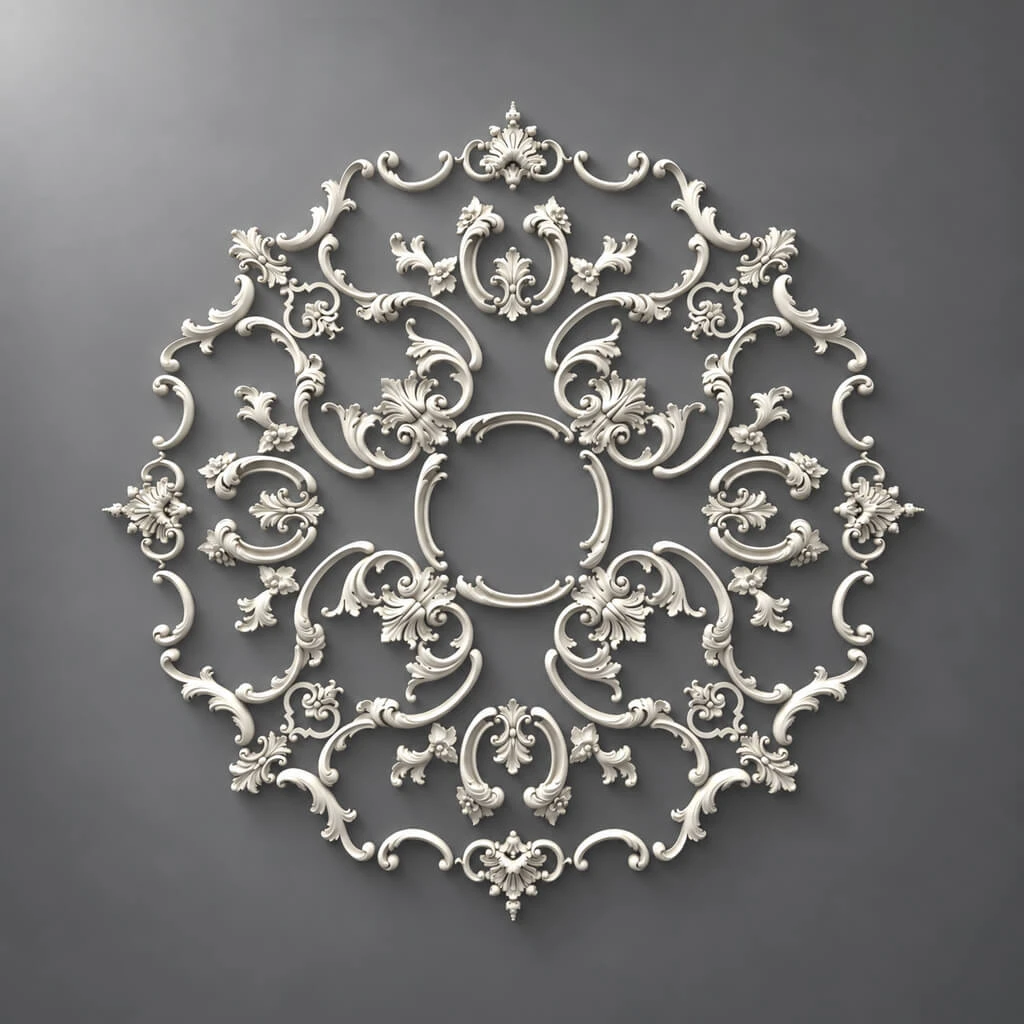
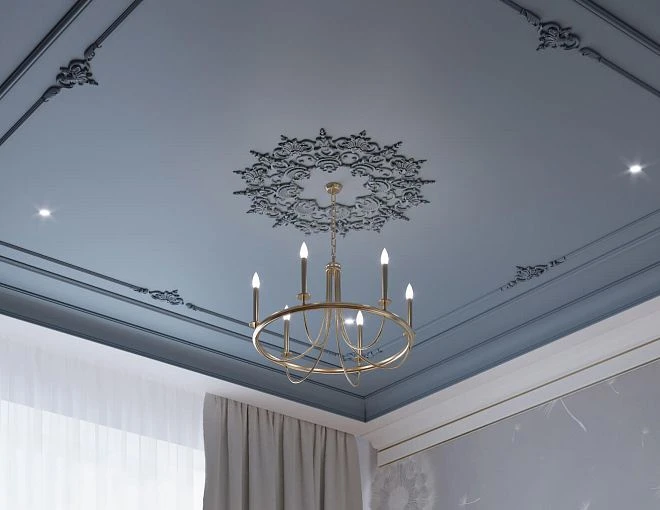
A ceiling rosette is a decorative architectural element installed in the center of the ceiling as a frame for a chandelier or a light fixture attachment point. In a classic design, it is a round stucco medallion with an ornament. But in a broad sense, a rosette is any central ceiling composition: square, oval, modular, baroque, or laconic neoclassical.
A large-format ceiling rosette differs from a standard one not just in size — it fundamentally changes the logic of working with the ceiling. A standard rosette with a diameter of 30–50 cm performs a local task: hiding the chandelier mounting point and creating a decorative accent. Large-format ceiling decor — from 90 cm and above — works differently. It sets the scale of the entire room, organizes the space around itself, and becomes an architectural center visible from any point in the room, perceived as a full-fledged ceiling "facade."
Among ceiling fixtures made of polyurethane Large-format products and modular compositions are considered to be those from 900 mm and larger. This is no longer just a rosette under a chandelier — it is a large ceiling medallion, a central ceiling molding that forms the entire vertical axis of the interior.
It is important to understand: a large polyurethane ceiling rosette is not a monolithic product measuring one and a half meters on a side. Most often, it is a modular ceiling system: a set of individual elements of different types, which are installed piece by piece according to a pre-designed scheme and, as a result, come together into a single large-scale ceiling composition. This approach simplifies transportation, reduces installation risks, and allows for creating ceiling solutions of exceptional complexity and artistic richness.

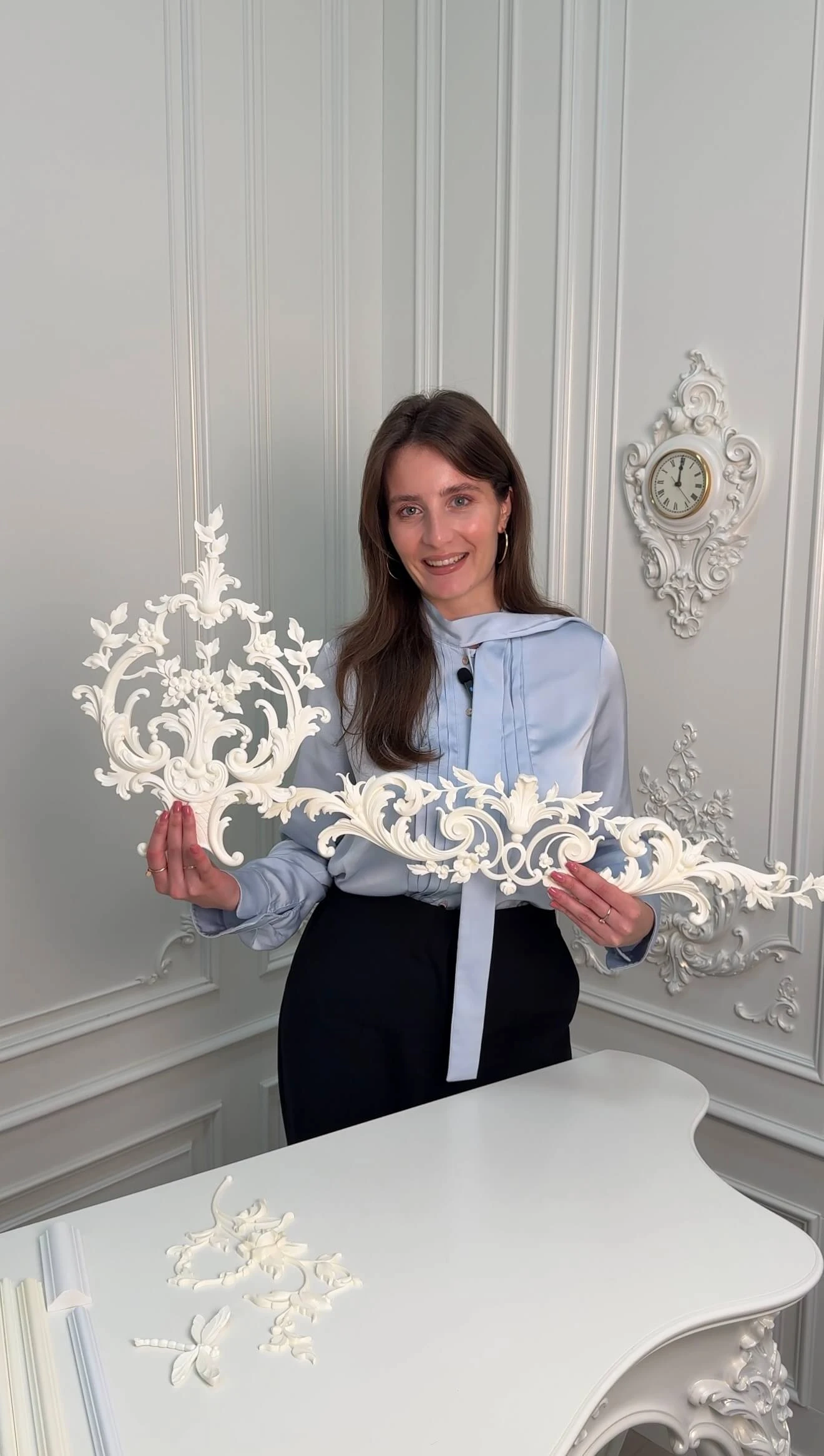
When you need a large rosette, not an ordinary one
A question almost everyone asks when decorating a spacious living room or hall: "Won't an ordinary rosette work?" The answer is direct: in some situations — it won't. And it's not about personal preferences, but about the objective laws of interior proportions.
Here are specific situations where a large rosette under a chandelier is the only correct solution:
-
Room larger than 25–30 m² — a standard rosette with a diameter of 40 cm on such a ceiling looks like a coin on a tablecloth. The ceiling area requires a large-scale decorative accent.
-
High living room or hall — the higher the ceiling, the larger the central decor should be. With a ceiling of 3.5 m and above, a small rosette simply won't be "readable" from floor level.
-
Massive chandelier with a diameter of 80–120 cm — a heavy multi-arm light fixture without proportionate framing hangs like a technical object not integrated into the architecture.
-
Classic interior with moldings, cornices, pilasters — the decorative system cannot have a weak central element. A richly decorated perimeter requires an equally rich center.
-
The ceiling looks empty — a large white horizontal plane without a central organizing element creates a feeling of incompleteness.
-
A formal area, a representative interior — a hotel lobby, a restaurant hall, a banquet room, a meeting room — all these spaces require an architectural statement on the ceiling.
-
There is a ceiling frame made of moldings — a frame system implies the presence of a central accent. Without it, the frame "hangs in the air."
-
A regular rosette is already installed and looks small — the most common request: "They installed a small one, the chandelier covers it, a large one is needed."
-
The interior of a restaurant, cafe, hotel, or salon — a commercial interior works on impression. A large polyurethane ceiling medallion is one of the most effective tools for creating the desired atmosphere.
-
A central architectural accent is needed without a complex multi-level system — sometimes one well-chosen large decor gives a greater effect than a complex ceiling system of dozens of elements.
Our factory also produces:
How to choose the size for the room and chandelier
This is the most practical question — and the most common source of errors. Choosing the size of a ceiling rosette depends on five parameters: room area, ceiling height, chandelier diameter, interior style, and the presence of adjacent decorative elements.
| Condition | What to consider |
|---|---|
| Small room up to 20 m² | A compact rosette is better; large decor will overload the ceiling. |
| Living room 25–35 m² | Large decor from 90 × 90 cm can be considered |
| Hall or grand entrance | A large-scale composition from 130 × 130 cm is needed |
| Chandelier 80–120 cm | A large rosette of comparable or larger size is needed |
| High ceiling from 3 m | More active relief and larger decor are acceptable |
| Low ceiling 2.5–2.7 m | Be careful with large relief thickness, prefer flat shapes |
| Classic with moldings | Expressive deep ornament |
| Neoclassical | Cleaner form, less overload with details |
| Restaurant, hotel | Grand scale, monumental solutions |
| There is a ceiling frame | The rosette must fit into the frame in size |
Principle of rosette and chandelier ratio: the diameter or size of the rosette should be equal to or exceed the diameter of the chandelier — no more than one and a half times. If the chandelier is 90 cm, the ideal rosette is 90–130 cm. A rosette that is too small under a large chandelier makes the fixture "overwhelming" the decor. One that is too large creates the effect of an empty ring around a modest fixture.
Principle of proportion to area: the rosette should not occupy more than 15–20% of the ceiling area. For a room of 30 m² with a ceiling about 5 × 6 m — the allowable rosette size in the center is up to 130 × 130 cm. For a hall of 50 m² — up to 170 × 170 cm.
The principle of height: the higher the ceiling, the greater the depth of the relief can be. On a 2.5 m ceiling, thick 20 mm stucco creates a feeling of heaviness. On a 3.5 m ceiling, the same thickness is already thin and aristocratic.
Get Consultation
Large STAVROS models for chandeliers and large rooms
CPU-071 — large square rosette for a massive chandelier
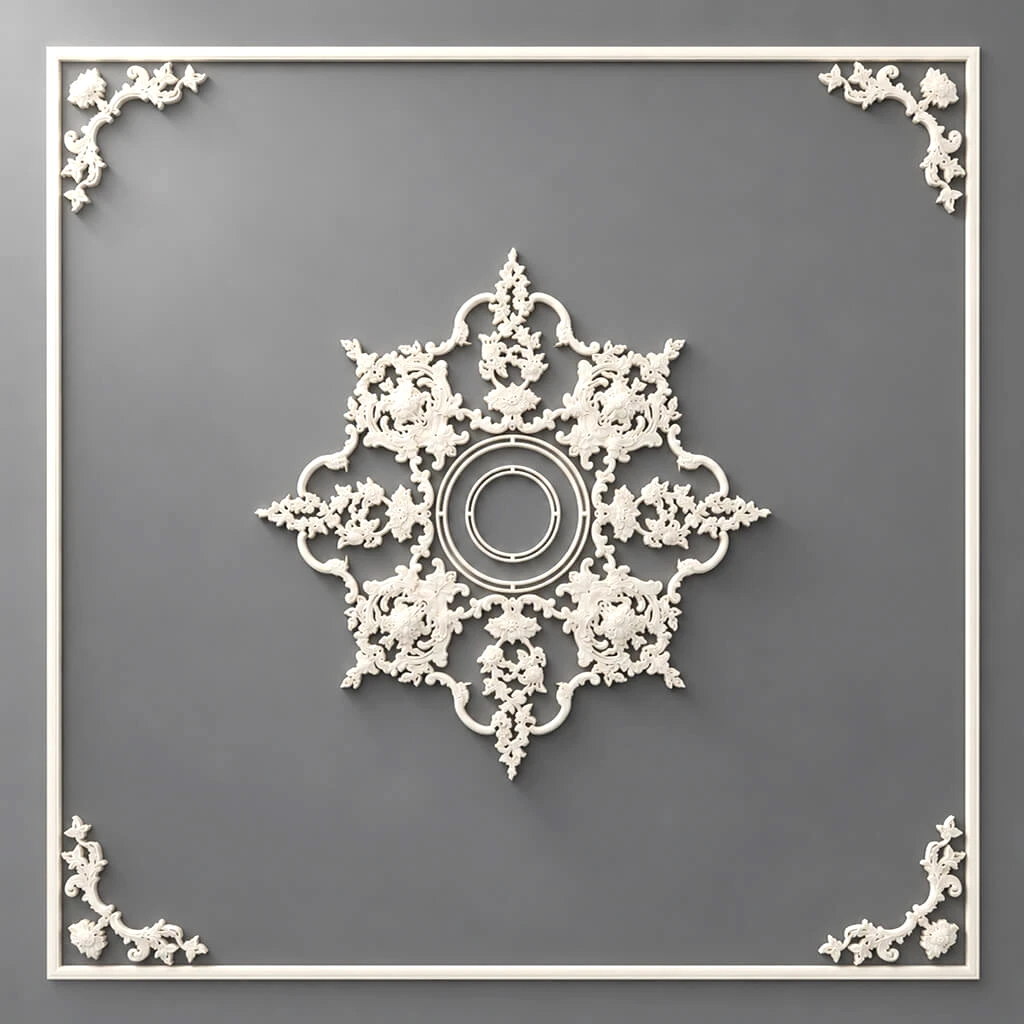
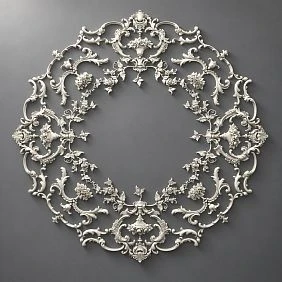
Ceiling rosette CPU-071 — this is an exemplary solution for a spacious classic living room, hall, or grand ballroom. Size — 1365 × 1365 × 19 mm. Square shape with an inscribed circular ornamental composition. Relief depth — 19 mm, ensuring expressive play of light and shadow in any lighting scenario.
The model is designed for rooms of 30 m² or more with a ceiling height of at least 3 meters. The ornamental design is rich Baroque with acanthus scrolls, floral rosettes, rocaille elements, and radially diverging rays. In the center — a double concentric ring for installing a massive chandelier with a diameter of 80–120 cm.
Kit contents: monumental element NPU-464 (300 × 420 × 15 mm), decorative panels NPU-475 (350 × 180 × 16 mm), symmetrical pairs NPU-430L/R and NPU-431L/R, central molding system MLDPU-027U-1 and MLDPU-027U-2. This is not just a rosette — it is a full-fledged ceiling architecture that, even without a molding frame, organizes the center of the ceiling at the level of a palace interior.
CPU-071 is chosen for formal living rooms with high ceilings, halls of private houses, restaurant halls, banquet rooms, and representative interiors. Ceiling stucco decor of this scale works as a central architectural accent — it does not need to be supplemented, it is a complete statement in itself.
CPU-068 — modular oval composition
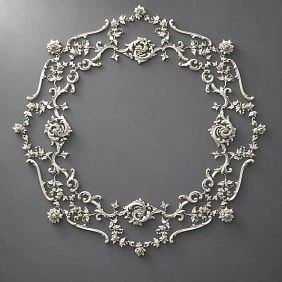
Stucco decor CPU-068 — this is a solution for those who want not just a large rosette, but a complex multi-level ceiling center with high artistic value. Size — 1325 × 1325 × 18 mm. Feature — an oval configuration within a square outline, creating a soft organic silhouette characteristic of French Rococo and Neoclassicism.
The set consists of 72 elements of 12 types. This is a large-scale modular ceiling system assembled piece by piece according to the scheme: main structural panels NPU-461L/R (195 × 112 × 13 mm), transition elements NPU-472L/R and NPU-433L/R, accent inserts NPU-431L/R and NPU-325, detailing elements NPU-309, NPU-112, and NPU-306.
The plant ornament — stylized acanthus leaves, vine tendrils, floral curls — features naturalistic detailing. The relief depth of 18 mm creates rich chiaroscuro. The oval shape is especially organic in elongated rooms, dining areas, living rooms with a wide sofa group, and spaces where a central accent is needed without the rigid geometry of a square.
CPU-068 — a choice for classic and neoclassical interiors, French living rooms, restaurant spaces with an atmosphere of refinement, halls of private homes, and premium-class apartments.
CPU-067 — a large-scale composition for grand interiors
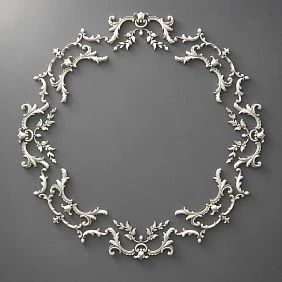
Stucco decor CPU-067 — this is the largest item in the category of large-format ceiling rosettes. Size — 1770 × 1770 × 20 mm. Composition area over 3 m². Set composition — 64 elements of 16 types. Such a composition requires rooms from 40 m² with a ceiling of 3.2 m and higher.
CPU-067 — this is a Baroque ceiling decor of the highest scale. Such large ceiling stucco is installed in grand halls of private residences, in hotel lobbies and lounges, in restaurant halls with high vaults, in banquet spaces, and concert halls. The relief depth of 20 mm and a rich ornamental program of 16 types of elements create a complex system of chiaroscuro that changes depending on the direction and intensity of lighting.
Such a large-scale composition under a chandelier is no longer an addition to the interior. It is the interior itself. Everything else — walls, furniture, lighting — becomes a context for this ceiling statement.
CPU-069 — a variant for standard rooms with an expressive center
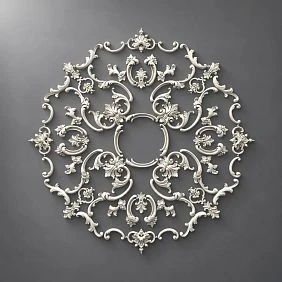
Stucco decor CPU-069 — an intermediate solution between a standard rosette and a monumental grand composition. Size: 910 × 910 × 15 mm. Set: 64 elements of 15 types. This is a modular square system, organic for living rooms of 20–30 m² with a ceiling height of 2.7 m.
CPU-069 is chosen when an expressive central accent is needed without the monumentality of CPU-071 or CPU-067. Such a large rosette for the living room is proportionate to standard rooms, but at the same time significantly richer in artistic design than a regular compact rosette. This is the optimal size for a chandelier with a diameter of 60–90 cm in a spacious bedroom, study, or small hall.
Square, round, or modular — what to choose
The shape of a large-format rosette is not just about aesthetics. It is an architectural solution that influences the perception of the entire room.
| Format | When it fits |
|---|---|
| Round rosette | Classic chandelier, soft center, square rooms |
| Square rosette | Strict geometry, ceiling frame, classic interior |
| Oval composition | Elongated room, dining area, French style |
| Modular system | Large ceiling, grand effect, 40+ m² |
| Rosette + moldings | When you need not only the center but also a frame system |
| Rosette + backlighting | Modern classic, neoclassical, contour LED backlighting |
Round rosette — a universal shape. It is organic in almost any room, does not conflict with the geometry of a square room, and creates a soft, smooth accent. Works well with plate chandeliers, pendant lights, and lampshade structures.
Square rosette — an architectural choice. This shape implies a ceiling frame made of of polyurethane moldings, orientation along the room's axes, strict symmetry. In a classic interior with wooden panels and parquet flooring, a large square rosette is definitely the right solution.
Oval or modular system — for those who want not just an accent, but a complex ceiling statement. A modular ceiling composition made of polyurethane is assembled from dozens of elements and creates a system with multiple ornamental levels that cannot be confused with standard ceiling decor.
What to pair a large ceiling rosette with
A large-format ceiling rosette does not exist in isolation. It is part of the architectural language of the interior, and this language must be consistent. Here is what should be considered together with a large rosette:
-
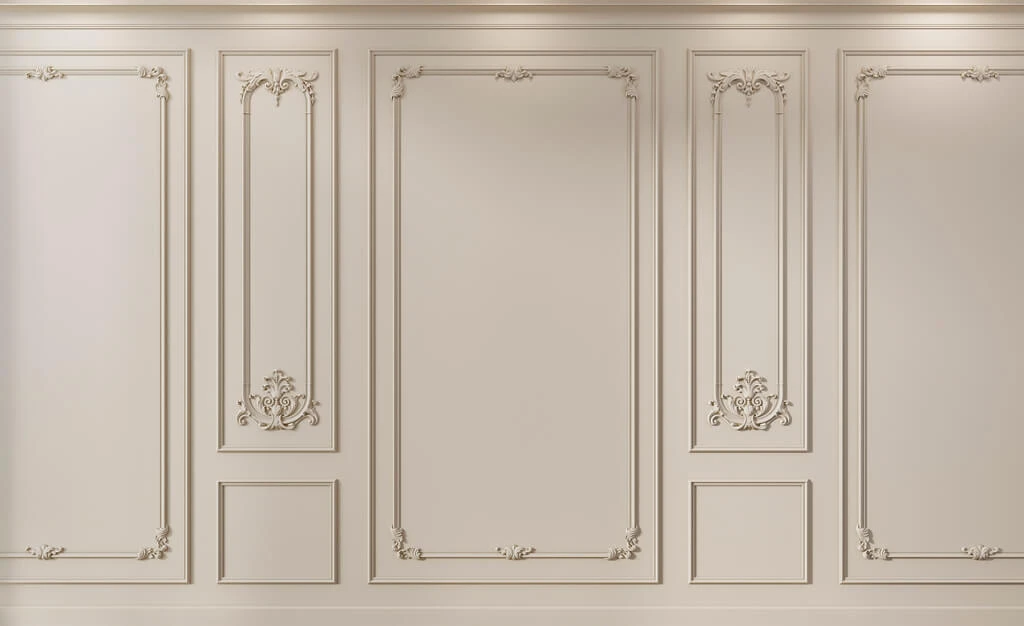
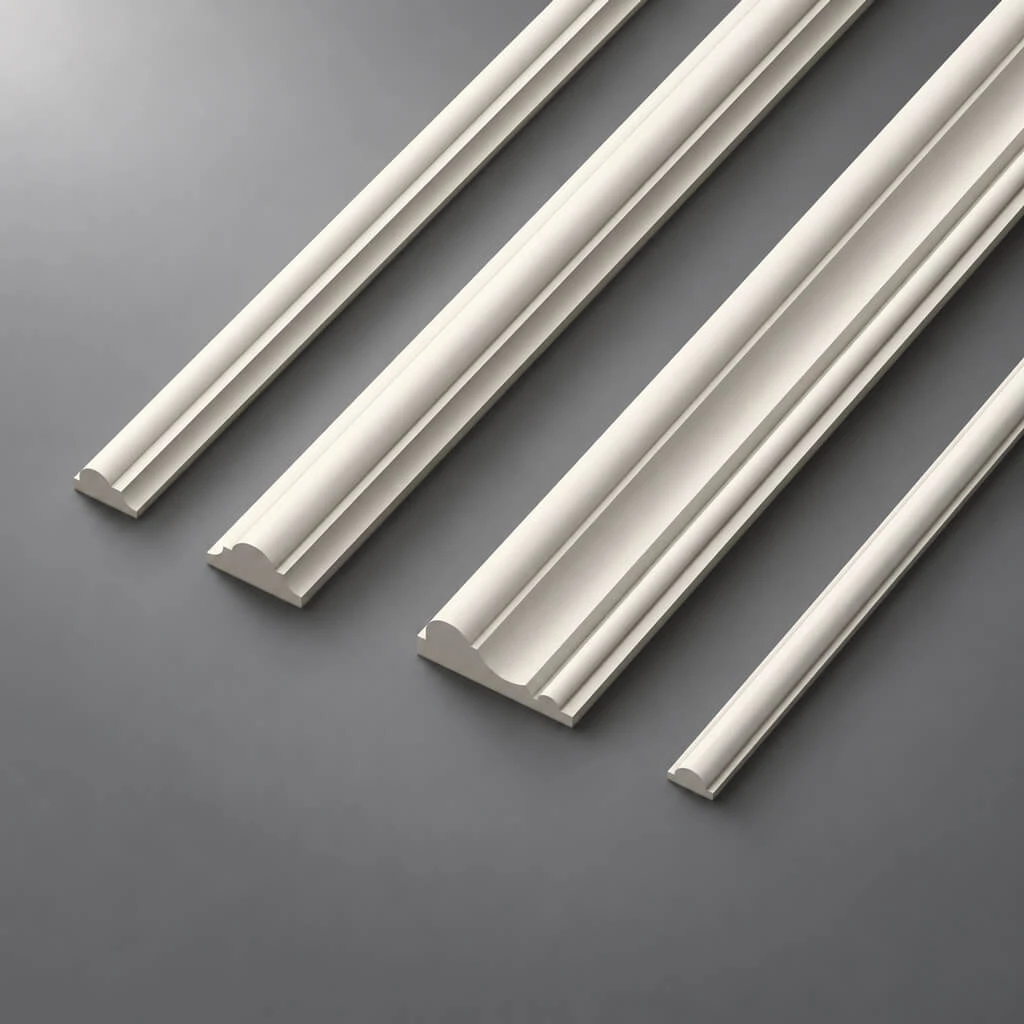
Moldings made of polyurethane — a ceiling frame made of moldings frames the rosette area and creates an architectural context for the central accent.
-
Polyurethane cornices and baseboards — a perimeter cornice connects the ceiling to the walls and creates a decorative hierarchy: cornice → frame → rosette.
-
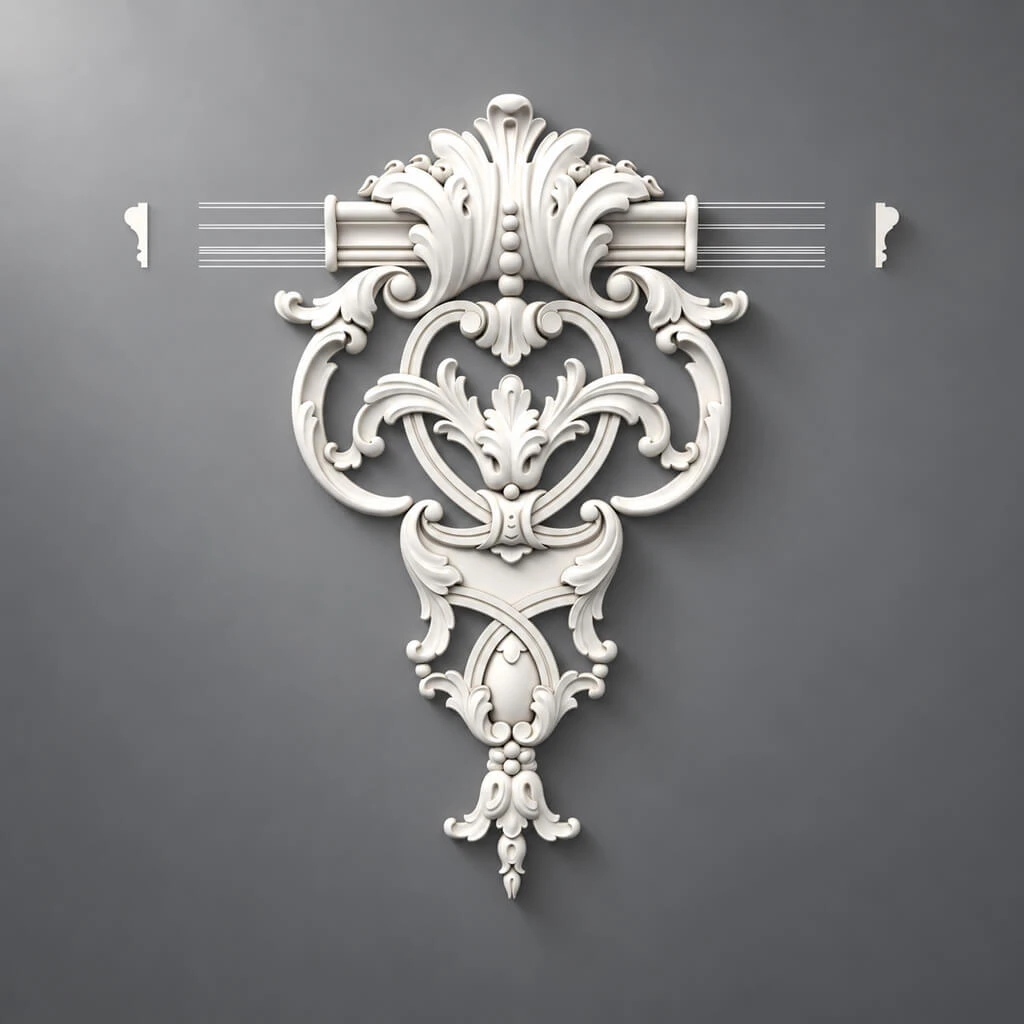
polyurethane ceiling decor — ready-made ceiling decor kits that already include a system of cornices, molding contours, ornamental overlays, and a central element.
-
molded decoration made of polyurethane — wall overlays, corner elements, decorative inserts — things that can extend the ceiling theme to other planes.
-
Hidden lighting behind the cornice — an LED strip behind the perimeter cornice creates a soft contour light that, in evening lighting, emphasizes the relief of the rosette and makes the ceiling composition three-dimensional.
-
Decorative molding frames on the walls — connect the ceiling decor with vertical planes and create a unified ornamental language throughout the entire volume of the room.
-
Baseboards and friezes — complete the decorative system across all planes.
The main principle of combination: the ornamental language must be unified. If a rosette with a plant acanthus ornament is chosen, the cornices and moldings should be from the same stylistic line. Mixing baroque curls with geometric art deco moldings is stylistic chaos that devalues even the most expensive rosette.
How to calculate the purchase of a large-format rosette
Buying large ceiling decor is not an impulsive decision. To make the result meet expectations, you need to follow a specific algorithm:
-
Measure the room area — length × width, taking into account ledges and niches.
-
Check the ceiling height — with a tape measure at several points (ceilings can be uneven).
-
Measure the diameter and weight of the chandelier — it is important that the central hole of the rosette matches the mounting element of the light fixture.
-
Determine the center of the ceiling — by diagonals from the corners. Mark the point with a pencil or laser.
-
Choose the shape of the rosette — round, square, oval, or modular.
-
Check the relief thickness — for low ceilings, flat elements up to 15 mm are preferable; for high ceilings, 18–20 mm is possible.
-
Select moldings and ceiling frame — check if there are compatible profiles in the same style in the catalog.
-
Count additional elements — corners, joints, expansion joints, decor for moldings.
-
Select glue and primer — specialized glue for polyurethane stucco.
-
Decide on painting — paint before installation (easier and better quality) or after (if seamlessness is important).
Pay special attention to modular systems like CPU-068, CPU-067, or CPU-071. Before ordering, do a preliminary layout on the floor: lay out all 64–72 elements in the design scheme and check that no element extends beyond the planned area and that the center of the composition aligns with the wiring exit point.
Mistakes when choosing large ceiling decor
This is the most valuable section of the article — not because mistakes are beautiful, but because each one costs time, money, and nerves.
They buy a large rosette without considering the ceiling height. A 1365 × 1365 mm rosette with a 2.5 m ceiling will overwhelm the space. The scale of the stucco should match the room height.
They take a small rosette for a massive chandelier. A chandelier with a diameter of 100 cm and a rosette with a diameter of 40 cm is an optically incorrect ratio. The chandelier "eats" the decor.
They choose a large relief for a low room. A 20 mm thickness of elements on a 2.5 m ceiling creates a feeling of heaviness and pressure.
They do not check the chandelier diameter and do not compare it with the central hole of the rosette. Result: the chandelier does not fit, requiring rework.
They do not take into account the shape of the room. A square composition in an elongated rectangular room looks shifted and out of place. For elongated rooms, an oval or rectangular format is suitable.
They place a square composition without connection to the ceiling frame made of moldings. A square rosette "in the air" without a frame looks unfinished. A frame is a mandatory element for square shapes.
They do not plan the painting in advance. Polyurethane stucco requires priming and painting. If painted after installation, it is difficult to paint the corners. If painted before installation, there is a risk of damage during installation. The decision is made in advance.
They buy the rosette separately from the moldings and cornice. As a result, there is incompatibility in style or profile, reordering, and delays.
They do not perform a preliminary layout of the modular system. For sets of 60–70 elements, this is a mandatory step, not optional.
They do not check the mounting point of the chandelier. If the wiring outlet point does not coincide with the center of the rosette, electrical redesign will be required.
Installation of a large-format rosette: key stages
A large ceiling rosette is installed differently than a standard one. Several fundamental differences:
Marking. Must be done with a laser level. The center and axes are determined with an accuracy of 5 mm. For a modular system, the positions of all groups of elements are marked.
Surface preparation. The ceiling is dusted, and if necessary, primed with a strengthening compound. Grease stains and old paint are removed. Irregularities are filled with putty.
Adhesive composition. For large ceiling elements, a specialized adhesive for polyurethane moldings is used — hybrid or acrylic with high initial adhesion. Apply with a notched trowel along the perimeter and diagonals of the element.
Installation. Large elements are installed by two people — one holds, the other presses and levels. After positioning, secure with temporary supports for 12–24 hours.
Additional fastening. For elements from 300 × 300 mm and heavy large decorative panels — additional point fastening with dowel nails in places hidden by the ornament.
Finishing. Joints between elements — acrylic sealant, sanding, primer, painting. The color must be uniform throughout the entire system.
Painting a polyurethane rosette for painting is a mandatory step. White moldings in most interiors are a classic choice. Patination with gold or silver — for Baroque and Rocaille interiors. Tinting to ivory — for neutral warm classics.
About the company STAVROS
STAVROS is a Russian manufacturer of architectural decor from polyurethane and wood, operating on the market since 2002. The company was founded by two artists — Andrey Ragozin and Evgeny Tsapko — as a workshop for carved wood products. Within a year of its founding, STAVROS participated in the reconstruction of the Konstantinovsky Palace in Strelna. Subsequently, the company worked on cultural heritage sites: the Hermitage, the Alexander Palace, the Trinity-Izmailovsky Cathedral, and the Sheremetev Mansion.
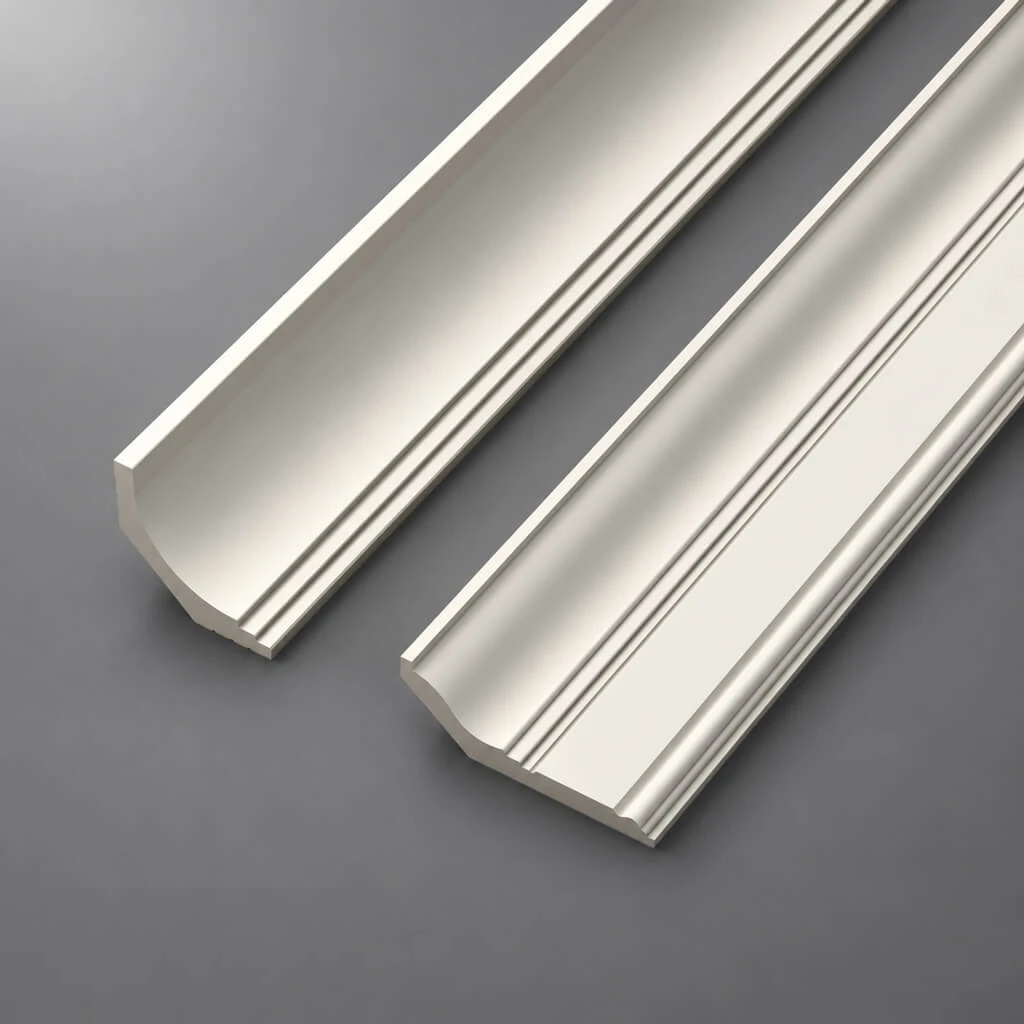
Today, STAVROS produces a full range of architectural decor from polyurethane: ceiling rosettes, moldings, cornices, baseboards, ceiling kits, wall overlays, furniture elements. Production is located in Saint Petersburg, showrooms — in Saint Petersburg and Moscow. Delivery — throughout Russia and CIS countries.
All STAVROS products are supplied primed, ready for finishing. Production time — from 3 working days (stock program) to 5–10 working days (custom-made products). The company has 264 reviews with a rating of 5.0 and is a reliable supplier polyurethane molding decoration for private and commercial projects.
Answers to Popular Questions
What is a large-format ceiling rosette?
It is a large stucco element or modular ceiling composition made of polyurethane, sized from 90 × 90 cm and larger, installed in the center of the ceiling as the main architectural accent and chandelier frame. Unlike a standard rosette, large-format decor works with the scale of the entire room.
When is a large rosette for a chandelier needed?
When the room is larger than 25–30 m², the ceiling is high from 3 m, the chandelier is massive from 80 cm, the interior is classic or neoclassical, the ceiling looks empty or the space is formal. Also for restaurants, hotels, halls, and lobbies.
How to choose the size of a ceiling rosette?
Base it on the room area (rosette no more than 15–20% of the ceiling area), the chandelier diameter (rosette equal to or no more than 1.5 times larger than the chandelier), and the ceiling height (the higher the ceiling, the deeper the relief can be).
Which rosette is suitable for a chandelier 80–120 cm?
A large-format rosette from 1300 mm. For example, CPU-071 (1365 × 1365 mm) — specially designed for massive chandeliers with a diameter of 80–120 cm.
Is a large rosette suitable for a low ceiling?
With caution. For a ceiling of 2.5 m, it is better to choose flat elements with a relief up to 15 mm. Modular systems with a relief depth of 18–20 mm are recommended for ceilings from 2.9 m.
How is a modular ceiling composition different from a regular rosette?
A modular system is a set of dozens of individual elements that are assembled according to a pattern and form a large-scale ceiling composition. A regular rosette is a single solid piece. Modular decor is artistically richer, more scalable, and more complex to install.
Can a polyurethane rosette be painted?
Yes. All polyurethane products come primed. Water-based acrylic paints, enamels, decorative patination, gilding, and silvering compounds are suitable.
How to combine a large rosette with moldings?
The ornamental language should be unified. Choose moldings of the same style — classic floral ornament, geometric neoclassicism, or a minimalist profile. A ceiling frame made of moldings frames the rosette area and creates a decorative context.
How to install large ceiling decor?
Surface preparation, laser marking, glue for polyurethane stucco, two-person installation with temporary supports for 12–24 hours, additional fasteners for large panels, final finishing and painting.
Where to buy a large-format polyurethane ceiling rosette?
In the Stavros catalog — Polyurethane ceiling rosettes. Contact us to confirm shipping to your destination., showrooms in St. Petersburg and Moscow. Phone: +7 (800) 555-46-75. Production — from 3 working days.