










































































Article Contents:
- What is a high skirting board for painting
- When you need a high skirting board instead of a standard one
- How to choose the height of the skirting board for the ceiling and interior
- STAVROS models: high skirting board for painting
- B90V1 — high profile with decorative relief
- L1605 — high skirting board with a laconic profile
- B98V1 — massive skirting board for luxury interiors
- W40V1 — compact moisture-resistant profile for small spaces
- LB99 — baseboard with backlight for modern classics
- B110V1 and B126 — for rooms with ceiling heights from 3.2 m
- B140 — maximum height for grand spaces
- How to choose a baseboard to match your interior style
- Modern interior and minimalism
- Neoclassicism
- Classicism and Baroque
- Neoclassical with backlight
- Premium interior
- Moisture-resistant baseboard: where it is critically important
- What to pair with a tall baseboard
- How to calculate the number of baseboards: step-by-step algorithm
- Painting the baseboard: rules and life hacks
- Mistakes when choosing a tall floor baseboard
- About the Company STAVROS
- Answers to popular questions
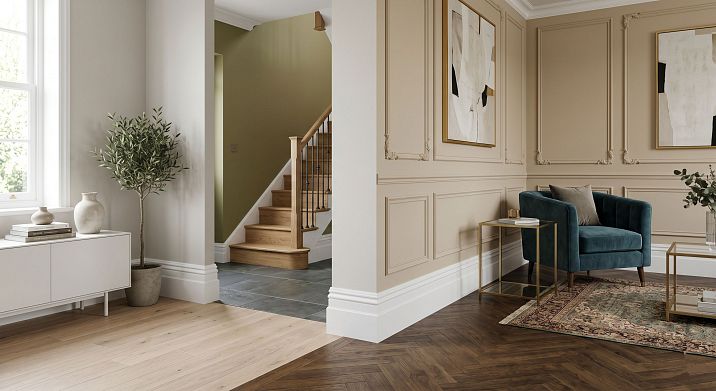
High skirting board for painting — this is the finishing element that either makes the interior complete and expensive, or reveals hasty renovation decisions. A small skirting board in a spacious living room with a 3-meter ceiling looks as incongruous as a narrow tie with a tuxedo. A 40–50 mm profile simply gets lost there — it doesn't hold the space, doesn't connect the floor with vertical planes, doesn't create an architectural base. For apartments with non-standard heights, for houses with spacious halls, for classic and neoclassical interiors, a different scale is needed — from 80 to 140 mm. This is exactly the range offered by HI WOOD skirting boards made of high-density polystyrene: from 58 to 140 mm, moisture-resistant, paintable, with a smooth or embossed front surface, easy to install and durable in use.
To make the right choice, you need to understand: a skirting board is not a "technical" element, but a full-fledged architectural detail. Its height affects the perception of the room, its shape sets the style, its color determines the character of the interior system. This article covers everything you need to know before purchasing: from principles of height selection to specific models and an analysis of the most common mistakes when choosing a floor profile.




What is a high skirting board for painting
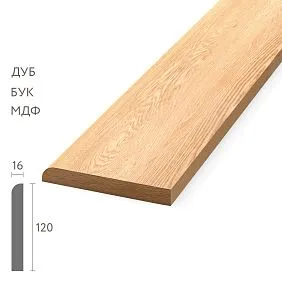
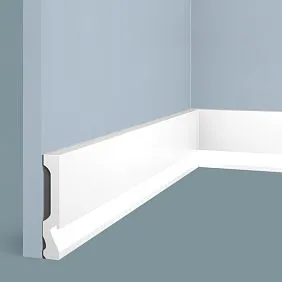
A floor skirting board is a profile strip installed along the perimeter of a room at the junction of the floor and wall. Its purpose is to hide the expansion gap that inevitably forms between the finished flooring and the wall (usually 10–20 mm, sometimes more), protect the lower part of the wall from mechanical damage, and create a visual horizontal line that "gathers" the room's perimeter.
A skirting board is considered high from 80 mm and above. The fundamental difference between a high profile and a standard one is not just in the numbers. A high skirting board is no longer just a technical element hiding a gap, but a full-fledged architectural detail that visually "weights" the base of the walls, creates an architectural base for the interior, and sets its scale. In classical architecture, this was called a plinth: the lower, most durable part of the wall, highlighted plastically.
In the HI WOOD line, represented by STAVROS, paintable skirting boards made of high-density polystyrene (phytopolymer) with a density of 680 kg/m³ — this is a South Korean material produced using patented precision extrusion technology. The white matte surface, ready for painting, allows the profile to be painted in any color with water-based acrylic paints. 100% moisture resistance makes these baseboards universal: they can be installed in bathrooms, kitchens, hallways, near the stove in the kitchen, or in the bathroom near the shower — without risk of swelling, mold, or deformation.




When you need a tall baseboard, not a standard one
The question most often asked: "Why pay more for a tall profile if a regular one also covers the gap?" The answer lies not in the technical plane, but in the architectural one.
-
Ceilings higher than 2.8 m — with a large room height, a 40–58 mm baseboard is perceived as a thin strip near the floor, not holding the space.
-
Spacious living room with an area of 25 m² or more — the scale of the room requires proportionate finishing details.
-
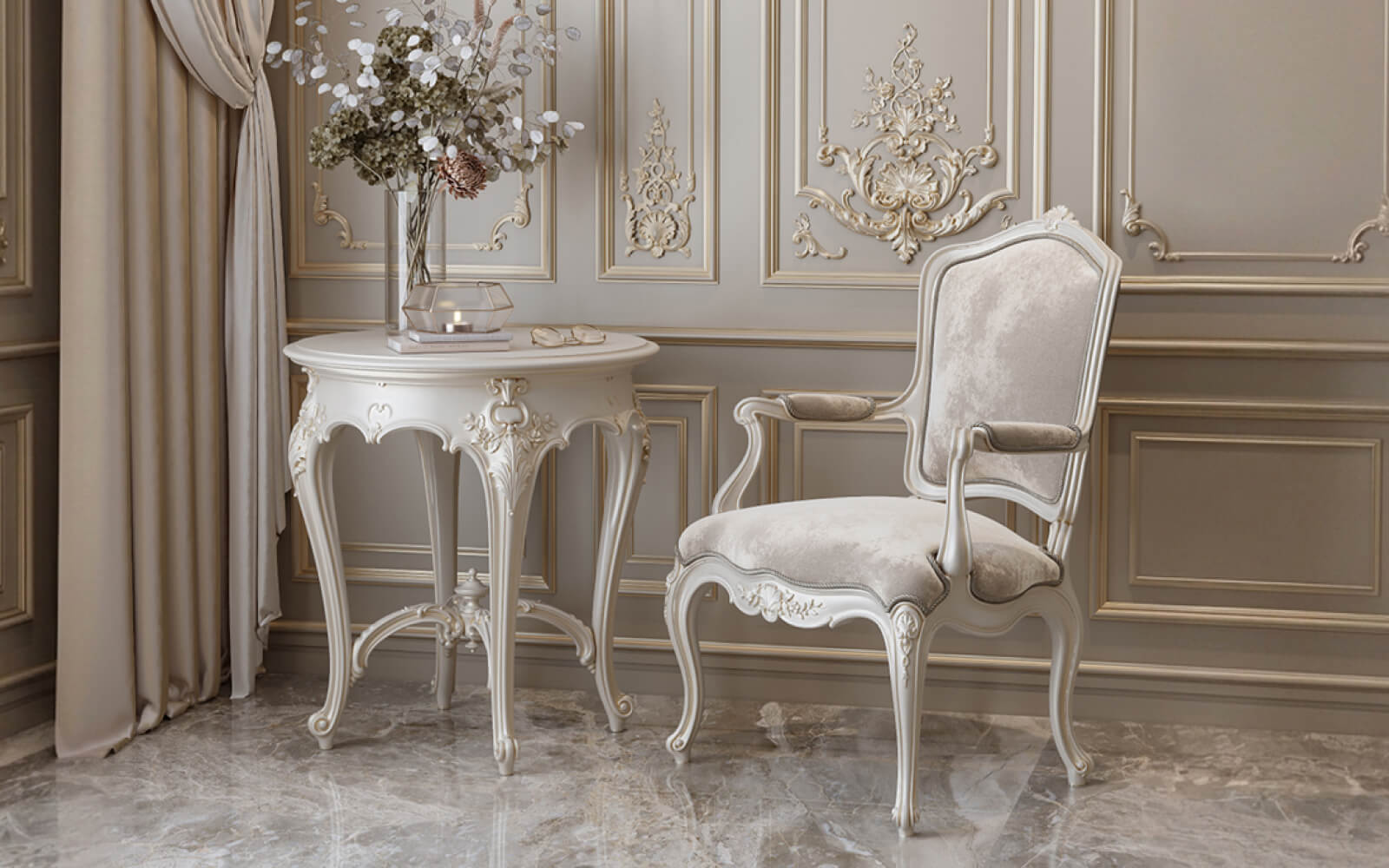
Classic or neoclassical interior — both styles are built on the architectural hierarchy of details: cornice — wall — plinth. The plinth is the tall baseboard.
-
Walls with moldings and panel frames — Moldings made of polyurethane on the walls require a proportionate baseboard at the base. A small profile disrupts the proportion.
-
Doors with tall architraves — if the door casing is wide and tall, a low baseboard looks disproportionate.
-
Premium renovation — in an expensive interior, every detail must match the overall scale. A thin baseboard in a luxury living room is a sign of saving in the wrong place.
-
You need to visually "assemble" the lower part of the wall — a high profile creates a clear horizontal line that structures the space.
-
The baseboard is planned to be painted the color of the walls — for the "baseboard in wall tone" technique, a sufficiently wide profile is needed, otherwise the visual effect is lost.
-
A moisture-resistant profile is needed — in the kitchen, hallway, bathroom, standard MDF baseboards start to swell after a few years. A high moisture-resistant polystyrene baseboard solves this problem.
-
A regular baseboard is already installed and looks small — a common case during renovation of a new building: they installed "whatever was available," and after a year they realize the scale is wrong.
Our factory also produces:


How to choose the height of the baseboard for the ceiling and interior
The correct height of the baseboard is calculated based on three parameters simultaneously: ceiling height, room area, and interior style. These are not three independent factors — they work together.
| Baseboard Height | Where it is appropriate |
|---|---|
| 40–60 mm | Small rooms, ceilings 2.4–2.5 m, minimalism, Scandinavian style |
| 70–80 mm | Standard apartments with ceilings 2.5–2.7 m, universal renovation |
| 90–100 mm | Spacious rooms, ceilings from 2.8 m, neoclassical, classical |
| 120–140 mm | High ceilings from 3.5 m, houses, halls, formal areas, premium interior |
A reliable guideline: the baseboard should be approximately 3–4% of the ceiling height. For a 2.5 m ceiling — about 75–100 mm. For a 3 m ceiling — 90–120 mm. For a 3.5 m ceiling — 105–140 mm. This rule comes from classical architecture, where the proportion of the base to the wall height was strictly observed.
An additional factor is the profile thickness. For rooms with a 2.5 m ceiling, thinner profiles — up to 14–15 mm — are preferable. A thick profile (18–22 mm) on a low ceiling creates a feeling of massiveness and pressure. On a ceiling of 3 m and above, on the contrary, a thicker profile looks monumental and appropriate.
Get Consultation
STAVROS models: high baseboard for painting
B90V1 — high profile with decorative relief
Baseboard B90V1 made of HI WOOD polystyrene — 90 × 14 × 2000 mm. This is a high expressive profile with a figured decorative relief, specially designed for spacious rooms with ceilings from 2.8 m. The relief front section creates horizontal protrusions, grooves, and transitions that form a play of light and shadow around the entire perimeter of the room.
This profile is the right choice for a classic living room, neoclassical hall, formal bedroom. The height of 90 mm hides an expansion gap of up to 20 mm and protects the lower part of the wall to a significant height. The thickness of 14 mm provides rigidity and reliable adhesion to the surface when installed with glue. The internal cavity is a functional cable channel for laying wires without chasing walls.
B90V1 is organic in combination with polyurethane moldings on walls and ceiling cornices — forms a complete decorative system from floor to ceiling. The white matte surface accepts acrylic paint without priming. 100% moisture resistance — installed in any room.
L1605 — high skirting board with a laconic profile
Skirting board L1605 — 90 × 13.7 × 2000 mm. The height is the same as B90V1, but the profile has a more restrained, calm shape — without active decorative relief. This is a choice for those who want a high skirting board without classic details: for modern interiors, neoclassicism with clean lines, Scandinavian classics, or lofts with high ceilings.
L1605 looks good when painted in the wall color — the profile creates a smooth transition from the floor to the vertical plane without overloading the interior with ornamentation. The same option — with contrasting painting in a dark color on light walls: the profile creates a clear graphic line without unnecessary details.
B98V1 — massive skirting board for elite interiors
Skirting board B98V1 — 98 × 19.5 × 2000 mm. Almost 100 mm in height and 19.5 mm thick — this is already a monumental profile. Such a skirting board is chosen for formal interiors with ceilings from 3 m: country houses, large halls, classic-style studies, representative premises.
The thickness of 19.5 mm is not just a technical characteristic. It creates a visible "protrusion" from the wall, which gives a pronounced shadow along the top edge of the skirting board. This is a characteristic feature of high architecture: the skirting board lives in space volumetrically, not as a flat strip. B98V1 combines perfectly with polyurethane wall decor — pilasters, panel moldings, corner elements — and creates a full-fledged premium-class finishing system.
W40V1 — compact moisture-resistant profile for small spaces
W40V1 skirting board — 40 × 10 × 2000 mm. This is the smallest profile in the HI WOOD line, and it is shown here deliberately — to emphasize the fundamental difference in scale. 40 mm is the choice for narrow corridors, small bathrooms, storage rooms, utility spaces, and minimalist interiors where the skirting board should be almost invisible. White matte surface, 100% moisture resistance, easy glue installation — all the same advantages of HI WOOD material, but in a compact format.
LB99 — skirting board with lighting for modern classics
The LB99 model deserves special mention — a 99 × 18 × 2000 mm skirting board with a built-in technical niche for LED strip. This is a solution for interiors where hidden perimeter floor lighting is needed. Contour light from the skirting board niche creates a floating effect — the floor seems to detach from the walls. This technique is actively used in neoclassicism, modern classics, and designer apartments with a well-thought-out lighting scenario.
B110V1 and B126 — for rooms with ceiling heights from 3.2 m
If the ceiling is 3.5 m or higher — B90V1 or B98V1 may look insufficiently large. The HI WOOD line offers B110V1 (110 × 16 × 2000 mm) and B126 (126 × 16 × 2000 mm) skirting boards for such spaces. These are profiles for country houses with grand halls, double-height spaces, restaurant halls, and hotel interiors where a tall floor skirting board of expressive scale is needed.
B140 — maximum height for grand spaces
B140 skirting board — 140 × 17.5 × 2000 mm — the top point of the line. 140 mm is a profile for rooms with ceilings from 4 m: grand halls, historical interiors, public spaces of museum scale. HI WOOD polystyrene allows producing such profiles without loss of geometry precision and without risk of deformation during installation.
How to choose a skirting board to match the interior style
Height is only one of the selection coordinates. The profile shape, presence of relief, and painting method must match the style of the entire interior.
Modern interior and minimalism
For a modern interior — a smooth profile without relief, height 70–90 mm, painted in the wall color or a contrasting dark tone. No figured details, no ornamental protrusions. Profiles L1605 or B80A are the right choice for apartments in a modern minimalist style.
Neoclassicism
Neoclassicism allows for moderate relief, but without Baroque overload. Height 80–100 mm, a calm figured profile, combined with molding frames on walls, ceiling cornices, and door trims. B90V1 is a precise fit for this niche. Decor for Molding — corner accent elements — enhances the system.
Classical and Baroque
For a full-scale classic interior — height from 98 to 140 mm, an expressive relief profile, painted white or with patination. B98V1, B110V1, or B126 create an architectural base proportionate to Baroque chandeliers, stucco, and profile cornices.
Neoclassicism with lighting
A modern interpretation of classics often involves hidden contour lighting. LB99 with a built-in niche for an LED strip is the answer to this request. Height 99 mm, thickness 18 mm, lighting around the entire perimeter.
Premium interior
For premium renovation without compromises on scale — B98V1 or B110V1, dense matte paint, precise corner joining, a complete system: baseboard + cornice + molded decoration made of polyurethane on the ceiling and walls. This is not just a renovation — it is an architectural project.
Moisture-resistant baseboard: where it is fundamentally important
The issue of moisture resistance is often underestimated. People buy MDF baseboards for the kitchen — beautiful, inexpensive. After three to four years: swollen bottom edges, profile pulling away from the wall, stains on the surface. The reason — even 'moisture-resistant MDF' gradually deforms with regular contact with moisture.
High-density polystyrene HI WOOD is a different story. Water absorption over 24 hours is less than 0.1% — practically zero. The material does not swell, rot, or develop mold even with prolonged contact with moisture. Therefore, HI WOOD baseboards can be installed without reservation:
-
In the kitchen — near the stove, sink, and dishwasher area.
-
In the hallway — where the floor regularly gets wet after coming in from outside.
-
In the bathroom and toilet — near the shower, bathtub, and sink.
-
In the laundry room and boiler room — in areas with high humidity.
-
In the pool or hammam — at 100% humidity.
-
In the corridor of a private house — with direct access to the street.
-
In commercial spaces — restaurants, cafes, office kitchens.
At the same time, moisture resistance does not reduce decorative qualities — the white matte paintable surface and precise profile geometry remain unchanged regardless of operating conditions.
What to pair with a tall baseboard
A tall floor skirting board works in conjunction with other finishing elements. The more thoughtful this connection, the more expensive and complete the result looks.
Skirting board + wall moldings. Wall molding frames are the most organic combination. Moldings made of polyurethane on the walls and a high skirting board at the base create a classic panel system. Important: the profiles must be compatible in style — the same relief character, the same height of details.
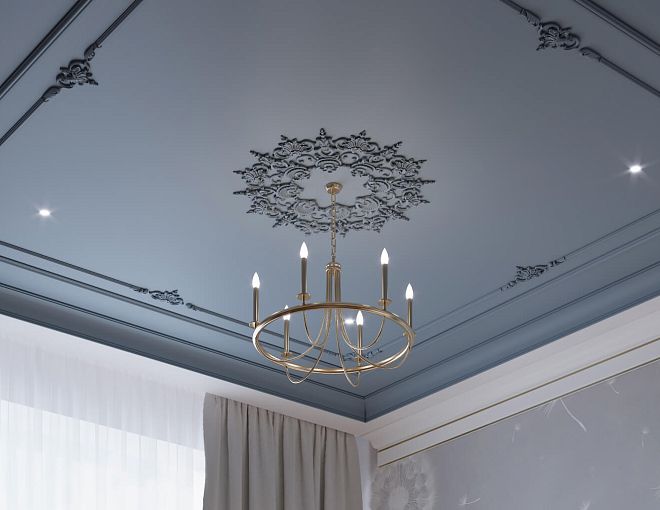
Skirting board + ceiling cornice. The ceiling cornice and floor skirting board are the upper and lower horizontal lines of the interior. They must be proportionate to each other. If the cornice is wide and embossed, the skirting board cannot be thin and smooth.
Skirting board + door architraves. The width of the skirting board and architrave should be comparable. Classic proportion: the architrave is slightly wider than or equal to the skirting board.
Skirting board + wall panels. A high skirting board is the lower part of the wall system. If the wall is decorated polyurethane wall decor with pilasters, overlay panels, the skirting board completes this system from below.
Skirting board + hidden lighting (model LB99). Contour LED lighting behind a special skirting board niche is a modern technique that adds depth and atmosphere to evening lighting.
Skirting board + wall color. The 'skirting board in wall tone' technique works with a profile height of at least 80–90 mm. With a smaller height, the skirting board completely blends with the wall, while the gap near the floor starts to 'show' at the joint.
Skirting board + dark accent. A dark skirting board — anthracite, black, dark gray, or dark blue — with white walls creates a clear graphic line. The technique is especially effective with high profiles from 90 mm.
How to calculate the amount of baseboard: a step-by-step algorithm
-
Measure the perimeter of the room — the sum of all walls along the perimeter. For example: a room 5 × 4 m — perimeter 18 linear m.
-
Subtract door openings — if the door width is 0.9 m, subtract 0.9 m from the perimeter.
-
Check the length of one plank — HI WOOD baseboards have a standard length of 2000 mm (2 linear m).
-
Divide the perimeter by the plank length — 17.1 m ÷ 2 m = 8.55. Round up: 9 planks.
-
Add a 10–15% margin for corner cutting — 9 × 1.15 = 10.35. Order 11 planks.
-
Specify the profile height — according to the specific ceiling height and interior style.
-
Check the thickness — how much the baseboard will protrude from the wall.
-
Decide on the paint color — white, matching the wall, contrasting dark.
-
Choose the adhesive — specialized adhesive for polystyrene baseboards or MS polymer sealant adhesive.
-
Ordering the entire volume as one batch is important so that all planks come from the same production series with identical geometry.
Special note: if the baseboard is purchased together with polyurethane moldings — the calculation is done as a single project, so that all elements arrive in one shipment and fit together seamlessly.
Baseboard painting: rules and life hacks
The white matte surface of HI WOOD baseboards is not a "blank" that needs to be painted immediately. Many leave it white: this is a universal option for most interiors. But if a different color concept is needed, the profile easily accepts paint.
What to paint polystyrene with: exclusively water-based paints. Acrylic interior paints, latex, silicone — all of them adhere well to a prepared surface without priming. Apply 2 coats with a 3–4 hour interval. For textured profiles, a brush with synthetic bristles is more convenient — it paints grooves and protrusions. For smooth profiles, use a velour or microfiber roller.
What is strictly prohibited: paints and primers based on organic solvents. Alkyd enamels, nitrocellulose varnishes, polyurethane enamels with solvents — all of these destroy the molecular structure of polystyrene. The surface softens, deforms, and becomes sticky.
When to paint — before or after installation? Professional approach: paint before installation, apply the final coat after installation with joint sealing. This gives the best result: joints do not remain unpainted, and the surface is monolithic.
Color concepts:
-
White — universal, creates a sense of space and cleanliness, maximally reveals the relief.
-
Matching the wall color — the baseboard "disappears," the wall continues to the floor, and the space is perceived as monolithic.
-
Contrasting dark — a clear graphic line, emphasizes geometry, characteristic of modern classics.
-
Matching the flooring — creates the feeling that the floor is "rising" up the wall, a depth effect.
-
Patination — gold, silver, bronze on the relief for classical and baroque interiors.
Mistakes when choosing a tall floor baseboard
Over many years of working with finishing materials, a clear list of mistakes that are made over and over again has emerged. Here are the most common ones — so you don't repeat them.
They choose a baseboard only by photo without checking the height. A picture in a catalog doesn't give a sense of real scale. Look at the technical specifications: height in mm is the main parameter.
They take a profile that is too tall for low ceilings. A 110 mm baseboard in a room with a 2.5 m ceiling presses on the space and ruins the proportion. The 3–4% rule works.
They use a low baseboard in a large living room with high walls. 40 mm with a 3 m ceiling is a scale mistake. The proportion is broken, the interior looks unfinished.
They don't account for the thickness of door architraves. If the architrave is installed with a 12 mm protrusion from the wall, and the baseboard has a thickness of 19.5 mm, the profile will hit the architrave. A preliminary fitting is needed.
They do not check moisture resistance for kitchens and hallways. They buy a beautiful MDF baseboard and after 2–3 years get a swollen profile that is coming away from the wall. HI WOOD moisture-resistant baseboards are the only correct solution for wet areas.
They do not add a margin for cutting. A standard mistake: they calculate linear meters "tightly." Always add 10–15% for cutting corners and possible defects.
They paint the baseboard after installation without pre-painting. Corners and joints painted only after installation often have unpainted areas in grooves and gaps. It is better to apply the base coat before installation.
They do not think through the color: white, matching the wall, or contrasting. The color of the baseboard is a design decision, not "whatever works." Define the concept before purchasing.
They join baseboards with moldings of different scales. A high baseboard of 90 mm with thin moldings of 15 mm width is a stylistic break. The scale of details must be coordinated.
They buy the baseboard separately from the rest of the decorative profile. Moldings, cornices, baseboards are a system. Buying in parts means risking incompatibility in style or profile during final assembly.
About the company STAVROS
STAVROS is a Russian manufacturer of architectural decor from polyurethane, polystyrene, and wood with a history since 2002. The company was founded by artists Andrey Ragozin and Evgeny Tsapko as a workshop for carved wooden products. Already in 2003, STAVROS participated in the reconstruction of the Konstantinovsky Palace in Strelna. Among the completed projects are the Hermitage, the Alexander Palace, the Trinity-Izmailovsky Cathedral, and the Sheremetyev Mansion.
Today STAVROS is a full-fledged manufacturer and distributor of architectural decor. The assortment includes: HI WOOD skirting boards with heights from 58 to 140 mm, Moldings made of polyurethane, ceiling cornices, Wall Decor, Decor for MoldingCeiling rosettes and decorative sets. Production in Saint Petersburg. Showrooms in Saint Petersburg and Moscow. Delivery across Russia and CIS countries. Shipment from warehouse from 3 working days.
Answers to Popular Questions
What is a high skirting board for painting?
A floor profile with a height of 80 mm or more with a white matte surface that accepts acrylic paint of any color. Made of high-density polystyrene (HI WOOD), installed around the perimeter of the room at the base of the walls.
What height of skirting board should I choose for an apartment?
For standard apartments with a ceiling of 2.5–2.7 m — 70–80 mm. For spacious rooms with a ceiling of 2.8 m or more — 90–100 mm. Guideline: skirting board ≈ 3–4% of ceiling height.
Which skirting board is suitable for 3-meter ceilings?
Optimal height is 90–100 mm. Models B90V1, L1605, or B98V1 are proportionate choices for such rooms.
Can I paint the skirting board the color of the wall?
Yes. The white matte surface of HI WOOD accepts water-based acrylic paints without priming. The 'skirting board in wall tone' technique is especially effective with profiles from 80–90 mm.
Is moisture-resistant skirting board suitable for the kitchen and bathroom?
Yes, this is one of the main advantages of HI WOOD polystyrene. The material's water absorption is less than 0.1% over 24 hours — the baseboard does not swell or deform even with direct contact with water.
Why is a tall baseboard better than a standard one?
A tall baseboard sets the architectural scale of the room, creates an expressive horizontal base for the walls, hides enlarged expansion gaps, and harmoniously combines with moldings, cornices, and other decorative profiles.
How to combine baseboard with moldings?
Choose moldings and baseboards from the same stylistic line — matching relief character and proportionate detailing. Molding frames on the walls and a tall baseboard at the base create a classic panel system.
How to calculate baseboard quantity?
The perimeter of the room minus doorways, divided by the length of one plank (2 m), plus a 10–15% reserve for trimming. It is better to order all planks in one batch.
Which baseboard to choose for neoclassicism?
B90V1 — height 90 mm, figured relief, thickness 14 mm. Combines with molding frames on walls, ceiling cornices, and decor for moldings.
Where to buy a tall baseboard for painting?
In the Stavros catalog — HI WOOD baseboards for painting from 58 to 140 mm. Showrooms in Saint Petersburg and Moscow. Phone: +7 (800) 55-46-75. Delivery across all of Russia, shipment from warehouse from 3 working days.