Article Contents:
- Confirmed specifications of N-258-1L and N-258-1R
- Left and right overlay: how their roles differ
- What is molding decor
- How a paired overlay differs from a regular furniture overlay
- Why L and R cannot be determined only by name
- Are N-258-1L and N-258-1R fully mirrored
- How to read dimensions A × B × C × E × F
- When to choose the small size option
- When to choose the larger size option
- How to compare two sizes on a paper template
- Do I need to buy both overlays at the same time
- When one N-258-1L is acceptable
- When one N-258-1R is acceptable
- How to determine the direction of the pattern towards the center or outward
- Can L and R be swapped
- Can the overlays be flipped vertically
- How to check symmetry from a distance
- How to choose a compatible straight molding
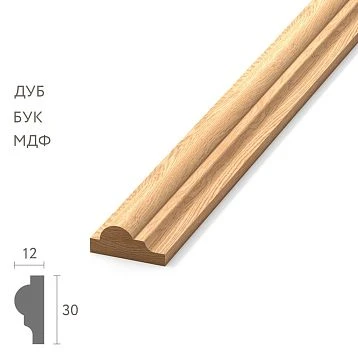
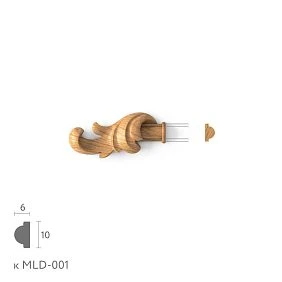
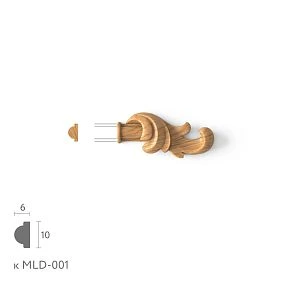
- MLD-001 10 × 6 mm as a candidate for a thin frame
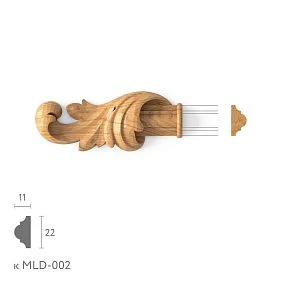
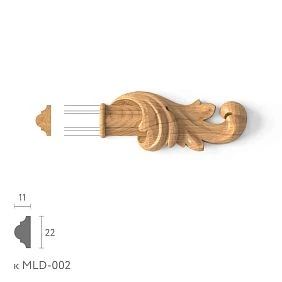
- MLD-002 22 × 11 mm as a commercial bundle
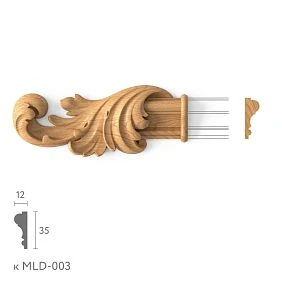
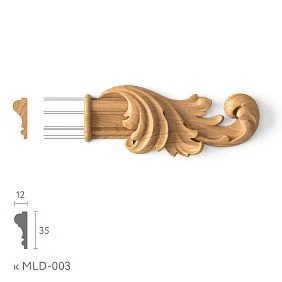
- MLD-003 for an expressive frame
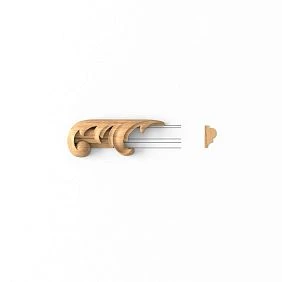
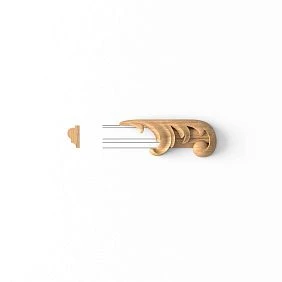
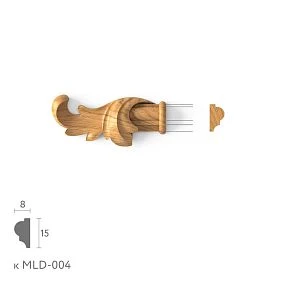
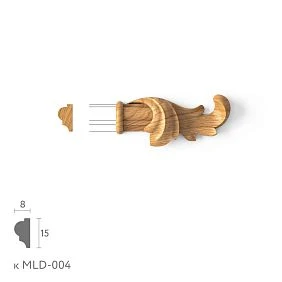
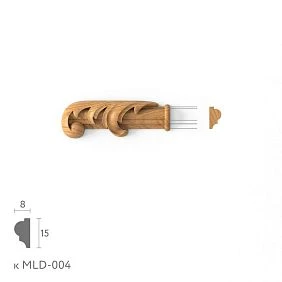
- MLD-004 15 × 8 mm for a compact solution
- What to check in the DWG of both overlays
- How to check the joint with a test piece
- Is trimming of the molding near the overlay needed
- How to finish the molding with a carved overlay
- Is the central overlay N-257-1 needed
- When to consider N-256-1
- Paired composition without a central element
- Paired composition with a central medallion
- How to calculate the distance between paired elements
- How to align two overlays along one axis
- How to assemble a symmetrical molding frame
- Decorating an interior door with moldings
- N-258 on a single-leaf door
- N-258 on a double-leaf door
- How to account for the handle and lock
- How to decorate a door without replacing the panel
- Pair of overlays on furniture facade
- N-258 for wardrobe and bookcase
- N-258 for sideboard
- N-258 for dresser
- N-258 for kitchen facade
- Frame around the mirror
- Wall frame and boiserie
- Decorative panel made of moldings
- N-258 in the living room
- N-258 in the bedroom
- N-258 in the study
- N-258 in the hallway
- N-258 in a commercial interior
- Beech for enamel
- Oak for tinting
- "Standard" or "Prestige"
- How to get the same color on two parts
- Test swatch N-258
- How to preserve the texture of oak
- Dry fitting before installation
- How to transfer markings to a door
- Installation on MDF
- Installation on solid wood
- Installation on painted wall
- How to glue overlays to the molding and base
- Is mechanical fixation needed
- How to press an overlay without damage
- How to remove excess glue
- How to hide the joint
- How to store parts before installation
- How to accept an order before finishing
- Mistake: buying two identical sides
- Error: consider a pair as a set in one box
- Error: select L and R of different sizes
- Error: mix beech and oak
- Error: mix "Standard" and "Prestige"
- Error: assign molding based on photo
- Error: consider MLD-002 guaranteed compatible
- Error: trim carved overlay instead of molding
- Error: do not mark top and center
- Error: mark left and right sides separately
- Error: ignore handle and hinges
- Error: install before painting without access to relief
- Error: using interior decor outside without confirmation
- Who is the N-258 pair decor suitable for
- Who should choose a different decor
- When a central composition is needed, not just a pair
- When it's better to leave the frame without carved overlays
- What not to do from scratch
- How to order a design project for the composition
- How to buy N-258 on STAVROS
- What to check before payment
- How to create an installation list
- How to accept the finished composition
- What to buy together with N-258-1L and N-258-1R
- How to check the pair after delivery but before painting
- How to calculate the full order, not just two overlays
- Check question before purchase
- FAQ: questions about N-258-1L and N-258-1R
- How is N-258-1L different from N-258-1R?
- Do I need to buy both overlays?
- Are N-258-1L and N-258-1R sold as a set?
- What sizes are available?
- Are the elements completely mirrored?
- How to determine the direction of the pattern?
- Can I swap L and R?
- Can I use only N-258-1L?
- Can I use only N-258-1R?
- Which molding do the overlays fit?
- Is MLD-002 suitable?
- How to check compatibility by cross-section?
- Is a central overlay needed?
- Can I install decor on the door?
- Are overlays suitable for furniture facades?
- Can I frame a mirror?
- What to choose — beech or oak?
- What is the difference between "Standard" and "Prestige"?
- How to get the same shade for two overlays?
- Paint before or after installation?
- What to use to glue the decor?
- Is additional fixation needed?
- How to calculate the quantity for multiple doors?
- Where to buy N-258-1L and N-258-1R?
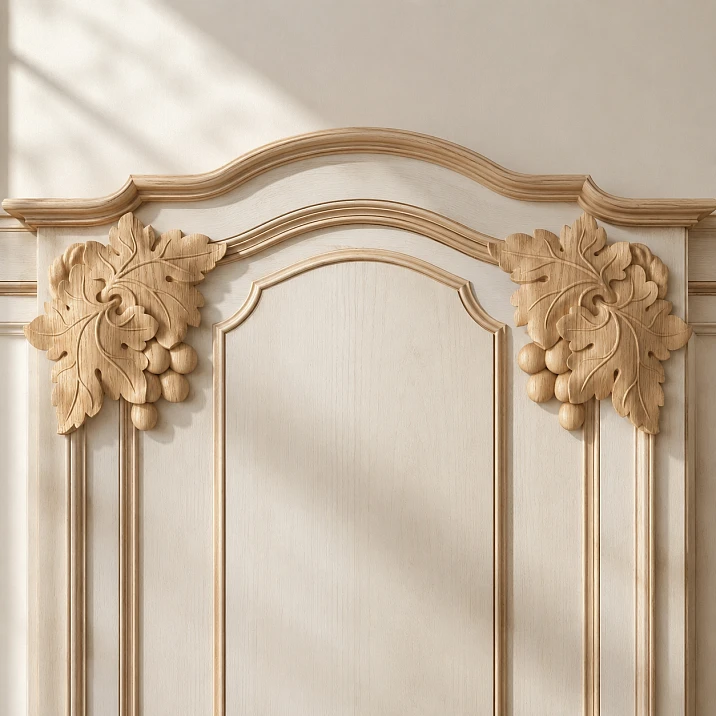
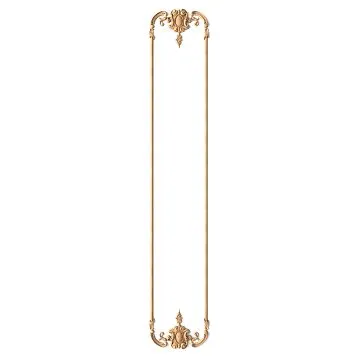
Paired carved overlays for moldings should be purchased not as two similar wooden parts, but as the left and right parts of a single pre-calculated composition. N-258-1L and N-258-1R help complete the molding frame on a door, wall panel, furniture facade, mirror, or portal. The buyer receives ready-made carved ends but must check the ornament direction, size variant, and physical connection with the selected profile.
Both product cards offer two identical size ranges: 96 × 102 × 20 × 22 × 11 mm and 153 × 163 × 31 × 35 × 12 mm. The values are given in the format A × B × C × E × F and should be read according to the drawing. You cannot independently call one parameter the sample length, another the channel width, or a third the seating depth without a DWG. The matching numbers for L and R confirm a common size range but do not replace visual and drawing verification of mirroring.
Buy left overlay N-258-1L и Buy right overlay N-258-1R It is rational to buy both simultaneously if the project is built around a central axis. One element is acceptable in a deliberately asymmetrical frame, on the edge of a furniture portal, or in a separate decorative node. Buying one side "as a test" and then automatically ordering the second is dangerous: before finishing, you need to see both parts together and confirm the direction of the pattern.
N-258-1L and N-258-1R are made from beech or oak. The cards provide for "Standard" and "Prestige" sanding, as well as preparation of beech for enamel and oak for tinting. For a paired composition, the material, preparation quality, and finishing system should be chosen identically. Even a slight difference in shade or relief depth becomes noticeable when the two overlays are placed mirroring each other at the same height.
Short answer. N-258-1L and N-258-1R should be ordered as a pair for a symmetrical door, wall frame, furniture facade, or mirror. The small size variant is 96 × 102 × 20 × 22 × 11 mm, the large one is 153 × 163 × 31 × 35 × 12 mm.
Before purchasing, download or open the drawings of both cards, compare the ornament direction and parameters A, B, C, E, F, then check the molding profile. Neither MLD-001, nor MLD-002, nor MLD-003, nor MLD-004 can be assigned as mandatory based solely on external similarity.
Buy N-258-1L Buy N-258-1R View decor for moldings Select wooden molding Order composition layout
Confirmed characteristics of N-258-1L and N-258-1R
| Parameter | N-258-1L | N-258-1R |
|---|---|---|
| Role | Left decorative element for molding composition | Right decorative element for molding composition |
| Small size A × B × C × E × F | 96 × 102 × 20 × 22 × 11 mm | 96 × 102 × 20 × 22 × 11 mm |
| Large size A × B × C × E × F | 153 × 163 × 31 × 35 × 12 mm | 153 × 163 × 31 × 35 × 12 mm |
| Material | Beech or oak | Beech or oak |
| Sanding quality | "Standard" or "Prestige" | "Standard" or "Prestige" |
| Preparation of beech | For enamel | For enamel |
| Oak preparation | For tinting | For tinting |
| Sale | Separate card and separate item | Separate card and separate item |
| Full mirroring | Checked by image and DWG | Checked by image and DWG |
| Compatible straight molding | Determined by sample and cross-section | Determined by sample and cross-section |
| Typical surfaces | Door, wall, furniture, frame, portal | Door, wall, furniture, frame, portal |




Left and right pad: how their role differs
| Criterion | N-258-1L | N-258-1R | What the buyer should check |
|---|---|---|---|
| Position in pair | Left side relative to the established axis | Right side relative to the established axis | Do not rely solely on the letter without a layout |
| Pattern direction | Determined by image and drawing | Determined by image and drawing | Ornament directed inward or outward per project |
| Use separately | Allowed in asymmetric node | Allowed in asymmetric node | A single element must have a clear compositional completion |
| Pair door | Left leaf or left part of the common frame | Right leaf or right part of the common frame | Gap between leaves and total height |
| Furniture portal | Left end of molding | Right end of molding | Hinges, handles, gap, and symmetry |
| Wall frame | Left part of the top or side group | Right side of the top or side group | Central axis and offsets from the molding |
| Mirror frame | Left carved transition | Right carved transition | Do not overlap the mirror and frame fasteners |
| Rotate the part | Do not confirm without DWG | Do not confirm without DWG | Vertical and horizontal scenarios are checked separately |
Our factory also produces:
What is the decor for moldings
Molding decor completes or complicates a straight profile. A regular molding creates a frame line, while a carved overlay forms a transition point, ending, or central node. The buyer receives a finished artistic detail, but it must be linked to a specific profile section.
Elements in this category may have a back cutout or side zones for the molding to continue. Therefore, the connection is evaluated not only from the front. The side view and drawing show whether the profile can fit into the designated area without gaps or excessive trimming.
If the overlay is simply placed on top of a surface without connecting to a straight molding, its role changes. In such a project, it is especially important to decide in advance where the frame ends and why the carved element is located at that particular point.
Get Consultation
How a paired overlay differs from a regular furniture overlay
A regular furniture overlay is often perceived as an independent center: it can be placed on a panel, door, or surface without requiring a second element. N-258-1L and N-258-1R are designed to work on the left and right sides relative to a common axis.
Pairing affects ordering, layout, and finishing. The buyer needs to check two product pages, select the same size, material, and sanding quality, and then assemble both parts on one layout.
If only the left or right position is taken for a symmetrical door, the composition remains incomplete. A single element is appropriate only where asymmetry is intended by the design, not caused by a configuration error.
Why L and R cannot be determined solely by the name
The letter L usually indicates the left position, R the right, but you need to look from the side of the finished composition. On the reverse side, when rotated or transferred to another door, the visual perception may change.
A reliable method is to open images of both product pages, print the outlines, and place them on the facade. Then mark which side faces the center and how the molding continues.
Before painting, parts are marked: location, side, top, and direction toward the center. After enameling or tinting, similar elements can easily be confused, especially if several pairs are intended for different doors.
Are N-258-1L and N-258-1R completely mirrored?
Identical size ranges suggest a consistent pair, but the text size table does not prove full mirroring of each curl, cutout, and side outlet.
The buyer should compare front images and DWG. If the design has minor artistic differences, they must be accounted for in the center of the composition and when continuing moldings.
In the article, it is safe to consider the models as left and right positions of one system. Claiming mathematically precise reflection without viewing drawings and actual products should not be done.
How to read dimensions A × B × C × E × F
Cards indicate five parameters, but the letter designations are tied to a specific drawing. One cannot recall from memory that A is total length, E is channel width, or F is cutout depth.
The small variant has a set of 96 × 102 × 20 × 22 × 11 mm, the large one — 153 × 163 × 31 × 35 × 12 mm. For ordering, it is important to keep the full set, not just the first two numbers.
The installer, designer, and manager must work with the same DWG version. If the specification only says "small overlay," the risk of error between the two variants remains high.
When to choose the small size variant
Compact size fits a small door, narrow furniture frame, medium-sized mirror, and wall panel with thin profiles. It fits more easily next to the handle, hinges, and gap between the doors.
A small element does not automatically mean compatibility with MLD-001 or MLD-004. The 10 × 6 and 15 × 8 mm parameters refer to the moldings themselves, and the N-258 mounting area is checked according to the DWG.
On a large wall, a small pair may get lost. Before ordering, it is depicted in full size and viewed from the normal distance of entering the room.
When to choose the large size option
The large set 153 × 163 × 31 × 35 × 12 mm fits a wide door, tall wall frame, furniture portal, and large mirror composition.
The increase affects several parameters, so not only the visible width changes. The side protrusion, relief depth, and connection to the molding also require a new calculation.
A large pair must have enough free space around it. If the elements touch the frame, handles, or adjacent carving, the facade looks overloaded and installation becomes more complicated.
How to compare two sizes on a paper mockup
Cut out the contours of 96 × 102 and 153 × 163 mm from cardboard, marking the conditional direction of the ornament. For accurate checking, add the side profile with parameters C, E, and F according to the official drawing.
The templates are installed as a pair on the actual door or wall. Check the distance between the inner edges, the offset to the molding, and the free space around the carving.
This layout shows whether a central detail is needed and whether the large version becomes too heavy. The decision is made before ordering and before manufacturing the straight moldings.
Do I need to buy both overlays at the same time?
For a symmetrical composition — yes. Individual cards mean that each side must be added to the order separately and the quantity checked.
Buying simultaneously reduces the risk of differences in material, sanding, and wood batch. This is especially important for oak under transparent tinting.
If the project includes multiple doors, count pairs, not individual pieces. For example, four symmetrical frames require four N-258-1L and four N-258-1R with the same size option.
When one N-258-1L is acceptable
The left element can be used separately on the edge of a furniture portal, in an asymmetrical wall panel, or as the end of a single molding line.
The project must explain where the ornament is directed and why there is no pair on the right. A random absence of the second part looks like an incomplete delivery.
Single use does not cancel the inspection of the molding, base, and finish. The L card does not turn the overlay into a universal furniture appliqué.
When one N-258-1R is acceptable
The right overlay can become an independent frame ending if the composition is built from a wall, column, cabinet, or other architectural boundary.
Before ordering, its layout is checked on a template. It cannot be assumed that R can simply be rotated to get L without changing the direction of the pattern and the cutout.
If asymmetry is not part of the project, it is more rational to order both positions at once and assemble a complete pair.
How to determine the direction of the ornament towards the center or outward
In one project, curls may converge towards a central rosette, in another, they may diverge from it and continue the frame. Both solutions are possible only after a visual check of the specific pattern.
Printed images are placed in two versions and compared. The center should look intentional, and the side exits should continue the line of the molding.
After approval, markings "towards the center" and "outward" are made on the back of the packaging. This prevents rotation of parts during painting and installation.
Can L and R be swapped
Mechanical swapping can change the direction of the ornament and the position of the cutout. Even if the external dimensions match, the connection with the profile may be incorrect.
Swapping is only allowed after checking images, DWG, and dry assembly. The word "mirror" should not be used instead of actual fitting.
On paired doors, the error is especially noticeable by the internal gap: two elements may start facing outward, although the design intended movement toward the center.
Can the overlays be flipped vertically
Vertical installation is possible as a design scenario, but should not be considered a confirmed universal function. The pattern orientation, molding fit, and visual axis stability need to be checked.
When rotated, the top becomes the side, and the side exit becomes the top or bottom. This can change the meaning of the ornament and create an awkward joint.
For a vertical frame, it is better to create a separate full-size layout and not transfer the horizontal scheme without revision.
How to check symmetry from a distance
Two overlays are first evaluated up close at the joints, then stepped back to the main viewpoint. On a door, this is usually the corridor or room entrance; on a wall, the opposite side of the room.
From a distance, different heights, incorrect rotation, and unbalanced spacing become noticeable. A small gap at the molding may visually disappear, but the shift of the overall axis intensifies.
A strictly frontal photograph helps compare the left and right sides without perspective distortions.
How to select a compatible straight molding
First, you choose not the color or breed, but the geometry of the joint. The profile must match the provided recess or side outlet of the overlay in width, height, and shape.
In the category you can Buy wooden molding, but the specific MLD is assigned only after comparing drawings. The accompanying card and general filter help narrow down the choice, not replace verification.
If the profile is smaller than the recess, a gap will remain; if larger, trimming will be required, which can damage the relief and precise fit. Therefore, a test piece of molding is tried on both overlays before finishing.
MLD-001 10 × 6 mm as a candidate for a thin frame
The thin profile suits delicate furniture and small wall frames. Its size 10 × 6 mm is confirmed by its own card.
You can buy thin molding MLD-001 10 × 6 mm and compare with the small variant N-258, but compatibility is not guaranteed in advance.
Even if the visual scale seems suitable, the shape of the back side and the contact area must match. Verification is done on the drawing and a control sample.
MLD-002 22 × 11 mm as a product bundle
MLD-002 is listed among related products on N-258 cards and has a confirmed size of 22 × 11 mm. This makes it an important candidate for verification.
Before ordering, you can buy furniture molding MLD-002 22 × 11 mm only after matching with parameters E and F on the DWG.
Presence in the 'bought with this product' block shows a commercial relationship but does not guarantee that each size of the overlay fits the profile without additional processing.
MLD-003 for an expressive frame
A larger profile is appropriate next to the larger N-258 option and on an architectural wall or door composition.
You can buy large molding MLD-003 and check it as a profile for an expressive frame.
An exact joint should not be described without a drawing. A large molding may require a different position of the overlay or a separate connecting part.
MLD-004 15 × 8 mm for a compact solution
The size 15 × 8 mm is between the thin MLD-001 and the more noticeable MLD-002. It is suitable for small frames and furniture facades in terms of scale.
Before purchasing, you can buy compact molding MLD-004 15 × 8 mm and attach its sample to the selected overlay.
Matching style and material does not prove matching cross-section. If the sample differs, the profile cannot be forcibly pressed into the carved part.
What to check in the DWG of both overlays
In the drawing, find the common contour, thickness, back side parameters, and exit points for the profile. For L and R, check if the seating geometry matches mirror-wise.
Separately note the direction of the top and center. If parts can be used in multiple orientations, this should be visible in the drawing or confirmed by the manager.
Save the DWG of both overlays and the selected molding in the installation folder. Working from a single image increases the risk of incorrect trimming.
How to check the joint with a test piece
Take a short sample with a clean end from the selected molding and apply it to each overlay without glue.
Check contact density, face surface height, and absence of gaps. The fitting is performed for both left and right parts, not just one.
If the joint requires trimming, its pattern is first executed on a spare piece of molding. The carved overlay is not used as an experimental blank.
Is trimming of the molding near the overlay required?
Trimming of a straight profile may be needed for a precise end or angle, but its extent is determined by the drawing. Installation without cutting cannot be promised in advance.
The end must fit into the designated area and not cover the relief. A piece that is too short will create a gap, one that is too long will shift the overlay.
A size-cutting service for custom products should not be assumed. Installation preparation is included in the work of a furniture maker or carpenter.
How to finish the molding with a carved overlay
The straight profile is brought to the side or inner area of the overlay, maintaining the common axis. The carved element becomes the completion of the line, not a random appliqué over the joint.
The left and right ends must be processed identically. If one molding goes in deeper, the pair will lose symmetry.
Before fixing, assemble the entire line on a flat surface: L, molding segment, central area, second segment, and R.
Is the central overlay N-257-1 required?
Paired elements can work without a center, leaving a free section or straight molding between them. A central piece is needed if the project requires a more saturated top group.
You can select the central overlay N-257-1 and complete the paired composition after checking its dimensions and joints.
The presence of N-257-1 among related products does not imply an automatic set. Three drawings are compared together.
When considering N-256-1
Another central element can change the scale and character of the composition. It is not suitable for every door or every pair of N-258.
Before approval, you can view the decorative overlay N-256-1 as an alternative center of the composition.
If the central piece is significantly larger than the side ones, the spacing and moldings are recalculated. It cannot simply be added to an already finished frame.
Paired composition without a central element
Two overlays can finish the left and right sides of the molding line, leaving a calm straight section between them.
This option suits a door with a pronounced panel, a mirror, or furniture where the central part is occupied by a handle, lock, mirror, or other design.
The gap between the inner edges is calculated based on the facade width and the overall axis. Too large a distance breaks the pair, too small compresses the ornament.
Paired composition with a central medallion
The central element creates hierarchy: the side N-258 guide the eye, the middle completes the group.
With this scheme, three distances are important — from L to the center, from the center to R, and from the entire group to the frame edges.
All elements must have a consistent material and finish. A central piece of a different wood species or shade looks like a later addition.
How to calculate the distance between paired elements
There is no universal number. The distance depends on the door width, overlay size, central decor, and the length of the straight molding.
First, find the central axis and arrange the elements symmetrically. Then check the free space around the thread and the working areas of the handle, lock, or mirror.
On the paper facade, it is useful to compare several distances. The selected value is fixed from the same reference points on both overlays.
How to align two overlays on one axis
Marking is done with a laser level or a common horizontal line. The reference is the same point on the drawing, not the edge of the relief, which may have a complex shape.
On paired doors, consider the gap between the leaves and the adjustment of the hinges. The axis is checked with the facades closed.
Before gluing, temporarily fix the two parts in a safe way and take a strictly frontal photo.
How to assemble a symmetrical molding frame
First, design the rectangle or the upper decorative group, then determine the role of L and R. The moldings should continue the lines of the overlays, not approach them with random ends.
On the assembly table, lay out all elements in full size. Check the angles, profile lengths, center, and thread orientation.
After approval, assign a number to each part. This is especially important for oak, where the wood grain can affect the paired perception.
Decorating an interior door with moldings
On door N-258, they can complete the top panel, side frame, or central decorative group. The size is chosen based on the width of the door leaf and the free field.
The handle, lock, hinges, and opening direction must remain functional. The carved element is not placed in the constant grip area.
Additional ideas are provided by decorative overlays for interior doors, but the specific pair N-258 requires its own marking.
N-258 on a single-leaf door
On one leaf, the pair is built relative to the center of the panel or the entire facade. The small size is suitable for a narrow door, the large one for a wide and tall door.
The left and right parts can be placed in the upper section, connected by a straight molding. The lower part remains calm and does not interfere with operation.
Before installation, the door is fully opened, checking contact with the casing and wall.
N-258 on a double-leaf door
The composition can be placed on each leaf separately or unite two doors with a common visual system.
In the first option, two pairs are needed; in the second, L and R can be located on the outer sides of the common group. The choice depends on the gap and the pattern of the panels.
Marking is done with the leaves closed and checked after adjusting the hinges. Shifting one door destroys the symmetry.
How to account for the handle and lock
The handle and lock define a work zone that cannot be overlapped by carving or protruding molding.
The upper group N-258 is usually safer, but the height is chosen based on the facade grid. You cannot simply raise the decor as high as possible without connection to the panel.
Paper templates are installed together with the actual hardware and the hand movement is checked.
How to decorate a door without replacing the panel
Ready-made overlays and moldings allow you to modify an existing door if the surface is durable and suitable for installation.
First, evaluate the coating, geometry, and space for the carved group. Old defects should not be hidden by decor without repairing the base.
A ready-made pair eliminates manual carving, but not precise marking and finishing. The existing door must be prepared as a full-fledged furniture front.
Paired overlays on a furniture front
On a wardrobe, sideboard, or chest of drawers N-258, they work as endings of a molding frame and help assemble the front without manual carving.
The size is chosen based on the clear field between the frame, handles, and door edges. The large option should not overlap hinges, gaps, or adjacent drawers.
The furniture composition is considered with doors open and closed. The decor should not collide with adjacent fronts.
N-258 for wardrobe and library
The tall central section of the wardrobe allows for a large pair and longer molding segments. On small side doors, a smaller size is more rational.
In the library, overlays can finish the top frame, frame a display case, or support the central portal.
All fronts in one group must have the same decor height, otherwise even high-quality carving looks disjointed.
N-258 for sideboard
A sideboard often combines doors, drawers, and open shelves, so a paired carved group should have one main location.
On upper glass doors, decor is placed on the wooden frame, not extending onto the glass or hardware. On the lower cabinet, a different, calmer layout can be used.
Oak for tinting is associated with natural furniture, beech for enamel with painted facades.
N-258 for a dresser
On a wide dresser, a pair can complete the frame of the central facade or the upper decorative strip.
Small drawers should not be overloaded with large overlays. If the decor touches the handles, it is better to move it to the body or the upper frieze.
Before ordering, check whether one pair is needed for the entire dresser or separate pairs on several doors.
N-258 for a kitchen facade
In the kitchen, daily cleaning, door opening, and proximity of handles are important. Carving is not placed where the hand constantly touches the surface.
Beech for enamel allows overlays to be linked with painted facades. Oak for tinting is suitable for a natural kitchen and display sections.
The pair must be protected with a compatible finish, and the mounting base must withstand weight and regular use.
Frame around the mirror
Paired overlays can complete the top of a wooden frame or support a central decoration.
The outline should not cover the usable area of the mirror or interfere with the mounting. All protruding parts are checked from the side.
If the mirror is already installed, templates are placed on the frame without drilling the glass. Installation is performed only on a suitable base.
Wall frame and boiserie
On wall N-258, they help complicate a simple rectangle of moldings and highlight the upper part of the panel.
A large size is better read in a tall room, a small one in a narrow wall space and next to a door.
Before ordering, a general wall elevation is made with all sockets, switches, furniture, and baseboard, so that the carved decor does not appear random.
Decorative panel made of moldings
The pair can frame a painting, wallpaper, textile insert, or painted field.
The ornament is directed toward the center or outward according to an approved scheme. The main thing is to maintain a clear connection with straight profiles.
If the panel is asymmetrical, one element can be used separately, but this decision must be visible in the full sketch.
N-258 in the living room
In the living room, the overlays match the wall panel, bookcase, door, fireplace portal, and mirror.
The large size works on a wide wall and tall furniture, the small one on a door or local frame.
The finish is tied to moldings, doors, and baseboards, without creating a separate random shade.
N-258 in the bedroom
Paired carving can complete a cabinet, mirror frame, door portal, or panel behind the headboard.
In a small bedroom, a large option can overwhelm the facade. A paper mockup helps assess the scale from the doorway.
The relief is not placed in contact with textiles and is not left without protective finishing.
N-258 in the study
Oak overlays under tinting support the library, desk, doors, and wall panels.
The pair creates strict symmetry, especially if the straight molding continues the lines of the furniture.
With a complex wood texture, it is better to order all elements in one batch and select the shade on a common sample.
N-258 in the hallway
A narrow passage requires control of the protrusion and distance to doors, clothing, and furniture.
The small version is more often suitable for a trim, mirror, or cabinet. The large one is used only when there is sufficient free space.
From the side, check whether the carving catches clothing and whether it interferes with opening.
N-258 in a commercial interior
In a hotel, restaurant, salon, or showroom, paired overlays can be repeated on doors, counters, and wall panels.
Before a serial order, assemble one control unit with the actual molding, coating, and fastening method.
After approval, a list is created for each room to prevent L and R from being mixed up during delivery and installation.
Beech under enamel
Beech is suitable for opaque finishes and furniture where the wood grain should not distract from the form.
It is better to order paired beech overlays with the same preparation and paint them in one batch.
The enamel should evenly cover the relief, side edges, and joints with the molding, without hiding small transitions.
Oak under tinting
Oak is chosen when it is important to preserve the natural texture and connect the decor with natural furniture or doors.
On a pair, the wood grain may differ, but the overall shade and gloss level must match.
Before tinting, L and R are laid out side by side to determine the most harmonious position.
'Standard' or 'Prestige'
"Standard" refers to machine sanding, "Prestige" to more detailed hand preparation.
For complex transparent finishes and close viewing, hand preparation can reduce the amount of finishing work.
You cannot order L in one quality and R in another: after painting, the difference will appear on the symmetrical pair.
How to get the same color for two parts
Both overlays and moldings are finished with the same system, the same batch of composition, and in the same sequence.
A test coating is done on the same wood species and compared next to the door, wall, or furniture.
After drying, the color is evaluated under daylight and artificial lighting because the relief creates different shadows.
Test coating N-258
For beech, check the primer, enamel, and gloss. For oak, check the tint, transparency, and uniformity of the grain.
The sample must include
How to preserve the oak texture
A semi-transparent finish should emphasize the grain, not turn oak into an opaque surface.
Ends and carved recesses may absorb the composition more intensely, so a test sample is mandatory.
The molding and overlays are tinted in one batch, controlling the overall shade.
Dry fitting before mounting
Dry assembly starts not on the wall, but on a flat surface. L, R, straight moldings, and the central element (if provided) are laid out.
Check the joints, the height of the front surfaces, and the direction of the pattern. Then the entire group is transferred to the door or wall using a template.
Glue is used only after the layout is approved. Correcting swapped L and R on an already painted surface is significantly more difficult.
How to transfer markings to the door
On the panel, draw a central axis and a common horizontal line. From them, mark the control points of both overlays and the lengths of the moldings.
Markings are made with the door closed, taking into account gaps, the handle, and the panel. The uneven edge of the panel should not be the only reference point.
Before fixing, apply paper or cardboard templates and check the composition from the hallway.
Installation on MDF
The MDF surface must be smooth, durable, and compatible with the chosen glue. Laminated, painted, and primed bases require different solutions.
A large overlay and a long molding create a total load, so the strength is assessed for the entire group.
Glue is not used as a thick leveling layer. Facade defects are corrected before installation.
Installation on solid wood
The array takes into account the grain direction, coating condition, and possible wood movement.
An oak overlay for tinting logically combines with a natural base, but the shade is still checked on a sample.
The fastening should not split thin carved areas. Mechanical points, if needed, are chosen by the craftsman according to the drawing.
Installation on a painted wall
The paint must adhere firmly to the base. If the top layer peels off, the decor will come off with it.
Before gluing, the compatibility of the composition with the coating is checked, and a test is done on an inconspicuous area.
For a large composition, temporary support or additional fixation may be needed, but a universal scheme is not confirmed.
How to glue overlays to the molding and base
The composition is chosen based on the wood species, door or wall material, coating type, and operating conditions.
In the catalog you can buy glue and materials for installing wooden decor after checking the instructions.
One glue is not considered universal for MDF, solid wood, painted walls, and ceilings. A test joint is performed before the main work.
Is mechanical fixation needed
Necessity depends on size, mass, position, and base. A large element on a vertical wall and a small decoration on a furniture door work under different conditions.
Mechanical fasteners are not placed close to thin ornamentation without preliminary calculation.
If the scheme requires hidden points, they are coordinated before painting. Drilling finished carving yourself may lead to cracks.
How to press the overlay without damage
Pressure is distributed over strong areas through a soft pad. Do not press a thin curl or protruding sheet with a clamp.
Paired elements are fixed in the same way so that one does not shift relative to the axis.
Excessive force does not improve adhesion and may deform the molding or damage the coating.
How to remove excess glue
Excess compound is removed according to instructions before or after setting, without smearing it over the carved relief.
The method must be compatible with enamel or tinting. A solvent safe for one coating may damage another.
Joints are checked under side light because dried glue is especially noticeable in recesses.
How to hide the joint
The best joint is achieved not through a thick layer of putty, but thanks to the precise geometry of the molding and the groove.
After installation, local finishing adjustments are permissible if provided for by the technology.
Paired joints should look identical. Different seams on the left and right destroy symmetry even with precise markings.
How to store parts before installation
The overlays are placed on a flat, dry surface and the threads are protected from point loads.
L and R are stored in pairs, noting the size, wood species, sanding quality, and installation location.
Long moldings are supported along their length to prevent bending. The packaging is kept until full acceptance.
How to accept an order before finishing
Check the article numbers N-258-1L and N-258-1R, the same size set, beech or oak, and "Standard" or "Prestige".
The parts are laid out next to each other and the direction of the pattern, surface quality, and joint with the test molding are compared.
All issues are resolved before priming, tinting, trimming, and installation.
Error: buying two identical sides
Two L or two R can create a repeat, but not a standard symmetrical pair.
The error occurs when a customer adds two pieces of the same card to the cart, assuming the second is automatically mirrored.
The order separately records the quantity of N-258-1L and N-258-1R.
Error: considering a pair as a set in one box
The cards are independent, so the presence of one item does not guarantee automatic addition of the second.
Before payment, both order lines, size, material, and finish are checked.
For multiple doors, the quantity is calculated in pairs, and then converted into separate L and R.
Error: select L and R of different sizes
Small and large variants have different five parameters. They cannot be used as a mirror pair on the same axis.
Even if the distance to the center is adjusted, the difference in relief and scale will remain noticeable.
Both cards in the order must contain the same size A × B × C × E × F.
Error: mix beech and oak
Different species differ in texture and behavior under finishing.
Under enamel, the difference may become less noticeable, but the preparation and surface must still be coordinated.
Under tinting, mixing is especially obvious. The pair is ordered with one species.
Error: mix "Standard" and "Prestige"
Different sanding can lead to differences in relief, absorption, and gloss.
On a symmetrical group, the mismatch is more visible than on a single overlay.
The pair, moldings, and central decor must have a consistent level of preparation.
Error: assign molding from photo
The front image does not show the shape of the back cut and the height of the joint.
A similar profile may be wider, narrower, or have a different relief.
First compare DWG, then a test piece. Only after that order the full length.
Error: consider MLD-002 guaranteed compatible
MLD-002 is listed among related products and is an important candidate, but this does not cancel the check of the specific size N-258.
Small and large variants may have different mounting parameters.
The article cannot promise physical connection without a drawing and fitting.
Error: trim the carved overlay instead of the molding
Trimming may disrupt the pattern, mirror symmetry, and seating area.
If the joint does not match, first check the correctness of the selected profile and size.
Modification of a finished overlay is performed only based on a separate professional decision, not as a standard installation operation.
Error: not marking the top and center
After painting, orientation may become less obvious, especially with several identical pairs.
On the packaging and assembly list, mark the side, top, and direction towards the center.
Such marking prevents rotating the part by 180 degrees.
Error: marking the left and right sides separately
Independent measurements from different edges lead to different heights and offsets.
A pair is marked from one central axis and one horizontal line.
On a double-leaf door, the overall gap and the position of both leaves are taken into account.
Error: ignore handle and hinges
A beautiful frame can interfere with operation if the threading falls into the grip or mounting area.
All hardware points are placed on the layout before size selection.
On a furniture facade, the opening of adjacent doors and drawers is additionally checked.
Error: install before painting without access to the relief
After fixing, deep side areas may become inaccessible to a brush or spray.
If finishing is done on site, the technology is planned in advance.
Paired parts must receive the same number of layers and the same finishing.
Error: use interior decor outside without confirmation
Outdoor environment requires special re-gluing, coating, and installation scheme.
Cards confirm beech and oak for interior decorative composition, but do not provide a universal guarantee for the building facade.
Outdoor use is agreed upon before ordering and is not transferred from the interior scenario.
Who is the paired decor N-258 suitable for
The pair is suitable for a buyer who wants to finish a molding frame with ready-made carving and maintain strict left and right symmetry.
It is especially appropriate on doors, furniture, wall panels, and mirrors, where a straight profile without finishing looks too simple.
Ready-made cards allow you to choose two scales and one wood species, and then focus on the project, finishing, and installation.
Who should choose a different decor
N-258 may be unnecessary on a minimalist facade, narrow door, or frame without sufficient free space.
If a regular corner transition is needed, it is worth comparing specialized corner decor rather than using a paired overlay as a random corner.
It's useful to learn how to choose decor for a molding frame, and to differentiate the functions of the corner, center, and side end.
When a central composition is needed, not just a pair
On a wide door or wall panel, the distance between L and R may be too large. Then consider N-257-1, N-256-1, or a calm molding center.
Adding a third piece should enhance the hierarchy, not just fill the void.
The entire group is tested on one facade, including dimensions, wood species, sanding, and joints.
When it's better to leave the frame without carved overlays
If the molding already has a complex relief, and handles, rosettes, pilasters, and other details are nearby, an additional pair may overload the surface.
A simple frame sometimes better supports active furniture or wallpaper.
An honest choice helps avoid buying decor just to fill every empty space.
What not to do from scratch
The buyer does not need to manually draw a mirror ornament, cut two identical parts, and create samples for the molding.
Ready-made N-258-1L and N-258-1R simplify the complex artistic part. All that remains is to choose the size, profile, material, finish, and exact position.
Additional ideas for using wooden carved decor help connect the pair with the overall architecture of the room.
How to order a design project for a composition
The project is especially useful for a double door, a large wall, a series of furniture facades, and a combination of N-258 with a central overlay.
You can order a molding composition layout, by providing surface dimensions, photos, and selected cards.
The facade and section should show the L/R direction, molding, distances, joints, and finish.
How to buy N-258 on STAVROS
Open both cards, select the same size range, beech or oak, and sanding quality.
Then select a straight molding according to DWG and order a sample or the required footage after checking the joint.
In the general category, you can Buy Decor for Moldings and compare central, corner, and connecting elements.
What to check before payment
The order must include separate lines N-258-1L and N-258-1R, same dimensions, material, and sanding.
Additionally, specify the molding article, central decor, installation materials, and number of pairs.
Current payment and delivery terms for wooden decor are checked before ordering.
How to create an installation list
For each frame, specify the room, surface, N-258 size, L/R quantity, molding, distances, and pattern direction.
Place a photo of the dry layout and a DWG fragment next to it.
This statement links the order, painting preparation, and installation without verbal assumptions.
How to accept the finished composition
After installation, check the central axis, uniform height, mirror perception, and quality of joints with moldings.
Doors and furniture are opened, and the wall composition is viewed from the main points of the room.
If one side looks darker or deeper, first check the lighting and finish, rather than masking the difference with additional decor.
What to buy together with N-258-1L and N-258-1R
Paired overlays are rarely used without a straight profile and mounting system. The buyer needs to assemble a kit: two sides, a suitable molding, if necessary a central element, the same finish, and compatible glue. No adjacent card is assigned automatically — all joints are checked against the drawings.
| What to add | Why | For which scenario | What to Check | Link |
|---|---|---|---|---|
| N-258-1L | Form the left side | Symmetrical frame | Size, material, direction | left decor for molding |
| N-258-1R | Form right side | Symmetrical frame | Size, material, direction | Right decor for molding |
| N-257-1 | Add central node | Wide door or panel | Three DWGs and distances | Complement pair composition |
| N-256-1 | Compare another center | Expressive frame | Scale and joints | Alternative composition center |
| MLD-001 | Assemble thin line | Small facade | Seat 10 × 6 mm | thin molding for frame |
| MLD-002 | Select a noticeable furniture profile | Door or furniture | Seat 22 × 11 mm | select a straight profile for the frame |
| MLD-003 | Assemble a large frame | Wall or portal | DWG compatibility | profile for expressive frame |
| MLD-004 | Create a compact line | Furniture and small door | Landing 15 × 8 mm | compact molding MLD-004 |
| Materials | Secure and finish decor | All surfaces | Base and coating | Buy installation materials |
| Tips | Check technology | Self-installation | Do not replace the project with advice | recommendations for installing overlays |
How to check a pair after delivery but before painting
Left and right overlays are laid face up in the chosen orientation and compared for overall size, relief, material, and surface preparation. Then the same test piece of molding is applied to each side. This check shows whether the joints match and whether the size options are mixed up.
If a pair is intended for a specific door or piece of furniture, it is immediately marked with the facade number. After oak tinting or opaque beech enamel, identical parts from several sets can easily be mixed up. A photo of the dry layout is saved as an installation reference.
How to calculate a full order, not just two overlays
The specification includes N-258-1L, N-258-1R, the selected length of straight molding, the center piece if present, installation materials, and a profile allowance for cutting. The number of carved overlays is calculated by the number of frames, and the molding by the actual perimeter and joint pattern.
A full calculation helps compare not the price of a single overlay, but the cost of a finished door, panel, or furniture composition. Before payment, it is separately checked that all L and R have the same dimensions, wood species, and sanding quality.
Check question before purchase
If it is impossible to clearly show on the facade where the center is, which part is left, which is right, and how the selected molding fits into their grooves, the set is not yet ready for ordering. First approve the dry layout, then fill out both cards.
FAQ: questions about N-258-1L and N-258-1R
How is N-258-1L different from N-258-1R?
These are separate left and right positions for one decorative system. Their identical size ranges do not negate the need to check the ornament direction and back side against images and DWG.
Do I need to buy both overlays?
For a symmetrical door, frame, or furniture facade, both are usually needed. Each has a separate card, so L and R are added to the order independently.
Are N-258-1L and N-258-1R sold as a set?
Cards are separate. Before payment, you need to check that both items are present in the order in the same size, material, and grinding quality.
What sizes are available?
Two sets A × B × C × E × F are confirmed: 96 × 102 × 20 × 22 × 11 mm and 153 × 163 × 31 × 35 × 12 mm.
Are the elements fully mirrored?
They are intended for left and right positions, but the full mirroring of all ornament details and cutouts must be checked against drawings and actual images.
How to determine the pattern direction?
Print images of both cards and lay them out on the facade. After approval, mark the top and direction to the center on the packaging or installation sheet.
Can L and R be swapped?
Only after checking the DWG and dry fitting. Simple swapping may change the ornament direction and the joint position with the molding.
Can only N-258-1L be used?
Yes, in a deliberately asymmetrical composition or as the left end of one line. For standard symmetry, a right element is needed.
Can I use only N-258-1R?
Yes, if the project is built from the right border or involves asymmetry. The absence of a left part should look intentional.
Which molding do the overlays fit?
A mandatory article is not assigned without a drawing. MLD-001, MLD-002, MLD-003, and MLD-004 can be considered as candidates, checking the cross-section and sample.
Is MLD-002 suitable?
It is listed among related products and has a size of 22 × 11 mm, but the specific connection with small or large N-258 needs to be confirmed by DWG and trial fitting.
How to check compatibility by cross-section?
Compare the drawings of the overlay and the molding, then attach a short test piece. The front surfaces and ends should connect without forced fit.
Is a central overlay needed?
Not always. Between L and R, you can leave a straight molding or an empty field. N-257-1 and N-256-1 are considered for a more saturated central group.
Can decor be installed on a door?
Yes, if the panel has a solid base, enough free space, and a suitable surface. The handle, lock, hinges, and opening are checked before installation.
Are overlays suitable for a furniture facade?
Yes, for a cabinet, bookcase, sideboard, chest of drawers, or kitchen facade. The size and placement should not interfere with hinges, handles, or adjacent doors.
Can a frame be designed around a mirror?
Yes, if the overlays are attached to a wooden or other suitable frame and do not cover the usable area of the mirror. Glass is not drilled independently.
What to choose — beech or oak?
Beech is rational for opaque enamel, oak for semi-transparent tinting with texture preservation. Both sides of a pair are ordered in the same wood species.
What is the difference between "Standard" and "Prestige"?
"Standard" is machine sanding, "Prestige" is more detailed manual preparation. Two levels cannot be mixed in one pair.
How to get the same shade for two overlays?
Order one species and one finish, finish L, R and moldings from the same batch. Before the main work, make a test coat.
Paint before or after installation?
It is convenient to do the main treatment before installation to paint the relief and side edges. After installation, you can locally finish the seams using the chosen technology.
What to use to glue the decor?
The adhesive is chosen based on the wood species, substrate, and coating. One composition cannot be considered universal for MDF, solid wood, painted wall, and ceiling.
Is additional fastening needed?
This depends on the size, weight, position, and substrate. A large overlay or ceiling composition cannot be automatically mounted only with adhesive.
How to calculate the quantity for several doors?
One symmetrical frame usually requires one L and one R. The number of doors is multiplied by the pair, and central elements and molding length are checked separately.
Where to buy N-258-1L and N-258-1R?
On separate STAVROS cards. Before ordering, select the same size, material, and finish, and confirm a compatible profile.
Result: how to buy paired overlays and assemble a symmetrical decor
N-258-1L and N-258-1R are designed for the left and right parts of a molding composition. Both cards offer two identical size ranges — 96 × 102 × 20 × 22 × 11 mm and 153 × 163 × 31 × 35 × 12 mm, beech or oak, with a "Standard" or "Prestige" finish.
For a symmetrical door, wall panel, furniture, or mirror, both sides are ordered simultaneously. Before purchasing, check the direction of the pattern, parameters A, B, C, E, F, and the joint with the straight molding. Identical material and visual similarity do not replace physical profile compatibility.
Beech is suitable for enamel, oak for tinting. L, R, moldings, and central decor are best finished in one batch and installed after a dry fit. A single element is acceptable only in a deliberately asymmetrical project.
On the STAVROS website, you can open both cards, compare the decor for moldings, select a straight profile, N-257-1 or N-256-1, and installation materials. This route allows you to assemble a complete frame without manually cutting mirror threads and randomly fitting incompatible parts.