Article Contents:
- How a standard decorative frame is installed
- Where the savings come from
- Wall frames: expressive geometry without reworking the wall
- Ceiling: a lightweight rosette instead of a heavy piece
- Furniture: this is where gypsum is especially inconvenient
- A unified decorative system without heavy material
- Example: four decorative frames made from real STAVROS moulding
- How to properly compare two quotes from craftsmen
- Can polyurethane molding be glued directly over wallpaper?
- Why is the joint between two profiles sometimes visible after painting?
- Can polyurethane stucco molding be repainted together with the wall?
- Is a polyurethane overlay suitable for a sliding wardrobe?
- Can a polyurethane ceiling medallion be installed on a drywall ceiling?
- Should you buy spare overlays right away?
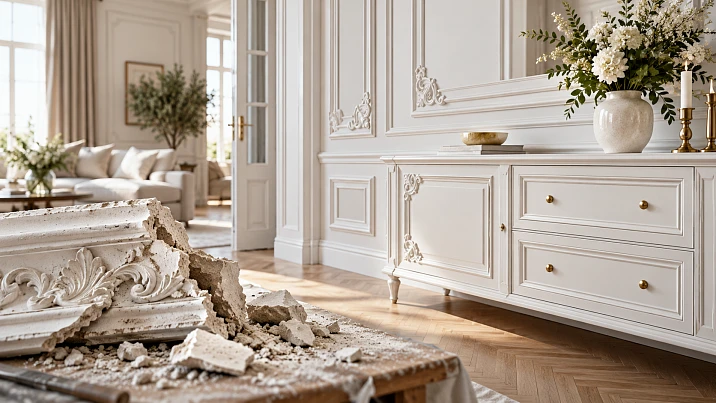
Imagine: the decorative cornices arrived at the start of the renovation, the packaging was opened before installation — and one element turned out to have a chip. For gypsum stucco molding this is a particularly unpleasant situation: the damage may fall on a protruding scroll that is difficult to restore invisibly. You will have to arrange a replacement, find a way to repair it, or postpone the finishing work. The beautiful design that the decor was chosen for does not solve anything for now.
Polyurethane stucco molding follows a different practical logic. It is lighter, less fragile, easier to cut and install, and handles humid environments better. When well made, the relief remains expressive, and after painting the material does not prevent creating a classic or modern interior. Therefore, for most ordinary apartments, country houses, and furniture projects, it is more sensible to choose polyurethane rather than gypsum.
This is not to say that gypsum is a bad material. It is appropriate in restoration and original sculpture. But a buyer who needs wall moldings, a ceiling medallion, or overlays for a wardrobe is solving more down-to-earth tasks: to receive intact products, install them without unnecessary complications, and use the result with peace of mind. By these criteria, polyurethane often wins.
Which is better — gypsum or polyurethane stucco molding: a comparison without advertising promises
Gypsum is a mineral material from which decorative elements are cast. Once it has set, it is hard but relatively brittle: thin edges and protruding details do not withstand impact loads well. Polyurethane mouldings are formed from a polymer material. Their properties depend on the composition and technology, but quality products are usually lighter and less sensitive to accidental impacts.
|
Criterion |
Gypsum molding |
Polyurethane Moldings |
|
Delivery |
Demanding in terms of packaging; chips on protruding relief are especially unpleasant |
As a rule, lighter and less brittle, but also requires protection during transport |
|
Weight |
With the same shape, often heavier |
Usually substantially lighter than a comparable gypsum product |
|
Installation |
Heavy elements may require additional fixing |
Small products are often installed with a suitable mounting adhesive |
|
Moisture |
Requires reliable protection from prolonged moisture |
The material itself is moisture-resistant; joints and the base need separate protection |
|
Random impacts |
Chips and cracks are likely on thin parts |
Usually withstands everyday mechanical stress better |
|
Painting |
Requires preparation that accounts for the absorbent surface |
Can be painted with compatible coatings over a prepared surface |
|
Furniture Decoration |
Heavy and fragile parts are inconvenient on moving fronts |
Lightweight overlays suit many furniture solutions |
|
Total cost |
Depends on the product, delivery, mounting, and labor |
Savings more often come from installation and related operations, not necessarily from the part price |
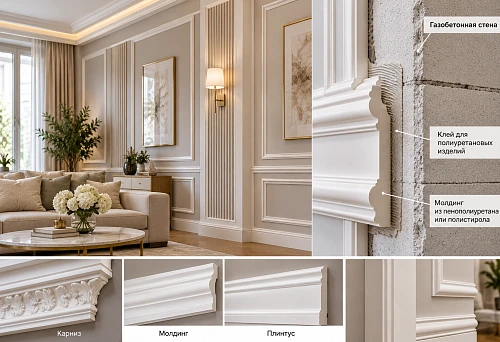
The STAVROS catalog features polyurethane moldings for walls, ceilings, and furniture. It is more useful to evaluate them as a complete finishing system: with specific dimensions, patterns, fastening, joints, and painting. This is exactly how the material reveals its advantages.
1. Less fragility — fewer delivery problems
A gypsum cornice may look massive and reliable while it sits on a display stand. But moldings have vulnerable spots: delicate ornamentation, sharp edges, narrow bridges, and long profile sections. With poor loading, the load falls on a small fragment, and it chips off. Even if the main body of the product is intact, a noticeable chip on the front side changes the result.
It is not only the likelihood of complete destruction that matters. Suppose six identical decorative elements were ordered for a room. Five arrived undamaged, and the sixth has a chipped edge. Formally, the order is almost complete; in practice, the installation composition cannot be finished. With a symmetrical layout, you cannot replace the product with a random similar one — the pattern must match.
In such a situation, polyurethane is more practical thanks to the combination of lower weight and lower fragility. Carrying a long molding is more convenient, an accidental touch does not necessarily end in a chip, and protruding relief areas more often remain intact under normal handling. However, "unbreakable" is the wrong word: a strong impact, improper support, or crushing can damage polyurethane too.
Packaging remains fundamentally important. A long profile must not be transported in such a way that its edges hang freely in the air. It must rest on a rigid base, not bend when carried, and be protected from local pressure. For example, for the polyurethane molding MLDPU-001 2600 mm long, STAVROS provides a rigid transport backing for small batches. This is a good reminder: even a more practical material requires proper logistics.
When accepting delivery, do not rush to throw away the packaging. Inspect the ends, the front surface, the corners, and all protruding elements, and verify the quantity and item codes. For shaped overlays, it is useful to immediately lay out the paired parts and make sure that the left and right sides of the order match the project.
The advantage of polyurethane here is quite specific: less risk of turning ordinary delivery into a separate stage of renovation and coordination.
2. Installation is simpler, faster, and often costs less
Installation cost is not determined by gluing time alone. The installer must bring the product, carry it up to the site, mark out the surface, cut the profile, hold it in the required position, and finish the joints. The heavier and more fragile the piece, the more difficult some of these steps become.
Gypsum mouldings require especially careful weight assessment. For heavy cornices, large rosettes, or massive decor, adhesive fixing alone may not be sufficient. The fastening scheme is determined by the weight of the product, the construction of the wall or ceiling, and the manufacturer's instructions. Whether mechanical fasteners are needed depends on the project, not on the word "gypsum" alone.
Small-section polyurethane elements are usually easier to work with. They are easy to hold while marking, to cut with a suitable fine-toothed saw, and to install using an adhesive intended for the specific material and substrate. You can view shapes and sections in the section mouldings for walls and ceilings. Important: this section features products made from different materials, so before purchasing, check the "Material" line in the product card.
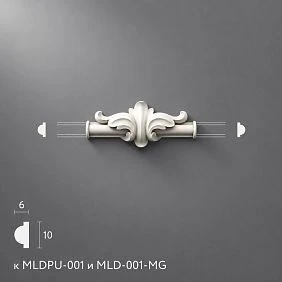
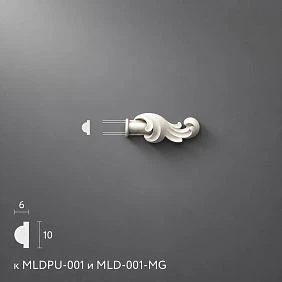
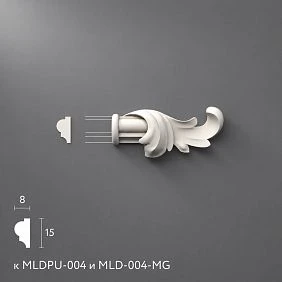
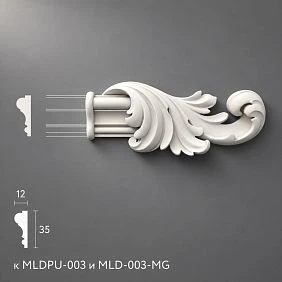
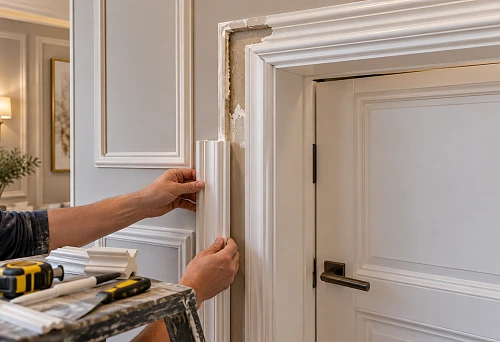
How a standard decorative frame is installed
1. Check the substrate. It must be dry, strong, and free of dust and flaking paint. Gluing a moulding to loose filler or poorly adhering wallpaper is risky: the finishing layer underneath may come away rather than the adhesive.
2. Mark out the frame. First mark the outer dimensions and the distances to the floor, openings, sockets, and furniture. Only after checking the diagonals should you proceed to cutting.
3. Cut the pieces. On rectangular frames, corners are most often cut at 45 degrees. You must measure along the exact profile edge that defines the frame dimension, otherwise the finished joints will not align.
4. Apply a compatible adhesive. Choose the compound according to the adhesive manufacturer's instructions, the wall type and the room conditions. Apply it to the designated mounting surface, leaving no empty areas where continuous contact is required.
5. Fix and hold. Press the profile against the markings, secure it temporarily if necessary, and do not load it until the joint reaches full strength. The time depends on the chosen adhesive.
6. Finish the joints and paint. Treat end joints and abutments with materials compatible with polyurethane. Gaps cannot simply be hidden under a thick layer of paint.
For joints, it is important to distinguish between mounting adhesive and materials intended for seams. A good-looking external seam does not yet guarantee that two profiles are reliably connected to each other. If the base is movable or the temperature regime changes, errors in the joint may show up later.




Where savings arise
On small elements, you can avoid heavy fasteners, prolonged holding of parts, and additional operations to reinforce the base. Sometimes the owner can install simple moldings independently. But this is not permission to glue any profile to any surface: large elements, complex ceiling geometry and weak bases require separate assessment.
The difference is especially noticeable when decorating several rooms. The craftsman repeatedly performs the same operations: lift the profile, trim it, try it on, fix it. With lightweight material, these usually take less effort. Labor savings become more noticeable as the number of parts increases.
For DIY work, a detailed installation instructions for polyurethane stucco molding. And when choosing an adhesive, first check the recommendations for the specific product, then the compatibility of the composition with the substrate. For example, the catalog includes adhesive for installation based on hybrid polymers, but the consumption and application method are determined by the actual working conditions.
Fast installation is an advantage of polyurethane not because the technology can be neglected, but because the material itself usually does not complicate it with excess weight and fragility.
3. Moisture resistance: a more reliable choice for the kitchen and bathroom
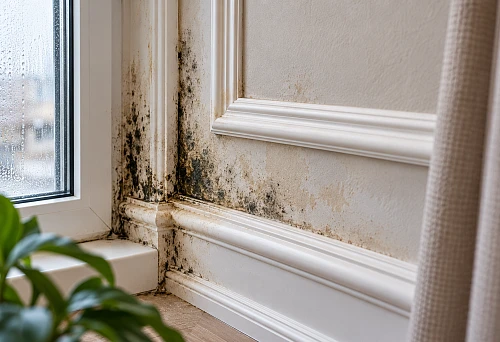
A ceiling cornice near the shower area and a molding in a dry bedroom exist in different conditions. In the first case, the finish is exposed to humid air, condensation, periodic splashes and frequent cleaning. Gypsum stucco molding without well-designed protection withstands such an environment less well: water can penetrate the porous material and weaken the finishing layers.
Polyurethane is more resistant to household moisture. Therefore, for a bathroom, kitchen or sanitary room it is usually more practical than gypsum. Especially if you want to continue a decorative cornice from the hallway into the adjacent bathroom or decorate the walls with moldings in the same style.
Here there is a fundamental boundary between the properties of the product and the properties of the finishing assembly. Even a moisture-resistant molding will not protect the wall if water freely gets behind its back side. Damp plaster, a non-sealed joint or paint not intended for the room can ruin the result without any destruction of the polyurethane itself.
For the bathroom, it is useful to run a quick check:
· check whether the manufacturer of the specific product allows its installation in the selected wet zone;
· make sure the base is dry and shows no signs of leaks;
· select adhesive and joint material intended for such conditions;
· protect the junctions from water getting behind the decor;
· choose a coating suitable for the room and compatible with the product.
Do not place ordinary interior moulding where a stream of water constantly hits it, unless the manufacturer explicitly permits such use. Above a stove or near an open flame, heating and the product's technical limitations must also be taken into account.
In a real interior, this is especially noticeable at the upper edge of the tile and the painted wall. A gypsum element would require more complex protection from moisture. Polyurethane, with proper selection and sealing, allows for a neat transition without unnecessary complication. The material wins when a beautiful relief is needed in a room with variable humidity, rather than an imitation of waterproof cladding.
4. Impact resistance: fewer chips where people are constantly moving
Relief moulding looks especially expressive in side light. But protruding ornamentation at a doorway can easily be caught by a bag, a box during a move, or furniture. On a gypsum overlay, such contact can leave a white chip with an uneven edge. It will have to be restored and touched up, and on a symmetrical pair the defect is sometimes more noticeable than on a single element.
High-quality polyurethane usually withstands minor mechanical impacts better. It does not become invulnerable, but the risk of the protruding fragments breaking off that is characteristic of gypsum is lower. This gives clear areas of application: entryways, corridors, door surrounds, wall frames at heights where contact is possible, and furniture facades.
However, strength should not be confused with everything at once. Surface hardness, impact resistance, and paint's resistance to scratches are different properties. You can preserve the overlay itself after an accidental touch but damage the painted layer. Sometimes repair comes down to local touch-up painting rather than replacing the product. That is already a noticeable difference in the effort involved.
When choosing where to place the decor, look at how the doors open and the drawers pull out. Even an impact-resistant profile should not be placed at a point of constant contact with a handle or an adjacent front. In areas of active use, it is not only the material's properties that win out but also smart placement.
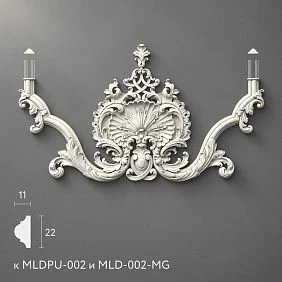
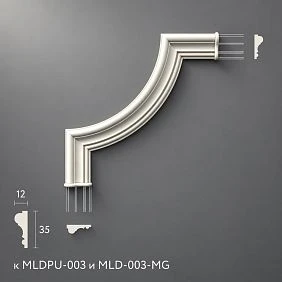
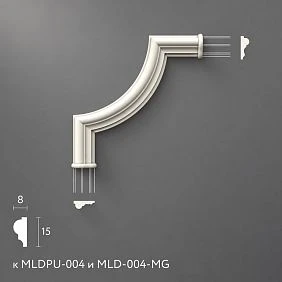
If the frame ends at the door, it can be complemented with suitable decorative elements for polyurethane moldingsThe corner element must match the main profile in pattern and installation geometry: a beautiful part on its own does not yet mean compatibility.
5. European raw materials and manufacturing quality: what the buyer sees
The words “polyurethane stucco molding” are not enough to evaluate a product. Two moldings with the same purpose can differ in geometric precision, edge sharpness, surface quality, and casting uniformity. The difference is noticed during installation: one profile lays easily onto the markings, another has to be adjusted, and flaws at the joints become visible after painting.
STAVROS lists European material among the advantages of its stucco decor. This is a significant part of the product positioning, but the country of origin of the components alone does not replace quality control. It is more useful for the buyer to check the signs that can be seen and measured on the finished product.
The first is geometry. Place a long profile against a flat surface and check whether there is any unexpected bend or twist. For a frame composition, it is especially important that pieces of the same article join without a noticeable step.
The second is the relief. On a quality casting, the pattern should not unexpectedly lose depth, break off on identical elements or turn into an unclear mass. With a repeating ornament, compare adjacent pieces: the decorative rhythm depends on the pattern matching.
The third is the surface for painting. Traces of manufacturing defects, contamination or damaged edges will not disappear after paint is applied. Moreover, side light can make them more noticeable. Therefore, it is advantageous to get a good surface right away rather than spend hours correcting it during finishing.
The fourth is compliance with documentation. If the origin of raw materials, a specific coating system, fire safety requirements or other indicators are fundamental to the project, request supporting documents for the specific article. One should not attribute the same properties to all polyurethane products without technical data.
The practical advantage of quality polyurethane lies in a predictable result: the decor should arrive intact, fit the dimensions, and retain its detailed pattern after painting. This is exactly what turns a good material into time savings on site.
6. One material for walls, ceilings, doors, and furniture
Moulding is usually associated with the ceiling: a cornice around the perimeter, a rosette above the chandelier, sometimes a few ornamental details. Polyurethane significantly expands this scenario. It can be used to assemble a decorative system in which the pattern on the wall continues onto door leaves and furniture fronts. At the same time, there is no need to make furniture doors carriers of heavy plaster castings.
Our factory also produces:
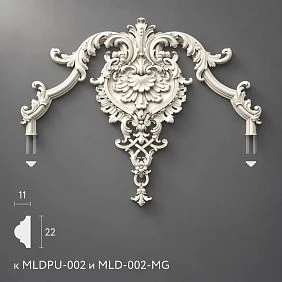
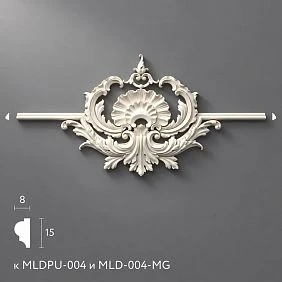
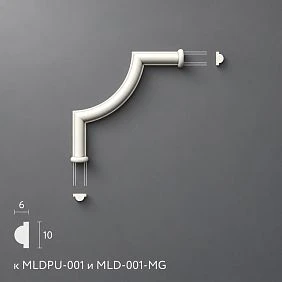
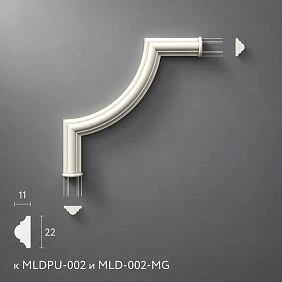
Wall frames: expressive geometry without remodeling the wall
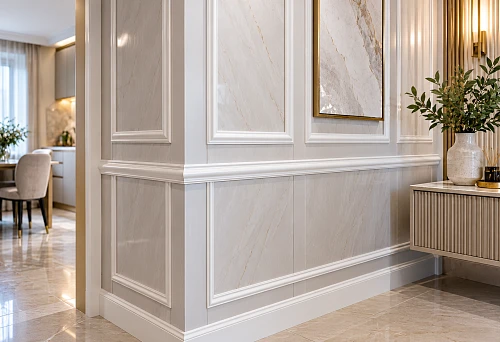
Imagine a living room with a smooth painted wall and a doorway on the side. Installing four thin frames changes the perception of the plane: a vertical rhythm, proportions, and shadows from the profiles appear. At the same time, the main volume of the room does not decrease, unlike with deep applied panels.
For modern neoclassicism, it is better to start with the furniture layout. If the sofa covers half of the lower frame, dividing the wall into identical rectangles makes no sense. Decorative fields should be marked out according to the visible surface, taking into account the skirting board, architraves, switches, and furniture height. With a narrow wall section by the door, it is sometimes better to leave a clean field than to insert a disproportionately cramped frame.
For a calm linear pattern, a suitable option is, for example, polyurethane molding MLDPU-027. It is available in cross-section variants of 14 × 9 and 20 × 12 mm with a length of 2600 mm. The narrower profile gives a delicate line, while the wider one is more noticeable in the light. The specific variant is chosen based on the wall dimensions, not on a photo of a single piece.
Get Consultation
Ceiling: a lightweight rosette instead of a heavy component
On the ceiling, low weight is especially valuable. A decorative rosette needs to be lifted, positioned precisely relative to the chandelier, and securely fastened. With a heavy plaster detail, the requirements for support and fastening increase. For polyurethane, choosing a mounting scheme is also mandatory, but working with the product itself is usually easier.
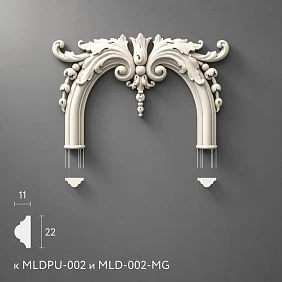
In the section ceiling fixtures made of polyurethane large ornamental compositions are presented. Before ordering, check not only the external size, but also the position of the light fixture, the presence of a mounting block, the possibility of safely routing the wiring, and the distance to the nearest ceiling elements. The rosette decorates the mounting point of the chandelier, but it must not serve as its load-bearing fastener.
A standard ceiling does not always need a large rosette. If the distance from the chandelier to the cornice is small, a rich ornament can overload the center. It is better to choose a piece with a suitable scale than to install the largest one available.
Furniture: here gypsum is especially inconvenient
A cabinet door is constantly in motion. It is opened by the handle, sometimes closed sharply, and it experiences small vibrations and impacts. Adding a heavy and fragile gypsum overlay to such a surface is a decision that requires additional justification. A lightweight polyurethane ornament is far more logical.
For example, NPU-505 overlays for furniture dimensions 50 × 228 × 10 mm. If it is installed in the center of a facade 400 mm wide and 650 mm high, the free field will be 175 mm on the left and right and 211 mm on the top and bottom. This is not a universal design rule but a simple way to estimate the scale in advance: the applique will be a vertical accent without covering most of the surface.
For a finer ornamental line, there is the decorative overlay NPU-506 a size of 12 × 205 × 5 mm. This format can be considered for a narrow area of a facade or a door leaf where a large applique would disrupt the composition. But even a small thickness requires checking clearances: on sliding doors and next to drawers, there is sometimes very little free space.
В catalog of STAVROS polyurethane overlays there are central, corner and other shapes. They should be chosen not only by the style of the ornament. For a cabinet, what matters more is the actual dimensions of the facade, the placement of handles, hinges, and slides, the painting conditions, and the coating material. On a glossy laminated facade, the approach to gluing will be different from that on a prepared MDF surface for enamel.
A unified decorative system without heavy material
An interesting result comes when one pattern of moldings is used on the walls and matching-in-style overlays are used on furniture. A connection between architecture and objects appears in the room, even though the furniture may have been made separately. Polyurethane is convenient here not only aesthetically: the same task is solved by products that are easier to transport, try on, and install on various substrates.
To keep the decor from looking like a random collection of ornaments, two principles are enough. First, choose a dominant motif: a smooth geometric line or a plant relief. Second, limit the number of large accents. If the cabinet is already decorated with an expressive overlay, a simple molding frame may be enough for the adjacent wall.
Will polyurethane stucco look worse than gypsum?
The doubt is understandable. Gypsum is associated with historical interiors, while polyurethane is sometimes mistakenly perceived as a material exclusively for inexpensive finishing. In a finished room, what matters more is something else: how evenly the profile is installed, whether the joints are neat, whether the pattern matches the scale of the room, and how the painting is done.
Let's take a smooth molding. Its expressiveness is created by a fine shadow on both sides of the profile. The material itself barely contributes to the visual effect. If a joint is open or a corner is cut inaccurately, the defect will be noticeable on both gypsum and polyurethane. And with proper installation and a uniform paint finish, the decorative pattern is perceived as part of the wall.
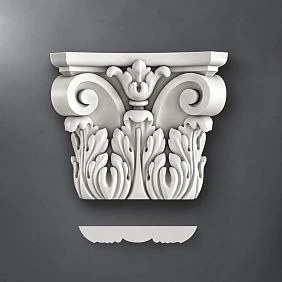
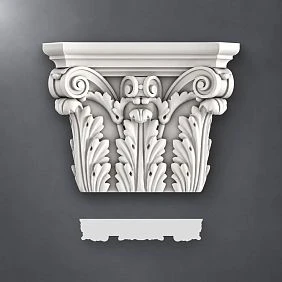
A complex ornamental overlay is more demanding. Clean recesses, pattern repeatability, and the absence of casting defects matter on it. With high-quality polyurethane, the relief can be detailed enough for classic interiors, and its low weight allows it to be installed where a gypsum ornament creates inconvenience.
You shouldn't try to hide poor preparation with a thick layer of paint: it can fill in small recesses. It is better to eliminate substrate defects, choose a compatible primer, and apply the coating in accordance with the manufacturer's recommendations. Under side lighting, it is precisely neat geometry and the finish that determine whether a decorative frame looks convincing.
What's more cost-effective: we count the finished result, not the price per meter
The statement "polyurethane is always cheaper than gypsum" is too crude. Some polyurethane products cost more than simple gypsum equivalents. However, the cost of a finished project is not made up only of the price tag on the part. You need to take into account cutting, packaging, transportation, fastening materials, labor costs, and the risk of rework.
Example: four decorative frames made from real STAVROS moulding
Suppose you need to assemble four rectangular frames. The outer size of each along the marking line is 1300 × 900 mm. One frame requires two long pieces of 1300 mm and two short pieces of 900 mm. In total, for four frames — eight pieces of 1300 mm and eight of 900 mm, that is, 17.6 linear metres of finished sections.
Let's take MLDPU-001 moulding, 2600 mm long. A simple division of 17.6 by 2.6 gives 6.77, and mathematically you'd want to order seven strips. But this is an incorrect cutting calculation. From one strip you can get no more than two required segments: for example, 1300 and 900 mm, leaving about 400 mm for the remainder and saw cuts. Since a total of sixteen segments is needed, a minimum of eight strips will be required. This way the order becomes feasible, and not just pretty on a calculator.
The verified MLDPU-001 product page lists a price of 1740 rubles per strip. Eight strips cost 13,920 rubles. For budget comparison, this is a concrete baseline figure, not the average market price of polyurethane. The actual price should be checked on the product page before ordering.
Glue, delivery and painting are calculated separately. The KUDO glue product page states an approximate consumption of up to 16 linear metres per cartridge when applied in a single line. For 17.6 m, theoretically at least two cartridges are needed, but on a wide base, with several strips and uneven surfaces, consumption will be higher. The verified glue product page lists a cartridge at 990 rubles; two — 1980 rubles. The moulding product page also indicates a transport backing of 390 rubles for a small order. That comes to 16,290 rubles for eight strips, two cartridges and the specified backing, excluding delivery, consumables for joints, painting and labour.
This is not a final room estimate. But the order of calculation is already clear, and the cost items that are easy to forget are visible. Gypsum and polyurethane can only be honestly compared after receiving a gypsum quote for a comparable profile with delivery and installation. If the gypsum piece is cheaper but requires more expensive installation, the total may shift in favour of polyurethane.
How to correctly compare two quotes from craftsmen
Ask contractors to list separately the cost of the products, delivery, surface preparation, fasteners, installation, joint treatment and painting. If one quote includes the finishing, while the other ends at gluing, comparing the totals is meaningless.
For long profiles, what matters is not only the price per linear metre, but also the price per number of whole strips. For shaped overlays — the price of a set with paired elements. For ceiling rosettes — the mounting scheme and work around the light fixture. For furniture — preparation of the facade coating and checking that it opens after installing the overlays.
The main savings of polyurethane are most often hidden in reducing the complexity of the project. The buyer pays for it once at installation but enjoys the finished interior every day.
When gypsum is still better — and why this does not change the overall choice
There are tasks where gypsum is genuinely justified. In the scientific restoration of a historic interior, the material of a new element may be specified by the project and by the requirements for preserving the authentic technique. When working with an original sculpture, the craftsman sometimes chooses gypsum for the sake of hand-finishing the relief or making a one-off mold. If the project imposes special requirements on fire performance, materials must also be selected based on verified ratings: gypsum and polyurethane are not automatically interchangeable.
However, these situations differ substantially from an ordinary apartment renovation. To trim a wall with moldings, put a decorative overlay on a cabinet door, or add a ceiling rosette, there is no need to take on the fragility and greater weight of gypsum if a suitable product already exists in polyurethane.
You should not choose polyurethane without checking the conditions near open flames, heating appliances, and in places where the decorative part will be in constant contact with water. Those areas require the specific product's technical tolerances. But for a normal residential interior with standard operating conditions, polyurethane remains the more practical solution.
Five mistakes that can ruin even high-quality polyurethane stucco
Buying based only on a beautiful photo. The scale is unknown in the image. A 400 mm high overlay may look good on a wide cabinet and turn out to be excessive on a narrow door. First measure the available field, then compare it with the product dimensions and check the thickness of the relief.
Gluing onto a weak substrate. Often the surface looks painted and even, but underneath there is an old peeling layer. The adhesive will bond the molding to the paint, and the paint will later come off together with the decor. Check the strength of the coating and, if necessary, prepare the substrate anew.
No cutting plan. Adding up the linear meters does not show the number of whole strips. A 500 mm remainder is useless if a solid 900 mm section is needed. Before ordering, write out the lengths of all individual parts and distribute them across factory strips, taking cuts into account.
Improper joint treatment. If two moldings are joined only with decorative filler without following the requirements of the selected installation system, the seam may open up. Ask what the manufacturer recommends for joining ends and corners, and what to use for sealing small gaps at the wall.
The decor interferes with using the furniture. On a closed door, the overlay looks appropriate. Once opened, it may catch on the adjacent door, the cabinet body, or a drawer. Check the movement path and clearances before ordering. Sliding systems are especially critical, where even a few extra millimeters of thickness matter.
Polyurethane reduces the complications associated with the properties of the material itself. It will not fix design and installation errors on the customer's behalf.
How to choose and buy STAVROS polyurethane stucco molding for your project
You should start not with the most striking ornament, but with the installation location. For wall frames you will need profiles of a suitable cross-section; for the ceiling, a cornice or rosette of the right scale; for furniture, overlays that do not conflict with the hardware and the finish of the facade.
Draw up a short order plan. Measure the height and width of each decorative field, mark the location of doors, sockets, baseboards and light fixtures. Then write down the exact item codes, dimensions and material of the products. If you need corner decorative elements, first check their compatibility with the selected molding. For complex ceiling decoration, you can study ceiling decor sets, but remember: sets may contain mixed materials, so the material of each part should be checked separately.
When finishing furniture, compare the dimensions of the overlay with the facade, leave the necessary technological clearances and check which adhesive is compatible with the finish. A product intended for painted MDF board should not be mounted on any glossy or laminated substrate without checking.
If the task is — buy polyurethane stucco molding for a unified room design, it is more convenient to first select the main moldings and cornice, and then choose rosettes and overlays with a matching pattern. This order reduces the risk of buying beautiful but incompatible parts. And it delivers exactly what the decor was intended for: the walls, ceiling and furniture are perceived as parts of one interior.
Questions to resolve before ordering
Can polyurethane molding be glued directly over wallpaper?
This depends on the condition of the wallpaper, the type of covering, and the weight of the piece, but it is more reliable to attach the decor to a solid, prepared base. Wallpaper may peel away together with the adhesive and the molding. If the renovation is already complete, first check the stability of the covering and the recommendations for the chosen mounting system.
Why is the joint between two profiles sometimes visible after painting?
The cause may be inaccurate trimming, movement of the base, an incompatible compound for joining the ends, or an insufficiently prepared seam. Paint does not compensate for poor geometry. Precise angles, a correct joint, and careful finishing are more important than an extra coat of paint.
Can polyurethane stucco be repainted together with the wall?
Yes, if the old coating is firmly adhered, the surface is cleaned, and the new paint is compatible with the existing finishing system. The relief should be painted without excessive accumulation of the product in the recesses. Before painting the entire surface, it is useful to do a test on an inconspicuous area.
Is a polyurethane overlay suitable for a sliding wardrobe?
Not based on the material name alone. Check how far the overlay protrudes above the door surface, the distance between the panels, and the movement path. Even a thin piece can interfere with the mechanism if the gap was calculated without it.
Can a polyurethane ceiling medallion be installed on a drywall ceiling?
The possibility depends on the weight and dimensions of the medallion, the condition of the ceiling, and the recommended fastening. For a lightweight decorative element, the adhesive system provided by the manufacturer is often sufficient; large items are assessed separately. The fastening of the chandelier itself must be independent and appropriate for its weight.
Should I buy spare overlays right away?
For single large pieces, this depends on the complexity of the order and the availability of the model. For repeated frames, the calculated stock of profile material and precise cutting are more important. If the ornament has left and right versions, check the quantity of each in advance — an extra element with the other orientation will not replace a missing one.
Conclusion: why complicate repairs when the relief can be made from polyurethane
Gypsum can produce beautiful moulding, but along with the design the buyer gets greater sensitivity to impacts, difficulty handling heavy pieces and additional moisture requirements. For most modern interiors, these characteristics do not offer advantages worth paying extra for with time and effort.
Polyurethane solves the same decorative task more practically: it is easier to deliver, more convenient to install, can be used in wet rooms with the right finishing system and on furniture fronts. A quality relief, after proper installation and painting, looks convincing — on walls, ceilings and furniture.
If you are choosing decor for an apartment, house, or furniture project, start with the dimensions and installation conditions, and then select the appropriate STAVROS elements. Polyurethane stucco is an opportunity to achieve an expressive interior without many of the difficulties that accompany gypsum decor.