Article Contents:
- Can Moldings Be Installed on Plastic Panels
- A Thin Hollow Panel and Rigid Cladding Are Different Substrates
- A Panel on Adhesive and a Panel on Battens
- Where It Is Better to Avoid Direct Bonding
- Checking Without Damaging the Surface
- Can You Lean on the Wall Behind the Panel
- A thin line or a wide relief
- Corners and decorative overlays
- How to read the technical description of the composition
- A test bond is useful, but it is not enough
- 1. A thin line on a painted wall above the panels
- 2. Vertical lines in the rhythm of the plastic seams
- 3. Frame around the clad area
- 4. Horizontal band between two types of finish
- 5. Stucco molding on the adjacent wall
- Vertical and horizontal edge
- Top edge and ceiling area
- Why the temperature gap must not be sealed tight
- Can polyurethane foam be glued to a plastic panel?
- Which is better on a PVC wall: polystyrene or polyurethane?
- What to use to glue molding to smooth PVC?
- Can decor be attached to hollow panels?
- Does a plastic surface need to be primed?
- How to hide the transition from a PVC panel to a painted wall?
- Is polyurethane stucco suitable for a bathroom?
- How can I make sure the molding doesn't come unstuck?
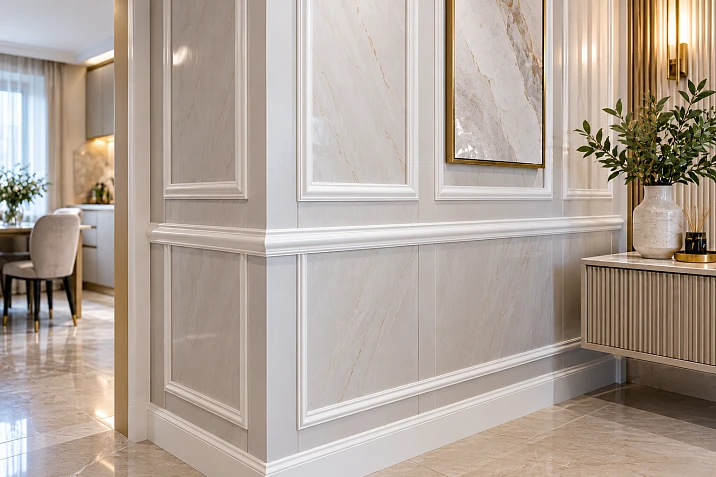
The wall in the hallway has already been covered with plastic panels. The vertical seams look neat, but the top edge of the cladding seems unfinished. The idea arises to glue a thin molding, and on the adjacent section assemble two decorative frames. The store has polyurethane, polystyrene, and polyurethane foam products. Choosing a profile by pattern is not difficult; it is much harder to understand where it will actually hold.
Attaching stucco directly to PVC panels can only be considered after checking the cladding structure, adhesive compatibility, and permissible load. If the plastic flexes, is mounted on a movable batten, or has temperature gaps, a simple promise that "the adhesive is suitable for PVC" is not enough. It is often more reliable to place the molding on a solid painted wall next to the panels, leaving the plastic cladding the freedom of movement provided by the manufacturer.
A decorative strip and a wall panel have two different jobs. The first creates relief; the second covers the wall and often serves as a standalone finishing system. The mistake occurs when molding is used to simultaneously decorate the surface, secure movable panels, and hide installation flaws. Let's look at how to separate these tasks, choose the material, and calculate the order without unnecessary details.
Can moldings be installed on plastic panels?




A thin hollow panel and rigid cladding are different substrates
Hollow panels have internal ribs. Between them, the face wall can flex noticeably when pressed with a finger. On such a surface, even a lightweight profile sometimes holds only until the first noticeable movement of the cladding: the load is borne not only by the adhesive but also by the thin plastic shell.
A thicker and more rigid sheet behaves differently. However, the strength of the face surface does not prove that the sheet is securely attached to the wall. If it shifts along with the adhesive or batten, adding a decorative element will not fix the problem.
Our factory also produces:


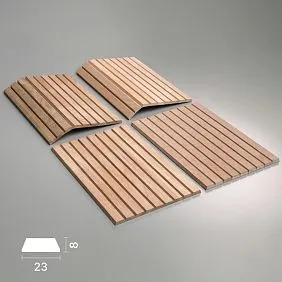
A panel on adhesive and a panel on a batten
A panel glued to a flat, solid substrate according to the manufacturer's scheme usually has more uniform support. But if large voids remain underneath, individual areas may spring. You should evaluate the actual construction, not just the word "glued."
There is a gap on the batten between the plastic covering and the wall. Here it is especially important to determine where the load-bearing rails run, how the cladding is fixed, and whether the desired decorative line falls in the middle of a hollow span. Turning a lightweight panel into a support for a massive overlay is not permissible without calculating the entire system.
Get Consultation
Where it is better to avoid direct gluing
The base is not suitable for experimentation if the panel rattles, noticeably shifts on ordinary touch, peels away at the edges, has cracks around the fasteners, or covers a wall with signs of persistent dampness. Postpone the decorative work until the cause is eliminated.
A separate case is unknown cladding. If it is impossible to establish the panel manufacturer, the face covering material, and the permitted method of additional fastening, it is safer to choose a molding on an adjacent mineral base or a factory-made PVC finishing profile.
Polyurethane foam, polystyrene, or polyurethane: what to compare
Polyurethane foam is polyurethane with a cellular structure. It does not form a separate family of materials. At the same time, the density, the proportion of closed cells, the manufacturing method, and the coating of a specific part can significantly change its properties. Soft foam rubber and a rigid molded decorative element cannot be evaluated by the same criteria.
Polystyrene profiles also differ: a foamed inexpensive strip and a dense extruded molding have unequal surfaces, resistance to local pressure, and processing requirements. A conventional comparison that "polystyrene is lighter than polyurethane" does not replace checking the weight and dimensions of specific products.
For a STAVROS polyurethane molding, one should look at the actual cross-section, length, shape of the back side, and the manufacturer's rules. It is not permissible to automatically declare every MLDPU model to be rigid polyurethane foam of a certain density or to promise it absolute dimensional stability: such data is not present in the reviewed product cards.
| Criterion | Polyurethane | Polystyrene | STAVROS polyurethane profile |
|---|---|---|---|
| Structure | Cellular; properties depend on the composition | Foamed or dense, depends on the product | Specified as polyurethane; the model's characteristics are clarified |
| Trimming | Edge quality and specific density matter | Some types are sensitive to chips and solvents | The trim is selected based on the profile geometry and the manufacturer's recommendations |
| Painting | Depends on the factory coating | depends on the configuration | A compatible primer and paint system is selected |
| Bonding with PVC | Only after checking both surfaces | Only after checking both surfaces | The molding material alone does not confirm adhesion to the panel |
| Repair | Depends on damage to the cellular structure | Depends on density and coating | Replacing a single plank may be considered if the cross-section matches |
The best material does not compensate for a poor base. For a lightweight frame on a solid wall, the choice is really determined by the pattern and budget. For movable plastic cladding, first decide whether the selected fastening unit can be used at all.
How to check whether the cladding can support a decorative element
Checking without damaging the coating
First, find out how the panels are installed: look for the instructions, renovation design photos, or information from the installer. Then inspect the edges, vertical joints, and areas where they meet the ceiling. Listen for any clicking or creaking when lightly touched. There is no need to hit the panel or test its strength by pulling.
Check whether the locks of adjacent elements are coming apart and whether any individual sheets protrude forward. For cladding on a batten frame, it is especially useful to compare the intended composition with the lines of the supporting battens. If in doubt, invite a specialist who can assess the actual fastening.
| Detected sign | What it may mean | Solution before buying the molding |
|---|---|---|
| The panel visibly sags between the slats | Insufficient rigidity of the decorative base | Do not attach the textured overlay there; relocate the composition |
| The sheet is rigid, but the edge is coming away | The cladding itself is not properly secured | Fix the cladding, then re-evaluate the assembly |
| There is film or a coating on the front side | The adhesive may bond to the coating rather than to the substrate | Test the system on a real sample and check the manufacturer's requirements |
| There is a painted solid wall nearby | Installation of the decor can be separated from the movement of the PVC | Consider fastening to the adjacent wall |
| Dampness, mold or a leak is visible | There is an unresolved construction issue | First eliminate the source of moisture |
Whether it is possible to anchor to the wall behind the panel
Sometimes it seems logical to drill through the plastic and fasten the profile into the mineral wall. But the hole may intersect electrical wiring, a pipe, waterproofing or a functional temperature gap. In addition, with rigid clamping between the screw and the cladding, the panel may deform. Such a solution is possible only in a designed assembly where access to the base, suitable spacer elements and preservation of the cladding movement are provided. You should not drill into an unknown structure on your own for the sake of a decorative molding.
More often it is simpler to leave the panels untouched and extend the composition onto a prepared field next to them. This is a full-fledged interior solution, not a forced compromise.
Which STAVROS moldings to consider for such a project
This refers to the decorative finishing of a suitable solid base, including around plastic panels. The listed products are not ready-made kits for gluing to any PVC.
| Product | Size, mm | Price of one strip as of 26.10.2026 | For which composition |
|---|---|---|---|
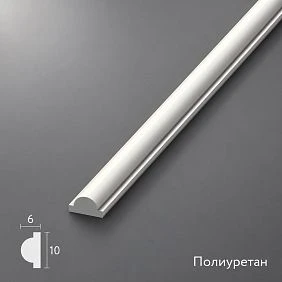
| MLDPU-001 | 10 × 6 × 2600 | 1 740 ₽ | The fine line between finishes |
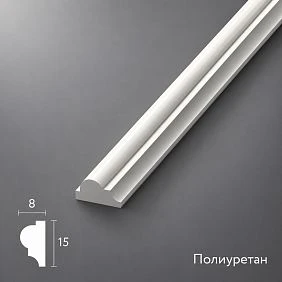
| MLDPU-004 | 15 × 8 × 2600 | 3 190 ₽ | Small wall frames |
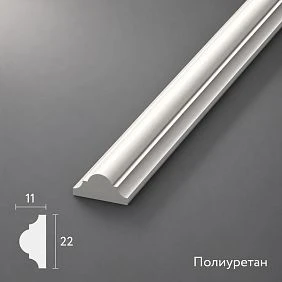
| MLDPU-002 | 22 × 11 × 2600 | 5 460 ₽ | A more noticeable framing |
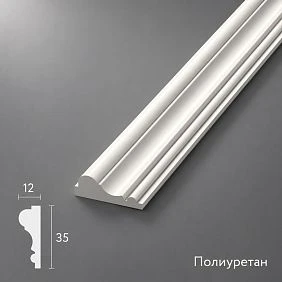
| MLDPU-003 | 35 × 12 × 2600 | 7 580 ₽ | An expressive contour on a stable wall |
| HIWOOD D22 | 22 × 10 × 2000 | 350 ₽ | A polystyrene option with a different plank length |
Prices apply only to the products themselves, excluding packaging, delivery and installation materials. For the HIWOOD D22 card, sales are limited to Moscow, the Moscow and Leningrad regions and Saint Petersburg. Availability for a specific address is best checked before calculating the final order.
A thin line or a wide relief
If you need to neatly separate a painted wall from a plastic section, the MLDPU-001 profile, 10 mm wide, can provide an almost graphic line. The MLDPU-004, 15 mm wide, is more noticeable and suitable for small frames. Profiles 22 and 35 mm wide create a deeper shadow; in a narrow section of a hallway, such relief may visually compete with the seams of the panels themselves.
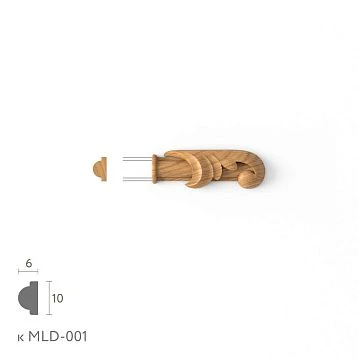
Also compare the depth: 6, 8, 11 or 12 mm is the amount by which the profile protrudes relative to the mounting surface according to the dimension designation in the product card. Do not automatically assume that the entire back side is flat and suitable for applying adhesive in a continuous strip. Before purchasing, study the cross-section drawing.
Corners and decorative overlays
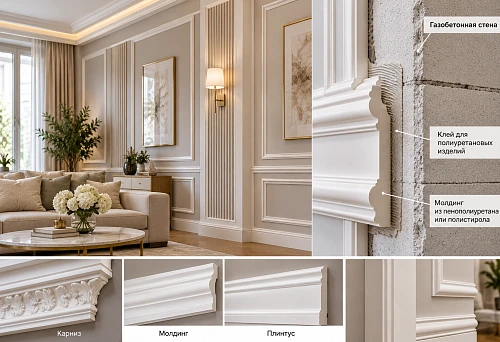
The catalog includes Decor for Molding with corner elements from different series. Select them based on the specific junction, not just on a similar external pattern. Larger Polyurethane decorative appliques it is reasonable to mount on a confirmed solid wall, not on a flexible sheet.
What to use to glue molding to a PVC panel
There is no universal adhesive name that will solve this task for all panels. PVC is a non-porous substrate, and its surface may have a printed film, protective varnish or another layer. The adhesive must be compatible with both the face layer of the specific panel and the material of the molding. A permissible temperature range and suitable curing conditions between two non-absorbent surfaces are also required.
A regular mounting adhesive for mineral walls does not become suitable for PVC just because it firmly holds polyurethane stucco on plaster. Some water-dispersion adhesives have difficulty drying when enclosed between two non-porous materials. Solvents in certain formulations can damage the plastic coating or the polystyrene profile.
How to read the technical description of the composition
Look for a direct indication of compatibility with rigid PVC or a specific face coating, polyurethane or polystyrene, depending on the selected part. Check restrictions for wet rooms, the application method, the fixing time and the full curing time. Separately clarify whether a special primer for plastic is needed.
The label "increased strength" usually refers to specific adhesive test conditions. It does not mean that a hollow wall panel will support a loaded decorative element or that its decorative film will not peel away from the base.
Test bonding — useful, but not sufficient
Use an offcut of the same panel type and the same moulding that is planned for installation. Clean the samples using a method approved by both manufacturers, apply the compound according to the instructions and let it fully cure. Then check the appearance: look for clouding, blistering, discoloration or coating delamination. Assess the strength in accordance with the manufacturer's method or with the involvement of a specialist.
A successful sample only confirms the compatibility of the tested surfaces under specific conditions. It does not prove the strength of attaching the installed panel to the wall and does not replace checking its deflection, thermal gaps and real load.
Details on the difference between mounting, jointing and finishing compounds are given in the STAVROS guide on choosing adhesive for polyurethane and polystyrene.
Preparing plastic cladding without damage
First remove dust with a soft cloth. If there are greasy marks, use a cleaning agent and method approved by the cladding manufacturer. Thoroughly remove any detergent residue and dry the surface. Before working on a large area, check on an inconspicuous fragment whether the gloss or colour changes.
Do not arbitrarily degrease the front film with acetone, aggressive solvent or abrasive. Even if the adhesive initially grabs after treatment, the damaged decorative layer may begin to peel off later. Sanding and special primer are permissible only where the manufacturer of the relevant system expressly provides for such preparation.
Do not cover movable panel joints with adhesive. Before marking out, identify the places that need free movement during temperature changes. Pay particular attention to the boundaries near pipes, heating appliances, windows and the junction of two different finishes.
Five wall design options with PVC panels
1. A thin line on the painted wall above the panels
The plastic cladding ends at a height of about one metre from the floor; above it is painted plaster. The narrow MLDPU-001 moulding can be positioned entirely on the mineral substrate above the cladding. Visually it will complete the lower part of the wall, but it must not press against or fix its upper edge. The necessary gap remains within the panel assembly structure.
2. Vertical lines in the rhythm of the plastic joints
If the panel joints run at equal intervals, it is not necessary to glue moulding onto each one. On the adjacent painted area, part of the spacing can be repeated with vertical lines. This creates a compositional link without the risk of bonding the movable panels to each other. Before marking out, check whether the moulding line will end up too close to a switch or an architrave.
3. A frame around the clad area
The plastic insert occupies the central part of the wall, while a solid painted strip remains around the perimeter. MLDPU-004 or MLDPU-002 moulding can frame this insert on the outside, positioned on the surrounding wall. However, the geometry of the frame must not block the factory profiles and expansion gaps inside the insert itself.
4. A horizontal band between two types of finish
In the hallway, the lower part is clad with panels and the upper part is wallpapered. The MLDPU-002 divider strip can give the transition a pronounced relief. But if one edge of the profile rests on the immovable plaster and the other on the moving plastic, rigidly gluing it to both substrates at once will create an undesirable connection. It is preferable to design independent fixing to a single suitable surface.
5. Moulding on the adjacent wall
In a bathroom or small kitchen, the plastic cladding covers the work area, while the decorative accent is located on the dry adjacent wall. Here you can consider the wider MLDPU-003 or a separate overlay. The plastic panels remain a functional finish, and the decorative profile does not interfere with their maintenance and replacement.
How to finish the transition from PVC to a painted wall
Vertical and horizontal edge
First, check how the panel itself ends: whether its end face is open, whether a starter or connecting profile is provided, and whether sealing is required. A decorative polyurethane molding should not replace the factory connector that holds the sheet and allows it to move according to the rules of the specific system.
If the panel manufacturer provides a finishing strip, install it according to the instructions. Next to it, you can create a separate decorative line on the plaster. It will visually bring the joint together but will remain structurally independent of the plastic.
Top edge and ceiling area
Irregularities are especially noticeable at the top boundary. A wide ceiling cornice cannot, without additional justification, be supported only on the edge of hollow PVC. For a large profile, check whether it can be fixed to a solid wall or ceiling base. If there is no confirmed support behind the panel, choose the standard profile of the cladding system.
Why the temperature gap must not be sealed tight
PVC changes dimensions when the temperature changes. Specific systems have their own compensation gaps: for example, Altro instructions for some sheet claddings require a gap at rigid abutments. These figures cannot be mechanically transferred to any household panels. In your project, use the requirements of the manufacturer of the installed panels.
The problem often does not appear immediately. After installation, the joint looks perfect, but when heated, the finish begins to warp or transfer stress to the molding. Therefore, a beautiful closed joint and a correctly designed abutment are not always the same thing.
Calculation: two frames 700 × 1400 mm on a 2.4 m wall
Let's imagine a wall 2400 mm wide with plastic cladding on the lower part. Two identical decorative frames are planned on a separate, sturdy, prepared mounting surface. The outer dimensions of each, measured at the extreme points of the moulding cuts, are 700 × 1400 mm.
The perimeter of one frame: 2 × (0.7 + 1.4) = 4.2 m. Two frames will require 8.4 m of profile, i.e. four vertical pieces of 1400 mm and four horizontal pieces of 700 mm.
If you use MLDPU 2600 mm long, you can cut each of the four strips into two pieces: 1400 + 700 = 2100 mm. The nominal remainder, before accounting for saw kerf thickness and fitting, will be 500 mm per strip, 2000 mm in total. When making 45° mitre cuts, be sure to fix the outer lengths of the pieces and do a test marking on one strip.
On a wall 2400 mm wide, two outer outlines of 700 mm each will fit. That leaves 1000 mm, for example 300 mm from the wall edges and 400 mm between the frames. This is only a layout scheme; architraves, switches and the actual panel size may require a different offset.
| Profile | Strips according to the calculation chart | Price per plank | Cost of profiles |
|---|---|---|---|
| MLDPU-001 | 4 | 1 740 ₽ | 6 960 ₽ |
| MLDPU-004 | 4 | 3 190 ₽ | 12 760 ₽ |
| MLDPU-002 | 4 | 5 460 ₽ | 21 840 ₽ |
| MLDPU-003 | 4 | 7 580 ₽ | 30 320 ₽ |
For HIWOOD D22 2000 mm long, the cutting plan will be different. Four verticals of 1400 mm will take four separate strips: the 600 mm remainders will not accommodate a 700 mm horizontal. Two more strips are needed for the four horizontals: each will yield 700 + 700 mm. That makes six strips in total, at the price shown on the card of 2100 ₽, and a nominal total remainder of 3600 mm before cuts. This is a comparison of purchasing different products, not proof of equal quality, service life or suitability for mounting on PVC.
Installing mouldings next to panels: sequence
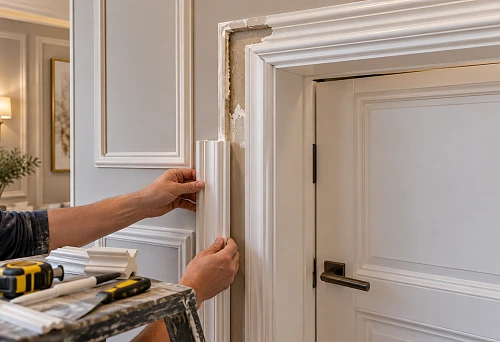
- Choose the mounting area. Mark it out so that the profile rests on a sturdy, prepared base and does not overlap moving components of the cladding.
- Check the wall. Do not glue the decor over peeling paint, weak filler, damp or dirt. The base must meet the requirements of the chosen adhesive system.
- Create a cutting plan. Mark the external lengths for angled cuts, account for the tool width, and check the actual wall angles: they are not always 90°.
- Do a dry fit of the parts. Align the moulding cross-section, the corners, and the junction with the factory PVC profile without force or tension.
- Glue according to the manufacturer's instructions. Choose an adhesive suited to the mineral wall and the moulding material. Do not automatically apply this recommendation to smooth plastic.
- Treat the end joints. If necessary, apply a compatible jointing compound, and after it cures, apply the finish. Cosmetic filler does not replace structural bonding of the ends.
- Paint after preparing the seams. First check that the adhesives and primer have fully cured according to their instructions; protect the adjacent cladding from paint.
Some time after installation, inspect the decorative lines under normal use of the room. A gap appearing at the boundary between the plastic and the profile is a reason to check movement of the substrate, not to automatically fill the gap with a rigid compound.
Stucco moulding and PVC panels in the bathroom: what changes
High humidity is not the same as constant exposure to water. In a well-ventilated area next to plastic cladding, a paintable decorative profile on a suitable substrate can be considered. In the shower or directly above the bathtub, the loads and sealing requirements are completely different.
Stucco moulding does not replace waterproofing. If the factory panel profile forms a watertight junction using a specific technology, a moulding glued on top must not disrupt that system. Do not drill into walls in the hidden waterproofing zone, and do not block access to inspection hatches, valves, or removable panels.
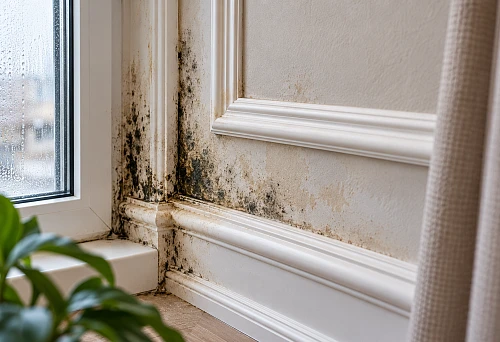
You should also not hide traces of mould, a wet substrate, or a leaking joint under a large overlay. Water left behind the decorative cladding can damage the wall base regardless of whether the face plastic remains intact. First eliminate the cause, then decide whether decorative finishing is needed.
In areas directly exposed to splashes, it is wiser to keep the standard PVC system components. If you want a decorative accent, move it to a dry wall or choose a solution specifically designed by the manufacturer for wet rooms.
Eight mistakes when decorating plastic walls
They glue the profile to a flexing panel. Visually the adhesive may hold, but with every bend the joint takes on load. First you need to assess the rigidity of the cladding and its own fastening.
They choose adhesive by the name "universal". The same composition may work on plaster and fail to provide the required adhesion to decorative PVC film. Technical confirmation of compatibility is required.
They sand plastic without the manufacturer's permission. The abrasive removes the protective layer, changes the gloss and creates damage that can no longer be fixed by neatly painting the molding.
They place a large overlay directly on a thin panel. The weight and area of the item require an assessment of the entire structure, not just the strength of the adhesive. Sometimes the right place for the overlay is the adjacent solid wall.
They cover the temperature gap. The panels stop freely changing size; stress, bulging and disruption of the decorative assembly are possible.
They attach decor over poorly installed cladding. The molding will not hold up a falling sheet and will not replace fixing the panel's fasteners.
They drill the cladding without knowing the hidden structure. This can damage wiring, utilities or waterproofing. Any mechanical fastenings require a detail design.
They increase the adhesive layer to compensate for a weak panel. A thick adhesive bed does not make the base more rigid and may cure worse between non-porous surfaces.
When molding on PVC is not needed
There are situations when it is wiser to avoid gluing stucco to a plastic sheet altogether. If the surface covers technical access, is located directly under the shower, or flexes at a light touch, additional decor will increase the complexity of maintenance and repair.
Instead of polyurethane framing, use the standard PVC profiles provided by the manufacturer: starting, corner, connecting, and end profiles. If a more expressive composition is required, change the boundary of the cladding or place the moldings on the surrounding solid wall. This choice may prove cheaper and more reliable than attempting to attach an unsuitable piece.
A regular panel wall sometimes benefits from a simple, neatly finished edge. Especially in a small room, where every additional protruding line collects dirt and complicates cleaning.
Where to choose stucco for combined finishing
Once the panel construction, safe mounting location, and composition dimensions are determined, you can proceed to selecting products. The STAVROS stucco decor catalog offers various types of products, and in the category Polyurethane moldings you can compare the width, depth, and length of the profiles.
If you plan to use it You can buy ready-made stucco matching the Baroque style. Calculate the quantity: linear meters of cornices and moldings, number of rosettes, pilasters, consoles, corner elements. Add a ten to fifteen percent allowance for trimming., start not with the number of pieces, but with a drawing of the installation area. Mark where the PVC panels end, which factory profile finishes the cladding, and where space will remain for your own decor. After that, specify the item code, cutting plan, availability, and price.
STAVROS General Guide on selecting moldings for wall panels helps match the proportions and pattern of the profiles; here, the main limitation remains the construction of the plastic cladding itself. If the base is not suitable for direct mounting, there is no need to buy additional moulding solely to mask the flaw.
Frequently asked questions
Can polyurethane foam be glued to a plastic panel?
Only if the product, the front surface of the panel, the adhesive and the entire mounting system are compatible and sufficiently strong. The material of the decorative profile alone does not provide such approval.
Which is better on a PVC wall: polystyrene or polyurethane?
For a composition on an adjacent solid wall, compare specific profiles by cross-section, price, length and finish. For direct mounting on a plastic sheet, the decisive factor remains the suitability of the cladding and the adhesive system, not the name of the polymer.
What to use to glue moulding to smooth PVC?
A compound whose manufacturer confirms compatibility with both materials and the specific panel coating. Without this information, no single universal adhesive can be recommended.
Can decor be attached to hollow panels?
They should not be considered a load-bearing base just because the moulding is lightweight. Assess deflection, fastening and permissible load; it is often better to move the profile to a solid wall.
Should a plastic surface be primed?
Only if such a primer is provided for by a compatible preparation system. A standard primer for plaster does not necessarily work on smooth plastic.
How to hide the transition from a PVC panel to a painted wall?
First, properly finish the plastic cladding with the standard component. Then, if desired, run a separate decorative molding along the adjacent stable surface without sealing the temperature gap.
Is polyurethane stucco molding suitable for a bathroom?
Its use depends on the specific product, coating, installation location and operating conditions. In areas of direct water exposure, stucco molding cannot replace the waterproof assembly provided by the cladding manufacturer.
How to make sure the molding does not come off?
Choose the correct substrate, check its strength, use a compatible fastening system, observe the curing time and do not cover movable joints. If the panel is weak, increasing the amount of adhesive will not solve the problem.