










































































Article Contents:
- CPU-9-1 or CPU-9-2: a ready answer for different tasks
- Why this is not an ordinary choice between a narrow and a wide set
- Comparison of CPU-9-1 and CPU-9-2 specifications
- What is included in CPU-9-1 and why the panel looks rich
- How the round medallion RPU-046 works
- What is included in CPU-9-2 and why the frame is convenient to repeat
- How two NPU-401.1 inserts work
- Why CPU-9-1 costs more than CPU-9-2
- When buying only one CPU-9-1
- Panel above the console
- Panel between two sconces
- Pier, fireplace area, and central part of the wall
- Two modules for symmetry
- Three modules for a long wall
- Background behind the headboard or sofa
- Asymmetric layout CPU-9-1 + CPU-9-2
- Furniture sets the second scale
- Can a TV be placed inside CPU-9-2
- Headboard and bedside lighting
- Choosing a panel only by a beautiful medallion
- Not connecting the center with furniture or architecture
- Not accounting for the number of details and complexity of layout
- Comparing price only with one CPU-9-2
- Buying one frame for a wall that needs repetition
- Considering width 860 mm as internal free space
- Reducing gaps for the sake of a third frame
- Replacing left and right corners with identical parts
- CPU-9-1 is suitable
- CPU-9-2 is suitable
- When it's better to design a composition from individual elements
- Which "Brussels" kit to choose for one central accent?
- When is CPU-9-2 better than CPU-9-1?
- Why is the wide CPU-9-2 cheaper than the narrow CPU-9-1?
- Can I place CPU-9-1 between two CPU-9-2?
- How many CPU-9-2 are needed for the wall behind the sofa?
- Can I place a TV inside CPU-9-2?
- Will CPU-9-1 fit above the console?
- How to place a sconce next to CPU-9-1?
- Can I use CPU-9-2 around the headboard?
- What is included in the central part of CPU-9-1?
- Why does CPU-9-2 have two NPU-401.1 inserts?
- Can I order kit components separately?
- How to check if the composition fits on the wall?
- Do I need to account for the baseboard and ceiling cornice?
- How to paint MDF and polyurethane in one color?
- What to choose for a calm modern interior?
- Which option is more budget-friendly?
- What should you check right before ordering?
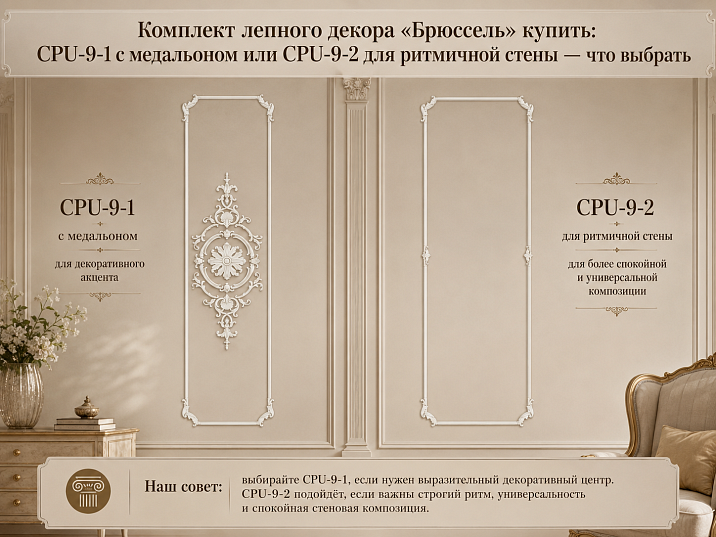
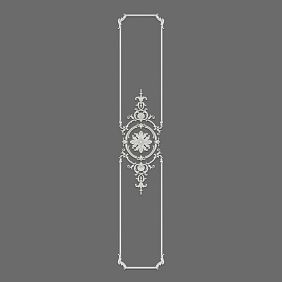
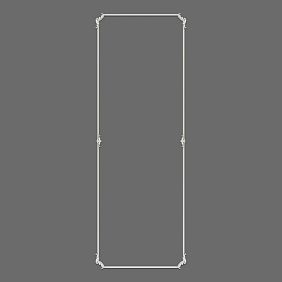
When a buyer decides to purchase the "Brussels" set of stucco decor, the choice between CPU-9-1 and CPU-9-2 cannot be reduced to comparing width or price. The narrower CPU-9-1, measuring 460 × 2300 × 25 mm, costs more because it contains a rich multi-element composition with a round medallion, mirror overlays, and vertical ornaments. The wider CPU-9-2, measuring 860 × 2300 × 25 mm, is calmer in design: it is an architectural frame that is convenient to repeat several times on a long wall.
Therefore, the main question is not "which set is larger." You need to decide which design principle suits the room: one dominant element, a series of identical frames, or a mixed scheme where CPU-9-1 occupies the center and CPU-9-2 forms the side fields. The answer determines not only the number of ordered sets. It changes the furniture layout, the wall axis, the distance to sconces, TV, outlets, baseboard, and ceiling cornice.
The short recommendation is simple. Buy the rich set of stucco decor CPU-9-1 suitable for a central panel above a console, in a pier, between sconces, near a fireplace area, or in the middle of the wall behind the sofa. Buy wide frame CPU-9-2 makes sense when you need to design an extended plane with several repeating modules, create a calm background behind furniture, or assemble symmetrical side panels.
Both models have a height of 2300 mm and a maximum relief of 25 mm, but the same vertical dimensions do not make them interchangeable. CPU-9-1 reads as an independent decorative panel. CPU-9-2 is perceived as part of a system and works best in repetition. A mixed layout allows combining these roles, but requires precise calculation of the free width and verification of the composition at full scale before ordering.
CPU-9-1 or CPU-9-2: a ready answer for different tasks
| Buyer's task | Preferred option | Practical Meaning |
|---|---|---|
| One strong central accent | CPU-9-1 | The round medallion and numerous paired overlays draw the eye to the center of the panel. |
| Long wall with a repeating pattern | Two or three CPU-9-2 | Wide frames provide a calm architectural grid without excessive ornamental density. |
| Symmetrical pair on the sides of furniture | Two CPU-9-2 | Identical modules are easier to align relative to a sofa, bed, dresser, or doorway. |
| Center and side fields | CPU-9-2 — CPU-9-1 — CPU-9-2 | CPU-9-1 becomes the dominant piece, CPU-9-2 supports it and fills the long wall. |
| Narrow wall section or area above a console | CPU-9-1 | A width of 460 mm allows highlighting the vertical axis without occupying the entire plane. |
| Wide background frame behind furniture | CPU-9-2 | A width of 860 mm helps tie the decor to the dimensions of the sofa, headboard, or low dresser. |
This table provides guidance but does not replace layout planning. Even a single CPU-9-1 may be inappropriate if its center conflicts with a TV, painting, or light fixture. Two CPU-9-2 may not fit next to a door, even though the sum of their widths seems suitable. Before purchasing, evaluate not the bare wall, but the actual plane after placing furniture and utility points.
For complex walls, it's helpful to start not with the article number, but with the role of each zone. First, mark the central axis of the room or furniture, then determine areas that should remain calm. After that, choose where an ornamental center is needed and where a frame is sufficient. This order protects against a common mistake: buying an expensive set and then adjusting the existing interior to fit it.




Why this is not an ordinary choice between a narrow and a wide set
CPU-9-1 has a width of 460 mm, CPU-9-2 — 860 mm. Based solely on geometry, one might expect the second set to be more complex and expensive. In practice, the opposite is true: the price is determined not by the area of the rectangle, but by the composition. CPU-9-1 includes numerous ornamental details forming a multi-level vertical composition. CPU-9-2 is built around a calmer frame with corner elements and two small inserts.
This is precisely why the assessment 'bigger means more expensive' does not apply here. A wide frame can occupy a significant part of the wall while maintaining a restrained character. A narrow panel may be more compact in width yet require many more decorative components. For the buyer, this means comparing not the price per millimeter of width, but the final role in the interior and the number of modules needed for the chosen scheme.
If the wall is short and requires a single accent, CPU-9-1 can fulfill the task with just one set. If the plane is long, a single CPU-9-2 often looks random, so two or three repetitions will be needed. Then the budget difference narrows. On the other hand, even several CPU-9-2 sets maintain a more even architectural rhythm and do not become a direct replacement for a rich central panel.
This approach helps avoid false economy. Buying one more affordable CPU-9-2 for a wall that needs a central accent can lead to additional costs for separate decor or reworking the layout. Conversely, CPU-9-1 would be excessive if the task is to create a calm series of identical frames. The economical choice is not the cheapest article number, but the option that immediately matches the compositional task.
Our factory also produces:


Comparison of CPU-9-1 and CPU-9-2 specifications
| Parameter | CPU-9-1 | CPU-9-2 |
|---|---|---|
| Collection | Brussels | Brussels |
| Size | 460 × 2300 × 25 mm | 860 × 2300 × 25 mm |
| Format | Rich vertical panel | Wide architectural frame |
| Compositional center | Round medallion RPU-046 | Two inserts NPU-401.1 |
| Structure | Multi-element system with multiple paired overlays | Simplified frame system with corner decor |
| Main role | Single dominant element | Repeatable module |
| Typical scenario | Pier, console, fireplace, wall center | Long wall, series of frames, background behind furniture |
| Price at time of check | 35 430 ₽ | 9 320 ₽ |
| Specified lead time | 5–10 days | 5–10 days |
Dimensions, prices, and lead times are based on data recorded in product cards at the time of material preparation. They must be rechecked before publication and especially before placing an order. For a commercial article, it is safer to either update the price on the day of publication or provide the reader with a direct link to the product cards showing current terms.
The main difference in the table is in the "primary role" row. CPU-9-1 is designed as a complete centerpiece. CPU-9-2 is designed as a grid element. When choosing by photo, this difference may not be obvious, especially if the items are shown separately and without furniture. On the wall, the scale reveals itself differently: the CPU-9-1 medallion draws the eye, while the repetition of CPU-9-2 creates order along the entire length of the room.
Get Consultation
What is included in CPU-9-1 and why the panel looks rich
CPU-9-1 belongs to multi-element compositions. The verified card lists 14 items and 28 individual parts, including left, right, and paired elements. This quantity should not be seen as an end in itself. It explains why the panel creates a complex pattern: several levels of decor work together rather than replacing each other.
The centerpiece is the round medallion RPU-046 measuring 200 × 200 × 25 mm. Around it are vertical and paired overlays, including NPU-093, NPU-325, NPU-432L/R, NPU-433L/R, NPU-303L/R, NPU-402.1L/R, and the frame base is completed by corner elements MLDPU-4U-2.1L/R. The composition must be verified against the kit's product card, as the buyer orders not an abstract pattern but a specific system of parts.
Special attention deserves vertical overlay NPU-093. The composition uses the large variant 133 × 300 × 15 mm. The vertical form supports the height of the panel and connects the central medallion with the upper and lower parts of the frame. At the same time, different size versions may be presented in the NPU-093 card, so when checking independently, it is important to focus on the variant specified in the kit.
Mirror details enhance symmetry. For example, left overlay NPU-433L и right overlay NPU-433R measuring 160 × 60 × 11 mm form a pair. They cannot be thoughtlessly replaced with two identical left or right elements: the direction of the ornament affects how the composition converges toward the center and diverges toward the edges.
The saturation of CPU-9-1 also means higher requirements for preliminary layout. Even if the kit is ready-made, the craftsman must precisely maintain the axes and distances between parts. A small displacement near the medallion is more noticeable than a similar error on a calm straight frame. Therefore, the central panel especially benefits from template marking and a test fitting before fixation.
How the round medallion RPU-046 works
The round medallion changes the character of the entire rectangular system. Without it, the frame would read as a vertical architectural outline. The circle creates an internal center and forces the gaze to stop at a specific point. This is why CPU-9-1 works well above a console, between two sconces, or in a narrow wall space where a clear axis is needed.
The medallion cannot be automatically considered a place for a lamp, mirror, or other object. It itself is a decorative detail. If a sconce, painting, or wall light is planned nearby, their position is coordinated with the round center, not randomly placed over it. Electrical outlets are checked before installation to ensure the decorative element does not end up in the place of a cable, junction box, or mounting anchor.
A round shape is especially sensitive to misalignment. The eye sometimes perceives a rectangular frame as even even with a slight error, if the parallels are preserved. For a circle, a deviation from the central vertical is immediately noticeable. Therefore, the axis of the medallion is linked to the axis of the furniture, wall, or the entire room. If these axes do not coincide, the decision is made consciously and checked on a full-size mockup.
With a monochrome paint, the medallion remains noticeable due to relief and shadow. With a contrasting finish, it will become even stronger, but specific painting options should be chosen only after checking a sample. The article should not promise a ready-made coating or color if they are not confirmed by a card. Before ordering, clarify in what form the elements are supplied and what preparation the selected finishing system requires.
What is included in CPU-9-2 and why it is convenient to repeat the frame
CPU-9-2 is built simpler, but this is not a drawback. Its task is not to compete with the central panel in the number of ornaments, but to form a large frame cell. The base is a straight profile, the corners receive a decorative finish, and two inserts support the vertical axis without turning each panel into a separate ceremonial center.
The geometric basis is formed by primed MDF molding MLD-004-MG with a profile of 15 × 8 mm and a length of 2600 mm. It sets the straight boundaries of the frame. When planning, it is important to consider that the length of the commercial profile and the finished size of the kit are different parameters. The buyer chooses CPU-9-2 as a ready-made system, rather than calculating the frame only by the length of an individual strip.
The corners are finished by left corner decor MLDPU-4U-2.1L и right corner decor MLDPU-4U-2.1R measuring 145 × 90 × 16 mm. They differ in the direction of the pattern. Pairing is not just for formality: the left and right elements mirror the ornament, so the frame gets finished corners and does not look assembled from random overlays.
Inside, two parts are used that can be purchased as a decorative insert NPU-401.1. The size of one insert is 47 × 123 × 14 mm. Together, they support the vertical reading of the frame and add relief, but do not create as strong a center as the RPU-046 medallion. This is fundamental: CPU-9-2 remains a repeatable module and does not conflict with neighboring frames.
The calm structure simplifies scaling. If there is enough space on the wall for two or three frames, identical CPU-9-2 can be placed in a row to get a predictable pattern. But repetition does not mean automatic simplicity: the distances between frames, margins from the wall edges, and furniture placement must be equally well thought out. Poor layout turns a neat system into a set of scattered rectangles.
How two NPU-401.1 inserts work
Two NPU-401.1 inserts act as internal guides. They support the frame's axis and make the long vertical less empty. At the same time, each part is significantly smaller than the round CPU-9-1 medallion, so the gaze does not linger on one point for long. It reads the overall outline and moves on to the adjacent panel.
This character is useful behind a sofa or headboard, where the main figure remains the furniture. The frame organizes the background but does not draw attention to itself. In a dining room or study, CPU-9-2 can highlight a separate wall zone, leaving space inside for a painting, sconce, or free painted surface. The specific content is checked on the diagram, since the decorative inserts already occupy their positions.
The NPU-401.1 should not be considered a random option that can be easily removed without changing the result. The set is designed as a complete composition. Excluding the inserts will make the frame calmer, but will simultaneously change the vertical pattern and distinguish it from the intended "Brussels" variant. If the buyer wants only a molding contour, it is better to compare the finished set with a custom system of individual profiles, rather than silently changing the composition.
When painting, the inserts must be prepared in the same system as the molding and corner decor. Different materials may accept primer and topcoat differently, so first check the preparation recommendations. Monochrome painting helps visually unify MDF and polyurethane, but an even color will not fix unevenness, unglued joints, or inaccurate layout.
Why CPU-9-1 is more expensive than CPU-9-2
At the time of verification, CPU-9-1 cost 35,430 ₽, while CPU-9-2 cost 9,320 ₽. The difference is 26,110 ₽ per set. The explanation lies in the composition: CPU-9-1 includes a round medallion and a large number of paired and vertical overlays. CPU-9-2 is wider, but its ornamental system is noticeably simpler.
This does not lead to the conclusion that CPU-9-2 is always more economical for a wall. One CPU-9-1 can finish a central zone, whereas CPU-9-2 is often purchased in quantities of two or three. Two CPU-9-2 at the fixed price give 18,640 ₽, three — 27,960 ₽, four — 37,280 ₽. With four repetitions, the total is already slightly higher than the cost of one CPU-9-1, although the visual task remains different.
| Scheme | Sum of widths without gaps | Cost at prices at the time of verification | For which task |
|---|---|---|---|
| 1 × CPU-9-1 | 460 мм | 35 430 ₽ | Single central dominant |
| 1 × CPU-9-2 | 860 мм | 9 320 ₽ | One calm frame or part of a future system |
| 2 × CPU-9-2 | 1720 мм | 18 640 ₽ | Symmetrical pair on the sides of furniture |
| 3 × CPU-9-2 | 2580 мм | 27 960 ₽ | Rhythmic long wall |
| CPU-9-1 + CPU-9-2 | 1320 мм | 44 750 ₽ | Center with one side module for an asymmetrical wall |
| CPU-9-2 + CPU-9-1 + CPU-9-2 | 2180 мм | 54 070 ₽ | Symmetrical center and side fields |
| CPU-9-1 + 3 × CPU-9-2 | 3040 мм | 63 390 ₽ | Extended composition with a single dominant |
The table shows only the cost of kits and the nominal sum of their widths. The estimate does not include base preparation, consumables, finishing, installation, and delivery. Gaps between frames are also not accounted for. Therefore, it is used for initial comparison of scenarios, not as a final project calculation.
Prices need to be updated before publication. If the article will be long-lived, it is better not to make price figures the main point of headlines. The uniqueness of the choice is preserved even when the cost changes: CPU-9-1 remains a saturated center, CPU-9-2 a repeatable frame. Prices help estimate the budget but do not replace the choice of compositional principle.
When to buy only one CPU-9-1
Panel above the console
The console sets a clear horizontal line, and CPU-9-1 adds a vertical axis to it. The panel can be centered relative to the tabletop, but first you need to check the actual width of the furniture and the free space on the sides. A narrow kit should not look like a random strip on a wall that is too wide. Its task is to gather a local zone, not to fill the entire plane.
A round medallion helps connect the console with items on the tabletop, but the decor should not be overloaded with vases, a large lamp, and a painting at the same time. The richer the panel, the more important it is to leave a calm surface around it. Before ordering, it is worth making a frontal diagram: wall, console, baseboard height, socket locations, intended light fixtures, and dimensions of 460 × 2300 mm.
Panel between two sconces
Symmetrical sconces enhance the centrality of CPU-9-1. The medallion ends up between the light sources, and the vertical overlays support the axis. However, first check whether cable outlets and mounting brackets fall into the decorative elements. Moving electrical wiring after installation increases the risk of damaging the finish and disrupts symmetry.
The distance from the sconce to the relief is chosen not by a universal number, but by the actual dimensions of the fixtures and the direction of light. A deep shade can cast a sharp shadow on the overlays. A wide base can overlap the frame. A full-size template and mock-ups of the fixtures help see the conflict before purchase.
Pier, fireplace area and central part of the wall
In the pier, CPU-9-1 works especially convincingly when the height of 2300 mm correlates with the baseboard and ceiling trim. The set should not rest against the cornice or start randomly above the baseboard. The top and bottom margins are planned as part of the pattern. If the pier is narrower than 460 mm plus the necessary side margins, the panel will not fit without changing the project.
In the fireplace area, the decorative center is aligned with the portal axis. It is necessary to check the thermal regime, the base, and the suitability of the selected material for the specific location; the article cannot promise compatibility with any hearth. If suitable conditions are not nearby, CPU-9-1 can be used on an adjacent wall as a visual partner to the fireplace composition.
In the center of the wall behind the sofa, one CPU-9-1 is appropriate when a vertical dominant is required, rather than a full background fill. The panel can be supported by a calm color or side frames, but it cannot be assumed that the width of 460 mm will automatically correlate with any sofa. On a wide piece of furniture, a single decor should be a conscious central point, not a randomly narrow element.
When to buy two or three CPU-9-2
Two modules for symmetry
A pair of CPU-9-2 is suitable for a wall where there is a central furniture area and identical decoration is required on the left and right. This could be a sofa with a small free center, a bed with side panels, or a chest of drawers above which two equal fields are planned. The total width of two sets is 1720 mm without a gap between them and without outer margins.
The pair is especially demanding on the equality of distances. If one module ends up closer to a corner, door, or curtains, the symmetry will be broken, even if the dimensions of the frames themselves match. Therefore, it is better to align the central axis with both the furniture and the room simultaneously. When this is impossible, you need to decide which axis is more important and not try to hide the conflict with a small difference in margins.
Three modules for a long wall
Three CPU-9-2 occupy 2580 mm without gaps. In a real project, more space will be required: air is left between the frames, free margins are maintained at the edges, and door trims, curtains, and protruding furniture are additionally taken into account. Therefore, a wall about three meters long does not guarantee that three modules will fit comfortably.
A triple repeat creates a calm system if all modules are equally aligned and there is no competing set of items inside them. You can leave the frames empty, place a related object in each, or highlight the central cell. In the latter case, it is important not to turn CPU-9-2 into an imitation of CPU-9-1 through random large decor: it is better to decide in advance whether a real central set is needed.
Background behind the headboard or sofa
Behind the headboard, CPU-9-2 can cover the central part of the bed or form side fields. The frame cannot be evaluated without bedside tables, lamps, and the height of the upholstered headboard. If the headboard overlaps the lower part of the decor, this should be planned, not discovered after installation.
Behind the sofa, the frames set the scale of the entire seating area. Their top line is linked to the room height, and the bottom part to the furniture and baseboard. Inside, the wall may remain free, but if paintings are planned, their sizes are checked together with NPU-401.1 and corner decor. The item should not overlap elements of the set or create accidental touches.
Scheme CPU-9-2 — CPU-9-1 — CPU-9-2
The mixed scheme solves the problem of a long wall without monotony. CPU-9-1 takes the central position and creates a rich focal point with a medallion. Two CPU-9-2 on the sides continue the composition with calmer frames. The sum of the nominal widths of the three sets is 2180 mm, but the actual layout will be wider due to gaps and edge margins.
The advantage of such a system lies in its clear hierarchy. The buyer does not need to choose between a single accent and repetition: both principles work together. The center can be linked to a console, fireplace, middle of the sofa, or room axis. The side frames support the central set and help fill the free plane without copying the complex ornament three times.
The weak point of the mixed scheme is the desire to reduce gaps to make everything fit. Too tight proximity blurs the difference between the panel and frames. The ornament of CPU-9-1 begins to visually clash with the corner elements of CPU-9-2, and free margins disappear. If the wall is insufficient, it is better to reduce the number of modules or choose a different scheme than to compress the composition into a decorative strip.
For a detailed calculation, it is useful to study the material on how to assemble a composition from several setsThe general article explains the principle of working with several ready-made modules, and in the case of "Brussels", you additionally need to consider the specific sequence CPU-9-2 — CPU-9-1 — CPU-9-2 and the different saturation of the central and side parts.
Asymmetric scheme CPU-9-1 + CPU-9-2
Not every wall requires mirror symmetry. If there is a window, door, tall cabinet, or open passage on one side, you can connect CPU-9-1 with one CPU-9-2. The nominal width of two sets is 1320 mm without a gap. Such a composition will be asymmetric, so it is balanced with furniture, light, or empty space, rather than trying to make it look like the center is in the middle.
In such a pair, CPU-9-1 should remain the dominant element. CPU-9-2 acts as an extension and connects the panel to the extended part of the wall. Role reversal is possible, but it is checked with a mockup: a wide, calm frame can visually outweigh a narrow, saturated module only due to its area, especially if a large TV or painting is placed inside it.
How to calculate the width of the composition for a wall
The calculation starts with the usable width, not the overall room size. From the wall length, exclude areas occupied by door and window openings, curtains, built-in cabinets, protruding portals, and zones where decor will be covered by furniture. Then mark the mandatory free fields along the edges, and only after that distribute the sets.
Nominal widths are needed for the first step: CPU-9-1 — 460 mm, CPU-9-2 — 860 mm. But the final formula includes gaps. For a three-part scheme with two equal distances between modules, add double the gap to 2180 mm. Then add the left and right edge fields. Specific values are chosen based on the room scale and checked visually, rather than assigned by a single universal rule.
| Scheme | Nominal width | What to add in a real project | Key risk |
|---|---|---|---|
| 1 × CPU-9-1 | 460 мм | Left and right margins | The panel may be too small for a wide wall |
| 1 × CPU-9-2 | 860 мм | Edge margins and connection with furniture | A single frame may look incomplete |
| 2 × CPU-9-2 | 1720 мм | Gap between frames and edge margins | Uneven margins break symmetry |
| 3 × CPU-9-2 | 2580 мм | Two gaps and edge margins | The system does not fit on the wall after accounting for doors and curtains |
| CPU-9-2 — CPU-9-1 — CPU-9-2 | 2180 мм | Two gaps and edge margins | Side frames are too close to the busy center |
| CPU-9-1 + 3 × CPU-9-2 | 3040 мм | Three gaps, edges, and furniture zones | The composition becomes longer than the available plane |
With complex geometry, it is useful to read separately how to choose a set of stucco decor based on the wall width. Such material helps to separate the general calculation principle from the specific choice of CPU-9-1/CPU-9-2. In the new article, width is considered not by itself, but together with the role of the central panel and repeating frames.
After arithmetic, a visual check is mandatory. The wall may formally accommodate the scheme, but look overloaded. This is especially noticeable with tall furniture, active textiles, or a large number of doorways. Having free space on the tape measure does not mean it needs to be completely filled with stucco.
How to account for a sofa, console, bed, and TV
Furniture sets the second scale
The dimensions of the set need to be compared with the furniture, not just the wall. CPU-9-1 with a width of 460 mm may look convincing above a compact console and too narrow above a long sofa. CPU-9-2 with a width of 860 mm may correlate well with one section of the headboard, but does not necessarily cover the entire furniture group. Therefore, the diagram simultaneously shows the decor and the actual frontal dimensions of the items.
Centering relative to furniture is usually more important than centering relative to the entire wall, if the furniture is the main object of the zone. But in walk-through rooms or symmetrical architecture, it may be the opposite. The conflict of two centers cannot be resolved automatically. It is considered on the elevation and the order that will be more noticeable to a person upon entering the room is chosen.
Can a TV be placed inside CPU-9-2
A wide frame seems like a suitable framing for a TV, but compatibility depends on the actual screen size, bracket, cable outlets, and ventilation gaps. It cannot be guaranteed that the TV will fit inside the CPU-9-2 just because the nominal width of the set is 860 mm. It is necessary to check the internal free space after installing the molding, corner elements, and NPU-401.1.
The screen should not touch the relief, overlap decorative inserts, or force the frame to be moved too close to the ceiling. Also consider the cabinet, acoustics, and cable channels. If the TV is large, CPU-9-2 can be used on the sides instead of framing. Then the equipment remains in a calm central field, and the frames maintain symmetry.
Headboard and bedside light
In the bedroom, the lower part of the frame often ends up behind the headboard. This is only acceptable with a deliberate layout. If a significant overlay is covered by a soft backrest, the decorative meaning is lost. Before ordering, note the height of the bed with mattress and headboard, the position of nightstands and sconces, and then check which parts of the CPU-9-2 remain visible.
CPU-9-1 above the bed requires special caution due to the saturated center. The medallion must align with the axis of the headboard, and the sconces should not conflict with the paired overlays. In many bedrooms, the calm CPU-9-2 series is more appropriate, but the final choice depends on the overall style and the number of other decorative details.
How to account for sockets, switches, sconces, and other engineering points
Electrical points should appear on the plan before the stucco. A socket, switch, or sconce outlet may fall into the molding line, onto the medallion location, or under a decorative overlay. Relocation after finishing increases costs and the risk of wall damage. Therefore, before ordering, create a layout with precise coordinates of all points and compare it with the dimensions of the sets.
A detailed breakdown can be seen in the material on how to place stucco decor near sockets and switches. For the "Brussels" collection, three zones are especially important: the round center CPU-9-1, two inserts CPU-9-2, and the corner elements of both frames. They must not be overlapped by a socket box or lamp base.
Sometimes it's easier to change the position of the frame than to move the electrical wiring. But the shift must maintain connection with the furniture and adjacent modules. If one CPU-9-2 is shifted due to a switch, and the second remains in its original place, the symmetrical system falls apart. In this case, it's better to reconsider the entire layout or consciously switch to an asymmetrical composition.
For sconces, not only the mounting location is checked, but also the diameter o
How to check the layout with painter's tape
Full-size check is one of the most useful stages. On the wall, use painter's tape to mark the outer contour of 460 × 2300 mm for CPU-9-1 or 860 × 2300 mm for CPU-9-2. For a mixed layout, mark all modules and gaps. Then return the furniture to its place and evaluate the wall from the main viewpoints.
The tape shows the scale but does not convey the saturation of the relief. Therefore, inside the contour of CPU-9-1, it is useful to separately mark a circle of 200 × 200 mm and the conditional zones of large overlays. In CPU-9-2, mark the positions of two NPU-401.1 and the corner decor. Such detail helps to understand whether sconces, a painting, or a TV will fall on an important element.
The check is carried out not only from the front. You need to look at the wall from the entrance, from the relaxation area, from the adjacent passage, and under natural lighting. In a direct view, the layout may seem symmetrical, but at an angle, one frame will visually approach a door or curtains. These effects are better seen before ordering.
If the tape shows that there is too much decor, do not reduce each gap to a minimum. More often, it is correct to remove one CPU-9-2 or leave CPU-9-1 without side frames. The free surface is part of the composition and helps the relief to be read more clearly.
MLD-004-MG and polyurethane decor in one system
The kits combine primed MDF molding and polyurethane decorative elements. This combination allows for a smooth geometric base and relief overlays. It is important for the buyer to understand that a visually unified frame consists of materials with different properties, so the preparation of the base, joints, and painting must be coordinated.
The profile can be separate see in the card MLD-004-MG. Its size 15 × 8 × 2600 mm helps to assess the scale of the straight line. However, purchasing the molding separately is not the same as purchasing the kit: CPU-9-1 and CPU-9-2 include a calculated system of corners, inserts, and ornamental elements.
MDF and polyurethane should not be joined with random materials without checking the purpose. The wall base, room humidity, chosen paint, and the master's technique affect the result. The article can explain the general principle, but the specific glue, primer, and sequence of work are chosen according to the material manufacturer's recommendations and the site conditions.
Before painting, it is important to achieve a uniform visual level of joints. A solid color paint will highlight any differences under side lighting. Therefore, assembly is assessed not only by hand but also with directed light along the wall. If the joint is noticeable before finishing, a layer of paint usually does not automatically make it invisible.
How to get the same color on MDF and polyurethane
A uniform color starts with an identically prepared surface. You cannot simply apply one layer of paint to different materials and expect identical gloss and absorption. First, clarify the condition of the supplied parts, then choose a compatible preparation system. If the elements are already primed, check whether this primer is suitable for the chosen finish.
A test paint is done on samples or inconspicuous areas. It shows not only the shade but also how light falls on the smooth molding and the relief overlay. A matte surface smooths out some differences, while a more pronounced gloss can emphasize them. The specific degree of gloss is chosen considering the interior and the quality of the base.
It is advisable to paint all parts of one wall in the same batch of material. Even the same color code may differ slightly between batches. For CPU-9-2, this is especially noticeable in a repeating series: adjacent frames should look uniform. For CPU-9-1, the difference between the central medallion and the frame will be perceived as an unintended contrast.
If the project involves highlighting individual parts with color, this decision is checked on a visualization or mockup. A contrasting medallion enhances the dominance of CPU-9-1, while contrasting inserts NPU-401.1 can disrupt the calm character of CPU-9-2. The color should support the chosen wall principle, not be added just for visibility.
What to buy together with the Brussels kits
| What to add to the purchase | Why this is needed | For which scenario | What to Check |
|---|---|---|---|
| the round medallion RPU-046 | Understand and, if necessary, replace an individual position in the CPU-9-1 assembly only after verifying the configuration | Central panel | Size 200 × 200 × 25 mm and exact location in the kit |
| Decorative insert NPU-401.1 | Verify paired internal elements CPU-9-2 | Repeatable frames | Two inserts are used in the kit |
| vertical overlay NPU-093 | Check the large vertical element CPU-9-1 | Rich panel | A dimensional variant specified in the composition is required |
| NPU-433L и NPU-433R | Assemble a mirror pair without direction error | CPU-9-1 | Left and right SKUs are not interchangeable |
| MLDPU-4U-2.1L и MLDPU-4U-2.1R | Finish frame corners | Both sets | Check the ornament direction |
| Molding MLD-004-MG | Verify the geometric base profile | Frames and additional lines | Profile size and plank length |
| The entire "Brussels" collection | Compare two finished sets in the same product group | Final selection | Current prices, availability, and composition |
The table does not mean that the buyer must order all components separately. On the contrary, the value of a ready-made kit lies in its coordinated composition. The links help to check individual items, understand the scale, and ensure the correctness of left and right elements. Before adding duplicate parts to the cart, you need to verify what is already included in CPU-9-1 or CPU-9-2.
Additional moldings may be needed to extend the system beyond the ready-made module, but such a solution requires a project. You cannot automatically extend the frame with a random length: the position of corners and inserts will change. If the wall differs significantly from the size of the ready-made composition, it is better to discuss adaptation with a specialist in advance.
How not to confuse a ready-made kit with individual moldings and similar decor
CPU-9-1 and CPU-9-2 are ready-made composite systems. They differ from purchasing individual profiles in that the frame dimensions, corner elements, and decorative inserts are already combined into a specific pattern. For a buyer who is just starting to choose, it is useful to first read, how to choose a ready-made set of stucco decor for a wall, and then proceed to the specific pair "Brussels".
Individual moldings offer more freedom but require independent design. You need to calculate lengths, angles, symmetry, the number of overlays, and the final height. A ready-made set reduces the number of design decisions, although it does not eliminate wall marking. Therefore, the comparison should not be "ready-made is more expensive or cheaper," but rather the amount of independent work and the desired result.
If the buyer wants to study the product group itself, you can look at material about how to choose and buy decorative moldings for walls. It covers a broader question about profiles and design methods. CPU-9-1/CPU-9-2 are needed when a ready-made composition with a specific height, width, and set of decorative elements is required.
Do not confuse a wall set with a ceiling rosette, picture frame, facade decor, or soft wall panels. The coincidence of the words "frame," "medallion," or "panel" does not mean the same purpose. In the product card, check the catalog section, material, dimensions, composition, and application photos. Such a check protects against purchasing an element that is visually similar but not intended for the desired scheme.
Practical selection for specific situations
| Situation | What to choose | Why | What to check before ordering |
|---|---|---|---|
| A small wall section between doors | CPU-9-1 | A narrow vertical dominant better utilizes the limited plane | Width with side margins, trims and switches |
| Long wall behind the sofa | 2–3 CPU-9-2 or mixed scheme | Repeating frames distribute decor across the width | Wall length, sofa dimensions, gaps and paintings |
| Console and two sconces | CPU-9-1 | Medallion fixes the central axis, sconces support symmetry | Cable outlets, base sizes and shadows |
| Bed with a wide headboard | 2 CPU-9-2 | Frames can form calm side margins | Headboard height, bedside tables, and bedside lighting |
| TV zone | CPU-9-2 on sides or frame after precise calculation | Wide module supports architecture without mandatory medallion | Inner field, screen, bracket, ventilation, and cables |
| Fireplace axis | CPU-9-1 | Panel creates a pronounced vertical center | Base, thermal conditions, and connection to the portal |
| Corridor or hotel lobby | CPU-9-2 series | Repetition helps organize a long passage plane | Doors, viewing angles, finish stability, and rhythm of openings |
| Large formal wall | CPU-9-2 — CPU-9-1 — CPU-9-2 | Combines a central dominant and side fields | Full width, edge margins, and room axis |
Practical selection starts with the task but ends with the specification. For each scenario, you need to record the number of sets, exact article numbers, location, current price, and related items. If the composition consists of three modules, it is not enough to order "one central and two side": the documents must specifically specify CPU-9-1 and two CPU-9-2.
For commercial spaces, repeatability across multiple walls is additionally considered. A small error in one module turns into a noticeable system if repeated ten times. Therefore, it is better to first approve one test layout and then transfer it to other areas with adjustments for doors, columns, and furniture.
Errors when purchasing CPU-9-1
Choosing panels only by a beautiful medallion
The round center attracts attention in the photo, but around it there is a large system of overlays. If the interior is already saturated with carvings, patterned textiles, and active furniture, CPU-9-1 may become excessive. You need to evaluate the entire set measuring 460 × 2300 mm, not just one RPU-046 part.
Не связать центр с мебелью или архитектурой
The medallion requires an axis. When the panel is offset relative to a console, fireplace, or wall section without a clear reason, the error is immediately noticeable. Before ordering, determine what the composition is centered on and mark that line on the wall. You cannot center the panel on both the wall and the furniture simultaneously if their axes do not align.
Not accounting for the number of details and complexity of layout
A multi-element composition requires careful assembly. The buyer may mistakenly expect that the ready-made set installs as a single panel. In reality, the composition and installation method need to be checked in the product card and instructions. If a professional is doing the work, provide them with the diagram and list of elements in advance.
Comparing price only with one CPU-9-2
One CPU-9-2 is significantly more affordable but does not solve the same task. A long wall may require several frames. Compare ready-made scenarios: one CPU-9-1 versus two or three CPU-9-2, not just two units of the product.
Mistakes when purchasing CPU-9-2
Buying one frame for a wall that needs repetition
CPU-9-2 functions as an architectural module. One frame may be appropriate in a local area, but on a long empty wall it can look incomplete. Before ordering, check whether one element is enough or if the composition requires a pair or triple repetition.
Assuming the width of 860 mm is the internal free space
860 mm is the overall kit dimension, not a guaranteed internal space for a TV, painting, or mirror. Part of the space is taken up by molding, corner decor, and NPU-401.1 inserts. A separate drawing of the internal field is required to place an object.
Reduce gaps for the sake of a third frame
When three modules don't fit, there's a temptation to compress the distances. This causes the frames to visually stick together and the side margins to disappear. It's better to choose two well-placed frames than three cramped ones. Free space helps the repetition look architectural.
Replace the left and right corners with identical parts
MLDPU-4U-2.1L and MLDPU-4U-2.1R have a direction. An error in pairing disrupts the corner pattern. When checking the delivery, you need to verify not only the quantity but also the letter designations of the article numbers.
When kits are suitable and when it's better to choose a different path
CPU-9-1 is suitable
- for a local area where one expressive vertical center is needed;
- for a wall section, console, fireplace axis, or a symmetrical pair of sconces;
- for an interior where the rich relief is supported by furniture and architecture;
- for a mixed scheme where calm CPU-9-2 panels are placed on the sides.
CPU-9-1 may not suit a very narrow plane without side fields, a wall with many utility points, or an interior where there are already several competing focal points. It also does not replace a wide series of frames: even an expensive and rich set remains 460 mm wide.
CPU-9-2 is suitable
- for a long wall with two or three repeating cells;
- for a calm background behind a sofa, bed, dresser, or dining group;
- for side panels around the central CPU-9-1;
- for rooms where furniture should remain the main visual object.
CPU-9-2 may not suit if the buyer expects a ready-made formal panel with a strong center. One frame does not have to create a complete dominant. If a medallion and a rich system of paired overlays are required, it is more rational to choose CPU-9-1 rather than add random details to CPU-9-2.
When it is better to design a composition from individual elements
Ready-made sizes may not match a non-standard wall, complex portal, or built-in furniture. Then individual moldings and overlays provide more freedom. But this path requires a project, calculation, and compatibility control. It is not a simplified replacement for a ready-made set.
For initial selection, you can view the entire collection of stucco decor "Brussels". If no format meets the task, proceed to a broader catalog and design, preserving actual dimensions and verified article numbers.
How to buy CPU-9-1 or CPU-9-2 on STAVROS
It is convenient to start the purchase by selecting a wall layout. First, determine the number of modules and their arrangement, then open product cards. In CPU-9-1, check the current price, full composition, number of left and right elements, size 460 × 2300 × 25 mm, and ordering conditions. In CPU-9-2, verify the size 860 × 2300 × 25 mm, two NPU-401.1 inserts, corner decor, and the required number of frames.
If a mixed layout is planned, add both article numbers to one specification. Record separately which set is central and which are side ones. This reduces the risk of errors during assembly and project handover to the installer. For multiple walls, mark each layout separately.
When you need to understand the overall logic of ready-made systems, the guide to selecting a ready-made stucco decor setis useful. To check prices and composition, go directly to the product cards. If you need to compare suppliers or understand the product category, you can study the material on how Where to Buy Moldings for Wall Decoration, не подменяя им выбор конкретных CPU-9-1 и CPU-9-2.
Before confirming the order, prices and the specified lead time are re-checked. The 35,430 ₽ and 9,320 ₽ stated in this article reflect the moment of preparing the SEO scheme and may change. The surface condition, finishing requirements, availability of all parts, and delivery conditions are also clarified. If the plan is complex, it is better to attach a wall layout and ask the manager questions about specific items.
Pre-order checklist
| What to Check | CPU-9-1 | CPU-9-2 | Why this is important |
|---|---|---|---|
| Number of sets | Usually one, but a mixed scheme is possible | One, two, or three depending on the wall | The quantity changes the budget and the width of the composition |
| Dimension | 460 × 2300 × 25 mm | 860 × 2300 × 25 mm | Need to check the fields, baseboard, and cornice |
| Central elements | RPU-046 and multi-element ornament | Two NPU-401.1 | Do not block with furniture and electrical fixtures |
| Paired details | Multiple left and right overlays | Left and right corners | Direction error breaks symmetry |
| Furniture | Console, fireplace, sofa, local center | Sofa, bed, dresser, long wall | Decor should relate to frontal dimensions |
| Electrical fixtures | Especially the medallion and sconce area | Inserts, corners, and a possible TV | Moving after finishing is more difficult |
| Price and timeline | Double-check the card | Double-check the card | Data may change |
| Finishing | Coordinate MDF and polyurethane | Coordinate MDF and polyurethane | Same color requires a common preparation technology |
It is useful to keep the checklist together with the sketch. It turns a decorative idea into a clear task for ordering and installation. If any item remains uncertain, it is better to resolve it before purchase. This is especially true for the number of CPU-9-2 and the position of the electrical wiring: these are the mistakes that most often require changing the entire layout.
How to choose the distance between adjacent frames
The gap between sets is not a technical leftover. It determines whether the modules are perceived as a single system or as separate panels. If CPU-9-2 is too close to CPU-9-1, the corner decor of the side frame starts to conflict with the numerous overlays of the central panel. If the distance is too large, the connection between modules weakens and the wall breaks into independent sections.
There is no universal distance for any room. It is chosen based on the wall scale, furniture width, relief depth, and the size of the edge margins. A useful technique is to mark three options at once with painter's tape: denser, medium, and looser. Then compare them from the main viewpoints and take a frontal photo. Distortions and overly tight spots are often more visible in the photo.
In a series of three CPU-9-2, the gaps are usually made equal unless the wall architecture requires otherwise. In a mixed scheme, it is also better to start with equal distances on the sides of CPU-9-1. Asymmetry is introduced only deliberately — for example, when there is a door or window on one side. A small random difference is perceived as an error, while a noticeable and justified one can become part of the project.
Edge margins are also compared with internal gaps. If the distance from the last frame to the wall corner is much smaller than between modules, the composition appears cramped. Sometimes it is better to reduce the number of kits than to leave narrow strips at the edges. A free field is not lost space: it creates a pause and allows the relief to be readable.
What to check when receiving kits and before starting installation
Before starting work, you need to compare the actual delivery with the specification. For CPU-9-1, especially carefully check the number of paired overlays and the presence of the central RPU-046. For CPU-9-2 — two NPU-401.1 inserts, a molding base, and left and right corner elements. The L/R marking is important: the same total number of parts does not compensate for a shortage of one direction.
Each element is inspected before painting and gluing. If there are questions about the surface, geometry, or completeness, it is better to resolve them before starting installation. After cutting, painting, or fixing, it is more difficult to determine the original condition. Parts are laid out by wall zones and labeled so that components of the central panel do not mix with elements of the side frames.
For a project with several CPU-9-2, it is useful to assemble a separate set of parts for each frame. Then the craftsman does not use elements from the first panel for the second and immediately notices a discrepancy in quantity. In a mixed scheme, CPU-9-1 is marked as the central module, and CPU-9-2 as left and right. This is especially convenient when installation is done in stages.
Before fixing, a dry layout is performed according to the markings. Check horizontals, verticals, the center of the medallion, the direction of paired overlays, and the position of inserts. Only after agreeing on the entire wall do they proceed to the chosen installation technology. Such a check takes less time than dismantling a part installed mirrored or at the wrong height.
Questions and answers about CPU-9-1 and CPU-9-2
Which "Brussels" kit to choose for a single central accent?
For a single expressed center, CPU-9-1 is usually suitable. Its round medallion RPU-046 and multi-element ornament form an independent panel. However, the size 460 × 2300 mm needs to be checked on the wall together with furniture and free margins. If the central zone is very wide, one set may require support from side CPU-9-2 or a calm finish.
When is CPU-9-2 better than CPU-9-1?
CPU-9-2 is better when a repeatable architectural system is needed, rather than a rich medallion. It is convenient to use in pairs or a triple row on a long wall, behind a sofa, around the headboard, or on the sides of the central zone. The choice is related to the role of the frame, not just the more affordable price.
Why is the wide CPU-9-2 cheaper than the narrow CPU-9-1?
The price is determined by the composition, not the overall width. CPU-9-1 contains a medallion and many paired ornamental details. CPU-9-2 is wider but is designed as a calmer frame with corner elements and two NPU-401.1. Before publication and ordering, current prices should be checked in the product cards.
Can CPU-9-1 be placed between two CPU-9-2?
Yes, such a scheme is logical: CPU-9-1 occupies the center, and CPU-9-2 form the side fields. The nominal sum of widths is 2180 mm without gaps. In a real project, two distances between modules and free margins on the edges are added, so a wider wall is required.
How many CPU-9-2 are needed for the wall behind the sofa?
The number depends on the length of the wall and the sofa. One set has a width of 860 mm, two — 1720 mm, three — 2580 mm without gaps. After adding offsets, the final composition becomes wider. Mark the options with painter's tape and evaluate them with furniture on site.
Can a TV be placed inside CPU-9-2?
Only after calculating the internal free field. The 860 mm dimension refers to the entire set, and part of the space is occupied by molding, corners, and inserts. The screen, bracket, cables, and ventilation need to be considered. For a large TV, frames are sometimes better placed on the sides.
Will CPU-9-1 fit above the console?
Yes, this is one of the strong scenarios. The vertical panel is linked to the console axis, and the round medallion becomes the center of the zone. Check the furniture width, outlets, desk lamps, and side fields. The composition should not conflict with items on the countertop.
How to place a sconce next to CPU-9-1?
First, apply the full contour of the panel and the positions of large overlays to the elevation. Then mark the sconce bases and cable outlets. The fixtures should maintain symmetry, not overlap the relief, and not fall on decorative details. It is advisable to check shadows on a temporary mockup.
Can CPU-9-2 be used around the headboard?
It can, if the lower part of the frame and inserts are not lost behind the soft back. The diagram should indicate the height of the bed, mattress, headboard, nightstands, and sconces. Sometimes two frames on the sides look better than one central one, but it depends on the width of the furniture and the wall.
What is included in the central part of CPU-9-1?
The compositional center is RPU-046 measuring 200 × 200 × 25 mm. Vertical and mirror overlays work around it. The full composition and number of parts should be checked in the CPU-9-1 card, because the article does not replace the current product configuration.
Why are there two NPU-401.1 inserts in CPU-9-2?
They support the vertical axis and make the wide frame less empty, but do not create a strong center. Because of this, CPU-9-2 can be repeated several times. Removing the inserts will change the intended pattern, so any changes to the composition are best designed separately.
Can I order kit components separately?
Cards of individual elements allow you to check dimensions and, if necessary, clarify a replacement or additional quantity. But before ordering separately, you need to verify what is already included in the finished kit. Self-assembly from parts requires a precise specification and does not always replicate CPU-9-1 or CPU-9-2.
How to check if the composition will fit on the wall?
Calculate the usable width after doors, curtains, and furniture. Add up the dimensions of the kits, add gaps and margins along the edges. Then transfer the outlines to the wall using painter's tape. Formal millimeter matching is not enough: you need to assess the scale and free space.
Do I need to consider the baseboard and ceiling cornice?
Yes. Both kits have a height of 2300 mm, so the top and bottom margins affect the fit. The panel should not accidentally hit the cornice or start without connection to the baseboard. The actual heights of finishing elements are marked on the layout.
How to paint MDF and polyurethane in one color?
You need to use a coordinated preparation system and make a test paintout. Different materials may differ in absorption and gloss. Check the condition of the primer, compatibility of the finish material, and quality of joints. One color does not hide installation unevenness.
What to choose for a calm modern interior?
CPU-9-2 is more often suitable because its frame structure is calmer and easier to repeat. But the result depends on the furniture, color, and number of modules. CPU-9-1 can also work in a restrained space as a single accent if there is enough free surface around.
Which option is more budget-friendly?
One CPU-9-2 is cheaper than one CPU-9-1 at the prices at the time of checking. But a wall may require several frames. Two CPU-9-2 cost 18,640 ₽, three — 27,960 ₽, four — 37,280 ₽ based on recorded values. Compare full schemes and update prices.
What should be checked right before ordering?
Check the article numbers, sizes, number of sets, current price, lead time, full composition, left and right elements, furniture and electrical placement. For a mixed scheme, attach a layout. Clarify the surface condition and requirements for installation and painting.
Result: central panel, rhythmic wall, or combined scheme
CPU-9-1 and CPU-9-2 cannot be ranked on the principle of "expensive is better, affordable is simpler." They solve different tasks. CPU-9-1 creates a single rich center with a round medallion and a complex system of paired overlays. CPU-9-2 forms a wide calm frame that can be repeated and linked to the furniture area.
For a pier, console, fireplace, or center between sconces, choose CPU-9-1 if the interior really needs a dominant. For a long wall, background behind a sofa, or side fields around a bed, the CPU-9-2 series is more often suitable. On a large symmetrical plane, the two principles can be combined in a CPU-9-2 — CPU-9-1 — CPU-9-2 scheme.
Before ordering STAVROS, you need to check the wall at full scale, consider furniture, electrical, baseboard, cornice, and free fields. Then check the current product cards, prices, and configuration. This procedure helps to buy not just a beautiful set of parts, but a ready-made system that matches the wall size and maintains a clear compositional hierarchy.