








































Article Contents:
- Decorative wall moldings: what they are and why people buy them
- How decorative molding differs from regular profile
- What problems does decorative wall molding solve
- Why it's a composition tool, not just decor
- Which decorative wall moldings to buy for your task
- For panels: full-wall frame system
- For frames: point accents
- For accent wall: main statement
- For TV zone: molding as a frame for the screen
- For symmetrical classic decor
- For modern minimalist design
- Wooden or polyurethane decorative moldings: what to choose
- When to choose wooden decorative moldings
- When to choose polyurethane decorative moldings
- What is More Convenient for Painting
- Where natural texture is important
- Where quick installation and clean joints are more important
- Which profiles are suitable for panels, frames, and accent walls
- Narrow profiles (8–20 mm): graphics and precision
- Wide profiles (40–80 mm): scale and character
- Smooth Profiles: Neutrality as a Strategy
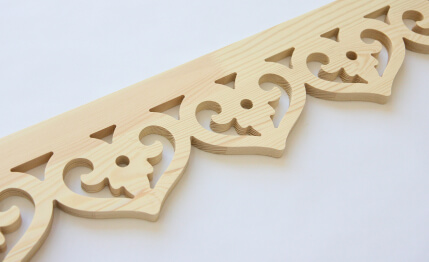
- Carved Profiles: Ornament with History
- Classical Profiles: Historical Sections
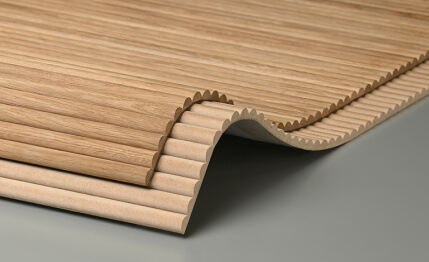
- Flexible Profiles: For Non-Standard Surfaces
- Corner Profiles: Installation Without Cutting
- Decorative Moldings for Painting: When It's the Best Option
- White Primed Profiles: Monochrome Elegance
- Polyurethane for Painting: Speed and Predictability
- Monochrome Wall with Moldings: Field and Frame in One Color
- Contrast Painting Inside Frames: Color as an Accent
- When corner elements and molding decor are needed
- Corner elements: accent at the intersection point
- Overlays: volume in the center
- Connecting decor: joints as a system element
- How to assemble a more expensive composition
- How to combine moldings with baseboard and cornice
- Unified profile language
- Rule of proportions: hierarchy of lines
- Unified style, unified material — or deliberate contrast
- When to combine materials, when to separate them
- What determines the price of decorative wall moldings
- Material
- Width and relief
- Standard or flexible profile
- Is decor needed
- Order volume
- Where to buy decorative wall moldings without mistakes
- How to choose material
- How to determine the right profile
- When to take a ready-made kit
- When to add decor
- Which catalog sections to view
- About the Company STAVROS
- FAQ: popular questions about decorative wall moldings

There are things that work subtly yet radically. You walk into a room—and feel that it is 'done'. You can't explain why, but the feeling is exactly that: the space is well-considered, it has character, it's not just painted and furnished. Most often, this feeling is created by a molding system on the walls. A few horizontal lines, frames around the perimeter, an accent on one wall—and the room stops being just 'square meters'.
Decorative Wall Moldings— is an architectural detail, not a decorative sticker. It works with space on the level of proportions, rhythm, and chiaroscuro. And if you're looking for where to buy them and how to choose—you've come to the right place. There are no general inspirational musings about beauty here. There are specific parameters, materials, tasks, and answers to questions that actually arise before purchase.




Decorative wall moldings: what they are and why people buy them
Let's start with a fundamental distinction that will save both money and time. Decorative molding is not the same as a simple profile strip. Standard trim (baseboard, casing, glazing bead) serves the function of transitioning or covering a joint. Decorative molding is a self-sufficient element that carries visual weight on its own.
Relief, proportion, stylistic cross-section—this is what makes a molding 'decorative'. It can be smooth or carved, narrow or wide, historically accurate or succinctly modern. But in any case, its presence on the wall is an artistic statement, not a technical necessity.




How Decorative Molding Differs from a Regular Profile
A standard profile solves a functional task: to close a gap, smooth a transition, secure an edge. Decorative molding—creates. It creates architectural structure where there is none, adds relief to a flat surface, forms visual 'anchors' for the gaze.
The difference is clearly seen in an example: a baseboard closes the gap between the floor and the wall—that's needed. A decorative molding at a height of 90 cm around the perimeter of the wall—that's not needed, that's a choice. A choice that turns an ordinary room into an interior.
Our factory also produces:


What tasks does decorative wall molding solve?
Three main tasks it handles better than any other finishing material:
Architectural structuring. A flat wall is a blank canvas. A molding system makes it readable: a 'plinth', a 'middle field', an 'upper zone' appear. The space gains tiered structure without any renovation.
Rhythmization. Frames arranged with equal spacing create rhythm—that elusive sense of 'refinement' that distinguishes a designer interior from a simply renovated apartment. The eye moves along the wall not chaotically, but along a predetermined path.
Proportion correction. Horizontal bands visually expand a space and 'ground' high walls. Vertical moldings increase the sense of height. These are not optical illusions—they are architectural techniques tested over centuries, working equally well in classical palaces and modern apartments.
Get Consultation
Why it's a composition tool, not just decor
A professional designer uses walldecorative moldingsas a composition-building tool: sets focal points, marks axes of symmetry, highlights accent zones. It's the same principle as in painting or architecture—a frame always enhances what's inside it.
A molding frame around a TV turns a 'black rectangle' into part of the wall's decorative program. A frame behind a bedhead creates a 'niche' that gives the bedroom intimacy. A framing system in a living room makes it stately without a single piece of antique furniture.
Which decorative wall moldings to buy for your task
Before looking at the catalog, answer the question: what task does the molding solve in your project? Everything depends on the answer: the profile, width, material, and quantity.
For panels: a full-wall framing system
A panel system is the most monumental way to use moldings on a wall. Several rectangular frames, arranged in a row according to a single module, cover a significant part or the entire wall surface. This is a classic technique found from French châteaux to modern St. Petersburg apartments.
Profile for panels: 25–50 mm width, moderate relief or smooth. Key is the frame proportion: height to width in the range of 1.4–1.7 to 1. This is an 'active' rectangle that is perceived naturally. Square frames are too heavy; strongly elongated ones are nervous.
The gap between frames and the gap from the outermost frame to the corner of the wall are the same. Violating this rule immediately gives a sense of amateurishness.
For frames: point accents
A single frame or a small group of frames on a specific section of the wall is a frame accent. A frame behind the sofa, a frame-'architrave' behind the bed, a frame around the fireplace, a frame under the TV. Each of them creates a 'center'—a point that draws the eye.
For frame accents, the profile can be slightly richer than for the panel system: 35–65 mm, with pronounced relief. This is where corner decorative overlays look organic—they 'hold' the corner of the frame and add a decorative point.
For an accent wall: the main statement
An accent wall is the one that carries all the decorative load of the room. Usually, it is the wall behind the sofa, behind the bed, or with the TV. The molding system on it can be significantly richer than on the other walls: horizontal belt + frame grid + corner overlays.
Inside the frames—contrasting paint or patterned wallpaper. The molding frames a field with a different color or texture and 'legitimizes' the contrast, turning it from a random spot into an architectural technique.
For the TV zone: molding as a frame for the screen
A television on a wall without additional decor is a 'black rectangle.' A molding frame around it is already an architectural object. Frame size: slightly larger than the TV (by 15–25 cm on each side). Profile—35–55 mm, with moderate relief.
On the sides of the TV frame are additional vertical frames of a smaller scale. Inside the TV frame and adjacent ones, there is a uniform color different from the main wall color. This way, the TV becomes part of the decorative system, not a foreign object.
For symmetrical classical decor
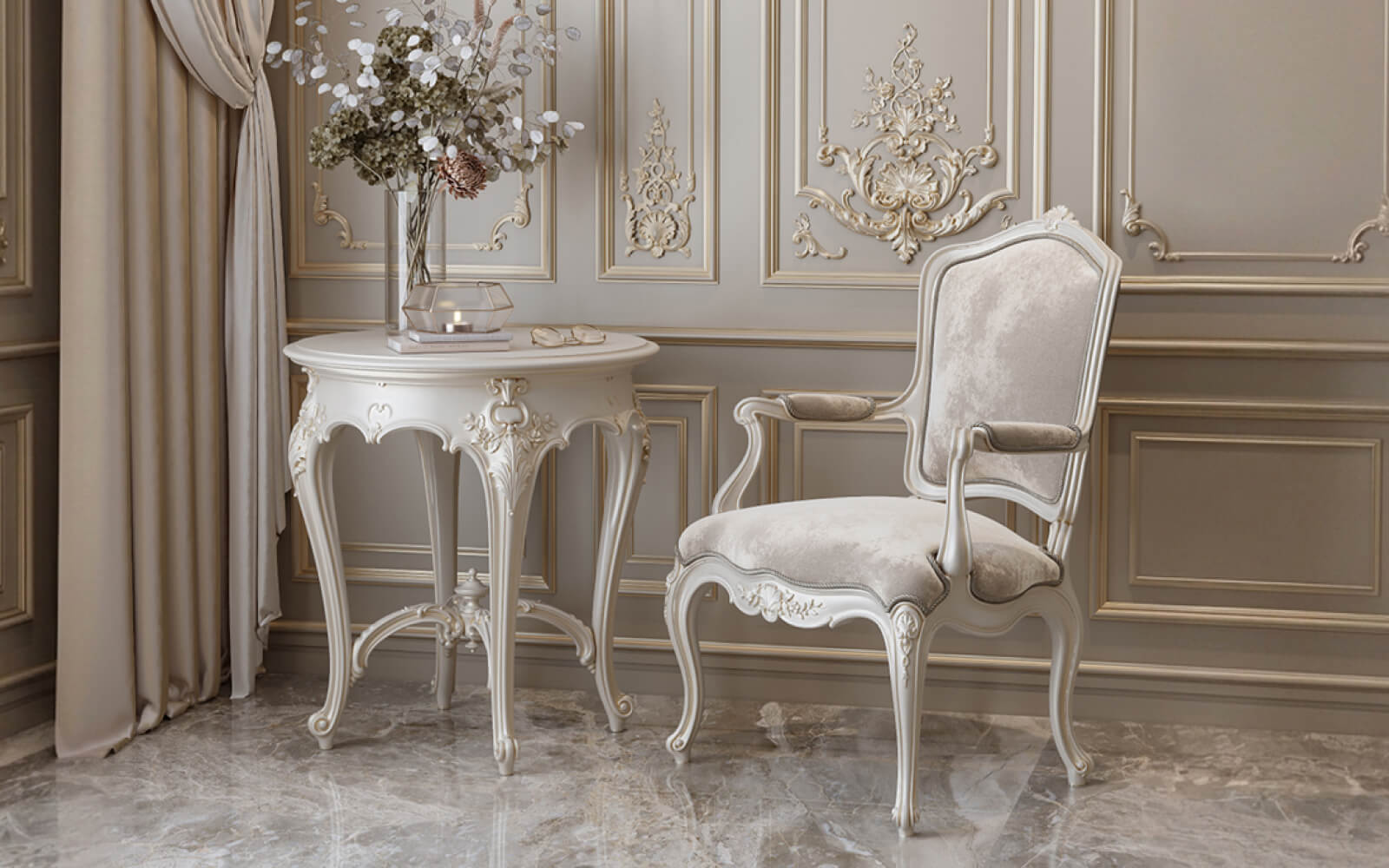
Classical wall decor is based on strict symmetry: the wall axis is the center of the composition, frames diverge from it mirror-like. The horizontal belt is at the level of doorways. The cornice runs along the entire perimeter. Frames are identical in size, with equal distances.
The profile for classic style is historical: ogee, cavetto, scotia. Material is oak. Corner overlays are mandatory.
For modern minimalist design
Modern minimalist molding is a thin line, not a decoration. Smooth profile 15–25 mm, matching the wall color. Frames of strict geometry, without overlays, without ornament. Monochrome surface with molding in wall color—relief is only visible in oblique light. This is the most sophisticated and 'expensive'-looking option for modern interiors.
Wooden or polyurethane decorative moldings: what to choose
This question is a key fork in the road. And many make the choice based on random principles—price, availability, the first search result. The correct choice is based on the task.
When to choose wooden decorative moldings
Wood is chosen when the molding should be visible as wood. Under tinting, oil-wax, or clear varnish, oak reveals its texture—large pores, fibrous pattern, warm shades. This cannot be reproduced with synthetic material. No way.
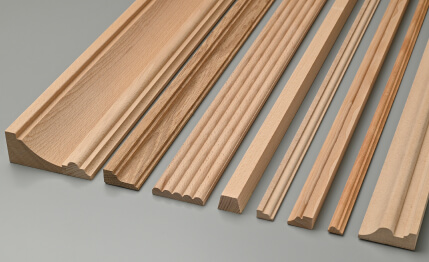
WoodenDecorative Wall MoldingsMade of oak or beech — the only choice for projects where the interior features natural parquet, wooden doors, or wooden furniture, and it's important for the molding to "rhyme" with these elements.
Wood is the right choice if:
-
finish treatment of the molding — tinting, oil, wax, clear varnish;
-
style — classic, neoclassical, English, Scandinavian with natural materials;
-
the room already has oak or other natural wood;
-
durability without maintenance is important: properly coated oak lasts 50+ years;
-
The room is "dry" — living room, bedroom, study, library.
When to Choose Polyurethane Decorative Moldings
Polyurethane is a different story. Lightweight (5–7 times lighter than wood), moisture-resistant, does not deform with humidity changes. The surface is primed, white, ready for painting without additional preparation.
Polyurethane wall moldings— is a smart, pragmatic choice for specific scenarios where the advantages of wood are unnecessary, and its limitations are a hindrance.
Polyurethane is the right choice if:
-
finish coating — painting (white or colored enamel);
-
damp room — bathroom, kitchen, rooms with unstable climate;
-
flexible profiles needed for arches, bay windows, curved surfaces;
-
installation speed is important — polyurethane is glued in 20–30 minutes;
-
budget is limited: polyurethane is 3–5 times cheaper than wood with equal relief.
What is more convenient for painting
The answer is clear: for opaque painting — polyurethane or beech, but not oak. Oak under white enamel loses its main feature — the living texture. Overpaying for natural wood to paint it over with white paint makes no economic sense.
Polyurethane for painting isMoldings for paintingwith factory primer. Apply two coats of acrylic enamel — and you get a professional-quality surface. Minimal effort, predictable result.
Where natural texture is important
Natural texture is important where the molding is visible in detail: a study with a library, a formal living room, a bedroom in a classic style. Where a guest comes close and sees the material — wood is irreplaceable. Where the molding is perceived from a distance of 3–5 meters and under paint — the difference between wood and polyurethane is practically indistinguishable.
Where quick installation and clean joints matter more
Polyurethane installs faster and easier. Light weight ensures reliable adhesion with glue, no extra fasteners needed. Special polyurethane profiles for external and internal corners simplify work in corner areas—no precise 45° cutting required.
For large volumes—long corridors, multiple rooms, office spaces—polyurethane reduces installation labor by 2–3 times compared to wood.
| Criterion | Wood (oak/beech) | Polyurethane |
|---|---|---|
| Natural texture | Yes | No |
| Moisture resistance | Medium | High |
| Weight (density) | 600–750 kg/m³ | 80–120 kg/m³ |
| For painting | Beech—yes, oak—not practical | Optimal |
| Under natural coating | Yes | No |
| Flexible profiles | No | Present |
| Price (with equal relief) | 3–5 times higher | Basic |
| Service life | More than 50 years | 15–30 years |
Which profiles are suitable for panels, frames, and accent walls
Molding profile isn't just about width. It's about cross-section, relief, stylistic language. One wrong profile choice—and the molding 'falls out' of the interior, clashes with the style, or simply gets lost on the wall.
Narrow profiles (8–20 mm): graphics and precision
Narrow molding is a line that defines structure without drawing attention to itself. Ideal for modern and minimalist interiors, for small spaces, for systems with many frames in a limited area.
Requires flat walls: on an uneven surface, a thin strip 'copies' all defects and makes them even more noticeable. If the walls are not perfect — first level them, then install narrow molding.
Wide profiles (40–80 mm): scale and character
Wide profile — for large rooms with ceilings from 2.8 m. An accent wall in a spacious living room, a formal hallway, a study with high ceilings. Here, 50–70 mm molding works organically: it 'holds' the scale of a large space.
In a small room with a 2.5 m ceiling, a wide profile creates a feeling of tightness and overload. Rule: the width of the profile should not exceed 2–3% of the ceiling height.
Smooth profiles: neutrality as a strategy
A smooth rectangular profile is absolutely neutral. It doesn't 'speak' for either classic or contemporary style. It structures the wall without imposing stylistic statements. This is the most universal choice, which works in any interior and does not conflict with any style.
If you are unsure about the interior style or it is transitional in itself — a smooth profile for painting made of MDF or polyurethane is a fail-safe choice.
Carved profiles: ornament with history
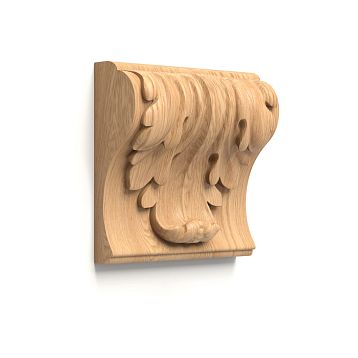
Carved molding carries cultural weight: acanthus leaf, meander, pearl ornament, rocaille pattern — these are direct references to specific historical eras. In the right context (ceiling 3+ m, appropriate furniture and finishes), a carved profile makes the interior historically convincing.
In an inappropriate context (a small room, modern furniture) — it looks like a carnival costume. Carved profiles — only with a full stylistic context.
Classical profiles: historical sections
Classical wall moldings are a system of historical sections: ogee (concave-convex transition), cyma reversa (convex-concave), scotia (concave quarter-circle), torus (semi-circular projection). In the right combination, they create a profile with an undeniable classical character.
Full range of classical wooden profiles — in the section Oak, beech, and MDF moldings.
Flexible profiles: for non-standard surfaces
Flexible polyurethane molding bends along a radius — indispensable for arches, bay windows, columns, rounded walls. Minimum bending radius: 20–40 cm for narrow profiles, 80–100 cm for wide ones. Mounted with adhesive — retains shape after fixing.
Flexible wooden molding does not exist: natural wood breaks when bent. Only polyurethane.
Corner profiles: installation without cutting
Corner molding — a specialized profile for installation in external or internal wall corners. The L-shaped section is adapted to the angle and does not require precise 45° cutting. Significantly simplifies work on sites with non-standard angles.
Decorative moldings for painting: when it is the best option
Paint-ready moldings are a separate story that is often underestimated. It is believed that 'wood is always better.' But in real projects, molding under white enamel often gives a stronger visual effect than stained wood.
White primed profiles: monochrome elegance
White enamel on molding against a white wall is a system where the molding's relief is read only through shadow. A slightly more intense shadow in the relief transition—and that is the only thing distinguishing the molding from the wall. The effect is refined, expensive, 'architectural' in the most precise sense of the word.
Preciselyprimed moldings for wallsmade of polyurethane is the perfect base for such a solution. The surface is already prepared, you only need to paint it.
Polyurethane for painting: speed and predictability
Polyurethane molding for painting is installed, joints are filled, and after drying—two coats of acrylic enamel. No sanding, no priming by hand. Factory surface preparation ensures even paint application without spotting or drips.
This is fundamentally important for DIY installation: professional results at any level of painter's skill.
Monochrome wall with moldings: field and frame of the same color
Monochrome scheme—molding and wall of the same color—is the most modern and most complex technique. The molding does not stand out by color, only by relief. The visual accent is delicate to the point of visibility. This technique is used in the most pretentious modern interiors—precisely because it requires confidence in the space and the profile.
Contrasting color within frames: color as an accent
Contrast scheme — wall-colored molding, frame field — in an accent tone. This creates volume and depth: the molding frame becomes a 'window' into the colored field. Especially effective on an accent wall: three or four frames with a dark blue, deep green, or terracotta field on a white wall with white molding — this is a strong decorative solution that is inexpensive but looks like a designer project.
When corner elements and decor for moldings are needed
Decor for moldings is not a mandatory addition. But where it is appropriate, it elevates the molding system from the 'neat' category to the 'expensive and professional' category.
Corner elements: accent at the intersection point
A corner decorative element is an overlay mounted at the intersection of two moldings in the corner of a frame. A square or rectangular block with an ornament: rosette, medallion, cartouche, geometric module.
Two practical advantages:
-
Simplifies installation — moldings are brought to the edge of the corner overlay without precise 45° cutting;
-
Creates a decorative accent exactly where the eye naturally stops — at the point where lines intersect.
BuyMolding corner piecesin the STAVROS catalog: from laconic geometric blocks for a modern interior to carved classic medallions.
Overlays: center volume
The central overlay is mounted on the middle of a horizontal or vertical molding segment where there is no corner but a 'point' is needed. Diamond, oval, fleuron — a visual accent in the middle of the line.
For classic systems with long horizontal belts: central overlay in the middle + corner overlays at the corners of frames. This is a 'three-point' decorative program that works flawlessly at any scale.
Connecting decor: joints as a system element
Where the profile needs to be extended — one plank ends and another begins — a connecting decorative element masks the joint, turning it into an intentional ornamental module.
How to assemble a more expensive composition
The algorithm is simple: molding frame + corner overlays on four corners + central overlay on long horizontal planks. This is a complete set for one classic decorative panel. The cost of the decor is comparable to the cost of the molding itself for one frame — but the visual result is 3–4 times richer.
The entire range of decorative elements for molding systems — in the section decoration for moldings.
How to combine moldings with baseboards and cornices
Wall molding does not exist in a vacuum. It is part of a trio: ceiling cornice — wall molding — floor baseboard. These are three horizontal lines that create a 'frame' for the entire room. If they are coordinated — the room reads as a cohesive interior. If not — an inexplicable feeling of incompleteness arises.
Unified profile language
The cornice, wall molding, and baseboard should belong to the same stylistic and profile 'family'. This does not mean identical cross-sections—on the contrary, different widths are essential. But repeating profile elements create unity: if the cornice contains a 'gooseneck', then the molding and baseboard also feature an element of the 'goose' curve.
For detailed information on the systematic use of moldings together with baseboards, see the article Solid wood baseboards and moldings—the architectural foundation of a classic interior.
Rule of proportions: hierarchy of lines
Classical ratio: cornice—the widest element (60–120 mm), baseboard—second in width (60–100 mm), wall horizontal molding—the narrowest of the three (25–50 mm). The cornice 'overhangs' from above, the baseboard 'supports' from below, the molding 'divides' in the middle.
Violating the hierarchy—where the molding is wider than the baseboard, or the cornice is narrower than the molding—creates visual discomfort: the space loses its familiar gravity.
Unified style, unified material—or deliberate contrast
Best option: all three elements made from the same material. Oak molding, cornice, and baseboard with the same tint—a complete system that requires no additional 'fine-tuning'.
Acceptable compromise: wooden moldings on the wall and a polyurethane cornice for painting. Works provided the cornice and moldings are painted the same color—color unity offsets the difference in materials.
Invalid option: tinted wooden molding + white polyurethane baseboard without stylistic connection. This is not 'contrast' — it's a 'mistake'.
When to combine materials, when to separate them
Rule: one material per level. The cornice is entirely polyurethane, all moldings are wood, all baseboards are wood — three levels, three materials, but each level is homogeneous. Mixing materials within one level (one wooden molding, another polyurethane in the same room) — is not allowed.
What determines the price of decorative wall moldings
Molding pricing is transparent — you just need to know what exactly you're paying for.
Material
Polyurethane — basic price category. MDF — slightly higher. Beech — even higher. Oak — 3–5 times more expensive than polyurethane for the same cross-section. This is a fair price: oak means 50+ years without replacement and a living texture.
Width and relief
Width — direct dependence: more material, higher price. Relief — nonlinear dependence: smooth profile — one operation; shaped with two levels — 3–4 passes; carved — 3D milling and manual finishing. The difference between smooth and carved of the same width — 5–15 times.
Standard or flexible profile
Flexible polyurethane molding is 30–50% more expensive than standard: special material, more complex production.
Is decor needed?
Corner pieces, central medallions—each element adds to the cost of the set. For a large room with 20+ frames, decor can account for 30–50% of the cost of all moldings.
Order volume
Retail from 1 linear meter — maximum price. Batch 20–50 m — wholesale terms. Project order from 100 m — negotiated terms.
| Molding type | Material | Width | Approximate price |
|---|---|---|---|
| Smooth wall-mounted | Polyurethane | 20–40 mm | from 80–200 rub./m |
| Smooth wall-mounted | Beech | 20–35 mm | from 230–450 rub./m |
| Geometric | Oak | 30–55 mm | from 550–1,300 rub./m |
| Classical figured | Oak | 40–70 mm | from 1,200–3,000 rub./m |
| Carved ornament | Oak | 40–80 mm | from 3,000–9,000 rub./m |
| Flexible | Polyurethane | 25–60 mm | from 130–370 RUB/m |
| Corner overlays | Wood/polyurethane | — | from 300–3,500 RUB/pc. |
Where to buy decorative wall moldings without mistakes
Practical route — from question to cart.
How to choose material
Step 1: Determine the finish.
-
Toning, oil, clear varnish → wood (oak or beech).
-
White or colored enamel → polyurethane or beech.
-
Budget is limited, volume is large → polyurethane.
How to Determine the Right Profile
Step 2: Determine the Style and Scale.
-
Classic, ceiling 3+ m → figured or carved oak, 35–70 mm.
-
Modern, ceiling 2.5–2.7 m → smooth, 15–30 mm.
-
Neutral universal → smooth rectangle, 20–35 mm, any material.
When to Use a Ready-Made Kit
Step 3: If the style is classic or neoclassical → use a ready-made kit: molding + corner overlays. This saves time searching for compatible elements and guarantees stylistic unity.
When to Add Decoration
Step 4: For frames larger than 60×90 cm — corner overlays are mandatory. For frames on an accent wall — add central overlays. For horizontal belts longer than 2 m — connecting decor.
Which catalog sections to view
Wooden Decorative Moldings:
→ Catalog of wooden moldings for walls, furniture, and ceilings
→ Oak, beech, and MDF moldings
→ New wooden moldings
Polyurethane moldings:
→ Polyurethane moldings and cornices
→ Article: polyurethane moldings and wooden furniture — how to combine
Decor for moldings:
→ Decorative elements and corner overlays for moldings
Material comparison:
→ Wooden and polyurethane moldings: differences and applications
About the company STAVROS
STAVROS — a Russian manufacturer of architectural decor and products from natural and synthetic materials: wooden moldings from oak, beech, and MDF, polyurethane moldings and cornices, decorative elements for molding systems, baseboards, casings, furniture trim. Production has been operating since 2002 in St. Petersburg.
STAVROS has implemented decorative finishing for the State Hermitage Museum, Konstantinovsky and Alexandrovsky Palaces, private residences, and high-end commercial properties across Russia. Production standards: chamber drying of wood to 8–12% moisture content, four-sided processing with a tolerance of ±0.1 mm, 3D milling of complex profiles, manual finishing of carved elements.
Sales: retail from 1 linear meter, serial and project deliveries for designers, furniture manufacturers, and construction organizations. Delivery across Russia and CIS.
FAQ: popular questions about decorative wall moldings
Which decorative moldings are better: wood or polyurethane?
Depends on the task. Wood — for natural finishes (staining, oil), for classic interiors with natural materials, long-term projects. Polyurethane — for painting, in humid areas, for large volumes, for arches and non-standard surfaces.
Can moldings be painted?
Yes. Polyurethane — supplied with factory primer and ready for painting immediately. Wooden beech — painted after sanding and priming. Wooden oak — better for staining or clear varnish to preserve the texture; under enamel, they lose their main advantage.
Which moldings are suitable for the bathroom?
Only moisture-resistant polyurethane. Installation — in areas without direct contact with water: upper part of the wall, mirror framing, ceiling line. Finish painting — with moisture-resistant acrylic enamel. Wooden moldings in the bathroom are only permissible with multi-layer waterproof coating.
How many moldings are needed for one wall?
For horizontal belt: wall length + 15% reserve. For frame system: calculate the perimeter of each frame (height + width) × 2, sum all frames, add 20% for trimming. Example: three frames 60×90 cm → (0.6+0.9)×2 = 3 m × 3 frames = 9 m + 20% = 10.8 m.
When are corner elements needed for moldings?
For frames in classic and neoclassical style — mandatory. For frames larger than 60×90 cm — highly recommended. For modern geometric systems with 45° cuts — optional, but corner geometric blocks are acceptable.
Which moldings are better for wall panels?
Medium profile 25–50 mm, smooth or with moderate relief. Material — for painting: MDF or polyurethane. For tinting: oak. Profile width — no more than 15–20% of the short side of the frame. Frame proportion — 1.4–1.7 to 1 (height to width).