




























































Article Contents:
- An opening without an architrave is an unfinished story
- What is a door architrave and why is it needed
- How an architrave differs from an extension
- When one architrave is enough and when an extension is needed
- Wooden architraves for interior doors: why solid wood is a strong choice
- Warmth, texture, living wood
- System: architrave + door + baseboard + molding
- Durability as an Investment
- What types of wooden architraves for doorways are there
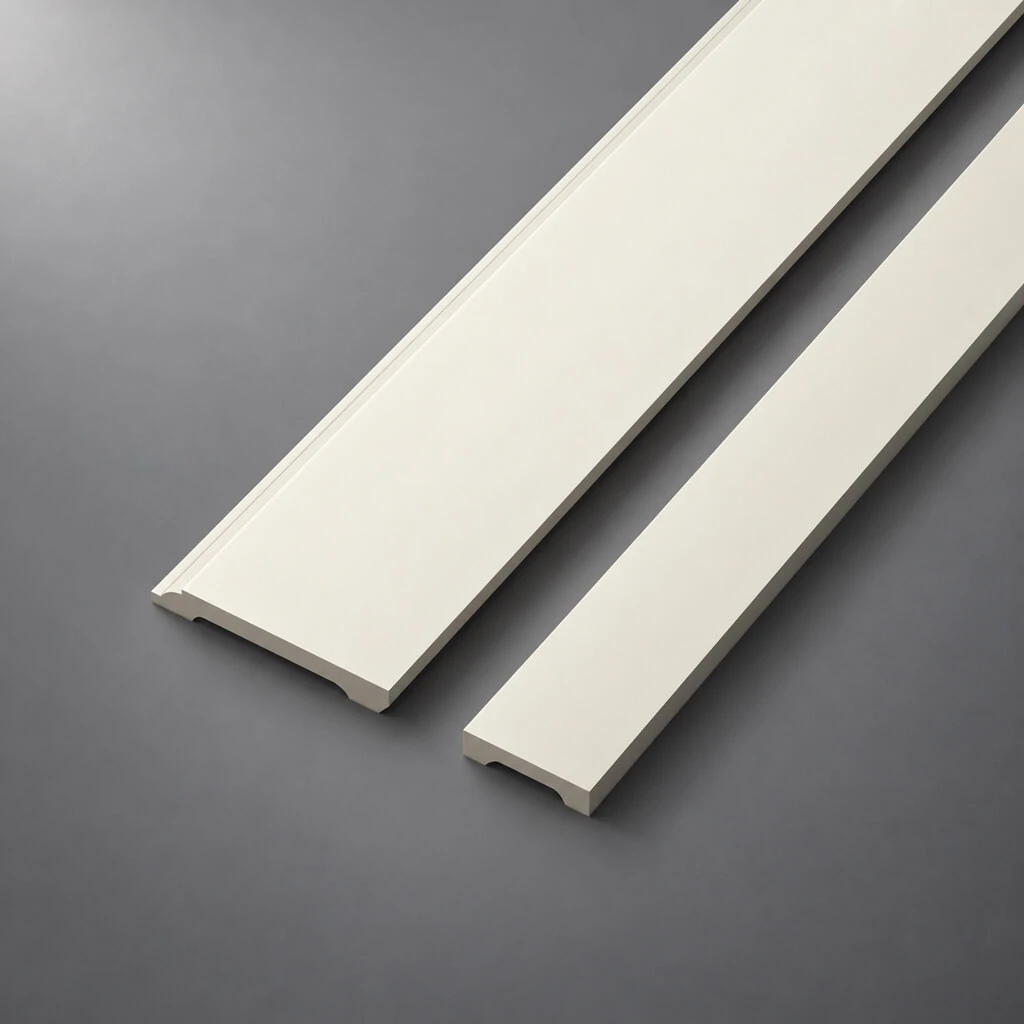
- Smooth (flat) trim
- Profiled trim
- Shaped casing
- Carved Casing
- Narrow and wide: what's the difference
- How to choose a wooden trim by door opening width
- Basic Rule of Proportions
- For a narrow door opening
- For a standard opening
- For a wide opening
- Tall doors and the 'narrow trim' mistake
- Indentation from the opening to furniture and walls
- How to choose a profile based on interior style
- Classic interior and Empire style
- Neoclassicism
- Modern apartment
- Country house
- Office and study
- How to combine a wooden architrave with the frame, extension, and door leaf
- Matching the door
- Matching the frame
- Deliberate contrast
- Profile unity
- What else to pair architraves with: the wooden molding system
- Door casing + baseboard
- Architrave + wall moldings
- Architrave + ceiling cornice
- Architrave + door leaf decor
- Oak or beech: which material to choose
- Oak
- Oak
- Mistakes when choosing wooden architraves for doorways
- Too narrow architrave
- Complex profile on a simple door
- Mismatch with the frame tone
- Ignoring extensions
- Lack of a unified system
- Incorrect length and joint at the corner
- How to buy wooden architraves for doorways: what matters in the catalog
- When a catalog model is sufficient
- When style matching is needed
- How to Calculate Quantity
- Wooden architraves in Moscow and Saint Petersburg
- Installation of a wooden architrave: several professional rules
- FAQ: wooden architraves for doorways — questions and precise answers
- STAVROS: wooden architraves for doorways — quality, choice, system
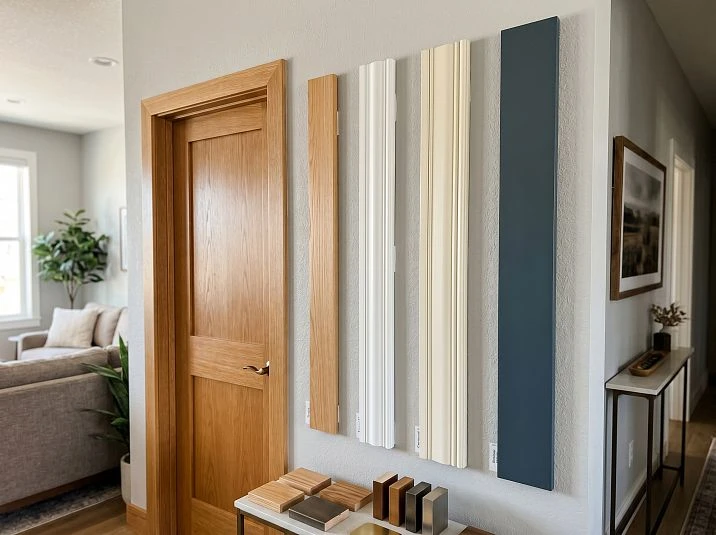
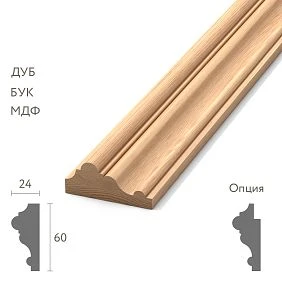
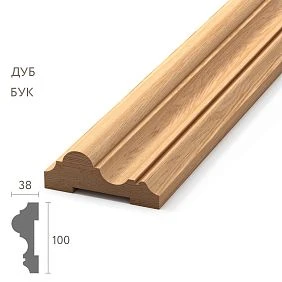
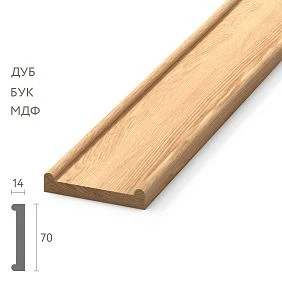
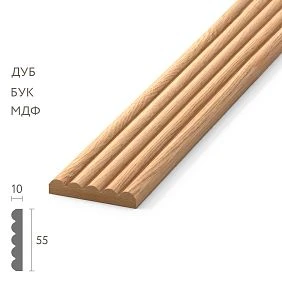
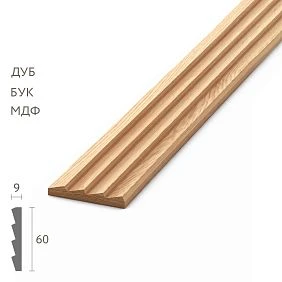
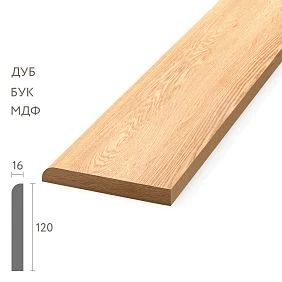
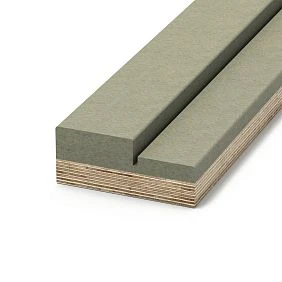
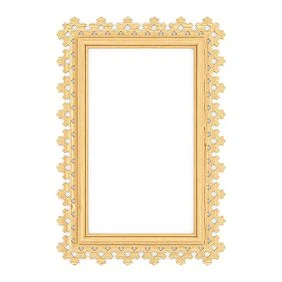
An opening without an architrave is an unfinished story
There is one nuance in the interior that immediately reveals the incompleteness of the space — a doorway without an architrave. Everything seems to be in place: the door is installed, the frame is aligned, the walls are painted. But the eye catches the bare joint between the frame and the wall, the strip of putty that should have been covered, the violation of that very "finished look" without which even an expensive renovation looks rough.
The architrave is an element that covers this joint and at the same time does something more: it sets the scale and character of the doorway. Wooden architraves for interior doorways are both a technical solution and an architectural detail. They solve a practical task (covering gaps and cracks) and an aesthetic one (turning the opening into a full-fledged architectural element of the interior).
This is especially important in apartments and houses with several interior doors. If there are five doors in a hallway, the architraves are what unites them into a single system or destroys this system through inconsistency. A mistake in choosing one architrave ruins the entire perspective. That is why the approach "any will do, the main thing is to cover the gaps" is the worst possible.
What is an architrave for a doorway and why is it needed
The word "platband" originates from the Old Russian term for the front part — "nalichie", meaning what is visible, on the face. This is an accurate description of its function: a platband is the face trim of a door or window opening, covering the technological gap between the door frame and the wall finish.
This gap always exists — and it exists out of necessity. The door frame cannot be installed flush against the plaster: allowance is needed for building settlement, mounting foam, and possible deformations. This gap — 8–15 mm in standard openings — is technologically necessary but visually unacceptable.Wooden platband for a door openingcovers it from one side of the wall. If platbands are installed on both sides of the opening — this is double-sided trim: done in partitions where both sides of the opening are decoratively significant.
Besides masking the gap, a wooden door platband performs several other tasks rarely spoken about. First, it seals the connection between the frame and the wall along the perimeter — blocking air drafts between adjacent rooms. Second, it acts as a visual frame: our eye perceives the door opening precisely through its trim. A wide profile with relief makes the opening "weigh" differently than the same opening with a narrow flat strip. Third, the platband is an integral part of the door unit as an architectural whole: the frame, extension (if needed), platband, threshold — each element is connected to the others.
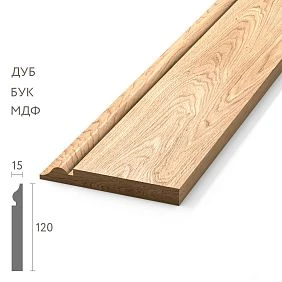
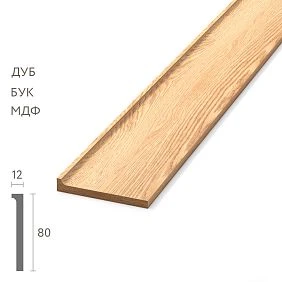
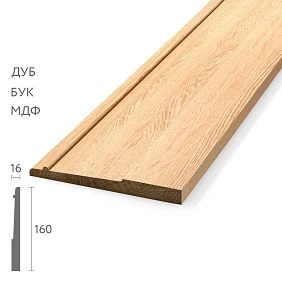
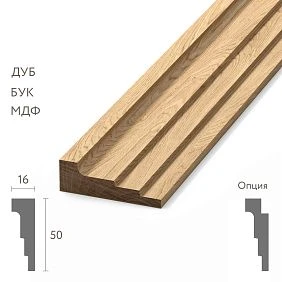
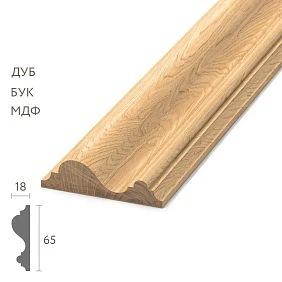
Our factory also produces:
How a platband differs from an extension
These two elements are often confused. An extension is not a platband. An extension is an extension plank that covers the end of the wall: the side surface of the opening (slope) formed when the wall is thicker than the width of the door frame. If the frame is 75 mm and the wall is 120 mm, an open section of wall 45 mm wide appears at the end. This is where the extension goes. The platband is installed over the extension (or without it — if the frame covers the entire wall thickness) onto the face surface of the wall.
In summary: the extension covers the end of the opening, the platband covers its face. These are different products that work together in a complex opening.
Get Consultation
When one platband is enough, and when an extension is needed
This is a key question asked for every door opening — but rarely answered precisely until the moment of installation.
The rule is simple: if the door frame covers the entire thickness of the wall including the finish, no extension is needed. The architraves cover the front of the opening, and the job is done. But if the wall finish (plaster, drywall, tile) has "sunk" the frame, then an open surface remains on the end of the opening, and that's where an extension is needed.
More precisely: measure the thickness of the wall in the opening (this is not the thickness of the load-bearing structure, but the distance between the finished surfaces of the finish on both sides). Compare it with the width of the door frame (telescopic or stationary). If the frame is narrower than the wall, an extension is needed.
The standard frame depth is 75 mm. Walls in most modern apartments are 120–180 mm including the finish. This means that in most cases, an extension is needed. However, telescopic frames with adjustable width (75–175 mm and more) allow you to cover the end without an extension strip—just choose the right width.
Why is a mistake at this stage costly? If you install architraves without an extension where one is needed, the edges of the architrave will "hang in the air," and behind them, the uncovered end of the opening will be visible. This is irreparable after laying the flooring and applying the final finish. The correctness of the assembly must be checked before installing the architraves, not after.
Wooden architraves for interior doors: why solid wood is a strong choice
On the market today—polyurethane, MDF, PVC, aluminum. Each has its own arguments. But Wooden architraves for interior doorsmade of solid oak or beech—this is a fundamentally different quality of sensation that cannot be imitated.
Warmth, texture, living wood
The temperature on the surface of a solid wood architrave is almost equal to room temperature—unlike metal or plastic ones, which are always slightly cooler. This is physics, not a metaphor. A hand touching a wooden door frame does not feel a temperature difference. This creates a subconscious sense of comfort. Wood is "alive."
The texture of oak or beech—each piece is unique. The pattern of annual rings, the direction of fibers, the character of medullary rays—all this makes a wooden architrave one of a kind. When tinted to resemble wood, this texture shows through and "works" as a decorative value. No print on MDF, no film on PVC can provide this.
System: casing + door + baseboard + molding
If the interior already has wooden doors, solid wood parquet, wooden baseboard —wooden door casingcompletes the material system. It's not just "beautiful" — it's architectural coherence. All wooden elements speak the same language. If a plastic or PVC casing appears in this system — it destroys it, even if the color "almost matches."
In addition, solid wood casings are fully repairable. Scratches, chips, varnish fading in a sunny hallway — everything is fixed by sanding and refinishing. An MDF casing with damaged film requires section replacement.
Durability as an investment
With proper surface treatment and normal indoor climate (temperature 18–24°C, humidity 45–65%), an oak casing lasts 40–60 years. This is not a marketing claim — it's the physics of dense wood with a Janka hardness of 5.5 kN. In the same time, PVC profiles lose plasticity and yellow, MDF with film delaminates at joints.
What types of wooden casings for doorways exist
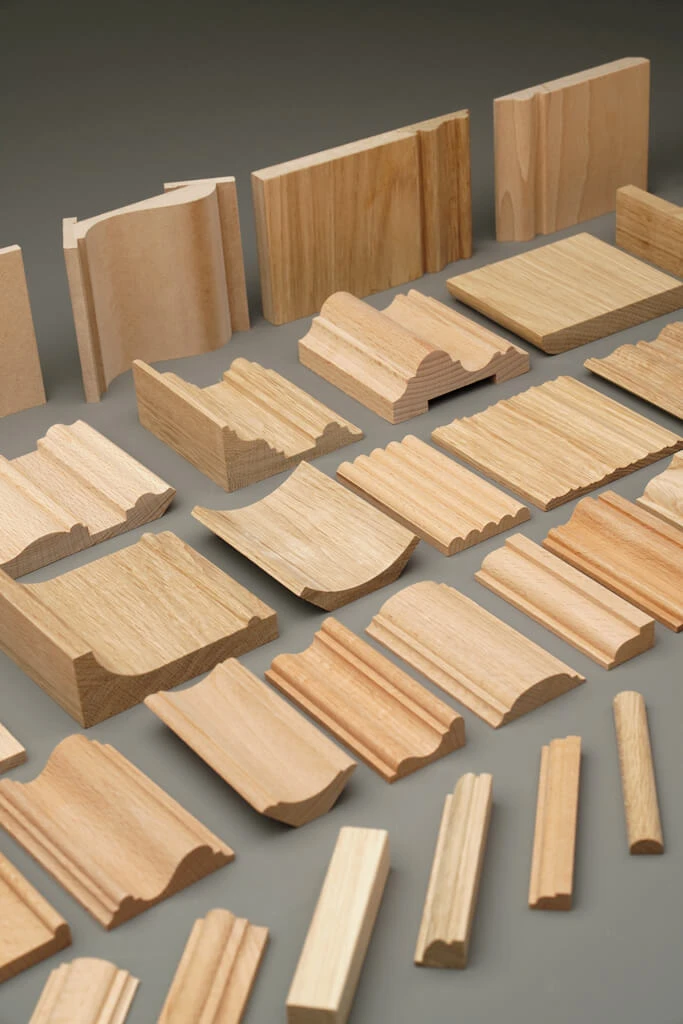
The range of wooden casings is much wider than it seems. Four key parameters — width, cross-section profile, wood species, and finish — create many combinations. Let's break down the typology step by step.
Smooth (flat) casing
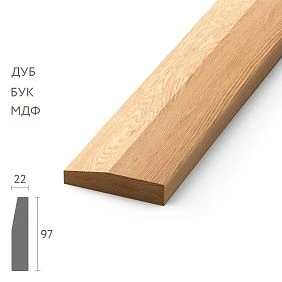
Rectangular cross-section, flat front surface, sharp or slightly rounded edges. The most minimalist type. Minimum relief, maximum purity of form. In the interior, it works as a clear geometric line — not a shadow, not volume, but a contour. Ideal for modern, Scandinavian, minimalist interiors. In solid wood, a flat casing retains all the expressiveness of the texture without decorative distractions — and this gives an excellent result under clear varnish.
Profiled architrave
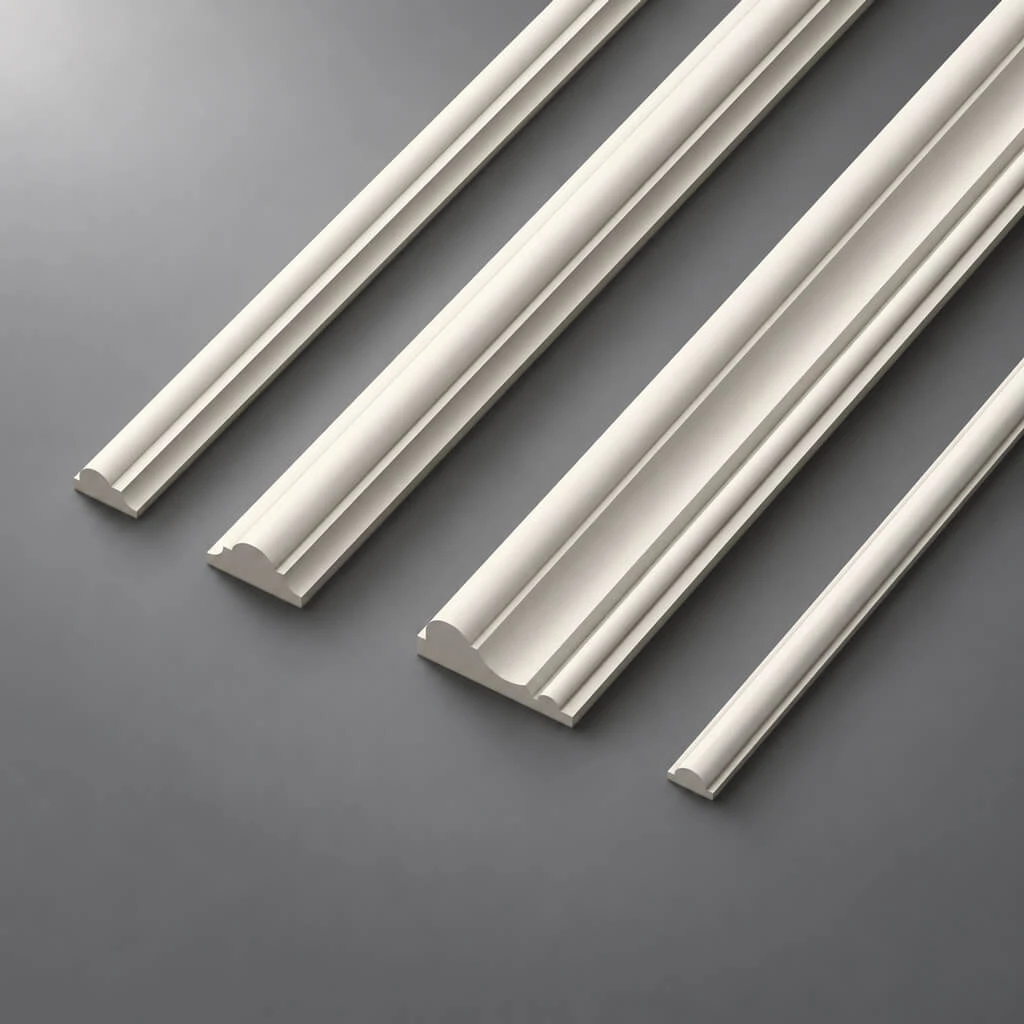
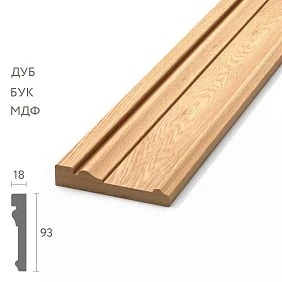
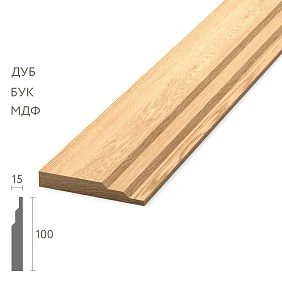
Figurative cross-section with one to three levels of relief. Typical profiles are a semi-circular roll (astragal), heel, and ogee. It creates a play of shadow around the perimeter of the opening and visually "weighs" more. Profiledwooden door architraveis optimal for neoclassicism and soft classicism: the relief is readable but does not overload. Width from 60 to 100 mm is the most common range for interior doors of standard height.
Molded casing
A more complex profile shape with pronounced relief in two to three levels. The shadow cast by such an architrave under side lighting creates a sense of architectural depth. This is the territory of classicism, Empire style, and Baroque. A figured architrave requires an appropriate context: rich stucco, high ceilings, large furniture. In a standard apartment with a 2.6 m ceiling, it creates a feeling of excess — even if perfectly executed.
Carved casing
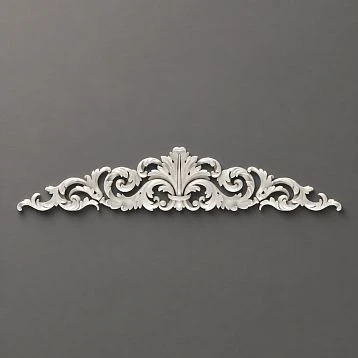
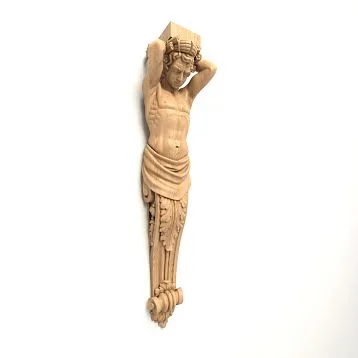
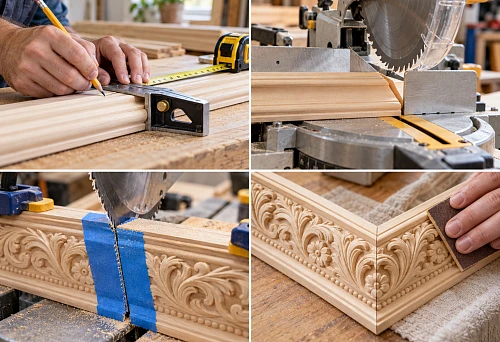
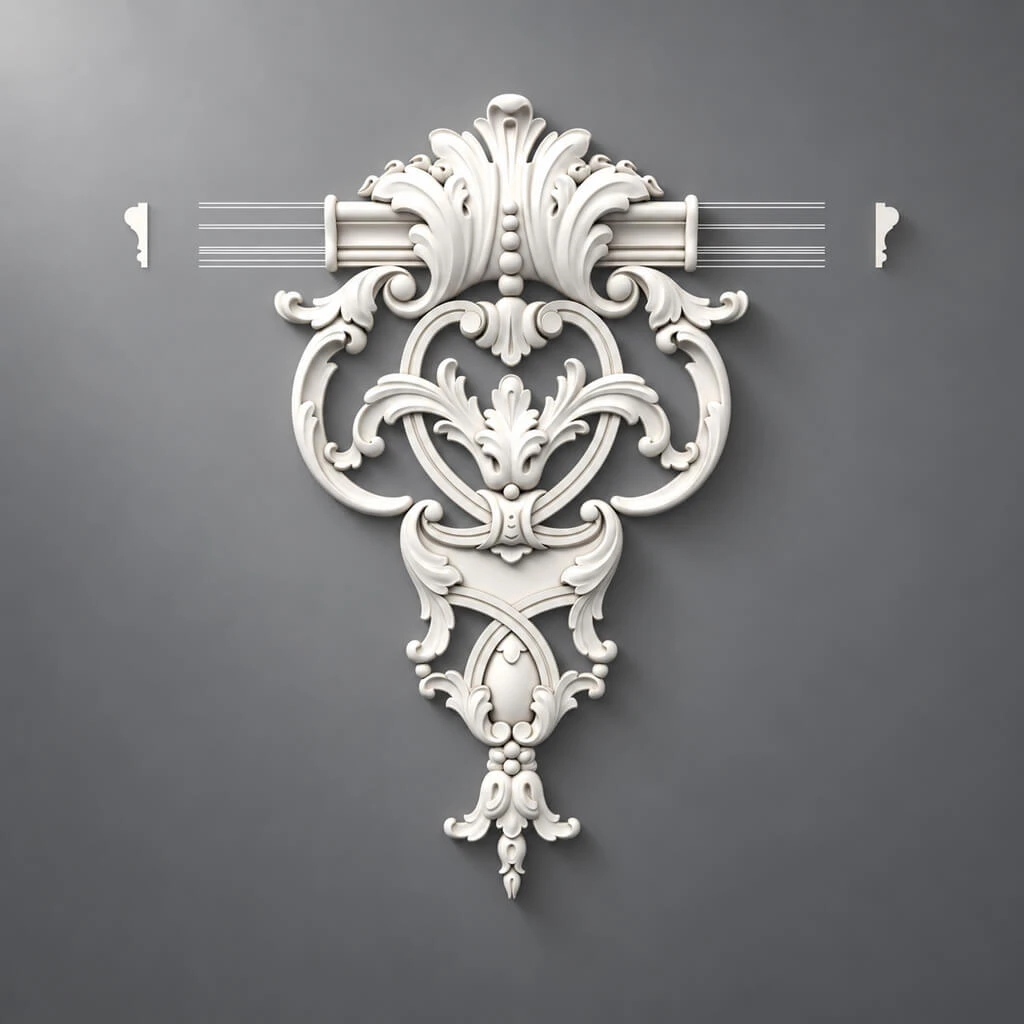
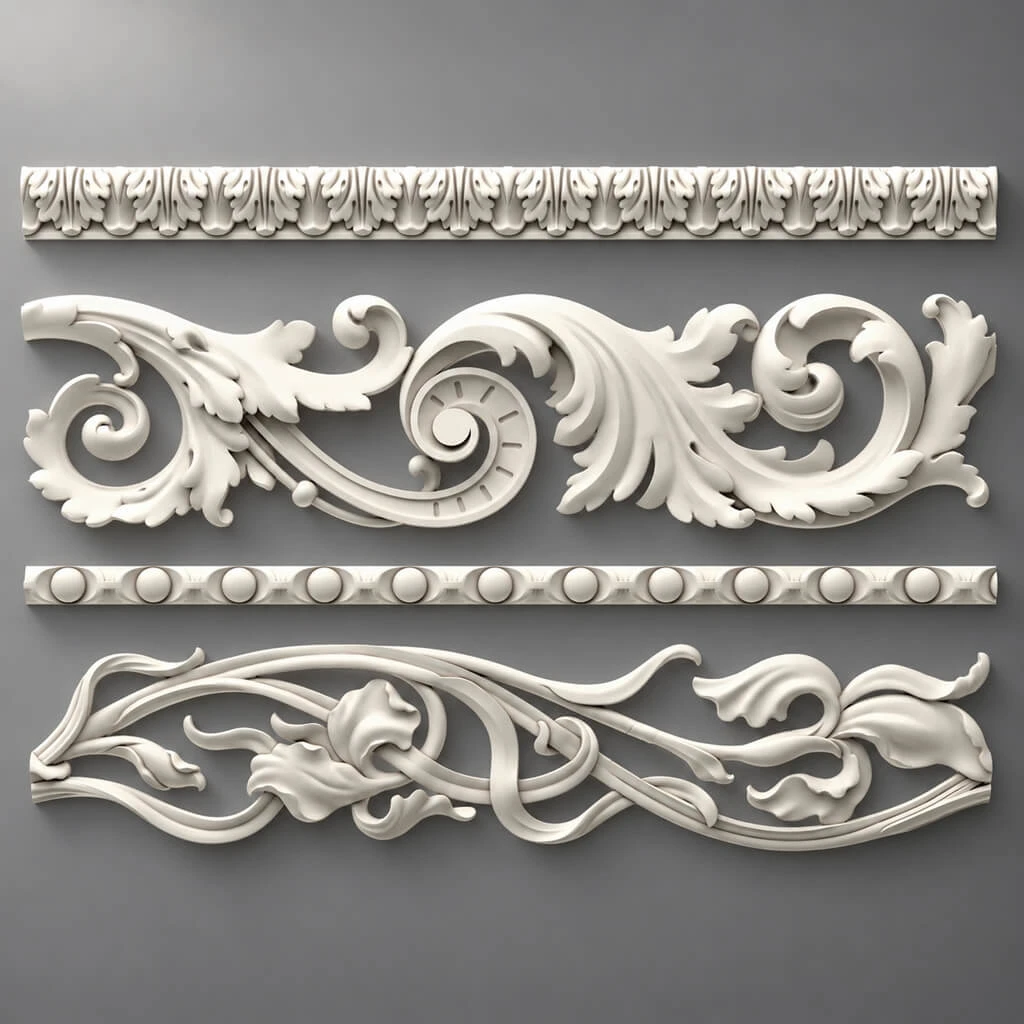
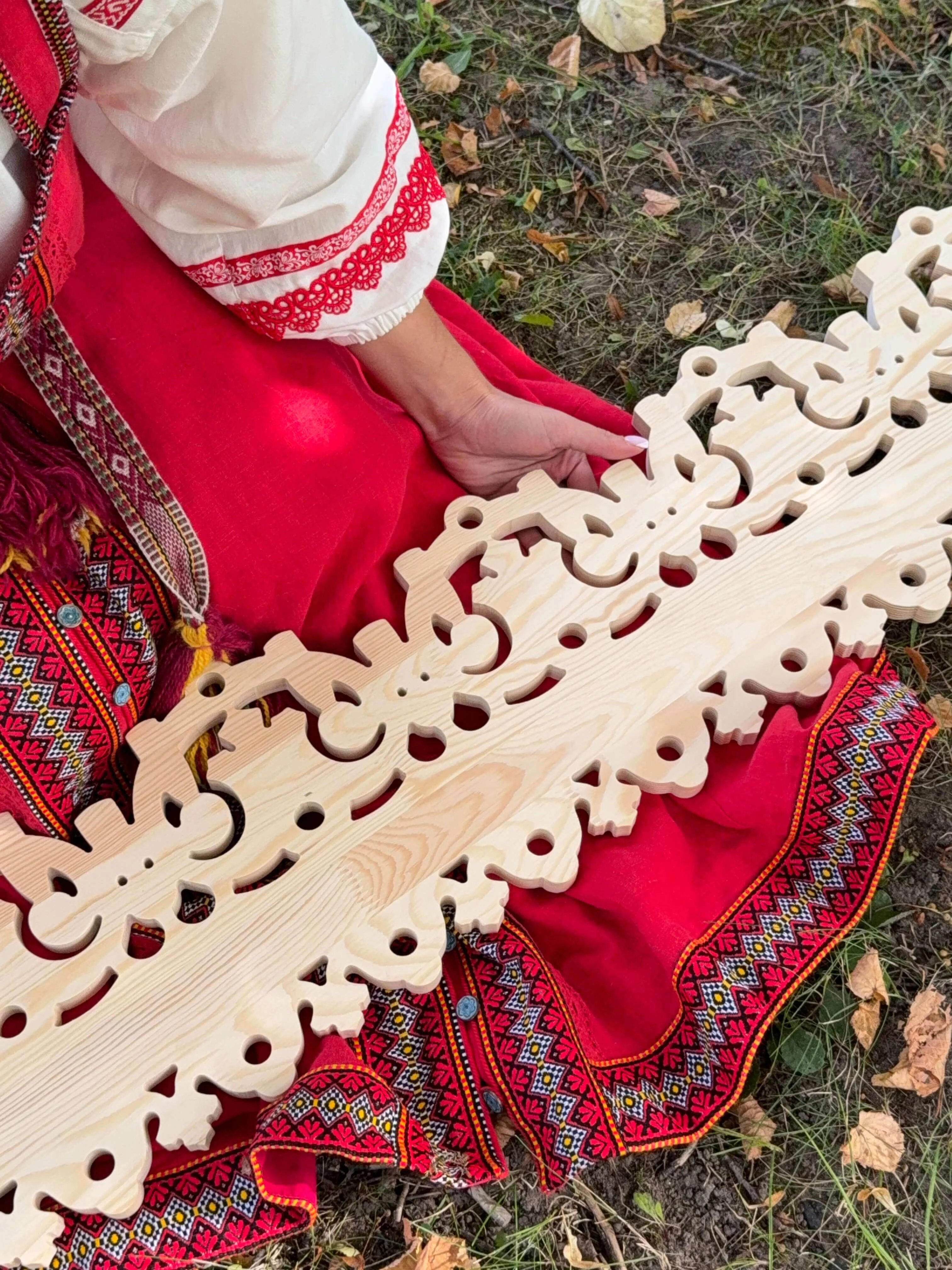
Carving is a separate class. This is no longer just a profile, but an ornament on wood: plant motifs, geometric repetition, architectural themes. A carving depth of 3–12 mm creates a visual effect that cannot be achieved with mechanical milling.Carved architraves for doorwaysare for high classicism projects, country houses in Russian or Empire style, and exclusive interiors. This is always manual or semi-manual work — and a corresponding price, which is justified in projects where the uniqueness of the result is important.
Narrow and wide: what is the difference
The width of the architrave is a parameter that determines the relationship with the doorway and the wall. Narrow (45–60 mm) — a delicate contour that does not overload the space. Medium (65–90 mm) — the standard for most interior doors. Wide (95–130 mm and more) — an architectural detail that requires high ceilings and spacious rooms. Below is a detailed breakdown of selection by width.
How to choose a wooden architrave based on the width of the door opening
The width of the architrave is not a matter of personal preference. It is a technical task with architectural constraints. And there are several rules here, violations of which are immediately noticeable.
Basic rule of proportions
The width of the architrave should be proportional to the width of the door leaf and the height of the room. A working formula: the width of the architrave in millimeters is approximately 3–4% of the height of the door opening. For an opening height of 2000 mm (standard) — an architrave of 60–80 mm. For an opening of 2100 mm — 65–85 mm. For an opening of 2400 mm — 70–95 mm.
For tall doors (2.3–2.7 m), which are popular in modern apartments with ceilings of 3 meters and higher, an architrave of 90–120 mm looks proportionate. With a narrow architrave of 50 mm, a tall door seems "homeless" — the framing does not create the necessary visual weight.
For a narrow door opening
A narrow opening (up to 700–750 mm) is a typical situation for bathrooms, storage rooms, small bedrooms. Here, a wide architrave physically reduces the light of the opening. A width of 50–65 mm is the optimal range. A flat smooth profile works better than a profiled one: it does not add visual volume, does not psychologically narrow the opening.
For a standard opening
A standard opening of 800–900 mm is the most common in residential premises. For it, the optimal architrave width is 65–85 mm. In a classic interior — a profiled architrave with one or two levels of relief. In a modern one — a smooth one with sharp edges.Wooden architraves for interior doorsThis width is the most sought-after category.
For a wide opening
Wide opening 1000–1200 mm — arch, double door, wide entrance to the living room. Here, a 85–120 mm casing is perceived as proportionate. A narrow profile on a wide opening creates visual imbalance — a thin frame on a large opening looks random and ill-conceived. This is especially noticeable if there are standard doors with wider casings nearby in the hallway.
Tall doors and the 'narrow casing' mistake
A common mistake: installing a tall door (2.3–2.7 m) and choosing a standard 65 mm wide casing for it. The result is a 'frameless' door: a tall panel with almost invisible trim. For tall doors, the minimum is 80 mm, optimal is 95–110 mm.
Distance from opening to furniture and walls
The second parameter that is often ignored is the distance from the casing to the corner of the wall, opening, or furniture. If 40–50 mm remains from the edge of the casing to the corner of the room, it is not critical. If the casing 'bumps' into the corner with less than 20 mm, you need to adjust the width choice or plan a corner joint.
| Opening width | Recommended casing width | Optimal profile |
|---|---|---|
| up to 700 mm | 50–65 mm | smooth, narrow |
| 800–900 mm | 65–85 mm | Any |
| 1000–1200 mm | 85–120 mm | profiled, wide |
| Door height from 2300 mm | from 90 mm | shaped or wide profile |
How to choose a profile by interior style
The style is set not by the designer's wish, but by the architectural context of the room. The trim is a detail that must fit into this context. A violation is immediately visible, even to people far from design.
Classic interior and Empire style
Classic requires profiled or shaped trims with a pronounced relief. Width from 80 mm. Mandatory — consistency with the door frame and the rest of the wooden moldings: cornices, moldings, baseboards are made in a single profile.Oak door trimsin dark tint or white enamel — two shades that always work in a classic interior. For white enamel, putty and multi-layer primer are mandatory: white coating does not forgive surface irregularities.
Neoclassicism
Neoclassicism is one of the most common styles in modern residential interiors. Its principles: lightweight classical form, clean lines, moderate relief, light or neutral colors.Wooden architrave for interior doorin neoclassicism — profiled with one or two levels of relief, width 70–95 mm. Beech under white or light beige enamel is the most characteristic solution. The uniform structure of beech wood gives an ideally smooth surface for a matte finish.
Modern apartment
A modern interior in its pure form — plane, line, minimum decor. Here, a smooth wooden architrave 60–80 mm wide with sharp edges and clear varnish that reveals the wood texture is appropriate. This is not a departure from "modernity" — wood as a natural material organically coexists with good modern design. The main thing is not to mix it with carved or richly profiled forms.
Country house
In a country house with wooden floors, beams, massive doors — a space where wooden architraves are not just appropriate but mandatory. The profile can be varied: smooth for a brutal style, profiled for rural classicism, carved for a Russian or Scandinavian wooden house.Solid wood door architravesin a country context work in pair with wooden baseboards, cornices, and wall moldings — and here the wood species should be uniform throughout the house.
Office and study
In an office, meeting room, or executive office, a wooden architrave made of dark oak with tinting is not decor—it's a signal of the space's seriousness. A smooth wide profile of 80–100 mm in a dark tinted lacquer finish creates the necessary weight and solidity. No plastic or MDF in such an environment.
How to combine a wooden architrave with the frame, extension, and door leaf
The three elements of a door unit must work together. The architrave does not exist separately from the frame and leaf—and is always chosen as a system.
Matching the door
The most common solution: an architrave of the same wood species and same tinting as the door leaf. A dark-tinted oak door—and an oak architrave in the same color system. This works, creating a unified volume in the corridor space. The mistake here is choosing a "similar" color that is not identical. Different shades of the same tinting diverge even more under different lighting conditions—and look like an error.
Matching the frame
Another correct approach: an architrave of the same wood species and tinting as the door frame. The leaf can be a different color—then a two-level color system is formed: the leaf as an accent, the frame + architrave as a neutral framing.
Deliberate contrast
Contrast is an acceptable technique in modern and designer interiors. A dark leaf with a white beech architrave under enamel is a solution built on the interaction of two planes. But the contrast must be planned, not accidental. If the architrave "doesn't match" the frame in color—that's not contrast, it's a mistake.
Profile unity
If the door frame has a shaped profile with one level of relief, the casing should support or continue that relief. A smooth casing on a profiled frame creates a break in form — they don't "sound" together.Set of casings for a door openingwith a unified profile is the ideal solution that eliminates this conflict.
What else to pair casings with: the system of wooden moldings
A casing is not a standalone element. In a good interior, it is integrated into the system of wooden moldings, where each profile is connected to the others by wood species, profile, and finish.
Architrave + skirting board
The baseboard and casing must be from the same wood species and the same staining system. If both products are oak with the same stain, the interior reads as cohesive. Violation: a baseboard of light beech in natural color and a door casing of dark oak in walnut finish. These are different woods, different colors — a conflict noticeable to everyone entering.Wooden trim— the casing, baseboard, and molding must come from the same production program. Only this guarantees unity of profile and color.
Casing + wall moldings
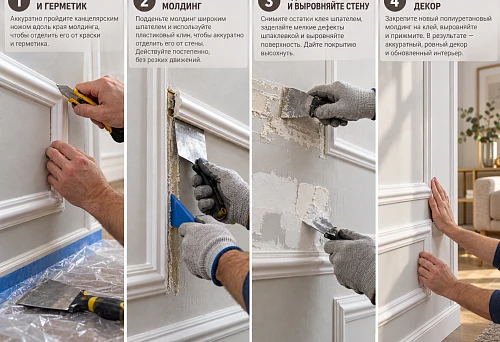
In interiors with decorative wall moldings, the casing should be "in conversation" with them in terms of width and profile complexity. If the wall frames are of a smooth 30 mm profile and the casing is a wide carved 120 mm, that is a disproportion. Optimal ratio: the width of the wall molding should be 50–80% of the casing width.Solid wood wall moldingsand trims in one catalog is the right starting point for a coordinated system.
Trim + ceiling cornice
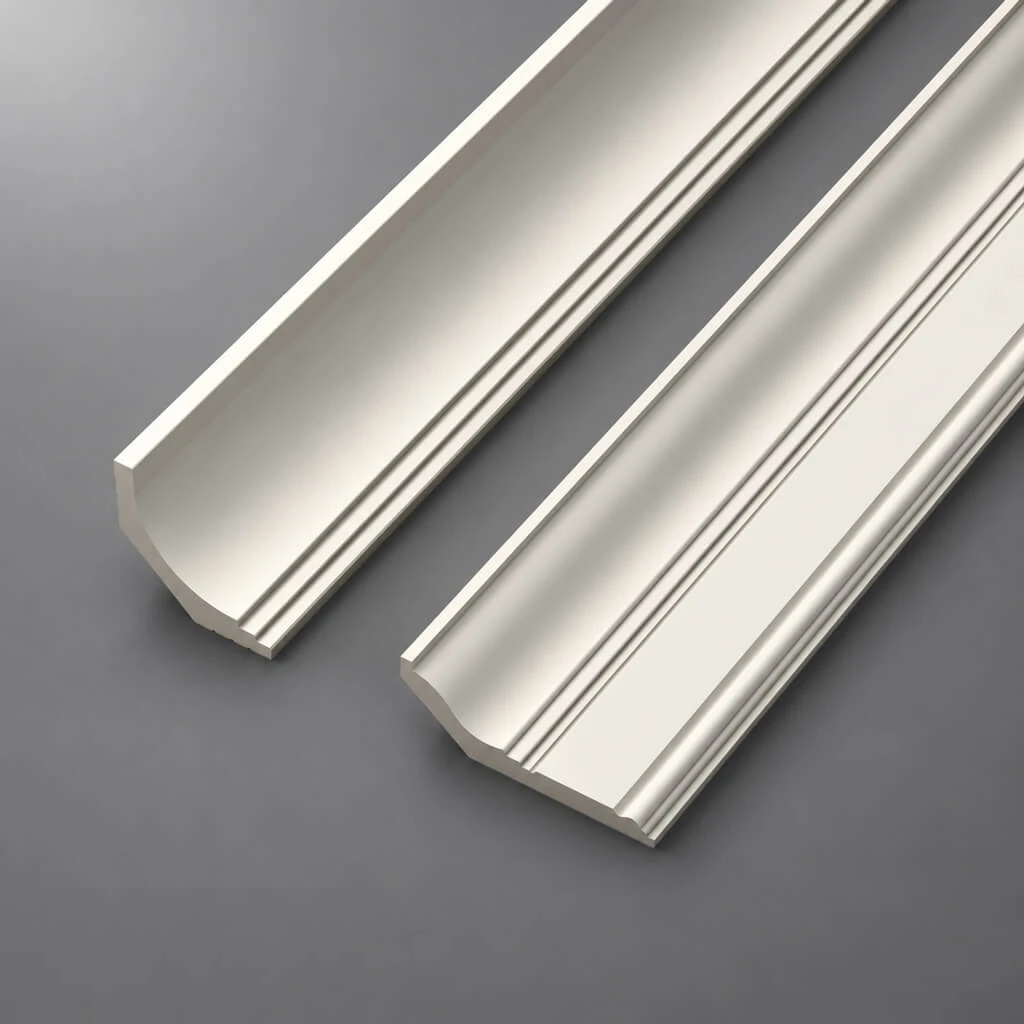
A wooden ceiling cornice is the dominant element of a wooden system in a room. Its profile, width, and tint set the tone for everything else. The trim in such a system is a second-level detail: the profile can be less complex, the width smaller. This is the principle of architectural hierarchy: the crown (cornice) is more important than the frame (trim).solid wood trim pieces— cornices, moldings, baseboards, trims — from the same production line allow you to maintain this hierarchy precisely.
Trim + door leaf decor
In projects where the door leaf is decorated with moldings (classic paneled doors or renovation of a flat leaf), the trim should be in the same "vocabulary" as the molding on the leaf. Carving on the leaf moldings + carved trim = architectural unity. Smooth molding on the leaf + smooth trim = modern consistency.
Oak or beech: which material to choose
This question arises every time when choosing a wooden trim. Both materials are solid wood, both durable, both suitable for trims of any shape. But their character is fundamentally different.
Oak
Density 650–750 kg/m³, Janka hardness 5.5 kN. Expressive texture with annual rings and characteristic medullary rays. Under clear varnish or tinting — noble, self-sufficient. Under white enamel — a bit more complex: additional putty is needed to hide the pores.Oak door trims— a choice for interiors where the texture of natural wood is important: country houses, classic apartments, studies. Service life with care — 50 years or more.
Beech
Density 620–680 kg/m³, uniform fine-porous structure without pronounced texture. Neutral pinkish tint. Accepts any coating perfectly — both for enamel, varnish, and tinting. For white coating — better than oak: smooth surface, no pores, enamel lays perfectly.Beech door trims— a choice for neoclassicism and modern interiors with monochrome wooden moldings for painting.
| Criterion | Oak | Beech | MDF |
|---|---|---|---|
| Texture for varnish | Expressive | Neutral | No (film) |
| For white enamel | Requires putty | Ideally | Good |
| Strength | Very High | High | Medium |
| Durability | More than 50 years | 30–40 years | 5–15 years |
| Repairability | Maximum | High | Low |
| Price | High | Medium | Low |
Mistakes when choosing wooden trims for doorways
Knowing the systemic mistakes in advance, you will not make them. Here are the most common ones.
Too narrow trim
The most common mistake: saving on width. A 45 mm trim on a 2100 mm high door is a contour that is barely readable. The visual weight of the opening requires proportionate framing. A width of 65–80 mm is the minimum guideline for standard doors.
Complex profile on a simple door
A carved trim with deep ornamental carving on a flat white door leaf is a conflict of styles. The trim is richer in decorativeness than the leaf—and it is immediately noticeable. The trim profile should not be more "interesting" than the leaf itself.
Mismatch with the frame tone
The trim and the frame are a single perceptual object. If they are made of different wood species or different painting systems, even with close shades, the mismatch is striking under any lighting. Never choose a trim "from memory," comparing it to a mental image of the door. Only with a sample nearby.
Ignoring extensions
Installing trims without extensions where the wall is wider than the frame means leaving the open end of the opening. It will be visible after installation. Redoing it will be almost impossible without dismantling. Always check the wall thickness and frame width before ordering.
Lack of a unified system
Different trims on different doors in the same corridor is chaos. Even if each trim is beautiful on its own, together they create a feeling of a "patchwork" renovation.Door trims for interior doorsshould be from the same collection—then the corridor reads as an architectural system, not a set of random decisions.
Incorrect length and joint at the corner
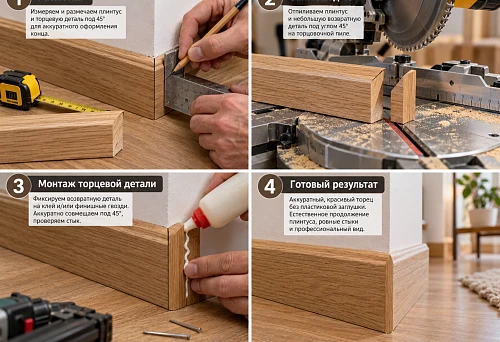
Trims are cut at a 45° angle at corner joints (top horizontal and side vertical elements). Inaccurate cutting results in a gap at the corner that cannot be hidden with sealant. A miter saw with a laser guide and patience are needed. An alternative is corner joints with a screw, straight ends, and a decorative corner block.
How to buy wooden trims for doorways: what matters in the catalog
Buy wooden trims for doorwayscorrectly means being able to see the profile cross-section, exact dimensions (width, thickness, standard length), wood species and moisture content of the blank, and also order a sample before confirming the batch.
When a catalog model is sufficient
Most projects are solved with ready-made profiles from the catalog. Standard sizes, standard wood species, standard tints — this is enough for 90% of tasks. Important: check compatibility with already selected baseboard and cornice from the same catalog.
When style-specific selection is needed
If the interior is built according to a custom project with non-standard profiles, a manufacturer ready to make the trim according to a drawing is needed. The minimum batch for a non-standard profile is typically from 50 linear meters. Lead time: 10–14 working days.
How to calculate the quantity
A standard doorway requires: two vertical trims (height of the opening + 5–10 mm) and one horizontal (width of the opening + 2 × trim width + 10 mm allowance). Total for one side of one opening is about 5.5–6 linear meters. If trims are double-sided, multiply by two. Always add 10–15% for cutting and defects.
Wooden architraves in Moscow and Saint Petersburg
Buy wooden architraves for doorways in Moscow and Saint Petersburgwith constant stock availability — a task solved by a manufacturer with an established warehouse program. Shipment from one piece is important for designers who need samples before client approval. Large batches are for developers, finishing companies, and furniture manufacturers.
Installation of wooden architraves: several professional rules
A correctly chosen architrave can be ruined by improper installation. Several rules that eliminate most mistakes.
Acclimatization is mandatory. Wooden architraves are kept in the room for 48–72 hours before installation. The humidity of the room and wood must equalize — otherwise, the installed profile will warp within the first weeks.
The base must be dry and flat. If the wall plane has a difference of more than 3 mm over the length of the architrave, it needs to be leveled or adjustable spacers should be used.
Installation — polyurethane mounting adhesive combined with thin finishing nails or screws with countersunk heads. Nails are driven at an angle to the plane of the architrave, heads are countersunk and filled with wood paste to match. Adhesive is applied along the perimeter of the back side in a zigzag pattern — not in a continuous layer, otherwise it is poorly squeezed out when pressed.
Angle — strictly 45°, miter saw with laser guide. Joints of horizontal and vertical elements after installation are filled with a thin layer of acrylic sealant matching the coating color. After drying — buff with a soft cloth.
FAQ: wooden architraves for doorways — questions and precise answers
Which architraves are best for interior doors?
It depends on the style. For classic — profiled or shaped, 80–100 mm, oak. For neoclassical — profiled, 70–90 mm, beech under white or light enamel. For modern interiors — smooth, 60–80 mm, under clear lacquer or monochrome coating. There is no universal "best" — there is the right one for a specific interior.
What width of architrave should I choose?
Basic rule: 3–4% of the door opening height. For a standard opening of 2000–2100 mm — 65–85 mm. For tall doors from 2300 mm — from 90 mm. For narrow openings (up to 700 mm) — 50–65 mm.
Is an extension needed for the architrave?
If the wall thickness with finishing exceeds the width of the door frame — an extension is needed. Measure both parameters before ordering. An error here is irreparable after laying the floor and finishing.
Which is better: smooth or shaped profile?
Smooth — for modern, Scandinavian, minimalist interiors. Shaped — for classic, Empire, neoclassical. Criterion: how complex the entire interior architecture is. If the walls are without stucco and cornices — smooth. If there is a developed ceiling cornice and moldings — profiled or shaped.
How to combine architrave with baseboard?
One wood species and one tinting system. Profiles may differ in complexity (baseboard more modest than architrave or equal), but in material and color — unity is mandatory.
Wood or MDF: which to choose?
Wood — where naturalness, repairability, and long-term use matter. MDF — for a monochrome budget solution for painting. If you have wooden doors, parquet, and solid wood baseboards — only wood. An MDF casing in a system with wooden trim destroys its material unity.
How to avoid gaps at corner joints of the casing?
Precise cutting at 45° (miter saw with accuracy ±0.1°) + applying glue to the ends before joining + after installation, filling with acrylic sealant in color. A gap of up to 1 mm is completely hidden by the sealant.
Can you install casing on an opening without a door?
Yes. Casings for openings without a door leaf are a common task for arches and open passages. In this case, the profile and tinting should match the casings of the nearest door openings — then the corridor looks cohesive.
How to choose casing for white doors?
For white doors — casing made of beech under white matte enamel. Beech provides a perfectly smooth surface without pores, the enamel lays without priming against protruding tannins (which is relevant for oak). The profile — any, depending on the style.
How much casing is needed for one door?
For one side of a standard door opening 800×2000 mm — about 5.5–6 linear meters including cutting. Plus 10–15% reserve. For a double door or arched opening — calculate the perimeter separately.
STAVROS: wooden architraves for door openings — quality, selection, system
Choosing a wooden architrave for an interior door is a decision that completes the door unit and integrates it into the interior architecture. That is why the architrave cannot be chosen at the last moment, 'whatever fits.' It is the first decision to be made in the system — together with the door, baseboard, and moldings.
STAVROS is a Russian manufacturer of wooden architectural elements and millwork products from solid oak and beech. Full production cycle: wood selection, chamber drying to 8–12% moisture, profile milling with a tolerance of ±0.1 mm, hand sanding, geometry control.
In the catalogSTAVROS— carved and shaped architraves for doors and windows, baseboards, cornices, moldings, and all wooden millwork for creating a unified interior system. Main items are always in stock. Shipment from one piece. Delivery in Moscow, St. Petersburg, and throughout Russia. Custom manufacturing from 50 linear meters, lead time 10–14 working days.
A door unit assembled from one production system is not detail for the sake of detail. It is the quality of the result that is immediately visible and lasts for decades. STAVROS helps achieve it.