












































































Article Contents:
- What are wall slats and how do they differ from slatted panels
- When to choose individual slats and when to choose modular systems
- Material battle: solid wood vs. MDF
- How to choose the format for a specific task
- Architecture of proportions: size and width of the slat
- The magic of rhythm: how to choose the spacing between slats
- Lighting: when light brings form to life
- Connections and transitions: integration into the interior system
- The Art of Installation: What You Need to Know Before Buying
- Fatal Mistakes: How Not to Ruin an Accent Wall
- Where to Buy and How to Order a System Without Compromises
- FAQ: Answers to Key Questions
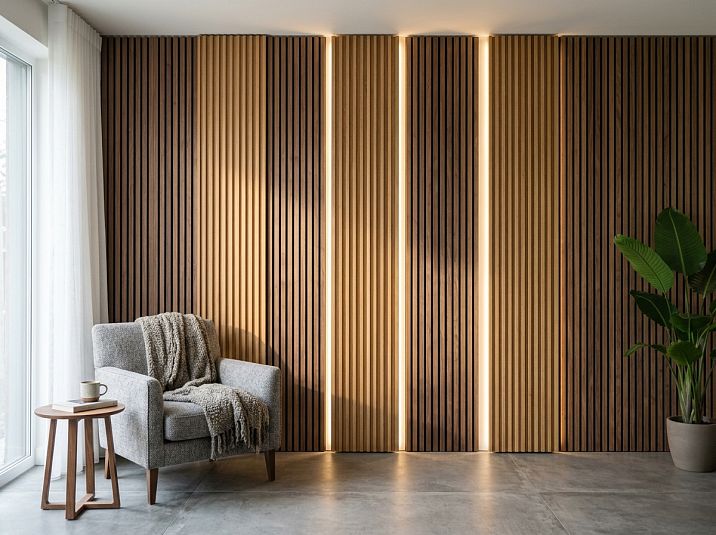
Space abhors emptiness, but it also cannot stand meaningless clutter. At some point, smooth painted walls ceased to meet the demands of complex interior architecture, and slatted decor rapidly burst into design. However, today simply saying "I wantrafter walls for walls" says absolutely nothing. It's like walking into a car dealership and asking for "a car with wheels." A modern interior requires jewel-like precision: rhythm, texture, light, shadow depth, and material must work in a single ensemble. Wall architecture no longer forgives random decisions. The choice between a set of individual slats and ready-made modular systems determines not only the budget and timeline but also the fundamental visual perception of the room. When you decideBuy oak wooden planks for walls, you face purely practical questions: what profile width won't "eat up" the volume of a small living room? What spacing between elements will set the right rhythm rather than visual noise? How to integrate a hidden LED strip so it highlights the wood texture instead of exposing flaws in the rough plaster? Finally, what is the fundamental difference between painstaking assembly piece by piece and installing ready-made blocks? Buying without answers to these questions turns into a lottery where the stake is the harmony of your home. In this guide, we will dissect the anatomy of slatted decor so that your choice is flawless and your interior gains that architectural depth that distinguishes amateur renovation from a master's work.


What Are Wall Slats and How Do They Differ from Slatted Panels
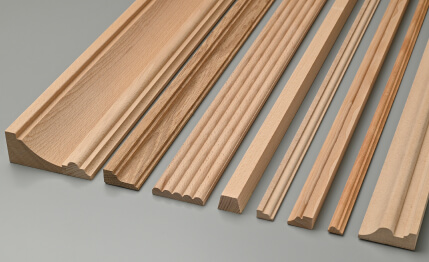
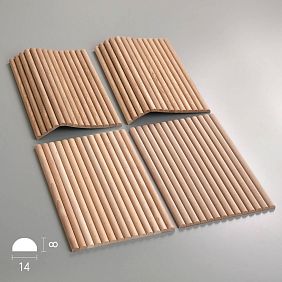
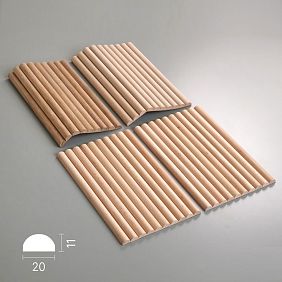
Many still confuse these two concepts, considering them synonyms, although technically and conceptually they are completely different products. IndividualWooden planks (baffles, lamellas) are piece linear materials. Imagine independent bars of a certain cross-section, each mounted on the surface individually. This gives absolute creative freedom: you set the spacing yourself, can change the distance between elements right during installation, create complex asymmetrical patterns or transitions. The piece format is a fine-tuning tool where the master acts as a conductor.
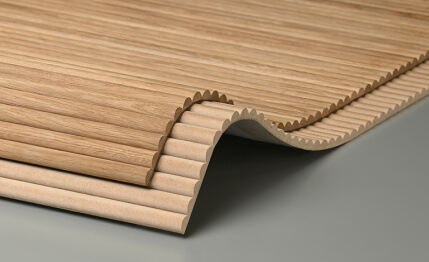
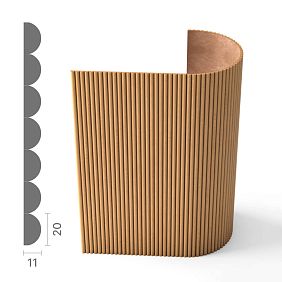
In turn,Rafter panelsThese are ready-made engineering modules. In them, the slats are already rigidly fixed on a single base (a substrate made of MDF, plywood, or acoustic felt) with a factory-verified, perfect pitch. Installation of such a module is many times faster: you don't fasten a dozen individual planks, measuring every millimeter, but immediately cover an area 40-60 centimeters wide in one motion. The substrate in the panels often serves as a visual background (for example, a contrasting black color) and an additional sound insulator. While individual linear elements require perfect base preparation, a modular system can level out minor defects in the rough finish. Understanding this difference, you are already taking the first step towards competent planning of the budget and project timelines.




When to choose individual slats, and when to choose modular systems
The choice of format is dictated by the architectural features of the room and your design task. There is no universal "best" solution, only the most relevant one for specific conditions. Individual slats are your only choice if the wall has a complex curved shape. It is impossible to bend a rigid panel without breaking the geometry, but running individual linear elements along a curved surface, meticulously adjusting each element, is a task solvable by an experienced craftsman. The individual format is also indispensable for projects with complex custom layouts: for example, if you need a gradient rhythm where the distance between planks smoothly increases from the center to the edges, or if you want to create a cross-shaped geometric pattern. A striking example of a high-quality individual material isWooden Rail RK-001, whose strict geometry allows the most daring author's ideas to be realized.
Ready-made modules come into play where impeccable speed, guaranteed parallelism of lines, and work on large areas are required. A huge wall in a double-height living room or a long corridor will become a nightmare for an installer if they are installed piece by piece — the risk of accumulating pitch error increases with every meter. Here,slatted panels for wallssave dozens of hours of work. In addition, modules with an acoustic substrate are indispensable in home theaters and studios: they not only decorate but also break up the sound wave, eliminating wandering echo. An outstanding example of a ready-made engineering solution isSlat panel PAN-001, which combines the aesthetics of natural wood with absolute structural stability.
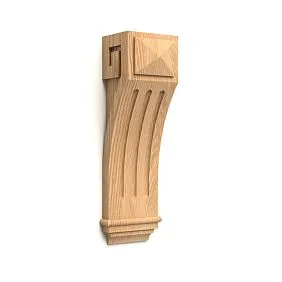
Our factory also produces:



Battle of materials: solid wood vs. MDF
The material determines everything: from tactile sensations to durability and the method of final finishing. Solid natural wood (oak, beech, ash) is the choice of uncompromising aesthetes. Wood breathes, it lives, its texture is unique. Oak has amazing hardness and an expressive, deep pattern of annual rings. When treated with tinting oils, it reveals an incredible palette of shades — from noble cognac to ash-gray. Beech, on the contrary, has a calmer, more even texture, it lends itself well to complex tinting and creates a soft, warm atmosphere in the interior. Solid wood is indispensable when the interior requires authenticity, when you want to touch nature, feel its power and warmth.
However, solid wood has its own character: it requires stable humidity in the room, it is heavier and more expensive. If your goal is perfect geometry under an opaque enamel, if you plan to paint the wall a deep emerald, rich terracotta, or absolutely black color, the best choice would be high-density MDF. This material is free from internal stresses, it is not "warped" by humidity changes, and the enamel lays on it in an impeccably even layer.Decorative planks for walls to buymade of MDF for painting is the most rational solution for modern monochrome interiors, where only relief and the play of shadows matter, not the texture of wood.
Get Consultation
How to choose a format for a specific task
Each functional zone of an apartment or house has its own requirements for slatted decor. What looks great in a spacious living room can kill the coziness in a bedroom. Let's break down the key scenarios.
Living room and home theater area. Here, an accent wall often serves as a backdrop for a large screen. Your task is not to create a visual conflict between the bright, dynamic picture of the TV and the variegation of the wall.TV zone with slatsrequires a calm, measured rhythm. Wide slats with a deep step, painted in dark, enveloping tones, or modules on a black acoustic backing that will absorb excess light from the screen and improve the sound of the audio system are ideal.
Bedroom. This is a territory of peace, intimacy, and relaxation. Sharp contrasts are inappropriate here.slatted panels in the bedroominstalled behind the headboard of the bed should radiate warmth. Choose solid oak or beech in light, natural tints, profiles with rounded edges and a soft step. Wood here works as a powerful psychological anchor, grounding the space and creating a sense of security.
Hallway and transit zones. Corridors usually suffer from a lack of natural light and narrowness of space. Vertical lines here work as a lifeline, visually raising the ceiling.Decorative planks for walls in interior designin the hallway are often combined with mirrors and hidden hooks for clothes. A practical choice would be durable oak elements capable of withstanding accidental bumps from bags and shoes.
Proportion Architecture: Size and Width of the Batten
One of the most common failures in design is a mismatch between the scale of the decor and the dimensions of the room. The cross-section size of the batten — width and depth — is not just a matter of taste; it is strict mathematics of proportions. If you take massive bars with a cross-section of 40x40 mm and install them in a small room of 12 square meters, they will visually crush the space, turning it into a cramped wooden cage. In compact spaces, elegance is everything: narrow slats of 20x20 mm or 20x30 mm will create a fine, delicate texture without taking away precious cubic centimeters of air.
On the other hand, in rooms with high ceilings (3 meters and above), a small profile will simply get lost, blending into an indistinct ripple. Here, bold, confident forms are needed: wide battens of 40x20 mm, 50x30 mm, or even more massive elements. The depth of the profile (how much the batten protrudes from the wall) determines the depth of the shadow. The greater the protrusion, the more contrasting and dramatic the wall will look under side lighting. When studyingLaths for interior finishing, always correlate the cross-section of the profile with the distance from which you will view it. The optimal rule: the width of the slat should be readable from any point in the room without straining your eyes.
The Magic of Rhythm: How to Choose the Spacing Between Battens
The rhythm of a slatted wall is its pulse. It is the distance (spacing) between adjacent elements that sets the dynamics of the space. A dense layout, where the gap is equal to or even smaller than the width of the batten itself (e.g., batten 30 mm, gap 20 mm), creates a dense, rich texture. From a distance, such a surface looks like a single massive panel with deep slits. This is a strong, aggressive technique that works well on small accent areas. However, if you stretch such a rhythm across a huge wall, it can create a rippling effect in the eyes.
A medium rhythm, where the distance between battens is 1.5-2 times their width (e.g., batten 20 mm, gap 40 mm), is considered the golden standard. It allows the wall to 'breathe,' each line is clearly readable, and the background surface shows through enough to create a beautiful contrast. A sparse layout (gap 3-4 times the width of the batten) is used less often, mainly for zoning or creating light architectural hints. When reading aboutWall cladding with louvered panels, remember: the more contrasting the color of the base wall and the color of the profile itself, the wider the spacing should be to avoid visual fatigue.
Lighting: When Light Brings Form to Life
Light is a tool that turns a merely good wall into a masterpiece. Without proper lighting, the relief remains flat, hiding half its beauty. Integrating LED lighting into slatted structures is a mark of high-class design. A hidden LED strip, run in the gaps between modules or built into specially milled grooves in the slats themselves, creates a stunning floating line effect. Directed light glides along the edges of the profile, emphasizing the texture of oak or the flawless smoothness of painted MDF, enhancing the contrast between light and deep shadow.
The most important nuance is the light temperature. Warm light (2700-3000K) works perfectly with natural solid wood in bedrooms and living rooms, bringing out golden and honey tones from the wood. Neutral white light (4000K) is preferable for monochrome painted surfaces, strict neoclassical and commercial interiors. When choosingSlatted panels with lighting, be sure to provide space for hidden installation of power supplies and use tapes with a high color rendering index (CRI>90) so that the wood does not look like lifeless plastic. The lighting can be end-mounted (light shines from bottom to top or top to bottom), creating long dramatic shadows, or front-mounted (built into the profile), which gives a more modern, technological look.
Connections and transitions: integration into the interior system
A slat should never exist in a vacuum. Its power multiplies many times over when it enters into a dialogue with other architectural elements of the room. The problem with many non-professional renovations is rough joints and a lack of connections. How does the vertical line meet the floor? How does it go into the ceiling? An ideal interior is built on well-thought-out nodes. If you are using natural wood, the baseboard should become a natural extension of the wall decor. The optimal solution, described in the article aboutwall slats and solid wood baseboards, involves using a baseboard of the same species and tint. Often, the baseboard is hidden altogether, using concealed installation, so that the slats visually grow directly from the floor.
Another powerful technique is the transition from wall to ceiling. Wooden lines rising up the wall and breaking at a right angle, moving onto the ceiling plane, create the effect of a visual cocoon, an architectural portal. This solution is often used in dining or sofa areas to highlight them in a studio space. Also, don't forget about doors: if you have hidden installation interior doors,vertical wooden slatsthey can be glued directly onto the door leaf, making the entrance completely invisible within the overall mass of the wall.
The art of installation: what you need to know before buying
The beauty of a slatted wall depends 50% on the quality of the materials and 50% on the skill of the craftsman and the chosen method of fixation. Base preparation is the alpha and omega of a successful project. If the wall has plane deviations of more than 2 mm per meter, a rigid slatted panel will not lie flat, and individual slats will go wavy, turning the intended strict geometry into a distorted mirror. There are two main installation methods: adhesive and frame.
The adhesive method is ideal for perfectly smooth plastered surfaces. Slats or panels are fixed with professional polyurethane glue, ensuring a rock-solid hold. The frame method using hidden fasteners (clips or guide profiles) is used where additional soundproofing of the wall is needed, thick cable bundles need to be hidden behind the cladding, or when the wall cannot accommodate glue. When studying the issue,How to install slatted panelspay attention to tongue-and-groove systems: they allow modules to be joined completely seamlessly, making joints invisible to the eye. The installation of complex ceiling structures, which the material details,Slatted panels for walls and ceilingrequires mandatory mechanical fastening and reinforced embedded elements in the ceiling.
Fatal mistakes: how not to ruin an accent wall
Experience from thousands of renovations shows that mistakes when working with slatted decor are standard and, unfortunately, fatal for the visual outcome. The first mistake is incorrect scale, which we already mentioned (too massive a profile in a micro-room or too small in a huge hall). The second is ignoring sockets and switches. If electrical fittings fall on the edge of a slat, it looks messy. Layout for sockets must be done down to the millimeter at the planning stage of the spacing, so that the socket frame fits clearly between elements or is neatly cut into a wide panel.
The third mistake is skimping on material. Cheapform the architecture of walls and ceilings, creating a play of light and shadow.materials of dubious origin (for example, under-dried pine) are guaranteed to warp into a bow at the first heating season. The wood must be kiln-dried (moisture content 8-10%), otherwise internal stresses will tear even the strongest glue. The fourth is the absence of finishing edges. The ends of the structure must be finished with special trim strips, otherwise the wall will look unfinished.
Where to buy and how to order a system without compromise
Having grasped all the nuances, you approach the main stage — purchasing. When you need unique tints, complex profiles, and a one hundred percent quality guarantee, mass market won't help. You need a manufacturer that controls the cycle from wood drying to final sanding. When referring to the full catalog and guideslatted panels: complete guideyou get the opportunity to order not just boards, but an engineering-verified architectural system. Whether it's individual planks of select oak or high-tech painted MDF modules on an acoustic substrate, a professional approach guarantees that the profile will be perfectly level, the tint will match tone for tone, and the mounting grooves will align to within a fraction of a millimeter.
ChoosingWooden boards in interioryou are investing in the architecture of your home for decades. And there is no room for compromise in material, geometry, or finish coating. Entrust your interior to proven production solutions, and the wall will transform from a simple enclosure into a true work of art.
FAQ: Answers to Key Questions
What is better to choose: individual slats or ready-made slatted panels?
Ready-made modules are ideal for flat walls, large areas, and quick installation. They provide perfect spacing and often have acoustic properties. Individual slats are indispensable for curved radius walls, complex custom layouts with variable spacing, and projects requiring maximum design flexibility.
What spacing between elements is considered optimal?
The golden standard is a distance 1.5–2 times the width of the slat itself. If the width is 20 mm, a gap of 30–40 mm will provide a comfortable visual rhythm. A smaller spacing will create a dense, massive wall, while a larger one will create a light, unobtrusive decor.
Which materials are best suited for painting with enamel?
High-density MDF or beech wood. MDF is absolutely stable and has no wood pores, providing perfect smoothness. Beech is a hard natural wood with an even, uniform texture that also takes opaque coatings beautifully without showing grain. Oak for enamel will require complex multi-layer priming.
What lighting is best for such a wall?
For bedrooms and relaxation areas with natural wood — warm light (2700-3000K). For modern monochrome interiors, painted MDF, and commercial zones — neutral white light (4000K). The main condition is hidden installation of the strip in a profile or behind the panel to create a sliding light effect.
Can decorative elements be mounted on uneven walls?
Piece-by-piece linear elements absolutely cannot be glued to an uneven wall — they will follow all the curves. Ready-made panels on an acoustic felt backing can hide minor irregularities (up to 2-3 mm). For significant differences, preliminary installation of a lathing (frame) is required, onto which the cladding is then attached.
In the world of interior design, not only the overall concept is important, but also the impeccable quality of every detail. Architecture does not forgive haste and neglect of materials. Your home is a reflection of your taste and attitude to life. To realize the boldest ideas and get results that exceed expectations, turn to professionals. The manufacturing company STAVROS creates masterpieces from solid wood and high-tech MDF, turning your interior dreams into lasting reality. Choosing STAVROS means choosing stability, unsurpassed aesthetics, and confidence in every line.