Article Contents:
- Where to buy mouldings in Syzran and how to start your order
- Can an interior door be updated with mouldings without replacing the door leaf
- Why polyurethane mouldings are chosen for this kind of project
- Which mouldings suit doors: a comparison of four product codes
- How to choose the pattern for two frames on an 800×2000 mm door
- Where people most often go wrong when measuring door leaves
- How much moulding is needed for two doors: a parts schedule
- Precise cutting plan for four 2600 mm strips
- How to make a neat 45-degree molding joint
- Cost of moldings for two doors: four STAVROS options
- How to fit updated doors into a hallway without ending up with a separate decorative element
- Additional calculation: two wall frames 500×1200 mm
- Complete set for two doors and a wall: what to add to the cart
- How to choose a profile for a narrow hallway and ceiling height
- Ready-made decorative corners or 45-degree miter cuts
- Door and furniture overlays: when it's better not to add them
- Surface preparation: why good glue doesn't solve everything
- Step-by-step installation of moldings on two interior doors
- How to paint a door with new decor
- How to prepare a STAVROS order without missing elements
- Delivery of stucco moldings to Syzran and other cities of Samara Oblast
- How to check moldings upon receipt and what to do if they are damaged
- How to control the final budget and avoid overpaying for a single strip
- Two door renovation scenarios: preserve the finish or repaint entirely
- Trial fitting and cutting check before the order is shipped
- Customer questions and answers about stucco moldings in Syzran
- Can I place an order without visiting the store?
- What the query "buy stucco molding" means and where to go from the article
- Are four strips enough for two doors?
- Why does the hallway need three more strips instead of two?
- Can moldings be installed on doors with PVC film?
- What thickness should I choose for two doors in a small apartment?
- Do I need to buy ready-made corners for the frames?
- Can the profile be installed directly over peeling paint?
- How much does delivery of seven strips to Syzran cost?
- Should I buy one additional strip?
- Can the same paint be used for the wall and the door?
- How should I check the product before final installation?
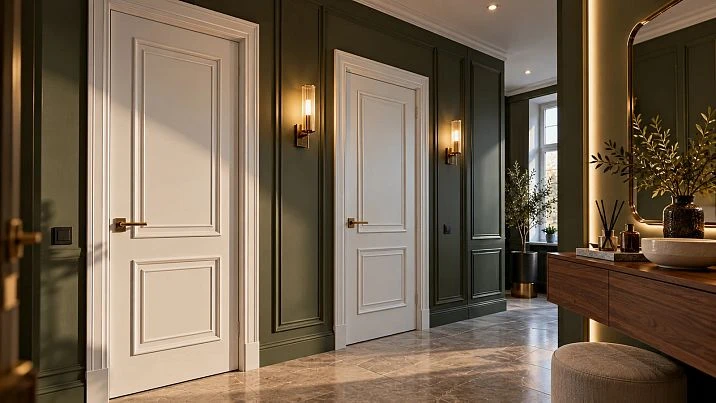
If the interior doors in an apartment are in good condition but look too plain, you don't necessarily have to start renovating the hallway by buying new door leaves. Slim relief profiles let you add neat decorative frames to smooth surfaces and then repeat their pattern on the adjacent wall. This approach is especially convenient when you want a coordinated interior, want to know material consumption in advance, and don't want to buy unnecessary elements. The STAVROS catalog features Moldings for walls, door leaves, furniture and ceiling areas. What matters most is not the amount of ornament, but the correct dimensions, compatibility of the base and profiles, careful cutting and proper ordering.
For residents of Syzran and other settlements in Samara Oblast, the task begins with planning the delivery: which SKU to choose, whether one batch will be enough for the doors and the hallway, how 2600 mm long strips will be transported, and how much extra you'll have to pay for packaging. If you are planning Buy molding, it's more useful to first draw up a parts list and only then move on to the cart. Below is a complete example: two doors of 800×2000 mm, two frames on each leaf and two more frames on the wall of a narrow corridor. Four real STAVROS profile models are given, along with a cutting map, price options, installation rules and questions to clarify before delivery. Product prices were verified against catalog cards as of October 28, 2026, but they must be confirmed again before payment.
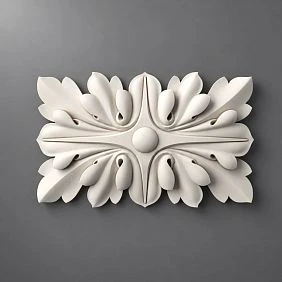
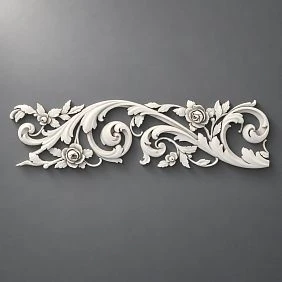
Where to buy stucco in Syzran and how to start an order
The buyer doesn't need to look for a separate specialized salon near home to compare polyurethane moldings. On the STAVROS website you can choose a SKU, find out the cross-section, product length, material and price, and then submit a request for a set. The availability of goods in a specific city, the existence of a local warehouse or a fixed delivery time do not follow from this information. Therefore, the phrase buy stucco in Syzran should be understood as placing an order with subsequent agreement on transportation, not as a promise of a local point of sale.
The first step is to decide what exactly will be decorated. For two identical doors, it's convenient to choose one profile and one pattern: this makes it easier to reproduce the markings, control dimensions and account for leftovers. For the corridor, you can repeat the same line thickness or deliberately choose a slightly more noticeable profile for the wall. The second step is to photograph each leaf, indicate its actual dimensions, the opening side, the handle position and the distance to the architraves. The third is to measure the free wall sections and mark switches, sconces, the intercom, sockets and the floor skirting.
An order becomes clear when the list of SKUs is accompanied not only by the room dimensions but also by a list of specific parts: how many segments need to be obtained, what their outer size is and where the leftovers will go. This protects against the most common mistake — buying based on a single total figure of linear meters, when the required solid sides of the frames cannot be cut from the paid-for strips. It is especially important to verify the material: the catalog includes products made of polyurethane, MDF, wood and polystyrene that look similar in the photos. For this project we are taking specifically polyurethane SKUs with the letters MLDPU.




Can an interior door be updated with moldings without replacing the door leaf?
Relief frames give a smooth door leaf the look of a paneled door, but they do not change its construction. If the door is flat, securely fixed, closes freely and has a suitable finish, applied decor can be part of a cosmetic refresh. However, if the leaf has swollen, delaminated, the frame geometry is distorted or there are problems with the hinges, a decorative profile will not fix a technical defect. First the base is repaired, then the finishing is done.
It is equally important to determine the type of surface. A painted MDF leaf, a laminated door, factory enamel, PVC film and natural veneer behave differently when in contact with adhesive and primer. A universal promise that "the molding will suit any door" would be wrong. For the chosen surface, a compatible adhesive composition is required, and on an inconspicuous area you should test the adhesion, the effect of the cleaner and the possibility of subsequent painting. If the coating has weak adhesion to the base, even a good adhesive will not help: the profile will come off together with the film or paint.
Applied moldings must not catch on the frame, the casing, the adjacent door, the wall when opening, or a hand on the handle. Therefore, before marking, you need to open the door fully, find the working trajectory of the leaf and assess the maximum protrusion of the chosen profile. The example of frames below is intended for a sufficiently free central plane and should not be automatically transferred to a leaf with glass, ventilation grilles, complex milling or narrow vertical inserts.
Our factory also produces:
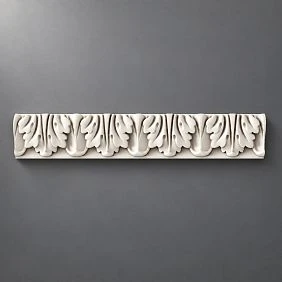
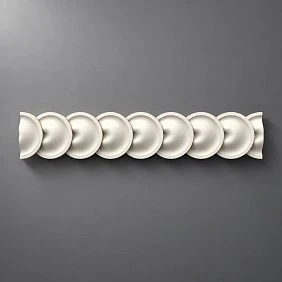
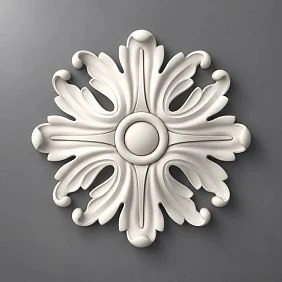
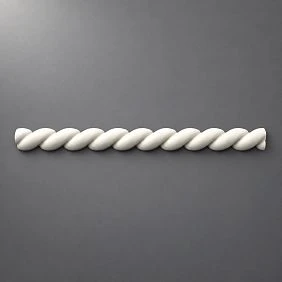
Why polyurethane stucco is chosen for such a project
Polyurethane molding combines a relatively low weight with a stable relief and allows a neat line to be formed without making heavy gypsum parts. For doors this is especially important: too massive a design increases the load on the moving leaf, and fragile elements are more dangerous with regular opening. At the same time, polyurethane should not be considered invulnerable. A thin profile can be damaged by an impact, and the durability of the finished trim also depends on the adhesive seam, painting and the quality of the base.
Gypsum stucco is suitable for architectural elements on prepared walls and ceilings, but small rectangular frames on a constantly moving door are easier to make with lighter profiles. MDF can work well with a suitable finishing technology, but it is important to distinguish it from polyurethane by installation conditions and reaction to moisture. Polystyrene products are also found among interior profiles, but this is a separate product group with its own mechanical properties. It is correct to compare materials not by a single slogan of "better or worse", but by the specific task: dimensions, hand contact, possibility of painting, surface condition and operating mode.
If the query is formulated as "polyurethane moldings buy", for door finishing it makes sense to first look not at all large ceiling ornaments, but at compact straight moldings. They allow the relief to be dosed and do not take up too much space near the hardware. For the walls of the same corridor, the profile can be chosen from the same line to create visual unity without excessive classical splendor.
Get Consultation
Which moldings are suitable for doors: comparison of four product codes
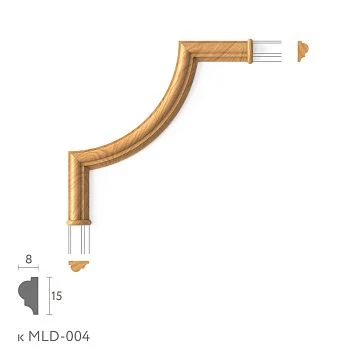
In the STAVROS catalogue you can find Moldings made of polyurethane of various thicknesses. For a standard 800×2000 mm door leaf, the widest option is not always needed. A 10×6 mm cross-section gives a delicate outline; 15×8 mm reads more noticeably; 14×9 mm may appear more textured at a similar width; 22×11 mm creates an expressive line that is best assessed in advance in relation to the door handle and other elements.
| Article | Profile size, mm | Strip length, mm | Price per strip as of 28.10.2026 |
|---|---|---|---|
| MLDPU-001 | 10×6 | 2600 | 1 740 ₽ |
| MLDPU-004 | 15×8 | 2600 | 3 190 ₽ |
| MLDPU-027 | 14×9 | 2600 | 3 990 ₽ |
| MLDPU-002 | 22×11 | 2600 | 5 460 ₽ |
For minimalist doors in a modern apartment, it is usually more logical to first place a sample of the thinnest profile against the surface. Look at it not up close, but from two or three steps away: the line should be noticeable but should not create the impression of a randomly glued cord. When the door is wide, has tall proportions, or fits into a design with high ceilings, a more voluminous profile may look more convincing. But even then, it is important to leave sufficient margins around the frame.
The stated price refers to individual strips, not to the manufacture of a finished door. It does not include preparation, paint, installation materials, tools, additional transport protection, or delivery. In addition, MLDPU-027 is available in several cross-section sizes: for a fair comparison, we take specifically the 14×9×2600 mm version at 3990 ₽. If a different variant of this item is selected in the cart, the entire budget should be recalculated.
How to choose a two-frame pattern on an 800×2000 mm door
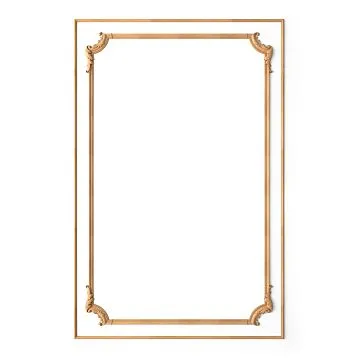
For a practical example, we take a standard in concept but hypothetical leaf 800 mm wide and 2000 mm high. Two frames are placed on it: the upper one 560×1000 mm and the lower one 560×400 mm. All frame dimensions are given by the outer long cut points when the corners are mitred at 45°. This is an essential caveat: if the inner clear area is measured, profile consumption will change, since the actual width of the strip itself is included in the outer dimension.
The frames are the same width, so the vertical axis is preserved and the door looks cohesive. The difference in height makes the upper part visually dominant. This pattern is often perceived as lighter than two identical frames, especially on a relatively narrow leaf. However, the optimal margins depend on the position of the handle, lock, and any existing milling. For practical marking, you can start with side margins of 120 mm each: 800−560=240 mm, that is, 120 mm on each side in a central position. These margins are checked with a tape measure on the actual leaf and are not considered a confirmed dimension of a specific production door.
In height, after the frames, 600 mm remains: 2000−1000−400. It must be distributed between the top margin, the gap between the frames, and the bottom margin. For example, a preliminary layout might include a top margin of 150 mm, an inter-frame distance of 180 mm, and a bottom margin of 270 mm. The sum 150+1000+180+400+270 indeed equals 2000 mm. But this is only a geometric draft: the handle and lock may require raising the lower frame, and the specifics of the door leaf may change both heights.
Before cutting the profile, make a paper template from painter's tape on one door. Then repeat the pattern on the second and compare it with the leaves in the same position: a closed door in a hallway may be perceived differently than an open one. It is important to take into account the width of the casings, the distance between the doors, and whether the decor will continue onto the walls. Avoiding haste in this part is almost always more beneficial than buying additional decorative elements.
Where people most often make mistakes when measuring door leaves
The most dangerous mistake is to assume that the nominal dimensions of the leaf are sufficient for finishing. Two doors of the same nominal size may have different actual areas of smooth surface. On one, the frame is limited by a handle with a large rosette; on another, by relief around the perimeter; on a third, by a door closer or surface-mounted hardware. Therefore, 800×2000 mm in our diagram is the initial dimensions for the example, not a universal recommendation for decor placement.
Measurements are taken under good lighting. The width and height must be checked at several points, not just along one edge. If curvature or local damage is noticeable on the leaf, assess whether the new line will emphasize the defect. Then mark the center, safe side zones, top and bottom offsets, the horizontal line of the handle, and the points where the applied profile may come into contact with the casing. For two doors, two separate measurement sheets are prepared, even if the result is the same layout.
The installer must check the trajectory of the leaf, especially near the hinges. A frame glued too close may obstruct access to the fasteners, lock maintenance, or repainting. On doors with a non-standard design, it is sometimes wiser to omit the lower frame or make a single central contour. This does not make the project worse: the decorative solution must be subordinate to the function of the door, not the other way around.
How much molding is needed for two doors: bill of materials
Once the upper frames of 560×1000 mm and lower frames of 560×400 mm are approved, an exact bill of materials can be compiled. Each upper frame requires two verticals of 1000 mm and two horizontals of 560 mm. Each lower frame requires two verticals of 400 mm and two horizontals of 560 mm. On two identical doors, this gives four upper verticals, four lower verticals, and eight horizontals. A total of sixteen individual parts, four frames, and one selected profile.
| Parts for two doors | Quantity | Total length |
|---|---|---|
| Upper verticals 1000 mm | 4 | 4,000 mm |
| Lower verticals 400 mm | 4 | 1,600 mm |
| Horizontals 560 mm | 8 | 4,480 mm |
| Total | 16 | 10,080 mm |
The total consumption is 10.08 linear meters. Dividing 10,080 by the length of one blank, 2600 mm, gives approximately 3.88; mathematically, at least four strips are required. But in finishing, what matters is not this quotient, but the ability to obtain all the specified segments without composite side pieces. For the selected set, this possibility does indeed exist: each of the four source profiles is divided into one 1000 mm part, two 560 mm parts, and one 400 mm part.
This cutting plan is convenient because the same operations are repeated on each strip. There is no need to store a large set of offcuts or decide on the spot where to make a crosswise joint on the visible side of the frame. At the same time, the task remains demanding in terms of precision: the nominal remainder is only 80 mm per blank. It must cover the kerf width, the characteristics of working with a miter box, and marking errors, and when cutting at 45°, the face side of the profile must be oriented correctly.
Exact cutting map for four 2600 mm strips
The repeating blank map looks like this: 1000 + 560 + 560 + 400 = 2520 mm. The nominal remainder from 2600 mm is 80 mm. This is the same scheme for all four strips, not four different combinations. After cutting, you get exactly four 1000 mm parts, eight 560 mm parts, and four 400 mm parts; the set fully covers two doors. It is convenient to label the blanks right away: “upper vertical,” “upper horizontal,” “lower horizontal,” and “lower vertical.”
| Plank | Finished part length, mm | Nominal remainder before cuts |
|---|---|---|
| № 1 | 1000 + 560 + 560 + 400 | 80 мм |
| № 2 | 1000 + 560 + 560 + 400 | 80 мм |
| № 3 | 1000 + 560 + 560 + 400 | 80 мм |
| № 4 | 1000 + 560 + 560 + 400 | 80 мм |
| Total | 10,080 mm | 320 мм |
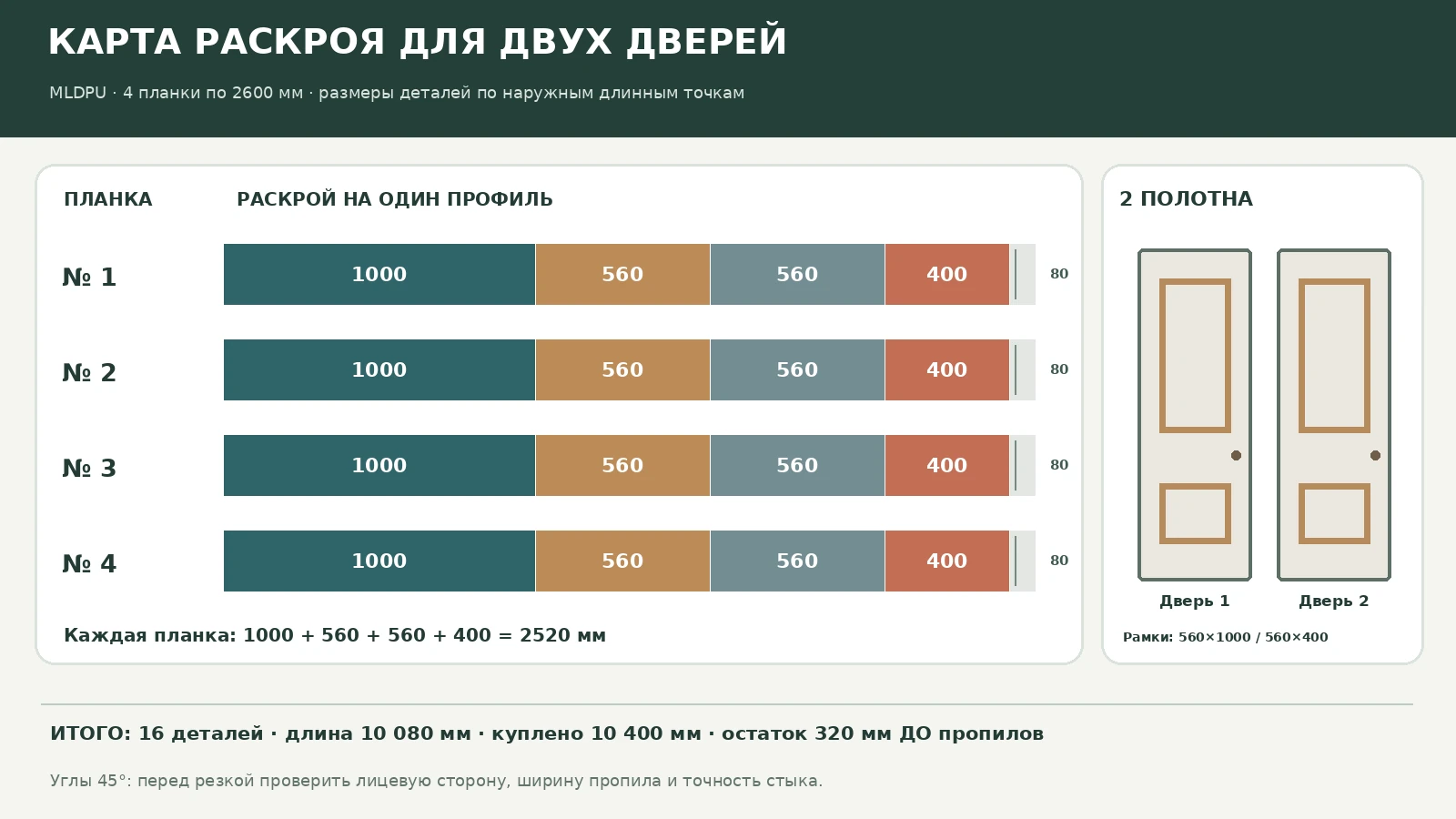
The diagram shows nominal part dimensions, not a working drawing for a specific miter saw. In reality, material is consumed by the blade width, the kerf, and possibly a technological end allowance. For narrow profiles and careful work, an 80 mm margin may be sufficient, but this cannot be guaranteed without a trial cut. If the tool causes too much loss and the angles need reworking, buying a fifth strip is more sensible than trying to assemble the missing centimeter from several short offcuts.
Before making production cuts, complete one test corner from sample offcuts and check how it closes. Set up the miter box or saw, make sure the profile sits stably, mark the face side and the angle direction. Only then repeat the four identical cutting plans. If the geometry of the chosen decor requires ready-made surface-mounted corner pieces instead of miters, the given straight-section dimensions cannot be used without recalculation.
How to make a neat 45-degree molding joint
On a rectangular frame, the four corners are more visible than the long sections. Therefore, even expensive molding can look sloppy if the miters leave a gap, shift the relief, or expose the ends. Setup begins with identifying the "face" of the profile and the point from which the length is measured: for our project, the outer long corner of each element. This makes the calculation of the top and bottom strips comparable with the outer dimensions of the frame.
When working with a manual miter box, the profile is clamped in the position in which it sits on the door, or a stable flip technique suitable for the specific section is used. In any case, the position must be checked on a sample. Offcuts cannot simply be cut one after another without marking: parts that are correct in length may end up with mitered ends facing the same direction and fail to assemble into a rectangle. One pair of corners must be mirrored relative to the other, otherwise the joint will be forced to turn its face side outward or inward.
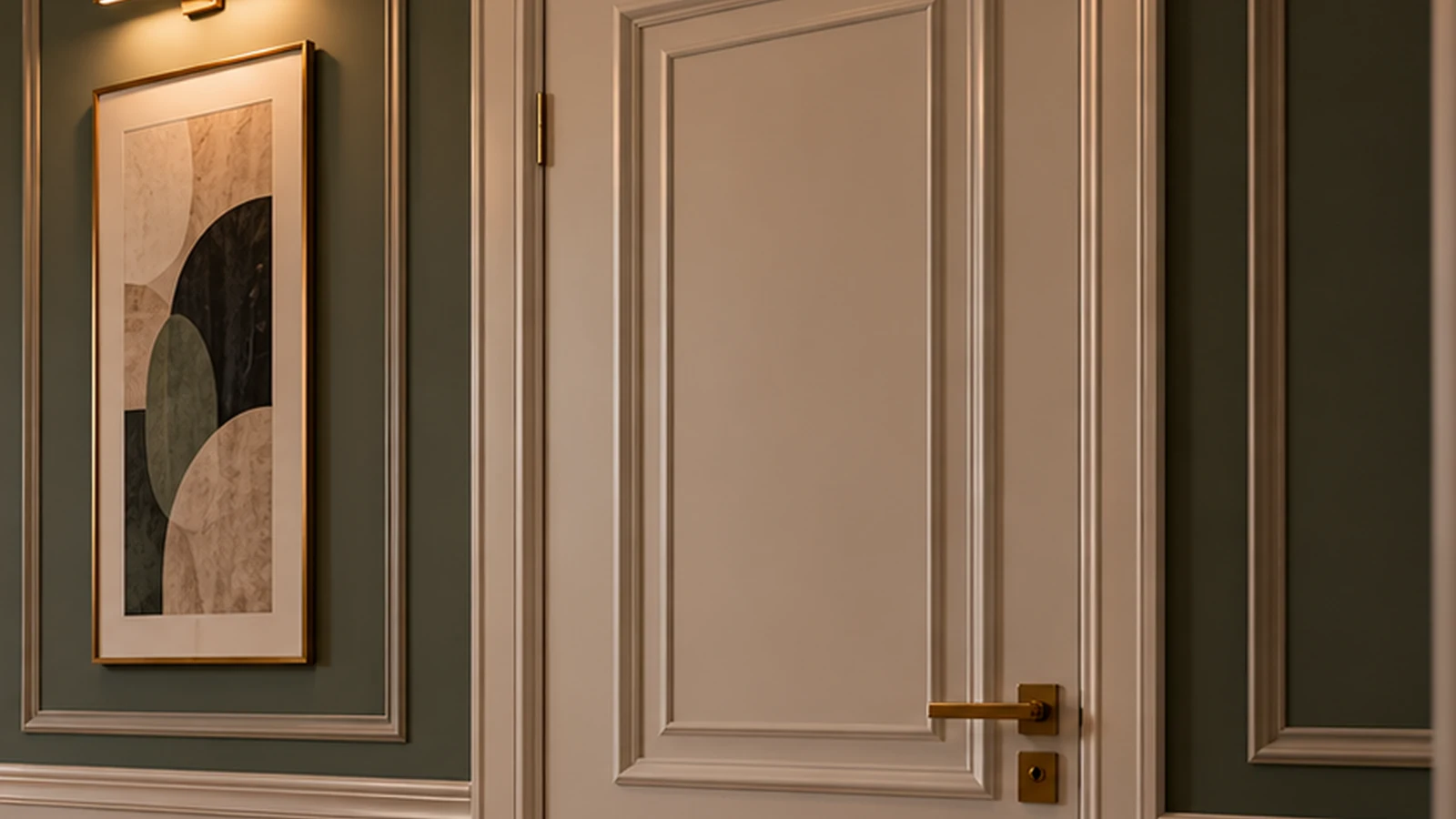
The image shows a generic decorative joint, not a photograph of a specific STAVROS item. During fitting, check that the relief matches, the frame angle is 90°, the seam is tight, and the profile height is the same on adjacent parts. Small technological gaps can be treated with the recommended finishing compound, but sealant must not replace correct geometry. A large marking error cannot be quality-hidden without losing appearance, especially if the door is later painted in a contrasting color.
Cost of moldings for two doors: four STAVROS options
The basic set requires four whole strips of the same item. Therefore, the budget for straight profiles is calculated transparently: the price of one strip multiplied by four. If you want to keep a reserve for a cutting error or unforeseen damage, the cost of a fifth strip is also easy to calculate. Prices below exclude labor, consumables, and transport, since none of these costs can be determined from the length of the decorative frame alone.
| Polyurethane profile | Four strips | Five strips with a reserve |
|---|---|---|
| MLDPU-001 | 6 960 ₽ | 8 700 ₽ |
| MLDPU-004 | 12 760 ₽ | 15 950 ₽ |
| MLDPU-027, 14×9 mm | 15 960 ₽ | 19 950 ₽ |
| MLDPU-002 | 21 840 ₽ | 27 300 ₽ |
The most economical of the selected options — Molding MLDPU-001: its small cross-section of 10×6 mm is well suited for delicate framing of door panels. When a more pronounced shadow from the relief is needed, it is appropriate to consider Molding MLDPU-004 a size of 15×8 mm. The other two options are useful for comparison, but their more expressive relief should be checked separately at the door handle and adjacent architraves.
One cannot assume that the buyer is "saving" the difference between the prices of different profiles without changing the design. A wider strip changes the width of the visible edging and the size of the inner field of the frame. If the interior is designed for certain proportions, new layout marking may be required. The price of the profile itself is only one part of the decision. The cost of a cutting error, repainting the door, or damaging the factory finish can turn out to be higher than the savings on a few strips.
How to integrate updated doors into a hallway without ending up with a separate decorative element
When both doors are in the same short corridor, an identical pattern helps unify the space, but the walls next to them also influence perception. If the door panels have pronounced two rectangular contours, it is not necessary to make dozens of small frames on the wall. It is enough to support the same thickness of relief on one free section. This way the door and the wall begin to be perceived as elements of one system, rather than as two independent renovations.
For a corridor, the principle of repeating height is convenient: wall frames can be larger than the lower door contour and maintain an overall vertical orientation. Their side offsets are chosen so that switches do not end up inside the profile line and there are no conflicts with architraves. When the wall section is narrower than the door panel, too wide a moulding visually "eats up" the surface. Conversely, a thin edging emphasizes the wall pier without excessive fragmentation.
In the catalog section wall molding it is convenient to consider not only linear mouldings but also other design options. However, for a specific budget, it is more important to choose one clear geometry and check the feasibility of manufacturing all sides without unnecessary joints. If the hallway has a mirror, wardrobe, coat rack, or a large door panel, the finished composition must be drawn with these objects, not on an empty wall. Designing from a photo without real dimensions often leads to the decorative frame ending up too close to the furniture.
Additional calculation: two wall frames 500×1200 mm
Suppose the hallway has two free wall sections and each can accommodate one vertical frame with an outer size of 500×1200 mm. Before approving this solution, you need to check the width of the section, the height of the skirting board, the distance to the door casing and all utilities. For the example, we assume two identical rectangles and the same profile that was chosen for the doors; this allows a single order to be assembled from one product item.
Two frames require four vertical sides of 1200 mm and four horizontal sides of 500 mm. The total net length is 4×1200+4×500=6800 mm, or 6.8 m. Two 2600 mm strips are not enough for the whole set, because their total length is 5.2 m. Three strips give 7.8 m, and the required parts can be obtained from them without joined sides.
Simple cutting plan: strip No. 5 yields two verticals 1200+1200 mm, strip No. 6 yields two more verticals 1200+1200 mm, strip No. 7 yields four horizontals of 500 mm. The nominal remainder on the first two strips is 200 mm each, on the third 600 mm, totaling 1000 mm before accounting for saw kerfs. This is a considerably more generous cutting plan than for the doors and allows the work to be organized more conveniently. However, the remainders are not necessarily suitable for any additional decorative element: the length and direction of the cut must be checked separately.
| Wall strip | Cutting plan, mm | Nominal remainder |
|---|---|---|
| № 5 | 1200 + 1200 | 200 мм |
| № 6 | 1200 + 1200 | 200 мм |
| № 7 | 500 + 500 + 500 + 500 | 600 мм |
| Total | 6,800 mm of parts | 1,000 mm |
Thus, together with the four door frames, we get six decorative frames for the hallway and two doors, made from seven full strips of the same profile. Ordering an eighth strip creates a reserve not only for saw cuts: it allows one accidentally damaged long side to be replaced or the composition to be adjusted after fitting. But this is an optional reserve, not a mandatory part of the minimum cutting plan.
Complete set for two doors and the wall: what to add to the cart
If the entire project is implemented using a single type of polyurethane moulding, seven 2600 mm strips yield 18.2 m of purchased material. The doors require 10.08 m of finished parts, the walls require another 6.8 m, for a total of 16.88 m. The nominal total remainder is 1.32 m before accounting for cuts: 0.32 m for the door cutting and 1.00 m for the wall cutting. This is a good example of why purchasing should be planned by segments rather than by mechanically adding arbitrary percentages to the linear footage.
| Profile option | Two doors only, 4 pcs. | Two doors and two wall frames, 7 pcs. | Full set with reserve, 8 pcs. |
|---|---|---|---|
| MLDPU-001 | 6 960 ₽ | 12 180 ₽ | 13 920 ₽ |
| MLDPU-004 | 12 760 ₽ | 22 330 ₽ | 25 520 ₽ |
| MLDPU-027, 14×9 mm | 15 960 ₽ | 27 930 ₽ | 31 920 ₽ |
| MLDPU-002 | 21 840 ₽ | 38 220 ₽ | 43 680 ₽ |
In a real order, the mouldings should be accompanied by materials and tools that are not in this table: an adhesive compatible with the chosen finish, consumables for surface preparation, a joint filler, primer and paint as needed, masking tape, abrasive materials, and tools for precise cutting. Possible transport protection is listed separately. For small orders of some MLDPU items, STAVROS product pages mention a pine backing board priced at 390 ₽: check whether it is added specifically to your invoice. This amount does not replace the transport company's tariff.
If the walls and doors are to be painted in different colours, it is sometimes more convenient to split the project into two installation stages while placing the purchase order at once. This way you can receive the materials in a single delivery and avoid reshipping a missing strip. At the same time, do not order adhesive long before the work without checking its shelf life and transport conditions. For accuracy, note in the specification which profiles will go on the doors, which on the walls, and which remain as a reserve.
How to choose a profile for a narrow hallway and ceiling height
Ceiling height alone does not determine the thickness of the door moulding. What matters more is the scale of the door leaf and the number of adjacent lines: casing, skirting board, furniture fronts, a horizontal lighting strip. In a hallway with a ceiling of about 2.5–2.7 m, thin and medium profiles often look visually lighter than large relief elements, but this is a composition guideline, not a technical limitation. For a confident decision, you can temporarily stick on a paper strip of the appropriate width and look at it in daylight and evening lighting.
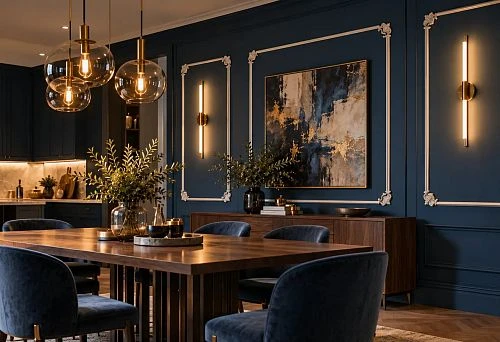
The walls of a small hallway do not have to remain completely white. Contrasting paint helps to reveal the relief and can make the entrance area more expressive. However, too frequent alternation of colours near two doors creates visual noise. If the walls are olive, graphite, dusty blue, or terracotta, a white door with white moulding often looks cohesive. If the door leaf and the wall are painted in similar shades, the role of the moulding shifts to the interplay of light and shadow. In such cases, the quality of the joints is especially noticeable under side lighting.
Stylistic consistency of the hardware is also important. A 22×11 mm molding next to a very miniature handle may look excessive, while a 10×6 mm profile may get lost on a door with large, elaborate casings. Before buying, it is useful to compare photos of all four SKUs with the furniture and door hardware already installed. You don't need to automatically use the same frame size on the walls as on the door: a unified style is formed by repeating proportions, line widths, and color, not by literally copying every detail.
Ready-made decorative corners or a 45-degree miter cut
Ready-made corners and overlays can beautifully complement strict frames, but they should not be considered a universal replacement for a standard mitered corner joint. Each decorative element has its own geometry, relief height, and method of mating with straight profiles. If you buy a randomly similar corner, its relief may not continue the molding lines; the result will be a noticeable break in the pattern. Confirmed compatibility is required, based on the specific product's listing or technical drawing.
Catalog Decor for Molding is useful for finding branded decorative elements, however in this calculation four strips on the door assume standard 45° joints. As soon as a ready-made corner is used instead of such a joint, the geometry of all straight sections changes. You cannot simply purchase eight additional corners and assume that the previous sixteen segments automatically fit the new design. First a joint drawing is created, then the lengths of the straight parts are calculated, and only after that is the bill of materials updated.
For narrow door leaves, decorative corners are not always justified. They can visually shrink the inner field of the frame, make the finish too busy, interfere with the handle, or catch on things when passing through. Therefore, a simple miter cut, when done correctly, often remains the most practical option. And for a tall, wide door in a classic interior, a decorative system may be appropriate if all its elements are truly coordinated in size and installation technology.
Door and furniture overlays: when it's better not to add them
Also available are Polyurethane appliqués, which are used as standalone accents on walls and furniture. But on moving doors, three-dimensional parts require caution. A central overlay may end up at hand level, catch on clothing, overlap with the lock area, or look excessive next to two already-formed frames. Particular attention is paid to clear passage and the ability to care for the surface.
In a small hallway, it is sometimes better to limit yourself to flat moldings on the doors and place an expressive overlay on the wall above a console or mirror. Then the decorative part is not subjected to constant contact and becomes the focal point of the composition. But even for a static wall, you must check the weight, dimensions, and mounting method of the product. Don't choose a relief based only on a photo without scale: an ornament that looks great on a large panel may turn out to be too large for a narrow wall section.
For furniture, polyurethane elements require a separate check of compatibility with the facade coating. Particular care is needed with smooth laminated surfaces and areas where the door opens flush against the adjacent module. After installation, the full travel of the door must be checked. If the decoration covers the hardware or interferes with cleaning, its decorative value does not compensate for the daily inconvenience.
Surface preparation: why good glue doesn't solve everything
Adhesion quality is determined not only by the brand of the adhesive. The surface must be dry, clean, strong, free of dust, grease film and peeling coating. For an old door, this may mean thorough washing, degreasing with a compatible agent, removal of loose paint and local preparation of small chips. However, you must not aggressively sand an unknown factory film or use solvents without a preliminary test: such treatment sometimes worsens the appearance even before installation begins.
Wall preparation also differs from door preparation. Loose filler, crumbling paint, weak old coating or excessive moisture create a risk of detachment. The molding must not cover mold, a damp corner or a defect in the substrate. The cause of the damage must be eliminated before the decor, otherwise the finish will only temporarily mask the problem. If the profile is painted together with the wall, it is worth checking the compatibility of the primer and the topcoat, as well as the absence of contamination between layers.
One adhesive cannot be called universal for all doors, especially when their coatings are unknown. You should rely on the instructions of the adhesive manufacturer and the substrate material. For polyurethane, chemical compatibility, sufficient adhesion and the absence of aggressive effects on the finished surface are important. The adhesive manufacturer may restrict use to certain types of plastic, films or lacquered materials — these restrictions must be read before purchase. Testing on a small sample is cheaper than redoing two door leaves.
Step-by-step installation of moldings on two interior doors
First, the doors are photographed, the working boundaries are marked and the sequence of work is determined. Sometimes it is more convenient to remove the leaf from its hinges and lay it horizontally, but this is not always possible and requires skill in safe removal. If the door remains in place, it is important to ensure access to all sides and reliable temporary fixation of the parts. Removal of casings or hardware is permissible only when it does not damage the coating and is provided for in the installation plan.
Marking is carried out according to the approved external dimensions of the frames. In our example, an upper contour of 560×1000 mm and a lower one of 560×400 mm are placed on each door, but the actual layout may be refined after checking the handle and lock area. Verticals are checked with a level, horizontals — by parallelism and distance from the edges. Before applying adhesive, all four sides of the frame are dry-fitted, and the diagonals and corners are checked. If the rectangle is skewed, it will be noticeable even after a beautiful paint job.
The profile is cut according to the specified cutting map, preserving the face orientation. Small offcuts are kept for trial joints and adhesive testing. The composition is applied according to the instructions of the chosen manufacturer: its quantity, distribution, open time and fixing method may differ. There is no need to rely on a universal "30 seconds" holding rule: some adhesives require prolonged fixation, while others require a holding time until handling strength is reached. Temporary holding means must be safe for the door's decorative coating.
After bonding, check the alignment of the relief at the corners and the absence of squeezed-out excess composition. If adhesive gets on the factory enamel, it is removed in a manner permitted by the manufacturer. Joints are filled only after the adhesive has properly cured, using a compatible material. Then the surface is prepared for the final painting. As the last step, check closing, opening, access to the handle and the absence of contact between decorative elements and the frame or adjacent wall.
How to paint a door with new decor
Moldings can be painted in the color of the leaf or made an accent, but the result depends on the compatibility of the paint system with both surfaces at once. If the door is covered with a durable factory enamel and the profile is prepared for painting, the task usually consists of achieving a visually uniform finish without a noticeable transition. For this, the adhesion of the primer, the degree of gloss and the shade are compared, not just the color name on the can.
On a white door with white frames, the relief works through shadow. For a more expressive result, a matte or semi-matte finish can be used, but the chosen gloss level must be practical for an area of frequent contact. Dust, filling inaccuracies and traces of unsuitable sealant are especially noticeable on dark door leaves. If you want a two-tone design, try painting a test fragment first: contrast highlights even a small cutting error.
Painting is carried out after the necessary curing time for the adhesive and joint materials. Drying time is determined by the instructions for the specific product, taking into account temperature, humidity and coat thickness. Do not accelerate the process with a heater directed at the door unless such a technique is provided by the manufacturer. After drying, open the door carefully and make sure the fresh paint does not stick to the seals and does not contact the frame before the permitted service period.
How to prepare a STAVROS order without missing elements
A useful specification looks like a small production sheet. It states the room name, the number of door leaves, the profile article number, the cross-section, the length of one strip, the number of strips, the cutting plan, the reserve and the list of consumables. For the doors in our example — four strips of one article number; for two wall frames — three more. If one complete project is being made, the final minimum quantity is seven strips, plus one optional as a reserve. Make sure that the ordered version MLDPU-027, if that is the one chosen, has the required cross-section of 14×9 mm and not another configuration.
It is also important to record the chosen paint finish and the installation method so as not to buy unsuitable decorative products. If the walls and doors have different coatings, the same can of adhesive is not always suitable for both tasks. The production sheet helps discuss this with the seller in advance. Before final payment, send the dimensions, photos of the substrate and the frame diagram to the manager: they can confirm the nomenclature and clarify packaging questions. But a consultation on the set of components should not be taken as a guarantee that the adhesive is compatible with an unknown factory coating of the door.
It is convenient to split the order into two logical groups: the main product and the accompanying materials. The first contains seven strips of one article number; the second contains consumables, tools, packaging and, if needed, separate decor. The estimate is drawn up with a clear price date, since the cost of goods and services may change. For a remote purchase, this is more reliable than copying prices from old publications without rechecking before payment.
Delivery of stucco moulding to Syzran and other cities of Samara Oblast
The official STAVROS website offers online ordering, by phone and by email, and the delivery options include transport companies and courier delivery methods. Detailed terms are available in the section Payment and delivery. But the availability of a general delivery service across Russia does not yet confirm that a specific package with 2600 mm long strips can be transported to the required address in Syzran. The length of the cargo unit after rigid protection may usually differ from the length of the product itself, so the carrier must be agreed upon with the finished packaging dimensions.
When calculating, you should clarify not only the price but also the handover method: delivery to the terminal or to the address, the possibility of transporting long-length profiles, restrictions on the length of one piece, volumetric weight, insurance and the rules for filing a claim in case of damage. The composition of the consignment is also important: seven strips will not necessarily require the same tariff calculation as seven small decorative overlays. Ask the manager whether the order will be additionally secured on a rigid backing, how the ends are protected and whether the packaging is counted as a separate item on the invoice.
A regional request may include Syzran, Oktyabrsk, Zhigulyovsk, Tolyatti, Samara and other settlements in the region, but the specific availability of delivery to each address must be confirmed by the carrier. It is not possible to promise the same timeframe, price or free delivery for the entire region. The buyer is better off comparing two scenarios: pickup at the terminal and address delivery. Sometimes the difference is noticeable, but the final decision depends on the actual rate and on the need to safely transport a long package from the terminal to the home.
How to check moldings upon receipt and what to do in case of damage
During acceptance, inspect the packaging before opening it. A dent in the middle of a long box, a crushed end, torn strapping or signs of moisture exposure are grounds to carefully check the contents and record the condition of the cargo unit. Ask for the order documents and make sure the item code and quantity match the specification. The presence of seven long strips must be checked piece by piece; the packaging may look intact, but one item inside may turn out to be damaged.
If damage is suspected, it is useful to photograph the general appearance of the parcel, the shipping markings, the location of the defect, and then the products themselves. Further actions are determined by the carrier's and seller's rules: sometimes a report must be drawn up directly upon delivery. Do not sign a document stating that there are no remarks without making sure that the inspection has been carried out to the permitted extent. Keep the waybill, order information and correspondence until the inspection of the complete set is finished.
After transportation in the cold season, decorative profiles and adhesive materials should not immediately be subjected to installation loads. They should be acclimatized under suitable indoor conditions, following the instructions of the product and adhesive manufacturer. Avoid sharp local heating and do not open the packaging in such a way that the resulting condensation gets onto an unprepared surface. If warping, chipping, a crack or a mismatch of the item code is found, record this before cutting and painting, since further processing may complicate the resolution of a claim.
How to control the final budget and avoid overpaying for a single strip
For this project, a transparent estimate consists of five lines: the price of seven or eight strips, the cost of related compounds, additional protective packaging, the actual delivery rate and installation. With self-installation, the cost of work may be absent as a separate payment, but the expenditure of time and tools remains. If a craftsman is engaged, a separate commercial proposal will be required, because installing a laminated MDF door and a painted leaf may require different preparatory operations.
Savings cannot be assessed solely by the price per linear meter. If an inexpensive profile requires complex repair of chips after an unsuccessful cut, the cost of rework may offset the difference between item codes. Likewise, purchasing an eighth strip does not always mean overpaying: with long transportation and limited access to an identical profile, a spare sometimes saves time and the cost of re-delivery. But if the cutting plan has been reliably tested on a sample and no additional material is needed, seven is enough.
Compare the final amount under the same set of conditions: the same item code, the same length of products, comparable packaging, the same address, the same consumables. When choosing a wider molding, the composition changes as well — the aesthetic difference should be considered separately from the arithmetic. This way the buyer makes a decision based on the complete project, not on a single line with the product price.
Two scenarios for updating doors: preserve the finish or repaint entirely
Before buying moldings, it is useful to decide on the final finishing result. In the first scenario, the existing door coating remains visible, and the contours are painted as closely as possible to its shade. This option looks economical in terms of the amount of work, but it places increased demands on matching color and texture. Even if the shade appears white, the factory enamel may have a different degree of gloss, warmth, or yellowness. A white overlay frame on a cool white door leaf sometimes looks like a random repair part. Therefore, before installation, it is advisable to make a test coating on a small section and look at it near the door in real lighting.
In the second scenario, the door leaf and moldings are painted in a single color after preparation. This allows you to obtain a cohesive decorative pattern and hide a small difference in the original materials, but it requires a much more thorough check of the compatibility of the primer, the finishing composition, and the door surface. Some factory coatings do not take new paint well; sometimes the feasibility of repainting depends on the technology that the craftsman can perform. You cannot count on the enamel layer by itself to provide a strong attachment for the molding: the adhesive seam must work with a prepared load-bearing surface, not with a poorly adhering paint layer.
The third, intermediate approach is contrasting frames. On door leaves in calm dark green, graphite, beige-gray, or muted blue, a light molding can look expressive. But in such a design, every inaccuracy in the corner seam becomes more noticeable, so first they check the quality of the cuts and the possibility of obtaining a clean edge when painting. The contrast does not have to be bright: the difference between a matte and semi-matte surface already creates an interesting shadow. When choosing a palette, take into account the doors, walls, casings, skirting boards, handles, and light fixtures, not just a separate photo of a frame you liked.
The most important decision is made before cutting. If the doors will be repainted, the order of operations and the holding time may change; if the factory coating is preserved, it must be more carefully protected from glue, scratches, and marking traces. The list of consumables and the cost of the work depend on this. Therefore, two visually similar projects with the same number of polyurethane strips can differ noticeably in the final budget. A clear description of the desired finish in the specification will help avoid confusing the purchase of a decorative profile with a full restoration of the door leaf.
Control fitting and cutting check before the order is sent
Even correct arithmetic does not replace a practical check of the model. For four frames on two doors, the list of parts looks convincing: 1000, 560, 560, and 400 mm from one blank. But before paying, it is advisable to check whether there is enough space for the specified outer dimensions on the specific doors, how the chosen section looks next to the handle, and what losses the tool used produces when cutting at 45 degrees. If the craftsman already has a small sample of the profile, a test corner can be made from it. Otherwise, before mass cutting, first test one element from the purchased batch and only then proceed to the serial process.
It is useful to draw each door contour on graph paper or in a simple graphics program, indicating the center of the leaf, the height of the handle, the side indents, and the location of the hinges. Then repeat the drawing directly on the door with colored masking tape and photograph it from a normal viewing point. Such a mock-up reveals problems that are invisible in a table: the upper frame turns out to be too close to the peephole or decorative insert, the lower one conflicts with the protective panel, or both frames align poorly with the horizontal lines of nearby furniture.
For technical approval of the order, it is worth keeping three documents separately: a measurement sheet, a cutting list, and a list of purchased products. The measurement sheet records the actual dimensions and constraints; the cutting list contains sixteen parts for two doors and eight for the walls; the product specification contains the selected article number and the number of whole strips. These are different pieces of information. If only the height of one door frame is changed, the total length of the profiles may still look sufficient, but the combination of parts 1000+560+560+400 will no longer fit. That is why a change to the project should automatically lead to a recalculation of the map, not to a mechanical correction of one figure in the estimate.
Another control measure is marking the direction of the cuts. When working with relief profiles, the error of "left corner instead of right" can ruin the blank even if the correct length is maintained. Before cutting, each part is marked with face, top, right, and left; after a trial assembly, the diagonals are compared, and only then do they proceed to gluing. For a series of two identical doors, one approved template can be used, but a repeat check of the second leaf is still not canceled: identical door markings do not guarantee a complete match of the coating, hardware, and free plane.
Customer questions and answers about stucco molding in Syzran
Can I place an order without visiting the store?
Yes, STAVROS describes remote ordering methods, including the website and contacting managers. Before payment, specify the city and delivery address, the itemized list of products, and the actual length of the strips. This does not assert that there is a separate STAVROS store in Syzran.
What does the query "buy stucco molding" mean, and where should I go from the article?
Buyers often enter a short rearrangement of words in search Buy moldings. For our project, it is better to open the catalog of polyurethane products right away, then go to the required moldings and verify their material, cross-section, and length. This way, similar profiles made of MDF, wood, or polystyrene will not be confused.
Are four strips enough for two doors?
For the four frames described — two upper ones at 560×1000 mm and two lower ones at 560×400 mm — an exact cutting plan from four strips exists. Each yields parts of 1000+560+560+400 mm. The remainder is only 80 mm per strip before the cuts, so a test cut and geometry check are needed first.
Why are three strips needed for the hallway rather than two?
Two wall frames of 500×1200 mm require 6.8 m of finished parts, while two strips contain only 5.2 m of material. Three strips provide sufficient length and a specific cutting plan of 1200+1200, 1200+1200, 500+500+500+500 mm. Linear meters and the ability to obtain individual parts were verified simultaneously.
Can moldings be installed on doors with PVC film?
The feasibility depends on the coating, the condition of the film and the adhesive composition. On such a door it is especially important to check adhesion, the effect of the cleaner and the absence of peeling areas. A universal guarantee for any film coatings would be incorrect; a test on an inconspicuous area and the manufacturer's recommendations are essential.
What thickness should I choose for two doors in a small apartment?
For a first mock-up, you can consider MLDPU-001 10×6 mm and MLDPU-004 15×8 mm. But the final choice depends on the width of the panel, the handle, the free space up to the architraves, the style, and whether the decor will be repeated on the wall. Too large a relief can visually overload a small hallway.
Do I need to buy ready-made corners for the frames?
No, a standard rectangular frame is assembled from straight segments with a correct 45° cut. Ready-made corners are possible as a separate design solution, but they have their own geometry and compatibility requirements. Adding such elements means recalculating the lengths of the straight parts.
Can the profile be installed directly over peeling paint?
No. The adhesive will attach the moulding to the layer of paint that is already poorly bonded to the substrate, and the finish may come off together with it. First, the unstable coating is removed, the base is prepared and dried, and then a material compatibility test is performed.
How much does delivery of seven planks to Syzran cost?
The exact amount cannot be determined from the price of the mouldings. It depends on the address, the chosen company, the actual dimensions of the cargo space, the weight and the packaging. When placing an order, request a separate calculation, as well as information on whether it is possible to transport a piece longer than 2600 mm with protected ends.
Should I buy one additional plank?
The eighth strip is not needed for the minimal set confirmed arithmetically and by cutting layout. But it helps in case of a sawing error, damage during installation, and pattern adjustment. The decision depends on the installer's skills, the availability of a repeat delivery, and the acceptable budget.
Can one paint be used for both the wall and the door?
Only with confirmed compatibility with both surfaces and the selected primers. Factory enamel and painted plaster have different preparation requirements; a color match does not mean that one system is automatically suitable for all substrates. It is advisable to do a test coat.
How should the product be checked before final installation?
Before cutting, compare the item code, length, quantity, and surface condition with the order. Check that the profile matches the selected drawing, that there is no damage, and agree on any delivery claims. Once cutting and painting have begun, it is usually harder to prove the original condition of the product.
What does the buyer get if they calculate the set before shipping?
Two ordinary doors can be finished with neat polyurethane frames without replacing the door leaves, if the surfaces are suitable for adhesive mounting and the decor does not interfere with use. In our example, four 2600 mm strips cover two sets of upper and lower frames; three more strips add two wall frames and help unify the hallway design. The eighth strip remains a possible reserve, not a hidden mandatory purchase.
For Syzran, the key to a convenient purchase is not only choosing a profile you like, but also confirming the entire order in advance: the specific MLDPU, length and cross-section, cutting plan, adhesive compatibility, packaging, and shipping rate. This sequence reduces the risk of missing parts, estimate errors, and repeat delivery. The STAVROS catalog lets you start with the product, but the finished result depends on precise measurements and careful on-site execution.