


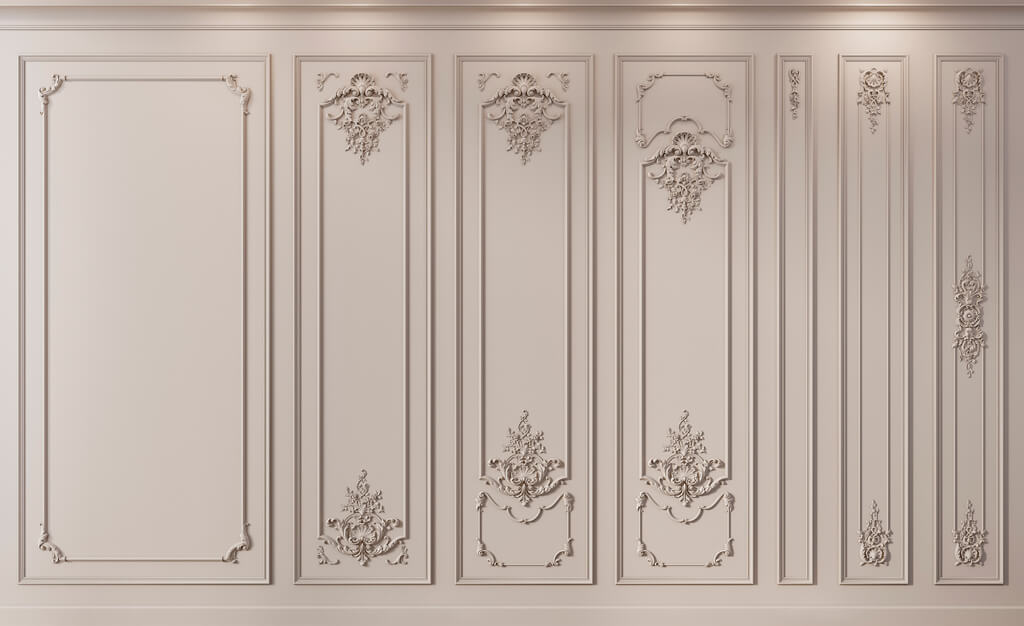
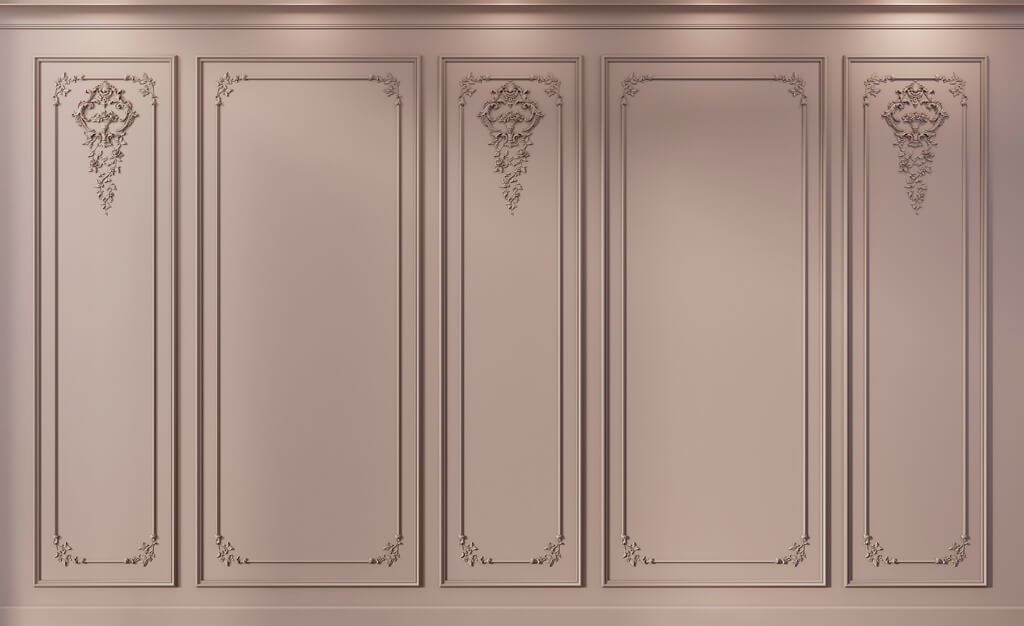
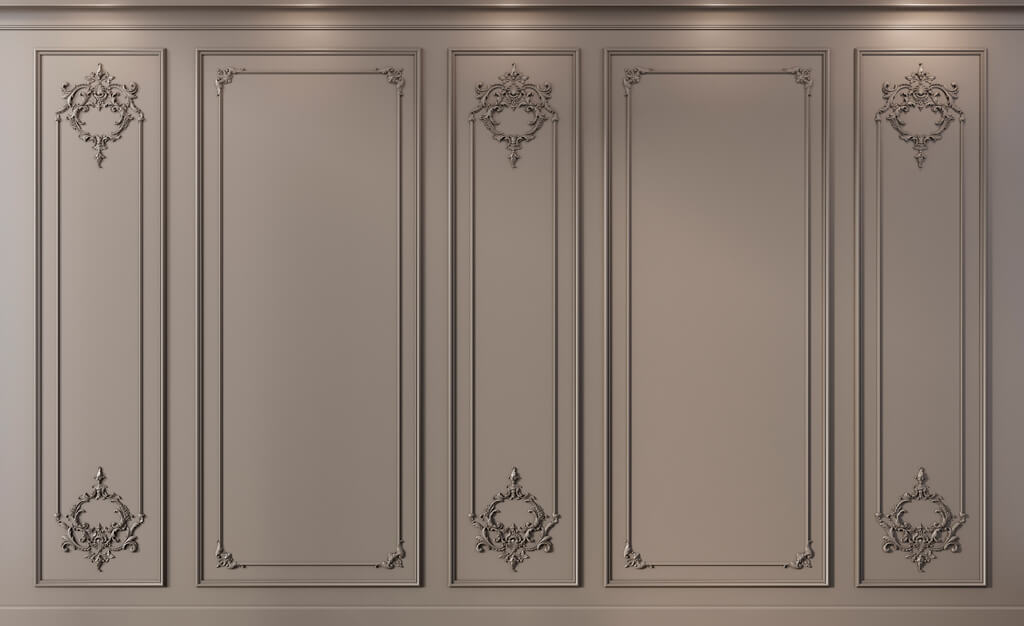
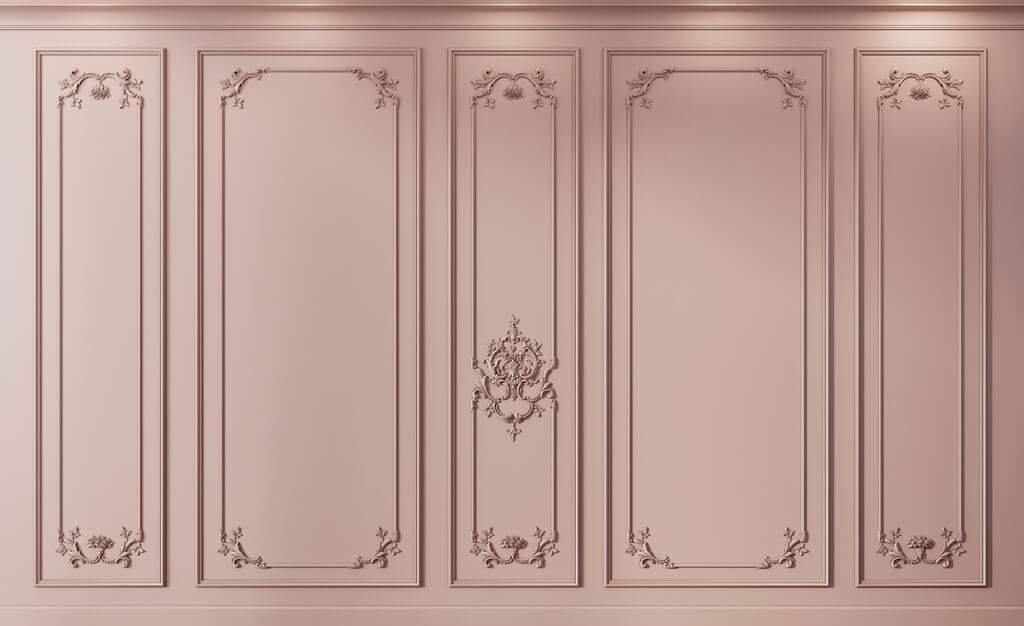
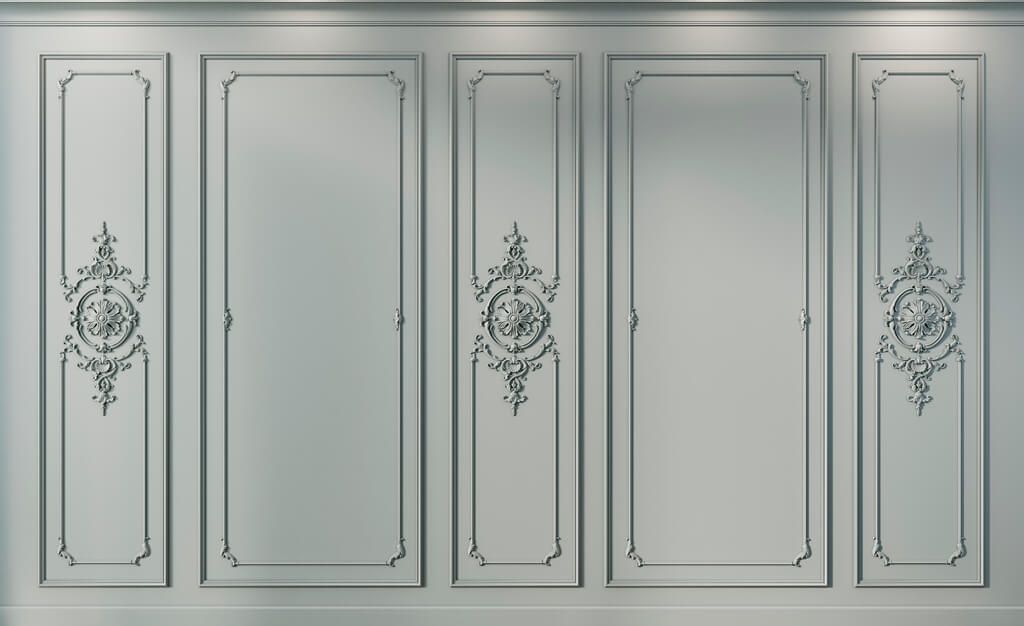
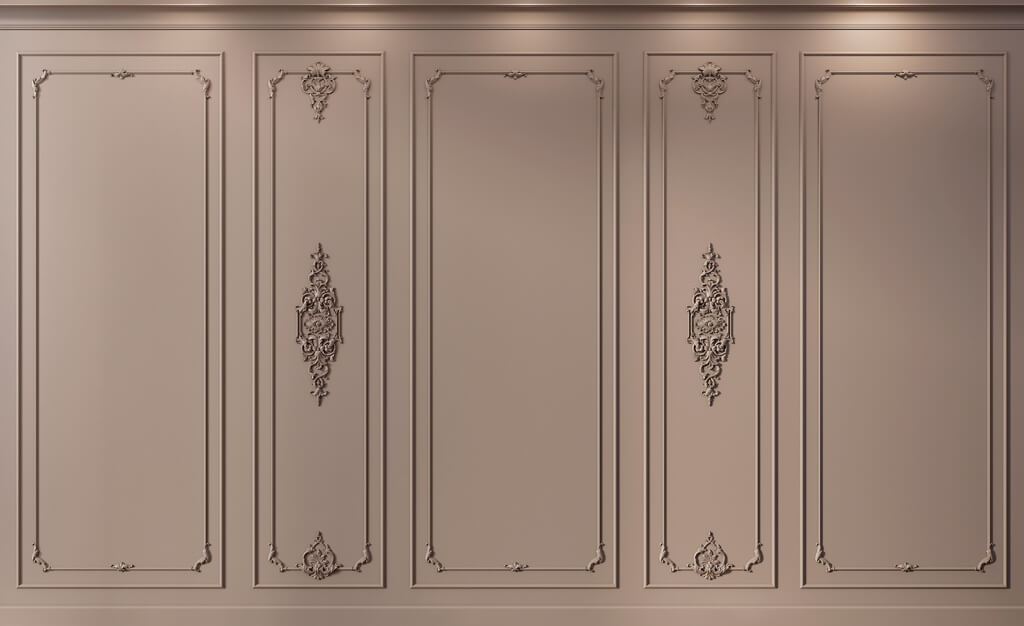
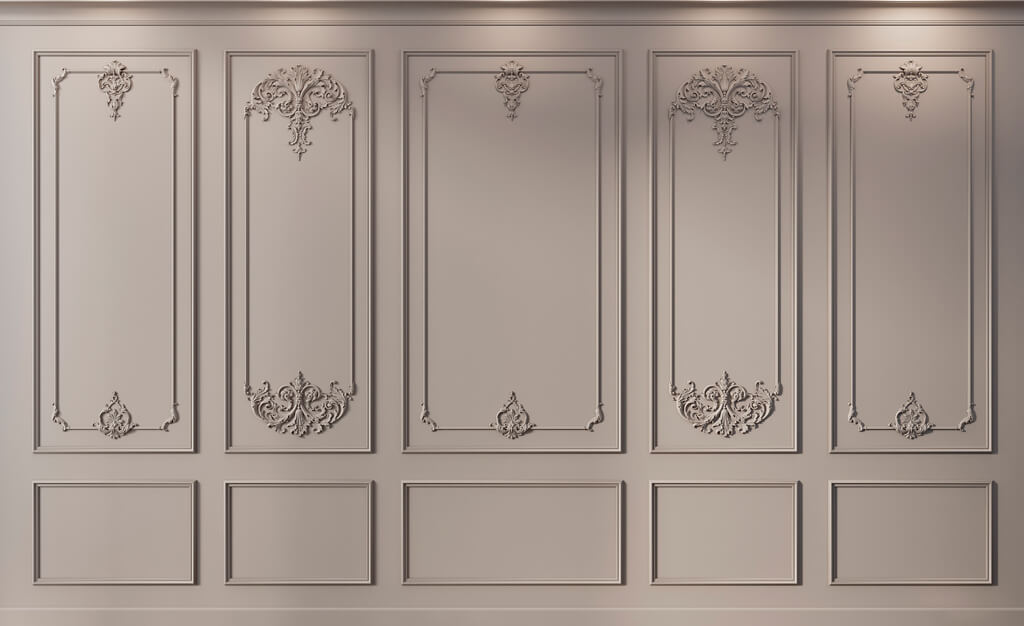
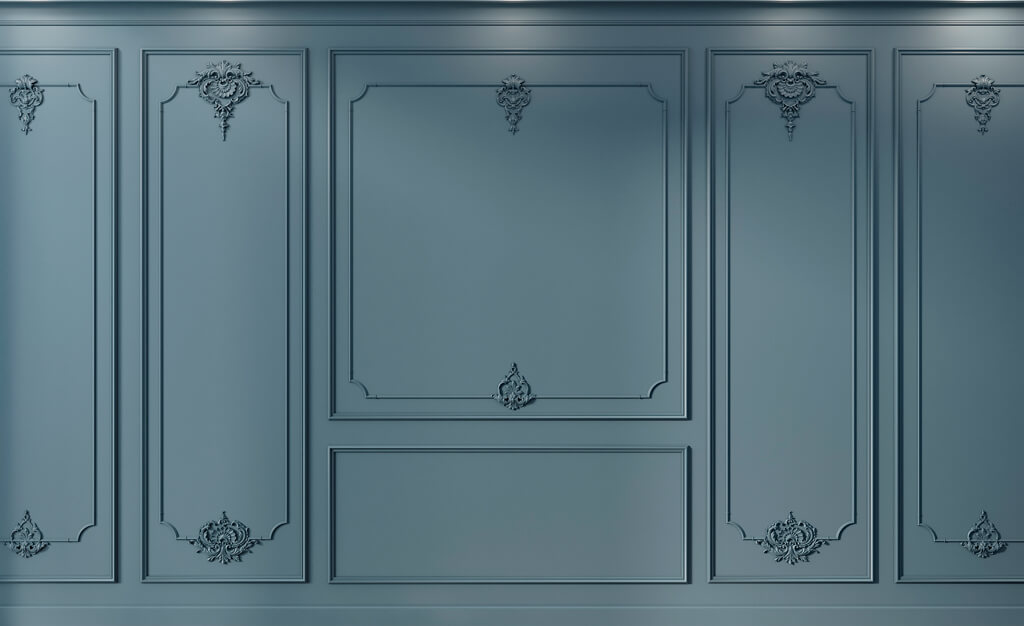

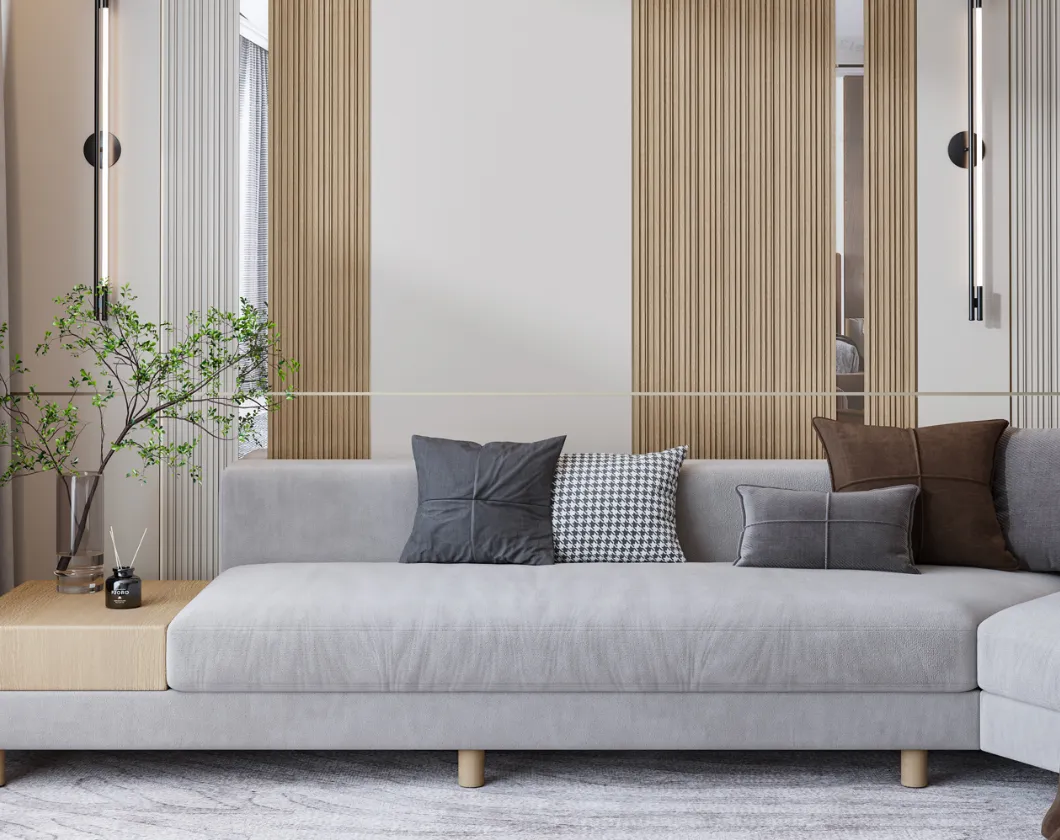
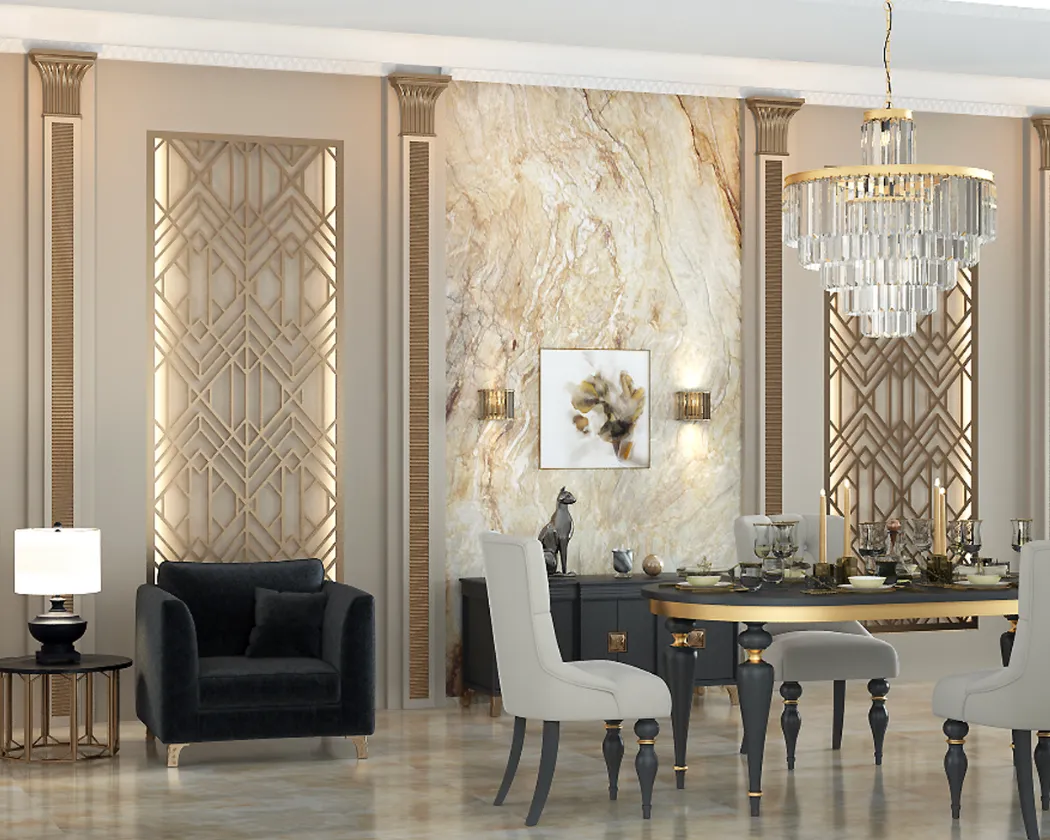
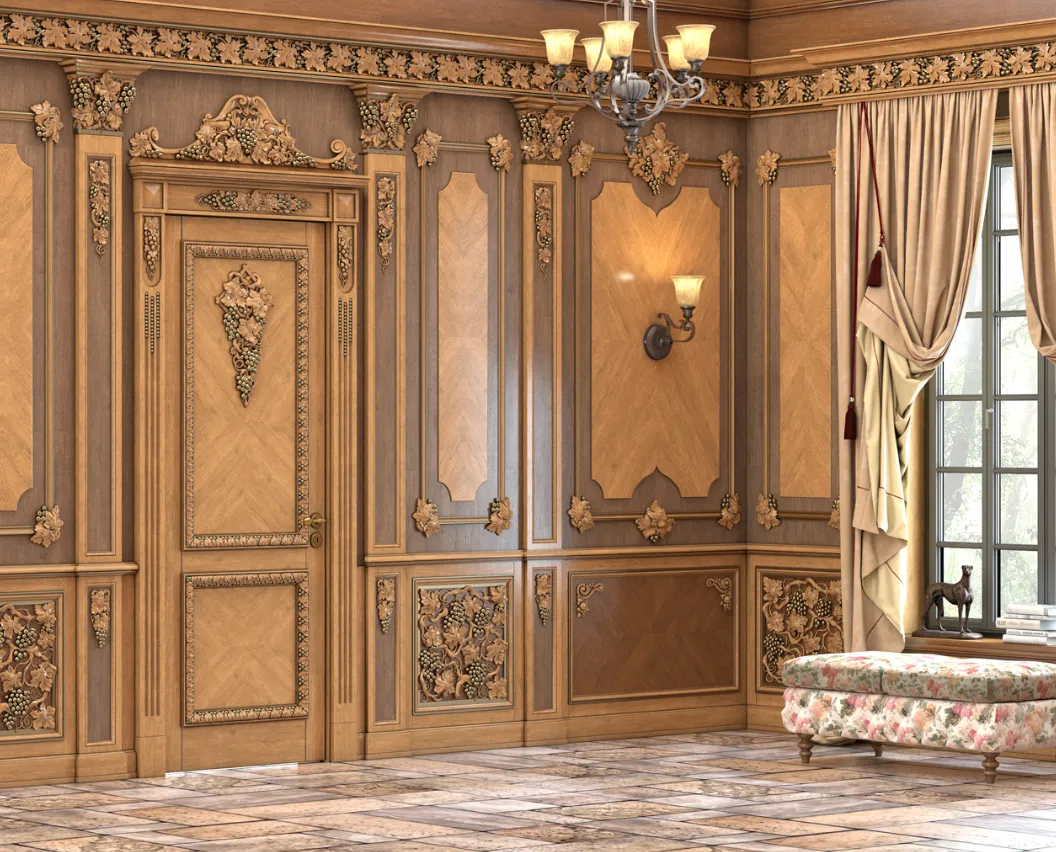
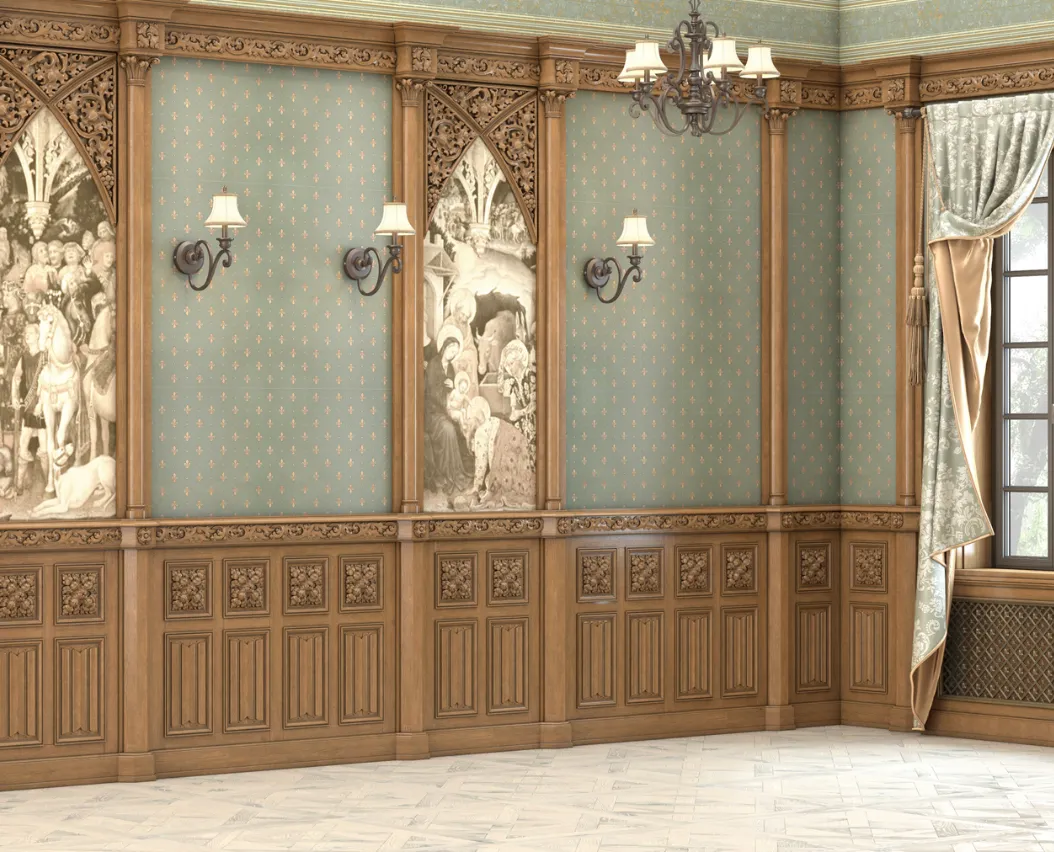
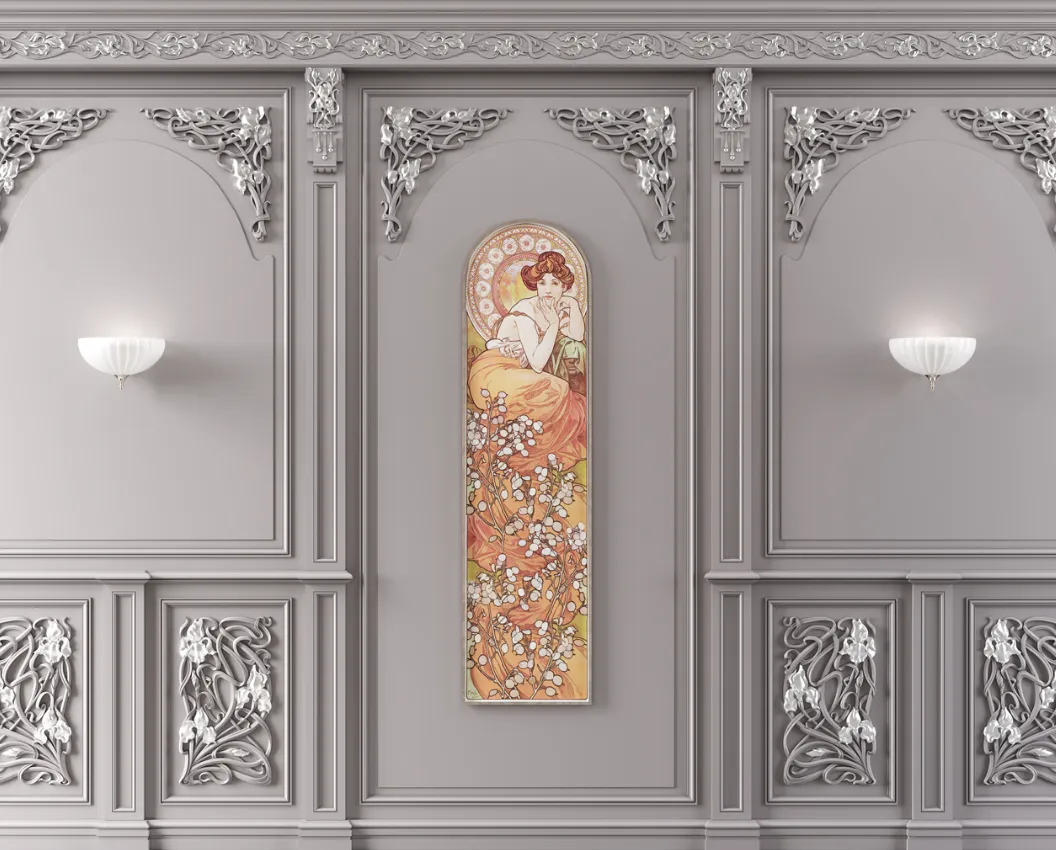
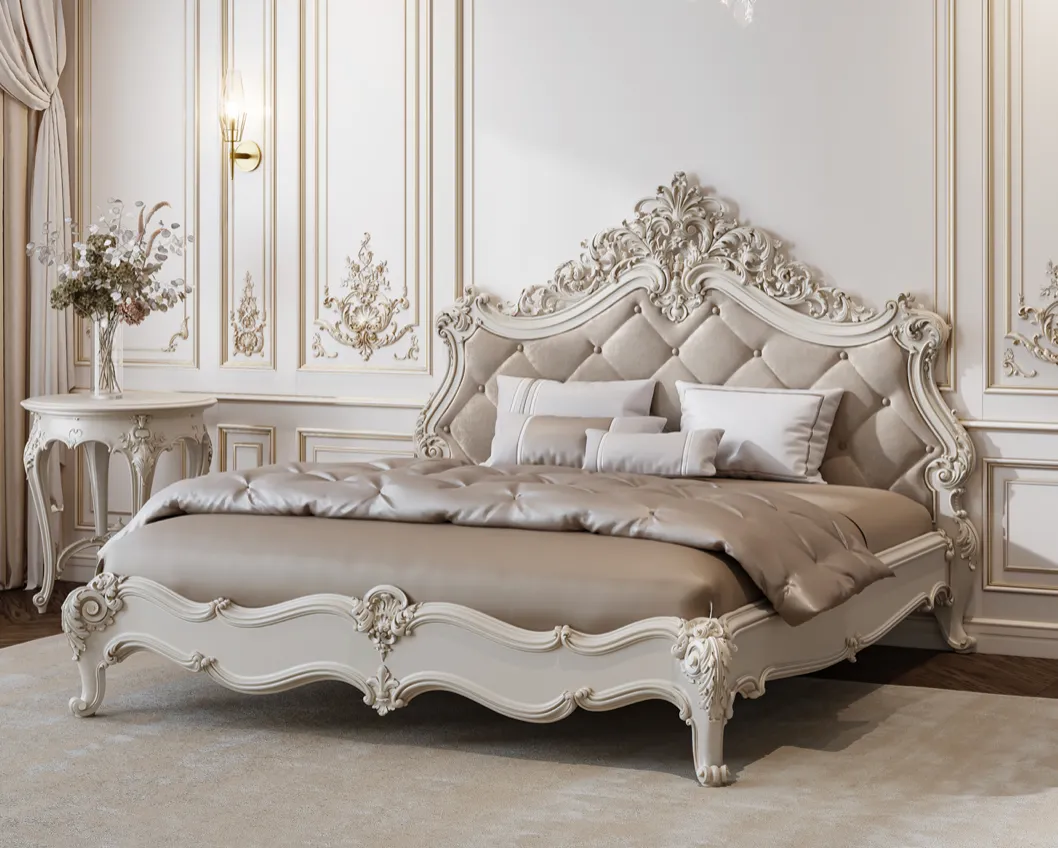
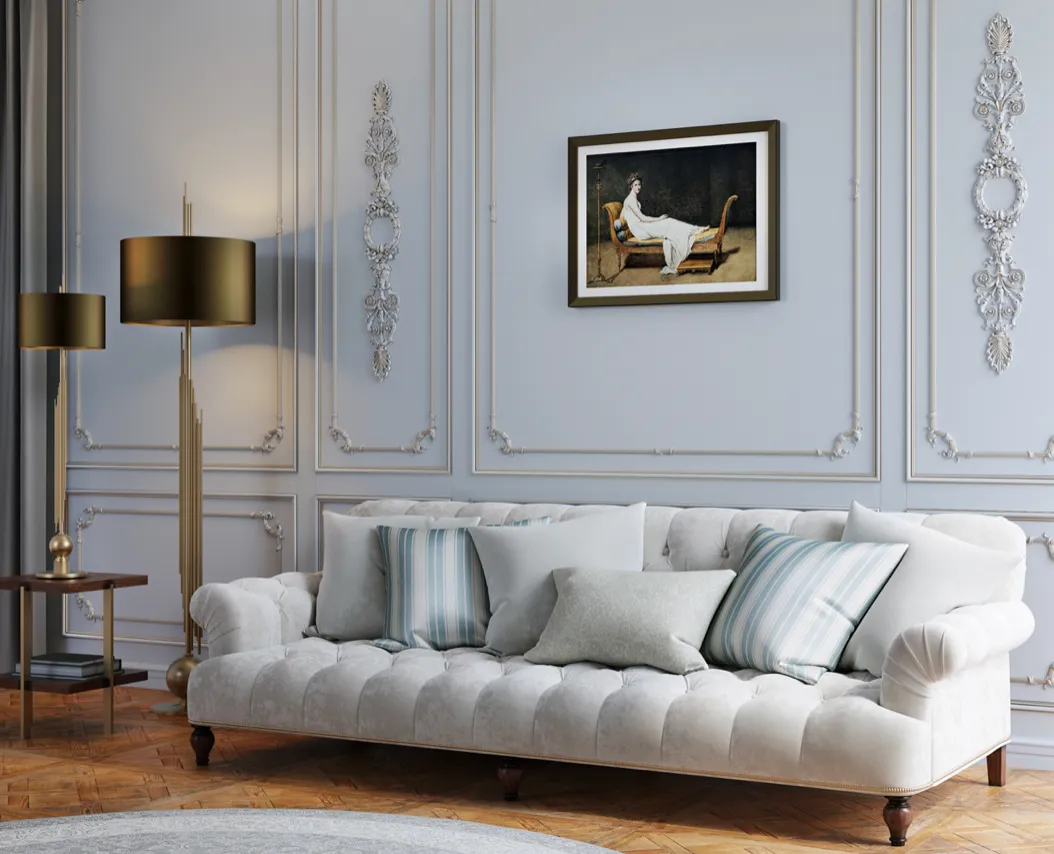

When buying decorative trim for a single room, it is easy to focus on a beautiful profile and forget about completeness: wall frames require precise cutting, the ceiling cornice requires a separate calculation by perimeter, and the medallion requires suitable dimensions and compatibility with the light fixture. For a buyer from Bratsk, such a mistake means not just an extra trip to the store, but a possible second order with payment for packaging and shipping. It is far more reliable to start with a single bill of materials and only then choose the finish in the STAVROS catalog.
In this article we look at a specific room of 4.5 × 4 m with an area of 18 m² and a ceiling of 2.7 m. On one wall we plan three decorative frames of 600 × 1600 mm, along the ceiling a cornice, and in the center an optional ceiling rose. You will learn why the frames will require six polyurethane strips 2600 mm long, how to obtain 17 m of ceiling perimeter without confusion with linear meters, by what criteria to choose different materials, and how to check the delivery of long items to the Irkutsk region.
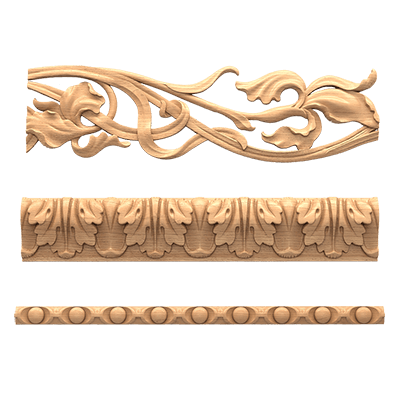
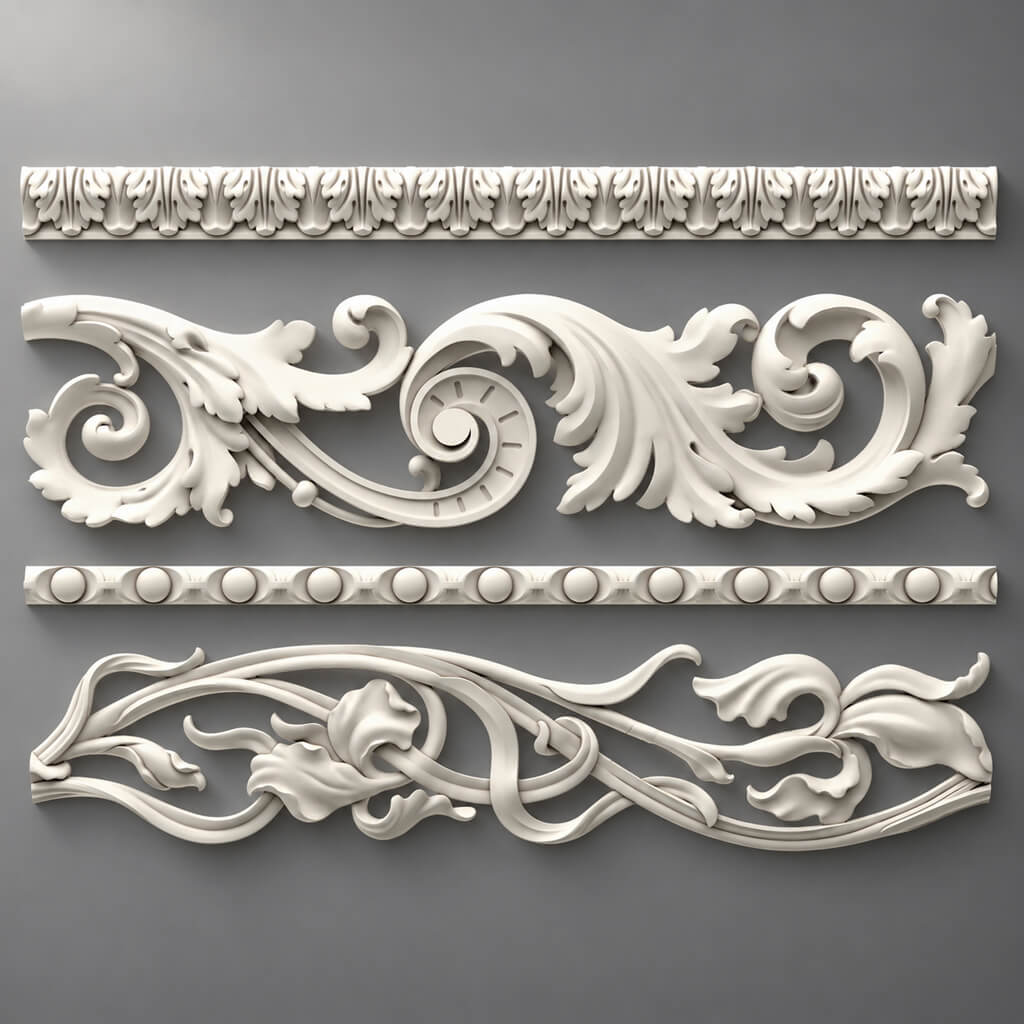
The word Moldings here refers to the range of architectural interior decor: primarily polyurethane moldings and ceiling roses. However, not all products in one section are made of polyurethane. In particular, the HIWOOD ceiling cornices reviewed are made of polystyrene. This matters for the estimate: different materials cannot be recorded under one name, and installation rules must be selected for the specific product.


Where to buy stucco in Bratsk: ordering by item codes, not by photo
If you are going to Buy molding for renovation in Bratsk, it is more convenient to compare not abstract "classic" and "modern" elements, but their item codes, geometry, length, and material. The STAVROS catalog includes wall moldings of several profiles, decorative overlays, ceiling roses, and ceiling products. For a first order, it is enough to choose two or three candidates for the wall, check the possibility of receiving them in the required city, and create a single list with the quantity of each item.
One should not assume that the profile price shown on the website automatically includes shipping. The final order may consist of the product, protective packaging, delivery, adhesive, materials for treating joints, and finishing paint. It is advisable to confirm the first three items before payment, and to select consumables according to the manufacturer's instructions. For a long 2600 mm strip, not only the weight matters: the transport company also evaluates the length of the packaging and the maximum permissible dimensions.
The selection procedure is straightforward. First, measure the room and record the finished dimensions of the decorative frames. Then decide whether you need a ceiling cornice around the entire perimeter or whether individual wall elements are sufficient. After that, open the product pages for the selected items, check the material, length and availability, and for delivery to Bratsk request the terms for the specific route. Buying as a single set is advantageous primarily because it is predictable: you know which parts should be in the shipment you receive and can check them against the packing list on delivery.
STAVROS should not be presented as a physical store in Bratsk: an own showroom or warehouse in the city is not confirmed here. This is about online ordering with a choice of delivery method. For residents of Bratsk, Vikhorevka and other settlements in the region, the delivery method must be checked separately for each specific address.

What a kit for an 18 m² room consists of
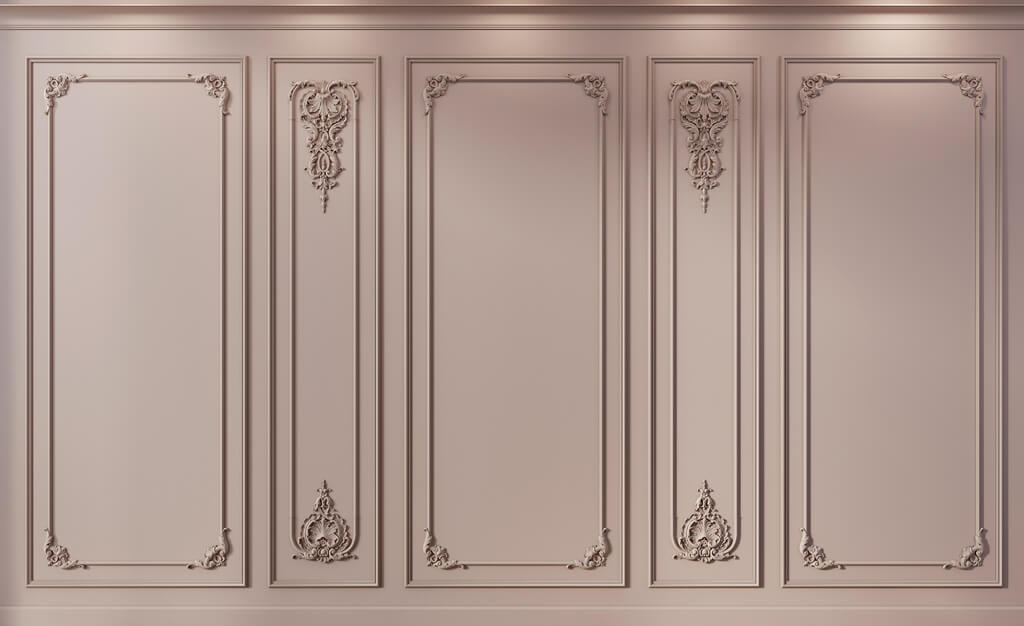
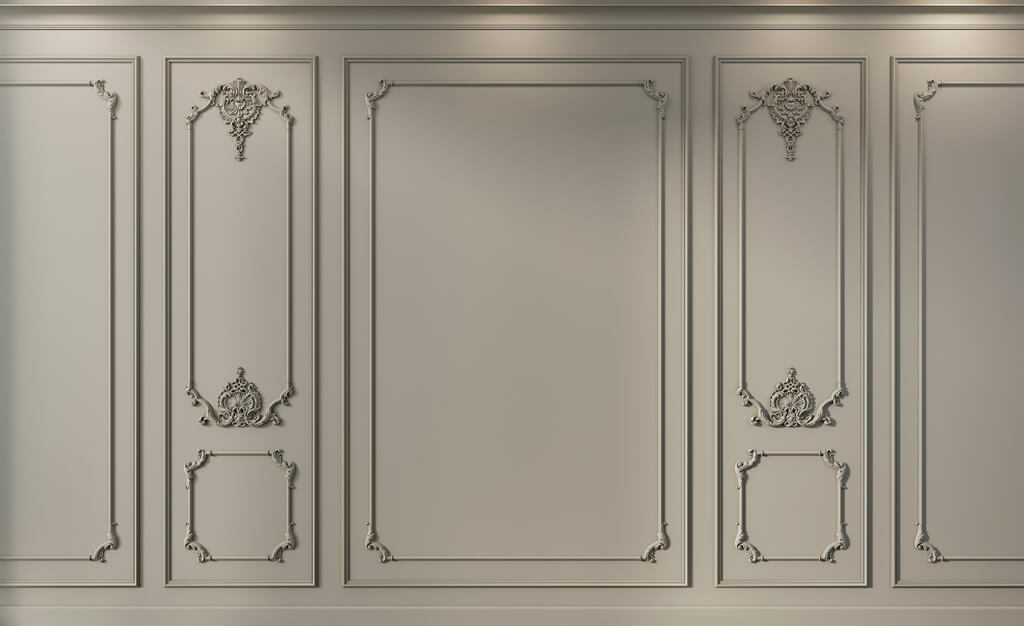
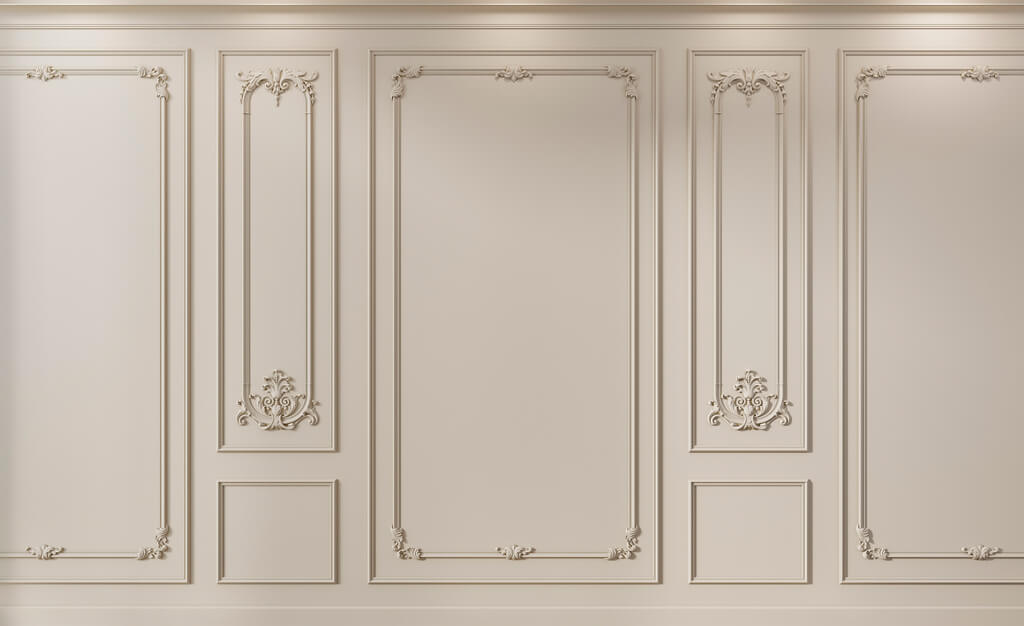
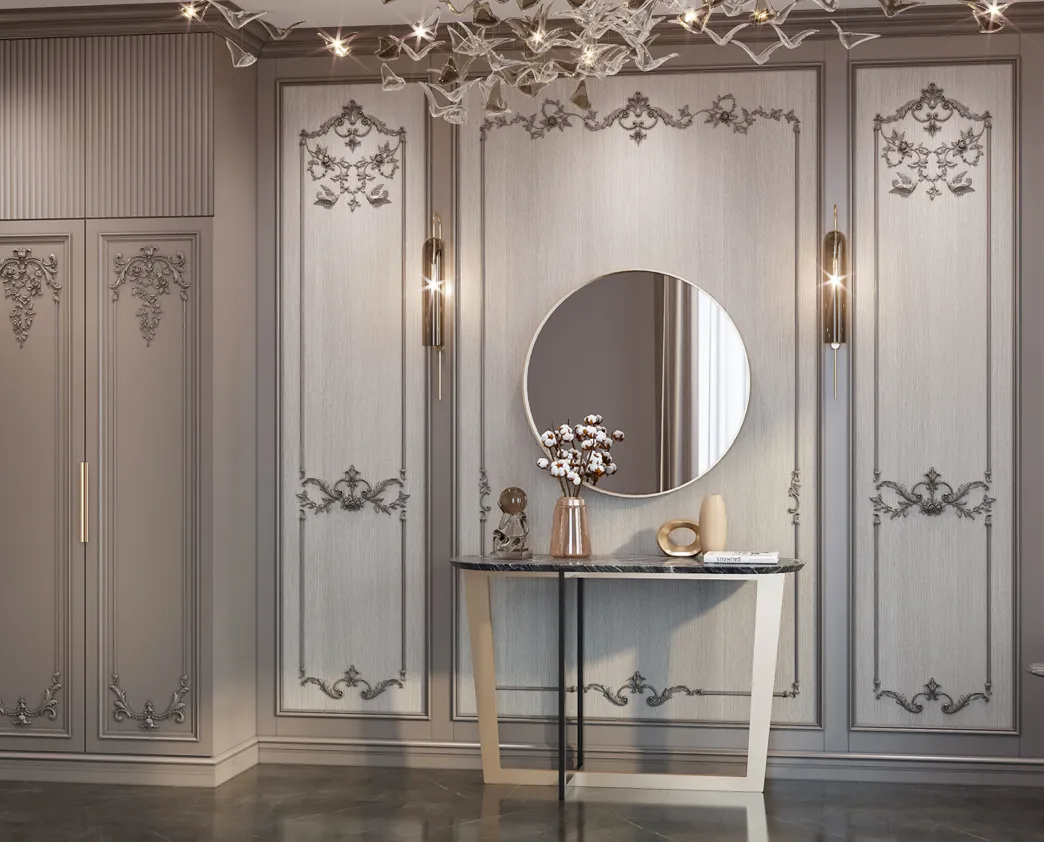
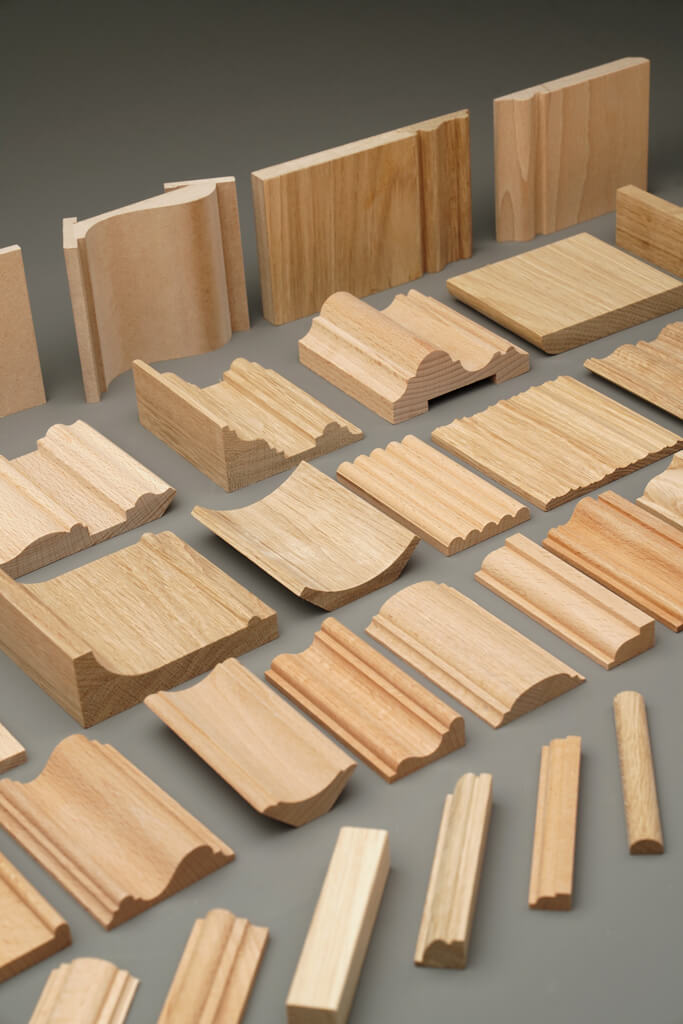
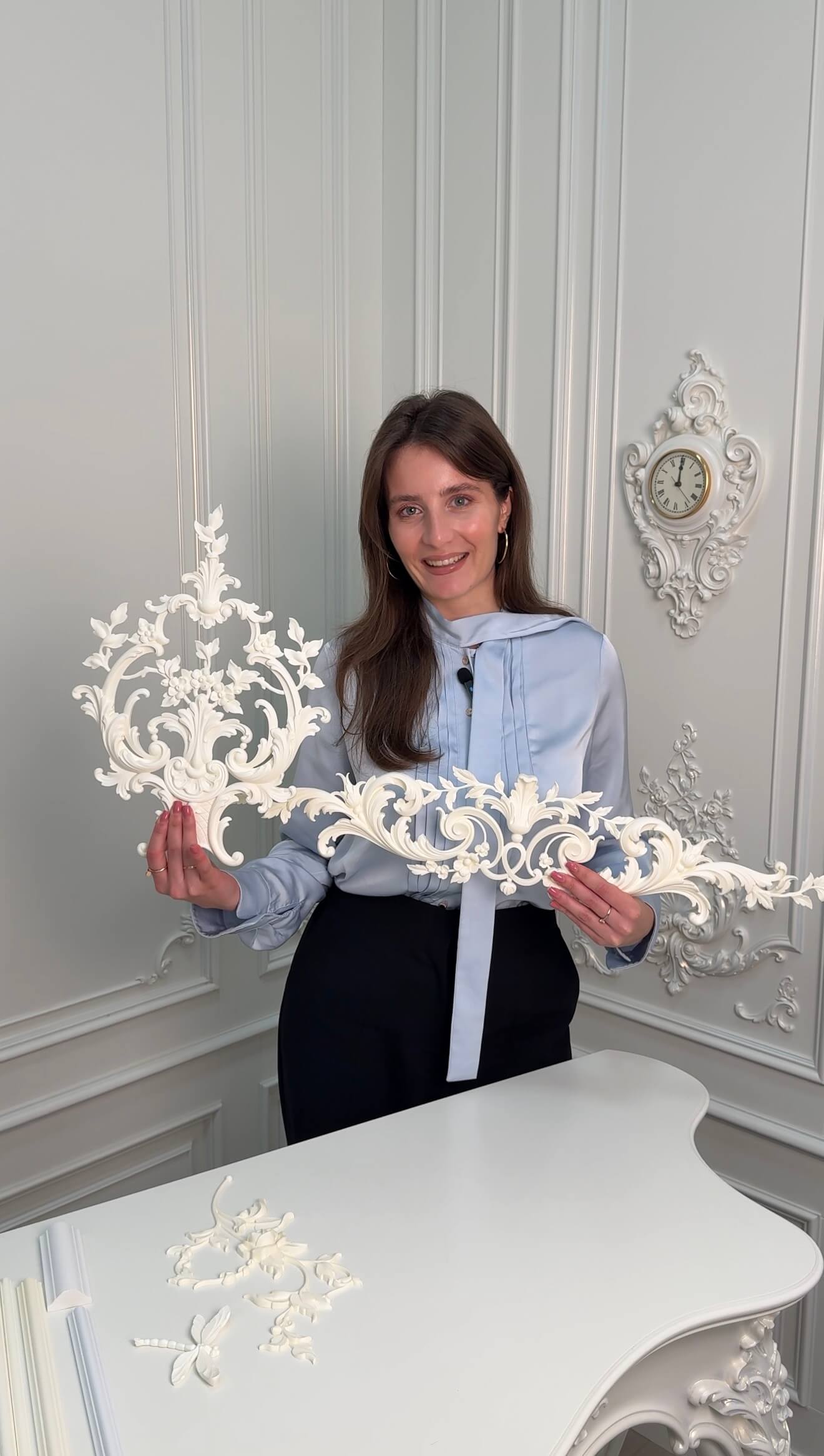
Unlike ordering several identical mouldings, a complete composition has three independent parts. The first is wall frames, which visually organise the wall. The second is a ceiling cornice that conceals or emphasises the transition between the wall and the ceiling. The third is a ceiling rose in the chandelier area, if its scale matches the interior and the ceiling structure allows such installation. These elements may be close in colour, but they do not have to be made of the same material.
The wall part is calculated by the lengths of individual segments, not by the wall area. Even a small frame requires four mitred pieces. If there are three frames, twelve segments are needed with the correct profile orientation and 45-degree mitres. In our example, the factory wall strips are 2600 mm long; first we create a cutting plan, then multiply the number of whole items by the price.
The ceiling part is determined by the perimeter of the room and the actual angles. For a 4.5 × 4 m rectangle, the perimeter will be 17 m. A 2000 mm cornice is a different product, with its own SKU, cross-section and material. In minimal arithmetic, 17 / 2 = 8.5, that is, nine pieces; but buying exactly nine without a cutting plan and a reserve may end in a shortage. The conservative working option is to check the cutting plan for ten pieces, without claiming that ten are guaranteed to be needed in all rooms.
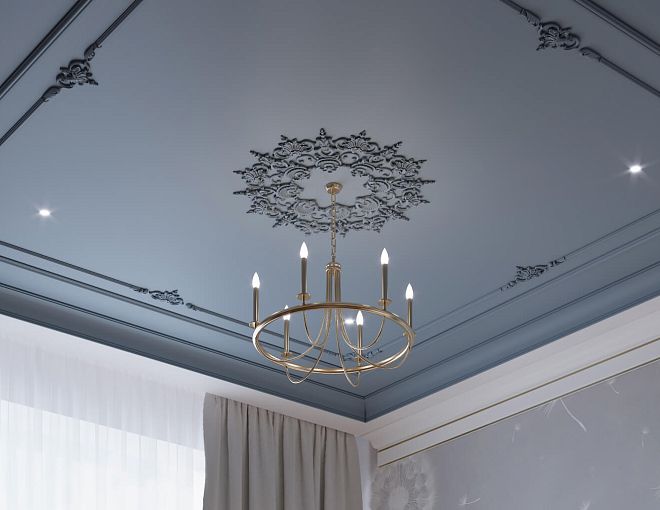
A ceiling rose is not measured in linear metres. It is ordered as a separate piece, after first comparing the outer diameter, the relief, the position of the lighting fixture and access to the electrical connections. When the ceiling is low or the fixture is understated, it is reasonable to leave the centre of the ceiling without a rose: the interior will not look unfinished if the walls and cornice are chosen consistently.
Polyurethane, polystyrene and gypsum: where the material really influences the choice
STAVROS polyurethane mouldings are convenient for precise geometric frames: the profile is a standard series item, the surface is intended for decorative finishing, and the weight and installation technology usually allow work without a heavy gypsum base. However, strength does not mean invulnerability. Narrow protruding edges and mitred ends can be damaged during transport or by a sharp impact, and incompatible adhesive or a poorly prepared wall will negate the advantages of the material.
Gypsum stucco may be appropriate in restoration or bespoke projects where a special relief and matching the existing finish are required. But gypsum products are heavier than many polymer analogues and often require different substrate preparation, fixing solutions and installer qualifications. Polyurethane should not be declared always “better than gypsum”: aesthetic and technical requirements are determined by the project. For an ordinary living room with geometric frames, stable geometry, the absence of excess weight and the possibility of neat painting are more often important.
HIWOOD cornices in the STAVROS range reviewed are made of polystyrene, although they are located within the broad section of stucco decor. This material has its own geometry, rigidity and adhesive requirements. You cannot mechanically transfer instructions for polyurethane moldings onto it or promise the same resistance to impacts and temperature without manufacturer data. Before ordering a cornice, check the exact article number and the application instructions for the chosen substrate.
Areas near heat sources, damp rooms, drywall ceilings and wooden walls require additional attention. Not only the decor material differs, but also the substrate: paint may peel, plaster may crumble, wood may change dimensions when humidity changes. Therefore, when choosing a material, ask questions about real-world use, not just about the visual similarity of white profiles in the catalog.
How to choose a wall molding for the living room: three proven STAVROS article numbers
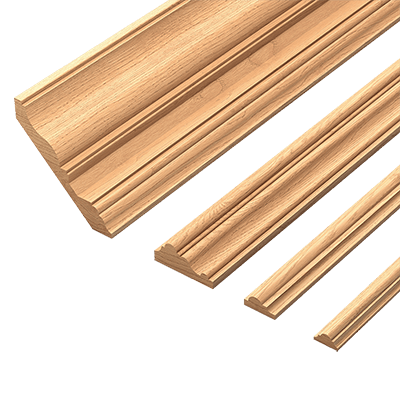
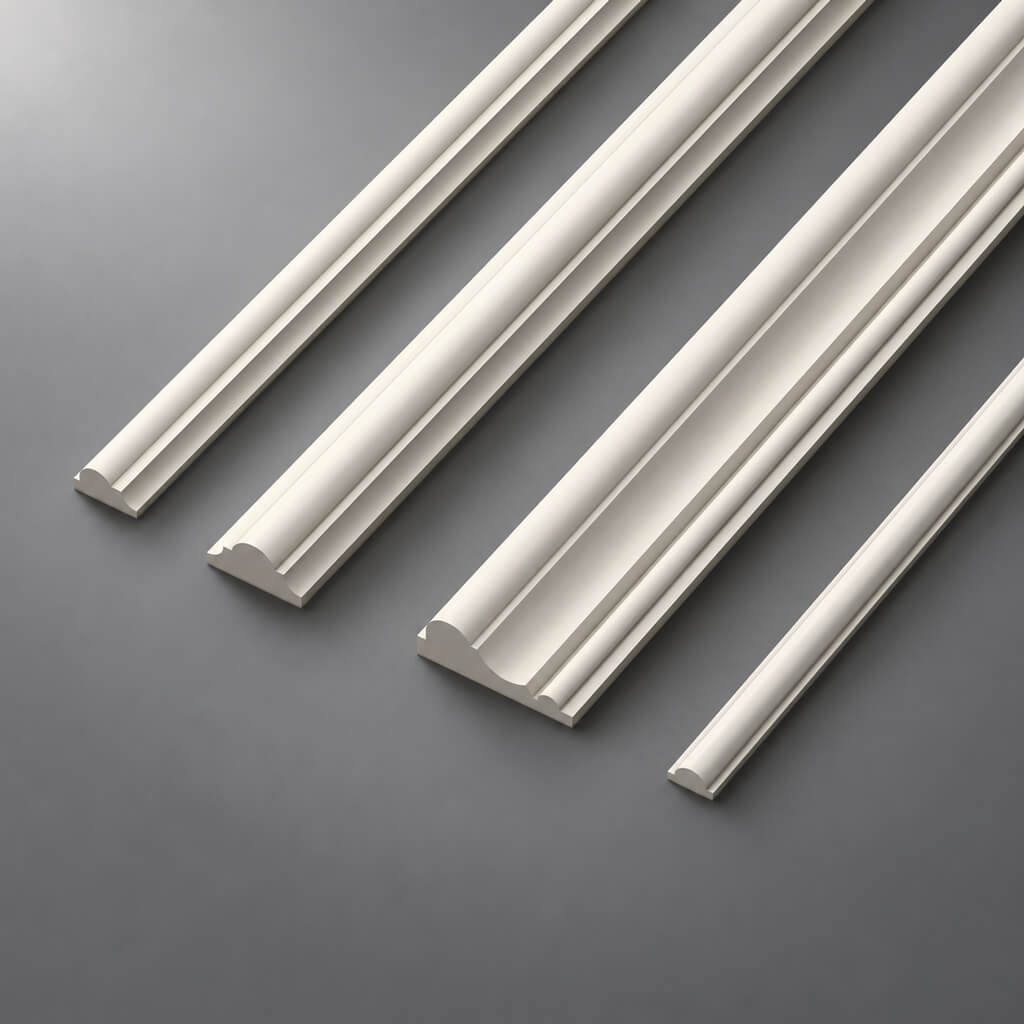
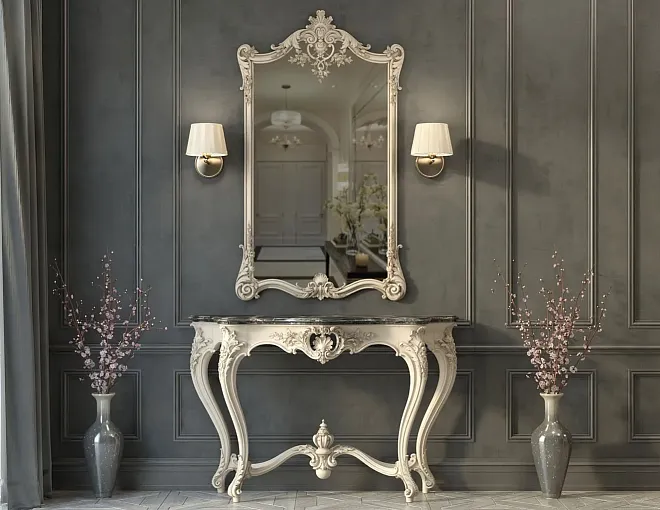
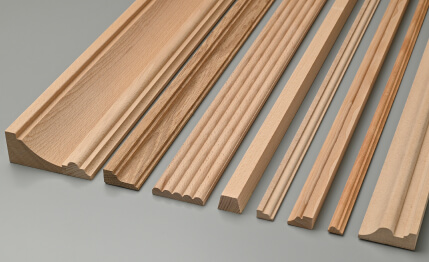
As an example, let's take three STAVROS polyurethane profiles of the same length, 2600 mm, but with different section widths and heights. MLDPU-001 — 10 × 6 mm; it is suitable for laconic thin contours. MLDPU-004 — 15 × 8 mm; it gives a slightly more readable line and a moderate shadow. MLDPU-002 — 22 × 11 mm; it looks more noticeable on a large painted surface. These are not rigid rules: the final choice depends on the size of the room, color and lighting.
On a 4.5 m long wall, a thin profile helps achieve light graphics that do not draw attention away from the furniture. In side sunlight it can look quite expressive, while in diffused light it may almost blend into the wall. A medium section of 15 × 8 mm often allows you to keep a modern composition but make it noticeable from a distance. A wider profile of 22 × 11 mm is worth considering if the room has space for a large pattern, the ceiling and door casings are not too thin, and you want a more distinct relief line.
For selection, it is useful to compare samples on the wall. Place short pieces at the height of the future frame, look at them in daylight and artificial light, and assess the shadow at the corner. It is not uncommon for a profile that looks striking up close in the product card to turn out to be too active next to a TV, wallpaper or textured panels. And vice versa: a thin bead on a long wall may look weaker than expected.
In a real calculation, the number of strips for three frames remains the same for all three article numbers, since their factory length is 2600 mm. What changes is the price and the visual effect, as well as adhesive consumption and the specifics of working with the relief. Using one width for the entire composition is simpler: the same profile makes it easier to align corners, paint and check completeness. Mixing MLDPU-001 with MLDPU-002 on one frame without a special artistic intent is not advisable.
Where to place three frames on the wall and what to check before ordering
The initial wall, 4.5 m wide, is only the geometric basis of the example. Before marking, you need to check the actual length of the free area from corner to corner, the position of doors, sockets, switches, wall lights and furniture. If there will be a TV on the wall, mark its bracket and cable channels before you determine the height and position of the frames. Correcting the composition after installation is much more expensive than changing the paper plan.
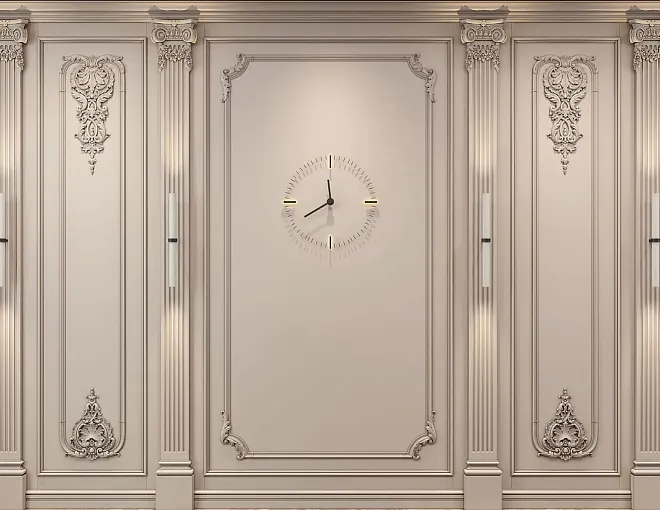
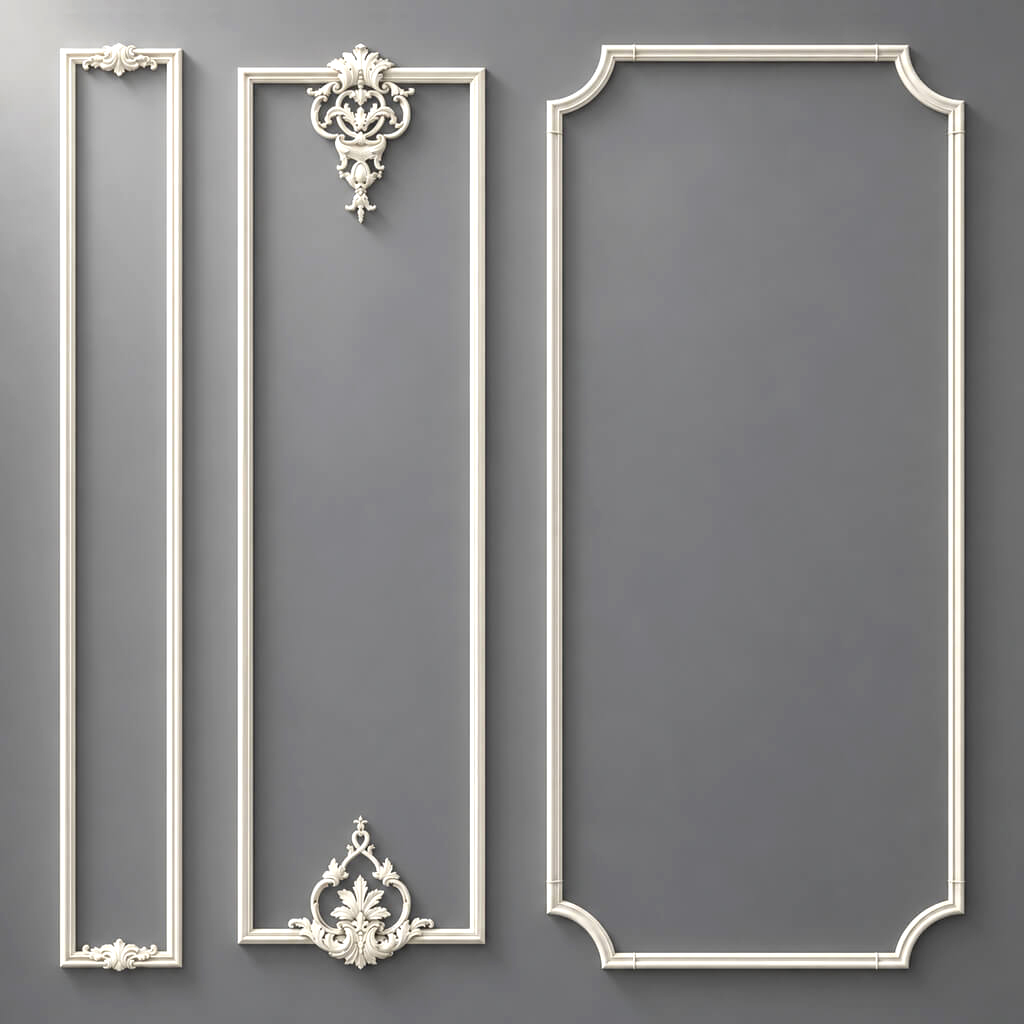
The proposed frames measuring 600 × 1600 mm can be placed vertically, aligning the bottom and top lines. The total width of the three frames is 1800 mm, but there must be gaps between them and at the edges. For example, with a free wall of 4500 mm, after subtracting the width of the frames, 2700 mm remains for four gaps: two outer and two inner. They do not have to be divided strictly equally. A composition often looks better if the inner distances are slightly smaller than the outer ones. This choice should be checked on a visualization and with real-life marking.
With a wall height of 2700 mm, a 1600 mm frame leaves 1100 mm in total for the top and bottom. This does not mean 550 mm each automatically: the lower boundary can be tied to the height of the sofa back or cabinet, and the upper one to the ceiling cornice and the chosen offset. If the furniture is tall, the lower part of the wall may be hidden behind it and the frame will lose its proportions. It is important to evaluate the composition as a real interior, not as a set of numbers.
Use painter's tape or paper strips to mark preliminary rectangles and step back to the opposite wall. Check whether the frames create visual "corridors" to the doorway, whether the line runs into a light switch, and whether the decorative outline divides the artwork and light fixtures. Such a check often reveals that it is better to keep three frames but slightly reduce their width or shift the whole group relative to the furniture. Only after the actual outer dimensions are approved should the material be cut.
Calculation for wall moldings: six strips, twelve pieces
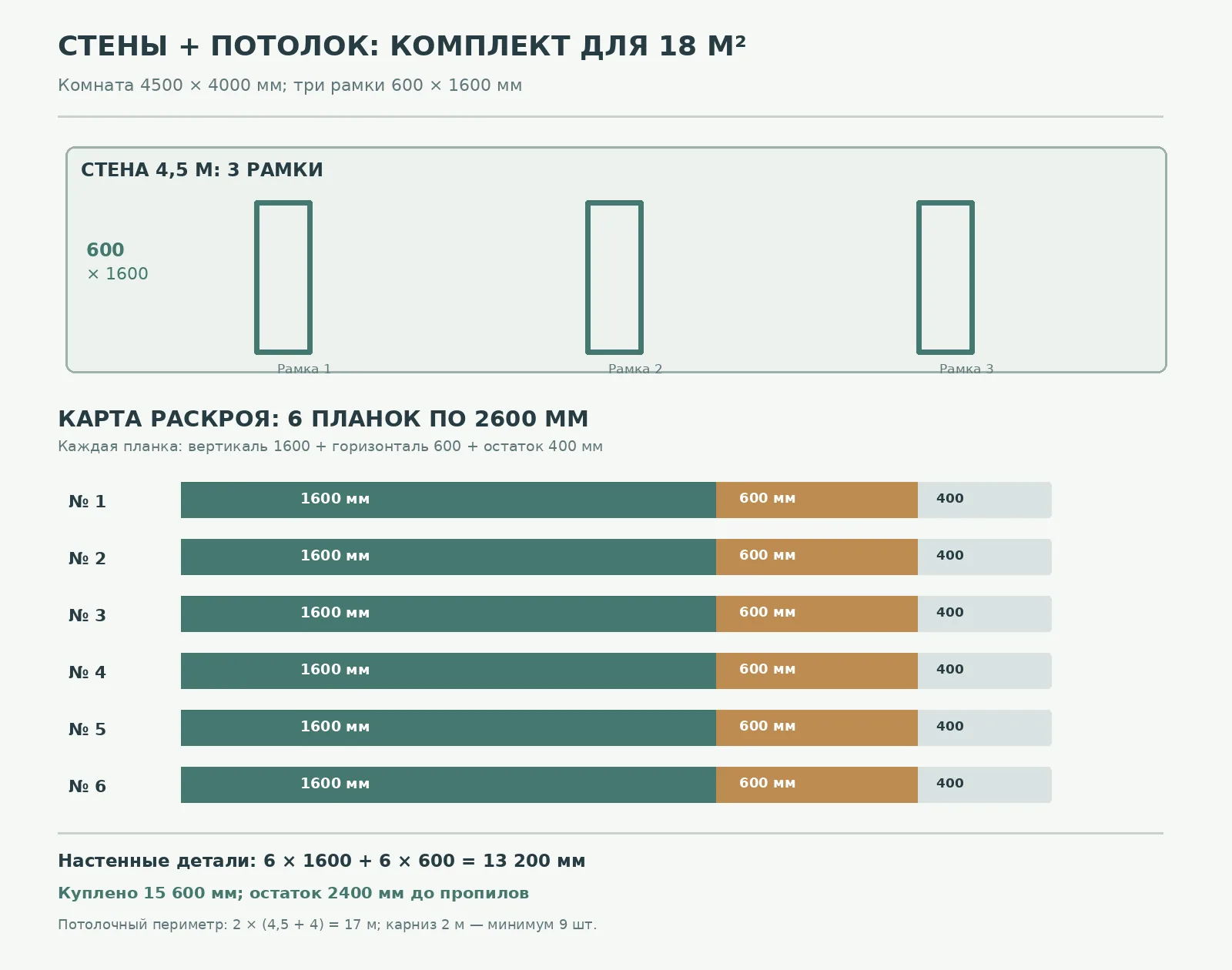
To avoid mistakes when buying, first count the sides of the finished frames, and then the possibility of cutting them from whole blanks. A 600 × 1600 mm frame has two vertical segments of 1600 mm and two horizontal ones of 600 mm. For three frames, that gives six long and six short pieces. The total installed length is 6 × 1600 + 6 × 600 = 13,200 mm, i.e. 13.2 m. This is the length of the elements on the wall, not the footage that must necessarily be purchased.
With a single factory strip length of 2600 mm, the efficient scheme is simple: from each strip we get 1600 + 600 mm. Nominally, 400 mm remains. Repeating this cutting plan six times gives six verticals and six horizontals without intermediate joints in the middle of the sides. The purchased profile will be 6 × 2600 = 15,600 mm, with a total remainder of 2400 mm. These are distributed short offcuts, not one solid spare piece 2400 mm long.
| Position | Size or quantity | Note |
|---|---|---|
| Frames | 3 × 600 × 1600 mm | Outer dimensions at the long points of the corner cuts |
| verticals | 6 × 1600 mm | No joint in the middle |
| horizontals | 6 × 600 mm | From the same planks |
| Ready-made outline | 13,200 mm | 13.2 linear m on the wall |
| Purchased planks | 6 × 2600 mm | 15.6 linear m of product |
| Nominal offcuts | 6 × 400 mm | Only 2.4 m total before cuts |
This scheme will only be correct if the measurement rules are agreed upon. The 600 and 1600 mm dimensions must correspond to the actual lengths of the parts measured along the outer long points of the mitred corner. If the designer specified the internal dimensions of the frames, the overall dimensions of the cut parts will increase to account for the width of the moulding. In addition, the saw removes a strip of material: on each strip, space must be left for the actual saw kerfs, end trimming and marking inaccuracies. Of the nominal 400 mm, enough space remains for normal processing, but this remainder cannot be considered guaranteed suitable for another project.
Do not confuse a reserve of linear metres with a reserve of a whole plank. The total 2.4 m of waste is distributed across six short pieces. If one 1600 mm vertical is broken during delivery, it cannot be restored from a 400 mm offcut without noticeable intermediate joints. Therefore, a seventh factory plank is not a mandatory cutting condition, but a separate decision about the risk of having to buy again. Agree it with the installer, especially if this is the first installation.
The 'by area' purchasing mistake: why 13.2 m does not equal five strips
At first glance, it may seem that 13.2 m is enough to divide by 2.6 m and round up: that gives about 5.08, i.e. six planks. In our case, this method accidentally gives the correct result, but it does not explain which sides need to be cut. In another geometry, the same 13.2 m would require more factory planks. The reason is that long parts cannot be assembled from arbitrary offcuts without an additional joint.
Imagine a project change: instead of a 1600 mm vertical, the owner asks for frames 2000 mm high with the same 600 mm horizontals. One 2600 mm strip would seem to fit 2000 + 600 mm exactly, but in real sawing there is no space left for the saw kerf thickness and end trimming. Such a scheme looks economical on paper, but on site it may prove unworkable. You will have to change the frame length, recalculate the number of strips, or agree on a joining method. Therefore, using the full nominal length without a technological gap is a poor guideline.
There is another trap. If the installer cuts all the verticals first without taking the horizontal parts into account, they may lose the optimal combination of segments within one strip. Six frame verticals will require six blanks, and then it will turn out that the horizontals could have been cut from the remaining parts if they had not been damaged or cut too short. A cutting plan is needed before work begins, and the cutting order is part of that plan. On products with a relief pattern, the required orientation of the parts must also be preserved.
Practical recommendation: assign a reference number to each part. For example, V1–V6 for verticals, H1–H6 for horizontals. For factory strips P1–P6, assign the pairs V1+H1, V2+H2, and so on. On site, it is enough to mark the reverse side to avoid mixed-up saw orientation. Such a simple schedule reduces the number of corrections and helps check the goods upon receipt: there should be six solid moldings of the same article and with identical characteristics.
Comparison of the cost of MLDPU-001, MLDPU-004 and MLDPU-002
For a buyer from Bratsk, the choice of section directly affects the price of the finished composition. At the time of preparing the material, STAVROS lists MLDPU-001 10 × 6 × 2600 mm at 1740 ₽ per piece, MLDPU-004 15 × 8 × 2600 mm — 3190 ₽, MLDPU-002 22 × 11 × 2600 mm — 5460 ₽. All three products are polyurethane; the figures relate to specific sizes and do not include installation or transportation. Availability and price must be rechecked before payment.
| STAVROS molding | Size | 1 strip | 6 working | 7 with reserve |
|---|---|---|---|---|
| MLDPU-001 | 10 × 6 × 2600 mm | 1 740 ₽ | 10 440 ₽ | 12 180 ₽ |
| MLDPU-004 | 15 × 8 × 2600 mm | 3 190 ₽ | 19 140 ₽ | 22 330 ₽ |
| MLDPU-002 | 22 × 11 × 2600 mm | 5 460 ₽ | 32 760 ₽ | 38 220 ₽ |
A budget option does not necessarily mean a cheap interior. A narrow profile can be painted in the color of the walls, then it will create a soft architectural grid, almost without changing the perception of the room. A medium profile is more noticeable and is often good when the walls are already plain and lack structure. A larger relief should be chosen if you really want to make decorative frames the main element of the wall; the visual effect should justify the difference in price.
To work with official specifications, use Molding MLDPU-001 and compare it with the more pronounced MLDPU-004 and MLDPU-002. In all variants, not only six strips are required, but also suitable adhesive, material for filling joints, primer if necessary, and paint. The example of a seventh strip is needed to assess the risk: an additional 1740, 3190 or 5460 ₽ may be justified if re-delivery is expensive, but with confident installation and an affordable repeat purchase, a reserve is optional.
Also take packaging into account. In the product pages for individual STAVROS mouldings, a pine transport base is described separately for small orders. Its current cost and applicability to the selected specification must be confirmed in the order calculation. You cannot automatically multiply the packaging by the number of strips: the packaging type depends on the composition of the batch and the shipping conditions, not only on the number of decorative parts.
Ceiling cornice: 17 meters of perimeter and a different cutting logic
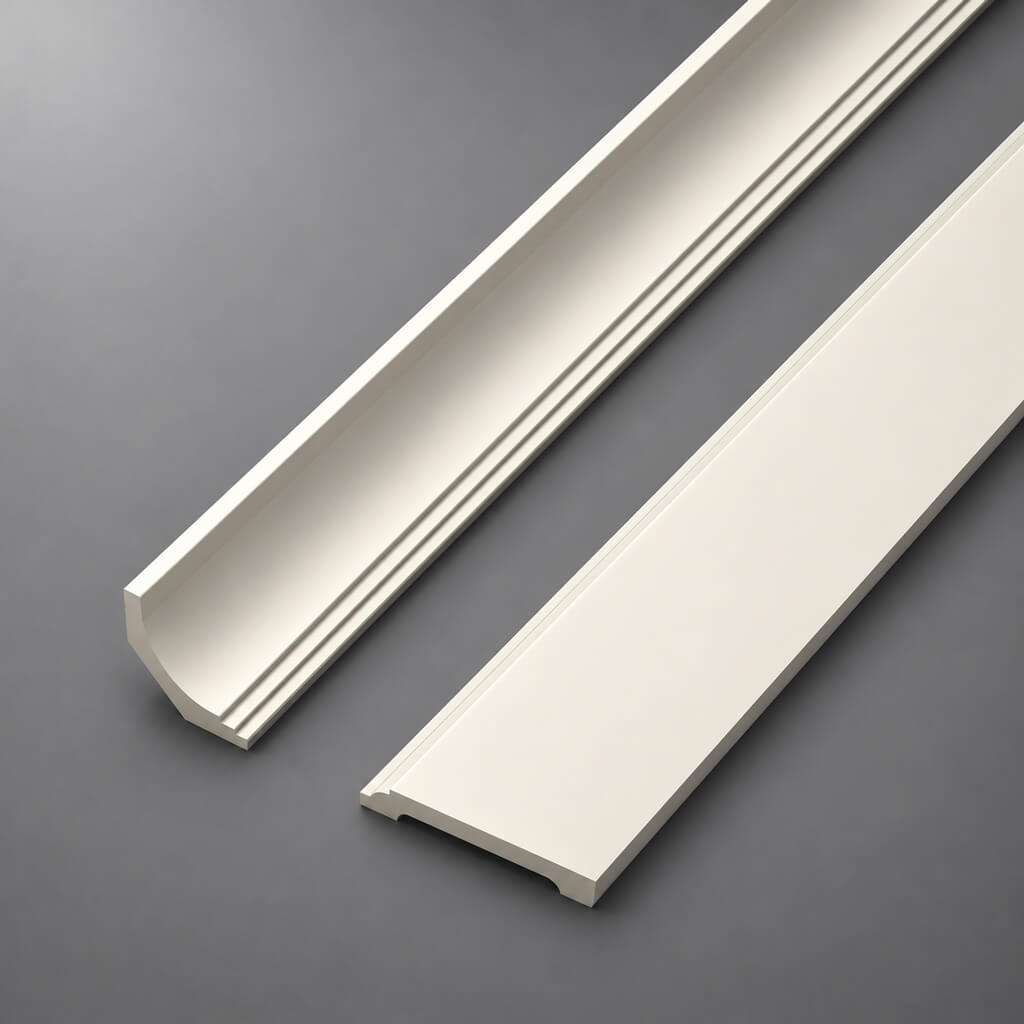
For a room of 4.5 × 4 m, the ceiling perimeter is (4.5 + 4) × 2 = 17 m. If you choose the HIWOOD A70 polystyrene cornice with a length of 2000 mm, purely arithmetically you need at least nine pieces: 9 × 2 = 18 m. However, the real task is more complex because of the four internal corners of the room, the saw kerf width and the need to preserve the correct face sides of the corner pieces. Nine pieces is the theoretical minimum with suitable cutting, not a promise that this quantity will be sufficient on any site.
Let us consider a simple distribution example: for each 4.5 m wall, two full 2 m sections and one more short 0.5 m section are needed; for each 4 m wall, two 2 m sections. By length, that is four two-metre pieces for the long walls on the left and right, four more for the short walls, plus two half-metre segments that can be obtained from one factory strip. In total, that comes to nine original strips. But such a calculation does not include technological allowances at the corners or the conventionality of using exactly two-metre segments; when finishing the room, fitting and checking of each corner are required, so a more comfortable starting specification is ten pieces, if the seller confirms that the selected article can be ordered to Bratsk.
There is an alternative approach: instead of trying to fit almost all walls into maximum long segments, design the joints in advance in less noticeable places. For example, on the side where there will be a tall wardrobe or heavy curtains, the joint of two elements is less noticeable than in the illuminated centre of the wall. At the same time, the number of joints should be minimised, not simply used to hide possible mistakes. The cornice must be continuous in geometry and relief on each section — an incorrect joint will become noticeable after painting.
On the STAVROS website, for example, there is a cornice A70 HIWOOD 50 × 50 × 2000 mm with a stated price of 800 ₽ per piece. This is polystyrene, not polyurethane. Also, the product page for a specific item contains regional ordering restrictions, despite the general information about Contact us to confirm shipping to your destination. Therefore, the 7200 ₽ for nine and 8000 ₽ for ten pieces given below are only the item price according to the product page and a conditional calculation model. Before adding A70 to an order for Bratsk, you need to obtain confirmation from a manager that the selected product is available for shipment to the specific address.
If a large ceiling profile with a different height is required, do not automatically use the price and footage of A70: the length and availability of another article may differ. Before final assembly, double-check how many strips are needed based on the actual measurement of the room, and whether there are niches, protrusions, boxes, bay windows, or additional corners. Sometimes a change in ceiling geometry increases consumption significantly more than adding one metre to an ordinary rectangular perimeter.
Why the HIWOOD cornice cannot be called polyurethane
Mixing materials is a common mistake in product bundle listings. The buyer sees a general "Decorative mouldings" section and assumes that the wall moulding, ceiling cornice and rosette have the same composition. In this example, that is not the case. Mouldings MLDPU-001, MLDPU-004 and MLDPU-002 are made of polyurethane, the A70 HIWOOD cornice is made of polystyrene, and the ceiling rosette CRPU-070, which we will look at next, is made of polyurethane. Decorative similarity does not cancel out the differences in their technical data sheets.
The material affects the cutting method, the choice of adhesive, the reaction of thin edges to pressure, and the painting requirements. Even within the polystyrene group, one can encounter different densities, geometries, and manufacturer recommendations. It is undesirable to buy one adhesive based on the general word “moulding” and then use it on all three groups without checking: it may interact differently with the material and with the specific substrate. Compatibility must be checked in the instructions for the products and the adhesive.
For a project with white walls and decorative profiles made of two materials, consistency of the finish coating and geometry matters most. Light, especially linear lighting, can reveal differences in surface texture. So do a test coat on small areas and evaluate them side by side. If different materials cannot be visually matched without complex preparation, it is acceptable to omit the cornice or choose another verified product. The goal of a bundle is a finished interior, not the mandatory presence of every category.
In a commercial article, it is important to state the conditions honestly: Ceiling Molding they are presented as a separate product group, not as a promise of polyurethane material. Before purchasing, confirm suitability, ordering conditions for your region, availability of the specific item and the actual delivery price. Only after such verification can the cornice be considered part of a final agreed specification.
Ceiling rosette for an 18 m² room: is it even needed?
A ceiling rosette can support a chandelier and add a classic accent, but in a room with a 2.7 m ceiling it should not visually weigh down the ceiling. Start by determining the type of light fixture. A small, understated shade often looks good without a moulded surround, while a large decorative chandelier may benefit from a central relief element. Scale is best assessed on the ceiling plan: the outer dimension, the projection of the relief and the distance to other lines should be known before ordering.
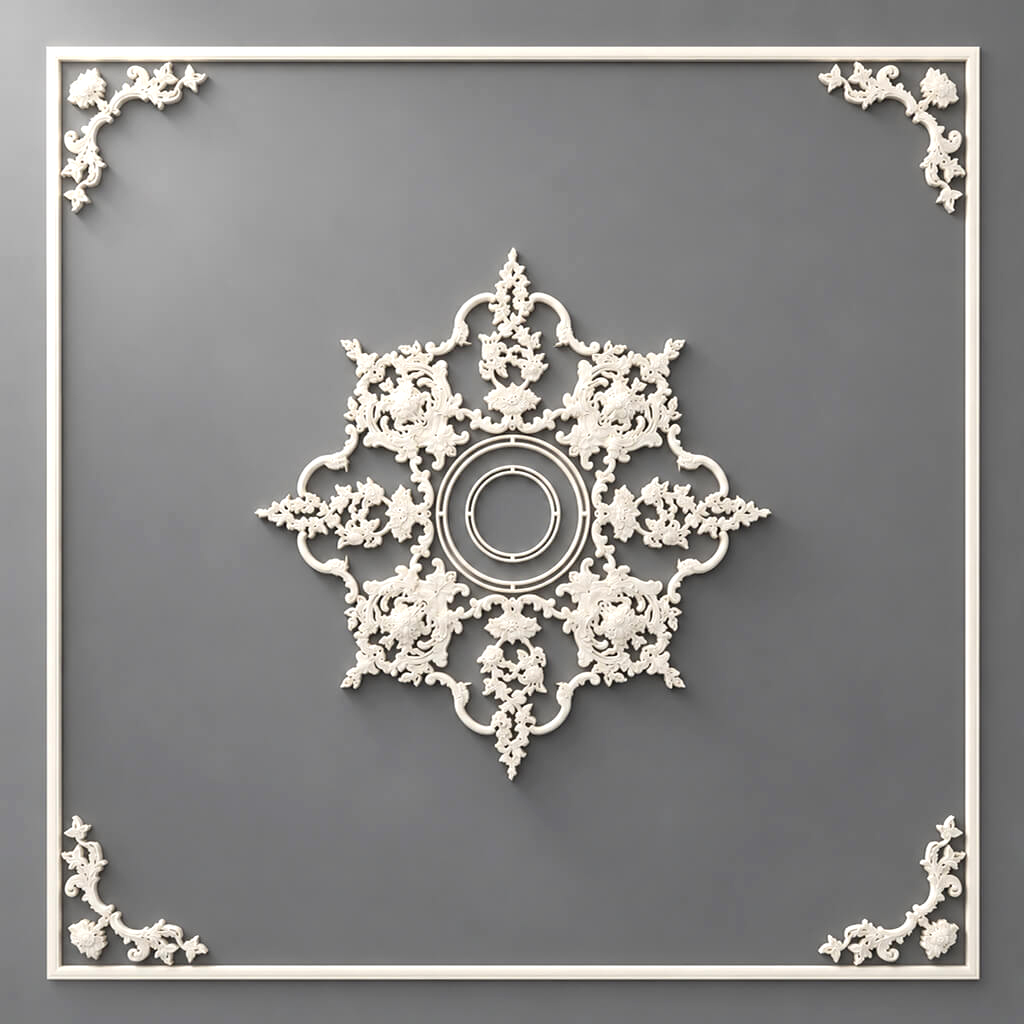
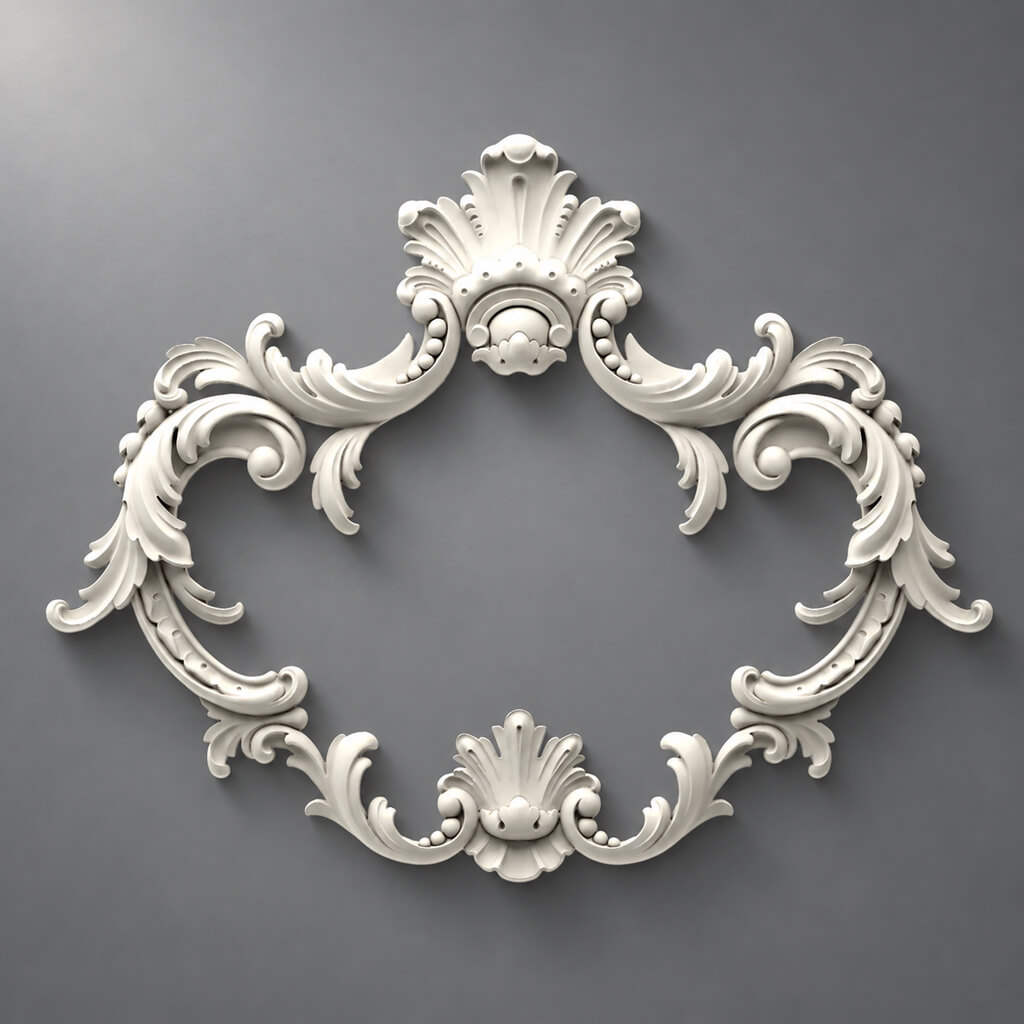
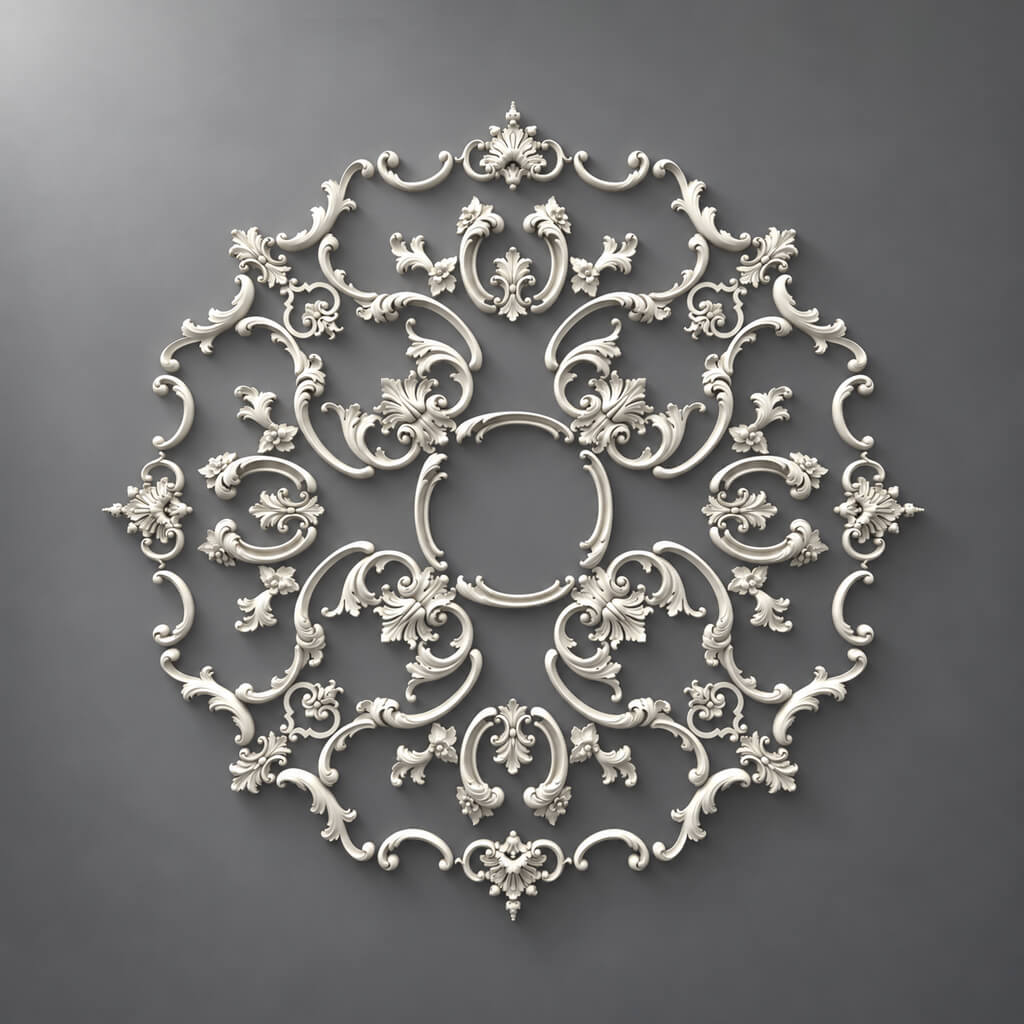
The STAVROS range includes a genuine polyurethane ceiling rosette CRPU-070 measuring 765 × 765 mm; the catalogue lists a price of 35,680 ₽. For an 18 m² room, this is a prominent and expensive element, so it should only be used after checking the scale, the ceiling construction and compatibility with the light fixture. Calling it a mandatory addition to three small wall frames would be wrong. As an alternative, you can leave a flat painted ceiling or look for another suitable product with a verified "ceiling rosette" specification.
When choosing, pay attention to electrical safety. A decorative rosette does not replace the structural mounting of the chandelier, the electrical box or the wiring. The load from the light fixture must be transferred to the base elements provided for in the design. If there is an inspection cover or junction box in the centre of the ceiling, it must not be covered with a decorative product in a way that removes access to serviceable connections. The engineering part is checked first, then the decorative solution is determined.
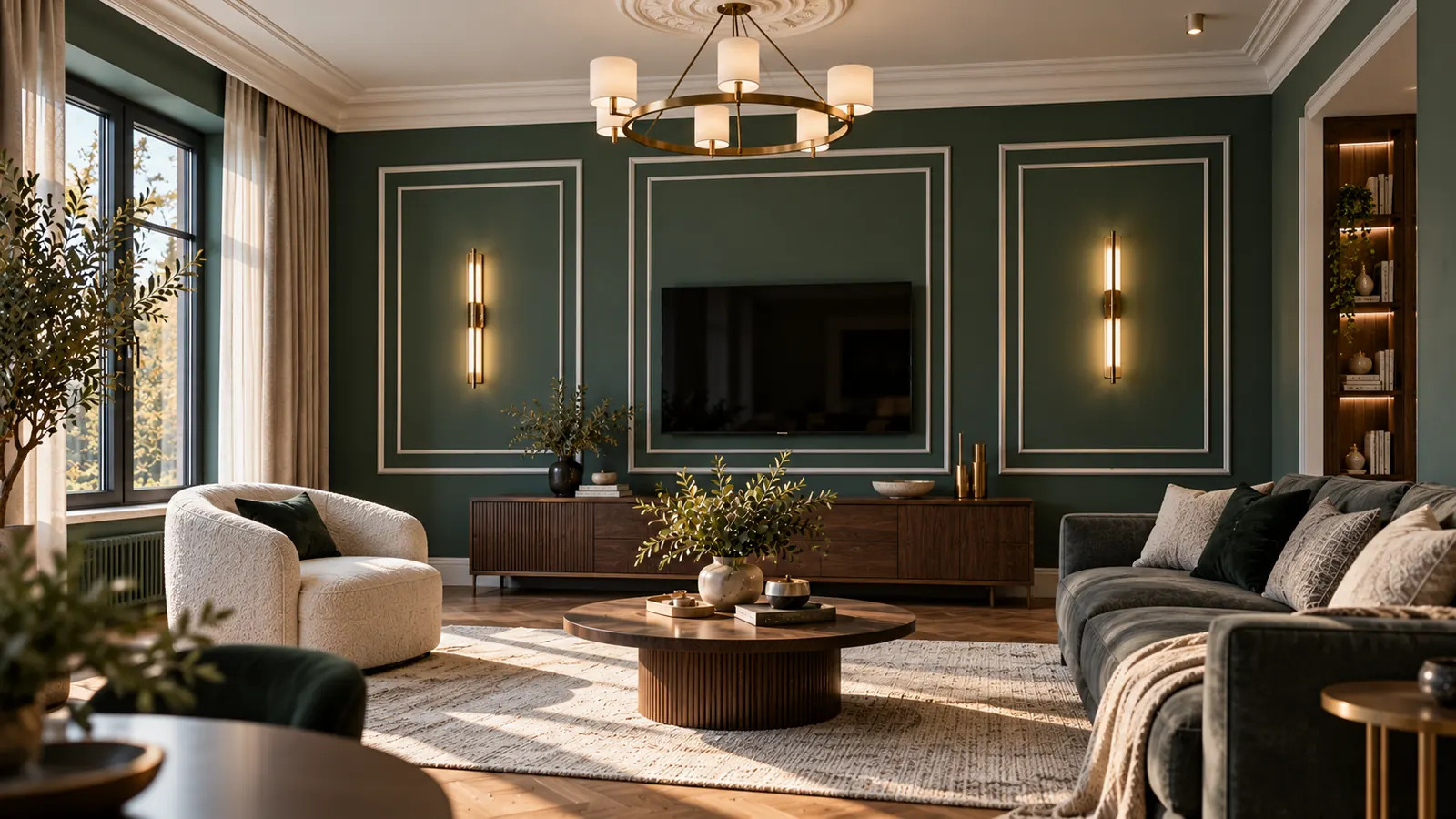
В ceiling rose catalogue the dimensions of different products vary considerably. An illustration of a finished living room cannot prove that a particular rosette is compatible with a specific chandelier. Keep the condition in the order: "CRPU-070 — option subject to approval." Then the estimate stays honest, and the buyer is not forced to purchase an expensive element simply because it appears in a topical article.
A single estimate for walls and ceiling: three budget scenarios
It is useful for the buyer to see not one beautiful final figure, but a cost structure from which optional items can easily be removed. So let's start with a confirmed wall set, then add a conditional ceiling cornice, and show the rosette as a separate line. We do not invent costs for glue, surface preparation, craftsman labor, and transportation: they depend on the condition of the apartment, the chosen composition, and the agreed method of receiving the goods.
The first scenario is minimalist: six MLDPU-001 strips at 1,740 ₽ each, totaling 10,440 ₽. The second is medium in relief: six MLDPU-004 at 3,190 ₽, totaling 19,140 ₽. The third is more expressive: six MLDPU-002 at 5,460 ₽, totaling 32,760 ₽. These three amounts do not change whether or not the owner decides to add a ceiling cornice and a socket, because the wall frames are the same size in all scenarios. What differs is the profile cross-section and its cost.
For example, the A70 HIWOOD cornice 50 × 50 × 2000 mm at the published price of 800 ₽ will cost 7,200 ₽ for nine items or 8,000 ₽ for ten. But until the availability of shipping A70 to Bratsk is confirmed, this is a conditional calculation, not a final offer to buy this product with delivery. If the seller does not confirm that it can be ordered to the required address, the buyer should replace the ceiling item with a genuinely available analogue, and then recalculate the entire ceiling section separately.
| Scenario | Wall moldings, 6 pcs. | A70 cornice, 10 pcs. * | Without socket * | With CRPU-070 * |
|---|---|---|---|---|
| Minimalist MLDPU-001 | 10 440 ₽ | 8 000 ₽ | 18 440 ₽ | 54 120 ₽ |
| Balanced MLDPU-004 | 19 140 ₽ | 8 000 ₽ | 27 140 ₽ | 62 820 ₽ |
| Expressive MLDPU-002 | 32 760 ₽ | 8 000 ₽ | 40 760 ₽ | 76 440 ₽ |
The asterisk here is essential: the ceiling cornice price is given as a model according to the published price list; availability for Bratsk must be confirmed. The CRPU-070 socket at 35,680 ₽ is also shown only as a separate option after verifying scale, availability, and installation. All lines omit unknown amounts for delivery, packaging, installation materials, painting, and labor. It is extremely important not to treat the table as a cart ready for payment without clarification.
If you need a reserve of wall molding, add the cost of one strip of the selected article: 1,740, 3,190, or 5,460 ₽. For the cornice, the reserve is checked separately, since a different length, different angles, and a different material do not allow combining the reserves of two types of decor. With a limited budget, it is wiser to first fully complete the wall frames, then confirm the availability and delivery of the ceiling profile, and only after that decide whether the socket is really needed.
How to assemble a complete STAVROS order without unnecessary repeat purchases
Instead of the phrase “six moldings and something for the ceiling,” create a specification that can be sent to the manager and installer. Specify the exact article, material, cross-section, factory length, quantity of whole items, and separately the role of the item in the project. This will help identify discrepancies: for example, one ordered molding may accidentally turn out to be MDF instead of polyurethane, or the cornice may be selected with a different radius and length.
For a room of 18 m², the working specification looks like this. Moldings: one of the articles MLDPU-001, MLDPU-004, or MLDPU-002, six whole strips of 2,600 mm, an optional seventh as a reserve. Ceiling cornice: example A70 HIWOOD polystyrene 2,000 mm, conditionally ten strips, only if the order's availability for Bratsk is confirmed. Ceiling socket: CRPU-070, one piece, only if it fits in scale and construction. Installation consumables — according to a separately agreed list drawn up taking into account the substrate and finish.
Ask the seller to confirm for each item not only the price, but also the possibility of shipping it as part of a single consignment. Sometimes a product is in the catalog, but a regional restriction, differing warehouse availability, or packaging dimensions prevent it from being combined with the rest. Then the overall order has to be revised. Such a check is especially relevant when 2.6 m long wall products and 2.0 m ceiling products must be transported in one shipment. The availability of Contact us to confirm shipping to your destination. in the store's general description does not yet mean that any item can be sent by any carrier at a single rate.
It is necessary to clarify the exact length of the finished transport packaging, not just the length of the bare strip. Protective end caps, a rigid backing, and the box can increase the dimensions. For the carrier, this may change how the piece is handled and the rate. If the delivery request is calculated based on "length 260 cm" without accounting for packaging, the actual piece sometimes turns out to be longer than allowed for the selected service. It is better to discover such a restriction before payment than after handing the goods over to the terminal.
Moldings made of polyurethane it is convenient to select by individual characteristics, but in the final letter to the seller be sure to specify the entire set. It is advisable to attach a drawing of the frames, a diagram of the ceiling perimeter, and a list of confirmed delivery addresses. This way the manager can check whether there are any incompatible or unavailable items, and the customer will receive a specification they can refer back to upon acceptance.
Delivery of stucco moldings to Bratsk: what needs to be confirmed before payment
The STAVROS payment and delivery page describes shipping options across Russia via transport and courier services. However, for Bratsk it is impossible to name the exact timeframe and rate in advance, especially when the cargo is long. The cost depends on packaging, permissible dimensions, weight, the chosen carrier, and the final address. Even with a single carrier, conditions may differ if the delivery city or rate changes.
For ordering 2600 mm long moldings, it is important to get answers to four questions: will the chosen service accept a piece of the specified length with packaging; will a rigid backing or additional crating be required; what delivery method is possible to an address in Bratsk; how is the documentation of external damage and a claim upon receipt handled. If the seller offers several options, compare not only the shipping cost but also the safety of the cargo and the receipt procedure.
Please specify in advance what is inside — decorative profiles with relatively thin edges and a face relief. Such items are vulnerable to bending, end impacts, and localized pressure from straps or heavy adjacent cargo. Soft film protects well against dust and scuffing, but it does not replace a rigid base on a long strip. Therefore, a request for reliable packaging is not an attempt to "over-insure," but part of a commercial order that affects the likelihood that all six pieces will be suitable for installation.
For residents of districts in Irkutsk Oblast, the conditions of the central city should not be automatically applied. Shipping to Bratsk and subsequent delivery to another settlement may be two separate stages with different responsibilities. If you plan to pick up from the terminal yourself, check in advance whether the packaging will fit in your available transport, how to secure it, and whether it can be transported without bending. A long-length profile secured with support only at the ends may develop hidden deformation.
Detailed current options should be verified on the page Payment and delivery, but the final answer is always tied to your cart. To contact the manager, it is useful to send the three packaging measurements, the final list of item codes, and the exact locality, and then ask for written confirmation of the rate and delivery method. It is precisely this information that helps compare carrier offers without guesswork.
How to receive long-length moldings and ceiling elements
Receiving the cargo is the last moment when transport damage can be recorded in time. You should not first sign the documents and then unpack all the items at home if the carrier's conditions allow inspection at the point of issue. Check the number of cargo places, item codes, and the integrity of the packaging. Inspect the ends, areas of possible impacts, crushed corners of the boxes, traces of water, and pressure marks from straps. In case of damage, follow the procedure of the specific transport service and record the condition before removing the protection.
After opening, check not only that the strips are present, but also their straightness and relief. A polyurethane molding may have intact outer ends while the protruding pattern in the middle is damaged. Lay the items out on a flat support and compare them with the ordered geometry. Pay special attention to the corners where chips, cracks, or deformations are noticeable. For a surface to be painted, minor scuffing is sometimes fixable, but this should be assessed by a specialist rather than automatically classifying any problem as an "insignificant defect."
Separately check the cornice if it is included in the actually delivered set. A polystyrene profile cannot be assessed only by the rules for polyurethane moulding: the cross-section shape, density and sensitivity of the relief differ. The rosette should be inspected along its entire outer contour, especially if it has a large diameter and a thin decorative edge. Make sure that the selected light fixture is actually compatible with it in terms of geometry and access to the mounting point.
It is better to keep the order documents, photos of the packaging, product labelling and the transport waybill until installation is complete. In the event of missing items, this will help to understand which item is missing and at what stage the error occurred. Do not confuse "ten ceiling cornices" with "ten transport units": the seller may combine several items into one package. The reconciliation should be done separately by the number of pieces of each SKU and by the number of cargo units.
Finally, do not cut all the strips immediately after receipt. Before installation, make sure that the geometry of the walls matches the design, that the chosen paint and adhesive are suitable for the substrate, and that there are no irreparable defects. Only after this does it make sense to transfer the layout from the sheet of paper to the profile. This order is especially useful for remote purchases: it preserves the ability to correctly record a claim and does not mix transport defects with the result of your own cutting errors.
Preparing the wall before installing polyurethane stucco
Even the highest-quality moulding will not fix an unsound substrate. Before marking out, check whether the old paint is peeling, whether the filler is crumbling, and whether there are local bulges or significant deviations from flat. On a loose or dusty wall, the adhesive may hold onto the finishing layer, which will eventually detach from the substrate together with the decor. For a quality result, first eliminate the defects, follow the priming technology and allow the compounds to reach the required strength in accordance with the instructions.
When choosing moldings for walls it is important to remember that a thin line particularly emphasises the curvature of walls. On an uneven surface, a long vertical may pull away from the surface, and an attempt to pull it in with adhesive sometimes creates internal stress. Check the area of the future frame with a long straightedge or level. If painting is planned and the walls have not yet been finally levelled, it is easier to solve the problem before installation than to correct open gaps at an already fixed profile.
Surfaces with wallpaper require a separate assessment. Attaching a heavy decorative composition to poorly adhered wallpaper is risky: adhesion will depend on the strength of the paper or vinyl layer, not only on the adhesive. The optimal technology is determined by the specific materials and the manufacturer's recommendations. On drywall, check the quality of the seams and the finishing coating. On wooden substrates, take seasonal movement into account, especially if the finish is attached over structures that are still changing dimensions. Do not make a rigid bridge with molding across a moving joint without a design solution.
Installation begins in a room with suitable temperature and humidity, after the delivered products have acclimatized. Don't try to come up with a single number of waiting hours: it depends on the condition of the load, the temperature difference, the packaging, the adhesive composition and the instructions for the selected item. If the planks arrive cold after transport, immediate sawing, gluing and painting can degrade the quality of the result. Allow the materials and the substrate to reach the conditions permitted by the technical documentation.
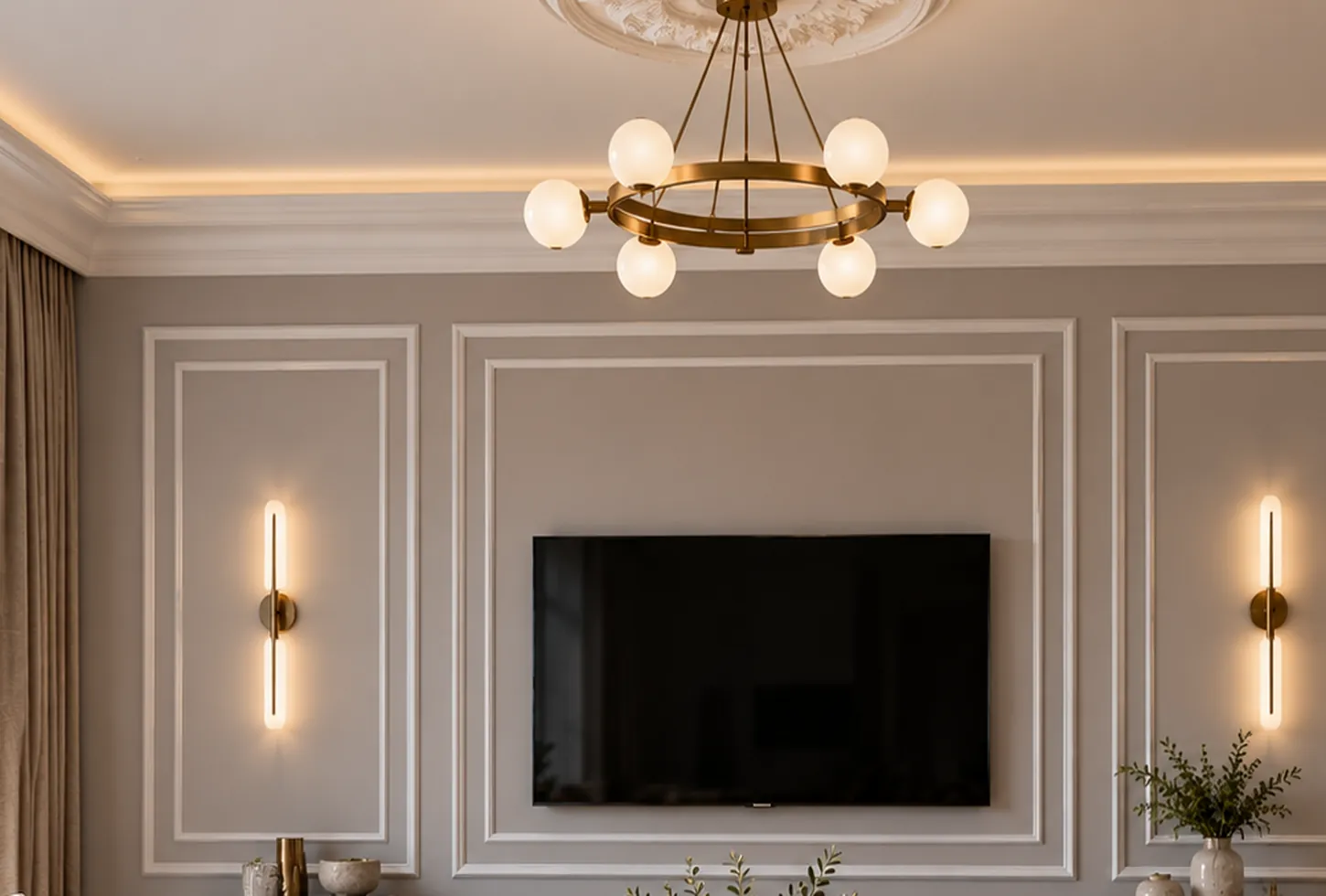
Marking and 45-degree mitre cuts: how to keep the relief aligned
Before sawing, mark the axes and outer boundaries of all three frames on the wall. Check the diagonals of the rectangles: equal width and height do not yet guarantee right angles if the verticals are slanted. It is useful to mark the top, bottom and front-face direction on the back surface of each plank. After that, you can prepare a test corner on short offcuts to check the tool settings and the fit of the relief sections.
For each frame you have two verticals of 1600 mm and two horizontals of 600 mm. Parts with 45-degree mitre cuts are measured at the long outer points, otherwise after joining the frame will be smaller or larger than the design. It is not recommended to cut all the segments according to the drawing without first checking the actual geometry of the first frame dry-assembled. If the wall angle or the saw setting deviates from an ideal 90 degrees, the seam will become noticeable after painting.
A large gap must not be compensated for only with a thick layer of adhesive. The adhesive joint must work within the permissible thickness and according to the instructions; for filling decorative joints, use a compatible compound, not a random construction mix. When cutting relief profiles, take into account the direction of the pattern and where the elements meet: if one piece is turned over, even a neat corner may look out of place. A reliable practice is to lay out the entire rectangle on a flat surface, adjust the corners, and only then transfer the parts to the wall.
When working with profiles of different cross-sections, the visual width of the corner joint also changes. For a thin 10 mm molding, deviations are seen differently than for a 22 mm one with pronounced steps. Therefore, a preliminary sample should be made from the chosen article, not from any similar material. If you are cutting for the first time, one extra strip as a reserve may be a justified measure, but the decision should be based on real experience, tools and the cost of re-delivery.
Ceiling cornice installation and painting: why instructions should not be mixed
A ceiling cornice connects two surfaces that may have different levels of evenness, finishes, and even mobility. Before installation, check the geometry of the wall-to-ceiling joint, the position of wiring, lighting elements, and stretch or suspended systems. If a stretch ceiling does not allow attachment to the fabric, the cornice cannot be considered an ordinary overlay that can be glued to any two sides. The specific method must correspond to the ceiling structure and the profile manufacturer's recommendations.
When Ceiling molding is considered part of a unified finish; the most important thing is to coordinate the scale of the cornice, the room height and the pattern of the wall frames. For a 2.7 m ceiling, a too-deep, massive profile can visually lower the height. A narrow polystyrene cornice can, on the contrary, emphasize the upper boundary of the wall without excessive weight. However, a visual recommendation is not a technical approval for installation: the chosen article, its base, the permitted adhesive and the location of the joints must be checked separately.
Painting unites the different parts of the decor into a single composition, but the surface must be prepared first. Check whether the manufacturer permits applying the chosen paint to polyurethane and polystyrene, whether a primer is required, and what the holding time after gluing is. On a ceiling cornice, it is advisable to do a test paint on an inconspicuous area: sometimes a slight difference in texture shows up only in side light. Do not cover fresh, uncured seams with paint: cracks and unevenness may appear later.
After installation, inspect each corner under evening lighting and in daylight. On the wall, the relief lines cast shadows that help reveal misalignments, unpainted ends and wavy areas. Corrections are best made right away, while the seam can still be carefully worked and a small area repainted. The final check should include both the ceiling perimeter and all twelve parts of the wall frames.
Five mistakes in ordering that are especially costly when re-delivery is required
The first mistake is buying "linear meters" instead of whole factory strips. For frames, the number of specific long segments matters, so dividing the total perimeter by the product length does not always give a realistic cutting plan. The second mistake is mixing polyurethane moldings and polystyrene cornices under one name. This can lead to the wrong choice of adhesive and errors in the order description. The third is assuming that all products in a category are shipped to Bratsk under the same conditions. An individual SKU's product page may contain restrictions that are not present in the general delivery section.
The fourth mistake is paying for an optional ceiling medallion before checking the chandelier and the base. A decorative medallion does not serve as a load-bearing mount for the light fixture, and a large medallion may be excessive for the room. The fifth is not taking into account the dimensions of the already packed cargo. A 2600 mm strip and a cargo unit with protective end caps may have different lengths, and this affects logistics. Correcting any of these mistakes after shipment can cost more than a calm check of the specification before payment.
Another practical risk is losing a consistent pattern. If you first order MLDPU-004 for the walls and then, due to damage, buy the cheaper MLDPU-001 as a replacement, the frame will end up assembled from different profiles. Such savings are pointless, even if the colors match. In the bill of materials, each side must have a single item code, and for a partial replacement you need to order an identical model and check that a change of batch or finish will not cause a visible difference.
For customers who want to buy stucco in Bratsk without unnecessary expenses, it is worth keeping three documents at once: the approved dimension plan, the final specification of item codes and the confirmed delivery terms. Then, if the project changes, you can understand exactly which item needs recalculating. For example, changing the width of one frame will affect the cutting plan but not the ceiling perimeter; dropping the medallion will change the cost but not the number of wall molding strips.
FAQ: buying stucco, ceiling decor and delivery to Bratsk
Which query should be used if you need a catalog of specific products?
The phrase "Buy moldings» appears in search as a short commercial phrase. But when choosing, it is more important to go to the actual categories and check the material, length, cross-section and item code. For a room of 18 m², first select the wall profile and the number of strips, then the ceiling cornice and, if it is really needed, the ceiling medallion. It is more useful to get one correct specification than to save several random images of beautiful interiors.
Can I order all the ceiling and wall decor at the same time?
First, find out the availability of each item for your address. Not all products in a broad catalog have the same regional conditions. A 2600 mm polyurethane molding, a HIWOOD 2000 mm polystyrene cornice and a large polyurethane ceiling rose may differ in warehouse, packaging and permitted transport. Combined shipping is possible only after confirmation from the seller and the carrier. If one product is unavailable for shipping, it should be replaced or excluded, and the budget recalculated.
How many strips are needed for three frames of 600 × 1600 mm?
When calculating by the outer long points of the cuts, six verticals of 1600 mm and six horizontals of 600 mm are needed. Each factory strip of 2600 mm yields one vertical and one horizontal. Total — six working strips. The seventh is considered a reserve in case of damage or installation error. The total nominal remainder of 2400 mm is made up of six separate offcuts and does not replace a whole spare strip.
What does the search phrase “buy polyurethane stucco moulding” mean?
This is a product query, not the name of a separate type of product. In the catalog, it is reasonable to search by this wording polyurethane moldings buy as a group of polyurethane decor, then refine the model. It is important to remember that neighboring products in the assortment may be made of MDF, wood or polystyrene. Therefore, when buying floor, wall and ceiling as one set, the material is checked for each item code, not by the general name of the section.
How many ceiling cornices are needed for a room of 4.5 × 4 m?
The perimeter is 17 m. For factory-made cornices 2 m long, the arithmetic minimum is nine pieces. The actual cutting of four corners and the technological reserve should be verified before ordering; the option of ten items is given in the article as a preliminary working specification. If A70 HIWOOD is chosen, it is polystyrene, not polyurethane. The possibility of delivering such a cornice to Bratsk requires additional confirmation: the cost calculation alone does not prove regional availability of the product.
Is a ceiling medallion needed in an 18 m² room?
Not necessarily. The medallion must match the diameter and design of the light fixture, the ceiling height and the overall visual density of the interior. CRPU-070, measuring 765 × 765 mm, is an example of an expensive, expressive piece rather than a universal recommendation for all owners of 18 m² rooms. If the wall composition is already active enough, a calm ceiling without a medallion may look better. Electrical connections and the mounting of the chandelier must remain safe and serviceable.
Can the profile be painted immediately after winter delivery?
You should not rely solely on the box looking dry. The products, substrate, adhesive and paint must meet the permissible conditions of use; after cold transport, temperature acclimatization may be required. Specific waiting times are determined by the manufacturers' instructions and the actual conditions of the room. First inspect the shipment, check flatness, prepare the substrate, do a trial assembly of a corner, and only then proceed with adhesive installation and painting.
What should I do if one strip is damaged on receipt?
Record the condition of the packaging, the product itself and the number of pieces before removing all the protective material, and follow the rules of the transport service and the seller. Do not try to cut parts out of the damaged strip right away: this will make it harder to confirm the original defect. Check the article number and the ordered length, and keep the invoices and photos. Further steps depend on the nature of the damage, the contract and the claims procedure. A spare strip is useful for keeping the installation going, but it does not remove the right to document a problem with the delivered goods.


Summary: which moulding to order for a room of 18 m²
If the goal is a neat living room without excessive decoration, start with three 600 × 1600 mm frames and six identical polyurethane mouldings. Choose the profile to suit the interior and budget: MLDPU-001, MLDPU-004 or MLDPU-002. Keep the cutting plan for six strips of 1600 + 600 mm and decide separately whether a seventh is really needed as a spare. This is a confirmed and clear part of the project that can be agreed even before the ceiling is finally chosen.
The ceiling perimeter of the room is 17 m. If you want to cover the transition between the wall and the ceiling, choose a cornice based on the specific material rather than the section name. Example A70 HIWOOD is polystyrene; its approximate estimate for nine to ten pieces becomes applicable to an order only after regional availability is confirmed. The CRPU-070 ceiling rose is an option with a noticeable cost that requires separate verification of the design and scale.
Before paying, send the seller the schedule of quantities, request the actual cost of packaging and delivery to Bratsk, and clarify the permissible dimensions for long-length shipments. After receipt, check the profile, the ends, the relief and the completeness, and start installation only with a suitable substrate and conditions. This way, buying STAVROS decor becomes a manageable project in which every article number, metre and rouble has a clear purpose.


