Article Contents:
- Why it's better to buy wooden handles as a set
- What is Pebble HL-065-2M
- Why the 'smooth stone' shape changes the perception of furniture
- Where a knob handle looks more appropriate than a pull
- How the 42 mm size looks on facades of different formats
- Single-point mounting: what to check before purchase
- How to replace old handles without damaging the facade
- How to calculate the number of handles
- Why you should buy spare handles at the same time as the main set
- How to avoid visual color mismatch
- Walnut: a calm natural base
- Wenge: a dark accent on a light facade
- Zebrano: an active pattern for a calm background
- Rosewood: a rich detail for representative furniture
- Walnut, wenge, zebrano or rosewood: selection table
- Why a screen cannot replace a physical sample
- How to combine a wooden part with stainless steel
- Pebble HL-065-2M on kitchen facades
- Set for a chest of drawers and a bedside table
- Handles for cabinets and wardrobes
- Can Pebble be used on bathroom furniture
- Pebble in sideboards, display cabinets, and office furniture
- One or two handles on a wide drawer
- How to align identical axes on all fronts
- Ergonomics: what can be checked without guesswork
- Other proportions of the Pebble series
- What to buy and check together with the handle set
- How not to confuse HL-065-2M with similar handles
- How to accept the set upon receipt
- Storage of the kit before installation
- Care for the wooden handle with a metal base
- Common mistakes when ordering Pebble HL-065-2M
- Buy handles one by one
- Count only the number of facades
- Choose wood by the screen
- Not reporting that products are installed nearby
- Ignore existing holes
- Not checking the metal
- Drilling without a template
- Not buying spare
- Mixing Pebble models without a project
- Assuming fastener universality
- How many Pebble HL-065-2M handles should I order for a dresser?
- Is it necessary to buy a spare handle?
- Can I mix walnut and wenge in one kitchen?
- How to know if the 42 mm size will fit?
- Will HL-065-2M fit instead of the old pull handle?
- Can I install a handle into an existing single hole?
- Which option should I choose for white facades?
- What is better for a wood-look facade?
- Can I put one handle on a wide drawer?
- How many handles are needed for a kitchen?
- How to check the uniformity of the set?
- Why can't you rely only on a photo?
- Is the handle suitable for bathroom furniture?
- Can I repaint the handle myself?
- Will the stainless steel of the base match the appliances?
- How is HL-065-2M different from HL-065-1M?
- Do I need to specify the facade color when ordering?
- What is included in the mounting kit?
- When is it better to choose a bracket instead of a button?
- Where to see other wooden handles?
- What should I do if one handle gets damaged after installation?
- How should I store the spare handle?
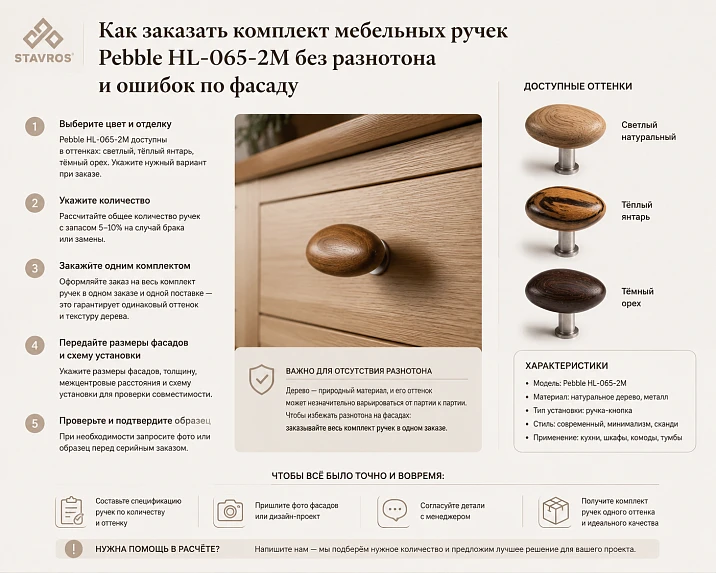
Wooden furniture handles are often chosen by photo and ordered one by one: first a few for ready-made facades, then another for an extra drawer, and a few months later a replacement for a damaged part. For metal serial fittings, this approach sometimes goes unnoticed. With natural wood, it creates a risk: the grain pattern, shade depth, and surface character can vary even within the same species. Therefore, it is better to calculate the entire set of furniture handles for a kitchen, chest of drawers, wardrobe, or closet completely and order them at the same time.
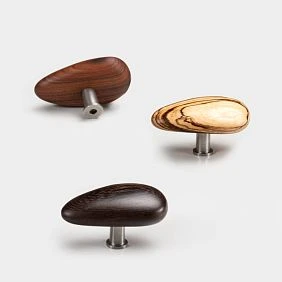
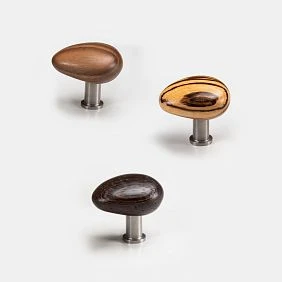
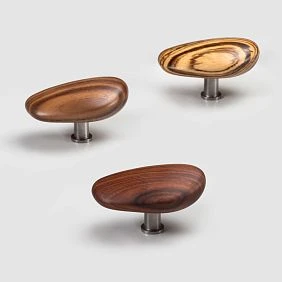
Pebble HL-065-2M is a round furniture knob handle measuring 42 × 38 × 38 mm. Its wooden part resembles a water-smooth stone, and the base is made of stainless steel. The model is offered in four wood options: walnut, wenge, zebrano, and rosewood. This combination makes the handle noticeable but does not turn the facade into an overloaded decorative composition: the shape remains concise, while the natural pattern and wood shade create individuality.
The main task before ordering is not just to choose a beautiful wood species. You need to count all doors and drawers, determine the handle position on each facade, check existing holes, coordinate the wood with the furniture color and metal parts, and then add a reasonable reserve. It is especially important to inform in advance that all items are intended for one set and will be located nearby: this helps formulate a request for a visually uniform set.
The article will help you understand where a round handle looks more appropriate than an elongated bracket, how a 42 mm size is perceived on facades of different formats, how walnut, wenge, zebrano, and rosewood differ specifically in a furniture project, how many handles to include in an order, and why it is better to purchase spare handles together with the main batch. Before placing an order, please check the current wood options, configuration, coating, availability, and price in the product card.
Short answer. First, count all doors and drawers, then add one or two spare handles. For a large set or commercial project, the reserve may be larger, but it is determined by the scale of the order. It is best to order all Pebble HL-065-2M handles for one piece of furniture at the same time, specifying the selected wood, facade color, and the requirement to select items for a single project. If the facade already has holes, be sure to check before purchase whether single-point mounting is suitable.
You can view specifications and current options in the product card to buy the Pebble HL-065-2M handle in the required quantity.
Why it is better to buy wooden handles as a set
Natural wood does not look like solid-colored plastic or painted metal. In each piece, the direction of the fibers, contrast of stripes, local darkening, and overall tone vary slightly. This is not a defect but a normal property of the material. However, on a kitchen or dresser, the handles are in the same plane and regularly come into view simultaneously. Differences that are unnoticeable in a single photo can become obvious in a row of six, ten, or twenty items.
Buying as a set does not mean that all handles must become visually identical. Wood retains natural variability. The task is different: to obtain a consistent row where differences are perceived as part of the same wood species, not as a random mix of shades. To achieve this, it is useful to order the entire quantity at once, indicate that the items will be installed next to each other, and not split one furniture project into several unrelated orders.
Tonal variation is especially noticeable on solid-colored facades. A white, light gray, or graphite surface acts as a neutral background and highlights each handle. On veneered furniture, some differences may blend into the facade's own pattern, but here another task arises: to avoid conflict between two active textures. Therefore, the decision about the wood species and completeness cannot be reduced to choosing a name in the product card.
A spare handle purchased together with the main set is also part of the system. It can be stored as a replacement in case of damage, facade rearrangement, or furniture expansion. Buying such a part a year later does not guarantee a perfect match with the installed items: the specific wood grain may differ, and the perception of already mounted handles can change due to light and wear.




What is the Pebble HL-065-2M
The Pebble HL-065-2M is a knob handle. Unlike a pull handle, which has an elongated grip area and two mounting points, this model is perceived as a compact volumetric element. The size 42 × 38 × 38 mm creates a noticeable but local accent. The rounded biomorphic shape works particularly well where furniture is built on clean planes, soft radii, or natural materials.
The wooden part is combined with a stainless steel base. This design allows linking the natural texture with adjacent metal elements: hinges, legs, profiles, lights, appliances, or plumbing fixtures. However, the mere presence of steel does not guarantee an automatic match in color and gloss. The base should be evaluated alongside the specific hardware of the project.
The model is available in walnut, wenge, zebrano, and rosewood options. The product listing also specifies the finished coating and mounting kit. Before purchasing, these details should be rechecked in the current product card, as availability and configuration may change. Do not independently attribute a specific type of varnish, coating thickness, screw length, or compatibility with any facade thickness to the product unless these parameters are confirmed.
| Parameter | Pebble HL-065-2M | What to check before ordering |
|---|---|---|
| Type | Furniture knob handle | Is the compact shape suitable for the facade opening method |
| Size | 42 × 38 × 38 mm | Scale on the facade and finger clearance |
| Mounting | Single-point | Number and location of existing holes |
| Base | Stainless steel | Combination with loops, profiles, and other metal fittings |
| Wood | Walnut, wenge, zebrano, rosewood | Actual shade next to the facade and batch uniformity |
| Finish | Finished coating is indicated in the product diagram | Current version and care recommendations in the card |
| Mounting kit | Indicated in the product diagram | Compliance with the thickness of a specific facade |
Our factory also produces:

Why the 'smooth stone' shape changes the perception of furniture
Pebble does not have the strict rectangular geometry of a regular handle. The handle looks like a small natural object, so the facade is perceived as softer. On furniture with straight lines, this shape creates a controlled contrast: the body remains architectural, while the touch point becomes more plastic. On radius furniture, the handle, on the contrary, continues the existing logic of the shape.
Biomorphism does not mean that the handle is only suitable for interiors with a lot of wood. It can work on painted facades, matte enamel, solid veneer, or calm decorative panels. What matters is not the stylistic label, but the relationship of scale and texture. One round knob on a small drawer looks like a finished center. Two knobs on a wide facade create symmetry. A row of identical elements in a kitchen turns into a repeating motif.
Active wood, such as zebrano, enhances the object-like character. More subdued walnut integrates more easily into neutral furniture. Wenge forms a dark spot on a light background, while rosewood can become part of a rich cabinet or executive composition. These descriptions help narrow down the choice, but do not replace checking a physical sample: the image on the screen depends on lighting and monitor settings.
Get Consultation
Where a knob handle looks more appropriate than a pull
A knob handle is especially convenient as a compositional solution on small facades where an elongated pull takes up too much space or visually fragments the surface. This applies to compact pull-out drawers, bedside tables, small cabinet doors, upper kitchen sections, and furniture inserts. The knob leaves more free surface around it and allows the facade material to be shown.
On a chest of drawers, round knobs help create a single axis along the centers of the drawers. On paired wardrobe doors, they form a mirror pair near the opening line. On a display cabinet or sideboard, the wood texture of the knob can support the shelves, countertop, or interior trim. In a walk-in closet, a set of identical knobs connects different modules, even if their facades differ in width.
A pull may be more practical where a long grip zone is needed, where the facade is large and heavy, or where two holes already exist that are not planned to be repaired. Pebble HL-065-2M should not be seen as a universal replacement for any hardware. The choice should be made after assessing the facade size, opening mechanism, edge placement, and habitual grip.
For a wider selection of designs, you can view wooden furniture handles and compare knobs, elongated models, and other options.
How the 42 mm size looks on facades of different formats
The size of a handle cannot be evaluated separately from the facade. On a narrow 42 mm drawer, handles can be perceived as an expressive center, while on a tall door, the same volume becomes a small dot. Therefore, before ordering, it is useful to make a simple mockup: cut out a silhouette of the appropriate size from thick paper or cardboard, attach it to the facade, and look at the furniture from a normal distance.
The mockup does not convey depth and texture, but helps to check the placement. You can see if the handle is too close to the edge, conflicts with the adjacent door, is comfortable to reach, and whether the axes align on multiple drawers. In the kitchen, it is especially important to evaluate the entire row, not just one module: a small offset repeated on ten facades becomes a noticeable error.
| Facade type | Possible scheme with HL-065-2M | What to Check |
|---|---|---|
| Small box | One handle in the center | Free grip and visual balance |
| Wide drawer | One handle in the center or two symmetrical | The width of the facade, load, and user habit |
| Tall door | Handle closer to the opening edge | Installation height and distance to the adjacent facade |
| Paired doors | Mirror arrangement of two handles | Matching height and identical indentation |
| Kitchen set | Unified height system for identical modules | Common pattern of the entire facade line |
| Commode | Single vertical axis across all drawers | Different drawer heights and marking accuracy |
| Wardrobe or dressing room | Repetition of handles on a group of doors | Convenience for users of different heights |
Single-point mounting: what to check before purchase
Single-point mounting simplifies the layout geometry but does not eliminate the need for precision. For new furniture, you need to determine the hole coordinate in advance and repeat it on all identical fronts. For existing furniture, first check how many holes are already present. If a knob handle was previously installed, the new product may fit the general mounting logic, but you must verify the hole diameter, front thickness, fastener length, and base fit.
If a pull handle was previously used, two holes usually remain on the front. Installing the Pebble HL-065-2M into one of the existing points does not solve the problem of the second hole. It will remain visible or require professional surface repair. Restoration methods differ for veneer, solid wood, enamel, and laminated material, so a simple replacement without a trace cannot be guaranteed.
Another risk is installation too close to the edge. The base and wooden part must be positioned so that the handle does not touch the adjacent front or obstruct its opening. On paired doors, check the gap between the two handles. On drawers, assess whether fingers will hit the decorative profile or countertop overhang.
How to replace old handles without damaging the front
Replacing hardware seems simple only until the old handle is removed. After disassembly, you may find a dented area around the base, a mark from the coating, two holes instead of one, a chip on the edge, or a color difference between the exposed and covered part of the front. Therefore, before ordering a full set, it is useful to remove one old handle from the least noticeable spot and inspect the surface.
If there is one hole in a suitable location, the remaining task is to check the fit and fastening. If there are two holes, first decide whether the front will be repaired, repainted, covered with a decorative overlay, or replaced. Buying a set of new knobs before this decision is risky: after repair, the desired installation coordinate may change.
For custom furniture, the issue is easier to resolve at the drawing stage. The designer or front manufacturer places one hole in the required location, and the handle becomes part of the specification. In this case, it is important to provide accurate model data and not replace it with other hardware after the fronts are made without rechecking.
How to calculate the number of handles
The basic calculation starts with an inventory of the furniture. You need to separately count hinged doors, drawers, drop-down fronts, and additional modules. Then determine whether one handle will be installed everywhere. For a very wide drawer, the design may include two symmetrical points, so the simple number of fronts does not always equal the number of items.
After calculating the working quantity, add a reserve. For a small dresser, one spare handle is usually sufficient. For a kitchen with many modules, a walk-in closet, or a commercial project, it is reasonable to consider two or more spare parts. The specific reserve depends on the scale of the furniture, the likelihood of expansion, model availability, and customer requirements.
Basic formula: number of doors + number of drawers + additional handles on wide fronts + reserve.
A spare cannot be considered an unnecessary purchase without a function. It preserves the ability to replace a part without having to match the wood to an already installed row after several years. Spare handles should be stored in a dry place, protected from impacts, along with information about the article number and wood variant.
| Example of furniture | Working quantity | Recommended reserve principle | Pre-order |
|---|---|---|---|
| Bedside table with two drawers | 2 | 1 spare handle | 3 |
| Chest of drawers with six drawers | 6 | 1 spare handle | 7 |
| Wardrobe with four doors and two drawers | 6 | 1–2 spare handles | 7–8 |
| Kitchen with ten doors and eight drawers | 18, if each facade has one | 2 spare handles | 20 |
| Wide chest of drawers: four drawers, two handles each | 8 | 1–2 spare handles | 9–10 |
| Walk-in closet with several sections | According to the full list of facades | The reserve is determined by the scale of the project | Working quantity plus agreed reserve |
These are calculation examples, not universal standards. Before ordering, you need to check the actual furniture drawing and decide how many opening points are required on each facade.
Why the reserve should be purchased together with the main set
The main reason is wood. Even if the name of the option remains the same, the future part may differ in grain and tone. Ordering at the same time increases the chance of forming a consistent group and allows you to immediately check the entire set under the same lighting. A spare handle from this batch will be closer to the installed products than a random purchase after a long time.
The second reason is specification preservation. The owner retains the exact model, required wood species, and mounting kit. When the spare is stored together with the furniture documents, replacement does not turn into a repeated search. This is especially useful for hotels, salons, offices, and rental properties where damaged hardware needs to be replaced without lengthy coordination.
The reserve does not necessarily need to be displayed. It is labeled, packaged, and stored separately. Do not leave a wooden handle near a moisture source, heating appliance, or in a place where it can be easily scratched. It is best to check the exact storage and care conditions with the manufacturer's recommendations.
How to avoid visual tone variation
It is impossible and unnecessary to completely eliminate the natural variability of wood. The goal is different: to make the differences manageable. To do this, order the entire set as one batch, indicate that the handles are intended for one project, and ask for visually matching adjacent products as a single group. The closer the handles are located to each other, the more important such information is.
After receiving the set, lay it out on a neutral surface and evaluate it under the same lighting. Do not compare some handles by the window and others under a warm lamp: light changes the perception of wood. Then the products can be distributed across the facades. Place those with similar grain next to each other, and a naturally different part on a separate module where it will not disrupt the rhythm.
Do not mix different wood options in one continuous row without a deliberate design intent. Walnut, wenge, zebrano, and rosewood have different characters. Random alternation will look like an incomplete set rather than a thoughtful composition. If the project actually uses multiple wood species, their distribution should be planned in advance: for example, one color for upper facades, another for a freestanding sideboard.
- Order all working and spare handles at the same time.
- Indicate that they are installed next to each other on the same set.
- Do not evaluate the shade only by the image on the screen.
- Check the entire set under the same light.
- Do not mix leftovers from different orders without pre-laying them out.
- Keep the article number and wood name together with the spare part.
Walnut: a calm natural base
Walnut within this model can be considered a versatile option in character for warm neutral facades. It can support milky, beige, gray-beige colors, natural veneer, and other calm surfaces. On light enamel, walnut becomes a noticeable warm point, but usually does not create as sharp a contrast as wenge.
On a facade with its own wood texture, you need to compare the direction and activity of the pattern. Two different woods can complement each other if one is calmer, or compete if both have expressive stripes. Therefore, the name "walnut" alone does not guarantee a match with walnut furniture: the shades of materials and coatings vary among different manufacturers.
The overall tone is especially important for a set. Several handles with naturally different patterns look organic when united by a similar color. Before purchasing, it is useful to hold a physical sample against the facade or request an available verification method from STAVROS.
Wenge: a dark point on a light facade
Wenge is suitable for projects where the handle should read contrastingly. On a white, light gray, or light wood facade, a dark button emphasizes each opening point. Such a rhythm can be a strong advantage on a minimalist kitchen or dresser, but it also makes layout errors more noticeable. All handles must be on aligned axes.
On dark furniture, wenge works differently: the contrast decreases, and the shape, the gleam of the metal base, and the difference in textures come to the forefront. To prevent the handle from getting lost, it is evaluated not only from the front but also under side lighting. In a project with black or graphite hardware, it is separately checked whether the stainless steel base conflicts with the chosen metal system.
The phrase "veneer handles in wenge" does not imply absolute uniformity. Natural wood retains its grain, so the set must also be evaluated as a whole.
Zebrano: active pattern for a calm background
Zebrano is distinguished by its expressive striped character. On a monochrome facade, the handle can become a small decorative detail that replaces a more complex ornament. On a surface with active veneer or stone pattern, there is a risk of visual noise: the stripes of the handle compete with the background, and the compact element ceases to be perceived as a whole.
In a zebrano set, the distribution of the pattern is especially important. Natural stripes do not have to match, but adjacent handles should look like parts of one series. Before installation, they are laid out in the order in which they will be installed. This avoids a situation where the two most contrasting details accidentally end up on paired doors.
It is reasonable to choose zebrano not based on a large product image, but on the scale of the actual furniture. In a photo, the handle takes up the entire screen, whereas on a facade measuring several tens of centimeters, it becomes a small dot. A mockup and a physical sample give a more honest representation.
Palisander: a rich detail for representative furniture
Palisander can be considered for dark, office, representative, or accent furniture. It can support a sideboard, library, display cabinet, desk, or wardrobe with a rich palette. However, it should not be automatically limited to a classic interior: the rounded shape of Pebble remains modern and can work on a laconic facade.
On a dark background, it is important to check whether the wooden part remains distinguishable. On a light facade, palisander becomes a strong point, so the number of handles and the distance between them affect the entire pattern of the furniture. In a long row, the rich shade repeats many times and is perceived more actively than a single handle on a sample.
Like other options, palisander needs to be evaluated physically. The screen does not convey the exact color, and the room's lighting can make the wood warmer, cooler, darker, or more contrasting.
Walnut, wenge, zebrano, or palisander: selection table
| Wood variant | Where to view | Main risk | What to Check |
|---|---|---|---|
| Walnut | Milky, beige, gray-beige facades, natural veneer | Mismatch with furniture that is only called 'walnut' | Real sample next to the facade |
| Wenge | White, light gray, light wood and contrasting facades | Too rigid rhythm or conflict with metal hardware | Entire row of handles and base made of stainless steel |
| Zebrawood | Solid color facades without active pattern | Visual noise on textured surface | Scale of stripes at a distance and layout of the set |
| Padauk | Dark, office, accent, or executive furniture | The handle gets lost on a too dark background or becomes overly active on a light one | Contrast in daylight and artificial lighting |
The table helps form a preliminary selection but does not replace physical verification. To see the actual finishes and buy the Pebble HL-065-2M handle, it is necessary to check the product card before ordering.
Why the screen does not replace a physical sample
The color on the screen depends on the camera, photo processing, display brightness, color profile, and ambient lighting. The same wood option may look warmer on a phone, cooler on a laptop, and significantly darker in a room with yellow lamps. Therefore, the image is useful for choosing a general direction, but not for final shade approval.
Physical verification is especially important when handles need to match the color of existing veneer, countertop, parquet, or wooden legs. Even the same species name does not guarantee a match: the facade material may be tinted, printed, or coated with a different composition. The goal is not always a perfect match. Sometimes it is better to choose a deliberate contrast than to get almost identical but conflicting shades.
When viewing a sample, it is useful to evaluate it under several conditions: by the window during the day, under the main evening lighting, and next to the furniture's built-in lighting. The handle is a small three-dimensional object, so side lighting reveals the shape's relief and metal base differently than a frontal photograph.
How to combine the wooden part with stainless steel
The metal base makes the Pebble HL-065-2M a combined "wood and metal" handle. It connects the natural form with the technical part of the furniture. In the kitchen, the base can echo household appliances, the faucet, profiles, and lights. On a dresser, it can match the legs, mirror frame, or decorative details. In a wardrobe, it can coordinate with hinges, rods, and tracks if they remain visible.
However, stainless steel can look different visually: matte, polished, warm or cool in reflection. The source data confirms the base material but not the specific degree of gloss in each available finish. Therefore, an exact match with any appliance or hardware should not be promised. Comparison should be made against an actual sample.
If the entire metal system in the interior is black, bronze, or brass, the steel base can become an independent contrast. This is not necessarily a mistake, but such a decision should be deliberate. On a small dresser, the difference may appear as a subtle detail, while in a kitchen with twenty handles, it will repeat many times and become a noticeable part of the palette.
For a more in-depth analysis of another design, you can read how to combine a wooden insert and metal on the facade. That article refers to a long handle with an insert, whereas here we are considering the round Pebble HL-065-2M.
Pebble HL-065-2M on kitchen facades
The kitchen is the most demanding scenario for completeness. In one room, there may be upper doors, lower cabinets, pull-out drawers, a tall pantry, and a separate island. If all of them receive the same handles, the quantity quickly adds up. Therefore, a list for each module should be compiled first, rather than counting facades by eye.
The round knob maintains a clean facade plane well and can support a modern kitchen with natural motifs. Walnut adds a warm tone, wenge creates contrast, zebrano provides an active pattern, and palisander makes the opening points richer. But the solution should be checked in the overall composition: twenty identical accents are perceived more strongly than a single sample.
For upper facades, the installation height and ease of grip are evaluated. For lower drawers, the hand position and distance to the countertop are considered. On corner modules, it is checked whether the handles of adjacent doors collide. On a dishwasher or built-in appliance, the same layout cannot be automatically used without coordination with the facade design and the furniture manufacturer's requirements.
In the kitchen, maintenance is also important. The original layout specifies the finished coating, but the exact restrictions on household chemicals should be verified in the product card or with a manager. Aggressive agents should not be used just because there is a metal base nearby: the wooden part requires separate attention.
Set for a dresser and bedside table
A dresser makes the rhythm of handles especially clear. If all drawers are the same width, the knobs are usually aligned along one vertical axis. If the drawers differ, the center of each facade can shift the overall pattern. Before drilling, it is useful to mark the points with painter's tape and look at the furniture as a whole.
On a wide drawer, two layouts are possible: one handle in the center or two symmetrical ones. The decision depends on the design, width, ease of opening, and visual task. It cannot be stated that 42 mm is sufficient for any large drawer. The furniture manufacturer must evaluate the facade mechanics and the load on the hardware.
For a pair of bedside tables, it is better to order handles as one set, even if each piece of furniture has only two items. The tables stand symmetrically by the bed, so a difference in shade between the left and right item may be more noticeable than on a single dresser. It is logical to add one spare handle to the overall order.
Additional placement scenarios are covered in the material on how to choose handles for a dresser and drawers.
Handles for a wardrobe and dressing room
In a wardrobe, handles are often arranged in vertical pairs on tall doors. Their height should be convenient for all users, and the distance from the edge should be uniform. If the dressing room consists of several sections, a single model helps connect different furniture: closed cabinets, drawers, mezzanines, and nightstands.
On a tall facade, a 42 mm size looks more compact than on a small drawer. This can be an advantage when a calm surface is desired. However, before ordering, it is worth checking the grip on a full-size mockup. If the door is large or has a tight mechanism, the choice of hardware should consider the construction, not just the appearance.
In a walk-in closet, natural wood interacts well with shelves and wood-like finishes. However, close but mismatched shades can create an undesirable effect. For furniture with an active pattern, either a calm handle or a deliberately contrasting option is chosen. "Almost matching" requires particularly careful sample checking.
The quantity is calculated for each door and drawer, including top sections that are often forgotten in the first step. It is better to include a reserve right away: expanding a walk-in closet with an additional module is more common than for a standalone chest of drawers.
Can Pebble be used on bathroom furniture
In the semantic scheme, bathroom furniture is listed as a possible application scenario for knob handles, but this does not automatically mean suitability for any wet area. Before ordering, you need to check the recommendations for use, coating, contact with water, and care. Conditions in a bathroom vary: one thing is a cabinet in a well-ventilated room, another is a facade near the shower area.
Also check the combination of the stainless steel base with the faucet, mirror frame, and other metal elements. If all the plumbing has a different finish, the steel base will be perceived as an additional metal. This decision is evaluated on a sample.
Do not promise resistance to constant wetting, steam, or aggressive cleaning agents without confirmed data. A safe strategy is to check the current product card and get STAVROS recommendations for specific conditions.
Pebble in a sideboard, display cabinet, and office furniture
On a sideboard and display cabinet, the handle becomes part of the object's image. Walnut can support warm wood, rosewood a rich office palette, wenge a contrasting modern composition, and zebrano a solid facade with a small active pattern. Unlike in a kitchen, there are usually fewer handles here, so each detail gets more attention.
On a glass or framed door, the attachment point is especially important. Pebble cannot be automatically installed on any structure: the furniture manufacturer must provide a suitable area on the facade. If the handle is placed on a wooden frame, its size and base are correlated with the width of that frame.
For a home office or library, it's useful to evaluate a handle next to a desk lamp. Dark woods may appear deeper under local lighting, while a metal base may reflect the lamp more strongly. The set is laid out in the same order in which it will be installed on the furniture.
One or two handles on a wide drawer
A wide drawer doesn't always require two handles, and a single knob isn't always convenient. The solution depends on the width of the front, the slides, the weight of the contents, and the furniture construction. Two symmetrical handles create visual balance and provide two grip points, but double the number of items and require more complex marking.
A single handle in the center maintains minimalism. However, on a very wide front, it may look too small or cause warping when opening if the furniture mechanism isn't designed for such a grip. These issues should be assessed by the furniture manufacturer. The 42 mm size alone doesn't provide an answer.
If two handles are chosen, they are counted as separate units. For example, four wide drawers will require eight working handles, not four. Then a reserve is added. Before drilling, a template is made so that the distance between the two points is repeated on all fronts.
How to align identical axes on all fronts
Even a high-quality set won't fix inaccurate marking. In a kitchen or dresser, the eye quickly notices when one handle is higher or closer to the edge. Therefore, coordinates are set not "roughly centered," but according to a template or drawing. For identical fronts, one system of offsets is used; for different ones, a rule is determined in advance.
On paired doors, mirroring is important. Handles should be at the same height and at the same distance from the central gap. On drawers, they should align on the vertical axis. If some modules have a framed front and others a flat one, it's necessary to decide whether the position is tied to the overall height or to the inner panel.
Before drilling, mock-ups are attached with painter's tape, and you step back a few meters from the furniture. This view shows the overall composition better than measuring one door up close. After approving the handle positions, a template is created and checked on each type of front.
Ergonomics: what can be checked without guesswork
Convenience cannot be assessed solely by a photo or the size 42 × 38 × 38 mm. Users have different palm sizes, habitual grips, and installation heights. Therefore, the best practical test is a physical sample or a full-size mockup placed at the intended location.
Check whether there is enough free space between the handle and the facade, whether fingers hit the edge, whether it is comfortable to open the upper and lower modules, and whether clothing catches on the protruding part. For children's furniture, the height and operating conditions are assessed separately, without making unsubstantiated safety claims.
If the handle is intended for a heavy or large door, the decision is coordinated with the furniture manufacturer. Pebble HL-065-2M is a specific piece of furniture hardware, but the source data does not contain permissible load standards or universal compatibility with all mechanisms.
Other proportions of the Pebble series
HL-065-2M is not the only proportion of Pebble. The confirmed cross-linking indicates an elongated model HL-065-1M with dimensions 67 × 41 × 38 mm. It suits a buyer who needs a more elongated accent and a different visual connection with a wide facade. You can view the elongated Pebble HL-065-1M handle and compare the sizes on the current product card.
Also in the series there is a neighboring model HL-065-3M. It should be considered as a separate proportion, not automatically mixed in the same set with HL-065-2M. To explore the option, you can select the Pebble HL-065-3M handle.
The point of this section is not to compare the three models on a 'better or worse' basis. The buyer needs to understand whether the compact round HL-065-2M matches the scale of the facade. If it seems too spot-like, it is worth checking other proportions before placing the full order, rather than changing the model after drilling holes.
What to buy and check together with the handle set
A handle does not exist separately from the facade and mounting. Before ordering, you need to check the thickness of doors and drawers, hole placement, type of adjacent hardware, and the furniture's readiness for installation. The original diagram has no confirmed URLs for specific hinges, screws, or mounting templates, so such items cannot be arbitrarily added to the cross-linking.
It is useful to simultaneously determine whether a complete set of ready-made handles with coating is needed or a product for self-finishing. Pebble HL-065-2M belongs to the section of handles with coating. To compare available ready-made options, you can select furniture handles with coating.
| What to check or add | Why this is needed | For which scenario | What to pay attention to |
|---|---|---|---|
| Spare HL-065-2M | Replacement of a damaged part without searching for another batch | Kitchen, wardrobe, commercial furniture | Order simultaneously with the main set |
| Facade drawing | Accurate calculation and unified markup | Any new furniture project | Separately count wide drawers with two handles |
| Physical wood sample | Check of shade and grain | Wood-look facades, complex palette | View in daylight and evening light |
| Samples of metal hardware | Approval of stainless steel base | Kitchen, bathroom, furniture on metal legs | Do not assume automatic coverage matching |
| Layout template | Repeating identical coordinates | Dresser, kitchen, cabinet, serial furniture | Check the template on each facade type |
| Solution for repairing old holes | Transition from bracket to button | Updating finished furniture | Do not buy the set before evaluating the facade |
How not to confuse HL-065-2M with similar handles
When searching by the name Pebble, it's easy to focus on the shape and miss the model index. For ordering, you need to record the full article number HL-065-2M, size 42 × 38 × 38 mm, selected wood, and quantity. Neighboring models in the series have different proportions, so an image without an article number is not suitable for specification.
Do not confuse a solid round knob with an elongated handle with an insert. Both designs can combine wood and metal, but they look different on the facade, require different markings, and create a different grip. The article about the handle with an insert is useful for an alternative scenario, but its recommendations cannot be automatically transferred to Pebble.
It is also important to distinguish a finished handle with a coating from a blank for self-enameling or tinting. The original product scheme for HL-065-2M specifies a finished coating. Before ordering, the current version should be checked in the product card. The buyer does not need to plan for self-painting without ensuring that the specific version is intended for this.
How to accept the set after delivery
Before installation, carefully open all packages and check the quantity. Compare the working and spare handles with the order: article number, wood option, completeness, and absence of visible damage. If the products are immediately distributed across several rooms, it is better to first gather them in one place and evaluate them as a single batch.
Then, lay out the handles under the same lighting. Natural differences in wood are acceptable, but the buyer should understand how they will look in a row. Paired or adjacent products can be matched by grain similarity. For a kitchen, it is useful to number the handles and facades on a temporary diagram before starting installation.
Do not use fasteners blindly. Check their compatibility with the facade thickness before tightening. Excessive force can damage the furniture or hardware, so installation should be carried out according to the instructions and considering the facade design. If information is insufficient, contact the furniture manufacturer or a STAVROS manager.
Storage of the set before installation
If the furniture is still being produced, the handles may be stored for some time. Leave them in protective packaging, do not stack wooden surfaces against each other without padding, and do not place them near moisture or heat sources. Mark spare products separately so they do not get lost among construction materials.
Do not use handles as samples on site without protection and then return them to the finished set: the surface may get scratches or dirt. For approval, it is better to set aside one piece and store it in a separate bag.
Precise storage recommendations depend on the coating and must be confirmed by the manufacturer. The general goal is to keep the entire set in the condition it was received until the moment of installation.
Care for a wooden handle with a metal base
The combined design requires considering both parts. A product safe for stainless steel is not necessarily suitable for the finished wood coating. Therefore, abrasives, solvents, or harsh household chemicals should not be used without verification. For regular care, a gentle method is preferred, following the recommendations from the current card or instructions.
In the kitchen, it is better to remove dirt promptly, without leaving moisture on the surface. In the bathroom, it is especially important to adhere to confirmed operating conditions. If the coating is damaged, DIY repair may change the shade of one handle relative to the set. In such a situation, a spare part purchased with the main batch is more practical than random restoration.
Main mistakes when ordering Pebble HL-065-2M
Buying handles one by one
Several consecutive orders increase the risk of noticeable differences in natural wood. It is better to calculate the full set and reserve in advance.
Counting only the number of fronts
For wide drawers, the design may include two handles. Reserve and future additional modules are considered separately.
Choosing wood by screen
The monitor does not convey the exact shade. Matching 'tone on tone' to veneer or countertop without physical comparison is especially risky.
Do not report that products are installed nearby
For visual batch matching, it is important to designate a single project. Handles for different furniture items can be distributed more freely than a row on one kitchen.
Ignore existing holes
A single-point button does not automatically close two holes from an old bracket. First, address the facade repair issue.
Do not check metal
The stainless steel base may differ from black, bronze, or brass hardware. Compatibility is assessed visually.
Drill without a template
Even a small deviation becomes noticeable in a row. Marking is checked on all furniture before irreversible work.
Do not buy spare
Late replacement may differ in wood grain pattern. One or two additional handles are usually simpler than a repeated selection.
Mix Pebble models without a project
HL-065-1M, HL-065-2M and HL-065-3M have different proportions. Their combination should be part of the drawing, not a consequence of product shortage.
Assume the versatility of the fastener
The completeness is indicated in the diagram, but the compliance with the thickness of a specific facade must be checked before installation.
Who is this set suitable for
Pebble HL-065-2M should be considered by the owner of a kitchen, chest of drawers, cabinet, wardrobe or dressing room who wants to use natural wood as a repeating accent. The model is suitable for projects with soft geometry, natural materials, laconic facades and a combination of wood with metal.
The set is especially useful for new furniture, where a single-point hole can be included in the drawing. It is also suitable for updating facades if the previous hardware had one hole or the furniture is planned to be repaired. For a commercial project, the advantage is the ability to immediately form a working quantity and stock.
When it's better to choose another option
Another handle should be considered if the facade already has two holes from a bracket and no repair is planned; if the user needs a long grip area; if the 42 mm size is lost on a large door; if the active wood texture conflicts with the facade; or if the stainless steel base does not fit into the metal palette.
In this case, you do not need to buy HL-065-2M just because of a liked photo. In the category, you can compare other designs and proportions, maintaining the commercial route within the confirmed STAVROS pages.
What to specify in the order
- Full article number Pebble HL-065-2M.
- Selected option: walnut, wenge, zebrano or rosewood.
- Number of hinged doors.
- Number of pull-out drawers.
- Facades requiring two handles each.
- Total working quantity.
- Number of spare items.
- Color and material of facades.
- Type of adjacent metal hardware.
- Information that all handles are intended for one project.
- Presence of one or two old holes when replacing.
- City of receipt and required deadlines to be confirmed before ordering.
This description reduces the risk of misunderstanding. It does not cancel checking the product card, but helps link the choice of breed, quantity, and installation into one specification.
How to buy a set on STAVROS
The first step is to open the card and check the current wood options, finish, configuration, price, and availability. Then verify the size 42 × 38 × 38 mm against the facade and ensure the single-point mounting suits the project. After that, calculate the total quantity with a reserve.
If the shade is critical, specify the facade color in the order and request to select handles for one furniture set. For a large project, it is useful to approve a sample. If the compact button does not fit the scale, compare other models in the series or view wooden furniture handles other designs.
Once all parameters are agreed upon, you can proceed to the card and buy the Pebble HL-065-2M handle immediately in the calculated quantity. Price and availability should only be taken from the current product page at the time of ordering.
Questions and Answers about Pebble HL-065-2M
How many Pebble HL-065-2M handles should be ordered for a dresser?
Count the number of drawers and determine if each will have one handle. If the dresser has six standard drawers, the working quantity usually starts at six. Then add one spare piece. For wide drawers with two grip points, calculate based on the actual facade layout.
Is it necessary to buy a spare handle?
There is no mandatory universal rule, but a spare is useful due to the natural variability of wood. A handle purchased later may differ in grain and shade. For a small piece of furniture, one spare part is often considered; for a large kitchen or wardrobe, two or more depending on the project scale.
Can walnut and wenge be mixed in one kitchen?
Only as a deliberate design technique. Randomly alternating two species in one row usually looks like an incomplete set. If the project uses two options, predefine a system: for example, one for the island, another for the main line of facades.
How to know if the 42 mm size will fit?
Make a full-size mockup of 42 × 38 mm and attach it to the facade. Evaluate the furniture up close and from a normal distance, check the hand position and free space near the edge. For an accurate assessment of shape and depth, it is better to use a physical sample.
Will HL-065-2M fit instead of the old pull handle?
Not always. A pull handle usually leaves two holes, while Pebble HL-065-2M uses a single-point mount. The second hole will need to be repaired or covered in another way. First, remove one old handle and assess the condition of the facade.
Can a handle be installed into an existing single hole?
The possibility depends on the diameter and location of the hole, the thickness of the facade, the base fit, and the fasteners. Matching the number of holes does not guarantee compatibility. All parameters must be checked before installation.
Which option to choose for white facades?
On a white background, any of the four options can be considered, but the character will be different. Wenge will create a strong dark contrast, walnut — warmer and softer, zebrano — an active striped pattern, rosewood — a rich accent. The final choice is made based on a sample.
What is better for a wood-look facade?
First, determine whether a close shade or contrast is needed. Almost matching wood tones can conflict more strongly than intentionally different ones. Compare the handle with the actual facade, because the same species name for different materials does not mean an exact match.
Can one handle be installed on a wide drawer?
Sometimes yes, but the decision depends on the width, guides, mass of contents, and furniture construction. On some facades, two symmetrical handles are more convenient. This issue should be coordinated with the furniture manufacturer before drilling.
How many handles are needed for a kitchen?
Make a list of all doors, drawers, tall cabinets, island facades, and built-in modules. Account for wide drawers where two handles are planned, then add a reserve. Do not use approximate counting based on a photo of the kitchen.
How to check the uniformity of a set?
Lay out all handles on a neutral surface under the same lighting. Compare the overall tone and distribute items with similar patterns to adjacent facades. Natural differences in wood are acceptable, but the row should be perceived as consistent.
Why can't you rely only on a photo?
The camera, processing, screen, and lighting change the shade. A photo shows the shape and general character but does not guarantee a match with the facade. For an accurate decision, a physical sample or an agreed method of verification is needed.
Is the handle suitable for bathroom furniture?
Such a scenario is only possible after checking recommendations for coating, humidity, and care. Resistance to constant wetting or aggressive chemicals cannot be automatically promised. The conditions of a specific bathroom should be discussed before ordering.
Can I repaint the handle myself?
The original scheme specifies a finished coating. Repainting should not be planned without confirmation that the specific version allows such treatment. For a different type of finish, it is better to choose a suitable product in the category and clarify recommendations.
Will the stainless steel of the base match the appliances?
Not necessarily. Stainless steel can vary in gloss and reflection. The base needs to be compared with the appliance, faucet, profiles, and other metal parts under real lighting.
How does HL-065-2M differ from HL-065-1M?
HL-065-2M has a compact size of 42 × 38 × 38 mm. For HL-065-1M, the size 67 × 41 × 38 mm is confirmed in the scheme, so it looks more elongated. The choice depends on the scale of the facade and the desired proportion.
Do I need to specify the facade color when ordering?
Yes, if you want to receive a coordinated set for a specific piece of furniture. The color and material of the facade help explain the task. However, remote selection still does not replace physical comparison when the shade is critical.
What is included in the mounting kit?
The product scheme indicates the presence of a mounting kit, but the exact composition and compatibility with the thickness of a specific facade must be checked in the current product card. Do not assume the screw length or universal compatibility on your own.
When is it better to choose a bracket instead of a button?
A bracket may be preferable for a large facade, a long grip zone, existing two holes, or a familiar opening mechanism. Pebble should be chosen when the compact form is confirmed by the layout and is convenient for the user.
Where to see other wooden handles?
The confirmed STAVROS category includes handles of different designs. Compare not only the appearance but also the dimensions, mounting, coating, and compatibility with the facade before placing an order.
What to do if one handle is damaged after installation?
Use a spare part from the same purchase if it is provided. That is why a spare is ordered together with the main set. If there is no spare, when reordering, you need to be prepared for a natural difference in the wood grain pattern.
How to store a spare handle?
Leave it in protective packaging, mark the article number and wood variant, store in a dry place away from impacts and heat sources. It is best to check the exact conditions with the manufacturer's recommendations.
Result: one project — one calculated set
Pebble HL-065-2M is not just a separate wooden knob handle that is convenient to buy as needed. In a kitchen, dresser, cabinet, or wardrobe, it works as a repeating element. Therefore, the quality of the result depends not only on the chosen wood species but also on the full calculation, simultaneous purchase, precise marking, and distribution of the natural grain across the facades.
Walnut, wenge, zebrano, and rosewood give four different characters. Walnut supports warm neutral surfaces, wenge creates a dark contrast, zebrano adds active stripes, rosewood forms a rich accent. No description replaces a physical sample: the final combination is checked next to the actual facade and metal parts.
Before ordering, count the doors and drawers, account for facades with two handles, add a reserve, check single-point mounting and existing holes. In the specification, indicate the full article number, wood, working quantity, reserve, and that all items are intended for one project. This approach reduces the risk of accidental color variation and repurchasing a mismatched part.
STAVROS allows you to move from a general selection of wooden fittings to a specific model card. Before placing an order, check the current options, price, coating, and configuration, after which you can buy the Pebble HL-065-2M handle immediately with a full set for the entire furniture.