Article Contents:
- Characteristics of R-024 and R-055
- What is a wooden decorative rosette and why is it needed
- Why R-024 and R-055 should be compared by thickness
- When to buy R-024
- When to buy R-055
- Comparison of all common sizes of R-024 and R-055
- Size 30 × 30 mm: small dot or geometric module
- Size 40 × 40 mm: choice for trim and frame
- Size 50 × 50 mm: almost identical depth, different character
- Size 60 × 60 mm: pedestal, cabinet or small door
- Size 70 × 70 mm: medium panel
- Size 80 × 80 mm: pronounced furniture decor
- Size 100 × 100 mm: large panel center
- Sizes 120 and 140 mm: only R-055
- Why R-024 appears thinner
- Why R-055 looks more architectural
- How to match a rosette to a furniture panel
- How to choose a rosette for a small facade
- How to choose a socket for a large facade
- Socket on a dresser drawer
- Socket on a cabinet door
- Socket on a sideboard
- Socket for a nightstand
- Socket for a bed and headboard
- How to choose a socket for a door casing
- How to use a socket at the intersection of moldings
- How to match the thickness of a socket with molding
- How to frame a mirror
- How to choose a socket for a pilaster
- Socket on a wall panel
- Socket for a portal
- Single socket or repeating composition
- How to use R-024 as a repeating pattern
- How to use R-055 in a geometric layout
- How to calculate the number of elements
- How to calculate the step in a repeating composition
- Beech for enamel
- Oak for tinting
- What to choose for white enamel
- What to choose for natural oak furniture
- Sanding "Standard" or "Prestige" for R-024
- Why R-055 is offered in the "Prestige" finish
- How to choose a finish for modern furniture
- How to choose a finish for classic furniture
- How to preserve the relief under paint
- Paint before or after installation
- How to use R-024 in the bedroom
- How to use R-055 in the living room
- How to choose for the hallway
- How to choose for the study
- How to choose for children's furniture
- How to choose for the kitchen
- How to choose for a commercial interior
- How to choose for repairing ready-made furniture
- How to choose for new custom-made furniture
- How to mark the center of a furniture facade
- How to mark multiple sockets symmetrically
- How to prepare the base
- How to choose the installation method
- Can a socket be glued to painted MDF
- How to temporarily test fit a socket
- How to install a socket next to a handle
- How to check the opening of an adjacent door
- How to design the inner corner of a frame
- How to design the outer corner or edge of a panel
- How to store sockets before installation
- How to accept goods upon delivery
- How to care for a painted socket
- How to care for tinted oak
- How to replace a damaged socket
- Mistake: choosing only by photo
- Error: not coordinating sanding R-024
- Error: mistaking sanding for finished finish
- Error: painting relief with too thick a layer
- Error: not checking glue on the coating
- Error: forgetting a spare part
- Who is R-024 suitable for
- Who is R-055 suitable for
- When it's better to choose a different model
- How not to confuse a socket with a large furniture overlay
- Practical choice: a small classic chest of drawers
- Practical choice: a modern cabinet without unnecessary decor
- Practical choice: a cabinet with paired doors
- Practical choice: a door with wooden moldings
- Practical choice: a trim about 50 mm wide
- Practical choice: a large wall panel
- Practical choice: a pilaster and a portal
- Practical choice: mirror frame
- Practical choice: art deco furniture
- Practical choice: calm modern classic
- Practical choice: natural oak interior
- Practical choice: commercial hall or showroom
- How to buy R-024 and R-055 at STAVROS
- Why a finished socket is better than a random blank
- What to buy with R-024 and R-055
- How to check the composition from a distance
- How to maintain consistent results on multiple facades
- How to create an order specification
- Do you need a spare socket
- How to estimate the cost of the entire composition
- Final check before ordering
- How to choose one size for the entire furniture collection
- Central outlet or elements in the corners
- How to match an outlet to already installed handles
- How to match an outlet to an existing trim
- How to check a large R-055 on the wall
- How to check R-024 on a small frame
- How to coordinate outlets with lighting
- How to save project data after installation
- How to decide between R-024 and R-055 without unnecessary risk
- Why it's worth keeping one spare part
- How to check the final selection on one control facade
- FAQ: questions about R-024 and R-055
- What is the difference between R-024 and R-055?
- Which model is thinner at the same width?
- What to choose for a small furniture facade?
- Which socket is suitable for a shallow panel?
- What to choose for a large wall panel?
- Can R-055 be used close together?
- Can R-024 be repeated?
- What size to choose for a door casing?
- Which model fits at the intersection of moldings?
- What to choose for a mirror frame?
- Which model is better for a pilaster?
- What to choose for white enamel?
- What to choose to preserve wood texture?
- What sanding options are available for R-024?
- Which sanding is confirmed for R-055?
- Do I need to paint the socket before installation?
- How to check the depth near the handle?
- Can a rosette be glued to painted MDF?
- How to calculate the quantity for a grid?
- Can R-024 and R-055 be mixed?
- Where to buy R-024?
- Where to buy R-055?
- Do I need to order in one batch?
- What to check before payment?
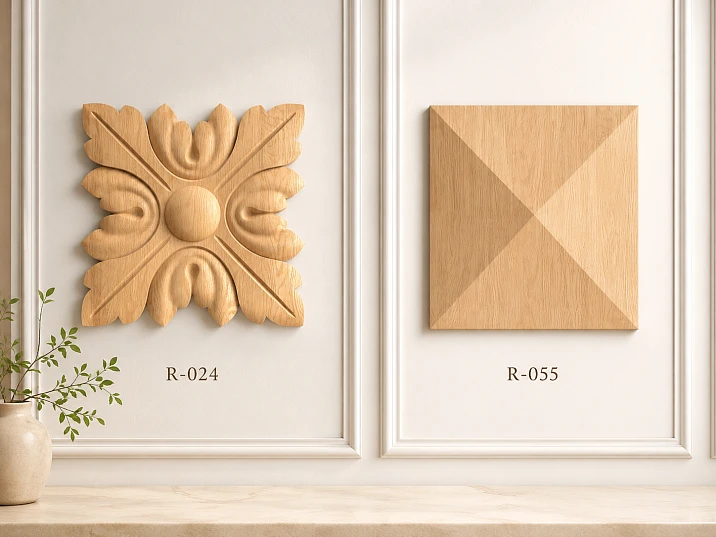
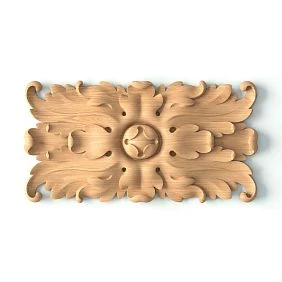
A wooden decorative rosette can be purchased for a furniture facade, casing, pilaster, door leaf, or wall panel, but the same width does not mean the same visual result. R-024 and R-055 are made from beech or oak, have a square format, and are available in seven common sizes from 30 to 100 mm. However, R-024 remains thinner, while R-055 protrudes more above the surface and creates a deeper geometric shadow.
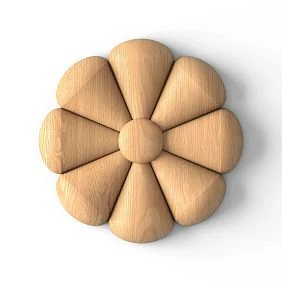
R-024 is suitable for a buyer who needs a neat central decor without excessive relief. The size range includes models 30 × 30 × 6, 40 × 40 × 7, 50 × 50 × 10, 60 × 60 × 10, 70 × 70 × 12, 80 × 80 × 14, and 100 × 100 × 18 mm. This rosette works well in a small panel, on a door casing, in a mirror frame, and in a composition where adjacent moldings should not be lost next to a deep element.
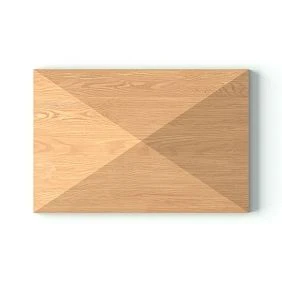
R-055 is a geometric pyramid rosette. With the same width and height, it is deeper: from 8 mm in size 30 × 30 to 21 mm in size 100 × 100. Additionally, the model continues with formats 120 × 120 × 25 and 140 × 140 × 29 mm. Therefore, it can be used not only as a separate point but also as a repeating square module, a large center of a wall panel, or an architectural decor of a portal.
The article helps to choose a specific article, size, and material, rather than just a "beautiful rosette from a photo." Below, common sizes 30–100 mm, thickness differences, combination with moldings and pilasters, placement on furniture and walls, repeating layouts, beech for enamel, oak for tinting, sanding, installation, and the commercial ordering route on STAVROS are analyzed.
Short answer. R-024 is worth buying when a thinner decorative element is needed for a small facade, casing, frame, or shallow panel. R-055 is chosen for strict geometry, strong chiaroscuro, sizes 120–140 mm, and a repeating composition of identical pyramids.
With the same width, R-024 is always thinner: the difference ranges from 1 to 3 mm in common sizes 30–100 mm. The closer the rosette is to a handle, panel edge, or protruding molding, the more important this difference becomes.
Buy wooden socket R-024 Buy geometric rosette R-055 buy decorative wooden rosettes
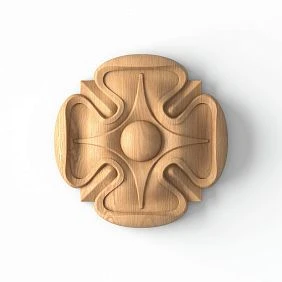
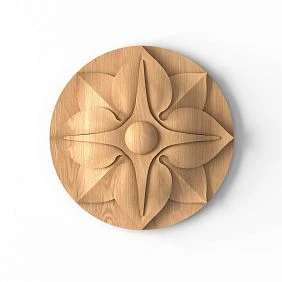
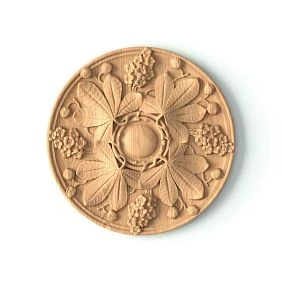
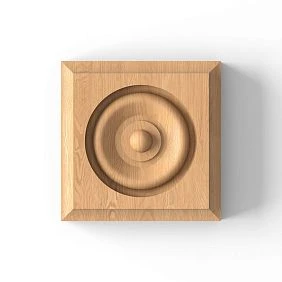
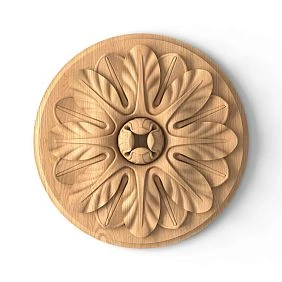
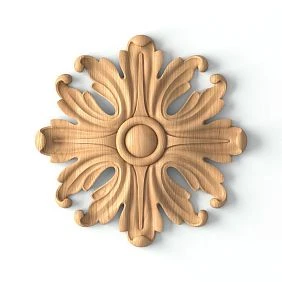
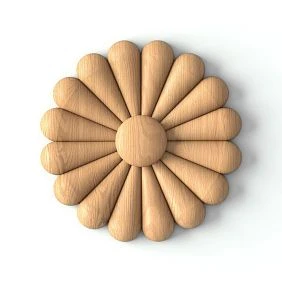
Characteristics of R-024 and R-055
| Parameter | R-024 | R-055 |
|---|---|---|
| Main idea | Thinner decorative socket | Geometric pyramid socket |
| Size range | 30–100 mm | 30–140 mm |
| Number of sizes | 7 | 9 |
| Thickness | 6–18 mm | 8–29 mm |
| Maximum size | 100 × 100 × 18 mm | 140 × 140 × 29 mm |
| Material | Beech or oak | Beech or oak |
| Sanding | "Standard" or "Prestige" | «Prestige» |
| Preparation | Beech under enamel, oak under tinting | Beech under enamel, oak under tinting |
| Visual effect | More delicate relief | Deeper geometric shadow |
| Placement | Central accent, frame, casing, small panel | Single accent, grid, repeat, portal, large panel |
| Strong scenario | Shallow panel and neat decor | Strict geometric composition |




What is a wooden decorative rosette and why is it needed
A wooden rosette is a compact carved or geometric element that covers an empty point on the facade, completes the intersection of moldings, and helps connect several parts into one system. It does not function as a handle, fastener, or load-bearing overlay: its task is to control shape, scale, and chiaroscuro.
On furniture, the rosette can become the center of a door, repeat on several facades, or support handles and moldings. On the casing, it emphasizes the corner or intersection of profiles. On a wall panel, the element turns a flat frame into a more complex architectural composition.
It is important for the buyer to distinguish a decorative rosette from a large overlay and a ceiling element. R-024 and R-055 are small square parts for furniture, doors, architraves, pilasters, and wall panels.
When you need to compare not two models, but an entire category, it is useful to study how to choose the size of a wooden rosette and then return to the specific pair R-024/R-055.
Our factory also produces:
Why R-024 and R-055 should be compared by thickness
The frontal size shows how much space the rosette will take on the facade. The thickness is responsible for the projection above the plane, the depth of the shadow, and the distance to the handle, molding, or adjacent door.
At a width of 30 mm, R-024 has a thickness of 6 mm, while R-055 has 8 mm. At a width of 100 mm, the difference is already 3 mm: 18 vs 21 mm. On paper, this is slight, but on a small furniture panel and with side lighting, the difference is immediately visible.
The thinner R-024 fits more easily into a narrow frame and calm furniture. R-055 more strongly emphasizes square geometry and reads better on a large panel.
Therefore, you cannot choose only by the size name. The full format is always considered as A × B × C.
Get Consultation
When to buy R-024
R-024 is suitable for a facade that requires carved central decor, but where a deep pyramidal shape would be excessive.
It is convenient for small doors, dresser drawers, door casings, mirror frames, pilasters, and molding intersections.
The size range up to 100 mm covers basic furniture tasks, and two sanding options allow you to choose the level of preparation in the relevant card.
For a project with a delicate relief, you can Buy wooden socket R-024, after checking the size, material, and sanding.
When to buy R-055
R-055 is chosen for a strict geometric facade, square layout, repeating ornament, large pilaster, and wall panel.
The pyramidal shape creates a strong shadow, and the 120 and 140 mm sizes allow you to go beyond ordinary furniture decor.
The model is especially convenient where one pattern should be repeated in several scales: on a nightstand, cabinet, door, and architectural panel.
For such a solution, you can Buy geometric rosette R-055 and choose a size from 30 to 140 mm.
Comparison of all common sizes of R-024 and R-055
| Width and height | R-024 | R-055 | Practical conclusion |
|---|---|---|---|
| Lightweight, well-readable | Thickness 6 mm | Thickness 8 mm | R-024 is more delicate, R-055 is more noticeable in the grid |
| 40 × 40 mm | Thickness 7 mm | Thickness 10 mm | The 3 mm difference matters on a narrow casing |
| 50 × 50 mm | Thickness 10 mm | Thickness 11 mm | Close in depth, but R-055 is more geometric |
| 60 × 60 mm | Thickness 10 mm | Thickness 13 mm | R-024 is calmer for the cabinet and wardrobe |
| 70 × 70 mm | Thickness 12 mm | Thickness 15 mm | R-055 works stronger on the middle panel |
| 80 × 80 mm | Thickness 14 mm | Thickness 17 mm | R-024 is easier to integrate into a furniture panel |
| 100 × 100 mm | Thickness 18 mm | Thickness 21 mm | R-055 provides a more architectural shadow |
| 120 × 120 mm | No confirmed variant | Thickness 25 mm | R-055 for large panel and portal |
| 140 × 140 mm | No confirmed variant | Thickness 29 mm | R-055 for a large architectural accent |
Size 30 × 30 mm: a small dot or geometric module
R-024 30 × 30 × 6 mm fits a small drawer, narrow frame, and delicate dot on a furniture piece. The small thickness helps maintain a calm silhouette.
R-055 30 × 30 × 8 mm is more noticeable in depth and works better in a repeating geometric grid.
On a small facade, the 2 mm difference feels stronger than on a wall panel. The socket is closer to the hand and frame edges.
For a single minimal accent, R-024 is often chosen; for modular repetition, R-055.
Size 40 × 40 mm: choice for trim and frame
R-024 40 × 40 × 7 mm fits a narrow trim, wooden mirror frame, and small intersection of moldings.
R-055 40 × 40 × 10 mm creates a deeper pyramid and requires additional space for protrusion.
The 3 mm difference matters if a door handle, wall edge, or another profile is nearby.
On a straight geometric frame, R-055 looks stricter, R-024 looks softer and less intrusive.
Size 50 × 50 mm: almost the same depth, different character
R-024 has dimensions 50 × 50 × 10 mm, R-055 — 50 × 50 × 11 mm. The depth difference is only 1 mm.
Here the choice is determined primarily by the pattern: R-024 is perceived as a more decorative rosette, R-055 — as a square pyramid.
Both models are suitable for a small furniture front, the center of a panel, and the intersection of moldings.
If the thickness is almost the same, the layout should show which motif best matches the furniture style.
Size 60 × 60 mm: cabinet, wardrobe, or small door
R-024 60 × 60 × 10 mm remains relatively flat and is convenient for a cabinet door, chest, or dresser.
R-055 60 × 60 × 13 mm creates a noticeable square shadow.
When placed next to a handle, the 3 mm difference may affect convenience.
For classic or soft upholstered furniture, R-024 is more suitable; for strict geometry, R-055.
Size 70 × 70 mm: medium panel
R-024 70 × 70 × 12 mm is suitable for the central decor of a medium panel.
R-055 70 × 70 × 15 mm protrudes more and turns the element into an independent geometric point.
Both models need to be checked against the frame width and the free field around.
If the rosette occupies almost the entire panel, it is better to reduce the size rather than shrink the margins to a random minimum.
Size 80 × 80 mm: pronounced furniture decor
R-024 80 × 80 × 14 mm is suitable for large facades, door panels, and wall frames.
R-055 80 × 80 × 17 mm creates a stronger relief and interacts more deeply with light.
On a cabinet or door, R-024 is easier to integrate next to moldings; R-055 requires a greater distance from the handle.
With the same area, the choice is influenced not only by the style but also by the allowable overhang above the surface.
Size 100 × 100 mm: large panel center
R-024 100 × 100 × 18 mm — maximum confirmed model format.
R-055 100 × 100 × 21 mm retains the same square but makes the center more architectural.
R-024 suits a large facade or a calm wall panel. R-055 works better in a portal, large panel, and geometric system.
At this size, the 3 mm difference is clearly noticeable under side lighting.
Sizes 120 and 140 mm: only R-055
Formats 120 × 120 × 25 and 140 × 140 × 29 mm are available only for R-055.
They suit a large pilaster, wooden portal, wide wall panel, and architectural composition.
Such a rosette no longer looks like a small furniture accent. It requires an open field and an appropriate scale of neighboring profiles.
Before ordering, the large square and depth are shown as a full-size layout on the wall.
Why R-024 is perceived as thinner
Despite all common formats, its depth is smaller.
The socket casts less shadow and blends more smoothly with a flat facade.
This is useful on furniture where a decorative detail should support the composition but not become the most protruding element.
A thin relief is also easier to match with a narrow molding and a shallow panel.
Why R-055 looks more architectural
The pyramid is built on straight edges and a central rise.
As the size increases, not only the area but also the thickness grows: up to 29 mm in the 140 mm format.
Side light creates a strong square shadow, so the element is readable from a greater distance.
This feature makes the R-055 suitable for wall panels, portals, and repeating geometric compositions.
How to choose a rosette for a furniture panel
First, measure the clear field inside the frame, not the overall door width. Molding, routing, and bevels reduce the available area.
There should be free space around the perimeter of the rosette so that the element does not look cramped.
R-024 is more suitable for shallow panels due to its smaller thickness. R-055 requires checking both width and projection.
A full-size paper square shows the area, while a three-dimensional model shows depth and shadow.
How to choose a rosette for a small facade
For a dresser drawer, cabinet door, and small wardrobe, sizes of 30, 40, or 50 mm are usually considered.
R-024 helps add decor without significant protrusion. R-055 creates a more noticeable geometric point.
If the facade already has a handle, molding, or panel, there should not be too many elements.
One control layout is better than a dozen photos because it shows the real proportion.
How to choose a socket for a large facade
On a wide door, a small socket may get lost.
R-024 ends with a size of 100 mm and suits a calm central accent.
R-055 offers 100, 120, and 140 mm and allows scaling up without changing the pattern.
A large element needs to be tied to the width of the moldings, handle, and facade height.
Socket on a dresser drawer
On a narrow drawer, the socket is placed in the center or a pair of symmetrical elements is used.
R-024 30–50 mm suits thin decor and does not overload the facade.
R-055 is appropriate if the dresser has a strict square geometry.
The socket should not fall into the natural grip zone of the handle or interfere with its extension.
Socket on the cabinet door
On paired doors, identical height and symmetry are especially important.
R-024 creates a softer center, R-055 emphasizes straight axes.
The size is chosen based on the free area inside the panel.
Before installation, both parts are temporarily fixed and inspected simultaneously.
Socket on the sideboard
A sideboard often combines panels, glass, moldings, and handles.
R-024 helps add a carved accent without competing with the rest of the decor.
R-055 suits updated art deco or a strict classical facade.
Size and thickness must align with the glass frame and furniture fittings.
Socket for the cabinet
On a small cabinet, a size of 30–50 mm is usually considered sufficient.
R-024 suits a thin central point, R-055 suits a geometric pair or row.
Sizes 80–100 mm are used only after a mockup: they can occupy almost the entire facade.
If the cabinet is in a narrow passage, the depth is checked especially carefully.
Socket for the bed and headboard
R-024 can frame the headboard, post, or central panel.
R-055 suits a square grid and geometric decor of the side rail or backrest.
Elements are placed outside the area of constant contact with pillows and textiles.
The material and finish are tied to the legs, moldings, and overall color of the bed.
How to choose a rosette for a door casing
The width of the casing should allow the square to be fully placed without overhang.
R-024 30 × 30 × 6 and 40 × 40 × 7 mm is convenient for narrow profiles.
R-055 of the same dimensions is deeper and stands out more at the intersection.
Before ordering, compare the width of the casing, the depth of its profile, and the position of the door handle.
How to use a rosette at the intersection of moldings
The rosette covers the ends of the vertical and horizontal profiles and turns the joint into a decorative node.
R-024 creates a smoother transition, R-055 creates a strict square point.
The size should cover the ends of the moldings with sufficient margin.
For a geometric frame, you can buy a wooden molding for the frame and check its dimensions together with the rosette.
How to match the thickness of the rosette with the molding
If the rosette is significantly deeper than the profile, it will become the main element of the intersection.
R-024 is easier to match with thin moldings due to its smaller projection.
R-055 is appropriate when a deliberate contrast and strong shadow are needed.
A cross-section layout helps to see not only the frontal shape but also the step between the parts.
How to design a mirror frame
Small R-024 can be installed in corners or at intersections of wooden profiles.
R-055 suits a strict geometric frame and can be repeated symmetrically.
Sockets should not bear the load of the mirror panel.
The mirror mounting is designed separately, and the decor works only as a visual part.
How to choose a socket for a pilaster
On a narrow pilaster, the width and depth of the element are important.
R-024 is easier to integrate into a small field without overloading the vertical.
R-055 in sizes 80–140 mm suits a large pilaster and portal.
For a vertical composition, you can buy a wooden pilaster PLM-014 and compare the width of 50 mm with the selected socket.
Socket on wall panel
Wall decor is viewed from a greater distance, so a small size may get lost.
R-024 suits calm points within frames and a repeating composition with a large free field.
R-055 works better in a grid, at intersections, and in a large center.
Before installation, mark the entire panel, including furniture, switches, and lights.
Socket for portal
The portal requires scale and clear architecture.
R-024 can be used as a secondary element on a casing or pilaster.
R-055 120 or 140 mm suits a large geometric center.
The element should not look like a random furniture piece on a too large surface.
One socket or repeating composition
A single element emphasizes the center of the facade and is simpler to lay out.
Repetition connects several doors, intersections, or wall sections.
R-024 works best as a delicate separate accent or a sparse row.
R-055 is specifically suited for dense repetition and modular grid.
How to use R-024 as a repeating pattern
R-024 can be placed on identical facades, at frame corners, or in a sparse row.
A thinner relief makes the repetition calmer.
The spacing should leave enough background so that the decorative pattern of each detail is readable.
For a series, choose one size, material, and finish option.
How to use R-055 in geometric layout
Pyramids can be placed tightly, with equal gaps, or at grid intersections.
A size of 30–50 mm suits a dense module, while larger options suit a sparse architectural rhythm.
Any shift or rotation is noticeable due to the straight square faces.
A test piece of four to nine elements is mandatory before ordering the entire panel.
How to calculate the number of elements
First, determine the number of facades, intersections, and individual centers.
For the grid, count the number horizontally and vertically, then add the edge margins.
A spare socket is useful for a series because wood and finish may vary between batches.
The final specification is compiled by article numbers, sizes, and material.
How to calculate the step in a repeating composition
The step can be set from center to center or by the clear gap between edges.
One measurement method is used throughout the project.
For R-055, a dense step enhances the geometry; for R-024, a large free background preserves delicacy.
The outer fields are aligned symmetrically, rather than leaving a remainder on only one side.
Beech under enamel
Both models are available in beech prepared for opaque finish.
White, black, or colored enamel helps connect the rosette with the facade, door, trim, or wall frame.
R-024 under enamel looks softer; R-055 retains a stronger shadow even when the color matches completely.
A test coat is needed to evaluate the shade, gloss, and preservation of small edges.
Oak under tinting
Oak is chosen when the wood grain should remain visible.
On R-024, the texture supports the decorative relief; on R-055, it emphasizes the pyramid planes.
Tinting is checked on a sample from the same batch.
It is better to finish all elements of one composition at the same time.
What to choose for white enamel
Beech is often considered for opaque white finishes.
R-024 suits calm classic furniture and light trim.
R-055 creates a more graphic white grid and is more noticeable under side lighting.
The gloss level is coordinated with the facade so that the rosette does not appear accidentally glossy.
What to choose for natural oak furniture
Both models can be ordered in oak for tinting.
R-024 fits better into furniture with soft carved decor.
R-055 suits strict geometry and modern oak facade.
The shade is compared to real canvas, veneer, legs, and moldings.
Sanding "Standard" or "Prestige" for R-024
R-024 is available in two sanding options.
The specific choice depends on the finish requirements and the current product card.
For complex enamel or transparent finish, preparation is evaluated on a sample.
Sanding cannot be considered a finished coating: the rosette still requires the chosen finish.
Why R-055 is offered in "Prestige" sanding
In the confirmed scheme, R-055 is presented with "Prestige" sanding quality.
This is important for a repeating geometric composition where differences in facets are more noticeable.
Before finishing, the entire batch is still inspected and sorted according to the project.
Too aggressive additional sanding can change the shape of the pyramid.
How to choose a finish for modern furniture
Solid matte enamel makes the decor part of the facade.
R-024 creates a soft relief, R-055 creates a clear square shadow.
Contrasting color is used only when the socket should become a separate point.
First, one control facade is approved, then the entire set is finished.
How to choose a finish for classic furniture
Tinted oak supports natural panels, moldings, and pilasters.
R-024 is easier to combine with traditional carved decor.
R-055 suits classic furniture with pronounced geometry and symmetry.
Patination or other complex effects can only be promised after confirming the specific finishing system.
How to preserve the relief under the paint
A thick layer of enamel can smooth out small details and fill in recesses.
R-024 is especially sensitive to excessive coating on small sizes.
For R-055, the clear edges of the pyramid need to be preserved.
A test sample shows whether the shape withstands the full finishing cycle.
Paint before or after installation
Pre-finishing allows for careful treatment of the side surfaces.
Finishing after installation helps conceal attachment points and unify the decor with the facade.
For the dense grid of R-055, it is important not to flood the seams between elements.
The order of work is determined on the control sample.
How to use R-024 in the bedroom
The socket fits a bedside table, chest of drawers, wardrobe, headboard, and mirror frame.
The thin relief does not overload the calm furniture.
Size 30–60 mm suits small facades, 80–100 mm suits large central panels.
The material is linked to the bed, legs, and overall room color.
How to use R-055 in the living room
The pyramid fits a wall panel, sideboard, console, and door portal.
Large sizes 100–140 mm are readable from a distance.
A repeating grid can connect several furniture sections.
Side lighting enhances geometry and must be accounted for in advance.
How to choose for the hallway
In a narrow passage, depth and distance to clothing are important.
R-024 is often safer due to its smaller projection.
R-055 can be used on a wide cabinet or wall panel outside the constant contact zone.
Doors and drawers are checked in the fully open position.
How to choose for the study
Oak R-055 supports strict furniture, panels, and library.
R-024 suits a classic wardrobe, desk, and calm facade decor.
The size is chosen based on viewing distance and panel width.
It is better to stick to one main motif in one room.
How to choose for children's furniture
For children's furniture, reliability, small overhang, and placement outside the active zone are especially important.
R-024 30–50 mm is suitable for a calm decorative accent.
R-055 is used selectively and only after checking the depth.
Unpainted wood should not be left without protective finishing.
How to choose for the kitchen
Sockets can be used on the buffet section, island, or individual facades.
R-024 is easier to fit into a classic kitchen with panels.
R-055 suits a geometric modern composition.
The decor is placed away from constant contamination and the ease of cleaning is checked.
How to choose for a commercial interior
In a restaurant, hotel, salon, or showroom, the decor is viewed from a greater distance.
R-055 better maintains scale on panels and portals.
R-024 is suitable for a series of furniture fronts and thin architectural frames.
Before a large order, a control module and finish sample are approved.
How to choose for repairing finished furniture
First, the condition of the facade and the location of the old decor are checked.
R-024 is convenient when a new socket should cover a small area without a strong protrusion.
R-055 is suitable for a complete style change to a more geometric one.
Holes, chips, and traces of old overlays are restored before installation.
How to choose for new custom-made furniture
In a new project, the socket is laid simultaneously with the facade, molding, handle, and finish.
This allows you to select the size according to the working drawing and avoid accidental depth conflicts.
R-024 suits thin compositions, R-055 suits modular geometry.
The full article number and location of each part are recorded in the specification.
How to mark the center of a furniture facade
The center is determined by the clean plane, not by the external size of the body.
If the facade has a panel, the axes are built inside it.
A paper template of exact size is temporarily attached and evaluated together with the handle.
Marking is checked simultaneously on paired doors.
How to mark several sockets symmetrically
First, draw the central axes of the entire panel.
Then set equal distances between elements and edge margins.
For R-055, additionally check the orientation of square faces.
Before gluing, photograph the entire group from a distance.
How to prepare the base
The surface must be strong, dry, clean, and level.
Weak paint may peel off along with the decorative part.
On a lacquered, painted, or laminated facade, compatibility of the mounting compound is checked separately.
The socket must be flush with the entire supporting surface.
How to choose the installation method
The exact scheme depends on the size, facade material, coating, and operating conditions.
A small wooden rosette is often installed as a surface-mounted decorative element, but a universal adhesive cannot be recommended without testing.
A large R-055 120 or 140 mm requires particularly careful assessment of the base.
If in doubt, the assembly is coordinated with the furniture maker or installer.
Can a rosette be glued onto painted MDF?
Only after checking the coating's strength and compatibility of the composition.
If the paint adheres poorly to the MDF, the decor will peel off along with it.
First, perform a test on a sample or inconspicuous area.
Final fixation begins after approval of the position and finish.
How to temporarily test fit a socket
To estimate the size, use a paper or cardboard mockup.
To check the depth, make a three-dimensional template of the corresponding thickness.
A heavy wooden part cannot be left on weak temporary fixation for a long time.
The main goal of test fitting is to see the scale, protrusion, and ease of use of the furniture.
How to install a socket next to a handle
Leave space between the decor and the handle for free finger movement.
R-024, due to its smaller thickness, fits more easily into a limited area.
R-055 requires more clearance, especially in sizes 80–140 mm.
The test facade is opened several times before final installation.
How to check the opening of an adjacent door
On a corner cabinet and base unit, the adjacent facade may pass close to the socket.
You need to check the full opening angle and the handle's trajectory.
Large R-055 protrudes more and often enters the contact zone.
If space is insufficient, choose R-024 or a smaller size.
How to design the inner corner of the frame
A socket can cover the intersection of two moldings and simplify end fitting.
R-024 creates a smoother transition.
R-055 turns the corner into a pronounced geometric node.
The size must completely cover the ends of the profiles.
How to design an external corner or panel edge
At the edge of the wall panel, it is important to leave sufficient margin to the corner of the wall.
The decor should not overhang the border or catch when passing.
R-024 is more convenient in a narrow area, R-055 requires more space.
The layout is checked from the main entry point of the room.
How to store sockets before installation
Parts are stored in a dry room, separated by article, size, and material.
The relief is protected from friction and point loads.
Painted elements are lined with soft material.
The layout diagram and markings are kept until work is completed.
How to accept goods upon delivery
They check the article number, size, material, quantity, and grinding option.
All elements of one composition are laid out next to each other and compared by shape and surface.
Issues are resolved before painting, trimming, and installation.
The spare socket is immediately separated and marked.
How to care for a painted socket
Dust is removed with a soft brush or cloth.
The care product is chosen based on the specific enamel, not just the wood.
Liquid should not accumulate at the base or in recesses.
For local repairs, a saved color sample is used.
How to care for tinted oak
The rules are determined by the protective finish after tinting.
Abrasive materials can change the gloss of protruding areas.
R-055 cleans along the edges, R-024 gently follows the pattern.
A spare part helps check the composition before repair.
How to replace a damaged socket
You need to know the full article number, size, material, and finish.
The old element is removed without damaging the facade and adjacent moldings.
The new socket is first compared in thickness and shape.
In a repeating grid, it is especially important to restore the exact pitch.
Error: choosing only by photo
Error: ordering part from beech, part from oak
Materials differ in texture and preparation for finishing.
One composition must be assembled from one species, unless mixing is specified by the project.
The difference is especially noticeable under a transparent finish.
In the specification, the material is indicated for each item.
Error: not coordinating sanding R-024
R-024 has confirmed options "Standard" and "Prestige".
The buyer must select the required preparation in the card, rather than considering them identical.
A sample is useful for complex finishes.
All parts of one series are ordered in one option.
Error: considering sanding as a ready finish
Sanded wood is not equal to painted or tinted wood.
Beech requires enamel, oak requires the selected tinting and protection system.
Raw decor gets dirty faster and may differ in shade.
Finish is planned before installation.
Error: painting the relief too thickly
Sags smooth out pattern R-024 and edges R-055.
Small sizes are especially sensitive to excess enamel.
A test cycle shows whether the shape is preserved.
The entire batch is finished after sample approval.
Error: not checking glue on coating
The composition may suit wood but adhere poorly to paint or lamination.
A weak surface will tear off along with the socket.
The check is performed before installing the entire series.
For a complex base, the fixing method is coordinated with a professional.
Error: forgetting the spare part
If damaged, the new batch may differ in wood or preparation.
For the grid and series of facades, one spare socket is especially useful.
It is finished simultaneously with the main set.
After installation, it is stored together with the order data.
Who is R-024 suitable for
R-024 is suitable for a customer who needs a neat relief for furniture, trim, frame, and a small panel.
It is especially convenient with limited depth and near a handle.
Sizes 30–100 mm cover most furniture scenarios.
The model may be too delicate for a large portal and rare wall layout.
Who R-055 is suitable for
R-055 suits strict geometry, grids, portals, large pilasters, and wall panels.
Nine sizes allow scaling one motif.
Strong shadow reads well from a distance.
The model may be excessive for a narrow panel and tight passage.
When it's better to choose a different model
If the R-024 pattern or R-055 pyramid does not match the furniture style, size coincidence should not be the main argument.
The category includes round, square, smooth, and carved options.
You can choose a wooden rosette for furniture by shape, depth, and purpose.
An honest rejection of an unsuitable article is better than a random alteration.
How not to confuse a rosette with a large furniture overlay
A rosette is a compact, centered element.
An overlay can be elongated and cover a significant part of the facade.
R-024 and R-055 are suitable for points, intersections, and repeating modules.
General principles are covered in the material on how to choose a furniture rosette and a carved overlay.
Practical choice: a small classic chest of drawers
For a compact chest of drawers, R-024 30–50 mm is often suitable.
The subtle relief does not conflict with the handles and paneling.
Beech can be painted in the color of the facade, oak — tinted together with the legs.
If the dresser has a strict square geometry, you can consider R-055 of the same size.
Practical choice: a modern cabinet without unnecessary decor
One R-024 creates a calm center without turning the facade into a historical composition.
R-055 is suitable if the square pyramid supports the straight lines of the body.
The size is chosen after checking the space around the handle.
Contrast color is used only as a deliberate detail.
Practical choice: a cabinet with paired doors
On two facades, the rosettes are placed mirror-symmetrically and at the same height.
R-024 gives a softer pair, R-055 gives strict geometric points.
Size 50–80 mm is usually read better than small 30 mm.
Before installation, both doors are opened and trajectories are checked.
Practical choice: door with wooden moldings
R-024 suits small intersections and traditional decor.
R-055 connects straight moldings and enhances art deco or geometric classics.
The size of the rosette should overlap the ends of the profiles.
Depth is checked relative to the handle, casing, and wall.
Practical choice: casing about 50 mm wide
The rosette should not extend beyond the profile boundaries.
R-024 30 or 40 mm usually leaves neat margins.
R-055 of the same size creates a more pronounced knot.
If the casing is complex in relief, a cross layout is mandatory.
Practical choice: large wall panel
On a large plane, R-024 100 mm can work as a calm central element.
R-055 100–140 mm is more noticeable and suits the architectural scale.
Repeating pyramids can be linked to a grid of moldings.
The quantity and edge margins are calculated on the full wall layout.
Practical choice: pilaster and portal
On a narrow pilaster, R-024 is easier to fit without overload.
On the large portal R-055, 120 or 140 mm maintains the scale.
Adjacent profiles must support the socket depth.
Before ordering, it is useful to assemble a fragment of the vertical composition.
Practical choice: mirror frame
R-024 fits corners and small intersections of wooden profiles.
R-055 creates a strict square frame and can be repeated at four corners.
The mirror panel must have a separate mounting.
Sockets are not used as load-bearing elements.
Practical choice: Art Deco furniture
R-055 naturally supports symmetry, squares, and a repeating geometric motif.
Sizes can be distributed hierarchically: a large center and smaller points.
R-024 suits secondary details and thinner frames.
The main thing is not to turn the facade into a collection of all available formats.
Practical choice: calm modern classics
R-024 better matches soft, moderate decor.
Painting in the color of the facade leaves only chiaroscuro.
R-055 can be used singly if a strict point is needed.
Adjacent moldings and handles should be restrained.
Practical choice: natural oak interior
Both models can be ordered in oak for tinting.
R-024 supports carved and classic details, R-055 supports strict geometry.
The shade is compared with furniture and moldings under real lighting.
All elements of one composition are finished simultaneously.
Practical choice: commercial hall or showroom
From a great distance, small R-024 may get lost.
Large-sized R-055 better preserves architectural scale.
On furniture and display cases, R-024 remains appropriate as a subtle accent.
The control sample is approved before the serial order.
How to buy R-024 and R-055 on STAVROS
First, determine the installation location, free field size, and allowable depth.
Then select the pattern, material, and finishing option.
After calculating the quantity, open the card of the desired model and check the current parameters.
For a complex composition, it is convenient to prepare a diagram and provide the manager with a full list of items.
Why a finished rosette is better than a random blank
For R-024 and R-055, exact dimensions, materials, and preparation options have been confirmed.
A random part may differ in thickness, geometry, and repeatability.
A ready-made SKU simplifies serial ordering and future replacement.
The buyer focuses on finishing and installation, rather than cutting the shape from scratch.
What to buy together with R-024 and R-055
| What to add | Why | For which scenario | What to Check |
|---|---|---|---|
| Socket R-024 | Create a subtle decorative accent | Facade, trim, frame, small panel | Size 30–100 mm, grinding and material |
| Socket R-055 | Assemble geometric center or grid | Wall, portal, pilaster, door, art deco | Size 30–140 mm and depth 8–29 mm |
| Catalog of carved wooden rosettes | Compare other shapes | When R-024 and R-055 do not match the pattern | Shape, depth, size and material |
| Molding MLD-003 | Assemble decorative frame | Furniture facade or wall panel | Profile width and intersection node |
| Pilaster PLM-014 | Create vertical decor | Portal, door, architectural panel | Width 50 mm and socket scale |
| Article about using sockets | Check placement options | Furniture, trims and walls | Do not mix too many motifs |
| Overview of types and sizes | Compare the entire category | When a different pattern or format is needed | Size, shape, and depth |
How to check the composition from a distance
The decor on the furniture is viewed both up close and from the main point of the room.
R-024 may look expressive up close but get lost on a large wall.
R-055 retains geometry from a distance, but becomes excessive on a small facade.
The layout is evaluated under both daylight and evening lighting.
How to maintain the same result on multiple facades
All sockets are ordered in one batch and marked by size.
Orientation and height are fixed with a template.
For R-024, the grinding option is additionally checked; for R-055, the precision of the edges.
The control facade is accepted before installing the rest.
How to compile an order specification
The document specifies the article number, full size, material, grinding, quantity, and installation location.
For repeating R-055, a step and edge field diagram is added.
For R-024 on paired facades, the same orientation and finish are recorded.
Associated moldings and pilasters are recorded in separate lines.
Is a spare socket needed?
For a single part, a spare is not always necessary.
For a grid, door series, and furniture set, one additional socket is useful.
It is painted or tinted together with the main ones.
After installation, the stock is kept with the article and size data.
How to estimate the cost of the entire composition
The price of one socket does not show the project budget.
You need to account for quantity, dimensions, finish, moldings, pilasters, and installation.
A grid of small R-055 may require more elements than one large center.
Compare full specifications of two options, not individual cards.
Final check before ordering
Check the full size A × B × C and do not limit yourself to the width.
Check the material, sanding, finish, and quantity.
Make a layout next to the handle, molding, and facade edge.
Only after this proceed to the R-024 or R-055 card.
How to choose one size for an entire furniture collection
If a chest of drawers, nightstand, wardrobe, and sideboard belong to the same collection, an identical rosette helps tie them together without fully repeating the fronts.
R-024 is convenient for a calm series: one size can be used on several pieces, changing only the quantity and position.
R-055 allows maintaining one geometric motif at different scales, for example 50 mm on a nightstand, 80 mm on a wardrobe, and 120 mm on a wall panel.
Before ordering, it is important to check that the small format does not look lost on a large piece, and the large one does not appear excessive on compact furniture.
Central rosette or elements at the corners
Central placement emphasizes the axis of the front and suits a single large detail.
Corner placement ties the rosettes to the frame and leaves the middle free for a handle.
R-024 in four corners creates a more delicate decorative pattern. R-055 forms a strict geometric system.
The choice depends on the width of the margins: corner elements should not touch moldings or appear randomly shifted.
How to choose a socket for already installed handles
First, measure the distance from the handle to the edges of the panel and the free space for fingers.
R-024 fits more often next to existing hardware due to its smaller thickness.
R-055 is suitable if the handle is located separately and the geometric relief does not interfere with grip.
Paper and 3D mockups are attached to the facade, after which the user opens the door or drawer several times.
How to choose a socket for an existing trim
The trim is measured at its narrowest visible part, especially if the profile has bevels and grooves.
R-024 30 or 40 mm fits more easily on a limited surface.
R-055 of the same size protrudes more and can become a noticeable element at the intersection.
If the square does not fit completely, the socket cannot be trimmed along the edges: it is better to choose a smaller size or a different element.
How to check a large R-055 on the wall
Formats 120 and 140 mm are first cut out of cardboard in full size.
A thickness of 25 or 29 mm is added to the mockup to see the actual protrusion and shadow.
The check is performed near moldings, pilasters, furniture, and switches.
The large element should be perceived as part of the wall architecture, not as an accidentally enlarged furniture detail.
How to check R-024 on a small frame
For a mirror frame or decorative insert, it is important to compare the profile width and the size of the rosette.
R-024 should overlap the intersection but not occupy the entire corner area.
A smaller thickness helps maintain a smooth transition between elements.
If the frame has a complex carved pattern, the rosette is evaluated together with it so that the ornaments do not compete.
How to coordinate sockets with lighting
Side light enhances thickness and makes R-055 noticeably deeper.
Soft frontal light emphasizes the pattern of R-024 without harsh shadows.
On the wall panel, the position of the fixtures is determined before installing the decor.
The same sample is checked in both daylight and evening lighting because the relief is perceived differently.
How to save project data after installation
The article number, size, material, finish, color, and layout are saved.
For R-055 in a grid, it is useful to record the pitch and edge margins.
For R-024 on paired facades, the height and orientation template is saved.
This data simplifies replacing a damaged part and repeating the decor on new furniture.
How to choose between R-024 and R-055 without unnecessary risk
Narrow the choice down to three checks. First — area: does the square fit on the facade, trim, or panel with normal free margins. Second — depth: does the relief interfere with the handle, adjacent door, or passage. Third — character: is a soft decorative center needed or strict pyramidal geometry.
If doubt remains only due to thickness, R-024 is usually safer for furniture and narrow profiles. If the project requires strong chiaroscuro and scaling up to 120–140 mm, R-055 has the advantage.
After selecting the pattern, determine beech or oak, the sanding option, and quantity. This order protects against a situation where a beautiful item has already been purchased but does not fit into the panel or conflicts with the hardware.
It is better to confirm the final decision with one control sample or a full-size mockup.
Why it is worth keeping one spare part
Wood has natural differences in pattern, and the finish may change slightly over time. A spare rosette from the same batch helps replace a damaged element without noticeable discrepancy.
For R-024, a spare is especially useful on paired doors and repeating facades. For R-055 — in grids and modular panels, where the absence of one pyramid will disrupt the entire pattern.
The spare part is finished simultaneously with the main set, marked with the article and size, and stored separately from the tool.
This small addition to the order makes future repairs significantly easier.
How to check the final selection on one control facade
Before installing the entire set, it is useful to fully complete one control facade: install moldings, temporarily fix the socket, check the handle, open the door, and evaluate the result under normal lighting. Such a sample shows the real ratio of thickness, size, and free margins better than any drawing.
If R-024 seems too plain, you can switch to a deeper R-055 of the same size. If R-055 interferes with grip or overloads the panel, it is safer to return to R-024 or reduce the format. After approving the control facade, the remaining parts are marked using a single template.
This approach is especially important for a series of cabinets, doors, and wall panels, where an error will be repeated many times. One verified sample helps avoid unnecessary ordering, re-drilling holes, and differences in height between facades.
FAQ: Questions about R-024 and R-055
How is R-024 different from R-055?
R-024 is thinner and available in seven sizes 30–100 mm. R-055 has a pyramid shape, nine sizes 30–140 mm, and a deeper relief.
Which model is thinner at the same width?
R-024 is thinner in all common sizes from 30 to 100 mm.
What to choose for a small furniture facade?
More often R-024 30–50 mm. R-055 is chosen if a pronounced geometric point is needed.
Which socket is suitable for a shallow panel?
R-024 due to its smaller thickness, but the size and free field still need to be checked.
What to choose for a large wall panel?
R-055 sizes 100, 120 or 140 mm or a repeating geometric composition.
Can R-055 be used close together?
Yes, the model is suitable for repeated use and dense geometric layouts after checking the layout.
Can R-024 be repeated?
Yes, but it is more often used as a separate accent or a rare row with a noticeable free background.
What size to choose for a door casing?
Usually 30 or 40 mm if the square fits completely within the profile width.
Which model fits at the intersection of moldings?
Both. R-024 provides a smooth transition, R-055 provides a strict geometric node.
What to choose for a mirror frame?
R-024 for thin corner decor, R-055 for a strict square composition.
Which model is better for a pilaster?
R-024 for a narrow pilaster, R-055 80–140 mm for a large architectural element.
What to choose for white enamel?
Usually beech. R-024 will create a softer relief, R-055 will create a stronger shadow.
What to choose to preserve the wood texture?
Oak for tinting in either of the two models.
What grinding options are available for R-024?
"Standard" or "Prestige". The current option is selected in the product card.
What grinding is confirmed for R-055?
"Prestige".
Does the socket need to be painted before installation?
The order depends on the project. Pre-finishing is convenient for side surfaces, finishing after installation hides traces of fixation.
How to check the depth near the handle?
Use a volumetric mockup of exact thickness and open the facade several times by hand.
Can a socket be glued to painted MDF?
Only after checking the coating strength and compatibility of the mounting compound.
How to calculate the quantity for the grid?
Count elements horizontally and vertically, check the step, edge fields, and add a spare position.
Can R-024 and R-055 be mixed?
It is possible in different zones or according to a well-thought-out hierarchy, but on a small facade the combination often overloads the decor.
Where to buy R-024?
In the card of the wooden rosette R-024 on the STAVROS website.
Where to buy R-055?
In the card of the geometric rosette R-055 on the STAVROS website.
Is it necessary to order in one batch?
For paired facades, grids, and serial furniture, this is advisable.
What should I check before payment?
Article, full size, thickness, material, sanding, quantity, finish, and installation location.
Result: thin R-024 or geometric R-055
R-024 is chosen for a finer decorative accent on furniture facades, door casings, frames, pilasters, or small wall panels. Seven sizes from 30 × 30 × 6 to 100 × 100 × 18 mm allow selecting the proportion for drawers, cabinets, wardrobes, doors, and central panels. The model is available in beech or oak with "Standard" or "Prestige" sanding.
R-055 suits strict geometry, pronounced chiaroscuro, and repeating compositions. Nine sizes from 30 × 30 × 8 to 140 × 140 × 29 mm allow using one shape on furniture, wall panels, pilasters, and portals. In common formats, it is deeper than R-024 and requires more distance to handles, edges, and adjacent parts.
Beech is chosen for opaque enamel, oak for tinting and preserving texture. Before ordering, you need to check the full size, create a front and 3D layout, calculate the quantity, coordinate moldings and pilasters, and determine the finishing and installation order.
On the STAVROS website, you can open the cards for R-024 and R-055, view the catalog of wooden rosettes, select MLD-003 and PLM-014, and explore applications of decorative elements. This route helps you buy a ready-made part with confirmed dimensions, rather than picking a random blank that won't match in depth, material, and scale.