Article Contents:
- What can be replaced with ready-made decor when restoring furniture
- What cannot be replaced with a stock element
- Not a “similar part,” but the function of the lost element
- The trace of a part as a source of data
- What to record before searching
- How to use a surviving paired element as a reference
- Mirrored pairs
- What to do with the reference next
- Carved overlays for restoring a furniture facade
- Central
- Corner
- Horizontal
- Vertical
- Paired
- Wooden rosettes: when the central element of the composition is lost
- How to select a rosette to replace a lost one
- Connecting Rosettes
- When a rosette doesn't fit
- When it's better to replace not just one piece, but a symmetrical pair
- What is lost when replacing a pair
- Calculation for a pair
- How to choose an ornament: acanthus, rocaille, cartouche, or garland
- How to identify the motif on an item
- Where style ends and coincidence begins
- Size matters more than ornament similarity
- Free field calculation
- Depth of Relief
- 1:1 template before buying the set
- Why this is essential for series
- What to check on the template
- Beech or oak for restoring old furniture
- Oak
- Oak
- How to avoid mistakes
- How to age a new part so it doesn't look "just bought"
- Contrast reduction
- Limitations
- Furniture legs during restoration: replace one or the whole set
- One leg is broken
- The original model no longer exists
- Uneven wear
- Preserve furniture height
- Fastening
- Conditional calculation
- Wooden handles: new hardware as part of old furniture
- What to Check
- How to use unpainted
- Capitals and vertical decor
- When a ready-made element doesn't fit and individual restoration is needed
- How to tell it's a non-standard case
- Mixed approach
- How to create a decor specification for restoration
- Example of filling out
- Sample budget
- Statuses
- Where to buy decor for furniture restoration
- Restorers' questions
The sideboard has one carved overlay left out of two. The left door is still decorated with a garland, while the right one lost its matching piece after the move: there is a light patch on the facade, four small nail marks, and a strip of a different color. Simply finding "something similar" won't work here. You'll have to determine the size of the missing piece, its relief, and how it was positioned relative to the edge of the panel, and only then look for a replacement in the catalog.
For a restorer and a joinery workshop, the question is this: can a lost carved piece be replaced with a ready-made serial element. Often it can, but only on the condition that the selection is based on the function and geometry of the original, not on the beauty of the picture. If the place, size, scale of relief, and character of the ornament match, a ready-made wooden piece, after fitting and final finishing, reads as part of the object. If only "similar" matches, the new overlay will remain alien. Below is a procedure that filters out unsuitable options before purchase, not after.
The article is written for workshops, restorers, and owners of classic furniture. The general selection of furniture decor, that is, overlays, rosettes, moldings, and ornaments for new facades, is covered in the material about Carved furniture decor. Articles about how to refresh an item with repainting and small decor discuss updating old furniture и Decorating old furniture. Here the subject is different: what to do when an item has a loss.
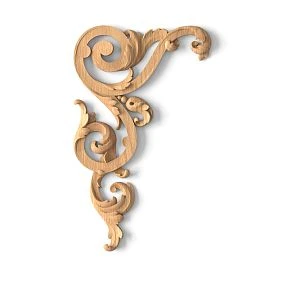
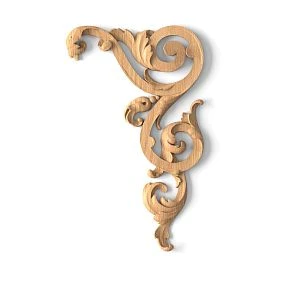
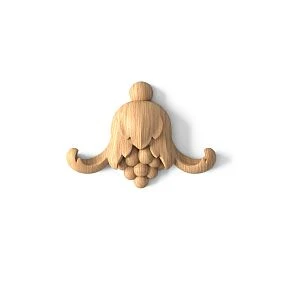
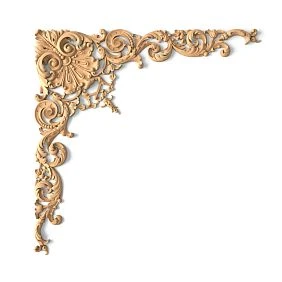

What can be replaced with ready-made decor during furniture restoration
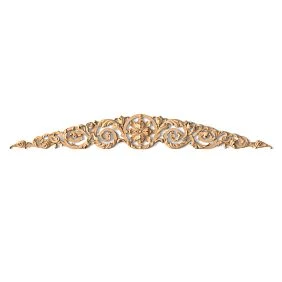
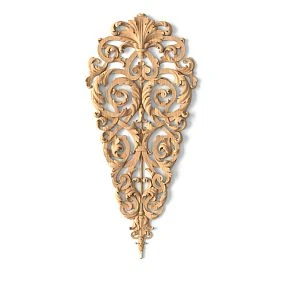
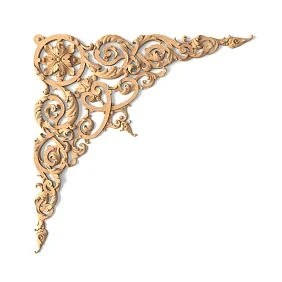
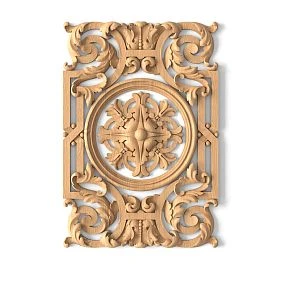
Let's start with a list of what is generally lost on old furniture and what it can be replaced with. The STAVROS catalog in the section Carved furniture decor combines overlays, rosettes, capitals, brackets, baguette, legs and supports, architraves, pilasters and columns. For restoration tasks, six groups from this list are most often in demand.
-
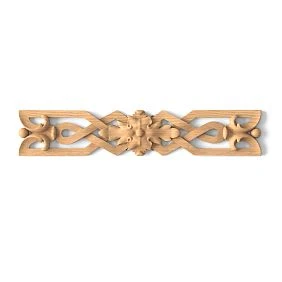
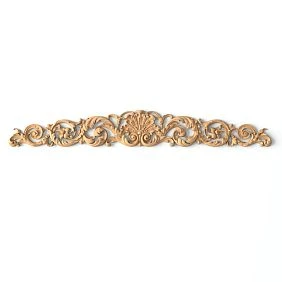
Carved overlay: central, corner, horizontal or vertical. It falls off first because it is held on by glue and small nails.
-
Rosette: round, square, oval or rectangular. It usually sits in the center of the frame or at the intersection of grid elements.
-
Part of the ornament: a fragment of a garland, branch, or leaf. It is lost during chips and falls.
-
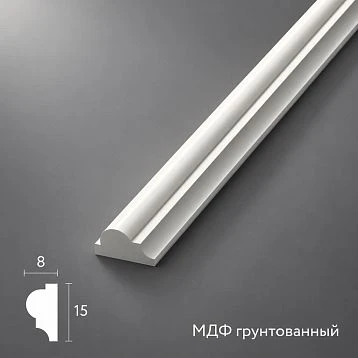
Molding and trim: a linear profile along the edge of the facade, frieze or cornice.
-
Leg or support: breaks from load and dampness, especially on chests of drawers and tables.
-
Handle: gets lost or replaced with an unsuitable one during use.
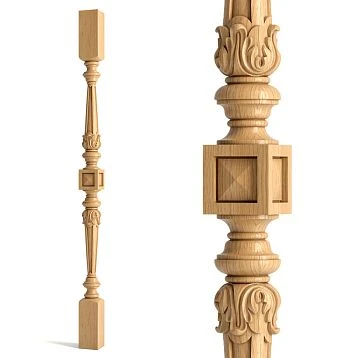
To these are added the capital and elements of vertical decor, for example a pilaster. They are less common on household furniture, but on buffets, display cabinets and wardrobes in an architectural style, they are precisely what form the top and side edges.




What cannot be replaced with a serial element
A serial part does not recreate the lost unique element; it substitutes a suitable one in terms of function and size. If the item has historical or museum value, the question is posed differently, and this is discussed in a separate section below. For ordinary classical furniture, furniture of the Soviet and post-Soviet period, factory-made suites, workshop pieces, and items that the owner wants to return to working condition, a ready-made part is justified.
There is also a second boundary. Only a decorative element can be replaced with a ready-made part. If a load-bearing part is broken, for example a post, apron, or leg under load, the structural issue is resolved first, and only then the decorative one.
How to compose a request in the catalog. Section filters allow you to select items by dimensions A, B, and C, shape, collection, and type of ornament. This means you should search not by picture, but by the numbers taken from the item: first dimensions and shape, then style, then pattern.
Our factory also produces:
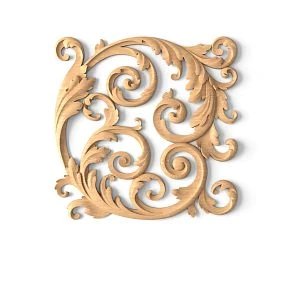
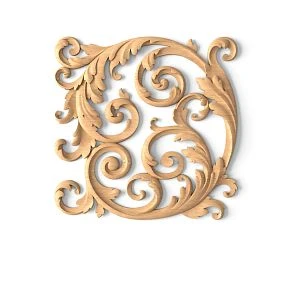
Not a “similar part,” but the function of the lost element
The first mistake in restoration occurs even before the catalog: the craftsman remembers the appearance of the missing part, but does not record what work it performed. Meanwhile, it is precisely the function that determines the type of replacement item. Different parts look almost identical, but are installed in different places and require different geometry.
Determine what disappeared using the table.
| Place on the item | What was there | What to look for |
|---|---|---|
| Center of the facade or door | Rosette or central overlay | Round or oval socket, central overlay |
| Top of the cabinet | Cornice, capital, finial | Cornice, capital, crowning element |
| Frame angle | Corner overlay | Corner piece in mirrored versions |
| Vertical side | Pilaster or vertical overlay | Pilaster, vertical overlay |
| Furniture base | Leg, support | Leg with required mounting type |
| Linear edge | Molding, carved trim | Profile and joint elements |
The main principle is formulated as follows: first the place and function of the part are determined, and only after that the ornament. This saves time. The overlay catalog contains hundreds of items, and sorting through them by pattern is pointless. The filter by shape (central, corner, vertical, horizontal, round, oval, S-shaped, C-shaped, crown, diamond) eliminates most of them already at the first step.
Get Consultation
The trace of the part as a source of data
A lost part always leaves traces. On wood, a lighter area is visible where the overlay was not exposed to light, because the old finish around it darkened, while under the part it remained clean. The contour of this spot shows the overall dimensions. Traces from nails and glue show the attachment points and the position of the axis. Sometimes even an imprint of the relief remains in the dirt.
Photograph the surface in side light so that the trace becomes visible, and place a ruler next to it. Then measure the spot by its maximum width and height. These numbers will become your A and B when searching. Thickness C cannot be determined from the trace, so it is taken from neighboring parts, and if they are absent, from the depth of the frame and the height of the handle.
If there are no traces and the part was lost long ago, the task becomes more difficult. Then you rely on analogues: a photo of the same furniture from the same factory or era, surviving elements on the symmetrical part of the item, a drawing, if one exists.
What to record before searching
Write down five points: where the part was located, what its shape was (round, oval, S-shaped), what its working contour is in millimeters, how the part is oriented relative to the axis of the item, and what surrounds it (handle, molding, edge of the frame). Without these five notes, the search turns into a lottery.
How to use a surviving paired element as a sample
The most convenient situation for a restorer: the left overlay is in place, the right one is lost. Or one door has a carved element while the other's is broken off. In this case, the surviving piece serves as a technical reference, and almost all parameters can be measured without guesswork.
Take measurements in this order.
-
Maximum width: at the widest point of the contour, not the visible part.
-
Height: likewise, from the bottom to the top point.
-
Thickness: at the highest point of the relief and at the edge, since these values differ for relief elements.
-
Relief: the depth of the main elements, approximately, and the overall character (flat, medium, deep).
-
Orientation: which way the leaf tips or scrolls point, and whether there is any asymmetry.
-
Position relative to the edge: the distance from the overlay contour to the edge of the panel or frame.
-
Distance to neighboring elements: to the handle, molding, or adjacent rosette.
This way you get not a description but a set of numbers by which the catalog can be filtered. The STAVROS overlay catalog lets you set a range by width, height, and thickness, and these are exactly the parameters you measured.
Mirrored pairs
The catalog includes models with mirrored left and right versions: for overlays this is stated directly, while for rosettes you can see pairs such as R-063L and R-063R or R-067L and R-067R. For restoration this means that if the left piece of the original has survived, don't look for "the same one" — first check whether the catalog has paired models with a similar pattern. Then you can install both sides from the same collection.
There is a subtlety that is often overlooked. The original pair may be mirrored, or it may be two identical pieces rotated 180 degrees. Look at the surviving piece: if the pattern is directed from the center of the item outward, you need a mirrored pair; if it is the same on both sides, two identical pieces will work.
What to do with the sample next
Do not remove the surviving piece from the item until you have made a contour and photographs. Place a sheet of paper against it, trace the contour, mark the central axis and the attachment points. You will need this template when checking at 1:1 scale; there is a separate section about it below.
Carved overlays for furniture facade restoration
Overlays account for the bulk of the tasks: they are lost most often, and they are also most often replaceable with a serial piece. In the section Carved decorative inserts for furniture According to the catalog description, STAVROS offers more than 400 models in beech and oak. The list counter, together with sets and other product types, shows 544 items, so rely on the filters rather than the total number.
Product types in the list: overlay, mascaron, decor set. Collections: Empire, Versailles, Grape, Gothic, Classic, "Summer Garden", Modern, Russian Style, Eclectic. Ornament types: geometric, floral, shells, acanthus, vegetal, branch, cartouche, laurel, garlands, animals, woven. Prices in the list start at about 950 rubles (for example, N-506) and go up to several tens of thousands for sets (C-020 from 32,420 rubles). Data as of the time of checking; before ordering, check the current price in the product card.
Central
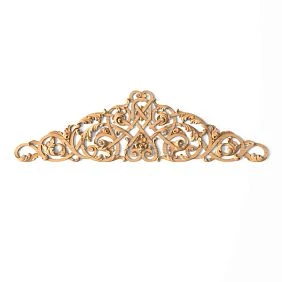
A central overlay sits on the axis of the facade, door, or drawer. It defines the composition, so selection here requires particular precision: any deviation from the axis is noticeable. For cabinets, sideboards, and doors, this is the main type. Check that the overlay is symmetrical about the vertical axis if the original was symmetrical, and that its height does not extend beyond the frame.
Corner
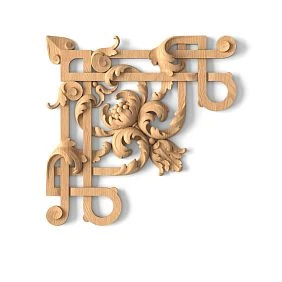
Corner overlays work in frame compositions: they cover the joint, complete the corner, and set the rhythm. There are usually four of them, and they must be identical or form mirrored pairs. If one corner out of four is lost, the issue is urgent: finding a piece to match the three surviving ones is harder than replacing all four. See more on this in the section about pairs.
Horizontal
Horizontal overlays are placed on drawers, friezes, and upper bands. Their length matters: it must fit the drawer width, allowing for gaps. Also check whether the overlay conflicts with the handle, which is often positioned in the center of the drawer.
Vertical
Vertical pieces are placed on posts, side panels, and elongated fronts. Height is critical here, and the relief must be such that the piece does not catch on adjacent surfaces when doors open.
Paired
For restoration, paired overlays matter more than anything else. They make it possible to restore symmetry to an item where only half of the composition has survived. Pay attention to the special features of the series: the catalog includes modular overlay kits with joining elements for connecting to profiled moldings, and overlays with a reverse rebate that follows the molding profile, allowing the decor to be mounted on top of the profile. For a front with molding, this is a convenient solution because the piece sits on the profile without fitting.
Wooden rosettes: when an element in the center of the composition is lost
A rosette on furniture lives in the center: in the middle of a front frame, at the intersection of a decorative grid, in a corner, or at the end of a repeating pattern. The loss of such an element is the most noticeable because the eye looks for the center. Moreover, rosettes are often repeated on several doors, which makes the task easier: you can compare them with the surviving ones.
In the are round or oval elements with relief floral ornamentation (acanthus leaves, flowers, vines) or geometric patterns (circles, spirals, solar symbols). Diameter varies from miniature 60 mm to monumental 500 mm. Rosettes are used as central accents on walls (above a fireplace, above a console, above a bed headboard), as corner elements of molding frames (at the junctions of vertical and horizontal moldings), and as furniture decor (center of cabinet fronts, center of chair backs). STAVROS at the time of checking has 65 items in the list, while the section text states 71 models. Shapes: square, round, oval, rectangular. Type: carved and geometric. Product type: rosette, connecting rosette, and decorative set. Collections: Empire, Art Deco, Grape, Gothic, Classic, Modern, Russian Style, Contemporary. Prices are modest compared to overlays: from 200 rubles for R-055, from 520 rubles for R-012, from 1,810 rubles for R-075, up to 2,600 rubles for R-082 and R-083. Dimensions: A is height, B is width, C is depth.
How to choose a rosette to replace a lost one
Start with the shape. A round rosette will not replace an oval one, even if the dimensions are close: the outline of the frame it fits into will look different. Then check the diameter or overall size: the rosette should leave free space around itself rather than press against the molding. After that, look at the pattern: the number of petals, the character of the leaves, the presence of a center.
Rosettes repeat, and this is important for restoration. If there are six of them on an item and one is lost, compare the new one with the five remaining by diameter and relief depth. A small difference in diameter of a couple of millimeters is noticeable only on close comparison, while a difference in relief depth is immediately noticeable in side light.
Connecting rosettes
A separate product type in the catalog is called a “connecting rosette.” Such parts work at the intersection of molding lines, concealing the joint. If your frame is assembled from profile and rosettes were placed at the corners or intersections, look for exactly this type.
When a rosette does not fit
A rosette will not replace an overlay with a branch or garland because it has a different compositional logic: it is centered and symmetrical. If an elongated element was in the place of the lost part, a rosette will look out of place, even if it fits in size.
When it is better to replace not one part but a symmetrical pair
Here is a situation that stumps restorers. The original model no longer exists, it cannot be found in catalogs, and one part of a pair has survived on the item. There are two paths.
The first path: find one element almost identical to the surviving one and place it next to the old one. The second path: remove the surviving original, and in its place and in the place of the lost one put two new identical parts.
In the second case, visual symmetry often proves more convincing than an attempt to combine the old with an "almost identical new" piece. The reason lies in how the eye works. Symmetrical elements are compared directly, and the slightest difference in pattern, relief depth, or tone stands out. Two identical new parts finished with the same coating have nothing to be compared against: they read as a pair, and the overall appearance of the piece looks cohesive.
What is lost when replacing a pair
By replacing both elements, you remove the authentic part. For an item without collectible value, this is acceptable. For an item with history, hand-carved detailing, a factory stamp, or traces of its era, this is unacceptable. In that case, the surviving part is kept, and the missing one is matched as closely as possible, honestly accepting that the pair will not be perfect.
Do not discard the removed authentic part: it may be needed as a reference for finishing, as a sample for ordering, or as part of the archive for the object.
Calculation for a pair
A hypothetical example. One rosette from a pair on the cabinet doors is lost. A suitable pair in shape and size, for example R-067L and R-067R, costs from 1,660 rubles per piece, that is, 3,320 rubles for two. If both sides are installed from the same collection, symmetry is guaranteed. If instead you look for a single part to match the surviving one, you will spend time searching and still risk a mismatch. The example shows the order of prices, and the exact match of specific dimensions must be checked against the product cards.
When the pair does not need to be replaced. If the surviving part is in good condition and the catalog has an exact analogue in size and pattern, replace only the lost one. This way you preserve more authentic material.
How to choose an ornament: acanthus, rocaille, cartouche, or garland
The ornament links the part to the era and style of the piece. You can choose correctly if you understand how one motif differs from another. The STAVROS applique catalog includes types of ornaments: acanthus, cartouche, garlands, laurel, shells, branch, floral, flower, geometric, woven, and animal. Let us break down the main motifs for classic furniture.
| Character of the furniture | What motifs to look for | What to look for |
|---|---|---|
| Baroque | Acanthus, garlands, cartouches | Voluminous, deep relief, lush forms |
| Rococo | Rocaille, shell, asymmetry | Curves, S- and C-shaped lines, lightness |
| Empire | Strict acanthus, laurel, symmetry | Clear symmetry, restrained relief |
| Classic | Floral and symmetrical motifs | Moderate relief, repetition of elements |
| Neoclassical | Calm geometry, plant decor | Flat or medium relief, laconic forms |
Each motif can be recognized. The acanthus looks like a large serrated leaf with scrolls. The cartouche is a shield or scroll, often with a medallion, framed by scrolls. The garland is a hanging ribbon of flowers, leaves, and fruits. The rocaille resembles a shell with broken, asymmetrical outlines. The laurel is a branch with narrow leaves, a symbol of triumph.
How to identify a motif on an item
Look carefully at the surviving details, if any, and at the overall silhouette of the furniture. If the item is strict and symmetrical, it is most likely Empire or Neoclassical. If the outlines are fluid, with curves, then it is Rococo. If the relief is deep and lush, it is Baroque. Do not try to guess the style from a single detail: look at the item as a whole, at the shape of the legs, the profile of the cornice, and the character of the hardware.
Where style ends and coincidence begins
A match in motif does not mean a match in design. Two acanthus leaves can be very different in the number of serrations, slope, and depth. Therefore, when choosing an applique to replace a lost one, check not only the name of the ornament, but also its character: the density of the relief, the size of the leaf relative to the overall dimensions, and the presence of a central axis.
There is a signature collection, “Summer Garden,” with free Baroque carving and plant motifs: it was created as a modern interpretation and works well in new furniture, but it is less suitable for restoring historical items. To restore classical pieces, focus on the Classic, Empire, Versailles, Gothic, and Russian Style collections, depending on the item.
Size matters more than similarity of ornament
A similar applique is not suitable if it is wider than the free field, taller than the frame, has too deep a relief, conflicts with the handle, extends beyond the edge of the panel, or looks disproportionate. A beautiful detail that does not fit is useless. Therefore, size is checked before ornament.
Check not only A × B × C, but also six additional parameters.
-
Working contour: the actual area that the part will occupy on the surface.
-
Free field: the distance from the part contour to the nearest boundaries.
-
Central axis: the position of the part relative to the axis of the item.
-
Adjacent molding: whether the part overlaps the profile.
-
Handle: whether there is still clearance for the hand and whether the relief collides with the hardware.
-
Door edge: whether the part protrudes beyond the panel.
Calculating the free field
A conditional example. The panel width is 240 mm. An overlay 210 mm wide, after centering, leaves 15 mm on each side. This is a normal margin. An overlay 230 mm wide will leave 5 mm, and the composition will look cramped, although formally the part fits. A 250 mm overlay will extend beyond the edge. This means that not all formally acceptable values are practically suitable, and in restoration it is better to keep a free field on both sides no smaller than the surviving samples on the item.
The second example concerns height. If the frame is 300 mm high and the overlay is 280 mm, it will fill the frame almost entirely, and the lower edge will end up two or three centimeters from the molding. If, however, on the surviving part the overlay occupies two-thirds of the height, repeat that ratio.
Relief Depth
Check depth C separately. Too high a relief will catch on neighboring items, interfere with closing doors, and look “overhanging.” Too low a one will get lost against the background of the surviving parts. Take the value of C from the surviving samples, and if there are none, use the depth of the frame profile and the height of the molding as a guide.
The most common mistake: selecting by a single number, usually width. The part fits in width but is taller than the frame or thicker than needed. Always verify all three dimensions and additional parameters.
Template 1:1 before purchasing the set
A catalog photo does not convey scale. A 200 mm high part and a 260 mm high part look almost identical on screen. The only reliable way to make sure a part fits is to see its real size on the item. For this, a 1:1 scale template is made.
The procedure is as follows.
-
Select a model in the catalog.
-
Get the real dimensions A, B, and C from the product page.
-
Draw the outline of the part at these dimensions on paper. You can trace a photo scaled to the required size, or draw a simple shape: a circle, an oval, a rectangle.
-
Print or cut out the template at full size.
-
Place the template on the item where the missing part belongs, securing it with painter's tape.
-
Photograph the item with the template from three meters and from half a meter.
-
Check symmetry relative to the axis and neighboring parts.
-
Approve the SKU by recording it in the specification with the status APPROVED.
-
Only after that, buy the set.
Why this is essential for series
If a single piece is being restored, a mistake will cost you the price of one applique. But if you need a pair of doors, six drawers, or an entire buffet, the mistake scales up. Ordering six identical pieces without a template and a test fit can result in six unsuitable elements. So first the template and one sample, then the series.
There is also a practical detail. A paper template shows not only the overall dimensions, but also how the piece looks on the item from two distances. Restored furniture is perceived up close, but it should also look cohesive from three meters away. What looks beautiful at arm's length may blur into a spot from a distance, and vice versa.
What to check on the template
Check how the template aligns with the central axis, whether it covers the handle, and whether there is a gap to the molding. Then mentally flip the item: if the piece sits on the left and right doors, place the templates on both and compare their positions. A difference of two to three millimeters between the doors is noticeable. If the piece is not available in the catalog in the required size, the size cannot be changed: choose another model or move on to custom restoration.
Beech or oak for restoring old furniture
There is no universal species; the question is what will happen to the piece after finishing. The decision is made based on the finish and the species of the main item. The STAVROS catalog offers carved appliques and legs made of beech and oak.
Beech
Beech is sensible when all the decor is covered with enamel, a smooth surface is needed, and the original texture of the new piece is not visible after finishing. Dense, uniform wood takes an opaque coating without visible pores, and the relief of the carving reads clearly. For furniture painted white, gray, or colored, beech is primarily suitable.
Another thing is also important: old enamel usually has patina, chips, and unevenness. A new piece under such enamel must be treated so that it does not look cleaner than the item. More on this below.
Oak
Oak is the priority when the decor is tinted, the wood remains open, and you need to get closer to the pronounced texture of an old oak piece. The large pores and characteristic grain match the grain on oak furniture, and after tinting the part blends with the item. For furniture under oil, wax, and clear lacquer, look for oak.
How to avoid mistakes
Do not choose the species "by color": the color of old furniture is formed over decades of oxidation and soiling and does not match the color of fresh wood. Look at the structure: are there large pores, is the grain noticeable. If the item is oak and the finish is clear or tinted, use oak. But if the item is painted opaquely, the species of the part does not matter, and beech gives a smoother result.
For mixed cases there is a rule: the species of the new part must match the species of the item where the wood remains visible, and may differ where everything will be hidden under enamel.
How to age a new part so it doesn't look "bought yesterday"
Choosing the article number solves the geometry, while the finish visually unites the new part with the old furniture. This distinction is important: even a perfectly sized overlay will look out of place if it is cleaner and lighter than the surrounding surface.
Catalog carved elements are ready for finishing: according to the section description, they are suitable for enamel, lacquer, stain, patina, and other decorative coatings. This means that everything that happens to the part after receipt is in the hands of the workshop. Here is a general scheme without the full painting technology.
-
Preparation: check the surface, if necessary lightly go over it with fine sandpaper, remove dust.
-
Primer: if enamel is intended, apply primer, but for tinting leave the wood open.
-
Color matching: make a test sample of the finish on the back side or on a spare part, compare with the item in daylight.
-
Tinting: bring the color to the tone of the main item, then add shade in the recesses of the relief.
-
Patina: emphasize the relief so that the raised areas remain slightly lighter and the recesses darker, as on old pieces.
-
Protective coating: lacquer, oil, or wax, selected to match the overall sheen of the piece.
-
Final check: attach the part to the piece and evaluate it under different lighting.
Reducing contrast
The main task is not to artificially age the part, but to eliminate the mismatch. Old furniture has reduced contrast: the relief is softer, the sheen is duller, the tone is darker. A new carved part has high contrast: crisp edges, light raised areas. Therefore, in restoration it is often necessary to slightly tone down the new part rather than deliberately age it. A small amount of tinting compound, rubbed into the relief and wiped off the raised areas, usually gives a sufficient effect.
Limitations
Do not aim for identity: it is impossible to completely hide a new part, and it is not always necessary. In professional restoration, it is accepted that a replacement should be distinguishable on close inspection rather than pass itself off as an original. For ordinary furniture, maximum closeness in tone is acceptable; for valuable pieces, it is better to leave a slight difference and record the replacement in the documentation.
Another limitation: thick enamel clogs fine relief. For delicate carved parts, apply a thinner coat and avoid buildup in the recesses.
Furniture legs during restoration: replace one or the whole set
Legs suffer from load, dampness, knocks, and floor washing. They break more often than appliqués, and the decision is made differently: replace one or all. Section Wooden furniture legs in the STAVROS catalog brings together supports of different types, while a separate section unpainted wooden legs especially convenient for restoration, because it allows you to match the finish to the piece. At the time of checking, there are 163 items in the unfinished list. Filters: application (chest of drawers, wardrobe, cabinet, console table, armchair, bed, table, chair, stool, sofa and others), sizes A, B and C, collections (Art Deco, Classic, Modern), product type (turned, carved, geometric).
One leg is broken
If one leg out of four is broken and the rest are intact, replace one, but only if you can find a part with matching geometry. Check the height to the nearest millimeter: even a 2–3 mm difference will cause wobbling. Check the diameter and profile, the type of attachment, the style. If there is no exact match, the option of "one new among three old" will be noticeable both in height and in pattern.
The original model no longer exists
Then the surviving legs become the reference, and new ones are selected as an analogue. If you cannot find an identical one in pattern and size, replace the whole set. Four identical legs read as a single whole, while a mismatch is always visible.
Different wear
The legs of one piece may have different wear: one is worn down, another is wobbly, a third has a chip. If the condition differs noticeably, it is better to replace the set: new legs are identical, and you do not waste time fitting the old ones to the new ones.
Preserve the height of the furniture
The height is determined by the sum: leg height plus base thickness. When replacing, you must not change the position of the body relative to the floor. Measure the height of the surviving leg from the floor to the mounting plane and compare it with parameters A and B in the catalog. Note: the section description mentions a height range from 30 to 2100 mm and diameters of round legs from 20 to 100 mm, so it is realistic to find a suitable value, but an exact match is not always achieved.
Fastening
According to the section description, legs can have attachment by tenon, bolt, sleeve or mounting plate. Check the connection method of the original and compatibility: the tenon must fit into the existing socket, and the hole diameter must match. If the socket is worn out, preliminary repair will be required.
Conditional calculation
Chest of drawers, four legs. Take the turned leg MN-220 (from 1,670 rubles): four pieces will cost 6,680 rubles. The same set from MN-217 (from 1,640 rubles) costs 6,560 rubles. The difference is small, and you should choose by geometry, not by price. The example shows the price range; check compatibility with a specific chest of drawers on the product page.
When replacing the set costs more than repair. If the leg has simply loosened in the socket rather than broken, it is enough to reinforce the tenon. There is no point in replacing a healthy part with a new one.
Wooden handles: new hardware as part of old furniture
Handles are often lost or replaced with unsuitable ones. A missing handle leaves a trace: a dark spot, holes, sometimes scuffing. The new part must cover this trace or match it in fit. In the STAVROS catalog, the section Wooden furniture handles includes coated and unfinished handles: they can be found in the subsection unpainted handles.
An important limitation for the restorer. According to the section description, the collection has 32 models of the overlay type with modern geometric shapes: round, triangular, shells, oval, rectangular, staples, and knobs. The handles are made by 3D milling from beech and oak; painted options come in four colors (black, white, brown, clear coating), while unfinished ones allow you to apply the finish yourself. Fasteners are included, and orders are possible from one piece. This means that for antique furniture with classic hardware, these handles are not always suitable: they are modern in shape. However, for mid-century furniture, reworked furniture, and items where the hardware has been changed, they are suitable.
What to check
-
Number of holes: one mounting point or two.
-
Center-to-center distance: between the holes, exact, in millimeters.
-
Diameter or size of the handle: to cover the trace from the old one.
-
Marks from old hardware: the new handle should cover the mark or align with it.
-
Scale: the handle should not be larger than the drawer.
-
Color: matched by the finish.
-
Number of identical handles: on a chest with six drawers, there are six or twelve of them.
How to use unfinished handles
Unfinished handles let you match the tone to the piece. Paint the handle with a test coat, compare it with the drawer, and only then coat the rest. This way the tone will be the same on all of them.
When it is better not to replace the handles. If the original handles have survived, even just a few, they are valuable in themselves. Match the missing ones to the surviving ones rather than replacing everything.
Capitals and vertical decor
The top of the cabinet and the verticals on the sides are most often decorated with capitals, pilasters, cornices, and finials. If the crowning part of a column or pilaster is missing from the cabinet, look for it in the section wooden capitals. At the time of checking, the list has 64 items, while the description states more than 60 models. Shapes: square, round, rectangular, semicircular. There are capitals for pilasters (for example, the "for pilasters PLM" series). Prices from 1,950 rubles for KL-007 to 16,120 rubles for KL-012.
How to select. Here the size determines the width and depth: the capital must cover the cross-section of the column or pilaster without overhanging. For restoration, height A matters because the capital affects the overall height of the item. Check style consistency: Empire capitals are austere, classical ones feature acanthus, Gothic ones have trefoils.
The limitation is simple. A capital does not replace the load-bearing element; it only crowns it. If the column or pilaster itself is broken, it must be restored first.
When a ready-made element does not fit and individual restoration is needed
A ready-made part is suitable if function, size, scale, style, material, and composition all match. If even one does not match, the replacement will be a compromise. Honestly determine which case applies.
Individual restoration is needed if:
-
an exact copy of unique historical carving is required;
-
a complex profile not available in the catalog must be reproduced;
-
the item is a museum piece or has historical value;
-
historical authenticity must be preserved.
In these cases, the path is different: taking a sample, modeling or copying the carving, manufacturing from a drawing, professional restoration. A serial catalog is no help here, and a decor seller should not promise otherwise.
How to tell that a case is non-standard
Signs: the piece has no analogues in the catalog by size and pattern, the carving is hand-made with individual details, the item is dated and has value, the owner insists on an exact copy. If two of the four signs match, it is worth contacting a restorer-carver.
Mixed approach
It is often advantageous to combine approaches. The main parts are installed as ready-made, while one or two unique ones, which are not in the catalog, are ordered individually. This way you reduce the budget and preserve what matters most.
For legs, the manufacturer states on the section page that production to individual dimensions and drawings is possible and that consultation support is available; terms, lead times, and minimum order quantities must be clarified directly. For overlays and rosettes, individual orders are not described in the section text, so check with the managers.
How to draw up a decoration specification for restoration
Restoration consists of dozens of small decisions, and without a record they get lost. A specification turns a set of ideas into a working document that can be used to order parts, check completeness, and reproduce the result a year later.
| Field | What to record |
|---|---|
| Location | Left door, top, front left leg |
| Old part | Preserved or lost |
| Size | A × B × C in millimeters |
| New SKU | SKU STAVROS |
| Material | Beech or oak |
| Quantity | 1, pair or set |
| Finishing | Enamel, tinting, patina |
| Check | Template, sample, APPROVED |
Example of filling in
Conventional sideboard with two doors. First row: left door, center, overlay preserved, size taken from sample, SKU to be selected, material oak, quantity one, finish tinting and patina, check template. Second row: right door, center, overlay lost, size taken from the left, SKU mirrored pair, material oak, quantity one, check sample. Third row: legs, four, one broken, the rest worn, size by height and diameter, material oak, quantity set, finish the same, check sample.
Budget for the example
Let's calculate a conventional option: a pair of rosettes R-067L and R-067R gives 3,320 rubles, four legs MN-217 give 6,560 rubles, two overlays N-316 at 1,750 each give 3,500 rubles. Total about 13,380 rubles at "from" prices. The actual amount depends on the selected models and sizes, and the combination of specific SKUs must be checked against the product pages, so the figure is needed for an order of magnitude, not for an estimate.
Statuses
Keep the "Check" column strictly: SAMPLE (sample ordered), APPROVED (approved after fitting), REJECTED (did not fit). Order the series only for APPROVED rows. For a repeat order in six months, such a table will save a day of work.
Where to buy decor for furniture restoration
The purchase order follows the project. First function and dimensions, then template, then sample, then quantity. The route through the STAVROS catalog is as follows:
-
General section carved decor for furniture restoration for a first introduction to the categories;
-
Carved decorative inserts for furniture for facades, doors and drawers;
-
Carved outlets from wood for frame centers and corners;
-
wooden capitals for crowning elements;
-
Wooden furniture legs и unpainted wooden legs for supports;
-
Wooden furniture handles и unpainted furniture handles for hardware.
According to the catalog, overlays and handles can be purchased from one piece, which is convenient for a sample. Delivery to Russia and CIS countries is indicated, as well as pickup from a warehouse in Moscow and St. Petersburg. For the products, availability or a lead time of 5–10 days is indicated. If some items are in stock and some are made to order, plan your work so that you do not have to wait for the last part.
Before placing an order, check the current price and availability in each product card. First order one sample of the key part, then the rest.
Restorers' questions
Which ready-made elements are suitable for furniture restoration?
Carved overlays, rosettes, capitals, legs, handles and moldings. Selection is based on the function of the lost part, dimensions and the character of the ornament. For museum pieces, serial elements are not suitable.
How to select a carved overlay to replace a lost one?
Take measurements from the trace or from the surviving part, determine the shape and position, filter the catalog by sizes A, B, C and shape, then choose the ornament. Check with a 1:1 template before ordering.
What to do if only one part of a pair has survived?
There are two options: find a nearly identical one and place it next to the old one, or install two new identical parts. For items without collectible value, the second option often looks more convincing. For valuable items, keep the authentic part.
How to choose the size of a wooden overlay for an old facade?
Measure the free field, the central axis and the distance to the handle and molding. The overlay must not extend beyond the edge of the panel. In a conditional example, with a 240 mm panel, a 210 mm overlay leaves 15 mm on each side.
Can an old rosette be replaced with a ready-made wooden one?
Yes, if the shape, dimensions and character of the design match. Check the free field and the depth of the relief. A round rosette is not placed in the position of an oval one.
What to choose for restoration — beech or oak?
Beech is better under opaque enamel, oak under tinting, oil and lacquer, when the wood remains visible, especially for oak furniture. The decision is made based on the finish and the species of the item.
Can I replace just one broken furniture leg?
Yes, if the height, diameter, profile and mounting match to the millimeter. If there is no exact match or the other legs are worn, replace the whole set.
How to choose handles for old furniture?
Check the number of holes, the center-to-center distance, the size and the mark left by the old hardware. Keep in mind that handles in the catalog are of modern geometric shapes and do not always suit classic furniture.
Should I buy a sample decorative element?
Yes, if you need a series or a pair. A sample checks the size, scale and behavior during finishing. For a single piece, the order itself is the sample.
How to make sure the new part does not look out of place?
Match the species and size, then compare under different lighting and adjust the tone with tinting and patina. Slightly mute the contrast of the texture so the part does not look cleaner than the surrounding surface.
Where to buy decor for furniture restoration?
In the section Carved Decor STAVROS catalog: overlays, rosettes, capitals, legs, and handles. Before ordering, check the current price and availability in the product card.
Prices, section dimensions, and specifications were verified against the STAVROS catalog at the time of preparation. The calculations in the text are illustrative and based on "from" prices.