Article Contents:
- We found the pad, but couldn't read the size
- Which FUR-028 specifications are confirmed
- Why you can't choose FUR-028 just by the name d = 28 mm
- Why the line 25 × 25 × 5 mm also doesn't give a complete answer
- Three different sizes that buyers often mix up
- Outer size of the assembled product
- Size of the working felt area
- Height of the pad
- Why zero alignment is not always convenient
- It is noticeable
- The edge receives lateral impact
- Soft material may deform
- The center has to be shifted
- Furniture fits closer to the baseboard
- Leg thickness and screw length are not the same thing
- Old hole
- Distance to the edge
- What to ask about the leg
- Why the leg size from the card may not help
- Mistake 1. The 28 mm diameter was taken as the outer size without confirmation
- Error 2. A size of 25 × 25 mm was declared as the diameter of the felt
- Error 3. Measured the leg above the end face
- Error 4. Did not account for the chamfer
- Error 5. Bought based on the model name of the leg
- Error 6. Did not check the 20 mm self-tapping screw
- Error 7. The shifted center was hidden by rotating the foot pad
- Error 8. FUR-028 was mistaken for a self-adhesive one
- Error 9. Bought four pieces for the sofa
- Error 10. Installed only one new element
- Error 11. The felt was not cleaned
- Error 12. FUR-028 was used for leveling
- Error 13. Chose felt for easy sliding on carpet
- Error 14. Did not check the price per piece
- Error 15. Mixed different models in one piece of furniture
- Step 1. Measure the end
- Step 2. Take a photo
- Step 3. Check the leg design
- Step 4. Specify FUR-028 dimensions
- Step 5. Match the screw
- Step 6. Count the supports
- Step 7. Define the task
- Step 8. Compare alternatives
- Step 9. Check price and availability
- Step 10. Arrange the set
- What is the size of FUR-028: 25 or 28 mm?
- Can 28 mm be considered the outer diameter?
- What does the size 25 × 25 × 5 mm mean?
- Will FUR-028 fit a leg with a diameter of 28 mm?
- Will FUR-028 fit a 25 mm leg?
- Which leg size should be measured?
- What should be done with the shaped end?
- Will the protruding felt get in the way?
- Which screw is included in the set?
- Can the included screw be replaced?
- Is a pilot hole required?
- Can FUR-028 be screwed into an old hole?
- Is FUR-028 self-adhesive?
- Can the glider be additionally glued on?
- Does FUR-028 protect parquet?
- Will FUR-028 work for laminate?
- Can FUR-028 be used on tiles?
- Will the glide work on a carpet?
- How is FUR-028 different from FUR-027?
- When to choose FUR-022?
- When is FUR-029 needed?
- How many FUR-028 are needed for a chair?
- How many glides are needed for a sofa?
- Is FUR-028 sold individually?
- Is the screw included?
- Is FUR-028 in stock?
- Where can I see the price?
- Where can I see other glides?
- Where can I match glides and furniture legs together?
- Can I order FUR-028 with delivery?
- Where can I buy the rest of the hardware for assembly?
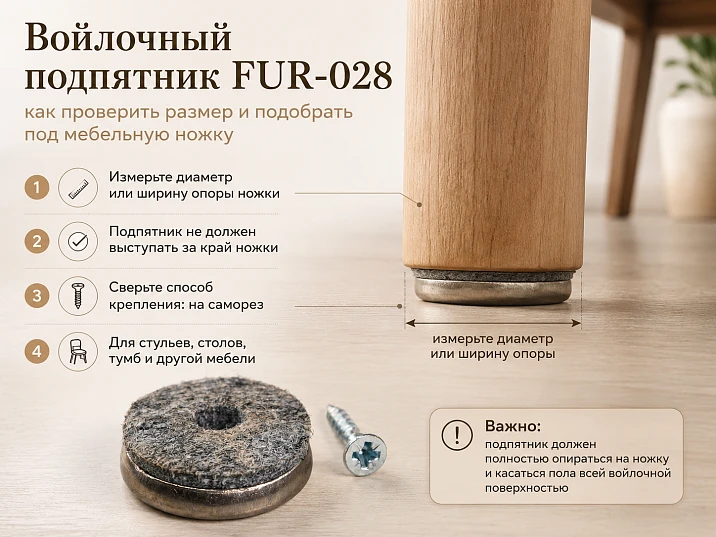
- The felt furniture pad FUR-028 has already been found, the product is right in front of you, the price is per piece, and the set includes a universal screw 3.5 × 20 mm. It would seem that all that remains is to measure the furniture leg, add the required quantity to the cart, and place the order. But the product card makes you stop: the name says "d = 28 mm," while the specifications table lists the size as 25 × 25 × 5 mm.
Which value should be compared with the bottom end of the leg? Should the support surface be 25 mm wide or at least 28 mm? What does the third number—5 mm—mean? Won't the pad be wider than the wood and visible from the side? Can it be installed on a thin leg with a 20 mm screw? Finally, how many units will be needed for a chair, table, nightstand, or sofa?
Until the discrepancy in the specifications receives an official explanation, you cannot independently declare one number as the outer diameter of the housing and another as the size of the felt part. Such an explanation may sound plausible, but plausibility does not replace a drawing. The buyer needs a confirmed size of the part of FUR-028 that actually sits under the furniture leg.
The right approach starts not with a guess, but with the bottom end of the support. It is measured, photographed next to a ruler, and the mounting center and wood thickness are checked. Then, you clarify with the manager the outer dimension of the pad, the size of the working felt surface, the height of the assembled product, and the position of the screw.
After such a check, you can buy felt furniture pad FUR-028 in the required quantity, or choose another model if FUR-028 extends beyond the edge of the leg, does not fit the mounting, or does not solve your problem.
Found the pad, but couldn't read the size
The confusion arises because the buyer sees two different forms of notation at once.
The product name uses the diameter designation:
d = 28 mm.
The table shows a size line:
25 × 25 × 5 mm.
If it were about two different cards, one could assume an erroneous transition between models. But both designations refer to the same article FUR-028. Therefore, choosing a product only by name or only by table is risky.
The problem is especially noticeable when buying a floor glide for a thin wooden leg. Imagine a bottom end with a width of 26 mm. According to the line 25 × 25 mm, the product seems to fit. According to the designation d = 28 mm, it already protrudes. The difference of 2–3 mm seems small, but on a narrow furniture support it is clearly visible.
Another example is a round leg with a diameter of 28 mm. The name FUR-028 creates the impression of a complete match. However, the table 25 × 25 × 5 mm leaves the question: which part has a size of 25 mm and does it determine the fit?
Until confirmation, you cannot choose a convenient version and pass it off as a fact. You need to get an answer to a specific question:
What is the maximum outer size of the assembled FUR-028 floor glide in the floor plane?
It is this value that shows whether the product will protrude beyond the edge of the leg.




Which FUR-028 characteristics are confirmed
Despite the size discrepancy, the card contains several precise details that can be used when selecting.
| Parameter | Confirmed data | How to apply before purchase |
|---|---|---|
| Article number | FUR-028 | Specify in the request to the manager and in the order |
| Name | Felt glider d = 28 mm | Do not take 28 mm as a confirmed external dimension without clarification |
| Size in the table | 25 × 25 × 5 mm | Request a breakdown of each value |
| Mounting type | Mechanical | Do not confuse FUR-028 with a self-adhesive pad |
| Fastening | Universal screw 3.5 × 20 mm | Check the thickness and construction of the lower part of the leg |
| Price | Per piece | Count quantity in cart per each support |
| Status | In stock | Recheck current availability before paying for the batch |
| Purpose | Floor protection and soft contact for furniture leg | Assess floor material, frequency of furniture movement, and condition of felt |
| Confirmed unit of sale | One piece | For four supports, usually four product units are needed if there are no other contact points |
| Self-adhesive layer | Not specified; mechanical attachment | Do not plan installation without a screw |
| Permissible load | Not specified in the source data | Do not prescribe application based only on furniture weight |
| Outer base dimension | Requires clarification | Compare with the lower end of the leg |
| Size of the felt part | Requires clarification | Check the soft contact area |
| Overall height | Requires clarification | Compare with other supports of the same furniture |
The table does not fix the contradiction but separates facts from questions. This is more useful than a confident assumption: the buyer understands what is already known and what data is missing before ordering.
Our factory also produces:


Why you cannot choose FUR-028 based only on the name d = 28 mm
The name is convenient for searching. A person enters the query "furniture glider 28 mm buy," sees FUR-028, and expects the product diameter to be 28 mm. This logic is understandable, but the card simultaneously shows a different dimension line.
The designation d is usually associated with diameter, but without a drawing, questions remain:
-
which part's diameter is indicated;
-
whether this part is the maximum in width;
-
whether it coincides with the contact pad;
-
whether the value refers to the felt, the base, or the assembled product;
-
whether the entire structure is round;
-
where the size 25 × 25 mm came from;
-
what the third value of 5 mm means.
If the lower end of the leg is significantly wider than both disputed sizes, the discrepancy may not affect the appearance. For example, on a support pad 40 mm wide, a glider of 25 or 28 mm likely will not extend beyond the edge. But even in such a situation, questions remain about the position of the screw and the contact area.
When the leg is narrow, every millimeter becomes noticeable. A glider protruding beyond the wood may:
-
disrupt the neat silhouette;
-
be visible from the side;
-
catch an edge when moving;
-
receive a side load;
-
deform faster;
-
hinder tight installation near the baseboard;
-
create a feeling of randomly selected hardware.
Therefore, the name helps find the product, but does not replace checking the fit.
Get Consultation
Why the 25 × 25 × 5 mm line also does not give a complete answer
Three numbers look technically convincing. There is a desire to immediately read them as width, depth, and height. However, the product shape in the name is indicated by diameter, while the table uses rectangular notation.
Until official clarification, it is unknown:
-
whether the 25 × 25 mm square bounding dimension is described;
-
whether this size refers to a single part of the product;
-
whether 5 mm is the thickness of the felt;
-
whether 5 mm shows the total height;
-
whether the base size matches the size of the soft part;
-
whether there is a protruding part not included in the tabulated value.
Possible versions can be listed, but none of them becomes confirmed just because it sounds logical.
The buyer needs not a general question "why the sizes are different," but a set of specific queries:
-
What is the maximum outer diameter or width of FUR-028?
-
What is the diameter of the working felt part?
-
What is the total height of the glider without the screw?
-
Where is the 5 mm dimension measured from?
-
At what distance from the edge is the screw axis located?
-
Does the metal or plastic part protrude beyond the felt?
-
Does the photo match the current version of the product?
Once you get the answers, you can compare the product with the furniture leg without guessing.
Three different sizes that buyers often mix up
A mechanical glider has several dimensional characteristics. Even when the product card is filled out without contradictions, they cannot be combined into one word "diameter".
External size of the assembled product
This is the maximum distance between the extreme points of the floor protector in the floor plane. It is this that is compared with the end of the leg if it is important for the buyer that the hardware does not protrude.
Size of the working felt area
This is the area that comes into contact with the flooring. It may coincide with the outer dimension or differ from it. For FUR-028, this ratio needs to be confirmed.
Height of the floor protector
It shows how much the position of the furniture will change after installation. If one leg has a new floor protector and the others have old ones, the difference in height can cause wobbling.
The line 25 × 25 × 5 mm likely describes several measurements, but assigning a specific part to a specific number without an official diagram is not possible. In the order, it is safer to write not "fits size 25" but:
Please confirm the maximum outer dimension of FUR-028, the size of the felt working surface, and the overall height of the product.
Measure the lower end, not the widest part of the leg
A furniture leg can be carved, tapered, turned, or shaped. Its main part may look massive, but it narrows to a small base near the floor. It is the lower contact area that determines whether a floor protector can be installed.
Let's imagine a classic leg with a wide upper part. Near the apron, its size is 90 mm, in the middle — 55 mm, at the floor — 27 mm. The buyer notes the maximum width and decides that a floor protector with d = 28 mm will definitely fit. In reality, the comparison should be made with the lower 27 mm.
For the reverse shape, the end face may be wider than the rod. Then the thrust bearing fits more freely than it appears in the photo.
There is only one rule:
Measure the surface to which FUR-028 will be screwed.
Do not use:
-
the width of the leg near the furniture;
-
the average diameter;
-
the size of the decorative ring above;
-
the dimension along the protruding thread;
-
the approximate value from the leg model name;
-
the size of another leg from a similar series.
How to measure a round furniture leg
For a round end, you need the actual diameter of the bottom platform.
Position the furniture so you have safe access to the base. If the item is heavy, do not turn it over alone. Secure the structure and do not leave it in an unstable position.
Measure the end in several directions. A part that appears round may have slight ovality, machining marks, or wear.
Write down:
-
minimum diameter;
-
maximum diameter;
-
presence of a chamfer;
-
size of the flat central part;
-
position of the old hole;
-
distance from the hole to the edge;
-
thickness of the wood above the mounting point.
The chamfer requires special attention. If the end has a rounded or beveled edge, the actual flat area may be smaller than the full diameter of the leg. The base plate must rest on a stable part, not balance on a narrow ring.
How to check a square end
For a square leg, measure both sides. Do not assume they are the same. After machining, painting, or repair, the dimensions may differ.
For example, the end is 27 × 29 mm. A base plate with an outer round dimension of 28 mm, if confirmed, would fit along one axis and protrude along the other. A table size of 25 × 25 mm, if it turns out to be the outer dimension, would give a different result. This is why the contradiction cannot be ignored.
Additionally, check:
-
corner rounding;
-
chamfer;
-
chip;
-
old center hole;
-
direction of fibers;
-
proximity of other fasteners;
-
flatness of the surface.
If the square end is heavily rounded, the usable area is smaller than the bounding square.
A rectangular foot requires two dimensions and a mounting center.
For a rectangular base, one dimension may be sufficient, while the other may not be. For example, an end of 24 × 38 mm. The foot pad must be placed so that it does not extend beyond the narrow side.
A round foot pad cannot be oriented by rotation: its maximum size is the same in all directions. Therefore, the smaller dimension of the end becomes decisive.
Also check the position of the screw. The geometric center of the rectangle may coincide:
-
with an old hole;
-
with a tenon;
-
with a stud;
-
with a channel of another fastener;
-
with an area of weakened wood.
In this case, the issue is not resolved by a simple offset. A foot plate that is not centered may extend beyond the edge. An assessment of the specific joint is needed.
It is better to transfer the shaped end onto paper
For a carved or turned leg, the bottom surface can be complex. A ruler shows width and depth, but does not convey the shape.
Make a template:
-
press thick paper against the bottom platform;
-
trace the outer contour;
-
mark the center;
-
transfer the old holes;
-
note the direction toward the furniture;
-
place a paper circle with a diameter of 28 mm on top;
-
separately place a 25 × 25 mm square;
-
compare both options;
-
send the photo to the manager.
Such a template does not determine the true size of FUR-028, but it shows in advance how critical the difference between 25 and 28 mm is.
If both conditional contours fit freely, the likelihood of a visual protrusion is lower. If one fits and the other does not, you cannot buy without clarification.
A photo with a ruler helps avoid incorrect measurement
The verbal phrase "leg approximately 28 mm" is not precise enough. In the photo, the manager will be able to see:
-
end shape;
-
the actual scale;
-
chamfer;
-
old hole;
-
the condition of the wood;
-
fastener position;
-
the limiting size.
Take three photos:
-
strictly from below;
-
from the side;
-
at a slight angle so that the thickness of the support part is visible.
The ruler should lie in the same plane as the measured section. If it is closer to the camera, perspective distorts the value.
For a particularly narrow leg, a caliper is useful, but the result should be recorded in millimeters and without false precision. If the surface is uneven, indicate a range rather than a single nice number.
How to determine whether FUR-028 will protrude beyond the edge
After confirming the external dimension, a simple comparison is used.
For a round leg:
Radius margin = (end diameter − outer diameter of the support foot) ÷ 2.
If the leg diameter is 34 mm and the confirmed external size of the support foot is 28 mm, the calculated margin will be:
(34 − 28) ÷ 2 = 3 mm on each side.
This is an example of the principle, not confirmation that the outer size of FUR-028 is actually 28 mm.
For a square or rectangular end face, compare the thrust plate with the smaller side.
If the outer size of the product is larger than the minimum width of the end face, it will protrude in at least one direction.
Why zero coincidence is not always convenient
Suppose the diameter of the end face and the thrust plate are the same. On the drawing, everything matches. In reality, the following factors have an effect:
-
measurement error;
-
chamfer;
-
rounding;
-
imperfect centering;
-
screw displacement;
-
wood unevenness;
-
tolerance of the part itself.
Therefore, matching "exactly to size" requires particularly careful fitting.
What's wrong with a protruding base plate
A small protrusion does not always lead to immediate breakage, but it creates several practical problems.
It is noticeable
On a thin furniture leg, the edge of the hardware is visible from the side. This is especially undesirable on classic furniture, where the support should look solid.
The edge receives lateral impact
When moving furniture, the protruding part may touch a threshold, the edge of a carpet, or an uneven floor.
Soft material can deform
If felt extends beyond the rigid base of the leg, the load is distributed differently. A specific result cannot be guaranteed without the product's construction, but the risk of deformation should be taken into account.
The center has to be shifted
Attempting to hide the glider on one side leads to a protrusion on the other and moves the screw away from the center.
Furniture fits closer to the baseboard
A protruding element can touch the wall or baseboard earlier than the leg itself.
Therefore, checking the outer dimension is not a formality, but part of a precise fit.
Screw 3.5 × 20 mm: the fastener size also needs to be verified
The FUR-028 kit includes a universal screw 3.5 × 20 mm. The first number describes the diameter, the second — the length. However, having a screw in the kit does not automatically mean compatibility with any furniture leg.
Before installation, you need to understand:
-
Is the wood thickness sufficient;
-
Where will the screw go;
-
Is there a stud nearby;
-
Is there another joint passing through the center;
-
Is there an old hole;
-
Is the end face damaged;
-
Is the edge too close;
-
Does the fastener match the support material.
The leg thickness and screw length are not the same thing
You cannot compare 20 mm only with the external height of the leg. Inside, there may be fastening elements or cavities.
For example, a wooden support looks massive, but a metal pin is installed in the center. Attempting to screw a self-tapping screw along the axis will result in hitting the metal.
On another leg, the lower part may be thin due to an internal hole. This is not visible from the outside.
Old hole
If the foot pad replaces previous hardware, the central hole may be damaged. A new self-tapping screw will not get reliable hold.
You cannot simply screw in a thicker fastener without assessing the structure. First, you need to determine the condition of the wood and choose a repair method.
Distance to edge
On an end face 25–28 mm wide, a 3.5 mm diameter self-tapping screw takes up noticeable space. If the axis is offset, the wood near the edge receives increased load.
The exact order of pre-drilling depends on the wood species, part condition, and installation technique. A universal pilot hole diameter cannot be assigned without this data.
Checking installation center
The center of the foot pad and the center of the bottom end face should ideally be aligned, unless the design requires a different position.
For marking:
-
find the midpoints of the two axes;
-
draw thin lines;
-
check the intersection;
-
align it with the old hole;
-
make sure there is no other fastener inside;
-
apply the thrust bearing;
-
check the outer contour;
-
only after this prepare the installation.
On a round end, the center can be found by two maximum diameters. On a square one, by the intersection of diagonals. On a shaped leg, the geometric center of the bounding rectangle does not always coincide with the center of the actual support area.
Why you shouldn't drive a screw without checking the grain direction
Wood is not uniform. On a thin leg, incorrect fastener placement can cause a crack, especially if there is already a hole or chip nearby.
The risk is influenced by:
-
wood species;
-
dryness of the wood;
-
direction of fibers;
-
distance to the edge;
-
condition of the old hole;
-
screw diameter;
-
preliminary preparation;
-
tightening force.
Do not tighten the fastener until the base of the foot pad is pressed through. The item should fit snugly, but excessive force can damage the felt, the body, or the wood.
The exact installation sequence should be coordinated with a craftsman if the leg is valuable, thin, old, or has complex internal fastening.
FUR-028 — mechanical, not self-adhesive, furniture glider
Felt furniture gliders are often associated with self-adhesive circles. FUR-028 confirms a different principle: mechanical fastening with a screw.
This difference affects the entire purchasing process.
A self-adhesive pad is chosen based on surface size, the base is cleaned, and it is glued on. FUR-028 requires checking the wood and space for the screw.
The mechanical method means:
-
access to the bottom end is needed;
-
the support must allow fastening;
-
a center is required;
-
depth is taken into account;
-
old fasteners are checked;
-
The installation leaves a hole;
-
Replacement requires working with a self-tapping screw.
Therefore, the query "furniture glider with a self-tapping screw or self-adhesive" describes not two identical products with different convenience, but different installation methods.
A detailed breakdown will help you understand how to choose a furniture glider for a specific leg, floor, and usage mode.
When mechanical fastening is more convenient
FUR-028 can be considered when:
-
the leg is made of a material suitable for fastening;
-
the bottom end has a sufficient surface area;
-
the self-tapping screw does not conflict with internal parts;
-
furniture is moved regularly;
-
the buyer needs a fixed seating;
-
installing the hole is permissible;
-
the external dimension is confirmed;
-
all supports can be equipped identically.
Mechanical fastening holds the foot not only through the adhesive layer. However, this is not a reason to skip preparation. An incorrectly installed self-tapping screw can loosen or damage the end face.
When the self-adhesive option may be more appropriate
A different design may be needed if:
-
drilling or screwing into the leg is prohibited;
-
metal fasteners run through the inside;
-
the lower platform is too thin;
-
the furniture is rented and must be kept without holes;
-
a temporary solution is required;
-
the surface is not wooden;
-
FUR-028 does not fit in size;
-
mechanical installation is not allowed by the project.
A self-adhesive pad cannot be considered an automatic replacement. Its retention depends on surface preparation, adhesive layer quality, load, and furniture movement.
A felt floor protector protects the floor but requires maintenance
Soft contact reduces direct contact of a rigid furniture leg with the flooring. However, felt does not provide absolute protection under all conditions.
The following can get into its fibers:
-
sand;
-
fine crumbs;
-
metal shavings;
-
hard dust;
-
particles after repairs.
If you move furniture with a dirty glider, a hard particle can act as an abrasive.
Therefore, periodically:
-
lift the furniture;
-
inspect the felt;
-
remove contaminants;
-
check for wear;
-
compare the height of all supports;
-
replace damaged elements with a set when required.
FUR-028 for parquet
Parquet is sensitive to point contact, sand, and moving heavy furniture. The felt surface can soften contact, but the result depends on the condition and cleanliness of the glider.
For parquet, the following are especially important:
-
no protruding screw;
-
clean working surface;
-
equal height on all legs;
-
absence of a sharp edge on the body;
-
smooth movement without skewing;
-
regular inspection.
If a piece of furniture is very heavy or frequently moved, it is necessary to evaluate not only the material of the glider but also the contact area.
Detailed criteria are collected in the material on which glider to choose for protecting parquet under furniture.
FUR-028 for laminate
Laminate also requires clean contact. Felt can reduce friction of a hard leg against the surface, but a dirty material can leave marks.
Before installation, check:
-
absence of metal protrusions;
-
evenness of the end;
-
seating without skew;
-
size compliance;
-
cleanliness of the floor;
-
identical condition of all glides.
Do not move heavy furniture with a jerk just because felt is installed. First, make sure all legs move evenly and none catch.
FUR-028 on tile and stone
Hard flooring is less afraid of soft wood, but a furniture leg can make a sharp sound, slide, or leave marks from dirt.
A felt glide creates a softer contact, but is not intended to level out tile unevenness. If furniture wobbles due to an uneven base, a different task and a different type of hardware are required.
On a wet floor, felt also needs checking. You should not leave it wet and expect the material to remain unchanged.
FUR-028 for carpet
On carpet, soft felt does not always provide the expected advantage. It can increase resistance to movement or collect fibers.
You need to determine what you want:
-
protect the hard floor;
-
make the contact quieter;
-
make sliding easier;
-
prevent rocking;
-
distribute the load;
-
keep the furniture in place.
For controlled movement, a different model may be suitable, and for leveling, an adjustable support.
Felt or adjustable foot: different tasks
FUR-028 is designed for soft contact and floor protection. The adjustable foot solves a different problem: it helps compensate for unevenness and level the furniture.
These functions cannot be mixed.
| Task | Felt FUR-028 | Adjustable FUR-029 |
|---|---|---|
| Soften contact with the floor | Main Scenario | Not the main criterion |
| Protect the surface from a hard edge | Yes, with proper seating and clean felt | Depends on the design of the contact part |
| Level the furniture | No confirmed adjustment | Designed for adjustment |
| Remove wobbling on uneven floor | Does not solve the root cause | May be considered for this task |
| Installation | Self-tapping screw 3.5 × 20 mm | Checked against card FUR-029 |
| Dimensional issue | 28 mm in the name and 25 × 25 × 5 mm in the table require clarification | Your own parameters need to be checked separately |
| Commercial choice | Floor protection and soft contact | Furniture leveling |
If a cabinet or table wobbles, increasing the thickness of felt on one leg creates a temporary shim, but it is not a proper adjustable system. Better buy adjustable foot pad FUR-029 and check its compatibility with the specific furniture.
Additional comparison will help decide whether you need an adjustable or felt floor protector.
FUR-027 or FUR-028: the smaller diameter is not chosen blindly
FUR-027 is labeled in the name as a felt floor protector with d = 24 mm. It can be considered for a narrower furniture leg, but here too, checking the actual dimensions is required.
You cannot reason like this:
-
leg smaller than 28 mm;
-
meaning FUR-027 is automatically needed;
-
no other measurements are required.
First, compare:
-
outer dimension;
-
work platform size;
-
height;
-
mounting;
-
hole position;
-
leg end;
-
wood condition.
If FUR-028 protrudes, you can buy felt foot pad FUR-027 d24 after confirming the dimensions of the smaller model.
For a systematic choice, it is useful to compare FUR-027 and FUR-028, but the decision is made based on the actual bottom platform.
When felt is not what you need, FUR-022 is required
FUR-022 is a round SUPER GLIDE d30 glider. It belongs to a different scenario: the customer needs not a soft felt contact, but a different character of furniture sliding.
This can be relevant when an item needs to be moved in a controlled manner. However, the floor type, furniture weight, and leg design still require verification.
The comparison is not based on the principle of "which glider is more modern," but on the task:
-
FUR-028 — soft felt contact;
-
FUR-022 — a sliding structure of a different type;
-
FUR-029 — adjustment;
-
FUR-027 — a smaller felt model.
If the furniture should move differently, you can buy the round furniture glide FUR-022 and check its fit.
Table for choosing between four similar models
| Model | Confirmed type | Main task | When to consider | What to check |
|---|---|---|---|---|
| FUR-028 | Felt, mechanical fastening | Soft contact and floor protection | End fits the confirmed external size | Discrepancy 28 mm and 25 × 25 × 5 mm, screw 3.5 × 20 mm |
| FUR-027 | Felt d24 | Soft contact on a narrower support | FUR-028 too wide | Actual size and fastening of FUR-027 |
| FUR-022 | Round SUPER GLIDE d30 | Different sliding character | Furniture should be moved on a suitable floor | Floor material, outer size, mounting |
| FUR-029 | Adjustable D25 | Furniture leveling | Floor is uneven or the item wobbles | Adjustment range and method, installation |
This table helps to distribute tasks, but does not replace product cards. Each model has its own dimensions, mounting method, and application conditions.
Furniture leg cap for wooden furniture leg
FUR-028 is especially related to wooden supports, since the included screw requires a base that allows mechanical fastening.
Before buying a wooden leg and leg cap as a set, you need to check the bottom end before finishing. After painting or tinting, it is harder to fix a mistake: the old hole remains, and a protruding leg cap cannot be hidden by changing the color.
In the catalog you can Buy wooden furniture legs and compare their base with the selected hardware in advance.
What to ask about the leg
-
What size is the bottom end?
-
Is it round, square, or shaped?
-
Is there a central hole?
-
Does a pin pass through inside?
-
What is the thickness of solid wood in the screw area?
-
Is space provided for a foot cap?
-
Is hardware needed before painting?
-
Can I get a drawing from below?
Why the leg size from the card may not help
The leg card often shows the overall dimension. The bottom end may be much narrower. Therefore, the reference "leg 80 mm" does not mean that a glider of any diameter up to 80 mm fits it.
You need the bottom view specifically.
FUR-028 for chair
The chair is moved regularly, so the condition of the gliders affects not only floor protection but also the feel of movement.
Before ordering:
-
count all legs;
-
measure each end;
-
check whether the front and rear supports are the same;
-
take into account the leg tilt;
-
check the screw location;
-
make sure the gliders have the same height.
In a classic chair, the front legs can be straight, while the rear legs can be angled. Their bottom plates are not necessarily identical. Ordering four FUR-028 just based on the number of supports is premature.
If the end caps differ, a different size or a separate solution may be required for the rear legs.
FUR-028 for a dining table
A table is moved less often, but the load on each support is higher than on a light chair. The source data does not include the allowable load for FUR-028, so compatibility cannot be promised based on size alone.
Check:
-
table weight;
-
number of supports;
-
end cap area;
-
floor material;
-
frequency of movement;
-
presence of a central base;
-
the ability to safely lift furniture for inspection.
If the table has four wooden legs, four glides will be required in advance, provided there are no additional contact points and the sales unit is confirmed as one piece.
FUR-028 for coffee table
Compact furniture often has narrow bottom ends. This is where the difference between 25 and 28 mm becomes critical.
Check the side appearance. A coffee table is below eye level, and a glide under a thin leg is more noticeable than under a tall massive support.
If the furniture is frequently moved during cleaning, regularly inspect the felt.
FUR-028 for sofa
A sofa may have more supports than visible from the outside. In addition to four corner legs, there are central and intermediate elements.
The buyer counts the visible legs, orders four glides, and during installation discovers two more internal supports. After installation, the furniture gets different contact heights.
Before ordering, inspect the bottom completely and map out all support points.
The central leg should also have a suitable floor protector if it touches the floor and the design includes such protection.
FUR-028 for bed
The bed may rest on outer legs, a central beam, and additional supports. Only decorative elements cannot be counted.
Also check the height. If the felt pads
Why it's better to order the entire set at once
Floor protectors that are consistent in design and height should be placed on one piece of furniture.
If part of FUR-028 is purchased later, differences may arise due to:
- changes in manufacturing;
- wear of old elements;
- of different heights;
- of uneven felt density;
- of various fasteners;
- updating the card.
Do not install one new foot pad next to three heavily worn ones and expect a level support. Sometimes it is wiser to replace the set.
In the category you can order a set of foot pads after checking all legs.
What to buy together with FUR-028
| Product or section | Why it's needed | What to check |
| FUR-028 | Soft contact and floor protection | External size, 25 × 25 × 5 mm, self-tapping screw |
| Other foot pads | Allow selecting a different diameter or function | Size, material, mounting type |
| Wooden furniture legs | Form furniture supports | Bottom end and internal mounting |
| Mounting plates and studs | Used in assembling furniture supports | Do they conflict with FUR-028 self-tapping screw |
| FUR-027 | Smaller felt model | Actual size and fit |
| FUR-022 | Sliding model of a different type | Floor material and movement characteristics |
| FUR-029 | Adjustable support | Need for leveling |
| General furniture hardware | Helps assemble the entire unit | Compatibility of all parts |
It is more convenient for a buyer assembling furniture from scratch to choose glides, studs, and mounting plates in one category, but the technical dimensions of each item are checked separately.
A broader section allows buy furniture hardware for the entire project, not just for contact with the floor.
How not to confuse a foot pad with a furniture support
The word "foot pad" is used for different products:
- felt;
- self-adhesive;
- mechanical;
- sliding;
- plastic;
- adjustable;
- hidden.
Therefore, searching by a single name does not guarantee the desired function.
FUR-028:
- has a felt working part;
- is attached mechanically;
- comes with a 3.5 × 20 mm self-tapping screw;
- designed for soft contact and floor protection;
- not confirmed as adjustable;
- sold individually.
If your task is to lift one corner of furniture, compensate for a difference in height, or level a cabinet, choose an adjustable design.
How to install a trial FUR-028 before purchasing a batch
Since the card dimensions differ, for a large order it is reasonable to first check one sample on a specific leg.
Procedure:
- clarify the outer dimension;
- get a photo with a ruler;
- order one piece for testing, if it fits the purchasing process;
- place the product against the end without mounting;
- assess the protrusion;
- check the center;
- compare the screw length;
- assess the internal structure of the leg;
- coordinate the installation;
- only after a successful test, order the entire batch.
A trial purchase is especially justified for dozens of identical chairs or furniture with thin carved legs.
Preparing furniture for installation
Before starting:
- clear the furniture;
- choose a safe location;
- protect the finish;
- ensure a stable position;
- clean the bottom edges;
- remove old covers;
- inspect the holes;
- mark the legs;
- Prepare the same position of the thrust bearings.
Do not turn over a heavy cabinet or sofa without help. Damage to furniture or injury is more dangerous than any time savings.
Removing the old thrust bearing
The old mechanical element is unscrewed without loosening the wood. After removal, check:
- hole diameter;
- the depth;
- condition of the edges;
- cracks;
- dents;
- residues of glue;
- center alignment;
- flatness of the end face.
If the previous screw was thicker or the hole is damaged, the included fastener FUR-028 may not hold. The repair method should be chosen by a specialist.
Can I use the old hole
Only after checking its position and condition.
The old hole must:
- match the center of the new part;
- match the direction;
- preserve the wood;
- not be too wide;
- not intersect with other fasteners;
- allow the foot cap to sit flat.
If the old center is offset, FUR-028 may protrude beyond the edge. Drilling a second hole nearby can weaken a thin leg.
Installation on a painted leg
The finish near the end may chip if handled carelessly. Marking is done thinly, the tool is held along the axis, and force is controlled.
If the furniture is valuable or recently painted, first test on a separate sample of the same wood.
Do not apply glue instead of checking the fastener if the card specifies mechanical installation.
How to check the result after installation
The installed FUR-028 must:
- lie flat;
- not wobble;
- not protrude unexpectedly;
- not have a skewed screw;
- not be pressed through by the fastener;
- touch the floor with the working part;
- match the height of the other support pads.
Place the furniture on a flat surface and lightly press on different corners. If the item wobbles, first determine the cause. Do not compensate for the error by tightening a single screw.
What to check when receiving an order
Before installation, lay out the entire batch and inspect:
- article number;
- quantity;
- presence of self-tapping screws;
- identical geometry;
- integrity of the felt;
- absence of severe deformation;
- same height;
- condition of the holes;
- compliance with the confirmed external dimension;
- packaging.
If the manager confirmed a specific dimension before the order, measure several items. If there is a discrepancy, do not start installation until clarification.
Errors due to which FUR-028 is not suitable
Error 1. The 28 mm diameter was taken as the external dimension without confirmation
The table simultaneously shows 25 × 25 × 5 mm.
Solution: request a drawing or a photo with a ruler.
Error 2. The 25 × 25 mm size was declared as the felt diameter
Such designation is not confirmed.
Solution: separately ask for the size of the working part.
Error 3. Measured the leg above the end face
The lower platform turned out to be narrower.
Solution: measure the mounting point.
Error 4. Did not account for the chamfer
The full width of the leg is larger than the flat support area.
Solution: trace the actual contact contour.
Error 5. Bought based on the leg model name
The overall size of the support does not match the bottom end.
Solution: get the bottom view.
Error 6. Did not check the 20 mm self-tapping screw
There was a stud in the center.
Solution: study the internal structure.
Error 7. The shifted center was hidden by rotating the foot pad
The round product still protruded.
Solution: align the centers or choose a different size.
Error 8. FUR-028 was mistaken for a self-adhesive one
The leg was not prepared for mechanical fastening.
Solution: take the screw into account.
Error 9. Bought four pieces for the sofa
The two central supports were left without foot pads.
Solution: inspect the entire structure from below.
Error 10. Only one new element was installed
The furniture started to wobble due to different heights.
Solution: check the set.
Error 11. The felt was not cleaned
Sand accumulated in it.
Solution: regularly inspect the contact surface.
Error 12. FUR-028 was used for leveling
The floor instability did not disappear.
Solution: consider adjustable FUR-029.
Error 13. Chose felt for easy sliding on carpet
The furniture started moving heavier.
Solution: select the type based on the coating.
Error 14. Did not check the price per piece.
There was an insufficient quantity in the cart.
Solution: count each support.
Error 15. Mixed different models in one piece of furniture.
The height and contact became uneven.
Solution: coordinate the entire set.
Who is FUR-028 suitable for?
FUR-028 is worth considering if:
- felt contact with the floor is required;
- the leg allows mechanical fastening;
- external size confirmed;
- the bottom end is wide enough;
- the 3.5 × 20 mm self-tapping screw does not conflict with the design;
- the furniture does not need height adjustment;
- all supports can be equipped identically;
- the buyer is ready to check the product card before ordering;
- the item needs to be purchased individually in the calculated quantity.
When to choose a different foot
A different model is needed if:
- FUR-028 protrudes beyond the edge;
- the end face is too narrow;
- mechanical fastening is prohibited;
- there is a pin inside;
- the furniture needs to be leveled;
- controlled sliding is required;
- felt is not suitable for the flooring;
- the height does not match other supports;
- the size discrepancy could not be confirmed;
- Need a self-adhesive version.
What to write to the STAVROS manager
The message should contain specific questions:
Good afternoon. We plan to order felt glides FUR-028. The card name indicates d = 28 mm, but the table shows 25 × 25 × 5 mm. Please confirm the maximum outer size of the assembled product, the size of the felt working part, and the total height. Also, please clarify the position of the hole and confirm the included screw 3.5 × 20 mm. The bottom end of our leg measures ___ mm, photo with a ruler is attached. Required: ___ pcs.
Such a request leads to a useful answer faster than the phrase "you have a size error."
How to buy FUR-028 without mistakes
Step 1. Measure the end
Write down the minimum and maximum width.
Step 2. Take a photo
Show the ruler, chamfer, and hole.
Step 3. Check the leg design
Find the studs, old holes, and cavities.
Step 4. Clarify FUR-028 dimensions
Ask for the outer dimension, felt pad, and height.
Step 5. Match the self-tapping screw
Check 3.5 × 20 mm against the leg.
Step 6. Count the supports
Include central and hidden legs.
Step 7. Determine the task
Floor protection, sliding, or adjustment require different models.
Step 8. Compare alternatives
FUR-027, FUR-022, and FUR-029 solve other tasks.
Step 9. Check the price and availability
The price is indicated per piece, availability is re-checked before payment.
Step 10. Place the set order
After confirmation, you can order FUR-028 with a self-tapping screw in the calculated quantity.
Frequently asked questions about FUR-028
What is the size of FUR-028: 25 or 28 mm?
The card simultaneously shows d = 28 mm and 25 × 25 × 5 mm. Without an official explanation, one cannot assign one value to the outer housing and the other to the felt. Before ordering, request a drawing or a photo with a ruler.
Can 28 mm be considered the outer diameter?
Only after confirmation by the manager or technical scheme. The product name indicates d = 28 mm, but the table contains a different row.
What does the size 25 × 25 × 5 mm mean?
The purpose of each value needs to be clarified. You should not independently call 25 mm the size of the felt, and 5 mm its thickness without confirmation.
Will FUR-028 fit a leg with a diameter of 28 mm?
The answer depends on the confirmed outer dimension and the shape of the end. If it matches exactly in size, you also need to consider the chamfer, centering, and tolerances.
Will FUR-028 fit a 25 mm leg?
Without specifying the outer dimension, it is impossible to answer. If the actual dimension of the glider is larger than 25 mm, it will protrude.
What size of the leg should be measured?
Measure the bottom platform to which the glider is screwed. The width of the leg above does not determine the fit.
What to do with a shaped end?
Trace it on paper and mark the center. Then compare the template with the confirmed FUR-028 contour.
Will the protruding felt get in the way?
The protrusion may be noticeable, catch on uneven surfaces, and deform. It is better to choose a model that fits entirely on the support.
Which screw is included in the kit?
The product card specifies a universal screw 3.5 × 20 mm.
Can the included screw be replaced?
Such a solution requires checking the leg, the base housing, and the mounting scheme. Replacing it yourself may change retention or damage the wood.
Is a pilot hole required?
This depends on the wood species, thickness, and condition of the leg. A universal drilling diameter cannot be assigned without this data.
Can FUR-028 be screwed into an old hole?
Only after checking the center, diameter, and condition of the wood. A damaged hole will not provide reliable fixation.
Is FUR-028 self-adhesive?
No, the product card confirms mechanical fastening with a screw.
Can the glider be additionally glued on?
The mounting system should not be changed without confirming the adhesive's compatibility with the product, wood, and finish.
Does FUR-028 protect parquet?
The felt surface provides soft contact but must remain clean. Sand in the felt can damage the floor during movement.
Will FUR-028 be suitable for laminate?
It can be considered after checking the size, cleanliness of the working part, and the nature of furniture movement.
Can FUR-028 be used on tiles?
Can be considered for soft contact, but the model does not level out tile differences and does not replace an adjustable support.
Will a floor protector fit under a carpet?
Depends on the required type of movement. Felt can increase resistance on soft flooring.
How is FUR-028 different from FUR-027?
FUR-027 is marked as the smaller felt model d24. The actual dimensions of both cards need to be checked before comparing.
When to choose FUR-022?
When a different type of glider is needed for controlled movement of furniture, rather than soft felt contact.
When is FUR-029 needed?
When furniture needs to be leveled or floor unevenness compensated.
How many FUR-028 are needed for a chair?
Based on the number of suitable legs. For a standard four-legged chair, four pieces are needed initially, but the front and back ends should be measured separately.
How many glides are needed for a sofa?
Count the outer, central, and hidden supports. Do not rely only on visible legs.
Is FUR-028 sold individually?
Yes, the price in the product card is per one piece.
Is the self-tapping screw included?
According to confirmed data, FUR-028 comes with a universal self-tapping screw 3.5 × 20 mm.
Is FUR-028 in stock?
The original product card shows the status "in stock." The current stock should be checked before payment.
Where can I see the price?
You can check the price of FUR-028 in the product card. Note that the price is for one piece.
Where can I see other furniture glides?
In the category you can buy furniture glides, comparing felt, adjustable, sliding, and other models.
Where can I choose furniture glides and furniture legs together?
You can choose legs and glides as a set, but the compatibility of the bottom end and fasteners needs to be checked for each model.
Can I order FUR-028 with delivery?
After confirming the size and quantity, you can order felt furniture glides with delivery.
Where can I buy the rest of the hardware for assembly?
In the parent section, you can Buy furniture components and assemble an order for legs, fasteners, and mounting.
Before payment, confirm one size that solves everything
The main problem with FUR-028 is not that the card contains many numbers. The problem is the lack of an unambiguous connection between them. The buyer needs to know the maximum outer dimension of the part that will be under the leg.
Before ordering, perform four checks:
- measure the bottom end;
- confirm the outer dimension of FUR-028;
- check the 3.5 × 20 mm screw;
- calculate all contact points.
If the glider fits completely, the screw does not conflict with the structure, and the quantity is calculated per piece, you can proceed to purchase. If at least one parameter is not confirmed, it is better to choose a smaller, adjustable, or sliding model based on the actual task.
STAVROS combines the FUR-028 card, the category of glides, furniture fittings, and wooden legs in one catalog. This allows you not to search for random components across different platforms, but to assemble a coordinated unit: support, fastening, and floor protection.
Open the FUR-028 card, send the manager the size of the lower end, and ask to confirm what exactly d = 28 mm and the line 25 × 25 × 5 mm mean in the current version. After such a response, the order ceases to be a guess and becomes a precise purchase.