Article Contents:
- Three L-023s stand side by side — but they fit structures of different scales
- Version 94 × 37 × 50 × 75 mm
- Version 131 × 52 × 70 × 106 mm
- Version 170 × 71 × 96 × 145 mm
- The top end is measured in two directions
- Check not only the middle, but also the edges
- A photo with a ruler is more useful than a verbal description
- Don't forget the final height
- Why C cannot be declared as a mounting size
- Why matching a single value is not enough
- The drawing must be opened specifically for the selected version
- The paper mockup is built after reading the schematic
- On a small stair post
- Paired with a thin decorative belt
- On a furniture post
- When 94 mm looks too small
- Commercial check of the small version
- Why the medium version is noticeably larger than the small one
- Checking the distance to the handrail
- Medium finial on paired posts
- When 131 mm should be replaced with 94 mm
- When it is better to consider 170 mm
- Full-size silhouette is mandatory
- A tall column does not always require a large capital
- One large accent or a series of large details
- Free space for finishing
- When a large L-023 technically fits but aesthetically does not
- A matching end does not create a finished joint
- It is impossible to universally promise installation with one adhesive
- An old hole is not always useful
- The platform must rest predictably
- A uniform overhang looks intentional
- A large overhang changes the scale
- A perfect match is not always necessary or desirable either
- The allowable overhang is coordinated on all four sides
- Take three measurements
- Physical contact is not the only problem
- A rotating post requires checking from all directions
- An already installed handrail cannot be considered a movable reserve
- Compare all columns in one system
- Paired finials require a common level
- Large finial under a low ceiling
- Beech for opaque color
- Oak to preserve the wood grain pattern
- Finial wood species and column wood species
- Full matching of wood grain pattern cannot be guaranteed
- Where to select materials
- When to consider Standard
- When Prestige is especially useful
- Choosing quality for opaque coating
- All parts of one group must have the same preparation
- Starting post
- End post
- Turning post
- Platform columns
- Paired furniture posts
- Cornice or interior portal
- Quantity calculation table
- When a sample is especially needed
- The sample does not replace the specification
- Starting point
- Turn
- End support
- Bed
- Sofa
- Cornice
- Furniture stand or portal
- Serial furniture
- When to open the general catalog
- When to choose a carved model
- Modern collection
- General guide for the L-series
- Do a dry fitting
- Number paired items
- Mark the front side
- Check the post coating
- Decide the finishing order
- Do not install before acceptance
- A swatch on a flat board does not show the full result
- Paired parts are painted in one cycle
- Contact pad and finish
- Touch-up after installation
- Mistake 1. Ordering by one height
- Mistake 2. Calling C the mounting size
- Mistake 3. Considering E the post size
- Mistake 4. Choosing 94 mm as the safest option
- Mistake 5. Buying 131 mm as a universal size
- Mistake 6. Ordering 170 mm for expressiveness
- Error 7. Measure the post only by width
- Error 8. Use the overall post size instead of the end
- Error 9. Not checking the end slope
- Error 10. Forget the handrail
- Error 11. Not accounting for the total height
- Error 12. Count the platform as a tenon
- Error 13. Rely only on glue
- Error 14. Use the old hole automatically
- Error 15. Install on an uneven surface
- Error 16. Choose beech for clear finish without a sample
- Error 17. Ordering oak under enamel without a reason
- Error 18. Mixing Standard and Prestige
- Error 19. Painting before fitting
- Error 20. Not numbering the parts
- Error 21. Counting "two for the staircase"
- Error 22. Buying spare stock without a purpose
- Error 23. Not checking completeness before painting
- Error 24. Ordering via the old duplicate route
- Error 25. Starting with color
- What sizes of L-023 exist?
- What does the first digit mean?
- Can A be considered the total height of the finial?
- What does B mean?
- What does C mean?
- What does E mean?
- Will L-023 with C = 50 mm fit a 50 × 50 mm post?
- What size should be chosen for a small post?
- Is the L-023 average universal?
- When to choose 170 mm?
- Does the L-023 have a mounting tenon?
- Can the finial be inserted into an existing hole?
- Can I simply glue the L-023?
- Which glue should I choose?
- Is mechanical fastening required?
- How to check the overhang?
- Should the overhang be the same?
- Can the L-023 be installed on a rectangular post?
- Will the finial fit a round column?
- What should be measured on a finished post?
- Do I need to measure both paired posts?
- How to check the levelness of the top platform?
- Can L-023 be trimmed from the bottom?
- Can the height of 170 mm be reduced?
- What wood is L-023 made from?
- What to choose for enamel?
- When to choose oak?
- Can oak be painted with enamel?
- What is better for an old oak post?
- Will the new oak match the old one?
- What is Standard?
- What is Prestige?
- Does Prestige mean ready-made finish?
- Will Standard work with enamel?
- Do I need to order all finials in one quality?
- How many L-023 are needed for one column?
- How many should I order for the staircase?
- Is a spare needed?
- Can I order one finial as a sample?
- Can I later include the sample in the batch?
- Is L-023 suitable for a bed?
- Can I put L-023 on a sofa?
- Will it work for a curtain rod?
- Can it be used on an interior portal?
- Is L-023 suitable for outdoor use?
- Is it suitable for a damp room?
- How to coordinate the color?
- Do I need to paint before installation?
- What to do with the old pole coating?
- What to do if the old finial left a mark?
- What to do if the L-023 platform is wider than the pole?
- What to do if the platform is narrower than the pole?
- Can the finial be shifted from the center?
- How to choose between 94 and 131 mm?
- How to choose between 131 and 170 mm?
- What is more important — technical fit or appearance?
- Where can I see the price of L-023?
- Where can I see other finials?
- Do I need to send a photo to the manager?
- What should I specify in the request?
- How to receive L-023 after delivery?
- Do I need to keep the packaging until trying on?
- What to do if size 131 arrived instead of 94 mm?
- What to do if the pommel wobbles on the post?
- What is the main question to ask before purchasing?
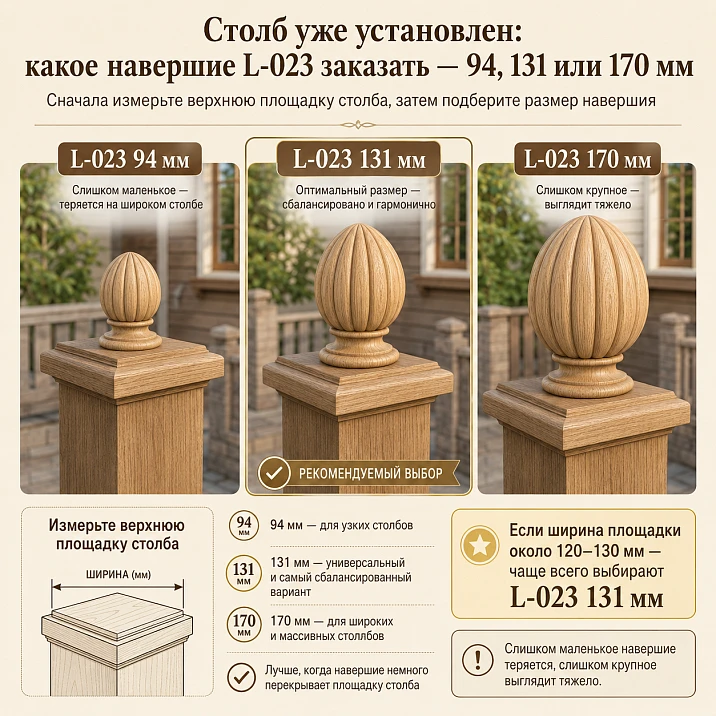
The post is already on the staircase. It is painted, connected to the railing, the handrail is brought almost flush, and on top there remains a flat area that needs to be finished with a wooden cap. In the L-023 card, the buyer sees three versions: 94, 131, and 170 mm. It seems that the task comes down to a simple choice of scale: a small cap for a small post, a medium one for a regular post, and a large one for a massive post. But it is precisely this logic that most often leads to mistakes.
The height shows how noticeable the wooden cap will be on the post. It does not prove that the base of L-023 will match the top platform of the existing post. Each version has four parameters — A, B, C, and E. They cannot be read separately, and the value of C or E cannot be declared a "mounting size" without a drawing. Even more so, one cannot automatically decide that the version with C = 50 mm is necessarily intended for a 50 × 50 mm post.
There is another fundamental feature: L-023 has a straight square platform without a mounting tenon. The cap is not inserted into a ready-made hole like a plug and does not center itself. The buyer needs to check the contact area, possible overhang, the position of the product relative to the post faces, the distance to the handrail, the overall height of the structure, and the future method of fastening. A matching number is only the beginning of the check.
Therefore, the request "cap for a post" cannot be closed by choosing the most beautiful photo. First, measure the top of the existing post, then open the technical drawing of L-023, find lines A, B, C, and E on it, compare each value with the actual part, and only then choose the 94, 131, or 170 mm version.
If the geometry has already been checked, you can buy the wooden cap L-023, specifying the full dimensional version, wood species, sanding quality, and quantity. In the order, it is not enough to write "L-023, medium." The working specification must exclude ambiguity.
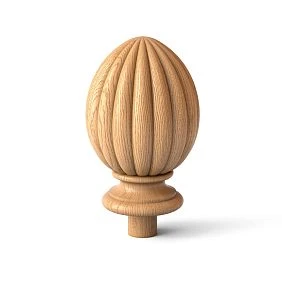
Three L-023s stand side by side — but they fit structures of different scales
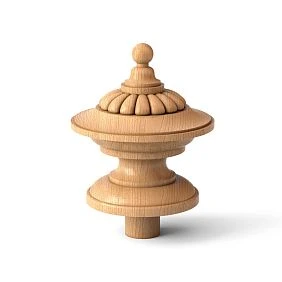
All three versions retain the recognizable shape of L-023, but they cannot be perceived as one part that was simply uniformly enlarged on the screen. The size changes the height of the decorative finish, the width of individual sections, the area of the top silhouette, the position of transitions, and the nature of the possible overhang above the post.
| Execution L-023 | A, mm | B, mm | C, mm | E, mm | First impression of the scale |
|---|---|---|---|---|---|
| Small | 94 | 37 | 50 | 75 | Compact finish without excessive height increase |
| Average | 131 | 52 | 70 | 106 | Noticeable finial for a more pronounced vertical |
| Large | 170 | 71 | 96 | 145 | Large decorative accent requiring free space |
The table is not needed to choose "by column A." It shows that along with the height, the other sections of the shape change. If you increase L-023 from 94 to 170 mm, the buyer gets not only an additional 76 mm vertically. B, C, and E change, and therefore the ratio of the finial to the post, handrail, decorative belt, and adjacent elements changes.




Execution 94 × 37 × 50 × 75 mm
The small L-023 looks more restrained than the other two options. It adds completeness to the top point of the post but does not turn it into an overly large accent. This scale may be appropriate on a relatively compact furniture stand, a small stair post, or in a composition where the top should not compete with the handrail and the carving of the support itself.
However, the word "small" does not mean "fits any narrow post." Even a compact finial can protrude beyond the edges of the end or conflict with an adjacent part. Before ordering, you need to open the drawing, determine which size describes the lower contact part, and compare it with the actual platform.
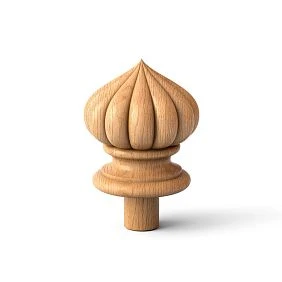
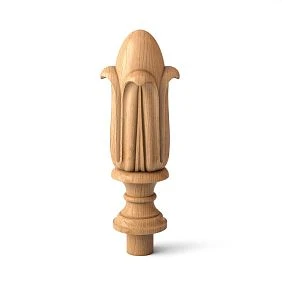
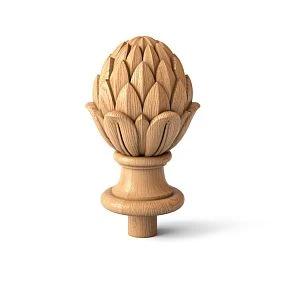
Our factory also produces:


Execution 131 × 52 × 70 × 106 mm
The medium version is noticeably larger. The difference from the small one is 37 mm in A, 15 mm in B, 20 mm in C, and 31 mm in E. In a real interior, this transition is felt more strongly than in the table: not only the height increases, but also the visual volume.
L-023 measuring 131 mm can be a confident finish for a stair post or furniture stand. But the buyer will have to check the distance to the handrail, side elements, cornice, or headboard. If there is little free space around the top part, the medium option can look cramped even if technically it can be mounted.
Get Consultation
Version 170 × 71 × 96 × 145 mm
The large L-023 is a standalone decorative accent. On a massive post, it can look proportional, but on a small stand, it can visually overpower the entire structure. Here, the reasoning "larger means more expressive" is especially dangerous. Expressiveness only works when the lower support can sustain the scale of the finial.
The height of 170 mm increases the final vertical of the post. The values B = 71 mm, C = 96 mm, and E = 145 mm require careful verification against the drawing. If a handrail runs nearby, there is a turn in the railing, or a cornice begins, a single free end is not enough: the surrounding space needs to be checked.
The first five minutes with a finished post: which dimensions to write down
The buyer can spend an hour comparing three photos of L-023 and still not get closer to the right order. It is much more useful to take a tape measure, a square, a sheet of paper, and write down the parameters of the existing structure.
What is needed is not approximate impressions, but specific values:
-
width of the top end of the post;
-
depth of the top end;
-
End shape — square, rectangular, or other;
-
Presence of a protruding top platform;
-
Dimensions of this platform;
-
Presence of a bevel, chamfer, or rounding;
-
Position of the decorative belt under the top;
-
Distance from the end to the handrail;
-
Distance to the adjacent post or wall;
-
Allowable overhang on each side;
-
Current post height;
-
Maximum height including the finial;
-
pole material;
-
already applied coating;
-
presence of a hole, pin, or other old mounting.
This data turns the choice of a finial from a guess into a verifiable task.
The top end is measured in two directions
Even if the pole seems square, record the width and depth separately. After painting, hand finishing, or old repairs, the values may differ. A 70 × 72 mm end is not the same as a perfect 70 × 70 mm.
Measurement is taken along the actual contact plane. If there is a chamfer, decorative step, or protruding band at the top, the overall external size of the pole cannot be transferred to the mounting area.
Check not only the middle, but also the edges
The top surface may have a slight slope, chip, or rounding. The flat platform L-023 requires clear support. If contact occurs only in the center while the edges hang, the installation method needs to be reconsidered.
A square helps to see how perpendicular the end is to the vertical. If the pole is tilted or the top is cut at an angle, the finial may also deviate from the axis after installation.
A photo with a ruler is more useful than a verbal description
The phrase "a post about seven centimeters" does not show the chamfer, handrail, old hole, and actual geometry. Take several photos:
-
strictly from above;
-
from the front;
-
from the side;
-
together with the handrail;
-
with a ruler placed alongside;
-
with the central axis marked.
A photo does not replace dimensions, but it helps connect the numbers to the structure.
Don't forget the final height
If the current post has a height H, after installing the cap the total value will increase. Exactly how much is determined by the drawing and the mounting assembly. You cannot always mechanically add A to the current height: part of the structure may interact with the platform differently. But the value A must be included in the check.
The final height at the stair turn, near the window, under a low ceiling, next to wall decor, or in furniture where the top must align with the adjacent post is especially important.
A, B, C, and E: the letters are not function names
The technical table provides exact numbers, but the meaning of each dimension line is revealed by the drawing. A letter by itself does not say: "this is the base," "this is the diameter," or "this is the post size."
The buyer sees C = 50, 70, or 96 mm and may decide that this parameter should match the end face. Another user selects E = 75, 106, or 145 mm as the platform width. Both decisions remain guesses until the technical diagram is opened.
Why C cannot be declared as the mounting dimension
To call a dimension a mounting dimension, you need to see on the drawing which geometric part it describes. If C refers to one of the silhouette sections, and the contact area is defined by another parameter, selecting "C to the post" will be erroneous.
Even when line C is visually located near the lower part, you need to consider the shape, the direction of the arrows, and the position of the dimension extension lines.
Why matching a single value is insufficient
Suppose one parameter L-023 matched the width of the end face. The other checks have not yet been performed:
-
the depth may differ;
-
the platform may protrude unevenly;
-
the upper decorative belt of the post may interfere;
-
the handrail may cross the silhouette of the finial;
-
the overall height may turn out to be excessive;
-
the mounting method may require an additional zone;
-
the shape of the end may not be square.
Compatibility is the result of comparing the entire geometry, not a single lucky number.
The drawing must be opened specifically for the selected version
You cannot study the diagram of the small version and then order the large one from memory. All four parameters change. When transferring dimensions to the request, indicate the full combination:
-
L-023 — 94 × 37 × 50 × 75 mm;
-
L-023 — 131 × 52 × 70 × 106 mm;
-
L-023 — 170 × 71 × 96 × 145 mm.
On the page you can to download the drawings of STAVROS products and align the dimension lines with the measured post. If the required technical material is not found, the parameters are clarified before payment, not after delivery.
A paper mockup is built after reading the diagram.
Once the actual width of the lower part of the finial and the overall outer contour are determined, a template can be made. For each version, two mockups are useful:
-
top view — shows the contact area and overhang;
-
side view — shows the height and interaction with the handrail.
One rectangle 94 × 75 mm does not replace the L-023 silhouette. The mockup must reflect the dimensions that actually correspond to the selected projection.
Small L-023 with a height of 94 mm: where compactness works to advantage
A compact finial is appropriate where the post should not become a dominant decorative axis. It completes the vertical line but leaves visual precedence to the handrail, the carving of the baluster, the headboard of the bed, or the cornice.
On a small stair post
If the top of the post is close to the handrail, the 94 mm option requires less vertical clearance. But "less" does not mean the handrail check can be skipped. The side profile L-023 can approach it even at a low height.
The side view should be evaluated on a full-size template. Mark the handrail line and check whether the finial looks cramped.
Paired with a thin decorative band
A small top can continue the proportions of a neat post. A large version on the same support would create a sharp transition from a narrow base to a massive finish.
At the same time, the size of the contact area must still match the end face. Visual lightness does not compensate for a poor fit.
On a furniture post
L-023 is suitable for use in the decor of beds, sofas, cornices, and other interior structures. The small version can be used where the finial is viewed from close range and should not interfere with the use of the furniture.
On a bed, check the height relative to the mattress and pillows. On a sofa, check the position next to the backrest and walkway. On a cornice, check the distance to the wall, ceiling, and fabric.
When 94 mm looks too small
On a tall, massive column, a compact finial can get lost. The top will be perceived as a randomly placed small detail, not as a continuation of the vertical.
You need to evaluate not only technical compatibility, but also the scale ratio:
-
the height of the finial to the visible height of the column;
-
the width of the finial to the thickness of the support;
-
the volume of the upper part to the pattern of the handrail;
-
visibility from the main viewing point.
Commercial check of the small version
Before order finial L-023 in size 94, 131, or 170 mm, do not choose the small version only out of fear of making a mistake. A too-small finial can also be wrong. It should be both compatible and proportional.
Medium L-023 with a height of 131 mm: a size that is especially easy to call universal
The average execution seems like a safe compromise. It is not as compact as 94 mm, nor as large as 170 mm. This gives rise to a dangerous thought: if there is no exact data, it is better to order 131 mm.
But the average size is not universal. It is only suitable when its A, B, C, and E are consistent with the finished post.
Why the average version is noticeably larger than the small one
The height difference is 37 mm. For a small part, this is a significant increase. At the same time, other parameters grow, so the volume is perceived even more strongly.
On a stair landing, the average finial can already become an important point of the composition. It connects the post with the handrail and emphasizes the beginning or end of the railing.
Checking the distance to the handrail
If the handrail enters the post high, the side part of L-023 may end up near the connection. A side view at 1:1 scale is needed.
Check:
-
whether the contour is free;
-
whether the fastening can be done;
-
whether the finial blocks access to the handrail joint;
-
does a visually tight gap not arise;
-
is the possibility of painting and repair preserved.
Average top piece on paired posts
If two posts stand next to each other or form a symmetrical composition, both L-023 must have the same execution, material, grinding quality, and finish. Even a slight difference in height will be noticeable along the top line.
Before ordering, both ends are measured. It cannot be assumed that previously manufactured posts are completely identical.
When 131 mm should be replaced with 94 mm
The transition to the smaller version is justified if:
-
there is little free space around the top;
-
the handrail is located close;
-
the post is visually thin;
-
The overall height is already large;
-
The finial should not draw too much attention;
-
A large contact part creates excessive overhang.
When it's better to consider 170 mm
The larger option may be more convincing on a massive support, in a tall room, or in a composition with pronounced neoclassical decor. But the decision is made based on the mockup and drawing, not on the desire to "add solidity."
Large L-023 with a height of 170 mm: scale verification begins before installation
The 170 × 71 × 96 × 145 mm option cannot be perceived as a slightly enlarged medium finial. It noticeably changes the upper part of the post and can become an independent decorative object.
A full-size silhouette is mandatory
Printing on an A4 sheet may be automatically reduced. Check the control segment with a ruler. A scale error of 10–15% can make a large finial look deceptively compact on paper.
The mockup is applied from several sides. The front view shows the relationship to the post, the side view shows the distance to the handrail, and the top view shows possible overhang.
A tall post does not always require a large finial.
Support height is only one criterion. A post can be tall but relatively thin. Then L-023 at 170 mm will create a heavy top.
You need to compare:
-
the width and depth of the post;
-
the height of the carved section;
-
the thickness of the handrail;
-
the size of adjacent balusters;
-
the scale of the room;
-
viewing distance;
-
the number of identical finials.
One large accent or a row of large details
A large L-023 on the starting post can look appropriate as the main focal point of the staircase. If such details are repeated at every turn and landing, the composition becomes much richer.
Quantity affects the perception of size. One detail 170 mm high is an accent. Four identical finials already create a rhythm that must match the entire staircase.
Free space for finishing
A large finial has a developed surface. After installation close to the handrail or wall, some areas will be difficult to paint and maintain properly.
The order of finishing and installation is agreed upon in advance. You cannot first secure the part in a tight area and then find out that the painter cannot treat it from the back side.
When a large L-023 technically fits but is aesthetically unsuitable
The absence of a physical conflict does not prove proportionality. The finial may stand on the landing and not touch the handrail, but look excessively wide or tall.
For evaluation, take a photo of the mockup from the point where the staircase is most often seen. A shot from a distance shows the scale more honestly than looking close to the post.
Comparison of three versions without trying to assign them by a single number
| Criterion | L-023 94 mm | L-023 131 mm | L-023 170 mm |
|---|---|---|---|
| General visual scale | Compact | Moderate pronounced | Large |
| Addition to vertical appearance | Moderate | Noticeable | Maximum among the three |
| Risk of getting lost on a massive column | Higher | Medium | Below |
| Risk of overloading a small column | Lower, but remains | Medium | The highest |
| Requirement to check the handrail | Mandatory | Mandatory | Especially important |
| Requirement to check the overhang | Mandatory | Mandatory | Especially important |
| Does it match by a single value A | No | No | No |
| Can C be equated to the column size | No without a drawing | No without a drawing | No without a drawing |
| Does it fit without checking the fastening | No | No | No |
| Is a full-scale mockup needed | Desirable | Needed | Practically mandatory |
The table does not choose the size instead of the buyer. It shows the direction in which the risk grows. The larger the L-023, the more carefully the surrounding space needs to be analyzed. But even the small version requires technical compatibility.
Square platform without a tenon: what this changes in the order
Wooden finials in this group feature a straight square platform without a mounting tenon. This feature affects both selection and installation.
L-023 does not automatically insert into a round or square hole on the post. The absence of a tenon means that the position and fastening are determined by a separate assembly.
A matching end face does not create a ready-made connection
Suppose the contact area of the finial matches the top of the post. Still, you need to decide:
-
how the part is centered;
-
what prevents shifting;
-
in what way it is secured;
-
whether the base allows drilling;
-
how the fastener interacts with an already applied coating;
-
whether the fastener needs to be hidden;
-
Is dismantling possible?
-
how to maintain the exact axis.
Without these answers, the product only rests on the post but is not yet installed.
It is impossible to universally promise installation on a single adhesive
The choice of adhesive, mechanical, or combined connection depends on the post material, end condition, load, usage conditions, and project. The article does not prescribe a universal compound.
The phrase "the wooden finial is simply glued on" is too categorical. On a staircase, the top of the post may be touched by hand, and on furniture, the load depends on the location. The joint must be coordinated with the manufacturer or installer.
An old hole is not always useful
If another finial was previously on the post, a hole, pin, or mounting trace may remain in the end. Since the L-023 has no mounting tenon, the old joint does not automatically become compatible.
Need to check:
-
the position of the hole relative to the center;
-
diameter;
-
depth;
-
the condition of the wood;
-
ability to use it in a new connection;
-
need for repair.
Do not enlarge or fill the hole at random before choosing the mounting method.
The platform must rest predictably
If the column has a shaped top, a small central platform, or a wide chamfer, the contact may be insufficient. Increasing the amount of adhesive does not fix the geometry.
First, you need to understand which part of L-023 actually touches the column. For this, use a drawing, a template, and a dry fit.
Cap overhang: a decorative technique or a sign of incorrect size
The cap does not have to fully match the column contour. A small uniform overhang can emphasize the top and create a clear transition. But the word "small" cannot be translated into a universal number without a drawing and proportions.
A uniform overhang looks intentional
If the cap protrudes equally on all four sides, the composition appears assembled. For this, the centers of L-023 and the column must align.
Different overhang may be permissible only per the project. Random offset to one side looks like an installation error.
A large overhang changes the scale
When the base of the cap is significantly wider than the end, the top begins to resemble a separate lid. On a massive neoclassical post, this may be part of the design intent. On a thin column, it may look heavy.
It should be checked from a distance, not just from above.
Exact matching is not always necessary or desirable either
If the dimensions of the platform and the post match to the millimeter, the slightest shift will become noticeable. Additionally, after painting, boundaries may be perceived differently.
Exact matching can only be accepted after checking the drawing and the quality of the end. It cannot be considered the only correct option.
The permissible overhang is agreed upon on all four sides
In the request or project, it is useful to specify:
-
front overhang;
-
from behind;
-
from the left;
-
on the right;
-
position of the central axis;
-
shape orientation.
Even a square base can be offset relative to the decorative volume. This is another reason not to choose a product based on a single number.
Handrail nearby: the space that is forgotten to measure
The top of the post rarely exists separately. A handrail runs nearby, a turn begins, a railing adjoins, or a decorative insert is located.
Take three measurements
For an initial check, write down:
-
the distance from the top end to the top point of the handrail;
-
the horizontal distance from the post axis to the handrail;
-
the minimum gap between the intended contour of L-023 and the adjacent part.
These values are transferred to the side template.
Physical contact is not the only problem
The top may not touch the handrail, but the gap may be too narrow. Then the surface is difficult to paint, clean, and inspect.
Visually, a narrow gap also looks accidental. Sometimes it is better to choose a smaller version than to leave a few millimeters between two large forms.
The turning post requires checking from all directions
At the turn, handrails may approach from two sides. The mock-up is applied in each plane. A front view only does not show the second joint.
An already installed handrail cannot be considered a movable reserve
Do not order a large top with the expectation that 'if it does not fit, we will move the handrail a little.' Changing a finished railing may affect several connections.
Size L-023 is selected for the existing structure if its modification is not included in the project.
Final post height: the top point should remain manageable
Adding a finial changes the overall height. On a staircase, this affects the visual rhythm of the posts, and in furniture, it affects the connection with the headboard, cornice, wall, or ceiling.
Compare all posts in one system
If the starting, ending, and turning posts have different current heights, identical L-023 finials will preserve the difference. Sometimes this is exactly what is needed, sometimes the top points should align on one line.
The schedule should include the current and design height of each position.
Paired finials require a common level
On a bed or sofa, two posts are usually perceived together. Even a difference of a few millimeters can be noticeable along the top line.
Not only the L-023 finials themselves are measured, but also furniture posts, floor condition, and assembly quality.
Large finial under a low ceiling
The 170 mm version increases the vertical more than the others. In a room with a low ceiling or upper cornice, it can visually compress the structure.
A full-size mockup helps to see not only the physical gap but also the compositional distance.
Beech under enamel or oak with visible texture
L-023 is made from beech and oak. The choice of wood species is not based on abstract preference, but on the material of the post and the future finish.
Beech for opaque color
A beech top is considered when the surface is planned to be painted with enamel. An opaque color can unify L-023 with the post, handrail, and other elements.
But the wood species and the finish are different order lines. Beech does not automatically mean white painting, and the phrase "under enamel" does not confirm that the color has already been applied.
Before finishing, the following are agreed upon:
-
shade;
-
gloss level;
-
surface preparation;
-
treatment of the platform;
-
finishing after fitting;
-
installation sequence;
-
masking of the fastening;
-
matching with the post.
Oak for preserving the wood grain
An oak top is chosen when the texture should remain visible under staining, oil, varnish, or another agreed-upon system.
On rounded and carved transitions, the wood grain interacts with light. Upper areas appear lighter, recesses deeper. Therefore, a flat color sample does not always convey the future result on L-023.
Top wood species and post wood species
It is better to find out in advance what the existing post is made of. The word "wooden" is not enough.
Beech and oak reveal texture and accept finishes differently. If the top and post are made of different species under a transparent coating, the difference may become noticeable.
Under an opaque enamel, the difference is easier to hide visually, but the technology is still coordinated with the painter.
It is impossible to promise a complete match of the wood grain
Two oak L-023s of the same size may differ in natural texture. For paired parts, an acceptable material character and a uniform color are approved, rather than expecting absolute fiber identity.
Where to select materials
After selecting the wood species, you can buy materials for finishing a wooden top, but the specific system is selected for beech or oak, the existing post coating, and the desired result.
You cannot choose a composition just by the label "for wood." The primer, stain, and finish must work together.
Standard or Prestige: two levels of surface preparation
For L-023, the qualities of Standard and Prestige sanding are confirmed.
Standard means machine sanding. Prestige involves more detailed manual preparation. These options should not be confused with wood species, grade, strength, or finished coating.
When to consider Standard
Machine preparation can be rational when the subsequent finishing cycle involves additional work by the painter, and the project requirements are agreed upon in advance.
You cannot automatically write that Standard is fully ready for the application of any enamel. Final preparation depends on the coating and the requirements of the contractor.
When Prestige is especially useful
More detailed manual preparation deserves attention:
-
for a small number of finials;
-
with a transparent finish;
-
when viewed from a close distance;
-
on furniture;
-
for paired elements;
-
under a complex lighting scenario;
-
when the surface becomes an important part of the decorative effect.
But Prestige also does not mean applied varnish, oil, stain, or enamel.
Choosing quality for opaque painting
Sometimes a customer thinks that any surface condition is sufficient under enamel because the paint will hide everything. In practice, an opaque coating does not correct geometry and can emphasize unevenness with side light.
The choice is discussed with the painter. The contractor must understand form L-023, the material, and the desired degree of smoothness.
All parts of one group must have the same preparation
If four identical finials are installed on a staircase, Standard and Prestige should not be mixed without reason. Different levels of preparation will increase the likelihood of inconsistent appearance after finishing.
Before purchasing, you can choose the sanding quality of the wooden finial and record it fully in the specifications.
One post — one finial? The quantity is counted by points, not by staircase
For one specific post, usually one part L-023 is considered. But an order for a staircase, furniture, or interior portal cannot be calculated with the phrase "one set."
First, mark each installation point.
Starting post
The beginning of the railing often has its own expressive post. If L-023 is installed only here, one position is required.
End post
A second part is needed when the top ends with a separate stand and the project provides for the same finial.
Turn post
At a stair landing, another point may appear. Its end and surroundings are measured separately: the geometry of handrails often differs from the starting zone.
Landing posts
On a large landing, the quantity is determined by the actual number of supports that must receive L-023. You cannot multiply floors by two without a diagram.
Paired furniture posts
A bed, sofa, console, or other item may have two or four verticals. Each position is specified separately.
Cornice or interior portal
The quantity depends on the composition. L-023 can finish a single central post, paired side elements, or a repeating row.
Quantity calculation table
| Installation location | Possible quantity of L-023 | What to Check |
|---|---|---|
| One starting post | 1 | End, handrail, height |
| Starting and ending posts | 2 | Coincidence of two supports |
| Start, turn, and end | 3 | Each node separately |
| Four posts of the platform | 4 | Common level and rhythm |
| Bed with two posts | 2 | Symmetry and height |
| Furniture with four verticals | 4 | All contact pads |
| One interior accent | 1 | Scale and mounting |
| Serial project | According to the list | Batch, finish, and marking |
After counting points, a control sample is added only when it has a clear purpose. An abstract percentage of spare for piece tops is inconvenient: 10% of four items does not become part of a product line.
Control part before the batch: when it saves more than it costs
If the existing column is complex, the end dimensions are doubtful, or the project includes several identical L-023, it is reasonable to first order one part for a full-scale trial.
The control top helps to check:
-
the actual scale;
-
platform geometry;
-
overhang;
-
distance to the handrail;
-
sanding quality;
-
behavior of the selected finish;
-
future fasteners;
-
total height;
-
combination with the post texture.
After approval, the control part can be included in the project if it matches the batch and is not damaged during testing.
When the sample is especially needed
-
the old post has a non-standard end;
-
the drawing is difficult to compare with the structure;
-
a 170 mm version is selected;
-
the clear finish must match the existing oak;
-
several paired finials are required;
-
the mounting assembly is developed anew;
-
the furniture is already painted;
-
an error will lead to reworking the staircase.
The sample does not replace the specification
An approved part must receive a passport: article number, full configuration, material, sanding quality, color, and installation method. The phrase "make the rest like the sample" is only useful together with precise data.
L-023 on the staircase: selection based on the role of a specific post
The same finial can be perceived differently on the starting, turning, and end support.
Starting point
The first post meets a person at the stairs. Here, a large finial can work as an accent. But it should not interfere with gripping the handrail or narrow the passage.
Check the distance from L-023 to the hand trajectory. It is useful to evaluate the mockup not only standing in front of the stairs, but also in motion.
Turn
On the turning post, handrails can approach from different directions. The 170 mm version requires particularly careful checking of lateral space.
Sometimes a medium or small finial looks more appropriate, because the turn is already saturated with connections.
End support
At the top of the stairs, the passage is important. The decorative finish should not protrude into the movement path or conflict with the door, wall, or p
L-023 in furniture: bed, sofa, stand, and cornice require different checks
The card allows the use of the finial not only on stair posts. But the furniture scenario does not cancel dimensional analysis.
Bed
On the L-023 bed, the headboard or footboard posts can be finished. Here, the following are important:
- height above the mattress;
- distance to pillows;
- absence of sharp or obstructive protrusions;
- symmetry of paired parts;
- resistance to accidental contact;
- matching of finish with the frame.
The 170 mm version can noticeably increase the headboard. The mockup should be evaluated together with the mattress and textiles.
Sofa
The finial on the sofa post is closer to the passage and the person. Check whether it interferes with sitting, standing up, and leaning on the backrest.
A small size may look neater, but the technical mounting must still match the furniture.
Cornice
When used on a decorative cornice, the distance to the wall, ceiling, curtain, and adjacent furniture is assessed. The large L-023 may require more side space.
Furniture stand or portal
Here, the finial can become part of the architectural composition. The size is chosen relative to the width of the stand, the height of the portal, and other decorative details.
Serial furniture
For a batch of beds or sofas, one control sample and one specification are approved. All finials are ordered in the same finish, from the same wood species, and with the same sanding quality.
What to order together with L-023
The finial is the finishing touch, but the completed project may require additional products and solutions.
| Position | Why it's needed | What to check |
| L-023 | Decorative finishing | Size A × B × C × E |
| Stair post | Base for finial | End grain, material, and height |
| Handrail and components | Overall staircase system | Distance to L-023 |
| Finishing materials | Enamel, tint, or other finish | Compatibility with beech or oak |
| Mounting unit | Platform fixation without spike | Project, material, and old mounting |
| Control sample | Color coordination | Post and finial together |
| Drawing | Check A, B, C, and E | Current version |
| Template | Scale and overhang assessment | Top and side view |
| Design project | Layout of the entire system | Dimensions and quantity |
| Delivery | Receiving a batch | Packaging and completeness |
If the existing post does not fit the size or the new project is not yet assembled, you can buy a wooden post for the stairs after matching its top part with L-023.
Fasteners should not be invented based on a general photo. The composition of the mounting assembly is determined by the actual structure.
L-023 and other finials: when the problem is not the size, but the shape itself
The buyer can carefully compare 94, 131, and 170 mm and not find a suitable option. This does not mean that you should choose the nearest size and compensate for the mismatch with mounting.
Perhaps the finished post requires a different model.
When to open the general catalog
In this section you can buy wooden finials and compare different shapes, dimensions, and character of decor.
The general catalog is needed if:
- no L-023 matches the platform;
- the shape is too large;
- The neoclassical character does not match the interior;
- A different silhouette is needed;
- A different height-to-width ratio is required.
When to choose a carved model
If there is already pronounced carving on a column, railing, or furniture, you can buy a carved finial for the column and find a motif that more precisely continues the existing decor.
L-023 also has a decorative shape, but it does not have to match every carved column.
Modern collection
For calm geometry and a modern interior, you can order a finial from the contemporary collectionSwitching to a category is useful when the L-023 scale fits, but the plastic itself seems too expressive or, conversely, insufficient.
General guide to the L-series
To understand the model's place in the range, you can look at what other wooden finials in the L-series STAVROS produces. The overview helps to study the series, but the specific choice of L-023 is still made based on the dimensions of the finished post.
Preparation for installation: what to do before applying glue or drilling
Even a correctly chosen size can be ruined by hasty installation.
Do a dry fit
L-023 is placed on the post without final fixation and check:
- the central axis;
- contact uniformity;
- overhang;
- position relative to the handrail;
- final height;
- orientation of the decorative shape;
- ability to work with the tool;
- access for finishing.
If the part wobbles, the cause must be eliminated before installation.
Number the paired items
With multiple posts, each finial is assigned a number. If the ends differ slightly, the parts must not be accidentally swapped after fitting.
Mark the face side
Even a seemingly symmetrical shape may have a preferred orientation based on wood grain or finish. Marking is done temporarily in a way that does not damage the surface.
Check the post coating
Installation over finished enamel or lacquer differs from working with bare wood. Preparation of the contact area is coordinated with the craftsman.
Decide the finishing order
Different layouts are possible:
- finish L-023 separately, then install;
- perform a dry fit, partial assembly, and overall painting;
- install after the finish with surface protection;
- assemble a test joint before starting the batch.
There is no universal answer. A unified technological plan is important.
Do not install before acceptance
First check the size, material, grinding quality, and quantity. After drilling, trimming, or painting, it is impossible to return the part to its original condition.
Finishing after size selection: first geometry, then color
It is easier for the buyer to discuss the shade than the dimensional lines. The color is visible immediately, while A, B, C, and E require a drawing. But the sequence should be the reverse.
First, they confirm:
- execution;
- platform compatibility;
- overhang;
- distance to the handrail;
- final height;
- installation method.
Only then do they choose the finishing.
A swatch on a flat board does not show the full result.
L-023 has a three-dimensional shape. Light falls on it at different angles. The same enamel looks lighter on the upper areas and darker in the transitions.
For a transparent finish, the oak pattern additionally changes perception.
Paired parts are painted in one cycle.
This reduces the risk of differences in color and gloss. Blanks are marked but processed in a unified system.
Contact area and finish
It must be decided in advance whether the contact zone is covered and how this affects fastening. The article does not prescribe a universal technology—it is chosen together by the installer and the finisher.
Touch-up after installation
If the installation method damages the finish, local rework is planned. The color and material must be available on site.
Twenty-five mistakes when choosing L-023
Error 1. Order by one height
The buyer chose 131 mm without checking B, C, and E.
Fix: verify all four parameters against the drawing.
Error 2. Call C the mounting size
The letter was interpreted without a technical drawing.
Fix: look at the position of the dimension line.
Error 3. Consider E the column size
The value was transferred to the end face without checking.
Fix: do not assign functions to letters on your own.
Error 4. Choose 94 mm as the safest option
The small finial turned out to be disproportionate to the massive post.
Fix: evaluate compatibility and scale simultaneously.
Mistake 5. Buying 131 mm as a universal size
The medium version did not match the platform.
Fix: measure the actual top.
Mistake 6. Ordering 170 mm for the sake of expressiveness
The large finial overloaded the thin post.
Fix: make a full-size mockup.
Mistake 7. Measuring the post only by width
The depth turned out to be different.
Fix: record two directions.
Error 8. Use the overall column size instead of the end face.
The chamfer reduced the contact pad.
Fix: measure the actual plane.
Error 9. Not checking the end face slope.
The finial settled at an angle.
Fix: apply a square.
Error 10. Forgetting the handrail.
L-023 entered along the end face but conflicted on the side.
Fix: build a side template.
Error 11. Not accounting for total height
The top ended up too close to the ceiling or cornice.
Fix: mark the design top point.
Error 12. Treating the platform as a tenon
The customer expected a mortise fit.
Fix: account for a straight square base without a tenon.
Error 13. Relying only on glue
The mounting joint was not calculated.
Fix: agree on the fixing method.
Error 14. Use old hole automatically
It did not match the new center.
Fix: inspect the end face.
Error 15. Install on uneven surface
Contact was partial.
Fix: prepare the surface according to the project.
Error 16. Choose beech for transparent finish without sample
Texture expectation did not match the result.
Fix: agree on wood species and finish.
Error 17. Order oak for enamel without reason
The texture was completely covered.
Fix: link material to task.
Error 18. Mix Standard and Prestige
Paired finials required different preparation.
Fix: order one configuration.
Error 19. Paint before fitting
After finishing, excessive overhang was found.
Fix: dry fit first.
Error 20. Not numbering parts
Finials were swapped between different posts.
Fix: keep a position log.
Error 21. Count "two on the stairs"
The rotating column was left without a part.
Fix: count all installation points.
Error 22. Buy stock without an assignment
The extra finial did not fit any end.
Fix: bind reserve to a specific task.
Error 23. Not checking completeness before painting
The shortage was discovered late.
Fix: accept the entire batch in advance.
Error 24. Order via the old duplicate path
The commercial signal was distributed among the cards.
Fix: use the recommended URL of the modern collection.
Error 25. Start with color
A beautiful shade was chosen for an unsuitable size.
Fix: follow the order: drawing → end face → scale → material → finish.
Who is L-023 suitable for
The finial should be chosen if:
- the neoclassical shape matches the project;
- one of the three sizes is consistent with the drawing;
- The top of the pole has a suitable platform;
- The overhang is checked;
- The handrail does not interfere;
- The total height is acceptable;
- The mounting method is developed;
- Beech or oak is matched with the finish;
- Standard or Prestige is specified in the order;
- The quantity is calculated for all points.
When it's better to choose a different model
L-023 does not need to be adapted at any cost if:
- No version matches the end face;
- The pole platform is too small;
- There is no free space nearby;
- The shape conflicts with the handrail;
- The large version overloads the stand;
- The small one gets lost;
- A mounting spike is required;
- A different style is needed;
- The existing hole cannot be used or repaired;
- The design does not allow the selected height.
In such a situation, it is better to open the finial catalog and find a model that matches the design without risky modifications.
A specification that cannot be interpreted ambiguously
Bad entry:
Finials L-023, medium, 2 pcs.
Dimensions, material, sanding quality, finish, and posts are not specified.
Working note:
Finial for post L-023, version A × B × C × E = 131 × 52 × 70 × 106 mm, beech, Prestige sanding quality, for enamel, 2 pcs. Positions C-01 and C-02. Compatibility with post top plates verified per drawing. Color and gloss level per approved sample. Mounting assembly per project.
For oak:
L-023, 170 × 71 × 96 × 145 mm, oak, Standard, 1 pc. For transparent finish per sample. Install on starting post L-01 after checking overhang, axis, and distance to handrail.
For control part:
L-023, 94 × 37 × 50 × 75 mm, beech, Prestige, 1 pc. Control sample for fitting to furniture post and coordinating enamel. Decision on batch to be made after approval.
What to check in the invoice
Before payment, find in the document:
- article L-023;
- full execution of A × B × C × E;
- quantity;
- beech or oak;
- Standard or Prestige;
- finish assignment;
- separate delivery line;
- absence of a fabricated landing pin;
- absence of unconfirmed fasteners;
- item numbers;
- note about the drawing;
- control sample, if needed.
If the invoice specifies only A = 131 mm, the configuration is not described fully enough.
Order route L-023 without guesses
- Photograph the finished column.
- Measure the width of the end face.
- Measure the depth.
- Mark the chamfers and protrusions.
- Check the levelness of the platform.
- Record the distance to the handrail.
- Determine the allowable overhang.
- Record the current height.
- Mark the design top point.
- Open drawing L-023.
- Find A, B, C, and E.
- Compare the 94 mm execution.
- Compare 131 mm.
- Compare 170 mm.
- Make templates.
- Evaluate them from a distance.
- Choose beech or oak.
- Select Standard or Prestige.
- Match the finish.
- Develop a mounting assembly.
- Count all points.
- Prepare the specification.
- Check the invoice.
- Order a control part if in doubt.
- Perform a dry fit.
- Approve the batch.
- Carry out finishing.
- Install according to the marking.
- Check the overall line.
- Save the drawing for future reordering.
For a complex staircase, furniture, or portal, you can order a design project for the staircase and decor, so that the dimensions of finials, posts, handrails, and surrounding elements are coordinated before purchase.
After confirming the configuration, you can order L-023 with Contact us to confirm shipping to your destination., specifying the city, quantity, and full execution.
Frequently asked questions about L-023
What sizes of L-023 are available?
Three versions are confirmed: 94 × 37 × 50 × 75 mm, 131 × 52 × 70 × 106 mm, and 170 × 71 × 96 × 145 mm.
What does the first digit mean?
In the table, it corresponds to parameter A. Its position should be checked on the drawing.
Can A be considered the total height of the finial?
The parameter is read from the technical drawing. Do not assign the size function based only on the order of digits without verification.
What does B mean?
This is one of the dimension lines of L-023. The exact geometric part is determined by the drawing.
What does C mean?
C cannot be automatically considered a mounting size or a post size. First, you need to see its position on the diagram.
What does E mean?
E also refers to a specific segment on the drawing. It is not an independent designation for the top platform.
Will L-023 with C = 50 mm fit a 50 × 50 mm post?
The matching number does not prove compatibility. You need to check the drawing, the entire platform, the overhang, and the installation.
What size should be chosen for a small post?
First, compare the end face with the technical diagram. The small version of 94 mm may fit in scale, but there is no automatic compatibility.
Is the medium L-023 universal?
No. The 131 mm size requires the same check as the other two.
When should 170 mm be chosen?
When the large scale corresponds to the column, room, railing, and overall height. The solution is confirmed with a mockup.
Does L-023 have a mounting tenon?
A direct square platform without a mounting tenon is confirmed.
Can the finial be inserted into an existing hole?
L-023 is not an automatically insertable part. The old hole is assessed as part of a separate mounting assembly.
Can L-023 simply be glued on?
Such mounting cannot be universally promised. The method depends on the column, coating, and project.
Which adhesive should be chosen?
A specific compound cannot be prescribed without the base material, coating, and joint structure.
Is mechanical fastening required?
Possibility and necessity determine the installation project.
How to check the overhang?
After reading the drawing, make a top view at full scale, align the centers, and measure the protrusion on each side.
Should the overhang be the same?
For symmetrical installation — yes, unless the project specifies a different arrangement.
Can L-023 be installed on a rectangular column?
Only after checking the square platform, contact, and overhang distribution.
Will the finial fit a round post?
Compatibility cannot be assumed. A square platform and a round top require a separate solution.
What should be measured on a finished post?
Width, depth, end shape, chamfers, distance to the handrail, allowable overhang, and final height.
Do both paired posts need to be measured?
Yes. Previously manufactured or installed posts may differ.
How to check the levelness of the top platform?
Use a square and a straight ruler. If in doubt, have the installer assess it.
Can L-023 be trimmed from the bottom?
Unauthorized trimming cannot be planned. It may change the shape of the platform and proportions.
Can the height of 170 mm be reduced?
Such a change is not confirmed by the standard card. You need to choose a different version or agree on an individual solution.
What wood is L-023 made from?
made of beech and oak.
What to choose for enamel?
Beech is considered for opaque painting with enamel.
When to choose oak?
When it is necessary to preserve and emphasize the texture of the wood.
Can oak be painted with enamel?
It can be considered on a project basis, but you need to understand why a species with a pronounced texture was chosen.
What is better for an old oak post?
An oak top seems like a logical direction, but the shade and texture are still checked on a sample.
Will the new oak match the old one?
Full matching cannot be guaranteed without a test finish and assessment of the existing surface.
What is Standard?
A confirmed option of machine sanding.
What is Prestige?
More detailed manual surface preparation.
Does Prestige mean a finished coating?
No. It is the quality of sanding, not an applied finish.
Will Standard be suitable for enamel?
The possibility depends on the painter's requirements and the chosen system. It is agreed before ordering.
Do all finials need to be ordered with the same quality?
For one visible group, this is preferable.
How many L-023 are needed for one post?
Usually one part per point is considered, but the structure must be shown on the diagram.
How many should be ordered for the staircase?
Count the starting, ending, turning posts and platform supports that should receive finials.
Is a reserve needed?
Only with a clear purpose. For a complex project, one control piece is more useful than an abstract percentage.
Can I order one finial as a sample?
Yes. It will help check the geometry, scale, finish, and mounting.
Can the sample be included in the batch later?
Yes, if it matches the approved configuration and is not damaged.
Is L-023 suitable for a bed?
The card allows use in bed decor. You need to check the post, height, and operational space.
Can L-023 be placed on a sofa?
Use is possible in a decorative structure, but the finial must not interfere with the use of the furniture.
Will it fit a curtain rod?
L-023 can be used in curtain rod decor. Size and mounting are calculated separately.
Can it be used on an interior portal?
Such a scenario is possible as a decorative task if the site and scale are confirmed by the project.
Is L-023 suitable for outdoor use?
Outdoor application conditions are not confirmed in the initial data. Such operation cannot be promised without separate approval.
Is it suitable for a damp room?
The operating mode and protective system need to be clarified. Specifying the wood species alone is not enough.
How to coordinate the color?
Make a physical color sample on the corresponding wood species and compare it with the column after drying.
Should it be painted before installation?
The order depends on the mounting and finishing system. Dry fitting is performed before finishing operations.
What to do with the old coating on the post?
Assess its type, condition, and compatibility with the new assembly. Do not remove the coating on your own without a plan.
What to do if the old cap left a mark?
Check whether L-023 covers the damaged area. If not, surface repair will be required.
What to do if the L-023 platform is wider than the post?
Assess the size and uniformity of the overhang. If it protrudes excessively, choose a different size or model.
What to do if the platform is narrower than the post?
Check whether an open top of the post is acceptable. An accidental step usually indicates incompatibility.
Can the cap be offset from the center?
Only if such a position is provided for by the project. For a standard installation, the axes are aligned.
How to choose between 94 and 131 mm?
Compare both versions according to the drawing, contact area, overhang, handrail, and visual scale.
How to choose between 131 and 170 mm?
Check the large version with a full-size template. If it overloads the column or pinches the handrail, choose a smaller one or a different model.
What is more important — technical fit or appearance?
Both conditions must be met. A beautiful but incompatible finial cannot be installed correctly; a technically fitting but disproportionate one will ruin the composition.
Where can I see the price of L-023?
In the product card before ordering. The current price depends on the selected version and purchase conditions.
Where can I see other finials?
In the general catalog of wooden finials and the corresponding filters.
Do I need to send a photo to the manager?
For a ready-made non-standard pillar, a photo along with dimensions helps to understand the task more precisely.
What should be specified in the request?
Article number, full configuration, quantity, wood species, sanding quality, end dimensions, photo, finish, and delivery city.
How to accept L-023 after delivery?
Check the quantity, full dimensional configuration, material, sanding quality, and surface condition before painting and installation.
Do I need to keep the packaging until fitting?
It is better not to throw away the labeling and documents until the configuration is verified.
What to do if size 131 arrived instead of 94 mm?
Do not start cutting or finishing. Verify the invoice and contact the seller.
What to do if the finial wobbles on the post?
Do not compensate for unevenness with a thick layer of random compound. Check the platform and the mounting assembly.
What is the main question to ask before purchasing?
"Which part of drawing L-023 should align with my top end, and what overhang will the selected version have?"
L-023 has no "roughly suitable" size
The choice between 94, 131, and 170 mm does not start with a photo or a desire to make the top of the post more noticeable. First, measure the end, the handrail, and the free space, then read A, B, C, and E on the technical drawing. Only after that can you evaluate proportions.
The small L-023 is not a universal option for all small posts. The medium one does not become a safe compromise. The large one cannot be chosen just for expressiveness. Each version has its own geometry, and a flat square platform without a mounting tenon requires a separate installation solution.
Before ordering, specify the full version, beech or oak, Standard or Prestige, quantity, and finish. For a complex finished post, first order a control piece or prepare a full-size template. This is cheaper and faster than redoing the handrail, repairing a painted platform, or finding a use for an unsuitable finial.
STAVROS company combines in one route the L-023 card, a catalog of wooden and carved finials, stair posts, components, drawings, finishing materials, design, and delivery. When every number is verified against the actual structure, the cart contains not just a beautiful wooden finial, but a precise completion of a specific post.