Article Contents:
- Wooden top piece L-110: the three dimension lines need to be read as a whole
- Why the entry 64 × 80 × 92 mm cannot be shortened to "L-110 for an 80 post"
- The product can be selected by the dimension line, but installation is only based on geometry
- Abbreviated dimensions cannot be declared a card error
- Why this is even more useful for the buyer than a regular size table
- Actual width of the top platform
- Actual depth
- Chamfers presence
- Rounded edges
- Protruding decorative elements
- Central axis
- Actual available mounting area
- Let's consider two possible scenarios
- The customer needs exactly the bottom contour
- What is not here
- First measure the top
- Then select the intended dimension line
- Get the L-110 drawing
- Match exactly the lower part
- Check the fasteners
- Only after that, specify the quantity
- Why it is useful to attach a photo of the pillar
- Even better — a small sketch
- Advantage of such an order
- But even within a single catalog, compatibility cannot be considered automatic
- Small finial on a large post
- Very large finial on a compact post
- Why this is important for the total height of the staircase
- Why the handrail cannot be used as a dimensional reference for the finial
- Post
- Balusters
- Handrail
- L-110
- Why it's useful to specify the quantity of finials separately
- What a trial installation provides
- Why is that
- With transparent finishing
- When covering
- What information to request
- How the craftsman controls the center
- Finial larger than the platform
- Why caution is especially needed in large sizes
- Poor specification
- Better
- Even better after technical confirmation
- What to compare in the category
- Why this is a separate line in the specification
- The choice is determined not only by the function of "closing the top"
- Mistake 1. Seeing 80 mm and immediately placing an order
- Mistake 2. Calling B the mounting dimension
- Mistake 3. Considering 64 mm the base width
- Mistake 4. Declaring 92 mm as the height
- Mistake 5. Considering 80 × 80 the size of the bottom surface
- Mistake 6. Measuring only one side of the pillar
- Mistake 7. Not accounting for chamfers
- Mistake 8. Not measuring the finished part
- Mistake 9. Buying based on a photo
- Error 10. Not requesting the bottom view
- Error 11. Buying the entire batch at once
- Error 12. Considering variants 80, 100, and 120 fully deciphered
- Error 13. Trimming the L-110 base
- Error 14. Trimming the column for the finial
- Error 15. Inventing the mounting
- Mistake 16. Painting before fitting
- Error 17. Choosing the material before the size
- Error 18. Not fixing "Standard" or "Prestige"
- Error 19. Accidentally mixing different wood species in one batch
- Error 20. Using the baluster size as a reference
- Error 21. Consider the handrail part of the top cap installation
- Error 22. Forget about the overall scale
- Error 23. Not check the view from the second floor
- Error 24. Call the position simply "L-110 80"
- Error 25. Not specify the material
- Error 26. Not save the drawing together with the invoice
- Error 27. Trust the master's memory
- Error 28. Consider all identical posts actually identical
- Error 29. Use the top cap as a repair for a damaged post
- Error 30. Consider matching external dimensions a guarantee of compatibility
- Bad
- Better
- After confirmation
- Will L-110 64 × 80 × 92 mm fit an 80 × 80 mm post?
- Why does the card show both 64 × 80 × 92 and 80 × 80 mm?
- Does B=80 mm mean the cap is designed for an 80 mm post?
- Can 64 mm be considered the width of the mounting area?
- Is 92 mm the height?
- What sizes of L-110 are available?
- What abbreviated options are listed in the description?
- Can these pairs be considered the sizes of compatible posts?
- What should be measured on a finished post?
- Is it necessary to measure the post if the project specifies 80 × 80?
- Why are chamfers important?
- What drawing should I request?
- Should I request a bottom view?
- Is the mounting hardware included?
- Can L-110 be mounted with glue?
- Can a dowel be used?
- Can it be screwed in with a self-tapping screw?
- Can L-110 be filed down from the bottom if it doesn't fit?
- Can the post be reduced instead of the finial?
- What materials are available?
- Which wood species should I choose?
- If the post is oak, does L-110 have to be oak as well?
- Can beech and oak be painted with opaque enamel?
- What do "Standard" and "Prestige" mean?
- Which option is better — "Standard" or "Prestige"?
- Can I order one finial first?
- When is a trial piece especially needed?
- What should I check on the trial sample?
- Do I need to paint L-110 first?
- Is L-110 suitable for a ceremonial post?
- Can I install L-110 on a regular decorative post outside a staircase?
- Where can I see other finials?
- Where to choose posts for a new staircase?
- Where to select balusters?
- Where to view wooden handrails?
- Can the handrail be selected to match the size of the finial?
- Should L-110 be taken into account when determining the total height of the post?
- Can 92 mm be considered an addition to the height of the column?
- If I have a 100 × 100 mm column, should I take 79 × 100 × 115?
- And for 120 × 120 mm — 95 × 120 × 138?
- How should L-110 be recorded in the invoice?
- Is it necessary to write "for an 80 × 80 column"?
- What to do if the drawing shows incompatibility?
- Can another finial of the same style be selected?
- Should the technical drawing be kept after purchase?
- What is the main question to ask the manager?
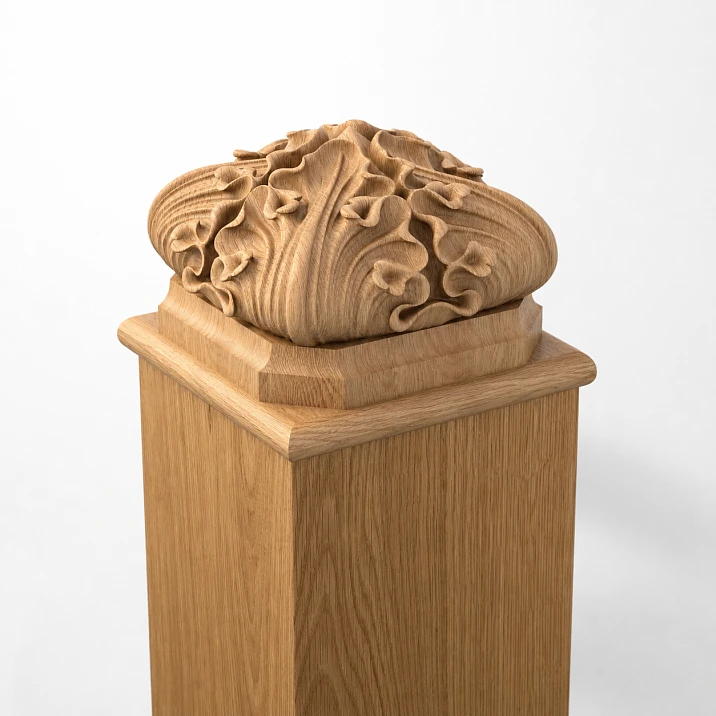
The post is already in the workshop. The top platform is leveled to exactly 80 × 80 mm, the wood is prepared, and the stairmaker is waiting for the decorative finish. The client opens the L-110 card and first calms down: the page description includes the 80 × 80 mm option. It seems the issue is resolved. But when selecting the item, another entry appears — 64 × 80 × 92 mm. And here begins that very mistake due to which a beautiful carved finial is purchased too early.
The matching 80 mm proves nothing yet.
Without a drawing, one cannot declare that B=80 mm is the mounting size. One cannot assume 64 mm is the width of the bottom platform. One cannot automatically call 92 mm the height of the product. And especially one cannot promise that the first dimension line of L-110 is guaranteed to fit an already manufactured 80 × 80 mm post.
The buyer needs an answer not to the question "which number looks suitable," but to a much more precise one: what is the actual size of the lower mounting surface of the selected L-110 and how should it interface with the top of the specific post.
Therefore, before buy wooden finial L-110, one must compare not the name of the dimension line, but the technical drawing with the actual geometry of the already manufactured post. For a finished post, this is fundamental: if the decorative part turns out to be smaller, larger, or differently organized at the bottom, it will be not the sketch but the wood that will need correction.
L-110 has two more dimension lines — 79 × 100 × 115 and 95 × 120 × 138 mm. On the same page, the text uses abbreviated notations 100 × 100 and 120 × 120 mm. This makes the card convenient for finding the right scale, but does not eliminate the technical check. An abbreviated notation cannot be independently turned into a mating drawing.
It is at this boundary that the correct order lies: the dimension line helps select a candidate, and the drawing confirms compatibility.
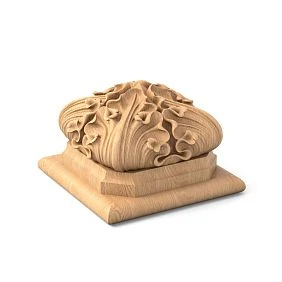
Wooden finial L-110: three dimension lines must be read in full
L-110 is not a single part of one size. The current card offers three size positions:
| Card size line | Materials | Sanding | What cannot be determined without a drawing |
|---|---|---|---|
| 64 × 80 × 92 mm | Beech, oak | "Standard", "Prestige" | Which side is the mounting side, what is the size of the bottom platform |
| 79 × 100 × 115 mm | Beech, oak | "Standard", "Prestige" | Compatibility with a 100 × 100 mm post |
| 95 × 120 × 138 mm | Beech, oak | "Standard", "Prestige" | Compatibility with a 120 × 120 mm post |
The last column is especially important. The card provides actual dimensions, but without decoding the A/B/C geometry, you cannot independently assign a mounting function to each number.




Why the record 64 × 80 × 92 mm cannot be shortened to "L-110 on column 80"
Because with such shortening, the other two parameters disappear.
Only a number remains, which coincidentally matches the top platform of your column.
Technical selection does not work this way.
For a part of complex carved shape, 64, 80, and 92 mm may refer to different geometric directions. Until this is shown on the drawing, any attempt to assign a value independently will be a guess.
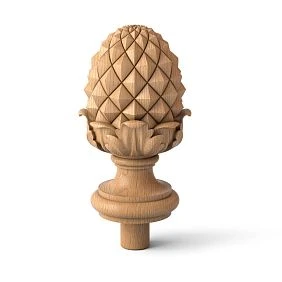
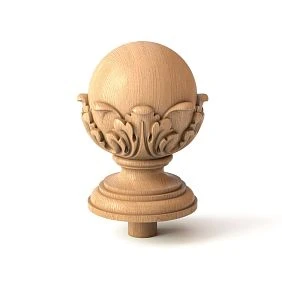
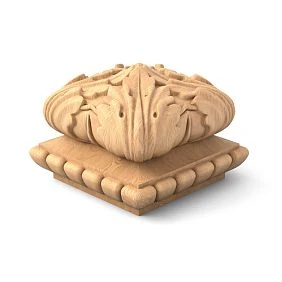
Our factory also produces:
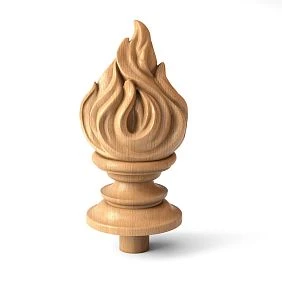
The product can be selected by the size line, but installation is only by geometry
This is a useful distinction.
For preliminary selection, you can say:
"I am considering L-110 in the 64 × 80 × 92 mm version."
This is not enough for production.
The master must receive:
-
external dimensions of the selected item;
-
contour of the lower part;
-
dimensions of the supporting surface;
-
position of the central axis;
-
recommended method of joining;
-
fastening data, if provided by the technical documentation.
Without this information, the phrase "80 mm matched" remains too weak a basis for drilling or trimming the post.
Get Consultation
Where did 80 × 80, 100 × 100, and 120 × 120 mm appear on one page?
The card uses two methods of describing size simultaneously.
In the table:
-
64 × 80 × 92 mm;
-
79 × 100 × 115 mm;
-
95 × 120 × 138 mm.
In the text description:
-
80 × 80 mm;
-
100 × 100 mm;
-
120 × 120 mm.
The buyer naturally wants to link them directly:
64 × 80 × 92 → column 80 × 80.
79 × 100 × 115 → column 100 × 100.
95 × 120 × 138 → column 120 × 120.
As a preliminary hypothesis, this connection is understandable. As a technical statement, not yet.
You cannot declare shortened dimensions as a card error.
We have no basis to claim that one part of the page is correct and another is incorrect.
It is quite possible that different entries describe different aspects of geometry or compatibility.
But the specific explanation should come from a technical drawing, not from the article author's assumption.
Why this is even more useful for the buyer than a regular size table
Because the problem is detected before payment.
It would be worse to order a part, give it to a craftsman, and only then find out that the value of 80 mm was understood incorrectly.
Seeing two recording formats in advance, you can immediately request technical confirmation.
Finial for a stair post 80 × 80: what measurements to take from the finished post
If the post is already manufactured, you cannot limit yourself to writing "80 × 80."
The top part of the wooden post should be described as carefully as the part that will be installed on it.
Actual width of the top platform
The actual part is measured, not the size from the original design.
The wood is already processed, sanded, and may have chamfers or decorative profiling.
Actual depth
Even if the design called the post square 80 × 80 mm, the finished platform must be checked in both directions.
Presence of chamfers
A chamfer reduces the flat support area.
Externally, the post remains 80 × 80 mm, but the fully flat central platform may be smaller.
That is why one external dimension does not answer the question of how the finial fits.
Rounded corners
Rounded corners work the same way.
A part that rests only on the central area may behave differently than a finial with a bottom contour across the entire surface.
Protruding decorative elements
If there is already carving, a transition, or a band near the top of the post, you need to check whether the lower part of the L-110 conflicts with that decor.
Central axis
The finial should be perceived as a continuation of the post.
Even a slight offset is noticeable on a tall stair post, especially if other posts and balusters are nearby.
Actual available mounting area
A dimension of 80 × 80 mm does not automatically mean that the entire area is available for the mounting assembly.
This is shown only by the technical diagram.
Wooden post decor: B=80 mm does not mean an 80 × 80 mm fit.
This is the central mistake of the topic.
The buyer sees:
64 × 80 × 92 mm.
Post:
80 × 80 mm.
The brain instantly connects identical numbers.
But even if B really refers to one of the horizontal sides of the part, one measurement is not enough to get a square 80 × 80 fit.
For a square platform, you need to know at least two perpendicular dimensions of the bottom surface.
Let's imagine two possible scenarios
They are given not as a characteristic of the L-110, but as an explanation of the principle.
Scenario A: bottom surface 80 × 80 mm.
Then the 80 × 80 column may turn out to be geometrically compatible.
Scenario B: maximum width of the decorative part is 80 mm, and the bottom platform has a different size.
The external number matches, but the fit is already different.
Until the drawing shows which scenario applies to the L-110, an order cannot be placed based solely on the number 80.
How the external width differs from the mounting platform
For a simple cubic part, these dimensions could coincide.
For a carved finial, the shape is more complex.
The decorative part may:
-
expand upward;
-
taper toward the base;
-
have a profiled transition;
-
protrude beyond the lower platform;
-
form a stepped base.
Therefore, the external dimension and the support surface are different concepts.
The buyer needs exactly the contour from below
The most useful drawing for an already finished column is the view of the bottom side.
On it, it is desirable to see:
-
length;
-
width;
-
central axis;
-
possible holes;
-
samples;
-
protrusions;
-
installation zone.
If such a drawing is obtained, the dispute 64 × 80 × 92 versus 80 × 80 ceases.
Carved wooden finial: how to compare three sizes without dangerous assumptions
It is convenient to consider the three positions as three scales of one model.
| Size L-110 | What can be said with confidence | What to check before ordering |
|---|---|---|
| 64 × 80 × 92 mm | The most compact of the three published lines | Lower mounting geometry |
| 79 × 100 × 115 mm | Average size position | Connection with text 100 × 100 mm |
| 95 × 120 × 138 mm | The largest of the three published lines | Connection with text 120 × 120 mm |
Such a comparison helps choose the scale without replacing technical documentation.
What is not here
There is no statement:
"For an 80 × 80 post, take the first one."
There is no:
"For 100 × 100, take the second one."
There is no:
"For 120 × 120, the third one fits exactly."
These are exactly the conclusions that the manufacturer must confirm according to the current scheme.
The 80 × 80 column is already manufactured: the safest path to L-110
In your case, the initial conditions are strict.
I don't want to change the column.
So, the cap is chosen for the ready geometry, not the other way around.
First, measure the top
Moreover, after final processing, if it has already been done.
Then select the expected size row
For the 80 × 80 column, it is natural to pay attention to the 64 × 80 × 92 mm position, because the number 80 is present both in the table and in the abbreviated description.
But the choice is just beginning here.
Get drawing L-110
Key stage.
Match exactly the lower part
Not the overall width of the decorative head.
Check the fasteners
Its method cannot be invented in advance.
Only after this, specify the quantity
One control part can be more reasonable than a large batch if the staircase consists of several identical posts.
What to write to the manager before payment for L-110
No need for a long story about the entire staircase.
Need a precise technical question:
"The pillar is already manufactured. The top platform is 80 × 80 mm. We are considering a wooden top piece L-110. In the product card, the selected position has dimensions 64 × 80 × 92 mm, but the text description specifies the 80 × 80 mm option. Please confirm the dimensions of the lower mounting surface of L-110 according to the current drawing and compatibility with the top platform of our pillar 80 × 80 mm. Also, please specify the recommended mounting scheme and send the drawing of the selected dimensional position."
Such a request cannot be misunderstood.
Why it is useful to attach a photo of the pillar
Even exact 80 × 80 mm does not show:
-
chamfers;
-
thread;
-
roundings;
-
the shape of the transition.
A photo and dimensions together give the manager more information.
Even better — a small sketch
Top view with four dimensions and marked chamfers.
This affects production more than the phrase "a regular square pillar".
If the pillar is not yet manufactured, it is better to reverse the order.
Then the situation is much more convenient.
There is no need to force a finished stand to accept the unknown geometry of the decorative part.
First, you can buy wooden pillars or select a specific pillar item, get its technical parameters, and then coordinate L-110 with it.
Advantage of this order
The designer knows both parts before production.
You can check in advance:
-
sizes;
-
axis;
-
overall scale;
-
connection;
-
final height.
But even within a single catalog, compatibility cannot be considered automatic.
One material and one style do not yet constitute a technical fit.
For each pair of parts, the actual dimensions must match.
Grand staircase column and inter-flight column: why L-110 is more noticeable than ordinary decor
The card primarily positions L-110 for grand and inter-flight staircase columns.
This is a logical place for an expressive finial: such a column is visually larger by itself than a regular baluster, and the top is at a noticeable height.
But the scale needs to be chosen carefully.
A small finial on a large post
May look too local.
A very large one on a compact post
Able to draw attention to the upper part.
Therefore, three L-110 sizes are useful not only technically, but also compositionally.
First, the fit is confirmed.
After that, the scale is evaluated.
The L-110 scale is better checked on a frontal sketch.
Suppose technical compatibility is confirmed.
The question of appearance remains.
Make a simple drawing:
-
the height of the column;
-
its width;
-
outer dimension L-110;
-
handrail position;
-
adjacent balusters.
Even without photorealistic rendering, it's immediately clear whether the finial is too large.
Why can't 92, 115, and 138 mm be considered heights until the A/B/C breakdown is obtained?
In dimension lines, the last number increases:
-
92 mm;
-
115 mm;
-
138 mm.
One really wants to call it height.
But without markings on the drawing, it's still an assumption.
In the article, it is more correct to say:
"the third parameter of the dimensional string"
until the technical documentation shows its direction.
Why this is important for the total height of the staircase
If the craftsman mistakenly takes C for a vertical dimension and ties the handrail or the overall level to it, the error will transfer from a decorative detail to the working drawing of the staircase.
Therefore, height calculations are performed only after deciphering the dimensions.
The handrail and the finial cannot be designed independently
The finial is located on the upper part of the post.
The handrail approaches the post from the side.
If its level is already fixed, L-110 must be coordinated with the finished height of the post and the overall design of the staircase.
If the staircase is still being assembled, it's possible buy wooden handrails for stairs after selecting the posts and confirming L-110.
Why the handrail cannot be used as a dimensional reference for the finial
This is a separate part with its own geometry.
It defines the railing line, but not the mounting surface of the finial.
Balusters and L-110 should be linked by style, but not by fit
After the posts, it's logical balusters for staircase to buy in the agreed material and style.
However, the baluster size cannot be used to select L-110.
The finial is installed on the post.
Therefore, the technical chain looks like this:
post → top platform → L-110.
And not:
baluster → finial.
Wooden post, baluster, and handrail: each element has its own task
The stair railing is perceived as a single whole, but is designed from individual parts.
Post
A large support and compositional point.
Balusters
They form a repeating row.
Handrail
Connects the top of the railing with a continuous line.
L-110
Finishes a specific post from the top.
Understanding this hierarchy helps avoid buying decorative elements piecemeal.
Buying stair components: it's better to compile the list from top to bottom or by nodes
If the project hasn't been put into production yet, it makes sense Buy staircase components not as a random list, but after creating the specification.
For each node:
-
post;
-
cap;
-
balusters;
-
handrail;
-
other provided parts.
Why it's useful to specify the quantity of finials separately
There may be several types of posts on the staircase.
Not every one necessarily gets the same finish.
Therefore, the quantity of L-110 is determined by the design, not by the total number of posts.
Identical posts — identical size position L-110
If the staircase is symmetrical and several posts have the same geometry, it makes sense to use the same finial.
But before purchasing a batch, it is still better to check one joint.
What a trial installation provides
It shows:
-
actual fit;
-
scale;
-
joint quality;
-
axis position;
-
ease of finishing.
After this, ordering the remaining parts becomes much more relaxed.
If the posts differ slightly in actual size
Wooden parts must be accepted as they are in reality.
If one platform is 80 × 80 mm and another differs after processing, you cannot turn a blind eye just because the project called them identical.
For a carved finial, it is important how each joint will look.
Carved finial made of beech or oak: the wood species is chosen after the geometry
In L-110, beech and oak are available.
But the material is the second stage.
First, it is determined whether the specific dimension line is suitable.
Then — which wood to order.
Why is that
If the geometry doesn't fit, a beautiful oak won't save the installation.
And conversely: when the fit is confirmed, it makes sense to solve the aesthetic task.
Beech L-110: when it makes sense in a stair kit
If the post and other wooden parts are made of beech, the same finial is easier to integrate into a unified material system.
Especially if a clear or tinted finish is planned, where the wood remains visible.
But the final color match depends not only on the wood species.
The following factors play a role:
-
the specific wood;
-
preparation;
-
finish;
-
lighting.
Oak finial L-110
Oak has a different visual character.
If the staircase is already made of oak, choosing an oak L-110 seems like a natural starting point.
But don't promise an automatic match of the texture.
Each wooden piece has its own grain pattern.
With a transparent finish
It's better to approve a sample.
With an opaque finish
The wood species remains a characteristic of the ordered product, even if the grain is hidden.
"Standard" or "Prestige": the size does not change based on the quality of sanding in the specification
The card allows you to choose "Standard" or "Prestige".
This characteristic should be a separate line.
Do not write:
L-110 oak 80 mm.
Write:
L-110, size line 64 × 80 × 92 mm, oak, sanding quality "Prestige", quantity ___ pcs.
After confirming compatibility, you can add:
for a post with a top platform 80 × 80 mm, fit confirmed per drawing.
Why "Prestige" cannot be translated into a made-up technology
The name of the sanding quality is confirmed.
But you cannot add on your own:
-
specific grit;
-
number of passes;
-
degree of readiness for a specific varnish;
-
No need for additional preparation.
If the painter needs this information, it should be requested separately.
The finish of L-110 and the post should look like a single unit.
Even a perfectly fitted cap will look out of place if the color noticeably differs from the post.
Therefore, for the finished staircase, it is necessary to decide in advance:
-
whether L-110 is finished together with the post;
-
whether a common color sample will be used;
-
whether the wood will remain exposed;
-
whether an opaque finish is required.
The exact preparation options for the selected position are checked in the current card.
Is it better to paint before or after installation?
There is no universal answer without technology.
Some projects are more convenient to finish with individual parts, others — after a test assembly.
The main rule: do not perform final finishing before checking the fit if there are doubts about the geometry.
Otherwise, after fitting, you can damage the already finished coating.
Test assembly before finishing
For L-110 on a finished column, this is especially reasonable.
First:
-
attach;
-
check the center;
-
evaluate the joint;
-
to ensure compatibility.
And only after that proceed to final finishing and permanent installation.
Installation of L-110: the mounting method cannot be invented from a photo.
The top piece is wooden, the post is wooden — and the buyer immediately assumes:
"I'll put it on glue."
Or:
"There's surely a dowel there."
Or:
"A screw from below is needed."
None of these options can be declared correct for L-110 without technical confirmation.
What information to request
-
the intended mounting method;
-
presence of ready-made holes or cutouts;
-
dimensions of the mounting zone;
-
permissible fastening direction;
-
installation recommendations.
Why drilling L-110 before obtaining the diagram is especially dangerous
A carved product may have sections of varying thickness.
Attempting to independently select the hole center based on appearance can miss where the structure is designed to bear load.
Therefore, the drawing is useful not only for mounting on a post.
It protects the part itself.
Central axis of the finial and post
Even if the lower platform is slightly smaller than the post, the product can look neat with proper centering — if such a scheme is technically confirmed.
But one cannot assume in advance that this is a normal option.
First, you need to know the actual contour.
How the master controls the center
Not by the decorative tip on top.
But by the basic technical surfaces specified on the drawing.
For complex carving, the visual apex is not always a convenient mounting base.
Is a finial smaller than the upper platform always bad?
Not necessarily.
Stepped transitions are often used in architecture.
But for the specific L-110, we need to know whether such a transition is provided by its design.
The finial is larger than the platform.
By itself, this does not indicate an error.
The decorative part may protrude.
What is critical is something else: whether the support node matches exactly.
Therefore, the outer contour should not be confused with the support one.
This is one of the most useful thoughts for buying any finials.
A beautiful silhouette is responsible for the appearance.
The lower mounting geometry is responsible for compatibility.
Both characteristics are needed, but they address different issues.
L-110 for a 100 × 100 mm post: the same principle
Suppose the stand already has a top of 100 × 100.
The card contains a line:
79 × 100 × 115 mm.
And a text designation:
100 × 100 mm.
This looks even more convincing.
But the method does not change.
Need to request the bottom surface of a specific version.
L-110 and column 120 × 120 mm
For the largest variant:
95 × 120 × 138 mm.
Description:
120 × 120 mm.
Again, you can't write "guaranteed to fit" without a drawing.
Why caution is especially needed in large sizes
A large column is usually more noticeable in the interior.
Any incorrect ledge or offset will be more noticeable.
Selection table for three ready-made columns
| Top platform of the column | Which row the buyer naturally considers | Status before drawing |
|---|---|---|
| 80 × 80 mm | 64 × 80 × 92 mm | Candidate, compatibility not confirmed |
| 100 × 100 mm | 79 × 100 × 115 mm | Candidate, compatibility not confirmed |
| 120 × 120 mm | 95 × 120 × 138 mm | Candidate, compatibility not confirmed |
This kind of table helps you choose without a false promise.
How not to confuse the "80 × 80 option" with the actual post size
The text description of the card is convenient for orientation.
But in working documentation, it's better not to write:
L-110, 80 × 80 option.
Write the full dimension line.
This eliminates ambiguity.
Poor specification
L-110, oak, 80 mm.
Better
Wooden carved finial L-110, 64 × 80 × 92 mm, oak, "Prestige", 2 pcs.
Even better after technical confirmation
Wooden carved finial L-110, 64 × 80 × 92 mm, oak, "Prestige", for a post with a top platform 80 × 80 mm; compatibility confirmed according to the current drawing, 2 pcs.
Ordering a finial to fit the post size means providing more than just one number
The phrase "post 80 × 80" is good for the first conversation.
For a serious check, it is worth providing:
-
80 × 80 mm in actual size;
-
chamfers;
-
dimensions of the flat platform;
-
photograph;
-
material;
-
finish condition;
-
Quantity.
Then the selection becomes specific.
If the stair builder says "it will fit exactly, it's 80 there"
Ask him to show this on the drawing.
This is not distrust of the craftsman.
This is a normal fixation of the decision.
When the part arrived and didn't match, the verbal "it should have fit" no longer helps.
If the manager confirms compatibility in writing
Save the correspondence along with the specification.
Even better to get:
-
article number;
-
size;
-
a drawing;
-
the execution version.
This way the installer works with the same data that was used for the purchase.
The staircase is still in the project: how L-110 affects the entire top line
At an early stage, the finial can be included in the railing architecture in advance.
Then the craftsman sees its scale next to:
-
starting post;
-
intermediate post;
-
handrail;
-
balusters;
-
opening.
For such a project, it is useful to buy a finial not in isolation, but after comparing several shapes and sizes.
Why the finial category is useful, even if L-110 is already appealing
Sometimes the problem is not in the fit of a specific part, but in proportion.
If after the layout the L-110 looks too big or too small, it is better to compare other finials than to modify the finished carved part.
What to compare in the category
-
external character;
-
size;
-
material;
-
proportion to the column;
-
future finishing.
Do not trim the L-110 from below without technical approval
If the finial almost fits, there is a temptation to remove a few millimeters.
For a carved part, this is a risky path.
Trimming can change:
-
base;
-
symmetry;
-
proportions of the lower profile;
-
fastening zone.
The possibility of such an operation must be agreed upon before intervention.
Do not extend the post with a spacer without a project.
The reverse situation: the finial requires different mounting geometry.
An idea arises to add an intermediate wooden platform.
Sometimes such solutions are architecturally possible, but a random spacer can look alien.
It should become a deliberate element of the profile, not a way to fix an incorrect purchase.
L-110 in a classic staircase
A carved wooden finial naturally fits where the staircase itself already has pronounced joinery detailing.
But style cannot be determined by a single detail alone.
You need to look at:
-
column shape;
-
balusters;
-
handrail;
-
door trims;
-
furniture nearby.
L-110 in a more restrained interior
Even a carved detail can work selectively.
For example, on one grand column with a calmer railing.
Then scale is especially important: a large finial becomes a noticeable focal point.
Gothic character of L-110: use as a unifying motif, not a separate souvenir
L-110 is present among the elements of the Gothic collection, so the buyer may want to support this language with other details.
But you don't need to assemble an interior only by collection names.
The shape of each detail should fit:
-
by scale;
-
by function;
-
by material.
Staircase hall: L-110 is visible not only from the stairs
The finial on the front column is often readable:
-
from the hallway;
-
from the second floor;
-
from the living room;
-
from the side of the stair flight.
Therefore, the final choice is better evaluated from several points.
Top view angle
Especially important.
On the first floor, one sees a side silhouette.
From the second, the upper part.
The finial has no "single facade side" in the same sense as a flat overlay.
Lighting enhances the carving.
Side light creates shadows.
If there is a wall lamp or a natural window nearby, the L-110 relief will become more noticeable.
When choosing the size, it is worth considering how active this top accent should be.
Painted L-110 and natural wood give a different feel of the relief.
With an opaque color, the form is read through light and shadow.
With a transparent finish, a wood grain pattern is added.
The choice depends on the entire staircase set.
But the finishing technology must match the specific configuration and the finisher's recommendations.
The entire wooden staircase in one wood species
This is the most straightforward approach if the wood remains visible.
The post, finial, balusters, and handrail are selected within the same material logic.
Then, after confirming L-110, you can balusters for staircase to buy in the same wood species, if specified by the project.
But one wood species does not guarantee one color
Oak parts may differ in natural grain pattern.
The same holds true for beech.
If a uniform shade is required, the finish is matched to a sample.
Mixing beech and oak can only be done deliberately.
For example, a designer may want contrast.
But buying an oak L-110 for a beech post by accident due to carelessness is another matter.
The wood species must be clearly stated in the invoice.
What to buy together with L-110
A newel cap rarely exists on a staircase alone. But neighboring parts are chosen not because "it's needed for SEO," but because they truly form a single structural and visual unit.
If the post has not been chosen yet, it makes sense first to buy wooden pillars or approve a specific model, and only then match L-110 to it.
After the pillars, you can balusters for staircase to buy, preserving the overall style and character.
Once the fence geometry is approved, it's time for buy wooden handrails for stairs according to the design length and shape.
| What to add | Why | When to choose | What to Check |
|---|---|---|---|
| buy wooden finial L-110 | Complete the pillar | After confirming the lower geometry | Dimension line, material, polishing |
| to buy a finial | Compare other shapes | If L-110 doesn't fit in size or scale | Geometry and style |
| buy wooden pillars | Form the support part of the staircase | If the post is not yet manufactured | Top platform |
| balusters for staircase to buy | Assemble a row of railing | After approval of the posts | Size, material, style |
| buy wooden handrails for stairs | Finish the top line of the railing | According to the working design | Cross-section, height, connection |
| Buy staircase components | Consolidate the design into a single list | For a new staircase or reconstruction | Compatibility of all nodes |
Wooden baseboard in the stair hall: there is a connection, but it is interior-related
The baseboard does not affect the installation of L-110.
Therefore, there is no point in placing it next to the technical drawing of the finial.
But when the staircase, doors, and lower contour of the hall are executed in the same wood tone, after approving the posts, balusters, and handrails, you can buy wooden skirting board to match the overall finishing style.
Why this is a separate line in the specification
Because the baseboard has its own geometry.
It should not influence the choice of L-110 just because the material matches.
How not to confuse L-110 with a regular ball or a simple cap
L-110 finial is a carved decorative element with its own model and size range.
If you just need a technical cap for the top of a post, an elaborate carved finial may be excessive.
If the post is intended as a ceremonial feature, a plain cube or ball may not provide the desired decorative finish.
The choice is determined not only by the function of "covering the top"
You need to understand the character of the entire staircase.
How not to confuse L-110 with a finial of a different scale
The category may contain a similar shape but a different size.
It is especially risky to order from a photo without an article number.
The specification must include:
L-110.
Not:
"Gothic finial as in the picture."
How not to confuse size 64 × 80 × 92 with the name 80 × 80
The full line is always a priority in order documents.
The abbreviated designation is convenient for conversation, but not for production.
PracticalMistakes that cause L-110 to be adjusted on site
Mistake 1. See 80 mm and immediately place an order
A match of one digit does not confirm fit.
Mistake 2. Calling B the mounting size
Without decoding A/B/C, this is an assumption.
Error 3. Consider 64 mm as the width of the base
Also not confirmed.
Error 4. Declare 92 mm as the height
Not allowed before the drawing.
Error 5. Consider 80 × 80 as the size of the bottom surface
A text designation may have a different meaning.
Error 6. Measure only one side of the column
Even a part that is square according to the design is checked in two directions.
Error 7. Not taking chamfers into account
They reduce the flat area.
Error 8. Not measuring the finished part
The design size and actual size may differ after processing.
Error 9. Buying based on a photo
The photo does not show the bottom mounting contour.
Error 10. Not requesting the bottom view
It is often the one that contains the key answer.
Error 11. Buying the entire batch at once
It is better to confirm one node first.
Error 12. Assuming variants 80, 100, and 120 are fully decoded
Abbreviated values do not replace the technical table.
Error 13. Trimming the L-110 base
Without permission, you can ruin proportions or the fastening zone.
Error 14. Trim the post to fit the finial
The finished post must only be modified according to the project.
Error 15. Making up a fastening method
Glue, dowel, or screw cannot be assigned without documentation.
Error 16. Painting before fitting
After adjustment, the coating may be damaged.
Error 17. Choosing material before size
Oak does not compensate for incompatible geometry.
Error 18. Not specifying "Standard" or "Prestige"
This is part of the product configuration.
Error 19. Mixing different breeds in one batch by accident
Especially noticeable with a transparent finish.
Error 20. Using the baluster size as a reference
L-110 mates with the post.
Error 21. Considering the handrail as part of the finial seating
This is an adjacent but separate node.
Error 22. Forgetting about the overall scale
A technically suitable finial may visually appear too large.
Error 23. Not checking the view from the second floor
The carved top is readable from different angles.
Error 24. Calling the position simply "L-110 80"
The order needs the full size line.
Error 25. Not specifying the material
Beech and oak are different finishes.
Error 26. Not saving the drawing together with the invoice
At installation, a dispute about sizes will arise again.
Error 27. Trusting the master's memory
A document is more reliable than a memory.
Error 28. Considering all identical pillars as actually identical
Before installing multiple parts, it is better to check each platform.
Error 29. Using the finial as a repair for a damaged post
First, the condition of the structure.
Error 30. Considering the match of external dimensions as a guarantee of compatibility
Installation is determined by the supporting geometry.
When L-110 is truly suitable for the task
L-110 should be considered if you need an expressive wooden top for a front or intermediate landing post and its size range matches the scale of the staircase.
The model is especially logical when:
- the staircase uses carved elements;
- the posts are sufficiently noticeable;
- need to repeat one finial on several posts;
- beech or oak is chosen;
- a choice between "Standard" and "Prestige" is required.
When it is better to choose a different finial
Don't force L-110 to fit at any cost.
Look at other options if:
- the bottom geometry does not match the column;
- the external scale is too large;
- the scale is too small;
- the style does not match the staircase;
- a different shape is required.
In such a situation, it is more reasonable to buy a finial after comparing several models, than reworking the finished L-110.
When a carved finial is not needed at all
If the interior is built on extremely simple geometry and the top of the post should remain laconic, a complex carved detail may be unnecessary.
A good choice is not an attempt to necessarily use a decorative element, but a match to the entire staircase.
How to place an order for L-110 without ambiguity
Make the line longer.
This is a case where a few extra words save hours of rework.
Bad
L-110, 80 mm — 2 pcs.
Better
Wooden carved finial L-110, size 64 × 80 × 92 mm, oak, "Prestige", 2 pcs.
After confirmation
Wooden carved finial L-110, size 64 × 80 × 92 mm, oak, "Prestige", 2 pcs.; for posts with an actual top platform of 80 × 80 mm; mounting compatibility confirmed per the current drawing.
This is the kind of entry that an installer understands unambiguously.
What to check in the STAVROS invoice
Before payment:
- item number L-110;
- the size line;
- beech or oak;
- "Standard" or "Prestige";
- quantity;
- the selected surface preparation, if provided by the configuration;
- the confirmed technical diagram.
There is no need to assume that the manager will remember parameters only from correspondence.
How to buy L-110 on STAVROS for an already manufactured post
The first step is to open the card and buy wooden finial L-110 only after checking the dimensions.
If the geometry does not fit, open the category where you can choose another to buy a finial.
If the post has not been selected yet, it is more logical to first buy wooden pillars or fix their specific model.
Then the whole project expands to balusters and the handrail.
So the purchase goes from the node to the system, rather than from liked photos to subsequent fitting.
Checklist before paying for L-110
| Check | Status |
| Item L-110 selected | Yes / no |
| Full dimension line recorded | Yes / no |
| Top of column measured by width | Yes / no |
| Top of column measured by depth | Yes / no |
| Chamfers accounted for | Yes / no |
| Rounds accounted for | Yes / no |
| Flat mounting platform measured | Yes / no |
| Drawing L-110 received | Yes / no |
| A/B/C decoded | Yes / no |
| Bottom surface known | Yes / no |
| Compatibility with column confirmed | Yes / no |
| Mounting method confirmed | Yes / no |
| Material selected | Beech / Oak |
| Polishing selected | "Standard" / "Prestige" |
| Quantity determined | Yes / no |
| Trial sample needed | Yes / no |
| Finish agreed | Yes / no |
| Handrail and balusters tied together | Yes / no |
| Order approved for payment | Yes / no |
The main line here is neither first nor last.
The main one is "the lower surface is known."
While there is no answer yet, the coincidence of the number 80 remains only a hint.
FAQ about L-110, dimensions 64 × 80 × 92, and the 80 × 80 mm column
Will the L-110 64 × 80 × 92 mm fit on an 80 × 80 mm post?
Possibly, but compatibility cannot be guaranteed based on these numbers alone. The dimensions of the lower mounting surface of the selected L-110 need to be confirmed against the current drawing.
Why does the product card show both 64 × 80 × 92 and 80 × 80 mm?
The page uses two size description formats. Without technical clarification, it cannot be stated that 80 × 80 mm is the size of the lower platform of the cap.
Does B=80 mm mean the cap is designed for an 80 mm post?
No. The purpose of parameter B needs to be confirmed from the drawing.
Can 64 mm be considered the width of the mounting platform?
No. There is no such confirmation in the source data.
Is 92 mm the height?
Without an A/B/C diagram, this cannot be stated categorically.
What sizes of L-110 are available?
Confirmed 64 × 80 × 92, 79 × 100 × 115, and 95 × 120 × 138 mm.
What abbreviated variants are listed in the description?
The page also mentions 80 × 80, 100 × 100, and 120 × 120 mm.
Can these pairs be considered dimensions of compatible posts?
Until a technical diagram is obtained, it is better to treat them as a card reference rather than proven mounting compatibility.
What should be measured on a finished post?
The width and depth of the top platform, chamfers, roundings, flat support area, and features of the already completed decor.
Do I need to measure the post if the project specifies 80 × 80?
Yes. For installation, the actual geometry is used, not just the design geometry.
Why are chamfers important?
They reduce the actual flat surface at the top of the post.
Which drawing should you request?
The current diagram of the specific dimensional position L-110 with designations A, B, C and dimensions of the lower mounting part.
Should you request a bottom view?
Yes, such a view is especially useful for checking the connection with the post.
Does it include fasteners?
There is no confirmed information about a specific mounting kit in the source data. The composition and installation method need to be clarified.
Can L-110 be installed with adhesive?
Such a method cannot be assigned without a technical recommendation for the specific model and assembly.
Can a dowel pin be used?
Only if this option is confirmed by the construction and recommendations.
Can it be attached with a self-tapping screw?
Do not drill the carved part at random. First, a mounting scheme is required.
Can L-110 be filed down from the bottom if it doesn't fit?
It's better not to do this without technical approval. Trimming can change the lower profile and the fastening area.
Can the post be shortened instead of the finial?
A finished post is modified only according to the working project. Reworking it for a mistakenly chosen finial is not rational.
What materials are available?
Beech and oak.
Which wood species to choose?
It's better to focus on the material of the post and other visible parts of the staircase, especially with a transparent finish.
If the column is oak, is an oak L-110 mandatory?
For a unified wood system, this is a natural option, but the result depends on the project and finishing.
Can beech and oak be painted with opaque enamel?
The feasibility and technology of specific finishing should be coordinated for the selected configuration and with the finisher.
What does "Standard" and "Prestige" mean?
These are confirmed sanding quality options in the L-110 card. Do not assign unconfirmed technical parameters to them yourself.
Which option is better — "Standard" or "Prestige"?
The choice depends on project requirements and further finishing. In the order, the selected option must be explicitly specified.
Can one finial be ordered first?
If the current card's terms allow a single order, a control sample is especially useful for an already finished column.
When is a trial part especially needed?
When the post is already manufactured, painted, or there will be several identical finials on the staircase.
What should be checked on a trial sample?
Fit, centering, joint, scale, actual material, and surface preparation.
Do I need to paint L-110 first?
If in doubt about the fit, it is better to do a technical dry fit first, so that subsequent adjustments do not damage the finished surface.
Is L-110 suitable for a newel post?
The card directly orients the product primarily toward newel and intermediate landing posts.
Can L-110 be installed on a regular decorative post outside a staircase?
The possibility depends on dimensions, the purpose of the joint, and the mounting method. For non-standard use, technical compatibility must be checked separately.
Where can I see other finials?
You can open the section and other things to buy a finial after comparing sizes and shapes.
Where to choose posts for the new staircase?
You can buy wooden pillars after approval of the railing project.
Where to select balusters?
After fixing the posts, you can balusters for staircase to buy in the agreed style and material.
Where to view wooden handrails?
To complete the railing, you can buy wooden handrails for stairs according to the working drawing.
Can the handrail be selected by the size of the finial?
No. These are different elements. The handrail is attached to the stair structure and posts, not to the external dimension L-110.
Should L-110 be considered when determining the overall height of the post?
Yes, but only after the technical drawing shows the actual vertical geometry of the selected configuration.
Can 92 mm be considered an addition to the post height?
No. Until C is deciphered, such a calculation cannot be considered confirmed.
If I have a 100 × 100 mm post, should I take 79 × 100 × 115?
This line is a natural candidate, but its compatibility with the post needs to be confirmed by the drawing.
And for 120 × 120 mm — 95 × 120 × 138?
The same principle: first, technical confirmation of the lower platform.
How to record L-110 in the invoice?
Specify the article number, full size range, material, grinding quality, and quantity.
Do I need to write "for a 80 × 80 post"?
After confirming compatibility, such a note is useful as an additional reference to the project.
What to do if the drawing shows incompatibility?
Do not automatically rework L-110. Better to choose a different size or another model of the finial.
Can I choose another finial in the same style?
Yes, for this it is useful to open the finials category and compare size options.
Do I need to keep the technical drawing after purchase?
Yes. It will be useful for the installer and will remain part of the project documentation.
What is the main question to ask the manager?
What is the exact size of the lower mounting surface of L-110 in the selected size row, and does it fit the actual platform of my post?
This question is more important than the matching number 80.
L-110 should be selected not by a single matching number, but by the complete assembly of "post + finial."
In the situation with an 80 × 80 mm post, the main temptation is to decide everything in a few seconds.
The table has 64 × 80 × 92.
The description has 80 × 80.
The post is also 80 × 80.
It seems that three identical numbers have already given the answer.
In reality, they only gave a good reason to open the drawing.
The wooden finial L-110 has a complex carved shape, and for installation, not only the maximum external dimension matters. You need to know the lower surface, its actual dimensions, its position relative to the post axis, and the recommended mounting method.
Therefore, for an already manufactured post, the correct sequence is as follows:
actual measurement of the post → selection of the dimensional line L-110 → drawing A/B/C → check of the bottom platform → check of the fastening → material → sanding → finishing → order.
If the post is still being designed, the sequence can be made even safer: choose a specific model of the post and cap simultaneously and coordinate them before the wood is manufactured.
L-110 is available in three dimensional lines — 64 × 80 × 92, 79 × 100 × 115, and 95 × 120 × 138 mm, in beech or oak, with sanding options "Standard" and "Prestige". This range allows you to select the scale for different stair posts, but it does not eliminate the need for technical verification.
STAVROS company gives you the opportunity to assemble a stair project not from random parts: you can choose the L-110 itself, view other caps, select wooden posts, balusters, handrails, and other components. But a strong set starts not with the same wood shade or beautiful carving. It starts with the correct fitting of parts.
Therefore, before paying for the L-110 for an already finished 80 × 80 mm post, ask for one specific thing — the current drawing of the bottom part of the selected cap. If it confirms your joint, you can proceed to material, sanding, finish, and quantity. If not, it is much cheaper to choose a different size now than to rework the finished stair post after delivery.