Article Contents:
- Short answer: L-114 can be ordered after installation, but not just based on the post size
- Confirmed specifications of L-114 and questions that remain open
- Why 90 × 90 mm is not a ready answer about compatibility
- Nominal size and actual size
- The platform may be square only by eye
- Paint changes not only the color
- Length and width of the top platform
- Two diagonals
- Flatness
- Radii, chamfers, and fillets
- Protruding elements
- The handrail may overlap the lower part
- The finial must have a readable direction
- Door opening and passage nearby
- White color is especially demanding
- Black enamel shows the difference in gloss
- Matte surface
- Semi-matte surface
- Glossy surface
- Full finishing before installation
- Main finishing before installation, local touch-up after
- Installation of a prepared blank and finishing on site
- Protect the top of the post
- Do not rotate the finial under load
- Check all four sides
- Fix the orientation
- Mistake 1. Ordering by the word "standard"
- Mistake 2. Measuring the column below the top platform
- Mistake 3. Not checking the diagonals
- Mistake 4. Mistaking beech for oak by color
- Mistake 5. Providing only the RAL code
- Mistake 6. Assuming "for enamel" means ready-to-paint finish
- Mistake 7. Ordering oak for a clear finish without specifying the lamination
- Mistake 8. Drilling the hole before receiving the drawing
- Mistake 9. Fully painting the finial before the technical fitting
- Error 10. Glue to a weak paint layer
- Error 11. Not checking the second column
- Error 12. Accepting goods without inspection
- Comparison should be done after complete drying
- A small sample can hide a problem
- Evaluate side by side, not from memory
- First, determine the type of coating
- Then, select the color base
- After that, restore the texture
- Make several options, not just one
- The bottom surface must also be included in the process
- Steps are covered to protect from falling tools
- The handrail and post protect against metal parts
- The adhesive is applied in a controlled manner
- Masking tape also requires checking
- The supplier confirms the product configuration
- The painter is responsible for repeating the finishing system
- The installer is responsible for the actual node
- The customer links three stages with one specification
- Can L-114 be ordered separately from the post?
- Will L-114 fit a 90 × 90 mm post?
- What is the size of L-114?
- What wood species is L-114 made from?
- What does the "Prestige" sanding finish mean?
- Will L-114 arrive already in the color of the staircase?
- Is the RAL number sufficient?
- How to determine the wood species of a painted post?
- Can an oak finial be installed on a beech column?
- Do I need to do a test paint?
- Can L-114 be tried on an already painted column?
- Is the fastener included in the order?
- Can L-114 be glued without mechanical fastening?
- Is a dowel or pin needed?
- What to do if the column platform is smaller than 90 × 90 mm?
- What to do if the column is wider than 90 mm?
- How to check the squareness of the top end?
- When to paint L-114?
- How many L-114 units should be ordered?
- Is a spare unit needed?
- Can the size of L-114 be changed?
- How to order one finial with delivery?
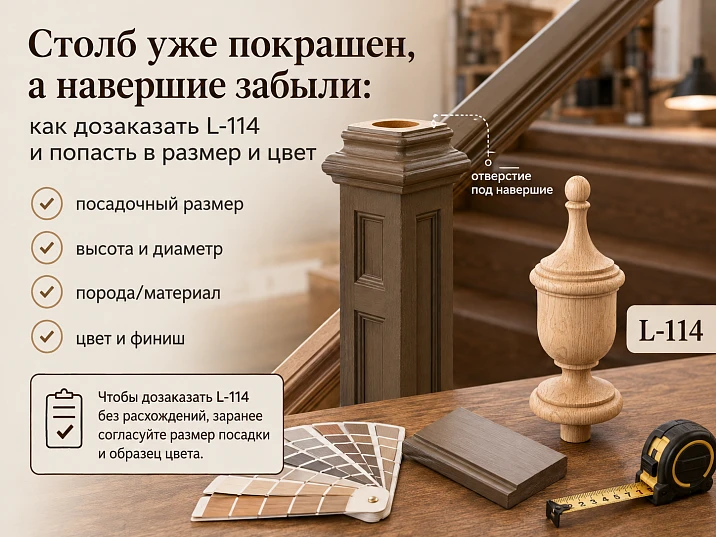
The staircase is assembled, the post is in place, the enamel or varnish has already dried — and only now it becomes noticeable that the top remains empty. Such a mistake seems small right up until the moment of ordering: choosing a beautiful wooden finial is not enough. The new part must fit onto the existing platform, not protrude as a random step, not be narrower than the post, and not differ in wood species, shade, gloss, or character of patina.
Buy wooden finial L-114 can be ordered separately from the post. But a late order requires more initial data than buying the entire staircase kit at once. The installed post can no longer be considered an abstract 90 × 90 mm square: its actual size is affected by end treatment, primer and paint layers, possible edge rounding, deviation from a right angle, railing position, and access to the future fastening.
The main task is not just to reorder L-114, but to create an accurate request for the finished painted staircase. It must include the dimensions of the top platform in two directions, diagonals, a photo of the end, wood species, coating system, color, gloss level, presence of patina, number of finials, and an agreed mounting assembly. The more complete this information, the lower the risk that the new top will look like a late and random addition.
Short answer: L-114 can be ordered after installation, but not only based on the post size
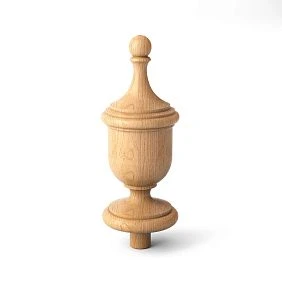
L-114 is a wooden finial 250 mm high with a width and depth of 90 × 90 mm. The product table also specifies parameter E — 220 mm. The model is offered in beech and oak, with a grinding quality of "Prestige". In the selected configuration, the card shows preparation "for enamel".
This information helps start the selection, but does not answer all questions about the finished object. The numbers 90 × 90 mm describe the dimensions in two directions, not universal compatibility with any post of the same nominal size. Before payment, you need to check:
-
actual length and width of the top end;
-
equality of diagonals;
-
flatness of the platform;
-
absence of protruding fasteners;
-
radius or chamfer on the top edges;
-
accessible area for fastening;
-
direction of L-114 per the drawing;
-
material of the installed post;
-
type of already applied coating;
-
permissibility of dry fitting without damaging the finish.
If the top of the finished post is indeed 90 × 90 mm, this is a good initial sign. But the final decision is made after comparing the actual end face with the current drawing of the top piece and the chosen installation scheme.




Confirmed characteristics of L-114 and questions that remain open
| Parameter | Confirmed data | What to check before reordering |
|---|---|---|
| Article number | L-114 | Do not confuse with neighboring L-series models |
| Type | Wooden top piece | Make sure the shape matches the installed post and the interior |
| Size A × B × C × E | 250 × 90 × 90 × 220 mm | See the current drawing for the breakdown and orientation of dimensions |
| Material | Beech or oak | Compare with the wood species of the existing post and the future finish |
| Sanding | «Prestige» | Check the surface upon acceptance before painting and installation |
| Preparation of the selected configuration | "Under enamel" | For transparent finish, separately agree on the quality of re-gluing |
| Delivery condition | Blank for final coating in the selected configuration | Do not consider the color final if the finish is not separately included in the order |
| Quantity | One product item — one finial | Count by the number of posts with open tops |
| Mounting | Determined by the project and the actual end | Do not assign glue, dowel, pin, or screw without checking the drawing |
| Delivery | Possible as a separate shipment | Consider thread protection and packaging acceptance |
The table separates product characteristics from design solutions. This is fundamental. The product size is confirmed by the card, but the method of mounting on a specific painted post is determined only after measurement. The wood species is specified in the catalog, but the matching of the external wood color in a photo does not confirm that the installed post is made of the same material. Preparation "for enamel" is not equal to applied enamel of the required shade.
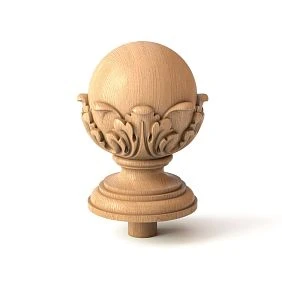
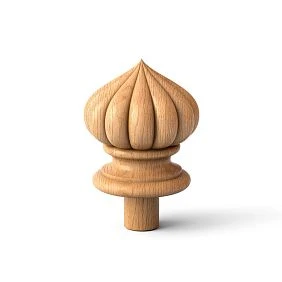
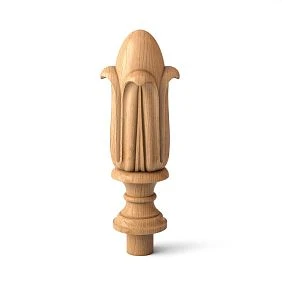
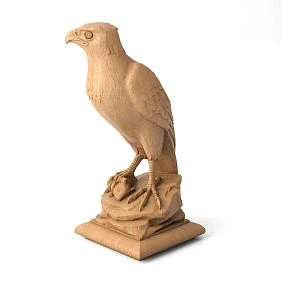
Our factory also produces:


Why 90 × 90 mm is not a ready answer about compatibility
In a staircase order, dimensions are often written briefly: "post 90 × 90". After painting, this wording turns into a dangerous simplification. One craftsman refers to the cross-section of the turned part, another to the top platform, a third to the size of the blank before sanding. If you order L-114 only by verbal description, you can get a part that is formally close in numbers but fits poorly with the finished end.
Get Consultation
Nominal size and actual size
Nominal is a value from the project or card. The actual size is obtained with a tape measure, caliper, or another suitable measuring tool on the installed post.
Suppose the documents specify a post of 90 × 90 mm. The actual top after sanding and painting may have:
-
89.4 × 89.7 mm;
-
90.2 × 90.0 mm;
-
91 × 90 mm due to a decorative frame;
-
88 × 88 mm due to trimming of the top end;
-
uneven height dimension due to chamfer or rounding.
None of these values can be automatically declared valid or invalid without drawing L-114 and the joint diagram. But they show why a single inscription "90 × 90" is not enough.
The platform may be square only by eye
If two sides are equal, the top still does not necessarily have right angles. Diagonals help check the geometry. For a theoretical square of 90 × 90 mm, the calculated diagonal is:
d = √(90² + 90²) ≈ 127.3 mm.
This is a reference geometric value, not a tolerance for production or installation. On site, it is more important to compare the two actual diagonals with each other. If one is noticeably longer than the other, the top platform is skewed. The cap may visually rotate relative to the column faces or leave an uneven seam.
Paint changes not only the color
A layer of finish can smooth out minor roughness, but it does not correct non-flatness. On the top end, the following may remain:
-
enamel runs;
-
coating roll at the edge;
-
putty marks;
-
protruding pin;
-
fastener head;
-
local depression;
-
chip covered with paint;
-
residue of protective film.
If you place the finial on such an end without checking, it will rest on individual points. As a result, wobbling, an uneven seam, or a risk of coating damage when tightening the fasteners may occur.
What dimensions to take from an already installed post
The measurement is taken before issuing the invoice, and a repeat check is done immediately before the dry fit. It is advisable to draw a simple top view diagram and label each face: stair side, landing side, inner side of the railing, and outer side.
Length and width of the top platform
Measure not the decorative belt below, not the maximum cross-section of the column, and not the size at the floor, but precisely the flat top on which L-114 should rest. Values are taken in two mutually perpendicular directions.
In the report, it is better to write not "approximately 90", but:
-
size along the march — 89.8 mm;
-
size across the march — 90.1 mm;
-
tool — caliper;
-
surface — after final painting.
The accuracy of the record does not mean that the customer independently assigns the tolerance. It gives the specialist factual data for comparison.
Two diagonals
Diagonals are denoted as D1 and D2. They are measured between opposite corners of the top end. A slight difference may be related to edge rounding and the measurement method, so the conclusion about compatibility is made by a specialist. However, a strong discrepancy cannot be hidden by the phrase "the column is square".
Flatness
A short straight edge is applied to the end in several directions, and it is checked for gaps or rocking. Do not scrape paint, file the post, or check flatness with a sharp metal tool on the visible surface. The purpose of the measurement is to record the condition, not to fix it before approval.
Radii, chamfers, and fillets
The top of the post may have chamfered corners. In that case, the actual contact area is smaller than the full square. On the diagram, note the chamfer width or approximate radius, and take a photo directly from above and a photo at an angle.
Protruding elements
If a stud, dowel, threaded insert, or other element remains in the center, it is necessary to measure:
-
the distance from the center to each face;
-
diameter;
-
protrusion height;
-
thread condition;
-
the possibility of dismantling;
-
the connection to the load-bearing structure of the post.
Such an element cannot be considered a mounting point for L-114 just because it is located in the center. Its purpose and compatibility are confirmed according to the project.
Measurement map: one sheet instead of ten messages
For a late order, a compact object map is useful. It can be hand-drawn, but must contain clear labels.
| Map field | What to record |
| SKU of the presumed finial | L-114 |
| Installation location | Lower post, upper post, platform, or other node |
| End size X | Actual value in millimeters |
| End size Y | Actual value in millimeters |
| Diagonal D1 | Actual value |
| Diagonal D2 | Actual value |
| Chamfer or radius | Size and placement |
| Central fastener | Type, diameter, height, coordinates |
| Pole material | According to documents, not by assumption |
| Finish | Manufacturer, system, color code |
| Gloss level | Matte, semi-matte, glossy, or numeric value from specification |
| Patina and effects | Color, location, technology |
| Quantity | By the number of specific pillars |
| Photos | General view, top view, surface macro, photo under neutral light |
Such a sheet allows discussing the same object without confusion. A photo of a 'pillar in general' does not replace a top view, and the phrase 'color white' does not replace the coating specification.
What to do if the end face is smaller, equal to, or larger than 90 × 90 mm
Size L-114 in width and depth is 90 × 90 mm. The relation to the installation site of the installed pillar can be different.
| Situation | Visual risk | Technical question | Action before ordering |
| End face exactly 90 × 90 mm | Minimal risk of random step | Do contours and mounting area match | Check DWG, diagonals, and flatness |
| End face slightly smaller | Top may protrude around the perimeter | Is uniform overhang acceptable | Make a 90 × 90 mm template and agree on the joint |
| End face noticeably smaller | Top may look heavy | Is the support area sufficient | Consider another model or design transition |
| The end face is slightly larger | A visible column shelf will appear | Can it be considered a decorative ledge | Evaluate with a template and view from all sides |
| The end face is noticeably larger | L-114 may look too narrow | Is another model needed | View catalog of wooden finials |
| The end face is not square | The seam will be uneven | Is it possible to prepare a transition platform | First, solve the geometry of the base |
| The end face is curved or has buildup | The finial wobbles | Is local preparation acceptable | Coordinate the correction before fitting |
In the article, a universally acceptable overhang in millimeters cannot be specified: such a value depends on the shape of the lower part of L-114, the scale of the column, the mounting method, and the design task. A paper template of 90 × 90 mm helps to see the outer contour but does not confirm the hidden fit.
A full-size template shows the proportion but does not replace the drawing.
Cut a 90 × 90 mm square from thick cardboard and place it on the top platform without glue and without pressure on the covering. On the template, mark the central axes and the direction of the flight. This mock-up shows:
-
whether the outer contour will protrude;
-
whether the post shelf remains;
-
whether the four sides are even;
-
whether the finial conflicts with the handrail;
-
whether there is enough space around;
-
how the detail reads from the landing and from below.
But a flat square does not convey the 250 mm height, profile, and mass of the silhouette. Therefore, a side template is also useful: cut out a conditional contour 250 mm high from an image or a scaled printout, without passing it off as a production drawing. For an accurate check, you need to download the current product drawings and use DWG or STAVROS technical materials.
The template answers the question "what does a dimension look like." The drawing answers the question "how is the geometry structured." The installation project answers the question "how to attach the part to this column." These three levels must not be mixed.
How to read the dimension 250 × 90 × 90 × 220 mm without guessing
The card designates parameters with letters A, B, C, and E. You cannot assign a role to each letter on your own just out of habit. Even if 250 mm obviously looks like the overall height, and the two 90 mm dimensions are width and depth, the value of 220 mm and its measurement boundaries must be checked on the drawing.
The error occurs when the buyer decides: "E is the seating, so everything fits." Without a graphic scheme, such a conclusion is not confirmed. In the request, it is enough to write the full dimension string and ask to verify:
-
which plane is considered the base;
-
whether the L-114 has a straight square platform;
-
whether a seating element is provided;
-
where the mounting axis runs;
-
how to orient the product relative to the column;
-
what part does size E occupy;
-
is installation on an already coated surface allowed;
-
is hole preparation required before painting.
The more precise the question, the less likely you are to get a formal answer like "dimensions match."
Why you need to check not only the post but also the handrail
The finial is installed on top of the post, but a handrail, decorative volute, adjacent balustrade, or wall element may run nearby. The 250 mm high part takes up noticeable space and must fit freely in all directions.
The handrail may overlap the lower part
If the handrail comes close to the top end, it is important to check whether it intersects with the base or the carved volume of L-114. This conflict may not be visible in the frontal photo.
The finial must have a readable direction
A model that seems symmetrical at first glance may have a front side or a preferred orientation of the pattern. The direction is clarified from the drawing and product photo, then fixed on the installation map.
Opening the door and passing nearby
On the stair landing, a tall top can sometimes end up near a door, curtain, cabinet, or the path of movement. Not only the static photo is checked, but also the free space around it.
The material of an existing post cannot be determined only by its shade
Beech and oak can be painted with the same opaque enamel. Tinted beech can visually resemble oak from a distance, and oak under a dense primer loses its visible texture altogether. Therefore, the reliability of sources is ranked as follows:
-
specification of the original order;
-
product marking or delivery note;
-
working drawing of the staircase;
-
confirmation from the manufacturer or contractor;
-
exposed unpainted section of wood;
-
assumption based on a photo — only as a preliminary version.
If the documents say the column is beech, for opaque enamel it is logical to consider beech, but the final choice is also related to the preparation of the workpiece. If the column is oak and coated with a transparent system, an oak finial usually gives a closer character of pores and grain. At the same time, a new batch of solid wood is still not obliged to repeat the texture of the old column like a printed pattern.
Before choosing, it is useful compare materials and quality of processing. This page explains the difference between beech and oak, preparation "under enamel" and "under tinting", as well as sanding "Standard" and "Prestige".
Beech for opaque enamel: what really helps to match the color
With dense covering paint, the wood grain should not be the main visual factor. It is much more important to replicate the finishing system:
-
the type of soil;
-
number of preparatory layers;
-
color of the final enamel;
-
gloss level;
-
application method;
-
coating thickness;
-
patina;
-
final protective varnish, if it was used.
Order L-114 made of beech by itself does not guarantee a match. A new finial with the same enamel code may look lighter or darker due to a different primer, gloss, and spray texture.
White color is especially demanding
The phrase "ordinary white" is almost always insufficient. Warm white next to cold becomes creamy, and cold next to warm becomes grayish. On a vertical column and three-dimensional carving, light falls differently, so the discrepancy is noticeable even with close colors.
Black enamel shows the difference in gloss
Two black coatings with the same color code can look completely different. A glossy finial reflects windows and lamps, a matte column absorbs light. The eye reads them as different materials.
Oak under a transparent coating: color cannot be separated from texture
If the existing staircase retains visible wood, the task becomes more complicated. Color is formed not only by stain or oil. It is influenced by:
-
the natural tone of a specific lamella;
-
the width and direction of annual rings;
-
porosity;
-
pre-moistening;
-
grinding method;
-
absorption of the composition;
-
number of layers;
-
holding time;
-
finish varnish or oil;
-
age of the coating on the staircase;
-
exposure to sunlight.
A new oak part can be painted with the same system, but may look different for the first few weeks. The old post has already changed under light and use, while the new material has only just received its coating. Therefore, the goal of a late additional order is not a promise of absolute identity of every pore, but a maximally consistent system and a controlled test application.
If a transparent finish is essential, it must be separately confirmed whether the selected L-114 configuration is available with a gluing quality suitable for tinting. The characteristic "for enamel" cannot be transferred to a semi-transparent scenario without approval.
Color code is only one line of the specification
The RAL number, NCS, or paint manufacturer's code helps narrow down the task, but does not fully describe the finished surface. The following are added to the request:
-
full name of the material;
-
manufacturer;
-
product line;
-
base;
-
color code;
-
type of hardener;
-
mixing ratio;
-
thinner;
-
primer;
-
gloss level;
-
number of layers;
-
application method;
-
presence of patina;
-
finish varnish;
-
date of initial painting.
Not all data can be recovered. In that case, it is more honest to state what exactly is missing and conduct a series of test patches than to substitute an unknown system with the phrase "paint it the same color."
Matte, semi-matte, and glossy: why the eye perceives the shade differently
The degree of gloss affects the perceived depth of color. On the carved L-114, the surface consists of many facets. Some reflect light, others fall into shadow. The higher the gloss, the more contrasting the highlights and the more noticeable the differences from the post.
Matte surface
It diffuses light more softly and often hides small differences in texture. But matte finishes from different series also do not match automatically. One may be velvety, another chalky or slightly satin.
Semi-matte surface
This is a common compromise for stairs: the finish reads as clean but does not turn every facet into a mirror. For a reorder, you need to know the exact product or at least a reference sample.
Glossy surface
Requires particularly high-quality preparation. Any scratch, sanding transition, or dust particle becomes more noticeable. Manual sanding with "Prestige" facilitates preparation but does not eliminate priming, intercoat matting, and finish control.
How to provide a color sample without damaging the finished staircase
The best reference is a preserved piece painted at the same time as the staircase: a scrap, a test board, a plug, or a spare baluster. If such a sample exists, it should be labeled and handed over along with a description of the system.
If there is no separate sample, there is no need to cut a piece from a visible post. Possible safe sources:
-
a removable decorative plug;
-
the underside of a removable part;
-
spare element from the original order;
-
can or label of the used coating;
-
color sample preserved by the contractor;
-
document with the order number;
-
contact of the painter or furniture manufacturer.
Photos are used as a supplement. The camera and screen change color, automatic white balance corrects lighting, and the messenger compresses the image. For photos, place a neutral gray or white card nearby, shoot in diffused daylight, and add a close-up of the gloss at an angle.
Patina: the color is there, but there is still no match
Patina is not applied in an even layer. It collects in recesses, highlights carvings, and sometimes wears off on protrusions. Therefore, it is not enough to write "gold patina" in the request.
It is necessary to specify:
-
patina color;
-
intensity;
-
application zones;
-
degree of blending;
-
presence of wiping on the peaks;
-
finish varnish;
-
photo under side lighting;
-
sample, if it has been preserved.
On the new L-114, the recesses and relief differ from the geometry of the column. The craftsman must transfer not the literal placement of each spot, but the artistic principle of the finish. A test coat on a wood sample helps to agree on the color, but the final distribution of the patina is checked on the form itself before installation.
Paint the finial separately or after installation
Since the column is already finished, painting L-114 on the workbench is usually safer for the existing staircase. You can treat the bottom edge, control the spray, and avoid covering the entire flight with film. However, a fully finished part requires very careful dry fitting and installation: tools or fasteners can damage the finish.
There are three working scenarios.
Full finishing before installation
Suitable when geometry and fasteners are confirmed, fitting is done on a protected surface, and installation does not require trimming. The final coat is applied after all preparatory holes.
Main finishing before installation, local correction after
The top piece is primed, painted, and fitted. After installation, the craftsman covers the mounting seam and does minimal touch-up. This scenario requires precise material matching.
Installation of a prepared blank and finishing on site
For an already painted staircase, this option creates a higher risk of staining the post, handrail, and steps. It is chosen only with careful protection and when the process truly requires a joint finish.
The sequence is fixed before work begins. You cannot first fully paint L-114 and then discover that the fasteners require drilling the front area or adjusting the base.
Dry fitting without scratches or chips
Dry fitting means installation without glue and final tightening. It is needed to check the contour, orientation, seam, and clearance.
Protect the top of the post
A clean, soft intermediate material is used that leaves no adhesive and does not scratch the coating. A thick pad distorts the fit, so its function is only protection during initial visual comparison. For the final flatness check, the specialist applies an appropriate method without damaging the enamel.
Do not rotate the finial under load
Turning a heavy carved piece while pressing it against a glossy end is dangerous. First lift it, change the orientation, and carefully lower it again.
Check all four sides
Inspect the finial:
-
from the stair side;
-
from the landing side;
-
from the railing side;
-
from the outer side;
-
from below at the usual walking viewpoint;
-
from above, if the platform allows such a view.
In one angle, a small protrusion may seem unnoticeable, but in another it can turn into a clear step.
Fix the orientation
After approval, a safe mark is placed on the invisible side or a diagram is used. Do not apply a marker to the finished face enamel.
Why you cannot assign fasteners based on an old photo
The product page or general description may mention a screw, glue, or another installation method. But late installation on a finished post requires checking the specific joint. It is unknown what is inside the upper part: solid wood, a lamella joint, a metal insert, an existing dowel, or a handrail attachment.
Before drilling, you need to determine:
-
the post construction;
-
the thickness of the available solid wood;
-
the position of existing joints;
-
the L-114 axis;
-
diameter and depth of the hole;
-
type of fastener;
-
direction of force;
-
possibility of concealed installation;
-
tightening sequence;
-
admissibility of the adhesive layer.
Dowels, pins, screws, and glue are not interchangeable. Each option requires its own preparation. The article cannot assign fasteners without a drawing, because an error will damage not only the top piece but also the already installed post.
Glue is a possible part of the system, but not a universal answer
In the category you can purchase materials for installation and finishing of wooden decor, including adhesive compounds and finishing materials. In the related product card, the following is also available TYTAN Classic Fix mounting adhesive.
The very presence of glue in the catalog does not mean that L-114 should be installed only with it. The adhesive scheme depends on:
-
material of both surfaces;
-
type of old coating;
-
strength of paint adhesion to wood;
-
contact area;
-
presence of mechanical fixation;
-
instructions of the specific compound;
-
operating conditions;
-
possibility of dismantling.
It is especially dangerous to glue the finial to a weak paint layer. Then the adhesive holds the paint, and the paint may peel off the post. They check not only the compatibility of the adhesive with wood, but also the strength of the entire chain of layers.
The installation joint should be designed, not smeared after installation
Even with a precise fit, a thin line may be visible between L-114 and the post. Its appearance depends on:
-
contact uniformity;
-
bottom edge color;
-
gloss;
-
end geometry;
-
presence of a chamfer;
-
adhesive layer thickness;
-
local touch-up.
A completely invisible joint cannot be promised in advance. The goal is to make it even and consistent. If a thin shadow line is intended, it must be uniform around the perimeter. If the seam is painted, the touch-up material must not crack due to wood movement.
How many L-114 to order
The quantity is calculated not by the number of stair flights or by a photo of the finished object, but by the number of posts that require this specific type of finish.
The formula is simple:
Q = N + R,
where Q is the ordered quantity, N is the number of confirmed installation points, R is the reserve, if justified by the project.
For one unfinished post, N = 1. The reserve is not added automatically. An additional finial may be justified if:
-
the staircase has a paired post that will also require finishing later;
-
the object is located far away and repeat delivery is difficult;
-
complex custom finishing is being performed;
-
L-114 is also used on furniture or a portal;
-
the order relates to a serial object;
-
a reference sample is needed for future repairs.
For a home staircase with one open top, usually one piece is needed. But first walk around the entire object: a second unclosed post is sometimes found on the upper landing.
One or two finials: checking for pairing
L-114 is a noticeable vertical detail 250 mm high. If there are two posts at the entrance to the stairs, installing it on only one will disrupt the composition. However, pairing does not mean that all posts must receive the same finial.
Check:
-
are the top platforms identical;
-
are the posts symmetrically positioned;
-
do their height and pattern match;
-
does the handrail pass evenly;
-
are both tops visible simultaneously;
-
does the second post have a built-in finish;
-
is L-114 suitable in scale for both points.
In the schedule, each item gets a number: C1, C2, and so on. For each post, record its actual end. Do not copy the measurement from the first to the second without checking.
What to order together with L-114
| Position | Why it's needed | When to include | What to check |
| L-114 | Covers the top and completes the post silhouette | After confirming the size and style | Material, sanding, preparation, quantity |
| Test blank or color sample | Helps to coordinate color and gloss | Almost always useful for late reorders | Wood species, primer, coating system |
| Installation materials | Form the approved mounting assembly | After checking the post structure | Compatibility with wood and old coating |
| Glue | May be part of a combined scheme | Only with confirmed technology | Instructions, adhesion, contact area |
| Finishing materials | Repeat enamel, varnish, oil, or patina | If L-114 is supplied without a finished color | The complete system, not a single code |
| Protective materials | Protect the staircase during fitting and installation | For a ready-painted surface | No traces of glue or scratches |
| Drawing | Checks geometry and orientation | Always before drilling | Current version |
| Delivery | Brings a separate carved piece | For remote ordering | Packaging, insurance, and acceptance |
If it turns out that L-114 does not fit in size, it is better to look at other models of the L-series and choose a solution for the confirmed area. Fitting a ready-made carved element to an incompatible post just to keep the article number is risky.
Specification for reordering L-114
A ready-made message to the manager might look like this:
Product: wooden finial L-114.
Size per card: 250 × 90 × 90 × 220 mm.
Quantity: 1 pc. / specify the actual quantity.
Material: beech or oak — according to the original staircase specification.
Grinding: "Prestige".
Quality of re-gluing: confirm for the selected finish.
Pole condition: installed and painted.
Actual end face: X × Y mm.
Diagonals: D1 and D2 mm.
Chamfers and roundings: describe and attach photos.
Existing fasteners: type, diameter, height, and coordinates.
Coating: manufacturer, system, code, gloss.
Patina: specify color and intensity.
Sample: attached / absent.
Finishing of the top: required / performed by the customer.
Fastening unit: please confirm per DWG and photo of the end face.
Delivery city: specify.
Date by which the part is needed: specify as a preference, not substituting the confirmed deadline.
This form separates facts from questions. The manager does not have to guess what "the same white" means, and the installer sees in advance that the fastening still requires approval.
What to check in the invoice before payment
Even a well-prepared request may be shortened when transferred to the invoice. Therefore, the buyer checks the document line by line.
The invoice must clearly indicate:
-
item number L-114;
-
size 250 × 90 × 90 × 220 mm;
-
material;
-
sanding quality;
-
gluing quality;
-
quantity;
-
presence or absence of painting service;
-
individual materials;
-
production or shipping time;
-
delivery method;
-
contact person for technical issues.
If the color is agreed separately, this should be reflected in the correspondence, attachment, or specification related to the invoice. The verbal phrase "we'll make it roughly like in the photo" does not protect either the buyer or the contractor from different interpretations of the result.
When it's better to choose a different post or a different finial
A late order doesn't always have to end with purchasing L-114. The model is not suitable if:
-
the area differs significantly in size;
-
the post shape conflicts with the finial base;
-
the handrail crosses
Comparison of three ways to solve the problem of an unfinished post
Method When it fits Advantage Risk Order additional L-114 Geometry and style confirmed Selected expressive model is preserved Need to exactly match the color and mounting Choose a different finial Size or scale L-114 is not suitable Can better fit into the pole base area Ornament may differ from the original idea Make a custom transition element The end face is non-standard, but L-114 is needed for style Allows aligning two contours Requires design, batch production, or separate manufacturing The table shows that abandoning L-114 is sometimes a more professional solution than aggressive fitting. The goal is a finished staircase, not preserving the article number at any cost.
Errors that are detected too late
Mistake 1. Ordering by the word "standard"
There is no standard that automatically links any post to L-114. Actual dimensions and a drawing are needed.
Mistake 2. Measuring the post below the upper platform
A turned or carved belt may be wider or narrower than the end face. The finial rests on a specific upper plane.
Mistake 3. Not checking the diagonals
Two sides of 90 mm do not guarantee a right square. The skew will show as an uneven seam.
Mistake 4. Mistaking beech for oak based on color
The coating changes the appearance of the wood. The species is confirmed by documents.
Mistake 5. Passing only the RAL code
Without primer, gloss, and technology, two coatings can look different.
Mistake 6. Considering "under enamel" as finished painting
This is a characteristic of the workpiece, not the finished color of an existing staircase.
Mistake 7. Ordering oak with a transparent finish without specifying the re-gluing
The configuration selected in the card may be specified for enamel. The transparent scenario requires separate confirmation.
Mistake 8. Making a hole before receiving the drawing
Incorrect axis or depth damage the post and complicate concealed installation.
Mistake 9. Completely paint the finial before the technical fitting.
Any adjustment after finishing creates chips and requires re-finishing.
Mistake 10. Glue to a weak layer of paint.
The joint can tear off along with the coating, even if the glue is suitable for wood.
Mistake 11. Not checking the second post.
After installing one finial, it turns out that the paired post also remains exposed.
Mistake 12. Accepting the goods without inspection.
A chip on the thread is better to record before painting and installation, while the acceptance history is still clear.
Acceptance of individual L-114
One finial may seem like a simple weight, but the carved shape requires careful packaging. Upon receipt, check:
-
number of packages;
-
integrity of the box;
-
absence of dents and signs of moisture;
-
article number;
-
size line;
-
material;
-
sanding quality;
-
condition of the base;
-
carving on all sides;
-
absence of chips;
-
match with the count.
Inspection is carried out before painting, drilling, and installation. If the packaging is damaged, record the general appearance, shipment number, and specific defect. It is better to review the order and shipping conditions in advance in the section Payment and delivery.
Storage before fitting and painting
Do not leave the wooden part near a radiator, on a wet floor, or in an unheated room. A sharp change in conditions can affect the wood and coating. L-114 is stored in a protected form, without loading the protruding carved parts.
Before finishing, the product is kept in workshop conditions according to the agreed technology. Do not unpack a cold part after transport and immediately apply a coating: possible condensation and temperature differences hinder a stable result.
Purchase route: from empty end to installed finial
-
Find the original staircase order documents.
-
Install the post material.
-
Measure the top in two directions.
-
Compare diagonals and flatness.
-
Secure the chamfers, fasteners, and handrail position.
-
Get the current L-114 drawing.
-
Make a 90 × 90 mm template and a side mockup 250 mm high.
-
Determine the number of posts.
-
Restore the coating system.
-
Prepare a sample or test swatch.
-
Coordinate the mechanical fastening.
-
Add installation and finishing materials.
-
Arrange a separate delivery.
-
Conduct the acceptance inspection.
-
Perform a dry fit.
-
Only after this, paint and install the part according to the approved technology.
If the project includes not only the finial but also missing balusters, handrails, or posts, it is useful buy components for a wooden staircase one coordinated system. However, the presence of items in the same section does not automatically prove the compatibility of each article.
How to compare a new swatch with an old post
The test sample cannot be evaluated only on the workshop table. The finished post is positioned vertically, with steps, walls, handrails, and light sources nearby. The same color on a horizontal board and on a vertical carved element is perceived differently.
For comparison, the sample is placed next to the post without touching the finished surface with the fresh coating. The check is carried out under at least three conditions:
-
during the day in diffused natural light;
-
in the evening under standard room lighting;
-
under side light, which shows gloss and relief.
The decision is not made based on a single bright glare. First, look at the overall color mass from a distance of several meters, then approach closer and evaluate the surface. If the paint matches frontally but differs sharply at an angle, the problem is more often related to gloss or texture, not just pigment.
Comparison should be done after complete drying
Many compositions change their appearance as the solvent evaporates and strength builds. Fresh enamel may be darker, brighter, or glossier. The time before evaluation is taken from the specific coating technology. Comparing a wet sample to a long-dried pole is pointless.
A small sample can hide the problem
On a fragment of several centimeters, the color looks calmer. A finial 250 mm high has a developed surface and deep shadows. Therefore, after selecting the base system, it is advisable to perform a control paint-out on a volumetric test piece or on an area with similar relief. If this is not possible, it is agreed that a flat sample confirms color and gloss but does not fully reproduce the light-and-shade of L-114.
Evaluate side by side, not from memory
A person remembers exact shades poorly. The phrase "it looked the same in the workshop" does not replace direct comparison. The reference and the new paint-out must be in the same lighting and field of view.
What to do if the original paint and materials are unavailable
The staircase may have been painted several years ago. The contractor has changed, the can is empty, and the name of the composition was not preserved. This is not a reason to order L-114 at random. The task is broken down into recoverable parts.
First, determine the type of coating
Based on documents, inspection, and specialist consultation, find out what was applied to the post:
-
covering enamel;
-
stain with varnish;
-
oil;
-
tinted varnish;
-
primer and patina;
-
multi-layer decorative system.
Do not test aggressive solvents on a visible area to determine the material. The method is selected by a specialist.
Then a color base is selected
The colorist compares the surface with a fan or device, but the resulting number remains a starting point. The old coating could have faded, yellowed, or changed its gloss. Therefore, the composition is adjusted according to the actual sample.
After that, the texture is restored
Even a close color will not match if the old pole is painted with fine spraying and the new top is painted with a coarse roller. The application method and required smoothness are recorded in the specification.
Several options are made, not just one
It is wiser to prepare two or three close color samples with different lightness or gloss. They are compared on site and the confirmed option is selected. The cost of test samples is usually lower than the price of a full re-finishing of the carved top.
The old coating has changed: which color to reference for L-114
On a staircase, different areas age unevenly. The side near the window gets more light, the zone near the handrail has more contact with hands, and the top of the post may wear less. Therefore, the same post can have several shades.
For the top, a reference is chosen near the future joint. One should not copy the color of the lower part of the post if the upper part looks different. At the same time, one cannot rely on a local spot, scratch, or faded edge.
It is useful to determine three values:
-
main color of the upper zone;
-
the lightest visible area;
-
the darkest visible area.
A new finish is selected so that it is perceived as part of this color group. With complex aging, an absolute match may be unattainable. Then it is better to make the difference manageable: for example, repeat the tone of the column but preserve the natural difference of the new carved form, rather than get a dirty intermediate shade.
If the staircase is planned to be repainted in the near future, it makes sense to install the prepared L-114 and perform the overall finish of the entire assembly at the same time. But such a sequence is accepted only after checking the fastening and protection of the remaining elements.
Control fitting before transfer to the painting workshop
Technical fitting should precede expensive finishing. It allows checking what color will not fix.
Before transfer to the painter, confirm:
-
base size;
-
orientation of the product;
-
position of the central axis;
-
absence of conflict with the handrail;
-
seam uniformity;
-
access to fasteners;
-
need for preparatory holes;
-
condition of the lower plane;
-
areas that cannot be filled with a thick layer of paint.
If a hole or recess needs to be made on L-114, this is done before the finishing layers according to the approved drawing. After processing, the edges are inspected again and prepared for coating.
The lower plane also needs to be included in the technology
The base of the finial is not always completely hidden. With a small overhang or shadow gap, part of the lower edge is visible from below. If the face surface is painted and the bottom is left light, a late order gives itself away when moving up the stairs.
At the same time, the coating of the contact plane should not interfere with adhesion and precise fit. Which zones to paint and which to leave as technological is determined by the installation diagram.
Protection of the finished staircase during work
The cost of L-114 is only part of the risk. With careless installation, the post, steps, railing, and wall can be damaged. Protection is planned as a separate operation.
The steps protect against falling tools
Soft protection should absorb accidental impacts, and the top layer should not let paint or glue through. A slippery film on the stairs is dangerous, so the covering is secured without forming wrinkles.
The handrail and posts are protected from metal parts
The key, drill chuck, or attachment must not touch the enamel. The tool is placed on a separate platform, not on the steps.
Apply glue in a controlled manner
Excess that comes out into the seam should not be thoughtlessly wiped with solvent over finished enamel. The volume of the compound and the removal method are agreed upon in advance. A compatibility test of the cleaner is conducted on a separate sample.
Masking tape also requires testing
Some tapes leave marks, lift weak coatings, or change the matte finish. Use material suitable for the specific surface and remove it within the recommended time.
If L-114 is delivered directly to the site
Delivery to a home where the stairs are already in use requires a prepared space for unpacking. The box is not opened on the steps and is not placed on the finished handrail.
Acceptance procedure:
-
photograph the packaging before opening;
-
check the shipping markings;
-
move the box to a flat, protected surface;
-
open without cutting deeply with a knife;
-
remove the padding pieces one by one;
-
lift the part by sturdy areas, not by thin threads;
-
verify the article number and material;
-
inspect in good light;
-
take photos of all sides;
-
return the item to its protective packaging before trying it on.
If a defect is found, do not attempt to fix it by sanding before fixing. Any self-processing changes the delivery condition.
Repeat order after a few months: keep the finish passport
After a successful match, it is useful to create a small L-114 passport. It will come in handy if a second finial or repair is needed.
The passport includes:
-
order number;
-
article number;
-
material;
-
sanding quality;
-
gluing quality;
-
actual dimensions of the post;
-
mounting drawing;
-
a primer brand;
-
brand of the finishing compound;
-
color code;
-
shine;
-
patina recipe;
-
photos before and after installation;
-
remaining paint sample plate;
-
contractor contact.
Such an archive does not guarantee an absolute match of a new batch years later, but it reduces the amount of unknowns. Without it, the next part is selected from scratch again.
Commercial choice: L-114 or another L-series model
Item L-114 has a distinctive height of 250 mm and a base of 90 × 90 mm. It is appropriate where the top of the post should become a noticeable architectural finish. But the large shape can overload a compact railing or conflict with a low handrail.
Before purchasing, they compare not only the price and pattern, but also:
-
the width of the base;
-
total height;
-
visual center;
-
finishing complexity;
-
number of paired posts;
-
the distance to the wall;
-
view from below and above;
-
possibility of secure fastening.
A broad query "buy wooden post caps" should lead to a category, because the buyer sometimes needs not a specific L-114, but a model with a different base. The item card becomes an order point only after the dimensions and style are confirmed.
When designer help is needed
For one straight post, properly taken measurements and coordinated installation are sufficient. A designer is useful if:
-
posts have different platforms;
-
a handrail of complex shape enters the top node;
-
a transition base is required;
-
the finial must be repeated on furniture or a portal;
-
the direction of the thread needs to be changed;
-
a series of staircases is planned;
-
color and patina are part of the overall author's finish;
-
fasteners intersect with an existing embedded part.
In such a situation, you can approve the stairwell project and hand over measurements, DWG, photos, and the initial specification to the specialist. The project is needed not for decorative visualization, but for coordinating geometry, scale, and work sequence.
Who is responsible for size, color, and installation in a late order
When ordering one additional part, it is easy to assume that one contractor will handle all issues. In practice, the result depends on three different areas of responsibility.
The supplier confirms the product configuration
In the request, confirmation of the article number, size, material, sanding, glue joint quality, quantity, and deadline must be obtained. If painting is ordered, it is separately recorded which data and samples are accepted for work. The supplier cannot verify the hidden structure of an installed post from a single general photo.
The painter is responsible for replicating the finishing system
They are given the reference, primer information, color code, gloss, and patina. Before applying the finish, the painter must know which zones of L-114 are involved in fastening and which surfaces will remain visible. It is not allowed to fill a technical hole with paint and then clean it with a sharp tool after drying.
The installer is responsible for the actual joint
He checks the end, drawing, axes, hole depths, and coating condition. If the actual post differs from the provided measurements, work stops until a new decision is made. On-site fitting must not turn into unplanned grinding of the carved finial or removal of enamel from the post.
The customer links three stages with one specification
Copies of the approved measurement map, color sample, and installation diagram must be available to all participants. Then the supplier does not promise an unknown fit, the painter does not cover fastening zones, and the installer does not choose the touch-up color at the last moment.
Before payment, it is useful to ask four direct questions:
-
Who confirms the compatibility of L-114 with the actual end face?
-
Who performs the test color sample and approves the gloss?
-
Who designs and performs the fastening?
-
Who accepts the result before final installation?
Answers are recorded, not left in verbal conversation. A late order becomes manageable when each stage has input data and a responsible executor.
FAQ: answers before reordering L-114
Can L-114 be ordered separately from the pole?
Yes, L-114 is sold as a separate line item. Before ordering, you need to check the actual surface of the installed post, material, finish, and mounting assembly.
Will L-114 fit a 90 × 90 mm post?
Possibly, but a nominal match alone is not enough. Verify the actual dimensions, diagonals, flatness, chamfers, and the DWG of the cap.
What is the size of L-114?
The confirmed line is A × B × C × E — 250 × 90 × 90 × 220 mm. The purpose of each letter and orientation are checked on the current drawing.
What wood species is L-114 available in?
The product card offers beech and oak. The choice is linked to the material of the existing post and the type of future finish.
What does "Prestige" sanding mean?
This is milling, machine, and detailed hand sanding with surface preparation for paint and varnish work. The final coating is still done separately if it is not ordered as a service.
Will L-114 arrive already in the color of the staircase?
You should not assume the color is included without separate confirmation of the finish. In the order, you need to specify the system, code, gloss, patina, and sample.
Is the RAL number enough?
No. The number describes a color reference, but not the primer, gloss, application method, layer thickness, or final varnish.
How to determine the wood species of a painted post?
Most reliably by the original specification, delivery note, or manufacturer's confirmation. Determining from a photo after opaque painting is unreliable.
Can an oak finial be placed on a beech post?
With a covering enamel, such an option can technically be discussed, but the material and preparation need to be coordinated. With a transparent coating, the difference in texture will be more noticeable.
Do I need to do a test coat?
It is very useful for a late additional order. A test coating shows not only the shade, but also the gloss, coverage, and behavior of the composition on the chosen wood species.
Can L-114 be tried on an already painted post?
Yes, but only carefully and without glue, drilling, or rotation under load. The surface is protected from scratches without distorting the actual fit.
Is the fastener included in the order?
The configuration must be confirmed in the current product card and invoice. Even if fasteners are present, their suitability for the specific installed post requires verification.
Can L-114 be glued without mechanical fastening?
This solution cannot be universally prescribed. It depends on the contact area, the old coating, the adhesive instructions, and reliability requirements.
Is a dowel or pin needed?
The installation project provides the answer after reviewing the drawing and the column structure. Choosing the hole diameter and depth on your own is dangerous.
What to do if the column base is smaller than 90 × 90 mm?
Make a template, assess the overhang, check the support area, and coordinate the fastening. If there is a noticeable mismatch, it is better to choose another model or an adapter solution.
What to do if the column is wider than 90 mm?
Evaluate the visible ledge around L-114. If it looks accidental, compare other caps with a larger base.
How to check the squareness of the top end?
Measure two sides and two diagonals. Equal sides with different diagonals indicate a skew or a measurement error.
When to paint L-114?
After a technical dry fit and preparation of all holes. The finish can be applied before installation or completed locally after it using an agreed-upon technique.
How many L-114 units should be ordered?
Based on the number of posts that require this specific cap. Each end is measured separately, even if the posts appear identical.
Is a spare unit needed?
For a typical single residential point, there is usually no automatic need. A backup is justified by complex finishing, a remote site, a series of identical staircases, or future repairs.
Can the size of L-114 be modified?
The possibility of custom manufacturing and the minimum batch size must be confirmed with a manager. It cannot be assumed that a single piece can be altered on-site without restrictions.
How to order one cap with delivery?
Specify the article number, material, size, sanding, quantity, city, and finishing requirements. Before payment, ask to confirm the lead time, packaging, and order contents.
First, repeat the facts of the old staircase, then order L-114 at STAVROS
An empty top of an already painted post can be fixed without redoing the entire staircase. But a late additional order requires discipline: the actual platform along two axes, two diagonals, flatness, chamfers, railing position, wood species, full coating system, and mounting assembly must be recorded before payment.
L-114 has a confirmed size of 250 × 90 × 90 × 220 mm, offered in beech and oak with "Prestige" sanding. These characteristics help select the product but do not turn it into a universal cap for any 90 × 90 mm post. Compare the drawing with the actual end, make a template and dry fit, prepare a test paint sample, and assign holes and fasteners only after checking the structure.
At STAVROS, you can order L-114, choose other wooden caps, select staircase components, mounting and finishing materials, and arrange separate delivery. A complete order should contain not the phrase "need the same cap" but a clear specification: one article number, confirmed material, precise measurements, color sample, gloss level, quantity, and agreed installation method. Then the new part will complete the post and not look like a forgotten piece added after the work was finished.
-