Article Contents:
- Why three items with the same image cannot be considered interchangeable
- What the image of a dove means in church decor
- When to choose standalone IKN-004
- When the N-457 overlay is needed
- When the NC-457-1 mascaron is suitable
- How to choose the size of IKN-004
- N-457 and NC-457-1: difference in scale and relief
- Oak or beech for church decor
- "Standard" or "Prestige"
- Which option to choose for a large church iconostasis
- What to choose for a home iconostasis
- Dove for the altar composition
- Application in a chapel and prayer room
- Can a dove be used on an analog or church furniture
- Where to place the dove relative to icons
- How to combine a dove with a cross
- Combination with columns, capitals, and floral ornament
- One detail or a symmetrical composition
- How to choose a background for a carved dove
- Light and shadow on a carved relief
- Practical choice for different tasks
- How to prepare the base for N-457 and NC-457-1
- How to secure the standalone IKN-004
- Paint before or after installation
- How to apply enamel without losing the carving
- Oak for tinting and clear varnish
- Gilding, patina and combined finish
- How to calculate space for the central element
- How not to confuse the dove, overlay and mascaron
- Typical errors in selection
- How to care for a carved dove
- Transportation and storage before installation
- What to buy together with a carved dove
- Who IKN-004 is suitable for
- Who N-457 is suitable for
- Who NC-457-1 is suitable for
- When it's better to choose a different church element
- How to buy IKN-004, N-457 or NC-457-1 at STAVROS
- Checklist before ordering
- Acceptance of the finished composition
- Ready iconostasis or new project: when the choice changes
- How to make a full-size mockup before ordering
- Uniform wood species throughout the composition
- How to account for viewing distance
- Safety of installation in a public space
- How to preserve the expressiveness of the symbol after finishing
- How to match the dove with the color of the iconostasis
- What to check in the card before placing an order
- Why choosing by product type is more important than choosing by design
- FAQ: questions about IKN-004, N-457, and NC-457-1
- How is IKN-004 different from N-457?
- How is the N-457 overlay different from the NC-457-1 mascaron?
- Which dove is suitable for a home iconostasis?
- Which option to choose for a large church?
- What sizes are available for IKN-004?
- What wood are the products made from?
- What to choose for white enamel?
- What to choose for tinting?
- Can a dove be gilded?
- What does the "Prestige" sanding finish mean?
- Can N-457 be installed on a finished panel?
- Can IKN-004 be glued like a regular overlay?
- Where is the best place to place NC-457-1?
- Do you need one figure or a pair?
- How to combine the dove with a cross?
- Can I trim N-457?
- What to check before buying?
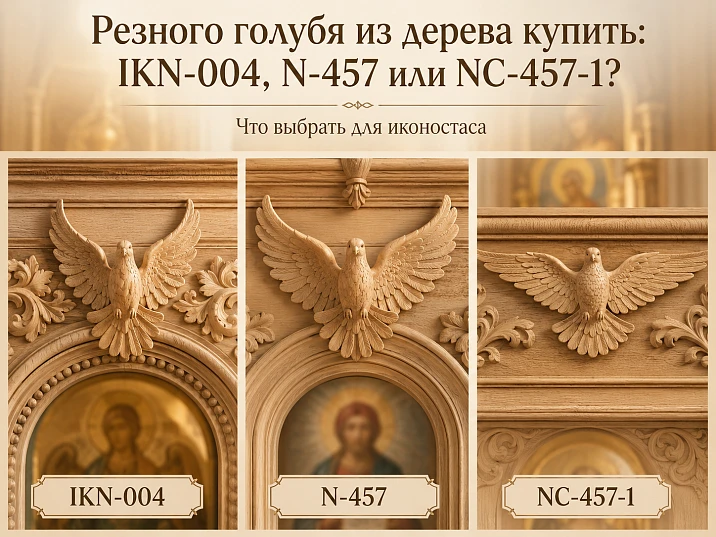
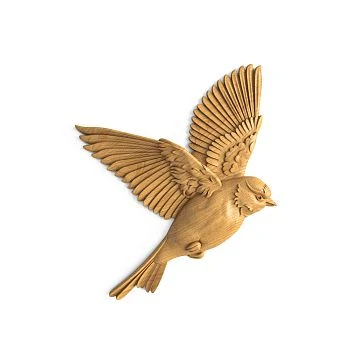
You can buy a carved wooden dove for completely different tasks, although the symbolic image remains the same. In one project, you need an independent three-dimensional element that is perceived as a separate figure and sets the center of the church composition. In another, an overlay relief for an already finished panel, door, or upper part of the iconostasis. In a third, a mascaron that works as a collected central accent and connects the surrounding floral or architectural decor. If you choose only by a photo of the dove, it is easy to buy the correct symbol but the wrong type of product.
In the STAVROS assortment, this fork is formed by three real models made of oak or beech. IKN-004 is a standalone carved dove, available in three sizes. N-457 is a large "Dove" overlay for installation on a prepared surface. NC-457-1 is a "Dove" mascaron, which occupies an intermediate position in scale and is perceived as a central relief sign. In all three cards, the image is associated with the symbol of the Holy Spirit, but the design, depth, role, and installation location differ.
This difference is especially important for the iconostasis. A standalone figure requires space around the silhouette and a well-thought-out support. The overlay measuring 691 × 397 × 70 mm needs a sufficiently large field and works as part of the surface. The mascaron measuring 453 × 192 × 58 mm is easier to integrate into the central zone above the icons, at the top of a panel, or into a composition with columns and floral ornament. For a home prayer corner, the scale is assessed even more strictly: a large element can overwhelm the icons, while a too small one will get lost on a wide panel.
Below is a practical selection guide. It will help you understand when IKN-004 is needed, when it is more advantageous to buy the wooden carved overlay N-457, and when NC-457-1 works more precisely; how to choose oak or beech, "Standard" or "Prestige", enamel or tinting; where to place the dove image; what to combine it with in church decor; what to check before ordering, and what mistakes most often occur when installing on a ready-made base.
Short answer. Choose IKN-004 when you need an independent carved symbol of the Holy Spirit that can be made the main element of an iconostasis, altar composition, or separate church panel. N-457 is suitable for a large finished surface where a dove overlay measuring 691 × 397 × 70 mm is needed. NC-457-1 measuring 453 × 192 × 58 mm is convenient as a central mascaron above icons, in the top part, or between architectural elements.
Beech is chosen for opaque enamel, oak for tinting while preserving the texture. IKN-004 has three sizes: 219 × 276 × 101, 300 × 378 × 139, and 400 × 504 × 185 mm. Before purchasing, you need to check the scale of the composition, the supporting base, the chosen finish, the method of attachment, and the free field around the symbol.
Buy carved dove IKN-004 made of wood Buy wooden carved overlay N-457 Buy wooden mascaron NC-457-1 Choose carved elements for the iconostasis
Why three products with the same image cannot be considered interchangeable
The symbolism unites IKN-004, N-457, and NC-457-1, but their method of integration into the interior differs. A standalone element forms its own silhouette and can be perceived separately from the background. An overlay is designed for a flat surface and becomes part of the panel. A mascaron creates a finished central relief and usually requires an architectural or decorative setting that emphasizes its axial position.
| Parameter | IKN-004 | N-457 | NC-457-1 |
|---|---|---|---|
| Product type | Standalone carved dove | Applied carved element | Central mascaron |
| Role | Individual symbolic image | Decoration of a finished panel, facade, or iconostasis | Central relief accent |
| Dimensions | 219 × 276 × 101; 300 × 378 × 139; 400 × 504 × 185 mm | 691 × 397 × 70 mm | 453 × 192 × 58 mm |
| Material | Beech or oak | Beech or oak | Beech or oak |
| Sanding | "Standard" or "Prestige" | "Standard" or "Prestige" | "Standard" or "Prestige" |
| Beech | For enamel | For enamel | For enamel |
| Oak | For tinting | For tinting | For tinting |
| Main location | Upper part of the iconostasis, separate church composition, altar area | Panel, facade, door, large field of the iconostasis | Center of the top, area above the icons, composition between columns |
| What to check | Support, scale, circular view and fastening | Base evenness, field size, and fit | Central axis, background and decoration surroundings |
The dimensions show the difference especially clearly. The most compact IKN-004 has a depth of 101 mm, while the large version reaches 185 mm: this is already a three-dimensional figure, not a flat overlay. N-457, with a height of 691 mm and width of 397 mm, occupies a significant area but protrudes by 70 mm. NC-457-1 is lower and narrower — 453 × 192 × 58 mm, making it easier to integrate into the axial decorative zone without overlapping adjacent elements.




What the image of a dove means in church decoration
In the cards of all three products, the dove is directly designated as a symbol of the Holy Spirit. For the buyer, this means that the element is chosen not only for its decorative form. The location, scale, and surroundings must preserve the semantic center of the composition and not turn the image into a random ornamental detail.
On the iconostasis, a dove is often placed in the upper or central zone, where the symbol can be seen together with the cross, icons, and architectural framing. However, there is no ready-made universal scheme for any church. The specific location is coordinated with the project and the church tradition of the particular space.
In a home prayer corner, the element should remain proportionate to the icons. The large IKN-004 figure may require a separate finial or a wide shelf. N-457 occupies a large vertical area. NC-457-1 is easier to install above the central icon or in a panel if the dimensions are suitable.
Purchasing a ready-made carved product helps maintain shape accuracy and focus on composition, finishing, and installation. Attempting to carve a complex symbol independently without experience often leads to loss of proportions, uneven relief, and difficulties with finishing.
Our factory also produces:
When to choose a standalone IKN-004
IKN-004 is needed when the dove should read as a separate carved image, not as part of a flat panel. The volumetric depth creates an independent silhouette that can be viewed from different angles. This is important for a top piece, altar composition, or architectural zone where there is air around the figure.
Three sizes allow the product to be linked to the scale of the object. The option 219 × 276 × 101 mm is suitable for a relatively compact composition. The size 300 × 378 × 139 mm occupies a middle position. The large IKN-004 400 × 504 × 185 mm requires a spacious field and becomes a dominant element.
If you need a separate image, you can Buy carved dove IKN-004 made of wood after checking the drawing. Do not choose a size only by width: the depth of 101, 139, or 185 mm affects the mounting, shadow, and distance to the wall.
IKN-004 works well where a flat overlay would look insufficiently expressive. But the volume requires more serious base preparation. You need to decide in advance which part of the product rests on the structure, where the mounting points are located, and how the finishing will be done.
For a small home iconostasis, even the first size may turn out to be significant. Make a paper template of the front silhouette and a volumetric mock-up of the depth to check whether the figure overwhelms the central icon.
Get Consultation
When you need overlay N-457
The N-457 overlay is designed for a finished surface: panels, facades, doors, large elements of an iconostasis or church furniture. Its height of 691 mm makes the image noticeable even on a large surface. This is not a small decorative sign, but a significant applied relief.
The flat mounting logic helps to integrate the N-457 into an already assembled structure if the base is level, sturdy, and matches the size. The overlay does not require a separate support like a standalone figure, but needs precise fit and an appropriate method of fixation.
Queries like 'buy wooden carved overlays' and 'buy carved wooden overlays' naturally lead to the product page where you can Buy wooden carved overlay N-457. Before ordering, compare the 691 × 397 mm field with the actual panel and leave free margins.
N-457 is especially appropriate in the central part of a tall door, on a wide panel of an iconostasis, or above a rectangular field. It creates vertical movement and can connect the lower part of the composition with the top.
On a small door, the overlay will be too large. Cutting a finished symbolic decor without confirmation is not allowed: it disrupts the shape and may damage the carving. If the size is not suitable, choose a different type of product rather than trying to reduce the N-457 on site.
When the mascaron NC-457-1 is suitable
NC-457-1 is chosen when a central relief accent is needed, more compact and assembled than N-457. The size 453 × 192 × 58 mm allows placing the mascaron in the top, above icons, in a central insert, or between vertical architectural elements.
The mascaron should not be understood only as an image of a face. In the decorative tradition, it is an independent central motif, designed as a complete relief. The general classification is explained in the article about how a mascaron differs from a regular overlay.
For an axial composition, you can Buy wooden mascaron NC-457-1. Its smaller width helps preserve space for moldings, columns, plant branches, and other elements around the central symbol.
A mascaron needs a background. On an overly rich carved surface, the outline of the dove will be lost. On a calm panel or in a specially designated field, the relief reads better and becomes the semantic center.
NC-457-1 is more convenient than N-457 for a medium-sized home iconostasis, but 453 mm in height still requires verification. The mascaron should not be considered a small overlay just because it is more compact than other models.
How to choose the size of IKN-004
Choosing among the three sizes of IKN-004 starts with the width and height of the available field. But a frontal template is not enough: the depth of the product changes with the size. A larger figure protrudes more, casts a deeper shadow, and requires more distance to neighboring elements.
The size 219 × 276 × 101 mm is suitable for a local accent, where the image is viewed relatively closely. It can be appropriate in a small church element, chapel, or home prayer corner if there is enough space.
The option 300 × 378 × 139 mm is more noticeable and requires a wider architectural field. It is suitable for a medium composition, where the dove should be visible from several meters away but not dominate the entire iconostasis.
The size 400 × 504 × 185 mm is designed for a large scale. It becomes an independent sculptural part of the iconostasis or altar area. For a home composition, this option is usually too large unless a specially wide structure is provided.
Before ordering, print or cut out the contour at full size. Place the template at the intended height and step back to your normal viewing distance. Then check the side cut by depth.
N-457 and NC-457-1: difference in scale and relief
N-457 is 238 mm taller and more than twice as wide. It occupies a larger vertical panel and forms an independent overlay composition. NC-457-1 is more compact and integrates more easily with the architectural framing.
The depth of N-457 is 70 mm, NC-457-1 is 58 mm. The difference seems small, but on a flat background, a 70 mm relief creates a strong shadow and requires sufficient free space. The mascaron looks more cohesive.
If the task is to fill the central part of a tall door or panel, N-457 works more convincingly. If you need to decorate a top or a narrow center between columns, NC-457-1 usually fits the proportions better.
You cannot choose only by price or visual appeal. Both products are made of oak or beech, but their purpose is determined by geometry and installation location.
Oak or beech for church decor
Beech is a dense wood with a calmer texture. In the cards of the considered products, it is offered for enamel. This option is chosen when the dove should become white, colored, patinated, or receive another opaque coating.
Oak has a pronounced natural texture and is offered for tinting. It suits projects where it is important to preserve the wood grain and connect the decor with an oak iconostasis, doors, columns, or other details.
For gilding, complex patina, or combined coating, the technology must be agreed upon separately. The availability of the material does not automatically confirm compatibility with any finishing system.
It is better to order all elements of one composition from the same wood species and finish them as a single batch. Different materials may differ in texture, absorption, and shade, even if the coating color is called the same.
If the iconostasis is already ready, take a sample of the finish or exact data of the existing wood. The words "dark oak" or "white enamel" are not enough for a confident match.
'Standard' or 'Prestige'
Two sanding qualities are available in the cards of three models. 'Standard' is machine sanding, which may require additional manual preparation before complex finishing. 'Prestige' is more detailed hand sanding.
For simple opaque enamel, the decision depends on the workshop's requirements and budget. For oak tinting, the quality of preparation is especially noticeable because the transparent coating preserves the texture and highlights the surface.
The complex relief of the dove includes feathers, wing contours, and small transitions. The more transparent the finish and the closer the viewer, the more important the uniformity of sanding.
Before purchasing, clarify who will perform the final preparation. If the finisher has experience working with carved wood, 'Standard' may be a working option. To minimize manual rework, choose 'Prestige'.
Which option to choose for a large temple iconostasis
In a large church, the decor is viewed from different distances. An element that seems expressive on the workshop table may get lost in the upper part of a tall iconostasis. Therefore, the scale is checked not only by centimeters but also by the actual viewing distance.
Large IKN-004 400 × 504 × 185 mm works as an independent symbol if there is free architectural space around it. It can complete the central axis of the iconostasis or be part of the altar composition, but requires a reliable support.
N-457 measuring 691 × 397 × 70 mm works on a large panel or high facade. Its vertical format reads well between columns, on a central door, or in an area where the overlay should become part of the surface.
NC-457-1 is convenient for the top and central insert when surrounded by carved branches, moldings, or other architectural details. It does not fill the entire height of the field and leaves room for framing.
If the project includes not only a dove but also crosses, capitals, columns, and other details, it is better to first open the catalog of church decor made of wood and assemble a common system by size and material.
What to choose for a home iconostasis
A home iconostasis requires a more restrained scale. Icons remain central, while a carved dove supports the symbolic and artistic structure. Too large a decoration can visually displace the images and make the composition heavy.
Of the three options, the compact IKN-004 219 × 276 × 101 mm or NC-457-1 453 × 192 × 58 mm are most often considered. The first remains a separate figure, the second is easier to integrate into a panel or finial. N-457 is only suitable for a sufficiently large home structure.
General rules for arranging icons, shelves, and decorative elements are covered in the article how to properly design a home iconostasis. The new article supplements it with a specific choice among three products featuring the image of a dove.
Make a layout of the entire wall, not just the decor. Mark the central icon, lamp, shelves, cross, and empty space. Then add the outline of a dove. This method shows whether the symbol ends up too close to the ceiling or adjacent objects.
For a home prayer corner, secure mounting is especially important. The voluminous IKN-004 cannot be installed on a weak decorative panel without calculation. The overlay and mascaron also require a solid base.
Dove for an altar composition
In the altar area, the symbolic image can be part of a complex architectural system. Here, the axis, height, relationship with the cross, columns, and surrounding carving are important. It is advisable to choose the product at the design stage, not after all panels have been made.
The standalone IKN-004 suits a space where the figure needs volume and circular lighting. N-457 works as part of a large plane. NC-457-1 helps to frame the center of a completion or a narrow vertical field.
The size is evaluated from the main viewpoint. For a high zone, a medium or large IKN-004 may be required, while in a small altar element it is better to use a mascaron.
The finish is coordinated with the entire composition. Oak for tinting supports visible wood, beech for enamel supports an opaque color system. Gilding and patina require separate technological development.
Use in a chapel and prayer room
In a chapel, distances are smaller than in a large church, so the relief is read closer. Even a compact IKN-004 becomes a significant element. N-457 can occupy a large part of the panel, and NC-457-1 can provide a precise central accent.
In the prayer room, it is important to maintain a calm scale. If the walls and furniture are already rich in carving, a mascaron works better than a large overlay. If the architecture is simple, a standalone figure can become the main symbol.
Light is often limited, so the depth of relief has a stronger effect. The voluminous IKN-004 casts a deep shadow, while N-457 and NC-457-1 depend on side lighting.
Before ordering, evaluate the product under the intended light. A mockup or printout helps understand dimensions, but shadow is better checked with a volumetric template.
Can a dove be used on an analogion or church furniture
The N-457 overlay is only suitable for large surfaces: for a standard analogion, the size 691 × 397 mm may be excessive. NC-457-1 also requires a sufficiently wide field. The compact IKN-004 can be used in a separate structure if confirmed by the project.
For a church cabinet, door, or panel, the N-457 overlay logic is convenient when the relief should be part of the facade. The mascaron suits a central panel or top piece.
Decor should not interfere with opening, handles, hinges, or passage. A depth of 70 or 58 mm significantly increases the surface protrusion.
On frequently used furniture, protection of the relief and placement away from areas of accidental impact are especially important. Protruding wings and feathers cannot be placed where they are constantly brushed against.
Where to place the dove relative to icons
Usually, the image of a dove is perceived as an upper or central symbolic element. It can be located above the central icon, in the top piece, or in a specially designated area. The specific decision depends on the structure of the iconostasis and church tradition.
Do not place large decor too close to the icon frame. There should be a free margin between the symbol and the image, which helps both elements to be read separately.
N-457 requires a large vertical area and can connect several levels of composition. NC-457-1 is better suited for a local center. IKN-004 needs space around its voluminous silhouette.
Before installation, mark the central axis and main horizontals. Even a slight shift is noticeable next to symmetrically arranged icons.
How to combine a dove with a cross
The cross and dove can be part of one composition, but one symbol must remain dominant at a specific level. If the cross is large and positioned higher, the dove can occupy a subordinate central area. If the dove is the finial, place the cross so that the symbols do not compete.
The difference in scale should be obvious. Two equally large elements next to each other create tension and make it difficult to read the central axis.
Oak tinting helps unify various carved pieces with a common texture. Beech under enamel allows the cross and dove to be monochromatic or to highlight one element with color or gilding.
Dimensions cannot be chosen independently. First, lay out both contours on a common drawing, then determine the spacing and surrounding decor.
Combination with columns, capitals, and floral ornament
Columns and capitals set the architectural framework. The dove should be in an area where its wings and contour do not intersect with vertical lines. NC-457-1 is especially convenient for the center between columns.
N-457 can fill a wide panel, but next to rich carving, its large pattern will become excessive. In such a case, it is better to leave a calm background or use a mascaron.
IKN-004 works well against the background of an architectural opening when the wings do not touch the framing. The free space emphasizes the independence of the figure.
The plant ornament should direct the gaze toward the symbol, not cover it. Before purchasing, it is useful to assemble a digital or paper composition of all elements to scale.
One detail or a symmetrical composition
The image of a dove most often works as a single central symbol. Duplicating identical figures on the sides is only possible with a clear artistic purpose and project approval.
N-457 and NC-457-1 are designed for central reading. Installing a pair on two doors can split the unified symbol and create unnecessary repetition. If two doors need to be decorated, it is better to consider surrounding overlays and leave the dove in the center.
IKN-004 should also not be automatically purchased as a pair. Its standalone form implies an axial placement. Two figures may be appropriate in a different compositional logic, but that is a separate project.
The quantity is determined not by the symmetry of the furniture, but by the semantic and architectural role. For most iconostases, one correctly placed detail is stronger than two randomly repeated ones.
How to choose a background for a carved dove
A calm background helps to read the contour of the wings, head, and feathers. On overly active carving, the dove may get lost, especially if the finish matches in color.
For N-457, a fairly large, even panel is needed. NC-457-1 can be surrounded by molding or a plant frame, leaving a free belt around the relief.
IKN-004 can be placed on an open background, in a niche, or on a special support. The shadow becomes part of the composition, so the color of the wall or panel affects perception.
The contrast of the finish does not have to be strong. Even a monochrome decor is readable due to the relief, if lighting and distance are chosen correctly.
Light and shadow on carved relief
The depth of IKN-004 reaches 101–185 mm, so side light creates a pronounced plastic shadow. This enhances the independence of the figure, but can hide small details with too sharp a direction.
N-457 with a depth of 70 mm also actively responds to side light. On a high panel, shadows emphasize feathers and volume. Frontal light makes the relief calmer.
NC-457-1 with a depth of 58 mm requires more precise lighting, especially if the color matches the background. A soft side flow helps highlight the mascaron without sharp contrast.
Lighting fixtures are designed before installation. After installing large decor, changing the direction of light is more difficult, and an unsuccessful angle can emphasize the joint with the base.
Practical choice for different tasks
| Situation | Preferred option | Why | What to Check |
|---|---|---|---|
| Need an independent symbol in the finial | IKN-004 | The three-dimensional figure is read separately from the background | Size, depth, support, and distance to adjacent decor |
| Need to design a large finished panel | N-457 | Overlay 691 × 397 × 70 mm fills the vertical field | Base evenness and free margins |
| Need a central relief above the icons | NC-457-1 | A mascaron is easier to integrate into an axial composition | Background, center, and surroundings with moldings or carvings |
| Small home iconostasis | Compact IKN-004 or NC-457-1 | They are smaller than the large overlay N-457 | Scale relative to icons and placement height |
| Large church iconostasis | Medium or large IKN-004, N-457 | Products remain readable at a distance | Overall design, lighting, and load-bearing structure |
| Door or church furniture decor | N-457 or NC-457-1 | Overlay logic matches the plane | Opening, handles, hinges, and relief protrusion |
| Finish with transparent tinting | Oak | The pronounced wood texture is preserved | Quality of sanding and test coating |
| White or colored enamel | Beech | The cards provide for beech under enamel | Relief preparation and coating thickness |
| Composition between columns | NC-457-1 | The narrow central format leaves room for architecture | Axis, opening width, and free space |
How to prepare the base for N-457 and NC-457-1
Applied decor requires a smooth, durable, and clean base. Dust, weak old coating, peeling paint, and noticeable unevenness impair adhesion. The relief does not correct a curved panel but rather emphasizes gaps along the edges.
Before installation, dry-fit the product and mark the central axis. For N-457, it is especially important to check the vertical alignment over the entire height of 691 mm. Even a slight tilt becomes noticeable next to columns, frames, and icons.
NC-457-1 requires precise positioning relative to the surrounding decor. If the mascaron is part of a molding frame, first assemble the overall layout and only then fix the central element.
The method of attachment depends on the base material, product weight, and operating conditions. It is impossible to promise a universal adhesive or a single scheme without testing. The current option is agreed upon via the card and with the master.
How to secure the standalone IKN-004
IKN-004 differs from overlays in that its volume requires a separate support logic. The smallest depth is 101 mm, the largest is 185 mm. Simple gluing to a surface cannot be considered sufficient without calculation.
The structure must hold the figure in the chosen position and not create point loads on fragile carved parts. Fasteners are placed in designated or safe areas, avoiding wings and thin elements.
Before final fixing, a mock-up installation is performed. The center, viewing angle, shadow, and distance to the wall are checked. If the figure is placed high, maintenance and cleaning accessibility are considered.
For the large IKN-004, the work of a specialist is especially important. The volumetric wooden figure must be securely fastened and not depend on a random decorative panel.
Paint before or after installation
Finishing before installation allows for even treatment of side surfaces and deep relief areas. This is especially convenient for IKN-004, which has significant depth and will be difficult to access after installation.
Installation before finishing helps hide small transitions along the overlay contour and unify the decor with the panel in one color. However, with this approach, the base must be carefully protected and fine carving details must not be flooded.
For oak under tinting, it is often more important to maintain separate high-quality treatment of the entire surface. Beech under enamel can be painted together with the background if the project requires a monolithic result.
The decision is made before ordering and installation. The craftsman must know which surfaces remain visible, where the attachment points are located, and whether access to them is required after finishing.
How to apply enamel without losing the carving
Beech in product cards is offered under enamel. An opaque coating helps to connect the dove with a white, colored, or patinated iconostasis. But an excessively thick layer smooths out feathers, contours, and fine transitions.
The coating is applied evenly, with control of recesses. On vertical N-457, drips are especially noticeable. On volumetric IKN-004, it is more difficult to paint the lower and side areas.
Before the main finishing, it is useful to perform a test on a wood sample or an inconspicuous area, if the technology allows it. Color on a flat board and on deep relief is perceived differently due to shadows.
If white enamel is planned, determine the degree of gloss in advance. A matte surface shows the carving more softly, while a glossier one reflects light more strongly and highlights preparation imperfections.
Oak for tinting and clear varnish
Oak is chosen when the wood grain should remain part of the church decor. Selecting lamellas by color and texture for execution under tinting helps achieve a more uniform surface, although natural differences remain.
The tint must match the iconostasis, columns, and frames. Names like "walnut," "dark oak," or "wenge" are insufficient: an actual sample of the existing finish is used.
Clear varnish protects the surface and changes the depth of color. The degree of gloss affects the readability of the carving. High gloss can create bright reflections, especially on protruding wings.
All three oak models should be finished in the same workshop and with the same system if used together. Different batches of tinting can produce noticeable differences.
Gilding, patina, and combined finish
A request for a dove to be gilded or patinated requires a separate technical solution. The presence of beech or oak does not mean any system can be applied without preparation.
Gilding can be used for the entire figure or individual sections, but the distribution must maintain the readability of the symbol. Too many contrasting effects can turn a church image into an overloaded decorative object.
Patina emphasizes recesses and enhances relief. On N-457 and NC-457-1, it helps the finish
How to calculate the space for the central element
Start with the total width and height of the available field. Then mark the central axis and the main horizontals: the top of the icons, the cornice, the lower edge of the finial. Only after that, place the outline of the dove.
For N-457, leave free margins around 691 × 397 mm. If the overlay almost touches the frame, the composition looks cramped. NC-457-1 requires a smaller width but also needs breathing room.
IKN-004 is evaluated in three dimensions. On the top view drawing, mark the depth of 101, 139, or 185 mm and ensure the figure does not protrude into the passage or conflict with light fixtures.
If the project is built symmetrically, the distances to columns, moldings, and adjacent elements must match. The actual dimensions of the base are taken after fabrication, not just from the preliminary sketch.
How not to confuse a dove, an overlay, and a mascaron
IKN-004 is not a flat overlay. It has significantly more volume and is chosen as an independent figure. A buyer who plans to glue it onto a regular door has likely selected the wrong type of product.
N-457 is not a small central emblem. Its height of 691 mm makes it a large overlay for a big panel. On a compact home iconostasis, it may take up too much space.
NC-457-1 is not a reduced copy of N-457. The mascaron has a different compositional role: it creates a cohesive central relief and is designed for an architectural setting.
Always check the article number, type, dimensions, material, sanding, and preparation for finishing in the product card. Visual similarity does not mean interchangeability.
Typical mistakes in selection
The first mistake is choosing only by the image of the dove. The photo does not show the actual scale and depth. Be sure to use dimensions and a full-size template.
The second is considering N-457 a universal overlay for any door. Its height of almost 700 mm requires a large field.
The third is buying a large IKN-004 for a home corner without a mockup. The voluminous figure may overwhelm the icons and protrude too far.
The fourth is choosing oak under opaque enamel when the natural texture will not be visible, without comparing its cost-effectiveness with beech. The material is selected together with the finish.
The fifth is tinting beech like oak without verification. In the confirmed scheme, beech goes under enamel, oak under tinting.
Sixth — mounting a mascaron on a rich carved background. The symbol gets lost among the details.
Seventh — covering thin carving elements with fasteners. Fixation points are determined by the master.
The eighth is buying the product separately from the overall project. Without considering columns, crosses, and icons, the scale often turns out wrong.
Ninth — expecting that the card includes finished finishing and installation without separate confirmation. The actual configuration and conditions are checked before ordering.
The tenth is cutting the finished overlay on site. Altering the symbolic shape and carving can irreversibly ruin the product.
How to care for a carved dove
Dust is removed with a soft dry brush or attachment that does not damage the coating. Complex relief cannot be cleaned with a hard cloth with strong pressure.
Wet cleaning is carried out only in a way compatible with the finish. Water should not accumulate in the recesses of the carving.
The high-mounted IKN-004 requires safe access for maintenance. This is taken into account during design, especially in a church with great height.
If the coating is damaged, do not try to paint just one spot with random material. The saved finish sample will help the workshop perform a neat repair.
Transportation and storage before installation
Carved wings, feathers, and protruding areas require protection from impacts. The product must not be carried by holding onto thin elements.
Before finishing, wood is stored in stable conditions, protected from moisture, sudden changes, and direct contact with the floor. Specific requirements are agreed upon with the supplier and finishing workshop.
N-457 and NC-457-1 are placed on a flat, rigid base to prevent pressure on the relief. IKN-004 is secured so that the three-dimensional figure does not move inside the packaging.
Before installation, the product is inspected in good light. Damage is easier to detect before installation and finishing.
What to buy together with the carved dove
The dove rarely exists in isolation in an iconostasis. It is surrounded by crosses, columns, capitals, carved overlays, molding frames, and other elements. The purchase becomes predictable when all details are pre-assembled on one drawing and selected in a common wood species and finish.
For a wide selection, you can buy wooden church decor through the general category. If the main choice is made in favor of N-457, it is useful to open the section where you can buy carved overlays for iconostasis. For NC-457-1, the logical continuation is the category where mascarons made of oak and beech.
You cannot add adjacent decor just because it belongs to the same category. Size, depth, axis, and pattern must support the dove, not argue with it. For one composition, a few coordinated motifs are usually enough.
| What to add to the purchase | Why | For which scenario | What to Check |
|---|---|---|---|
| Carved elements for an iconostasis | Assemble crosses, columns, and overlays in a unified system | Temple, chapel, home iconostasis | Material, scale, finish, and overall drawing |
| Wooden church overlays | Complement N-457 or decorate adjacent panels | Large doors and facades | Do not repeat the dove symbol without an artistic purpose |
| Mascarons for church decor | Compare other central motifs | Finials and axial compositions | Role of the symbol and free space |
| Cross and architectural framing | Form a completed central axis | Iconostasis and altar composition | Hierarchy of symbols and distances |
| Sample finish | Coordinate enamel, tinting, varnish or patina | Beech and oak | Color, gloss, and preservation of fine carving |
| Installation project | Determine the mounting and load-bearing base | Especially for volumetric IKN-004 | Base material, depth and access for maintenance |
Who is IKN-004 suitable for
IKN-004 is suitable for temples, chapels, workshops and owners of large home iconostases who need an independent volumetric symbol. It is especially appropriate in a finial, a separate niche or an altar composition.
Three sizes allow you to choose the scale, but even the smallest option remains a deep carved figure. The buyer needs space around the product and a structure capable of securely holding it.
IKN-004 is not suitable for thin furniture doors, narrow panels, or situations where the decor needs to fit flush against the surface. In those cases, it's better to choose N-457 or NC-457-1.
Before ordering, it is worth looking at the carved dove for church decor, download the drawing and check all three dimensions.
Who N-457 is suitable for
N-457 is suitable for large panels, tall doors, central facades of the iconostasis and church furniture where a prominent applied dove is required. The height of 691 mm makes it expressive on a large surface.
It is convenient for finished structures where installing a separate three-dimensional figure is difficult, but the surface is already prepared. The overlay becomes part of the panel and can be painted or tinted together with it.
N-457 is not suitable for a small door, a compact home corner, or a narrow top piece. It cannot be reduced by random trimming.
If the task matches a large surface, you can order a church overlay with a dove and compare its size with the project.
Who is NC-457-1 suitable for
NC-457-1 is suitable for central zones where a finished relief motif is needed, but there is no space for the wide N-457. The mascaron is conveniently placed above icons, between columns, and in the top.
It is suitable for a temple, chapel, and medium-scale home iconostasis. The size 453 × 192 × 58 mm remains noticeable but combines more easily with architectural decor.
NC-457-1 does not replace an independent sculpture. If the dove should be read separately from the background and have a circular volume, choose IKN-004.
For comparison of central motifs, you can view mascaron for church decor, then return to card NC-457-1.
When it is better to choose another church element
The dove should not be added to the composition just to fill an empty space. If the central area is already occupied by a cross, icon, or complex ornament, an additional symbol may create overload.
For a narrow panel, it is better to choose a different overlay decor of a suitable size. For a small shelf, choose a compact element that does not protrude or interfere with use.
If the buyer is looking for general church utensils, rather than a specific image of the Holy Spirit, it's better to start with the category and compare crosses, icons, columns, and other items.
An honest choice sometimes means refusing a dove in a specific area. The symbol reveals itself more strongly when it is truly given a meaningful place.
How to buy IKN-004, N-457 or NC-457-1 at STAVROS
Start with precise measurements and a photo of the area. For a finished iconostasis, measure the width, height, depth, position of icons, columns, cornice, and lighting. For a new project, use a layout.
Then choose the type: a standalone dove, overlay, or mascaron. After that, compare sizes, not the other way around. The geometry must match the task.
Open the card of the desired article and check beech or oak, "Standard" or "Prestige", enamel or tinted finish, and current ordering conditions. Prices and availability may change, so check them directly on the website.
If the product is being selected to match existing finishes, prepare a color sample. If installation is complex, provide the STAVROS manager with a drawing and photos of the base.
For a complex order, it is convenient to open products made of oak and beech for the church and check which adjacent elements can be made in the same wood species and finish.
Pre-order checklist
Write down the article, size, wood species, sanding quality, and future finish. For IKN-004, be sure to specify one of three sizes so that the workshop and customer do not assume different options.
On the drawing, mark the outer boundaries of the product, the central axis, depth, and free field. For the overlay and mascaron, show the panel; for a standalone dove, show the support structure.
Separately list adjacent elements: cross, columns, capitals, moldings, and icons. Their dimensions influence the choice no less than the dimensions of the dove itself.
Agree on the finishing sample before starting work. For oak — tinting and varnish, for beech — enamel and gloss level. Gilding and patina are documented in a separate technical card.
Before handing over for installation, check the completeness, thread condition, and compliance with the project. Fixing an error after installation is significantly more difficult.
Acceptance of the finished composition
Examine the dove in daylight and artificial light. The relief should read evenly, without accidentally darkened areas or highlights that hide the symbol.
Check the axis relative to icons, columns, and the cross. A misalignment of a large N-457 or mascaron is immediately noticeable.
Ensure the product does not wobble, has no gaps in unintended places, and does not obstruct door opening. For IKN-004, check the support and absence of load on thin parts.
Compare the color with the adjacent decor. Even a slight difference in tint or white enamel is noticeable in the central zone.
Save the article number, drawing, and finish sample. This data will be useful during maintenance and further expansion of the iconostasis.
Finished iconostasis or new project: when the choice changes
For a new iconostasis, it is easier to immediately plan a niche, panel, or separate support for the selected item. The architect sees the depth of IKN-004, the width of N-457, and the central axis of NC-457-1 before the frame is made. This allows coordinating the light, fastening, and adjacent carving without rework.
In a finished iconostasis, the existing surface imposes limitations. The N-457 overlay is convenient only with sufficient space, and the mascaron only with a free central zone. A standalone IKN-004 will require additional construction and may be too deep.
Before updating an old iconostasis, you cannot rely solely on the free area. You need to check the condition of the wood, the old coating, hidden joints, and the possibility of securely attaching the new element.
If the project is a restoration, the color and texture are coordinated with the existing finish. The new oak decor should not look like a random insert next to the old wood.
How to make a full-size mockup before ordering
Print the front contour or assemble a paper template according to the dimensions of the selected product. For IKN-004, additionally make a side profile with a depth of 101, 139, or 185 mm. Such a mockup shows the actual protrusion.
Secure the template at the intended height and evaluate it from several points: from the center of the room, from the side, from the entrance, and from close range. A large symbol may look appropriate in a drawing but excessive in real space.
For N-457, it is important to see the full height of 691 mm. For NC-457-1, there should be free space around the narrow relief. Mark the contours of icons, columns, and crosses nearby.
The mockup helps to choose not only the size but also the type of product. Sometimes after fitting, it becomes clear that a standalone figure is too deep, and an overlay better matches the finished panel.
Uniform wood species throughout the composition
If the iconostasis is made of oak and coated with a transparent tint, an oak dove is easier to integrate into the overall design. Beech under enamel is suitable in a painted composition where the texture is hidden.
Mixing species is possible but requires artistic intent. Different textures and absorption of the finish can result in a noticeable difference even with the same color.
When purchasing a dove, columns, overlays, and mascaron together, it is useful to settle on one wood species and one finishing technology. This reduces the risk of mismatch.
For an existing iconostasis, a wood sample or paint swatch is more important than a verbal description. A real standard is passed to the manager and finisher.
How to account for viewing distance
In a home corner, the product is viewed from a distance of one to two meters, so fine carving and depth are clearly visible. In a church, the viewer may be much farther away, and a small element loses readability.
Large IKN-004 retains its silhouette at a distance but requires spacious architecture. N-457 reads well on a large vertical plane. NC-457-1 is suitable for an area that remains noticeable due to its central position.
Evaluating a photo on screen is useless without scale. A full-size template and viewing from the actual point provide a much more accurate decision.
Light and contrast of the finish can compensate for some distance, but do not replace the correct size. A symbol that is too small cannot be made architecturally significant with just bright gilding.
Installation safety in a public space
In a church or chapel, people walk under the decor, so the reliability of the fastening is more important than the convenience of quick installation. The volumetric IKN-004 requires a calculated support, and the large N-457 requires uniform fixation along the base.
Installation cannot be performed on weak cladding that itself holds poorly. First, the load-bearing structure is checked, then the fastening method is selected.
After installation, inspection and control are carried out. The product should not have mobility, and the fastening points should not create stress in the thin carving.
For high zones, safe access for periodic inspection and cleaning is provided in advance. This is especially important for large figures and complex finishes.
How to preserve the expressiveness of the symbol after finishing
The main task of the finish is to protect the wood and support the composition without hiding the form. Thick enamel, excessive patina, or overly bright gloss can reduce the readability of feathers and wings.
On oak, transparent tinting should emphasize the wood but not create spots in the recesses. On beech, enamel is applied evenly, controlling thin transitions.
Gilding is especially noticeable and requires moderation. Sometimes it is enough to highlight individual details, leaving the main volume in the color of wood or enamel.
After a trial finish, the sample is examined under the same light that will be in the church or home iconostasis. Only then can the real contrast be assessed.
How to match the dove with the color of the iconostasis
A light iconostasis requires careful choice of contrast. White enamel on beech makes the dove part of the overall architecture, while gilded or patinated details highlight it from the background. On dark oak wood under tinting, it may look deeper and more solemn, but the relief needs sufficient light.
If the iconostasis combines several colors, you don't need to automatically repeat each one on the dove. One main tone and moderate highlighting of details are usually clearer. The decision is checked on samples and a full-size mockup.
Color should support the semantic hierarchy. The dove does not have to be the brightest element, but it should not disappear among the neighboring carvings. Contrast is created not only by paint but also by empty space, light, and the depth of the relief.
What to check in the product card before placing an order
Before purchasing, open the product card of the selected item again and check not only the name. Verify the specific size, beech or oak, sanding quality, execution for enamel or tinting, and current manufacturing conditions.
For IKN-004, it is especially important not to confuse the three size options. For N-457 and NC-457-1, check the drawing and actual depth so that the mounting surface is prepared in advance.
If the project is complex, provide the STAVROS manager with a layout, photos, and a finish sample. Such a package helps avoid a situation where the product matches the symbol but does not match in scale, material, or installation method.
Why choosing by product type is more important than choosing by design
All three models use one symbolic image, so visual similarity can be misleading. But the buyer gets three different ways to include the dove in the iconostasis: a separate figure, a large overlay, or a central mascaron. It is the design that determines the base, scale, installation, and surroundings. When this order is followed, the material and finish already complement the correct choice, rather than trying to fix an unsuitable shape.
Before final fixation, check the central axis relative to the icons, cross, and columns again: even a slight shift is noticeable in a symmetrical church composition.
FAQ: questions about IKN-004, N-457 and NC-457-1
How does IKN-004 differ from N-457?
IKN-004 is a standalone three-dimensional figure in three sizes. N-457 is a large overlay 691 × 397 × 70 mm for mounting on a flat surface.
How is the N-457 overlay different from the NC-457-1 mascaron?
N-457 fills a large vertical field, while NC-457-1 works as a more compact central relief measuring 453 × 192 × 58 mm.
Which dove is suitable for a home iconostasis?
More often the compact IKN-004 219 × 276 × 101 mm or NC-457-1. But the choice depends on the size of the wall, icons, and load-bearing base.
Which option to choose for a large temple?
Large or medium IKN-004, as well as N-457, are well readable from a distance. The mascaron is suitable for central architectural zones.
What sizes are available for IKN-004?
219 × 276 × 101, 300 × 378 × 139, and 400 × 504 × 185 mm.
What wood are the products made from?
All three models are available in beech or oak.
What to choose for white enamel?
In the product cards, beech is offered for enamel. The coating thickness is controlled to avoid smoothing out fine carvings.
What to choose for tinting?
Oak with tinting, when it is necessary to preserve the pronounced natural texture.
Can the dove be covered with gold leaf?
This option requires a separate technology and approval. Not all gilding should be considered automatically compatible.
What does "Prestige" sanding mean?
This is a more detailed manual sanding. "Standard" is a machine preparation that may require finishing.
Can N-457 be installed on a finished panel?
Yes, if the field is large enough, the base is level and sturdy, and the mounting method is agreed upon.
Can IKN-004 be glued like a regular overlay?
This cannot be relied upon without a project. A three-dimensional figure requires a reliable support and installation scheme.
Where is the best place to place NC-457-1?
In the center of the top, above the icons, between columns, or in a specially designated panel.
Is one figure needed or a pair?
Usually the dove is used as a single central symbol. Paired placement requires a separate artistic task.
How to combine the dove with the cross?
Determine the main symbol at each level, maintain the axis, and leave free space between elements.
Can N-457 be trimmed?
This cannot be done without confirmation: trimming will disrupt the composition and damage the thread.
What to check before purchasing?
Product type, size, material, sanding, finish, base, mounting, adjacent decor, and current card conditions.
Result: which carved wooden dove is suitable for the iconostasis
IKN-004 is chosen as an independent volumetric symbol. Three sizes allow it to be linked to a home prayer corner, chapel, or large temple iconostasis, but each option requires its own support and sufficient space around the figure.
N-457 is needed for a large finished surface. The size 691 × 397 × 70 mm makes it a noticeable vertical overlay for panels, doors, and the central part of the iconostasis. NC-457-1, measuring 453 × 192 × 58 mm, is suitable for a more compact axial zone, top piece, and composition between columns.
In all three cases, the material is chosen together with the finish: beech for enamel, oak for tinting. The quality of sanding, scale, background, lighting, and installation are checked before placing the order. The finished carved element allows you to avoid carving a complex symbol from scratch and focus on proper integration into the church composition.
On the STAVROS website, you can open the cards of three models, compare drawings, and navigate to the categories of church overlays and mascaron. An informed choice based on product type and actual dimensions helps to obtain not just beautiful carving, but a symbolically and architecturally precise element of the iconostasis.