Article Contents:
- Short answer: IKN-016 is an overlay, not a ready-made wooden arch
- Confirmed specifications of IKN-016
- Why the semicircle looks like an arch, although it performs a different task
- What 569 × 240 × 21 mm means — and what these numbers do not promise
- 1:1 template — the cheapest check for an expensive mistake
- Where IKN-016 really works convincingly
- Above the icon field
- At the top of the iconostasis
- Above the church door or on the door panels
- On the front of the analogion or church furniture
- In a home prayer corner
- On a separate decorative panel
- Example calculation for the field above the door
- Example calculation for a kiot (icon case)
- Example for a wide iconostasis field
- Beech for opaque finishing
- Oak for transparent finishing
- The material is not chosen just by a photo
- When close-up viewing changes the requirements
- Who is responsible for the final surface
- Do not repeat the same semicircle three times
- The ornament should continue the lines of adjacent parts
- The composition center should be one
- Do not mentally enlarge IKN-016
- Do not reduce IKN-009 to the role of a small finishing touch
- Wooden panel
- MDF or other board-based base
- Plastered or painted wall
- Door leaf
- Temporary fixation
- Post-installation check
- Opaque enamel
- Tinting and transparent coating
- Patina
- Gilding
- Test sample
- Finishing before installation or after it
- Why related products cannot be chosen after installation
- When one overlay is enough
- When a full system is needed
- Overlay above a door 900 mm wide
- Top field of a kiot 700 mm wide
- Central section of an iconostasis 1100 mm wide
- Overlay above paired doors
- Home prayer corner
- Series of identical overlays
- Reconstruction of an existing iconostasis
- Design of an analogion
- Decor for individual church furniture
- Purchase based on doorway width
- Waiting for a ready-made arch
- Refusal to use a template
- Selecting the base after purchase
- Installation flush with the cornice
- Ignoring the 21 mm thickness
- Trimming the ornament
- Mixing beech and oak without a finishing scheme
- Choosing "Standard" without a budget for finishing
- Universal mounting adhesive
- Competition with the cross
- Lack of layout photos
- Checking only from the front
- Identical indents by formula without visual check
- Finishing each part separately
- Ordering multiple overlays without a control part
- Who should not order based only on a photo
- When IKN-016 can be purchased confidently
- What to attach to the request
- What to clarify about the price
- What is IKN-016?
- Is IKN-016 a ready-made wooden arch?
- Can it be used instead of a trim?
- Does 569 mm mean the width of a suitable door?
- What does the height of 240 mm mean?
- Why consider the thickness of 21 mm?
- Is a solid panel needed under IKN-016?
- Can the overlay be installed directly on the wall?
- Is IKN-016 suitable for a home iconostasis?
- Can the overlay be placed above a church door?
- Is IKN-016 suitable for installation above the royal doors?
- Why make a 1:1 template?
- How to calculate the side margins?
- Should the top and bottom margins be the same?
- What to choose — beech or oak?
- Can I coat beech with clear varnish?
- Is oak suitable for enamel?
- How does "Standard" differ from "Prestige"?
- Is the base included in the price of IKN-016?
- Does the mounting hardware come included?
- Can the overlay be attached with glue only?
- Can the overlay be reduced by trimming?
- How to combine IKN-016 with a cross?
- How many overlays should be ordered?
- Can I order one overlay as a sample?
- Where can I see the current price for IKN-016?
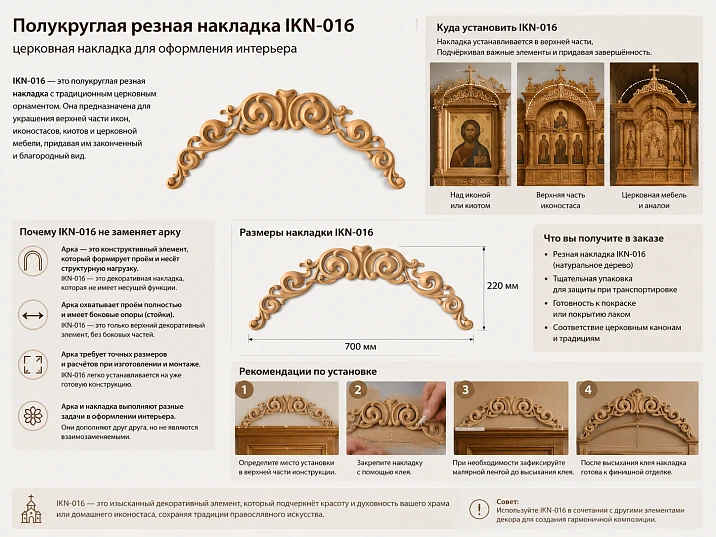
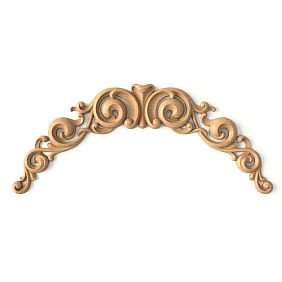
The semicircular carved overlay IKN-016 easily misleads with its silhouette alone. The buyer sees the smooth top finish, mentally aligns it with a door, niche, or icon, and decides it is a ready-made wooden arch. Then they compare the width of the opening with the size of 569 mm, choose beech or oak, and expect to receive a piece that will cover the entire top contour. The mistake is discovered only after ordering: IKN-016 does not form an opening, does not replace a casing, and does not include side posts. It is a separate carved overlay installed on a pre-prepared base.
Such clarification does not diminish the value of the product. On the contrary, it helps to use the decor exactly as intended. The size of 569 × 240 × 21 mm makes the overlay a noticeable but not monumental top accent. It can be included in an iconostasis composition, placed above an icon field, church door, shutters, a kiot, an analogion panel, or a furniture facade — provided that the base matches in size, material, and mounting method. The beautiful semicircle works convincingly only when enough free space is left around it, and neighboring crosses, cornices, columns, and frames do not conflict with the ornament.
Before buy semicircular carved overlay IKN-016, need to answer a few practical questions. Where exactly will the part be installed? What are the width and height of the free field? Is there a solid base? Will the opening doors catch the carving? Is beech suitable for the intended finish, or is oak better? Is the "Standard" preparation sufficient, or will the surface be viewed from close range and require more thorough finishing "Prestige"?
The main principle is simple: first design the space, then check the overlay in full size, and only after that place the order. Then IKN-016 becomes not a random beautiful fragment, but a precise completion of the entire composition.
Short answer: IKN-016 is an overlay, not a ready-made wooden arch
IKN-016 belongs to carved church overlays. It is an independent decorative piece made of natural wood, measuring 569 × 240 × 21 mm. The card offers options in beech and oak, as well as two levels of surface preparation — "Standard" and "Prestige".
The product does not perform a structural function. It does not hold up a wall, does not form an arch vault, does not correct the geometry of an opening, and does not replace a frame. There must be a base under the overlay: a panel, a pediment, a door leaf, the upper field of a kiot, part of an iconostasis, or another element specified in the project.
What does the buyer get for the price of one item? One carved overlay of the selected material and preparation quality. The cost cannot automatically include:
-
a solid mounting panel;
-
side trims;
-
posts or columns;
-
cornice;
-
cross;
-
door panels;
-
icon case or iconostasis;
-
mounting hardware;
-
glue and finishing compounds;
-
painting, tinting, patina, or gilding;
-
designing the entire composition;
-
installation at the site.
These elements and works are priced separately. Therefore, comparing the price of IKN-016 with the cost of a finished arch or an entire iconostasis is incorrect: these are products of different scale and purpose.
The semicircular shape only indicates the external character of the ornament. It helps create a soft upper finish for a rectangular field but does not dictate the radius of a structural arch. If the overlay is planned to be placed above an existing arched opening, the matching of contours must be checked against a template. Sometimes the semicircle of IKN-016 supports the architectural line, and sometimes two different radii visually conflict.




Confirmed specifications of IKN-016
| Parameter | Confirmed value | What to check before ordering |
|---|---|---|
| Article number | IKN-016 | So that the card, drawing, and order refer to the same model |
| Product type | Carved church overlay | Do not confuse with an arch, casing, pediment, or ready-made icon case |
| Size | 569 × 240 × 21 mm | Are the width, height, and depth of the mounting field sufficient |
| Material | Beech or oak | What finish is planned and what are the adjacent parts made of |
| Surface preparation | "Standard" or "Prestige" | Who performs further finishing and how closely the decor is visible |
| Shape | Semicircular ornamental composition | Does its contour conflict with the arch, cornice, or cross |
| Package contents | One separate product item | What bases, adjacent elements, and materials need to be ordered separately |
| Purpose | Overlay carved decor | On what prepared surface and according to what scheme is it installed |
The table answers basic questions but does not replace a fitting. Dimensions describe the external size of the overlay itself. They do not indicate the size of a suitable door, the width of an iconostasis, or the height of a pediment. Two bases of the same width can perceive IKN-016 completely differently: on one, calm margins will remain, on the other, the carving will appear squeezed between the frame and the cornice.
The material also cannot be chosen separately from the project. Beech and oak differ not only in price or the shade of raw wood. The future finish, grain pattern, combination with adjacent elements, and requirements for the visible surface are important. If the overlay is painted together with the panel with opaque enamel, one logic of choice applies; if a transparent tint preserving the texture is planned, another.
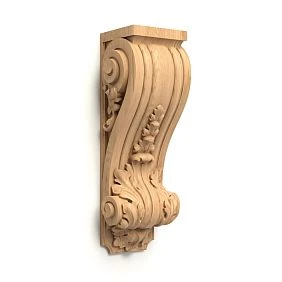
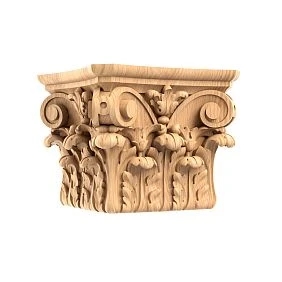
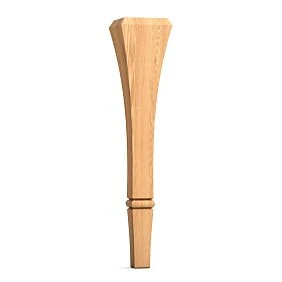
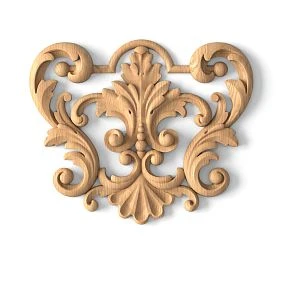
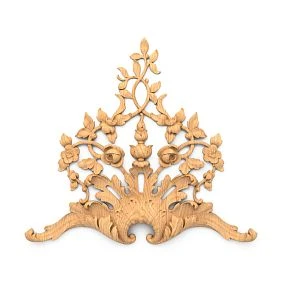
Our factory also produces:
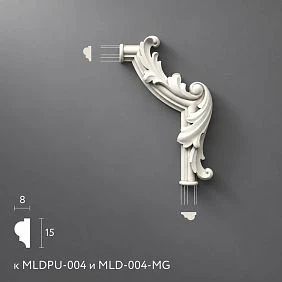
Why a semicircle seems like an arch, although it performs a different task
The eye quickly recognizes familiar geometric signs. A semicircle is associated with an arch, a dome, the completion of a portal. Therefore, a separate overlay in a photo may appear larger and more structural than in reality. Especially if the product is photographed without scale and the background does not show the boundaries of the base.
An arch has a structural or decorative task: it defines the shape of an opening, frames it along the contour, and often includes side parts. An overlay has a different task. It lies on the surface and adds ornament. Its edge may resemble an arched contour, but beyond the part, the base continues to exist independently.
Let's compare four similar concepts.
| Element | What shapes it | Is a ready-made base needed | What happens to the opening |
| IKN-016 | Ornamental top accent | Yes | The size and geometry of the opening do not change |
| Arched casing | Framing the opening along its contour | Yes, the opening already exists | Visually emphasizes its shape |
| Decorative pediment | The upper composition above the door, icon, or furniture | Yes | May be larger than the overlay and include several parts |
| Structural arch | The shape of the opening or the covering itself | Not in the sense of applied decor | Defines the geometry of the architectural element |
The main mistake is trying to solve the architrave task with an overlay. For example, a door 900 mm wide will not become a decorated arch after installing a part 569 mm wide. Unfinished space will remain on the sides. It can be part of a deliberate composition if posts, a frame, or a cornice are provided. But the IKN-016 itself does not replace these parts.
There is also the opposite mistake: trimming the ornament to "stretch" or "fit" it onto a foreign radius. The carved composition is designed as a whole. Removing edge fragments changes the rhythm of leaves, curls, and symmetry. If the external dimension does not fit, it is better to change the base or choose another overlay rather than save the project by cutting the face pattern.
Get Consultation
What 569 × 240 × 21 mm means — and what these numbers do not promise
The dimensions of IKN-016 should be read as the size of the rectangle within which the shaped overlay is located.
569 mm is the maximum width of the outer contour. This is the distance between the extreme points of the thread horizontally.
240 mm is the maximum height of the composition. It shows how much vertical space the overlay occupies.
21 mm is the maximum thickness. The relief protrudes above the base plane, so the decor interacts with light, neighboring frames, and opening elements.
These numbers do not mean:
-
the width of the doorway;
-
the diameter or radius of the arch;
-
the size of the niche;
-
the width of the casing;
-
the height of the entire upper part of the iconostasis;
-
the distance between columns;
-
the size of the icon case;
-
finished mounting opening;
-
dimensions of the panel included in the kit.
Let's imagine a panel 800 mm wide. If IKN-016 is placed strictly in the center, the clean geometric field on the left and right will be:
(800 − 569) / 2 = 115.5 mm.
This is not the final conclusion yet. The figured ornament does not fill the entire rectangle evenly. On one side, the edge may be visually lighter, on the other — denser due to a specific curl. In addition, columns, a frame, and a cross may be nearby. Therefore, the calculation shows only the initial symmetry, and the template helps assess the real perception.
If the free field has a height of 400 mm, and the overlay occupies 240 mm, with conditional centering, 80 mm will remain at the top and bottom:
(400 − 240) / 2 = 80 mm.
But above the door, the bottom and top indents rarely need to be the same. The overlay may rest on the frame line and leave more air up to the cornice. The formula checks whether the part fits at all; the compositional position is determined separately.
1:1 template — the cheapest check for an expensive mistake
A photo in the catalog helps assess the character of the carving, but not the scale at your site. On screen, IKN-016 may look compact above a door and large above a small icon. The only reliable way to see the real size before purchasing is a full-scale template.
For testing, you will need a sheet of paper, cardboard, or several connected sheets. Draw a rectangle 569 × 240 mm. It is better to reproduce not only the rectangle, but also the approximate semicircular contour. If a drawing is available, use it. Mark the vertical axis and the extreme points.
Further work is done not on the table, but directly at the installation site:
-
apply the template to the base;
-
align the axis of the overlay with the axis of the door, icon, or panel;
-
mark the cornice, frame, cross, and adjacent columns;
-
open the doors or flaps;
-
check that the relief does not fall into the movement trajectory;
-
step back to the distance from which the composition will most often be viewed;
-
take a photo;
-
compare several height positions;
-
Attach the image to the application or design project.
Why is a simple paper outline so useful? Because the brain poorly estimates 569 mm without an object scale. Next to a tall iconostasis, the overlay seems small. On a home panel 650 mm wide, it almost fills the entire field. The template immediately shows whether an additional cornice is needed, whether there is enough side margin, and whether the ornament looks too dense.
Do not try to replace the template with a ruler held against the wall. A ruler shows one length, but not the area, height, and external silhouette. Even a rectangle of painter's tape provides more information than a single 569 mm mark.
Where IKN-016 works convincingly
The scope of application of the overlay is broader than one scenario, but each option requires its own base. The universal promise "fits anywhere" would be incorrect.
Above the icon field
A semicircular composition can complete the upper part of the panel with an icon. Three axes are critical here: the axis of the icon itself, the axis of the frame, and the axis of the overlay. Even a slight shift is noticeable because the entire composition is perceived frontally.
The width of IKN-016 is compared not only with the icon but also with the outer size of the shrine or frame. The overlay can be wider than the image but narrower than the overall panel. Such a transition looks natural if the edges do not break off randomly and are supported by the lower architecture.
The height is checked separately. A meaningful distance must be left between the top of the frame and the start of the carving. If the elements almost touch, small details merge. If the gap is too large, the overlay loses its connection with the icon field.
In the upper part of the iconostasis
IKN-016 can work as a separate pediment module or section completion. But an iconostasis is a system, not a set of favorite details. The semicircle must be coordinated with columns, capitals, cornice, cross, gates, and adjacent fields.
Before ordering, it is useful to study how to select church wood decor within a unified system. This approach helps avoid a situation where each detail is beautiful on its own, but the overall ensemble consists of different scales and rhythms.
If the overlay is placed above the central part, it becomes more noticeable than on a side field. Then it is especially important not to duplicate the semicircle with another large pediment and not to place a cross nearby that visually competes for the main center.
Above a church door or door leaves
The overlay can become the top accent above the door if there is a prepared panel or frieze behind it. But it does not replace the upper casing. First, the opening is framed, then it is decided whether additional ornament is needed.
Check:
-
the width of the outer frame;
-
the position of the central gap between the leaves;
-
opening direction;
-
top hinges and fasteners;
-
distance to the cornice;
-
thickness of 21 mm;
-
the ability to securely fasten the base;
-
matching of the door finish and the overlay.
When the project includes carved gates IKN-010, semicircular decor cannot be assigned automatically. First, check the pattern of the gates themselves and the top line. Possibly, an additional overlay will enhance the composition; possibly, it will create an unnecessary repetition.
On the pediment of an analogion or church furniture
IKN-016 is suitable for a flat top field of sufficient width. On an analogion, one must account for inclined surfaces, the working part, the possibility of hand contact, and future finishing. You cannot simply glue the overlay to any inclined plane without calculating the fastening.
On a cabinet, nightstand, or other church furniture, check the thickness of the facade, the frame, hinges, and the direction of opening. The 21 mm relief should not interfere with the adjacent door. If the item is moved, the fastening is calculated differently than for a stationary wall panel.
In a home prayer corner
A compact home iconostasis may include a separate wooden overlay, but IKN-016 is not a ready-made home iconostasis. It will require a base, space for icons, and well-thought-out finishing.
In a small room, the pattern is especially important. An overlay 569 mm wide can become the main visual element of the wall. If there is already a carved frame, shelf, and cross nearby, the composition may become overloaded. Sometimes one expressive semicircle is better than several competing details.
On a standalone decorative panel
A separate panel is convenient when the overlay needs to be pre-fitted, finished, and then installed as a single unit. In this case, the panel dimensions are determined not only by the 569 × 240 mm size. Margins, base thickness, wall mounting method, and coordination with adjacent items are needed.
The panel can be rectangular, shaped, or included in a wider pediment. But its contour should not accidentally repeat the semicircle of IKN-016 with a small offset. Two close radii create a nervous line. Either the base remains calm, or its shape is designed as part of a unified pattern.
Where the overlay will not solve the task
An honest choice begins not with listing advantages, but with understanding limitations.
IKN-016 is not suitable as the only element if a wide doorway needs to be fully decorated. The overlay will cover only the central upper part. For a complete portal, trim, jambs, cornice, or other framing will be needed.
It will not fix a curved arch. If the construction radius is uneven, the applied ornament will not align the contour. First, repair the base.
It will not replace a solid panel. Openwork and shaped sections must rest on a provided surface or fastening scheme. The air behind the carving does not by itself create a reliable joint.
It is not suitable for a project where the size can only be achieved by trimming the face ornament. Changing the outer contour destroys the composition. It is better to choose a model of a different size.
It may be redundant next to a large cross, complex cornice, and rich capitals. In church decor, expressiveness depends not on the amount of carving, but on hierarchy. Each center must have its own role.
Finally, the overlay does not resolve the finishing issue. Beech or oak without a single color scheme may differ from adjacent parts. Even the same wood species looks different after different stains, primers, and varnishes.
How to calculate free margins around the overlay
For a preliminary check, let us denote:
-
W — width of the base;
-
H — height of the free decorative field;
-
569 mm — width of IKN-016;
-
240 mm — height of IKN-016.
With symmetrical placement, the side field is calculated as follows:
Side field = (W − 569) / 2.
If the base is 700 mm wide:
(700 − 569) / 2 = 65.5 mm.
This is a fairly tight placement. In reality, the outermost ornament may come even closer to the frame. You need to look at the template and make sure the carving doesn't look cramped.
If the base is 900 mm wide:
(900 − 569) / 2 = 165.5 mm.
The margins become more relaxed. You can place a transition to the columns in them or leave a clean surface.
For the vertical, a conditional formula:
Top and bottom margin = (H − 240) / 2.
But using it literally is rarely needed. The top and bottom spaces serve different functions. At the bottom, the overlay is connected to an icon, door, or frame. At the top, it's connected to a cornice, ceiling, or the next tier. Therefore, after the geometric calculation, the height is adjusted visually.
| Base Width | Side margin when centering | Preliminary assessment |
| 620 мм | 25.5 mm | Very tight fit, mandatory check of the shaped contour |
| 700 мм | 65.5 mm | Compact composition, important not to press the thread against the frame |
| 800 мм | 115.5 mm | Moderate margins for a separate accent |
| 900 мм | 165.5 mm | Calm surroundings, possible connection with neighboring details |
| 1100 мм | 265.5 mm | The overlay may look too small without additional elements |
The table does not set standards. It helps to understand the scale. Based on 1100 mm, IKN-016 can work perfectly if there are columns on the sides and the overlay completes the central field. On an empty wide panel, the same piece can get lost.
Calculation example for the field above the door
Suppose the outer width of the door portal together with the architraves is 940 mm. The side field when centered:
(940 − 569) / 2 = 185.5 mm.
The figure looks sufficient, but the calculation does not yet account for the extreme curls, the top cornice, and the thickness of the architrave. On the template, it may turn out that the semicircle is positioned too high or too low. Therefore, the formula only answers the question "does the overlay fit in width".
Calculation example for the icon case
Let the top field have a width of 680 mm and a height of 320 mm. Horizontally, there will remain:
(680 − 569) / 2 = 55.5 mm.
Vertically, with conditional centering:
(320 − 240) / 2 = 40 mm.
The composition will be dense. If the kiot frame has a protruding profile, the actual gap will be smaller. In this case, a template is mandatory, and sometimes it is better to choose a more compact overlay.
Example for a wide iconostasis field
With a width of 1200 mm, the side fields will be:
(1200 − 569) / 2 = 315.5 mm.
On an empty plane, IKN-016 may look too small. But if there are columns on the sides and a cross above the overlay, such fields become part of a complex architecture. That is why the size of the base cannot be assessed without neighboring details.
Centering: the geometric center is not always visually correct
The most obvious way is to align the middle of the overlay with the middle of the base. In most symmetrical church compositions, this is a correct starting point. But the final perception depends on the surrounding pattern.
Suppose there is a massive column to the right of the panel and a free wall to the left. A geometrically centered overlay may visually lean to the right. Fixing this by random shifting without a project is risky: the connection with the door or icon will be disrupted. It is better to balance the entire composition with neighboring elements.
The error is especially noticeable above paired doors. The axis of IKN-016 must coincide with the central gap, not with the outer edge of one panel. If the doors differ in width or one part is stationary, the center is determined by the entire portal.
When aligning the icon, focus on the frame, not just the image inside. The kiot may have its own cornice and protrusions. The semicircle is connected to the outer contour of the entire composition.
A useful technique is to photograph the template from the distance at which a person enters the room. Then take a second photo strictly from the front. The first will show real perception, the second will show geometric errors.
Thickness 21 mm: a small size that cannot be ignored
The number 21 mm seems secondary compared to width and height. In practice, it is the depth that affects the shadow, junctions, and opening.
Under side lighting, the relief becomes more noticeable. If the overlay is located near a lamp, sconce, or window, the protrusions cast shadows. This emphasizes the carving, but at the same time shows uneven seating and gaps between the base and the part.
On a door leaf, the thickness may conflict with the adjacent panel or top frame. You need to open the door fully, applying the template not only flat but also with a conditional volume. To do this, you can attach strips of cardboard about 21 mm thick to the paper outline.
Near the cornice, too small a vertical gap creates a heavy dark line. The reliefs begin to overlap visually. Between the overlay and the cornice, there should be air calculated according to the real profile.
Thickness is also important when painting. Deep areas require careful tool access. If the overlay is finished before installation, you need to protect the front surface and not damage the edges. If after installation, check whether the areas near the frame can be processed properly.
Beech or oak: the material is chosen for the final look
In the IKN-016 card, beech and oak are available. Both materials are suitable for carved decor, but lead the project to different visual logic.
Beech for opaque finishing
Beech is often chosen when the wood texture should not be the main effect. The overlay is planned to be covered with opaque enamel, made the same color as the panel, add patina or other decorative highlighting.
The advantage of this scheme is the ability to combine different elements by color. However, solid paint does not hide rough preparation. On the contrary, side light reveals risks, transitions, and uneven joints. Surface quality should be selected considering viewing proximity and the painter's requirements.
Beech is also appropriate when the base is already painted and the customer wants a uniform, calm background. But color matching cannot be assessed from a photo of raw wood. Specific paint, primer, and a test sample are needed.
Oak for transparent finishing
Oak is logical when natural grain and combination with oak columns, doors, or furniture are important. Transparent coating and tinting preserve the texture, so matching adjacent details becomes stricter.
Even oak from the same species can differ in shade and grain. If a set is assembled for one prominent composition, coordinate the material and finish of all parts simultaneously. Do not buy the overlay separately and then look for columns of "approximately the same color" a few months later.
Oak IKN-016 works especially expressively under side light: the wood grain and carving depth complement each other. But transparent coating does not hide repair spots, rough fastening points, and uneven surface preparation. Therefore, installation must be planned before finishing.
Material is not chosen only from a photo
The color of an unfinished part on screen depends on lighting and display settings. The final appearance is shaped by the finish. Before ordering a batch, a test sample on a compatible piece is useful. It shows how the species accepts the chosen composition and how contrastingly the relief reads.
Compare not only the external shade, but the entire system:
-
the type of base;
-
the material of adjacent columns and cornices;
-
the type of soil;
-
opaque or transparent finish;
-
desired degree of gloss;
-
patina or gilding;
-
lighting at the site;
-
viewing distance.
If the overlay is to be painted with dense enamel, paying extra just for the pronounced oak texture may be unjustified. If the project requires a live natural surface, choosing beech with subsequent imitation of oak is also not always reasonable. The material should match not the general idea of "expensive wood," but the specific finish.
"Standard" or "Prestige": the decision depends on the finish and viewing distance
Preparation level names should not be reduced to a simple "cheaper — more expensive" scheme. The buyer needs to understand who and how will finish the surface.
"Standard" may suit a project where the craftsman performs their own preparation before the covering paint. The budget then includes manual finishing, priming, and intermediate inspection.
"Prestige" is reasonably considered when the overlay is close to the viewer, a transparent finish is planned, or surface requirements are especially high. Exact differences and the scope of preparation should be verified in the card and with a STAVROS manager, because the final result still depends on the painting system.
Before choosing, answer:
-
will the overlay be seen from a distance of one meter or from a height of several meters;
-
is the finish transparent or covering;
-
who performs sanding and priming;
-
is uniform quality with adjacent elements required;
-
are there deadlines for additional manual work;
-
will patina or gilding be used;
-
how much side light emphasizes the surface.
Savings on preparation may disappear if the craftsman spends more time on finishing. But overpaying for a level that is still completely reworked in the workshop also makes no sense. A general finishing process map is needed.
When close-up viewing changes requirements
In a home prayer corner, the overlay is viewed from a distance of several tens of centimeters or one to two meters. Any scratch, roughness, or rough edge is more noticeable. For such an area, the quality of preparation and finishing accuracy are critical.
High on the iconostasis, minor processing marks may be less noticeable, but this does not mean the surface can be left without control. Side lighting and gilding can emphasize even a high-placed defect. The decision is made not only by height, but also by light and type of coating.
Who is responsible for the final surface
Manufacturer preparation is one stage. The painter or restorer is responsible for primer, intermediate sanding, color, varnish, and decorative effects. If responsibility between participants is not defined, each believes the next will fix the problem.
Before ordering, it is useful to specify: in what form the overlay arrives, what operations the workshop performs, who accepts the surface before painting, and which sample is considered the standard.
How to coordinate IKN-016 with the cross, gates, and other overlays
The upper zone of the iconostasis easily becomes overloaded. The semicircle, cross, cornice, and capitals can simultaneously claim to be the main element. Therefore, the arrangement should be built according to hierarchy.
If a separate carved cross IKN-008 is placed in the center, determine who is more important: the cross or the ornamental overlay. The cross usually requires a free background. If IKN-016 is located too close, the plant curls visually merge with its contours.
Above the gates, check the design of the doors. When the upper part is already saturated with carving, an additional semicircle can repeat the shape and weigh down the composition. If the doors are calmer, IKN-016 can connect them with the cornice.
When choosing several overlays, it is useful to look at all carved church overlays and compare not only sizes but also the density of the ornament. Two details of the same width can have different visual mass.
The general principle: large elements set the architecture, medium ones connect fields, small ones complete individual nodes. IKN-016 belongs to expressive medium accents. It needs space, but it does not have to dominate the entire wall.
Do not repeat the same semicircle three times
If the door already has a semicircular top, with an arched cornice above it, and IKN-016 is added between them, the eye sees three close arcs. Instead of reinforcement, the result is fragmentation. One contour must be the main one, and the others should support it or remain straight.
The ornament should continue the lines of adjacent parts
The plant scrolls of IKN-016 direct the gaze to the sides and upward. If there are columns with a vertical pattern nearby, the transition can be made natural. If the adjacent overlay directs lines downward, the two ornaments may collide. You need to check not only the overall shape but also the direction of individual branches.
There should be only one center of composition
The cross, icon, and overlay are not equal in meaning. The decorative element should support the main sacred center, not draw attention away. This is especially important with contrasting finishes or gilding.
IKN-016 and IKN-009: two overlays for different fields
Comparison with IKN-009 is useful because both items belong to church carved decor but solve different compositional tasks.
IKN-016 has dimensions of 569 × 240 × 21 mm and a semicircular silhouette. It is suitable for a relatively compact upper field.
IKN-009 is a larger overlay measuring 750 × 470 mm with a different compositional character. It cannot be considered an enlarged version of IKN-016. Not only the dimensions change, but also its role on the iconostasis or analogion.
| Criterion | IKN-016 | IKN-009 |
| Main silhouette | Semicircular completion | Large compositional overlay |
| Confirmed dimension | 569 × 240 × 21 mm | 750 × 470 mm |
| Typical field | Upper compact zone | Larger central or frontal plane |
| Main check | Do not confuse with a finished arch | Check the scale of the large panel |
| Risk of error | Order to the size of the opening | Underestimating visual mass |
If the free field is significantly larger than IKN-016, do not automatically fill the emptiness with additional random details. First compare IKN-016 with the large overlay IKN-009 and assess which composition matches the scale.
A detailed article on how to check the large overlay IKN-009 with a cross, will help avoid mixing two different selection tasks.
Do not mentally enlarge IKN-016
Photos of individual products are often taken at roughly the same screen scale. As a result, IKN-016 and IKN-009 may seem comparable. The real template shows how much more strongly the large overlay occupies the field.
Do not reduce IKN-009 to the role of a small finishing touch
A large composition requires sufficient background. If placed in a tight top margin, the edges will be too close to the frames, and the central cross may lose breathing room. Model selection starts with the base area, not with pattern preference.
Base for the overlay: what you need to know before ordering
IKN-016 must rest on a prepared base. The phrase "attach to the wall" is too general. The wall may be plastered, painted, wooden, tiled, or covered with a decorative panel. For each case, the mounting is assessed separately.
Base parameters:
-
material;
-
thickness;
-
strength of the top layer;
-
flatness;
-
size of the free field;
-
presence of voids;
-
frame position;
-
possibility of mechanical fixation;
-
adhesive compatibility;
-
future finishing;
-
element mobility.
A solid wood or panel board is often more convenient for precise composition because it allows elements to be laid out and finished in advance. But it cannot be declared mandatory for any project without a drawing. Sometimes the overlay is installed on another reliable base according to an agreed scheme.
On a painted wall, not only the adhesive but also the paint's adhesion to the plaster is checked. A strong compound will hold the overlay together with a weak layer, which will then peel away from the base. On an old door, the condition of the wood, hinges, and door leaf movement are assessed.
Before installation, it is useful to select materials for mounting and finishing carved wood, but the final composition of the basket depends on the project. There is no universal adhesive for all walls, doors, and panels.
Wooden panel
A wooden base is convenient for matching material and finish. But the grain direction, moisture content, thickness, and the possibility of fastening from the reverse side must be checked. If the panel is movable, the joint is calculated considering deformations and load.
MDF or other panel base
Panel material provides a flat surface, but its thickness and density must match the fastening. The scheme for solid wood cannot be automatically transferred. Edges, old holes, and cavities are considered separately.
Plastered or painted wall
Here, the weak point may not be the adhesive, but the top finishing layer. Before installation, check the strength of the coating, dust, cracks, and local irregularities. The preparation method is coordinated with the craftsman.
Door leaf
The door creates dynamic load. The weight of the overlay affects the hinges, and the 21 mm thickness affects the o
Temporary fixation
On a vertical surface, the part must remain in its design position until the joint gains strength. The temporary fixation method is chosen so as not to damage the threads and finish. Masking tape, supports, and clamps are used only after compatibility checks.
Post-installation inspection
Check the axis, margins, absence of displacement, and quality of fit. Under side lighting, gaps and steps are visible. It is better to correct them before final finishing.
Finishing: the overlay should become part of the composition, not a separate spot
Even precise installation will not yield a cohesive result if the color and gloss differ from the base. The finishing system is selected simultaneously for IKN-016 and adjacent parts.
Opaque enamel
Solid-color painting unifies beech with the panel and other elements. The relief is read through shadow. This option requires careful preparation: enamel highlights surface defects and sanding marks.
Tinting and transparent coating
A transparent system reveals the oak texture. The color of the overlay must match the columns, doors, and cornice. A test coat is mandatory when the shade is critical.
Patina
Patina emphasizes the depth of the carving. It also highlights every scratch and imperfection. First, the base coating is checked, and only then the decorative effect.
Gilding
Gilding can be used as a separate accent, but its volume should be limited. A fully gilded overlay 569 mm wide becomes a strong focal point. If there is already a gilded cross and capitals nearby, the composition may lose hierarchy.
Test sample
A sample is made not only for color. Adhesion, degree of gloss, pore filling, behavior of the composition in recesses, and relief contrast are checked. A small sample is cheaper than redoing a finished overlay.
Finishing before or after installation
Pre-finishing provides easier access to deep relief but requires careful fastening without damage. Painting after installation unifies the overlay with the base, but it is harder to treat the joints. The decision is made for the entire system, not for a single part.
What to order together with IKN-016
Purchasing a single part is justified if everything else is already in place: the base is prepared, the finish is approved, and the fastening is calculated. In a new project, the cart is usually larger.
| What to add | Why | When especially needed | What to check |
| Drawing or template | Check the dimensions and axes | Before ordering and installation | Matches article IKN-016 |
| Base | Create installation field | If the panel is not yet manufactured | Material, thickness, evenness |
| Adjacent church decor | Assemble a unified ensemble | For iconostasis or portal | Scale, material, ornament |
| Cross | Form a semantic center | If provided by the project | Does it compete with the semicircle |
| Installation materials | Attach the overlay | For any object | Compatibility with the base and wood |
| Finishing materials | Achieve a uniform color and protection | If the product is supplied without finish | The system of primer, paint, or varnish |
| Design project | Check the entire composition | For a complex iconostasis | Full dimensions and specification |
| Sample for testing | Check the finish | For transparent tinting and patina | Material match |
In this section you can Select other elements for the iconostasis and assemble them according to the general logic. Do not turn this stage into a selection based on the principle of "all parts have similar leaves." Compare the relief height, ornament density, line direction, and future finish.
For a complex wall, it is reasonable to check IKN-016 in the overall composition according to the project. This is especially useful if the overlay is located between columns, above the gates, or near several tiers of cornices.
Why related products cannot be selected after installation
If you first secure the overlay and then look for a cross or cornice, there may not be enough free space. The new element has to be pressed against the carving, the axis shifted, or the indents reduced. The correct order is the reverse: the entire composition is assembled on the diagram, then a unified specification is formed.
When one overlay is enough
A single IKN-016 can be a complete solution on a calm panel, above a small icon, or in a home prayer corner. Additional decor is not required. Sometimes a clean field around the carving enhances its expressiveness better than several adjacent details.
When a full system is needed
For the central section of an iconostasis, one overlay is usually not enough. It must be connected to the frame, columns, cornice, and the semantic center. In such a case, you buy not a "beautiful detail" but a set of coordinated elements according to the project.
Practical Selection Scenarios
Overlay above a door 900 mm wide
Do not compare 569 mm with the clear opening. Measure the outer width of the platbands or panel. If the base is 900 mm wide, the side fields when centered will be 165.5 mm. Then apply the template, check the top gap and the opening.
If there are no posts or platbands on the sides, a single overlay may look detached. Perhaps the project needs a full portal. Conversely, when the door already has an expressive frame, IKN-016 may become a redundant repetition. The decision depends on the entire composition.
Top field of a shrine 700 mm wide
The side fields will be 65.5 mm. This is a compact fit. It is necessary to accurately reproduce the figured contour and check whether the extreme curls touch the frame.
With a transparent finish, it is better to match the overlay material with the shrine in advance. If the shrine is made of oak and covered with a tint, a beech overlay under a clear varnish may differ in texture. With an opaque enamel, the difference in wood species is less noticeable, but surface preparation remains important.
Central section of the iconostasis, 1100 mm wide
Geometrically, 265.5 mm will remain on each side. On an empty IKN-016 panel, it may get lost. But between columns and under the cornice, such fields may be necessary. The decision is made for the entire section, not based on a single number.
If a cross is planned above the overlay, first set its height and the free field. The semicircle should not touch the lower part of the cross. A calm zone is needed between the two accents.
Overlay above paired doors
The axis is aligned with the central gap. Both doors are checked in the open position. If the part is attached to a fixed upper panel, the task is simpler. If to the panels, the overlay cannot be divided arbitrarily without a project.
It is especially dangerous to position a solid IKN-016 so that part of the carving extends onto the movable panels, while the rest remains on the fixed base. Different elements will move relative to each other, and the joint will be disrupted.
Home prayer corner
First, apply the template to the wall. Check the distance to the shelf, lamp, and ceiling. In a small space, it is better to exclude extra adjacent overlays. One semicircle can complete the composition without overloading it.
If the overlay is wider than the shelf or frame, this is not always a mistake. It can unite several icons into one group. But the extreme points should correspond to the overall width of the composition, not hang in emptiness.
Series of identical overlays
For several sections, make one approved template. Order materials with a single specification, perform a trial finish, and mark the parts. A serial error repeats on every field, so a control sample is mandatory.
Before installation, lay out all items and check the direction of the wood, the shade, and the quality of preparation. If the overlays are placed nearby, differences are more noticeable than in products in different rooms.
Reconstruction of an existing iconostasis
First, record the actual dimensions and condition of the old base. You cannot assume that the historical field is perfectly symmetrical. The template is applied at several points, checking cracks, old fasteners, and previous finish.
The new overlay must be matched not only in size but also in the character of the carving. A too fresh and contrasting piece may stand out. The finishing system is selected considering existing surfaces and the requirements of the restoration project.
Design of the analogion
On the analogion, the overlay is seen up close, so the quality of preparation and finish is especially noticeable. Check the tilt of the panel, the position of hands and books, the possibility of touching the relief, the stability of the furniture, and the method of attachment.
If the upper part of the analogion already has a figured pediment, an additional IKN-016 may overload the silhouette. The template is applied not only to the front panel but also assessed from the side.
Decor for individual church furniture
On cabinets, nightstands, and doors, hinges, gaps, and load are important. The overlay must be within a solid field. It cannot be placed so that the edge protrudes beyond the facade and constantly catches during use.
Mistakes that prevent IKN-016 from fitting into the project
Purchase based on door opening width
569 mm is the width of the overlay, not the door. You need to measure the mounting field and the entire frame.
Expectation of a ready-made arch
The order does not include side trims and a base. The semicircle is only a decorative shape.
Refusal of the template
The size on the screen does not convey the scale. A paper fitting reveals the problem before payment.
Selecting the base after purchase
First, the panel is designed, then the overlay is checked. The reverse order forces the structure to be adjusted to an already purchased part.
Installation flush with the cornice
Two reliefs merge and create a heavy shadow. The gap is assessed by profile, not just by ruler.
Ignoring the 21 mm thickness
The part may interfere with the door, frame, or light fixture.
Ornament trimming
Attempting to reduce the width disrupts symmetry and pattern. A different model or base is needed.
Mixing beech and oak without a finishing scheme
Different wood species do not become identical after random stain. Color is checked on samples.
Choosing "Standard" without budget for finishing
If the surface requires additional work, its cost and timeline must be accounted for in advance.
Universal mounting adhesive
The inscription on the packaging does not replace checking the base and calculating the fastening.
Competition with the cross
The cross and the semicircle should not be two equal centers on a small field.
Lack of layout photos
A template photo helps the manager, designer, and craftsman discuss the same option rather than different interpretations.
Checking only from the front
From the front view, the overlay may look correct, but from the side it may protrude too much. This is especially important for doors, icon cases, and furniture.
Identical margins by formula without visual verification
Geometric centering does not always yield the best result. The bottom margin may be smaller than the top if the overlay is meant to complete the frame. The formula is a starting point, not a finished design.
Finishing each part separately
If the overlay, cornice, and columns are painted by different craftsmen without a common sample, the shades and gloss will diverge. All participants must work according to one approved system.
Ordering several overlays without a control sample
In a serial project, an error in the template, color, or fastening will repeat many times. First, one complete assembly is approved.
Who IKN-016 suits, and who should choose a different element
IKN-016 suits customers who need a semicircular wooden accent about 569 mm wide for a prepared upper field. The part is appropriate in an iconostasis, icon case, above a door, on a lectern, and church furniture, if the base is calculated in advance.
It is especially useful when:
-
an expressive but relatively compact finish is required;
-
the composition is symmetrical;
-
a template or drawing is available;
-
the material of adjacent parts is coordinated;
-
a unified finish is provided;
-
installation is performed by an experienced craftsman;
-
there is free space around the thread.
Another option is better to choose when:
-
a full arched casing is needed;
-
it is required to frame the entire opening;
-
the width of the base is smaller than the outer contour;
-
the only installation method is to cut the ornament;
-
there is already a large semicircular pediment nearby;
-
movable sashes are needed every day without space for relief;
-
the project requires a significantly larger central decor;
-
the customer does not plan for the base, mounting, and finishing.
If the task is still formulated in general terms, start not with a specific model, but with a section where you can buy wooden church decor after comparing shapes, sizes, and purposes.
Who should not order based only on a photograph
If the buyer does not have the dimensions of the base and an understanding of the future finishing, the product card will not provide a sufficient answer. First, measurements need to be taken or a project ordered. Otherwise, the choice of material, quality, and quantity will be based on assumptions.
When IKN-016 can be purchased confidently
The solution is ready when there is a 1:1 template, a confirmed base, approved margins, a selected wood species, a finishing system, and a mounting scheme. At that moment, the product card becomes a point of purchase, not a source of guesswork.
Order specification: what data to provide to the manager
A good request reduces the number of clarifications and lowers the risk of errors.
| Field | What to specify |
| Article number | IKN-016 |
| Quantity | By the number of approved fields |
| Product size | 569 × 240 × 21 mm |
| Material | Beech or oak |
| Preparation | "Standard" or "Prestige" |
| Installation location | Iconostasis, icon case, door, lectern, panel |
| Base size | Full width, height, and thickness |
| Free fields | Left, right, top, and bottom |
| Adjacent parts | Cornice, cross, columns, frames, gates |
| Finishing | Enamel, transparent system, tinting, patina — as per project |
| Installation | Base material and intended method |
| Applications | Drawing, photo, 1:1 template |
You can add text to the request:
A carved overlay IKN-016 is required for installation on a field measuring ___ × ___ mm. Please confirm the dimensions 569 × 240 × 21 mm, availability of beech and oak, differences between "Standard" and "Prestige" preparation, the contents of one item, and recommendations for further finishing. The base is made of ___. Nearby are ___. We attach a full-size photo of the template.
Such a request is much more useful than the phrase "we need an arch 569 mm wide," which initially describes the product incorrectly.
What to attach to the request
One photo of the wall is not enough if it lacks a scale. Add a general view, a close-up of the field, dimensions, a door opening diagram, and a photo of the template. For a complex iconostasis, include a drawing of the entire section.
What to clarify about the price
The current price is checked for the selected wood species, preparation quality, and quantity. Do not transfer the cost of one finish to another. Separately, find out whether finishing, fasteners, packaging, and additional services are included in the order.
Check before payment
Before placing an order, make sure that:
-
you are choosing exactly IKN-016;
-
you understand that this is a separate overlay;
-
size 569 × 240 × 21 mm fits on the base;
-
template is provided at full scale;
-
axis aligns with the door, icon, or section;
-
outer elements do not touch the frame;
-
thickness of 21 mm is accounted for;
-
doors open;
-
cornice is not pressed against the relief;
-
cross does not compete with the overlay;
-
material is chosen for the final finish;
-
Surface preparation is coordinated with the master;
-
The base is not expected to be included;
-
Mounting materials are selected separately;
-
The quantity corresponds to the number of fields;
-
A control sample has been prepared for the series;
-
The current price and ordering conditions are checked in the card.
If all items are checked, you can proceed to order. If not, it is cheaper to fix the scheme now than to redo the wood after manufacturing.
Frequently asked questions about IKN-016
What is IKN-016?
IKN-016 is a separate semicircular carved wooden overlay measuring 569 × 240 × 21 mm. It is installed on a prepared base and serves a decorative function. It is not a finished panel, not a door portal, and not a structural part of an arch.
Is IKN-016 a ready-made wooden arch?
No. The overlay does not form an opening and does not include side trims. The semicircle refers to the outer silhouette of the ornament. To achieve a complete arched design, a separate base and other elements according to the project will be required.
Can it be used instead of a trim?
No, if you need to frame the entire opening. IKN-016 can serve as a top accent above a ready-made trim, door frame, or panel. It does not cover the sides and does not replicate the full door contour.
Does 569 mm mean the width of a suitable door?
No. This is the maximum width of the overlay itself. The suitable door or panel size is determined by the outer dimension of the entire composition. First, measure the base, then calculate the margins and apply the template.
What does the height of 240 mm mean?
This is the maximum height of the outer carving contour. You need to add free space up to the cornice, frame, or ceiling. A field exactly 240 mm high will not work because the overlay will be squeezed between adjacent lines.
Why consider the thickness of 21 mm?
The relief protrudes above the base and may interfere with the opening of doors, adjoin the cornice, or create a deep shadow. The thickness is checked not only on the drawing but also during a three-dimensional fitting.
Is a solid panel needed under IKN-016?
A base is necessary, but its specific type depends on the project. It could be a panel, a pediment, a door, or another calculated surface. It cannot be stated in advance that one material or mounting method suits every object.
Can the overlay be installed directly on the wall?
The possibility depends on the material and strength of the wall, the finish, the mounting, and the operating conditions. It cannot be mounted on weak paint or a crumbling base without preparation. The decision is made by a specialist after inspecting the surface.
Is IKN-016 suitable for a home iconostasis?
Yes, as a separate decorative element. It does not replace a ready-made iconostasis, shelves, frames, or the base. In a small space, it is especially important to check the scale with a 1:1 template.
Can the overlay be placed above a church door?
Yes, if there is a suitable upper field and the relief does not interfere with opening. First, check the outer width of the frame, the door axis, the upper cornice, and the trajectory of the leaves.
Is IKN-016 suitable for installation above the royal doors?
Such a scenario is possible only after a design check. The drawing of the doors, the cross, the cornice, and the overlay must form a single hierarchy. A semicircle cannot be automatically added above any model of the doors.
Why make a 1:1 template?
The template shows the real scale, margins, axis, and proximity to the cornice. It reveals errors before fabrication and installation. From a photo or a separate 569 mm mark, it's difficult to assess the area and the shaped contour.
How to calculate side margins?
For symmetrical placement, use the formula: (base width − 569 mm) / 2. Then verify the result against the shaped template. The formula shows geometry but does not replace visual assessment.
Should the top and bottom margins be the same?
Not necessarily. The overlay can be visually connected to the frame at the bottom and have more air space to the cornice at the top. Equal margins are suitable for preliminary calculation, while the final position is determined by composition.
What to choose — beech or oak?
Beech is more often considered for opaque finishes, oak — when texture and transparent coating matter. The decision depends on adjacent parts, approved color, and treatment method. There is no universally best wood species for all projects.
Can beech be coated with clear varnish?
Technical feasibility depends on the desired appearance and coating system. If pronounced oak texture is needed, the material is chosen before finishing, not attempted to be imitated with random tinting.
Is oak suitable for enamel?
This option is possible in individual projects, but it should be understood that opaque finishing hides a significant part of the visual value of the texture. Material selection is coordinated with the painter and the overall specification.
How does "Standard" differ from "Prestige"?
These are surface preparation levels. The exact content needs to be checked in the card and with the manager, linking the choice to further finishing and the volume of manual refinement. The level name itself does not describe the finished surface coating.
Is the base included in the price of IKN-016?
No, unless explicitly stated otherwise in the order. The card refers to one carved overlay. The panel, cornice, columns, and other elements are formed separately.
Is mounting hardware included?
Hardware should not be considered included without confirmation. The installation method depends on the base, location, and load. For a stationary panel and a movable door, the schemes may differ.
Can the overlay be attached with glue only?
Without data on the base, mass, and operating conditions, this cannot be stated. In some projects, combined or mechanical fastening is required. The decision is coordinated with the responsible craftsman.
Can the overlay be reduced by trimming?
Trimming the face ornament is not recommended: symmetry and pattern are disrupted. It is better to choose another product or change the field size. Any shape changes require separate approval.
How to combine IKN-016 with a cross?
First, determine the main center of the composition. Leave enough free space between the cross and the plant ornament. If both elements have contrasting gilding, distance and scale are especially important.
How many overlays should be ordered?
The quantity equals the number of approved mounting fields. For symmetrical sections, check whether identical parts are needed on each side. Spare items are ordered only based on the actual needs of the project.
Can I order one overlay as a sample?
The possibility and terms of ordering are clarified in the product card or with the manager. For a series, one control piece helps verify scale, finish, and installation before launching the full quantity.
Where can I see the current price for IKN-016?
The price, material, and available preparation options are checked in the product card before placing an order. The cost cannot be transferred from one version to another without verification.
Final choice: first the base, then the overlay
The semicircular shape of IKN-016 does indeed resemble an arched top, but it cannot be purchased as a ready-made arch. It is a separate wooden decor piece measuring 569 × 240 × 21 mm. It only works together with a prepared base, a precise axis, free margins, and coordinated neighboring elements.
Before ordering, do three things. First, measure the full mounting surface, not just the door or icon. Second, apply a 1:1 template and check the opening, cornice, and cross. Third, determine the material, preparation quality, and finishing system for the entire composition.
If IKN-016 fits only after trimming the ornament, the project is chosen incorrectly. If the semicircle tries to replace a platband, a different product is required. If the overlay looks too small on a wide panel, compare it with larger models and evaluate the entire ensemble. An honest preliminary check saves more than trying to fix a mismatch after manufacturing.
STAVROS company allows linking the IKN-016 card with other elements of church decor, mounting materials, and design engineering. This route is more reliable than a random purchase based on a photo: first the project and scale check, then precise specification, after that — manufacturing, finishing, and installation. As a result, the overlay does not try to depict an arch, but performs its own task: neatly and expressively completes the selected field.