Article Contents:
- Why a Window Without an Architrave Looks Unfinished
- Architrave as an Element of Facade Rhythm
- Carved Architraves: Not Old-Fashioned, But Architectural
- House Carving as a Living Tradition
- Which Architraves to Choose for a Wooden House
- Architrave Width: How to Avoid Mistakes with Scale
- Height of the Upper Part: Pediment or Simple Framing
- Side Elements and Their Role
- Pattern saturation and facade color
- Carved or plain wooden trim: which is better
- Linear trims: a convenient ready-made solution
- Trims for a country house: how to make the facade cozier without a complete renovation
- Which carving style to choose for a country house
- Window casing from the outside: technical aspect
- Carved trims and shutters: a ready-made composition for a window
- How to assemble window decor into a unified system
- How to choose a pattern so the facade doesn't look overloaded
- Ornamental motifs: what to choose
- Which wood to choose for platbands: material matters
- Treatment of wooden platbands for exterior use
- Mistakes when choosing and installing platbands
- Additional decorative elements: how to complete the facade look
- How to properly combine decorative elements
- Carved platbands in different styles of wooden construction
- Russian Traditional Style
- Scandinavian Style
- Art of installation: installing trims
- Modern country house
- Where to buy carved platbands for a wooden house
- FAQ: answers to popular questions about carved platbands
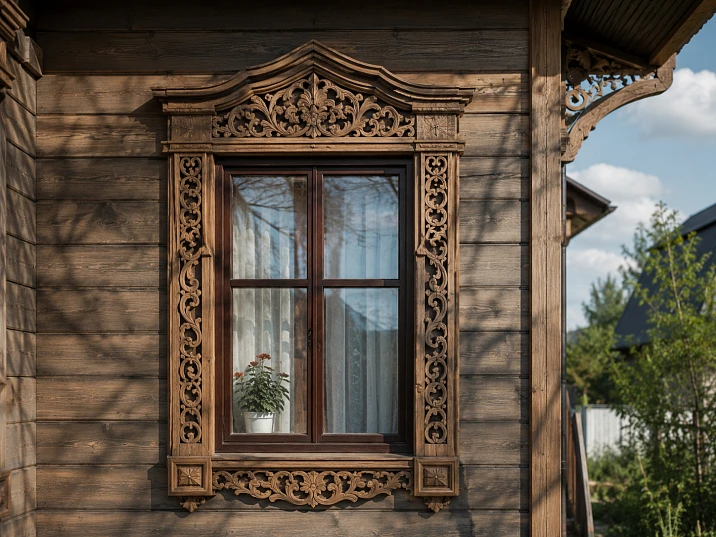
There are things that are immediately noticeable — and there are things whose absence is no less noticeable. Carved Door Casings for Windows belong to exactly this category: when they are present — the house looks complete, alive, with character. When they are absent — even a good facade seems bare, unfinished, as if an artist painted a picture but forgot the frame.
A platband is not just a strip covering the gap between the window frame and the wall. It is an architectural element, a decorative signal that tells more about the homeowner than it seems. A properly chosen carved wooden platband turns an ordinary window into a facade accent. A poorly chosen one creates visual chaos. In this article, we will break down everything: what types there are wooden window trims, how to choose the shape, pattern, and width, how not to overdo it with decor, and where to buy high-quality carved platbands for a wooden house, cottage, and modern facade.
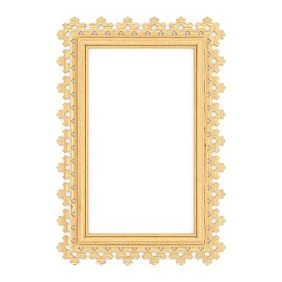
Why a window without a platband looks unfinished
Imagine the facade of a wooden house. Fresh boards, even walls, beautiful windows. And then you look at it—and something is off. Something is missing. The windows are there, the walls are there, the porch is beautiful—but the house still looks like a draft. Why?
Because a window in a wall is an opening. Architecturally, it is a hole, a break in the facade plane. And this break requires framing. Without framing, the opening looks like an unfinished thought: function exists, but image does not. The platband closes this break not only physically but also visually—it creates a transition between the wall and the window, adding depth, rhythm, and shadow.
Shadow is the key word. It is thanks to the relief of the platband that a play of light and shadow appears on the facade, bringing the wall plane to life. In the sun, the relief carved pattern creates a changing shadow design—and the house literally "breathes" depending on the time of day and the angle of lighting. A flat facade without a platband is completely devoid of this effect.
There is another point that is rarely discussed. The platband sets the scale of the window. A wide window frame visually enlarges the window, making it more stately. A narrow platband delicately hints at the window opening without drawing attention. This is an architectural tool, and it must be used consciously.




The platband as an element of facade rhythm
On a facade with several windows, platbands perform another important function—they create rhythm. Identical platbands on all windows of one floor set a horizontal or vertical rhythm, making the facade proportionate and harmonious. This is one of the basic principles of architectural composition: a repeating element creates order.
That is why House Carving — platbands, cornices, bargeboards, soffits—were traditionally executed in a single motif. Not because fashion demanded it, but because a unified ornamental language across the entire facade creates a sense of thoughtfulness and completeness.
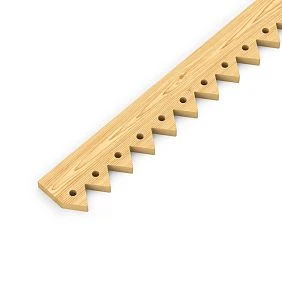
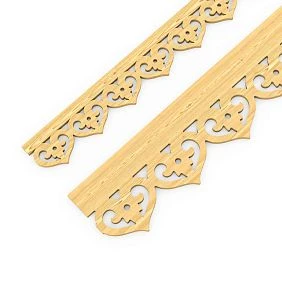
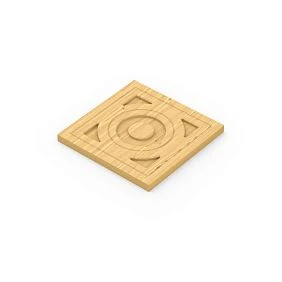
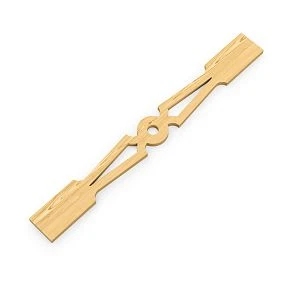
Our factory also produces:
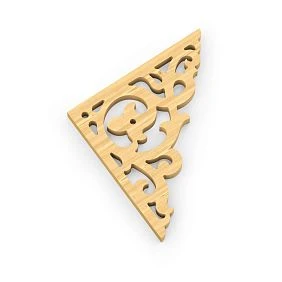
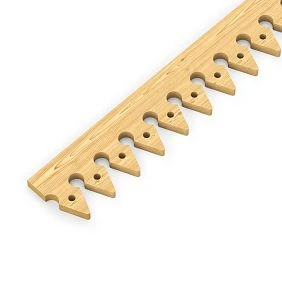
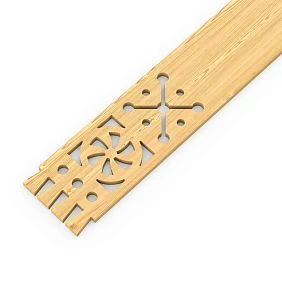
Carved architraves: not old-fashioned, but architectural
The word "carved" still evokes for many an image of a little house with lush lace carving — excessive, decorative, a bit museum-like. This is a stereotype that it's high time to get rid of.
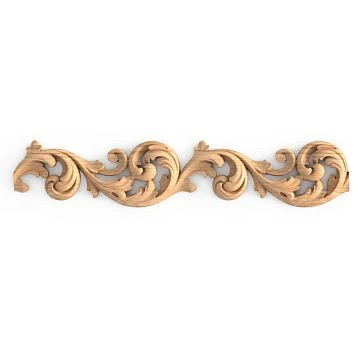
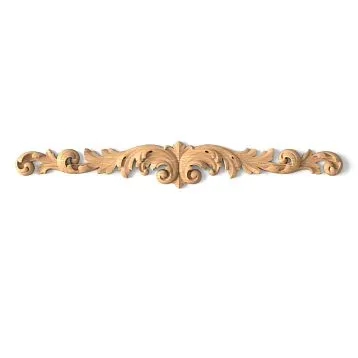
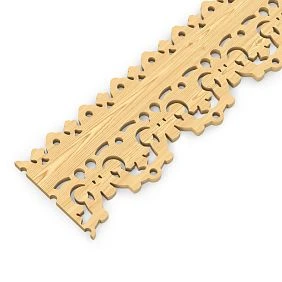
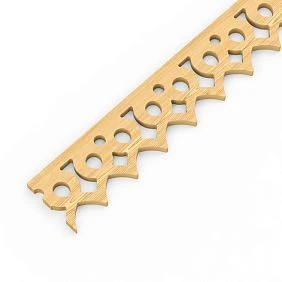
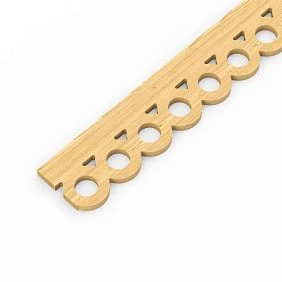
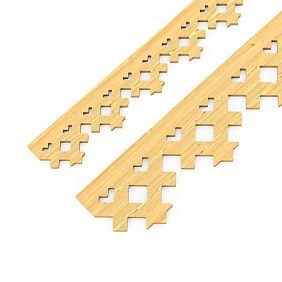
A carved architrave is not a style, it's a technique. Carving can be fine and delicate, like lace, or it can be strict and geometric — almost minimalist. It can replicate plant ornaments in the spirit of Russian folk tradition, or it can be a clear rhythmic pattern without a single curved line. It all depends on the chosen design.
A modern carved wooden architrave is quite appropriate on a facade made of planks or painted boards, on a timber house in Scandinavian style, on a country house with black windows and laconic architecture. The main thing is to correctly choose the degree of ornament saturation and correlate it with the character of the facade.
Here are several scenarios in which a carved architrave works completely differently:
-
Traditional wooden house — lush pattern with plant motifs, wide framing, active relief. The house looks richly Russian and self-sufficient.
-
Classic-style dacha — calmer design, moderate width, uniform color. The facade looks cozy and neat.
-
Timber or log house — the architrave emphasizes the naturalness of the material. Carving with natural motifs — leaves, waves, geometry — organically continues the wood theme.
-
Modern country house — laconic architrave with a simple geometric pattern. Carving is present but not loud.
-
Facade made of planks or painted boards — a carved wooden architrave adds warmth and texture, becoming a contrasting accent on the modern facade.
In all these cases, we are talking about the same product — a carved wooden window casing. The only difference is in the pattern, proportions, and execution style.
Get Consultation
House carving as a living tradition
House carving for home decoration — is a tradition that is several centuries old. Carved window casings, gable boards, valances, cornices — all of this historically was not just decor, but also a way to express the owner's wealth, skill, and character. Today, this tradition is experiencing a new revival: not as nostalgia, but as a conscious choice of people who want their home to look individual, not mass-produced.
About the rich history and modern interpretation of house carving in modern design you can learn more — this helps to understand which ornaments are appropriate in which context and how to properly adapt a traditional pattern to a modern facade.
Which window casings to choose for a wooden house
A wooden house is the most rewarding object for carved window casings. There is no material conflict here: wood on wood is organic, integral, and truthful. The question is different: how to choose casings that will work specifically on your facade?
Let's break down the key selection parameters.
Trim width: how to avoid mistakes with scale
Width is the first parameter to determine. A trim that is too narrow on a large facade will get lost. One that is too wide on a small window will feel oppressive, overloaded, and create a sense of heaviness.
A practical rule: the trim width should be between 1/8 and 1/6 of the window opening width. For a standard window 900–1200 mm wide, the optimal trim width is 80–150 mm. For wide windows from 1500 mm, the width can be increased to 180–200 mm.
It is also important to consider the floor height. The higher the ceilings and the larger the facade, the more substantial the window framing should be — otherwise, the trim will be perceived as a random overlay rather than an element of the architectural composition.
Height of the upper part: pediment or simple framing
The upper part of the trim is the detail that immediately catches the eye. It creates the 'crown' of the window and largely determines the character of the entire framing.
Upper part options:
-
Straight horizontal bar — minimalism, modern style, calm horizontal line.
-
Triangular pediment — classic, neoclassical, traditional Russian style.
-
Semicircular decorative element — Provencal, romantic, more feminine image.
-
Stepped frieze with carving — active decor, expressive architecture, tradition.
-
Flat with carved ornament — a universal solution that works in several styles.
For a wooden house in a traditional style, the top element with a pediment and carved ornament is a classic that never gets old. For a more modern house, a horizontal trim with a light relief pattern will suit.
Side elements and their role
The side parts of the trim are vertical planks that frame the window on the left and right. They can be flat, with a chamfer, with a relief pattern, or with through carved work. The side planks set the vertical rhythm — they visually stretch the window upward, giving it elegance.
Important point: side trims must be identical in pattern on all windows of the same facade. This is the law of facade composition. Even if the top elements differ in height due to different window levels — side planks with a unified ornament will maintain visual order.
Saturation of the pattern and facade color
window architraves for a wooden house must match the saturation of the facade. On a dark facade — made of tinted board, dark timber, or burnt wood — a light or contrasting trim works well: it stands out, creating a bright accent. On a light facade, it is important that the trim has sufficient relief — only then will it be readable through the play of shadows.
On a painted facade, you can use trims of the same color (for a calm, monolithic look) or a contrasting shade (for an active decorative effect). Both solutions are valid — the main thing is that the choice is deliberate.
Carved trim or simple wooden: which is better
This question arises for many. The answer, as usual, depends on the task.
Wooden casings Without carving — it's a neat, neutral framing. They cover the joint, create a clean line, and do not attract much attention. This is a good choice for a modern minimalist facade where the trim should be present but not dominate.
A carved trim works differently. It turns the window into a facade accent, adds decorative value, and tells a story. On the right facade, a carved wooden trim instantly raises the 'value' of the house in the eyes of passersby — not literally, but figuratively: the house looks richer, warmer, more individual.
Let's look at different options based on specific parameters:
| Casing Type | Decorative effect | Style | Installation Difficulty | Care |
|---|---|---|---|---|
| Simple wooden | Minimal | Modern, minimalism | Simple | Lightweight |
| Carved with openwork ornament | High | Traditional, country, dacha | Medium | Moderate |
| Wide with pediment | Very high | Classic, neoclassic | Medium | Moderate |
| Narrow with light relief | Moderate | Scandi, modern country | Simple | Lightweight |
| Carved with three-dimensional ornament | Maximum | Russian traditional | Complex | Requires painting |
The conclusion is simple: the more active you want to make the window decor, the richer the carving should be. The calmer and more modern the facade, the more laconic the framing should be.
Molded architraves: a convenient ready-made solution
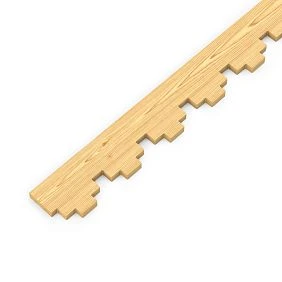
It is worth mentioning separately Pogonazh iz massiva as an option for those who want a neat wooden framing without complex carved decor. Molded architraves made of solid wood are profiled strips with a chamfer, fillet, or soft relief, sold by linear meters and convenient for installation. They are well suited for modern houses, for interior use, and for cases when you need to frame windows quickly, neatly, and without excessive decoration.
Architraves for a country house: how to make the facade cozier without a complete renovation
A country house is a special story. Expensive major facade repairs are rarely done here. But you want to make the country house cozy, warm, and 'your own' without large investments. And here, carved architraves turn out to be one of the most effective and affordable tools.
You don't need to repaint the entire facade. You don't need to change the windows or the cladding. It's enough to install new carved window casings — and the dacha is transformed. Especially if you add cornice decorative elements, gable boards, or a valance — details that complete the look.
Why does this work so well? Because the dacha facade is usually simple. Planks, clapboard, timber. There is texture, but no image. Carved casings instantly add depth to this image: they create a play of light, add pattern, and make the facade voluminous.
Which carving style to choose for a dacha
For a dacha in a traditional style — classic openwork carving with floral ornament. This is an eternal classic that is associated with summer, countryside, warmth. Such casings look good on dachas made of clapboard, logs, or timber.
For a dacha in a modern style — a calmer pattern with geometric elements or a simple profile casing made of solid wood. Here it is important not to overload the facade: one neat pattern repeated on all windows will give the desired effect without a feeling of excess.
For a dacha in Russian country style — a wide casing with an active pattern, a top gable element, possibly a color accent. Such a house immediately becomes "postcard-like" and memorable.
Window casing outside: technical aspect
Window casing outside performs not only a decorative but also a protective function: it covers the mounting seam between the frame and the wall, protecting it from moisture and drafts. This is especially important at a dacha, where the building often stands without constant heating and experiences seasonal temperature loads.
External window casings should be made of dense, properly dried wood and treated with protective compounds before installation. This is an important point that many forget, focusing solely on the decorative effect. Without proper treatment, a wooden casing outdoors will last significantly less than its potential lifespan.
Carved window frames and shutters: a ready-made composition for a window
Want to make a window truly expressive? Then think not about a single casing, but about a system. A full-fledged window composition is a casing + a top accent element + shutters or side decorative details. Such a system creates a self-sufficient architectural object on the facade, which reads as a complete work.
Carved shutters are a logical addition to carved window frames. They frame the window from the sides, creating a sense of a "room" around the window opening. Carved wooden shutters can be functional (open and close) or decorative — in either case, they radically change the look of the window.
Carved window decor — the top cornice element, the valance, the gable board — completes the composition from above. This is what in folk architecture was called a "towel" or "headpiece" — the top decorative accent that first catches the eye when looking at the house.
How to assemble window decor into a single system
Here is a practical scheme for assembling a window composition from individual elements:
-
Side casings — vertical planks on both sides of the window. The basis of the framing.
-
Top casing with a pediment or straight plank — a horizontal that unites the side elements and creates a "roof" for the framing.
-
Bottom window sill element — not always necessary, but adds completeness.
-
Decorative shutters — side accents that expand the window area on the facade.
-
Upper cornice decor — a frieze, valance, or carved element above the top casing.
All elements must be executed in a unified ornamental key — this is the main condition for a harmonious facade composition. In the catalog STAVROS house carving both individual elements and kits for complete window design are presented.
Read more about the systematic approach to wooden facade decor in the article about carved wooden elements and house carving — there it is detailed how different elements work together and which motifs are appropriate in which context.
How to choose a pattern so the facade does not look overloaded
Perhaps the most subtle question in the entire topic of carved casings is how to choose the degree of ornament saturation so that the facade looks rich but not flashy. The line between "beautiful" and "overdone" in folk architecture has always been a matter of intuition rather than precise calculation. But a few practical rules will help avoid mistakes.
Scale rule. The smaller the house, the more delicate the pattern should be. On a small country house of 40–60 sq.m., lush lace carving will look excessive. Here, a moderate pattern with clear contours is needed — one that is readable from a distance of 5–7 meters. On a spacious two-story house, on the contrary, a calm pattern will be lost — more relief and scale are needed.
Readability rule. Thread that is too fine, designed for close-up viewing, loses its meaning on a street facade. The pattern should be readable from the distance from which a person usually looks at the house — that is, from 5 to 15 meters. That is why good Carved Mouldings have a sufficiently large and clear ornament with good relief.
Unity rule. One ornamental motif should be used on one facade. Mixing different patterns on different windows is a gross mistake. Even if each trim is beautiful on its own, their incompatibility creates visual noise. Choose one motif — and consistently repeat it on all windows, adapting only the proportions.
Contrast rule. A light trim with an active pattern works well on a dark facade. On a light one, relief is important: without sufficient carving height, the ornament dissolves on a light background. If the facade is monochromatic and calm, the trim can be slightly more saturated — it will become an accent on a neutral background.
Dominance rule. There should be one main accent on the facade — as a rule, this is the entrance or the central window. This is where the most active decor can be allowed. The remaining windows are designed more calmly, supporting the overall rhythm but not competing with the main accent.
Ornamental motifs: what to choose
Wood carving knows several classical ornamental groups:
-
Plant motifs — leaves, flowers, branches, shoots. Warm, lively, organic. Well suited for a dacha, a traditional wooden house, country style.
-
Geometric motifs — diamonds, squares, triangles, stars, waves. Strict, clear, modern. Work in minimalist and modern country style.
-
Combined motifs — a combination of plant ornament with a geometric frame. A universal option for most wooden houses.
-
Folk symbolic motifs — solar signs, protective patterns, traditional geometric symbols. Relevant for houses in Russian style with a pronounced cultural message.
What wood to choose for window trims: material matters
A carved window trim is a product for outdoor use. This means that special requirements are placed on the material and its processing: resistance to moisture, temperature changes, ultraviolet radiation, and biological damage (fungus, insects).
The best wood species for outdoor wooden window trims are conifers: pine and spruce. They are easy to carve, have sufficient density for relief ornamentation, are relatively affordable, and absorb protective compounds well. Larch is an even more reliable option: it has high natural resistance to moisture, practically does not rot, and lasts for decades without significant maintenance.
Oak and beech are excellent species for interior wooden products, but for outdoor use they require careful preparation: high-quality drying, impregnation, and painting. Solid Wood Items STAVROS products are made from properly dried wood, which is a fundamental condition for product stability — especially for outdoor use.
Treatment of wooden window trims for outdoor use
The issue of treatment is an issue of durability. An untreated wooden window trim outdoors will start to turn gray after just one season, and after two to three years it will crack, begin to mold, and lose its decorative appearance.
What needs to be done before or after installation:
-
Antiseptic impregnation — protects against fungus and wood blue stain. Applied first.
-
Primer — creates an adhesive layer for paint and additionally protects against moisture.
-
Facade paint or glaze — the finishing layer. High-quality facade paint lasts 5–7 years without repainting when applied correctly.
It is important to treat not only the front surface, but also the ends, the back side, and all carved elements — that is where moisture accumulates most quickly. The ends are especially vulnerable: the wood fibers are cut crosswise, and moisture is absorbed there many times more intensely.
If you bought wooden trim without coating — it is recommended to treat it before installation, when all surfaces are accessible. After installation, treating the ends and joints is significantly more difficult.
Mistakes in choosing and installing trim
Practice shows: most disappointments with carved trim are related not to poor product quality, but to incorrect decisions made at the selection stage. Here are the most common mistakes.
Trim that is too narrow for a large facade. A narrow strip on a large window gets lost, looks awkward, and does not create the necessary accent. Maintain the proportion: the width of the framing should match the scale of the window opening and the height of the floor.
Carving that is too fine. A delicate, elegant ornament that looks beautiful in hand or in close-up photos turns into barely noticeable texture from a distance of five meters. For outdoor use, a pattern with sufficient relief and enlarged elements is needed.
Different styles on adjacent windows. This is the main mistake that ruins the facade composition. Different patterns, different widths, different styles — all of this creates chaos instead of harmony. Choose one trim and use it on all windows of the same facade.
No top accent element. Side planks without an expressive top part are an incomplete composition. This is especially noticeable on wooden house facades: without a top accent, the trim looks like just a closed seam, rather than a window frame.
The trim does not match the shutters. If you plan to add shutters, the ornament on the trim and shutters must be coordinated. Different patterns will create a visual conflict right in the center of the facade composition.
You chose a pattern but did not consider the window proportions. A narrow tall window and a wide horizontal window require different approaches to framing. On a vertical window, more elongated side elements work well. On a horizontal window, a horizontal dominant is important.
Forgot about treatment before installation. This point cannot be skipped under any circumstances. Even the highest quality solid wood without protective coating outdoors will last significantly less than it should.
Wrong choice of fasteners. For outdoor use, galvanized fasteners resistant to corrosion are needed. Regular screws rust under the paint, leaving dark streaks on the trim.
Installation without a gap. The trim cannot be installed flush against the wall without a ventilation gap. Without a gap, moisture will accumulate behind the trim and destroy the wood from the inside — where it is not visible.
Additional decorative elements: how to complete the facade look
Trims are the most important, but not the only element of wooden facade decor. A complete look is composed of several layers of decor, each working towards the overall idea.
Wooden cornices and moldings — these are horizontal profiled elements that divide the facade plane into zones, create shadows, and add architectural complexity. A cornice above the window, a cornice under the roof overhang, a molding between floors — each of these elements works as an architectural accent and simultaneously diverts water from the wall.
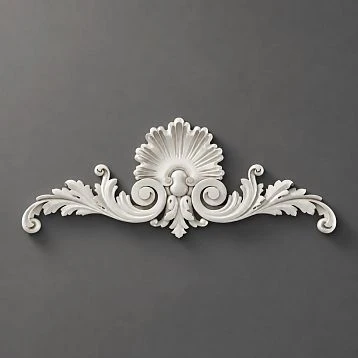
Carved wooden decoration — overlay elements that are attached to the wall plane, the pediment, the space between windows. These can be rosettes, pilasters, decorative overlays with ornament — elements that add relief where there is none.
Pricheliny and podzory are elements that decorate the pediment and roof overhangs. In folk architecture, it was the podzor under the cornice that gave the house that very "lace" image that became a symbol of Russian wooden architecture.
How to properly combine decorative elements
The main principle is a unified ornamental language. Window casings, cornices, pricheliny, and podzory should use the same motif or at least a unified system of proportions. Then the facade is perceived as a cohesive work, not as a set of random details.
The second principle is hierarchy of decor. Not all elements should be equally active. Choose one point of maximum saturation — for example, the main front window or entrance — and make the decor there the richest. Let the other elements be a bit calmer. This creates a visual hierarchy and makes the facade readable.
The third principle is conformity to architecture. The decor should support the character of the house, not contradict it. On a strict modern house made of timber with a flat roof, lavish folk carving will look like a contradiction. Here, a geometric or very restrained ornament is needed. On a house with a high roof, veranda, and wooden columns — on the contrary, a rich floral pattern will be absolutely appropriate.
Carved window casings in different styles of wooden construction
Wooden construction today is not one style, but a whole spectrum of directions. And for each of them, there is its own type of window casing.
Russian traditional style
High pediments, rich floral ornament, wide framing, active carving. This is a style in which House Carving sounds in full force. Window casings are wide, with a triangular pediment, with cut-out or relief patterns. Shutters are wooden carved. The cornice has a podzor. This is an image that is immediately read as a "real Russian wooden house."
Scandinavian style
Clean lines, calm geometry, moderate decor. The architraves are straight, without a pediment, with a soft profile relief. The color is often white or light gray contrasting with a dark facade. Carving is present, but in a very restrained form — more of a hint than an accent.
Country and Provence
Warm shades, soft shapes, slight aging. The architraves are of moderate width, with a light floral ornament or soft profile. A combination of architraves and carved shutters in a single style works well. Buy window trims for a country dacha — means choosing something warm, slightly romantic, with a light village feel.
Modern country house
Strict geometry, contrasting colors, flat or low-slope roof. For such a house, a wooden architrave is a deliberate "living note" against the background of modern materials. The shape is simple, almost profile-like. The carving is geometric, minimalist. The main thing is the quality of execution and combination with other facade materials.
Where to buy carved architraves for a wooden house
If you are looking for where to buy carved window architraves with a guarantee of material and workmanship quality — STAVROS offers a catalog of wooden house carvings for facades of any style and scale.
The company STAVROS specializes in the production of solid wood for furniture, interiors, and facade decor. The catalog includes:
-
House carving and carved window architraves — for a wooden house, dacha, facades made of timber and logs;
-
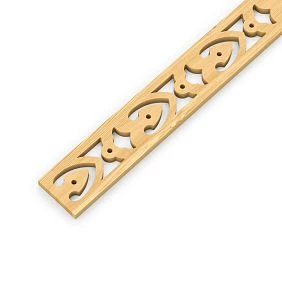
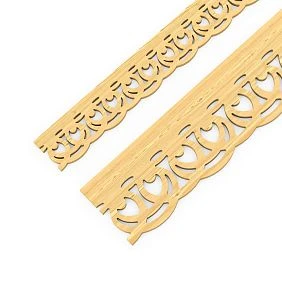
Wooden architraves and moldings — linear and shaped elements for framing windows and doors;
-
wooden cornices and moldings — horizontal profiled elements for facade architecture;
-
Carved wooden decoration — applied decorative elements for facade and interior;
-
Pogonazh iz massiva — additional and finishing profiles for interior and exterior finishing.
Shipment — from one piece. This means you can buy a carved window architrave for a single window of a country house or for a large-scale project of a private house with 20 windows. Delivery is carried out in St. Petersburg and throughout Russia.
All Solid Wood Items STAVROS products are made from properly dried wood in compliance with strict production conditions. This is fundamentally important for facade products: unstable, poorly dried lumber inevitably deforms when used outdoors — warps, cracks, loses shape. High-quality drying and proper material preparation are what ensure the long service life of architraves outdoors.
STAVROS is a Russian manufacturer with a wide range of wooden products, its own production, and a clear understanding of what proper wooden decor should look like. Over 4,000 models, two quality levels — Standard and Prestige, a custom order system, and a real warehouse in St. Petersburg. Here you can choose architraves, shutters, cornices, and all elements of house carving in a unified style — and get a facade that looks like a single architectural statement, not a collection of random details.
Buy carved wooden architraves — means taking a step from a faceless window to a window with character. This is not an exaggeration. This is simply architecture.
FAQ: answers to popular questions about carved window trims
Which window trims are best for a wooden house?
For a wooden house, the most organic are wooden window trims made of solid wood, matching the facade in texture and tone. The width, shape of the top part, and richness of carving should correspond to the scale of the house and its architectural style.
How do carved window trims differ from regular wooden ones?
A regular wooden trim is a profiled strip that neatly covers the installation seam. A carved trim additionally serves a decorative function: it creates a facade accent, adds relief and play of shadows, making the window an expressive architectural element.
Can carved window trims be installed on a modern house?
Yes, if you choose the right pattern. For a modern house, trims with geometric ornament or simple profiled relief are suitable — without excessive opulence. Buying a carved window trim for a modern facade means finding a balance between decor and minimalism.
Are shutters needed for carved window casings?
Not necessary, but desirable. Shutters turn a separate casing into a full window composition, adding depth and expressiveness. Especially relevant for a dacha and a traditional wooden house.
Where to buy wooden window casings in Saint Petersburg?
In the STAVROS catalog you can Buy window trims made of solid wood with delivery across St. Petersburg and Russia. Wide selection of shapes and sizes, shipment from one item.
Do wooden casings need to be treated before outdoor installation?
Absolutely. Antiseptic impregnation, primer, and facade paint or glaze are the necessary minimum for outdoor use. It is better to carry out treatment before installation, when all surfaces, including ends and the back side, are accessible.
How to choose the width of the casing?
Focus on the scale of the window opening: the width of the casing should be 1/8–1/6 of the window width. For a standard window of 900–1200 mm, the optimal width is 80–150 mm.
Can different casings be used on different windows?
Not recommended. A single ornament and a single width on all windows of one facade is the main rule of a harmonious facade composition. Differences are only allowed in proportions due to different window sizes, but not in the pattern.
What is house carving and how does it relate to window casings?
House Carving — is a broad concept that includes all wooden decorative elements on the house facade: window casings, gable boards, eaves, cornices, shutters. Window casings are part of this system, its most visible and functionally important element.
What to combine with carved window casings on the facade?
For a complete facade composition, carved window casings should be complemented with Wooden cornices and moldings, and if desired, carved shutters and decorative overlay elements made of carved decor elements. The main condition is a unified ornamental motif across the entire facade.