Article Contents:
- Folk Carving: History, Symbolism, Soul of the Russian House
- Soviet Period
- Golden age of house carving
- Decline and Revival
- Symbolism of Folk Carving
- Elements of Folk Carving
- Types of Wood Carving
- Flat Relief Carving
- Deep (Relief) Carving
- Through (Openwork, Pierced, Cut) Carving
- Three-Dimensional (Sculptural) Carving
- Contour Carving
- Geometric Carving (Triangular Hollow)
- Modern Decorative Appliqués: Carving in Interior Design
- Application of carved appliqués
- Motifs of Carved Appliqués
- Wood Species for Carving
- Technologies for Manufacturing Carved Elements
- Carving in Different Interior Styles
- Classicism and Baroque
- Russian Style, Rustic
- Provence and Country Style
- Modern (Art Nouveau)
- Minimalism and modernity
- Installation of Carved Elements
- Care for Carved Elements
- Where to Order Carved Elements
- Wood Carving Workshops
- Manufacturers of Decorative Elements
- Restoration workshops
- Conclusion: Carving — Living Art

Step into an old wooden house somewhere in the Russian countryside. Windows don't just look out at the street as simple glass rectangles. Each window is framed by carved casings — sun rosettes at the top, plant patterns on the sides, protective symbols at the bottom. Carving turns a window into a work of art, a portal between the inner world of the house and the outer world. Every swirl, every leaf, every bird is hand-carved, with soul, with craftsmanship passed down from generation to generation.
Now step into a modern apartment with a classic interior. Doors made of solid oak, parquet, ceiling moldings. And on the doors, on the furniture, on the fireplace mantel —Carved Elementsmade of wood. Acanthus leaves, grapevines, rosettes. They add volume, expressiveness, artistic value. Carving turns standard furniture into unique pieces, a generic interior — into an original design.
Wood carving is the oldest art, tested over millennia. From Slavic folk carving with its powerful symbolism to exquisite Baroque appliqués in palace interiors, from rustic elements to delicate iconostasis carving — carving creates beauty, carries meaning, preserves traditions.
This article is a professional guide to the world of wooden carved elements from a specialist with fifty years of experience in carving, restoration of historical buildings, and traditional crafts. We will delve into the history of folk carving and its symbolism, examine types of carving from flat relief to through carving, discuss modern decorative appliqués, show how ancient traditions live on in modern interiors, and explain technologies from hand carving to CNC.
Ready to learn how wood becomes art? Let's begin our journey into the world of carving.


Folk Carving: History, Symbolism, Soul of the Russian House
Folk carving is a method of decorating wooden houses by carving ornaments, symbols, and figures onto external elements (window casings, eaves, gables, shutters, porches).




Origins of the Tradition
The tradition of decorating houses with carving on Rus' emerged in the 10th-11th centuries. It was adopted from the Varangians (Scandinavian seafarers), who decorated ships, houses, household items with carving. However, Slavs reinterpreted carving, filling it with their own symbolism associated with pagan beliefs, nature worship, sun, and fertility.
Initially, carving carried less of a decorative and more of a sacred character. It protected the house from evil spirits, attracted benevolent forces, and ensured family prosperity. Each element of carving carried meaning and was part of a system of protective symbols.
With the adoption of Christianity (988 AD), pagan symbolism did not disappear — it transformed, intertwined with Christian motifs, creating a unique synthesis. Solar rosettes came to be associated with divine light, plant patterns with the Tree of Life, and protective symbols adapted to the new faith.
Our factory also produces:


Golden age of house carving
The golden age of house carving fell in the 19th century, especially its second half. This was a period of economic growth, development of wooden architecture, and spread of saws, chisels, and other tools. Carving became a mass phenomenon — almost every house in towns and villages was adorned with carved lintels, cornices, and gables.
Carvers passed down their craft from generation to generation; each region developed its own style and distinctive motifs. Northern carving (Arkhangelsk, Vologda regions) — large, powerful, geometric, with solar symbols. Volga region (Nizhny Novgorod, Gorodets) — elegant, plant-based, multicolored. Siberian carving — eclectic, combining Slavic, Turkic, and Chinese motifs.
By the beginning of the 20th century, house carving had reached incredible diversity — thousands of unique ornaments, forms, compositions. Each house was a work of art, each lintel a painting.
Get Consultation
Decline and Revival
The 20th century became a period of decline for house carving. The 1917 Revolution, industrialization, standardization of construction, transition to stone and concrete houses — all this led to the disappearance of the tradition. Wooden houses were torn down, carved elements destroyed as 'remnants of the past,' master carvers lost their jobs, and the craft was not passed on to youth.
By the end of the 20th century, house carving survived only in museums, on individual historic buildings, and among a few enthusiasts.
But since the 1990s, revival began. Growing interest in traditions, national culture, wooden architecture, and the emergence of suburban cottages — all this revived demand for carving. Masters began restoring old techniques, studying historical samples, and creating new elements in traditional style.
Today, house carving is experiencing a new flourishing. Owners of wooden houses order carved lintels, cornices, gables — either according to historical models or with modern interpretations. Carving transforms a standard house into a unique one, with character, soul, and roots.
House carving symbolism
House carving is not just beautiful patterns. It is a whole system of symbols, protective charms, codes.
Solar symbols: the most common. The sun — source of life, light, warmth, fertility. Solar symbols — rosettes (circles with rays radiating from the center), kolovraty (swastikas, the oldest Slavic symbol of moving sun), spirals (symbol of eternal motion, cyclicity). Solar rosettes were placed at the top of lintels (above the window — the sun rises, illuminating the house), on gables (the apex of the house — the point closest to the sky, to the sun).
Plant motifs: symbols of life, growth, fertility, connection with nature. Leaves (especially grape, oak, acanthus), flowers (roses, lilies, daisies), fruits (apples, grape clusters, acorns), stylized trees (Tree of Life — the world tree connecting the underworld, earthly realm, and heavenly realm). Plant motifs were placed on the sides of lintels, on cornices, creating a sense of abundance and vital energy.
Animals and birds: protectors, mediators between worlds. Birds (especially roosters, peacocks, swans) — symbols of ancestral spirits protecting the house, heralds of dawn and sun. Lions, griffins — protectors against evil. Snakes, dragons — ambivalent symbols (can be protectors or threats — in carving they were usually depicted as tamed, controlled). Horse — symbol of strength, movement, sun.
Geometric patterns: the oldest, pre-Christian. Rhombuses (field sown with grain — symbol of fertility, earthly abundance; often with dots inside — seeds), triangles (mountains, arrows, fire — protective symbols), zigzags (water, lightning, boundary between worlds), circles (sun, eternity, cyclicity), crosses (intersection, protection, later — Christian symbol).
Anthropomorphic figures: human figures, faces. Often stylized, schematic. Depicted deities, spirits, ancestors. Placed at key points — above the entrance (protection of the house), on gables (householder, head of the family). Berdiny (female figures with raised hands — goddesses of fertility, mothers, protectresses).
Placement of symbols on the house:
-
Roof, ridge, gable: highest point, closer to the sky — solar symbols (solar rosettes, horses), protective symbols (birds, berdiny).
-
Window lintels: window — boundary between inner and outer worlds, vulnerable spot — strong protective symbolism (solar rosettes at the top, plant patterns on the sides, protective geometric ornaments at the bottom).
-
Door, porch: entrance to the house — main point of penetration — maximum protection (threshold decorated with carved symbols, door framed by carved lintels, above the door — a carved overhang).
-
Cornices: boundary between wall and roof, between earth and sky — plant motifs, symbols of fertility and abundance.
Elements of house carving
Lintels: window framing. The most noticeable, most decorated element. Composed of several parts:
-
Ochel'ye (kokoshnik): upper part crowning the window. Often has a complex shape (semicircular, triangular, multi-tiered), decorated with rich openwork carving (solar rosettes, plant patterns, birds).
-
Side stiles (vertical lintels): frame the window on the sides. Decorated with flat relief or solid carving (plant motifs, geometric ornaments).
-
Sill board: lower part. Often with simple carved ornament or without it.
Gables: triangular part of the wall under a gable roof. Decorated with carved boards with openwork carving — solar symbols, plant patterns, anthropomorphic figures.
Cornices, subcornices: boards running along the edge of the roof, under the cornice. Decorated with carving — plant motifs, geometric ornaments, creating rhythmic patterns.
Chimneys, boards: boards covering the ends of logs on the gable. Decorated with carving — protective symbols, plant motifs.
Veranda, posts: veranda — the formal entrance to the house. Posts supporting the veranda awning were decorated with relief carving — twisted columns, carved capitals, plant motifs, figures.
Shutters: carved shutters with pierced carving — functionality (protection from sun and cold) and decorative appeal.
Types of wood carving
Flat relief carving
The pattern protrudes 3–10 mm above the background, creating a low relief. The background remains flat (or slightly recessed), the pattern protrudes.
Technique: first, the pattern outline is drawn on the wood, then the background around the pattern is recessed with chisels, the pattern remains at the original level or is slightly modeled (volumes and smooth transitions are created). The surface of the pattern is processed (edges are rounded, details — leaf veins, flower petals — are created).
Where it is applied: furniture (cabinet, chest, bed facades), door casings, wall panels, iconostases. Classic carving type for interiors.
Advantages: moderate labor intensity (easier than deep relief carving), visual expressiveness (play of light and shadow on the relief), versatility (suitable for any style from classic to modern).
Solid (relief) carving
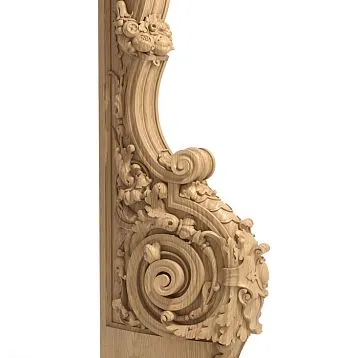
The pattern protrudes 10–30 mm and more above the background, creating a deep, expressive, volumetric relief. The background is deeply recessed (selected), the pattern is maximally volumetric, sometimes almost detaching from the background.
Technique: the background is selected with chisels to significant depth, the pattern is modeled in detail — volumes, curves, numerous small elements (leaves with veins, flowers with stamens, figures with detailed faces, fabric folds) are created. Requires high skill, patience, and time.
Where it is applied: Russian domestic carving (casings, gables), church carving (iconostases, royal doors, altars), luxurious furniture (baroque, rococo), fireplace portals, monumental panels.
Advantages: maximum expressiveness, depth, volume, artistic value.
Disadvantages: very labor-intensive (carving a panel 50×70 cm takes 20–50 hours of master’s work), expensive, requires soft wood (lime, aspen — hard oak is difficult for deep carving).
Through (openwork, pierced, cut) carving
The pattern is cut through, there is no background, creating a wooden lace effect. Works through — through the holes, the wall, sky, or other background is visible.
Technique: the pattern outline is drawn, then the inner parts (background) are cut out with a hand or electric jigsaw or on a machine, leaving only the pattern — fine line interweavings, swirls, leaves, flowers. The edges of the holes are processed (sanded, rounded).
Where it is applied: domestic carving (casings, window sills, gables — the most characteristic type for domestic carving), shutters, decorative panels, screens, partitions.
Subtypes:
-
Simple through: the pattern is cut through, flat (board thickness 15–30 mm), without relief. Most common, relatively easy to manufacture.
-
Through with relief (overlay carving): the through pattern is additionally modeled — volumes and relief are created on the pattern elements. More complex, expressive.
Advantages: visual lightness, airiness, play of light and shadow (sunlight passes through the holes, creating patterns on the wall, floor), decorative appeal.
Disadvantages: lesser strength (thin elements may break under impact), requires protection from moisture (water enters the ends of holes, may cause rot), labor-intensive (many small holes need to be cut).
Three-dimensional (sculptural) carving
Creation of three-dimensional figures — animals, birds, people, mythological creatures. Carving from all sides, the figure is fully volumetric.
Technique: from a wooden block, the figure is gradually carved out — first rough shaping (with an axe or saw), then detailing with chisels, knives, gouges, final refinement of small details, sanding.
Where it is applied: interior sculptures (figures on fireplaces, shelves, pedestals), furniture elements (carved table legs in the shape of lion paws, carved armrests of chairs in the shape of animal heads), facade elements (carved veranda posts, figures on gables), church utensils (crucifixes, icons with volumetric elements).
Advantages: maximum volume, realism, sculptural expressiveness.
Disadvantages: most complex, requires the highest level of skill (the carver must be a sculptor), very labor-intensive, expensive.
Relief carving
The pattern is created by fine grooves cut into wood to a depth of 2-5 millimeters. Similar to engraving.
Technique: the pattern outline is drawn, then lines are cut with a chisel or gouge — creating leaf, flower, and figure outlines. Lines can be thin or wide, shallow or deep, depending on the design intent.
Where it is applied: decorative panels, boxes, cutting boards, furniture (simple decoration on Scandinavian and Northern style furniture), utilitarian items.
Advantages: simplicity (relatively easy to learn), speed, ability to create graphic, clear patterns.
Disadvantages: limited expressiveness (no volume, only lines), less decorative than relief or through-carving.
Geometric carving (three-sided recessed)
The pattern consists of geometric elements — triangles, rhombuses, squares, circles — cut into wood. Each element is a three-sided recess (a pyramid-shaped cut with the apex pointing inward into the wood).
Technique: using a special chisel or gouge, three-sided recesses are cut, which, when assembled into a composition, create a pattern — rhombuses, stars, rosettes, complex geometric ornaments.
Where it is applied: folk carving (household carving in northern regions, furniture, utensils), modern decorative carving (boxes, frames, panels).
Advantages: graphic quality, rhythmic composition, play of light and shadow (the facets of recesses are illuminated differently, creating sparkle and shimmer), ancient traditionalism (the most archaic type of carving).
Modern decorative appliqués: carving in interior design
Decorative carved appliqués — wooden elements with carving, attached to furniture, doors, walls, fireplaces for decoration and style creation.
Application of Carved Appliqués
Furniture: appliqués on cabinet, chest, buffet, and bed fronts transform standard furniture into unique, luxurious, stylistically expressive pieces. Carved rosettes, floral patterns, scrolls, cartouches add volume, depth, and artistic value.
Doors: carved appliqués on door panels and above doors (pediments, friezes) create grandeur and monumentality. Characteristic of classical, baroque, and neoclassical interiors.
Fireplaces: carved appliqués, columns, and brackets framing the fireplace opening create a focal point in the living room, adding luxury and tradition.
Walls: carved panels on walls — works of art, accents. Can depict floral compositions, narrative scenes, coats of arms, monograms.
Furniture elements: carved legs of tables and chairs, carved armrests, carved bed backs with carving — elements that define the character of furniture.
Motifs of carved appliqués
Classical botanical: acanthus leaves (the most common motif in classical carving — lush curved acanthus leaves), grapevines with leaves and clusters, roses and other flowers, oak leaves with acorns, laurel wreaths, olive branches.
Baroque and rocaille: lush asymmetrical compositions with angels, putti (baby angels), shells (rocaille — from French rocaille, shell), scrolls, volutes, cartouches (heraldic shields, inscriptions).
Geometric: rosettes (circular symmetric patterns), meanders (continuous geometric ornament made of broken lines), braids (imitation of weaving), rhombuses, stars.
Narrative: scenes from mythology, biblical themes, historical events, portraits, coats of arms, emblems.
Animalistic: lions (symbol of strength, power), eagles (symbol of greatness, freedom), griffins, chimerae, birds, fish.
Wood Species for Carving
Linden: soft deciduous wood, ideal for carving. Easily cut (minimal resistance to tools), does not splinter, does not crack, allows creation of delicate details — filigree leaves, petals with veins, hair, fabric folds. Color is light cream, texture is fine and uniform (does not distract from carving). Traditionally used for church carving, iconostases, carved moldings. Disadvantages — softness (not suitable for load-bearing elements — furniture legs, handles), requires protection from moisture and insects. Price is medium (carved appliqué from linden 20×30 cm — 1500-4000 rubles depending on carving complexity).
Oak: hard durable wood (density 700 kg/m³), expressive texture. Harder to carve than linden (requires more effort, sharp tools), but allows creation of strong, long-lasting elements. Thin details (thin leaves, delicate elements) on oak may splinter — oak is better suited for large relief elements, three-dimensional carving. Color ranges from light to dark brown (depending on staining), texture is vivid (may compete with carving for attention — must be considered). Suitable for elite interiors where longevity and prestige are important. Price is high (carved appliqué from oak 20×30 cm — 3000-8000 rubles).
Beech: medium hardness (density 650 kg/m³), fine uniform texture, pinkish color. Easily cut, holds details better than linden, stronger. Texture is calm, does not distract from carving. Often stained or painted (uniform structure ensures even coloring). Price is medium (carved appliqué from beech 20×30 cm — 2000-5000 rubles).
Pear, apple: fruit woods, dense, fine-grained, easily cut, hold the finest details. Traditionally used for miniature carving, carved boxes, utensils. Color is pinkish (pear), yellowish (apple). Availability is limited (trees are small and expensive), price is high.
Pear, apple: fruit tree species, dense, fine-grained, cut well, retain fine details. Traditionally used for miniature carving, carved boxes, utensils. Color pinkish (pear), yellowish (apple). Availability limited (trees small, expensive), price high.
Technologies for manufacturing carved elements
Hand carving: traditional method. The master carver manually cuts the pattern into wood using chisels, knives, gouges. Allows creation of unique elements, high-quality artistic carving, each master’s distinctive style is visible in the work. Disadvantages — very labor-intensive (carving a panel 50×70 cm — 30-80 hours of master’s work), expensive (carving is paid by the hour — 1000-3000 rubles/hour depending on the carver’s skill), slow (production time 2-8 weeks), each element is unique (impossible to create two absolutely identical parts).
CNC Carving: Modern Method. The computer model of the pattern is loaded into the CNC machine, and the milling cutter carves the pattern into wood according to the program. Allows creating highly complex patterns with perfect accuracy (tolerance 0.1 mm), quickly (a panel 50×70 cm — 1-3 hours of machine operation), reproducibly (can create hundreds of identical elements), 40-70% cheaper than hand carving. Minus — no individual style (all elements of one model are identical), some mechanical nature (the machine cuts perfectly straight — sometimes one desires the liveliness of handwork), technological limitations (very small details, recesses, some complex shapes the machine cannot carve).
Combined Method: Optimal for mass production of quality carving. The basic relief is carved on a CNC machine (fast, accurate, cheap), then the master carver manually refines the details — adds small elements, smooths transitions, creates liveliness and individual style. Results in quality close to hand carving at a price 30-50% lower. Production time is average (basic carving on machine — 1-3 hours, manual finishing — 5-15 hours).
Carving in Different Interior Styles
Classical and Baroque
Classical styles value carving as the main decorative element of furniture and interiors.
Carving Characteristics: Flat relief or deep relief; plant motifs (acanthus leaves, grapevines, roses, laurel wreaths); symmetrical compositions; from noble woods (oak, walnut, beech); with natural finish (lacquer, highlighting wood texture) or patination (gold, silver on raised relief).
Baroque: Maximum opulence, decorative richness. Deep relief carving with angels, putti, shells, scrolls, asymmetrical compositions. Often gilded or patinated. Furniture, fireplace surrounds, panels overloaded with carving — this is a characteristic feature of Baroque.
Applications: Furniture facades (cabinets, chests, buffets) entirely covered with carving; door surrounds with carved casings, pediments; fireplace surrounds with columns, brackets, appliqués; carved frames for mirrors, paintings; carved cornices, moldings.
Russian Style, Rustic
Based on traditions of domestic carving, folk art.
Carving Characteristics: Openwork (lattice) or solid relief; solar symbols (sun rosettes, sunbursts), plant motifs (stylized flowers, leaves, grapevines), geometric ornaments (rhombuses, triangles, zigzags), anthropomorphic and zoomorphic figures (berdiny, birds, horses); bright multi-colored painting (red, green, blue, yellow) or natural wood with toning.
Applications: Facade carving (window casings, pediments, cornices, porches) on wooden houses; interior carving (panels with Russian motifs, carved door casings in Russian style, carved furniture — tables, benches, cabinets).
Provence and country
Rural styles with moderate decoration, aged appearance.
Carving Characteristics: Flat relief, shallow; plant motifs (flowers, leaves, simple without excessive detail); white or pastel paint with aging effect (scratches, patina, wood showing through in places); simple forms, no fussiness.
Applications: Light carving on furniture facades (not full coverage, but accent — in the center of doors, at corners); carved furniture handles; carved frames for mirrors, paintings; decorative panels with floral motifs.
Modern (Art Nouveau)
Style of the transition between the 19th and 20th centuries with smooth curved lines, asymmetry, plant motifs.
Carving Characteristics: Flat or three-dimensional relief; smooth curved lines (no sharp angles, abrupt transitions); stylized plants (lilies, irises, vines, long-stemmed seaweed); asymmetrical compositions; female figures with long hair, flowing garments.
Applications: Carved furniture (bed backs, chairs with smooth lines, carved plant motifs); carved doors with stained glass inserts, carved casings; carved panels, mirror frames.
Minimalism and modernity
Modern styles usually avoid carving (value simplicity, minimalism). But sometimes a single carved element becomes the only decorative accent in a neutral space.
Carving Characteristics: Simple geometric or abstract; shallow flat or contour relief; neutral colors (white, black, gray) or natural wood; minimalist forms.
Applications: A single carved panel on a wall as an art object; a carved appliqué on a door (simple geometric pattern); a carved element on furniture (accent detail).
Installation of Carved Elements
On Adhesive: Main method for light appliqués. Use construction-grade PVA D3-D4 (water-resistant) or polyurethane glue. Apply glue to the back of the appliqué, press it onto the surface, secure with painter’s tape or weight for 12-24 hours. Wipe off excess glue immediately with a damp cloth.
On Nails: For heavy elements. Use finish nails (small heads) 30-50 mm long. Nail into inconspicuous areas (relief recesses, back of elements), flatten and mask with putty or wax pencil.
Combined (Adhesive + Nails): Maximum reliability for large heavy elements.
Care for Carved Elements
Cleaning: Once a month, wipe with a dry soft brush (toothbrush for small details), removing dust from carving recesses. Every 3-6 months — with slightly damp cloth.
Protection: Carved elements require protective coating (lacquer, oil, wax) — protection against moisture, dirt, insects. Reapply coating every 5-10 years (lacquer) or 3-5 years (oil).
Repair: Chips, cracks — fill with wood putty, sand, repaint. Broken elements — reattach with wood glue, secure until dry.
Where to Order Carved Elements
Wood carving workshops
For unique hand-carved elements — contact woodcarvers. Find workshops online (search for "wood carving on order", "woodcarver"). Review portfolios and reviews. Discuss the sketch, wood species, dimensions, deadlines, and price. Custom production, 2–8 weeks, price 1500–5000+ RUB per 20×30 cm element (depends on carving complexity, wood type, carver’s skill).
Manufacturers of decorative elements
For mass-produced carved inserts and standard models — contact manufacturers of decorative elements. Wide selection of ready-made models, prices 30–50% lower than individual artisans, shorter production time (1–3 weeks or available in stock).
Restoration workshops
For restoring historical carved elements and recreating lost carvings — contact restoration workshops. Specialists will study historical analogs, recreate the carving exactly according to the sample, using traditional techniques and materials.
Conclusion: carving — living art
Wood carving — the oldest art, yet living, evolving, and relevant. From symbolic house carvings protecting our ancestors’ homes to exquisite baroque inserts in palace interiors, from rustic elements to delicate iconostasis carvings — carving creates beauty, carries meaning, preserves traditions, connects past and present.
Company STAVROS — leading manufacturerof carved elementsWooden elements with over 25 years of experience offer professional solutions for any style: carved inserts from solid lime, oak, beech, walnut — over 300 models of all main motifs — plant motifs, classical acanthus leaves, grapevines, roses, laurel wreaths, oak leaves, baroque rocaille, angels, putti, shells, scrolls, geometric rosettes, meanders, braids, Russian solar symbols, plant patterns. Sizes from miniature 10×10 cm to large panels 100×150 cm. All types of carving — flat relief, solid relief, through carving, openwork, combined. Carved casings for house carving from solid oak, larch, pine — traditional Russian motifs, solar rosettes, plant patterns, geometric ornaments, through openwork carving for wooden house facades, window casings, side panels, gables, cornices, window sills. Ready-made casing sets for standard window sizes or custom production to fit your home’s dimensions. Carved panels — artistic carving, narrative compositions, coats of arms, monograms, emblems, portraits from solid wood, handmade by master woodcarvers, unique artworks for interiors. Sizes from 30×40 to 200×300 cm. Price 15,000–150,000 RUB, depending on size, complexity, detail level, wood species.
All carved elements from STAVROS are produced using a combined method ensuring optimal balance of quality, speed, and price: the basic relief is cut on modern CNC 3D routers (Morbidelli, Italy) using digital models created by professional designers (accuracy 0.1 mm, ideal detail reproduction), then experienced master woodcarvers manually refine the elements, add fine details, smooth transitions, create liveliness, texture, and individual style (each element is unique despite mass production). For exclusive orders, fully hand-carved elements are produced by master woodcarvers with 15–40 years of experience — artworks of the highest artistic level.
Carving is performed from selective solid wood of the highest grade, moisture content 8–12%, after long-term kiln drying (guarantee of dimensional stability, absence of deformation or cracking). Lime for carving is selected especially carefully — only fine-grained, uniform, knot-free, defect-free (allows creating ultra-thin details 2–3 mm thick, non-chipping, non-breaking). Oak, beech, walnut — kiln-dried, selective grade, ideal texture.
Finishing of carved elements is done manually with professional compositions: staining with Sayerlack dyes in hundreds of shades highlights the relief texture, creates depth of color; Osmo Biofa oil finish creates a matte silk-like surface, protects the wood, emphasizes naturalness and tactile pleasantness; Hesse Lignal lacquer finish creates a durable long-lasting coating, lasts 10–15 years; painting with enamels in white, pastel, any RAL colors; patination with gold, silver, bronze for baroque, rococo, palace interiors; artificial aging — wear, cracks, wormholes for Provence, country, rustic styles.
STAVROS provides a full range of services: professional designer consultation to help select carved elements to match interior style, furniture, and tasks; development of individual sketches of carved elements according to your wishes (designers create unique compositions considering interior specifics and personal preferences); 3D visualization of carved elements in your interior (see the result before manufacturing); manufacturing of carved elements of any complexity according to individual sketches (unique panels, coats of arms, monograms, narrative compositions, portraits of any size and motif, production time 3–10 weeks); restoration of historical carved elements (recreating lost carving, repairing damaged carving, preserving authenticity); professional installation of carved elements on-site. Official 2-year warranty on all solid wood carved elements — guaranteed absence of manufacturing defects, deformation, cracking, coating delamination.
Visit stavros.ru, explore the catalog of carved elements with detailed close-up photographs showcasing carving quality and detail, technical descriptions, drawings, finish options. Order samples to evaluate carving quality, texture, and finish. Arrange delivery across Russia with professional packaging (carved elements are packed in individual boxes with soft padding, guaranteeing safety during transport) or visit our showroom in Moscow, where dozens of samples of carved elements in various styles, motifs, wood types, and finishes are displayed — you can see, touch, evaluate the quality of handwork, receive consultations from professional designers, view completed project portfolios — and add artistic value, uniqueness, and connection to traditions to your interior with elements that create beauty, preserve history, and pass down craftsmanship for decades and centuries to come.