






























































Article Contents:
- Why wood with ornamentation is not archaic but a contemporary language
- Geometry versus scrolls: how ornamentation has changed
- Wood as a material with 'memory'
- The function of ornamentation: not decoration, but accent
- When ornamentation is appropriate alongside slat panels
- The 'background and accent' principle
- Where ornamentation works alongside slats
- When ornamentation alongside slats is inappropriate
- Which wooden patterns work in a modern interior
- Geometric ornament: timeless and universal
- Linear lattice ornament: a relative of slat
- Floral ornament in a laconic version
- Ethnic motifs: Russian wooden ornament in a new interpretation
- Abstract-textural patterns
- How to combine a calm background and an accent element: system rules
- Rule 1: one ornamental accent per room
- Rule 2: tonal coordination, not matching
- Rule 3: ornament scale = slat scale
- Rule 4: Unity of Wood Species
- Rule 5: Relief Ornament Matches Lighting
- Where to Use Wooden Ornament: Specific Positions
- Ornamental Insert in Slatted Panel
- Ornamental Frieze on Upper Boundary of Slatted Zone
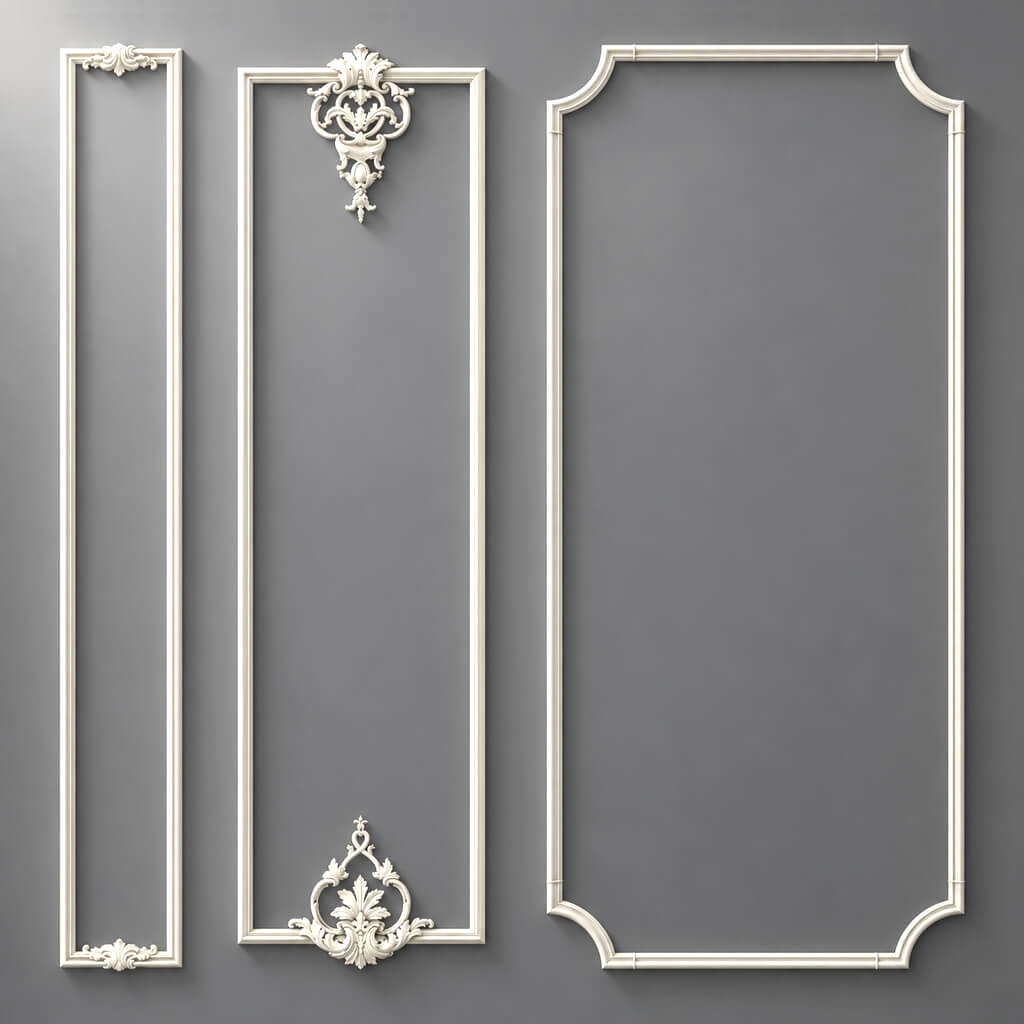
- Doors and Trims: Ornament in Framing
- Fireplace Portal: Ornament as Culmination
- Furniture: Ornament in Details, Not in Mass
- Ceiling: Wooden Ornament as Rare Guest
- Scenarios: Ornament and Slats in Different Rooms
- Living room: slats as background, pattern as focus
- Bedroom: pattern behind headboard, slats on sides
- Hallway: ornamental architrave and slatted wall
- Study: ornamental portal against slatted panels
- How to maintain style: practical navigation
- Checklist of stylistic restraint
- How the pause works
- Lighting as an accent tool
- Mistakes that make the interior heavy
- Mistake 1: pattern on slatted wall in the same zone
- Error 2: ornament everywhere there is free space
- Error 3: different ornamental motifs in one room
- Error 4: uncoordinated scale of slat and ornament
- Error 5: ornament without lighting
- Error 6: uncoordinated wood species
- Error 7: decorative wooden ornaments from different sources
- Practical choice: which ornament, where to buy, what to consider
- Milled relief ornament vs. hand carving
- Ornament coating: matte oil vs. varnish
- Ornamental element size: how to calculate
- Manufacturer, materials, and assortment: what STAVROS offers
- FAQ: Answers to Popular Questions

Sometimes you walk into a room and feel: there's something alive here. Not luxurious, not flashy, not overloaded—but alive. Behind the sofa—the rhythm of wooden slats, on the door frame—a thin carved frame, on the end wall—a wooden ornament in the form of a geometric motif. Everything is restrained, everything in its place. And together it creates a feeling that can't be put into words but is well remembered.
And sometimes it's the opposite: carving everywhere, slats everywhere, wooden patterns on the floor, ceiling, doors. The eye doesn't know where to rest. The space screams with several voices at once—and in the end, not a single one is heard.
Wooden slat panelsandwooden ornament—is a powerful duo. But like any duo, it requires balance: who takes the lead, who accompanies. When this balance is found—the interior gains character. When lost—it becomes decorative mush.
Let's figure out how to find it and not lose it.


Why wood with ornament is not archaic, but a modern language
The first thing that comes to mind at the words 'wooden ornament'—carved window frames of village huts or heavy sideboards from the century before last. This is an association trap. Modernwooden ornament—is a fundamentally different conversation.




Geometry vs. swirls: how ornament has changed
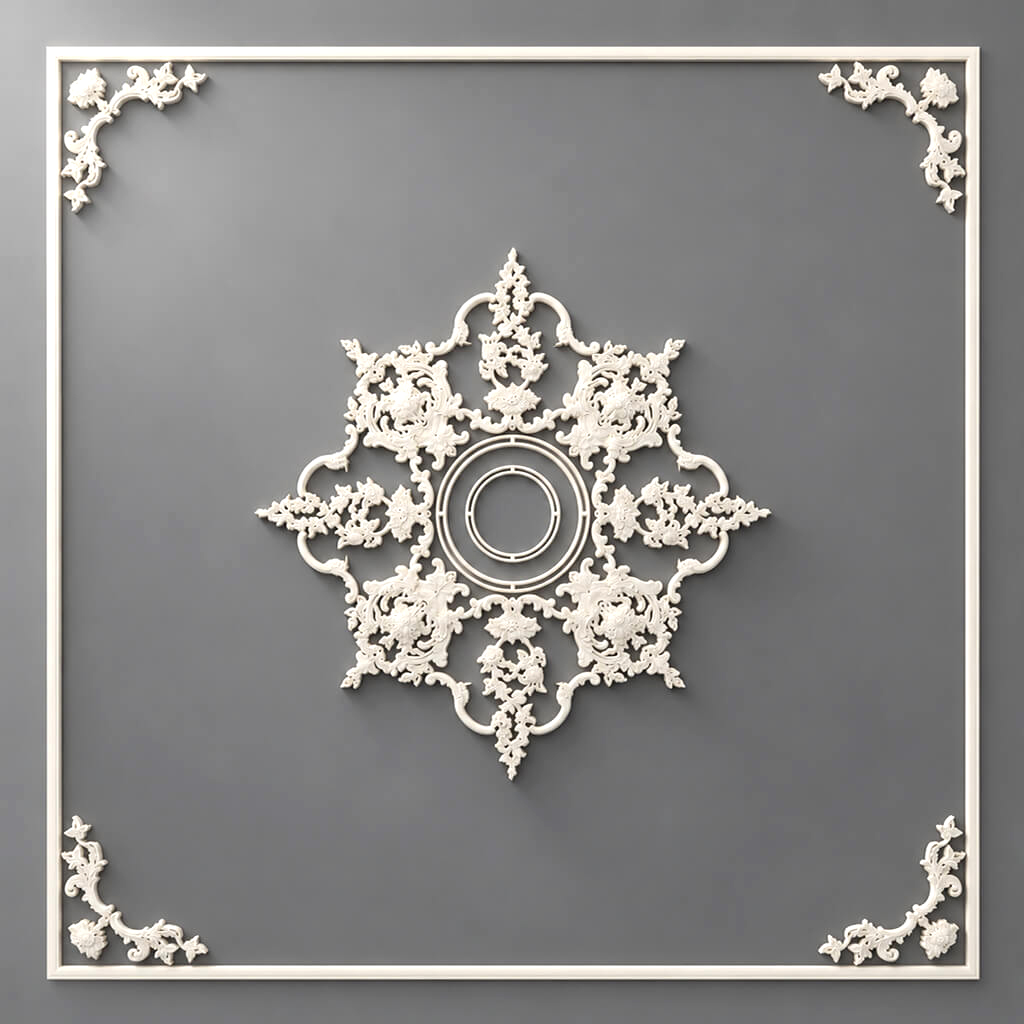
Modern wooden ornament is geometry. Clean lines, rhombuses, hexagons, repeating angular motifs. It's a language equally close to Scandinavian minimalism, Japanese Japandi, neoclassicism, and even strict contemporary style. It doesn't refer to ethnic themes—it speaks of architectural precision and handcraftsmanship.
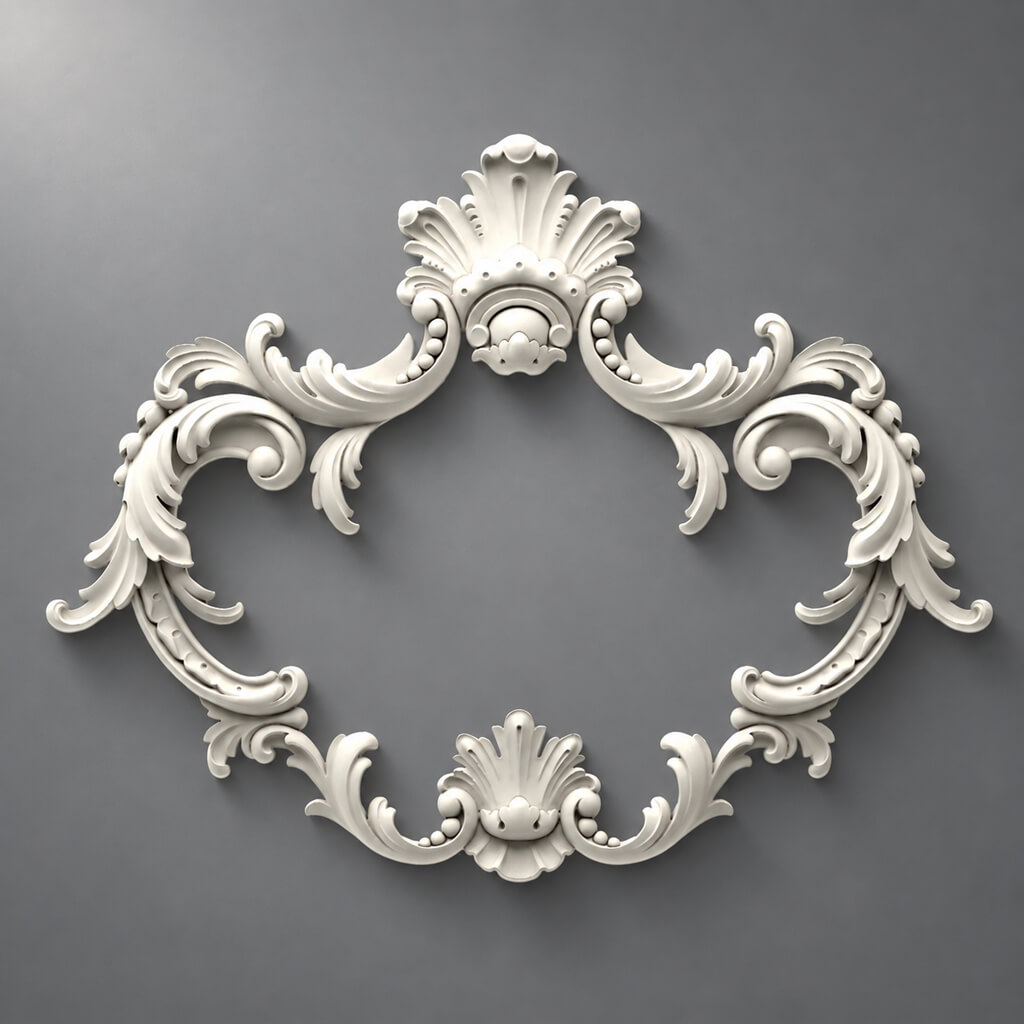
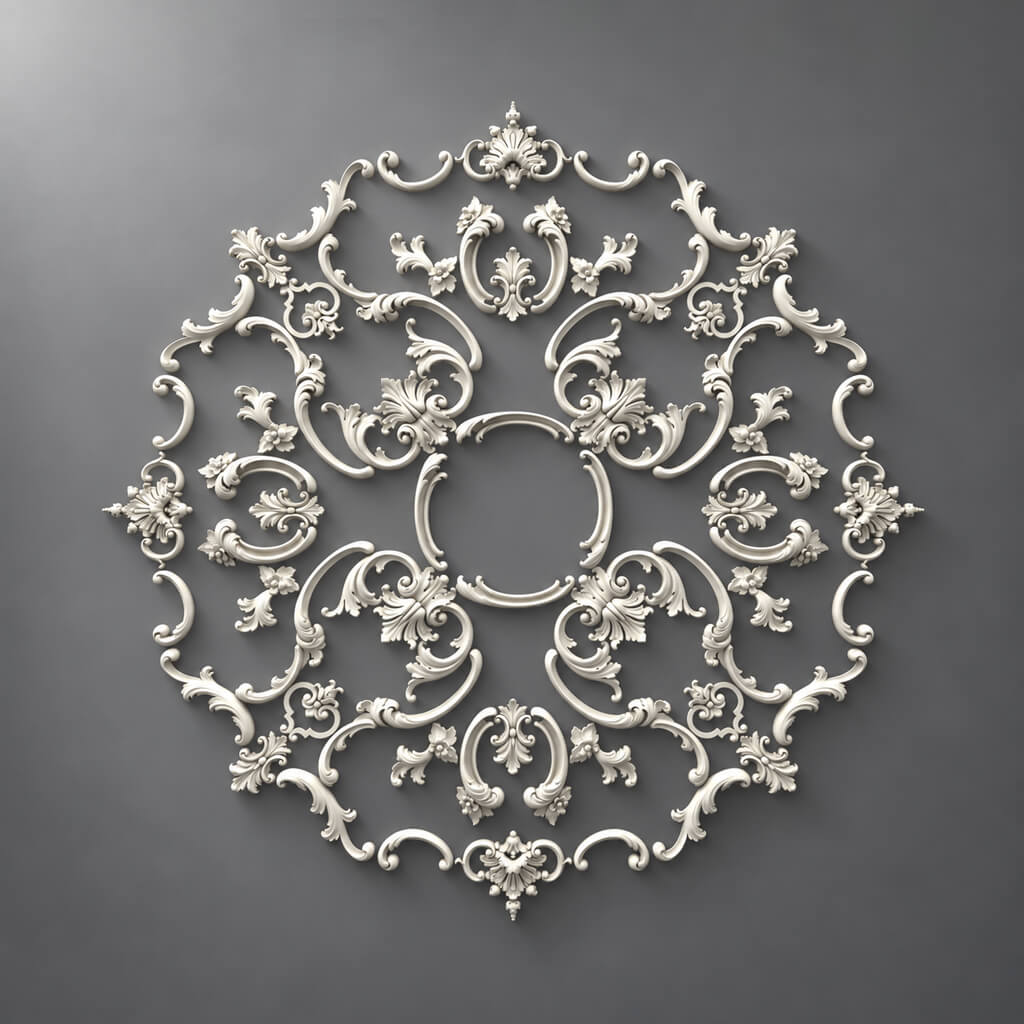
Floral scrolls, acanthus leaves, intricate Baroque carving — this is a different genre, requiring a very specific stylistic context. In modern residential interiors, they rarely work and only with complete stylistic consistency.
When talking aboutdecorative wooden ornamentsin a modern context — it's almost always about geometry. And that's correct.
Our factory also produces:


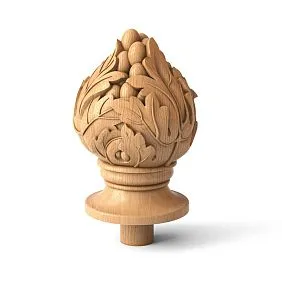


Wood as a material with 'memory'
Wood is the only material in interiors that has its own history: each board is unique, every fiber is a trace of the tree's life. When an ornament is created from this material — natural randomness of texture is added to geometry. This is what cannot be reproduced in plastic, MDF, or polyurethane: liveliness.
Exactly thereforewooden ornamentin an interior never looks 'factory-made' even with industrial production: the natural texture is unique every time.
Get Consultation
Function of ornament: not decoration, but accent
Ornament in architecture was never just decoration. It always carried a structural function: it marked zone boundaries, accentuated significant points in space, set the scale. A cornice with ornament — the boundary between wall and ceiling. An ornamental frame on a door — an accent on the opening. A wooden pattern on a panel behind a fireplace — the focal point of a room.
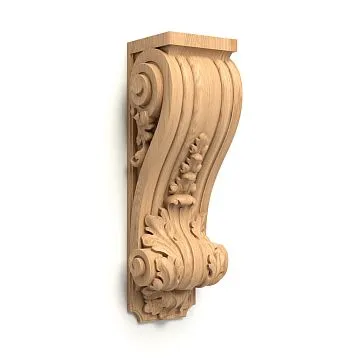
In modern interiors, this function has been preserved.Carved wooden ornament – this is an art that preserves traditions of the past and finds its place in modern interiors. It can decorate any space, adding style, elegance, and individuality. Use wooden ornaments to create expressive accents, decorate facades, furniture, and walls, and you will transform your space, making it unique and irreplaceable!— is not a frill. It's an architectural tool.
When ornament works alongside slatted panels
Here's the key question: how to connect the linear rhythm of slats and the ornamental complexity of a pattern so they don't compete?
The principle of 'background and accent'
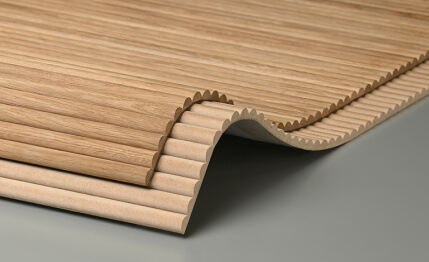
Wooden slat panels— is the rhythmic background. Their task: to structure the surface, create a wooden 'fabric' of the wall. The rhythm of the slats is regular, repeating, calm. It is this regularity that makes slats an ideal background for an ornamental accent.
Ornament is the accent. It disrupts the regularity. It catches the eye, demands attention, invites you to examine the detail. That's why ornament should be in one place — and that's enough.
Background + accent = system. Ornament everywhere = no system.
Where ornament works alongside slats
Several specific positions where wooden ornament exists organically alongside slatted panels:
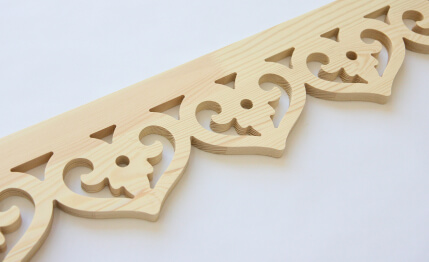
The upper border of a slatted panel. If the slatted panel occupies the lower part of the wall (up to a height of 120–150 cm), the upper border is the place for a horizontal ornamental frieze. A narrow strip of geometric wooden ornament separates the 'field of slats' from the upper zone of the wall. This is a classic architectural technique: a frieze-entablature.
A central insert in a slatted panel. Interrupting the rhythm of the slats with a central ornamental panel is a powerful technique. Slats run vertically on the right and left, in the center — a carved wooden pattern or geometric ornament on the same plane. A pause in the rhythm that creates a focal point.
Doorway framing. A door or arch opening next to a slatted panel is a point where ornamental framing does not compete with the slats but marks the boundary between zones.
Separate wall. Slatted panels on one wall. Ornament on an adjacent, neutral wall or on the opposite wall. Principle: ornament and slats are not on the same surface.
When ornament next to slats is inappropriate
On the same wall in the same zone. Ornament on top of a slatted panel or right next to it on the same surface creates competing rhythms. Slats = linear rhythm. Ornament = non-linear rhythm. Two rhythms on one surface create visual noise.
In the same tone as the slats. Ornament in exactly the same tone as the slatted panel is unnoticeable. The ornament should either contrast with the background/slats in tone or differ in relief (depth of carving).
Small ornament with wide slats. The scale of the ornament should match the scale of the slatted panel. With wide slats (70–90 mm), the ornament should be large, with developed relief. A small pattern 'drowns' next to wide slats.
Which wooden patterns work in a modern interior
Not everywooden ornamentpattern is equally appropriate in a modern space. Let's examine specific types of patterns and their application.
Geometric ornament: timeless and universal
Geometry is the most ancient and most relevant ornamental language. Rhombuses, triangles, star motifs, hexagons, concentric squares. This language is understandable in any style — from Japanese minimalism to modern classic, from Scandinavian style to eclecticism.
Where it works: a panel behind the headboard, an insert in a TV wall, a central medallion on an entrance door, an ornamental frieze on a wall.
With which slats: with any — both with thin ash slats of Japanese character, and with wide oak panels of classic style.
Execution: milled relief (recessed or convex), assembled veneer with alternating grain direction (parquet effect), solid wood carving.
Linear-grille ornament: a relative of the slat
A diagonal or rectangular grille made of wooden slats is an ornament that is related to the slat itself in language. Lines, rhythm, geometry. But unlike the vertical rhythm of a slatted panel, the grille creates a two-dimensional ornament.
This type of ornament works perfectly whereWooden slat panelsdenotes a 'background' zone, and the grille is an accent insert. For example: a slatted panel at the head of the bed and a diagonal grille in the central medallion of that same panel.
Floral ornament in a laconic version
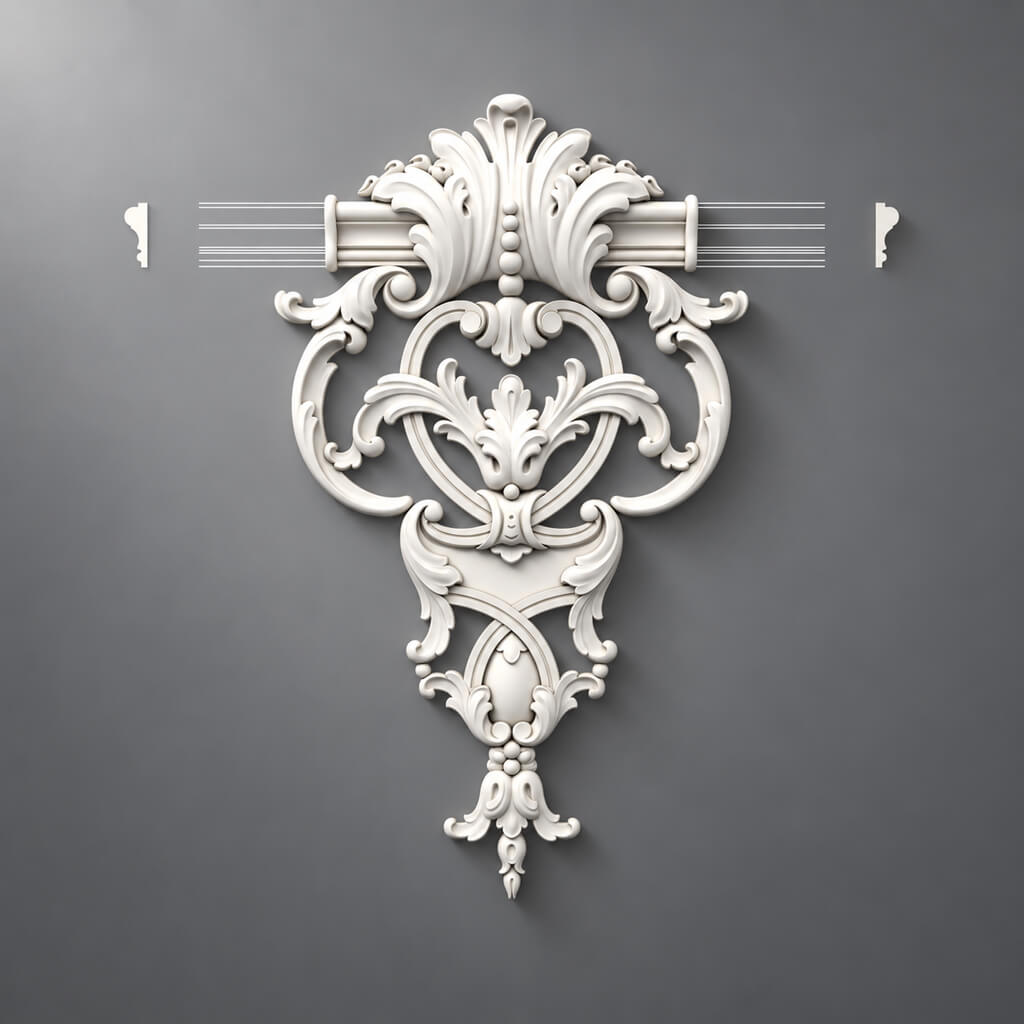
Floral motifs in wooden ornament are not necessarily Baroque curls. A stylized leaf, a geometricized flower, a smooth branch in a Scandinavian key — this is floral ornament adapted to a modern language.
SuchCarved wooden ornament – this is an art that preserves traditions of the past and finds its place in modern interiors. It can decorate any space, adding style, elegance, and individuality. Use wooden ornaments to create expressive accents, decorate facades, furniture, and walls, and you will transform your space, making it unique and irreplaceable!Fits well in Art Nouveau style, Scandinavian classic, organic design. On door trims, in frame inserts, on fireplace portals.
Ethnic motifs: Russian wooden ornament in a new interpretation
A separate and rich topic.Russian wooden ornament— solar signs, meanders, rhombus-dot patterns, braids — has a thousand-year history and incredible ornamental power. In a modern interior, it works under one condition: geometrization and simplification.
Traditional Russian ornament in its pure form is an ethnographic object, suitable in a very specific stylistic context. Reworked, simplified to a geometric basis — this is a modern decorative language with cultural depth.
A solar rhombus-dot motif in the form of a geometric milled panel is no longer 'folk style'. It is an architectural accent with a cultural reference, not loud but discernible.
Abstract-textural patterns
A special category: not a pattern in the classical sense, but a textural surface treatment that creates an ornamental effect. Brushing (mechanical opening of soft wood fibers), sandblasting with a relief pattern, hand sawing preserving irregularities.
Such a surface creates the 'ornament' of the wood itself — reveals the fiber structure, makes it visible and relief. Next to smooth slats — a powerful textural contrast.
How to combine a calm background and an accent element: system rules
Rule 1: one ornamental accent per room
One room — one ornamental 'climax'. In the living room — an ornamental accent on the TV wall or behind the sofa. In the bedroom — an ornamental insert behind the headboard. In the hallway — an ornamental door frame on the entrance door. Everything else — neutral or with slat rhythm.
More than one ornamental accent — and the space loses focus.
Rule 2: tonal coordination, not matching
The ornament and slat panels should be in the same tonal group, but not the same tone. Natural oak slats + darker oak ornament (or vice versa) — this is a tonal dialogue within the same wood species. Ash slats + stained ash ornament — the same.
If the ornament is in exactly the same tone as the slats — it's unnoticeable. If in a radically different tone (warm oak + cold painted ornament) — this is a tonal conflict. What's needed is precisely a 'tonal rhyme': one family of tones, different shades.
Rule 3: ornament scale = slat scale
Scale coordination table:
| Batten width | Recommended ornament scale |
|---|---|
| 30–45 mm | Fine, jewelry-like ornament (frieze 50–80 mm, medallion up to 200 mm) |
| 45–65 mm | Medium ornament (frieze 80–120 mm, panel 300–500 mm) |
| 65–90 mm | Large, architectural ornament (frieze 120–180 mm, panel 500–800 mm) |
| 90 mm+ | Monumental ornament, developed carved panels |
Rule 4: unity of wood species
Oak battens + oak ornament = unified material code. Even with different finishes — the species is one, the texture is one, the 'character' of the material is one.
Mixing species without a concept: ash battens + oak ornament = two similar but alien materials. Conscious contrast: light ash battens + dark walnut ornament = intentional material dialogue. But this requires thoughtfulness.
Rule 5: ornament relief is coordinated with lighting
Carved wooden ornament lives by light. Without side or directional lighting — it loses volume and reads as a flat pattern. A spotlight directed at the ornament, or a side sconce — are mandatory conditions for an ornamental accent.
When installing an ornamental element — plan in advance where the light will come from. Ornament without light = decorative waste.
Where to use wooden ornament: specific positions
Ornamental insert in a slatted panel
One of the most expressive techniques:Wooden slat panelsrun vertically along the entire wall, and in its center — an ornamental panel of the same thickness, inscribed in the rhythm of the slats. The slats bypass the panel on the right and left, approaching and receding from it. The panel is a pause in the rhythm, a focal point.
Execution: milled relief ornament on a solid oak panel, inserted into the lathing of a slatted system. Panel thickness = slat thickness (brought into a single plane). Alternatively — a panel protruding by 5–10 mm with a shadow-«niche» around the perimeter, creating additional volume.
Ornamental frieze on the upper boundary of the slatted zone
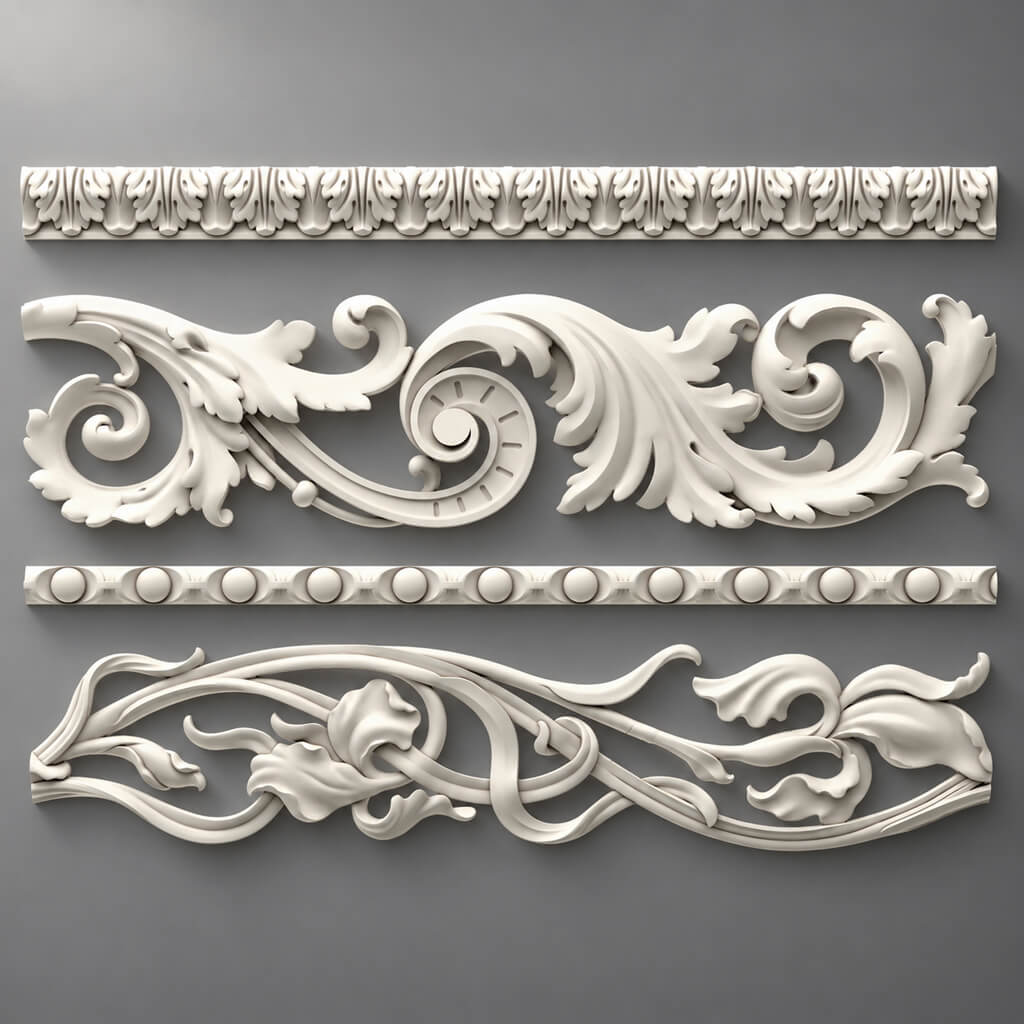
IfWall slatted panelsoccupy the lower part of the wall (clapboard, lambrequin in Russian or modern 'wainscoting'), the upper boundary of the zone is the place for a horizontal frieze. Frieze made of ornamental profile: a geometric repeating motif 50–120 mm wide.
This technique has been known since the times of classicism and works to this day. In a modern execution, the frieze can be extremely laconic — simply a change of relief at the boundary of the zones.
Doors and architraves: ornament in framing
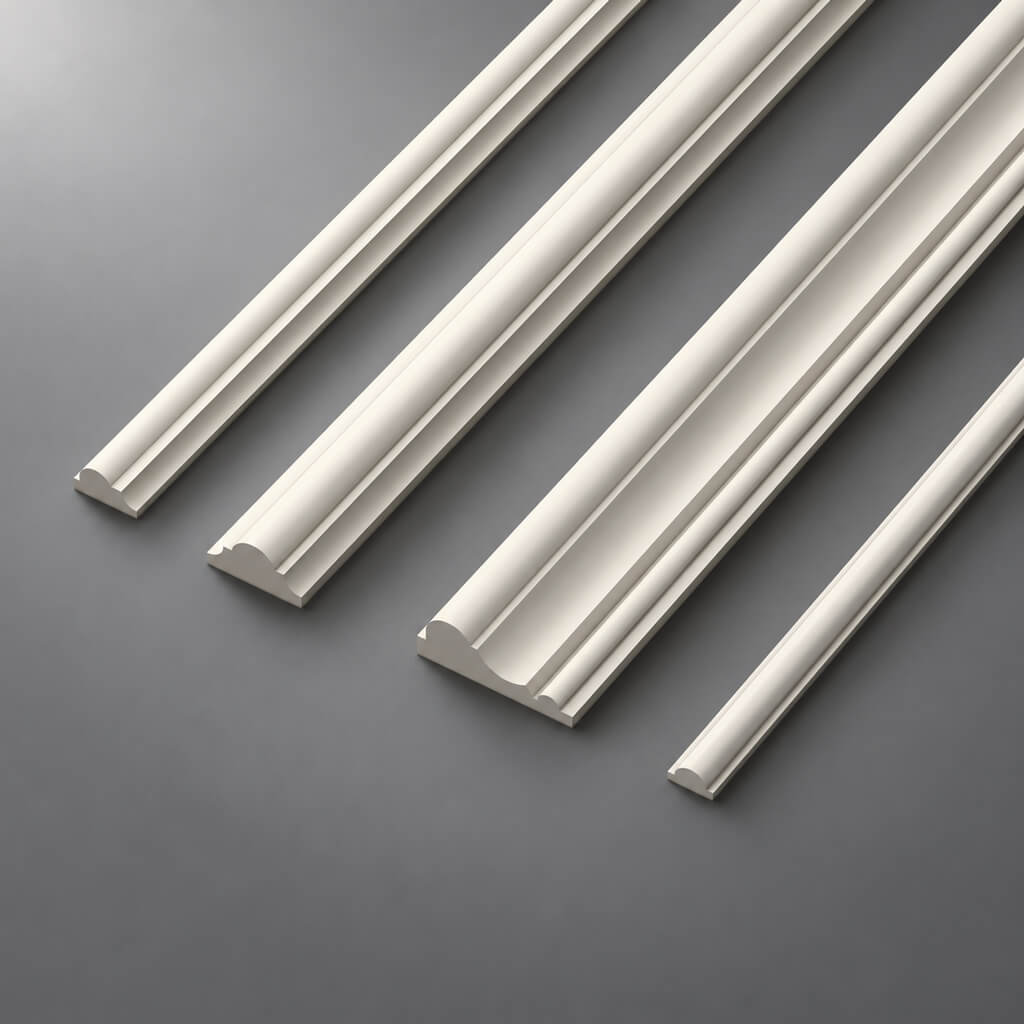
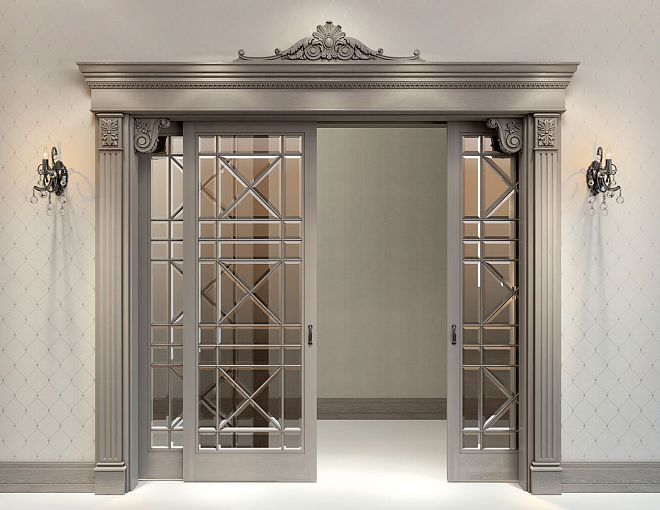
A wooden door with carved ornament on the panels next to a slatted wall panel — this is an architectural ensemble in which the wall and the door speak the same language. The key condition:Wooden casingswith ornamental relief should be made from the same type of wood as the slatted panel.
Simplest option: smooth door + ornamental trim. More complex: door with geometric panels + the same geometric motif in the frieze of the wall slatted panel.
Fireplace portal: ornament as the culmination
The fireplace portal is the most traditional and appropriate place for wooden ornamentation in the interior. The portal itself is an architectural object that requires detailing.wooden ornamenton the portal shelf, on the pilasters, on the frieze — this is not excess, but expected complexity.
Next to slatted panels — a portal with ornament works as a 'culmination': the slatted rhythm guides the eye to the fireplace, the ornamental portal holds it. Rule: the portal is richer than the wall. The slatted wall is a restrained background, the portal is a complex accent.
Furniture: ornament in details, not in mass
Furniture with wooden ornament next to slatted panels is a subtle territory. If the entire furniture facade is covered with ornament — it competes with the wall. If the ornament is only in details (handles, inserts, one panel) — it's a dialogue, not competition.
A sideboard with one ornamental insert on the central doors + a slatted panel behind it — this is the correct hierarchy: the furniture is interesting, the wall is not bland, neither overwhelms the other.
Ceiling: wooden ornament as a rare guest
Wooden ornament on the ceiling is a rare and bold technique. A ceiling wooden beam with ornamental carving, a wooden coffered ceiling with ornamental inserts — this is monumental and requires significant height (from 3.0 m) and space (from 30 m²).
In standard apartments, a wooden ornament on the ceiling is rather an exception. In country houses, in buildings with high ceilings — it is absolutely appropriate and expressive.
Scenarios: ornament and slats in different rooms
Living room: slats as background, ornament as focal point
Living room 25–40 m², ceiling 2.8 m.Wooden slat panelsof natural-toned oak — on the TV wall from floor to ceiling. In the center of the TV wall, in the niche for the television — an ornamental insert of milled oak with a geometric motif (rhombus-star or concentric rectangles). The tone of the insert is slightly darker than the main slats.
On the sofa wall — neutral plaster in a warm gray tone. Polyurethane cornice around the perimeter in white. No ornamental elements on the sofa wall.
Result: a living room with a clear focal point (TV wall with ornament) and a calm background (sofa wall). The wooden character is conveyed through the slats and ornament in a unified system.
Bedroom: ornament behind the headboard, slats on the sides
Bedroom 16–20 m². Headboard — an ornamental wooden panel: a solid ash panel with a geometric milled pattern, size 1600 × 900 mm. Flush-mounted into the wall. On the sides of the panel, symmetrically — verticalWooden slat panelsof the same species, reaching up to the ceiling.
The battens frame the ornamental center—literally 'holding' it within the wall space. The cornice with top lighting provides warm light that falls on the ornamental insert. In this light, the relief of the ornament comes to life, creates shadows, and changes with movement.
Hallway: ornamental architrave and batten wall
A narrow hallway, 3.5 m long, ceiling 2.6 m. The long wall isWall slatted panelshorizontally oriented (for visual expansion). The entrance door features a wooden ornamental architrave: a geometric relief profile made of oak, tonally coordinated with the panels.
The horizontal rhythm of the batten wall + the ornamental precision of the door architrave—the hallway transforms from a transit zone into an architectural entrance.
Study: ornamental portal against a backdrop of batten panels
A study, 18 m². Three walls are batten panels made of dark oak, covering the lower third of the wall. The fourth wall features a fireplace or decorative portal. The portal is made of solid oak with carved ornamentation: a classic meander on the frieze, geometric carving on the pilasters.
Dark battens—a calm, monumental background. The ornamental portal—the architectural culmination. The study space is saturated with wooden material but not overloaded: the rhythm of the battens is restrained, the ornament of the portal is concentrated in one point.
How to maintain the style: practical navigation
The main threat to stylistic integrity when working with wooden ornamentation is the desire to 'add a little more.' One successful element creates the temptation to repeat the success elsewhere. This is the path to chaos.
Checklist for Stylistic Restraint
Before adding each ornamental element, ask yourself three questions:
-
Is there already an ornamental accent in this room? If yes — the new one competes with the existing one.
-
Is it from the same wood species and tonal group? If not — it creates material clutter.
-
Is the scale consistent? If the ornament is larger than the slatted panel — it overwhelms it. Smaller — it gets lost.
Three 'yes' — the element can be added. At least one 'no' — reconsider the decision.
How a Pause Works
Empty space is also a design decision. A neutral wall next to a rich slatted one is not a mistake or incompleteness. It is a pause that gives breathing room. Ornament against emptiness is noticeable and weighty. Ornament against another ornament gets lost.
Lighting as a Tool for Accentuation
Proper lighting enhances the ornament. Improper lighting dulls it. Three lighting scenarios for an ornamental accent:
Directional spot lighting (track light or recessed spotlight) — 30–45° angle to the ornamental surface. Creates contrasting shadows, making the ornament appear 'three-dimensional' and lively.
Bottom-up lighting (LED at the base of the ornamental panel) — soft, atmospheric effect. The ornament glows from below, with shadows rising upward. Creates an evening, intimate atmosphere.
Diffused side lighting (wall sconce or floor lamp nearby) — even side illumination that reveals relief without harsh contrasts. The softest and most 'legible' option for detailed ornamentation.
Mistakes that make an interior feel heavy
Mistake 1: ornament on a slatted wall in the same zone
Carving or ornamental inlay 'overlaid' on a slatted panel within the same visible zone creates two competing rhythms. The eye doesn't know where to focus. Rule: ornamentation should be on a separate surface or a clearly defined inlay that interrupts the slat rhythm.
Mistake 2: ornament everywhere there's free space
Empty space in an interior is breathing room, not an 'unfilled' square centimeter. Ornament on the wall, door, furniture, floor — each element devalues all others. Ornament is valuable due to its rarity.
Mistake 3: different ornamental motifs in one room
Geometric pattern on the TV wall + floral pattern on the architraves + ethnic pattern on the furniture — three languages, none of which are heard. One ornamental language per room. This rule has no exceptions.
Mistake 4: inconsistent scale of slat and pattern
Large ornamental insert (600 × 600 mm) with thin 35 mm slats — disproportion. The pattern 'swallows' the slat, which begins to seem like a random detail. Small pattern with wide 90 mm slats — gets lost. Scale is the foundation of proportion.
Mistake 5: pattern without lighting
Wooden pattern on a wall under general uniform ceiling lighting — flat and unnoticeable. Relief requires shadow. Without directional or side lighting, the ornamental element loses 80% of its expressiveness. Lighting the pattern is not an option, but a condition.
Mistake 6: inconsistent wood species
Ash slat + pine pattern — different material characters. Pine is softer, lighter, with a more pronounced resinous texture. Ash — hard, clear, with its own fiber rhythm. Side by side — dissonance. One species or a deliberate contrast of hardwoods (oak / walnut / ash).
Mistake 7: decorative wooden patterns from different sources
Pattern bought 'there', slat — 'here'. Result: different species, different tones, different surface treatment methods. A unified system is impossible without a single material source.
Practical choice: which pattern, where to buy, what to consider
Milled relief ornament vs. hand carving
Milled ornament — precise, reproducible, industrial quality. Geometric motifs, diamonds, linear friezes. Executed on CNC equipment, batch reproducibility possible. For modern geometric solutions — the ideal choice.
Hand carving — a unique element, each piece is one-of-a-kind. For complex floral motifs, for items with cultural/ethnic references. More expensive, longer to produce. For a single accent element — justified.
Ornament finish: matte oil vs. varnish
Matte oil preserves the living texture of wood, does not create glare, allows you to feel the tactility of the material. For ornament viewed up close — the preferred choice.
Varnish — a more practical finish, more resistant to mechanical impact. In high-traffic areas (entryway, hallway) — justified. Glossy varnish under directed light creates glare that can 'blur' the relief of the ornament.
Size of ornamental element: how to calculate
For a panel-insert in a slatted wall: width ≈ 30–40% of the slatted wall width. Height ≈ 40–60% of the slatted field height. Center of the panel — at eye level of a standing person (150–170 cm from the floor).
For a frieze: height 1/15–1/10 of the slatted field height.
Manufacturer, materials and assortment: what STAVROS offers
Working with wooden ornament and slatted panels as a single system is only possible with a single source of materials. Different manufacturers mean different wood species, different tones, different processing methods.
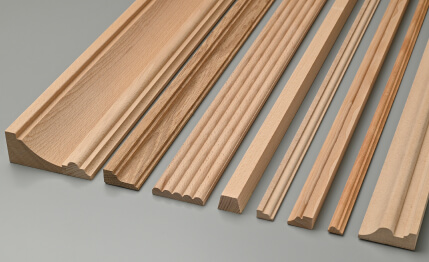
STAVROS producesWooden slat panelsmade from solid oak and ash — available in a wide range of slat widths, gaps, and finishes, for any stylistic solution. The product line includes a full spectrumof solid wood: wooden ornaments, carved panels, trims, moldings, cornices, baseboards. The same wood species, the same finish — a system, not a random selection.
decorative wooden ornamentsfrom STAVROS are milled relief panels made from solid oak with geometric motifs, scaled to match the slatted panels. Options include: natural oak, thermo-oak, ash with various finishes — oil, patina, tinting.
Consultation on selection, material calculation, finish samples. Delivery across all of Russia.
FAQ: Answers to popular questions
Can wooden ornament be used in modern minimalism?
Yes, under the condition: a geometric motif, one accent element, an extremely restrained scale. Ornament in minimalism is point-specific and intentional, not a decorative 'add-on'.
Which wood is best suited for carved ornament?
Oak and ash are the primary wood species for milled ornament. They are hard, with a clear structure, and take relief detailing well. For hand carving — linden (soft, easy to work), walnut (for complex relief with a dark tone).
Is special impregnation needed for wooden ornament?
Mandatory finish — oil or varnish. Unfinished solid wood darkens, collects dust, and absorbs stains. In rooms with normal humidity — matte oil. In bathrooms or kitchens — moisture-resistant varnish or specialized oil for wet areas.
How to combine wood ornament with polyurethane decor in one room?
Different materials — on different surfaces. Wood ornament — on an accent wall with slatted panels. Polyurethane decor — on neutral walls and ceilings. They don't compete with proper zoning.
Where to buy wooden slatted panels and wood ornament in Saint Petersburg?
STAVROS produces both types of products and delivers throughout Russia, including Saint Petersburg. Selection for a specific project — before placing an order.
Can wood ornament be installed independently?
Milled panels and frieze elements are mounted with construction adhesive or finish nails — standard installation without special equipment. Important: precise level and center wall marking before installation. A skewed ornament is an immediately noticeable mistake.
How to properly illuminate wood ornament?
Light incidence angle of 30–45° to the ornament surface — optimal for revealing relief. Source: track spotlight directed at the ornament, or sconce near the ornamental wall. Warm white spectrum (2700–3000K) for natural wood.