























Article Contents:
- Why cheap balusters are not always profitable: an honest conversation
- What hides behind the low price
- What makes up the price of stair balusters
- Wood species: the main variable
- Shape and profile complexity
- Processing class
- Size of the item
- Ready-made product vs custom order
- Which balusters can be bought inexpensively without risk
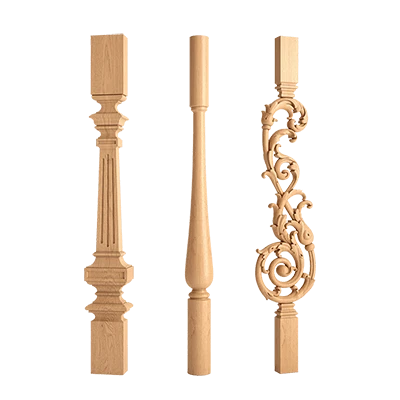
- Turned pine balusters: standard for budget projects
- Flat balusters: economical and functional
- Square balusters: minimalism at an optimal price
- Standard sizes — the key to savings
- Where you cannot save when buying balusters
- Fence height: below standard — dangerous
- Thickness and load-bearing capacity
- Compatibility with handrail
- Wood drying
- Fasteners and installation
- Beech, oak or pine: how to choose material for your budget
- Pine: honest affordability
- Beech: quality at a reasonable price
- Oak: an investment with a 20-year horizon
- Practical selection table by wood type and budget
- What is more profitable: buying only balusters or the entire set
- Why 'only balusters' is often more expensive
- System order: what it provides
- What is included in a complete railing set
- How a complete order affects the final cost
- How to calculate the budget for balusters before purchasing
- Step 1: number of balusters
- Step 2: number of posts
- Step 3: handrail length
- Step 4: fasteners
- Step 5: delivery
- Summary table of estimated budget
- Mistakes when buying cheap balusters: anti-rating
- Mistake 1: choosing the lowest price without checking the composition
- Mistake 2: did not check the tenon size
- Mistake 3: bought balusters without posts from the same series
- Error 4: didn't take a spare
- Error 5: mixed different styles
- Error 6: didn't account for installation
- Error 7: chose based on a photo of one baluster without visualizing the row
- How to choose balusters from a catalog: step-by-step guide
- Wooden balusters from the manufacturer: why it matters
- Where to buy inexpensive wooden balusters: conclusion
- About the Company STAVROS
- FAQ: Answers to Popular Questions
- Can you buy quality balusters cheaply?
- What determines the price of stair balusters?
- Which is cheaper: flat, square, or carved balusters?
- How not to overpay when buying balusters?
- Where to buy wooden balusters at a reasonable price?
- How much does a set of balusters and handrails for a staircase cost?
- Are wooden balusters from the manufacturer cheaper?
- What is better: to buy only balusters or the whole set at once?
The word "inexpensive" in the context of stair railings is not just a matter of price. It is a matter of choice: where exactly to save wisely, and where saving will result in costs twice as high as if you had bought correctly right away. The baluster market today is wide — from marketplaces with nameless items to a direct manufacturer with a full catalog and set calculation. And here is what is important to understand from the very beginning: Buy wooden balusters inexpensive and buying wisely are not the same thing.
Some buyers grab the first available item at the lowest price, only to find that the balusters don't fit the handrail, the tenons break during installation, and after a year the railing starts to wobble. Others spend time choosing, correctly calculate the set, and get a durable, beautiful railing for a reasonable price — without rework.
In this article, we will honestly break down what actually makes up the cost of wooden balusters for staircaseswhere savings are justified and where they are not, and how wooden balusters for stairs buy so that you don't regret the decision six months later.
Why cheap balusters are not always profitable: an honest conversation
Let's start with an uncomfortable truth. There are balusters on the market that look quite decent in photos, are cheap, and seem like a normal product in every way. The problem appears not at the time of purchase, but during installation and in the process of use.
What hides behind the low price
from the manufacturer undergo chamber drying to 8–10% moisture content. This is a standard that eliminates deformations. But it is this operation that adds to the cost of the product — and it is precisely this that is "cut" during the production of the cheapest items.
Quality Wooden balusters From the manufacturer, they undergo chamber drying to 8–10% moisture content. This is a standard that eliminates deformations. But this operation adds to the cost of the product — and it is precisely this that is "cut" in the production of the cheapest items.
Second — geometry. A cheap baluster often has noticeable runout in diameter, an uneven profile with different necks, and a skewed tenon. In a row of 20–30 pieces, such defects multiply: the railing looks uneven, the balusters "dance" in height.
Third — rough sanding. Tool marks, uneven transitions between profile elements, fuzz on the surface — all this requires additional hand sanding before coating. This is your time or the craftsman's money.
Fourth — size mismatch. Cheap balusters often have an actual tenon size that does not match the stated one. A handrail with a groove for a 25 mm tenon does not accept a 28 mm tenon — which means fitting on site again.
The conclusion is not that cheap balusters are always bad. The conclusion is that "cheap" without understanding the composition of the price is a risk. Let's break down what exactly affects the price — then it will be easier to compare.
Our factory also produces:
What makes up the price of balusters for stairs
Let's break down pricing step by step — no marketing, just facts.
Get Consultation
Wood species: the main variable
Balusters price — is primarily the price of the species. The same profile, the same shape, the same size in pine and oak differ in cost by 2–2.5 times. Why?
Oak is a hardwood. The blank is more expensive. The tool wears out faster during processing. There is more waste during turning. Added value — durability, expressive texture, resistance to deformation. All this is a justified premium.
Pine is a softwood, easy to process, cheaper to purchase, less waste. That is why pine balusters are the most affordable item in any catalog. This is not a "bad" species — it is a species for specific tasks.
Beech occupies an intermediate position: harder than pine, slightly cheaper than oak. It is valued for its uniformity — it takes paint and tinting well.
Shape and profile complexity
A simple turned baluster with two elements — minimum turning time, minimum setup. A complex profile with eight to ten transitions — longer, more precise, more expensive. The price difference between a simple and complex profile from the same species is 20–40%.
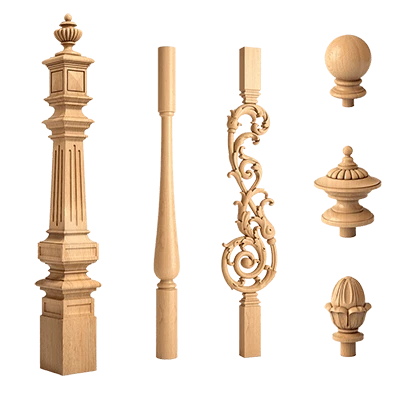
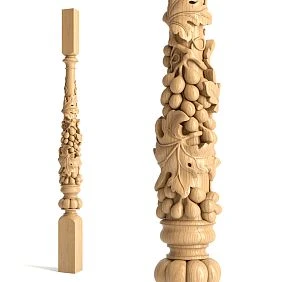
A carved baluster is a separate story: after turning, the ornament is milled. This is an additional operation, additional equipment. Buy carved wooden balusters — means paying for decorative richness, which is simply unnecessary in a simple interior. If the goal is to save money, start by choosing a simple profile instead of a carved one.
Processing class
Basic machine sanding is more affordable. Manual finishing sanding in 2–3 passes is 15–25% more expensive, but gives a surface ready for coating without additional operations.
Product size
Length 900 mm and 1100 mm — different material consumption. Diameter 45 mm and 70 mm — different wood volume. Both parameters directly affect the price.
Finished product vs custom order
Items from the manufacturer's catalog are products that are produced in series. Serial production = optimized costs = best price per piece. A custom order (non-standard height, non-standard diameter, special profile) involves equipment reconfiguration and individual cutting. The minimum batch is usually 10–15 pieces, and the price per piece is higher.
Conclusion: if you want to buy balusters for stairs cheaply — choose standard items from the catalog, simple profiles, and affordable wood species. This is legitimate savings without sacrificing quality.
What balusters can be bought cheaply without risk
Good news: a significant portion of requests for wooden balusters are solved with standard items at an affordable price. Let's look specifically.
Turned pine balusters: standard for budget projects
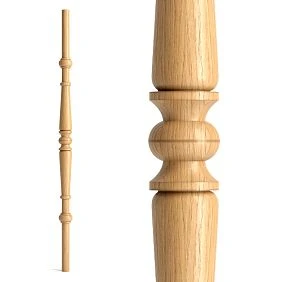
A simple turned pine baluster with a profile of 2–3 elements, diameter 45–50 mm, length 900–1000 mm — this is the lower price segment of the market where normal manufacturing quality is still maintained. With proper chamber drying and basic sanding, such a baluster lasts for years in a warm room.
What it is suitable for: dacha, country house in a natural style, budget apartment renovation with wooden elements, first floor with less load than the main front staircase.
Flat balusters: economical and functional
Buy flat balusters made of pine — this is one of the most affordable options for wooden fencing. A flat baluster is cut from a board, not turned from a cylinder. This is simpler technologically, and less wood is consumed. At the same time, visually it is a full-fledged decorative element with a figured silhouette.
Flat buy wooden balusters especially appropriate in a wooden house, on the porch, on the terrace, in a country or rustic interior. At the same time, it creates a denser railing than a turned baluster with the same installation step — this is a plus for safety.
Square balusters: minimalism at an optimal price
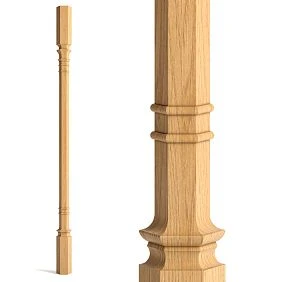
square balusters for stairs are simpler to manufacture than turned ones: no lathe processing with a complex profile, only edge milling and sanding. A cross-section of 40×40 or 50×50 mm is standard for modern stairs. With proper tinting or painting, square beech balusters look expensive and modern, although they cost less than a similar turned profile made of oak.
Standard sizes are the key to savings
Standard size balusters (900 mm length, 45–50 mm diameter) are always cheaper than non-standard ones. They are produced in series and do not need to be ordered separately. If your staircase parameters allow using a standard size, go with the standard. This is direct savings without any compromises.
Where you cannot save when buying balusters
Now, about the other side of the coin. Some selection elements allow reasonable savings, others categorically do not.
Railing height: below the norm is dangerous
standard baluster height for staircases — at least 900 mm from the step surface to the top edge of the handrail. This is not a recommendation — it is a safety standard. Buying balusters that, by their length, result in a lower railing height is saving with a risk to life. Especially in homes with children.
No price difference justifies violating this parameter. Check the height BEFORE ordering, referring to the article on baluster sizes for staircases.
Thickness and load-bearing capacity
A baluster with too thin a cross-section will not withstand lateral load. When leaning on the railing while moving up the stairs, a person creates not only vertical but also horizontal load. The minimum allowable diameter for a residential staircase is 40 mm. Thinner than that are decorative elements, not structural supports.
Compatibility with handrail
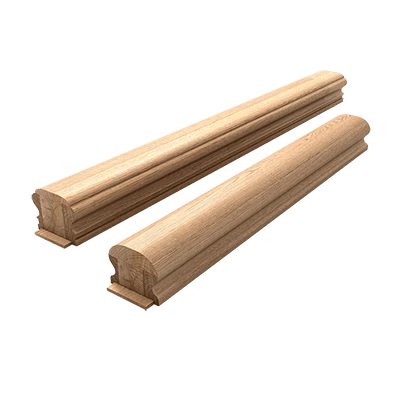
Saving on selecting a compatible handrail for balusters always ends up costing more. A mismatch between the handrail groove and the baluster tenon means either replacing elements or manual on-site adjustment. That's why Handrails and balusters they buy from one manufacturer: compatibility is structurally guaranteed.
Wood Drying
It has already been said, but we'll repeat: wooden balusters with moisture content above 12% for residential interiors pose a risk of deformation. Kiln drying is not a "premium-class" option; it is a production standard that ensures durability. Check the moisture content with every order.
Fasteners and installation
Saving on fasteners means saving on connection reliability. M8 studs instead of M6, quality PVA instead of nameless glue from a hardware store — the difference is insignificant in cost but fundamental in the result. More details on the technology are in the guide on installation of wooden railings and balusters.
Beech, oak, or pine: how to choose material based on budget
This choice is the most obvious lever for managing the budget when purchasing balusters. Let's consider three main wood species in terms of price-to-result ratio.
Pine: honest affordability
Pine is a wood without unnecessary pretensions. Soft (2.5 Brinell units), affordable, easy to process. With kiln drying and proper coating (primer + 2–3 coats of varnish), pine balusters serve perfectly in heated rooms.
Main limitation: pine is not for high loads or a "formal" look. The soft surface scratches from accidental impacts, and the large grain with amber pockets creates a natural but not refined appearance.
Optimal use: country house, cottage, porch, terrace, staircase with moderate load. balusters for staircase to buy pine is the right choice for all these scenarios.
Beech: quality at a reasonable price
Beech is an intermediate wood: harder than pine (3.5 Brinell units), cheaper than oak. The main value of beech is the uniformity and neutrality of the texture. Under opaque paint, it looks like any other material: the form comes to the forefront, the wood "recedes." This is ideal for painted railings.
Buy beech balusters is the right solution when you need a hardwood but the budget doesn't allow for oak. Beech also works great under tinting: the color applies evenly, without surprises.
Limitation: beech is more hygroscopic than oak. In rooms with unstable humidity or when used on an open porch, it is a risky choice. For closed, heated interiors, it is excellent.
Buy beech baluster compared to oak, saving 20–30% with similar hardness and high processing quality.
Oak: an investment with a 20-year horizon
Buy oak balusters — this is not a luxury or an overpayment. It's a calculation: oak serves for decades without deformation, does not lose geometry during humidity fluctuations, and holds coating better than softwoods.
If a house is built for 30–40 years, if the staircase is a central architectural element, if you want to see expressive texture under clear varnish — oak is justified. This is a conscious choice, not an overpayment.
For a budget project: if oak is not in the estimate — take beech for painting or pine for a summer house. This is not a compromise, it's an exact match of material to the task.
Practical selection table by wood species and budget
| Task | Recommendation | Why |
|---|---|---|
| Summer house, natural style, budget | Pine, flat/turned | Affordable, organic, sufficient |
| Painted railing, apartment | Beech, turned/square | Good hardness, paints evenly |
| Classic staircase, tinting | Beech, turned | Predictable result, savings vs. oak |
| Grand staircase, clear varnish | Oak, turned/carved | Durability, texture, status |
| Modern staircase, minimalism | Oak/beech, square | Geometry + wood quality |
What is more profitable: buying only balusters or the whole set
This is a question that directly affects the final budget — and it is most often solved incorrectly.
Why 'only balusters' are often more expensive
You buy balusters today. A week later, you order a handrail from another supplier — the groove doesn't match. You buy a handrail from the baluster manufacturer. You wait another week. Then you realize you need posts — you order them as a third separate order. Three deliveries, three waits, three invoices, risk of color mismatch. The final cost is higher than if everything had been ordered at once.
System order: what it gives
buy balusters and handrails in one order — this is:
-
One delivery — logistics cost is not multiplied
-
One batch — all elements from the same wood species of the same tone
-
Guaranteed compatibility — the handrail groove exactly accepts the baluster tenon
-
Unified style — baluster, post, and handrail from the same series, without stylistic conflict
-
Convenience of calculation — the manufacturer's manager calculates everything at once, with a margin
Buy balusters and posts for a wooden staircase From one manufacturer, this is not just convenience. It is constructive and aesthetic consistency that you don't have to pay extra for separately.
What is included in a complete railing kit
To understand what to include in the order, you need to clearly see the system composition:
Balusters — vertical posts. Quantity = span length ÷ installation step + 10% reserve.
Support posts — load-bearing elements of the system. 2 for each straight span, +1 for each turn. Wooden stair posts are selected from the same series as the balusters.
Handrails — sold in linear meters. Span length + 15% reserve.
Fasteners — M8–M10 studs, nuts, washers, glue.
buy staircase components Systematically — this is a direct path to results without 'add-on purchases' during installation.
How a complete order affects the final cost
Let's look at specific numbers. A straight staircase, 14 steps, step height 150 mm, pine.
Option A: order only balusters (28 pcs. × 1,990 RUB = 55,720 RUB) + 2 separate orders for handrail and posts with two deliveries at 3,000 RUB each = total about 62,000 RUB and three weeks of waiting.
Option B: a system order of balusters + posts + handrail + fasteners in one order with one delivery. The total cost of elements is the same or slightly lower due to wholesale terms, but one delivery, one week of waiting, zero risks of incompatibility.
The conclusion is obvious. Buy a staircase railing kit from one manufacturer — this is the best logistical and financial strategy.
How to calculate the budget for balusters before purchase
Calculating the budget in advance means not getting an unpleasant surprise at the finish. Here is an algorithm that works.
Step 1: number of balusters
Formula: march length in mm ÷ installation step + 10% reserve. Step: 130–150 mm for families with children, 150–180 mm for adult homes.
Example: march 3,600 mm, step 150 mm → 3,600 ÷ 150 = 24 balusters per march. Two marches = 48 + reserve 5 pcs. = 53 balusters.
Detailed calculation with examples — in the guide on baluster sizes for stairs.
Step 2: number of posts
2 posts per march (start + end) + 1 post for each turn or landing. For a two-flight staircase: minimum 5–6 posts.
Step 3: handrail length
Calculate the length of each march using the hypotenuse (√(L² + H²)), add them up, add 15% reserve.
Step 4: fasteners
Approximately: 3,000–5,000 rubles for a full set of a standard staircase.
Step 5: delivery
Check the cost with the manufacturer or transport company. For bulk orders — often free.
Summary table of estimated budget
| Element | Option "pine" | Option "beech" | Option "oak" |
|---|---|---|---|
| 53 balusters | ~105,000 RUB | ~150,000 RUB | ~210,000 RUB |
| 6 pillars | ~18,000 RUB | ~28,000 RUB | ~45,000 RUB |
| Handrail 8 m | ~10,000 RUB | ~14,000 RUB | ~20,000 RUB |
| Fastening | ~4,000 RUB | ~4,000 RUB | ~4,000 RUB |
| TOTAL | ~137,000 RUB | ~196,000 RUB | ~279 000 RUB |
These are approximate figures. Actual balusters for stairs price — in the STAVROS catalog.
Mistakes when buying inexpensive balusters: anti-rating
I've compiled typical mistakes — all of these are real situations that regularly happen to buyers.
Mistake 1: choosing based on the lowest price without checking the composition
"The cheapest" doesn't mean "the most profitable." If the manufacturer doesn't specify wood moisture content, doesn't provide information about the sanding grade, and doesn't have a full catalog with sizes — these are red flags.
The right approach: compare not only the price but also the conditions: wood species, moisture content, sanding, and the possibility of a system order.
Mistake 2: didn't check the tenon size
Ordered balusters with a 28 mm tenon, handrail with a 25 mm groove. A 3 mm mismatch turns into replacing the handrail or reworking with a router. Check compatibility of the baluster tenon and handrail groove BEFORE purchase.
Error 3: bought balusters without posts from the same series
The posts were bought later, from another supplier. The style didn't match — the balusters have a classic profile, the posts are neutral without decor. Visually — dissonance. The cost of rework was more than the price difference with a system order.
Error 4: didn't take a spare
We ordered exactly as per the invoice. During installation, one baluster split when installing the tenon, two had to be cut for a non-standard angle — and three pieces were missing. Reorder: waiting, delivery, and most importantly — the risk that the balusters will be from a different batch and slightly differ in shade.
Rule: a 10% spare is always mandatory.
Error 5: mixed different styles
We bought turned balusters with a baroque profile from one place, square posts from another, a Scandinavian handrail from a third. The result — three different 'voices' in one railing. It doesn't look beautiful under any coating.
Error 6: didn't account for installation
We bought flat balusters without specifying — but during installation it turned out that the standard handrail requires modifying the groove for the non-standard width of the flat baluster. Additional costs for the craftsman. Ask the manufacturer in advance: 'Is this model compatible with your standard handrail without modification?'
Error 7: chose based on a photo of a single baluster without imagining the row
A single baluster on a neutral background looks good. In a row of 30 on a staircase, it's completely different. A rare step + thin profile = an airy, almost empty railing. A frequent step + wide profile = a solid, heavy one. Look for photos of an installed railing and use it as a guide.
How to choose balusters from a catalog: step-by-step instructions
Working with a catalog is a skill. Here is a sequence that eliminates mistakes.
1. Determine the style of the house and staircase. Classic — turned profiles. Minimalism — square ones. Country, rustic — flat ones. Baroque — carved ones.
2. Choose the wood species according to your budget. Pine → beech → oak. This is a direct scale of price and durability.
3. Filter by type. Turned / flat / square / carved — this is the first level of selection in the catalog.
4. Look at the size. Check the height (900–1000 mm), diameter, tenon size. Compare with the standards for baluster height for staircases.
5. Look for photos of the assembled set — with a handrail and newel post. Evaluate the proportions of the set, not the baluster alone.
6. Check the availability of a post from the same series. This is critical for a consistent result.
7. Request a kit calculation. A reputable manufacturer does this for free.
8. Check delivery conditions. Cost, timelines, packaging for long-length cargo.
Wooden balusters from the manufacturer: why this matters
A discussion about buying inexpensive balusters without losing quality inevitably leads to one conclusion: a direct manufacturer offers the best price-to-guarantee ratio. Here are the specific reasons.
No intermediary markup. A store or marketplace adds 20–40% to the manufacturer's price. Buying directly means this is your savings.
Full range, not just "what's in stock." A retail store has 5–7 models. A manufacturer has 50+, with filtering by all parameters.
System order. Staircase Components for Sale from the manufacturer — these are balusters, posts, handrails, and fasteners from one system. Compatibility is guaranteed.
Technical guarantees. Kiln drying, correct geometry, quality control at the production site. This is something that nameless suppliers often lack.
Free calculation and consultation. Describe the staircase and receive a ready-made specification. This saves time and eliminates errors.
Buy balusters from the manufacturer — this is not about finding the 'lowest price on the market.' It's about finding the best result within a specific budget. The difference is fundamental.
Where to buy inexpensive wooden balusters: conclusion
Let's summarize everything that has been said into a practical conclusion.
If the budget is limited — choose pine, a simple turned or flat profile, standard sizes. This is honest savings without sacrificing functionality.
If you want a mid-range price and good results — choose beech, a turned or square profile, basic processing class. For painting, this is the best value for money.
If the staircase is for years — consider oak, even if it exceeds the minimum budget. In 10 years, the difference in initial cost will become negligible, but the railing will remain in pristine condition.
In any case: balusters for staircase to buy systematically, from the manufacturer, with a full set calculation — this is the only strategy where 'inexpensive' truly means 'profitable'.
About the company STAVROS
STAVROS is a Russian manufacturer of wooden products for stairs and interiors, operating since 2002. During this time, the company has implemented thousands of railing kits across Russia — from country projects to representative facilities with grand staircases.
STAVROS production is equipped with CNC lathes, 3D milling centers, and chamber dryers. The wood undergoes drying to 8–10% moisture content. Sanding in 2–3 passes — on premium-class products. Quality control — at every stage of the production cycle.
The catalog features more than 50 models of balusters (turned, flat, square, carved), Posts for staircase, handrails and a complete set of components for wooden stairs. Available species: oak, beech, pine, ash. System series with coordinated profiles.
Pickup in Moscow and St. Petersburg. Delivery across all of Russia. Balusters buy price and calculation of the kit — free for every customer. Ready to answer any question about selection, dimensions, and compatibility of elements.
FAQ: Answers to popular questions
Can you buy quality balusters inexpensively?
Yes. Choose ready-made balusters of standard shape from the manufacturer's catalog — this is the most affordable price without compromising manufacturing quality. Pine, simple turned or flat profile, standard size — the optimal entry point.
What determines the price of stair balusters?
The type of wood (pine is 2–2.5 times cheaper than oak), height, diameter, profile complexity, carving, sanding grade, and order volume. More details in the "What makes up the price" section.
Which is cheaper: flat, square, or carved balusters?
Usually flat and square pine balusters are the most affordable. Carved ones are more expensive due to additional ornamental milling. The final Balusters for wooden stairs price depends on the material and size of the specific model.
How to avoid overpaying when buying balusters?
Calculate the quantity in advance (+ 10% reserve), choose the appropriate shape and wood type, order balusters and handrails together with posts in one order. Do not buy chaotically one piece at a time.
Where to buy wooden balusters at a reasonable price?
In the STAVROS catalog — a direct manufacturer, without intermediary markup, with free kit calculation and delivery across all of Russia.
How much does a set of balusters and handrails for a staircase cost?
It depends on the wood species, shape, and size. Approximate prices: from 137,000 rubles for pine, from 196,000 rubles for beech, from 279,000 rubles for oak — for a staircase with two flights and 14 steps each. Current prices are in the STAVROS catalog.
Are wooden balusters from the manufacturer cheaper?
Yes, usually. A direct manufacturer does not add a middleman markup, offers a systematic order with one delivery, and guarantees compatibility of elements. This saves both on price and logistics.
What is better: to buy only balusters or the entire set at once?
A systematic order is always more advantageous: one delivery, one batch, matched profiles, zero risk of incompatibility. Buying elements piece by piece is more expensive and troublesome.