Article Contents:
- What makes a home item truly interesting
- Function
- Material
- Shape
- Context
- Need something for the wall
- Need an item for the desk
- Need an item for table setting
- Need a small gift
- What to put on a carved shelf
- Where to place it
- What to measure before buying
- PKR-001: large shelf and real scale
- PKR-012.1 and PKR-012.2: one design — two different scales
- PKR-028.1: a compact model with different geometry
- Why shelf size matters more than a photo
- Small or long shelf
- Compact shelf
- Long shelf
- CHPU-001: a useful exception to the "wooden" theme
- Clock and molding frame: how to avoid two competing focal points
- Before buying a stand, check not only the phone but also the case
- How to choose the size of a wooden plate
- Oak, beech, or ash: the material is chosen for a specific item
- Oak
- Oak
- Ash
- How not to make a mistake with an interior gift
- A gift for someone who "has everything"
- An interesting item should have one clear place
- A catalog photo doesn't show the real scale
- When one unusual item is better than five accessories
- In stock or made to order: two different buying scenarios
- In stock
- Available to order
- How to put together a small gift set
- How to choose a gift when the recipient's interior is unknown
- Seasonal souvenir: when a small item is truly appropriate
- Classic carving in a modern interior
- A minimalist piece in a classic interior
- How to check an item next to existing furniture
- What to do if you like an item but have no space for it
- How to compare two carved shelves
- When it's better not to buy a carved shelf
- When it's better not to buy a clock
- When a smartphone stand isn't the right fit
- When a wooden plate isn't the best gift
- The price of the selected finish and the "from" price are different things
- Beautiful things for the interior: beauty is verified in context
- Creative home products: where the idea ends and inconvenience begins
- Aesthetic home products and the principle of repeating material
- Natural texture or painted finish
- How to choose an item for a classic interior
- How to choose an item for a modern interior
- How to choose an item to match an existing collection of objects
- When a small item becomes too big
- When it's better to choose a compact item
- How to choose a housewarming gift
- How to choose an item for a business gift
- How to choose an item for someone who loves natural materials
- How to move from "buy unusual things for home" to a specific SKU
- How to move from "buy interesting things for interior" to a purchase
- Collecting too many accents in one area
- Keeping the old price and availability as permanent data
- Choosing a gift based only on appearance
- Ignoring the depth of a wall-mounted item
- Assuming the entire category is wooden
- Buy without a specific place
- Where to buy interesting things for the home?
- What unusual things can you buy for the interior?
- What to give to someone who has everything?
- What original wooden home goods are there?
- Where to buy a wooden shelf?
- What to choose for a desk?
- Which wooden items are suitable as a gift?
- How to choose the size of a decorative shelf?
- Can STAVROS products be purchased online?
- Where can I check availability and price?
- How does an “interesting thing” differ from a souvenir?
- Can a carved shelf be combined with a modern interior?
- What to choose: oak or beech?
- Can wall clocks be given as a gift if the interior is unknown?
- How can you tell that an item is not worth buying?
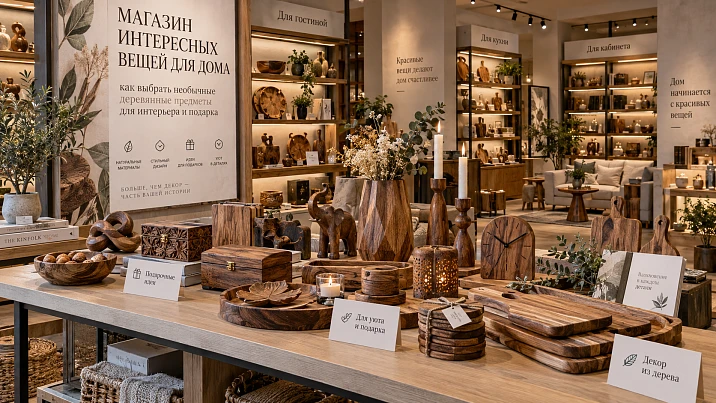
When a person is looking for interesting things for the home, they rarely need another random souvenir that will sit on a shelf for a month and then disappear into a cupboard. Usually, they want to find a small item with character that is actually used: a carved shelf, a clock, a smartphone stand, a wooden plate, or another compact item for the home.
Therefore, a good store of interesting things for the home should be viewed not as a showcase of "unusual knick-knacks," but as a catalog of specific solutions. First, the purpose is determined, then the place, the allowable size, the material, and only after that — the design, price, and availability. Unusualness is useful as long as it does not interfere with function.
STAVROS has a separate category "Home Goods". It currently features carved shelves, clocks, a smartphone stand, wooden plates, and seasonal souvenir items. At the same time, the material must be checked for each SKU: a significant part of the assortment is made of solid wood, but not all items in the category are wooden.
The working sequence for a purchase looks like this: idea → function → place of use → category → actual dimensions → material → design → SKU → availability or lead time → price → order. It works equally well for buying for yourself and for a gift.
What makes a home item truly interesting
An unusual shape quickly ceases to be an advantage in itself. An item becomes successful when four layers align: function, material, form, and context.




Function
The item is useful in some way. A shelf stores or displays things, a clock tells time, a stand holds a phone, a plate is used for serving or presenting. Even a purely decorative souvenir must have a clear role: a seasonal accent, a memory of an event, a gift.
Our factory also produces:
Material
Natural wood changes the perception of a small item more strongly than that of large furniture: on a compact piece, the grain, end grain, surface finish, and shade are clearly visible. But the material should not be idealized — it is evaluated together with the specific form and finish.
Get Consultation
Handle shape affects not only style but also usability. The website offers a variety of shapes, from traditional brackets to modern minimalist button-style handles. The choice of a specific shape depends on personal preferences and the interior style in which they will be used.
An interesting item does not have to be complex. A minimalist stand can look more expressive than an overloaded souvenir if it has clear geometry and good material. A carved shelf, on the contrary, is valuable precisely for the work of its silhouette and relief.
Context
An item has a specific place. If the buyer cannot say exactly where the item will stand or hang, the risk of an impulse purchase increases. For small accessories, this is just as important as for furniture.
A functional item or a decorative object — what to choose
The line between practical and decorative is arbitrary. A shelf both stores and decorates the wall. A clock works as a functional device and as a visual centerpiece. A wooden plate can be used for serving and remain a noticeable object on the table.
| Type | Example | Core value | The main question |
|---|---|---|---|
| Functional | Smartphone stand | Daily use | Is the item compatible with the device and the place |
| Functional and decorative | Carved shelf | Storage + interior | Does the size suit the wall and the items on the shelf |
| Decorative and functional | Clock | Accent + function | Do they clash with the wall and furniture |
| Serving | Wooden plate | Presentation + material | Does the size suit a specific scenario |
| Seasonal / gift | Wooden ball | Emotion + decor | Is there a clear reason and place for use |
Before buying, it is useful to determine what matters most in this particular item. If a stand is inconvenient for a phone, beautiful wood does not save the purchase. If a clock technically works but completely destroys the molding composition of the wall, functionality also does not solve the problem.
STAVROS home goods: where to start
Instead of browsing everything STAVROS catalog in a row, it is better to start with the task. This narrows the search several times over.
You need something for the wall
Look at carved shelves or clocks. For a shelf, the main filter is dimensions and placement. For a clock, it is the scale of the wall, the mounting method, and the visual surroundings.
You need an item for the desktop
A smartphone stand is an example of a small accessory with a clear function. It takes up little space, is used daily, and can be a gift without needing to know the exact room dimensions.
You need an item for serving
A wooden plate is a category of its own. Here, size and purpose matter more than "uniqueness": a plate for a small serving and one for a large dish are different tasks.
Need a small gift
It's better to choose a standalone item that doesn't require knowing the geometry of the wall or furniture in advance: a desktop accessory, small tableware, or a seasonal wooden object.
This is how original home goods turn from an abstract idea into a concrete shortlist.
Carved shelf: when a functional item becomes wall decor
The carved shelf is especially interesting because it works on two planes at once. It provides a small surface for storage or display and at the same time becomes part of the wall composition.
STAVROS offers various models, including PKR‑001, PKR‑012.1, PKR‑012.2, and PKR‑028.1. They differ noticeably in size, so you can't choose "by a similar photo."
What to put on a carved shelf
Small books, decorative items, photo frames, candles, collectibles — only after checking the actual usable area and permissible load of the specific model and mounting. If the load is not specified in the product card, it must not be assumed.
Where to place it
In the living room, a shelf can be an accent in a narrow wall section. In the study, it can be part of the wall above the work area. In the hallway, it can be a small spot for lightweight items. In the bedroom, it can be a decorative surface, as long as it is not above an area where accidental contact is possible.
What to measure before buying
The width of the narrow wall section, the height from the floor, the depth, nearby doors and curtains, the furniture under the shelf, outlets, moldings, and the free space around the carved silhouette.
If the task is already defined, you can go straight to the carved shelf PKR‑001 or compare it with more compact models.
PKR-001: a large shelf and real scale
PKR‑001 measures 360 × 280 × 170 mm and is available in beech and oak. These numbers immediately provide more information than a general catalog shot. The 170 mm depth makes the shelf a noticeable three-dimensional object rather than a thin wall-mounted strip.
Before buying, it is useful to cut a cardboard rectangle matching the frontal size and separately model the depth. Painter's tape on the wall shows only the outline, but not how far the item will protrude into the room.
That is why the query “buy a wooden shelf” should be refined down to a specific model and size.
PKR-012.1 and PKR-012.2: one design language — two different scales
PKR‑012.1 has a full set of dimensions 272 × 325 × 150 × 79 × 100 mm, while PKR‑012.2 — 272 × 900 × 150 × 79 × 100 mm. Visually, these are related products, but the widths of 325 and 900 mm create completely different scenarios.
The compact PKR‑012.1 one is easier to place in a small wall section or use as a single accent. The long PKR‑012.2 one already forms a horizontal wall composition.
You shouldn't choose a long shelf just because “more will fit on it.” On a narrow wall, it can visually overload the space, and next to a door it may conflict with the door casing or curtain.
PKR-028.1: a compact model with a different geometry
PKR‑028.1 has dimensions 272 × 325 × 145 × 69 × 165 mm and is also available in beech and oak. In width, it is close to PKR‑012.1, but differs in its other parameters and silhouette.
This is a good example of why “a compact carved shelf” is not yet a choice. First you need to open the specific product page PKR‑028.1, compare the actual dimensions, and decide which shape works better in the given area.
Why shelf size matters more than the photo
A catalog photo almost always shows the item up close. Two shelves can occupy the same image area on screen, even though one is almost three times longer than the other in reality.
Before ordering, follow a simple sequence:
wall size → physical template → specific SKU.
For depth, it is better to make a three-dimensional mockup out of cardboard. This is especially important near curtains, walkways, doors, and a desk.
Small or long shelf
Compact shelf
Suitable for a single item, a small wall section, and an intimate composition. It works more easily next to a mirror, a light fixture, or a doorway.
Long shelf
Creates a horizontal line and can unite several items. But it requires a free wall and a more rigorous check of the center, edge spacing, and neighboring decor.
Price should not determine this choice before geometry. Even an advantageous long model remains unsuccessful if it has no suitable wall.
Wall clocks: a functional item that can become the center of the wall
A clock is a good example of how a small household function turns into an interior accent. On an empty wall, it can work as a standalone center. In a composition with moldings or furniture, it already becomes part of a more complex system.
Before buying a wall clock, check:
- width of the free wall;
- mounting height;
- distance to the cabinet, console, or shelf;
- molding grid;
- wall panel;
- visibility of the dial from a usual viewing point;
- material of the specific model.
The last point is crucial. In the "Home Goods" category, solid wood items sit alongside products made from other materials. You shouldn't automatically call all clocks wooden just because they share a catalog with carved shelves and wooden tableware.
CHPU-001: a useful exception to the "wooden" theme
The Versailles CHPU-001 clock measures 453 × 250 × 49 mm and is made of polyurethane with white enamel. It is a standalone classic model, not a wooden item. Inside the clock is a clock capsule, and the case is mounted on the wall as an independent decorative object.
Link to the specific model: Versailles CHPU-001 clock.
For this article, the model serves as a reminder: if a customer is looking for "interesting wooden things," the material must be checked on each SKU's product page. The store category defines the use case, not automatically the same material for all products.
Clocks and molding frame: how to avoid two competing focal points
If there is already a molding frame on the wall, the clock should either clearly live inside it or be in a separate independent zone. Accidental intersection with the architectural grid looks like a coordination error.
Practical procedure:
- Measure the inner field of the frame.
- Mark the outer dimensions of the clock.
- Check whether the fields at the edges are identical or intentionally different.
- Look at the composition from the point where the wall is seen most often.
- Only after that, fix the mounting height.
If the clock turns out to be too large for the frame, it is better to choose another wall or another object rather than "slightly overlapping" the molding.
Smartphone stand: a small item with a real, verifiable function
The SUV-001 stand shows that interesting items for the interior do not have to be purely decorative. It is a compact desktop accessory made of solid wood, designed for a specific daily action — holding a smartphone at an angle.
The model measures 155 × 84 × 24 mm and has a slot width of 13 mm. The current product page offers options in oak, beech, and ash; the surface has a clear finish. This is exactly where the slot size matters more than the general verbal promise of "fits a phone."
You can view the model via the exact link: smartphone stand SUV-001.
Workbench
The stand keeps the screen visible during calls, video communication, or working with notifications. It takes up little space and does not require a separate area in the room.
Stimulates creative thinking, creates a comfortable working atmosphere.
A natural material can complement a wooden tabletop, frame, clock, or other accessories if they are already used in the office.
Bedside table
This is a scenario with a clear function: the phone has a permanent place. But before gifting, it's better to consider the user's case — the slot width creates a physical limitation.
Kitchen
The stand can hold a smartphone with a recipe or timer, but it should be placed where the accessory doesn't end up in the zone of water, steam, and active cooking.
Gift for a colleague
A compact functional accessory is easier to gift to someone whose interior you don't know well. It has no complex attachment to the wall, room size, or furniture style.
Before buying a stand, check not only the phone but also the case
If the slot has a fixed width, compatibility is determined by the actual thickness of the smartphone together with the case. A phone without a case may fit, but with a thick protective cover — no longer.
The check is simple:
- Measure the thickness of the phone with the case at its widest point.
- Compare with the slot size in the product card.
- Do not treat a "just barely" match as a guarantee of comfortable use without a physical check.
- For a gift when the case is unknown, consider the risk of incompatibility.
This is how a small accessory turns from an abstract "interior thing" into a product with a clear selection condition.
Wooden tableware: the boundary between a household item and an interior accessory
A wooden plate can be used for serving, presenting, arranging a table composition, or as a small surface for dry items. But the purpose must be checked against the specific product card and specifications, rather than transferring the properties of one model to all wooden tableware.
KU‑004 has an oval shape and in the current product table is presented in four oak sizes: 250 × 130 × 22, 300 × 180 × 22, 360 × 240 × 22, and 430 × 310 × 24 mm. This range alone shows why the query "buy wooden plate" needs to be supplemented with a usage scenario.
Card: wooden plate KU‑004.
Serving
The size is chosen for a specific portion or set of products. A large plate is not automatically "better" than a small one.
Serving
The shape should match the composition of the food. An oval geometry can be convenient for linear plating, but this should be verified with a real portion.
Decorative storage
In a dry interior scenario, the plate can be used for small items or as a standalone accent. Here, the scale relative to the table or console is more important.
Gift scenario
Natural material tableware works well as a gift when you understand that the recipient actually uses table settings or loves wooden items.
How to choose the size of a wooden plate
Start not with the catalog, but with the contents. Place the intended products or items on a regular surface, measure the rectangle they occupy, and add the necessary visual margin. Then compare with the actual product options.
For a gift, when the scenario is unknown, it is wiser to choose a medium universal format, but not to assume that it will suit any task. A large plate requires more storage space, while a small one limits serving.
Interesting things for the interior: why natural material changes perception
With a small item, the material is perceived very closely: it is picked up, the texture is seen from a short distance, and the edges and finish are noticed. That is why wood often makes an accessory visually more self-contained.
But this section should not be turned into a declaration about the “best” material. Natural wood has its own grain and variability. If the buyer wants a completely uniform surface, this very natural irregularity may be undesirable.
You should choose not “wood in general,” but a specific SKU, species, size, and finish.
Oak, beech, or ash: the material is chosen for a specific item
Oak
Visually, it often has a more pronounced wood grain and works well where the natural texture should be emphasized.
Beech
It may be perceived as calmer and more uniform. For a carved shelf or a small accessory, this gives the surface a different character.
Ash
Not available for all products. For example, SUV-001 has an ash variant, but its availability cannot be applied to carved shelves. The material is verified in the product page of a specific item.
The main principle: the wood species is part of the product configuration, not a general property of the entire section.
Original home goods: originality should not get in the way of usability
Original home goods are often chosen precisely for their unusual shape. But successful unusualness does not require sacrificing function.
Weak item:
- unclear where to place it;
- inconvenient to use;
- too large for the actual space;
- interesting only for the first five minutes;
- not connected to any material or object around it.
A strong object has a clear function, scale, place, and expressive form. This applies both to a carved shelf and to a minimalist stand.
How to choose an interesting item as a gift
A gift for the home is better chosen not by the recipient's gender, but by scenario. The phrases "gift for a man" and "gift for a woman" say little about how the item will be used. It is far more useful to understand the person's lifestyle and space.
For new homeowners
An item that is easy to integrate into a new home without complex placement is suitable: a compact shelf, wooden tableware, a clock, or a small desktop accessory. The less you know about the final arrangement, the more carefully you should choose large items.
For a colleague
A small functional accessory is safer than large decor. A smartphone stand, if it is compatible with the device, has a clear daily purpose and does not require knowledge of the interior.
For an office owner
A clock, shelf, or desktop item can work as a gift if you understand the style of the workspace. For a public office, it is especially important not to overload the interior with souvenirs.
For someone who loves to cook and serve
Wooden tableware has a clearer function than an abstract decorative object. The choice of size can be tied to a real serving scenario.
If someone asks to "buy wooden gifts," it is worth first clarifying not the recipient's gender, but the situation: housewarming, office, kitchen, desk, seasonal holiday.
How not to make a mistake with an interior gift
Five questions help filter out most risky purchases:
- Size. Does the item have a clear place?
- Style. Does it conflict with the interior?
- Function. Will the item be used?
- Material. Is natural wood or another material suitable for the recipient?
- Scenario. Is it clear where the item will stand, hang, or be used?
If the recipient's interior is unknown, a compact standalone item is safer than a large carved shelf or clock that requires a dedicated wall.
A gift for the person who "has everything"
In such a situation, you don't need to look for the most complex or expensive item. What works better is an unusual interpretation of an ordinary function: a stand instead of another souvenir, an expressive plate instead of a useless figurine, a small wooden object with a tactile material.
That is, the question "what to give to a person who has everything?" is better reframed as "which small everyday function can be made more pleasant?"
What to choose for different rooms
Work Office
An office doesn't require a large number of accessories. The principle of one or two intentional objects works especially well here.
Possible categories:
- a clock as a wall accent;
- a smartphone stand on the desk;
- a small carved shelf;
- a wooden plate or tray for small dry items — only if this matches the purpose of the specific model;
- a small seasonal souvenir.
The office wall is often already occupied by shelves, diplomas, paintings, or a screen. A new item should have its own place, not fill the last available space.
What to choose for the hallway
The hallway is compact and packed with functions. Here, an interesting piece should be especially disciplined in size.
A carved shelf can occupy a small wall section, a clock can take a free wall, and a small accessory can sit on the console surface. But before buying, you need to check the door, mirror, wardrobe, and baseboard.
If the hallway already has a large console and an expressive mirror, adding another active shelf just because you liked it in the catalog is not necessary.
What to choose for the living room
The living room has more space for an accent, but also more competing objects. A long shelf, a clock, or an expressive wooden piece can work stronger than a set of small accessories.
Before buying, find the existing focal points: TV, fireplace, sofa, large painting, mirror, panel wall. The new item should either support one of them or create a separate small composition.
What to choose for the bedroom
In the bedroom, items with a quiet function are especially useful: a small stand on the bedside table, a compact shelf, one decorative object. A clock can be appropriate if its size and placement do not create extra visual noise.
Here, the criterion of “aesthetic home goods” is better associated with a calm composition rather than with the number of decorative details.
What to choose for the kitchen
In the kitchen, a decorative item quickly comes up against real use. Surfaces are used, there is water, heat, food, cleaning. Therefore, a small wooden accessory should have a clear place outside the risky zone.
A smartphone stand is convenient for recipes and a timer, but it should not be placed next to the sink. A wooden plate can be part of serving if this matches the characteristics of the specific item and your way of using it.
An interesting thing should have one clear place
Before clicking “buy,” ask yourself one question:
Where exactly will this thing be located?
Not “somewhere in the living room,” but specifically: on the right wall section between the window and the door, on the desk to the left of the monitor, on the wall above the console, on the kitchen shelf.
If there is no answer, the purchase is probably impulsive. For small accessories, this mistake seems harmless, but it is precisely from it that visual noise appears over time.
How to check the size of an item before buying
A simple algorithm works for almost all interesting things for the interior:
- Open the product card.
- Write down the actual A × B × C and additional dimensions.
- Transfer the dimensions to the wall, table, or another surface.
- If the item is three-dimensional, model the depth with a box or cardboard.
- Photograph the mockup from a normal viewing point.
- Check neighboring items, doors, curtains, and light.
For a shelf, depth is especially important. For a clock, the frontal dimensions and height. For a stand, the dimensions of the accessory itself and slot compatibility. For tableware, the usable size relative to specific contents.
A catalog photo does not show the real scale
A product photo is optimized for viewing the item itself. It rarely shows it next to a wall of known width, a door, or a person. Therefore, a small shelf and a long shelf in product cards can both look equally "large."
Do not try to judge the size by the number of decorative curls, the thickness of the shadow, or the background of the photo. Use only the actual dimensions of the card and the drawing, if one is available.
How to combine small items with STAVROS architectural decor
The connection with the site's main assortment does not arise because moldings or panels need to be sold additionally. It arises in a real interior: a small item exists on a wall, table, or background that has already been styled.
Several scenarios:
- molded wall + clock — the clock fits into a separate field;
- console + carved shelf — the vertical interval and scale are checked;
- wooden baseboard + item in a similar wood tone — the actual finish is compared;
- panel wall + one accent item — the piece does not block the panel's main rhythm.
If the architectural background is already active, the accessory is better kept calmer. And conversely, on a neutral wall, a small expressive piece gets more visual freedom.
When one unusual item is better than five accessories
A focal point helps a room look put together. One expressive item is easier to place, coordinate with the architecture, and support with material.
Five different accessories require five decisions: where to place them, how to connect them, which one is the main piece, and whether their function is duplicated. If each one tries to be the focal point, the interior loses its hierarchy.
That's why beautiful interior pieces shouldn't automatically be collected into a set. Sometimes a single carved shelf on a calm wall works better than a whole collection of small objects.
How to read a product card in a store of interesting things for the home
The product card is the main document before ordering. Check:
- exact name;
- SKU;
- actual dimensions;
- the material;
- available finishes;
- availability;
- production time, if the item is made to order;
- the price of the selected configuration;
- delivery conditions;
- a technical drawing, if one is needed for placement.
If one item is available in several materials or sizes, the price of the neighboring option does not automatically apply to your choice.
In stock or made to order: two different purchase scenarios
Item in stock
You can order a specific available configuration after checking the size and material. Availability changes, so check the current product page before paying.
Item made to order
First check the lead time for the specific SKU and finish you have chosen. You cannot apply the lead time of another model to the entire section.
If the item is being bought as a gift for a specific date, a time buffer is especially important: besides manufacturing, there is also delivery.
How to buy unusual items online
The query “interesting things for the home online store” assumes that the buyer makes a decision without physical contact. That means technical details become more important.
Algorithm:
category → function → actual size → material → product page → availability → price → delivery → order.
If a website shows only beautiful photos but does not let you understand the dimensions and material, the risk of error is higher. For natural wood, it is also advisable to look at close-up photos of the surface and take natural variation into account.
How to put together a small gift set
A gift set does not have to consist of five items. The more random souvenirs there are, the higher the chance that some of them will be unnecessary. One main item and one small additional item work better.
For example:
- wooden plate + compact desktop accessory;
- smartphone stand + small seasonal souvenir;
- carved shelf as the main gift without additional items;
- a clock as a standalone accent.
These are not ready-made STAVROS product sets, but the logic of selecting items yourself. If the store does not officially sell a set, it should not be presented as a ready-made SKU group.
How to choose a gift if the recipient's interior is unknown
The less information there is about the interior, the more self-contained the gift should be. A large wall shelf requires free wall space. A clock requires space and stylistic compatibility. A smartphone stand or small tableware depends less on the room.
A useful risk scale:
| Gift type | How much you need to know about the interior | Main risk |
|---|---|---|
| Stand | Low | Smartphone / case compatibility |
| Wooden plate | Low–medium | Size and usage scenario |
| Seasonal souvenir | Low | Personal preferences |
| Clock | Medium | Free wall and style |
| Carved shelf | High | Size, installation, wall architecture |
If you want to buy a wooden gift for someone whose home you barely know, a compact tabletop or serving piece is usually safer than a wall-mounted one.
A seasonal souvenir: when a small item is truly appropriate
In the STAVROS home goods category, there are wooden Christmas ornaments. This is an example of an item that does not need to justify itself with an everyday function: its purpose is a seasonal emotion and a decorative scenario.
But even here, it is useful to understand the context. A single wooden ornament can be part of a calm, natural Christmas tree arrangement or a standalone gift object. A large set is worth buying only if you truly want a repeating motif.
Modern and classic collections: how to use them as a filter
If the buyer does not yet know a specific SKU, the collection helps narrow down the visual language. STAVROS separately shows the modern collection и the classic collection, and a broader list can be found in the collections catalog.
But a collection is a filter, not a mandatory set. The SUV-001 stand may appeal to someone with a modern interior, while a separate carved shelf can work as a contrasting accent. You don't need to furnish a room using only items from a single section.
Classic carving in a modern interior
Contrast works when it is deliberate. A carved shelf on a smooth neutral wall can look more expressive than against a backdrop of five other classic elements.
To keep such an item from looking random, it helps to support it with at least one parameter: the color of the wood, the material of the furniture, the shape of the frame, the character of the light fixture. A complete stylistic match is not required.
A minimalist item in a classic interior
The reverse scenario is also possible. A small modern solid wood stand does not necessarily conflict with a classic study. The material can connect it to wooden furniture, and the calm shape will not compete with carved decor.
This shows why "style" should not be the only filter. Function and material often connect things more strongly than formal belonging to a collection.
How to test an item next to existing furniture
Before buying, photograph the actual area and mark the spot for the new item. For a shelf — the height and width. For a clock — the outer dimensions. For a stand — the place on the table. For a plate — the storage or serving surface.
Then answer three questions:
- Does the new item duplicate the function of an existing one?
- Does it create a second visual focal point in a small area?
- Is there a material or color connection with at least one neighboring element?
If the answers are negative, an "interesting thing" may remain interesting only in the catalog.
What to do if you like an item but there is no place for it
The most economical option is not to buy. The second is to find a smaller equivalent. The third is to move the idea to another room.
You should not free up space by removing a more necessary function. For example, you should not narrow a passage for a shelf or remove working storage for a decorative object.
How to compare two carved shelves
If you like two models equally, create a simple table:
| Parameter | Shelf A | Shelf B |
|---|---|---|
| Width | By card | By card |
| Depth | By card | By card |
| Height / decorative dimensions | By card | By card |
| Material | Selected option | Selected option |
| Role on the wall | Single accent / horizontal | Single accent / horizontal |
| Nearby items | What's nearby | What's nearby |
| Lead time / availability | Check | Check |
After such a check, the aesthetic choice remains between genuinely suitable items, not between two beautiful photographs.
When it is better not to buy a carved shelf
Refusal is reasonable if:
- it is not confirmed that the wall is suitable for the intended installation;
- the permissible load is unclear, and you plan to place heavy items;
- the depth interferes with passage or curtains;
- the shelf blocks a switch or light;
- there is already too much active decor nearby;
- there is no specific function or items that will be placed on it.
The phrase "the shelf is beautiful" does not override technical limitations.
When it's better not to buy a clock
If there is no free wall in the room and the clock would have to be placed on top of an existing composition, it is wiser to choose a different accessory. The same is true if the mechanism and appearance do not match the purpose of the room.
For the CHPU‑001 clock, keep in mind separately that this is a polyurethane model. If the gift or interior task is specifically framed as “natural wood,” you need to choose a different SKU.
When a smartphone stand is not suitable
SUV‑001 has a 13 mm slot. Therefore, a thick phone with a protective case needs to be measured. If the device does not fit in thickness, a beautiful accessory will not solve the main function.
For a gift, when the phone model and case are unknown, this risk is better taken into account in advance.
When a wooden plate is not the best gift
If you do not know whether the person uses tableware and likes wooden dishes, a large plate may turn out to be too specific. In that case, a compact functional accessory is more neutral.
Also, you must not invent universal food compatibility. The method of care and use must be checked for the specific model and coating.
How to choose an item for a budget without starting from the price
Price is a mandatory filter, but placing it first is not always useful. First determine the acceptable type and size. Then, within the suitable shortlist, compare cost.
Otherwise, you might buy a cheap long shelf that doesn't fit the wall and get zero utility. Or reject a compact model because of a higher price, even though it solves the problem without modifications.
The price of the selected configuration and the "from" price are different things
On product cards with multiple materials or sizes, the price depends on the specific configuration. Therefore, the order must clearly show which SKU, size, and material were selected.
For KU‑004, the four sizes have different prices. For carved shelves, beech and oak may also differ
A store for interior items: how to separate small accessories from furniture
The query "store for interior items" can lead to both a console and a small stand. For the buyer, it is useful to separate the two levels.
Large standalone pieces — consoles, side tables, benches, mirrors — require a full-fledged zone and affect the layout. They are best viewed in the furniture and interior items section.
Small ready-made items — shelves, clocks, stands, wooden plates, souvenir products — belong to a different scale of purchase. They can refresh the interior without rearranging the entire room, but they still require a specific place.
So this new article does not repeat the buyer’s guide on consoles and side tables: the central question here is which small item will actually be used and where it will be placed.
How to buy interior items and not end up with a random set
If you want to buy interior items for several zones at once, divide them by purpose:
| Zone | Function | Candidate | What to measure |
|---|---|---|---|
| Work desk | Phone placement | SUV‑001 stand | Phone with case, free table area |
| Small partition wall | Shelf / accent | PKR‑012.1 or PKR‑028.1 | Width, depth, neighboring elements |
| Long free wall | Horizontal composition | PKR‑012.2 | Wall width and outer margins |
| Office | Time + accent | Clock | Wall dimensions and style |
| Table / table setting | Serving | KU‑004 | Size of the intended serving |
This table has no mandatory “set.” Each zone can have one item or none.
Beautiful things for the interior: beauty is tested in context
Beautiful things for the interior are easy to evaluate on their own, but a real interior always adds context. Stylish interior items for the home become convincing not because of the label “stylish” itself, but when scale, function, and material match a specific zone. Wall color, the rhythm of moldings, nearby furniture, and lighting change the impression of a product.
Therefore, a photo on a white background only answers the question "do I like the item itself." A photo or mockup in your space answers the more important one: "do I like it right here."
Creative home products: where the idea ends and inconvenience begins
A creative shape is useful if it doesn't impair use. A stand should hold a smartphone securely, a shelf should have a real surface, a clock should remain readable, and tableware should match its intended scenario.
If the unusualness makes an item difficult to store, install, or use daily, the buyer must consciously accept that trade-off. There's no need to hide it behind the word "designer."
Aesthetic home products and the principle of repeating material
One of the simplest ways to fit in a small item is to repeat an existing material. If there's an oak table in the room, a small oak accessory gains a visual connection without needing an exact style match.
The same rule works with beech or other wood. But the shade and finish may differ, so "both made of oak" doesn't guarantee a perfect color match.
Natural texture or painted finish
Some items benefit from visible wood grain. Others can be integrated through paint. The choice depends on the specific SKU and available finish.
You shouldn't decide in advance to "keep everything wooden natural." If a shelf should blend into the wall color, a painted finish may make more sense. If a stand is bought for its tactile wood feel, then, conversely, the natural texture becomes part of the item's meaning.
How to choose a piece for a classic interior
Classics allow for elaborate carving, but that doesn't mean every accessory has to be carved. If the room already has an intricate cornice, frame, and furniture, an additional small piece can be more subdued.
For an initial selection, you can open the classic collection, and then go to a specific product page and check the dimensions.
How to choose a piece for a modern interior
In a modern space, pieces with a clear function and a simple silhouette work especially well. The SUV‑001 stand is an example of a piece where the unusual quality comes from the material and form, not from elaborate carving.
But a modern interior doesn't rule out a classic accent. If a carved shelf is used alone on a calm wall, the contrast can be striking.
How to choose a piece for an existing collection of objects
If you already have several wooden accessories at home, a new piece should be compared not only by style but also by scale. Three small items next to each other can turn into a visual scattering; one larger piece sometimes brings the composition together better.
It's convenient to photograph the existing group and add the new item in a simple collage. This is faster than buying in the hope that "we'll rearrange it later."
When a small item becomes too large
Even an "accessory" can take up a significant part of a surface. A long 900 mm shelf already requires its own wall. A 453 mm tall clock is a noticeable wall object. A large wooden plate 430 × 310 mm requires space on the table and storage.
That is why the "small things" category does not cancel out exact dimensions.
When it is better to choose a compact item
A compact item is more convenient if:
- the recipient's interior is unknown;
- the space is small;
- the gift needs to be transported easily;
- the area already has large accents;
- you want to first test the material and style on one small object.
This is especially sensible for a first introduction to the range.
How to choose an item for a housewarming
At a housewarming, people often still rearrange the layout. That is why a large shelf that requires drilling and a dedicated wall is riskier than a compact stand or a serving item.
If you know the new home's layout well, the choice can be more precise: a shelf for a specific wall section or a clock for a predetermined spot.
How to choose an item for a business gift
A business gift works best when it is functional and does not require guessing someone's personal interior. In this sense, a desk accessory is safer than active wall decor.
Do not promise custom engraving or branding unless the specific product page or manufacturer confirms it. Commercial copy must stay within the bounds of actual options.
How to choose an item for someone who loves natural materials
Here it makes sense to look at solid wood pieces and pay attention to the species and finish. A stand, shelf, or tableware offer different kinds of contact with wood: a desk accessory is more often picked up, a shelf is perceived from a distance, and a plate is used in serving.
That is, a love of natural wood does not yet determine the category — function comes first.
How to move from "buy unusual things for home" to a specific SKU
A broad query needs to be narrowed down in five steps:
- Choose the scenario: a gift or a purchase for yourself.
- Define the function: wall, table, table setting, seasonal decor.
- Set the acceptable size.
- Choose the material and the design character.
- Go to the specific product page and check availability, price, and lead time.
This way, the query "buy unusual things for home" stops being an endless browsing of catalogs.
How to move from "buy interesting things for interior" to a purchase
For the query "buy interesting things for interior", one more filter is added: the architectural surroundings. The item must pass the check of the wall, furniture, and other accents.
If an item fits functionally but visually conflicts with the interior, look for a different material, size, or category. If it is visually perfect but does not fit, also pass on it.
The cause — each item individually seems interesting. The consequence — the focal point disappears. Keep one main object, and the rest either support it or do not participate in the composition.
Common mistakes when buying unusual items for the home
Collecting too many accents in one area
The cause — the link was checked during the initial selection. The consequence — by the time of ordering, the commercial terms are already different. Before paying, reopen the product page for the selected configuration.
Treating the old price and availability as permanent data
The cause — the recipient's interior and scenario are unknown. The consequence — a large item cannot be placed. If there is little information, prioritize a self-contained compact item with a clear function.
Choosing a gift based only on appearance
The cause — the photo mainly shows the front. The consequence — the shelf interferes with the curtain, passage, or furniture. For a three-dimensional wall-mounted item, make a cardboard mockup of the depth, not just an outline with painter's tape.
Ignoring the depth of a wall-mounted item
The reason — most neighboring products are made of solid wood. The consequence — the buyer receives an item made of a different material, although they expected a wood texture. Check the material of the specific SKU: for example, SUV‑001 is made of solid wood, while CHPU‑001 is made of polyurethane.
Assuming the entire category is wooden
The reason — the item was liked separately from the interior. The consequence — the piece moves from shelf to shelf and never looks convincing anywhere. Before ordering, identify a specific wall, table, or area and transfer the real dimensions there.
Buying without a specific place
STAVROS, a store of interesting things for the home: how to move from an idea to an order
The final commercial path should be short. If you already understand the function and the place, open the category STAVROS “Home Goods”, choose the product type and compare only real product cards.
Work sequence:
function → category → specific SKU → real dimensions → material → finish → availability or lead time → price → delivery → order.
This is how a store of interesting things for the home turns from an emotional showcase into a clear shopping tool.
Final checklist before ordering
| Check | Yes / no |
|---|---|
| The item has a specific function or a deliberate decorative role | |
| The exact place of use is clear | |
| Actual dimensions transferred to the wall / table / surface | |
| Depth checked if the item is three-dimensional | |
| SKU selected | |
| Material verified against the product page | |
| A specific finish selected | |
| The item does not conflict with furniture and architectural decor | |
| The price corresponds to the correct variant | |
| Availability or lead time checked | |
| Delivery fits within the required date |
If several answers remain uncertain, it is better to postpone the order. This is especially useful for wall-mounted items, which require dedicated space and installation.
FAQ: unusual and interesting things for the home
Where to buy interesting things for the home?
STAVROS has a separate category "Home Goods" with carved shelves, clocks, a smartphone stand, wooden tableware, and seasonal items. It is better to choose based on function and size, not on the overall impression from the photo.
What unusual things can you buy for the interior?
A carved shelf, wall clock, wooden smartphone stand, wooden plate, or a small souvenir. The category depends on where the item will be used: on the wall, on the table, in table setting, or as a gift.
What to give to someone who has everything?
It is better to look for an unusual take on an ordinary function. A compact desktop accessory or a table setting item is often more practical than a random decorative souvenir. If the person's interior is unknown, avoid large wall-mounted items.
What original wooden home goods are there?
The current STAVROS catalog includes carved shelves made of beech and oak, the SUV‑001 stand in oak, beech, or ash, wooden plates, and seasonal wooden items. However, the material of each SKU must be checked separately.
Where can I buy a wooden shelf?
In the home goods section and on the specific product pages for PKR‑001, PKR‑012.1, PKR‑012.2, and PKR‑028.1. Before ordering, compare the width, depth, height, and available wall space. Do not rely only on the price or the photo.
What should I choose for a desk?
A small functional item — for example, a smartphone stand. For the SUV‑001, it is important to check that the phone fits together with its case into the 13 mm slot.
Which wooden items are suitable for a gift?
Compact desktop accessories, wooden tableware, a small seasonal souvenir. A carved shelf can also be a gift if you know exactly where it will be installed and what the recipient's interior is like.
How do I choose the size of a decorative shelf?
Measure the wall section, transfer the front dimensions onto the wall, and model the depth separately. For long models, check the end margins, curtains, doors, and adjacent furniture. If it will bear a load, do not guess the allowable weight — rely only on confirmed data.
Can STAVROS products be purchased online?
Catalog cards let you select specific items and place an order. Before payment, check the current configuration, availability, price, and delivery terms.
Where can I check availability and price?
On the card of the specific item. Availability and price may change, so saved old data should not be considered valid for a new order.
How is an “interesting thing” different from a souvenir?
Not necessarily different. A souvenir can also be a good thing if it has a clear occasion and place. But for everyday interiors, functional value usually increases the likelihood that an item will actually be used.
Can a carved shelf be combined with a modern interior?
Yes, if it is used as a deliberate accent and does not compete with several other active objects. A calm modern background often emphasizes a carved silhouette more strongly than a cluttered classic wall.
What to choose: oak or beech?
There is no universally best wood species. Compare the available finish of the specific SKU, the texture, and neighboring materials. If an exact color match is needed, a physical sample or a real photo of the surface is more useful than the name of the wood species.
Can wall clocks be given as a gift if the interior is unknown?
Yes, but it is a riskier gift than a compact desktop accessory. Clocks require a free wall and stylistic compatibility. Also, the material of the model should be checked: for example, CHPU‑001 is made of polyurethane, not wood.
How do you know when something isn't worth buying?
If it has no specific place, duplicates a function you already have, blocks passage or architecture, or you can't verify the material and size. Turning down an unsuitable item is a normal part of making a good choice.
Bottom line: unusualness starts with function, not form
Strong, interesting pieces for the home don't need a long explanation of why they're needed. A stand holds a phone. A shelf provides a small surface and works with the wall. A plate is part of the table setting. A clock tells the time and creates a focal point. A souvenir is tied to a specific occasion.
Material and form make these functions expressive, but they don't replace them. That's why a good choice is built like this:
purpose → specific place → real size → material → design → SKU → availability → price → order.
This approach is especially useful for those who want to buy interesting pieces for the interior online. Instead of endlessly browsing "pretty little things," you compare items that actually suit your wall, table, office, kitchen, or gifting scenario.
If you need a small ready-made item, start with the "Home Goods" category. If the task already involves a console, table, bench, or other large furniture, move to the dedicated furniture section. That way the interior doesn't mix different scales of purchases, and each piece gets a clear place and function.