Article Contents:
- What is the round tabletop ST-030
- Confirmed specifications of ST-030
- How to read the three parameters of ST-030
- Can the shape be determined only by dimensions
- First read the name, then the dimensions
- Check the outer contour
- Do not rely on the bounding box
- Specify the shape in each working document
- Outer contour
- Center position
- Edge thickness and profile
- Mounting area
- Work order in the program
- How to check the scale
- When project assistance is needed
- Simple circular template
- Why you shouldn't limit yourself to four extreme points
- Add chairs and people movement
- Measure not only the tabletop
- Consider the shape of the backrest
- Check the knee space
- Dining table
- Coffee table
- You can't change the purpose just by naming it
- What to request for the base
- Central base
- Frame with multiple supports
- How to check the pair correctly
- When the simple formula does not work
- Visual and mounting overhang
- Center Marking
- Check before drilling
- The mounting plane is smaller than the outer contour
- Edge finishing requires attention
- The bevel affects the shadow
- Why an MDF base is needed
- What solid wood edging is used for
- What natural veneer provides
- Comparison of Options
- When oak makes sense
- When beech is suitable
- Separate dining room
- Living Room
- Meeting room or office
- Set for different tasks
- Do not buy parts separately without an overall scheme
- Round shape
- Square shape
- Rectangular shape
- The table should stand in the center of the room
- The table is placed near the wall
- The base has already been purchased
- The project already specifies a square tabletop 1148 × 1148 mm
- Need a table with the same finish as other furniture
- There are doubts between several sizes and shapes
- Mistake 1. Equal sizes were taken as the sides of a square
- Mistake 2. The tabletop article number was taken as the number of the compatible frame
- Mistake 3. The outer diameter was taken as the mounting area
- Mistake 4. The tabletop was called solid wood
- Mistake 5. The wood species was chosen separately from the base
- Mistake 6. The space was checked without chairs
- Mistake 7. The base height was simply added to 24 mm
- Mistake 8. The fasteners were chosen based on the tabletop thickness
- Error 9. The shade was chosen by name
- Error 10. Didn't check the packaging and delivery
- Basic information
- Questions to Ask
- Step 1. Open the ST-030 card
- Step 2. Compare the countertops
- Step 3. Choose the base
- Step 4. Check the drawings
- Step 5. Agree on materials
- Step 6. Confirm the set
- Step 7. Refine the receipt
- What to measure
- Where to unpack
- Check the marking
- Inspect the packaging
- Inspect the contour and planes
- Re-check the size
- Is ST-030 really round?
- Why does the round tabletop have two identical sizes listed?
- What is the diameter of ST-030?
- What does the third size, 24 mm, mean?
- Is ST-030 made of solid oak?
- Is there a beech version?
- Can ST-030 be considered a wooden tabletop?
- Will ST-030 fit the STL-030 frame?
- Can ST-030 be placed on a central pedestal?
- How many people can sit at the table?
- How to check the size in a room?
- Can I simply unfold the 1148 × 1148 mm square?
- What is a beveled profile?
- How to calculate the overhang?
- Can I choose fasteners myself?
- How to choose between oak and beech?
- Will solid wood and veneer look the same after tinting?
- Is ST-030 suitable for a coffee table?
- Is ST-030 suitable for a dining table?
- Is the underframe included in the set?
- Where can I see the price of ST-030?
- How can I check availability?
- How is the tabletop delivered?
- What to check upon receipt?
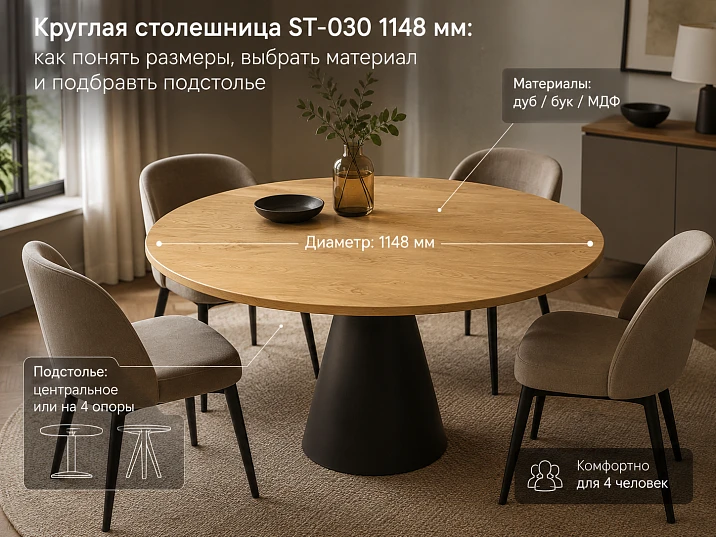
For the round tabletop ST-030, the table lists three parameters: 1148 × 1148 × 24 mm. The first two numbers are the same, so a buyer, designer, or furniture maker might mistake the product for a square panel with sides of 1148 mm. But ST-030 is round in shape. The equal values indicate its maximum width and depth, i.e., the outer diameter measured in two mutually perpendicular directions.
At first glance, this is a minor detail in the description. In practice, the entire table project depends on correctly reading the dimensions. If you transfer a square instead of a circle into the plan, the assessment of walkways, chair placement, distance to the wall, and the visual mass of the furniture will change. The error can carry over into the estimate, the base drawing, the installation diagram, and the order.
Round tabletop ST-030 is suitable for dining and coffee tables. It has an outer size of 1148 × 1148 mm, a thickness of 24 mm, and a beveled profile. The product is available in a combined construction: an MDF base is combined with a solid wood contour edging and veneered surfaces. Options with oak and beech are available.
Before buy round tabletop ST-030 1148 mm, it is not enough to check only the outer diameter. You need to match the shape of the tabletop with the room dimensions, select a base, calculate the overhang, check the installation area, determine the future table height, and choose the wood species to match the finish of other parts.
This article will help you go through the entire process without guessing: from reading the line "1148 × 1148 × 24 mm" to preparing a clear task for a STAVROS manager.
What is the round tabletop ST-030
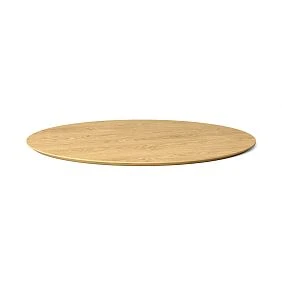
ST-030 is a ready-made round furniture tabletop with a beveled profile. It can be used as the top part of a dining or coffee table. The specific purpose of the finished furniture is determined not by the tabletop alone, but by the height, proportions, and design of the chosen base.
The model cannot be called a solid wood slab. Its construction combines several materials:
-
MDF is used as the base;
-
the outer contour has a solid wood edging;
-
the surfaces are veneered with wood veneer;
-
The species of exterior wooden elements and veneer may be oak or beech.
Such a design is important to consider when selecting, specifying, and approving the finish. The phrase "round wooden tabletop" reflects the appearance and presence of natural wood, but should not create a false impression that the entire thickness of the product is cut from a solid oak or beech board.
It is useful for the buyer to immediately separate three questions:
-
What does the finished surface look like?
-
What materials is the structure assembled from?
-
How will the tabletop be connected to the base?
The first question is answered by the photo and the selected wood species. The second is answered by the composition description. The third cannot be answered without a drawing of the tabletop and technical data of the underframe.




Confirmed characteristics ST-030
| Parameter | Value | What the buyer should check |
|---|---|---|
| Article number | ST-030 | Specify the article number in all requests, estimates, and drawings |
| Product type | Furniture tabletop | Do not confuse with a ready-made table or furniture set |
| Shape | Round | Transfer a circle to the plan, not a square |
| Size | 1148 × 1148 × 24 mm | Read the first two parameters as the outer dimensions of the circle |
| Outer diameter | 1148 мм | Check the space in the room and the size of the base |
| Radius | 574 мм | Use when marking the contour from the central point |
| Thickness | 24 мм | Consider when selecting fasteners and calculating the total height |
| Profile | Beveled | Check the boundary of the flat mounting area from below |
| Base | MDF | Do not describe the product as a solid slab of array |
| Contour | Array edging | Coordinate the wood species and future finish |
| Planes | Veneered with wood veneer | Consider the direction and character of the natural grain |
| Material option | Oak / MDF / oak veneer | Match to oak legs, frame, and other elements |
| Second option | Beech / MDF / beech veneer | Match to beech base or specified tint |
| Sanding | «Prestige» | Clarify requirements for further finishing |
| Application | Dining and coffee tables | Purpose to be determined together with the height of the base |
| Packaging | Rigid box | Check the delivery route before delivery |
The table helps to see the main thing: size, shape, material, and mounting method are different characteristics. One value does not replace the others. Diameter does not indicate the mounting device, the word "oak" does not mean solid wood, and identical dimensions A and B do not turn a circle into a square.
Our factory also produces:
Why the size 1148 × 1148 mm does not mean a square
In furniture catalogs, dimensions are often written as width, depth, and thickness. For a rectangular tabletop, the first two numbers indeed correspond to the lengths of the two straight sides. If the values are equal, the rectangular product will be square.
A circle has no straight sides, but it has a maximum width and a maximum depth. Both values are equal to the diameter. Therefore, a circle with a diameter of 1148 mm occupies 1148 mm in width and also 1148 mm in depth.
Imagine a square frame measuring 1148 × 1148 mm. A circle is inscribed in it, touching the frame on the left, right, front, and back. The distance between the left and right points of the circle is 1148 mm. The distance between the front and back points is also 1148 mm. These are the dimensions reflected in the table.
But the corners of the frame do not belong to the tabletop. If you transfer the entire square to the project, a non-existent surface will appear in the four corner areas. The table will look larger, and the free passages will appear narrower than they will be after assembly.
Get Consultation
How to read the three parameters of ST-030
The entry 1148 × 1148 × 24 mm should be understood as follows:
-
1148 mm is the maximum external dimension along one axis;
-
1148 mm is the maximum external dimension along the perpendicular axis;
-
24 mm is the thickness of the tabletop.
The first two dimensions describe the bounding size of the round product. The third shows the vertical dimension of the part.
The radius of the tabletop is equal to half the diameter:
1148 ÷ 2 = 574 mm.
For room planning, the value of 574 mm is more convenient than the full diameter. It is enough to determine the center of the future table and measure 574 mm from it in different directions. The resulting points form the actual outer contour.
Can the shape be determined only from the dimensions
No. Equal width and depth are found in circles, squares, and some symmetrical shaped products. Therefore, the shape must be confirmed from multiple sources:
-
the exact product name;
-
photographs;
-
the top view;
-
the outer contour on the technical drawing;
-
the dimension line labels;
-
the profile description;
-
the article number of the specific model.
If the estimate only states "1148 × 1148 × 24 mm", the entry is incomplete. The shape and article number should be added: "round furniture tabletop ST-030, outer diameter 1148 mm, thickness 24 mm".
Such wording leaves no room for misinterpretation.
How not to confuse ST-030 with a square tabletop
It is easier to prevent an error than to fix it after the base has been manufactured. You don't need to be an engineer for this. It is enough to give up the habit of determining the shape by matching two numbers.
First read the name, then the dimensions
The name answers the question "what is it?", and the dimension answers "how much space does it take?". The order should not be changed.
If the card says "round tabletop", two identical dimensions describe the diameter along different axes. If a square tabletop is specified, the same numbers will be the lengths of the sides.
Check the outer contour
In the top view of ST-030, a continuous circle should be readable. A square product will have four straight sides and four corners. Even if the photo is taken at an angle and the circle appears oval, the technical top view removes perspective distortion.
Do not rely on the bounding rectangle
Furniture and graphic programs often place a round object in a rectangular frame. The size of this frame will indeed be 1148 × 1148 mm. But the frame is needed for moving, scaling, and snapping the object. It does not show the physical surface of the tabletop.
Specify the shape in every working document
The word "round" must be present:
-
in the designer's assignment;
-
in the furniture specification;
-
in the supplier request;
-
in the estimate;
-
in the installation drawing;
-
in the file name;
-
in the message to the manager;
-
in the assignment to the base manufacturer.
The article number ST-030 must also be preserved. The description "tabletop 1148" is not sufficient: the same size can occur in products of different shapes and constructions.
Where to find the ST-030 drawing and what to check on it
A photograph helps assess the appearance, but a technical drawing is needed for design. It must show not only the circumference, but also the profile, thickness, axis designations, and available information about the bottom plane.
On the website, you can download the ST-030 drawing and compare it with the selected underframe. The drawing should be checked before ordering the base, not after holes have been drilled in it.
Outer contour
The first question: does the line of the outer edge actually form a circle? If the answer is yes, equal A and B refer to the maximum dimensions of the circle.
Do not draw straight sides between the extreme points of the dimension lines. These lines are for measurement, not for describing the shape.
Center position
The center of a round tabletop is a key point of the project. The radius is measured from it, the base is positioned relative to it, and the uniform overhang is checked against it.
If the center of the tabletop and the center of the underframe diverge, one side will protrude more than the other. Even a slight offset is clearly visible on a round table, especially with a central base.
Thickness and edge profile
The third parameter ST-030 is 24 mm. However, the beveled profile means that the cross-section of the edge is not a simple rectangle with a height of 24 mm.
The drawing needs to determine:
-
which side the bevel starts from;
-
how far it extends toward the center;
-
where a flat surface remains at the bottom;
-
whether the mounting plate falls into the sloped part;
-
which section of the edge will be visible after assembly.
Without profile dimensions, it is impossible to independently assign the exact width of the mounting zone. The outer diameter of 1148 mm is not equal to the diameter of the guaranteed flat bottom area.
Mounting zone
Mounting points should be located where the tabletop structure and base shape allow for a secure connection. They cannot be chosen solely based on the convenience of screwdriver access.
For verification, you need:
-
drawing of the upper part of the underframe;
-
hole locations;
-
distance between mounting points;
-
offset of holes from the edges of the mounting plate;
-
allowable mounting depth;
-
structure of the underside of the tabletop;
-
recommendations for the specific base.
If this data is not available in the open drawing, the request should be forwarded to the manager. Guessing at the mounting stage can damage an already finished tabletop.
How to transfer a circle with a diameter of 1148 mm into a design project
The correct object is built from the center. First, the central point is determined, then a circle with a radius of 574 mm is created around it.
This method is suitable for professional software, a simple plan on paper, and marking directly in the room.
Work order in the program
-
Mark the center of the future table.
-
Create a circle with a diameter of 1148 mm.
-
Check the project scale.
-
Place the base as a separate object.
-
Align the center of the base with the center of the tabletop.
-
Place the chairs in the pushed-in position.
-
Show the chairs after pulling them out.
-
Check the opening of doors, drawers, and adjacent cabinets.
-
Measure the passages along the actual arc of the countertop.
-
Remove the bounding square from the working view so it does not affect space assessment.
Pay special attention when working with imported files. Sometimes a circle displays correctly, but its bounding box remains square. This box must not appear in the construction plan as a furniture outline.
How to check the scale
After import, measure the object's diameter within the program. It should be 1148 mm. Do not rely solely on the file name or scaling percentage.
If the size differs, there are three possible reasons:
-
the program used different units of measurement;
-
the file was inserted as an image and scaled manually;
-
the object changed during transfer between formats.
It's better to adjust the scale before placing the base and chairs. Otherwise, all related distances will have to be recalculated.
When you need help with a project
The check is especially useful if:
-
the table must be positioned strictly under the ceiling light;
-
the base has a complex shape;
-
there is a kitchen island nearby;
-
a round tabletop fits into a tight dining area;
-
the furniture position is related to the floor pattern;
-
several items need to be coordinated within a common system;
-
the project involves non-standard mounting.
In such situations, you can check the round ST-030 in the project, having previously provided the room dimensions, layout plan, base model, and desired height of the finished table.
How to make a template for a round tabletop in a room
The plan on the screen does not always convey the real sense of scale. Before purchasing, it is useful to mark the outline on the floor. But you cannot lay out a square of 1148 × 1148 mm: its corners will create a false impression of crampedness.
Simple circular template
For marking, you will need a center mark, a cord 574 mm long, and removable pieces of masking tape.
Procedure:
-
Determine the center of the future table.
-
Secure one end of the cord at the center point.
-
Measure 574 mm.
-
Tighten the cord.
-
Mark the edge of the tabletop in several directions.
-
Connect the marks with a smooth arc.
-
Check the distance to walls and furniture.
-
Add outlines of chairs to the floor.
To understand the shape, eight or twelve marks are enough. Four of them are placed along the main axes, the rest between them.
Why you shouldn't limit yourself to four extreme points
Four points show width and depth, but poorly convey the arc. A person continues to mentally see a square. Intermediate points help to notice how much the circle recedes from the corners of the bounding frame.
It is in diagonal directions that the round shape frees up space compared to a square tabletop of the same maximum dimension.
Add chairs and people movement
The tabletop contour is just the beginning of the check. Nearby, you need to mark:
-
the position of the chair's front legs;
-
the position of the backrest;
-
the trajectory of pulling the chair out;
-
space for a person sitting down or standing up;
-
the main walkway;
-
opening cabinet fronts;
-
room door;
-
drawers;
-
the edge of the rug, if it has already been chosen.
Such a template answers the practical question: whether it will be convenient to use the table, not just whether a circle with a diameter of 1148 mm fits between the walls.
How to assess the space around a round table
It is impossible to name a universal amount of free space without a room plan, chair dimensions, and usage scenario. A compact chair without armrests and a deep armchair require different amounts of space. A passage used constantly should be assessed differently than an area near a blank wall.
Therefore, the calculation is based on the specific furniture.
Measure not only the tabletop
For the check, you will need four contours:
-
round tabletop;
-
base;
-
pushed-in chair;
-
pulled-out chair.
First, place the tabletop and the under-table. Then position the chairs as they will be most of the time. After that, pull each chair back to the position where a person can sit.
Only now measure the remaining passage.
Consider the shape of the backrest
For some chairs, the seat goes almost completely under the tabletop, but the backrest remains far from the edge. For other models, front legs or armrests prevent moving closer.
Therefore, the size of the chair from the card does not always equal its actual protrusion relative to the table. A fitting based on the plan or a real sample is needed.
Check the knee space
The outer diameter of the tabletop does not show how much free space will remain underneath it. Comfort is affected by:
-
the width of the upper part of the base;
-
placement of supports;
-
presence of crossbars;
-
the shape of the central column;
-
the direction of the legs;
-
the distance from the edge of the tabletop to the obstacle below.
A wide tabletop can provide enough space on top, but an uncomfortable underframe will limit seating. Therefore, the number of seats cannot be promised based only on the diameter of 1148 mm.
How to choose the purpose: dining or coffee table
The ST-030 card specifies use for dining and coffee tables. The difference is determined by the height and base construction.
The same tabletop can look different:
-
on a high base it becomes the center of the dining area;
-
on a low frame — a large coffee table;
-
on an expressive central pedestal — an accent piece in the living room;
-
on a calmer base — part of a restrained furniture composition.
Dining table
For the dining option, you need to coordinate:
-
the total height of the finished table;
-
the thickness of the tabletop 24 mm;
-
the height of the pedestal;
-
the height of the seats;
-
free leg space;
-
position of the supports relative to the chairs;
-
stability of the entire structure;
-
intended usage scenario.
You cannot simply add the nominal height of the base and 24 mm without checking the connection method. The tabletop may be installed on top of the platform or fit into the structural assembly differently. The final height is determined by the drawing of the pair.
Coffee table
In the low variant, attention shifts to other parameters:
-
ratio of diameter to height;
-
visual stability;
-
distance to the sofa;
-
possibility to walk around;
-
ease of access to the surface;
-
matching the scale of upholstered furniture.
A circle with a diameter of 1148 mm for a coffee table takes up noticeable space. Before ordering, it must be marked out in the living room. On an empty floor plan, the size may seem moderate, but next to a deep sofa and armchairs, the composition will become denser.
You cannot change the purpose by just changing the name.
A coffee table base does not become a dining table after changing the description in the estimate. Height, stability, fastening, and proportions must match the actual use.
Therefore, first the scenario is defined, then the frame is selected, and only after that the finished pair is checked.
How to choose a base for a round tabletop of 1148 mm
The base is responsible for several tasks at once:
-
holds the top part;
-
sets the height;
-
affects stability;
-
defines legroom;
-
shapes the style;
-
distributes visual and physical load;
-
sets attachment points.
Choosing a base based only on appearance is not enough. Even a beautiful underframe can be too wide, too narrow, inconvenient for placing chairs, or incompatible in terms of mounting.
В catalog of frames for dining tables you can compare different types of bases, but the final choice should be made after comparing drawings.
What to request for the base
For technical verification, you need:
-
full name and article number;
-
total height;
-
size of the upper support part;
-
size of the lower base;
-
shape of the upper platform;
-
position of holes;
-
mounting scheme;
-
material;
-
intended finish;
-
recommendations for tabletops;
-
restrictions on the size of the upper part.
If at least one critical parameter is missing, compatibility remains unconfirmed.
Central base
A central underframe supports the geometry of a round table well: the base axis can be aligned with the center of the tabletop. But this solution has its own questions.
Need to check:
-
is the upper mounting part wide enough;
-
is the base too large at the bottom;
-
is it convenient to arrange chairs;
-
does the stand not interfere with the legs;
-
How is the load distributed?
-
do the holes not fall into the beveled zone of the tabletop;
-
does the design match the diameter of 1148 mm.
In a separate article, you can choose a central underframe and understand which parameters need to be compared for conical and cylindrical models. Mentioning ST-030 next to the base does not replace a technical check.
Frame with multiple supports
A frame with spread-out supports can provide a different seating position and a different perception of the furniture. Here, it is especially important to check the position of the legs relative to the chairs.
Questions for the project:
-
where the supports run under the round contour;
-
can the chairs be placed evenly;
-
do the cross elements interfere with the legs;
-
does the geometric center coincide;
-
is the overhang the same in all directions;
-
does the top frame fit the flat area of the tabletop.
To compare similar solutions, it is useful to study how to choose a frame for a round table, without relying on matching numbers in the article codes.
Why the same number 030 does not confirm compatibility
The article codes ST-030 and STL-030 are similar, but the matching numeric part is not a technical designation of a complete set.
The number may reflect an internal naming system, development sequence, or cataloging. It does not indicate:
-
mounting platform diameter;
-
hole locations;
-
permissible load;
-
height;
-
overhang size;
-
compatibility of materials;
-
Mounting method.
The phrase 'ST-030 fits STL-030 because the numbers are the same' lacks sufficient technical basis.
How to correctly check a pair
-
Open the countertop drawing.
-
Open the frame drawing.
-
Align the central axes.
-
Place the upper mounting part of the base onto the lower surface of the countertop.
-
Check the edge of the beveled profile.
-
Measure the overhang.
-
Align the mounting holes.
-
Check the overall height.
-
Assess the position of the supports relative to the chairs.
-
Pass the pair of item numbers to the manager for confirmation.
Only after this can the set be included in the final estimate.
How to calculate the overhang of a round tabletop
The overhang is the distance from the edge of the base to the outer edge of the tabletop. For a round top, it should be assessed in all directions, not at a single random point.
If the top mounting part of the base is also round and positioned exactly in the center, the preliminary uniform overhang can be determined as half the difference in diameters:
Overhang = (tabletop diameter − diameter of the top part of the base) ÷ 2.
For ST-030, a diameter of 1148 mm is substituted into the formula. The second value is taken from the confirmed drawing of the underframe.
But this formula only solves the geometric problem. It does not confirm the mounting.
When a simple formula does not fit
The calculation becomes more complicated if the upper part of the base:
-
square;
-
rectangular;
-
is shaped;
-
consists of several lintels;
-
has protruding fastening elements;
-
is offset relative to the lower part;
-
does not match the shape of the mounting area.
For example, for a square platform, the distance from the center to the middle of a side and to a corner differs. Therefore, the overhang along the main axes and along the diagonal will be different.
This option cannot be evaluated only by the width of the square. Its full contour needs to be overlaid on a circle with a diameter of 1148 mm.
Visual and mounting overhang
These are two different concepts.
Visual overhang is the part of the countertop that a person sees beyond the base.
Mounting allowance is the distance between the fastening zone and the edge of the structurally usable surface.
A large visual overhang does not guarantee sufficient mounting allowance. A beveled profile can reduce the flat lower part. Therefore, the profile drawing is as important as the top view.
How to find the center and avoid misalignment
On a round countertop, base misalignment is noticeable faster than on many rectangular models. The eye easily compares the width of the annular overhang around the circumference.
If one side protrudes more, the table looks assembled carelessly, even when the difference is small.
Center marking
The center is determined by the intersection of two diameters. In practice, you can:
-
use axes from the technical drawing;
-
draw two mutually perpendicular lines through the extreme points;
-
make a round template;
-
move the center from the digital file;
-
use an assembly jig.
Do not look for the center by eye based on the veneer pattern. The natural pattern does not have to be symmetrical relative to the geometric axis.
Check before drilling
Before final fastening:
-
Place the tabletop upside down on a clean, soft surface.
-
Mark the center according to the drawing.
-
Align the center of the base with it.
-
Measure distances to the edge in at least four directions.
-
Check the position of the holes.
-
Make sure the fasteners do not extend into the bevel area.
-
Re-match the mounting depth with a thickness of 24 mm.
-
Only after this proceed to installation.
The type of fastener, its length, and quantity must be determined by the design of the specific base. A universal scheme for any pair cannot be used.
What the beveled profile ST-030 changes
The beveled edge visually reduces the thickness of the tabletop. When viewed from the side, the outer part appears thinner than the central area. Thanks to this, a circle with a diameter of 1148 mm is perceived as lighter.
This effect is especially noticeable:
-
on tables with a central base;
-
in interiors with thin furniture lines;
-
next to soft rounded shapes;
-
with a contrast between a light tabletop and a dark underframe;
-
in a room where a large circle should not look like a heavy slab.
However, the profile affects not only aesthetics.
The mounting plane is smaller than the outer contour.
The outer edge has a diameter of 1148 mm, but at the bottom part of the space is occupied by a bevel. If the base mounting plate is too large or the holes are located close to its edge, they may fall into an undesirable area.
The exact size of the flat part should be taken from the drawing or clarified before ordering.
Edge finishing requires attention.
The solid wood contour trim and the veneered surface should be perceived as a single surface. When choosing a color, it should be considered that solid wood and veneer may show texture differently after tinting.
This is not necessarily a drawback. Natural wood does not look like a printed solid-color material. But a finish sample should be evaluated on the combination of those materials that are present in the product.
The bevel affects the shadow.
A thinner shadow line is formed under the tabletop. It changes depending on:
-
table height;
-
directions of light;
-
edge colors;
-
shade of the underframe;
-
distance between the tabletop and the upper elements of the base.
If the project relies on a precise visual effect, the profile should be shown not only in the plan view, but also in the side view.
What ST-030 is made of: MDF, solid edging, and veneer
The buyer may see the word "oak" or "beech" and decide that this is a solid tabletop made of the corresponding wood. For ST-030, such a description would be inaccurate.
The construction is combined:
-
MDF forms the base;
-
solid wood is used along the perimeter;
-
The surfaces are covered with natural veneer of the selected wood species.
To understand more deeply, how solid wood differs from a veneered construction, you need to compare not only the external pattern, but also the structure of the product.
Why an MDF base is needed
MDF allows forming a flat surface and stable geometry of the base. For a round tabletop this is especially important: any deviation in the contour or plane is clearly noticeable when connecting to the central base.
At the same time, the surface receives an outer layer of natural veneer. The buyer sees the wood grain pattern, not the raw board base.
What the solid wood edging is used for
The outer edge is constantly in view. A beveled profile is formed on it, so the contour should be perceived as a full-fledged wooden part.
The solid wood edging solves several tasks:
-
forms the outer geometry;
-
allows the profile to be executed;
-
supports the wooden appearance of the end face;
-
connects the upper and lower planes;
-
participates in the overall finishing pattern.
Exact properties and boundaries of elements should be read from the technical description of the specific model, without attributing additional layers or technologies to the construction.
What natural veneer provides
Veneer preserves the pattern of the selected wood species on a large round plane. It does not turn the base into solid wood, but provides the natural texture of oak or beech.
The pattern may vary between individual products. This is natural for wood. If strict consistency with the base is important in the project, the shade and character of the finish should be discussed before ordering.
Oak or beech: which ST-030 option to choose
Two variants are confirmed for ST-030:
-
oak / MDF / oak veneer;
-
beech / MDF / beech veneer.
The choice cannot be reduced to the question of which wood species is "better." The entire furniture set must be taken into account.
Comparison of options
| Criterion | Option with oak | Option with beech |
|---|---|---|
| Main wood species of external elements | Oak | Beech |
| Surface veneer | Oak veneer | Beech veneer |
| Visual character | More pronounced natural grain | Calmer and more even texture |
| Combination with the base | Preferably check with oak parts or matched tinting | Preferably check with beech parts or matched tinting |
| Color selection | Evaluate on a real finish sample | Evaluate on a real finish sample |
| Main risk | Mismatch of shades between parts from different batches or materials | Color difference of beech, veneer, and adjacent elements after finishing |
| What to convey to the manager | Photo of the interior, base color, desired finish | Photo of the interior, base color, desired finish |
The table does not assign a specific style to the wood species. Both oak and beech can be used in different interior directions. The result depends on the base profile, color, surrounding materials, and the nature of the final finish.
When oak is logical
The oak option is worth considering if:
-
the base is made of oak;
-
the room already has noticeable oak surfaces;
-
the project relies on expressive wood texture;
-
the table should match oak facades, panels, or trim elements;
-
the intended finish has been tested on oak and oak veneer.
But matching the wood species name does not guarantee the same shade. Oak parts may differ in grain, preparation, and reaction to the finishing compound.
When beech is suitable
The beech option is appropriate if:
-
the underframe is made of beech;
-
a calmer pattern is required;
-
other furniture parts are also made of beech;
-
the project provides for coordinated tinting;
-
the selected finish sample has been tested on beech materials.
Beech should not be chosen solely because it is planned to be completely covered with an opaque finish. The possibility of a specific staining method and surface preparation must be coordinated for the selected product.
What does the "Prestige" sanding quality mean
Separate dining room
In a spacious area, the circle can be arranged along the central axis of the room. It pairs well with a symmetrical light fixture and rug, but the center of all elements needs to be checked separately.
The center of the light fixture, the center of the rug, and the center of the tabletop may coincide if provided for by the project. If the utilities are already routed with an offset, the table should not be automatically moved under the light. First, assess the walkways and furniture placement, then decide on the lighting issue.
Living room
In the ST-030 living room, it can be used as the top part of a large coffee table. Here, the round shape interacts with the sofa, armchairs, and rug.
Check:
- access to the seats;
- distance to upholstered furniture;
- possibility to pass between items;
- scale of the tabletop relative to the sofa;
- height of the finished table;
- position of the base;
- opening of built-in storage systems.
If the diameter of 1148 mm seems too large on the plan, make a template. A circle is often perceived as lighter than the square bounding it, but it still remains a large object.
Meeting room or office
A round table creates an equal seating arrangement since it has no pronounced "main" end. But for work use, additionally evaluate:
- space for armchairs;
- equipment placement;
- cable routing;
- free flat surface;
- base stability;
- ability to approach from different sides.
The presence of wires or equipment requires a separate technical solution. You cannot independently designate holes in ST-030 without coordinating their location and the admissibility of processing.
What to buy together with the ST-030 tabletop
A tabletop is the upper part of furniture, not a finished table. Assembly will require a base and coordinated mounting. Additionally, finishing materials and services may be needed, but their exact composition depends on the selected delivery option and project.
Kit for different tasks
| What is required | Why is this needed | Where to look | What to check |
| Tabletop ST-030 | Forms the round upper part | Countertop card ST-030 | Material, size, profile, current availability and ordering conditions |
| Underframe | Sets the height and supports the countertop | Catalog of furniture underframes | Size of the top part, height, mounting and stability |
| Drawing | Confirms the shape and dimensions | Drawings and catalogs | Contour, axes, profile and mounting area |
| Shape selection | Helps compare ST-030 with other models | Catalog of furniture countertops | Diameter, shape, material, and purpose |
| Project review | Helps to match the countertop, base, and interior | Design project development | Scale, overhang, centering, and passages |
| Quality approval | Needed to understand surface preparation | Materials and quality | Surface condition and further finishing |
| Delivery | Ensures production of a large item | Payment and delivery | Packaging dimensions, route, and receiving method |
Fasteners cannot be added to the table as a universal ready-made item without a confirmed scheme. Their type, quantity, and sizes are determined after checking the specific table base.
Do not buy parts separately without an overall scheme
A common mistake is to first order a tabletop you like, then look for a base by photo. Another option is to buy a table base, and then try to match the top part to it only by outer diameter.
It is more reliable to form a complete set before payment:
- choose the purpose;
- determine the height;
- confirm the tabletop;
- choose the base;
- combine the drawings;
- check the overhang;
- agree on the mounting;
- choose the material and finish;
- clarify the packaging and delivery.
This way, the buyer sees in advance not a set of disparate items, but the future table.
How to compare ST-030 with other tabletops
ST-030 is not suitable for every project. Sometimes it is wiser to choose a smaller diameter, a rectangular shape, or a square model.
To compare round and square models, you need to evaluate not abstract advantages of shapes, but the specific layout.
Round shape
Strengths:
- no protruding corners;
- equal distance from center to edge;
- convenient to build composition around the central axis;
- the shape supports soft interior lines;
- chairs can be distributed around the circle.
Limitations:
- the circle does not adjoin a straight wall with its entire side;
- part of the room area in the corners of the conditional frame remains free;
- not every base is convenient for circular seating;
- a large diameter requires checking the actual passage;
- the number of seats cannot be estimated only by the outer size.
Square shape
Strengths:
- clear reference to the rectangular geometry of the room;
- ability to place the side parallel to the wall;
- convenience in some symmetrical layouts;
- predictable orientation along the axes.
Limitations:
- corners protrude into the passage;
- rotating the tabletop changes the occupied footprint;
- areas near corners and sides are perceived differently;
- for a central base, checking the corner overhang is required.
Rectangular shape
It suits elongated rooms and linear seating. But in a compact square room, the long side may restrict the passage more.
ST-030 should be chosen not because a circle is universally better, but because a circle with a diameter of 1148 mm meets the task of a specific room.
Practical choice for different situations
The table should stand in the center of the room
ST-030 is suitable for a central composition if enough space remains around it for chairs and movement. The center of the tabletop should be aligned with architectural axes, but do not sacrifice convenience for formal symmetry.
Place the table near the wall
A round table can be placed near the wall, but part of the contour will use space less densely than a rectangular tabletop. Make a floor template and check whether the round shape is justified.
The base has already been purchased
First, request its drawing. Do not order ST-030 just because the outer diameter seems suitable.
Need to check the top platform, fasteners, height, overhang, and leg positions.
The project already specifies a square tabletop of 1148 × 1148 mm
Do not automatically replace it with ST-030. The maximum dimensions will match, but the useful contour and corner zones will change.
It will be necessary to re-check:
- the arrangement of items on the surface;
- position of chairs;
- overhang;
- shape of the base;
- aisles;
- visual balance.
Need a table with the same finish as other furniture
Choose between oak and beech based on the material of the set, then coordinate the finish sample. Do not rely only on the shade name.
If you are unsure between several sizes and shapes
It is useful to first study the material about how to choose the tabletop shape, and then make templates of the final options to scale in the room.
Who ST-030 is suitable for
The round tabletop ST-030 deserves consideration if the buyer needs:
- round furniture tabletop with a diameter of 1148 mm;
- top part for a dining table;
- large tabletop for a coffee table;
- model with a beveled profile;
- veneered surface with a natural pattern;
- option with oak or beech;
- tabletop for a separately selected base;
- expressive round shape without corners;
- blank for a project with agreed finishing;
- a model that can be verified against a technical drawing.
ST-030 is especially useful in projects where round geometry is repeated in lighting fixtures, carpet, upholstered furniture, or architectural elements. But the matching shape does not eliminate the need to check the scale.
When it is better to choose a different tabletop
ST-030 may not be suitable if:
- the available space is smaller than the required footprint including chairs;
- a straight edge is needed for tight placement against a wall;
- the project is designed for rectangular seating;
- the base is incompatible with the mounting zone;
- a different outer dimension is required;
- the estimate includes a solid slab of solid wood;
- a different edge profile is needed;
- the existing frame creates an uncomfortable leg space;
- the rigid box cannot be carried in along the accessible route;
- the project's technical requirements do not allow confirming the mounting.
Rejecting a specific model is not a project failure. Sometimes the right choice is precisely to switch to another form or size in time.
Errors that are detected too late
Mistake 1. Equal dimensions were taken as sides of a square
A square of 1148 × 1148 mm is transferred to the project. Then a base is selected for it and the corner overhang is calculated.
How to prevent: always write "round, diameter 1148 mm" next to the dimensions.
Mistake 2. The countertop article number was taken as the number of the compatible frame
ST-030 is connected to STL-030 without checking.
How to prevent: compare the drawings and get confirmation of the pair.
Error 3. The outer diameter was mistaken for the installation zone.
The base is placed too close to the beveled edge.
How to prevent: check the profile and the flat bottom surface.
Error 4. The countertop was called solid wood.
The estimate includes "solid oak array," although the structure includes MDF, edging, and veneer.
How to prevent: fully record the composition.
Error 5. The wood species was chosen separately from the base.
An oak countertop is ordered for a beech underframe without coordinating the finish.
How to prevent: consider the top and bottom parts as a single set.
Error 6. The space was checked without chairs.
The circle fits, but after arranging the furniture, the passage disappears.
How to prevent: draw pulled-out chairs on the plan.
Error 7. The height of the base was simply added to 24 mm.
The actual mounting assembly was not taken into account.
How to prevent: check the assembly drawing.
Error 8. Fasteners were chosen based on the thickness of the tabletop.
The screw length is determined without considering the mounting plate, holes, and product design.
How to prevent: use the diagram for the specific pair.
Error 9. The shade was chosen by name.
After finishing, the tabletop and the base differ.
How to prevent: agree on a physical sample or a unified finishing system.
Error 10. Did not check the packaging and delivery access
The product fits the room, but the rigid box does not fit through the staircase or elevator.
How to prevent: request the packaged dimensions and measure the route.
What to send to the manager before ordering
A good request saves time and reduces the risk of misunderstanding. Instead of sending a message like "need a round tabletop," prepare specific details.
Basic data
- SKU ST-030;
- size 1148 × 1148 × 24 mm;
- indication of round shape;
- selected option: oak or beech;
- purpose: dining or coffee table;
- article number of the intended base;
- drawing or link to the base;
- desired height of the finished table;
- finishing requirements;
- city of receipt;
- delivery route restrictions;
- photo or floor plan of the room.
Questions to ask
- Is compatibility with the selected underframe confirmed?
- What overhang will result after centering?
- Does the top mounting part of the base fit?
- What mounting scheme is provided?
- In what condition is the surface delivered?
- What finishing options are available for the selected material?
- How to match the color of the countertop and the base?
- What are the current availability and lead times?
- How is the product packaged?
- What is the size of the rigid box?
- What delivery conditions apply to the order?
- What should I check upon receipt?
Such a request allows discussing a real set, not a separate catalog line.
How to place an order for STAVROS
The path to purchase is better divided into sequential stages.
Step 1. Open the ST-030 card
In the card, you need to check the current price and availability, check material options and re-verify the size.
Price and stock status may change, so they cannot be carried over from an old estimate without re-checking.
Step 2. Compare countertops
If a circle with a diameter of 1148 mm did not pass the template check, open Catalog of furniture countertops and choose a different shape or size.
Step 3. Choose the base
Compare several underframes by height, construction, and mounting parts. Do not limit yourself to appearance.
Step 4. Check the drawings
Make sure the round shape, center, profile, and fastening area are read correctly.
Step 5. Coordinate materials
Choose oak or beech. Check what the base is made of and determine finishing requirements.
Step 6. Confirm the set
Before payment, send both article numbers to the manager and ask to verify the technical compatibility.
Step 7. Clarify delivery
On the page you can order delivery ST-030 and clarify packaging parameters, payment method, and acceptance procedure in advance.
How to prepare the delivery route
The tabletop diameter is 1148 mm, but the product arrives in a rigid box. The packaging size will be larger than the part itself. The exact dimensions should be requested before delivery.
What to measure
- width of the entrance door;
- height of the opening;
- corridor width;
- turns;
- stair landings;
- elevator cabin size;
- elevator door opening;
- distance from elevator to the room;
- entrance to the room;
- space for unpacking.
A round item can be rotated when bringing it in, but a rigid box limits maneuverability. You cannot rely only on the tabletop diameter.
Where to unpack
The space should be:
- clean;
- dry;
- spacious enough;
- free of construction debris;
- protected from impacts;
- prepared for inspection of both sides.
Do not open the box in a narrow corridor where the countertop cannot be fully inspected and safely turned over.
How to accept the tabletop after delivery
Acceptance is needed before finishing and installation begin.
Check the marking
The following must match on the packaging and documents:
- article number;
- the material;
- quantity;
- order data.
Inspect the packaging
Fix:
- dents;
- tears;
- impact marks;
- wetting;
- damage to the box corners;
- violation of packaging fastenings.
If the packaging is damaged, the condition of the product must be checked especially carefully and follow the established acceptance procedure.
Inspect the contour and surfaces
After unpacking, check:
- round shape;
- outer edge;
- beveled profile;
- top surface;
- bottom surface;
- absence of visible transport damage;
- compliance of the material variant with the order.
Do not start drilling or finishing until the inspection is complete.
Re-check the size
The diameter is measured through the center. A random chord will be shorter than the full diameter and give an incorrect result.
If the center is not marked, take several measurements between opposite extreme points and compare them with the drawing.
FAQ: Questions about the round tabletop ST-030
Is ST-030 really round?
Yes. ST-030 is a round furniture tabletop. The size 1148 × 1148 mm shows its identical maximum dimensions along two axes.
Why does the round tabletop have two identical sizes listed?
Because the catalog describes the maximum width and depth of the product. For a perfect circle, both values equal the diameter.
What is the diameter of ST-030?
The outer diameter is 1148 mm. Accordingly, the radius is 574 mm.
What does the third dimension, 24 mm, mean?
This is the thickness of the tabletop. When choosing a mounting and calculating the height, you need to consider not only the thickness, but also the actual mounting assembly.
Is ST-030 made of solid oak?
No. The confirmed construction includes MDF, a solid wood edge banding, and veneer. In the oak version, oak and oak veneer are used.
Is there a beech version?
Yes. A version is available that uses beech, MDF, and beech veneer.
Can ST-030 be considered a wooden tabletop?
Such a name is acceptable as a general description of a product with natural wood and veneer, but the technical specification must disclose the combined composition. It cannot be called a solid wood slab.
Will ST-030 fit the STL-030 frame?
Number matching does not confirm compatibility. You need to compare drawings, mounting area, fasteners, height, and overhang.
Can ST-030 be placed on a central pedestal base?
A central base can be considered, but the specific model must be checked for top platform size, stability, mounting, and chair placement.
How many people can fit at the table?
The exact number cannot be determined by diameter alone. It depends on chair sizes, base construction, knee space, and required seating width.
How to check the size in the room?
Mark the center of the table and draw a circle on the floor with a radius of 574 mm. Then add outlines of chairs pushed in and pulled out.
Can I simply lay out a square of 1148 × 1148 mm?
Such a square will show the maximum footprint, but its corners do not correspond to the actual tabletop. A circular template is needed to assess walkways.
What is a beveled profile?
This is a form of edge where part of the thickness goes along an inclined line. The outer edge looks lighter, but the flat mounting area may decrease from below.
How to calculate the overhang?
For a round central platform, the preliminary overhang is equal to half the difference in diameters. For a square, rectangular, or shaped base, full contour overlay is required.
Can I choose the fasteners myself?
This should not be done without a diagram of the specific pair. The type, length, and position of the fasteners depend on the underframe, tabletop thickness, and mounting area.
How to choose between oak and beech?
Match the wood species with the base material and other wooden parts. Then check the future finish on a sample.
Will solid wood and veneer look the same after tinting?
They may differ slightly in grain and color perception. Therefore, the sample should be evaluated on a combination of materials present in the product.
Is ST-030 suitable for a coffee table?
Yes, such application is specified for the model. The final proportion depends on the height and design of the low base.
Is ST-030 suitable for a dining table?
Yes. Before ordering, you need to check the height, base, legroom, chair placement, and mounting.
Is the underframe included in the set?
ST-030 is considered as a separate tabletop. The composition of a specific order must be checked in the product card and with the manager; the base is selected separately unless otherwise explicitly confirmed.
Where can I see the price of ST-030?
The current price should be checked in the product card. Do not use the price from an old article, saved estimate, or correspondence without re-checking.
How can I check availability?
The warehouse status is checked in the product card or clarified with the manager before ordering.
How is the tabletop delivered?
For ST-030, packaging in a rigid box is confirmed. The exact packaging size and delivery conditions need to be clarified before placing the order.
What to check upon receipt?
First inspect the crate, then the article number, material, both surfaces, the round contour, and the beveled edge. Do not begin finishing or installation until acceptance is complete.
How to make the final decision
For ST-030, there is no contradiction between the round shape and the specification 1148 × 1148 mm. The two identical values describe the maximum width and depth of the circle. The outer diameter is 1148 mm, the radius is 574 mm, and the thickness is 24 mm.
Before ordering, five things need to be confirmed:
- A circle with a diameter of 1148 mm fits in the room along with the chairs.
- The selected table base is compatible in size and mounting.
- The centers of the tabletop and the base can be precisely aligned.
- The oak or beech option is coordinated with the furniture finish.
- The rigid crate fits along the delivery route.
After that, you can proceed to the product page and order ST-030 with oak or beech veneerwithout mixing the shape of the product, its external dimensions, and the material composition.
STAVROS helps you assemble a project not from random parts, but from coordinated elements. In the catalog, you can select a tabletop and base, check drawings, clarify the quality of processing, and discuss delivery in advance. This approach protects against the most expensive mistake — a situation where each part individually is appealing, but together they do not form a properly designed table.