Article Contents:
- STL-041 or STL-042: short answer
- What is a central table base and why it changes the entire table
- One support does not mean simple installation
- The shape of the base affects legroom
- The central support defines the character of the entire furniture
- A table base is not equal to a frame structure
- The angle hides the change in diameter
- White color visually reduces volume
- The countertop changes proportions
- The plate remains hidden but affects the structure
- A mockup provides more information than a visualization
- Wide bottom 500 mm
- Top 300 mm
- Shape dynamics
- Seating around the table
- When STL-041 looks particularly convincing
- Constant diameter 450 mm
- Monolithic design
- Connection with minimalism and art deco
- Seating and knee clearance
- When STL-042 is particularly suitable
- Tabletop thickness
- Mounting plate
- Chair and seat height
- Writing and dining scenario
- FUR-034 for cone
- FUR-035 for cylinder
- Diameter difference of 160 mm
- Why FUR-035 cannot be installed on STL-041
- Why FUR-034 does not fit STL-042
- Fasteners purchased separately
- Wide base does not equal automatic stability
- Large plate does not eliminate overhang
- Floor evenness
- Centering the tabletop
- Load during use
- Overhang relative to STL-041
- Overhang relative to STL-042
- Overhang relative to the plate
- Round tabletop and seating
- ST-030 as a reference, not an automatic pair
- First, find the center of the square
- Check the overhang on the side
- Check the overhang on the diagonal
- Corners and passage safety
- Cone or cylinder under the square
- Visual symmetry is not structural symmetry
- Location of embedded parts
- Local load
- Corner rounding
- Short rectangle
- Long conference tabletop
- Desk
- Rectangular tabletop with rounded ends
- When to choose a frame base
- Too long top part
- Very heavy material
- Weak embedded fixtures
- Intensive load on edges
- Lack of legroom
- Use painter's tape
- Add a cardboard tabletop
- Place real chairs
- Simulate movement
- Knees at STL-041
- Feet at STL-041
- Knees and feet at STL-042
- Armrests
- Colored enamel
- Preparation before painting
- Oak on STL-041
- Oak on STL-042
- Combination with tabletop
- Stain and clear varnish
- Beech on cone
- Beech on cylinder
- Can I paint the veneered version
- One material and a close tone
- Contrast
- Base in the color of the interior
- Round kitchen table
- Square table in the dining room
- Modern classicism
- Minimalist dining room
- Art Deco
- Table in the center of the room
- Desk
- Small conference room
- Long conference room
- Commercial interior
- MDF with veneer and solid wood
- Central underframe and separate furniture leg
- Underframe and frame structure
- Cone and truncated decorative casing
- Cylinder and decorative column
- FUR-034 and FUR-035
- Need a round dining table for the family
- Need a square table for a modern kitchen
- Need a table for white enamel
- Need a natural oak texture
- Need a calm wooden surface
- Need a desk for one person
- Need a table for a small meeting room
- Need a long conference table
- Need to replace the old base
- The table will be placed in the center of the room
- Select only by height 740 mm
- Confuse the upper and lower diameters of STL-041
- Consider STL-042 as a base with a diameter of 580 mm
- Swap the plates
- Expect the countertop to be included
- Expect the mounting hardware to be included with the plate
- Call a veneered model solid wood
- Consider the large plate a guarantee for a heavy countertop
- Do not check the corners of a square countertop
- Ignore the leg space
- Paint before fitting
- Do not check the clearance
- How is STL-041 different from STL-042?
- Which model looks lighter?
- Which model looks more monolithic?
- Are the base heights the same?
- Which plate to buy for STL-041?
- Which plate to buy for STL-042?
- Can I swap FUR-034 and FUR-035?
- Is STL-041 suitable for a round tabletop?
- Is STL-042 suitable for a square tabletop?
- Can I install a rectangular tabletop?
- Is ST-030 automatically compatible with both models?
- What are the table bases made of?
- Are these table bases made of solid oak or beech?
- What to choose for enamel?
- What to choose for visible wood grain?
- Can I paint the veneered model with an opaque finish?
- How do I check the legroom?
- Which model is best for minimalism?
- Which model is better for the kitchen?
- Can I install the countertop without a mounting plate?
- Is the mounting hardware included in the kit?
- What load can the models withstand?
- Where can I see other bases?
- What to check before payment?

Comparison of two central bases for a dining, writing, and conference table

STL-041 or STL-042: short answer
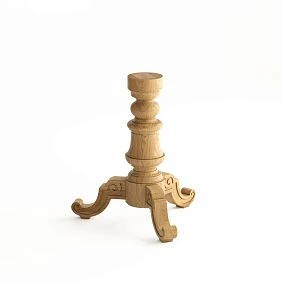
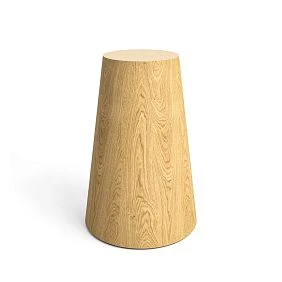
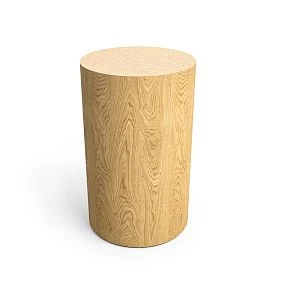
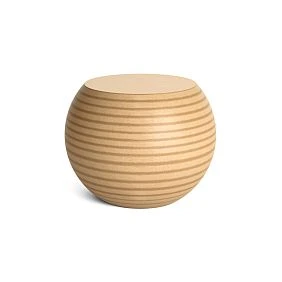
STL-041 should be chosen when a conical silhouette with a wide lower part of 500 mm and a taper to 300 mm at the countertop is needed. This base looks more dynamic, leaves more visual space directly under the top part, and suits soft modern geometry. STL-042 is better suited for a strict table with a straight cylinder of 450 mm diameter. Uniform width along the entire height makes the base monolithic and especially appropriate in minimalism, art deco, and symmetrical composition in the center of the room.
buy the conical underframe STL-041 Buy cylindrical pedestal STL-042 Buy mounting plate FUR-034 Buy mounting plate FUR-035 view the ST-030 countertop Go to pedestal catalog
Both models have a height of 740 mm. Therefore, the finished table is compared not by the height of the support, but by the shape, tabletop, mounting plate, and final height of the entire structure.
STL-041 — cone 500 × 740 × 300 mm. The lower part is wider, the upper part is narrower; the recommended plate FUR-034 has a diameter of 420 mm.
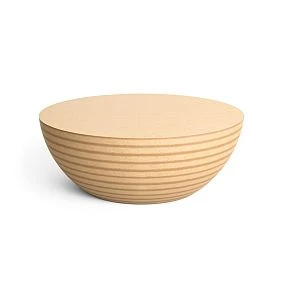
STL-042 — cylinder 450 × 740 mm. The diameter does not change along the height; the recommended plate FUR-035 has a diameter of 580 mm.
The plates cannot be swapped. FUR-034 is intended for STL-041, FUR-035 for STL-042; both are purchased separately, as is the hardware.
MDF is chosen for covering enamel. Options with oak or beech veneer allow preserving the wood texture and using stains, clear varnishes, or patination according to the appropriate technology.
No model is a solid wood underframe. The structure is hollow, the base is made of MDF and plywood, and oak and beech are represented by external veneer.
When a buyer wants to purchase an underframe for a tabletop, photos of the central supports often create a false impression that the cone and cylinder differ only decoratively. In a real table, the shape changes the distance to the knees and feet, the perceived mass of the base, the relationship with the tabletop, and the mounting assembly. Therefore, STL-041 and STL-042 cannot be chosen as two interchangeable bodies of the same height.
STL-041 tapers towards the top. The diameter at the floor is 500 mm, and in the upper area — 300 mm. The eye reads the transition from a stable bottom to a lighter connection to the tabletop. STL-041 maintains a diameter of 450 mm along the entire height and forms a strict vertical column. It looks the same from all sides and is especially convincing when the table stands in the center of the room.
The connection to the tabletop also differs. For the conical model, a mounting plate FUR-034 with a diameter of 420 mm is provided, for the cylindrical one — FUR-035 with a diameter of 580 mm. The difference is 160 mm. The larger plate distributes the fastening points over a wider area, but does not turn STL-042 into a universal support for any weight and any overhang. The thickness, shape, inserts, and centering of the upper part remain part of the structural calculation.
For a soft modern table, you can choose the STL-041 base. For a strict geometric silhouette — choose the STL-042 base. If no single central support matches the size or shape of the tabletop, it's better to open the catalog of central bases and compare other options before manufacturing the top part.




What is a central base and why it transforms the entire table
A central base is a single support placed under the geometric center of the tabletop, freeing the edges from four separate legs. This solution simplifies seating, allows chairs to be placed on different sides, and creates a striking unified support. But convenience only arises when the tabletop, plate, and fasteners are designed as a single system.
Our factory also produces:
One support does not mean simple installation
With four legs, the load is distributed across the corners; with a central base, it is concentrated at a single node. Therefore, the area of the mounting plate, the fastening zones of the tabletop, the mass of the upper part, and the overhang size are critical. An error in the center, even by a few millimeters, can be visually noticeable and affect stability.
Get Consultation
The shape of the base affects legroom
The STL-041 cone leaves more space directly under the tabletop due to its 300 mm top diameter. The STL-042 cylinder maintains 450 mm along its entire height. At the same height of 740 mm, knees and feet will interact with the bases differently. It is better to check this with a mock-up of chairs, not just from a front view.
The central support defines the character of the entire furniture
The conical silhouette looks transitional and dynamic: the base seems to gather the tabletop at the center. The cylinder looks like a monolithic column and emphasizes geometry. Therefore, the same round tabletop on two different bases will yield different interior results.
A pedestal base is not the same as a frame structure
A central base supports the upper part through a local mounting node. A frame structure distributes supports along the perimeter or corners. For a wide rectangular tabletop, a frame system is sometimes more rational. Before purchasing, it is useful to know how a pedestal base differs from a table frame.
Confirmed specifications of STL-041 and STL-042
| Parameter | STL-041 | STL-042 | Practical Meaning |
|---|---|---|---|
| Shape | Conical | Cylindrical | The cone looks lighter at the tabletop, the cylinder maintains uniform mass along its height. |
| Size | 500 × 740 × 300 mm | 450 × 740 mm | For STL-041, two diameters must be considered; for STL-042, the diameter is constant at 450 mm. |
| Height | 740 мм | 740 мм | The final table height is calculated including the tabletop and mounting assembly. |
| Construction | Hollow | Hollow | Models cannot be described as solid wooden columns. |
| Base | MDF and plywood | MDF and plywood | The material provides stable geometry and requires suitable fastening and finishing technology. |
| Execution 1 | MDF | MDF | The main scenario is covering enamel. |
| Execution 2 | MDF with oak veneer | MDF with oak veneer | The oak texture becomes noticeable on a large smooth surface. |
| Version 3 | MDF with beech veneer | MDF with beech veneer | Beech pattern is calmer and suits soft natural finishes. |
| Sanding | «Prestige» | «Prestige» | The surface is prepared for further finishing without rough manual rework. |
| Mounting plate | FUR-034, sold separately | FUR-035, sold separately | The plates are model-specific and must not be interchanged. |
| Plate diameter | 420 мм | 580 мм | FUR-035 distributes fasteners over an area 160 mm larger in diameter. |
| Tabletop | Not included | Not included | The top part is selected separately by weight, shape, thickness, and embedded elements. |
| Fastening | Purchased separately | Purchased separately | Screws and other components are selected based on the countertop material and mounting scheme. |
| Supply | In a rigid box | In a rigid box | The drift route and storage location are checked before delivery. |
Cone or cylinder: comparison based on real scenarios
| Situation | Preferred model | Why |
|---|---|---|
| A lighter upper base part is needed | STL-041 | Tapering to 300 mm reduces the perceived mass directly under the tabletop. |
| Strict geometry is needed, identical from all sides | STL-042 | A cylinder with a diameter of 450 mm maintains a straight vertical line from the floor to the top. |
| Interior with soft rounded shapes | STL-041 | The cone supports transitions, rounded facades, and a more plastic furniture composition. |
| Minimalism or Art Deco | STL-042 | A pure cylinder forms a monolithic geometric volume without changing diameter. |
| Compact round tabletop | Both after calculation | The cone looks lighter, the cylinder stricter; stability is determined not only by shape but also by mass, overhang, and plate. |
| Square tabletop with pronounced corners | STL-042 is often visually more convincing | A straight cylinder supports strict geometry, but the diagonal overhang of corners needs to be checked separately. |
| The base should be a noticeable interior object | STL-042 | A diameter of 450 mm along the entire height makes the support visually independent. |
| More visual space is needed under the edge of the tabletop | STL-041 | The upper part with a diameter of 300 mm recedes from the knees more than a 450 mm cylinder. |
| Need a plate with a wider point distribution | STL-042 with FUR-035 | Plate diameter is 580 mm, but the allowable tabletop is still determined by the overall calculation. |
| Desk with seating on one side | Both after inspection | Need to consider not only the shape, but also the offset workload, keyboard, elbows, and the overhang of the rectangular tabletop. |
Why these bases cannot be chosen just by photo
The catalog photo shows the clean shape, but does not show the tabletop, chairs, the seated person's legs, and the free space of the room. A cone may appear almost cylindrical from a frontal angle, and a cylinder may look lighter than it will under a small tabletop. The real scale is only revealed in the system.
The angle hides the change in diameter
For STL-041, the difference between the lower and upper diameter is 200 mm. From the side, it reads as a noticeable taper, but when viewed from above or against a light background, the transition may appear weaker. On the floor, the base occupies a circle with a diameter of 500 mm, although at the tabletop its width is only 300 mm.
White color visually reduces volume
On white enamel and a light background, both models appear lighter. In dark tinting or contrasting enamel, the boundaries become more noticeable. A cylinder with a diameter of 450 mm can appear monumental, especially under a small upper part.
The tabletop changes proportions
The same STL-042 under a large diameter round tabletop looks more compact than under a small square one. STL-041 may appear stable and wide at the bottom, but almost disappear at the top junction. Therefore, the final choice is made based on the combined silhouette.
The plate remains hidden but affects the structure
On the finished table FUR-034 or FUR-035, it is almost invisible, yet it connects the base to the tabletop. A buyer evaluating only the external body risks forgetting about the plate diameter, inserts, and mounting location.
A mockup provides more information than a visualization
On the floor, you can draw a circle of 500 mm for STL-041 and 450 mm for STL-042. At a height of 740 mm, attach a cardboard template of the future tabletop. Such a mockup shows passages, seating, and real visual weight without a complex 3D model.
How the conical silhouette of STL-041 works
The cone-shaped underframe is built on the contrast of a wide lower part and a narrow upper part. The diameter at the floor helps form a stable visual center, while the narrowing towards the tabletop frees up space and makes the connection less massive. This is not proof of greater physical stability: the structural properties are determined by the entire table.
Wide base 500 mm
The base occupies a noticeable floor area and looks securely placed. For a round tabletop, the lower diameter is easily correlated with the outer circle: the larger the top, the calmer the base appears. For a square one, the diagonals need to be additionally evaluated.
Top 300 mm
The taper creates a free zone under the tabletop and emphasizes its thickness. This is useful when the upper part should appear as an independent plane, and the support should gently enter the center. With a too small tabletop, the difference in diameters can make the table look like a high pedestal.
Shape dynamics
The eye moves from the wide bottom to the narrow top. This silhouette pairs well with rounded facades, soft armchairs, oval lamps, and modern classics. The cone can also soften a strict square tabletop if the proportions are checked.
Seating around the table
At the knees, the base is narrower than at the floor. The feet, on the contrary, can approach the wide lower part. Therefore, the model must consider not only the upper diameter of 300 mm but also the 500 mm circle on the floor. Comfort is checked in the actual chair position.
When STL-041 looks particularly convincing
The cone opens under a round or compact square tabletop when the lower diameter remains noticeably smaller than the upper part, and the taper is visible from the side. For dining, writing, or meeting scenarios, the load and overhang need to be separately evaluated.
A complete analysis of the model and model plate is revealed in the article about detailed installation of STL-041 with FUR-034. In a comparative article, it is more important to understand whether the cone matches in shape and scale.
How the straight cylinder STL-042 works
The cylinder maintains a diameter of 450 mm along its entire height. It has no visual transition from the floor to the tabletop, so the base is perceived as a single column. This shape emphasizes symmetry and looks good from all angles.
Constant diameter 450 mm
A person immediately understands the actual width of the support at any level. There is less free space under the tabletop than at the top of STL-041, but the silhouette looks more consistent. This is important for a table that stands in the center of the room and is visible from all sides.
Monolithic appearance
The cylinder looks more massive, although the lower diameter is less than 500 mm of the cone. The reason is the constant width: the eye sees a continuous volume from the floor to the tabletop. On a dark finish, the effect is enhanced.
Connection with minimalism and art deco
Pure geometry works with circles, squares, symmetrical panels, and contrasting materials. In Art Deco, a cylinder can be emphasized with dark tinting, enamel, or a combination with an expressive tabletop. The specific finish is chosen according to the card and finishing technology.
Seating and knee clearance
The 450 mm diameter is maintained in the upper zone. For a small table, this may limit space more than a 300 mm cone at the tabletop. However, actual knees are not at the center but at the edge of the tabletop; therefore, the top diameter, overhang, and chair position are important.
When STL-042 is especially appropriate
The cylinder suits a round or square tabletop that is symmetrically centered over the support. It works well in a kitchen-living room, meeting room, and modern office where the base should look the same from any side.
Details of the model and mounting assembly are collected in the material about detailed selection of STL-042 and FUR-035.
Same height 740 mm — is the finished table the same
The underframe height is the same, but the final table height may differ due to the tabletop, mounting plate, inserts, and connection method. You cannot mechanically consider 740 mm as the final furniture height. You need to add up the confirmed structural dimensions and check the seating with a chair.
Tabletop thickness
The thin and thick top parts give different work surface heights. Even a few centimeters affect the position of the elbows and the distance to the seat. Before ordering the underframe, the buyer must know the material and thickness of the tabletop.
Mounting plate
The plate is located between the base and the tabletop or in a designated node. Its actual effect on height depends on the design. FUR-034 has a confirmed thickness of 2 mm, for FUR-035 the diameter is confirmed in the SEO scheme, so other parameters cannot be invented.
Chair and seat height
The same table can be comfortable with one chair and uncomfortable with another. A high soft seat reduces the distance to the tabletop. Armrests may not fit under the edge. The underframe is chosen together with the chairs, not after assembly.
Writing and dining scenario
A work desk requires a comfortable position for hands, monitor, and keyboard. A dining table requires space for dishes and free seating. A height of 740 mm is suitable for designing both types, but the final result is checked against the specific tabletop and chair.
FUR-034 or FUR-035: why plates cannot be swapped
Each underframe has its own mounting plate. FUR-034 with a diameter of 420 mm is designed for the conical STL-041. FUR-035 with a diameter of 580 mm is for the cylindrical STL-042. The matching height of the bases does not make the plates interchangeable.
FUR-034 for cone
The plate is made of steel, has a thickness of 2 mm and a black moiré coating. It is purchased separately, as is the hardware. The geometry is designed for connection with STL-041. Can buy plate FUR-034 for STL-041 and check current parameters in the card.
FUR-035 for cylinder
Confirmed diameter — 580 mm. The plate is used with STL-042 and also purchased separately. For the correct set, it is worth buy plate FUR-035 for STL-042.
Diameter difference 160 mm
FUR-035 distributes mounting points over a wider area of the underside of the tabletop. This may be important for a specific design, but does not negate the calculation of weight and overhang. A larger plate is not an automatic guarantee of stability.
Why can't FUR-035 be installed on STL-041
Diameter 580 mm exceeds the lower cone diameter of 500 mm and does not match the model assembly. Even if the plate physically fits under the tabletop, the connection to the base is not confirmed. Self-replacement breaks the compatibility logic.
Why FUR-034 does not fit STL-042
The 420 mm plate is smaller than the 450 mm cylinder diameter and is intended for a different product. Reducing the mounting area without calculation may change the force distribution. Selecting a "similar" plate based on price or availability is not allowed.
Fasteners are purchased separately
The type and length of screws depend on the tabletop, inserts, and mounting holes. Fasteners that are safe for a solid wood panel may not be suitable for MDF or composite construction. They are selected by the craftsman after checking the drawing.
How shape affects stability — and why results cannot be guaranteed based on a single diameter
A cone and a cylinder distribute visual mass differently, but the stability of a finished table cannot be determined solely by the external size of the base. It is influenced by the mass and shape of the tabletop, the height of the center of gravity, the mounting plate, the rigidity of the connection, the position of objects on the table, and the levelness of the floor.
A wide bottom does not automatically equal stability
For STL-041, the lower diameter of 500 mm is larger than that of STL-042, but the upper zone is narrower and the plate is smaller. Therefore, it cannot be concluded that a cone is always more stable than a cylinder. The entire load path from the tabletop to the floor must be considered.
A large plate does not eliminate overhang
FUR-035 with a diameter of 580 mm distributes fasteners over a larger area, but a square tabletop with long corners can create significant leverage. If a person leans on the edge or places a heavy object far from the center, the load becomes asymmetrical.
Floor evenness
A single base is sensitive to local unevenness. If the bottom plane rests unevenly, the table may wobble regardless of shape. Before assembly, the floor and the supporting surface itself are checked. Random wedges should not be placed under a finished painted base.
Centering the tabletop
Offsetting a round or square top relative to the axis creates uneven overhang. This is visually noticeable and changes the load distribution. Marking is done based on the center of the tabletop and plate, not along one edge.
Load during use
A dining table receives dishes and arm support, a desk receives a monitor, equipment, and local work load, while a conference table receives several people from different sides. For each scenario, the craftsman must evaluate the structure. The article cannot specify a universal allowable weight.
How to calculate the overhang of a round tabletop
For a round tabletop, the basic visual calculation is simple: subtract the base diameter from the top diameter and divide the difference in half. However, two dimensions should be used: the outer diameter of the body at the floor or at the tabletop and the diameter of the mounting plate. The structural overhang is determined not only by a beautiful proportion.
Overhang relative to STL-041
The cone has an upper diameter of 300 mm and a lower diameter of 500 mm. If the tabletop is round, its edge is noticeably farther from the upper part than from the lower circle. Therefore, the table looks light on top, but for the feet, there is a wider contour at the floor. The buyer must imagine both circles simultaneously.
Overhang relative to STL-042
The cylinder has a diameter of 450 mm along its entire height. The overhang reads the same from any horizontal line of the body. The table looks more cohesive and monolithic. The smaller the tabletop, the more the cylinder fills the space underneath it.
Overhang relative to the plate
FUR-034 has a diameter of 420 mm, FUR-035 — 580 mm. If the edge of the plate approaches the edge of the tabletop, you need to check whether there is enough material for the fasteners and whether the holes fall into the weak edge zone. The exact minimum offsets are determined by the design of the upper part.
Round tabletop and seating
A person sits along the radius. The larger the overhang, the farther the knees are from the base, but the greater the leverage on the edge. A small overhang reduces leverage but can make the seating cramped. The balance is checked on a mockup and in calculations.
ST-030 as a reference, not an automatic pair
The ST-030 tabletop, measuring 1148 × 1148 × 24 mm, is listed among the accessories for both models. It can view the ST-030 countertop, but before purchasing, you must check the weight, shape, embedded parts, overhang size, and fasteners. Mention in accessories does not replace structural compatibility.
How to check a square tabletop
A square looks symmetrical over a central support, but its corners are farther from the center than the midpoints of the sides. Therefore, simply comparing the width of the tabletop with the diameter of the base is not enough. The main parameter is the diagonal overhang of the corners.
First, find the center of the square
The center is at the intersection of the diagonals. The mounting plate and underframe are aligned to this point. If the center is offset, the sides and corners will have different overhangs. Correcting this after drilling is difficult.
Check the overhang on the side
The difference between the tabletop side and the base diameter is divided in half. This size indicates the knee space along the straight side. For STL-041, additionally consider the top 300 mm and bottom 500 mm. For STL-042 — constant 450 mm.
Check the overhang diagonally
The distance from the center of the square to the corner is greater than half the side. It is the corner that creates the longest lever. If a person leans on the corner, the force is higher than in the middle of the side. Therefore, a square tabletop cannot be evaluated only by its frontal view.
Corners and passage safety
The square top protrudes in four directions and may intersect the path. The central base does not show its actual dimension at floor level. In a kitchen-living room, you need to check the table clearance, chair pulling out, and distance to the island.
Cone or cylinder under a square
STL-041 softens the angular shape and creates a contrast of geometries. STL-042 continues the strict logic of the square through a clean cylinder. Visual choice does not cancel the calculation of diagonal overhang and plate.
Why diagonal overhang of corners is especially dangerous
The corner of a square or rectangular tabletop is farther from the center of support. The load on it creates a greater moment. Even a lightweight top can behave differently if a person regularly leans on the edge or sits using the corner as a support point.
Visual symmetry does not equal structural symmetry
A square perfectly centered above a cylinder looks stable. But structural behavior depends on the thickness of the tabletop, rigidity, and fastening zones. A beautiful alignment of axes does not replace verification by an engineer or furniture maker.
Placement of embedded inserts
Plate fasteners must enter areas capable of bearing load. If the tabletop is hollow, composite, or has internal voids, a confirmed embedded insert is required. Screwing self-tapping screws into a random layer is not allowed.
Local load
Heavy equipment, a stack of books, or a person leaning on one corner create an uneven scenario. For a conference table, the load can shift. Therefore, the calculation must consider not only static center placement.
Corner rounding
A rounded square feels softer and safer in a walkway, but the geometric leverage does not completely disappear. The radius changes the outer contour, while the center and diagonals remain part of the calculation.
Can a rectangular tabletop be used
Technically, a central support can be used with a rectangular top, but the long axis creates a large overhang and uneven seating. The more elongated the rectangle, the higher the requirements for rigidity, plate, and load distribution.
Short rectangle
A tabletop close to square can work after checking. The long and short sides, diagonals, and chair positions need to be matched. Cone STL-041 softens the shape, cylinder STL-042 emphasizes central symmetry.
Long conference tabletop
A single central support may be insufficient. People sit far from the center, and the edges receive significant leverage. In this case, two supports or a frame structure are considered. The designer makes the decision.
Desk
The user sits on one long side, and the monitor and equipment can shift the load center. A central under-table frees up legroom, but the body must not interfere with the knees. A layout of the chair and work area is mandatory.
Rectangular tabletop with rounded ends
The shape looks softer, but the long overhang remains. An oval or rounded rectangle cannot be considered equal to a circle. The distance from the center to the ends is still greater than to the sides.
When to choose a frame structure
If the top is long, heavy, or must bear load at the edges, the frame system distributes supports closer to the perimeter. The material about what to buy for a ready-made tabletop.
When one central support is not enough
One support works well with a symmetrical tabletop of moderate size, but is not a universal solution. It should be abandoned not when the table looks large in a photo, but when calculations show excessive overhang, insufficient rigidity, or uncomfortable seating.
Top part too long
If the ends are far from the center, the load creates a large lever. For a conference or dining tabletop, two supports may be required. The distance between them is calculated so that they do not interfere with chairs.
Very heavy material
Stone, thick wood panel, or composite construction require separate calculations. The presence of a large-diameter FUR-035 does not automatically guarantee compatibility. Mass cannot be guessed by dimensions.
Weak embedded parts
If the tabletop's fastening zone cannot hold the plate, a central support will not solve the problem. A new top part, reinforcement, or a different frame is needed. The plate cannot be attached to a thin decorative layer.
Intensive load on edges
In a public space, people may lean on the table, move it, and place heavy objects asymmetrically. This scenario requires a calculation with a safety margin and possibly a different design.
Lack of legroom
If the base diameter and overhang do not allow free placement of knees and feet, increasing the tabletop does not always help: it simultaneously increases the leverage. Sometimes it is more rational to choose a frame base with supports in other areas.
How to make a base layout on the floor
The layout does not replace engineering calculations, but quickly shows the scale and fit. For STL-041, draw a circle with a diameter of 500 mm on the floor and mark the upper circle of 300 mm at a height of 740 mm. For STL-042, a circle of 450 mm on the floor and the same template at the top are needed.
Use painter's tape
It allows you to mark the circle, the outer contour of the tabletop, and the placement of chairs without damaging the floor. On tiles or parquet, first check if the tape is easy to remove and leaves no residue.
Add a cardboard tabletop
A sheet or frame of slats at a height of 740 mm plus the thickness of the future top part shows the actual passage. For a square model, be sure to mark the corners and diagonals.
Place real chairs
Move them back, sit down, and check your knees, feet, and armrests. The layout should account for not just one chair, but all planned seats. On a conference table, check the seating from different sides.
Simulate movement
Walk around the table with dishes or a laptop, open adjacent cabinets and doors. The central support frees up the edges, but the tabletop still occupies the full outline. In the kitchen, it is important to check the distance to the cabinet set and the island.
How to check the distance to knees and feet
Seating is determined by three levels: the edge of the tabletop, the upper zone of the base, and the lower contour near the floor. STL-041 and STL-042 behave differently at each level.
Knees for STL-041
The upper diameter of 300 mm creates more free space near the center. With sufficient overhang, the knees are less likely to approach the body. But this advantage disappears if the tabletop is too small.
Feet for STL-041
The lower diameter of 500 mm occupies a noticeable area. Feet may hit the wide part, especially with a small overhang and deep seating. Checking on the floor is mandatory.
Knees and feet for STL-042
The diameter of 450 mm is constant. The seating is predictable, but the free space under the tabletop is less than near the upper part of the cone. With a large round top, this may be unnoticeable; with a compact one, it is critical.
Armrests
They should go under the tabletop or not interfere with seating. The height of the underframe is the same, but the final mark depends on the top. The chair is chosen before final assembly, not after.
MDF for covering enamel
The smooth MDF option is chosen when the base needs to have an opaque color. Enamel hides the material's structure and emphasizes clean geometry. On STL-041, it makes the transition from 500 to 300 mm diameter especially smooth. On STL
Colored enamel
A complex shade helps tie the base to kitchen fronts, doors, or wall panels. A test paint-out is needed because the same color from the catalog looks different with varying gloss levels and lighting.
Preparation before painting
The "Prestige" sanding reduces the volume of rough finishing, but the final system still requires suitable primer and technology. Mounting areas are best marked before the final enamel, so drilling and fitting do not damage the coating.
The material is covered in more detail in the guide on how to choose an MDF underframe.
Oak veneer for pronounced texture
The oak veneer option is chosen when the base should look wooden and retain a noticeable pattern. The structure remains hollow, made of MDF and plywood. Veneer is an external natural layer, not evidence of solid wood.
Oak on STL-041
Vertical drawing helps emphasize the taper. Light tinting makes the cone calmer, dark tinting enhances dynamics. The direction and joint of the veneer should look neat from all visible sides.
Oak on STL-042
On a straight cylinder, the wood texture reads as a continuous shell. A table standing in the center of the room shows the base from all sides, so the shade and quality of the finish are especially noticeable.
Combination with the tabletop
The oak base can be matched with the oak veneer of the top part or made contrasting. Almost matching but different shades look accidental. It is better to use a common sample or deliberately separate the colors.
Stain and clear varnish
Cards allow a finish that preserves the pattern. The specific system is chosen by the workshop. A test swatch shows how the tone appears on a radius surface and whether the cylinder or cone becomes visually too dark.
Beech veneer for a calmer pattern
Beech veneer provides a more restrained texture. It suits an interior where wood is needed but a bright oak pattern would compete with the tabletop, floor, or furniture. Both models are available in this finish.
Beech on cone
A calm pattern does not fragment the changing shape. STL-041 remains plastic and light, especially in light tinting. This option suits modern classics and soft minimalism.
Beech on cylinder
The even texture emphasizes a clean column without strong decorativeness. The base can support beech chairs or furniture if the shades are matched according to the sample.
Can the veneered version be painted
Technically, the finish depends on the chosen system, but dense covering enamel hides the main advantage of veneer. If the wood pattern is not needed, smooth MDF is usually more rational. Buying veneer solely to completely cover the texture is only worthwhile for a specific technological reason.
How to match the color of the base and tabletop
The underframe occupies a large vertical area, so the color affects the perception of the table no less than the tabletop material. There are three working approaches: precise matching, deliberate contrast, and a neutral support.
Same material and close tone
Oak veneer on the base and an oak top create a solid wooden object. Matching is checked against real samples because the species and grain direction change the perception of the shade.
Contrast
White or dark MDF under enamel can support a stone, wood, or colored countertop. STL-042 becomes more noticeable in contrast, STL-041 preserves the transition and visually separates the top.
Base in the color of the interior
Enamel matching the color of kitchen fronts or walls reduces the presence of the under-table. This technique is useful when the countertop should be the main accent. Exact matching requires a test swatch under the same lighting.
STL-041 for kitchen and dining room
The cone model suits a dining table when you want to maintain central seating without a heavy cylinder under the countertop. The top 300 mm frees up knee space, while the bottom 500 mm forms a noticeable support.
Round kitchen table
A round countertop naturally follows the cone's axis. Check the overhang, FUR-034 plate, and distance to feet. For a small kitchen, the full table diameter with chairs pulled out is especially important.
Square table in the dining room
The cone softens corners and supports round light fixtures or chairs. Diagonal clearance is checked separately. If the countertop is too large, a single central support may not be enough.
Modern Classic
Oak or beech veneer adds natural texture, enamel bonds the base with painted furniture. The absence of carving makes STL-041 modern, and the smooth taper makes it less rigid than a cylinder.
STL-042 for minimalism and art deco
The cylindrical model is based on simple geometry. It looks the same from all sides, so it works well in the center of a kitchen-living room, under a light fixture, and in a symmetrical layout.
Minimalist dining room
Smooth MDF under a solid-color enamel creates a clean volume. In such an interior, centering, floor evenness, and neat tabletop joining are especially noticeable.
Art Deco style is renowned for its love of ornamentation, symmetry, and refined details. The molded decoration NPU-422 can become an excellent complement to geometric motifs and contrasting color combinations characteristic of this style. Try highlighting it with metallic paint or patina — and you’ll get an eye-catching detail that’s hard to look away from.
The cylinder supports circles, symmetry, and material contrast. Dark veneer or enamel can become an independent accent. However, the decorative effect should not hide the need to calculate FUR-035 and overhang.
Table in the center of the room
The cylinder has no "front" side. It suits furniture that is walked around. The veneer version requires particularly careful pattern matching because all surfaces are visible.
Choice for desk and conference table
Desk
STL-041 provides more knee space in the upper part, but the wide bottom takes up foot space. STL-042 is predictable in diameter, but the 450 mm body may be close to the sitter. The workload and rectangular tabletop are calculated separately.
Small meeting room
A round table on a single central support allows seating participants without legs in the corners. The cone looks lighter, the cylinder more formal. The tabletop size should provide space for documents and equipment without excessive overhang.
Long meeting room
One STL-041 or STL-042 may not provide the necessary structural scheme. Two supports or a frame base are considered. The distance between the central bodies is coordinated with the mounting points.
Commercial interior
In an office, salon, or showroom, furniture movement, edge loads, and regular cleaning must be considered. The finish is chosen based on usage intensity, and the installation specification is kept for maintenance.
What to buy with a table base
A ready-made table requires at least a base, a model mounting plate, a compatible tabletop, and fasteners. Buying these elements separately without a general scheme is risky. STAVROS categories help assemble a kit, but compatibility is confirmed by dimensions and drawings.
| What to add to the purchase | Why this is needed | For which scenario | What to Check |
|---|---|---|---|
| Conical central table support | Creates a base of 500 × 740 × 300 mm | Round or compact square table, soft geometry | Top and bottom diameter, overhang, material, and finish |
| Cylindrical central support | Forms a straight cylinder 450 × 740 mm | Minimalism, art deco, table in the center of the room | Constant diameter, knee space and centering |
| Mounting plate with a diameter of 420 mm | Connects STL-041 to the tabletop | Conical base | Holes, embedded parts, separate fasteners and thickness of 2 mm |
| Mounting plate with a diameter of 580 mm | Connects STL-042 to the tabletop | Cylindrical base | Tabletop overhang, mounting zones, and separate fasteners |
| Tabletop 1148 × 1148 × 24 mm | Provides a reference for the finished top from related products | Square or other confirmed design | Weight, shape, embedded parts, overhang, and actual compatibility |
| Buy components for DIY table assembly | Allows comparison of tabletops, bases, and frames | New table or replacement of existing base | Compatibility of all elements and uniform finish |
How not to confuse these underframes with similar solutions
MDF with veneer and solid wood
Both models have a hollow construction of MDF and plywood. Options with oak and beech indicate external veneering, not a solid wooden column. The phrasing "solid oak underframe" for STL-041 and STL-042 would be incorrect. If the buyer insists on solid wood, they need to look for a different product group.
Central underframe and separate furniture leg
One large support carries the tabletop through a mounting plate and occupies the center. A regular leg is designed to work in a group and has a different attachment system. You cannot replace STL-041 with four random cones or perceive STL-042 as an enlarged leg without a project.
Underframe and frame structure
The central support frees up corners but concentrates the load in the middle. The frame structure distributes it around the perimeter and may be better suited for a long rectangular tabletop. The external lightness of a single column does not always mean a better structural scheme.
Cone and truncated decorative casing
STL-041 is a ready-made furniture base with a confirmed model plate. A homemade decorative casing around a random support is not an equivalent system. Its rigidity, internal construction, and attachment may differ.
Cylinder and decorative column
STL-042 is designed for dining, writing, and conference tables. An architectural column or decorative box may look similar but may not have the necessary embedded anchors and mounting assembly. Selection should be based on the card's purpose, not its shape.
FUR-034 and FUR-035
The names differ by one digit, but the diameters and compatible bases are different. FUR-034 — 420 mm for STL-041, FUR-035 — 580 mm for STL-042. An error in the article number leads to purchasing a part that cannot be considered compatible.
Practical selection for specific situations
Need a round dining table for a family
Both models are possible after calculation. STL-041 will provide a lighter knee space and a wide bottom near the floor. STL-042 will form a strict cylinder. Compare overhang, number of chairs, plate diameter, and foot space. For a general approach, the material on how to choose a table base for a dining table.
Need a square table in a modern kitchen
STL-042 more often supports strict geometry, STL-041 softens it. The main risk is diagonal corner overhang. Draw a square and the base circle, check seating on the sides and support on the corner.
Need a table for white enamel
Choose smooth MDF. The cone will look more plastic, the cylinder more monolithic. Before finishing, perform a trial assembly with the plate to avoid drilling into the finished enamel.
A natural oak texture is needed
Consider an oak veneer finish. For STL-041, the pattern emphasizes the taper; for STL-042, a continuous shell. Do not call the product solid wood and coordinate the shade with the tabletop.
A calm wooden surface is needed
Beech veneer gives a less contrasting pattern. It suits a soft interior and does not conflict with an expressive tabletop. In the main product card, you can choose STL-041 with oak veneer or specify the option with beech veneer; for a strict shape — choose STL-042 with oak veneer or beech.
A writing desk for one person is needed
Check where the knees, feet, system unit, and drawers are located. The cone frees up the upper area, the cylinder is predictable in width. A rectangular top and local load require separate calculation.
A table for a small meeting room is needed
A round tabletop on a central support allows people to sit evenly. STL-041 looks less massive, STL-042 is more formal and strict. The plate must match the model, and the upper part must have suitable inserts.
Need a long conference table
One support may not be enough. Consider two central supports or a frame base. Do not enlarge the tabletop around a single STL-042 just because FUR-035 has a diameter of 580 mm.
Need to replace the old underframe
Take measurements and check the fastening zones of the existing tabletop. Old holes may not align with FUR-034 or FUR-035. If there are no embedded parts, the top will need to be reinforced or replaced.
The table will be placed in the center of the room
STL-042 is especially logical: the cylinder looks the same from any angle. STL-041 also has no front side, but the taper creates a more dynamic look. For veneer, check the quality of the pattern around the entire circumference.
Errors when ordering STL-041 and STL-042
Select only by height 740 mm
Same height does not mean same fit and installation. Diameters, shape, and plates differ. The final height is calculated together with the tabletop.
Confusing the top and bottom diameters of STL-041
The size 500 × 740 × 300 mm describes a cone with two diameters. On the floor it occupies 500 mm, and at the tabletop — 300 mm. Ignoring the lower circle leads to conflict with feet.
Assuming STL-042 has a base diameter of 580 mm
Body diameter is 450 mm. The 580 mm refers to the FUR-035 plate located under the tabletop. These dimensions serve different functions.
Swap the plates
FUR-034 is intended for STL-041, FUR-035 for STL-042. Interchangeability is not confirmed. Do not select a plate based solely on price or availability.
Expect the tabletop to be included in the kit
Both models are sold as bases. The tabletop is purchased separately. Even ST-030 from related products requires checking weight, overhang, embedded parts, and fasteners.
Expect fasteners to be included with the plate
Fasteners are selected separately based on the tabletop structure. A random long screw may go through, while a short one may not provide fixation.
Calling a veneered model solid wood
The base is made of MDF and plywood, the structure is hollow. Oak or beech veneer forms the external texture but does not make the body solid wood.
Assuming a large plate guarantees support for a heavy tabletop
The FUR-035 diameter helps distribute the fasteners, but the permissible weight is determined by the entire system. Without calculation, stability cannot be guaranteed for stone, thick slabs, or large rectangles.
Do not check the corners of a square tabletop
The diagonal overhang is greater than the straight overhang along the side. A person leaning on a corner creates a stronger lever. Checking only the front is insufficient.
Ignore legroom
The central support frees up the corners but occupies the middle. STL-041 is wide at the floor, STL-042 maintains 450 mm throughout the height. Real chairs need to be placed on the mockup.
Paint before fitting
Mounting holes, center, and plate are checked before finishing. After enamel or tinting, additional drilling may damage the surface.
Do not check clearance
Both models are supplied in a rigid box. The package size and route through doors, stairs, and elevator need to be clarified before delivery. The tabletop is usually carried separately.
Who is STL-041 suitable for
- for a customer who needs a cone silhouette;
- for a round or compact square tabletop after calculation;
- for modern classic and soft minimalism;
- for a table where the upper part of the base should look lighter;
- MDF under covering enamel;
- for oak or beech veneer under clear or tinted finish;
- for a dining, writing, or small conference table;
- for a project with FUR-034 plate of 420 mm diameter;
- for a composition where the wide bottom of 500 mm does not interfere with feet;
- for a customer ready to check overhang and inserts before ordering.
When it's better not to choose STL-041
- the base at the floor with a diameter of 500 mm interferes with installation;
- strict vertical geometry without tapering is required;
- the tabletop is too long or heavy for a single support;
- the project is designed for the FUR-035 plate;
- the buyer needs solid wood;
- there are no confirmed inserts in the tabletop;
- it is impossible to precisely center the cone and the plate.
Who is STL-042 suitable for
- for a buyer who needs a straight cylinder with a diameter of 450 mm;
- for minimalism, art deco, and strict modern interiors;
- to the table in the center of the room;
- to a round or square tabletop after calculation;
- MDF with solid color enamel;
- for a version with oak or beech veneer;
- to the project with FUR-035 plate 580 mm in diameter;
- to a dining, writing, or conference table;
- compositions where a monolithic body should be noticeable;
- to the buyer who will check the knee space and diagonal overhang.
When it's better not to choose STL-042
- the 450 mm cylinder is too close to the knees;
- the base should visually taper towards the tabletop;
- The tabletop is long and requires two supports or a frame;
- The customer plans to install FUR-034;
- A solid wood structure is needed;
- The large plate does not fit into the safe fastening zone of the tabletop;
- The monolithic cylinder overloads the small room.
What to Check Before Ordering
- SKU STL-041 or STL-042;
- Shape: cone or cylinder;
- Size 500 × 740 × 300 or 450 × 740 mm;
- Diameter of the base on the floor and at the tabletop;
- Shape, dimensions, weight, and thickness of the top part;
- straight and diagonal overhang;
- space for knees, feet, and armrests;
- embedded and fastening zones;
- plate FUR-034 or FUR-035;
- separate fasteners;
- MDF, oak veneer, or beech veneer;
- enamel, stain, varnish, or other certified coating;
- centering and floor levelness;
- route for bringing in a rigid box;
- current price, availability, and ordering conditions in the product cards.
How to buy STL-041 or STL-042 on STAVROS
First, determine the shape of the tabletop and make a scale layout. Then choose the base silhouette. For a cone, you can buy the conical underframe STL-041 and separately select a plate for STL-041. For strict geometry — Buy cylindrical pedestal STL-042 и select a plate for STL-042.
General commercial inquiries without an article number should be directed to the category where you can buy an underframe for a tabletop and compare central or other bases. For a full constructor, you should open furniture frames and under-table structures.
Before payment, check the material, plate, tabletop, and fasteners as one system. If the top part is already made, provide its drawing, weight, thickness, and the location of embedded parts to the manager or furniture maker. This approach is more reliable than random selection based on outer diameter.
FAQ: questions about STL-041 and STL-042
How is STL-041 different from STL-042?
STL-041 — cone 500 × 740 × 300 mm, STL-042 — straight cylinder 450 × 740 mm. They use different mounting plates.
Which model looks lighter?
More often STL-041, because it tapers to 300 mm at the tabletop. The lower part is wider — 500 mm.
Which model looks more monolithic?
STL-042. A constant diameter of 450 mm creates a solid vertical column.
Are the base heights the same?
Yes, 740 mm. The final table height also depends on the tabletop and mounting assembly.
Which plate should I buy for STL-041?
FUR-034 with a diameter of 420 mm. It is purchased separately, as is the hardware.
Which plate should I buy for STL-042?
FUR-035 with a diameter of 580 mm. It cannot be used with STL-041 without separate confirmation.
Can I swap FUR-034 and FUR-035?
No. Each plate is designed for its own model.
Is STL-041 suitable for a round tabletop?
Yes, after checking the diameter, weight, overhang, inserts, and legroom.
Is STL-042 suitable for a square tabletop?
It may fit, but you need to check the diagonal corner overhang and local edge load.
Can I install a rectangular tabletop?
Only after calculation. The longer the rectangle, the higher the likelihood that two supports or a frame structure will be required.
Is ST-030 automatically compatible with both models?
No. It is listed among related products, but the weight, overhang, shape, inserts, and fasteners need to be checked.
What are the table bases made of?
MDF and plywood. The structure is hollow. Available in MDF, MDF with oak veneer, and MDF with beech veneer.
Are these table bases made of solid oak or beech?
No. Oak and beech are represented as veneer on an MDF and plywood base.
What to choose for enamel?
Smooth MDF. It is intended for opaque painting.
What to choose for visible wood texture?
Option with oak or beech veneer. Oak gives a more pronounced grain, beech is subtle.
Can the veneered model be painted opaquely?
The technique needs to be coordinated, but dense enamel will hide the texture. If grain is not needed, MDF is more practical.
How to check legroom?
Make a mock-up of the base and tabletop, place real chairs, and check knees, feet, and armrests.
Which model is better for minimalism?
More often STL-042 due to its clean cylinder. STL-041 suits soft minimalism with transitional forms.
Which model is better for the kitchen?
It depends on the countertop and layout. The cone looks lighter, the cylinder stricter. It's more important to check the overhang, passages, and fit.
Can the countertop be installed without a mounting plate?
You should not deviate from the confirmed kit logic. Each model has its own plate.
Is the mounting hardware included in the kit?
No, it is selected separately based on the material and countertop inserts.
What load can the models withstand?
A universal figure is not confirmed. The permissible load depends on the entire structure, countertop, plate, fasteners, and overhang.
Where can I see other bases?
You can select a table base for the table in the general category.
What should I check before payment?
SKU, shape, dimensions, material, plate, tabletop, inserts, overhang, fasteners, and current card conditions.
Result: STL-041 for a dynamic cone, STL-042 for a strict cylinder
STL-041 and STL-042 have the same height of 740 mm and the same material options, but create two different tables. The cone 500 × 740 × 300 mm looks lighter near the tabletop and suits soft geometry. The cylinder 450 × 740 mm maintains a monolithic volume and supports minimalism or art deco.
The choice doesn't end with the shape. For STL-041, you need FUR-034 with a diameter of 420 mm, for STL-042 — FUR-035 with a diameter of 580 mm. Plates and fasteners are purchased separately. A round tabletop is checked for overhang, a square one also for diagonal corner extension, a rectangular one for length and the need for a second support.
MDF is suitable for covering enamel. Oak or beech veneer preserves the natural texture but does not turn the hollow structure into solid wood. Before ordering, you need to check the inserts, centering, knee and foot space, floor levelness, and the delivery route.
On the STAVROS website, you can order a ready-made base, a model plate, and select a tabletop in one product system. This helps move from a beautiful idea to a structurally sound table without accidental plate replacement, incorrect SKU, or unconfirmed overhang.