Article Contents:
- Why table frame, underframe, supports, and legs are confused
- Legs are not always an underframe
- Supports — a broader concept
- Underframe — a ready-made base for a tabletop
- Frame — the load-bearing structure of a table
- Why a buyer needs an underframe
- When an underframe is especially convenient
- What can a frame consist of
- When a frame is better than individual legs
- When separate legs are enough
- When supports are needed
- When is it better to choose an underframe
- When a frame is needed
- Heavy tabletop
- Large dining table
- Everyday kitchen table
- Table for commercial interior
- Non-standard tabletop shape
- Tabletop already selected
- Need a wooden accent
- Base appearance is important
- Why a table may wobble
- Why a ready-made base is often more convenient
- Tabletop size
- Weight and material
- Table height
- Tabletop shape
- Seating comfort
- For Kitchen
- For the dining room
- living room
- For Office
- For cafes and restaurants
- Buying a base only from a photo
- Not considering the weight of the tabletop
- Confusing decorativeness and construction
- Not checking the height
- Not considering leg placement
- Buying one part instead of the whole system
- What is the difference between an underframe and a table frame?
- What to buy for a tabletop — legs or an underframe?
- When is a table frame needed?
- What is more stable: an underframe or separate legs?
- How to choose a base for a wooden table?
- Can I use a table frame instead of a table base?
- Which underframe should I choose for a kitchen table?
- Is a wooden underframe suitable for a dining table?
- Can I place a heavy tabletop on individual legs?
- What is better for a round table: an underframe or legs?
- Where to buy a wooden underframe?
- Where to buy a table frame?
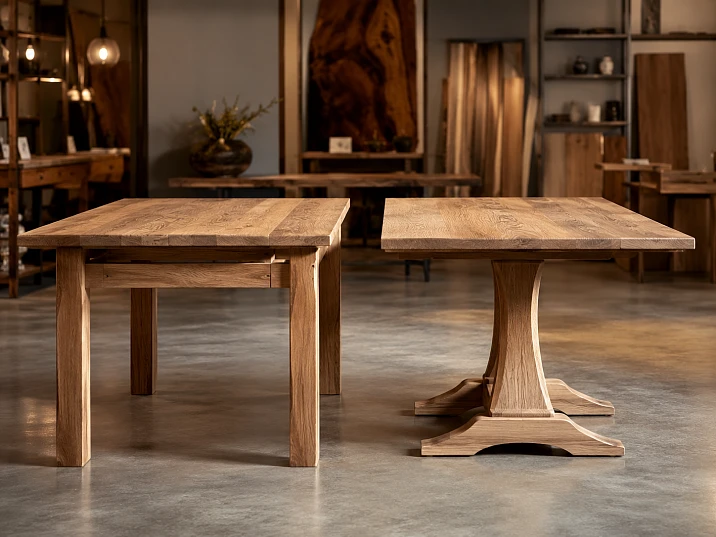
Table frame or underframe — this question arises for almost everyone who has already chosen a tabletop or is just planning to assemble a table for their interior. The catalog may contain different names: frame, underframe, supports, legs, table base. At first glance, it seems like the same thing, but in practice there is a difference. The choice affects the stability of the table, seating comfort, appearance, service life, and whether the base can support the weight of a wooden tabletop.
Confusion arises because in everyday language, all these words are often used as synonyms. A buyer says "I need legs," a craftsman offers an "underframe," a designer writes "frame" in the project, and the product catalog may list a group "furniture frames." As a result, a person does not always understand what exactly to order: separate supports, a ready-made base for the tabletop, or a full-fledged load-bearing structure.
If the task is to assemble a stable wooden table, you cannot choose the base based solely on appearance. You need to consider the size of the tabletop, its weight, shape, the height of the future table, the usage scenario, and where it will be placed: in the kitchen, dining room, living room, study, cafe, or restaurant.
At STAVROS you can buy a table frame or wooden underframe for different tasks: from an interior dining table to a more expressive base for a wooden tabletop. Below, we will break down how an underframe differs from a table frame, when individual legs are sufficient, when a full frame is needed, and how to avoid mistakes when choosing a base.
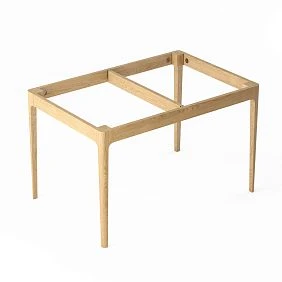
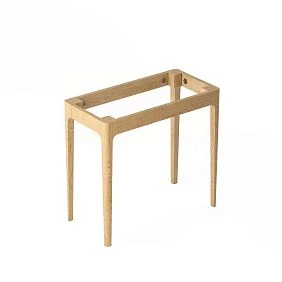
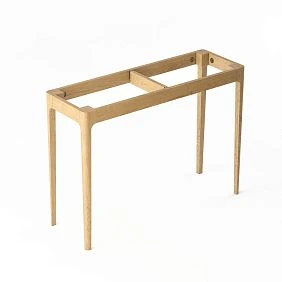
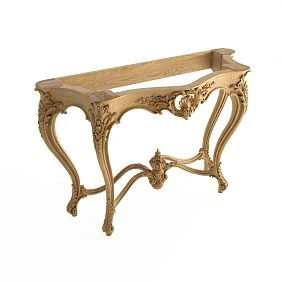


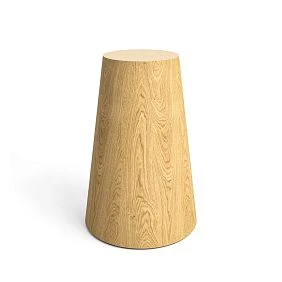
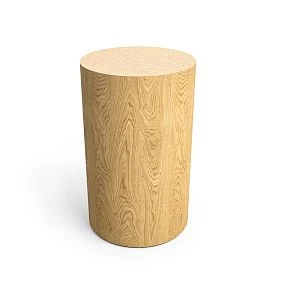
Why table frame, underframe, supports, and legs are confused
A buyer rarely starts the selection with precise technical terms. Usually the task sounds simpler: "there is a tabletop, I need something to put under it." But different solutions may fit this "something." Some provide only vertical support. Others form a ready-made base. Still others work as a rigid load-bearing system.
That is why queries like "table supports underframe", "underframe table supports" or "leg supports underframe for table" appear not by chance. A person sees similar products but does not understand the boundary between them. In some cases, they really need separate legs. In others, a ready-made underframe. And for a large wooden tabletop, a full frame may be needed.




Legs are not always an underframe
Legs are separate vertical elements on which the tabletop rests. They can be simple, turned, carved, massive, thin, straight, or shaped. But legs alone do not make a table stable. Important are the fastening, distance between supports, tabletop material, presence of crossbars, aprons, and the rigidity of the entire structure.
For a small coffee table or a lightweight decorative tabletop, separate legs may be sufficient. But for a large dining or kitchen table, such a scheme requires precise calculation. If the legs are too narrow, the mounting plate is weak, and the tabletop is heavy, the table may wobble even with a beautiful appearance.
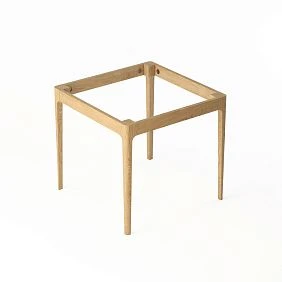
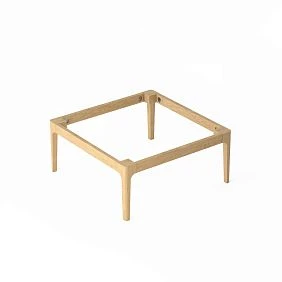
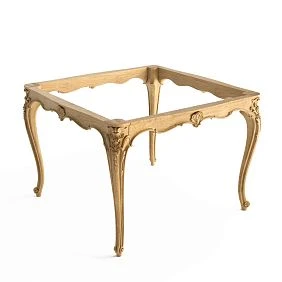
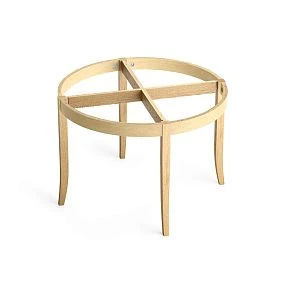
Our factory also produces:


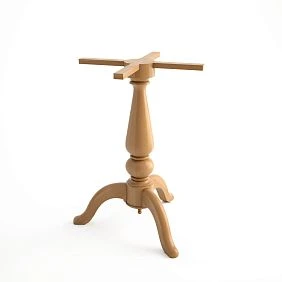
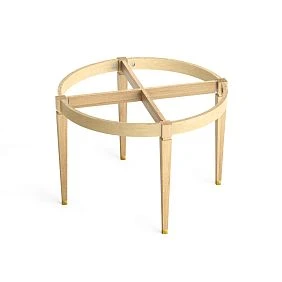
Supports — a broader concept
A support is any element that bears the load from the tabletop. A leg can also be a support, but not every support looks like a classic leg. A support can be a central post, a side structure, a carved base, a crosspiece, a pair of massive posts, or part of an underframe.
When the query contains the words "table base supports for a table", the buyer is most often looking not for a term, but for a stable foundation. They need to understand which elements will hold the tabletop, won't interfere with legs, and will match the style of the future table.
Get Consultation
A table base is a ready-made foundation for a tabletop
A table base is usually perceived as a ready-made foundation on which the tabletop is installed. It can be a decorative wooden base, a central support, a structure with several legs, a carved solution, or a simpler base. The main difference is that a table base is purchased as a foundation for a specific tabletop, not as a separate random part.
If you already have a tabletop and want to assemble a designer table, you should look specifically at the base under the tabletopThis approach is simpler than selecting legs, crossbars, and fasteners separately.
The frame is the load-bearing structure of the table
The table frame is a more structural concept. It can include supports, aprons, crossbars, mounting plates, and other elements that tie the base into a single system. A frame is needed where rigidity, stability, and predictable behavior of the table under load are important.
For a large wooden tabletop, a daily dining table, a kitchen table, or a commercial interior, it's better to look in advance table frame, rather than limiting yourself to beautiful legs without calculation.
What is a table base
The underframe is the base on which the tabletop is installed. It bears the load, sets the table height, affects seating, supports the interior style, and helps make the table visually cohesive. Unlike individual legs, the underframe is often perceived as a finished lower part of the table.
For the buyer, an underframe is convenient because it reduces the number of decisions. There's no need to separately look for legs, think about the distance between them, select crossbars, and guess whether the structure will be stable. A ready-made base is easier to match with the tabletop size and the future installation location.
If you want to get an expressive wooden table, rather than just a tabletop on four random supports, it makes sense Buy wooden furniture and then select proportions, finish, and overall style to match it.
Why a buyer needs a table base
The main task of a table base is to hold the tabletop and make the table comfortable. But in the interior, it solves not only a technical task. It sets the character of the table. The same tabletop on thin legs, a massive wooden base, and a decorative table base will look completely different.
A table base helps:
- make the table more stable;
- choose a base to match the shape of the tabletop;
- connect the table with the interior of the kitchen, dining room, or living room;
- create a decorative accent without extra details;
- avoid accidental selection of individual legs;
- assemble the table as a single piece of furniture.
When the underframe is especially convenient
The underframe is convenient when the tabletop has already been chosen, but the lower part of the table is not yet clear. For example, a customer has bought or plans to order a wooden tabletop and is now deciding what to put under it. If you choose only legs, you need to think about fastening, stability, distance from the edge, seating comfort, and overall rigidity. The underframe partially removes this complexity because it is immediately perceived as a ready-made base.
For a dining table, the base helps make the center of the composition more expressive. For a kitchen, it helps choose a foundation that won't interfere with legs and will fit with the furniture. For a living room, it creates a decorative item that doesn't look randomly assembled.
What is a table frame
A table frame is a load-bearing structure that holds the tabletop and connects the table elements together. Unlike the underframe, the frame is often perceived not only as a decorative base but also as a structural part of the product. It is responsible for rigidity, stability, load distribution, and durability.
The frame can be visible or partially hidden. In some tables, it becomes an important part of the design; in others, it is hardly noticeable. But in both cases, its task is not just to "hold the tabletop from above" but to work as a system.
When a customer searches for 'buy table frame' or 'buy frame for table', they most often need a more reliable structure than individual legs. Especially if it involves a wooden tabletop, a large size, daily use, or a commercial space.
What can a frame consist of
The frame may include supports, stretchers, crossbars, mounting plates, and other structural elements. The specific composition depends on the model and purpose of the table. The main point is that the frame connects the lower part into a single rigid base, rather than leaving each support to work independently.
That is why a frame is often chosen for tables that must withstand regular loads. A dining table, kitchen table, conference table, cafe table, or massive wooden table in the living room requires not only a beautiful shape but also the correct structure.
When a frame is better than individual legs
Individual legs can be a good solution for simple tables, but they have a limitation: stability depends on the quality of installation and how each leg is connected to the tabletop. If the tabletop is large, heavy, or heavily used, the structure may start to wobble.
A frame distributes the load differently. It connects the elements together and helps the table maintain rigidity. Therefore, for a large tabletop, it is better to look in advance furniture frames, rather than assembling the base from random parts.
How an underframe differs from a table frame
The underframe and the frame may overlap in meaning, but they cannot be considered completely identical. The underframe more often describes a ready-made base for the tabletop. The frame is a structural system that ensures the rigidity and load-bearing capacity of the table.
| Criterion | Underframe | Table frame |
|---|---|---|
| Purpose | Ready-made base for tabletop | Load-bearing structure of the table |
| Visual role | Often noticeable decorative element | Can be visible or structural |
| Composition | Support, base, mounting platform | Supports, aprons, crossbars, fasteners |
| When to choose | If a ready-made base for the tabletop is needed | If increased rigidity is needed |
| For which tables | Dining, coffee, kitchen, interior | Large, heavy, work, dining |
To put it simply, an underframe is more often chosen as a visible ready-made base, while a frame is chosen as a structure that should provide rigidity. But in the catalog, these concepts may overlap. Therefore, it is better to look not only at the name, but at the shape, dimensions, purpose, method of fastening, and compatibility with the tabletop.
What to buy for under the tabletop: legs, supports, underframe, or frame
To understand what to buy for the tabletop, you need to start not with the product name, but with the tabletop itself. It has a size, shape, weight, material, and usage scenario. A lightweight decorative tabletop for a coffee table and a massive wooden tabletop for a dining table require different bases.
If the tabletop is small, lightweight, and used infrequently, you can consider individual legs. If the table should be an expressive interior piece, it's better to look at an underframe. If the tabletop is large, heavy, or will be used daily, it's wiser to choose a frame or a ready-made structural base.
When individual legs are enough
Individual legs are suitable for simple solutions: small tables, lightweight tabletops, decorative items, temporary or low-load structures. But even here, it's important to consider the height, mounting area, and stability. A leg should not only be beautiful. It must work correctly with the size of the tabletop.
If the table will be placed in a walkway area, used by children, or bear dishes, appliances, or constant load, individual legs need to be chosen with particular care. Without crossbars and a common connection, the structure may be less stable.
When supports are needed
Supports are needed when the structure is assembled from several elements or when the table must have a special base shape. For example, it could be a central support for a round tabletop, two side supports for a rectangular tabletop, or a decorative base for an interior table.
But supports themselves do not guarantee stability. You need to look at how widely they are spaced, how they are attached to the tabletop, whether they interfere with legs, and whether they match the weight of the future table.
When it's better to choose an underframe
An underframe is convenient when you want to buy a ready-made base and not assemble the lower part of the table from scattered elements. This is especially relevant if the tabletop already exists or has been chosen in advance. In this case, it's easier for the buyer to assess the size of the tabletop and select a suitable base for it.
For a wooden tabletop, they often choose wooden table base, because it supports the tabletop material and helps make the table visually cohesive.
When a frame is needed
A frame is needed when rigidity is important. This includes large dining tables, everyday kitchen tables, work surfaces, tables for commercial spaces, non-standard tabletops and structures where the load is not just decorative.
If you are torn between legs and a frame, ask yourself a simple question: will the table be actively used every day? If yes, it is better to consider a more rigid base.
When a table frame is needed
A table frame is not always needed, but there are situations where it is better not to take risks without it. The main indicator is load. The larger the tabletop, the heavier the material, and the more actively the table will be used, the more important the structural base is.
Heavy tabletop
A wooden tabletop can be heavy, especially if it is large and made of solid wood or thick material. In such a situation, a weak base will quickly show itself: the table will start to wobble, the fasteners will experience increased load, and using the table will become uncomfortable.
For a heavy tabletop, it is better to consider a frame in advance that distributes the load and connects the supports together. This helps avoid a situation where a beautiful lower part cannot handle real use.
Large dining table
A dining table is not a decorative console. People sit at it, they put dishes, meals, drinks on it, and sometimes lean on it with their hands. If the table is large, the base must be not only beautiful but also stable.
The query "buy dining table frame" usually appears when the buyer already understands: ordinary legs may be too simple a solution. For a large tabletop, it is better to evaluate the frame as a system, not as a set of individual elements.
Everyday kitchen table
A kitchen table is used more often than many other pieces of furniture. People eat at it, cook, place heavy objects, move chairs, and sometimes use it as an additional work surface. Therefore, the frame for a kitchen table must be reliable.
If you need to choose a base for a kitchen table, don't focus only on style. Check the height, stability, seating comfort, and whether the supports will get in the way of your legs.
Table for commercial interior
In a cafe, restaurant, salon, showroom, or office, a table experiences more load than at home. Different people use it, it may be moved, objects are regularly placed on it, and its appearance must remain neat.
For such scenarios, a frame is often preferable because it helps assemble a more stable structure. This is especially important for wooden tables, where the base must match the visual and physical weight of the tabletop.
Non-standard tabletop shape
A round, oval, elongated, or non-standard tabletop requires careful selection of the base. Individual legs may look awkward or interfere with seating. An underframe or frame allows for better weight distribution and maintains comfort.
For a non-standard shape, it's important to understand in advance where the center of gravity will be, how people will sit at the table, and whether the base will be too narrow for the chosen tabletop.
When to choose an underframe
A table base is the better choice when not only strength but also the appearance of the lower part of the table is a priority. This is especially important for dining areas, living rooms, open-plan kitchens, home offices, and interiors where the table is a prominent piece of furniture.
An underframe helps make the table look complete. It doesn't appear as a temporary assembly of separate parts. A well-chosen base supports the shape of the tabletop, the room's style, and the overall interior concept.
The tabletop is already chosen
If the tabletop is already available, a table base becomes the logical next step. You can measure the length, width, thickness, estimate the weight, and determine which base will look proportional. This is easier than selecting legs individually and then checking if they form a stable structure.
In such a case, the buyer often searches for "buy underframe for tabletop" or "purchase underframe for tabletop." It's important not just to find a suitable product but to match it with the actual parameters of the tabletop.
A wooden accent is needed
A wooden base works well where the table should look warm, expressive, and interior-oriented. It supports the natural character of the tabletop and helps avoid the feeling that the top and bottom of the table are from different projects.
If the interior is built around wooden details, solid wood, carved elements, or classic furniture, Buy wooden furniture it is often more reasonable than looking for random metal or plastic supports.
The appearance of the base is important
Sometimes the lower part of the table is even more visible than the tabletop. For example, in a dining room, living room, open kitchen, meeting area, or cafe. If the base is rough, too thin, or mismatched in style, the entire table looks random.
The underframe allows the lower part to be decorative. It can support classic, soft modern styling, interiors with natural materials, or a more expressive furniture composition.
What is more stable: an underframe or individual legs
Stability depends on the design, not the name. It cannot be said that any underframe is always more stable than any legs. But a ready-made underframe or frame is easier to select as a single system, while individual legs require more precise calculation.
Stability is affected by the width of the base, table height, tabletop weight, distance between supports, quality of fastening, tabletop shape, and how people will use the table. A narrow base under a wide tabletop is almost always a risk. A too-light lower part under a heavy top also creates a problem.
Why a table may wobble
A table may wobble not only due to a bad floor. Often the reason is an incorrect base. If the legs are placed too close to the center, if the mounting plate is small, if there is no rigid connection between the supports, or if the tabletop is too heavy, the structure becomes unstable.
Another reason is a mismatch of height and width. The taller the table and the narrower the base, the greater the risk of wobbling. Therefore, for a dining or kitchen table, it is important to look not only at the beauty of the supports but also at the geometry of the entire structure.
Why a ready-made base is often more convenient
A ready-made underframe or frame is easier to evaluate as a whole. The buyer sees not a separate leg, but the lower part of the table. This helps to understand how the base will look under the tabletop and how suitable it is in scale.
If you need a table for daily use, it is better to choose in advance a base for a wooden table, rather than assembling it from parts that were not designed as a single system.
How to choose a base for a wooden table
Choosing a base for a wooden table starts with the dimensions of the tabletop. You cannot choose an underframe or frame based solely on style. Even a beautiful base won't save the situation if it is too narrow, too light, too low, or interferes with seating.
Tabletop size
First, you need to measure the length, width, and thickness of the tabletop. The larger the tabletop, the more requirements there are for the base. A small table can stand on light legs, but a large dining surface requires a more substantial structure.
For a round tabletop, the position of the central support and the width of the base are important. For a rectangular one, the distance between supports and stability along the long side matter. For an oval one, it's a balance between seating comfort and load distribution.
Weight and material
Wood is visually and physically heavier than many lightweight materials. Therefore, for a wooden tabletop, you need to choose a base that matches its weight. Too thin legs may look beautiful in photos, but in a real table they do not always provide the necessary stability.
If you are choosing a table made of natural materials, it is also useful to check the related section Solid Wood Items, to understand which wooden elements can be combined with each other in style and purpose.
Table height
Height affects seating comfort. Even the most beautiful frame will be uncomfortable if the table is too high or too low. Before ordering, you need to understand what type of table is being assembled: dining, kitchen, coffee, work, or decorative.
You should also consider the height of the chairs. A common mistake is to choose a base that looks beautiful on its own, but after installing the tabletop, it results in an uncomfortable seating position.
Tabletop shape
A round tabletop often requires a central or balanced base so that people can sit comfortably on all sides. A rectangular one works well with two side supports, four legs, a frame, or a long base. An oval one requires particularly careful selection: the base must be stable but not interfere with legs.
The shape of the tabletop also affects the appearance. A too-small base under a large round tabletop looks unsteady. A too-massive base under a light rectangular tabletop overloads the table.
Seating comfort
The base should not interfere with legs. This is especially important for dining and kitchen tables. If the supports are poorly positioned, it will be uncomfortable to sit at the table, even if it looks beautiful. Before purchasing, imagine where the chairs will be, how many people will sit at the table, and how they will get up.
For a family table, seating comfort is sometimes more important than decorativeness. A beautiful table base should not only decorate the interior but also not interfere with daily use.
Selection for different customer scenarios
For the kitchen
A kitchen table should be stable, comfortable, and practical. It is used every day, so the base must withstand regular load. If the tabletop is wooden, it is better not to choose too light legs just because they match the style.
When a customer asks which table base to choose for a kitchen table, the answer depends on the kitchen size, tabletop shape, and number of seats. For a small kitchen, a neat table base may be suitable. For a large family table, it is better to look at a frame or a more rigid base.
For the dining room
In the dining room, the table often becomes the center of the room. Here, not only stability but also expressiveness is important. The base can play a decorative role, especially if the chairs, light fixture, and decor support a wooden theme.
For a large dining room tabletop, you need a base that visually supports its scale. Too thin supports may look accidental. A frame or massive base helps make the table more convincing.
For the living room
In a living room, coffee tables, side tables, or decorative tables are more often chosen. Here, the load may be less, but the appearance of the base is especially important. The table base can work as an accent and connect the table with the rest of the furniture.
If the table is used rarely, you can choose a more decorative solution. If books, decor, equipment, or dishes are constantly on it, it's better not to forget about stability.
For a study
In an office, the table should be calm and reliable. If it's a work surface, the base must withstand prolonged loads, equipment, documents, and constant use. Here, a frame is often preferable because it gives a feeling of rigidity and stability.
A wooden base pairs well with a classic study, an interior with solid wood, a library, or a quiet work area.
For cafes and restaurants
In a commercial interior, the table base must be designed for active use. Tables are moved, different people sit at them, and dishes, meals, and utensils are placed on them. A mistake in stability quickly becomes noticeable.
For cafes and restaurants, it's better to choose not only by appearance but also by practicality: how stable the base is, whether it's comfortable to sit, whether it interferes with chairs, whether it matches the hall's style, and whether it withstands daily use.
How not to confuse similar solutions
The main difficulty is that the frame, underframe, supports, and legs can indeed look similar visually. But you need to buy them based on the task, not just the name.
| What you are choosing | What it is confused with | How to distinguish |
|---|---|---|
| Table frame | With separate legs | The frame works as a connected structure |
| Underframe | With a decorative support | The underframe is chosen as the base for the tabletop |
| Supports | With a ready-made underframe | Supports can be part of the structure, but do not always form a ready-made base |
| Legs | With a frame | Legs themselves do not guarantee rigidity |
If in doubt, look at the function. Need to simply lift a lightweight tabletop? Legs might suffice. Need a ready-made decorative base? Look at the underframe. Need a rigid base for a heavy table? Better to look at the frame.
What to buy together with a table base
The base is only part of the future table. For a successful purchase, you need to think in advance about the tabletop, fastening, finishing, material compatibility, and usage scenario. This is especially important for wooden products, where differences in shade, texture, and scale can be noticeable.
| What to add to the purchase | Why this is needed | What to Check |
|---|---|---|
| A tabletop of the right size | To match the scale of the base and the top | Length, width, thickness, and weight |
| Fasteners and mounting materials | For reliable installation of the tabletop | Compatibility with material and construction |
| Solid wood elements | To assemble the interior in a single material | Texture, style, and future finish |
| Additional furniture details | If the table should match other furniture | Size, material, and purpose |
If the table is being assembled as part of a large interior project, it is useful to look in advance not only at the base, but also at adjacent wooden parts. This makes it easier to avoid a situation where the table lives separately from the kitchen, sideboard, chairs, wall panels or other furniture.
Typical mistakes when choosing a frame or under-table base
Buying a base only by photo
A photo shows the shape but does not show how the base will behave under your tabletop. The same frame can look light under a small tabletop and too weak under a large one. An under-table base that looks beautiful in the product card may turn out to be too massive for a small kitchen.
Before buying, you need to look at the dimensions, purpose, shape, mounting method and actual usage scenario.
Not considering the weight of the tabletop
This is one of the most serious mistakes. The buyer chooses a beautiful lower part and then installs a heavy wooden tabletop on it. As a result, the table may wobble or look unbalanced.
The heavier the tabletop, the more carefully you need to choose the base. For a large wooden table, it is better to consider a frame or a sturdy underframe, rather than random individual legs.
Confusing decorativeness and construction
A decorative base can be beautiful, but for heavy loads, proper construction is also needed. If the base looks impressive, it doesn't automatically mean it will suit any tabletop.
Before ordering, you need to understand for which table the product is being chosen: coffee, dining, kitchen, work, or commercial.
Not checking the height
The height of the base together with the tabletop determines seating comfort. If the tabletop thickness is not considered, the finished table may end up too high. If the base is too low, it will be uncomfortable to sit at the table.
It is especially important to check the height for kitchen and dining tables, where comfort matters every day.
Not accounting for legroom
A beautiful central support or a massive under-table can get in the way of legs if seating positions are not thought out. For a dining table, you need to plan in advance where the chairs will be placed and how many people will sit at the table.
The base should be not only stable but also comfortable.
Buying one part instead of a system
Sometimes a buyer chooses individual legs, thinking that's enough. But then it turns out that crossbars, fasteners, additional elements, and precise assembly are needed. As a result, a simple purchase becomes a complex task.
If you need a predictable result, it's better to look at a ready-made table base or frame.
Where to buy a table frame or wooden underframe
If you are choosing a base for a wooden tabletop, start with the task. For a simple, light table, individual legs may work. For an expressive interior piece, it's better to consider an under-table. For a large, heavy, or frequently used table, you should look at a frame.
In the STAVROS section you can buy a table frame or wooden underframe and choose a base that matches the size, style, and purpose of the future table. Before ordering, check the dimensions, weight, shape, height, seating comfort, and attachment method of the tabletop.
If you need a ready-made wooden base, look at wooden table base. If structural rigidity, large size, and daily load are more important, go to the furniture frames section and compare options by purpose.
FAQ
What is the difference between an underframe and a table frame?
A table base is usually perceived as a ready-made support for a tabletop. A table frame is a broader structural concept. It can include legs, stretchers, crossbars, and fasteners that connect the table into a rigid system.
What to buy for a tabletop — legs or an underframe?
If the tabletop is light and the table is simple, you can consider individual legs. If stability, a cohesive appearance, and easy selection are important, it's better to choose a table base. For a heavy or large tabletop, you should look at a frame.
When is a table frame needed?
A frame is needed when the tabletop is heavy, the table is large, the load is high, or a rigid structure is required. This is especially important for dining, kitchen, work, and commercial tables.
What is more stable: a table base or individual legs?
Stability depends on the design, dimensions, fastening, and weight of the tabletop. However, a ready-made table base or frame is easier to choose as a single stable system than assembling a base from individual legs without calculation.
How to choose a base for a wooden table?
You need to consider the size and weight of the tabletop, the shape of the table, height, interior style, seating comfort, and reliability of fastening. For a large wooden tabletop, it is better not to choose a base based solely on appearance.
Can a table frame be used instead of an underframe?
Yes, if the frame matches the size, height, and fastening to the tabletop. In some cases, a frame is even preferable, especially if increased rigidity is needed and the table will be used daily.
Which underframe should I choose for a kitchen table?
For a kitchen table, it is important to consider stability, height, seating comfort, and frequent load. If the table is small, a neat table base may be suitable. If the table is large and used daily, it is better to consider a more rigid base or frame.
Is a wooden underframe suitable for a dining table?
Yes, if it matches the size, height, mounting, and can support the chosen tabletop. For a dining table, it's important that the base doesn't interfere with legroom and matches the number of seats.
Can a heavy tabletop be placed on individual legs?
Only with correct calculation. You need to consider the weight of the tabletop, the attachment area, the distance between the legs, and the rigidity of the structure. In most cases, for a heavy tabletop, it is safer to consider a frame or a ready-made underframe.
What is better for a round table: an underframe or legs?
For a round table, a central or balanced table base is often more convenient because it doesn't interfere with seating and helps support the tabletop evenly. However, the final choice depends on the diameter, weight, and purpose of the table.
Where to buy a wooden underframe?
A wooden underframe can be selected on the STAVROS website in the underframes section. Before purchasing, it's worth checking the dimensions, purpose, material, attachment method, and compatibility with the tabletop.
Where to buy a table frame?
A table frame can be viewed in the STAVROS furniture frames section. Before ordering, it's important to understand what kind of table it is needed for: kitchen, dining, work, coffee, or commercial.
<h2>Summary: what to choose for a tabletop</h2>
<p>The table frame and under-table solve similar but not identical tasks. The under-table is more often chosen as a ready-made base for the tabletop, especially if the appearance of the lower part is important. The frame is needed where a rigid load-bearing structure, high stability, and reliability under daily load are required.</p>
<p>If the tabletop is light and small, you can consider individual legs or simple supports. If you need a solid wooden base, it is better to choose an underframe. If the table will be large, heavy, kitchen, dining, or commercial, it is more reasonable to look at a frame.</p>
<p>Before purchasing at STAVROS, check the size and weight of the tabletop, shape, height of the future table, seating comfort, attachment method, and interior style. This approach helps not just buy a beautiful part, but assemble a stable wooden table that will look cohesive and be comfortable to use every day.</p>