Article Contents:
- Why you should buy the STL-041 table base
- What is the conical table base STL-041
- Hollow Construction
- Size 500 × 740 × 300 mm
- Central support instead of four legs
- Modern exterior character
- For dining, writing or conference table
- Individual legs
- Frame base
- Central cone
- When a central support is more convenient
- When another base is better
- The plate connects two different geometries
- Countersunk holes for the underframe
- 9 mm diameter holes for the tabletop
- Steel, 2 mm thick
- Black moiré
- Why direct mounting is risky
- Why a random plate is not equivalent to FUR-034
- When an individual project is needed
- Centering
- Marking Hole Positions
- Pilot hole drilling
- Depth control
- Uniform tightening
- Post-installation check
- Round tabletop
- Square tabletop
- Oval tabletop
- Rectangular tabletop
- Asymmetrical shape
- Overhang relative to the plate
- Overhang relative to the base
- Mounting points
- Clearances around the table
- Material in the attachment area
- Thickness 24 mm
- Tabletop weight
- Edge profile
- Veneer pattern position
- MDF for painting
- When MDF is more rational
- MDF with beech veneer
- MDF with oak veneer
- Can a veneered underframe be painted with enamel
- How to match the underframe with the tabletop
- Solid wood
- Combined tabletop
- Stone and marble
- Composite
- Glass
- Geometric calculation
- Edge load
- Tabletop rigidity
- Center of mass
- Floor reference contour
- Layout on the floor
- Dry assembly
- Gradual loading
- Pressing at multiple points
- Floor check
- Dining table
- Desk
- Conference table
- Café and restaurant
- Kitchen and dining room
- Living Room
- Office
- Showroom and salon
- Cafe
- Meeting room
- Need a round dining table for four
- Need a table matching kitchen cabinet color
- Need a table with natural oak grain
- Need a heavy stone tabletop
- Need a glass tabletop
- Need a long conference table
- Need to replace the old central base
- Need a table for commercial space
- Mounting plate
- Fasteners for tabletop
- Materials for finishing
- Underframe and separate leg
- FUR-034 and small mounting plate
- Plate and ready-made fastener kit
- Veneered underframe and solid base
- ST-030 and guaranteed compatible tabletop
- Round tabletop and any tabletop with the same diameter
- Purchase only STL-041
- Waiting for fasteners inside FUR-034
- Universal advice "take a 30 mm self-tapping screw"
- Fastening stone with ordinary self-tapping screws
- Ignoring weight
- Too much overhang
- Square tabletop without checking corners
- Drilling the under-table without a drawing
- Finishing after full assembly
- Tightening of fasteners
- Assembly by one person
- Use immediately after painting
- Check only on the store's level floor
- Delivery check
- Tabletop check
- Template preparation
- Trial fastening
- Finish protection
- Preparation for flipping
- Centering
- Levelness
- Backlash
- Local load resistance
- Seating comfort
- Re-inspection
- Undercarriage execution
- Mounting plate
- Tabletop
- Finishing
- Assembly
- Logistics
- Delivery route
- Assembly area
- Temperature and humidity
- Floor Protection
- Assembly participants
- Underframe data
- Plate data
- Tabletop data
- Fasteners
- Centers and offsets
- Finishing and assembly order
- Tabletop contour
- Cone volume
- Height
- Checking square corners
- Checking daily actions
- First weeks
- Signs of a problem
- After moving
- Care for FUR-034
- Care of STL-041 finish
- One support
- Two supports
- Why you can't just double the allowable length
- What is STL-041?
- Which tables is STL-041 suitable for?
- What is FUR-034 for?
- What size is FUR-034?
- Does the FUR-034 kit include fasteners?
- Can FUR-034 be used with a different underframe?
- Can the tabletop be attached without the plate?
- Which round tabletop should I choose?
- Does ST-030 fit STL-041?
- What are the dimensions of ST-030?
- Can I install a stone tabletop?
- Can I use a glass tabletop?
- How to choose screws for a wooden tabletop?
- How to calculate the overhang?
- What will be the table height with ST-030?
- MDF or oak veneer — which to choose?
- Can I paint STL-041 to match the kitchen color?
- How to check stability?
- Is a design calculation needed?
- Where to buy STL-041 and FUR-034?

Why you should buy the STL-041 table base
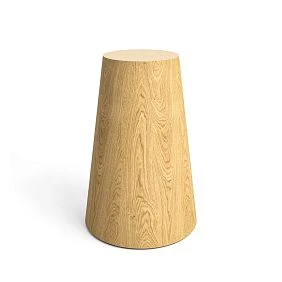
The STL-041 is suitable for a customer who needs a modern table with a single central support rather than a set of four separate legs. The table base already has a ready-made conical shape, confirmed dimensions of 500 × 740 × 300 mm, and several surface options for future finishing.
Before purchasing: STL-041 should be selected together with the tabletop, FUR-034 plate, and fasteners. The size, weight, and material of the tabletop must be checked separately — universal compatibility with any top is not assumed.
Buy underframe STL-041Buy a conical underframe for a tabletop makes sense when you need a table with a single central support, free legroom, and expressive geometry without four separate legs. But choosing such a base cannot be reduced to appearance. The underframe, mounting plate, tabletop, and fasteners form one structural system. If at least one element is chosen randomly, the finished table may wobble, have excessive tabletop overhang, or be uncomfortable for seating.
STL-041 — hollow conical pedestal base measuring 500 × 740 × 300 mm. The product card shows three versions: MDF for subsequent painting, MDF with oak veneer, and MDF with beech veneer. The manufacturer separately recommends using the metal mounting plate FUR-034. It has a diameter of 420 mm, a thickness of 2 mm, and connects the upper part of the conical base to the tabletop through a system of holes.
The plate is not a universal small part for any furniture leg. It is designed for STL-041 and works as an intermediate rigid element. Through the inner row of holes, the plate is attached to the pedestal base; through holes with a diameter of 9 mm closer to the edge, it is attached to the underside of the tabletop. Self-tapping screws, metric bolts, and other fasteners are not included in the delivery. They are selected separately based on the material and thickness of the tabletop.
Therefore, the buyer is not just choosing a beautiful cone. They are assembling a set: STL-041 table base, FUR-034 plate, a suitable tabletop, and a fastening assembly. In this article, we will analyze which tables the central support is suitable for, how to evaluate the shape and size of the tabletop, why a plate with a diameter of 420 mm is needed, how MDF and veneered options differ, how to calculate the overhang, and what parameters to check before placing an order.




What is the conical pedestal base STL-041
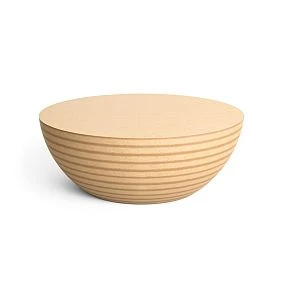
STL-041 is a geometric central base for a table. Its external shape resembles a truncated cone: the lower part creates a support contour on the floor, the upper part connects to the tabletop via a mounting plate. Unlike four legs, this design leaves the edges of the table free and allows chairs to be placed without being tied to corner supports.
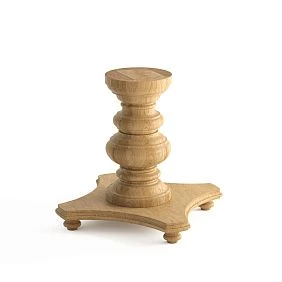
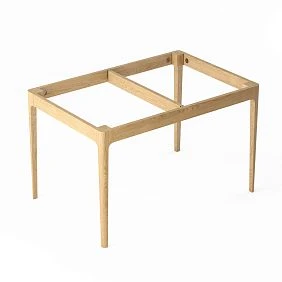
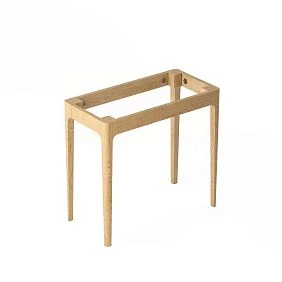
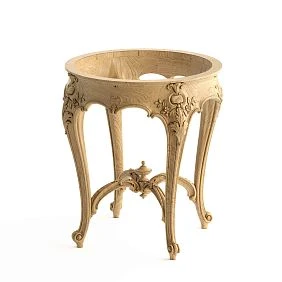
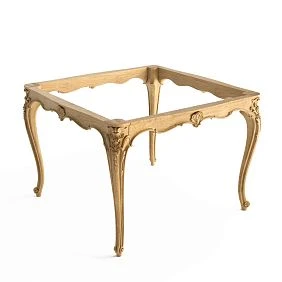
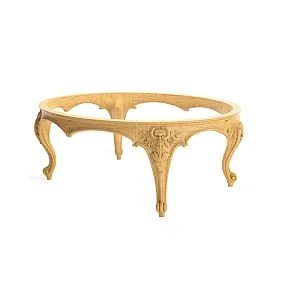
Our factory also produces:
Hollow construction
The pedestal base is not a solid massive wooden block. The product card indicates a hollow construction made of MDF and plywood. This is important for understanding installation: fasteners must go into the designated areas and work together with the plate, rather than being screwed into a random spot on the wall. The cavity also means that drilling without a drawing can damage the structure.
Get Consultation
Dimensions 500 × 740 × 300 mm
In the product card table, the dimensions are given according to the A × B × D scheme: 500 × 740 × 300 mm. It is important for the buyer to check the drawing and understand which parameter refers to the upper and lower parts. The height of 740 mm is close to the standard height of a dining base, but the final table height will increase by the thickness of the mounting plate, tabletop, and any possible spacer elements.
Central support instead of four legs
A person can move a chair closer to the edge without hitting their knees on the corner leg. This is convenient for round and near-round tabletops, as well as for conference tables. However, the central structure imposes increased stability requirements: the tabletop creates a lever relative to the base, so its weight and overhang must be checked.
Modern exterior character
A clean conical shape suits modern, minimalist, and eclectic interiors. The underframe can be made calm and almost neutral under enamel or emphasize the texture of the veneer. However, style should not become the only criterion. First, evaluate dimensions, construction, and compatibility.
For a dining, writing, or conference table
The STL-041 card specifies application for dining, writing, and conference tables. The actual configuration depends on the tabletop. For the dining option, seating arrangement is important; for the writing option, stability when leaning on hands; for the conference option, even access from all sides and absence of excessive deflection of the upper part.
If the buyer is still comparing different base shapes, you can buy an underframe for a tabletop through the general section of furniture frames and compare the central model with other structures.
Confirmed characteristics of STL-041, FUR-034, and ST-030
| Parameter | STL-041 | FUR-034 | ST-030 |
|---|---|---|---|
| Type | Conical central underframe | Round mounting plate | Round tabletop with beveled profile |
| Size | 500 × 740 × 300 mm | Diameter 420 mm, thickness 2 mm | 1148 × 1148 × 24 mm |
| Material | MDF and plywood; options: MDF, MDF/oak veneer, MDF/beech veneer | Steel | Oak/MDF/oak veneer or beech/MDF/beech veneer |
| Finishing and preparation | MDF primed for enamel; veneered options ready for paint and varnish finishing | Black moire | Sanding quality "Prestige" |
| Structural role | Takes the load and defines the central support | Connects the top of the underframe to the tabletop | Forms the working and dining surface |
| Fastening | Plate is purchased separately | Fasteners are not included in the kit | The mounting method is checked based on material and thickness |
| Important limitation | You cannot select a tabletop only by its outer diameter | Designed for STL-041, not claimed as universal | Not automatically considered compatible with STL-041 without verification |
ST-030 is given in the article as a real example of a table top, not as a pre-approved set. Its size 1148 × 1148 × 24 mm allows for a clear discussion of the relationship between the tabletop, the 420 mm diameter plate, and the base. However, before ordering, it is necessary to check the weight, overhang, location of mounting zones, permissible fixing method, and stability of the entire structure.
How a central pedestal differs from individual legs and a frame base
Individual legs
Four legs distribute support points closer to the corners. The attachment of each part is relatively local, and the tabletop rests on several zones. The disadvantage is that the legs take up space near the seating areas and restrict the movement of chairs.
Frame base
Drawers and supports create a rigid perimeter under the tabletop. This system distributes load well but can interfere with knees and visually weigh down the table. The attachment of the top part often includes compensation for wood movement.
Central cone
STL-041 concentrates support in the center. There are no legs or drawers at the edges of the tabletop, but the lever effect increases: the farther the edge is from the plate and base, the greater the load when pressed. Therefore, you cannot use an arbitrary wide tabletop just because it physically fits on top.
When a central support is more convenient
It is useful for a round dining table, meeting area, cafe, and interiors where chairs should move freely around the circumference. The conical shape also covers the central node and creates a finished silhouette without a visible leg system.
When a different frame is better
For a very long rectangular tabletop, heavy stone, or large cantilever load, a different system with multiple supports may be required. The decision is made after calculation, not based on universal advice.
Why STL-041 needs mounting plate FUR-034
A conical underframe does not have a wide top frame to which the tabletop can be screwed around the perimeter. The upper zone of the base is relatively compact, and the tabletop is usually noticeably wider. FUR-034 increases the connection area and moves the fastening points closer to the edge of the metal disk. This allows the load to be transferred not through a single narrow point, but through several holes.
The plate connects two different geometries
The top of the underframe has its own diameter, the tabletop has another. A steel plate with a diameter of 420 mm becomes an intermediate link between them. The inner circle of holes is oriented towards the underframe, the outer one towards the tabletop. This is structurally clearer than trying to attach a large top part directly to the thin edge of the cone.
Countersunk holes for the underframe
The inner holes have countersinking. The fastener heads can be flush and not interfere with the subsequent fit of the tabletop. However, the type and length of screws must be coordinated with the actual material thickness in the STL-041 fastening area.
9 mm diameter holes for the tabletop
The outer row allows the use of metric bolts or screws depending on the upper part. The hole diameter does not mean that fasteners with a diameter of exactly 9 mm are needed. This is a clearance hole, and the working fasteners are selected based on the material, threaded insert, washer, and design load.
Steel and thickness 2 mm
The plate is made of steel, has a thickness of 2 mm and a weight of about 2.2 kg. It adds rigidity to the joint, but by itself does not make any tabletop safe. If the top is too heavy or too wide, the leverage will remain large.
Black moiré
The coating protects the steel and creates a neat appearance. After assembly, the plate is usually hidden under the tabletop, but its edge may be visible from a low angle. Therefore, the color and condition of the coating still matter.
For the system with STL-041, you can purchase the mounting plate FUR-034 for STL-041. Before ordering, it should be considered that the fasteners for the underframe and tabletop are purchased separately.
Can the tabletop be secured without FUR-034
The STL-041 card directly recommends this plate. Refusing it means designing an alternative assembly that must be calculated by a designer or furniture maker. You cannot simply screw a few self-tapping screws into the upper part of the cone and consider the joint equivalent.
Why direct fastening is risky
Without the plate, the support area and the distance between fastening points decrease. When pressing on the edge of the tabletop, the joint receives a greater moment. The self-tapping screws may be subject to pull-out, and the underframe material may be locally overloaded.
Why a random plate is not equivalent to FUR-034
Another part may have an unsuitable diameter, thickness, hole placement, or shape. FUR-034 is designed for STL-041. Universality for other underframes is not stated in the card, so the reverse combination cannot be considered confirmed either.
When an individual project is needed
If the tabletop is non-standard, heavy, has built-in equipment, or an unusual bottom structure, the ready-made scheme may be insufficient. In that case, a custom adapter, embedded parts, threaded elements, and load distribution are calculated.
How the under-table frame, plate, and tabletop are connected
The general logic consists of three levels: STL-041 stands on the floor, FUR-034 is fixed to its upper part, and the tabletop is attached to the outer row of holes on the plate. It is convenient to design the assembly from top to bottom, and to execute it in a sequence that allows precise centering of the parts.
Centering
The center of the plate must align with the axis of the cone. Then the axis of the underframe is aligned with the geometric center of the tabletop or another calculated point if the top is asymmetrical. An error of a few millimeters on a round tabletop is noticeable due to uneven overhang.
Marking holes
Before drilling, check that the holes do not fall into voids, weak zones, material joints, or decorative profiles. On a composite tabletop, it is important to understand the location of the solid edging, MDF, and veneer.
Pre-drilling
For wood, the diameter and depth of the pilot hole depend on the screw. A hole that is too large will weaken the hold, while one that is too small may split the material or strip the head. For MDF, fasteners that work reliably in panel materials are needed.
Depth control
The thickness of ST-030 is 24 mm, but this does not mean that any screw shorter than 24 mm can be used. The thickness of the plate, washers, possible gaps, and a safe margin to the front surface must be subtracted. The end of the fastener must not protrude outward.
Even tightening
The fasteners are tightened alternately around the circumference, without deforming the plate or skewing the tabletop. First, all points are lightly secured, then final tightening is performed. Excessive force can damage the threads in MDF or press in the metal.
Post-installation check
The table is flipped with several people involved, holding the structure at calculated zones. Then check for levelness, absence of play, and equal overhang. The load is increased gradually.
For a general understanding of the sequence, you can additionally study the material how to attach the table base to the tabletop, but the specific fastener dimensions for STL-041 are determined by the actual kit.
How to choose the tabletop shape
Round tabletop
This is the most natural shape for a central cone. The overhang is uniform around the entire circumference, and chairs can be evenly distributed. However, a large diameter increases leverage. Do not assume that symmetry automatically guarantees stability.
Square tabletop
The central support frees up the corners, but the distance from the center to the corner is greater than to the middle of the side. It is the corners that create the maximum overhang and put more stress on the joint when pressed. A square shape requires particularly careful inspection.
Oval tabletop
A cone can be used in the center of an oval if the length does not become excessive. A large cantilever overhang appears at the long ends. For a large oval, a pair of underframes or a different structure may be needed.
Rectangular tabletop
One central support is only suitable for limited sizes. A long rectangle is prone to rocking along the longitudinal axis and deflection. For a conference table, multiple supports are often more rational.
Asymmetrical shape
Free geometry requires calculating the center of mass. The visual center may not coincide with the structural one. If one side protrudes significantly, the table will be more sensitive to local load.
How to estimate the diameter of a round tabletop
It is impossible to determine a safe diameter based solely on the 420 mm plate size. The lower support contour STL-041, the mass and stiffness of the tabletop, the number of attachment points, the table's purpose, and the likelihood of edge loading must be considered.
Overhang relative to the plate
For the round ST-030 with a diameter of 1148 mm, the radius is 574 mm. The plate radius is 210 mm. The geometric overhang of the edge relative to the plate is about 364 mm. This is a useful figure for discussing leverage, but it does not confirm compatibility on its own.
Overhang relative to the base
The size 500 mm in the STL-041 diagram may refer to one of the cone diameters, and 300 mm to the other. The exact orientation must be verified against the drawing. Without this, the distance from the tabletop edge to the floor support point cannot be correctly calculated.
Mounting points
The diameter is chosen not only for stability. For four people, sufficient perimeter, space for dishes, and knee room are needed. The cone should not be so wide at the bottom that feet hit it.
Walkways around the table
In the room, consider pulled-out chairs, not just the tabletop outline. A round table is convenient for movement, but a large diameter may block the path. A floor layout is mandatory.
ST-030 as an example: what to check before combining with STL-041
The STL-041 card shows ST-030 among related products, but the article should not turn this proximity into a technical guarantee. The tabletop has a round dimension of 1148 × 1148 × 24 mm and a combined construction with solid wood edging, MDF, and beech or oak veneer.
Material in the mounting area
The FUR-034 holes must fall into areas designed for fasteners. If they are only in MDF, one scheme is chosen. If solid wood inserts or edging are available, another. The location of internal layers needs to be clarified.
Thickness 24 mm
It limits the length of the self-tapping screw. After subtracting the plate thickness, a small working range remains. Any washer or spacer reduces the depth of entry into the tabletop.
Tabletop weight
The exact weight is not specified in the confirmed data. It must be requested before calculating stability and logistics. Oak and beech variants may differ.
Edge profile
The beveled profile visually lightens the tabletop but does not change the requirements for the central part. Fasteners cannot be placed too close to the beveled area or edge.
Position of the veneer pattern
For a round table, the direction of the texture affects the appearance. It is better to orient the underframe relative to the room after the veneer direction has been approved.
For a detailed comparison, you can select the ST-030 tabletop made of beech or oak, using it as an example and separately confirming compatibility with STL-041.
Comparison of tabletops by material and fastening
| Tabletop material | What is important in fastening | Main risk | What to clarify |
|---|---|---|---|
| Solid wood | Fiber direction, wood movement, screw depth | Cracks, fastener pull-out, or rigid blocking of seasonal movement | Permissible hole pattern and fastener type |
| MDF | Holding capacity of panel material and number of points | Thread failure due to overtightening | Special fasteners or embedded parts |
| Composite countertop | Array, MDF, veneer, and inner layers layout | Hole falling into a weak or hollow area | Drawing of the upper part structure |
| Stone or composite | Embedded parts, glue, or special adapter | Crack, local stress, and large mass | Countertop and underframe manufacturer's calculation |
| Glass | Special supports, pads, and pre-prepared points | Failure under point load | Glass manufacturer project |
There is no universal set of self-tapping screws for all these materials. Even within one group, thickness, density, and internal structure differ. Therefore, the commercial route includes not only purchasing the under-table and plate but also agreeing on the fasteners.
To select suitable parts, you can select fittings for attaching the under-table, but the specific fastener must be confirmed for the tabletop material.
MDF under enamel or beech and oak veneer
The external shape of STL-041 is the same, but the surface material changes the table's character and finishing technology. The basic MDF version is intended for covering enamel. Veneered versions preserve the wood grain and allow the use of stains, clear varnishes, or patina.
MDF for painting
The basic under-table is made with deep milling and comes with a primer-insulator. This reduces preparation for final painting, but does not mean the product already has a decorative color. The buyer needs to choose a compatible enamel, gloss level, and application technology.
When MDF is more rational
If the base should be white, black, gray, or painted to match the walls and furniture, an opaque finish allows you to focus on the geometry. MDF is not purchased for visible wood grain. Its advantage is a smooth surface under the color.
MDF with beech veneer
Beech veneer provides a calmer pattern and a light wood character. The surface is ready for paint and varnish finishing. It can be tinted, coated with clear varnish, or patinated if the system is compatible.
MDF with oak veneer
Oak veneer has a more pronounced texture. It suits a table where the base should visually connect with the oak tabletop, wooden chairs, or panels. Tinting is approved on a sample because the vertical conical surface reflects light differently than a horizontal tabletop.
Can a veneered underframe be painted with enamel
Technically, an opaque system is possible with proper preparation, but the wood grain will be hidden. If a solid color is needed, basic MDF is usually more practical. Veneer is chosen when its visual properties are actually utilized.
How to match the underframe with the tabletop
It is not necessary to make both elements from the same material. A white cone can be combined with an oak tabletop, and a veneered base with a solid-colored top. But the contrast must be planned. A random difference in shades of beech and oak looks like a configuration error.
For a specific configuration, you can buy the conical underframe STL-041by choosing a basic MDF or veneered option.
How the tabletop material affects fasteners
Solid wood
Wood changes dimensions with changes in humidity. The fasteners must hold the tabletop vertically but not create destructive stresses during natural movement. Oval or enlarged plate holes can provide a small technological margin, but the exact scheme requires confirmation by a craftsman.
Combined tabletop
ST-030 does not consist of a solid array over the entire area. The contour trim is made of wood, the surfaces include MDF and veneer. A self-tapping screw will work differently in different zones. The internal structure must be known before drilling.
Stone and marble
You cannot screw a regular self-tapping screw directly into stone by analogy with wood. Embedded parts, special adhesive systems, threaded inserts, or adapters developed by the countertop manufacturer are used. The mass of the stone also requires a separate check of STL-041.
Composite
Different composites have different structures and permissible local loads. Some allow the installation of embedded parts, others require a distributing substrate. The term "composite" is insufficient for choosing fasteners.
Glass
A glass countertop requires special solutions that exclude rigid point contact of metal with glass. Holes, embedded parts, and gaskets are designed at the manufacturing stage. FUR-034 itself does not make glass compatible with STL-041.
How to calculate the countertop overhang
Overhang is the distance from the edge of the support or fastening zone to the outer edge of the countertop. The larger it is, the stronger the lever effect when a load is applied to the edge. For a round shape, it is uniform around the circumference; for a square shape, it is maximum at the corners; for a rectangular shape, it is at the long ends.
Geometric calculation
For a round tabletop, the radius is reduced by the radius of the plate or base. For example, ST-030 has a radius of 574 mm, FUR-034 has 210 mm. The difference of about 364 mm shows the cantilever relative to the plate. But safety is determined not only by this number.
Edge load
A person may lean on their elbows, a child may reach for an object, an employee may place a heavy folder on the edge of a conference table. The calculation must account for real scenarios, not just evenly distributed dishes.
Tabletop stiffness
A thin large surface can sag regardless of the attachment. The 24 mm thickness of ST-030 seems moderate, but the internal structure increases stiffness. For another tabletop, this conclusion cannot be transferred without verification.
Center of mass
For a symmetrical circle, the center of mass usually coincides with the geometric center. A built-in socket, stone insert, or asymmetrical profile can shift it. The underframe is positioned relative to the actual load.
Support contour on the floor
Stability depends on the lower part of the cone. The farther the tabletop edge is from the base's contact point with the floor, the easier it is to create a tipping moment. The STL-041 drawing should be used for accurate calculation.
How to check stability before final assembly
Layout on the floor
Mark the lower contour of STL-041 and the future edge of the tabletop. This shows how far the top extends beyond the base and where the chairs will be placed. For a large circle, the layout is especially useful.
Dry assembly
Before final tightening, the parts are centered and temporarily connected. Check for equal overhang, levelness, and no contact of the plate with decorative elements.
Gradual loading
You cannot immediately sit on the edge or place a heavy object. First, check the tabletop's own weight, then normal table setting and moderate hand pressure. Any play requires stopping and checking the fasteners.
Pressing at multiple points
A round tabletop is checked around the entire circumference. A square one — at the corners and midpoints of the sides. If one area noticeably lifts the opposite edge, the design needs rework.
Floor check
An uneven surface creates a false sense of instability. First, place the table on a verified flat surface. If the base has adjustable elements, set them according to the instructions; unverified support pads must not be added.
How does the height of STL-041 affect the finished table
The underframe height is 740 mm. To this, 2 mm plates and the tabletop thickness are added. With ST-030 and no additional spacers, the geometric height is approximately 766 mm. This is a calculated sum of dimensions, not a guarantee of actual fit: sinking, finishing layers, and the structural joint must be considered.
Dining table
The height is compared with chairs. The user should be able to freely place their hips under the tabletop, and their elbows should be in a comfortable position. If the chairs are low, a table around 766 mm may be too high.
Desk
For work, the height of the chair, keyboard, and forearms are important. The central cone frees up side areas but may take up legroom in the center. The user should check the seating position from the side where they will sit.
Conference table
People sit around it. The conical support should leave room for feet and not interfere with chairs. For a large number of seats, a single central support may be insufficient for the size of the tabletop.
Cafe and Restaurant
The table should be comfortable for people of different heights and withstand frequent movement. Fasteners are checked periodically, and the base coating is chosen considering cleaning and impacts from shoes.
For which rooms is STL-041 suitable
Kitchen and dining room
The central round table frees up the passage around corners and allows flexible chair arrangement. MDF under enamel can be matched with kitchen fronts, oak veneer with the tabletop or wooden details.
Living room
STL-041 is suitable for a separate dining area or a large table for shared activities. The cone becomes a noticeable element, so the finish should coordinate with the floor and furniture.
Cabinet
For a round conference table, the central support helps participants sit without corner legs. For a permanent workstation, check access to cables and legroom.
Showroom and salon
The table can be used for consultations and displaying samples. The load on the edge can be high when visitors lean on the surface. Stability needs to be tested in a real scenario.
Cafe
A round tabletop is convenient for small groups, and the cone does not interfere with rearranging chairs. The base surface must withstand frequent cleaning. A large overhang is dangerous in a walkway area where people may bump into the edge.
Meeting room
One STL-041 is only suitable for a limited-size tabletop. For a long conference table surface, multiple supports or a different frame are used. The quantity is determined by calculation.
Practical choice for different situations
Need a round dining table for four people
A central support fits the seating logic. Choose the tabletop diameter, create a layout with pulled-out chairs, calculate the overhang, and confirm the fasteners. ST-030 can be considered as an example, but do not buy as a set without verification.
Need a table in the color of the kitchen fronts
Basic MDF for enamel allows color matching. Order a test swatch because the vertical surface of the cone and the front may differ in gloss. The countertop can be made contrasting.
Need a table with a natural oak pattern
Choose STL-041 with oak veneer and coordinate the tint with the countertop. Matching the shade name does not guarantee the same appearance on veneer and solid wood edging.
Need a heavy stone countertop
Don't start the purchase with fasteners. First, get the weight, the embedded parts diagram, and the stability calculation. STL-041 or FUR-034 may not be suitable without individual reinforcement.
Need a glass countertop
Requires a glass manufacturer's project with safe connection points. Regular screws are excluded. A central underframe can only be considered after coordinating the adapter and gaskets.
Need a long conference table
One cone support will likely create excessive overhang in length. Consider multiple bases or a frame structure. The distance between supports is calculated based on the tabletop's rigidity.
Need to replace the old central base
Measure the tabletop, old holes, center, and thickness. The new FUR-034 may not match the existing layout. Weak holes should be repaired, not reused without inspection.
Need a table for a commercial space
Order a test sample and test it in real operation. Save the specification of fasteners and finish. For a series, it's important that each plate is installed using the same template.
What to buy together with STL-041
A conical table base cannot be considered as a standalone ready-made table. The minimum set includes the base, mounting plate, tabletop, and fasteners. Depending on the material, inserts, washers, bushings, gaskets, and finishing materials may be required. You cannot automatically add any hardware from the general section: each part must have a structural function.
Mounting plate
FUR-034 is the main accompanying element, directly recommended
Fastening to the tabletop
Through holes with a diameter of 9 mm, use self-tapping screws or metric screws depending on the material. For a metric connection, matching threaded elements are needed. For wood, properly calculated pilot holes.
Materials for finishing
MDF requires a finishing enamel, veneered options require a selected tinting and protection system. It is better to agree on the finish before assembly to avoid painting the metal and leaving untreated areas around the plate.
| What to add to the purchase | Why | For which scenario | What to Check |
|---|---|---|---|
| FUR-034 | Connect STL-041 to the tabletop | Standard system with a single conical base | Diameter 420 mm, holes and number of plates |
| Tabletop | Form the work surface | Dining, writing or conference table | Size, weight, thickness, shape and internal structure |
| Fastening to STL-041 | Secure the inner circle of the plate | All sets STL-041 + FUR-034 | Length, diameter and entry zone into the under-table |
| Fastening to the tabletop | Hold the upper part on the plate | Wood, MDF, composite, or other material | Compatibility with a specific tabletop |
| Washers or bushings | Distribute force or create a threaded connection | Only if specified in the design | Thickness of the assembly and no contact with the front surface |
| Finish sample | Match the color of the base and the tabletop | Enamel, beech or oak veneer | Color under daylight and artificial lighting |
How not to confuse system components
Undercarriage and separate leg
STL-041 is a full central support 740 mm high, not a decorative leg installed in sets of four. It works in the center and requires a distribution plate.
FUR-034 and small mounting plate
The 420 mm diameter makes FUR-034 a large structural part. It is not intended for a single furniture leg. The card indicates a connection specifically with STL-041.
Plate and complete fastener kit
FUR-034 is supplied without screws or bolts. The buyer receives a steel part with holes, and fasteners are selected separately. Do not expect everything for any tabletop to be in the box.
Veneered underframe and solid base
STL-041 variants have a base of MDF and plywood, and the surface may be veneered with beech or oak veneer. This is not a solid wood cone. This construction is important for drilling and finishing.
ST-030 and guaranteed compatible tabletop
The cards show products together, but the specific set must be confirmed. The size of 1148 mm, thickness of 24 mm, and combined material require separate calculation.
Round tabletop and any tabletop with the same diameter
Two round surfaces of the same size may differ in weight, thickness, and internal structure. Compatibility cannot be transferred solely by diameter.
Mistakes when purchasing and assembling
Purchase of STL-041 only
After delivery, it turns out that the tabletop cannot be directly attached according to the planned scheme. The plate must be ordered separately, and the project timeline increases. The set is assembled in advance.
Waiting for fasteners inside FUR-034
The card directly indicates that fastening elements are not included in the delivery. Their absence is not a shortage. Screws and bolts are selected for the countertop.
Universal advice "take a 30 mm screw"
For a countertop thickness of 24 mm, such fasteners may be too long considering the plate and safe margin. For a different thickness, they may be too short. The specific value is calculated based on the assembly.
Attaching stone with ordinary screws
Stone does not work like wood. Attempting to drill and screw in fasteners without embedded inserts can lead to cracks. The scheme is determined by the countertop manufacturer.
Ignoring weight
The buyer sees a suitable diameter but does not check the weight. A heavy countertop increases the load on the base and makes flipping during assembly more difficult.
Too large overhang
A wide surface looks impressive, but the edge becomes a lever. The table may lift from the opposite side when pressed. Size is limited by calculation, not by the desire for more space.
Square tabletop without corner check
The corner is farthest from the center and creates maximum torque. Checking only the middle of the side does not show real stability.
Drilling the underframe without a drawing
A hollow structure has different zones. A random hole may hit a void or weaken the wall. Use designated points and recommendations.
Finishing after full assembly
A metal plate prevents quality painting of the base top, and enamel gets on the threads and steel. The sequence of finishing and installation is approved in advance.
Retightening of fasteners
MDF can lose holding capacity, metal can deform, and the tabletop can get a dent. Tightening is done evenly and with controlled force.
Assembly by one person
A large tabletop is difficult to center and safely flip over. Dropping it damages the veneer, base, and floor. The number of participants and lifting method are planned in advance.
Use immediately after painting
The coating may feel dry to the touch but not yet have gained strength. The plate and hands will leave marks. The curing time is determined by the paint system manufacturer.
Check only on the store's level floor
On site, the floor covering may have unevenness. The structure must be installed and checked in the actual location, not just in the workshop.
Who is STL-041 suitable for
The conical underframe is suitable for a buyer who wants a round or nearly round table with a single central support. It is useful for a dining area, office, meeting room, showroom, and cafe, provided the tabletop dimensions are coordinated with the base.
The model is convenient when the appearance should be minimalist and chairs should move freely around it. Surface options allow the cone to be painted or to retain the wood grain pattern of the veneer.
Who STL-041 may not suit
For a very long rectangular tabletop, a heavy stone slab, or a large conference table, a single support may be insufficient. Also, the model may interfere with legs if the tabletop is too small and people sit close to the center.
It is not suitable for a buyer looking for a fully finished table without selecting a tabletop, plate, and fasteners. This is a component for assembling a furniture system, not a finished item.
How to prepare the kit for assembly
Checking the delivery
Check the article numbers, dimensions, and material. STL-041 must match the selected configuration, FUR-034 must have a diameter of 420 mm and a thickness of 2 mm. Inspect the plate coating and the surface of the under-table.
Checking the tabletop
Measure the actual thickness, find the center, examine the bottom side and inner layers. For ST-030, request the data required for mounting if it is not in the card.
Template preparation
Transfer the plate holes onto a paper or rigid template. This helps to check where they land on the tabletop. The template is labeled according to orientation.
Trial mounting
Before serial assembly, install one element into a sample of the same material. Check depth, retention, and absence of exit on the face side.
Finish protection
Cover the work surface with soft material. Veneer and enamel must not contact metal shavings or a dirty floor.
Preparation for flipping
Determine where people will hold the tabletop and base. Do not lift the entire table by the edge of the top part only or pull on the cone without understanding the load.
How to check the table after assembly
Centering
Measure the overhang at four or more points. For a round tabletop, the values should match unless the design includes an offset.
Levelness
The level is checked in several directions. Misalignment may come from the floor, base, plate, or tabletop. The cause is determined before adjustment.
Play
Grasp the edge and apply a small amount of force. Movement at the joint indicates weak fastening or deformation. Operation is postponed until correction.
Resistance to local load
Gradually press on different edges without exceeding the normal scenario. The opposite side should not lift noticeably. For a commercial table, the test is documented.
Seating comfort
Place real chairs and sit on all sides. Check knee and foot space. A beautiful table cannot be considered successful if the cone interferes with users.
Re-inspection
After a few days, the fasteners are inspected again. Wood, gaskets, and joints may settle slightly. Tightening is done without excessive force.
How to calculate the kit budget
The price of the underframe is only the starting point of the calculation. The total includes STL-041, FUR-034, the tabletop, fasteners, finishing, assembly, and delivery. If the top is made separately, inserts or adapters are added. For a heavy tabletop, engineering calculation and reinforcement may be required.
Underframe execution
Basic MDF, beech veneer, and oak veneer have different costs. The choice should be linked to the finish. Purchasing a veneered option for opaque enamel may be irrational if the texture is completely hidden.
Mounting plate
FUR-034 is purchased separately. For multiple underframes, the number of plates increases. The budget also includes fasteners that are not included in the kit.
Tabletop
The cost depends on the material, size, profile, and internal structure. Heavy stone may be more expensive not only by itself: costs for embedded parts, transportation, and installation increase.
Finishing
MDF needs to be painted, veneered surface needs to be tinted or protected with varnish. A test sample and the painter's work are included in the real budget. Saving on finishing reduces the durability of the base.
Assembly
Professional installation is especially important with an expensive tabletop. A mistake in screw length can ruin the face surface. The cost of work should be compared with the risk of damaging the kit.
Logistics
STL-041 is supplied in a rigid box. The ST-030 tabletop also has its own rigid packaging. Dimensions, lifting, and unpacking space need to be considered. The assembled table may not fit through the door, so final assembly is often done indoors.
How to prepare the room for delivery and assembly
Delivery route
Measure the front door, elevator, hallways, and turns. The conical table base cannot be folded like four separate legs. The packaging increases the dimensions, so the box size is clarified before delivery.
Assembly area
A flat area larger than the countertop, covered with a soft material, is needed. There should be space nearby for tools and safely flipping the structure.
Temperature and humidity
After cold transport, parts should not be immediately painted or loaded. Materials must acclimate to the room according to the coating and furniture manufacturer's technology.
Floor protection
The steel plate and fasteners may scratch the coating. The work area is covered, and the underframe is not dragged across the floor.
Assembly participants
A large tabletop requires several people. One holds the center, others control the edges. The flipping method is discussed in advance to avoid putting stress on an untested joint.
How to buy STL-041 and FUR-034 at STAVROS
First, determine if the central support fits your tabletop shape. Then open the STL-041 card and choose MDF, beech veneer, or oak veneer. Check the dimensions 500 × 740 × 300 mm and the future table height.
The next item is FUR-034. Check the diameter of 420 mm, thickness of 2 mm, and its purpose for STL-041. Do not rely on included screws: they need to be selected after choosing the tabletop.
The tabletop is chosen last only in name, but it is designed simultaneously with the base. For ST-030, check the dimensions 1148 × 1148 × 24 mm, the combined construction, and the attachment zones. For another model, the same parameters are recorded.
It is useful for the manager to send the tabletop drawing, weight, material, thickness, and intended use. If the top is stone, glass, or non-standard, involve its manufacturer. This approach is more reliable than randomly buying four unrelated components.
What to check before payment
- underframe article STL-041;
- dimensions 500 × 740 × 300 mm;
- finish: MDF, beech veneer, or oak veneer;
- future base finish;
- presence of separate plate FUR-034 in the order;
- plate diameter 420 mm and thickness 2 mm;
- absence of fasteners in the plate kit;
- shape and size of the tabletop;
- exact thickness of the upper part;
- weight of the tabletop;
- internal structure and mounting zones;
- overhang relative to the plate and base;
- final table height;
- legroom;
- type of fastening to the underframe;
- type of attachment to the tabletop;
- need for bushings, inserts, or washers;
- finishing and assembly sequence;
- delivery and lifting conditions;
- possibility of safe assembly indoors.
How to write a technical specification for a table
Even for a single table, it is useful to draw up a short specification. It is needed not only for production but also for the buyer: all project participants understand equally which version of STL-041 is selected, which plate is used, and what the tabletop is. The wording "round table on a cone" is too general and does not protect against errors.
Underframe data
Write down the article number STL-041, size 500 × 740 × 300 mm, and surface finish. For MDF, specify the enamel color and gloss level. For veneer, specify the wood species, tint, varnish, and grain direction if it is important for the interior.
Plate data
Record FUR-034, diameter 420 mm, thickness 2 mm, and quantity. If the table has two bases, the specification must include two plates and a separate diagram of their placement.
Tabletop data
Specify the shape, outer dimension, thickness, weight, material, inner layers, and edge profile. For a combined structure, add a diagram of embedded parts and areas where fasteners are allowed to be installed.
Fastening
Record the type, diameter, length, quantity, washers, bushings, and depth of guide holes. Separately divide the fasteners for the plate to STL-041 and the plate to the tabletop. These two sets may differ.
Centers and offsets
On the drawing, show the underframe axis, plate center, and tabletop position. For a circle, indicate the same offset; for an oval or rectangle, indicate distances along the main directions.
Finishing and assembly order
It is necessary to decide in advance when the cone is painted, when the plate is installed, and when the finish is applied to the tabletop. This prevents metal contamination, coating damage, and re-disassembly.
How to make a test mockup before purchasing the tabletop
The main mistake when choosing a central support is evaluating it separately from the top part. A full-size mockup allows you to check not only the dimensions but also the fit. It can be assembled from cardboard, sheet material, and boxes, without trying to imitate real strength.
Tabletop contour
Cut out or mark a circle, square, or oval on the floor. For ST-030, use a diameter of 1148 mm. Place chairs and check passages, distance to the wall, and the ability to pull out the seating position.
Cone volume
A simple cylinder does not replace a conical shape. Make a template of the lower and upper contours and connect them with cardboard strips. This will make it visible where the knees and feet are.
Height
Raise the tabletop mockup to approximately the calculated mark. For STL-041 with a 24 mm top, it is close to 766 mm. Sit on real chairs and check the position of your elbows.
Checking square shape corners
If a square is planned, separately evaluate the protruding corners. They can interfere with passage and create maximum leverage. A round mockup will not reveal this problem.
Checking daily actions
Place dishes, a laptop, or material samples in their usual spots. Try to stand up, push back the chair, and walk past. This test shows whether the size suits the room.
How to maintain fasteners after the start of use
A table with a central support regularly receives load on the edge. Even properly installed fasteners need to be inspected, especially after transportation, rearrangement, or intensive use in cafes and meeting rooms.
First weeks
Check the connection after a few days and again after a few weeks. If the screws have loosened, find out the reason. Simple constant tightening can damage the tabletop material.
Signs of a problem
Squeaking, rotation of the tabletop relative to the cone, a gap between the plate and the top, or noticeable wobbling require stopping operation. You cannot wait until the connection is completely loose.
After moving
Do not carry the table by one edge of the tabletop. After each move, check for levelness and play. An impact on the cone may damage the coating or change the position of the fasteners.
Care for FUR-034
The plate is usually hidden, but it can be inspected from below. Damage to the coating, deformation, or signs of corrosion require evaluation by a specialist. The metal should not be in constant contact with water.
Care for STL-041 finish
Enamel is cleaned with mild agents compatible with the coating. Veneer under varnish or oil requires care according to the finish system. The lower part of the cone is more often hit by shoes and cleaning equipment, so it is inspected separately.
When to use one base and when to use two
One STL-041 naturally works with a round or compact square tabletop. As the length of an oval or rectangle increases, the central support stops evenly supporting the top. In such a situation, two bases may be used, but the distance between them cannot be chosen by eye.
One support
Suitable for a symmetrical tabletop with a confirmed overhang. Advantage: free seating around the circumference and a solid silhouette. Limitation: sensitivity to load on the far edge.
Two supports
They can support a long tabletop and reduce the longitudinal overhang. But there must be room for legs between the cones, and the mounting plates must not conflict. The distance is determined by deflection and stability calculations.
Why can't you simply double the allowable length
Two supports change the load pattern but do not make the tabletop infinitely rigid. Deflection may occur between them, and the long ends remain cantilevered. A drawing of the entire structure is needed.
How to save kit data for future repairs
After assembly, save the part numbers STL-041 and FUR-034, the tabletop drawing, the hole pattern, the type and length of fasteners, and finish samples. This information will be useful during relocation, reassembly, or replacement of the top. Photos of the underside of the table before final installation will help restore the location of the plate and mounting points.
If the table is used in a cafe, office, or showroom, add the date of the control check and the person responsible for maintenance. Such a kit card eliminates the need to select fasteners from memory and reduces the risk of accidentally installing unsuitable screws after disassembly.
Frequently asked questions
What is STL-041?
This is a hollow conical central underframe measuring 500 × 740 × 300 mm made of MDF and plywood. It is available in basic and veneered versions.
Which tables is STL-041 suitable for?
The card indicates dining, writing, and conference tables. The specific tabletop size and purpose must be confirmed by calculation.
What is FUR-034 for?
The plate increases the connection area and links the top of the cone to the tabletop. The inner row of holes is used for the underframe, the outer row for the top part.
What is the size of FUR-034?
The diameter is 420 mm, thickness is 2 mm. The plate is made of steel and has a black moire coating.
Does the FUR-034 kit include fasteners?
No. Self-tapping screws, metric bolts, and other components are selected separately based on the material and thickness of the tabletop.
Can FUR-034 be used with a different underframe?
The card indicates its purpose for STL-041. Universal compatibility with other models has not been confirmed.
Can the countertop be secured without the plate?
Only according to an individually calculated scheme. Simple direct attachment to a hollow cone cannot be considered an equivalent replacement.
Which round tabletop to choose?
Need to check diameter, weight, thickness, internal structure, overhang and fasteners. There is no universal allowable diameter based solely on the size of the underframe.
Is ST-030 compatible with STL-041?
It can be considered as a real example, but automatic compatibility is not claimed. It is necessary to check the fastening zones, weight and stability.
What are the dimensions of ST-030?
The tabletop has dimensions 1148 × 1148 × 24 mm and a round shape with a beveled profile.
Can a stone tabletop be installed?
Only after calculating the weight, embedded parts and connection method. Regular self-tapping screws are not suitable for stone.
Can a glass tabletop be used?
A special fastening system developed by the glass manufacturer is required. Direct contact and regular self-tapping screws are not allowed.
How to choose screws for a wooden tabletop?
Consider thickness, internal material, pilot hole diameter, and safe margin to the face surface. The size is selected by the craftsman based on the actual joint.
How to calculate the overhang?
Subtract the radius of the plate or support contour from the tabletop radius. Then evaluate leverage, mass, stiffness, and local load.
What will be the table height with ST-030?
Geometrically, 740 mm underframe, 2 mm plate, and 24 mm tabletop give about 766 mm. The actual value depends on the joint.
MDF or oak veneer — which to choose?
MDF is suitable for opaque enamel. Oak veneer is chosen for visible texture and tinting. Beech veneer provides a calmer pattern.
Can STL-041 be painted to match the kitchen color?
Yes, the base MDF is designed for covering enamels. Color and gloss should be approved on a sample.
How to check stability?
After centering, gradually load different edges, check for play and lifting of the opposite side. The test begins with moderate force.
Is an engineering calculation needed?
It is especially important for heavy, large, stone, glass, and asymmetrical tabletops, as well as for commercial use.
Where to buy STL-041 and FUR-034?
Both items are presented in the STAVROS catalog. It is better to order them together with the specification of the tabletop and fasteners.
Conclusion: STL-041 should be purchased as a system, not as a separate cone
STL-041 creates a modern central base and frees up space at the edges of the table. But its advantages are only realized in a properly assembled system. The size 500 × 740 × 300 mm, hollow construction, and chosen finish must be coordinated with the tabletop.
FUR-034 with a diameter of 420 mm connects the cone to the top part and distributes the fastening points. The plate is designed for STL-041, and self-tapping screws and bolts are purchased separately. They cannot be selected until the material, thickness, and internal construction of the tabletop are known.
ST-030 shows a possible round configuration but requires compatibility verification. Before ordering, you need to calculate the overhang, final height, stability, and legroom. STAVROS allows you to assemble a kit from confirmed components, and a precise specification protects the buyer from accidentally combining beautiful but structurally unrelated parts.