Article Contents:
- Start with the furniture's stage of completion
- Separate mandatory parameters from negotiable changes
- Three interchangeability check outcomes
- Create a table of the original part and the candidate
- How to check borderline dimensions
- Replacing a furniture leg starts with the installed height
- Check the leg set as a whole
- Wooden handle: holes matter more than overall length
- Matching holes do not guarantee a clean facade appearance
- Carved overlay is compared by contour and depth
- Mirrored overlays are replaced with a matched pair
- Rosette and bracket: different abutment conditions
- A new molding can change the entire inner field
- When replacing linear trim, recalculate the cutting plan
- Check fasteners and component parts together with the replacement
- Can beech be replaced with oak
- The previous finish designation requires a new color sample
- A single sample is checked before purchasing a batch
- After the replacement, release a new version of the specification
- The list of approved replacements stores the conditions of use
- The first delivery is compared with the approved replacement
- When it is wiser to change the project
- Where to buy elements for custom furniture

The fronts are already drilled for the handle, but the selected finish does not fit the delivery timeframe. The catalog contains a similar model: the same material, a close length, almost the same pattern. But if the holes are positioned differently, the visual similarity will not help to install it in the prepared place.
Elements for custom furniture are replaced according to the parameters of a specific unit. First, determine what is already fixed in the project: height, holes, mounting area, free field, relief protrusion. Then the candidate is checked, a trial fit is made, and visible changes are agreed upon. The purchase of the batch is arranged after the replacement is approved.
This is about ready-made parts for furniture that a workshop makes to an individual project. This is not a promise to manufacture any element to the customer's dimensions. And even a direct replacement that preserves the carcass and drilling requires recording the new item code in the specification.
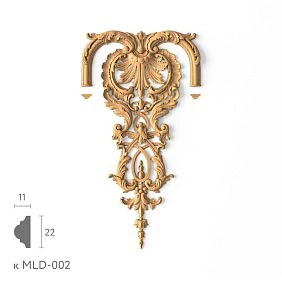

Start with the stage of furniture readiness
The same handle can be a convenient replacement before the front is drilled and unsuitable after. A molding is easy to revise at the sketch stage, but after the frame is cut, changing the profile affects parts that have already been manufactured.
Before searching for an equivalent, record what has been completed: the drawing has been approved, the blanks have been cut, the holes have been made, the finish has been applied, and the body has been assembled. Separately note the adjacent components that have already been purchased. A new leg may fit under the bottom, but it may interfere with the existing mounting plate.
For painted furniture, the condition of the surface under the previous element is added. There may be traces of fastening, glue, or the edge of the coating. This limitation is absent on a clean blank, but becomes significant when replacing on a finished facade.
It is useful to photograph the assembly from several sides and record the actual dimensions. The drawing describes the project, but the replacement must fit what has actually been manufactured.




Separate the mandatory parameters from the changes to be agreed
Mandatory includes everything that determines the fit, operation, and geometry of the furniture: hole locations, installed height, fastening type, allowable protrusion, and required clearances. These conditions are written down before viewing similar products.
The other group consists of changes that may be permissible after agreement: the carving pattern, degree of decoration, color, or character of the texture. They are not free by default. If the client has approved a specific oak ornament, switching to a different pattern or species requires a separate decision.
| Detail | What is usually checked first |
|---|---|
| Leg | Installed height, top part, fastening, outer dimension |
| Handle | Number and location of holes, fasteners, bases, overhang, and grip |
| Overlay | Overall dimension, relief protrusion, orientation, contact surface |
| Rosette | Center, outer contour, thickness and joint with the frame |
| bracket | Both contact planes, fastening and purpose in the structure |
| Molding | Cross-section, position of frame boundaries, angles, delivery length and cutting |
The list is supplemented per project. There is no universal set of three dimensions for all wooden components.
Our factory also produces:
Three interchangeability check results
For a small workshop, a simple system of solutions is sufficient. It does not replace the check but shows what to do with its result.
| Result | What does it mean | Next action |
|---|---|---|
| Direct replacement confirmed | The candidate fits the existing assembly, mandatory conditions are met, appearance is approved | Update the specification and place the order |
| Verification required | There is a seemingly acceptable difference, or insufficient data | Obtain dimensions, check a sample, resolve the specific question |
| A project change is required | Holes, fit, height, or another mandatory parameter do not match | Find another candidate or issue a revised drawing |
The second line does not permit putting a part into production "just in case." An unknown dimension remains unknown until it is clarified. And several matching parameters do not compensate for one incompatible fastening.
The result applies to a specific project and size variant. A part that successfully replaced another in a drawer unit does not become its universal equivalent for any piece of furniture.
Get Consultation
Create a table of the original part and the candidate
Compare both items in a single document. For each parameter, you need the original value, the project requirement, the candidate's value, and the decision. This helps separate real constraints from the habit of looking for absolutely identical numbers.
Below is a conditional example of an overlay. The dimensions do not relate to specific STAVROS article numbers.
| Parameter | Source part | Project conditions | Candidate | Solution |
|---|---|---|---|---|
| Height | 220 мм | 220 мм | 220 мм | Matches |
| Width | 90 мм | No more than 96 mm | 92 мм | Fits; check composition |
| Relief protrusion | 14 мм | No more than 18 mm in the checked area | 28 мм | Not suitable without modifying the assembly |
| Material | Beech | Per approved finish | Beech | Check preparation and paint coat |
| Contact surface | Per original sample | Suitability for installation location | No data available | Request a drawing or sample |
The width increased by only 2 mm and remained within the specified field. However, the protrusion exceeds the limit by 10 mm. Such a candidate cannot be recognized as a direct replacement due to the similar pattern. First, it is necessary to decide whether the project allows a change to the corresponding assembly.
If the product card uses designations A, B, C, or L, decode them according to the drawing. The same letter on different diagrams does not guarantee the same dimension purpose.
Use drawings and product models for the selected size variant. Save the diagram together with the comparison table so that subsequent verification relies on the same document. If the dimensions on the diagram and the received sample differ, determine the cause before approving the batch: it may be a different version, a modification, or an identification error. Do not choose the convenient value from two conflicting sources.
How to check borderline dimensions
If a part is nominally equal to the available space, the fit is not yet confirmed. It is necessary to account for permissible dimensional deviations, the condition of surfaces after finishing, and the space required for assembly. These conditions are taken from the project and the part documentation; a universal allowance of "a couple of millimeters" does not work here.
For a disputed parameter, record three things: what limits the dimension, how to check it, and what result will allow the replacement to be accepted. For example, for the protrusion of an overlay, the limit will be the position of the adjacent door on the opening path. The check will be a trial assembly with the actual hinges, and the acceptance condition will be maintaining the clearance specified by the project throughout the entire operating movement.
The result of one successful trial fit must also be correlated with batch repeatability. If a part fits only after individual adjustment, this operation is included in the routing and cost. The replacement can no longer be described as installation without additional work.
Replacing a furniture leg starts with the established height
When selecting wooden furniture legscompare the height of the entire mounting assembly. It may include the base plate and the protruding part of the hardware, and the top of the leg may extend into the mounting seat.
Two parts with the same catalog height can raise the cabinet differently. If the mounting plate or the insertion depth changes, the previous final furniture dimension must be checked again.
Then compare the top section, the fastener layout, and tool access. In a hypothetical project, the free space for mounting is 80 × 80 mm. A 70 × 70 mm leg top fits, while a 120 × 120 mm one no longer does, even though both legs may be 150 mm high. Even for the first option, the hardware dimensions and required clearances are checked separately.
Check the maximum profile extension, the position of the supports, and how the cabinet performs under load. Matching outer dimensions alone does not confirm the strength of a different material or joint. If the load-bearing support changes, data and verification are needed for that specific assembly.
The leg set is checked as a whole
Replacing one leg in a new set can disrupt the pattern, the set height, or the cabinet position. For four identical supports, it is useful to compare the assembled set, including base plates and fasteners.
If the original design provides for different front and rear parts, they are treated as separate items. Such a scheme must not be turned into four identical legs just because the new item is easier to order.
In the selection unpainted furniture legs check the exact dimensional version and the preparation for the required finish. An unfinished part makes it possible to agree on the color, but does not automatically make it suitable for modifying the mounting section.
Wooden handle: holes matter more than overall length
For an already drilled front, keep the hole layout with its coordinates. Check the number of fasteners, the center-to-center distance, the diameter, the orientation, and the position relative to the edges. For handles with a complex shape, center-to-center distance alone may not be enough.
In the section wooden furniture handles compare specific versions. For example, in the product card handles HL-011 the variants A × B × C × D are listed: 180 × 40 × 25 × 128 and 260 × 40 × 25 × 192 mm. A single model name combines different size combinations. The meaning of each designation for installation is clarified using the diagram.
Check the thread and the required screw length, taking into account the thickness of the front. A screw that is too long may hit the mating part before the handle is secured, while insufficient length will not provide the intended connection. Old fasteners cannot be reused automatically.
If installation requires relocating the holes, that is already a modification of the front. A small difference in center-to-center distance does not become acceptable just because it is barely visible in a photo.
Matching holes do not guarantee a clean appearance of the front
The new handle may have narrower bases. The holes will match, but an area of the old finish, a pressure mark, or damage that the previous part covered will remain around them.
In a hypothetical example, the round mark around the fastening has a diameter of 24 mm, while the base of the new handle is 18 mm. With matching centers, a ring of width (24 − 18) / 2 = 3 mm will remain visible outside. This needs to be checked on the front itself: the actual mark is sometimes uneven.
Also compare the projection and finger clearance. A handle may fit the holes but interfere with an adjacent overlay or be uncomfortable to grip.
If you are choosing handles without coating, first confirm the geometry, then finish the sample. A new color does not fix the incompatibility of the base with an already damaged area of the front.
The carved overlay is compared by contour and depth
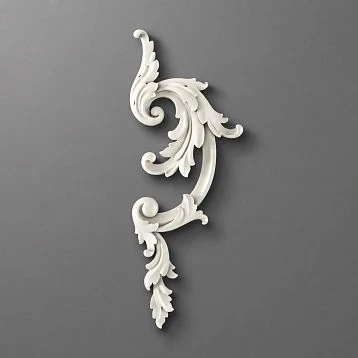
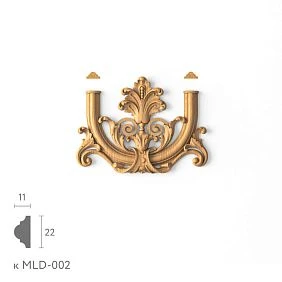
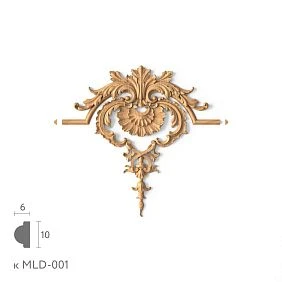
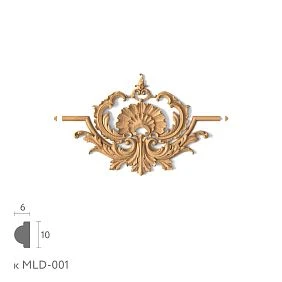
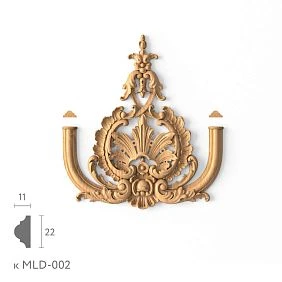
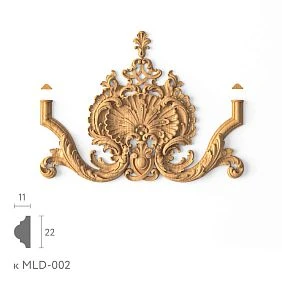
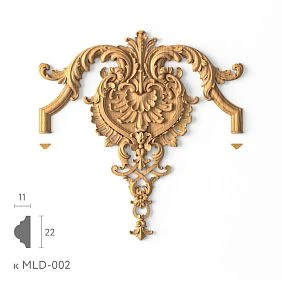
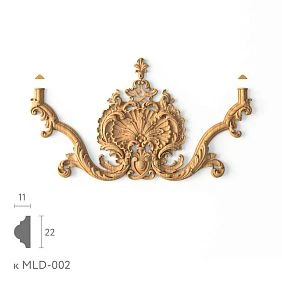
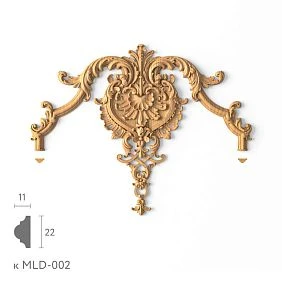
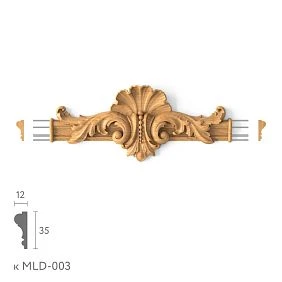
For replacement — this is the decoration of cabinet fronts, chests, tables, and doors. Carved inlays allow creating a unique furniture design, adding individuality and expressiveness. The inlay N.VRS-014L gives furniture an elegant look, making it a true work of art. Using carved decoration on furniture adds luxury to the interior and highlights the owner’s taste. transfer the entire outer contour onto the drawing. Two parts of the same width may differ in the height of the side scrolls, the open gaps, and the contact area.
Check not only the position on the closed front but also the opening path. A deeper relief may catch on the adjacent door or a protruding cabinet element. The check is performed with the actual hinges and adjustment.
Determine which areas of the new part come into contact with the base. If the previous overlay was already fastened or an unpainted area has been prepared beneath it, a different ornament may expose these zones. A matching overall bounding rectangle does not guarantee that the new pattern will cover everything.
For a glued-on overlay, separately assess the possibility of removal. Selecting a suitable new element and preserving the surface after dismantling are two different tasks.
Mirrored overlays are replaced as a matched pair
If the composition is built from left and right elements, check that both versions of the candidate are available. It is important that the dimensions and the relative direction of the pattern match, not just that they belong to the same decorative theme.
Replacing the left part with a similar one while keeping the previous right part may disrupt the symmetry. Try the pair on relative to the common axis, with the same distance between the elements and surrounded by the other front parts.
Keep separate article numbers for the sides in the specification. For three fronts with one pair on each, three left and three right elements are required. An entry of “overlays — 6 pieces” does not protect against a packing error.
Rosette and bracket: different abutment conditions
When replacing wooden rosette they preserve the specified center, then check the outer contour and the protrusion. A new rosette may fit the field in width but cross the inner border of the molding with its corners or protruding parts of the ornament.
for wooden brackets compare two planes: vertical and horizontal. A suitable height does not confirm the required depth and mating angle. The part should be test-fitted together with the shelf, cornice, or another adjacent element.
If the bracket performs a load-bearing function, an external counterpart is not considered a replacement without checking the structure and fastening. Decorative similarity provides no information about the permissible load.
A new molding can change the entire inner field
for wooden moldings for furniture first determine which border of the frame must remain in place: the outer, inner, or center line of the profile. The result of the replacement depends on this.
Suppose the outer size of a rectangular frame is 500 × 700 mm, and the flat width of the profile in projection onto the facade is 20 mm. The inner field will be 460 × 660 mm. If the outer border is preserved and the profile is replaced with one 30 mm wide, it will shrink to 440 × 640 mm.
Each side of the free field will shift by 10 mm. A rosette, handle, or central overlay selected for the previous space will require a new check. If the inner field is preserved, the outer size of the frame will change.
In addition to width, compare depth, the reverse side, corner joints, and compatibility with adjacent decor. Even with identical outer dimensions, two profiles may abut a single corner element differently.
When replacing the moulding, recalculate the cutting plan
The previous number of metres cannot be carried over to another article without verification. The new strip may have a different supply length, pattern repeat and requirements for joint placement.
A conditional example for a frame with straight end joints: two pieces of 900 mm and two of 600 mm are needed, for a total finished length of 3000 mm. From two 1600 mm strips, one long and one short piece can be obtained from each, provided the total allowance for saw kerfs and end preparation fits within the remaining 100 mm of each strip.
Two 1500 mm strips give the same 3000 mm in total, but with cuts of positive kerf width this material is no longer sufficient for the specified finished pieces. The pattern and defects may further limit the usable length.
After choosing a new profile, recalculate the cutting plan, the number of commercial strips and the joint locations. The length of a demonstration sample or an offcut from the workshop does not replace information about the supplied product.
Check fasteners and component parts together with the replacement
If the new part requires a different plate, screw or mating bushing, the composition of the assembly changes. Select furniture hardware and check whether it fits on the previous base. A matching thread diameter is only part of the check; its parameters, connection length and access for installation are also important.
For modular parts from the section ready-made turned elements compare the locating hole, mating surfaces and position on the common axis. A similar ring or thickening may have a different fit.
Changing the adhesive or the surface preparation procedure also counts as replacing a component. Mounting and finishing materials they are selected for the actual pair of surfaces, not just for the name of the wood.
Can beech be replaced with oak
Such a replacement is checked in three areas: dimensional specification, how the part works within the structure, and appearance. A matching model in the catalogue does not exempt you from checking the available sizes and preparing the new variant.
Under clear lacquer, oil or tinting, the species becomes a visible part of the project. A single oak overlay among beech parts can stand out noticeably, even if it is finished with the same composition.
Under opaque enamel the colour of the wood is hidden, but the surface preparation requirements remain. In the description quality of wooden products STAVROS separately identifies re-veneering options for enamel and for tinting. This is an independent order parameter alongside species and finish quality.
Oak cannot be declared a universal upgrade over beech, nor can strength data from one model be transferred to another. The decision is made for a specific product and its finish.
A previous finish designation requires a new colour sample
Even a part made of the same species can look different after finishing if the carving depth, the position of the end-grain sections or the character of the surface have changed. Patina collects in different recesses, and shadow changes how the colour is perceived.
Make a color sample on the candidate sample and compare it with the approved result next to the facade. The required color and gloss can be retained, but the working preparation sequence is clarified if necessary.
If the replacement affects the visible shape, scale, material, or shade, it is presented to the client separately. The wording "same decor" does not describe the changed result. The approval record specifies the exact execution and, if necessary, a new version of the sample.
A single sample is checked before purchasing the batch
First clarify the candidate's missing characteristics, then order the verifiable execution. Section product samples is useful for getting acquainted with materials and profiles, but verifying a specific fit often requires a full-size production part.
During a dry fit, check the geometry, contact surfaces, holes, fasteners, tool access, and movement of adjacent parts. After that, evaluate the finish and approve the appearance.
If the check requires drilling or trimming the candidate itself, the result is described as a part prepared according to the project. A regular purchase of the same item without this operation will no longer reproduce the verified assembly.
It is not enough to get a beautiful photo on the facade. The question that sent the candidate for verification must receive a measurable answer: whether the area fits, whether the mark is covered, whether the gap is maintained.
After the replacement, issue a new version of the specification
Keep the original version and issue a new one with the change date. For the replaced item, specify the old and new item codes, size variants, reason, list of related changes, and approval result.
If the body geometry has been preserved, this can be noted directly. But the fasteners, cutting, material consumption, or finishing scheme could still have changed. They must be updated in the relevant documents.
Pass the new version to the designer, purchasing, and the contractor. Mark old printouts and templates as no longer valid wherever they are no longer used. Otherwise, purchasing will order one handle while the workshop keeps drilling for another.
In a batch that has already been launched, mark the boundary of the change: which products use the previous configuration and which use the new one. Simply replacing a line in a shared file does not explain the fate of facades that have already been manufactured.
The list of verified substitutions stores the conditions of use
It is useful to keep a table of interchangeable items, but two part numbers are not enough. Also record the project or product family, dimensions, material, fastening, finish, documentation version, and restrictions.
For example, a handle may be permitted only for facades that have not yet been drilled. An overlay may be permitted only for opaque painting. Molding may be permitted with a modified cutting plan. Such options cannot be given to the purchaser as unconditional equivalents.
A verified substitution does not necessarily work in reverse: a larger handle base may cover an old mark, whereas a smaller base would expose it in a reverse substitution. The direction of the substitution matters.
When reordering, compare the current product specifications with the saved conditions. The workshop table stores the result of a previous check and does not guarantee that all future deliveries will remain unchanged.
The first delivery is compared with the approved substitution
After receiving the batch, check not only the part number on the packaging but also the dimensional version, material, preparation, and completeness. For a substituted component, pay especially close attention to the parameter that determined the decision: hole locations, mounting dimension, base area, or profile cross-section.
The approved sample is kept until the inspection is complete. If the item requires the same rework that was performed during testing, issue the appropriate work order to the workshop. A similar photograph in the product card does not confirm that this operation has already been performed by the supplier.
Separate the remaining original parts from the new set and label their purpose. They can be used in suitable previous projects, but two versions should not be mixed on a single item without verification. Paired elements and groups that must match in finish are accounted for separately.
When it is wiser to change the project
If the candidate requires new holes, a different base, significant trimming, or changes to the moulding frame, evaluate the rework as a separate job. It should not be hidden under the word "analogue".
Compare two specific solutions: wait for the original version or switch to a new one with rework of the assembly. Take into account the cost of parts, refinishing, damaged blanks, labour, and approval time. A cheaper part may increase the overall cost of the project.
If furniture parts are required to customer dimensions, this is already a separate manufacturing task, which is agreed upon according to drawings and the supplier's terms. A catalogue component does not become a custom item merely because the desired dimension is entered in the order.
Where to buy elements for custom furniture
Ready elements for custom furniture in the STAVROS catalogue are selected according to the requirements of the existing project. For visible carcass parts, use the section furniture decorative elements, for ornamental solutions — Carved wooden decoration.
Before purchasing replacement furniture parts, provide the supplier with the original item code, the candidate's details, and a list of required dimensions. Confirm the material, preparation, completeness, and the availability of the required quantity. A visual similarity in the photo should not remain the sole basis for ordering.
For regular restocking, the following are useful conditions for manufacturers. When planning the assembly timeline, separately check payment and delivery and the confirmed terms of the specific order.
The approved replacement is passed to purchasing with a new specification. It must clearly state which part is being purchased, in which version, and why it fits the furniture that has already been designed.