
























Article Contents:
- KL-044 or KL-060: short answer
- When to choose KL-044
- When to choose KL-060
- Main selection principle
- Separate square column in the living room
- Pilasters on the sides of the door
- Architectural cabinet
- Narrow pier
- Grand portal with a wide vertical
- Compact furniture column in Empire style
- KL-044 will suit
- KL-044 may not suit
- KL-060 will suit
- KL-060 may not fit
- How is KL-044 fundamentally different from KL-060?
- Which capital is suitable for a standalone column?
- Which model is better for a wall pilaster?
- Can I install KL-060 on PLM-019?
- What is the minimum width of KL-060?
- What is the maximum width of KL-060?
- What sizes are available for KL-044?
- Which is better under enamel: beech or oak?
- What does the "Prestige" sanding finish mean?
- Why does the price of KL-060 require verification?
- How much does a pair of minimal capitals cost?
- Can I choose a capital only by width?
- Can a wooden capital be attached only with glue?
- Does the capital perform a load-bearing function?
- Do I need to buy capitals as a pair?
- Can KL-044 be combined with K-009?
- How can I check the scale before purchasing?
- What to check upon receipt?
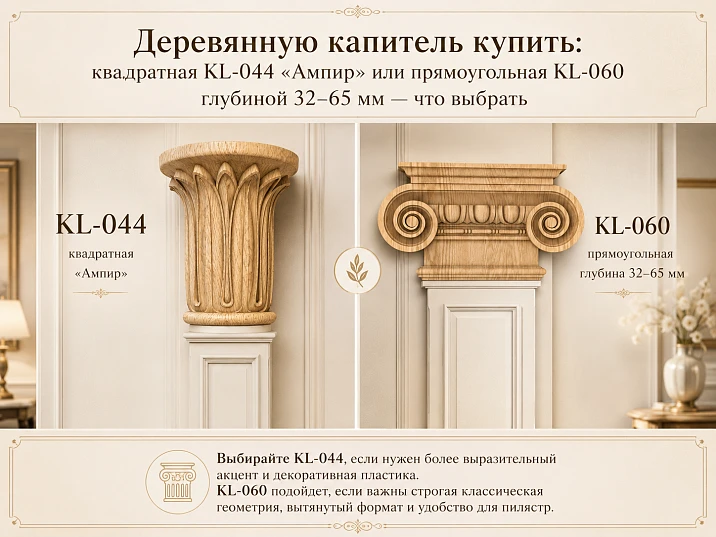
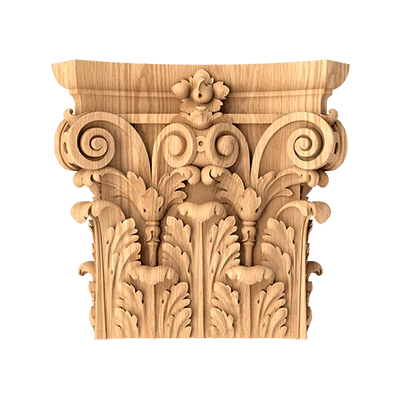
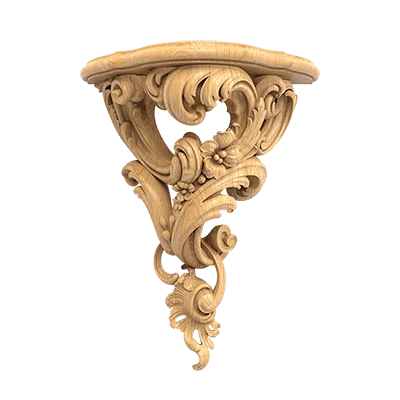
A wooden capital is not purchased separately from the project, but as the top finish of a specific vertical: a post, column element, pilaster, door portal, or furniture facade. Therefore, the external similarity of carved parts does not mean they solve the same task. Square capital KL-044 и Rectangular capital KL-060 belong to the same product category, are made from beech or oak, and are available with "Standard" or "Prestige" sanding, but their planned geometry, depth, and size range are fundamentally different.
KL-044 is designed for a compact volumetric finish. Its two versions have square dimensions of 95 × 95 and 110 × 110 mm in plan. This capital is noticeable not only from the front: the side volume participates in the composition, so the model is suitable for a separate post, column component, or other vertical element that is viewed from different angles. The "Empire" collection enhances the architectural character of the product, but the decisive parameter remains the mounting geometry.
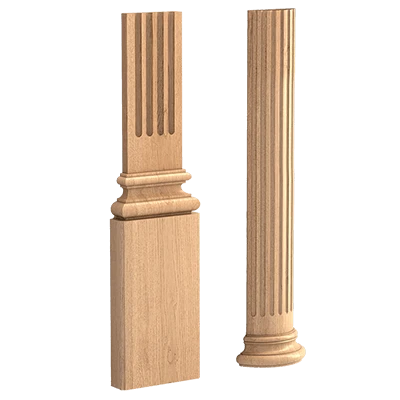
KL-060 is constructed differently. Five versions provide a frontal width from 123 to 300 mm, while the depth remains in the range of 32–65 mm. This is a wide but relatively shallow capital for a wall-mounted system. It can complete a pilaster, support a door or furniture portal, and form a horizontal top line where the projection from the wall is limited. In the related product environment, the card lists PLM-019, bases BS-003 and BS-008, but compatibility of each size must be confirmed via DWG.
Below are the dimensions of KL-044 and KL-060, the choice between square and frontally elongated shape, depth, scale, beech and oak, sanding options, price guidelines, cost per pair, selection of pilaster and base, installation checks, and ordering mistakes. Prices reflect data recorded in the SEO scheme: before publication and purchase, they must be re-verified, especially for KL-060, where a discrepancy has been found between the current category and the old saved version of the card.
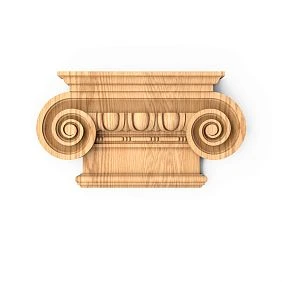
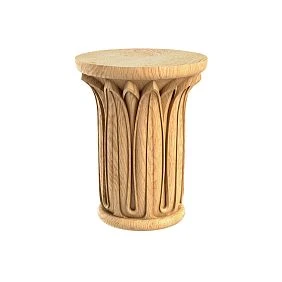
KL-044 or KL-060: short answer
When to choose KL-044
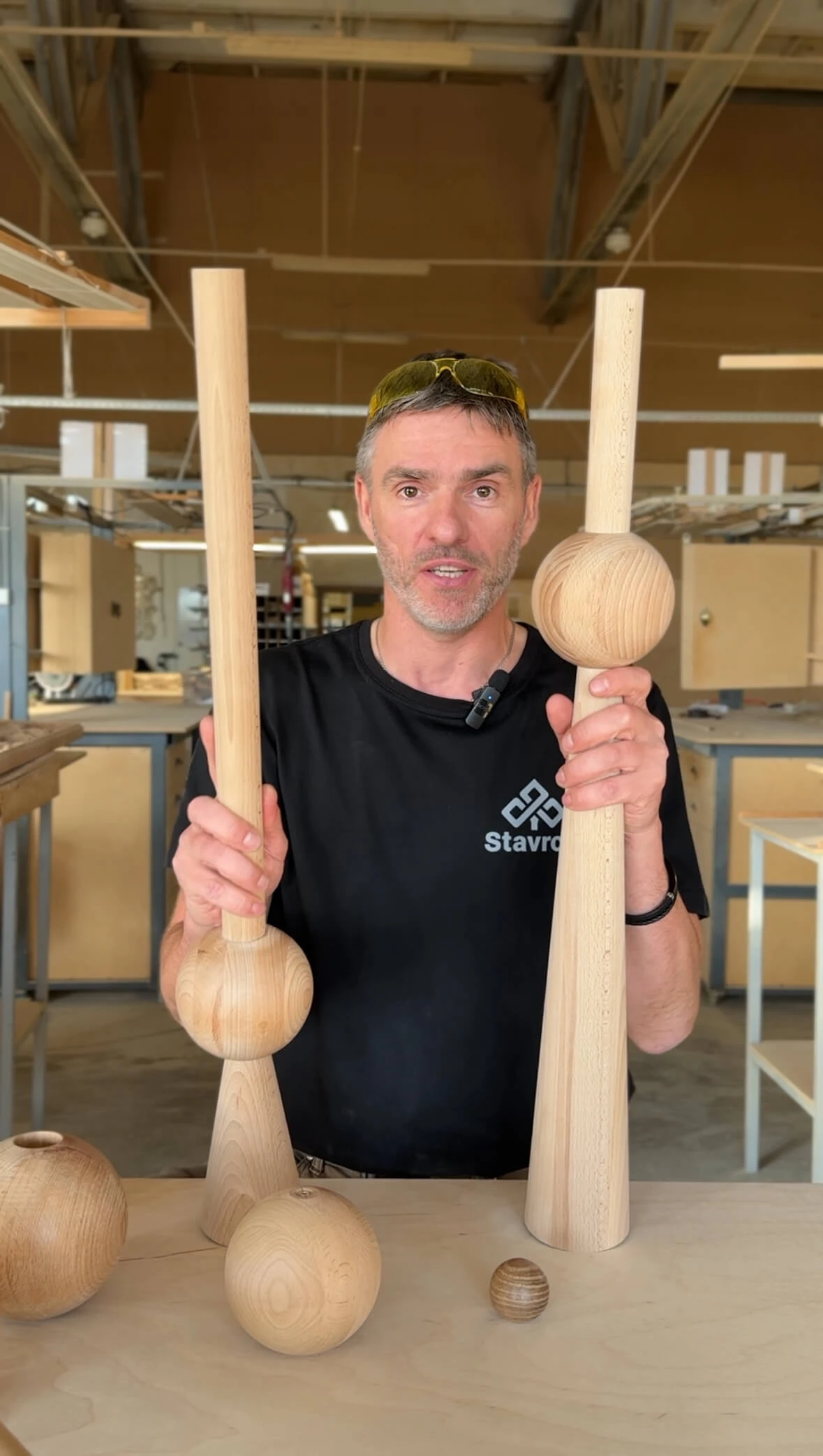
KL-044 is suitable when the top part should finish a post with a square or near-square cross-section, and the side faces of the capital remain visible. The two planned sizes — 95 × 95 and 110 × 110 mm — are convenient for compact architectural verticals. The model should be considered for a separate post, furniture column, small portal, or decorative element that needs volume rather than just a wide frontal overlay. Before ordering, compare all card parameters with the end face and base drawing.
Our factory also produces:
When to choose KL-060
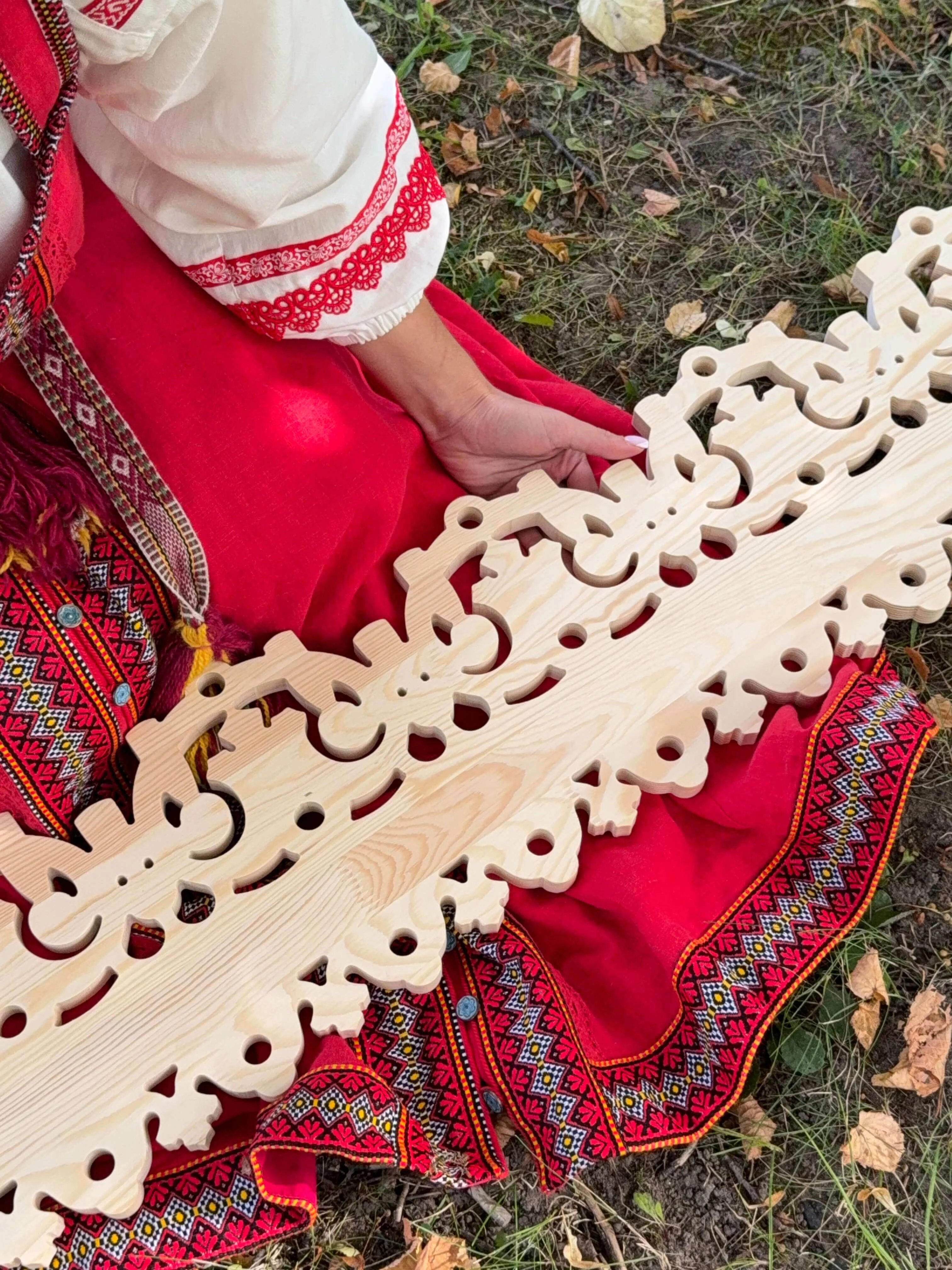
KL-060 is chosen for a pilaster or other detail located close to the wall. Widths of 123, 176, 229, 264, or 300 mm allow connecting the capital with verticals of different scales, while a depth of 32–65 mm reduces the side projection. This is a strong option for a doorway, cabinet, fireplace surround, or decorative wall composition. When working with PLM-019 and bases, it is important not to rely on the name of the associated product, but to compare dimensions E, the mounting plane, and the overall height of the system.
Get Consultation
The main selection principle
First, determine the type of vertical and the available depth, then the size, and only after that the ornament. If the capital should be visible from the side, the square KL-044 is usually more logical. If it works as a frontal top of a pilaster near a wall, the wide size range of KL-060 offers more options. Choosing based on a single photo is dangerous: equally expressive carving can hide geometry that physically does not fit the project.
Why models cannot be chosen only by the carving pattern
The carved ornament first catches the eye, but in the finished composition, the capital is evaluated together with the vertical. For KL-044, the width and depth in plan coincide. This creates a voluminous top that protrudes in two directions. On a freestanding post, such a character is justified: the capital forms the finish from all visible sides. On a narrow wall-mounted element, the same depth may be excessive and create a conflict with the casing, facade, or passage.
For KL-060, the frontal width significantly exceeds the depth. The minimum version has parameters 68 × 123 × 32 × 18 × 74 mm, the maximum — 165 × 300 × 65 × 32 × 175 mm. This proportion allows for a noticeable horizontal projection above the pilaster without turning the detail into a deep volume. Therefore, KL-060 is not an enlarged KL-044: it is a different spatial model.
The ornament is chosen after the geometric solution. In an Empire interior, KL-044 may support the collection language, but even an exact stylistic match does not compensate for a fitting error. KL-060 may look calmer or wider, but its value lies in the size range and wall-mounted logic. The buyer gets a more convincing result when considering carving as a final filter, not as the first and only criterion.
A practical method is to print or cut out a full-size contour of the front and side projection. On the wall, it will immediately become clear how far the capital extends beyond the pilaster, and a cardboard side template will show the actual depth. Such a fitting does not confirm installation compatibility, but it eliminates obviously disproportionate options even before ordering.
Comparison table of KL-044 and KL-060
| Criterion | KL-044 | KL-060 | Practical conclusion |
|---|---|---|---|
| Type | Wooden carved capital | Wooden carved capital | One category, different geometric tasks |
| Main shape | Square in plan | Elongated rectangular | KL-044 reads volumetrically, KL-060 — frontally |
| Number of sizes | 2 | 5 | KL-060 is easier to select by vertical width |
| Minimum size | 122 × 95 × 95 × 60 mm | 68 × 123 × 32 × 18 × 74 mm | Minimum versions cannot be compared only by height |
| Maximum size | 141 × 110 × 110 × 70 mm | 165 × 300 × 65 × 32 × 175 mm | KL-060 covers a significantly wider front |
| Width range | 95–110 mm | 123–300 mm | Models work with different vertical scales |
| Depth range | 95–110 mm | 32–65 mm | KL-060 protrudes noticeably less from the wall |
| Material | Beech or oak | Beech or oak | The rock is chosen together with the future finish |
| Sanding | "Standard" or "Prestige" | "Standard" or "Prestige" | The preparation level is fixed in the order |
| Collectible nature | Empire style | Classic wall-mounted composition | Style does not cancel dimensional check |
| Related items | K-009 among related products | PLM-019, BS-003, BS-008 and other items | Card linking does not equal automatic compatibility |
| Main role | Volumetric rack finish | Wide top of pilaster or portal | Selection starts with the type of structure |
KL-044: square capital for volumetric vertical
Model KL-044 from the Empire collection available in two versions: 122 × 95 × 95 × 60 mm and 141 × 110 × 110 × 70 mm. Matching width and depth parameters is the main guideline. The capital forms a square volume, so it cannot be evaluated as a flat frontal part. Before purchasing, you need to check whether it will protrude excessively from the side and whether there is enough space for its full silhouette.
The smaller version 95 × 95 mm is appropriate on a compact stand, where increasing to 110 mm overloads the top. The larger version 110 × 110 mm requires a corresponding vertical: a narrow shaft under a wide capital may look disproportionate, even if the parts can technically be joined. You need to evaluate not just one end, but the transition from the vertical to the expanded upper part.
The height of the capital also changes the overall scale. The versions have the first parameter of 122 and 141 mm. These millimeters are added to the height of the stand, base, and possible upper molding. In a door portal, an error can lead to a conflict with the cornice or ceiling; in furniture, it can change the position of the decorative line relative to the facades. Therefore, the capital is included in the overall vertical calculation before manufacturing the other parts.
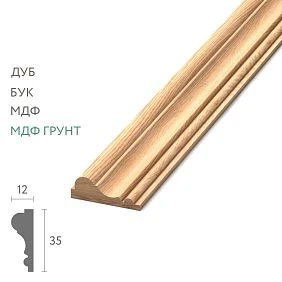
If the project is built around neoclassical carved moldings, you can select the carved baguette K-009 to match KL-044. Card-based matching helps find stylistically similar elements, but does not set a ready-made scheme: the width, depth, joint pattern, and final finish are still coordinated on the layout.
KL-060: five sizes for frontal composition
The wooden capital KL-060 is presented in five versions. Their width ranges from 123 to 300 mm, depth from 32 to 65 mm, height from 68 to 165 mm. This range allows selecting the top not only by style but also by the scale of the pilaster, portal, or furniture vertical. The model does not have a single universal size: each version is considered as a separate geometric configuration.
The minimum version 68 × 123 × 32 × 18 × 74 mm is suitable for a relatively narrow frontal detail. The next sizes — 97 × 176 × 38 × 18 × 104, 127 × 229 × 48 × 22 × 135, and 146 × 264 × 53 × 22 × 154 mm — gradually increase not only width but also height and depth. The maximum KL-060 165 × 300 × 65 × 32 × 175 mm already forms a large architectural top.
A wide capital does not have to exactly match the width of the pilaster. The architectural finish often has a side overhang, but its size must be deliberate and symmetrical. Too small an overhang makes the capital look like an extension of the strip; excessive overhang creates a heavy shelf above a thin vertical. The specific ratio is checked on the drawing and full-size template.
The KL-060 depth helps work near a wall, but even 32–65 mm needs to be matched with the trim, door frame, cabinet front, and adjacent molding. If the capital protrudes into the passage or blocks the door opening, belonging to a wall-mounted system alone does not solve the problem. Before ordering, the front, side view, and movement trajectory of adjacent elements are modeled.
Full size table: which option to compare
| Model and version | Height A | Width B | Depth C | Additional parameters | Typical design role |
|---|---|---|---|---|---|
| KL-044, small | 122 мм | 95 мм | 95 мм | 60 мм | Compact volumetric finish |
| KL-044, large | 141 мм | 110 мм | 110 мм | 70 мм | More prominent square top |
| KL-060, №1 | 68 мм | 123 мм | 32 мм | 18 and 74 mm | Small wall-mounted vertical |
| KL-060, №2 | 97 мм | 176 мм | 38 мм | 18 and 104 mm | Portal or medium-scale furniture front |
| KL-060, №3 | 127 мм | 229 мм | 48 мм | 22 and 135 mm | Pronounced frontal termination |
| KL-060, №4 | 146 мм | 264 мм | 53 мм | 22 and 154 mm | Wide pilaster or large portal |
| KL-060, №5 | 165 мм | 300 мм | 65 мм | 32 and 175 mm | Formal wall-mounted composition |
How to read dimensions and why one number is not enough
Often, only the width remains in the project name: "need a capital 110 mm" or "need a capital 300 mm". This is not enough for selection. For KL-044, a width of 110 mm simultaneously means a depth of 110 mm, while for KL-060, a width of 300 mm is combined with a depth of 65 mm. Two products with similar frontal expressiveness can occupy completely different volumes.
In addition to width and depth, the height of the decorative body and mounting parameters are considered. The KL-060 cards provide additional dimensions that change with the execution. They cannot be interpreted without a drawing: the letters on the DWG show specific sections, ledges, and planes. Before ordering, the buyer or designer must compare not a set of numbers from the text, but the entire dimensional scheme.
For the square KL-044, checking the end of the post is especially important. If the top platform is smaller than the base of the capital, a calculated transition is needed. If larger, the edge of the post may remain visible. For KL-060, the frontal width of the pilaster, the mounting area, and the side offset from the wall are checked. In both cases, decorative projection is only permissible when it is provided for by the composition.
General principles can be further studied in the material how to choose a wooden capital for a column and pilaster, but the final decision for KL-044 and KL-060 is made based on their own drawings.
Square or rectangular capital: geometry in plan
Planar geometry answers how a part behaves around the vertical. The square KL-044 expands approximately equally forward and sideways. This creates the feeling of a full architectural block. In a room, its side face is noticeable when a person moves, so the ornament and finish must be carefully coordinated not only on the front.
The rectangular KL-060 works like a wide frontal cap. It can noticeably extend beyond the edges of the pilaster on the left and right, but protrude relatively little into the room. This ratio is especially useful on a wall where a deep detail would interfere with a doorway, facade, or passage.
The difference becomes obvious at the corner. If the post is separate from the wall, KL-060 may look too flat from the side. If the pilaster is almost flush with the wall, KL-044 may seem unnecessarily deep. Neither model is inherently better: each is convincing in the design for which its proportion was developed.
Before purchasing, it is useful to mark the contours on the floor or wall with painter's tape. For KL-044, show a square of 95 × 95 or 110 × 110 mm. For KL-060, mark the frontal width and separately the side depth. Even a simple outline helps to see if the capital will intrude into the adjacent area.
Depth 95–110 mm or 32–65 mm: how it changes the interior
Depth forms the side shadow and physical protrusion. KL-044 at 95 or 110 mm noticeably separates from the wall plane. On a separate post, this enhances volume. On a narrow wall section, a deep capital can visually narrow the passage and approach the trim or cornice.
KL-060 at a depth of 32–65 mm remains flatter. But the difference between the minimum and maximum versions is almost twofold, so the model cannot be described as equally shallow in all sizes. The maximum version already creates a pronounced shelf and requires checking the side view.
Light also changes perception. A deeper relief gives a strong side shadow and emphasizes the carving. A shallow capital reads better under frontal or grazing light. This is a design assessment, not a fixture characteristic: the specific effect depends on the window location and artificial light.
In a furniture composition, depth is compared with the facade, cornice, and handles. The capital should not interfere with door opening or protrude as an accidental ledge. In a portal, check the distance to the door leaf and casing. If a molding runs nearby, its profile must be coordinated with the lower or upper line of the capital.
How to choose KL-044 by post size
The choice between 95 × 95 and 110 × 110 mm starts with the actual end. Measure the width and depth of the vertical in its finished or designed state, including cladding and trim. Then open the DWG of KL-044 and look at the mounting plane, not just the maximum external dimension.
The small version is easier to fit into a compact furniture post or narrow column element. It creates less projection and adds 122 mm to the total height. The large KL-044 forms a more noticeable top and has a height of 141 mm. The 19 mm difference may be important near a cornice or ceiling line.
If the post is between two facades, check the symmetry of the gaps. A square capital may extend toward each facade. If the facades open, allowance for the trajectory is needed. If the post is free-standing, evaluate the view from all four sides and the direction of the carved pattern.
The capital cannot be automatically trimmed for fitting. Such an operation may alter proportions, damage the carving, and affect the mounting geometry. Any possibility of modification must be agreed upon before ordering. It is better to select the size or create a calculated transition element as part of the project.
How to choose the size of KL-060 based on the pilaster width
The five widths of KL-060 allow for more precise scale adjustment: 123, 176, 229, 264, and 300 mm. First, measure the frontal width of the pilaster or furniture vertical, then determine the desired side overhang. This overhang should be equal on the left and right if the composition is symmetrical.
For a rough visual estimate, subtract the vertical width from the capital width and divide the difference in half. For example, if a pilaster has a front of 170 mm, a capital of 176 mm will give only a slight projection, while 229 mm will create a noticeable shelf. This calculation shows the proportion but does not confirm the fit: internal dimensions and profile are checked against the DWG.
When choosing between adjacent sizes, it is useful to consider the upper molding. If there is a baguette or cornice above the capital, a wider model may better connect the vertical with the horizontal. If the upper line is already rich with decor, an overly large capital will create a competing accent.
The 300 mm width is justified only on a large vertical element or in a formal composition. On a small door, it can visually weigh down the top. Conversely, the minimum 123 mm may get lost on a wide portal. The choice should be verified on the overall wall elevation, not on an enlarged product image.
When the capital needs to be visible from the side
The side view is important for a standalone post, corner element, column divider, and furniture approached from different sides. Here, the square KL-044 reveals its main advantage: depth equals width, so the capital is perceived as a volumetric finish, not a frontal overlay.
However, volume imposes requirements on the surroundings. On a post near a passage, check that the capital does not protrude at head or shoulder level. On furniture, assess whether it extends beyond the countertop dimensions. In a portal, ensure it does not conflict with the casing or adjacent wall.
If the side is barely visible, sacrificing space for square depth is not always justified. In such cases, KL-060 can provide a wider and more architecturally expressive front with less projection. The solution depends on the viewpoint: it is useful to walk around the room and note from which directions the top detail will be visible.
When finishing a volumetric capital, all sides must look equally neat. For enamel, surface uniformity and coverage are important; for oak, consistency of tone and grain direction. Therefore, the quality of preparation is chosen considering the actual visibility of the side faces.
When it is important to reduce the projection from the wall
Limited depth can be critical near a door, cabinet, stairway, or narrow corridor. KL-060 allows creating a wide front without a square block of 95–110 mm. The minimum depth of 32 mm is especially useful where the decorative vertical should remain close to the wall.
But reducing depth does not mean that installation can be ignored. The capital still has relief, a mounting plane, and a side profile. The wall may be uneven, the pilaster may have its own projection, and the upper cornice may add several more levels. The total sum of depths is designed.
For a cabinet, check the opening of the outermost doors. For a door portal, check the position of the door leaf and casing. For a fireplace surround, check the distance to adjacent parts and the requirements of the specific project. The article does not confirm use near a heat source: such conditions must be evaluated separately.
The section helps to select references view furniture portals and cabinets with architectural decor, however, the dimensions of each composition are individual. The project image shows the principle but does not replace room measurements.
KL-044 for a separate post, column element, and furniture
On a separate stand, KL-044 creates a clear finish: the vertical gets an extended top that reads around the perimeter. This makes the model convincing in paired stands, furniture dividers, and compositions where the side view is not hidden by a wall.
For furniture, scale is important. A capital 95 × 95 mm can support a cabinet post or portal if its height of 122 mm does not conflict with the top frame. The 110 × 110 mm version is more noticeable and requires a larger body. On a small cabinet, such a detail may be disproportionate.
The Empire collection sets a stylistic reference but does not require repeating complex decor on every element. The capital can be the top accent, while the vertical and base remain calmer. The main thing is to coordinate the rhythm of the ornament, width, and finish.
When installing in pairs, both capitals are ordered in the same size, wood species, and level of sanding. Before installation, they are laid out side by side and the orientation is checked. For natural oak finish, it is important to determine in advance how to visually match the texture of the two parts.
KL-060 for pilaster, door portal, and cabinet
The pilaster is the main scenario for KL-060 because its front width and limited depth correspond to a wall-mounted vertical. The capital completes the pilaster, creates a side projection, and transitions the vertical rhythm into a horizontal one. The wider the portal, the more noticeable the influence of this transition.
The card links the model to PLM-019, so in the project you can select the KL-060 capital for the PLM-019 pilaster. This is a useful starting point, not a promise that any of the five sizes fits automatically. PLM-019 has its own parameters, and the specific connection is confirmed by drawings.
In a door portal, two capitals must be at the same mark and have the same projection. An error of even a few millimeters is noticeable on the horizontal line. Therefore, the axes and the top mark are first marked, the level is checked, and then the mounting unit is determined.
The KL-060 cabinet can terminate the extreme verticals or the central architectural axis. Here, the depth is compared with the facade and the cornice. If the capital protrudes too much, it may interfere with opening. If it is too flat relative to a massive cornice, the upper system looks disjointed.
Cost of KL-044 and KL-060: what can be compared correctly
According to recorded data, the minimum KL-044 in beech with a "Standard" finish cost from 5,790 ₽. The large oak "Prestige" version reached 10,990 ₽. These figures show the model's range but do not replace the current trade configuration: material, size, and finish must be selected again in the card before publication.
A discrepancy was found for the KL-060. The current category listing showed a minimum price from 3,770 ₽, while the old saved card variant was 3,420 ₽. Using 3,420 ₽ as the current price is not allowed. In the article, it is correct to leave the reference "from 3,770 ₽ at the time of verification" and an explicit requirement for re-verification.
Based on these minimum benchmarks, KL-044 is approximately 2,020 ₽ more expensive per part than KL-060. For a pair, the difference is about 4,040 ₽. However, this comparison does not mean that KL-060 is always cheaper: it has five sizes, materials, and grinding options. Specific configurations suitable for a single project must be compared.
The portal budget includes not only capitals. Pilasters, bases, linear elements, finishing materials, and installation are added. A cheaper capital may require a different vertical or a more complex transition. Therefore, the part price is only considered in the selection after geometry is confirmed.
| Price benchmark | KL-044 | KL-060 | How to use |
|---|---|---|---|
| Minimum price based on recorded data | from 5,790 ₽ | from 3,770 ₽ in the current category | Re-check on the day of publication |
| Old value that cannot be pinned | — | 3 420 ₽ | Do not use as the current price |
| Estimated difference of one minimum detail | approximately +2 020 ₽ | baseline reference | Comparison does not account for different sizes |
| Estimated difference of a pair | approximately +4 040 ₽ | baseline reference | Recalculate after selecting material and processing |
| Maximum recorded for KL-044 | 10 990 ₽ | Not confirmed in the scheme | Do not set an upper price for KL-060 |
One capital or a symmetrical pair
One capital is needed for a separate post, central furniture vertical, or single accent. In this scenario, the sides and orientation of the ornament are especially noticeable. KL-044 often looks more natural as a volumetric single top, but KL-060 can also be used separately on a front pilaster.
A pair is used on the sides of a door portal, cabinet, or symmetrical wall composition. Here, not only the same model is important, but also a single mark, mirror logic of the pattern, and identical projection. Two parts from different batches or with different finishes may differ visually, so the specification is made as a single order.
The cost of a pair is calculated by multiplying the price of the selected finish by two, not by the minimum price of the category. Two pilasters or posts, two bases, necessary linear elements, and finishing are added to the total. If the project includes several identical portals, the quantity is fixed before ordering to maintain uniformity.
Before finishing, the pair is laid out side by side under the same lighting. For enamel, the preparation of the relief is checked; for tinted oak, the general character of the wood is assessed. Natural material does not have to have an identical pattern, but the two capitals should be perceived as parts of a single composition.
Beech or oak for a wooden capital
Both models are available in beech or oak. The difference in wood species should be evaluated through the future finish. General information about solid wood preparation can be found in the section beech or oak for a wooden capital, and the specific option is selected in the KL-044 or KL-060 card.
Beech in the SEO scheme is associated with preparation for opaque enamel. This is practical when the capital, pilaster, and base should become part of a single painted architecture. The opaque color unifies different elements, but the relief remains visible due to light and shadow.
Oak is chosen for tinting or finishing that preserves the texture. On the wide front KL-060, the wood grain becomes a noticeable part of the composition. On the volumetric KL-044, the texture is visible on several sides, so the tone sample is evaluated both from the front and from the side.
It is advisable to keep the wood species uniform within a set. Mixing beech and oak under a transparent finish creates a difference in texture. Under opaque enamel, the visual difference is smaller, but the finishing technology and material compatibility should still be coordinated with the contractor.
Sanding "Standard" or "Prestige"
For KL-044 and KL-060, two levels of sanding are confirmed: "Standard" and "Prestige." These are surface preparation options, not a finished decorative coating. After receipt, the product still goes through the stages provided by the selected finishing system.
The choice depends on the requirements for the finish, the complexity of the relief, and the amount of subsequent preparation. For a smooth opaque enamel, the quality of the base is especially noticeable in side light. For tinted oak, it is important to preserve the relief and texture without rough traces of processing.
In a single portal, preparation levels cannot be mixed accidentally. If two capitals, pilasters, and bases are purchased as a set, the selected sanding is fixed for each item. This simplifies planning of finishing work and reduces the risk of surface differences.
Before ordering, clarify what exactly is included in the selected option and which operations will remain on site. The article does not replace technological consultation: suitable primers, enamels, oils, or other materials are selected for the specific wood species and operating conditions.
Capital in the interior: where each model shines
In the living room, KL-060 can complete pilasters on the sides of a TV area, doorway, or decorative panel. The width helps connect verticals with the upper cornice, while the shallow depth preserves free passage. KL-044 is appropriate on a standalone column or in a furniture composition with volumetric side panels.
In the study, a square capital supports a massive bookcase or architectural rack if the furniture scale allows a depth of 95–110 mm. Rectangular KL-060 is better suited for built-in cabinets and wall libraries, where facade width is more important than side volume.
In the hallway, depth is especially critical. A narrow passage often leads to KL-060, but even the minimum 32 mm is checked against doors and clothing. KL-044 is only suitable where a separate rack has enough space around it.
To understand the overall role of the elements, you can study the material
What to buy together with the capital
A capital rarely forms a complete composition on its own. A portal requires a vertical, a base, and horizontal elements. For furniture, a rack, cornice, or baguette is needed. All details must be coordinated in width, depth, wood species, and finish.
For KL-060 in the card environment, PLM-019, BS-003, and BS-008 are indicated. You can open the category of wooden pilasters and columns and compare verticals, but specific compatibility is confirmed by drawings. For KL-044, the associated decorative element is K-009.
It is useful to buy a set with a single specification. It records the article numbers, sizes, quantity, wood species, sanding, and purpose of each part. This reduces the risk that the capital will be made of oak, the pilaster of beech, or that two sides of the portal will have different sizes.
| What to add | Why | For which scenario | What to Check | Link |
|---|---|---|---|---|
| Pilaster PLM-019 | Create a vertical for KL-060 | High door or wall portal | DWG, placement, full height | Select PLM-019 |
| Base BS-008 | Complete the lower part of the system | Wall-mounted classic composition | Width and depth relative to the pilaster | Select BS-008 |
| Base BS-003 | Assemble alternative base | Portal or furniture vertical | Compatibility of a specific size | buy BS-003 |
| Baguette K-009 | Link KL-044 with carved molding | Neoclassical furniture or portal | Drawing, thickness, joint and finish | select K-009 |
| Pilasters and columns | Choose another vertical | When PLM-019 doesn't fit in size | Front, depth, height and style | view category |
| Design project | Align all elements | Complex portal, cabinet or multiple openings | Measurement, layouts, specification | order selection |
How to match KL-060 to pilaster PLM-019
The KL-060 and PLM-019 pairing is specified in the product environment, so it deserves separate verification. First, select a specific pilaster size and record its front width, depth, and top mounting area. Then compare with one of the five KL-060 drawings.
You cannot choose a capital just because its outer width is greater than the pilaster width. The internal transition and relief position are important. The capital must create a deliberate lateral projection, not randomly overhang the vertical.
The total system height is calculated as the sum of the base, pilaster, capital, and top element with the installation gaps specified in the project. If the total exceeds the available height, you cannot automatically trim the carved decor. First, reconsider the size combination.
For a paired portal, check both sides of the opening. The walls may have different geometry, and the floor and ceiling may have deviations. Layout is built from a single design mark so that two KL-060s form a level horizontal line.
BS-003 or BS-008: how to choose the base
Base BS-008 и wooden base BS-003 are in the relevant environment of KL-060, but the base name does not guarantee a ready-made set. The base must match the vertical, not just the capital. Therefore, first assemble the chain "base — pilaster — capital", and then check each joint.
The width of the base can be greater than the width of the pilaster and create a lower projection, similar to the upper projection of the capital. These two extensions should balance each other. A base that is too large with a small capital makes the composition heavy at the bottom; the opposite combination looks unstable.
Depth is also important. On a wall-mounted system, the base should not protrude excessively into the passage. In furniture, it should not interfere with the baseboard, facades, or plinth. The side view of the system is checked on a single drawing.
If the finished base is not suitable, its trimming or modification cannot be promised without approval. Selecting another model or designing a transition is safer than randomly modifying a finished carved product.
How to connect the capital with the baguette and molding
The capital transitions the vertical to the horizontal, so the adjacent baguette or molding should support its scale. If the profile is too thin, the top piece looks like a separate massive block. If too large, the capital gets lost in the horizontal decor.
K-009 is listed as a related element to KL-044. This helps create a neoclassical composition, but the joint is still designed. The profile height, projection, ornament repetition, and the ending point of the baguette relative to the capital are checked.
For KL-060, the original description mentions K-011 and MLD-003, but confirmed URLs for them are not provided in the SEO scheme, so links to these cards are not placed in the article. They can be considered as part of the original product environment and must be rechecked directly in the KL-060 card.
Before finishing, a dry layout or mockup is assembled. It shows whether the horizontal lines align and whether accidental steps are formed. This test is especially useful for a pair of portals, where any difference is repeated twice.
How to calculate the total height of the portal
The height of the portal is not equal to the height of the pilaster. The calculation includes the base, vertical, capital, upper cornice or baguette, as well as the connections provided by the project. KL-044 adds 122 or 141 mm, KL-060 adds from 68 to 165 mm.
First, measure the available height from the finished floor to the upper limit. Then subtract the height of all selected parts from it. The remaining size shows whether the pilaster fits or another system is required. The mounting gap cannot be chosen arbitrarily: it is determined by the design and installation method.
For a door opening, additionally consider the frame, casing, and door swing. For a cabinet, consider the upper cornice, ceiling gap, and assembly feasibility. For a wall panel, consider the position of moldings and outlets.
References for ready-made solutions can be found in the section door and interior portal projectsTheir proportions are not copied without measurement, but they help to understand how the capital contributes to the overall height.
How not to confuse KL-044 and KL-060 with similar products
Both items are called wooden capitals, so the mistake often starts with a common filter. KL-044 is identified by its square plan and two sizes 95 × 95 or 110 × 110 mm. KL-060 is identified by five front widths 123–300 mm and a depth of 32–65 mm.
Do not confuse the external dimension with the mounting dimension. The maximum width of the capital may include decorative overhang. A drawing and a specific size letter are needed for matching with the vertical.
KL-044 belongs to the Empire collection, but this does not mean that any Empire part is compatible in size. KL-060 is associated with PLM-019 and bases, but this is also not a ready-made kit promise. The card adjacency helps to choose a search direction, while compatibility is confirmed separately.
When placing an order, the article is written in full: KL-044 or KL-060, then size, wood species, and sanding. Formulations like "capital 110" or "wide capital" are insufficient and can lead to errors.
Practical selection for specific situations
Separate square column in the living room
If the column is visible from three or four sides, first consider KL-044. Choose 95 or 110 mm based on the end face and scale, check the height of 122 or 141 mm and the lateral offset. KL-060 may appear too frontal here, although the final decision depends on the drawing.
Pilasters on the sides of the door
For a wall pair, KL-060 is often more suitable. The width is chosen based on the pilaster and desired offset, the depth is checked against the trim and door leaf. Both capitals must have the same mark, execution, and orientation.
Architectural cabinet
For cabinet furniture, the solution depends on the side view. The outermost volumetric post can get KL-044, while the front pilaster of a built-in cabinet can get KL-060. Door opening, cornice, and overall depth are checked.
Narrow pier
Limited depth makes KL-060 a more likely candidate. However, a wide execution may not fit along the front. It is useful to compare minimum dimensions and mark the outline on the wall.
Grand portal with a wide vertical
Large executions of KL-060 up to 300 mm allow creating a noticeable top. Together with them, a pilaster, base, and horizontal decor are selected. KL-044 may not be wide enough, even if its volume is expressive.
Compact furniture column in Empire style
KL-044 supports a collection scenario and offers two compact square sizes. Before ordering, check that the capital height does not overload the body and that there is enough space for the side faces.
Selection table by scenario
| Situation | Preferred candidate | Why | Main check |
|---|---|---|---|
| Separate post | KL-044 | Square volume is readable from the sides | End face and side projection |
| Wall pilaster | KL-060 | Large front width with smaller depth | Fit per DWG |
| Narrow corridor | More often KL-060 | Smaller projection from the wall | Clear passage |
| Empire furniture column | KL-044 | Collectible and voluminous character | Scale relative to the body |
| Wide door portal | KL-060 | Size range up to 300 mm | Height and symmetry of the pair |
| Vertical with front-only view | More often KL-060 | Side volume is less important | Front overhang |
| Vertical with three-sided view | Mostly KL-044 | Side faces are part of the composition | Finishing of all sides |
Installation preparation without unconfirmed promises
The capital is considered a decorative element. The source data does not confirm a load-bearing function, so it cannot be described as a structural support. The attachment method depends on the base, mass, geometry, and project conditions.
General preparation guidelines can be found in the section Installation and finishing of wooden capitals. It does not replace the node design. The universal statement "glue is enough" is not suitable: in some cases, mechanical fastening or an embedded part may be required, the decision is made by a specialist.
Before installation, check the evenness of the base, the verticality of the pilaster, the horizontal mark of the pair, and the actual dimensions of the parts. The capital is tried on without final fastening to see gaps and the position of the ornament.
It is more convenient to plan finishing before final assembly, especially in areas that will become hard to reach after installation. But the sequence of work depends on the coating technology and the fastening method. It is coordinated with the craftsman.
Preparation for enamel and tinting
Beech versions in the scheme are considered for opaque enamel. The color unites the capital with the pilaster and base, but the relief requires careful preparation. A too thick layer can visually soften small details, and an uneven surface will show up in side light.
Oak options are chosen to preserve the texture. Tinting is tested on a sample of the same wood species and preparation. The color on a small sample may look different on a wide KL-060 or voluminous KL-044, because light falls on the relief at different angles.
All elements of the set are finished in one system. Different primers, stains, or gloss levels can split the portal into random parts. The specification records the wood species, sanding, and expected type of finish.
Before applying the coating, check for damage and order compliance. After finishing, it is more difficult to return or adjust the product, so the article, size, and quantity are confirmed in advance.
Errors when purchasing KL-044
The first mistake is to install a square capital on a wall pilaster without checking the depth. A projection of 95 or 110 mm may be excessive. The second is to choose between two sizes based only on external width and forget about the height difference of 122 and 141 mm.
The third mistake is to assume the "Empire" collection guarantees compatibility with all elements of the same style. The ornament may match, but the fit may not. The fourth is to leave the side surfaces unassessed, even though they are what make KL-044 voluminous.
The fifth mistake is to order one capital for a symmetrical portal and later purchase a second without a common specification. It is better to immediately determine the quantity, wood species, and finish.
The sixth mistake is to plan self-cutting. The possibility of modifying a finished carved part is not confirmed. If the size does not fit, choose a different model or adjust the project.
Mistakes when purchasing KL-060
The first mistake is to use the minimum price of 3,420 ₽ from an old saved option as current. For the current category, a benchmark from 3,770 ₽ is recorded, and it also needs to be rechecked.
The second mistake is to consider all five executions identical in depth. The range of 32–65 mm noticeably changes the projection. The third is to choose the width based on the pilaster without analyzing the seating geometry.
The fourth mistake is to automatically declare PLM-019, BS-003, or BS-008 fully compatible. Related products help compile a list, but specific dimensions are verified against the DWG.
The fifth mistake is not considering the pair. On two sides of the portal, even a small difference in the mark and offset is noticeable. The sixth is forgetting about facades and doors next to a wide capital.
Common mistakes when ordering a wooden capital
Choosing only by photo and ornament is the most frequent problem. Next come lack of measurements, confusion between external and seating size, random selection of wood species, and expecting a finished coating where only sanding is confirmed.
You cannot calculate the load-bearing function or permissible load based on appearance. The capital decorates the top of the vertical. The structural work is performed by the calculated base and fastening system.
You should not order finishing separately from the architectural set. If the pilaster, base, and capital have different wood species or preparation, achieving a uniform result is more difficult.
The last mistake is not saving the final specification. It must include the article number, execution, size, wood species, sanding, quantity, and related elements. This document is compared with the received order.
Who KL-044 suits and who should choose a different model
KL-044 is suitable
- a project with a separate stand or column element;
- those who need a square plan of 95 × 95 or 110 × 110 mm;
- interiors where the side view of the capital remains exposed;
- compositions from the Empire collection;
- for customers willing to check the end face and DWG before ordering.
KL-044 may not fit
- a narrow wall pilaster with limited depth;
- a wide pilaster requiring a front of more than 110 mm;
- a project where the capital needs to be almost flat;
- a system with no space for side projection;
- an order requiring one of the five intermediate sizes of KL-060.
Who KL-060 suits and who needs a voluminous capital
KL-060 will fit
- a wall pilaster and door portal;
- a wide furniture vertical or cabinet;
- a project with a front from 123 to 300 mm;
- an interior where it is important to reduce the protrusion from the wall;
- a system with PLM-019 and bases after checking the drawings.
KL-060 may not fit
- a separate stand that is visible from all sides;
- a square end requiring equal width and depth;
- a very narrow vertical less than the minimum width;
- a project where a pronounced volume of 95–110 mm is needed;
- an order without the ability to check the specific execution via DWG.
How to place an order for STAVROS
First, open catalog of wooden capitals and make sure you compare current trade options. Then go to the cards KL-044 and KL-060, select the specific size, wood species and sanding. Do not fix the price from the article without re-checking.
In a separate order table, record: model, full set of dimensions, material, finish, quantity and purpose. For KL-060, add the selected pilaster and base; for KL-044, add the post and related moldings.
For a complex composition, it is reasonable order selection of capital, pilaster, and base. Measuring and unfolding help to coordinate width, depth, height and ornament before purchase.
Before payment, check Conditions for manufacturing and delivery of wooden capitals. Deadlines, availability, and logistics change, so they cannot be fixed in the article without current confirmation.
Control specification before payment
| Field | What to record | Why it's important |
|---|---|---|
| Article number | KL-044 or KL-060 | Excludes replacement of square and rectangular model |
| Finish | Full set of sizes from the card | One width is not enough |
| Material | Beech or oak | Determines texture and finishing route |
| Sanding | "Standard" or "Prestige" | Coordinates the preparation of the entire set |
| Quantity | One, two, or more | Needed for symmetry and estimate |
| Vertical | Rack, pilaster, PLM-019 or another model | Allows checking the fit |
| Base | BS-003, BS-008 or another solution | Matches the lower system scale |
| Molding | K-009 or another confirmed element | Forms the horizontal extension |
| Finish | Enamel, tinting or another agreed option | Helps choose the species and preparation |
| Price and timeline | Current card data | Especially important due to KL-060 discrepancy |
Full-size mockup: how to check the capital before ordering
A card photo shows the relief but hides the real scale. To check KL-044, it is enough to cut a 95 × 95 or 110 × 110 mm square from cardboard and a separate front silhouette 122 or 141 mm high. The mockup is applied to the top of the post and evaluated not only straight on, but also from the passage, from the sofa, from the door, and from the stairs if the composition is in a double-height space.
For KL-060, two templates are made. The first shows a frontal width of 123, 176, 229, 264, or 300 mm and the corresponding height. The second is placed perpendicular to the wall and marks a depth of 32, 38, 48, 53, or 65 mm. This angle allows you to see how much the capital enters the passage, approaches the casing, or protrudes relative to the cabinet facade.
It is useful to supplement the layout with pilaster and base lines. Then it becomes clear how similar the top and bottom projections are, whether the vertical looks too thin, and whether the capital conflicts with the cornice. For a pair, templates are placed on both sides of the opening at the same height.
A paper mock-up does not confirm the mounting geometry or attachment method. Its task is to check scale and visual appearance. After visual selection, you still open the DWG, compare dimensional letters, and prepare a technical specification.
How to document measurements so that the manager and craftsman understand the task the same way
It is better to document measurements not as a single line but as a small diagram. The front view shows the vertical width, distance to the door or facade edge, available wall width, and height to the cornice or ceiling. The side view marks the pilaster depth, casing protrusion, door trajectory, and maximum allowable capital projection.
For KL-044, both end dimensions must be recorded. The phrase "100 mm post" does not indicate whether it is square or has cladding. For KL-060, record the pilaster front and the distance to the wall or adjacent part. If surfaces are not yet finished, separately indicate the design and actual dimensions in the diagram.
It is useful to add dimensional arrows and a number for each vertical on a photo of the room. If the portal consists of left and right sides, they receive separate designations. This approach helps detect that one wall section is narrower than the other or that one side is limited by a switch, niche, or furniture.
Accurate data allows discussing a specific KL-044 or KL-060 execution, rather than guessing from the image. They also help to determine in advance the number of bases, pilasters, capitals, and linear moldings, so that the entire set ends up in one order.
How to compare the budget of two systems, not just two price tags
The minimum price of one capital does not reflect the cost of a finished portal. For a correct comparison, create two estimates. In the first, include the selected KL-044, suitable post or vertical, base, K-009 or other confirmed linear element, finishing, and installation. In the second, include the specific KL-060, PLM-019 or other pilaster, BS-003 or BS-008, top profiles, and the same associated work.
Then they check whether the systems solve the same task. If KL-044 requires a deep separate post, and KL-060 is installed on an existing wall vertical, a simple comparison of 5,790 and 3,770 rubles distorts the decision. The difference may increase or decrease after adding other elements.
For a pair, each item is multiplied by two, but finishing and installation operations are calculated based on the actual volume. A wide KL-060 may require more painting area, while a voluminous KL-044 may require more complex processing of side edges. The initial data does not confirm the specific cost of these works, so it is requested from the contractor.
The estimate is also useful as a completeness check. If one system is missing a base or linear elements, it artificially appears cheaper. Two complete routes should be compared, after which the one that fits the geometry, style, and budget is chosen.
How to maintain symmetry in a paired portal
A paired portal is perceived by the overall horizontal line, so the two capitals must not only be identical but also installed identically. Before ordering, measure both sides of the opening separately. Even in a new room, the width of the piers and the distance to the ceiling may differ, and the existing frame may not be strictly centered.
On the layout, draw a common axis of the door and two axes of the pilasters. Then mark the frontal width of the selected KL-060 or the square dimension of KL-044. The side projection should be mirrored. If one capital butts against a wall, and the other has free space, the problem is solved at the design stage, not by shifting an individual part after installation.
The elevation mark is set from a single level. Relying only on the floor next to each pilaster is dangerous if the base has a slope. Bases and verticals may require design alignment so that the top capitals form a single line.
After receiving, compare the two parts side by side: article number, size, wood species, sanding, and grain orientation. Only then assign them to the left and right sides. Such preliminary sorting reduces the risk of discrepancies being discovered after finishing.
FAQ: answers to frequently asked questions
How does KL-044 fundamentally differ from KL-060?
KL-044 is square in plan and has dimensions of 95 × 95 or 110 × 110 mm. KL-060 is frontally elongated: a width of 123–300 mm is combined with a depth of 32–65 mm.
Which capital is suitable for a free-standing post?
KL-044 is more often considered because its volume is readable from the sides. The final choice depends on the end and the post drawing.
Which model is better for a wall pilaster?
More often KL-060. Its wide frontal shape and smaller depth are convenient against a wall, but the fit must be confirmed via DWG.
Can KL-060 be placed on PLM-019?
PLM-019 is listed among related products. This is a base for checking, not an automatic guarantee of compatibility for every size.
What is the minimum width of KL-060?
123 mm with dimensions 68 × 123 × 32 × 18 × 74 mm.
What is the maximum width of KL-060?
300 mm with dimensions 165 × 300 × 65 × 32 × 175 mm.
What sizes are available for KL-044?
122 × 95 × 95 × 60 mm and 141 × 110 × 110 × 70 mm.
Which is better under enamel: beech or oak?
In the original scheme, beech is considered under opaque enamel, oak under tinting while preserving texture.
What does "Prestige" sanding mean?
This is a surface preparation option, not a finished coating. The exact composition of subsequent work is clarified before ordering.
Why does the price of KL-060 require verification?
The current category showed from 3,770 ₽, while the old saved version was 3,420 ₽. The old figure cannot be considered valid.
How much does a pair of minimum capitals cost?
The exact calculation depends on the current price and execution. Based on fixed minimum benchmarks, the difference between a pair of KL-044 and KL-060 was about 4,040 ₽.
Can I choose a capital only by width?
No. Depth, height, mounting parameters, and a full DWG are needed.
Can a wooden capital be attached only with glue?
The universal rule is not confirmed. The attachment method is determined by the base and the project.
Does the capital perform a load-bearing function?
In the initial data, it is considered a decorative element. Load-bearing work cannot be attributed without an engineering calculation.
Do I need to buy capitals in pairs?
For a symmetrical portal, a pair is usually required. For a single post or central vertical, one may be sufficient.
Can KL-044 be combined with K-009?
K-009 is listed among related products for KL-044. Dimensions, joint, and finish should still be checked.
How to check the scale before purchasing?
Make a full-size front and side template, apply it to the wall or post, and evaluate the projection.
What to check upon receipt?
Article number, size, wood species, sanding, quantity, surface quality, and absence of damage before finishing.
Result: square KL-044 or rectangular KL-060
KL-044 and KL-060 cannot be ranked by the principle of "more expensive is better" or "wider is more expressive." KL-044 has a square geometry of 95 × 95 or 110 × 110 mm and creates a voluminous finish visible from the sides. It is suitable for a standalone post, column element, and compact furniture architecture, especially in the "Empire" style.
KL-060 offers five sizes with a width from 123 to 300 mm and a depth of 32–65 mm. It is better suited for a front pilaster, door portal, cabinet, and wall composition. The ability to choose an intermediate width helps adjust the projection but requires precise DWG verification.
The material and sanding are chosen together with the finish: beech for a project under enamel, oak for preserving texture and tinting. The capital, pilaster, base, and moldings are ordered as a single system, not as a set of randomly liked parts.
For a general selection, you can view all wooden capitals and study how to design a portal with wooden pilasters and capitals. After that, open the KL-044 and KL-060 cards, check current prices, and compile the specification. A correctly chosen model completes the vertical without excess volume, supports the scale of the portal, and makes the architectural composition cohesive.