Article Contents:
- Turned leg: a form built around an axis
- What's in the catalog
- Difference from carved and geometric
- Why you can't choose a turned leg from a photo alone
- Example from the catalog
- First the furniture type, then the leg height
- What to note down before choosing
- How to calculate the height of a turned leg
- Numerical examples
- Ferrules and glides
- Turned legs for the table
- Example MN-124
- Turned legs for a console
- MN-116
- MN-029
- Turned legs for the sofa and armchair
- MN-083 and MN-081
- About the stated load
- Turned legs for the bed
- MN-094
- Calculation for the bed
- Turned ball leg: the profile as the main accent
- Thick or thin turned leg
- How to choose
- About the general range
- Maximum diameter matters more than it seems
- Template check
- What to look at in the product card
- Turned legs with metal decor
- Turned or carved leg: what's the practical difference
- How to choose
- Beech or oak for a turned leg
- Gluing grade and sanding
- About the price
- Unfinished turned legs as a production semi-finished product
- Uniform tone
- Who paints
- Leg with or without finish
- How to decide
- Timelines
- Why one sample is more useful than ordering four blind
- Conditions
- What to keep
- Orientation of four turned legs
- Practical tip
- How to specify a turned leg in a specification
- What to add
- Series calculation
- Where to buy turned furniture legs
- Order terms
- What to clarify with the manager
- Craftsmen's questions
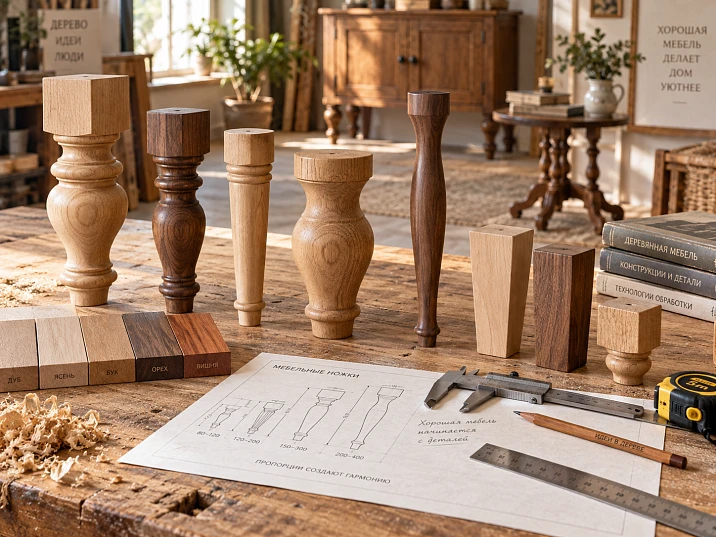
Two turned legs in a photo look almost identical: a cone, a pair of rings, a smooth base. But one is 100 mm tall and the other is 720. The first suits a bed or a dresser, the second a table. Swap them, and the furniture either won't stand or will end up with absurd proportions. That is exactly why you can't choose a turned leg from a picture: the turning profile reads to the eye, but the height and top dimensions don't.
A turned leg is defined not by the number of ornaments but by the profile turned around an axis: cylinders, necks, rings, spheres, cones and smooth transitions. It is chosen in this order: furniture type, overall height, leg height, profile, top section, material, finish, mounting, quantity, purchase. Below, this chain is broken down using real STAVROS models: MN-094 at 100 mm for a bed, MN-124 at 720 mm for a table, the ball-shaped MN-220, models with metal decor and others. What turned products are in general and whether it is worth buying ready-made turned parts instead of producing your own is covered in a separate article; here we are talking only about choosing a specific furniture leg.
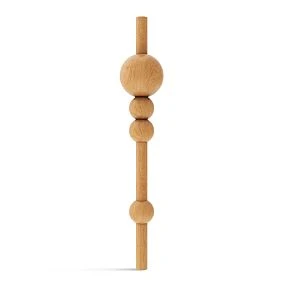
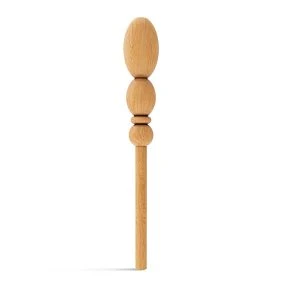
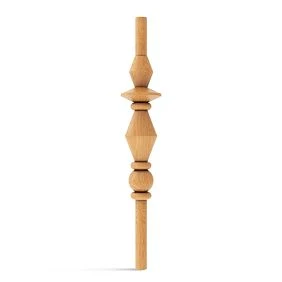
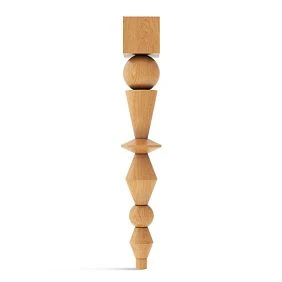
A turned leg: a shape built around an axis
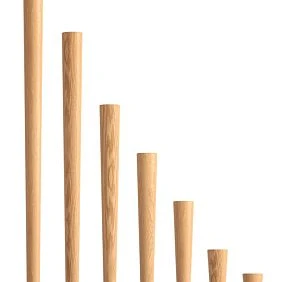
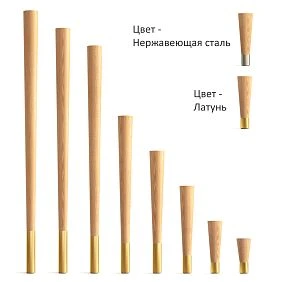
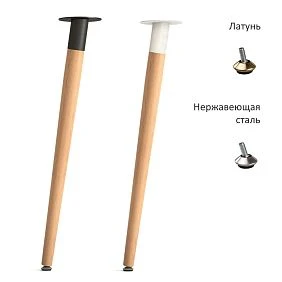
A turned product is born on a lathe: the blank rotates, the cutter removes material, and the cross-section is always a circle. The shape is created by cylinders, necks, rings, spheres, cones and the transitions between them. With a carved leg, the main thing is ornament and relief; with a geometric one, straight faces and edges; and with a turned one, it is precisely the turning profile.
This leads to practical characteristics. A turned leg is axially symmetric, so it has no front or back side, and during installation it does not need to be oriented to a pattern. It looks the same from all sides, and this makes it convenient for furniture that is walked around: tables, consoles, beds. The profile reads as a silhouette: even in half-light a person sees the rings and narrowings. Finally, a turned shape scales easily: the same design can be produced in several heights.




What's in the catalog
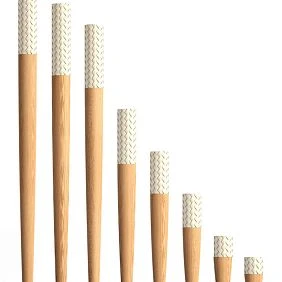
Section Turned Legs STAVROS shows legs with "from" prices: from 440 rubles (MN-222) and 540 rubles (MN-145) to 17,010 rubles (MN-124) and 17,450 rubles (MN-126). Here you also find modern legs MN-241, MN-237, MN-238 and the geometric MN-215; in this list the types overlap. According to the general description of the section, legs in the catalog range from 30 to 2100 mm in height and round supports from 20 to 100 mm in diameter. Prices and contents are as of the time of checking; before ordering, look at the product page.
Our factory also produces:
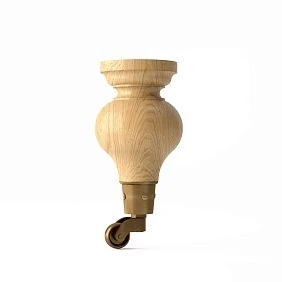
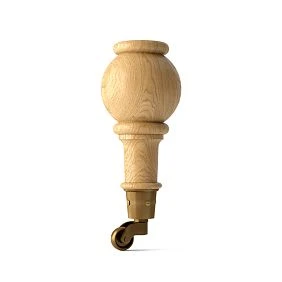
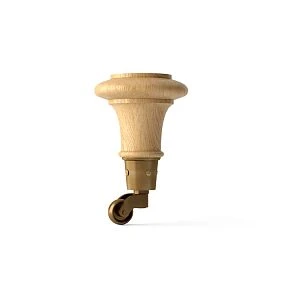
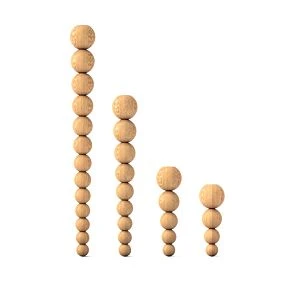
Difference from carved and geometric
A turned leg differs from carved leg the fact that its relief is created by rotation rather than by a cutter on the surface. A single leg can combine techniques: a turned body with carved inserts. Therefore, when choosing, look at the actual geometry of the specific product, not at the word in the name.
Get Consultation
Why you shouldn't choose a turned leg based on a photo alone
In a photo, two models may look similar. In a project, they differ in seven parameters: height, maximum diameter, top mounting part, bottom diameter, placement of the rings, profile massiveness, and mounting method.
The reason is that a photo compresses dimensions. There is no ruler next to the leg, the angle hides the top, and processing makes the tone lighter or darker. A leg 100 mm high and a leg 720 mm high occupy the same frame in catalog images.
The correct sequence is different: item code, actual dimensions, profile, fitting to the furniture. Open the product page, find the table “All dimensions and prices,” write down A, B, C, compare with the project, and only then look at the appearance.
Example from the catalog
According to the description on the product page, leg MN-094 has a height of 100 mm, a round shape, and a refined relief, while MN-124 has a height of 720 mm and tapers downward with several convex rings. Both are turned, both are made of oak or beech, but one is for a bed, dresser, and nightstand, while the other is for a table and console. Only the numbers allow you to distinguish them.
First the furniture type, then the leg height
The same turned shape can exist in several sizes, but the purpose changes. Let's break down the main groups.
Low furniture: beds, poufs, benches, low cabinets. Legs from 30 to 150 mm. They raise the body above the floor and determine the clearance.
Chest of drawers and cabinet furniture: legs are usually 100–250 mm. The height affects the clearance, and with it cleaning and appearance.
Upholstered furniture: sofa and armchair. The leg determines the seat height, so even a small difference in millimetres is noticeable.
Table: legs around 700–740 mm. The height is coordinated with the tabletop and chairs.
Console: the height is close to that of a table, but the depth is small, and the stability requirements are higher.
Tall stand: 1000 mm and more. The mounting joint becomes critical.
The main principle: the leg height is part of the overall height of the furniture. You cannot choose a “700 mm leg” without knowing the rest of the construction.
What to note down before choosing
For each item: furniture type, required final height, weight with load, construction (with or without an apron), number of supports, finish. These six points turn the choice into selection by parameters.
How to calculate the height of a turned leg
The formulas depend on the furniture.
-
Dresser: the body plus the leg equal the total height.
-
Table: the leg plus the tabletop plus the structural joint equal the total height.
-
Chair: the frame plus the soft pack plus the leg define the seating geometry.
-
Bed: the base plus the leg plus the mattress determine the height of the sleeping surface.
You cannot choose a nominal 700 mm without understanding the rest of the construction.
Numerical examples
Dresser: a 700 mm body and an MN-094 leg 100 mm high give 800 mm. Replacing it with MN-095 (height is stated in the product card) gives a different figure. Table: MN-124 720 mm high plus a 30 mm tabletop give about 750 mm. Bed: a 250 mm base plus a 100 mm leg plus a 200 mm mattress give a sleeping surface of about 550 mm. All numbers except the leg heights from the product cards are nominal.
Tolerance and glides
Set a tolerance for the total height, for example ±10 mm. Take into account the thickness of the glide or mounting plate. Recommended glides in the product cards: round FUR-021 (d=19 mm, 130 rubles), FUR-022 (d=30 mm, 170), felt FUR-027 (d=24 mm, 55) and FUR-028 (d=28 mm, 70). Check their thickness in the glide product card.
Turned legs for the table
This is where commercial demand is strongest: buyers search for "turned wooden table legs" and want a specific product code. For a table, check the height, whether there is an apron, the thickness of the tabletop, legroom, and the distance between the legs.
A height of 720 mm plus a 30 mm tabletop gives about 750 mm, which is close to the guidelines for dining and work tables. The general text of the table legs section names typical heights of 710–730 mm for dining tables and 700–720 mm for writing desks, but these are manufacturer guidelines, not standards.
Example MN-124
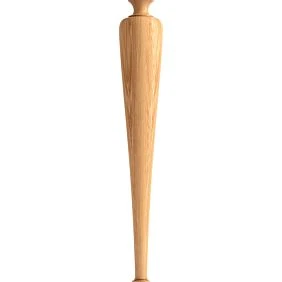
Leg MN-124 in the list it starts at 17,010 rubles. In its product page, its height is 720 mm, the shape tapers toward the bottom, the surface is divided by several convex rings, and the material is oak or beech. Recommended hardware: M8x60 stud (FUR-001-1, 72 rubles), square mounting plate (FUR-044, 490 rubles), FUR-012 set (152 rubles), FUR-021 and FUR-027 glides. A set of four legs costs at least 68,040 rubles.
Note the contradiction in the product page: in the title it is called turned, while the long promotional text below calls it carved, describing floral motifs and leaves. Judging by the list and the description of the shape (a rounded cone with rings), it is turned. Check with the manager whether there is relief carving on the surface.
For a table, remember: it is not "any tall turned leg suits a table," but a specific product code suits it after checking the height, the top cross-section, and the joint. The scheme "four legs or a ready-made base" is discussed in a separate article about table supports.
Turned legs for a console
A console requires a different check: height, shallow depth, stability, number of legs, wall mounting or freestanding construction. A tall narrow support is sensitive to lateral load, so the mounting joint is more important than for a chest of drawers.
MN-116
Leg MN-116 in the product page it is directly linked to the console. According to the previous check, its height is 720 mm, the shape is a round cone, the material is beech or oak, and the price in the related products block starts at 14,760 rubles. Recommended hardware: FUR-001-1, FUR-044 mounting plate, FUR-027 glide.
MN-029
Leg MN-029 it is listed among legs for a console table: in the console list it starts at 3,510 rubles. We did not open its product page for this article, so check the height and dimensions there.
The detailed selection of console legs by tabletop height is covered in a separate article about Console legs, so here we limit ourselves to a comparison: two turned models for a console can differ in price by more than four times, and it is the height and profile that decide, not the status.
Turned legs for a sofa and armchair
Here the height is much lower than that of a table or console, and it directly changes the seating position. The seat height is made up of the frame, the upholstered package and the leg, so a difference of 10–20 mm is noticeable.
MN-083 and MN-081
Legs MN-083 и MN-081 are listed in the product cards as legs for a sofa and armchair. Both are round and tapered, made of oak or beech, without painting. For MN-083, the description states a height of 100 mm. MN-081 in the related products block starts at 1,310 rubles. Recommended hardware: M8x60 stud (72 rubles), FUR-001 (117) and FUR-012 (152) sets, FUR-022 (170) and FUR-028 (70) glides.
A set of four MN-081 costs at least 5,240 rubles. For upholstered furniture, check not only the height but also the load: a sofa distributes weight across six or more supports, while an armchair uses four. A detailed seating calculation is covered in the material about Legs for chairs.
About the declared load
The manufacturer states a vertical load of at least 100 kg for all furniture legs. For certain shapes, the actual stability depends on the assembly, so check with the manager for the permissible load for your model.
Turned legs for a bed
For a bed, the base height, mattress, final sleeping height, position of the supports and frame construction are checked. A bed is heavier than any other item in the bedroom: the weight of the structure itself, the mattress and people.
MN-094
Leg MN-094 it is listed from 1,590 rubles. In the product card it is described as a turned bed leg, height 100 mm, round shape with a refined relief, material oak or beech, supplied unfinished. Fasteners are not included. Recommended hardware: M8x60 stud (72 rubles), FUR-001 (117) and FUR-012 (152) kits, FUR-022 (170) and FUR-028 (70) glides. The description also mentions other uses: dresser, nightstand, wardrobe, sofa. Nearby are offered MN-088 (from 1,690 rubles), MN-145 (from 540), and the geometric MN-146 (from 590).
A bed usually rests on four or more supports, and a heavy double bed structure may require a central support. A 100 mm leg gives a low seating height: a 250 mm base plus a 100 mm leg plus a 200 mm mattress give about 550 mm. The example is conditional.
Calculation for a bed
Four MN-094 legs cost at least 6,360 rubles, six legs 9,540 rubles. The figures are based on "from" prices; for a heavy bed, check the load and the number of supports.
Turned ball leg: the profile as the main accent
Sometimes the entire leg is a single profile element. The leg MN-220 it is listed from 1,670 rubles and, according to the description in the product card, is a spherical support about 105 mm high for poufs, low nightstands, and small cabinets, made of oak or beech without finishing. Recommended felt glide FUR-027 (55 rubles).
Its example shows three features of a spherical profile.
Visual mass. A ball is perceived as heavier than a cone of the same diameter because the entire volume is concentrated in one form. A small ball looks cozy, while a large one presses down on the body.
Difference from a long thin leg. A thin tall leg reads as a line, while a ball reads as volume. They solve different tasks: the line makes furniture lighter, while the ball gives it massiveness and stability.
The need to match the diameter with the cabinet. A 100 mm diameter sphere under a narrow 300 mm cabinet looks too massive, while under a 900 mm cabinet it looks proportionate.
Another feature: the sphere rests on the floor with a small contact area, so a foot pad or sliding pad is important for protecting the surface.
Thick or thin turned leg
Don't reduce the choice to height alone. Two legs of the same height can look completely different.
A more massive leg works with a heavy cabinet, a large tabletop, and classic furniture. It looks visually reliable and stable. A thin one gives visual lightness, more air, and a more elegant silhouette, but requires attention to strength and the joint.
Key parameter: the ratio of height to maximum cross-section. A 720 mm leg with a maximum diameter of 60 mm has a ratio of 12:1 and looks slender. The same height at a diameter of 100 mm gives 7.2:1 and looks massive. The values are approximate and illustrate the principle.
How to choose
Assess the mass of the cabinet or tabletop. Heavy furniture needs a leg with a reserve of cross-section, while light furniture can use a thin one. Assess the style: classics allow massive profiles, a modern interior allows thin ones. And check it on a 1:1 template, not by eye.
About the general range
According to the section description, the diameter of round legs in the catalog varies from 20 to 100 mm. This means that for one height you can find both thin and massive options. Look for them using filters A, B, and C.
Maximum diameter matters more than it seems
The leg may have a narrow upper part but a wide central collar. On the drawing, the furniture maker checks not only the mounting plate but also the maximum profile overhang, proximity to the apron, proximity to the front, and the distance between the legs.
Example. The upper plate of the leg is 40 mm, the maximum diameter at the collar is 70 mm. If the leg is positioned in the corner of the cabinet with a 20 mm offset from the outer edge, the axis is 40 mm from the edge, and a 70 mm diameter collar will extend 5 mm beyond the cabinet edge. On a drawing with a single axis this is not visible, but on the finished furniture the protrusion is noticeable.
Checking with a template
Draw the leg profile at full scale, front view and side view. Place it against the cabinet mockup. Check whether the maximum diameter extends beyond the edge, whether it touches neighboring elements, and whether the offsets are symmetrical. This is cheaper than redoing the cabinet.
What to look for in the product card
Part dimensions in the table "All dimensions and prices": A, B, C or diameters. The product drawing, if available. The mounting method in the recommended hardware. Verify against the project, not the picture.
Turned legs with metal decor
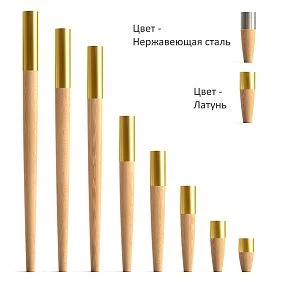
This is a separate product subgroup. The list includes legs with metal decor: MN-199 (from 2,750 rubles) and MN-200 (from 2,170 rubles), as well as legs with decor MN-148 (from 1,350) and MN-149 (from 1,470), and a leg with polyurethane decor MN-152 (from 2,160). Link to MN-149 in your plan it is called a leg with metal decor, but in the list it appears as a "turned leg with decor" without specifying metal, so check the insert material in the product card. MN-200 in the list it is directly called a leg with metal decor. We have not opened the product cards for these models, so check the dimensions yourself.
The metal accent is already part of the design of the item, so the rest of the furniture decor must take this material into account. A brass insert on the leg next to black handles and chrome hinges looks random. Coordinate the color and sheen of the metal with the rest of the hardware.
There is also a practical advantage. The metal on the lower edge protects the wood from abrasion and adds stability. But it also adds height and can affect the final size, so check the height taking the insert into account.
Turned or carved leg: what's the practical difference
Turned: the key is the rotational profile. Carved: the key is ornament and relief. A single leg can combine techniques, but to choose, the furniture maker looks at the actual geometry of the specific item.
| Sign | Turned | Carved |
|---|---|---|
| Basis of the shape | Rotation around an axis | Relief, curve, ornament |
| Cross-section | Round | Other |
| Orientation during installation | Usually not critical | Important |
| Price | Wide range, some inexpensive options available | As a rule, higher |
| Light | Transitions cast a shadow along the entire height | The relief depends on the lighting |
| Suitable | Classic, neoclassic, contemporary | Pronounced classic decor |
More about carved legs is described in the section carved legs. Prices for carved legs in the catalog start from 1,940 rubles, while turned ones start from 440. This means the turned shape is often more economical.
How to choose
If the furniture needs a calm silhouette and a light price, choose turned. If you need pronounced decor, choose carved. If in doubt, compare templates of both on the layout.
Beech or oak for a turned leg
Briefly, so as not to repeat a separate material. Beech is a dense, non-porous wood that the manufacturer most often calls the most used in products under enamel. It is often rational under enamel, an opaque coating, and a calm, even finish. For a turned leg under enamel, beech gives clear shadows at the transitions, and the pores do not interfere.
Oak is a dense, porous wood with a pronounced texture, often used with a semi-transparent coating. It is chosen when an open texture is needed: oil, clear lacquer, tinting. On the convex areas of a turned leg, the fibers form arcs that create an additional pattern.
Glue-up grade and sanding
For opaque finishing, choose "enamel"; for semi-transparent, choose "tinting". The "Standard" level is machine sanding, "Prestige" is detailed hand sanding, after which the products require no additional work. For turned shapes with a complex profile, "Prestige" saves time on finishing the transitions.
About the price
The price difference between oak and beech depends on the model: see the size chart in the product card. Do not choose oak for enamel if the texture will be hidden anyway.
Unpainted turned legs as a production semi-finished product
This is important for a workshop: the geometry is already ready, and you can apply your own finish. Enamel, stain, oil, lacquer, patina — it all depends on the project. Section Unpainted legs contains the main part of the catalog.
The manufacturer provides the sequence for lacquer and enamel: dust removal after sanding, even priming, matting after the primer dries, and a two-coat topcoat with intercoat drying. For a turned leg, add a practical tip: paint it suspended by the end on a wire so you can cover the entire surface in one go, and dry it without contact with a support.
Uniform tone
If the legs and the body are painted together, the shade comes out the same. But a turned leg and a flat facade absorb the material differently, so compare on a sample, not by the color name.
Who paints
The manufacturer paints products when ordering goods worth 150,000 rubles or more. For a single table or chest of drawers, this amount is unattainable, so plan your own finishing.
Leg with or without coating
Choose without coating when you need your own finish, the color must match the furniture, or the product is produced in a series. This is the main option for a workshop.
With coating is suitable if a matching ready-made finish is found and a ready-made component is needed. Section legs with a ready-made finish saves time but limits the choice of color. For example, the MN-145.2 leg has a version with the MN-145.2M coating.
How to decide
If you have your own color and finishing system, choose unfinished ones. If you need one or two legs and a separate finish does not pay off, choose coated ones. For series, always choose unfinished: one system for the entire batch.
Timeline
Most products are stored in the warehouse unpolished; shipping from the warehouse takes up to three business days. If the item is not in stock, the production time is 5–10 business days. Plan so that the legs arrive before final assembly.
Why one sample is more useful than ordering four blindly
The correct production path: item code, sample, fitting, finish, approval, set. Skipping any step turns the order into an experiment.
Check six things on the sample: the actual height, the maximum diameter, the top platform, the visual scale, the quality of sanding, and the result of staining. Place the sample under the furniture mockup and assess the proportion from three meters away. Make a trial finish and compare it with the cabinet in daylight.
The price of a sample is low for simple models: MN-145 from 540 rubles, MN-094 from 1,590. For expensive ones, it is noticeable: MN-124 from 17,010 rubles. But a mistake in a series of ten tables with four MN-124 legs would cost at least 680,400 rubles.
Conditions
The catalog ships all items from one piece, so you can take a sample without any obligation for a production run. Keep the timelines in mind and allow for the sample in advance.
What to keep
The sample with the tag, photos, a record of the finish, and the inspection result. This is the batch reference and the basis for a repeat order.
Orientation of four turned legs
For an axisymmetric purely turned leg, the orientation around its own axis is usually less critical than for a cabriole or an asymmetric carved part. You can rotate the leg to any angle, and the appearance will not change.
But there are exceptions. If the leg has a metal insert, additional decor, or an asymmetric mounting part, the orientation must be checked against the specific SKU. For example, a leg with a square mounting plate should be positioned so that the plate is parallel to the edges of the cabinet, otherwise the rotation is noticeable. For legs with a grain pattern (oak under a clear finish), it makes sense to arrange the four legs so that the pattern reads consistently.
Practical advice
Lay out the four legs and look at the grain pattern and machining marks. Mark them on the hidden side. For a series, establish a single orientation rule and record it in the process sheet.
How to specify a turned leg in the specification
The entry "wooden leg, 4 pcs." is useless. You need an entry that allows the order to be repeated: code, manufacturer, SKU, material, finish, quantity.
Example: LEG-01, STAVROS, MN-124, oak, unfinished, 4 pcs. If the front and rear supports are different, specify them separately: LEG-F and LEG-R.
| Code | Article | Material | Finish | Quantity |
|---|---|---|---|---|
| LEG-01 | MN-094 | Beech | Enamel | 4 |
| LEG-02 | MN-124 | Oak | Oil | 4 |
What to add
Dimensions from the table, gluing grade, sanding level, finish system, hardware, status (SAMPLE or APPROVED), revision, inspection date.
Series calculation
Ten chests of drawers on four MN-095 legs (from 1,660 rubles) require 40 legs, that is, at least 66,400 rubles. Ten beds on six MN-094 legs will require 60 legs and at least 95,400 rubles. Hardware: a hanger bolt (72 rubles) and a glide (55) give 127 rubles per leg. The prices are "from" prices at the time of checking; actual prices depend on size, species, and sanding. Determine the reserve based on risk and record it as a separate line.
Where to buy turned furniture legs
Main product point: section Turned Legs. Additionally:
-
Wooden furniture legs: general catalog of supports.
-
Unpainted legs: for your own finishing.
-
legs with a ready-made finish: for ready-made solutions.
Order conditions
Items are shipped from a single piece. Delivery is available across Russia and to CIS countries via CDEK and DPD; pickup is also possible. Showrooms in Saint Petersburg and Moscow, production in Saint Petersburg. Cutting items to size is not performed. Custom items and required sizes are made only for bulk orders. Before ordering, the manufacturer recommends preparing a design project: drawings can be downloaded on the website. Check the current price and availability in the product card.
What to clarify with the manager
Availability of the complete set in one delivery, exact dimensions and maximum diameter, fastener kit, permissible load for tall models, insert material for decorative legs.
Craftsmen's questions
What types of turned furniture legs are there?
Cylindrical, conical, spherical, with rollers and necks, with metal or polyurethane decor. In height from short (about 100 mm for MN-094) to table (720 mm for MN-124).
Where to buy turned wooden legs?
In the section Turned Legs of the STAVROS catalog. Ordering is possible from a single unit.
How to choose the height of a turned furniture leg?
Calculate from the final height of the furniture: for a chest of drawers, the body plus the leg; for a table, the leg plus the tabletop plus the joint; for an armchair, the frame plus the upholstered pack plus the leg. Set a tolerance and select models within the range.
Which turned legs are suitable for a table?
About 700–740 mm high, for example MN-124 at 720 mm. Check the tabletop, apron, legroom, and distance between the legs.
Which models are suitable for a console?
The console table product cards list MN-116 and MN-029. For a narrow tall console, check stability and the mounting point.
Can turned legs be used for a sofa and an armchair?
Yes, the product cards for MN-081 and MN-083 state they are suitable for a sofa and an armchair. Check the seat height, mounting plate, and load.
How does a turned leg differ from a carved one?
A turned leg is defined by its rotational profile and round cross-section, while a carved one is defined by relief and ornament. Carved legs are usually more expensive and require orientation during installation.
What to choose: beech or oak?
Beech is for enamel and a calm, even finish; oak is for oil, lacquer, and tinting with visible grain. Choose the glue-up grade to match the finish.
Can unfinished turned legs be painted?
Yes, that is what they are intended for. The sequence: dust removal, primer, sanding, two finish coats with drying between coats.
Should I order one leg as a sample before ordering a set?
For a new SKU, yes. A sample verifies the height, diameter, top, and finish. For a proven SKU, a sample is not needed.
Prices, the composition of the turned leg section, the specifications of MN-124 and MN-094, recommended hardware, glue-up grades, sanding levels, finishing sequence, and ordering terms were verified against the STAVROS catalog at the time of preparation. Data for MN-116, MN-083, MN-081, and MN-220 were taken from previous checks of their product pages. Calculations are illustrative.